february 2026
Editorial
Dear Friends,
During the Age of Sail in the nineteenth century, many mariners voyaged the seas and returned with rich cargoes, but some ships never returned. Jeff Ward brings to us the story of the family of Captain Lemuel Lockhart whose ocean voyages were beset by tragedies that affected his family, one member in particular. In many ways, it is difficult to absorb the numerous tragedies that were faced by this family over time. Hang on tight as you read Jeff’s detailed account!
This story is followed by a special memory of Al Smith’s that touched me in surprising ways. I first came to Sackville as a Mount Allison University freshman on 10 September, 1969. At that time, The Kennel Club was a very student-friendly restaurant in town (i.e. very affordable). A “Burger and Fries” at The Kennel Club was sometimes followed by a great milkshake at Mel’s. For young freshmen at that significant time in our lives (first time independent and away from home), those days were very special and The Kennel Club was a popular hangout. I am aware that for some readers, this local restaurant several decades ago is unknown territory. But for numerous alumni (I was in the Mount A Class of ’73), it brings back some unique memories. For a number of us, the text and associated photos of The Kennel Club take us back to those very special times.
Furthermore, twenty-seven years after my arrival at Mount Allison and a thirty-year career with The Canadian Wildlife Service, Environment Canada, in Sackville, I was very pleased to celebrate the incorporation of The Tantramar Heritage Trust and become one of its founding members. This year we celebrate the thirtieth anniversary of this incorporation. For his second contribution to this issue of your newsletter, Al Smith summarizes the activities of the Trust in its first year, thirty years ago. It is important to read this as the beginning of what would become a very successful thirty-year period for the Tantramar Heritage Trust in Sackville (or so we like to think!).
To complete this newsletter, I have added copies of a letter and an email connected with Christian Corbet’s article on Broadmoor Manor in Sackville in The White Fence No. 115, particularly on the topic of a bomb shelter in the house. I need not say any more; the two communications speak for themselves.
Enjoy!
—Peter Hicklin
Heroism and Tragedy
Captain Lemuel Lockhart and His Family
by Jeff Ward
Introduction
This is the story of a Tantramar family that bridges two centuries – the late nineteenth and early twentieth. At its narrowest it is about a single family touched by repeated tragedies and one member of that family in particular and the sadness that must have permeated her life prior to her own tragic, yet heroic, demise. At its broadest, it is about transportation and our transition from the age of sail and steam to the age of the motorcar. It takes place at that period in time when motor travel was in its infancy, when driving was terribly unsafe, and when we left the constant and tragic realities of death at sea for those of death on the road.
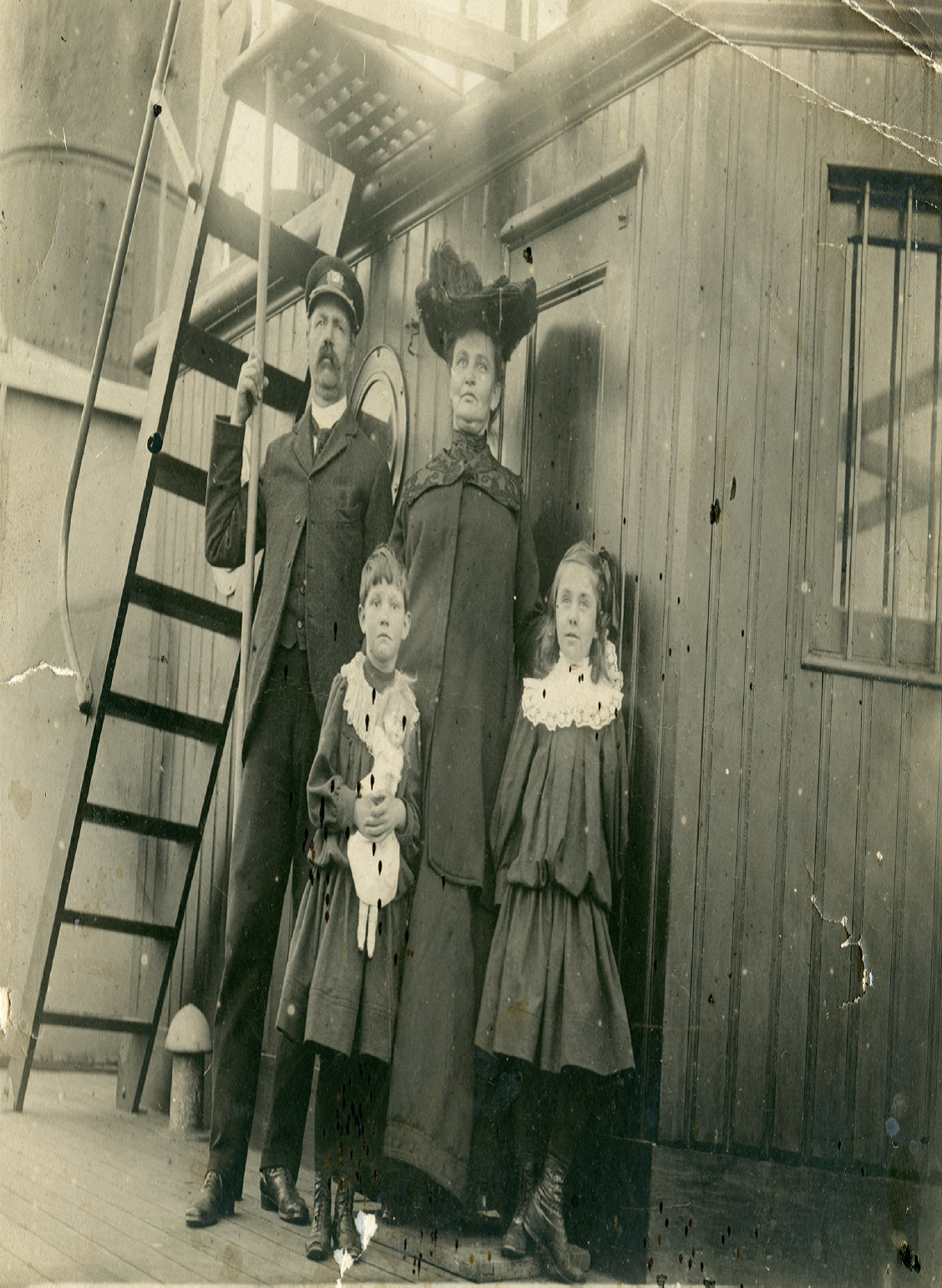
Photo (circa 1905) showing Lemuel and Florence and their two youngest children, Eleanor and Nan.
Captain Lockhart and the Age of Steam
The patriarch of the family was Lemuel Lockhart, born in Rockport in 1853. He went to sea at age fourteen, sailing out of Saint John. According to his florid obituary in the Ottawa Journal, he was “not content to remain for long a hand before the mast. By close observation and study beneath the rays of swinging oil lamps in many a dinghy, Lockhart mastered the intricacies of navigation, and in his early twenties was rated a master mariner competent to take full command of ships propelled by wind or steam.”1 He worked for the Hickman interests of Dorchester and at the time of his wedding to Florence Mitton of Cherry Burton on 17 February 1880, he commanded the barque Thomas Keillor.2
He claimed to have been shipwrecked on several occasions while a crew member but never once after he took command of a vessel himself. His wife sometimes accompanied her husband on his voyages and he sailed twice around the world. Though his home port was Saint John, he lived in Dorchester until 1925. Florence gave birth to seven children in Dorchester between 1891 and 1899. Their oldest child, Winthrop, died by drowning at Bayshore (Saint John) in 1900.
Children:
i. Winthrop H., 1881-1900
ii. Mary Elizabeth, 1883-1977
iii. Myna Pearl, 1889-1978
iv. Florence Alma 1894-1939
v. John William 1895-1972
vi. Eleanor 1897-1926
vii. Annie (Nan) 1899-1981
Unlike many master mariners who earned their ticket in the age of sail, Lockhart successfully transitioned to the age of steam. He became associated with Thomson & Sons, the only steamship company to be based in Saint John known for its fleet of tramp steamers known as the “Battle Line,” named for famous Greek battles. The fleet eventually numbered 14, including the Albuera, built in Scotland in 1902 and named after a battle in the Peninsular War of 1811. This was the steamship helmed by Lockhart. His obituary continues, “One of Captain Lockhart’s most thrilling experiences was his carrying of cargoes of rails to the Russian government during the Russo Japanese War (1904-05). On several occasions he narrowly escaped capture but always managed to bring his much needed freight into port.”
It seems he was safer at sea than on land: “It developed today” said a 1907 news report “that Capt. Lemuel Lockhart, master of the British steamship Albuera is confined to St. Vincent’s Hospital (Norfolk VA) suffering from injuries received at the hands of an unknown highwayman while en route from the Jamestown exposition grounds to his ship which was coaling at the Lambert’s Point piers. Captain Lockhart was assaulted on the head, robbed of his gold watch and cash, and left for dead. His ship was compelled to sail for Hamburg without him. The assault occurred the night of July 4. There is no clue to the assailant.”3
In 1925 Lockhart retired while the Albuera remained in service until 1929. He and his wife moved to Ottawa where a daughter, Mary Elizabeth, lived with her husband Cecil Henry Fatt, an administrator for the national penitentiary service. Captain Lockhart died in Montreal in January 1930 while on a visit there with another daughter, Florence.
Florence Lockhart and the Age of the Automobile
Weeks before his death, around Christmas 1929, Captain Lockhart and his wife travelled to Montreal to stay with the third of their five daughters, Florence. It could not have been a happy Christmas. Her husband and daughter both died earlier in the year on the same day. What made his death on 28 February, 1929, particularly Page 3 tragic was the means and consequences. Her husband was Philip W.K. Robertson, a McGill- educated mining engineer who in 1900 had been awarded a Dawson fellowship in metallurgy.4 Years before he met Florence, he had worked at a copper mine in Globe, Arizona, and was married to a Jewish socialite there named Minnie Drachman, born in 1884.
At that time, in 1916, cars were comparatively expensive and road infrastructure was often poorly built and maintained, still used mainly by slow-going horses and wagons. Safety features such as seatbelts had not been invented and roadside crash protection was virtually non-existent. According to the Drachman genealogist, Roy Drachman, Minnie Drachman Robertson had been previously married and divorced. “She was a ‘gadabout’ and a socialite in the mining camps,” he wrote, “living in both Mexico and Arizona.” Philip was away and she was driving with friends near Globe on April 26, 1916, when the car “went over a cliff on a narrow road near Inspiration Mine …many (were) hurt in the touring car but she was the only one to die.” She was 32.
Likely despondent, soon after her death Robertson gave up his job and returned to Montreal. The Great War had already begun and he enlisted for active service. He was shipped overseas but if he expected to see action on the front, he was disappointed. His skills as an engineer were immediately recognized and he entered the Canadian Engineering Corps, serving in a behind-the-front capacity. In December 1917, he transferred as a temporary Lieutenant to the Canadian Forestry Corps.5
After returning home from the war, Robertson met Florence Lockhart who had moved to Montreal to work as a nurse. They were married in 1923 and came to Dorchester for the wedding. They had a son, Kenneth, born in 1923 and a daughter, Phyllis, born in 1926.
It is impossible to know today what prompted his suicide but it is not unlikely that the violent and premature demise of his first wife rested heavily on his mind. And thus, did the tragic event in Arizona 14 years earlier revisit itself in Montreal?
The family lived in the luxurious Bishop Court Apartments at 1445 Bishop Street in Montreal, an elaborate Neo-Tudor sandstone building built in 1904 with an interior courtyard and parking garage under the apartment. He was planning a road trip but his car had not been running all winter so on 28 February 1929, he came home from work early and started his car to make sure it was running properly. In the poorly-ventilated garage, he succumbed to carbon monoxide poisoning.Tragedy was compounded when the gas travelled up into the dwelling, killing six-year old Phyllis and asphyxiating Mrs. Robertson, three-year old Kenneth and the maid. Though the latter three were in critical condition when found, they survived.6
Ten months later when Capt. and Mrs. Lockhart visited, it must have been a very sad Christmas. The season was made even more difficult by Lemuel’s own death later in January. But this family’s legacy of tragic and violent death was not over. A few years later, her sister Eleanor met a violent death in western Canada and in 1938 her mother died in a car crash in Montreal.
On the eve of World War II, Florence was vacationing in Arundel, Quebec. The Ottawa Journal (July 10, 1939) tells the tale: “William J. Babe, St. Thomas, Ont. railways man, and Mrs. Florence Robertson, of Montreal, were drowned today in Bevan Lake at this Laurentian resort north of Montreal. Mrs. Robertson, a nurse, was drowned when she went to Babe’s rescue. Both bodies were recovered within 10 minutes but artificial respiration proved unsuccessful. At a subsequent inquest conducted by Dr. J. N. Mason, of La Chute, district coroner, a verdict of accidental death was returned.”
The following day The Ottawa Journal summarized the family tragedy: “[The] drowning of Mrs. Florence Robertson at Arundel, Que., Saturday, raises to six the number of persons in her family who met violent deaths over a period of years. She died in an unsuccessful attempt to save the life of William J. Babe, 67, of St. Thomas, Ont. Her husband, Philip Robertson, and their young daughter died 10 years ago from asphyxiation by carbon monoxide gas. She and her son were rescued. Winthrop Lockhart, a brother, drowned when he was a schoolboy. Her sister met a violent death in Saskatoon and her mother died last year in an automobile accident in Montreal. Mrs. Robertson, formerly Alma Lockhart, was born at Dorchester, N.B. She graduated from the Provincial Normal School here and the Royal Victoria Hospital at Montreal. Before returning to Montreal ten years ago she served on the staff of the Soldiers’ Memorial Hospital at Campbellton, NB. Survivors include a brother, William J. Lockhart, Moncton, N.B., and a sister, Mrs. H. C. Fatt, Ottawa.”7
Footnotes
1. Ottawa Journal, Ottawa ON, January 8, 1930
2. Saint John Globe, Saint John NB, February 20, 1880
3. Evening Star, Washington, DC, July 9, 1907
4. Science Weekly Journal, July 13, 1900, p. 80
5. Supplement to the London Gazette, London UK, March 22, 1918, p. 3581
6. Montreal Star, March 1, 1929, p. 3
7. Ottawa Journal, Ottawa ON, July 11, 1939
2026 Memberships
A big thank you to everyone who has already paid their 2026 THT membership!
If you haven’t already done so, here’s a reminder to renew now.
Your membership gives you free admission to our museums, research centre, and archives, a vote at our Annual General Meeting and copies of The White Fence sent directly to you by email or by post. Plus you get the satisfaction of knowing you’re playing an important role in preserving the heritage of the Tantramar region.
The cost is: $20 for individuals, $30 for families/ businesses, and $5 for students. Visit our website, www.tantramarheritage.ca to join and pay your membership dues online. You can send an e-transfer for the payment and email Karen to let her know you’ve done so, with any changes to your contact information. You can also print and mail the form with a cheque or credit car number or drop by the Boultenhouse Heritage Centre in Sackville.
Do you know someone interested in local history? A membership can make a great gift, so please consider purchasing one for someone else.
Not sure if you’ve already renewed? Contact Karen at (506) 536-2541 or tantramarheritage@gmail.com to find out.
Thank you for your support!
The Kennel Club Restaurant
by Al Smith
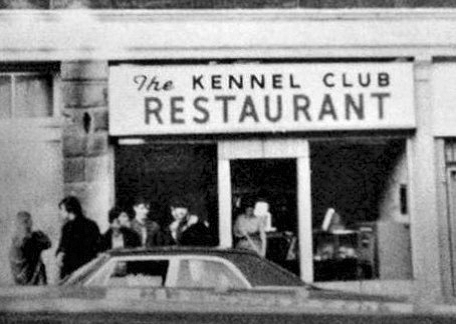
Early 1970s-era photo provided by Colin MacKinnon.
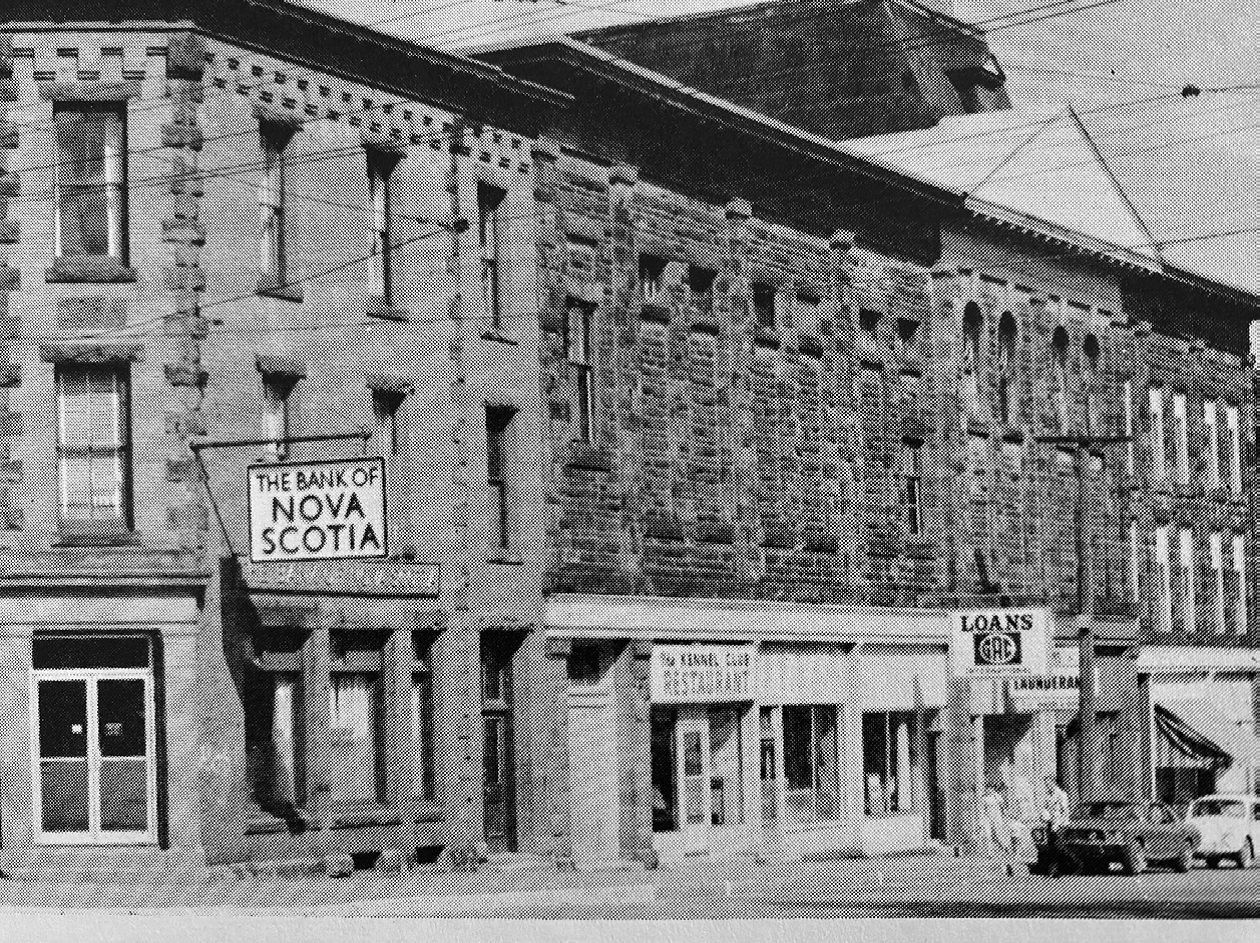
East side of Bridge St., 1967, photo by the Clares, This is Sackville by W.W. Sears and D. McKay.
Long gone now, but in my youth, The Kennel Club restaurant on Bridge Street was a go-to spot. Located in the Wood Block, in the current location of Ducky’s Pub, it was a classic little diner and most definitely a very nostalgic spot in Sackville’s restaurant history. Recently, my wife Elaine received a Facebook post from one of her Mount Allison 1968 classmates that had a 1960s-era menu for The Kennel Club which prompted this brief article.
It was a spot where students from the Sackville High School would “hang out” after school and maybe order a small fries with a cherry coke. The Coca-Cola Company did not officially have a “cherry coke” product until 1985; however, diners like The Kennel Club had been making it for years simply by adding cherry-flavored syrup to Coca-Cola. The drink was quite popular with younger patrons.
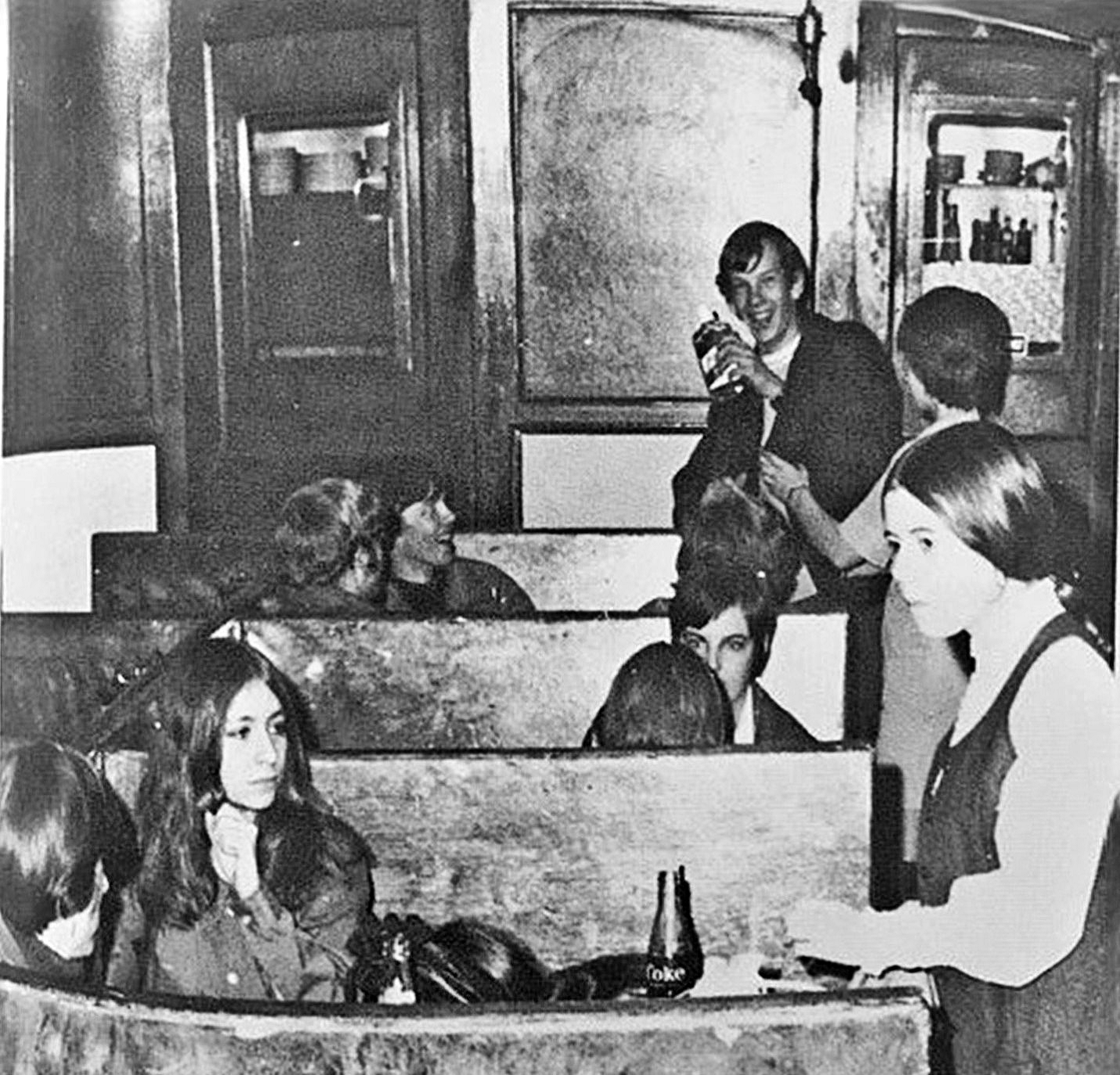
This photo shows and interior view of The Kennel Club that was posted recently on Facebook. It is from a 1971 Sackville High School yearbook. Logan Atkinson was able to identify some of the people in the photo: “Standing in the back is Jim Hazlehurst. That’s Logan looking up at him and one his left is Roger Snowdon. The girl standing on the right foreground is Brenda (Leger) Long, I’m almost certain. The waitress at the back next to Jim is Margie Kay, I think.”
Take a look at the “Kennel Club” menu below and remember this was from the latter half of the 1960s. A chicken burger was 35¢, a hamburger 25¢, lobster roll 60¢, and fish & chips 60¢. A small fries and Cherry Coke would have cost 40¢.
According to a recent Facebook post by Betty Harper, the restaurant was owned by Hester and Ellsworth Mitton in the 1950s and possibly into the 1960s when it was purchased by Harry (Junior) Tingley and his wife Evelyn who operated it through the 1970s. The restaurant was later sold and the name changed to Riviera and which operated by that name for a few years.
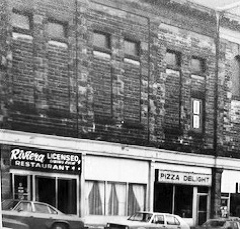
Location of the Riviera restaurant on Bridge St., Sackville, NB.
The Kennel Club restaurant was a classic old-style diner serving inexpensive meals, great milkshakes and wonderful hot fudge sundaes. It has been gone from Sackville for close to fifty years but its legacy fondly lives on in the memories of older Sackville residents and Mount Allison alumni.
The Trust’s First Year
by Al Smith
Early this fall, the Tantramar Heritage Trust (THT) will achieve a significant milestone: our 30th Anniversary. Incorporated on September 9, 1996, as a non-profit charitable organization, the first board meeting was held on October 6, 1996, electing an executive and a board of ten directors, plus approving the draft by-laws. Also approved at that inaugural Board meeting was the Trust’s first Mission/Purpose Statement:
The Tantramar Heritage Trust is a non-profit, charitable organization that promotes preservation of the region’s heritage resources. The Trust will facilitate the development of a heritage preservation program, focusing on: education and awareness; development of a museum facility; displays, pamphlets, and publications; identification of historic sites; placement of plaques and cairns; and other programs.
So, as we approach this 30-year milestone, let’s take a look back at what was accomplished in the Trust’s first full year, September 1996 to October 1997:
• Letters Patent issued September 9, 1996, establishing the Tantramar Heritage Trust Inc.
• Founding meeting October 9, 1996.
• The Trust’s lawyer Nick Rodger forwarded a package of documents in mid-October, 1996, to Revenue Canada seeking approval for non-profit charitable status. We had earlier screened our draft by-laws and mission statement by Revenue Canada prior to applying for incorporation, so were pretty confident we would get non-profit charitable status.
• The Tantramar Historical Society, an education/outreach arm of the Trust was established. Chaired by Paul Bogaard, the first session was held on November 27, 1996.
• At a December 4th Board meeting, a motion was adopted to pursue the acquisition of the Campbell Carriage Factory property with the objective of creating Sackville’s first museum.
First THT Board of Directors
(1996-1997)
Al Smith – President & Planning
Colin MacKinnon – Vice President & Projects
Steve Ridlington – Secretary
Phyllis Stopps – Treasurer
Paul Bogaard – Historical Society
Dave Fullerton – Fundraising
Karen Trueman – Membership
Peter Hicklin – Newsletter
Rhianna Edwards – Artifacts
Tim Morice – Projects
• Adoption of a logo for the Trust and production of a brochure, letterhead, and envelopes was approved by the Board on December 4, 1996.
• Prior to the end of 1996, the Trust launched its first financial campaign.
• Executive members of the Board met in mid-December with Barb and Will Campbell seeking a donation to the Trust of the Carriage Factory property. It was agreed that a formal proposal from the Trust would be submitted to the owners.
• Work descriptions for each of the THT committees were drafted.
• January 1997 – Revenue Canada advised that the non-profit charitable status was approved and we received a registration number effective back to the date of incorporation (September 9, 1996).
• Edited by Board member Peter Hicklin, the Trust mailed out its first issue of The White Fence newsletter in January 1997. Peter continues as editor of our popular newsletter and, as you can see, the one that you are now reading is number 116.
• A formal proposal to the Campbell family to acquire the Carriage Factory property was submitted on January 15, 1997.
• The Trust’s first Heritage Week event on February 16, 1997 was most successful. Our very first breakfast event held at TRHS attracted 300 people, which along with heritage displays and an Antiques Road Show (Peter Seitl appraised 71 items that members brought in) was hugely popular. The afternoon lecture series in conjunction with Westmorland Historical Society attracted 125 attendees. The annual Heritage Day breakfast event, held at the High School continued until 2017.
• A policy procedure for the disposition of archival materials donated to the Trust by members of the public was approved.
• The Trust co-sponsored with the Heritage Branch a submission to the Environmental Trust Fund for a project on a Heritage Building Register for Tantramar.
• Co-hosted with the Heritage Branch a Provincial meeting of Heritage Trusts held in Sackville on April 11, 1997.
• A Publications Committee was established in the spring of 1997 which was led by Pat Finney and Leslie Van Patter and included Peter Hicklin. Peter suggested that a number of Tantramar residents be interviewed for potential future stories for the The White Fence newsletter. One of those interviewed was Dick McLeod of Westcock. His wealth of knowledge on the horse era of Sackville was soon assembled into a 36-page booklet edited by Pat Finney that became the Trust’s first publication which was launched in November, 1997.
• First Annual General Meeting (AGM) held on May 20, 1997, at the Lions Club building on Dufferin Street. Twenty seven members attended that first AGM at which time the THT Board was expanded to 11 Directors.
• August 6, 1997 the Trust launched its first website homepage via the Tantramar Access project (TAP).
• The THT Board agreed to be the official host of Yorkshire 2000, planned to be a major gathering of descendants of Yorkshire Settlers to occur in the first week of August in the year 2000. A Local Arrangements Committee was to be established and chaired by Al Smith.
The Trust’s first full year was a busy and productive one. The Board was very encouraged by first year membership numbers (125), and by an excellent reception in the news media. Clearly there was high local interest in heritage preservation and much work ahead, but none of us could have imagined that by our 10th year (2006) we would own and be operating two outstanding museums.

Broadmoor Manor: A Clarification
In newsletter no. 115, author Christian Corbet presented us with information about a historical home in Sackville with an article entitled Broadmoor Manor Part 1. In this article, Christian described the presence of a room described as a “bomb shelter.” Following the mailout of this newsletter, on 23 November we received a note from Larry Black who was born in this house and commented on the “bomb shelter.” I forwarded Larry’s note to Christian. Below, I have included both the letter and email received from Larry and Christian, respectively, which help to clarify the background associated with the presence of this mysterious room in this lovely historical home on Main Street, Sackville. First is Larry Black’s note sent to the Tantramar Heritage Trust received last November and Christian’s email response sent to me.
—Peter Hicklin
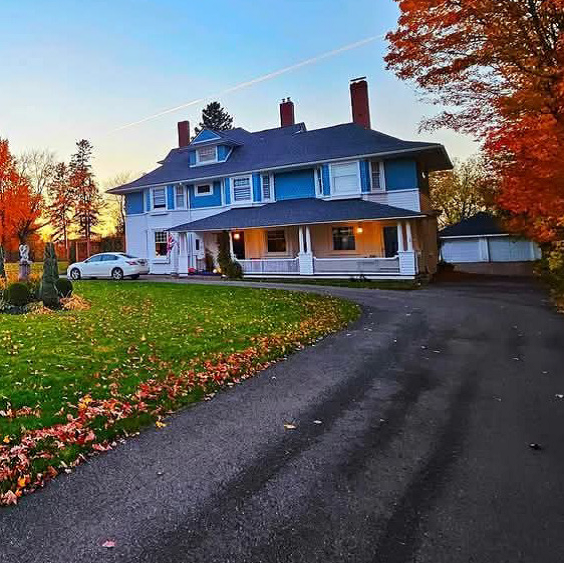
Broadmoor Manor
Dear Mr. Corbet,
I was very interested in seeing The White Fence issue on Broadmoor Manor, built for J.W.S. (Jack) Black by his father Joseph L. after Jack joined the family business in 1901. My parents lived in that house after their marriage in 1935, and my brother was born in it in 1936 and I was born there the next year. We moved out in 1938 as my father tore down the old Joseph L. Black house across the then dirt road (Main Street now) and built the house that stands there now. Bob Black, Jack’s eldest son, moved back in to Broadmoor. I spent many, many hours with his sons in Broadmoor Manor over the years of our youth and teen age – though we had no idea it was called that.
I recall a cold storage room; we all had them to store vegetables and apples in over the winter; and also a coal bin room; but never heard them referred to as a ‘bomb shelter.’
These houses were in what was then called Middle Sackville, in many ways quite a separate entity from Sackville.
The house was featured on postcards in the 1920s. I have several.
Incidentally, Edmund Burke was also the architect for Braeburn, the large house on York Street first built for the painter John Hammond. My grandfather purchased the house in 1912, and it stayed in the family until the late 1950s, but is now owned by Mount Allison. Burke married my Great Aunt Minnie. They moved to Toronto and then to Winnipeg.
Cheers,
Larry Black
Peter,
Most interesting.
Original blueprints 1912 cite the one bomb shelter. The second bomb shelter was made during the Cold War for Mr. Alcorn.
Cold cellar was situated below kitchen now a workshop.
Original blueprints going to CCA. Not keeping local for obvious reasons.
Knew all the information Mr. Black kindly submitted otherwise.
Xn
Most Sincerely,
Christian Corbet, PPCPA, FRSA.
Sc. – Royal Canadian Navy Reg.
Sc. – The Royal Canadian Regiment
Forensic Sc. – Western University


