The White Fence, issue #3

October, 1997

Editorial

Another fascinating year of exploration into the rich history of Tantramar lies before us and many stories are yet to be told at the white fence! In this episode of our newsletter, we enter Part II of Dick McLeod’s fascination with the horses of Tantramar and read further into Nathaniel Smith’s letter from Fort Lawrence to his brother in Yorkshire in 1774. But I am especially pleased to introduce you to the late F.A. Fisher’s model farm in Frosty Hollow, a farm based on a book by Louis Bromfield and established by Mr. Fisher to fulfill his fascination and love of agriculture. And we also have some interesting developments on one of our very special heritage projects which Al will tell you all about. Overall, the horse, the main source of transportation and power in the older days of Tantramar, is featured in this issue.

But also, I am most pleased to introduce you to a new section of this newsletter: the Heritage Properties Series. There are many fascinating heritage homes in the Tantramar area, some of which still stand and others we’ve just heard about. Our first property of this series will be the building we all know as the “Marshlands Inn” in Sackville. But I want to stress that I want to include many heritage properties from accross the Tantramar area, not just properties in Sackville. So my friends, if you know of, or live in, a home of historical interest to our readers, within our Tantramar area (Dorchester to Sackville to Rockport to Jolicure and so on…), please get in touch with me and we can get the ‘heritage properties’ pot cooking!!

—Peter Hicklin

To begin this issue of The White Fence, I wish to thank Mrs. Barbara Fisher who responded to my request for information in our last newsletter and submitted a most interesting story about F.A. Fisher’s “model farm” in Frosty Hollow. This fits in very well with the idea of starting a new focus on special properties in our area for this newsletter. So here’s my summary of Barbara’s interesting story about her husband’s uncle Frederick Arnold Fisher (1880–1957) who obviously shared Dick McLeod’s love of horses as well as farming.

The Fisher Model Farm at Frosty Hollow

Around the time of World War I, F.A. Fisher (F.A. as he was then known by all) was president of the Enterprise Foundry and lived in the house now owned by Dr. Laing Ferguson on the corner of Main and Queens Road (formerly known as Boultenhouse Road) in Sackville. Around 1920, F.A. bought a 750 acre parcel of woodland in Frosty Hollow on which he built three houses and a barn. One house was to serve as a summer home for him and his family, which by then included five children, and a house for the manager of the farm and one for the hired hand. Today, this property is owned by Mr. Bob Kaye who purchased the property after Mr. Fisher died in 1957.

Mr. Fisher’s farm included a cattle barn with a silo, probably built by special design, as was the horse barn. The barn was constructed in the shape of an E without the middle bar. In other words, it consisted of one long building with two shorter ones at either end, one for the stallions and a forge and the other for the riding horses and brood mares. In the center of the long building was a large space for the hay wagons which were driven into in order to fill the hay mow overhead and for the stable manager to pull down the hay at feeding time.

The horses never had to be taken to the blacksmith, the latter simply arrived and fired up the forge in the stallion barn. The visiting farmer typically looked over the barn very slowly and usually said something to the effect: “Well, it’s a fine lookin’ buildin’ but a hell of a lookin’ barn!”

F.A.’s crop production was usually far in excess of that of farmers using traditional methods of the day and that was a source of great wonderment in the farming community. For one thing, F.A.’s methods included an early form of organic farming; every bit of organic waste went back into the land.

There were trails and bridle paths built throughout the Frosty Hollow Farm woods with special paths where the slope of the land was an invitation to canter. The horses were a great passion with F.A. and they always brought home their share of ribbons from the old Maritime Winter Fair in Amherst and other shows in Halifax, Truro and Saint John.

F.A. brought the first French-Canadian Cape Rouge horses from Quebec. Cibella de Cape Rouge was one of the brood mares and Cyrano de Cape Rouge was the stud. With these two foundation horses, he raised horses for general purpose work on the farm. Then he brought in a thoroughbred stallion named “Perlapides” for crossing with the French-Canadian mare to produce a strong flat-boned hunter-type horse. Other breeds of draft horses are inclined to round bone, a trait that they pass on to their offspring, but the french Canadian breed did not and it was a very successful cross. A farmer from Prince Edward Island bought some of F.A.’s mares and bred some excellent hunters from them and competed very successfully with them.

F.A.’s wife was Nora Wiggins, the daughter of the Anglican rector of St. Paul’s church in Sackville (it was for Dr. Wiggins that the present Anglican rectory was built around 1880). Afternoon tea on Sunday afternoons was an institution at “the Farm” as it was known to all. There were always several guests from outside the family circle and, during the Winter Fair, it was the highlight of the week to be included in the “Frosty Hollow Fishers’ Family Gathering”.

Aunt Nora’s first love was gardening. She made her preserves in the special kitchen that F.A. had built for her; the counters and cupboards were built by the steelworkers at the foundry and made entirely of stainless steel! In their later years, in the 1950s, he had a greenhouse built attached to the house so that the morning coffee or after- noon tea could be enjoyed in a garden atmosphere.

After F.A. died, Bob Kaye bought the property. It’s interesting to note that Kaye’s father, “Red” Kaye, worked most of his life in the foundry that F.A. ran for so many years. This bit of local history about a property, now for sale, in Frosty Hollow will hopefully make your trips to Dorchester, through the Hollow, a bit more interesting.

Barbara Fisher

And now, I can think of no more appropriate story to follow the tale of F.A.’s model farm than to enter into Part II of “Tales of the Horse” which, by the way, will be published separately by the Trust later this year.

Tales of the Horse — Part 2: The Port Elgin Exhibition

by Dick McLeod

About 1946, I discovered another phase of the horse business that has remained with me ever since. Dovey Ibbitson was my cousin and he had children my age and I spent a lot of time with them as he lived near us for a while. Dovey was organizing a trip to the old Port Elgin Exhibition and invited my brother and I to go. We were given permission, 50¢ for admission, some spending money, and away we went. I was fascinated by the stock exhibits, especially the horses. It was here that I saw my first horse pull and I vowed that I would show horses there someday…

Well, as I went along, I was still dreaming about my promise to myself to show horses in Port Elgin and, by this time, I was going to High School in Sackville and my best friend was as horse-crazy as I was. His name was Charlie Goodwin from Wood Point. I got Charlie convinced to go down to Port Elgin with me but I only had one slight problem… I had only half a team. I mentioned earlier that I knew every horse in the area and a real good neighbour of ours, Henry Cole, had a ringer for my mare. So this required a little thought. I went down to Henry’s and felt him out. He was willing, but his mare had a foal and a 30-mile walk was a little too much. He agreed to let me take the mare and he would bring the foal down in a truck the next day.

Young Dick McLeod and brother Donald on Sid

Young Dick McLeod and brother Donald on Sid

I broke the good news to Charlie the next day and this started a week of feverish work shining harnesses, shoeing, painting harness and a wagon. Finally the big day arrived, 14 September, 1948. We left home at 7 o’clock at night and arrived in Port Elgin at 3 o’clock in the morning. There was a heavy white frost and we nearly froze before daylight but I showed the horse team that afternoon and won first prize of $3.00 and a red cardboard ribbon. When the judge awarded me first prize, some of those old-time horsemen almost swallowed their chewing tobacco!! They couldn’t believe that a kid from Westcock had gall enough to come 30 miles to “show” against them. And to beat them was almost more than they could stand!

We left Port Elgin about 3:30 in the afternoon in a light rain and, about halfway home, Henry’s mare started to tire out. She was nursing a big foal on grass and was quite weak. We had to stop and rest her a lot and we didn’t get home until about 1 o’clock the next morning. I once figured it out that, for the work I did, getting ready and the round trip of thirty hours, that $3.00 prize amounted to about 5¢ an hour not counting the feed and the shoeing. I was well on my way to being a millionaire.

Tantramar Heritage Properties Series: number 1.

Ruth Crane Cogswell’s House — The Marshlands Inn

Marshlands was built in the early 1850s by William Crane for his daughter Ruth Crane Cogswell whose portrait hangs in the green parlour of The Marshlands Inn, as we know it today. Two photographs of the Inn are displayed in the front entrance. One shows the house as it was when bought by Mr. Henry Read (see below) in 1895 and the other shows the Inn as it was in the late 1920s (see below).

Marshlands Inn

The Marshlands in the 1920s

Mr. Read called his home Marshlands after the Tantramar marshes that surround the town. Between 1905 and 1908, Mr. Read made major alterations by adding the three rooms on the top front and the large room on the top rear, installing six bathrooms;

Henry Read in the Wood Point Quarry

Henry Read in the Wood Point Quarry

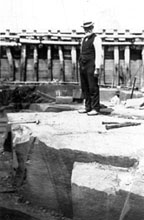
changing the heating system, from hot air to hot water, adding five fireplaces to the two which were then in the house, changing the front entrance and adding the verandah and sun porch, and creating the pannelled dining room from three storage pantries. The frieze in the dining room is a hand-painted William Morris original. Morris was the father of the Arts and Crafts Movement in England in the late 1800s. The Reads had been in the stone business since the early 1800s with two primary product lines: dimension stone and grindstones. They owned quarries at Wood Point and Wallace for building stone and at Rockport, Ragged Reef, Lower Cove and Stonehaven for grindstones (see photo of Henry Read at the Wood Point Quarry on previous page).

Grindstones were shipped to the U.S. and were used to finish Stanley tools, Colt pistols, Remington shotgun barrels and Collins machetes. The Stonehave quarry produced the finest natural abrasive in the world until the 1920s when synthetically-bonded abrasives such as carborundum replaced the natural grindstones.

This was the family home of the Reads until the fall of 1935 when it became Marshlands Inn owned and operated by Mr. and Mrs. Herbert W. Read who passed it on to Mr. and Mrs. Herbert C. Read who operated the Inn until 1984. It is presently owned and operated by Peter and Diane Weedon.

Did you know?

Did you know that the old City Hall and Queen’s Park in Toronto were built with stone which came from the Read quarry at Wood Point? And furthermore, Lord Shaughnessey’s residence and other buildings on Dorchester West in Montreal are also made of Wood Point stone.

And did you know the first wheeled carriage, a grass hopper shay imported by Squire Christopher Harper, arrived in Sackville in 1810? And did you know that the first stagecoach arrived in 1840?

Did you know that the most intense tropical cyclone (hurricane) ever to strike our coast occurred 128 years ago this week? On October 5, 1869, the Saxby Gale or Great Saxby Tide struck Tantramar and is thought to be one of the highest (if not the highest) historic tides in the Bay of Fundy. The storm was named after an English naval officer, S.M. Saxby, who had predicted over a year earlier that extremely high tides would occur in the northern hemisphere. What he did not foresee was that the timing of the high tides would correspond with a viscious tropical hurricane that would drive the Bay of Fundy waters to a crest several feet above the tops of the dykes. The intensity of the storm destroyed barns, drowned cattle and ruined a substantial amount of the stored hay crop. There was also loss of human life.

And please note…

The occasion of the Saxby Gale is currently being researched by Mr. Alan Ruffman, of Geomarine Associates Ltd. in Halifax, N.S. . Mr. Ruffman is looking for published materials or other in-depth accounts, or firsthand accounts such as diaries, journals, local histories, vessel logs, records of wharf repairs etc.. Anyone with information they would like to pass along to Mr. Ruffman should contact the newsletter editor and we will ensure that the information is passed along. The research is to be completed in early 1998 and the Tantramar Heritage Trust intends to invite Mr. Ruffman to give an illustrated public presentation about the Saxby Gale at a future meeting of the Tantramar Historical Society.

—Al Smith

The letters of Nathaniel Smith

We continue on with the last section of Nathaniel Smith’s letter from Fort Lawrence to his brother Benjamin in Yorkshire, England. We pick up the letter when Nathaniel has just finished writing about the need for new settlers to come to Cumberland, “Especially the poorer sort”. [Note: original spelling left unchanged.]

May 28, 1774:

We suffered greatly in our goods on ship bord by pilaging and so did many oathers. I fear some of our company will bring a dishonour to Old England. When we came nigh the shores we thought it prudant to take a pilate up the bay as our capton was altogether a strainger to the place. Consequently we steard for Hallifax and anquored two miles from the town by reason of the smallpox.

Here two of the eldest daughters of Bryan Kay finished their coarse in a most unhappy way. A scooner belonging to the Governor was ordered to lay along side of us to guard our people from landing for fear of the infection from the smallpox. One of their sailors, I suppose the capton, frequented our vessel and began to affect a frienship, but I fear for no good end, with some of the young girls. Our capton soon perceived the scean and gave a charge some should go with him as he pretended to take them to an Island at about a mile distance for their recreation, our capton having ocation to go to Hallifax. The fellows waited their opportunity and came slily with a small flatbottomed cobble and in very little time took in 4 of them (girls) and the fifth was just stepping down which was one of our girls. But, as Providence so ordered it, I happened to go on deck at that very instant she was going down and cast her by her shoulders and dragged her up. I only turned about to speak a few words to her by way of reproof when instantly the cobble overset with the fellows and four womin all floating alongside the ship. Such shrikes, cries and confusion I never saw before, very few rightly knowing who it was. Rope was thrown but to no purpose. At length they took the longboat and rowed off to take in their dead bodies as they supposed, but the men was saved by jumping upon the bottom of the cobble and two of the womin came to life again, but Bryan’s two daughters was quite dead.

I have little more to say at present but to beg you to remember me and mine at the Hour of Grace as I hope I shall do you, and altho we are in reallaty so far parted in body as never to see each oather again in the flesh, yet we shall be present in spirrit with the Lord, for I find my affections more closely united to you than ever before. I am determined by the Grace of God to set apart for that purpose one hour every day, when possible, which shall be eight at night and which shall be answerable to your 40 minutes past three in the afternoon, which I hope you will at opportunities observe.

My dear wife and all the family joins in our dear loves to you and to all enquiring friends and neighbours.

From your ever loving Brother and Sister.

Nathaniel and Elizabeth Smith.

letter to brother Benjamin in Appleton-by-Wisk, Yorkshire (cont’d)

Tantramar Historical Society

In the fall of 1996, one of the first projects of the newly-created Tantramar Heritage Trust was the creation of the Tantramar Historical Society. The Historical Society was established as the education outreach arm of the Trust and, under the able leadership of Paul Bogaard, the Society enjoyed a stellar first season. The program lineup for the 1996/1997 season included: November — The Campbell Carriage Factory; February — Shipbuilding/Seafaring days of Tantramar; April — Footprints in the Marsh Mud: the Planters, Yorkshire and Loyalist settlers to Tantramar; June — Centering on Sackville, an examination of the forces that led to the location and development of the Town of Sackville in the 1840s.

The Tantramar Historical Society starts its 1997/1998 season on October 15 with a presentation on “The Old Marine Hospital and the Botfords” followed by a late November meeting on The Horse Era of Tantramar. Further meetings of the Society will be held in mid-February (Heritage Week) April and June. Some possible topics that members of the Society are pursuing: a) Acadian and Native Settlements at Tantramar, b) Local Architectural Styles, c) Musical History of Sackville, d) Early Railways in the Tantramar Region, e)The Life and Times of Sir Charles G.D. Roberts f) The Saxby Gale and g) The Boultenhouse Shipbuilding Era.

Watch for notices and do plan to attend; the organizers would love to hear from you of any suggestions for programs and speakers. Please contact Peter Hicklin, the Newsletter Editor, or Paul Bogaard, Chairman, Tantramar Historical Society (536-0454).

The Campbell Carriage Factory to become the Trust’s first major project

In November 1996, the Board of the Tantramar Heritage Trust selected the Campbell Carriage Factory as the focus of its first major project. In January, the Board submitted a written proposal to the Campbells, the owners of the factory, and discussions over the ensuing months led to a formal response from them on September 4th. The agreement between the owners and the Trust will see the transfer of the property (via donation) to the Trust over the next couple of months. The sequence of events to take place this fall will be as follows: securing advice from the Tantramar Planning Commission (re: zoning and subdivision requirements for the property), contracting the survey and subdivision plan for the property, transfer of title to the Trust and commissioning a formal appraisal to determine the value of the property. Once title has been secured, work can begin on cataloguing the many material artifacts and the assignment of research students. Actual restoration work is unlikely to commence until late 1998, or early 1999, once cataloguing and research activities are completed.

A project advisory/management committee is being assembled and will hold its first meeting in mid-October. The Campbell Carriage Factory will become a unique museum to focus on the horse era of Tantramar. A major fundraising campaign will be launched over the next few months to support the restoration of this historic building dating back to 1838.

—Al Smith

And a further note…

Effective October 20th, 1997, due to postal changes, the new mailing address for the Tantramar Heritage Trust will be:

Tantramar Heritage Trust
P.O. Box 6301
Sackville NB E4L 1G6

And… help!

The Trust urgently requires a Chairperson, Membership Committee to keep track of the Trust’s membership activities. If you are interested in helping us out, please call Pat Finney at 536-1938; we need you!

Contributions solicited

This newsletter can only succeed with your help. We will need your assistance for information, stories, interesting “did you knows” and historical events that you may wish to present in the newsletter, your white fence, where someone waits to hear your tales. So please call me during the day at 506-364-5042 or at home at 506-536-0703 or write to me (or visit) at the following address:

Peter Hicklin
c/o Canadian Wildlife Service
P.O. Box 1590
Sackville NB E0A 3C0

And to all, I wait by the white fence looking forward to hear your tales of Tantramar.

And thanks…

My warmest thanks to Dick McLeod and Barbara Fisher for stopping by this special spot and passing on their very important contributions to this newsletter.

And I look forward to many more of you stopping by the white fence and telling me a story… or two….

The white fence is never a dull spot.

—Peter Hicklin

And please note…

As of this month, a “List Server” has been created for the T.H.T. to allow its members to communicate with each other across the Internet. This List Server is an e-mail address which forwards all e-mail it receives to all the members of the list server. In order to use this list server, you must first register. The instructions are as follows: To subscribe, send an e-mail to: listserver@tap.nb.ca with following line in the message body:

subscribe tht_discuss (Your Name, without the brackets)

After you subscribe, additional information, such as how to unsubscribe, will be sent to you.

To send mail to the List Server, send e-mail to: tht_discuss@tap.nb.ca
If you have any questions e-mail jason@tap.nb.ca

The White Fence, issue #2

May, 1997

Editorial

This is the second foray into our historical venture of Tantramar. After telling you about “the white fence” in our first issue, I learned much about this little Sackville “landmark”. Indeed many stories had been exchanged there between storytellers who are no longer with us, but the children of those times brought back their memories for me to record. They, like Bob Milton, are today’s storytellers. Since the first issue of this newsletter, I learned much about people, horses and plane crashes in Tantramar. It is truly a Pandora’s Box of history! And we’ve just cracked open the lid, so hang on!

I met with Mr. Milton on Good Friday last and my understanding and appreciation of Happy Hill of Sackville’s past grew in leaps and bounds. There was more to the white fence of East Main street than just tales of storytelling. First, to start at the beginning.

The white fence was built when Bob Milton attended grade 4 at the Ogden School in 1932. Surely you remember where that school was: next to “Money Art” Estabrooks’ farm near the top of Happy Hill where the road to Tantramar Regional High School is now.

The school’s location would have provided a clear view to the Ogden School students of the meeting place known around town as “the white fence”. Prior to the white fence, there was an old wire fence there which was removed in ’32 and replaced with a wooden fence painted white. According to Mr. Milton, many bicycles rested along the white fence and cars were parked along the road-side as many a tall story was told by the storytellers leaning on the fence under the windy skies of Tantramar.

But not long after the white fence was completed (when Bob Milton still attended the Ogden School), and during a football game at Mount Allison, Charlie Fawcett Jr. and a friend flew over the football field in a biplane rented from the Moncton Flying Club to do swirls, loops and other tricks over the football field! In the course of their aerobatics, a clip on the plane’s manifold broke, and the two acrobats had to do an emergency landing, which they did in a hayfield just above the white fence! Bob Milton was at the Ogden School playground at the time and witnessed this event. Once Mr. Fawcett and his friend fixed the manifold, they rode their plane up the hayfield towards Moncton, turned towards Amherst, and prepared for take-off! Bob Milton watched the biplane roll down the field towards the white fence. It started to rise but was unable to gain much elevation and down it came! Again! About 100 feet from the white fence, the biplane crashed nose first and smashed both wings. The two pilots escaped serious injury and walked out. Kids playing at the Ogden School witnessed this event and this story must have been re-counted many times at the old white fence!! And so, I think that we will keep the subtitle of this newsletter as “the white fence”; a unique place to exchange great stories from this area.

After our first issue appeared, I received a telephone call from Pat Finney in response to my request for assistance. Pat wanted to help in any way she could, so I asked her to interview Mr. Dick McLeod in Westcock about his stories of horses in this area. I knew from long ago that Dick had a love of, and knowledge about horses in this region, that was unequalled. I was not disappointed. Dick and Juanita had already written a small book entitled “Tales of the Horse” which they have given us permission to excerpt in “the white fence”. Part I of Dick’s fascinating account appears below, along with Part II of Nathaniel Smith’s (1774–1789) letters, a continuation of that series begun in our first issue. I also received a call from Leslie Van Patter, one of the creators of our logo, to assist with this newsletter. And when I approached Sandy Burnett to help us with stories he did not hesitate to say yes. So, with all the interest in this newsletter about Tantramar’s past expressed to me since our first issue, and the expert help now on board, we have a great future ahead of us!

Erratum

In our first issue I made a mistake which I would like to mend here. In my discussions about my visits with Mrs. Godfrey, I had reported in the first issue on her telling me about the “former” Once-in-a-While Club. The Once-in-a-While Club is still very much active as Mrs. Joyce Ferguson, the club’s current president, pointed out to me. So to make amends, I’ve asked Mrs. Ferguson to prepare a brief history of the club which I will discuss at our next meeting at the white fence.

—Peter Hicklin

Did you know?

When I first came to Sackville, my job with the CWS was to participate in assessing the impacts of proposed Fundy tidal power generation on wildlife in the bay. But I was unaware how long the topic of tidal power had been discussed in the area. For example, did you know that on August 30, 1906, the Sackville Tribune Post reported that Mssrs. Wilber J. Webb of Boston and Geo. H. Cove of Roxbury “arrived in town yesterday” and were “interested in a scheme for utilizing the tides of the Bay of Fundy to generate tidal power.” They found that the Tantramar River was “singularily (sic) well suited for the proposed project and the possibilities of the scheme stupendous.” The article closed with the optimistic comment that “Sackville may yet become the great industial centre of the Maritime provinces”. Well, we did get an industrial park 80 (or so) years later….

But following this article, an interesting editorial appeared the next month which illustrates how seriously tidal power development was considered in this area. The editorial is reproduced in full below:

September 1906 — Editorial: “As to the invention of Messrs. Cove, a word may be said. The plan involves the building of three large dams across the Tantramar River. The first two will form the south-west and north-east boundaries respectively of an immense reservoir, which will be filled twice every twenty-four hours by the incoming tide.

The third dam will form the farthest boundary of the discharge basin, which will have twice the capacity of the reservoir. When the tide comes in, the reservoir will be filled but the gates of the discharge basin will be closed, thus preventing any water from entering. When the reservoir is filled, the gates are closed. At the centre of the dam are placed turbine water wheels, which are run by water in the reservoir.

As the tide recedes, the gates in the dam of the discharge basin are opened, thus allowing the water which has spent itself in running the turbines to escape into the river. When the tide is full again, the gates of the reservoir are opened, thus allowing the water to flow in and supplying the power which will drive the turbines until the next tide.

Some have thought that the plan would interfere with shipping but the reverse is true. The ships would come through the locks in the dam at high tide into the reservoir, and since the reservoir would not lower more than nine or ten feet at a time, the ships at the wharves would be afloat all the time instead of being aground at low tide as under present conditions.

The cost of the dams and equipment will be large, but the operating expenses will be small, a comparatively few men being required to do all the necessary work.” So dear friends, just think of what the Tantramar River might look like today had the Tribune-Post’s editorial of 1906 become reality!

The tales of tidal power never came to fruition , but back in 1906, the horse provided the town’s power needs. So, on this topic, enjoy Mr. Dick McLeod’s unedited autobiographical sketch centered around his love of horses in the Tantramar area:

Tales of the Horse — Part 1

I was born in the midst of the depression, 1933 to be exact and in our part of the country the horse was the main source of transportation and power. I was fifteen before we owned a truck so I developed a love for horses that remains with me yet and I hope it always will.

Young Dick McLeod and brother Donald on Sid

Young Dick McLeod and brother Donald on Sid

The first horse I remember was a grey horse called Sid. He seemed like a giant to me but my father later told me he weighed about 1150 lb., small by today’s standards for a farm but in those days he was considered big enough… We would rig plow lines to his halter and drive him around the yard, accompanied by threats from my mother and grandmother but this wouldn’t discourage two expert four and six year old teamsters. Another time we painted the old fellow a dirty yellow with a broom and drainage water from the manure heap…

By the time I reached school age, I knew every horse in the community by sight and name and I was fast friends with most of the owners or teamsters. The teamsters of the delivery teams… always seemed ready to talk to a young fellow and I made friends with many of them.

The grocery horse had the hardest life, I always thought. They were always hooked to express wagons with a breast strap harness, generally loaded heavy and trotted uphill and down six days a week. I don’t think we have horses today that could stand this treatment.

There were grocery horses, coal teams, farm teams, woods teams, driving horses and they all fascinated me. One gentleman I’ll never forget, the late Aubrey Hicks, delivered coal with a single horse. It was reputed he could land a ton of coal into places that would worry some teams. I saw him do some great teaming around the siding and coal scales and never touch his reins. He also claimed that in his lifetime he used and wore out 26 coal scoops (they don’t have men like this today either).

The local blacksmith shops were also fascinating places for a young fellow. There were three that I went to when I got the chance. Herman (Hum) Amos’, Stevie Smith’s and Will Teed’s… Will Teed’s shop was especially fascinating and he also kept and travelled two stud horses, a pure bred Percheron called Coalbar and a standard bred called the Worthy J. He also was a great storyteller and claimed to have a great memory. One story he told about his memory is as follows: He said he was born in Second Westcock and he remembered when they moved to Sackville. He was a baby in his mother’s arms, his father drove the horse and two sisters sat on the floor of the carriage, his brothers came behind driving cattle. He said they met a man leading a cow. He didn’t know the man but he said if he met the cow tomorrow, he’d know her (he was over 90 when I heard him tell this story).

What an experience to go to town on Saturday night. There were several areas where the men all seemed to gather to tell yarns, brag up their horses, argue and lie about the exploits of themselves and their horses. I think sometimes there was more work done in front of the Corner Drug Store on Saturday night than there was during the week at home or in the woods.

It would take a book to record all these old teamsters, the stories they’d tell, the horses owned and drove but some of you older readers probably knew them, their horses and their stories so I’ll leave them for now.

The Letters of Nathaniel Smith

In our first newsletter, I transcribed for you the first portion of Nathaniel Smith’s letter to his brother in Yorkshire relating the great dangers of crossing the Atlantic to Nova Scotia. Nathaniel had just written to Benjamin about the ship Adamant which he suspected had perished on “the Cape called Sable… the most dangerous place in all the passage from the Lande end of England to the Continant of America”.

In the mid 1980s, a collection of letters written by Nathaniel to his relatives in England were recovered in Suffolk, England. The letters, in poor condition, were re-written by the owner, Jennifer Crabby, and studied by Anne Calabresi at Yale University in 1986 and recently (1994) reprinted by Ron Atkinson in Smith Family History in the Atkinson Lineage. Nathaniel’s letters relate many interesting facts and experiences of an emigrant farming family to 18th century Nova Scotia and we will excerpt passages from his letters as a regular feature of this Newsletter.

May 29, 1774 – letter to brother Benjamin in Appleton-by-Wisk, Yorkshire (cont’d):

Some of our people have made purchases and oathers are seeking after lande, Many of the Poorer Sort seems very discontented and not without reason as none is able to imploy them, altho their is such great need. The indulence of the people is the real cause of great poverty altho the land apears capable of producing every nesessary to support Human Life. Enough hath been said in favour of the land already theirfore shall make a few words serve, One thing I am eyewitness to, one gallon of Cream will yield as much butter as two in Old England upon the best of lande I was ever concerned with. I could say the cattle is small but their milk is exceding delitious and butter exceeds in tast and flavour any I ever tasted in England. The Marsh Land is tollerable rich, but I am under a mistake if C. Dixons report doth not exceed the truth, I am sorry to tell you the people are all in an uproar about his ears, and some brands him with a lier and worse, saying hes the real cause of their ruin, But he stills hold his integrity and says he hath spoak nothing but the truth, I verily believe some will return to Old England, those I doth not will bring a bad report of the Land and will be found in as great an extream as the oather, Some appears as tho they expected to have found provided for them a fine house and land cultivated to their mind without further trouble and because they are disappointed, murmours greatly, As to my own part I am no ways disappointed in my expectations. The report is, that its the best purchase that hath been made for many years bypast, and so fare as I have yet seen it agrees with the truth. The land both Marsh and Upland is the best in jenneral as I have yet seen, and by industory in a few years will be a beutiful estate, I am determined neighthor to persuade to, nor dishartain any from coming but let none come, save Man of Resolution and industory and such need not fear doing well. Mr. Frankland hath been at Cumberland and many are incouraged to settle upon his lands, Especially the poorer sort. The People, especially the Better Sort, as they are jennerally called, are very sivil, and I’m glad to tel you son Benj’n hath gained a good report among them, All in jennoral seams to have a good will toward him.

–to be continued—

And please note…

The Annual Meeting of the Tantramar Heritage Trust will be held at The Lion’s Den on Dufferin Street on May 20 at 7:30 p.m. The election of a new board will be held and reports from the directors summarizing all activities over the past year will be presented.

June Meeting of the Tantramar Historical Society

Centering on Sackville

Wednesday, June 18 at 8:00 p.m. in the Anglican Church Hall during the week of the “Marshland Frolics”, the Tantramar Historical Society will hold its fourth meeting.

Ask anyone where the centre of Sackville is and surely they’ll say it is our one and only stoplight. But as Jim Snowdon explained at our last meeting in April, at the time Sackville was founded as a “township” in 1762, the plan laid out three villages including Upper Sackville, Middle Sackville and Westcock. The centre, if anywhere, was to be Westcock!

Now we know that did not happen. But still the earliest settlement including our first stores and churches spread out in these three villages. So when did things shift into the central area that eventually was incorporated as the Town of Sackville? That is the topic for the evening of June 18.

None of the histories of our community spell this out very clearly, so we are going to try sorting this out for ourselves. There is no one guest speaker lined up for the evening, but a few of our members will begin by outlining major changes in the 1800’s and Paul Bogaard will conduct a general comparing-of-our-notes-and-dates-and-stories. The goal is to weave together a picture of when and how things came to centre on Sackville (as we now know it) by sharing the bits and pieces of information so many of us already have. There will be a number of maps on display to help us all in piecing this together.

This is a bit unusual as a way to conduct one of our meetings, but it could be a lot of fun and we could all learn something of how our community came together. Please come with your own dates and stories concerning churches and schools, businesses and houses, especially in the 1800’s.

Do you know where the first stores and churches were located? Do you know when the Methodists built a chapel in Lower Sackville? …when we got our first Post Office? …when Bridge Street first got its bridge? …and why it’s called Crane’s Corner?

Join us on June 18th and help put this puzzle together.

And a further note

It is my great pleasure to announce to all that our latest applicant for membership this year is Mrs. Clementina Godfrey. At 101 years of age Mrs. Godfrey has never lost her sparkle for the history of this town and region. This editor is especially pleased to make this announcement and welcome Mrs. Godfrey to the fold.

And Mrs. Godfrey, Bill Ogden would quite likely love to join in too…. After all, he moved into our house, across from your grandfather’s, in 1861; how I would love to interview him and his dear wife “aunty Bill” … Welcome to the white fence Mrs. Godfrey!!

Peter Hicklin
c/o Canadian Wildlife Service
P.O. Box 1590
Sackville NB E0A 3C0

The White Fence, issue #1

January, 1997

Editorial

This is the first of many newsletters to keep you in touch with Tantramar’s past. Its main objective is to provide us with a medium where we can exchange stories and inform each other about Tantramar’s fascinating history. An equally important objective is to make available a space where we can communicate, where we can exchange stories about this area, its history and its interesting people. That is why the sub-title of this newsletter is “the white fence” and why I’ve asked Al Smith to write the first article on the topic of the old white fence which used to be along East Main Street until 1961. Let me explain: every community in Atlantic Canada has its “white fence”. When I first came to work in Sackville in the mid-seventies, my favourite “white fence” was the Post Office. The late Bud Milner always had a story to tell me; Bud knew that I was new to the area and every day he helped to “break the ice”. He told me who I should talk to if I wanted to know about this and that, who’s who and why things are the way they are in Sackville. I managed to first meet many of my neighbours in Sackville alongside Bud and Ken in the Post Office. I want this newsletter to be your “white fence,” your favourite place to exchange stories about the Tantramar area just like Bud turned a new page for me every day in the Post Office back then. And so, during your time at this white fence, there are two very special things that I hope you will experience as I did when I first moved to this town: learn and enjoy!

Another regular feature will be the “end column” that we will begin with The Letters of Nathaniel Smith, Al Smith’s great great great great- grandfather whose letters about early settlement in this area have been preserved and which date back to 1774. The first installment is at the end of this issue. So just read on… and learn & enjoy…

—Peter Hicklin

Did you know?

Over the last couple of years, I have been visiting with Mrs. Clementina Godfrey of Sackville who celebrated her 101st birthday last July. She has regaled me with the most interesting bits of Sackville history, especially stories about Happy Hill where I now live (top of Main Street across the corner of Main and Ogden Mill). In the course of our discussions, she talked enthusiastically about the former Once-in-a-While Club in Sackville and a presentation she made about this club to the university in 1985. Her presentation at was entitled “Did you know?” So I would now like to introduce you to a new section henceforth to be known by that designation.

Recently (November 20, 1996), the Sackville Tribune-Post presented us with a short and fascinating historical glimpse of the Campbell Carriage Factory in Middle Sackville. This is an especially interesting part of town history and on 27 November, 1996, Mr. Darrell Butler, Chief Curator of The New Brunswick Museum, following his visit to the carriage factory on 13 October,1995, gave a fascinating and well-researched presentation about the carriage factory to 52 Tantramarians who attended the first meeting of the Tantramar Historical Society.

He spoke to us about a time when the car did not exist and the horse was the main means of transport. But did you know that during the years that the Campbell Carriage Factory was probably at its busiest (between 1885 and 1902), four other similar businesses also co-existed in Sackville: there were horse-related businesses (blacksmiths, wagon, sleigh and cart-building and repairs) run by i) Silas Black at the corner of Ogden Mill and East Main, ii) Fillmore and Wheaton’s shop in Upper Sackville, iii) B.C. Rayworth’s in Willow Lane and iv) R.B. Taylor’s on Main Street where Home Hardware is now operating. From what I can understand, there was no shortage of business!

But there remains little evidence of those enterprises. Mr. Butler made it clear during his visits to the Campbell Carriage Factory that “it is very rare to see a craftsman’s work building preserved in such a relatively untouched condition. While the countryside still abounds with mid-nineteenth century houses, this is not the case with blacksmith shops, woodworking shops… . The Campbell Carriage Factory is one of the very few left in such condition in Canada.”(Letter to the Heritage Trust; 17 October, 1995).

For this reason, the Tantramar Heritage Trust wishes to make the preservation of the Campbell Carriage Factory its main conservation project. This unique property was purchased by Ronald Campbell and his son George from John and Rebecca Beal on 9 October, 1855. The main factory building was originally built of hewed beams and post-and-beam construction around 1835.

Did you know that the business operated continuously for 130 years, always under Campbell men, until finally in 1949, the business closed its doors. The main building was the wood working shop and today some of the tools used still lie on the benches and others are stored in racks, or in chests. There also remains some casket hardware since the family had also begun a funeral or undertaking business during the years they built wagons and sleighs.

The paint shop on the second floor is still visible and an extension on the eastern part of the building (i.e. toward the marsh) no longer exists, although it would have contained a wide elevator for raising and lowering carriages and wagons between the paint shop to the ground below!

Did you know that the factory also made cobblers’ benches, home furniture, picture frames and churns? They rented horses and driving wagons and also sold hay, lumber, shingles, tobacco, molasses, socks, fine boots, candles, yarn goods and glass and did shoe repairs and possibly made boots! (Margaret Henderson, 1965). Mr. Butler’s final words were: “It is important to the heritage community of New Brunswick and Canada that every effort be made to preserve and thoroughly study and document the Campbell Carriage Factory”.

The White Fence

by Al Smith

I remember the white fence of childhood days growing up on East Main Street (now Main Street) near the Trans-Canada Highway. There used to be a little white fence at the dip in the road where a creosote culvert provided drainage for the farm fields to the north. That was the place we used to bike to, a rallying place to talk, dream, and think about growing up.

The White Fence is gone now, ripped out in 1961 with the construction of the TCH and replaced by the overpass cutting across the highway. Today, as I cross over the new bridge to accommodate the new four-lane TCH and witness daily the beehive of activity at Tim Horton’s, Wendy’s, MacDonald’s, Esso and Irving, I am reminded that even in Sackville, time and change bring transition and opportunity; essential, I guess, if Sackville is to meet the challenges of the 21st century. But still my childhood memories come haunting back.

Gone forever is the little white farmhouse perched on the knoll just before the white fence ; it was sacrificed with the construction of the Tantramar Regional High School in the early 1970s. All that remains is a single old apple tree that once was the pride of the orchard. I knew the farm as the home of “Money Art”, that fabled old gentleman who, it was said, was wealthy beyond belief. To us kids, it was hard to believe that this kindly old man with his very modest dwelling and rusted-out 1949 Ford, could ever be rich. On many a cold winter’s morning, I would catch a ride into town with him and he would drop me at the High School en route to delivering his milk to the local dairy. I remember his sparkle, his zest for life and the smell of his barn clothes as I would stare at the road through the rusted floorboards of his old Ford and wonder why he would not buy a new car! The other half of “Money Art” was Vera who made the best fudge in the community and amply treated all the neighbourhood kids on Halloween.

Across the gully from “Money Art’s” and past the white fence was the newest house in the community, an attractive little story-and-a half belonging to an art professor at Mount Allison. It too is now gone, moved to a new location on Ogden Mill Road in order to make room for the southbound access ramp for the new highway.

The intersection that we see today at Main and the TCH is a far cry from the tranquil meeting place at the white fence where so many stories were exchanged.

One can now stand on the overhead bridge where the white fence of 40 years ago used to stand and marvel at the volume of traffic on the new four- lane highway and the hustle-and bustle at Tim Horton’s and McDonald’s. In the distance, one can enjoy the calm of the Waterfowl Park. Time and change are leaving their mark on Sackville and in a way that this view from the intersection is a microcosm of a larger dynamic that is changing communities everywhere as they hurry to catch up with these changing times. But, one cannot help but wonder if “Money Art” would approve.

The Letters of Nathaniel Smith

by Al Smith

My great (four times repeated!) grandfather Nathaniel Smith emigrated from Yorkshire, England, in 1774 to establish a new home for his family at Fort Lawrence, Nova Scotia. Like many other Yorkshire families, Nathaniel had purchased some land in advance of embarking to North America. He booked passage on the brigantine Albion (188 passengers) that departed from Hull on March 11, 1774, and arrived in Halifax on May 10 and at Fort Cumberland on May 17, 1774. In the mid 1980s, a collection of letters written by Nathaniel to his relatives in England were recovered in Suffolk, England. The letters, in poor condition, were re-written by the owner, Jennifer Crabby, and studied by Anne Calabresi at Yale University in 1986 and recently (1994) reprinted by Ron Atkinson in Smith Family History in the Atkinson Lineage. Nathaniel’s letters relate many interesting facts and experiences of an emigrant farming family to 18th century Nova Scotia and we will excerpt passages from his letters as a regular feature of this Newsletter.

May 29, 1774:

It is through His kind Providence I am writing and our passage is safely landed in Nova Scotia, America with many difficulties which would had I but the time relate in full but firstly shall acquaint you with the struggle and shall let you know some were afflicted with sea sickness. Secondly the smallpox brought out amongst us which carried off Charles Blankey’s wife, and three children belonging to other people. Thirdly we had three weaks of excessive stormes and dreadful horicanes but were in no great danger of suffering save upon Sable Island which sertainly would have been the case if our Capton had not been before the ship, in his rekoning two hundred miles, as the Isle is the distance from the Cape called Sable. He begun to sound expecting to see we were nigh the shores and about the dead of night could find not bottom. Again about two they sounded on the Starboard side and found only eleven fathom. All was in an uprore expecting we were just upon the rocks. Instantly they sounded on the Larbord side and found it thirteen fathom — by that means they know it right to steer to the left and, as the goodness of God would have it, we escaped the most daingerous place in all the passage from the Lande end of England to the Continant of America. Two brigs have lately perished here and it is more than probable the Adamant is one of them. Their is report the ships crew and passingers escaped to the Island, whether or no that is true God only knows. How great will be the distress of poor John Wheldon’s family if he have suffered as I greatly fear he hath.

letter to brother Benjamin in Appleton-by-Wisk, Yorkshire

—to be continued—

Heritage week, 1997

The Tantramar Heritage Trust wishes to salute Heritage Week 1997 (10–17 February) with a special Tantramar Heritage Day on February 15 at the Tantramar high School with i) a hearty Heritage Week Breakfast, ii) a Tantramar Antiques Appraisal and iii) guest speakers on the theme of: Down East to Far East: Tantramar’s Sailors in the 1800s. See below for details:

Saturday, 15 February

Tantramar High School

  • 7:30 a.m. to 11:00 a.m.: a hearty Heritage Week Breakfast at the High School cafeteria. Tickets: adults $5, children (to 10) $3 available from members of the Trust or at the door. For information call Elaine at 536-0164.
  • 10:00 a.m. to 12:00 noon: Tantramar Antiques Appraisals in the High School Lobby where antiquarian Mr. Peter Seitl will appraise and share information in an open forum with the audience about the value and history of antiques brought in by members of the audience and
  • 2:00 p.m. to 4:00 p.m.: In the High School auditorium, four guest speakers will speak on the theme Down East to Far East: Tantramar’s Sailors in the 1800s

All of the above will be open to the general public. The speakers are sponsored jointly by the Tantramar Heritage Trust and the Westmorland Historical Society.

We need your help

This newsletter can only succeed with your participation. We need your assistance for information, stories, interesting “did you knows” and historical events that you may wish to present and debate with the members.

We also need a Newsletter Committee to help make this newsletter as interesting and widely read as possible. We very much need your help. If you wish to assist, call me at work at 506-364-5042 or at home at 536-0703 or write at the following address:

Peter Hicklin
Tantramar Heritage Trust
P.O. Box 313
Middle Sackville NB E0A 2E0

It does take a bit of time to put a newsletter together three times a year but it’s especially interesting and great fun. So join the team!