The White Fence, issue #98

february 2022

Editorial

Dear Friends,

Over the years, my experience as your editor has been one of discovery. This newsletter is no different. I had never heard of there ever having been a rifle range in Sackville. But when asked a question about it, as you will read here, Colin MacKinnon was able to clarify and elucidate. And he does again in this issue. What I found especially interesting about this rifle range was the many land transactions involved with it over time; in this case, a period extending over the years 1909-1954 with Colin’s personal observations in 2021 added in. This exchange of property is a process that is often central to understanding important aspects of the history and social landscape of a city or town. The details of the land under discussion in the text are further described by Colin in the accompanying appendix. Many of you may be very familiar with the Sackville Rifle Range as it was likely used for shooting practice by local hunters in the area over the years of its existence. However, with two World Wars over the past century, the range would have been especially important to the military. But for others like me, it is a new and fascinating discovery. So settle yourself in your favourite chair, read on and …

Enjoy!

—Peter Hicklin

Heritage Day

Join us on Saturday, February 19 at 2 p.m. as we celebrate Heritage Day with a presentation by Paul Bogaard on his new book, The Cumberland Basin Grindstone Industry: A Compendium of Sources and Illustrations. This will be a virtual presentation, so you’ll be able to join us from the comfort of your home. A Zoom link will be emailed to members prior to the event. You can also check our Facebook page (Tantramar Heritage Trust) or contact Karen at the office at (506) 536-2541 or tantramarheritage@gmail.com to receive the link.
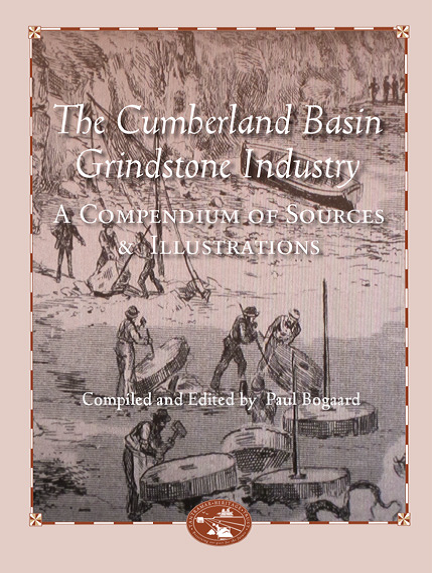
Cover of grindstone book

The book will be published in March and copies will be available at the Boultenhouse Heritage Centre and Tidewater Books in Sackville. This will be the Trust’s 38th book on local history.

This event is held in partnership with the Town of Sackville.

History and Archaeological Reconnaissance of the Sackville Rifle Range in Sackville, New Brunswick

by Colin M. MacKinnon

Sackville Rifle Range

Figure 1. General location of the “Sackville Rifle Range”, Sackville, New Brunswick, as well as the woodlot owned by Hilyard Crossman centered on the “Hicks Place” (Note the approximate location of shooting platforms: A – 600 yds, B – 500 yds and C – 200 yds; mound “C” could not be located in 2021).

David Beattie, a respected military historian and editor of Vincent Goodwin’s WW I diary, once asked me, “Do you know anything about the shooting range past York Street?” Much to his surprise, I was able to describe to him the location of the range (situated immediately west of the intersection of York Street and the Crossman Road) along with some information about the shape and size of the small shooting platforms, or mounds, as well as the condition of the backstop (Figure 1). The information I shared was based largely on site visits years ago with my father as well as from family tradition since some of the range had straddled property owned by my grandfather Hilyard Crossman Sr. (1902-1963). My answer to David also revealed how little I actually knew about the site: who owned the land? When did the range open? How long did it operate? When did it close? As we continued our discussion, my lack of details led to more questions than answers. Thus, the following article provides a more complete account of the history of the “Sackville Rifle Range”; a timeline of the site follows in Appendix 1. Measurements are expressed in Imperial units as used during the operational era of the range.

The Sackville Rifle Range consisted of a 60 ft. wide swath cut through the forest with an outwardly expanding safety zone, allowing for overshoot and ricochet of projectiles, extending on either side of the shoulders of this corridor. As measured from the backstop, this safety zone extended 150 yards from each side of the range proper (Figure 2).

Blueprint of the Sackville Rifle Range

Figure 2. At top, blueprint of the Sackville Rifle Range showing extent of land covered by the range and surrounding “danger area” extending from the end of York Street to the Mill Brook on the Lower Fairfield Road, Sackville, New Brunswick (Plan showing DANGER AREA, DND, 26 February, 1938). At bottom, an enlargement of the range proper showing the Department of National Defence (DND) land at the end of York Street, that was secured as part of the “Sackville Rifle Range”, as well as the 4.9-acre parcel leased from Hilyard Crossman Sr. (Surveyed by Thomas D. Pickard, Provincial Land Surveyor, 26 February 1938; author’s collection).

The site was described as consisting of three lanes, wide enough to accommodate three marksmen with a matching number of targets down-range (Figure 3). The backstop and target area was situated against the slope of a ridge that ran about 50 m from, and parallel to, the west bank of the so-called “Indian Brook”. Part way up this slope, a trench had been dug with the spoil thrown downhill such that an elevated berm was created perpendicular to the axis of the shooting corridor. This berm (measuring 24 feet long and 4 feet high in 2021) would have supported the three targets, while the “ditch” up-slope was once deep enough for someone to point “hits” on a target while still being safely protected in an area called the “target markers gallery”. In the early 1970s, I recall seeing the remains of a small wooden hut at the northern end of this trench (entry was from the south) where I was told by my father that this was where the targets were once stored. The footprint of this little building looked to be no larger than a typical outhouse – maybe 4 x 4 ft. On this visit, only the roof and about the top two feet of a doorway was visible as years of erosion from the slope above had largely in-filled the trench and buried the shack. The steep slope above the berm and trench acted as the backstop for the range. It is here, after a spring thaw, where spent lead bullets could often be found as they became exposed from the rain-washed face of the earthen bank. Not much of this infrastructure is visible today (Figure 4). Inexplicably, a few years ago a forest access road was built directly up the steep slope and through the northern edge of the berm and backstop such that some of the features, as described above, have been lost.

View of the Amherst, Nova Scotia Rifle Range

Figure 3. View of the Amherst, Nova Scotia, rifle range with targets in the far distance. The “Sackville Rifle Range” would have looked similar. The marksman lying prone at centre of image, third from left, is RSM George E. Lawrence (photograph courtesy Everett Mosher).

View of target area and backstop of Sackville Rifle Range

Figure 4. View of the target area and backstop of the Sackville Rifle Range. With a little imagination, one can visualize the approximate location of the target positions 1 to 3 as supported by the berm in front of the backstop. The location of the small target storage building, protected by the berm is indicated by a “T” (4 February 2021).

I had wondered if the range was strictly for military training or if it was used by local hunters looking to improve their shooting skills. Over a number of years, I have collected a few “relics” as they became exposed from the backstop. Most projectiles were heavily deformed from striking small stones in the earth. However, those that survived intact could be easily identified as standard .303 metal jacketed lead bullets (so called Military “ball” ammunition): they consisted of either 215-grain “round nose” or 174-grain “pointed nose” bullets (Figure 5). No non-military ammunition was recovered from the site. Only a very few empty brass casing were found and these were solely from .303 ammunition.

Military .303 jacketed lead bullets

Figure 5. Examples of standard military .303 jacketed lead bullets recovered from the backstop of the Sackville Rifle Range: top row, 215-grain and at bottom 174-grain projectiles. No non-military ammunition was recovered from the site.

A portion of the much larger “danger area” as found on either side of the three firing lanes bisected a small 10-acre parcel of land called the “Hick’s Place” as shown in Figure 2. This cleared knoll, surrounded by forest, was the 19th century homestead of millwright George Hicks (1817-1894) (see White Fence #28, 2006). As an aside, even though the Crossman family has owned the property continuously since 1905, after 117 years it is still known locally as the “Hicks Place”. With regards to this parcel, my mother had always understood that the government had paid her father some sort of an annual allowance for use of the property. In actuality, there was a formal lease for the aforementioned portion of land that fell within the range’s danger area.

On the 22nd June 1939, Hilyard Crossman Sr. signed a “Shooting Rights Agreement” with the Department of National Defence (DND) for the lease of 4.9 acres of the “Hicks Place” lot for $10.00 per year. As the danger area extended not just on both sides of the range but also for an additional 2,400 m down-range of the backstop, a similar agreement would have been required between DND and a number of other landowners.

This agreement contained nearly two pages of conditions, including a clear indemnity to save the Crown “harmless” in the event of an accident. The wording was as follows: “the said Lessor further promises and agrees that if, through, or by any reason of, Rifle practice on the said range, any injury is caused to him, or to any of his employees, servants or agents, or to any of his horses, cattle, sheep and other livestock, or to his crops, the Lessor will not hold His Majesty or any of his officers or servants, or any person or persons duly authorized by His Majesty to carry out rifle practice on the said range, responsible for such injury, and will not look to His Majesty or any of his officers, or servants, or any person or person duly authorized to carry out rife practice as aforesaid, for compensation therefore, and will indemnify and save harmless His Majesty and any of his officers or servants, or any person or persons duly authorized to carry out rifle practice as aforesaid, from and against any claims or demands whatsoever which may be brought against them by reasons of such injury” (Agreement between Hilyard Crossman and His Majesty the King, 22 June 1939). After nearly 22 years, the Crossman lease with DND was terminated on the 23rd February 1951.

I wondered if perhaps, with World War II on the horizon, a heightened patriotic spirit may have been a motivating factor for the various land-owners to allow the Department of National Defence to use their property. Besides grandfather Hilyard, the other property owners were: T. A. Siddall, Mount Allison College, Estate of Willard Bowser, Charles Bembridge, Charles M. Wry, Fred Babcock, William Wheeler, Frank T. Mitton, Ernest Bulmer and the Town of Sackville.

The first formal notice of a range situated past the end of York Street appeared in a sale, 30th June 1909, from Senator Josiah Wood and his wife Laura to James F. Anderson (1880-1960), Charles Pickard and Clinton C. Campbell (1859-1928), trustees of the Sackville Rifle Club (Westmorland County Records No. 91399). James F. Anderson, one of these trustees, was a prominent Tantramar farmer and dykeland manager who was actively involved with the Sackville Rifle Club. From notes written by James’s wife, Annie (Morton) Anderson, we are fortunate to have the following biography that highlights his diverse and exemplary career:

“James Fairweather Anderson attended school at Upper Sackville and Middle Sackville. He was a member of the Middle Sackville United Baptist Church and their choir from 1898 on. When the church was divided in 1903 he was elected a trustee and continued in that office, also a deacon from 1906. He was a commissioner of the West Marsh body from 1916 to 1946, a trustee of the Middle Sackville school district from 1918 to 1939 and a trustee of The Four Corners Burying Ground. He was a member of the Sackville Rifle Association (Civilian) from 1902 to 1914 and from 1925 to 1939, winning a trophy for the highest aggregate score in 1910 (the Major Pickard Trophy; see Figure 6). He was also a member of Sackville Cornet Band from 1904 to 1907, playing the tuba. A liberal in politics, he was appointed to the Provincial and to the Federal Marshland Commissions under the Maritime Marshland Rehabilitation Administration (M.M.R.A.) of the federal government from 1949.” (Transcript courtesy Bertha (Wheaton) Douglas).

Trophy Sackville rifle association

Figure 6. Trophy inscribed: “SACKVILLE RIFLE ASSOCIATION, MAJOR PICKARD TROPHY, HIGHEST AGGREGATE SCORE, SEASON 1910” won by J. F. Anderson”. (Courtesy Fred Anderson collection).

James F. Anderson, noted above, also appears as a younger man in a photograph of a group of marksmen, circa 1905 (Figure 7). The shooting range in this image was once situated past the long vanished “Wright’s Farm”, and parallel to the Trueman Mill Pond on the Etter Ridge Road. An anecdote has been told that years after this range closed, there was a lumbering operation in the forest down range of the old backstop. When the woodsmen were felling timber, there would be a shower of sparks whenever the cutting teeth on the chain-saw struck a bullet that had been imbedded in a tree (recalled by Don Colpitts as told by Wayne Siddall).

Marksman and J.F. Anderson

Figure 7. Group of marksman in front of the backstop of a shooting range that was once situated parallel to the east side of the Trueman Mill Pond on the Etter Ridge, New Brunswick, circa 1905. At right: James Fairweather Anderson (1880-1960), trustee of the “Sackville Rifle Club” and winner of the Major Pickard Trophy in 1910. Tentative identification for some of the other men in the photo: Hazen Etter (young man, 2nd row, 1st on the left); Al Wells (large man, 2nd row, 3rd from left in bowler hat), Bliss Lowerison (far right, 2nd row, wearing a uniform and corded hat with badge). Photograph courtesy Phyllis Stopps.

In 1939, the Sackville Rifle Range property (12.6 acres [5.1 ha]), was acquired by the Department of National Defense (DND) from the Civilian Rifle Association by Order-in-Council, PC #2330, 21 September, 1938. Following that acquisition and during the war years (1939-1945), the range was used by various Canadian Army units such as “C” Squadron, 5th Canadian Armoured Regiment (8th New Brunswick Hussars), and C Company, 2nd Battalion of the New Brunswick Rangers as well as the COTC (Canadian Officers’ Training Corps) of Mount Allison University and staff of Dorchester Penitentiary. The DND estimated that the range was used by 500 personnel annually. In 1944 through to 1946, a number of repairs and improvements were recommended, however, it is unclear if any work was actually done (see Appendix). The main stumbling block was the expenditure of a significant amount of public funds on land that was not entirely owned by the Crown. Finally, in 1954, DND transferred the “Sackville Rifle Range” parcel back to James Anderson who was “the surviving trustee of the Sackville Civilian Rifle Club” (Order-in-Council, PC #1319, 8 September 1954).

I had assumed that any specific details regarding the actual operations of the Sackville Rifle Range would have been long gone. However, thanks to the sleuthing efforts of Bertha (Wheaton) Douglas, the granddaughter of James Fairweather Anderson, we are very fortunate to have the following detailed description of operating procedures at the Sackville Rifle Range as written by her uncle Donald Anderson (1918-1991): “Papa [James Fairweather Anderson] was a marksman. He pursued this interest nearly every Saturday afternoon during the summer when he went to join the rifle shoot on the rifle range in the woods just north of Sackville. There, in a wide track of trees cut down, was a range with two targets at one end and shooting “mounds” at 200 yards, 500 yards and 600 yards along the length. The mounds facilitated marksman-like shooting over the tops of the bushes. The targets were 4-5 foot rectangles of white canvas (or equivalent) mounted on a frame counter weighted and hung from pulleys so they could be raised to open view and lowered behind a thick earthen parapet. When the tenders heard the echoing crack of a rifle, they would look at the target to spot a hole. As soon as the hole was spotted, the target would be drawn down. A circular flat marker 2 or 3 inches in diameter, white on one side and black on the other and with a peg through the center, would be removed from the previously-made hole and plugged into the new one. The white side would be made to show if the hole were in the black target area, and vice versa. The previous hole would then be patched with a quickly-sticking ready-made patch, and the target raised for the next shot. The location of the target area was arranged so that on passing through the target, the bullets ran into a substantial hill of earth behind [see Figure 4].

A set of coloured metal circular signals was hoisted beside each target to signal whether the new hole was a bull’s eye, an inner, magpie, outer or a miss visible on the target after each shot. Charles [Donald’s brother] and I tended target several times and got familiar with the requirements.

Back on the firing mounds, the competing marksmen assembled for the afternoon shoot. The 200-yard mound came first. The 200-yard targets run up on the target hoists behind the parapet were slightly smaller than the 500/600 yard ones. Four marksmen would lie down across the mound with their rifles taking turns shooting at the two targets. The others waiting their turn would mark down the scores on the scorecards and observe the location of the marker. Each marksman with the knowledge of the target distance, the location of his last shot on the target, any crosswind on the range as well as his own impression of his shot, would adjust his sight appropriately for the next shot. Most marksmen will know before the signal comes up approximately where on the target his bullet will have struck and will almost certainly know if he has missed.

The rifles were regular army Lee Enfield .303s. The gun has a wooden protective shield held on around the gun barrel. Marksmen often added their own choice of adjustable “peep-hole” sight for the rear sight. Sometimes they had the rifle “bedded” by a professional. This consists of putting certain linings in between the barrel and the wooden shields to influence the action of the barrel while the bullet is passing through. The barrel actually bends in a certain way during this passage so that a marksman’s accuracy can depend to a large degree on the consistency of this behaviour.

There is also a strap on the rifle that can be arranged around the left arm (for a right handed, “right eyed” person) to help hold the rifle still. One normally stops breathing for the last few moments before squeezing the trigger. However, one cannot stop one’s heart and sometimes the strap is tugged by an artery in the arm. The strap can usually be rearranged to avoid this. However, being excited or nervous driving a shot is no help!

I remember the first one or two times my Dad handed the rifle to me to try a shot on target. I made bull’s eyes and inners on the first few shots. Then excitement began to take its toll. My score slipped down a bit. It took a lot of control to bring my score back up again. Papa was a very good shot and made quite high scores. This is quite in keeping with his laid-back sort of continuous good-humoured approach to everything.

In 1927, I [Donald Anderson] was nine years old. It was a special year. It was the 60th anniversary of Canada’s nationhood. That summer, our aunt Patience and Uncle Alex, who lived in Coronation, Alberta, came to visit us for the summer. Papa was well into the marksmanship thing about then. He took advantage of the presence of Uncle Alex to take a week off, right in the middle of haying season, and go down to Sussex to compete in the annual rifle shoot. This was an event in which marksmen from all over the Maritimes (or was it Canada?) came. Papa left Uncle Alex in charge with the hired man and us kids to do the work. Uncle Alex promised us that if we worked hard and did everything right, he would take the lot of us kids to a trip to the theatre down in Sackville to see a MOVIE; the first one ever for, at least, Charles and me!”

Thanks to this detailed description by Donald Anderson, we have a first-hand account of the actual operations of the facility. Organized training by the military and local rifle club appears to have ended by 1954. Very few traces of the long-abandoned Sackville Rifle Range can be seen today. A popular snowmobile and ski trail now meanders along the length of the old range and the 500-yard shooting mound makes a nice, shaded, rest spot if you know where to find it (Figure 8). The target area and backstop are now barely recognizable as anything of significance.

View of old Sackville Rifle Range

Figure 8. View of the 500 yd. shooting mound of the old Sackville Rifle Range. The top of the shooting platform measures 10 x 24 ft. (30 January 2021)

The Sackville Rifle Range, now largely lost to memory, was once part of this community’s contribution towards Canada’s war effort during the Second World War. For a more detailed chronological account on the history of the Sackville Rifle Range, see the Appendix below.

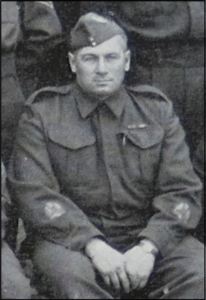
George E. Lawrence

Figure 9. RSM George E. Lawrence, 5th Canadian Armoured Regiment (8th New Brunswick Hussars), 15 May 1941.

This article is dedicated to RSM George E. Lawrence (1898-1980), 5th Canadian Armoured Regiment (8th New Brunswick Hussars) (Figure 9). In 1959, he was part of an 18-person team of marksmen who represented Canada at the National Rifle Association Meet in Bisley, England. His many accomplishments were recognized in 1989 by his induction into Sackville’s Sports Hall of Fame.

Acknowledgements

A special thanks to Bertha (Wheaton) Douglas for sharing her family’s stories, including the rare description of the Sackville Rifle Range in operation and to Fred Anderson for showing me his grandfather’s trophy. A note of appreciation also goes to Don Colpitts, Glen Crossman, Linda Fury, Everett Mosher, Nick Sanders (DND) and Phyllis Stopps who all assisted with this article.

APPENDIX I

Timeline regarding various activities pertaining to the Sackville Rifle Range, Sackville, New Brunswick (sourced from various files from the Department of National Defence).

1909 (30 June) – Senator Josiah Wood and his wife Laura conveyed land to James Anderson (1880 1960), Charles Pickard and Clinton C. Campbell (1859-1928), trustees of the Sackville Rifle Club (Westmorland County Records No. 91399). The reason behind this transaction is explained later in the 1939 land purchase: “Whereas “C” squadron of the 8th Princes Louise Hussars some years ago had taken over the said Sackville Rifle Club the operation and management of the said Rifle Range, and have continued to conduct Rifle practice thereon up to date, but had never received a transfer of title of the Real Estate from the said trustee.”

1912 – The Sackville Rifle Association and several Militia units (8th Hussars and 74th Battalion) acquired the Sackville Rifle range around 1912 under sponsorship of DND.

1912 (November)“The Plan of the Sackville Rifle Range. The plan shows the position of existing Markers shelter, and 200x, 300x, 500x, and 600x firing points, and the suggested extension to 800 & 900 yards with danger area necessary for a target range.” (The General officer Commanding, 6th Division, Halifax, NS).

1913 (13 November)“The rifle range at Sackville, N.B. would accommodate: “C” Squdn. 8th Hussars; “E” Coy., 74th Regiment and No. 173. Sackville Rifle Association – Membership 40.” And “If it is possible to secure a rifle range at a reasonable price, which should accommodate the Militia units above mentioned and the Rifle Association, it would appear advisable to do so.” (R. A. Helmer, Lieut. Colonel, Director of Musketry, DND memorandum).

1938 (1 September) – Order-in-Council (PC #2330) approving the leasing of approximately 1 acre of land from “C” squadron, 8th Princes Louise (NB) Hussars.

1938 (9 September)““C” Squadron, 8th P. L. (N. B.) Hussars hold title to about 11 acres of land in the vicinity of Sackville, New Brunswick, which they use as part of a rifle range, the targets being on land leased from Mount Allison University, and the danger zone over lands belonging to various parties. The Hussars have offered to convey title to the Crown for the land they hold, provided the Department of National Defence refits the range and undertakes future operation of the same.” And “The proposed range would be used not only by the Militia Units in the vicinity of Sackville, but also by the prison guards at Dorchester Penitentiary about 8 miles distant.” (Minutes of a meeting of the Committee of the Privy Council, 21 Sept., 1938).

1939 (6 March) – Range property was acquired by DND (12.6 acres) from the Civilian Rifle Association (Order-in-Council, PC #2330, 21 September 1938). Shooting rights over the down range “danger area” acquired from landowners.

1939-1945 – During World War II, the rifle range was used by the Canadian Army units including C Squadron, 5th Armoured Regiment (8th Hussars), C Company, 2nd Battalion of the New Brunswick Rangers, the COTC of Mount Allison University and staff of Dorchester Penitentiary. DND estimates that the range was used by 500 personnel annually.

1944 (21 December) – $3,503 was approved for the following proposed improvements: $1,602 for concrete markers, shelters backfill; $1,080 for installation of 3 standard steel target frames, and $480 for clearing approximately 4 acres of land (Total $3,202).

1945 (2 April) – Request for $7,600 for reconstruction of the 3 target rifle range in Sackville, N.B.

1946 – In 1946 the range was identified for post-war use and the infrastructure was improved [Note: it is not clear in the records if any work was actually done].

1946 (19 September)“The DOC MD 7 states that deterioration of the range is such that its reconstruction is necessary, the estimates cost of this being $5,300.00 and he further recommends that the work be done in or about the month of May 1947.” However, the document further states “I do not recommend the expenditure of this amount on rented property, but recommend that this item be included in the Annual Estimates 1957-1948 with steps being taken this year to purchase the land presently leased.” (DND, Engineer Services, Ottawa). It does not appear that any of this work was done as no lands were acquired.

1950 – Internal memorandum recommending that DND terminate agreements pertaining to DND
shooting rights at the site.

1954 (1 November) – DND transferred the Sackville Rifle Range parcel back to JAMES ANDERSON, the surviving trustee of the Sackville Civilian Rifle Club (Order-in-Council, PC #1319, 8 September 1954).

The White Fence, issue #97

november 2021

Editorial

Dear Friends,

Join us on an adventure of architectural mystery: the mystery of the brick houses. As though inspired by Canada’s William Murdoch and following the steps of Sherlock Holmes, Paul Bogaard attempts to solve two closely-related Tantramar mysteries, an investigation which could be entitled “Solving the Mysteries of Brick Houses and their Associated Brick Yards.” It combines interesting historical and archaeological research in the Tantramar area (primarily Sackville) in the eighteenth and nineteenth centuries and describes results of detailed work which, like me, you will read through more than once, with great interest and much pleasure!

Furthermore, in this issue we include an interesting recipe from Marilyn Keller’s mother, Helen McKinnon: Porridge Bread from the Frosty Hollow Tea Rooms, later known as the Frosty Hollow Inn. This porridge bread could have graced the kitchens of some of the brick houses described herein at one time or another. So, seek your favourite chair and with a well-buttered slice of warm bread, indulge your curiosity in the bygone days of Sackville.

On a sad note, it is my difficult duty to report to you the passing of a cherished member and publications contributor to the Tantramar Heritage Trust, Mr. Paul Henri Surette (see the notice in this issue).

—Peter Hicklin

Brickmakers in New Brunswick

The 1774 Report by Robinson and Rispin records that there were already amongst the recent settlers brickmakers with the skills to produce quality bricks from local clays.

Early Brick Houses and Their Brick Yards

by Paul Bogaard

There are two puzzles named in this title. As with most historical puzzles, definitive answers are hard to come by, but we’ve gathered enough information together to provide an account of the brick houses built during the first hundred years or so in the Township of Sackville.1

First is the surprising fact that several brick houses were built in this immediate area, well over a dozen that we know of. I say “surprising” because only two of these are still standing and they are actually outside of Sackville. Not only are the others mostly long gone (as are many others that have not even survived in documents), the historical record tells us that after 40 to 60 years, most of these early brick houses were already being taken down.2

So, if two remain, why did the others last only a generation or so, when I think of brick houses as what you build if you want your house to last?

The second puzzle is: to build a brick house you need a supply of bricks – lots of bricks! Where did these come from? Well, in the two examples still standing we have good evidence that they were constructed of brick made on the spot or conveniently close by. Was that usually true? And does this have anything to do with many of them being pulled down after a relatively short time?

18th CENTURY HOUSES

In addition to the two brick houses still standing [see sidebar above] there are others known to have been built before 1800. Four examples are described here:

1. Charles Dixon (like William Chapman) was a Yorkshireman and it is said that, after a few years in a log house,3 he built for his family a two-story brick house in 1788. This was at or near the Dixon house now lived in by Dr. John Murray at 59 Charles Street, Sackville. There is quite a slope from this house down to Crescent Street and apparently Charles Dixon used this to good effect, building up two stories from the low side and one story up from the top of the slope. This house continued to be occupied by his son, Edward, until his grandson, James Dunbar, finally had it removed to build the wood frame house now on the site, in 1847. So, this brick house lasted about 60 years.

Milner noted that Dixon’s purchase included what today is called the Dixon Island Marsh and later that bricks were made on the Island Marsh Road.4 It seems plausible that this road is the one leading out onto Dixon’s Marsh and that location can be confirmed by the Walling map of 1862.5 Taking this as confirmation of its location and that it was Charles Dixon’s own property not far away, it seems most likely that out on that marsh, perhaps close to the Tantramar River (to which that road leads) there must have been a deposit of clay suited to making bricks. And it would have been a large enough deposit to provide for the bricks not only of Dixon’s house (as we shall see) but for several other buildings.

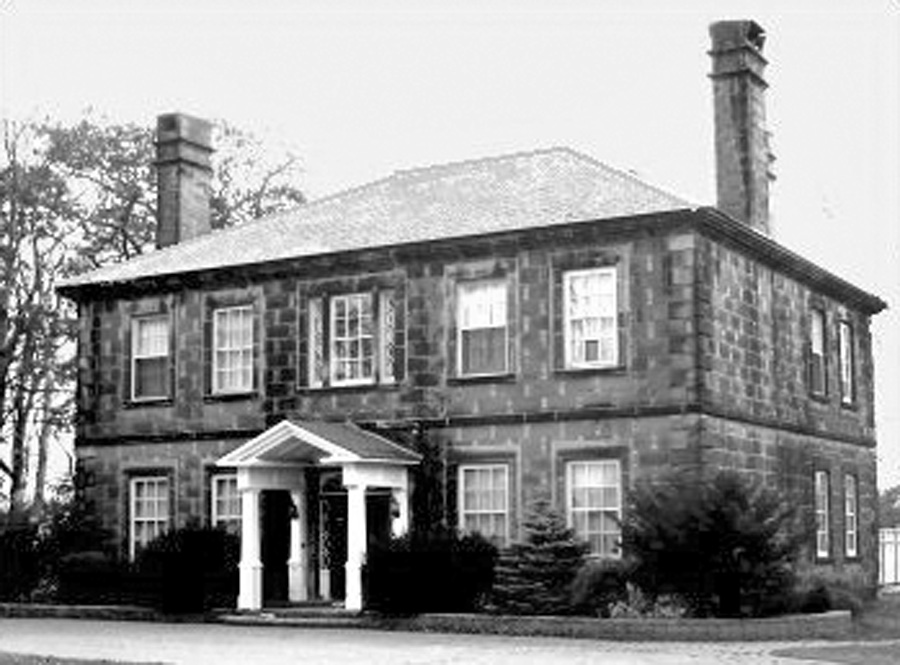
2. Amos Botsford, like Robert Keech, was a Loyalist who arrived early in the 1780s acting as an agent for the large number of Loyalists moving into the Province. He soon built for himself a stone house on Dorchester Island and by 1790 was constructing another house completed in 1792. The latter was “Westcock House”, quite a grand manor overlooking the Westcock Marsh at the head of the bay. This time Botsford had his house built of brick, at least for the main walls (and probably one of the bearing walls through the interior) with stone – called quoins – to strengthen the corners, and above/below the windows. This house was destroyed by fire in 1945.

Westcock House, New Brunswick

Photo of Westcock House taken by Charles G.D. Roberts in 1925. On the back he wrote: “It hurts to see this grand old mansion, about which so many of my childish memories cluster, left thus to ruin.” Photo courtesy of Mount Allison University Archives.

Folklore carried down through the Fisher family who have long lived on Botsford’s holdings suggested where Botsford might have made the brick for his house. The stone was easier to obtain as there were quarries just down the coast. This location was confirmed by the description of a property transfer still recorded in the Registry Office. Essentially a swap of two parcels from Botsford to the church in Wood Point was made in exchange for two parcels of land he received in Westcock, one of them described as lying just above the “brick yard.” Sometimes historical details pop up quite unexpectedly! The description makes it quite clear that the brick yard was at the mouth of a creek feeding out from the Town Platt in Westcock onto the marsh west of the Tantramar River. Like the Chapmans and Dixons (and thereafter the Keechs and Truemans) Botsford had located a good deposit of clay and the brick yard was established right there, within a few hundred meters of the building site.

Westcock House Keystones

Detail from photo ca. 1940, showing keystones above windows and quoins at corner of Westcock House.

3. The brick house owned by Charles Frederick Allison is a more complex story. He purchased this house, along with most of the ground where Mount Allison now stands, from William Atkinson in 1832. By 1839 or 1840 he had it demolished and replaced – in the area where Convocation Hall now stands – with a wood frame house. The brick house may have been built by William’s father Robert Atkinson or Robert may have obtained the house with the large holding he got from the Killams. Amasa Killam had received the original grant to this area already in the 1760s, but as he was associated with the Eddy rebellion in the 1770s, he had to forfeit his holdings. Robert Atkinson (Amasa’s son-in-law) obtained title from two of Amasa’s children. Curiously, that 1798 transfer actually says Robert was already living there. So, it remains unclear whether Robert built himself a brick house before 1798 (although it would have been odd for him to have built it before he received title) or the Killams had already built it sometime earlier. What is clear is that by 1840, after having lived in it for only a few years, Allison decided to tear it down and replace it about 50 or 60 years after it had first been built.

And there is one other fact that is also quite clear: Milner stated that this house had been built using brick made on the Island Marsh Road.6 What the arrangements with Dixon might have been we do not know, but it will turn out that this is not the only case where bricks were sold from this brick yard. Neither this house nor the Charles Dixon house lasted more than 50 to 60 years and whether that had anything to do with the quality of the clay deposits out on Dixon’s marsh, we will assess, later.

4. One further brick house is known to have been built just before 1800. Soon after they arrived from Yorkshire in 1774, the Trueman family purchased a small farm at Pointe de Bute and then a larger one on the land which they have farmed ever since. By 1797, they had decided to build a fine new house and Howard Trueman has left us an account: “In 1799 the house was built, the main portion being made of brick, burned on the marsh nearby. It fronted the south, and was 27′ by 37′, and two stories high, with a stone kitchen on the west side…. In 1839 the stone kitchen was pulled down and one of wood built on the north side…it is [in 1900] as comfortable a dwelling as it has ever been. Five generations have lived in it.” It was demolished in 1917, having served the Trueman family for almost 120 years.

Painting of the Trueman House.

Painting of the Trueman House by Bessie McLeod shortly before it was torn down. Photo thanks to Genie Coates.

Howard Trueman sketch of house

Detail from sketch provided by Howard Trueman in his Chignecto Isthmus, showing band at second floor, keystones above door, and windows and a hint of quoins at the corners.

This house was almost the same size as the Chapman house and shared some of its features, like the side-wall chimneys. But it also seems to have incorporated some stone over the entryway, above and below the windows, and perhaps at the corners like at Westcock House. The Truemans also shared with both Chapman and Botsford the logistical advantage of providing their own brick from a marsh deposit of clay quite nearby. With the exception of the Atkinsons (or Killams) whose house was located in the middle of town and relied on the Dixon’s Island Marsh Road brickyard, all of these 18th century brick house builders chose sites near enough to good clay deposits that yielded all the brick they needed.

19th CENTURY HOUSES

The 18th century brick houses described thus far were all built either by Yorkshire immigrants or Loyalists. But none of them started laying bricks as soon they stepped off the boat. In every case, it took ten to twenty years before they established where they wanted to reside, located a deposit of clay and began planning to construct using brick. Only in Dixon’s case are we told explicitly that they first lived in log houses, but that must have been the common experience in those pioneer days. We also know this was the case for Keillor and Chandler before they erected stone mansions in Dorchester.7 We now consider examples of brick houses built in this region in the 19th century.

5. There were two Planter families who were the first to re-settle the Township of Sackville after the Acadian Expulsion. Both erected brick houses for themselves, but only after having lived in the area for 40 years or more. William Lawrence is described by Milner as building his family house (like Charles Dixon’s) with one story on the uphill side and two stories on the downhill side.8 For that he needed a property near a road with a substantial slope. We drive by such a location whenever heading out to Middle Sackville. On the right-hand side, past the junction with the Ogden Mill Road, Lawrence found such an opportunity. Actually, when they first arrived in the early 1760s, the Lawrence family had been granted a share of the Township in Division A, which is Westcock. Like many Planters, however, they wasted no time swapping and adjusting their holdings so that by the 1780s they had gained a foothold on this desirable property that slopes down to the marsh from the Main Road to Middle Sackville. William Lawrence (and his across-the-road neighbors, the Outhouses) then petitioned the new Loyalist government to grant them the remainder of this land that was as yet vacant9 and those grants were confirmed in 1802 and 1808.

While no source that we can find says so, it would have made little sense for Lawrence to build in brick until he had clear title to the land, so it seems safe to conclude that he was erecting the uphill-downhill portions of his new house sometime in the early 1800s. Nor do these sources tell us where he got the bricks he needed. Dixon’s Island Marsh Road brick yard was in production by then, but it makes just as much sense that Lawrence found useable clay deposits along the marshy margin of his new grants and had the bricks manufactured himself. William, alas, only lived until 1820 and Milner suggests that several of his children and grandchildren living nearby had all moved into places of their own. So, it seems likely that this brick house, as handsome as it may have been, did not last all that long.

6. The Census of 185110 which notes the construction material for each household’s dwelling, was too late to catch most of the families we’ve already described, but it does note that Benjamin Scurr’s household was living in a brick house. Benjamin was already 63 years of age at the time and passed away only two years later. His son, Thomas, is listed as one of the family in 1851, but by the publication of the Walling map in 1862, Thomas is shown still living in what I take to be their brick home. Milner confirms this by mentioning that Thomas continued to “live in the Scurr homestead, a brick house.”11 The census says nothing about when the house was built, but we know Benjamin married Mary Bulmer in 1809 so it seems unlikely this brick house was built any earlier than that. Mary was still alive in 1866 when their son, Thomas, was head of the household; so the house may well have lasted 50 to 60 years. The house of Thomas’s brother, Charles (shown on the Walling map as being right next door), is still standing today at 24 Harris Drive.

7. Also listed in the 1851 Census as living in a brick house was the family of James B. Anderson. With no indication of when this house might have been built, or even whether James was the one who built it, we checked the Registry of Land Transactions and found that he had purchased this land in 1838 with the brick house already on it. The Registry shows he bought it from James Estabrooks, “that well-known farm in Letter C… a certain piece or parcel of upland with a Brick dwelling house and two barns erected and standing thereon…upland, marshland bordering on lands of the Estate of Valentine Estabrooks late of Sackville.” James was a well-known figure in Sackville’s early history (known as “Squire Jim”). Though he was only a boy when the Estabrooks arrived in 1761, he was soon granted the land on which this house stood.

Milner’s History of Sackville (1994) says: “He lived in a brick house on the place afterwards occupied by the late Josiah Anderson.”12 That connects to the census listing as Josiah was James B. Anderson’s son and Josiah’s own grandson and great grandson are the Charles (now deceased) and Fred Andersons who have been living on this site until today. That is to say that they live in the two-story wood frame house either James or Josiah had built on the foundation of the earlier brick house. Greek Revival in style, this frame house was likely built in the 1850s or, at the latest, when James B. passed away in the late 60s and Josiah married. At least we know when the brick house had been built, because the Andersons saved the Keystone from over Squire Jim’s front door (see photo below). It declares that this house was built (or completed) in 1811. The keystone from the Trueman family’s brick house was also saved (now refitted into a fireplace mantel) and it, too, records the date it was completed. And the photos of Chapman and Botsford houses also feature keystones either over windows, or doors, or both. Built in the decades just before or after 1800, this common feature hints at what was likely a common style. Squire Jim’s keystone also reminds us his house did not last for more than 50 to 60 years.

Keystone from Estabrooks brick house

Colin MacKinnon took this photo of the keystone saved from Squire Jim Estabrooks’ brick house and made the faded carving legible.

8. A more puzzling listing in the 1851 Census is that of William Cole. The Census indicates he was living in a brick dwelling, but also that he had only arrived in Sackville in 1834, so it was unlikely we would be able to tie him into the extended Cole family established in this area long before. However, the Census also notes that he was an “innkeeper” and there could not have been many of those. It was Gene Goodrich, having researched all the innkeepers for his book on the Stagecoach era (W.E. Goodrich. Stagecoach Days at the Westmorland Great Road 1835-1872. Westmorland Historical Society, 2010) who suggested it might be a misspelling of the surname, William “Coll.”

In fact, William Coll (not Cole) purchased an inn (or hotel) located on Main Street, Sackville, in 1846 from the estate of Abraham Bass. This was “a two-story brick building that no doubt served as their dwelling as well as a tavern and roadhouse.”13 Bass had built this brick structure in 1815, so it would already have been well established as an inn and stage stop. Coll seems to have carried on the tradition. Milner wrote: “These were the halcyon days for Coll’s Hotel, a great resort for the travelling public, where it was said the lights never went out and the fires never burned low.”14 Around 1860 this hotel was sold to Arthur King who kept the tradition going even longer. The Miller Block of commercial buildings was built on this site (up from Allison Ave. on Main Street) after a fire in 1912 cleared the way. Whether the hotel building lasted that long, we do not know, but it certainly represents one of the oldest commercial buildings (brick, of course) for which we have records.

Postcard image of Bridge Street, Sackville, NB

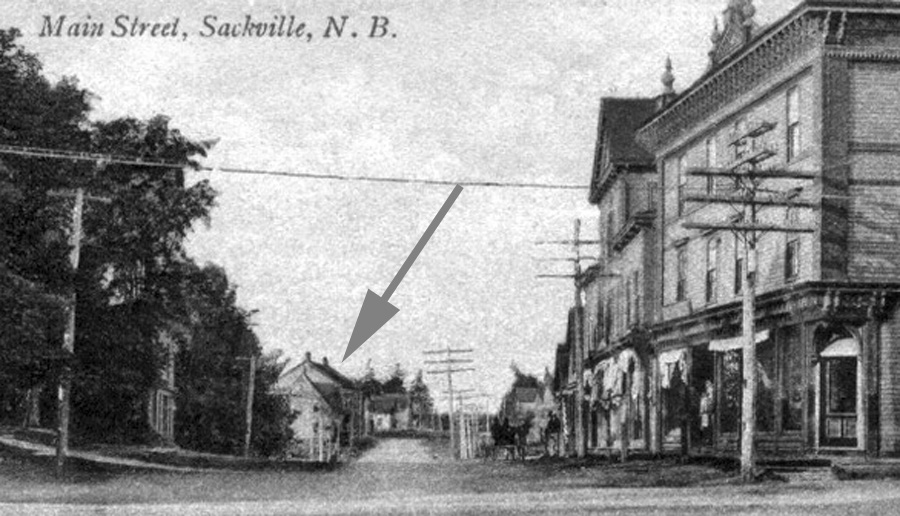
Donna Sullivan called my attention to this postcard image (year?) that captures what we think was the Inn run by Bass, Coll, and King.

9. Stone houses are also identified in the 1851 Census. There are only two and one was William Crane’s house, the one we know today as “Cranewood” on 113 Main Street, Sackville. The only other stone house was attributed to Thomas DeWolf. The Census tells us DeWolfe was an “Episcopalian Clergyman” and local church records confirm he was the Rector at St. Ann’s Church through this period. The rectory for St. Ann’s was located in Westcock on the Burying Ground Road15 and was the same rectory to which G. G. Roberts brought his family as DeWolf’s successor. The Robert’s family included his son, Charles G. D. Roberts, whose biographer clearly states that they moved into a brick rectory. Existing church records do not clarify this matter so either the census taker mistook a brick house for stone or this biographer mistook a stone house for brick.

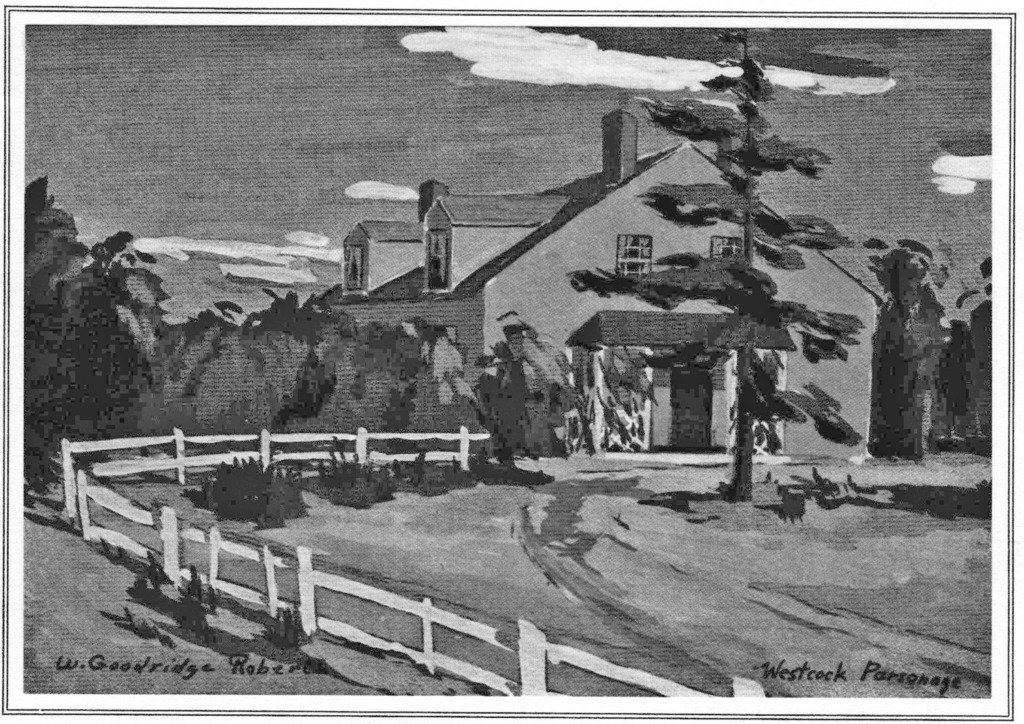
There might be a simpler solution to this riddle: that it was a brick house using stone for quoins at the corners (as we have seen in older brick houses) and perhaps around doors and windows. To confirm this possibility, we tracked down a painting completed by Goodrich Roberts some years later. (It was used for the cover of the 2002 edition of Roberts’ The Heart that Knows, edited by Carrie MacMillan.) Unhappily, this artistic rendition of the house (as on the cover) provides little detail and while the colour he chose is suggestive of brick, it doesn’t really decide the matter. We will have to be content with not (quite) knowing, although I think it likely that DeWolf’s rectory was one more brick house. We do know it replaced an earlier rectory in 1838-39 and lasted 40 to 50 years.

Goodridge Roberts painting of Westcock parsonage

From W. Goodridge Roberts’ painting we get a good sense of the size and shape of the house, but not whether it was of brick, or stone, or both. Courtesy of Queen’s University Archives.

10. The last listing of brick houses we can pluck from the 1851 Census is for Joseph Bowser.16 The son of Thomas Bowser, a Yorkshire immigrant, the elder Bowser had purchased two of the original shares of the Township that extended from Lorne Street all the way up York Street. Various Bowsers settled up and down this substantial holding and we can find two J. Bowsers on the Walling map as late as 1862. By the time of the 1851 Census, Joseph was already 60 years old and having married (for the first time) in the early 1820s, that seems a plausible time for him to have erected this brick house. It was on York Street just above Salem where many of us will remember “Hillcrest House.” One of Joseph’s nephews (or son of a nephew?) built that handsome wood frame house with an Italianate tower on the same site in 1880. So, Joseph’s brick house must have lasted 50 to 60 years.

11. There is a second J. Bowser showing on the Walling map, whose house was located inside the corner of Main and York. And with Milner’s help, I think we can link this one with Joseph’s brother, John. Relying once again upon the memory of Cynthia Atkinson who recalled for him the houses she remembered in her younger years, Milner states: “The next [near] (?) Crane’s Corner was the John Bowser House on a side hill, in a garden with cherry trees. The brick house remembered by the older generation was erected about 1825. The old house was then turned into a schoolhouse.”17 Like his brother, Joseph, John built his brick house about the time he married. At some later stage (if I am reading this correctly, always a challenge with Milner…) this house (or his father’s?) became a schoolhouse.

12. In a similar vein, Milner cited Cynthia Atkinson’s narrative of the two-story brick house built by Charles Dixon with which we began. Then she mentions another two-story brick house also attributed to Charles Dixon and here I suggest we forgive either Milner or his informant for repeating the same story. But then there is a third: “Charles Dixon erected a brick house on the site of the A. E. Wry residence. It was demolished in 1848 by the late Christopher Milner.18 In this case, our historian, William Cochran Milner, is not likely to be mistaken, because the Christopher referred to here was his father and the house was where he grew up. Indeed, this was yet another brick house built by another Charles Dixon – Charles Sr.’s grandson, the builder of vessels in the Dixon shipyard. This Charles Dixon trained to be a carpenter and then was away from town for a few years, returning in 1831.19 Assuming he built this brick house upon his return, it lasted less than 20 years!

13 The Dixons had owned all the land from one end of Charles Street to the other – from Charles Sr.’s house on Crescent Street to Charles Dixon the grandson’s house on Bridge. The margins of this substantial holding figure into our final case. Charles Sr. had purchased most of what in the 1770s was still called “Spectacle Island”, that is, all the upland east of the marshy ground reclaimed as Lorne Street, which when flooded leaves all Dixon’s ground as an island. This extended from Dixon’s island out onto what we now call the Dixon Island Marsh, Beale Heights, around through the industrial park and down both sides of Bridge Street.20 The northern portion of this same “island” was owned by William Cornforth, another Yorkshire immigrant, and his holdings extended out to the smaller island lived on by his son-in-law, John Harris. Where the properties of Dixon and Cornforth abutted (a few lots up Squire from Bridge), “Mr. Charles Dixon and Mr. William Cornforth gave a site for a Methodist parsonage of about four acres. A brick house was erected about 1810. In 1850 it was demolished and a wood one erected in its place.21 So, right where these two properties joined, we have at least one further brick house, one that lasted only 40 years. I might add: the Methodists also undertook to build a chapel at the corner of Main and Bridge, said to be brick, but in this case, it was superseded by a wood frame church across Main Street because the brick one proved to be too small.22

BRICKYARDS & LIME MORTAR

Reviewing all these examples still leaves us with the second puzzle mentioned at the outset. Although we have some cases of 18th century brick houses still standing and others now gone, but which stood for 120 years and more, the majority (11 out of 15) only lasted a few decades. Even those that stood for 50 to 60 years were not living up to the longevity that brick should have afforded. Something seems suspiciously wrong and others have noted this in the past.

Architectural historians Peter Ennals & Deryk Holdsworth have noted: “Local wisdom has suggested that the quality of brick made by early settlers from marsh mud was poor and that with time it crumbled and houses using this construction were later dismantled.”23 Since local bricks were not all made from the same clay deposit, but from almost as many different deposits as there were brick houses, it seems possible that not all the deposits were comprised of equally good clay. Some of the clay chosen must have been excellent for they have lasted very well. There may also have been differences in the skills of brickmakers and the success of their “burnings.” But there were stonemasons and brickmakers amongst the early settlers whose skills were honed well before they immigrated to the Township of Sackville.

There is another consideration. The bricks in all these houses would have been “laid” using lime mortar. Portland cement was as yet unknown and lime mortar had been used quite successfully for centuries. Limestone had to be baked to form quicklime (to make lime mortar) and there is not much limestone available in this area. Our excellent building stone is all sandstone. Still, “Limekiln Brook” by Amherst reminds us there must have been enough to provide some of what masons would have needed. They could also have used gypsum – there are substantial quarries along the Petitcodiac and Shepody Bay – that when heated sufficiently became “Plaster of Paris.” This was used to plaster walls (or spread on fields) but it could also be made into a usable mortar. So far, so good.

Problems could have arisen because, for any of these alternatives, an aggregate had to be mixed in which was invariably sand. Throughout much of North America sand is dug out from along rivers or from old riverbeds. But all the rivers in this area are tidal. The Tantramar and Aulac Rivers flow through our magnificent marshlands, all built up by the Bay of Fundy waters. However, the Bay is saltwater and all its marsh building and tidal effects include salt. If the sand used contained a modicum of salt, which might have been difficult to avoid, there would eventually be a serious problem. Lime mortar mixed with salty sand would act as mortar should, at first, but over the years the salt would weaken the mortar and brick walls would begin to falter, even if the clay was top quality.

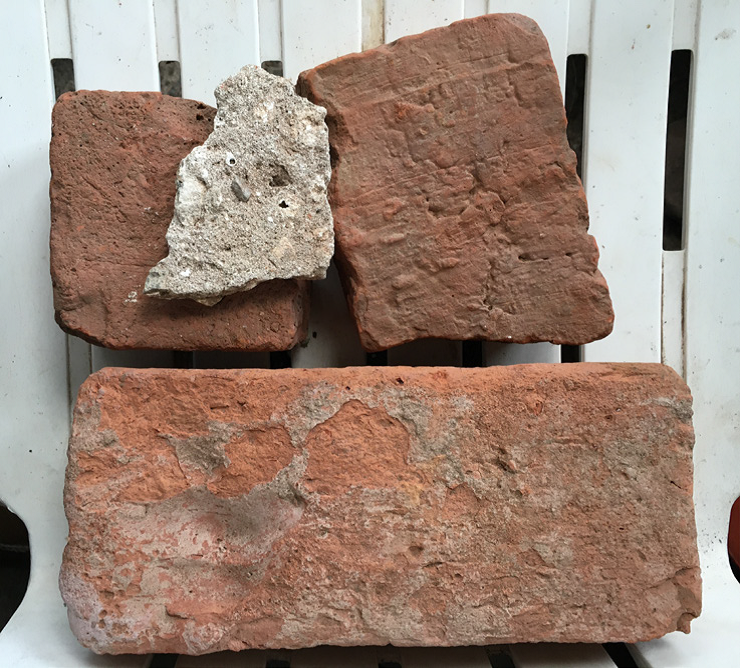
It would be difficult to prove what problems caused early brick houses to be prematurely pulled down. The offending brick and lime mortar is, after all, long gone. Alternatively, the reason could have been the desire for a more fashionable frame house. Thanks to Ray Dixon we have some brick that came from the demolition of the Charles Dixon house. It looks just as tough as those from the Chapman house (see the photo below), but it is hard to draw conclusions from three bricks.

Handmade bricks

STILL STANDING
Sackville is flanked by two brick houses still standing, one in Fort Lawrence and one in upper Dorchester, and they are two of the oldest. The Chapman House was built by Yorkshireman William Chapman. He had already built a house (near the Methodist Cemetery in Pointe de Bute) that was burnt down during the Eddy rebellion. By 1780, William had purchased land from the Smith family between Mt. Whatley and the Fort Lawrence ridge. Note the keystones over door and windows.

Chapman House, Fort Lawrence NB

My photo of the Chapman House taken over 10 years ago.

Soon thereafter he had set up a brick yard about 200 m behind the house (as pointed out to me by the present owner) along a creek that joins the Missaguash River. Being a joiner, Chapman was no doubt able to assemble the wooden frame needed inside the brick facade, much as he did a few years later for his father-in-law, Charles Dixon.

The Keech House is said to have been built in 1796 by the Loyalist Robert Keech. Like the Chapmans, Keech relied upon clay deposits located nearby. Once again, this was about 200 m behind the house where the creek at the boundary of his grant joins the Memramcook River. He had his bricklayer arrange them in a special pattern, so that the darker ends of certain bricks produce what is known as a “Flemish Bond.” These bricks have darker ends because they were fired longer, almost burning their ends, and then laid with the burnt ends out. From this we also learn that the walls were at least two bricks wide so that the bricks with burnt ends could reach across the width of the wall, helping to bind it together. Colin MacKinnon provided this combination of the Keech House and a close-up of the arrangement of bricks with darker ends showing. The mortar has been re-pointed, that is, new mortar has been added.

Keech House bricks

STONE HOUSES
One grand old house we all know well is “Cranewood” constructed around 1836 (records differ), and it was built using two colours of sandstone. That’s quite unusual. The well-known stone houses of Dorchester: Keillor House (1815), Bell Inn (1818), Chandler House (1831), like the buildings at Fort Beausejour/Cumberland and the Keillor, Siddal and Etter Houses on Aulac ridge are all from local quarries that each produced a distinctive colour. Where Sackville’s later stone buildings (MtA, downtown, Train Station) are of two colours, these colours are known to have come from different local quarries. William Crane’s choice of two colours seems also to have been quite intentional, because it is known he had part ownership24 in the one productive site in our area that could produce both of the colours found in his house – almost an advertisement for his quarry at Mary’s Point.

Cranewood, Sackville, NB

Cranewood, showing smaller, lighter coloured stone scattered among the larger, darker sandstone.

PRODUCING BRICKS
Robinson and Rispin, from their tour through Nova Scotia in 1774, report that recent settlers have “a very fine clay, that will make any sort of bricks…When it is ready for making… They have a mould that holds three bricks, which the one carries off whilst the other molds them. They burn their bricks with wood and the bricks have a good appearance.”25 These techniques had been followed for centuries and followed these British settlers to their new land holdings. Having located a suitable source of clay, they would dig out a quantity and leave it over winter to help dry out and make it easier to work. It is said a skilled team of brickmakers could turn out 2,000 a day, let them dry and then fire them a week later. One of the larger houses in our area might require 20,000 to 25,000 bricks. If the walls were two bricks wide, it might take twice that number. The lower brick I received from the current owner of the Chapman House (can you see the two finger marks, lower left?). The other two pieces of brick, and an old piece of lime mortar, are from Charles Dixon’s house. None are crumbling.

CONCLUSION

There are likely other buildings of brick and/or stone we have not accounted for from these earlier decades. Fleeting comments in Milner’s History of Sackville (1994) reveal that other buildings were erected, especially along the stretch of Bridge Street near where Squire Street joins it, but they no longer stand and we could not trace them. As anyone can see strolling around Sackville, however, this was not the end of construction with brick and stone. In the 1880s, Mount Allison erected its first stone building (Centennial Hall) and has been relying upon stone and brick ever since. The commercial building at the corner of Main and Bridge declares it was 1886 when it was constructed of brick (with stone at corners and reinforcing openings) and so it has continued for decades. When at the turn of the century Hammond built his grand “Queen Anne Revival” house on York Street, and others on Salem and Park Streets, he resurrected the use of stone in residences but he did not spark a trend that has continued.

These are the buildings we live with, daily, and they provide much of the character of our community. Except for Cranewood, all our earlier brick and stone dwellings are now gone. This article is one small attempt to reach into the past and remind us that long before university and local businesses, there were more than a dozen brick dwellings, and they had been impressive enough to have caught people’s attention, adding greatly to the early stature of our young community.

ENDNOTES

1. I say “we gathered” because this remarkable array of detail only came together with the help of many others: Colin MacKinnon, Gene Goodrich, Al Smith, Genie Coates, Ray Dixon, Bill Snowdon, Donna Sullivan, Phyllis Stopps, David Mawhinney, Carrie Macmillan, Juliette Bulmer, and Jane Tisdale each contributed crucial pieces. There are still a few gaps, and mistakes, and those are all mine.
2. Perhaps that does not strike you as short lived but my own house is now 60 years old and it has only needed a bit of maintenance. Sackville has many frame houses that are 150 to 200 years old.
3. This is the story told to W. C. Milner by Cynthia Atkinson as she remembered it from about 1820, pages 4-45 In: Milner (1994). Milner recounts this narrative twice.
4. W.C. Milner, 1994. History of Sackville, New Brunswick. The Tribune Press Ltd, Sackville,
New Brunswick. (pages 26 and 45).
5. What Milner says is that Charles Richardson lived near the Island Marsh Road and the Walling map locates that family’s house right next to Dixon’s Island (p. 44 In: Milner [1994]).
6. W.C. Milner, 1994. History of Sackville, New Brunswick. The Tribune Press Ltd, Sackville,
New Brunswick. (pages 28 and 44-45).
7. See E. Goodrich’s In Search of John Keillor: A Historian’s Odyssey, Westmorland Historical Society, 2016. (pages 194 and 217).
8. W.C. Milner, 1994. History of Sackville, New Brunswick. The Tribune Press Ltd, Sackville,
New Brunswick. (pages 24 and 45).
9. Ibid. (page 39).
10. The Census of 1851 unfortunately is the only census to do so, but along with Milner’s History of Sackville, New Brunswick (1994) (and the Registry of Deeds where we could find listings) these were the best sources for putting together documented cases of early brick houses.
11. W.C. Milner, 1994. History of Sackville, New Brunswick. The Tribune Press Ltd, Sackville,
New Brunswick. (pages 136-37).
12. Ibid. (page 141)
13. From “‘Bass’ and afterwards Coll’s at Sackville – A Tale of Two Taverns That Were Actually One” by W. Eugene Goodrich, in The White Fence, issue #69, Oct. 2015. All issues of The White Fence can be found on the website of the Tantramar Heritage Trust (tantramarheritage.ca).
14. W.C. Milner, 1994. History of Sackville, New Brunswick. The Tribune Press Ltd, Sackville,
New Brunswick. (page 101).
15. I realize that looks like a mistake but it is the folks responsible for providing new civic addresses that made the mistake – it was never named “Barren” Ground Road!
16. 1851 Census (page 72).
17. W.C. Milner, 1994. History of Sackville, New Brunswick. The Tribune Press Ltd, Sackville,
New Brunswick. (pages 25 and 44).
18. Ibid. (page 45).
19. James Dunbar Dixon’s 1891 account of this Charles in his History of Charles Dixon, One of the Early English Settlers of Sackville, Sackville, NB. (page 170).
20. As we explain in The Struggle for Sackville: the British Re-settlement of Chignecto, 1755-1770 by Amy Fox and Paul Bogaard (Tantramar Heritage Trust, 2012), the 1½ acre residential lots for downtown Sackville were surveyed in Westcock and 6 to 8 acre lots for farm residents were surveyed in Middle and Upper Sackville. What we consider downtown Sackville today was distributed in large grants, leading to the large purchases of the Dixons, Bowsers and others and only subdivided into downtown parcels in later years.
21. W.C. Milner, 1994. History of Sackville, New Brunswick. The Tribune Press Ltd, Sackville,
New Brunswick. (page 58).
22. The Methodists had cycled through all the choices for building material: a stone chapel in Pointe de Bute and a small log chapel in Middle Sackville, superseded by the brick chapel at Bridge and Main, and finally the wood frame churches across the street on Main. If we count their recent move to the existing building next door, it is brick once again.
23. P. Ennals & D. Holdsworth, “Looking Backward and Moving Forward: Early Building Patterns among the Yorkshire Settlers of Chignecto,” In: Yorkshire Immigrants to Atlantic Canada: Papers from the Yorkshire 2000 Conference, ed. Paul Bogaard (Tantramar Heritage Trust, 2012), page 173, note 16.
24. Thanks to Gwen L. Owen’s remarkable pulling together of details about each of the quarries in New Brunswick, in her For Love of Stone, Volumes I and II produced by the NB Department of Natural Resources and Energy, Mineral Resources Division, Miscellaneous Reports Nos. 8 and 9 (1990).
25. John Robinson & Thomas Rispin, “A Journey through Nova Scotia containing a particular account of the county and its inhabitants…” (York 1774) p. 11.

Paul Surette 1946-2021

Paul Surette

Described as “one of the great Acadian Historians and Writers of our Time,” in his official obituary (see below) Paul researched and published numerous books on Acadian history, primarily in French and had recently informed Paul Bogaard that he had many other books planned and some “in preparation.” Unfortunately, we will never see those. Paul Surette’s research and publications for the Tantramar Heritage Trust involved two atlases and the third one on Beauséjour villages was never completed. The two atlases he researched and published for the Trust are as follows:

Atlas of Acadian Settlement of the Beaubassin 1660 to 1775: Tintamarre and Le Lac (2005).
Atlas of Acadian Settlement of the Beaubassin, 1660 to 1755: Mesagouche and La Butte. (2015)

We are grateful for his connections with, and contributions to, the Tantramar Heritage Trust. He will
be sadly missed.

OBITUARY

Dieppe, NB – Paul Henri Surette, 75, passed away peacefully at the Dr. George-L.-Dumont University Hospital Centre of Moncton on Thursday, November 4th, 2021.

Born in Dieppe, NB, he was the son of the late Gilbert Surette and the late Émilie Surette, born LeBlanc.

Paul Surette, one of the great Acadian historians and writers of our time, left us. Author of several books, atlases and other publications on Acadian history, Paul was the happiest in front of an audience ready to listen to him!

Paul will be sadly missed by his wife, Hélène Camiré Surette of Dieppe; his son, Joël Surette of Dieppe; one daughter, Marjolaine Surette of Victoriaville, QC; one brother, David Surette (Charline Léger Surette) of Binbrook, ON; as well as several cousins, nieces and nephews.

Porridge Bread (from the Frosty Hollow Inn)

by Marilyn J. Keller

Frosty Hollow Inn

The card reads: “Frosty Hollow Inn, 3 Miles west of Sackville NB Route 2” (year not marked).

In these pandemic times, bread making has become a very popular hobby, so I thought it would be timely to share this recipe for Porridge Bread which came from the Frosty Hollow Tea Rooms, later known as the Frosty Hollow Inn, owned and run by John “Jock” & Lillie (Raymond) Wiggins.

My mother, Helen McKinnon, the daughter of Charlie & Flossie (Reid) McKinnon, was born in Frosty Hollow and grew up there. My grandparents lived across the road and just up the hill from the Frosty Hollow Inn. In 1941, when she was only 13, Mom started working at the Frosty Hollow Inn as a waitress on weekends. It was during World War II and the older women were getting better-paying jobs elsewhere. Two years later she started working there full time. She would start at noon and couldn’t leave until all the dinner dishes were washed at night, so sometimes it was 11:00 p.m. before she could leave. When she wasn’t busy in the restaurant or the kitchen, she was expected to make the beds. She worked 7 days a week and got paid 50¢ an hour. But the tips were good. Most of the customers were wealthy Americans, some of them arriving in a Rolls Royce with a chauffeur. Mom worked at the Frosty Hollow Inn until she got married at the age of 20 to my father, Manning Wheaton, the son of Bliss & Annie (Milton) Wheaton of Middle Sackville.

Jock, the owner of the Inn, gave Mom this recipe. It is moist and delicious, especially with baked beans and ham.

PORRIDGE BREAD
Pour: 3 cups boiling water
over: 2 cups rolled oats, ¼ cup shortening
Stir until shortening melts. Let stand about 20 minutes.
Meanwhile, dissolve: 2 tsp sugar in 1 cup lukewarm water
Sprinkle on this: 2 pkg dried yeast
Stir into the oatmeal mixture: 2/3 cups molasses, 4 tsp salt
Add the yeast.
Beat in 2½ cups flour. Then work in 5½ to 6 cups more (8 to 8-1/2 cups total).
Let rise 1½ hours. Punch down, let sit 15 minutes, and shape into loaves or rolls.
Bake in a 375° oven, 30 to 35 minutes for bread or 15 to 18 minutes
for rolls.
Makes 2 loaves or 3 dozen rolls.

Can you contribute to our museum collections?

We’re always looking for items, original documents, and photographs made and/or used in the Tantramar Region that are unique and important to the area’s historical record.

Some of the areas we’re particularly interested in right now are: tanneries; shoe and boot makers; the foundries; local shops, bars, and restaurants; shipbuilding and sea captains; and the Sackville Paper Box Factory.

Our criteria for accepting items are as follows:
• we don’t have another item like it
• it’s in good condition
• it has a provenance (so we know who, when, and where it was used it or made it and any other background information or stories about it)
• we have space to store and/or exhibit it
• we can afford the cost of its storage and care and take care of it properly
• ownership can be transferred to us (the person giving it to us owns it!)
• there’s no possibility of this item causing any damage to the rest of our collection (watch out for bugs and mold!)

If you have something you think we’d be interested in, we’d love to hear from you. Just contact Karen at the office at tantramarheritage@gmail.com or (506) 536-2541.
Thank you to CANB!

Many thanks for the extreme generosity and support of the Council of Archives New Brunswick (CANB) for awarding the THT three fully funded grants for a total of $2,438.44.

Demonstrating archival equpment

Annika Williams can be seen in the photo above utilizing our new imaging centre to copy a 1930s drawing of Enamel and Heating Ltd.’s Plant #2. Annika arranged and described archival fonds and learned archival principles and best practices under Kathy Bouska (our Collections Chair) as part of the Mount Allison Experiential Learning Program.

With this funding we purchased: a high-resolution digital camera; a tripod with a 90 degree column mechanism for taking directly overhead photographs; a remote for camera shutter release; a computer capable of processing images from a high-resolution digital camera; and a few archival supplies for document storage.

The first four items have allowed us to take in-house digital images for preservation of oversized or fragile (or both) photographs, documents minimizing their handling and increasing their accessibility to researchers, not only on-site but also for those who need a copy (especially when they can’t visit our archives in person). This set up will make it easier to include images from our archives in our exhibits. We also really needed the computer for the archives to do processing, archives administration, and to upload our RAD compliant finding aids to Archives CANB.

The White Fence, issue #96

october 2021

Editorial

Dear Friends,

We learn something new every day! Until recently, I was completely unaware of the existence of the Canadian Paper Money Society and the fact that this society has its own journal. The main article in this newsletter, written by Mark Holton, appeared in the Canadian Paper Money Society Journal (Volume 57, Number 169) in June 2021. The journal “accepts original manuscripts on Canadian banknotes, banking history, and other Canadian paper money” as stated in its Guidelines for Contributors. When Mark informed me of the article that he was submitting for this issue of The White Fence on “The Mount Allison Bank,” he wrote that he had discovered, “a fascinating parcel of forgotten history.” And so it is! I myself am an alumnus of Mount Allison (class of ’73) and can confidently state that this small university always made very special efforts to maximize the learning experience for its students. I certainly benefited from it. But I never realized how far back these “special efforts” went. I found the exercise described below and created by the commercial programme of Mount Allison in the late 1800s quite fascinating. Author Mark Holton makes it a most compelling read! I hope that you feel the same way.

Furthermore, as you probably know, each year the Tantramar Heritage Trust hires summer students as tour guides to our museums and at the end of each season, the students write a report on their experiences. This year, we’ve extracted portions of these reports and thought that you would be interested in reading some of the students’ opinions of their time with us. At the end of this newsletter, read carefully the latest THT news. I submit to you that there is much here for you to read and learn.

But more importantly,

Enjoy!

—Peter Hicklin

The Mount Allison Bank of Sackville, NB

by Mark Holton, FCNRS

It was a bank very different from all the other banks in New Brunswick. Yes, it called itself a bank and issued paper banknotes like a bank and those notes looked like real banknotes. And each note, in addition to the usual picturesque vignettes, carried two signatures, of David Allison as President and one S. E. Whiston as Cashier. They were handsomely designed and professionally printed by the St. John and Halifax Lithography Company, according to the credit line appearing on each note. They were certainly not out of place as far as size, style and format were concerned. All in all, at first glance, the notes issued by The Mount Allison Bank of Sackville, New Brunswick, were very reassuring.

Mount Allison University Academy Note 1874

Academy Note 1874

$1 Banknote of the Westmorland Bank of New Brunswick (1859).
Courtesy of Geoffrey Bell Auctions, Moncton.

These uniface notes dated September 1874 were printed in denominations of $1, $2, $5, $10, $20, $50, $100 and $500.1 But the Mount Allison Bank was not a “real” bank. There was no reference on the notes to the capital amount of the bank, a feature included on many other Canadian banknotes of that time. Some might have also noticed the lack of a serial number. Others could perhaps recall seeing part of the Mount Allison design on the notes of another New Brunswick bank. And a note-issuing bank in tiny Sackville! What were these things?

They were issued by the commercial arm of Mount Allison Academy for use by students in the college’s business courses. Before the computerization of banking and business, computer scanning of goods and electronic funds transfers, money entering and leaving a business had to be counted note-by-note and carefully documented in writing. A detailed inventory was required for goods bought and sold. Double-entry bookkeeping was a mystery that budding commercial students had to learn. What better way to learn than by handling “real” paper money in business simulations?

Students in the commercial programme doubtless gained experience and confidence handing this “money” as they learned the mysteries of book-keeping, accounting, banking, inventory work, merchandising, and many other aspects of running a business. This included knowledge of shipping and receiving procedures, understanding railroad services, costs, timetables, handling invoices and order forms. Handwriting was also an important part of the curriculum.

One other important subject and an unfortunate sign of the times was being able to identify worthless banknotes issued by creative forgers and spurious or “wildcat” banks. Students would have to become familiar with the specialist publications that would have to be consulted to determine if a note from such sources as the Bank of Acadia in Liverpool, NS, was good (it was) or the Bank of Charlottetown in PEI (it wasn’t).2

One wonders how many schools went as far as the Quebec Commercial Academy which in July 1870 was congratulated by the Pilot newspaper for the successful introduction of a course in telegraphy and soon had “a number of students who operate and read [Morse code] with facility.” In time, according to the university history, telegraphy was part of the programme in Sackville!

It is most likely that these Sackville students, coming from small towns and rural areas where aspects of the barter economy still operated, would most likely have never seen, let alone handled, banknotes of high denominations. These imaginary pieces of “college scrip” as they are now called, were a practical introduction to handling real money. And behind these notes is an interesting story from the history of Mount Allison University.

Why did the Mount Allison Academy create a commercial college in the 1870s? Partly to diversify and improve the Academy, according to historian Professor John G. Reid in his history of the university3, but it was also a response to the times. The mid-1870s was one of recession in Canada but optimists saw that people with commercial and business skills would be soon needed in an expanding economy. The Academy could attract such students, help pay its bills, and make a useful contribution to Atlantic Canada. Across North America and Europe, similar commercial colleges were operating and many issued their own “college scrip” for use by students. The standard catalogue of college scrip by researchers Herb and Martha Schingoethe details hundreds of issuing institutions in a hefty reference book of over 350 pages.4

The origins of the Mount Allison Bank are recorded in the Minutes of the Trustees of what were usually referred to as the Mount Allison Educational Institutions, held in Charlottetown in June 1874. These Minutes are now in the archives of the university.5 Among other things, on Saturday the 27th, they state that:

“President Allison expressed his conviction of the desirability of our doing a work similar to that done in the Commercial Colleges of the country and intimated that he had provisionally engaged the service of Samuel E. Whiston Esq. to take charge of such a Department at Mount Allison at a salary of nine hundred dollars and on motion the nomination was confirmed. President Allison also nominated Mr. Geo. Smith A.B. as English teacher at a salary of six hundred dollars.”

During the years when this commercial programme was offered, Mount Allison issued three sets of notes, the first dated 1874 under the tenure of Samuel Whiston (1834-1903) and the second and third issues (undated) appearing late in 1890 or soon after. The first set was deliberately designed to mimic the circulating currency of the day while the second and third sets were designed to comply with the requirements of the 1890 federal Bank Act that outlawed private issues of notes that could be easily confused with genuine issues.

That 1874 note was indeed an attractive piece of work. The vignette appearing in the centre of each note presented a detailed view of the campus. It was taken from a drawing, now in the permanent collection of the university’s Owens Art Gallery, by artist and fine arts professor John Warrener Gray (1824-1912) of the Mount Allison Ladies’ Academy. Residents of Sackville may recognize St. Paul’s Anglican Church (1856) in his drawing while the back of the stone-built Cranewood House (1836) might be harder to identify. Several of the principal buildings of Mount Allison at that time also appear in this creative drawing that neatly brings together most of the significant buildings of the community. Visible are the spire of the Methodist church and Mount Allison buildings such as the president’s residence (today the Faculty Club), The Lodge, and Lingley Hall and the second Academy building.6

The artist John Warrener Gray was born in Britain and came to Canada in 1847. After periods of time spent in Halifax and Sackville he continued as an art teacher in the United States before settling in Montreal in the 1890s. A competent landscape painter and teacher, during his career he wrote about art and in Montreal was a prominent figure in the local arts scene as a writer and a lecturer at the then Art Association of Montreal (now the Montreal Museum of Fine Arts/Musée des beaux-arts de Montreal).7

Gray’s scene of urban order and stability was flanked by the image of a sturdy sailor borrowed from a $1 banknote issued by the entirely legitimate Westmorland Bank of New Brunswick in 1854-59 then domiciled at The Bend of Petticodiac, a settlement later called Moncton. The image on the Sackville note is “flopped”, suggesting this direct copy. The Westmorland Bank note is the work of reputable banknote printer Rawdon, Wright and Hatch of New York. The sailor, seen here holding compass and sextant, was a popular figure on many nineteenth century Canadian banknotes and made reference to shipping and commerce and maritime affairs in general while his tools of the trade (the navigation instruments) can be suggestive of wisdom and order.

Mount Allison Banknotes 1890s

Britannia appears at the right of the 1874 note holding her traditional symbol, a trident. This too looks like a “borrowed” image but to date the source has not been found. To the viewer in the 1870s, however, Britannia represented stability, success, permanence and the wider horizon offered by the British Empire of which New Brunswick was but a modest part. To see Britannia was to be reassured. There would be no surprises. The solid design and quality printing coupled with the two bold signatures confirmed that this was indeed serious money. Perhaps only the observant would notice the lack of a serial number or that the notes stated “Will pay bearer in tuition…. on receipt of current funds / at Commercial College”.

How was this money actually used? Three items recently appearing at a Moncton auction elaborated upon the comments made by Prof. Reid and the late numismatist Ray Mabee.8 According to Mabee, students were given $1000 in notes and then small printed cards were distributed stating the nature and quantity of a particular commodity or “Representative Merchandise”. It could be five barrels of white fish, or five barrels of trout or perhaps 40 pounds of coffee. The goods were added to inventory, wholesale and retail prices calculated, then they were put up for sale; students would buy and sell their “merchandise” with the cash proceeds received and carefully accounted for. The card for 5 barrels of white fish indicates in a very neat handwriting on the reverse a “1st cost 5.00 / 25.00”, then “Wholesale 6.00 / 30.00” and finally “Retail @ 8.00 / 40.00”. All this, presumably, to be recorded under the sharp eyes of Prof. Whiston and his assistants.9 It should be noted that the existence of many of these early Mount Allison notes is due to the chance discovery by numismatist and antiques collector Ray Mabee of “a folder with a small hoard of bills” found in a Queen Anne style walnut chest of drawers in an old New Brunswick home.

In 1875, a special building was erected on campus to accommodate the commercial department. A photo appearing on a 1906 postcard shows the commercial college building as a two-floor wooden structure with a mansard roof and, if not large, then certainly displaying a significant campus presence. Alas, the commercial college was not destined to survive in this form for very long. The talented and highly regarded founder, Samuel E. Whiston, left Sackville to open what became “Whiston’s Commercial College” at 95 Barrington Street in Halifax.10 Student numbers declined and some courses or programmes were shed and it was not until the arrival in 1890 of C. W. Harrison from Ontario that matters improved. He revitalized the commercial programme and this most certainly included the printing of a new set of paper banknotes, this time more restrained in design due to the demands of the decennial Bank Act.

These notes were much less attractive than the 1874 notes. There is no cheerful scene of Sackville, no reassuring Britannia or a neatly-dressed and well-equipped sailor. Instead, with the heading of “Good Only in the Actual Business Department of / Mount Allison Business College / Sackville, New Brunswick” the design can only be called bureaucratic/institutional. To give one example: at the left is the large digit “1” and “One” printed vertically, both within a small vertical guilloche and at the right, a woman coming in from the field carrying what might be a sheaf of wheat. The lower half of the note carries a statement and a quotation that perhaps explains the Spartan nature of the design. The following clause from the Bank Act, 53 Victoria Chap. 31, 1890, explains why a Bill resembling a Bank Note cannot be issued by any Business College – Clause 63:

“Every person why designs, engraves, prints or in any manner makes, executes, utters, issues, distributes, circulates or uses any business or professional card, notice, placard, circular, hand bill or advertisement in the likeness or similitude of any Dominion or Bank Note, or any obligation or security of any Government or of any Bank, is liable to a penalty of one hundred dollars, or to three month’s imprisonment, or to both.”

And here it is worth noting historian Reid’s reference to a Mount Allison 1874 $2.00 bill that an enterprising student successfully passed as the genuine article!

It is not known how long these 1890s notes were in use or when they were discarded. Included in this large series were notes of 5 cents (printed in black), 10 cents (green), 25 cents (dark blue), and 50 cents (red) with notes in brown ink for $10, $20, $100 and $500, according to the data provided by the Schingoethes. This set of notes carried the heading “Mount Allison Academy”. In blue ink were notes of $1, $5, $10 and $20 and they were headed “Mount Allison Business College”. The notes held by the university archives and those held by collectors confirm many of these combinations but not all; unfortunately the Schingoethe book does not reveal their source(s) of information.

Promissory Note, 1910

Cheque, 1910

Deposit slip

A small collection of receipt blanks, deposit slips, and blank cheques indicate that the commerce programme continued into the early years of the 20th century. These blank forms carry preprinted dates of “19__” and “191_” but no further series of banknotes are known after the 1890s. The institution itself was known by various names after that, including The Mount Allison Business College Bank at the turn of the century and on a promissory note dated March 1910, the “Mount Allison Commercial College Bank”.

According to Professor Reid’s history of the university, the commercial programs continued at Mount Allison University into the 1930s. After the Great War Reid writes that the commercial college “drew students from throughout the region for training in bookkeeping, business practices, stenography, and related skills, with an especially strong contingent each year from Sackville itself and the immediate area.” (II, 182).

In 1936, the university created the Commerce department. A study recommended that the commercial college courses “should be taken over by the university from the Academy, and that a four-year degree programme should be introduced, consisting both of business administration courses and a leavening of arts subject. In this way, Mount Allison could continue its tradition of offering commercial education while not duplicating the work of private business schools….”

The Commerce department continues to this day at Mount Allison University, but without courses in handwriting, telegraphy and railroads.

Mark Holton, FCNRS, lives in Sackville, NB. Now retired, he has been an art museum curator and director, university lecturer, fine art advisor to a number of collectors, and a high school teacher.

ENDNOTES/SOURCES
1. To clarify the matter of names…the Mount Allison Wesleyan Academy was a school for boys established in 1843, with the Female Branch (later called the ‘female academy’ and then ‘Ladies Academy’) opened in 1854. In 1886, the name changed officially to the Mount Allison Ladies’ College. Mount Allison granted its first degrees as a University in 1863.
2. One such reference work is W. L. Ormsby, 1852. A Description of the Present System of Bank Note Engraving showing its tendency to facilitate counterfeiting: to which is added a new method of constructing bank notes to prevent forgery. New York: W.L. Ormsby and London: Willoughby & Co.
3. John G. Reid, Mount Allison University: A History to 1963. Two volumes, Toronto: University of Toronto Press, 1963. I am indebted to librarian Laura Landon for obtaining these books for me when the pandemic kept me from the university library.
4. Herb and Martha Schingoethe, and Neil Shafer (editor) 1993. College Currency; Money for Business Training. Port Clinton, Ohio: BNR Press.
5. I am greatly indebted to university archivist David Mawhinney for providing me with photocopies to work with during the COVID-19 lockdown when the university archives was closed to non-university users.
6. I am indebted to Jane Tisdale at the Owens Art Gallery for very kindly showing me the original drawing using on the Mount Allison Bank note as well as a coloured view of the same.
7. Gray is the subject of a very brief but laudatory biographical sketch in the Franklin Historical Review, a copy of which is in the vertical file at the Mount Allison University archives: “John Warrener Gray — An Art Teacher of Long Ago” by a “Miss Claribel Cantwell”. She notes that Gray “painted mostly landscapes in oil”. The Montreal Herald notes that while “an artist of genius” Gray died “penniless and almost forgotten in his old age.” Herald, February 26, 1912.
8. Ray Mabee, The Mount Allison Commercial College Currency, in the Journal of the Canadian Numismatic Association, April 1971, 256-257 and also printed in the Newsletter of the Atlantic Provinces Numismatic Association, January 1971.
9. These cards appeared in the G. Bell Auction, April 30 and May 1, 2020, at the Toronto Coin Expo Spring Sale, as lots 456-458.
10. But in the end he returned, to be buried in the Sackville Rural Cemetery after his death in Halifax, March 5, 1903, to be with his daughter, Ethel, who died at age 6 in 1876. Also buried there is spouse Maud Whiston who died April 1912 at age 73. Whiston successfully operated “Whiston’s Commercial College” in Halifax until 1900 when he sold the business to Messrs. Kaulback and Schurman, proprietors of the Maritime Business College. This sale is noted in the Charlottetown Guardian newspaper on February 21, 1901, and later issues. In Charlottetown, Mabee suggests that Whiston may have been the head of the Eaton’s Actual Business College when he was lured away by President Allison.

Our Summer Students’ Experiences
with the Tantramar Heritage Trust in 2021

Every year, with the assistance of many funding sources (see below), The Tantramar Heritage Trust hires students who lead visitors to either the Boultenhouse Heritage Centre or the Campbell Carriage Factory to create a special learning experience. Each year, we pride ourselves in selecting special people for these important tasks and, at the end of tourist season, our tour guides and research assistants are requested to write a report of their experiences with the Trust as well as offer suggestions to make our visitors’ experience with our museums an even better one. These reports are always carefully read, suggestions recorded and the reports filed. But this year as we read through the seasonal reports, we were touched by many of the personal comments made by the students about their experiences with us. And on that basis, we thought that our membership should be made aware of the very positive commentaries and suggestions made by our summer students. Below, we accumulated some of the many commentaries expressed by our summer employees and extracted from their annual summer reports. We felt that it was best to not add any names as these commentaries were made confidentially. But the board of directors felt that our members should be made aware of these as you all assisted, one way or another, in the funding of those important summer positions.

Our funding sources are varied and include: the J.E.A. Crake Foundation, Mount Allison University Experiential Learning, Canada Summer Jobs (Government of Canada), Young Canada Works in Heritage Organizations (Canadian Museum Association), Community Museum Summer Employment Program and the Department of Tourism, Culture and Heritage. We are very grateful to all.

I cannot thank you all enough for the amazing work you do on a daily basis. I could have never imagined how integrated and integral the Tantramar Heritage Trust is to the Tantramar Region. The work, time, and energy you all put in is inspiring. I am so thankful to have been a part of such a lovely team and a wonderful organization this summer! I have learned a lot and I would like to thank you all from the bottom of my heart for giving me the opportunity to grow tremendously as a person. You are all such crucial aspects to the community of Sackville and, without all of your efforts Sackville would not be what it is today.

____________________________________________

I was able to learn and experience a lot in a very safe, supportive and fun environment. This job allowed me to explore new skill sets and there were a good variety of tasks to do.

____________________________________________

It is exciting to be a part of an organization with so many opportunities. I hope that the next Crake Intern has as much fun as I did connecting with the Tantramar community and learning about its history.

____________________________________________

Over the past ten weeks, I have learned many things, made incredible friends and overall, acquired an appreciation for Sackville and the history within this small town.

____________________________________________

I really enjoyed my summer here and I am glad that I was able to work in collections this summer.

____________________________________________

As someone who is interested in museums, I really appreciated the opportunity to give tours at the Boultenhouse and at the Campbell Carriage Factory. I learned a tremendous amount about important local history and the significance of the Tantramar region, both past and present, including how the region had a very active economy. The museums and accompanying exhibitions present so much history in an enjoyable and informative way.

NEWS FROM THE THT OFFICE

We had a great summer with a staff of 8 working out of the museums. By August, we were getting lots of visitors and it almost felt like a normal summer. We continued to follow safety protocols to keep everyone safe, including wearing masks, social distancing as much as possible, and using hand sanitizer regularly.

Unfortunately, cases have risen in New Brunswick and in our own community. As a result, we’ve decided to cancel our fall fundraising dinner and perhaps hold one in the spring instead. As with everyone, we’re in “wait and see” mode.

As of October 5, our museums continue to be open to the public. Masks and proof of double vaccination are required to enter our buildings. The Boultenhouse Heritage Centre is open Tuesdays through Fridays from 10 am to 2 pm. The Campbell Carriage Factory is available for tours by appointment. Just contact the office at (506) 536-2541 or tantramarheritage@gmail.com.

We’re pleased to be partnering with Mount Allison University’s Experiential Learning Office to have Annika Williams working in Archives this fall for course credit. Check out our holdings in the Council of Archives New Brunswick database here: https://search.canbarchives.ca/tantramar-heritage-trust.

I’m also pleased to tell you that our Research Centre is now open to the public. It’s best to make an appointment if you’d like to visit, since it can get busy around here. Thanks to the Young Canada Works Program, we have hired Alex Nay to work in the Research Centre this fall and winter. He’s worked with us in the past and is very familiar with our organization and will be happy to respond to research and genealogical inquiries. Just email him at thtresource@gmail.com with questions or to set up an appointment.

–Karen Valanne

The White Fence, issue #95

May 2021

Editorial

Dear Friends,

History is best told by those who lived it. Our dear friend and contributor, Al Smith, was born and raised, retired, and is living in Sackville and is best- qualified to share two fascinating stories from Sackville’s past, one of which he played a part in. After reading the first story in this newsletter and dipping into a jar of honey, you might just think of what may be missing…white clover, possibly. Al’s second story reaches back to 1856 when Sackville got its first community newspaper. The Borderer went through a number of transformations before evolving into the “The Trib” as I knew it when I first arrived in Sackville in 1969. In 1964, The Sackville Tribune-Post told the story of the production of honey in Sackville. But not any more…“The Trib” no longer graces coffee tables in Sackville every week. Learn here about Sackville’s “Bee-man” and this town’s newspaper history. If these topics prompt your interest, read on.

—Peter Hicklin

Bishop’s Pure
Sackville Beekeeper Philip Bishop

By Al Smith

Can of Bishop's pure honey

In 2020, New Brunswick had just over 300 beekeepers operating approximately 14,000 hives.1 Most kept bees as a sideline or hobby but about 20% did so commercially, some with more than 1000 hives.2 Beginning in the mid-1960s, beekeepers started to rent out hives to blueberry farmers to enhance pollination and crop yields. That additional rental income made beekeeping a much more viable commercial venture. However, back in the 1940s through to the mid-1960s there was only one full time beekeeper in the province, Sackville’s Philip Bishop.

Born in Greenwich, Kings County, Nova Scotia, on June 24, 1899, Philip was a sixth generation descendant of a Planter family (John Bishop) who relocated from New London, Connecticut, USA, to Cornwallis Township in Nova Scotia in 1761.3 Growing up in the Annapolis Valley, he acquired an interest in bees at a very early age. In 1913, he obtained a half interest in one hive of bees and gradually built it up to a full time business by making his own equipment and increasing his stock of bees.4 In 1937, Philip relocated his beekeeping business from the Annapolis Valley to Sackville, New Brunswick, establishing six apiaries in the Tantramar area.5 Philip built a home on East Main Street (currently 262 Main Street) that served as the headquarters for his business which he very successfully operated until his death in May, 1965.

Philip was diminutive in stature but large in wisdom, ingenuity and resourcefulness along with being a bit of a character. I got to experience his many interesting ways first hand during the summer of 1960 when I was employed by Philip as an assistant beekeeper. So my story on the business of being a beekeeper relies heavily on the memory of those few months. I was his first employee although his wife Dorothy had worked by his side for many years doing the books for the business and helping in the packaging of the product. By 1960, Philip was 61 years old and realized that he could use help during the busy summer period.

So as soon as school finished in early June, 1960, I began my first, full-time summer employment with a salary of $35 per week. The first task at hand was dismantling, cleaning and sterilizing all the stainless steel extraction equipment and the holding tank. That was done intermittently along with working with the bees. In addition to his home property, Philip had five other sites in the Border region where he deployed his hives: Charlie Carlisle’s farm in Upper Sackville, the Farm Annex property at the Dorchester Penitentiary, Ben Wallace’s property in Westcock, Trueman Farm in Point de Bute and in a small valley immediately south of the Nappan Experimental Farm in Nova Scotia. All were accessed on a regular schedule using Philip’s Volkswagen bus/van.

The summer of 1960 was a good honey year with a nice mix of warm sunny days and intermittent rainfall that produced a really good clover crop. We tended 160 hives that summer and, as I recall, Philip estimated that his harvest that year would be close to 11 tons. By the time I arrived on the job in early June, Philip had already placed most of his hives out in the locations mentioned above. Apparently most beekeepers at that time would annually purchase packaged bees in the spring from Florida or from other suppliers in the southern states. Philip did have a few queen bees that he purchased that spring from Florida, but most of his colonies were over-wintered on his home property, a procedure that he had been doing for over 50 years. He had a well-designed overwintering building where he packed them in eight-colony, special winter cases. It was just one of many ways that Philip managed to keep expenses down and make the business profitable.

All hives were checked on a weekly basis. A hive consisted of several rectangular boxes stacked vertically, usually up to four high. Each box contained eight removable frames that each held a sheet of honeycomb foundation upon which the bees would build their cells for brood-rearing and honey storage. The bottom one or two boxes were brood chambers where the queen resided and the colony’s bees were reared. A device called a Queen excluder was placed between the brood chamber box and the boxes above so that worker bees could pass through and deposit honey in the upper boxes but not to the much larger Queen bee and the Drones (males) which were confined to the brood box(es). The upper boxes (known as “supers” in beekeeping jargon) were where all of the hive’s surplus honey (that was not needed in the brood chamber) was deposited. Those boxes would be removed when filled and replaced with an empty one.

Philip Bishop checking a frame of bees from a brood box.

Philip Bishop checking a frame of bees from a brood box.

Throughout the summer it was necessary to check the brood chambers regularly to ensure that no large swarm cells were present. If one was found it would indicate that the colony was producing a new Queen bee which would eventually cause a swarm to occur and thus the loss of a good percentage of the bees in the colony. The upper boxes (the “supers”) were checked regularly as the summer progressed and when all honeycomb cells in a box had been filled and capped, that box would be removed from the hive and taken home for extraction of the honey.

Philip’s extraction facility (known as the “honey house”) was attached to his residence in Sackville. The extraction process began with removal of a frame from the “super” and uncapping the cells in the honeycomb. Most beekeepers at that time were using an electrically heated uncapping knife, a procedure that was labour intensive and time consuming. Philip invented and built his own unique uncapping machine. He made it from a diverse array of used parts including bicycle sprockets and chain, used motor-piston rods and a hand crank. Each of the eight frames from a full “super” would be passed through the machine then placed in a box in the extractor, a large centrifuge. Once the centrifuge was loaded and balanced, the hood was closed and the machine, run by an electric motor, extracted the honey from the honeycombs by centrifugal force. The honey was then pumped up from the extractor into a two-ton capacity, stainless steel, holding tank.

From the holding tank, the honey passed through filters down to a large, lever-operated, valve. From there, honey was poured into one-pound tubs for retail sale in food markets. Some five and ten-pound buckets were also filled for special orders from local customers. Filling the tubs was one of the more challenging assignments that I had that summer. In previous years, it was a task that Dorothy Bishop had done but she was finding it more difficult so asked me to take it on. The procedure was to place the empty tub on the scale under the holding tank’s lever valve and fill it so that you had a perfect one-pound quantity. The trick was to judge when to quickly shut the valve so that the final long “lick” of honey would perfectly fill the tub. Once filled, the tub was passed to Philip who checked that the weight was precise and he then capped the tub and passed it to Dorothy who packed them into boxes for distribution. It took a bit to get on to, but soon the production line was working smoothly. Philip had always packed his own product, steadfastly resisting selling it in bulk to packing companies who, in the early 1960s, were paying producers about 13 cents per pound.

Philip Bishop's uncapping machine

Philip’s uncapping machine’s cutting blades that rotated and nipped the caps off the honeycomb’s cells as the frame was passed through. Mount Allison Archives accession 2004.02

Honey coming into the “honey house” was checked weekly for grade colour by Philip. Honey gathered in June and early July was mostly graded as “No. 1 White” as it was sourced mainly from white clover. However, as the summer progressed and the bees were gathering from Golden Rod and other mid- to late summer flowers, it took on a much darker colour and was graded as “Golden”.

By early August, product was delivered to local stores as well as to Atlantic Wholesalers for distribution to their network of food stores throughout the Maritimes. Philip had built up a very loyal customer base over the years and had no problem selling all that he produced. At the end of August we delivered some five, ten and twenty-pound containers to a number of farm families in the Sackville and Amherst areas who were annual customers.

Philip had been in the business for so many years that his “Bishop’s Pure Honey” was known to consumers to be a superior product. As a Beekeeper, he was recognized as one of the best. He served as secretary-treasurer of the Maritime Beekeepers Association for many years.6 He was also the Maritime correspondent for the Canadian Bee Journal and wrote occasional articles for Gleanings in Bee Culture and The American Bee Journal.7 Journalists from the national magazine The Family Herald visited his apiary in the summer of 1964 and published a feature story on him entitled “Bee King of the Maritimes”. That story was reprinted in The Sackville Tribune Post on October 15, 1964.

Philip became terminally ill during the winter of 1964/65 and died on May 12, 1965, at the age of 65. His wife Dorothy left Sackville a year later and moved to Pennsylvania, USA, to be close to their son, Dr. David Bishop. The home property on Main Street was sold to David and Jean MacAulay. The “honey house” was converted to a garage. The only remains of the beekeeping business today is the storage barn that housed Philip’s home-made brood boxes and “supers” and the much smaller building where his bee colonies were overwintered.

Philip Bishop was a full-time bee-man for 45 years, a fiercely independent and rugged individual who defied the odds and made a good living from beekeeping. Working alongside that energetic and resourceful gentleman in the summer of 1960 was one of the highlights of my youth. This story has been in the back of my mind since August 2003 when Peter Hicklin and I visited the home of Ralph Estabrooks on East Main Street as it was then called (now Main Street) with his daughter Ann Hubert. Ralph had passed away earlier that year and Ann was cleaning out the house and wondered if the Heritage Trust would be interested in any items. On a shelf in the basement Ralph had saved two empty Philip Bishop, two pound, honey cans. The photo at the beginning of this article is of one of those cans.

Oh, by the way, I forgot to mention that Philip had given me a raise in late July to $37.50/ week.

Gravestone reading Philip Bishop Beekeeper 1899-1965

Endnotes/Sources
1 Alan Cochrane, “What’s the Buzz on NB beekeeping”, Moncton Times and Transcript, March 7, 2020.
2 Ibid.
3 Al Smith’s Bishop Family Tree, Ancestry.ca
4 “Local Man Featured in Magazine Article: Bee King of the Maritimes” – originally published in The Family Herald and reprinted in The Sackville Tribune-Post, October 15, 1964.
5 Charles W. Moffatt, Sackville New Brunswick –- The Official Book On The Most Central Town In The Maritime Provinces, 1946, page 76.
6 “Funeral Tomorrow For Philip Bishop”, The Sackville Tribune-Post, Thursday May 13, 1965.
7 Dorothy Bishop, “July 6, 1981 letter to Barbara Fisher”, Mount Allison Archives, Barbara Fisher fonds accession 2004.2.

ANNOUNCEMENTS

Trust Announces its 37th Publication

The Tantramar Heritage Trust is pleased to announce the publication of Compendium III of The White Fence Newsletter. Printed in April, 2021, the book is the third in the series of compendiums that compile past issues of the Trust’s popular newsletter and is complete with an index. A 250 page book, Compendium III contains newsletter issues 61 to 90 that were published over the period October 2013 to April 2020. The book is a treasure trove of 65 historical articles that were researched and written by 23 contributors.

It is available from the Trust Office, or from one of consignment stores. Price $25.00.

Trust to Launch New Capital Campaign

At the upcoming 2021 Annual General Meeting (AGM) for the Tantramar Heritage Trust, a new Two-Year Capital Campaign will be launched seeking to raise just over $40,000.

The campaign will hopefully provide funding to complete four significant renewal projects at the Boultenhouse Heritage Centre:

•Replacement of all the 100+ year-old windows in the second story of the Boultenhouse house (summer or fall 2021).
•Replacement of the 25+ year-old furnace and oil tank with a Heat Pump system (fall 2021).
•Complete upgrades to the apartment on the second floor of Boultenhouse house (spring 2022).
•Complete full exterior painting of Boultenhouse house and the trim on Anderson and Bulmer houses (summer 2022).

Detailed information and a donor card will be made available to the membership during May and fully explained at the AGM. We sincerely hope that friends and members of the Tantramar Heritage Trust will support this new campaign as well as they have in the past.

When Sackville Had a Newspaper(s)

By Al Smith

As I write this article in March, 2021, it has been a year since The Saltwire Network decided to stop the publication of many of its weekly newspapers including The Sackville Tribune Post. The curtailment of the “Trib” ended 164 years of continuous newspaper coverage in Sackville.

The first newspaper in New Brunswick was established in 1783 just seven months after the arrival of the Loyalists into Saint John (then called Parrtown). William Lewis and John Ryan set up their press and printed the Royal St. John’s Gazette and Nova Scotia Intelligencer. That small format, weekly newspaper, was just eight by thirteen inches in size and printed in three columns.1

Sackville’s first community newspaper,2 The Borderer, was established in 1856 by Edward Bowes which, at that time, was the only newspaper between Saint John and Halifax.3 Bowes who was originally from Halifax, had some experience in printing before moving to Sackville in the 1840s to become a teacher in the Upper Sackville School.4 He gave up his teaching job in order to establish the newspaper, which he published for 12 years until his untimely death in 1868 at age 55.5 Initially, Bowes published the paper from his home in Middle Sackville and later moving the newspaper to a facility at the corner of Charles and Bridge Streets.6 Typical of the times, the paper was heavily aligned with a political party and in covering local news he was influential in promoting the Conservative party. After his death, the paper was carried on by several people until it was amalgamated in 1879 with Sackville’s second newspaper, the Chignecto Post.7

Photograph of Chignecto Post

With W.C. Milner as editor, the first issue of the Chignecto Post was published on May 19, 1870, from offices located on Bridge Street opposite Marshlands. After taking over the assets of The Borderer, the name was changed to Chignecto Post and Borderer and published weekly until 1896 when it changed to a semi-weekly newspaper.8 The Chignecto Post continued publishing twice-weekly until 1946 when it was amalgamated with The Tribune. There was apparently another newspaper called The Sackville Free Press that started around 1895 by a chap named John Gay but it was purchased by The Chignecto Post in 1897.9 A. H. McCready was the Post’s editor and owner from 1896 onward.10

The Tribune commenced publishing in 1902 in a facility on the second floor of the Copp Block on Bridge Street. C.C. Avard is credited with starting The Tribune with financial backing from Senator A.B. Copp. With the establishment of the Tribune building on Main Street in 1906, the newspaper offices were moved there (across from the parking lot beside the Post Office—editor). Starting out as a weekly, The Tribune changed to twice weekly in 1907. Both The Tribune and The Chignecto Post (also known just as “the Post”) published twice-weekly on Tuesdays and Fridays, so the Town had four newspapers weekly from 1907 to 1946. With amalgamation of the two papers in 1946, the name changed to The Sackville Tribune-Post and two issues were published weekly until June of 1957 when the switch was made to once-weekly paper.11

Currently we have no local newspaper and the likelihood of it ever returning seems remote. Personally I miss the “Trib” and the weekly Wednesday tradition of having to go to the Post Office to pick up the latest issue. We have lost more than just a newspaper, we have lost our sense of community. No longer is there coverage of community activities, sport events, upcoming events, and happenings. We are also losing a printed record that for years has been microfilmed and archived – a treasure trove for historical researchers. As the Joni Mitchell song goes, “you don’t know what you’ve got till it’s gone” – pity!

Endnotes/Sources
1 D.J. Dickie. How Canada Grew Up, 2nd edition, June, 1927, page 9; J.M. Dent and Sons Ltd. Toronto.
2 The Mount Allison Academic Gazette was published three years earlier in 1853 and was a semi-annual academic journal whereas The Borderer was a weekly community newspaper.
3 W.C. Milner. History of Sackville, New Brunswick (1994 reprint). The Tribune Press Ltd., page 83.
4 Helen L. Bateman. Home Is Where One Starts From (1984). Chedik Printing Ltd., ISBN 0-9691734-0-7.
5 W.C. Milner. History of Sackville, New Brunswick (1994 reprint). The Tribune Press Ltd., page 83.
6 W.W. Sears and D. McKay. “Printing Plant Produces Variety” (1968). This Is Sackville. Tribune Press Ltd.
7 W.C. Milner. History of Sackville, New Brunswick (1994 reprint). The Tribune Press Ltd., page 83.
8 Helen L. Bateman. Home Is Where One Starts From (1984). Chedik Printing Ltd., ISBN 0-9691734-0-7.
9 W.W. Sears and D. McKay. “Printing Plant Produces Variety” (1968). This Is Sackville. Tribune Press Ltd.
10 Ibid.
11 Ibid.

Upcoming Events

Sunday, May 30, 2 pm Annual General Meeting Anderson, Octagonal House
Guest speaker: Rhianna Edwards, “Trueman Arithmetic Copybooks: Providing Clues to Early Education on the Chignecto.” Limited attendance in accordance with COVID-19 safety protocols. To book your seat, please contact Karen at the office by calling (506) 536-2541 or by email at tantramarheritage@gmail.com.

Sunday, June 20, 12-5 pm
Official Opening of Campbell Carriage Factory Museum for the summer.
Entertainment, games, blacksmithing demonstrations and the very popular Annual Plant Sale.

Thursday, July 1, 2-4 pm Canada Day Strawberry Social, Boultenhouse Heritage Centre
Join us for games, tours, music, and delicious homemade strawberry shortcake.

July and August
Make It Workshops Heritage-themed children’s workshops (details to be announced).
Under the Sky Events Community events at our museums (details to be announced).

Sunday, August 8, 12-5 pm
Heritage Field Day at the Campbell Carriage Factory Museum.
Blacksmithing demonstrations, live music, dancing, snacks, artisan demonstrations, tours, and much more.

Please note that all events are subject to change in order to keep our visitors and staff safe during the pandemic. We follow a COVID-19 operational plan and all guidelines set out by the Government of New Brunswick.

To keep up with what’s happening at our museums, follow us on Facebook or Instagram (tantramarheritagetrust) or Twitter (@TrustTantramar) or contact the office at tantramarheritage@gmail.com and ask to be put on our email list.

The White Fence, issue #94

march 2021

Editorial

Dear Friends,

The sea is in the blood of most Maritimers. This could not be truer than for Captain George Anderson and his family. The great grandparents of Captain George were Yorkshire immigrants who came to our shores in 1772 and a direct descendent, Jesse Irwin Anderson, died in 1936. This article by Catherine MacLean, a fourth-generation descendent of Captain George, covers that span of the Anderson family in this area, a period of 164 years! Shipbuilding and seafaring were very much a family affair for the Andersons. Furthermore, I should inform you that present-day Sackville resident, George Anderson, is the grandson of Captain Thomas Reese Anderson who was very active in the town of Sackville following his retirement many years ago. Captain Tom was an alderman on Town Council and served as President of the Sackville Curling Club in 1900-1901. And to this day, the descendants of this active family continue to prosper (and curl!) in the Sackville Township.

In Atlantic Canada, trade remains important to our economy, but coastal and international trade by ship was the lifeblood of this region in the nineteenth century. The Andersons played a major role in that endeavor. Come sail with me and learn of the trials, tribulations and many successes of this seafaring family. It is a fascinating story, and, as always, I hope you will learn and enjoy.

—Peter Hicklin

Photograph of Anderson Octagonal House, Sackville, NB

The Anderson octagonal house built by George Anderson in 1855 and later lived in by his parents, Titus and Jane Anderson. The photo shows the house still on Bulmer Lane, now empty, but before it was moved and renovated first by the Town of Sackville and then by the Tantramar Heritage Trust.

Captain George Anderson
Tales of a Seafaring Family

by Catherine MacLean

Captain George Anderson (1830-1873), Sackville businessman, sea captain, ship owner and shipbuilder, is mainly remembered today for having built Sackville’s Anderson House. That octagonal structure, originally built in 1855 as a home for his family, has for more than 100 years served as a marker to a dim and distant past; a time nearly forgotten.

Now that its skillfully engineered craftsmanship has been restored by the Tantramar Heritage Trust,1 and is relocated to the grounds of the Boultenhouse Heritage Centre, we can begin to look back on Captain George Anderson’s life, one which paralleled, and was inspired by, our Atlantic Provinces’ Golden Age of Sail.

This tribute is written on top of the work by many before me for which I am very grateful. First, to the Anderson family for having had the foresight to collect, save and organize the family papers and letters, and then to the Mount Allison Archives2 for ensuring their preservation. I am especially grateful to the head archivist at the time of the donation, Margaret Fancy, who selected and transcribed nearly 200 of them. They are my major source of information used in the writing of this article. There are many more correspondences and I look forward to further readings with the continued help of current head archivist David Mawhinney.

The photographs included here are a selection from two photo albums also from the Mount Allison Archives3. With the help of the living George Anderson (Captain George’s grand-nephew) and Sackville historian Al Smith, I have been able to identify most of the subjects on the photographs. They are published here for the first time.

I am also indebted to Al Smith for his Notes on Vessels Associated with the Anderson Family4 and last, but not least, I thank the Trust’s newsletter editor Peter Hicklin for allowing me, a relative stranger to the Sackville heritage community, to undertake the writing of this article for The White Fence. Their work has enabled me, a fourth-generation direct descendent, to experience the exquisite delight of discovering how my ancestors lived, loved, sailed and stayed true to their mistress, the sea, in ships they designed, built and mastered.

Photograph of Captain George Anderson

Captain George Anderson (1830-1873). Photo probably taken not long before his death. Mount Allison Archives, Thomas Reese Anderson Papers accession 8610, item 2/13.3.

George Anderson was the eldest of five sons born to Titus and Jane Oulton (Bulmer) Anderson. All but one followed the sea for their livelihood as had their father and uncles and as would be the case with their own sons. Arriving to our shores in 1772, the Andersons were one of the first English Yorkshire families to come to Nova Scotia during the Yorkshire immigration of 1772-1775. The Yorkshire families supplanted some of the New England Planters who were originally given the land grants by the British.

George’s great grandparents, Thomas and Mary Anderson, settled at Cole’s Island in Sackville Township and, for two generations, they and their children farmed the land doing the tough job of refurbishing and expanding the dykes that had been originally built by the Acadians in the 1700s. By the time of George’s birth in 1830, the family had expanded their livelihoods from farming to become master carpenters, stonemasons, sea captains and ship owners. The first Anderson-owned vessel, the 87-ton schooner Temperance was built by Christopher Boultenhouse in a cow pasture on Cole’s Island just months after George’s birth and launched on June 8, 18315. A second son, Ammi, the brother who chose not to follow the sea, was born one year later in 1832. Ammi was apprenticed to his uncle Edward Anderson as a stonemason and together they built many of Sackville’s finest homes and institutional buildings.

It would be a few years before Charles Marshall (1838), Thomas Reese (1840) and Gaius (1842) arrived and the four seafaring sons of Titus and Jane would each embark on their amazing adventures all well documented in their letters. It is important, however, to pause for a moment to acknowledge the closeness of George to Ammi, both in age and outlook. It was Ammi in the old family tradition of cooperation between fathers and sons, uncles and brothers, to work together in support of the innovations and single-minded modern thinking and pioneering spirit that was the genius of George Anderson. Without Ammi, there would not have been the Captain George Anderson we know and celebrate today.

By the time George undertook the addition of shipbuilding to the Anderson portfolio, a new tradition of employment on vessels, adventures in faraway lands and, if desired, free passage to a new home, had begun. George’s and Ammi’s three younger brothers Charles, Thomas and Gaius, were of that mind.

The Anderson local shipping trade ran between Sackville and Saint John and was known as “the Saint John Trade”. The cargoes were varied: farm produce was delivered to Saint John and staples, especially food, were brought back to Sackville, as well as timber, sail cloth, all manner of building materials. These schooners sailed with the Fundy tides carrying goods and passengers at all times of day.

Photograph of Ammi Anderson

Ammi Anderson (1832-1885), carpenter, mason, plasterer, brick maker, family accountant, and brother to Captain George Anderson. Mount Allison Archives, Thomas Reese Anderson Papers accession #8610, item 2/13/2.

The business of the local coastal trade was to “buy cheap and sell dear”6. The Saint John Trade was highly competitive. The family’s chief rivals were the Dixons. Like Titus and sons, the Dixons ran a schooner in the Saint John Trade. They also owned a shipyard that the Andersons leased for building their vessels. George, who was generally good-natured and positive even when things went wrong, was often infuriated by the Dixons whom he spoke of as being “damnable”.

Owning and building vessels were two separate businesses. All of the schooners that the Andersons owned and sailed in the local trade were built by two generations of the Boultenhouse family who had supplied the sailing vessels to this area since 1825 including the Temperance built in the Anderson pasture7. The Temperance was co-owned by Titus, Titus’s father Thomas and his brother James with Titus holding most of the shares.

In 1853, Titus, with sons George and Ammi, co-owned the schooner Jane (named for their wife and mother, respectively) with Ammi holding most of the shares. In 1859, the Bella (named after George’s wife Arabella), was co-owned by George and Ammi.

Photograph of Arabella Anderson

Arabella (Ayre) Anderson (1838-1880). Mount Allison Archives #8610, item 2/13/3.

The ocean trade in the Maritimes was at first fueled by Britain’s need for lumber and local timber barons and shipbuilding families prospered. During George’s lifetime, that trade underwent a change that was marked by a spectacular event in the Bay of Fundy. The craft of shipbuilding in the Maritime Provinces had advanced markedly in the years leading up to The Golden Age of Sail. In April, 1851, James Smith’s Marco Polo was launched from Marsh Creek near Saint John. At 1,625 tons (each ton referring to a holding capacity of 100 cubic feet) and possessing a hull so large that it twice failed to launch, was the largest ship ever to sail out of the Bay of Fundy. It also broke the world record for speed when it sailed for Liverpool, England, in just 15 days8. The Marco Polo proved the skill of its builder, James Smith, and others like him on Canada’s east coast. Although Smith sold the Marco Polo in 1852, its fame soon spread around the globe as it was transformed into a passenger ship that would carry thousands of immigrants to Australia9.

Their vessels could be built for and used in the ocean trade for many types of trade to and from any port for months or years before being sold by the builders who owned them. During the Golden Age of Sail, the term “Bluenose,” used both for describing the expertly-built vessels and the men who sailed them, came into use with great respect and admiration in ports around the world.

The centre of the shipping industry in Canada was the Atlantic coast, accounting for 72% of all shipping tonnage registered in British North America. Its largest shipbuilding centre was by far Saint John, New Brunswick, where shipbuilders and ship owners and working people had created the first manufacturing industry in the region10.

George Anderson, 21 years old in 1851, would have been one of the thousands who cheered the Marco Polo out of the Saint John Harbour. Running a vessel in the ocean trade was complex and possibly not very different from having a schooner in the Saint John Trade. The momentous departure of the Marco Polo from the Bay of Fundy may have been the very moment that marked the beginning of Captain George Anderson’s shipbuilding career.

The building of the octagonal house, completed in 1855, would have served two purposes for George. It would be a home for himself and Arabella and their future family. It would also be an extraordinary feat of craftsmanship that would cement his reputation, not only as a master carpenter but also of a young man fully embracing the modern world.

At that time, octagonal houses were still unheard of in the Maritime Provinces and yet to reach their peak in popularity even in the United States. Though not as dramatic as the sensation caused by the Marco Polo, George’s achievement would have been news in the streets of Saint John. He was ready to search for investors in the Saint John business community.

Following the completion of the octagonal house, however, he was forced to put production on hold. Not long after the launching of the Marco Polo, a flurry of activity in the Sackville shipyards collided unfortunately with unforeseen changes in the ocean trade11. Wrought by the subtle interactions of a complex market, there was a sudden calm. Both Christopher Boultenhouse and Charles Dixon suffered bankruptcies and insolvencies over the period 1857-185912.

It was a quiet time that George and Arabella used to become settled in the “octagon house”. Their first child, Rupert Titus Anderson, was born December 27, 1858, and followed soon after by brothers Ernest Laurence (1861) and Jesse Edwin (1863). All three followed the sea. A daughter Carrie, the last child to survive, was born in 1870; there were three infant deaths in all.

Having a house, wife and three children before any of his brothers had married, contributed to George’s ascendancy as patriarch of the family. Titus continued to operate the Saint John Trade until July, 1870, when he tragically drowned in the wreck of the schooner Bella just when he was about to retire (see The White Fence No. 86, April, 2019, for a full account of that disaster).

Photograph of Captain George Anderson with his wife Arabella

A young Captain George with his wife Arabella (Bella). Mount Allison Archives TRA Papers, Accesssion #8610, item 2/13/3.

The collected correspondences are something archivist Margaret Fancy had never seen the like of before and described them as not only very well-written but she was astounded that so many were saved and in such good order. Furthermore, each letter-writer displayed a distinct style of expression and penmanship allowing history to express itself in a very personal way via a group of distinctly individual personalities.

Public schools in New Brunswick in the mid-1800s existed but attendance was not enforced. Boys generally attended for longer periods than girls for whom an education was deemed not as important. George acquired a Teacher’s Certificate which would have meant he had completed the highest level of schooling available at that time, since a Teacher’s College was not yet established in the province. A Teacher’s Certificate would have allowed him to home-school his siblings, helpful when, from a very early age, the brothers gained their sea legs working alongside Titus and George.

George’s letters are written with an elegant compact script. Most, but not all, concern the business at hand and are brief and to the point. At least half of the letters in Margaret Fancy’s selection are between Ammi and George and many of those were written when George was in Saint John conducting business. His instructions to Ammi, whether they were outlining the plan for his next vessel or the price of oats, often included the words “don’t tell Dixon”.

In contrast to George’s , Ammi’s letters are long and include colourful descriptions of local events, gossip and his strong opinions on all matters, especially the scarcity of women he can trust. He shares these views equally to all and, in turn, the younger brothers confide to Ammi who is a sort of “den mother” to them. Ammi’s gruff demeanor did not work well in courting; in his search for a wife he took a lot of ribbing from his brothers. However, in 1870, he married Elizabeth Bulmer who had lived with the family as a servant.

Photograph of Elizabeth Bulmer Anderson

Elizabeth Bulmer Anderson (1838-1891). Mount Allison Archives, TRA Papers, accession #8610, item 2/13/3.

Elizabeth chose to leave her position with the family when Jane, sensing that her sons would be deserting her in old age, formally adopted a daughter, Sarah Kinnear, who was the same age as Elizabeth. The brothers thought of Elizabeth as their sister and agreed that she had been ill-used by their mother. Ammi and Elizabeth had two daughters, Jane and Cassie, both of whom would die before the age of ten. Ironically, Sarah stayed with Jane for only a short time before marrying a friend of the family, Bedford Bulmer, and leaving with him for New Zealand along with the third Anderson brother, Charles Marshal and his family.

Charles seems to have always lived in Dorchester, perhaps with relatives, which was not uncommon. He was moody, suffered from depression and paranoia and, as a young man, drank heavily and frequently got into trouble, often resulting in him getting beaten up and landing in jail. News of his escapades circulated among the brothers along with warnings that “mother is not to know”.

Charles’ first wife, Mary Elizabeth Wry, died shortly after giving birth to their daughter, named after her mother. Young Mary was raised in the home of George and Arabella and also possibly in the home of Titus’s brother Edward, until Charles married again in 1872 to Bertha Dixon. Bertha and Charles had five more children: George, Reese, Calista, Bertha and Pearl.

Charles served as mate and captain on several vessels. In 1884, following in his younger brother Gaius’s footsteps, he left Dorchester with his family on the Dorchester-built brigantine Jka Vuka, named after a Fijian chieftain. The vessel’s owner, Philip J. Palmer, had contracted Captain Charles to take the Jka Vuka from Dorchester to Fiji. Charles left with his second wife and six children. Palmer sailed with them. At the last moment, Mary Elizabeth, the now 16-year-old eldest daughter of Charles, hid, delaying departure. She was eventually found and did join the family on the 121-day voyage to Fiji. Mary married a Fijian, Ephraim Hatheway, and they settled in New Zealand. Charles and the rest of his family also eventually relocated to New Zealand.13

When Charles lived in Dorchester, the fourth brother, Thomas Reese Anderson, grew up with two older brothers (George was 10 and Ammi 8 when he was born). Whether he showed an interest or had greater success in school or simply because his parents had a wish for him to, Thomas (or Tom as he was called) received more education than his brothers. Tom graduated from Mount Allison Academy in 1857 and lost no time in undertaking the six years of “servitude” necessary to obtain a Master’s Certificate in 1864.

Photograph of brothers Charles and Gaius Anderson

Charles Anderson (left) with his younger brother Gaius. Charles (1838-1895) was Captain and then first mate of George’s third vessel The Northern Star. Mount Allison Archives, TRA Papers, accession #8610, item 2/13/2.

In the ocean trade, the Master’s Certificate served as a standard measurement of skill and experience, necessary in securing employment as captain on merchant-owned vessels. To qualify for such certification, mariners were required to spend six years at sea and complete several months of study in the UK where they had to be approved by a board of examiners. Tom took this task seriously and seldom visited his home.

Tom’s letters were written in calligraphic script used by businessmen of the day and are long and descriptive. He became fluent in both French and Spanish, attributes that contributed to his long and outstanding career as Master Mariner.

Jane and Bella wrote to Tom reminding him of Ruth Cole whom the family expected him to marry. Ruth was said to be beautiful and described by Jane as being tall and having hair that “emanated light”. She was four years older than Tom. On October 22, 1863, the couple married and Ruth went to sea with her husband, taking a cow with them for good health. However, in November, 1864, a little over one year later, Ruth became sick and died at sea. Tom married again after he had retired.

Photograph of Thomas Reese Anderson

Thomas Reese Anderson (1840-1918) began his career as a Master Mariner on George’s second vessel, the Gussie Trueman. Mount Allison Archives, TRA Papers, accession #8610, item 2/13/3.

Letters from the Anderson women are much fewer in number. Bella’s are written with apologies for any error in grammar and George related in a letter to Tom that she sometimes destroyed them before they could be sent. Jane’s letters were written like sermons. The two women did not get along. Jane always referred to Bella as “Mrs. George Anderson” and Bella would not let the boys visit their grandmother unless accompanied by either her or George.

Sickness and death, especially infant deaths, the deaths of women in childbirth and of men often swept without warning into the turbulent Fundy tides, created a constant atmosphere of uncertainty – just as young men leaving home and young married men being away from home played havoc with domestic life.

George’s mother Jane was a god-fearing woman who sometimes sounded as if she were speaking from a pulpit, a fact which could overshadow her very real concern for her children. This was especially true of Tom who was more and more away from home following what Jane referred to as “the pathless ocean” for a living. In a letter to Tom, she scolds him for having been in Dorchester and not visiting her in Sackville. George inserted a note to Tom before the envelope was sealed. In it he applauded Tom’s decision to put business before pleasure, telling him not to be lead away from his work as this was the time for his reputation to be made or lost.

Jane died in 1895, five years before Tom’s return to Sackville and, at 85, was the longest-lived member of the family. Tom, who always sought out doctors abroad when ill, outlived all the rest of the family. He returned to Sackville at age 60 bringing a new wife, Bessie Bickerton (1877-1948), with him. Bessie was from Dublin, Ireland, and 38 years his junior. The couple had two sons, Thomas and George. George was the father of the living George Anderson who remembers his grandmother well. In retirement, Thomas Reese Anderson was active in the Sackville community serving as a town councilor. He was an avid curler, an interest his grandson has inherited. Tom died in 1918 at age 78.

Photograph of Gaius and Emma Anderson

Gaius Anderson, the youngest of the Anderson brothers, and his wife Emma Keillor. Mount Allison Archives, TRA Papers, accession #8610, item 2/13/2.

The letters of the youngest brother, Gaius, are witty and lyrical, even poetic. Instead of waiting for news about going on the schooner Bella as mate in the Saint John Trade, Gaius, dynamic and impatient, jumped on a vessel bound for Ireland. He was only 19 and there was great concern about what could happen to him.

Tom, George and Ammi exchanged information secretly not wanting to alarm their mother, underlying the dangerous nature of working from one vessel to another and losing sight of home [“He is as yet the same Gaius” – George to Ammi, 1861].

Gaius survived, returned and for a while involved himself in the Saint John Trade on a small schooner Express, which he co-owned with Charles Gray. He also worked for the railway. At Tom’s suggestion, Gaius at age 26 was the first of the brothers to leave Sackville permanently with his wife Emma (Keillor) and their three small children. He travelled to Fiji where he lived the rest of his life – but not before accompanying his brother George as second mate on the maiden voyage of the first of George’s four vessels, the Tantamar.

The Tantamar
In a letter to Ammi on October 6, 1862, George discussed his plans for a first vessel. He was in favour of a double deck. He was 33 years old at the time and it had been eight years since the octagonal house was built. The Tantamar, a 387-ton brig, was launched in autumn 1863, with George as Master, making him one of the very few shipwrights who owned, and was also Master of, the vessels they built.
The name Tantamar was unusual for a Westmorland County vessel. Tantamar, or Tantramar as it is spelled today, refers to a natural terrain and not a politically-bordered territory. As an Acadian word it gives a nod to the emigrants who had preceded his ancestors, all things making him truly Canadian by today’s standards. Though George may not have been conscious of those things at the time, it did tell of his love for “the Great Marsh”. Also, the meaning of tantamar (tintamarre) … “big noise” (originally referring to the noise of large numbers of wild ducks and geese migrating to the Great Marsh at that time each year) is one that would not have been lost on the man who built the sensational octagonal house.

Painting of the brig Tantamar

The Brig Tantamar under full sail entering Leghorn (Liverno) Harbour, Tuscany, Italy, August 1864. Watercolour painted by Italian artist Luigi Renault. New Brunswick Museum, accession #1969,72.

George, who did not have his Master’s Certificate but hoped “to dance that jig someday” hired McLaughlin, a Scot with a Master’s Certificate. McLaughlan was first mate, Gaius second mate and Al Black was signed on as carpenter. The approximately 20 men required to handle the rigging of a brig were hired locally. Forty deals (long thick planks of spruce) were loaded at the wharf. The Tantamar left Saint John on October 12, 1863, and arrived 22 days later at Liverpool, England, on November 3rd despite a gale during the last week, proving the brig for speed.

“A man going out to sea should be like a runaway dog with neither home nor master.” – George Anderson

George stayed with the Tantamar for its 18-month maiden voyage, crossing the Atlantic four times and stopping at ten ports: Liverpool (England), Havana and Cardenas (Cuba), Queenstown (Ireland), Greenock and Glasgow (Scotland), Genoa and Leghorn (Italy) and in the United States at Boston and New York. Though the Tantamar maintained top marks for speed throughout its maiden voyage, there were serious setbacks, mostly the result of low freight rates at all ports of call. George remarked to Ammi on the large numbers of vessels docked and cautioned that they should hold off building for a while.

There was a month-long wait at Liverpool before he could off-load the 40 deals and fill the vessel with 530 tons of coal bound for Cuba, freight he had prearranged at a promised price. Repairs, dock fees, wages and the cost of replacing tainted meat that had been bought in Sackville, swallowed up any profits as well as the captain’s own salary. George left Liverpool $200 in debt.

The 58-day voyage to Havana proved again the ability of the Tantamar to make good time despite the unfortunate fact that two men, one of them the cook, jumped ship at Havana. But, overall, George was pleased with his crew and the vessel’s performance. He hoped to make up in speed what he was losing on low freight rates. In Cuba, Gaius was employed briefly in the rescue of a Yankee schooner in distress and once Charles arrived in Havana, they missed Tom and his new wife Ruth who were there on the barque G. Palmer. George arranged for the crew to hold a fight in the forecastle every week “just for friendship”.

George was unable to send money to his family and he asked that Ammi “not let Bella starve”. Bella was not well (possibly the beginnings of the consumption that would eventually take her life) and the boys were all sick as well. At this time, Ammi gave up making payments on a house that he had hoped to purchase and considered going to work in Portland, Maine, where he had heard that the wages were better.

The American Civil war had begun and the British, who continued to trade with the Confederates, were often challenged by Yankee vessels. As a consequence, mail delivery was interrupted and though George’s letters arrived in Sackville, there were no replies waiting for him when he reached Havana, thus giving him the illusion that Ammi and Bella were annoyed with him. Despite all of this, George was happy with the Tantamar and wrote to Ammi that he had more hardship and discomfort in one trip to Saint John in the fall than he had on the entire journey to date.

It was still early days and Captain George had many challenges ahead. For example, his tour of the Mediterranean on the Tantamar was soured by the odor of the rotting remains of a sugar cargo with infestations of cockroaches, fleas and “steam bugs”. He received an excellent offer to sell the Tantamar in Leghorn, Italy, but was unable to make contact with the owners to settle on a price. Never one to complain, he joked about the infestations and commissioned an artist to paint a portrait of the Tantamar (see photo) which is now part of the collections of the New Brunswick Museum. Food continued to be a problem and on the last leg of the journey, there was so little of it that George and Gaius survived on coffee and bread for two weeks before entering Boston Harbour. On his return to Sackville, George was in bed for weeks recovering. He would have worse luck with the next vessel that he built, the barque Gussie Trueman.

“Sometimes I wish I never saw a ship.” – George Anderson

The Gussie Trueman
George’s second vessel, the three-masted 464-ton barque Gussie Trueman, was launched on August 25, 1866. Heavier by 77 tons and 23 feet longer than the Tantamar, Ammi referred to it as “a lump of a vessel”. Again, George served as Master on the first voyage of the Gussie Trueman with Tom, who was soon to receive his Masters Certificate, as First Mate. The Tantamar, under the command of Captain Brown, a colleague and good friend to the Anderson family, sailed on the same course as the Gussie Trueman. In Liverpool, Tom “passed the board” and was given his Master’s Certificate.

They were not far into their course when the two vessels suffered terrible damage and loss of one life during an Atlantic gale that lasted 40 days. This is the first time that we saw George really discouraged. Insurance was a large expense and George had more insurance on the Gussie Trueman than the Tantamar. Unfortunately, it was the Tantamar that suffered the most damage.

“I have been up to see the Tantamar today and she is a hard pile. Both masts, bowsprit, most of her yards, both top gallant masts, fore topmast, rail and stanchions from forrard to main rigging on port side, nearly all her sail … I am mad, sick, hungry, tired and almost discouraged so don’t ask me to write any more.” George to Ammi, November 7, 1866.

George confessed to Ammi that if it could have happened without loss of life that he would have preferred that the Tantamar had been a total loss. His wish may have been granted for in March, after expensive repairs had been made to both vessels, the Tantamar struck a reef, three days after leaving Jamaica and was a total wreck. Worse, only two of the shareholders had taken out insurance. The first voyage of the Gussie Trueman was the last Atlantic crossing that George would undertake. However, he would build two more vessels.

Once back home, Tom took over as Master of the Gussie Trueman, a position he held until 1871 when the vessel also struck a reef and was condemned as un-seaworthy14. Just before the wreck of the Gussie Trueman, George heard from the Taylor brothers of Taylor Village that Tom was to become Master of their new vessel, the 620-ton barque Algeria, built by Robert Chapman15. Perhaps because he had been critical of some of George’s methods or maybe he preferred to answer only to the owners of the vessels he commanded, Tom signed on as Master of the Algeria and would never sail on an Anderson-owned vessel again. The Algeria was launched in 1871, the same year as The Northern Star, George’s third vessel. From 1867 to the winter of 1871 when he began building The Northern Star, Captain George worked on the Bay Verte Canal Survey.

The Northern Star
The Northern Star, a 315-ton brigantine, launched on October 14, 1871, was George’s favourite of the four vessels he built and he retained the majority of the shares (52). Charles, who at this point had passed all his seamanship exams for his Masters Certificate (except for navigation), was the Captain. George sold the vessel to a buyer in Ireland that spring with Charles staying on as Captain and then as Mate once Captain Brown took command in 1873. The last record of The Northern Star was in Shields, England, where it was still sailing in 1903, in her 32nd year, an outstanding feat when the average vessel life at this time was 15 years16. There is no record of her demise.

The Assyria
George’s fourth and largest vessel, the 729-ton barque Assyria was purchased by the Saint John Taylor brothers for their fleet of merchant ships. Launched on August 20, 1872, it was the only Anderson-built vessel in which no shares were owned by the Anderson family. The Assyria sailed for 12 years before being wrecked at Port Ellen, Scotland, on March 20, 1884.

George’s Last Months
George continued to persuade Tom to get involved, offering to build whatever size ship he would prefer. George’s own preference was for another brigantine like The Northern Star. He informed Tom that its shares were each selling for $525. Ammi who by this time was married and had a child, had bowed out of the shipbuilding business and Christopher Boultenhouse was considering selling his yard. “Times are Dull” was the saying often used by Ammi to describe life in Sackville during this time.

In a letter to Tom written in December 1872, George described how in November a hurricane wreaked havoc in the Bay of Fundy tossing vessels up on shore and sinking ships with much loss of life. Bella, in the last stages of a difficult pregnancy, hemorrhaged which resulted in her baby needing to be prematurely delivered surgically. The baby, named George Ammi after his father and uncle, suffered broken limbs and Bella nearly died. Days later, George received a telegraph notifying him that while waiting to load coal onto The Northern Star at Cow Bay in Cape Breton, Charles suffered an attack of insanity and “left his vessel in the night and wandered afoot and alone to Glace Bay”.

It took George a week of travel to Glace Bay where he found Charles recovered. The two sailed to Saint John where George received the message that Bella had taken a turn for the worse. Back in Sackville, George learned that Charles had “taken wrong again”. Consequently, he made arrangements for Captain Brown to take command of The Northern Star.

In a letter to Tom, George reassured him that all was now well but did not tell him of his own chronic illness that was growing worse every day. He spoke again of his plans to establish a shipyard and build another vessel, any that his brother would like, hoping that Tom would sign on as Master.

George’s last letter in Margaret Fancy’s transcribed collection is another to Tom dated January 29, 1873: “Yours of the 21st is here and I am glad to hear of your good health and not what you say about the new vessel. I have done nothing yet for the various reasons that I have been sick the last three weeks. I was unwell when I wrote you last but did not expect you to be laid up but have not been out of the house for 15 days. I am under Dr. Wilson’s treatment for liver complaint and so far am not any better. I am scarcely able to walk from my bed to the sitting room and am swollen nearly as large as my friend Gay. However, I hope to get my mending tacks aboard soon. I intend to build soon, if the winter is not spent before I get out again, and I intend to build for your command and that is a large inducement for builders to invest.”

George Anderson died on March 8, 1873, at the age of 42.

His death came as a terrible blow to all of the family, especially to Ammi who had closed up shop for the previous three weeks so that he could nurse George. Ammi had three doctors look at George. All indicated that his brother had a congenital liver problem and dropsy but there was nothing they could do. Ammi wrote to his brothers that George died cheerfully and without pain with his family near him (the children were brought from school). Ammi wrote to Tom that the effort he had put into the building of the Assyria had cost George his life while the price to which he had mistakenly agreed to had left him with little to show. Although in recent times, Charles had voiced complaints and indicated to Tom that Ammi had also become critical, Ammi’s letters burst forth with the news “… until he died, I knew not what I had …” and Charles wrote about him as “our dear brother, the head of the family”.

Tom and Ammi arranged to sell George’s shares in The Northern Star to create a Trust for the five children who were between the ages of four months to thirteen years. The baby, George Ammi, died on December 6, 1874, at the age of 13 months. Arabella died eight years (almost to the day) after her husband, also at the age of 42. The Anderson seafaring traditions were carried on by George and Bella’s three remaining sons.

Captain Rupert Titus Anderson (1858-1922) received his Master Mariners certificate on Dec. 12, 1885, initially sailing vessels owned by the Taylor Brothers of Saint John and later for the Grace Line out of both New York and San Francisco. He served on numerous vessels for over 40 years and died February 19, 1922, in Charleston, South Carolina, presumably on his way home to New York.

At the age of 40, in Valparaiso, Chili, Rupert married Kate Murphy, daughter of Captain Patrick Murphy who also worked for the Grace Line. They had four children: Stanley Titus, Katie Belle, Gertrude and Geraldine. Stanley had a career in the American Merchant Navy sailing out of Florida. Katie Belle while on an extended visit to Sackville with her recently widowed mother, met and secretly married Gray Steadman. Katie and Gray owned and operated the old Steadman’s Grocery on Queen’s Road in Sackville. Gertrude and Geraldine lived in New York.

Captain Ernest Laurence Anderson (1861-1912) went to sea as a teenager, serving with his uncle Captain Thomas Reese Anderson. He had earned his Master’s Certificate by 1893 and was captain of the barque Armenia for more than ten years.

Captain Jesse Edwin Anderson (1863-1936) was the youngest son of George and Arabella Anderson. Upon finishing school, he asked his uncle, Captain Thomas, to give him a job on his sailing ship in 1881. Earning his Mate’s papers by 1887, he soon after became a Master Mariner. He sailed every ocean in the world finally settling in Ketchikan, Alaska, in 1902 where he captained several coastal steamers plying between Seattle and Alaska. Affectionately known as “Cappy” he was at sea until 1927.

George Anderson rode the crest of a wave that swept the coast at the heart of the Bay of Fundy. Backing him were a family that had lived with one foot ashore and one at sea for four generations. Had George lived long enough to pass onto his sons his passion for ships, his love for the Great Marsh and his ability to dream large, the outcomes for the ship-building industry in the Maritimes may have been different? Fortunately, the many letters of this seafaring Anderson family in the Mount Allison Archives have allowed us to travel through those times with them and wonder.

I hope that you have enjoyed this journey as much as I have.

Endnotes/Sources
1 Paul Bogaard, The Captain George Anderson Octagonal House – The Second Time Around (2013). The White Fence Newsletter #59 and An Octagonal Renovation (2013). The White Fence Newsletter #60.
2 Anderson Family Fonds, Mount Allison Archives, accession # 9610, donated in three parts by George Anderson (nephew of Capt. George Anderson) in 1977,1987 and 1997.
3 Thomas Reese Anderson Papers, Mount Allison Archives accession # 8610. 2/13/2 and 2/13/3 donated in 1987.
4 Al Smith, Notes on Voyages and Vessels Owned by, or Associated with, the Seafaring Anderson Family (2013). Unpublished Manuscript, Tantramar Heritage Trust, Sackville, N.B.
5 Al Smith, Temperance – the Schooner that Launched the Amazing Seafaring Adventures of the Local Anderson Family (2013). The White Fence Newsletter # 59.
6 Eric W. Sager and Lewis R. Fisher, Shipping and Ship Building in Atlantic Canada 1820-1914 (1987). Canadian Historical Association Historical Booklet No. 42.
7 Charles A. Armour and Allan D. Smith, Shipbuilding in Westmorland County, NB 1784-1910 (2008). Tantramar Heritage Trust, ISBN # 978-0-9784100-5-6.
8 Joseph Schull, The Salt Water Men: Canada’s Deep-Sea Sailors (1957). Toronto, MacMillan Press.
9 Esther Clark Wright, Saint John Ships and Their Builders (1976). Lingley Printing Company, Saint John, NB.
10 Eric W. Sager and Lewis R. Fisher, Shipping and Ship Building in Atlantic Canada 1820-1914 (1987). Canadian Historical Association Historical Booklet No. 42.
11 Esther Clark Wright, Saint John Ships and Their Builders (1976). Lingley Printing Company, Saint John, NB.
12 Charles A. Armour and Allan D. Smith, Shipbuilding in Westmorland County, NB 1784-1910 (2008). Tantramar Heritage Trust, ISBN # 978-0-9784100-5-6.
13 Al Smith, Notes on Voyages and Vessels Owned by, or Associated with, the Seafaring Anderson Family (2013). Unpublished Manuscript, Tantramar Heritage Trust, Sackville, N.B.
14 Charles A. Armour and Allan D. Smith, Shipbuilding in Westmorland County, NB 1784-1910 (2008). Tantramar Heritage Trust, ISBN # 978-0-9784100-5-6.
15 Ibid.
16 Ibid.

The White Fence, issue #93

february 2021

Editorial

Dear Friends,

Come with us on two exciting journeys! The first is a trip by horse and sleigh in the early part of the twentieth century when horses were still the primary mode of transportation. But this is no ordinary trip; Frank Ward and daughter Teckla travelled by sleigh around the Jolicure Lakes in winter… and then the weather turned. So hang on to your seats as Colin MacKinnon take us on a sleigh ride you won’t soon forget! Then Colin and Irish immigrant Andrew Kinnear turn back the clock of time to carry us into Tantramar in April, 1785. On that date Kinnear, an officer at Fort Cumberland, wrote a report on the state of agriculture, fishing, lumbering and shipping in this area. Read Andrew’s report and walk back in time to experience life in early Tantramar. It is an eye-opener!

Enjoy!

—Peter Hicklin

Lost in a Blizzard
while travelling the “winter road” across Jolicure’s Large Lake

Drawing of horse and sleigh

by Colin M. MacKinnon

If anyone has spent time in the vicinity of the Jolicure lakes, situated about 11 km north-east of Sackville, one is struck by the comparative remoteness of the place. Buffered by the Tantramar Marsh to the south, woodlands to the north and the lakes otherwise fringed by floating Black Spruce and sphagnum bogs, it is an area not easily accessible. Now largely protected within the Tintamarre National Wildlife Area, administered by the Canadian Wildlife Service, Environment Canada, this piece of hinterland gives us a glimpse of times past. The observant visitor will notice gnarled apple trees, Cinnamon Rose and Hop vines: the remains of old, long abandoned homesteads scattered along the Lake Road (Figure 1).

Aerial photograph of Jolicure Large Lake

Figure 1. Aerial photograph of Jolicure Large Lake showing locations of old homesteads as well as the approximate orientation of the “winter road” across the lake (dashed line). Aerial photography courtesy Andrew Kennedy

The old Bellamy family farm

Figure 2. The old Bellamy family farm “over the lakes” in Jolicure. Photograph courtesy Linda Fury (Lorna [Bellamy] Etter collection).

One place, occupied by the Ward family, situated deep in the woods about 3.7 km from the southern connection with the Luciphy Road and 1.6 km north of the Bellamy farm on the Lake Road (Figure 2), was more distant than most.

Frank Ward (1875-1945) of Wilbur’s Cove, Rockport (Figure 3), married Clarissa Oulton (1888-1933) of Jolicure on the 20th February 1901.

Photograph of Frank L Ward

Figure 3. Frank L. Ward (1875-1945) at his farm at Wilbur’s Cove, New Brunswick (c. 1935). Frances Jean (Ward) Keenan collection, see Ward 2009, p. 157.

They began their married life living with Clarissa’s parents, Stewart and Amelia Oulton. By 1911, they had moved and were living on their own farm, back on the Jolicure Lakes, with 5 young children. Also living in the household were Frank’s nephews, Brenton and Frank Read, who likely helped with the farm. Brenton and Frank were the sons of Alpheus and Margaret (Ward) Read of Johnson’s Mills. Sadly, on the 19th September 1901, when Margaret “Maggie” was just 34 years old, she died of tuberculosis and the boys were raised by Frank Ward and his family. Besides maintaining a small farm, Frank also prospered in the lumbering business and was able to build for his family a substantial home (Ward, 2009). Today the house is long gone with only an empty cellar to mark the spot. The surrounding 6 ha (15 acres) of field that once delineated the property is now covered with a tall stand of “pasture” spruce. The following story likely occurred sometime around 1910, or shortly thereafter, when their daughter Teckla (1903-1987) (Figure 4) was a young girl yet old enough to vividly remember the event.

Photograph of Teckla Ward and Ernest Tower

Figure 4. Teckla Ward (1903-1987) and her husband Ernest B. Tower (1902-1990). Photograph courtesy Ken Tower collection.

When living at the Ward farm throughout the winter months, it must have felt even more isolated than at other times of the year. However, when snow and ice conditions allowed, one could leave the roads and travel by sleigh across country to do errands and visit friends. At the sharp bend of the Jolicure Lake Road, adjacent to the site of the old Townsend farm, there is a lane that leads down to the boat landing of Jolicure Large Lake (see Figure 1). This trail is more than it appears as it once was the eastern anchor of a nearly one kilometer long “winter road”, over the ice, to the Brooklyn Road and nearby Midgic to the west. This “winter road” greatly shortened the distance to those neighbouring communities and was an important travel link in the winter months.

On a crisp winter day, Frank Ward hitched the horse to the sleigh and, after bundling young Teckla in the requisite buffalo robe for such trips, headed west across the lake. On their return, the weather had deteriorated and it had started to snow. They had only progressed a short distance over the ice when a raging blizzard, accompanied by a “white out”, blocked their visibility and they were soon lost. As mentioned, Jolicure Large Lake is predominantly surrounded by a series of low-lying bogs save for a low ridge situated just above the landing on the east side of the lake. As such, there are few distinguishing features to aid in navigation as viewed from the middle of the lake (Figure 5).

Photograph of boat on Jolicure Large Lake

Figure 5. One out on the water, much of the vegetated shoreline of Jolicure Large Lake is devoid of many identifying features. Photograph courtesy Earl Bowser collection.

Teckla must have been terrified as her father tried to guide the horse through the swirling snow while searching in vain for the landing and safety. If they ventured too far off course, there was a chance of breaking through the ice, either near the inflow at Robinson Brook to the north or around the outflow at Fillmore’s Hole to the south. In the end, the horse saved the day. It was able to find its way unguided through the blizzard until reaching the landing and woodland trail. This event was seared in Teckla’s memory and the story was told and re-told to her family. In 1918, Frank, Clarissa and family moved back to Frank’s parent’s place overlooking Wilbur’s Cove in Rockport. The homestead was secured through the good graces of Frank’s sister Augusta who became an accomplished opera singer. When Frank made the move to the property at Wilbur’s Cove, she said, “You can have it as long as you pay the taxes on it” (Ward, 2009, p.83). One wonders if the event on the ice, that cold and blustery day, had anything to do with Frank and Clarissa’s decision to move to Rockport, although the family recalls that Teckla always loved Jolicure and the lakes!

Acknowledgements
I would like to thank Ken Tower for sharing this story about his grandmother Teckla Ward. I extend a special acknowledgment to Lorna (Bellamy) Etter (1925-2017) and Helen (Read) Locke (1925-2019) for their many stories while reminiscing about their childhood in Jolicure and life at the Bellamy farm, “over the lakes” in Jolicure (note that the Bellamy farm was previously owned by the Acton family).

References
Ward, Jeffrey P. 2009. Head of the Bay, A History of the Maringouin Peninsula. Tantramar Heritage Trust, 240 pages.

Particulars collected at Fort Cumberland and its neighbourhood

A report prepared by Andrew Kinnear, Assistant Commissary, Fort Cumberland, 21 April 1785
Presented by Colin M. MacKinnon

Lewis Parker painting of Fort Beausejour

Figure 1. One of the Lewis Parker paintings, displayed on the grounds of Fort Beausejour/Fort Cumberland, depicts a scene as viewed from one of the ramparts in 1776. It is titled “Soldiers prepare to defend the fort from an attacking party of American rebels led by Jonathan Eddy.”

In the spring of 1785, Andrew Kinnear, an officer with the commissariat at Fort Cumberland, prepared a brief report for Edward Winslow that summarized the economic circumstances and development potential within the great Tantramar region. Written only nine years after the failed attempt to take Fort Cumberland (Figure 1), his letter also included observations on natural resources along the northeast coast of New Brunswick.

Not a great deal has been written about Andrew Kinnear. Hicklin (2013) provided a brief summary from information collected by Kinnear’s descendent Mary Day (see Day, 2011) while Eugene Goodrich (2012 and 2014) tells us much of what we know about his professional appointments and activities within government. Described as one of the “Loyalist elite” by Goodrich, Kinnear, along with Amos Botsford, Samuel Gay and Charles Dixon, held one of the four seats for Westmorland County following the first New Brunswick provincial election of November, 1785. Various accounts suggest Kinnear was with the commissary at Fort Cumberland for 30 years. However, a summary of his service, likely written by one of his family members, says that his postings over the aforementioned thirty years also included Halifax, Saint John and St. Andrews:

“Andrew Kinnear, a native of Newtown Limavady, Londonderry County, Ireland, who, during the latter part of the last century, came to America with the British army. Occupied a prominent position in the commissariat department, first at Halifax, Nova Scotia, and subsequently at Saint Andrews, Saint John, and Fort Cumberland, in New Brunswick; his full service covering a period of more than thirty years, in all of which time he maintained the character of a faithful and efficient officer. Represented the county of Westmorland in the first house of assembly elected in New Brunswick.” (Bunting, 1895).

If a surviving receipt from 1786 is any indication, Andrew Kinnear ap-pears to have been well compensated for his services at Fort Cumberland. For example, from the 1st April to 30th June (91 days), Kinnear was paid seven shillings & six pence per day for a total of £36.11.3 or approximately £145 per year (The Winslow Papers, Vol. 5-59). It is worth noting that in this same era, Captain John Huston, who for a time lived at Fort Cumberland, paid his maid servant £8 per annum and his hired man £12 for the same period (Milner, 1939, p. 106). It is also interesting to note that Andrew Kinnear’s intended place of residence at Fort Cumberland may not have been ideal, for he either requested, or was issued, alternative lodgings (one room, presumably in a private residence). The cost of this new accommodation was covered by the government (£18.5 for the year); the reason stated was “The Barrack rooms not being habitable” (Figure 2).

Transcript of note regarding lodgings for Andrew Kinnear

Figure 2. Transcript of note regarding lodgings for Andrew Kinnear at Fort Cumberland 1785 to 1786 (The Winslow Papers, New Brunswick Accounts, page 87). Note: “C. Darby” is probably Christopher Darby (1758-1832), the seventh son of Jonathan Darby (1713-76) of Leap Castle. In 1779, he became Captain-Lieutenant in the 54th Regiment of Foot and served in North America for six years during the War for Independence (1775-83) and afterwards served in New Brunswick until 1791.

The Kinnear report is held in the “The Winslow Papers, Vol. 4-72” at the University of New Brunswick and a transcript was published by W. O. Raymond in 1901. The following version was independently transcribed by the author and then compared with Raymond’s work for consistency. However, I have tried to retain the spelling, including the use of the so-called “long s”, as in the original letter along with the irregularities (by today’s standards) in the phonetic spelling. The original editing where text was either crossed out or inserted, has also been retained. Modern equivalents of most places in the report can easily be recognized today, such as “Cocaigne” for Cocagne and “Petecodiak” for Petitcodiac. Other terms may be less obvious where “Chipotee” is Shepody and “Ramsheg” is an older name for Wallace, Nova Scotia. Volumes of commodities also require some conversions whereas, for example, “1 Tierce” equals 42 Gallons and “1 Quintal”, as used by the British for weighing fish, represents 112 pounds (the British hundredweight). The transcript of Andrew Kinnear’s letter follows.

Particulars collected at Cumberland and its Neighbour hood, relative to matters mentioned in an Extract of a letter from Brook Watson Esqr to Edward Winslow Esqr, dated the 6th August [17]84

Lumber The River Cocaigne and Richebucto are allowed to be the best for white pine; there is a small quantity at Ramsheg -. At Petecodiak, there are great plenty of Elm, Ash, Rock Maple, Spruce, Black birch, and a little white pine; at Chipotee the same. The whole Country abounds with building Timber, and any quantity may be had either ready framed, or squared into scantlings

Saw Mills _. We have only four in the whole country, and they are but indifferent; scarce sufficient to serve the home consumption -: but many might be erected if encouragement was given, particularly to the Eastward and Northward. – Cocaigne is particularly well calculated for saw Mills, and the lumber trade might be carried on there to a great extent. Fish – At Merimshee the Inhabitants expected, according to former experience, to take 1,000 Tierces of Salmon last year (I mean Salmon) half of which might be caught on Mefsr. Cort & Davisons lands. Many place in the Bay of Chalierrs are allowed to be very advantageous for Salmon fishing. The most advantageous Salmon fishing is supposed to be in the River Restigouch, they are not so delicate, but are as large again as those at Marimichi some 40lb weight. The River Rishabuctoo and Phillip, are much famed for Salmon, but no Inhabitants are yet settled on these Rivers. In the River Merimiche there are immance quantities of shad and sturgeon which the Inhabitants will not take the trouble to salt. There is good Authority for saying that three men, in a Shallop, have taken in three Months say June, July & August, 500 Quintalls of Cod-fish in the Bay of Chalieur ~ After Aug1. they take their course to the Northward of the Island Saint John, where they may be pursued to a great advantage in large Vessells – The fish call’d Gaspereau, are to be found in immense quantities here, as well as to the East –

Shipping _ None here whatsoever –

Cattle _ . Neat Cattle may be spared from the County of Cumberland this year, to the amount of Six hundred head, and Eight hundred for the year 86 From a hundred and sixty, to two hundred Horses can be also spared Yearly – with oats to the amount of two or three thousand bushels for this area.
For Ballast for Vessels, there are Grind stones, and Coals in abundance to be found at the Joggins within twelve miles of Ft. Cumberland –

The above information is all that could be collected in so short a time, that with safety, could be relied upon ~ As to the prices they are fluctuating, and unsteady _ Good beef, by a Single Cow or ox, is now sold for 3d per pound; in large quantities it will of come for less _ Tollerable good Horses from £12 to £15 others, from 8 to 12 ~ The frame of a House 40 feet by thirty, may be bought here for about 30 to £35; when numbers will be wanted it is expected they will be less _ Lumber is dearor here than any part of the two provinces but that is owing to its scarcity of Mills – As to the price of fish, I cannot get any intelligence which can be depended on _

A. Kinnear, Cumberland 28th April [17]85

University of New Brunswick, Report from Andrew Kinnear to Edward Winslow, 21 April 1785, The Winslow Papers Vol. 4-72

The following discussion highlights some of the more salient points within the letter. Kinnear’s summary provides interesting commercial and biological details on lumbering, sawmills, fish, agriculture (cattle, horses and oats) as well as some information on prices obtained. It is interesting to note that under “Lumber” he highlighted the abundance of Elm (now virtually gone due to Dutch Elm disease) and rock maple (also known as Sugar Maple); the latter still a common hardwood in our area and a key species to the maple syrup industry.

Kinnear also states, with reference to “Saw Mills”: “We have only four in the whole country”. It is not clear what geographical area he is referring to. There are two sawmills listed in the 1770 census for the Sackville Township and these were owned by eight or nine people (the largest shareholders were Samuel Bellew [Ballou] and John Olney). Regrettably, the 1770 census for the adjacent Cumberland Township is damaged and the portion recording sawmills is missing. However, while trying to determine what operations may have existed, I stumbled on this important reference to an early Grist Mill that, although a tangent to the Kinnear story, is worth noting. On the 8th Nov. 1787, Robert Scott Esq. sold lands that had once belonged to Ebenezer Gardner (of Eddy Rebellion fame) to John Anderson for £300 (Registry of Deeds, Book A, No. 126, Pages 162-163). Of significance, this purchase specifies “with the Mill and all the Buildings”. The location of this parcel is confirmed in a later sale, of the same land, from John Anderson to John Trenholm for £350 on the 29th July, 1789 (Registry of Deeds, Book A, No. 298, Page 336), where a portion of the description mention: “being the lands formerly belonging to Ebenezer Gardiner and sold at auction by execution, together with the Grist Mill and Stream, with all the other Buildings thereon Situate laying and being at a place called Point de Bute”. I have no doubt this refers to the steep ravine and associated earthen dam at present day Point de Bute.

Another important observation by Kinnear will likely be of particular interest to some of our readers researching early Tantramar homes. He says, “The frame of a House 40 feet by thirty, may be bought here for about 30 to £35; when numbers will be wanted it is expected they will be less ”. These measurements represent a significant sized house and by comparison are similar in dimension to the many hay barns that once dotted the Tantramar marsh. His observation suggests that there must have been at least a few such buildings erected in the environs around Fort Cumberland by 1785. I know of two deeds that hint at early frame structures. The first, dated 5 August, 1780, regards a number of parcels of land transferred by William Shaw, Deputy Provost Marshall, to Christopher Harper. Of particular interest within this deed is the mention of “two Rights of Land number Forty two & forty three with a Dwelling House & frame for a Barn on the same in the Tantramar division of the Township of Sackville” (Registry of Deeds, Book A, Page 5). Note that this document specifically mentions a “frame for a barn”. To me, this suggests a mortise and tenon timber-frame construction rather than a house built from horizontally stacked round or squared logs as frequently portrayed in images of the stereo-typical “log cabin”. A second and somewhat later land transfer, signed 8 May, 1809, (Registry of Deeds, Book C, Page 391), refers to the sale of “the Mansion house and Barn with land” from the estate of the late William Allan Esq. to Ralph Siddall for £310. The mansion was situated “at the Point near Fort Cumberland being the northern side the road leading from said Fort to Au Lac landing in Westmorland”. I rather doubt that a building described as a “mansion” would have been a log cabin and thus this designation more likely reflects a large, more commodious, timber-frame structure as suggested in Kinnear’s report. Old “Cumberland house”, a residence that once sat below the present day museum at Fort Beauséjour/Fort Cumberland, hints at the grandeur of these old buildings (Figure 3).

Photograph of old Cumberland House

Figure 3. Old “Cumberland House” once sat just below the present day museum at Fort Beausejour/Fort Cumberland, New Brunswick (undated photo).

I have not been able to trace much of the history of this house but it may have been owned and likely built by loyalist Titus Knapp Esq. (1757-1828), a lieutenant in Delancy’s Rangers. Titus Knapp’s descendent, Ralph Knapp states: “The former Knapp homestead was just over the hill from Fort Cumberland and was the biggest house in those parts and all distinguished visitors were entertained there. It was a huge three-story colonial type with large fireplaces.” (Knapp, 1953, P. 39). For now, however, our earliest and best documented timber-frame residence in Sackville Parish is the Bulmer house, the back ell of our very own Boultenhouse Heritage Centre (see Bogaard, 2016).

With regards to fishing potential, Kinnear mentions the salmon fishery on lands of “Cort” and “Davidson” on the Miramichi. William Davidson (c. 1740-1790) and John Cort received a grant of 100,000 acres in northern New Brunswick (see Spray 2003 for details on Davidson). Furthermore, of biological interest was the observation that “The most advantageous Salmon fishing is supposed to be in the River Restigouch, they are not so delicate, but are as large again as those at Marimichi some 40lb weight”. Not surprisingly, current research has confirmed that these fish stocks are indeed genetically different and exhibit size differences as noted by Kinnear over 235 years ago. The report of taking “500 Quintalls of Cod-fish” (25.4 metric ton / 56,000 pounds) in the Bay of Chaleur by three men over three months is also remarkable given the plight of the Atlantic Cod today.

Many of those with a long and distinguished service to the Crown were awarded compensation in the way of land grants. I have only briefly looked at Andrew Kinnear’s holdings but he was amply rewarded. A perusal of the grant map for the Tantramar area shows Kinnear receiving 620 acres (251 ha) divided between five parcels, the largest being 300 acres (121 ha) in Midgic (Figure 4). Interestingly, all of these parcels were situated within the bounds of the old Cumberland township.

Map of parcels of land granted to Andrew Kinnear

Figure 4. Various parcels of land granted to Andrew Kinnear Esq. within the bounds of the old Cumberland Township: (A) 300 acres in Midgic, (B) 67 acres on Jolicure Large Lake, (C) 120 acres between Paunch Lake and the old township boundary, (D) 76 acres bordering on the Aulac River, at La Coupe, along the High Marsh Road, and (E) 57 acres at Upper Point de Bute.

Of Andrew Kinnear’s family, a look at various genealogy sites show that he was married twice and appears to have had over a dozen children. Many of his descendants succeeded in public and professional careers. For example; “Four sons survived him: John, Francis A., William B., and Harrison G., two of whom were leading merchants and the other two prominent barristers in Saint John” (Bunting, 1895). Of two of his great-grandsons, William Agnew Dennis Morse became a Judge in Nova Scotia while Thomas Anderson Kinnear was a prominent lawyer in Sackville (Cochrane 1894).

Fort Cumberland’s commissary, Andrew Kinnear Esq. departed this life at his residence in Westmorland County on the 13th May, 1818, at the age of 68 years. He is buried at the Methodist Burying Ground in Middle Sackville, New Brunswick. Sadly, his memorial is broken at the base, lying flat on the ground. The text on the stone, although heavily worn, is barely legible. It reads: “SACRED to the Memory of Andrew Kinnear Esq. who was born in London Derry in the Year 1750 and Died here in the Year 1818. He served his Majesty as Commifsary for the Space of 30 Years.” (Figure 5).

Memorial for Andrew Kinnear Esq. 1750-1818

Figure 5. The heavily worn and broken memorial for Andrew Kinnear Esq. (1750-1818) located at the Methodist Burying Ground in Middle Sackville, New Brunswick.

Acknowledgements
I extend a special thanks to Andrew MacKinnon for sourcing for me a copy of the original handwritten version of the Kinnear letter from the University of New Brunswick archives.

Literature Cited
Bogaard, Paul. 2016. The First Frame House in Sackville Parish. Journal of New Brunswick Studies, Issue 7, No. 1, 14p.
Bunting, William Franklin. 1895. History of St. John’s Lodge, F. & A.M. of Saint John, New Brunswick. J. & A. MacMillan publishing, Saint John, New Brunswick.
Cochrane, Rev. William. 1894. The Canadian Album, Men of Canada, Vol III. Bradley, Garretson & Co., Brantford, Ontario, 495p.
Day, Mary. 2011. These are some of our ancestors. Manuscript on file, Boultenhouse Heritage Centre, Sackville, NB.
Goodrich, W. Eugene. 2012. Letters to Sally – An Early Sackville Love Story. Tantramar Heritage Trust, The White Fence, No. 58. https://tantramarheritage.ca/2012/12/ white-fence-58/ (accessed 15 Sept. 2020).
Goodrich, W. Eugene. 2014. Local Government in Early Westmorland County being an Annotated Edition of the Minute Book of The General Sessions of the Peace 1785-1809 together with Explanation and Copious Commentary. Privately published, Sackville, New Brunswick, 310p.
Hicklin, Peter. 2013. A Note on Andrew Kinnear. Tantramar Heritage Trust, The White Fence, No. 59. https://tantramarheritage.ca/2013/02/ white-fence-59/ (Accessed 15 Sept. 2020).
Knapp, Ralph Read. 1953. Titus Knapp Loyalist. Privately Published, Seattle, Washington, 148 pages.
Milner, William C. 1939. The Basin of Minas and Its Early Settlers. Wolfville, Acadian – printer, 132p.
Raymond, Rev. W. O. (Ed.). 1901. Winslow Papers A.D. 1776-1826. New Brunswick Historical Society. The Sun Printing Co. Ltd., Saint John, New Brunswick – Page 298.
Spray, W. A. 2003. Davidson, William, in Dictionary of Canadian Biography, vol. 4, University of Toronto/Université Laval, 2003 (Accessed September 18, 2020). http://www.biographi.ca/en/bio/ davidson_william_4E.html.
The Winslow Papers Vol. 4-72, University of New Brunswick. https://web.lib.unb.ca/winslow/ (accessed 13 Sept. 2020).

Heritage Week – February 8-15

Do you know where Porcupine Rocks is located? What about Plaster of Paris? Join your Tantramar Heritage Trust to celebrate Heritage Week!

Come to a Zoom celebration Saturday, February 13th at 2 pm: https://us02web.zoom.us/j/86427795012

•Find out about Porcupine Rocks, Plaster of Paris and other lesser known place names in Tantramar.
•See where these and other historical locations are situated on our new interactive Google map.

The White Fence, issue #92

december 2020

Editorial

Dear Friends,

One way or another, we all leave an imprint on the land. In an exercise of historical and archeological investigation, Paul Bogaard has researched the homes of the Seaman family in Minudie. But first, a little background: Amos Peck “King” Seaman was born in Wood Creek near Sackville, New Brunswick, on January 14, 1788, the tenth of eleven children of Zena and Nathan Seaman from Swansea, Massachusetts. His grandfather was a sea captain, which is how Amos began an illustrious and lucrative career in the shipping industry. In 1806, older brother Job joined Amos (aged 18) to found the shipping and trading business A. Seaman & Company. Amos applied for his first land grant in Minudie in 1813 and married Jane Metcalf from Maccan in 1814. He built his first house in Minudie in 1818. In 1823, Amos became a tenant of the DesBarres estate and in 1834 purchased the entire estate from the DesBarres family, including grindstone quarries, a shad fishery and 3,000 acres of marshland known as Elysian Fields. It was his great success in the grindstone industry that earned Amos his nickname the “Grindstone King” (hence the name Amos “King” Seaman). Amos built his mansion in 1837. To indicate the magnitude of his wealth and fame, his house was frequently filled with guests from all corners of the world, including Sir Charles Tupper and Joseph Howe, and he was presented at court in 1846. Between 1856 and 1861, four of Amos and Jane’s sons died (Amos Thomas, James, William and Job). Amos Thomas and Job are two sons who built homes in Minudie, discussed here in great detail by Paul Bogaard. The “King” died in 1864 and his house no longer stands. But the remnants of both sons’ homes remain to this day. You can read all about them in this issue thanks to the interest and diligence of Paul Bogaard.

Enjoy!
—Peter Hicklin

Seaman Houses of Minudie
A Question of Style

by Paul Bogaard

Amos T Seaman House

Figure 1. House at 5355 Barronsfield Road built by Amos T. Seaman in 1843.

Amos T Seaman House

Figure 2. From this side one can see the main entrance, the kitchen ell, and a carriage barn.

What are we to make of the historic house shown in the photo above? It is still standing, across the Bay in Minudie, Nova Scotia, and there is some controversy right now about whether to save it or tear it down. I wish the local folks well with that difficult decision and glad it is not mine to make. But that was why I was asked to drive around the Bay and have a closer look.1

What I found was quite interesting but in terms of the house’s architectural style, quite puzzling. I want to share some thoughts about these questions of “style”, particularly for houses of this period, and illustrate why they can be difficult to “read”.

The house I was invited to inspect and shown here in Figures 1 and 2 was built for Amos Thomas Seaman, the oldest son of Amos Peck “King” Seaman. King Seaman’s own house is now gone but enough is known about it to make possible some interesting comparisons. More than that, a third house built by another of King Seaman’s sons, is also still standing just down the Barronsfield Road and it provides some additional comparisons.

Anyone interested in the earlier houses in our region usually draws comparisons between examples scattered all about. But here we have three houses, all built by the Seaman family and all within a few miles of each other: one in the 1830s, one in the 1840s and the third in the 1850s. Such a neat package I could not resist and what I want to do here is use these three examples to tease out some features we can all learn to recognize about houses from these decades, as found in our area.2

Architectural history has long focused on grand institutional buildings and mansions of the wealthy. For houses that look like the ones we actually live in, attention has often been given to a whole series of styles usually considered Victorian – roughly covering the period of Queen Victoria’s reign (1837-1901) – and that’s at least in part because they are both handsome and easily distinguished (like cars as they appeared each year when I was growing up: they were flashy, and you could nail the very year each was brought out). Once pointed out, we can in a similar way see the differences between Gothic Revival, Italianate, Second Empire, Queen Anne Revival, and so on. But the houses built in the decades during which the British resettled our area are often more challenging to distinguish. These earlier styles did not appear (and then largely disappear) in the lock-step way that became typical throughout Victoria’s long reign.

One reason for this shift from slower to quicker changes in style lies hidden within walls and behind cladding. Once steam-driven sawmills using circular saws began turning out large amounts of standard dimensioned lumber, house builders quickly found they could nail together the structure of houses in almost any configuration. Wildly different angles and shapes, projections and towers and with lots of factory-shaped ornaments made possible the whole sequence of Victorian styles. Fashions came in and out of favour. By comparison, in previous decades, houses were primarily hand-hewn and hand-joined. Aided by sawmills with only straight-bladed “reciprocal” saws, house skeletons were invariably heavy timbers joined together without nails. Timbers had to meet at right angles and the result was buildings that were inevitably rectangular boxes. There were, as we shall see, changes in style. But these came more slowly, the differences less dramatic, and there were longer periods of overlap. The Seamans, I’m happy to say, left us some examples that can help us to discern some of the differences. The 1830s through the 1850s are pretty well the final decades of timber frame houses in our area. There are examples to be found on into the 1860s but by then circular saws were doing their work and the results were an amalgam of timber framing and the more flexible use of sawn studs.

So, after these preliminaries, let us take a closer look at that first photo shown in Figure 1. It shows the house built in 1843 by King Seaman’s oldest son, Amos T. Seaman. As I drove up the Barronsfield Road to the big curve at Minudie it seemed to be a large and imposing house. It sits on the top of a rise and much of the stone foundation reaches above ground on the downhill side. So, my expectation was that it would be quite grand. But it is not (I will return to this point). It stands there with a wide two-story front made to look even larger by a hipped roof and two tall chimneys. These are all architectural “tricks” learned over many decades and we can see them even better in his father’s house from the previous decade.

Grindstone Castle in Minudie built by Amos King Seaman in 1837-38n

Figure 3. The “Grindstone Castle” in Minudie built by Amos “King” Seaman in 1837-38.

Figure 3 shows Amos “King” Seaman’s house built in the 1830s after he had already created his grindstone empire. He called it his “Grindstone Castle”. Notice that it too has a broad two-storied front atop a stone foundation reaching above the ground level with a hipped roof and tall chimneys. These are all features we would expect of a substantial “Georgian” manor.

Although clad in wood, undoubtedly nailed onto a joined timber frame, we can immediately see how similar this is to the stone houses built by William Crane in Sackville and Edward Chandler in Dorchester (see Figures 4 and 5 below). Less foundation shows in either of these; they each display five bays (count the windows across) and each features a substantial entrance centered in the front. They are each a bit larger than Seaman’s (especially Chandler’s “Rocklyn”) and were also built in the 1830s.

Edward Chandler house in Dorchester NB

Figure 4. House at 5900 Main Street, Dorchester, built by Edward Chandler in 1831.

William Crane house in Sackville NB

Figure 5. House at 113 Main Street, Sackville, NB, built by William Crane in about 1838.

C.R. Prescott house in Starr's Point, NS

Figure 6. House at 1633 Starr’s Point Rd., Starr’s Point, Nova Scotia, built by C.R. Prescott in 1812-16.

D.D. Merritt House in Saint John, NB

Figure 7. House at 120 Union St., Saint John, NB built by D.D. Merritt in 1817.

Allow me to reach a bit further afield. The Prescott House (Figure 6) now part of the Nova Scotia Museum system, was built 20 years earlier when Prescott retired from Halifax. It is entirely of brick, but the similarities stand out clearly. The Museum’s website declares that Prescott built one of the finest examples of a “Georgian” house in Nova Scotia. Not surprisingly, the name for this style arose during the reign of the Georges, decades earlier. However, it took some time for these neoclassical features to make it across the Atlantic and filter down to the houses of the elite in our area. And one can well imagine their owners fully intended that their family homes would distinguish them as elite, if not quite English aristocracy, and that would include the image King Seaman created of himself.

One final example of this long-lasting style comes from Saint John called the Loyalist House (see Figure 7). It dates from the same time as the Prescott house except that it is all of wood. It is one of the few (perhaps the only one) of the grander homes that were lost to Saint John in a terrible fire of the 1870s. With “loyalist” credentials, it was surely an echo of what the “well-to-do” were building in the United States. Recently divorced from England and King George, Americans were determined not to use his name, so grand houses from New England thereafter were dubbed “Federalist.” Whether this example should be called Federalist or Georgian (they were Loyalists, after all) you can readily see that the key architectural features are all pretty much the same despite the name change. All these examples stretch five bays wide with a grand central entrance (likely with a handsome staircase in the central hallway), sturdy foundation below, hipped roof above and tall chimneys on each side.

Amos “King” Seaman knew what he aspired to; such examples were all around and he and his builders knew exactly what they were doing. By all reports, with flagstone hallway, high ceilings and large parlours he achieved his effect. But somehow, the next generation must have been less determined to impress. That’s hard for us to know, of course, and Amos T’s house carries over some of these same features. But its dimensions are actually a bit smaller and across the front it is only three bays wide. More striking, Amos T. decided not to have his “front” entrance centered in the longest side. That is choice not often seen in Georgian/Federalist style houses but appears in the next emergent style: Greek Revival.3

Job A. Seaman house in Minudie, NS

Figure 8. House at 4827 Barronsfield Road built by Job A. Seaman in 1851.

Job A Seaman house in Minudie, NS

Figure 9. The long side facing the road from which one used to access the main entrance.

At this point, let’s step ahead to Amos T.’s younger brother, Job A. Seaman. In the 1850s, Job A. built a house for himself (Figures 8 and 9) closer to the size of his brother’s than that of his father’s and chose to leave the Georgian style behind completely. It is three bays across the long side (no longer symmetrical) and instead of a hipped roof, he built one with a ridge the full length of the house creating two gable ends. This “revival” feature on such houses is meant to be reminiscent of Greek temples and in this house we can see corner boards that have expanded into “pilasters” (meant to echo Greek columns, often with a capital) and a prominent triangular shape to the face of the gable meant to echo a temple “pediment.”

But where was the main entrance to Job’s house? It is not to be found where one might expect behind the bushes or oil tank in Figure 8. As we will see in later examples, Greek Revival houses often featured a main entrance centered on the long side of the house with lights (small windows) all around the door. But it also became popular to shift the entrance around to the gable end, becoming a feature of the “temple’s” facade. However, given the way timber framing works, the entrance is usually not placed directly in the center of a gable end in a house. It is always found over to one side or the other. And that goes along with the choice of where the entry hall will be found, inside, and the main staircase to the second floor.

That is what Job A. chose to do but he placed it on the other gable end (the vegetation would have been much different or even absent then) and in Figure 9 showing the long side, it is obscured by a porch added later (notice the large stone steps up onto that porch). Later on, this entrance was closed up (as I have seen in other photos) but it is still marked by entrance-size casings and the main staircase still begins just inside that original front door.

Christopher Boultenhouse house in Sackville, NB

Figure 10. House at 29 Queens Road built by Christopher Boultenhouse around 1842.

Fawcett house at 175 Main Street, Sackville NB

Figure 11. House at 175 Main Street built by the Fawcetts in perhaps 1861 and since owned by the Doncasters.

We can clarify these Greek Revival features on other examples of houses in our area. Sackville alone still has several. One is the Trust’s museum built by Christopher Boultenhouse in the early 1840s (Figure 10). It presents a grand front, five bays across, with a central entrance incorporating lights all around. There is a wide board featured underneath the front eave called a “frieze” board (another temple feature) and pilasters at each corner. Around the gable end the frieze board continues and the cornice mouldings also continue emphasizing the pediment at that end.

By comparison, the Doncaster house (Figure 11) built perhaps 20 years later, still features a prominent frieze board and corner pilaters (with capitals at the top) but stops with “return eaves” instead of completing the pediment. It shows three bays along the long side but the main entrance (hidden by a more modern porch) was shifted around to the gable end. The shutters are another modern addition but otherwise the choices exhibited here are very similar to Job A. Seaman’s.

There are other more subtle features found on these Greek Revival houses. The casings around windows are more prominent than in most Georgian/ Federalist houses and, if we could see inside, there are heavier (often plainer) styles of moulding used around doors and fireplaces, distinctive to Greek Revival. But from the outside we can see that chimneys are more frequently moved away from the exterior walls on each side to interior positions lined up with the dividing walls between front and back rooms. That means that fireplaces migrate to the interior walls of rooms, usually back-to-back between front and back rooms (extending to chambers upstairs).

Finally, we can return to Amos T. Seaman’s house introduced at the outset and hopefully recognize more clues in what we see there (see again Figures 1 and 2). Initially, I had said that I found this house intriguing but puzzling and that was precisely because it does not fit comfortably within one of these neoclassical styles. In its overall shape and imposing size, it is very much like his father’s house, if a bit smaller. But the doorway is not center-front; it has been moved around to the side. That may have been motivated by the way the ground slopes or to ensure that Amos T. had his main entrance facing dad’s Grindstone Castle. It was not possible, strictly speaking, to place the entrance on the temple façade because, with a hipped roof, there are no gable ends. Nevertheless, woodwork and small windows around this side entrance all seem like Greek Revival (if rather plain ones) and the house sports frieze boards, corner pilasters and heavier window casings.

The entry hall and staircase are not central features with major rooms to either side, as in his father’s house. They are just inside the relocated entrance and the main parlours are now both on the other side (facing the road and river). The interior woodwork is all quite substantial but actually quite plain. It would be interesting to know whether Amos T. had chosen such a plain pattern for casings and fireplace surrounds because it fitted with a more Greek Revival style or whether it was because they were relying at this point upon the newly installed steam-powered sawmill. It is said that King Seaman installed the first steam mill anywhere in Nova Scotia (or in the Maritimes?). However, the sawmill would not yet have used circular sawblades nor have moulding blades for turning out more decorative woodwork. His father’s house would have sported hand-planed woodwork (or he could have had it imported) and it would have been much more decorative than what we find in Amos T’s house. In any case, what we find today is a curious mixture of choices, some reaching back to his father’s house from the 1830s and some anticipating his younger brother’s choices in the 1850s—a mix of Georgian and Greek Revival styles.

In conclusion, I should be careful to acknowledge, as I was warned by Bill Seaman4, that many of these comparisons may have been less intentional and more coincidental. How intentional we will never know, but it is certainly more than coincidence that the house built in the 1840s, sits right in between (temporally and geographically) family homes from the 30s and 50s, each quite consistently within its chosen style. Amos T’s house is also “in between” stylistically. Georgian in overall shape but finished with a main entrance and woodwork that are already Greek Revival. I find that irresistibly neat: an instructive (if not intentional) Seaman package.

Endnotes

1.I am indebted to Judith Read and others with deep roots in Minudie for providing access to the Amos T. Seaman house. Naomi Kirkbride and Joyce Makela provided information from the Minudie Heritage Association. Bill Seaman also introduced me to the house from his side of the family. None of them are responsible for this flight of my own fancy. Photos used have all been photoshopped by the author and are either from the author or courtesy of Minudie Heritage, the Tantramar Heritage Trust, Nova Scotia Museums or the New Brunswick Historical Society.
2.The sources I have relied upon include: Kalman’s History of Canadian Architecture, an excellent general source; Ennals & Holdsworth’s Homeplace which draws attention to vernacular architecture and Allan Penny’s Houses of Nova Scotia, a useful guide to house styles in our area. Heritage websites like Canada’s Historic Places are invaluable, as are detailed studies produced by Parks Canada. But for me, much credit goes to the interaction with my friends and colleagues for whom local history is also a passion. If Ben Philips and I have now examined well over two dozen timber frame houses in our area, perhaps it should be called an obsession.
3.In the classical world, the Greeks came before the Romans and influenced their architecture. But in later centuries, Europeans rediscovered Rome and all its wonderful classical buildings first and then later made their way to Greece and its temples. So, “neoclassical” in art and architecture originally grew out of Roman/Italian examples, and only later revived Greek examples. I should add a note of warning that I am simplifying these style changes, somewhat, and a reading of what Allen Penny has to say about “Architectural Style” and why he warns it might be better to use the term “Neo-Classical” (where I am following those who use “Georgian”) will provide a measure of the complications I would prefer to avoid. For example, this leads Penny to use the slightly broader term “Classical Revival” for what others depict as “Greek Revival”. Although these Seaman houses are also heavily influenced by owner/builder “verna- cular” choices, I still think we can retrieve something interesting about the way they are choosing to mix features across these three decades.
4.Bill Seaman is the great grandson of Job A. Seaman and grew up in his house. He is the great, great, grandson of Amos “King” Seaman

ANNOUNCEMENT

Don’t miss an issue of The White Fence!

Renew your THT Membership for 2021.

Visit our website, www.tantramarheritage.ca/join, to pay your membership dues online. The cost remains the same: $20 for individuals, $30 for families/businesses, and $5 for students.

Thank you for your support!

We appreciate you and look forward to being able to spend time with you in person at our museums.

And to all, the very best wishes of the season!


The White Fence, issue #91

October 2020

Special Edition: Coping with Covid-19

Editorial

Dear Friends,

The coronavirus, commonly referred to as Covid-19, has essentially upended our economic and social world. With the country being in the midst of this pandemic, changes and modifications to our “normal” activities have become essential to our lives. The work of the Tantramar Heritage Trust has been modified in response to pandemic protocols. In this newsletter, we review how the Trust has been able to function in a world where we can no longer meet in groups nor travel outside our geographical “bubble.” In this issue of The White Fence, we offer accounts by directors of the Trust of the impact of Covid protocols on our operations since last March. Our president, Barb Jardine, describes the many adjustments that were required to maintain the Trust’s activities during this time and Executive Director Karen Valanne informs us how we’ve managed two museums without visitors! As you may already have deduced, our publications sales were affected by the lack of visitors to our museums, the results of which are detailed by Al Smith. Nonetheless, the lockdown also has a few bright sides: we’ve added two new titles to our publications list: Jim Snowden’s 1972 thesis, The Cumberland Basin Grindstone Industry and a new book by Al Smith on Sackville’s curling history, Sackville’s Roarin’ Game, which goes on sale next month (see Announcements). Furthermore, for a number of reasons, including the loyalty and support of our members and friends, our finances, as described by Treasurer Paul Bogaard, remain in relatively good shape and the lockdown has allowed us to complete several projects which would otherwise have been impossible for us to undertake. For details, read on…

Peter Hicklin

Surviving the Coronavirus Pandemic

By Barbara Jardine, President, Tantramar Heritage Trust

Just like the rest of the world, the Tantramar Heritage Trust (THT) was taken by surprise with the sudden threat of a Coronavirus pandemic. The only comparison would be the Spanish Flu epidemic of 1918-1919 a century ago. It seemed as though the whole world, including the two museums of the THT, was shut down in mid-March 2020 by Covid-19.

To me, the shutdown due to the Coronavirus was “The Great Divide” in the working life of the Trust, before and after the mid-March closures. Before, we carried out our usual activities and enjoyed visits from school groups, seniors’ groups, THT members and other visitors to our museums. We also put on our fall dinner, strawberry social and Father’s Day opening of the Campbell Carriage Factory Museum. We launched a new exhibit on the railway and had a Heritage Day presentation on this topic, partnering with the Town of Sackville. Other partnerships were with the Crake Foundation and the Sackville Rotary Club. Our activities were supported by all levels of government. We could send out printed information by mail and summer students gave regular tours of our museums to visitors.

We were catapulted into a new and alien (or at least unknown) world by the mid-March shutdown. We were unable to carry out our programs, show our exhibits, nor partner with other organizations. The THT had to learn to navigate in this brand-new and very difficult world. We had to protect our executive director and her working conditions from the virus. We had to learn and apply new cleaning protocols. Our board meetings were held via Zoom on our computers. We are grateful to THT board member David McKellor and the Sackville Rotary Club for hosting on their Zoom account. Even our Annual General Meeting (AGM) was held on Zoom, complete with a presentation by our Crake Intern on the Spanish Flu epidemic and its effects on the Sackville area. We could no longer send out printed material because the print shop was closed.

Our working life after Covid-19 is outlined on the following pages by the members of the THT Board of Directors in their particular field(s) of THT activities and responsibilities. It has been a most interesting (and terrifying) experience.

Board of Directors’ Summaries of Activities During the Pandemic

The Pandemic’s Impact on THT Operations

By Karen Valanne, Executive Director

The last several months have brought some big changes to our museums. The good news is that we’re not alone. Museums world-wide are struggling with the same issues. How do we deal with closures and, if and when open, a very reduced numbers of visitors? How do we ensure that everyone involved with our organization is safe and healthy? How do we stay in touch with our community when we can’t gather in the same place? It’s been challenging, but not impossible, to keep operating. From the perspective of the administrative office, here are some of the ways we’ve compromised and continued.

Operational Plan
We were ordered to shut down on March 13. In early May, we were told we could open to the public, but in order to do so, we had to develop a written operational plan. There was lots of guidance on this from the provincial Heritage Branch and a special document was produced in collaboration with the NB Museum about how to care for our collections. After all, you can’t use Clorox wipes on artifacts! We had several meetings in May and June to write our plan, design forms for daily operations, and create self-guided brochures for tours. The Boultenhouse Heritage Centre opened on June 16 and the Campbell Carriage Factory Museum opened on July 1. Visitor numbers were very low, but everyone has been very cooperative and kind about following our rules. Our plan is a living document and has been changing whenever necessary. For example, when the mask mandate was put in place in October, we incorporated that into our plan. Like everyone, we’re taking it a day at a time.

Summer Staff
Normally our summer staff consists of 7 or 8 people, plus me. Everyone is assigned a work area (Research Centre, Collections, etc.) or a special project (such as planning a new exhibit or doing research for an upcoming book), plus they give tours, plan and carry out events, and perform a multitude of other tasks. This summer was quite different. We had no idea how many visitors we’d get (turns out – not many!) and knew early on that we couldn’t hold many events and those we did hold would have to be quite different from usual. As a result, we decided to only hire four staff members. These were our Crake Community Programming Intern (Brooklyn Beatty), a Collec-tions Assistant (Samuel Smedley), an Archives Assistant (Rebecca Estabrooks), and a Research Centre Assistant (Erich Zerb). Everyone was based here at the Boultenhouse Heritage Centre, with strictly assigned work areas. Museum hours were reduced so that we were able to take turns going to the Carriage Factory Museum to keep it open Wednesday through Sunday afternoons.

Although it was a strange summer (virtually no visitors and very few events), it was productive. Our staff was able to work through a backlog of items in Collections, Archives, and the Research Centre. This consisted of accessioning and photographing items and entering them into databases to make them available to the public. Our Crake Intern was able to compile lists of workshops and events from past years and plan events for the future. Our summer staff was extremely hard-working and dedicated and I truly enjoyed working with them.

The federal government has made some changes to employment programs so that some of our grants could be transferred to the fall and winter months and to allow for the students to work part time. For example, this extended one of our eight-week Canada Summer Jobs grant to a 16-week part time position. As a result, we’ll have three students working here part time over the next few months. I’m thrilled to have the company and to be able to move forward with some exciting projects.

Events
In the past few months, we’ve held only three in-person events: the Berry Social on August 1, the Murder Mystery Night on August 13 and the Atlantic Antique Tool Collectors Show on October 1. All three went well and, although attendance certainly wasn’t what it would have been in usual times, we were pleased. I remember at the Berry Social in particular how happy people were to see each other. It was the first time some friends had seen each other in months! We tried to keep in touch with our community in other ways: through our Facebook page, email, videos, and our website. Our next big project is our online fundraising auction, which is replacing our annual Taste of History Fundraising Dinner this year. (See Susan Amos’ note in this issue for more information.)

The Bright Side
Despite the challenges, we’ve been able to keep operating. We’ve had an increase in email inquiries of all sorts and many requests for our publications through the mail as well as several requests for information on local houses and businesses. And lots and lots of genealogical inquiries which David McKellar is gracious enough to answer. We continue to have great support from our community and look forward to the day we can celebrate our tremendous heritage in person once again. In the meantime, stay healthy and keep in touch.

Pandemic Hits the Trust’s Finances

By Paul Bogaard, Treasurer

When Covid-19 forced us all into lockdown, the prognosis for the Trust’s finances looked pretty bleak. Indeed, the initial hit on our revenues was serious, but there have also been a number of unexpected positive developments.

For one thing, seven months ago (seems like seven years!), we had no idea how long this pandemic would last nor just how it would tamp down our usual activities. It is still not over (by a long ways) but we can now gauge how we have weathered this summer season.

Since we have big expenses early in our fiscal year (beginning April) like insurance, the cost of accountants and the beginning of summer wages – with little prospect of usual revenues (admissions, fund-raising events, sales of publications) – we nervously put together a fund-raising plea. This included a couple small projects we hoped to take on, regardless, but it was primarily reaching out for donations to help us through these extraordinary times. To our delight, this brought in extraordinary returns.

At an unusual time of year, from friends both near and far, folks recognized the need and we very nearly met our target within the first two months.

The next surprise was that the programs which usually subsidize our hiring of summer students, instead of disappearing with the closure of museums, were maintained and government sources actually allowed more flexibility. This has stretched on into the fall and winter, and typically at little expense to THT. These students have been a great asset to us.

Then came the federal relief programs. While the province managed to maintain their usual support to us, the federal government unrolled several programs available to small and not-for-profit organizations like ours. One program reduced the remittances on wages; not by much, but it helped. One was a loan program that will only require us to pay back 75% of the loan. Another was an outright grant to heritage organizations. We could not have anticipated that these kinds of programs would be so generous, nor that they would reach down to small organizations like ours. There may even be further opportunities… and we will be watching out for them, especially now that “returning to normal” looks like it may be a long way off.

On balance, with help from our friends and support from the government, we have managed to avoid the financial disaster that seemed to be threatening only a few months ago. But the shadow of this pandemic still stretches out ahead, and we will continue to depend upon your on-going support through the coming months. Our heart-felt thanks to all.

Committee Reports

Collections and Archives – Kathy Bouska

Because cataloguing artifacts and archival processing requires significant time, having only a few visitors allowed us to accomplish a substantial amount of work. This started with us revising and updating our procedures for cataloguing our artifacts and for how we accession and process in our archives, something we are continuing to work on. To do this, Karen Valanne and I have been taking advantage of the many opportunities being offered for professional development, which under the current circumstances have all been done as workshops over Zoom. We are especially excited about the upcoming Digital Preservation and Developing an Emergency Response Plan workshops being offered by the Canadian Conservation Institute.

This summer we had two exceptional students working in our Collections, one who handled the artifacts and the other who worked in our Archives. Our Collections Assistant, Sam Smedley, did a brilliant job of cataloguing a large number of artifacts that had been donated including from the participants in the Railway Employees Oral History Project. Sam quickly researched, described, and entered all of these artifacts into our Collective Access database, and then did the same for a sizeable number of artifacts from the Campbell Carriage Factory Museum that had not yet been catalogued. For this latter project he worked closely with Paul Bogaard.

Our Archives Assistant, Rebecca Estabrooks, enthusiastically worked with us to acquire initial intellectual and physical control over all of our archival fonds (which means a body of records that come from a single creator such as an individual, one or more families, or an administrative body). Following this, she arranged and described multiple fonds to make them accessible to the public, including some gems relating to the foundries and to George Rogers (the longest serving employee at the Campbell Carriage Factory) and his family. Thanks to Young Canada Works funding positions for the school year, this Collections and Archives work will continue!

Meanwhile, we have begun our Foundry Employees Oral History Project! Susan Amos and I conducted our first interview with Marion Carter and she was delightful and a wealth of information. Marion worked in the Administrative offices at the Enterprise Foundry from 1945 to 1983. Because she worked in Payroll and Personnel, rising to be in charge of each, she interacted with all the employees every week so she remembered many of them. Another reason she was a perfect person to interview first is she also gave us a good overview of the foundry as a whole. It was fascinating hearing how they used to do Payroll manually using one adding machine between three of them and paying everyone in cash. Besides some great stories, Marion donated two fabulous photographs to us of the Administrative staff (which consisted of all women and one man) in 1946 in front of the Foundry and in 1950 in the garden at Mrs. Fisher’s house in Frosty Hollow. We look forward to all the interviews ahead and if you know of other employees, please contact us!

Finally, when we had the WWII Corvette HMCS Sackville exhibit at the Boultenhouse Heritage Centre in 2010 to celebrate the 100th Anniversary of the Royal Canadian Navy, the Town of Sackville loaned us artifacts, framed documents and photographs. This collection had been gifted to the town by the Naval Authority in Halifax and the Maritime Museum of the Atlantic to be used in an exhibit. After this popular exhibit ended, the town asked us to keep it on loan. Because of the importance of having ownership over collections when they are not part of a temporary exhibit due to storage space and for provincial and federal funding, we recently asked the town if they could gift it to us. After discussions and sending a follow-up letter, the town council passed the motion for the gift agreements on the 14th of September! This exciting news prompted CHMA news reporter, Erica Butler, to do a lengthy interview with Paul Bogaard, Karen Valanne, and myself about the THT and this donation. We are very grateful to the Town of Sackville for this magnificent collection and for their continued financial support!

The Research Centre – David McKellar

Like at the museum(s), there has been a drop off in visitors since March 2020 and this has given us an opportunity to catch up on filing family history and genealogy information. We have been able to extend our summer student Erich Zerb due to pandemic-related funding. We created a publicly-available family tree of many descendants of early Tantramar families that now includes over 55,000 people.
https://www.ancestry.ca/family-tree/tree/159890669/family/familyview

This family tree was donated by Kenneth ‘Ken’ Tower in 2019 which reflects a significant amount of research by both Ken and his father over many years – we welcome any corrections and additions to this research family tree. We are working on other projects to make the Resource Centre information more available through Internet access which will allow researchers to remotely-access critical family history and genealogy information.

Boultenhouse Heritage Centre – Bill Snowdon

The Covid restrictions had limited effect on the jobs I performed at Boultenhouse or occasionally at the Carriage Factory. The restrictions did limit our activities for Spring Clean-up, but after that it was mainly routine maintenance of lawns, etc. Any jobs I performed in the apartment were one-man operations.
I took a couple of days to build a metal stand for the outside mural at Boultenhouse, but I did that at home.

Having the board meetings via Zoom may not be the most socially amiable way, but it got the job done.

Landscaping – Gerald Baycroft

Boultenhouse Heritage Centre About a year ago it was decided that we needed to improve the walkways to both Boultenhouse and Anderson Houses. It was decided to locate the walkway from the parking lot to go directly to the front door of the museum. It would involve removing the stone steps at the back and creating a wide entrance in front of the flag pole to enable display of the existing monument as well as the new bench, a ship’s anchor and the new painting of the “new” wharf by Peter Manchester. It also included a handrail for assistance up the slope. The area in front of Anderson House and between the buildings was also to be improved.

New walkway at Boultenhouse Heritage Centre

The new walkway with railing between the parking lot and the Boultenhouse Heritage Centre (with Anderson House in the background).

The final plan was carried out this summer and everyone seems pleased with the result. Many thanks to Paul Bogaard and Bill Snowdon for removing the stone steps and border.

View from Boultenhouse Heritage Centre

The new Boultenhouse walkway showing the view from the Heritage Centre’s front steps showing Peter Manchester’s painting which illustrated what the original view would have been from the same front steps.

Much of the growth between the parking lot and the museum has been trimmed back and more is required. Plans are under way to repair the front steps and widen the entrance walk at the front of Boultenhouse. The roses, urns, and large flower pot have all been tended.

Campbell Carriage Factory The rose beds and grass have been tended over the summer. Rotting wooden borders were removed and beds and trees have been mulched.

Tantramar Hay Barn The barn was repaired, hay removed by a local farmer and Bill Snowdon bush-cut the area around the barn.

Communications, Education and Outreach – Susan Amos

Because of COVID-19, our Annual General Meeting was held by Zoom rather than in person. In order to make the THT annual report more accessible, I prepared a summary of THT’s key achievements in 2019-20. Sunday, June 21, marked Canada’s National Indigenous Peoples Day which also happened to be Father’s Day. The THT collaborated with the Town of Sackville to promote a safe celebration of these events by encouraging people to check out the walking trail system at the Fort Folly Reserve (http://ffhr.ca/cause/medicinewalking- trail/).

COVID-19 means we are not able to offer our annual fundraising dinner. Instead, stay tuned for our online auction starting November 8 and featuring many one-of-a-kind items and experiences (see page 8). Looking to the future, we’re starting into an exciting project to commemorate Sackville’s two foundries which formed the foundation of our industrial base for so many years. We have already collected our first oral history account from Marion Carter who worked at the Enterprise Foundry from 1945 until 1983. We’ll be interviewing others who worked at the foundries and plan to stage a play about this vital part of our Town’s history.

Trust Publications – Al Smith

The sale of Tantramar Heritage Trust publications is normally a significant revenue stream, annually amounting to $5,000 plus. However, in this Covid-19 year we will be lucky to see that revenue source surpass $1,500. Two of our usual consignment outlets: Keillor House Museum and Cape Jourimain Nature Centre did not have retail sales this year and The Craft Gallery in Sackville will only operate for four months.

Visitation of the Trust’s two museums has been dismal this season and subsequently sales of publications have only amounted to 11 books over the past six months. Even mail and internet sales are down (only 7 copies sold) compared to past years. The two main bookstores which sell our publications under consignment (Tidewater Books in Sackville and Cover to Cover Books in Riverview), have reported much lower sales than normal.

Sackville Curling Club members 1908

Sackville Curling Club members: W.R. Rodd (skip), H.A. Ford, R.C. Williams and A.G. Putnam, winners of the 1908 Maritime Bonspiel.

On the brighter side, the Trust’s Publications Committee will publish two new titles this fiscal year. Trust publication # 35 will be Sackville’s Roarin’ Game – A 125 Year History of the Sackville [NB] Curling Club researched and written by Al Smith. See the detailed announcement on page 8 to find out how to get a signed copy. The book will also be available for purchase at the the Trust Office and at Tidewater Books in Sackville in early November.


Trust Publication #36 will be The Cumberland Basin Grindstone Industry by James Dean Snowdon, his 1972 honours thesis, Mount Allison University. Publications Committee member Paul Bogaard has agreed to take on this project and we have secured permission to publish the document and to augment the text with photos and maps and interviews from Paul’s collections. A tentative launch time is in the first half of 2021.

Announcements

Tantramar Heritage Trust Launches a New Publication

The Trust is pleased to announce a new publication entitled Sackville’s Roarin’ Game – A 125 Year History of the Sackville Curling Club. Due to Covid-19 restrictions, a formal book launch will not be possible but a Drive-by Book Sale will happen on Sunday afternoon, November 1, 2020 between 2-4 pm using the circular driveway in front of the Boultenhouse Heritage Centre. Simply enter the driveway from the end closest to Main Street (the west end) and stop at the front door. A sales area will be set up at the entry way to the Heritage Centre. Cost of the book is $15.00.

Established in November 1895, the Sackville Curling Club played its first games on a skating rink. A proper curling rink was built in 1896, the first of three that have housed the club during its 125-year history.

Initially, members of the club were all male, a cross section of business and academic elite of the community. Apart from a brief inroad by women in 1909 and 1910, it remained an “old boys club” for a long time. With the opening of the third (and current) curling rink in 1949, women curlers formed their own organization, but were not fully integrated into the administration of the club until amalgamation in 1979.

Considered to be a primarily recreational curling club, the Sackville Curling Club has nonetheless produced over 40 championship teams, including national champions. To date, four inductees into the Sackville Sports Wall of Fame are curlers.

The 125-page book traces the full 125-year history of the Sackville Curling Club from the organizational years to the present day. The Sackville Curling Club was the 10th curling club to be established in New Brunswick. The Tantramar Heritage Trust is very pleased to present this history of the Sackville Curling Club as its 35th publication.

Join in the Fun
Check out the Trust’s Online Auction

Support the Trust’s online fundraising auction November 8-14! Lots of items for every taste, and remember your Christmas list! A small sampling…

Are you looking for a tasty treat? Chocolate chip cookies and chocolate cheese cake are just two of many delectable food options.

How about an adventure? Take a day trip on Sue Ash’s sailboat, ‘O’ Happy Day.

House and Home: Iconic local scene, Yellow Barn, a watercolour painting by Shirley Barnes. Stunning display cabinet with mirrored floor and working clock. Mystery novels for the winter.

Does your photo collection nag at you? Learn how to make a striking photo journal to highlight your top travel pictures or memorialize family favourites.

Blacksmithing experience: Choose a customized garden tool or hair fastener. Trust board member, Paul Bogaard, will forge it for you at the Campbell Carriage Factory Museum black smithery while you watch him do it!

Get Ready… Get Set…
1.Mark your calendar: 8 am, Sun day, November 8, to 9 pm, Saturday, November 14.
2.Go to https://www.32auctions.com/tantramarheritage. Check out all the fabulous and unique items waiting for your bids. Keep checking the auction regularly as new items will be added right up until start time.
3.Create an account so you will be ready for the bidding.
4.Spread the word to family, friends and neighbours.
5.Contact Karen Valanne for questions or assistance: (506) 536–2541, tantramarheritage@gmail.com.

Sackville Centennial Monument Restored

Sackville Centennial Monument from above

A view of the Sackville Centennial Monument from above.

A significant historical monument in Sackville, N.B. has acquired a new lease of life this summer by the construction of a new access path.

The “Sackville Centennial Monument,” located in downtown Sackville at 120 Main Street, adjacent to the Mount Allison University “Swan Pond” and directly across Main Street from St. Paul’s Anglican Church, was commissioned by the Town to commemorate its incorporation in February 1903.  Incorporation meant the town became self-governing with the right to elect a Mayor and Town Council.

In 2002 the Tantramar Historic Sites Committee was asked to erect a suitable monument to commemorate the centennial of the 1903 incorporation. A sub-committee chaired by Paul Bogaard commissioned local artist Peter Manchester to design the monument.  Arrangements were made for the Town to lease the site of the proposed monument from Sackville United Church which owned the property at that time.

Various delays were encountered and the monument was finally unveiled on 24 September 2004.

A decision was made to have the monument commemorate not just the 1903 incorporation but also the much earlier history of the community and specifically the “Five Founding Peoples” of Sackville in the 1700s. Thus one part of the monument consists of five square stone blocks, each topped with black polished marble, and bearing the names of the five founding peoples: MI’KMAQ, ACADIAN, PLANTER, YORKSHIRE AND LOYALIST.

Sackville Centennial Monument The five blocks

The five blocks in the Sackville Centennial Monument.

Sackville Centennial Monument from the east

Another view of the Sackville Centennial Monument.

Tantramar’s first people, the MI’KMAQ, were here long before the arrival of the first Europeans. French settlers, the ACADIANs, lived in the area from the early 1700s until the tragic events of the Deportation in 1755. They were replaced by the PLANTERs from New England in the 1760s.  Settlers from YORKSHIRE, England came in the 1770s, followed by LOYALISTs from the new United States in the 1780s.

The other part of the monument consists of two slender, square, stone pillars with four rectangular, bronze, historical plaques on each, containing information about the monument and what it commemorates. The full text of these eight plaques is available on the Tantramar Heritage Trust website here: https://tantramarheritage.ca/archive/historicsites/hs17_1600.php.

Sackville Centennial Monument the two pillars

The two pillars in the Sackville Centennial Monument.

Sackville Centennial Monument Historial Plaques

Sackville Centennial Monument Historical Plaques

In 2004 the monument was largely surrounded by birch trees so that it was not readily visible from the road. The original intention was to have a path run from the Rotary Millennial Bridge (constructed in 2001), swinging round between the two pillars, and ending in a circle around the monument.  Unfortunately, for a variety of reasons, this was not done at the time and the monument remained somewhat neglected because of problems of visibility and accessibility.

In 2012 most of the United Church property was acquired by Lafford Realty and in 2018-2019 a 35 unit seniors’ apartment building, “The Maples,” was erected on the site. This left the Centennial Monument in the area between the new apartment block and Main Street. Lafford agreed to landscape this area, and to construct the path originally planned to run from the Rotary Bridge to the monument.

At this point the Rotary Club of Sackville stepped in and offered to fund the construction of a path from Main Street to the north side of the Bridge. This was done in co-operation with Mount Allison University which owns that piece of property.

Work on the new paths was undertaken in June and July 2020. The removal of trees on the site means that the monument is now clearly visible, while the new paths make it readily accessible.

Local residents and visitors alike now have an excellent opportunity to learn more of Sackville’s long and distinguished history.

The twin pillars of the Sackville Centennial Monument each have four bronze historical plaques on them (a total of eight) with information on the town’s incorporation and on its founding peoples in the 1700s.

  1. The first plaque refers to the 1903 incorporation and recalls the unveiling of the monument on 24 September 2004 by Tantramar MLA Peter Mesheau, Sackville Mayor Jamie Smith, and the monument designer Peter Manchester.
  2. A second plaque outlines the history of Sackville in the century leading up to incorporation (the 1800s). Highlights include the shipbuilding industry, the coming of the railroad, and the development of Mount Allison University.

The remaining six plaques are devoted to the five Founding Peoples.

  1. Artifacts have been found in this area from at least 4,000 years ago testifying to the presence of “Tantramar’s First People.” The Mi’kmaq had seasonal encampments throughout the area. The Isthmus of Chignecto was an important crossroads long before European fishermen and traders arrived in the 1600s.

4, 5.  Two plaques, one in English and one in French, cover the first Europeans to arrive – the French “Acadians.” The nearby Acadian settlement at Beaubassin was established in 1672, and in the early 1700s settlers from there established villages at Veskak (Westcock), Prés des Bourg (Sackville), Prés des Richard (Middle Sackville) and Tintamarre (Upper Sackville). Following the British capture of Fort Beauséjour in 1755, most of the Acadians were deported and their farms burned.

  1. To replace the Acadians the British authorities offered free land grants to settlers from New England, known as “Planters.” In 1762 a “township” was established and named “Sackville.” By 1767 the township had a population of about 350.
  2. After a few years some of the Planters opted to return to New England. In order to ensure a population loyal to Britain, over 1000 settlers from Yorkshire, England were encouraged to come to the area during the period 1772-1775. These Yorkshire settlers brough with them their Methodist faith, and went on to make a valuable contribution to the area.
  3. The last plaque commemorates the Loyalists who moved here after the American Revolution. To accommodate them, in 1784 a new province named “New Brunswick” was carved out from the former Nova Scotia. Sackville found itself in the south east corner of the new province.

People are encouraged to visit the monument and/or access the web site (https://tantramarheritage.ca/archive/historicsites/hs17_1600.php) and read the information provided on the early history of Sackville, the oldest town in New Brunswick.

Charlie Scobie

1 August 2020

New Historical Memorial in Downtown Sackville, NB

Memorial Bell and Plaque in Sackville, NB

Memorial Bell and Plaque commemorating Sackville United Churches, unveiled May 2020

The return of better weather has facilitated the completion of the installation of a new historical marker in downtown Sackville, N.B., – a memorial bell and a historical plaque commemorating “Sackville Methodist Churches.” Located in the corner of the Old Lower Sackville Methodist Cemetery at 112 Main Street, directly opposite “Cranewood,” the memorial consists of a 1,200 lb church bell salvaged from the 1898 Methodist/United Church when it was demolished in 2015. The plaque alongside the bell features information and pictures of the four successive Methodist churches which stood in this area of downtown Sackville between 1818 and 2015.

According to the inscription on the bell, it was cast by Meneely & Co., West Troy, New York in 1898, and was presented to Sackville Methodist Church by Mary Anne (Snowball) Black, wife of Hon. Joseph L. Black in October 1898. The bell was preserved by Lafford Realty who donated the bell for the memorial and contributed significantly to its creation. The site within the cemetery was used with the permission of Sackville United Church. The cost of the metal stand and the historical plaque was contributed by the Rotary Club of Sackville.

Methodism was brought to this area by Yorkshire settlers in the 1770s, and a Methodist chapel built in Middle Sackville in 1790 was among the first Methodist churches in Canada. The first downtown church was built in 1818 at the corner of Main and Bridge Streets (where the Powell Block now stands), diagonally across the street from the new memorial. Successive churches were built in 1838, 1876 and 1898 on the site now occupied by the apartment building directly adjacent to the memorial.

The new memorial and plaque are reminders of the important role played by Methodism in the history of Sackville. Methodist lay people who attended these churches, made major contributions to the community, especially to the founding and development of Mount Allison University.

The project was overseen by an advisory committee with representatives from Sackville United Church (Dave Fullerton, Phyllis Stopps, Lloyd Bruce), The Rotary Club of Sackville (Bill Evans, Dale Creelman), The Tantramar Heritage Trust (Al Smith, Paul Bogaard), and John Lafford; the group was chaired  by Charlie Scobie. Background research and the wording of the plaque was carried out by members of the group, and the design was by Leslie Van Patter.

Bell Plaque Design 29 Oct 2019