The White Fence, issue #17

December 2001

Editorial

Dear Friends,

As I gaze out the window to the world outside, I think of Santa who, in slightly more than two weeks, will pace the floor of our kitchen wondering where in heck I hid the cookies! But he won’t have reindeer ruining the tiles of my roof; oh no! this year he’ll have to put up with a couple of work horses tied to an old buggy since there is yet not a hint of snow in the air for a sleigh to slide on!

Now this may change by the time you read this but on this particular December eve, it feels more like a pleasant warm September day than a few days to Christmas! And since we are in “the season” and, after all, I am supposed to write of Tantramar history to you, you will find below the text of a copy of the Christmas issue of The Sackville Tribune of Thursday, December 18, 1902 (I’m pretty sure Sackville had snow then!).

A photocopy of this little treasure was passed on to me by Ray Dixon who thought that you and I might be interested to see it. Please note the writing styles of the day: an interesting use of words and also the complete absence of criticism… many of today’s “letters to the editor” would likely never have made it in the paper in 1902! Consider this Part I since I had space for only two of the six pages of this newspaper. Watch for Part II in the new year.

The Christmas season at the turn of the century was as important to Sackville businesses then as it is now! Consequently, the “Special Issue” of The Tribune in 1902 was devoted to the town’s businessmen and their businesses. Many of you will not be familiar with the businessmen discussed below but, for some of you (like me), after a few minutes and a bit of thought, the bell will ring… familiar family names of Sackville, street names around town, buildings and stories still told around the Post Office… all these should start circling around your head and pieces of old puzzles will start to fit!

Sackville flourished at the turn of the century; so travel back 99 years with me and let’s enter into the office of the reporter and editor who put compiled this special issue and peek over their shoulders as they wrote, probably sitting at a small desk by a coal fire on a cold and wintry evening…

—Peter Hicklin

Sackville Tribune 1902

Sackville Tribune 1902

Its Business Interests — Business Men

M. Wood & Sons

Wholesale Dealers

This is the oldest existing business here, being established by the late Mariner Wood upwards of seventy-five years ago, when he was a young man not more than twenty years of age. The oldest ledger in the possession of the firm was opened in 1830. Mr. Wood at first did business in a small shop on the Philip Palmer farm. He soon afterwards purchased the adjoining property where he built a store and the business was carried on there until 1864 when it was removed to the present stand at Lower Sackville. His business at first developed into a general country trade. In 1847, he commenced ship building and between 1850 and 1856 had the principal interest in a number of large vessels built by Charles Dixon for the English market. Later he sailed and managed ships built by Edward Ogden, Henry Purdy and others. In 1871, a partnership was formed with his two sons Josiah and Charles under the firm name of M. Wood & Sons. Mr. Wood died in 1875 and the business has since been under the control of Senator Wood, Charles having died shortly after the partnership was formed. The firm, which dealt in general dry goods, hardware and groceries, is almost entirely wholesale, dealing in flour, tea, sugar, molasses and general groceries. They also buy and export lumber, hay and country produce. It is practically the only wholesale firm in Sackville. For many years a large trade has been done with the West Indies. In 1874, Josiah Wood started a private bank, the first in the place. This business was taken over in 1882 by the Halifax Banking Company.
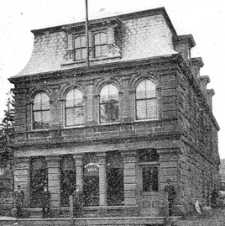
Offices of M. Wood and Sons

Offices of M. Wood and Sons

R. Alder Trueman entered the employ in 1844 as clerk and book-keeper and remained until 1898 when he retired. He is still hale and hearty, although in his 78th year. His high character of honesty and integrity might be referred to as contributing to the high standing of the firm. C. W. Ford entered the employ in 1880 and since Mr. Trueman retired has had a large share of responsibility in the management of the business. Senator Wood was born in 1843, graduated at Mount Allison with Honors in 1863, received the degree of M.A. in 1866 and D.C.L. in 1891. He studied law and called to the bar in 1866. He did not practice his profession but entered his father’s business in 1867. He represented Westmorland in the House of Commons from 1882 to his appointment to the senate in 1895. Politically a conservative, he is also an Imperialist. He is a member of the senate and Board of Regents of Mount Allison University. He is thoughtful and well-informed and his opinions always command respect and attention.

New Brunswick & Prince Edward Island Railway

The head office of this railway is at Sackville, where the principal stockholders reside, Hon. Senator Wood being the President of the Company. This railway was completed in 1887, the charter having been granted in 1873. Traffic has steadily increased as the general business of the country has expanded. Last year it assumed greater importance than formerly, owing to the trial of a winter steam boat on the route between Summerside and Cape Tourmentine. It is said to be the intention of the government to again try this route during the present winter. The N.B. and P.E.I. railway enjoys a good patronage during the summer, conveying numerous excursion parties to the seaside and some considerable tourist travel as well. It is one of the best branch lines connecting with the I.C.R., being free from accidents in the past and kept open successfully during the winter months. In fact it is as well equipped as the present traffic demands.

F.C. Harris

Mr. F.C. Harris is the popular and efficient superintendent, and being a man of well-known mechanical attainments, as well as a businessman generally, the road is fortunate in the acquirement of so good an officer. Mr. Harris is a Sackville boy, being the son of the late John Harris a respected farmer. Early in life Mr. Harris showed a fondness for mechanics, and resisting all persuasion to remain on the farm, he went into the I.C.R. shops in Moncton. Later he was a practical locomotive engineer on the I.C.R. and and subsequently engaged in manufacturing work in the Moncton lock factory. He afterwards gave considerable attention to electrical engineering and was mainly instrumental in establishing the electric lighting system in Sackville, and has been more or less engaged in overseeing this enterprise while occupying his present position. Mr. Harris is 52 years of age and is in religion a spriritual and can talk quite as interestingly on this little understood theme as on the perhaps less difficult themes of mechanics and electrical energy.

Mr. Harris has lately invented and patented an improved snow-plough, the rough model of which has proved highly satisfactory.

A.B. Copp — Barrister

A.B. Copp, M.P.P., studied law in the office of W.B. Chandler in Dorchester and Moncton. He attended Harvard law school in 1892 and subsequently studied two years at Dalhousie, graduating from the latter institution in 1894. He was admitted an attorney in the Michaelmas term of that year and in the spring of 1895 began the work of his profession in Sackville, where he has an excellent practice. He unsuccessfully contested Westmorland County in the general local elections of 1899 but in 1901 he took by acclamation the seat my vacant by the death of W.W. Wells. Mr. Copp has always taken an active interest in politics and makes an admirable representative.

J.E. Hickey — General Merchant

A merchant long and favorably known in Sackville is J.E. Hickey. He began by clerking in the store of the late David G. Dickson in 1872, and ten years later bought out his employer when Mr. Dickson retired from active business life owing to ill health. Since 1882, Mr. Hickey has been at his present stand with the exception of five or six years when he occupied the store now used by C.W. Cahill. He carries a large and varied stock of hardware, staple dry goods and men’s furnishings and has the best line of china in town. He imports china direct from Japan, the articles never seeing daylight after leaving the Flowery Land till their arrival in Sackville. It is unusual to find such tasteful and unusual goods outside of a large city.

He is doing an excellent trade in men’s clothing, having sold among other articles eighty over-coats this fall. Mr. Hickey well-merits his success being active, a capital salesman, pleasant to his customers and is liked by everyone. He is a native of Melrose, N.B., his father being the late John Hickey of that place. There are two other sons in the family, Frank, who travels for a Toronto firm, and James, who does all the fancy turning for Rhodes & Curry, Amherst, N.S. Mr. Hickey is now favoring his customers with one of the prettiest calendars ever issued by a Sackville business concern.

Walter Cahill — Stipendiary Magistrate

Squire Cahill, as he is usually called, was appointed J.P. in 1870. There were then about a dozen or more but in a few years he practically did all the business and has continued to do so ever since. He was made commissioner of the parish court in 1877 and Stipendiary Magistrate in 1884. He has probably done more magistrate business than any other man in the county and is noted for his ability and impartial decisions.

Royal Bank of Canada

D. Cameron, Manager — This bank was incorporated in 1869, opened in Sackville in 1882, and has paid the capital of $2,000,000 and a rest of $1,700,000. It has over forty branches throughout Canada, has foreign correspondents at chief centres. The Savings Bank department is a strong feature of the Sackville branch; sums of $1.00 and upwards are received at most favorable current rates.

Royal Bank, Sackville

Royal Bank, Sackville

Royal Bank of Canada — The present manager is Mr. Duncan Cameron who succeeded Mr. Fulton McDougallon the latter’s promotion to Moncton after fifteen years successful work in Sackville. Mr. Cameron is late of Shubenacadie where he was manager five years and possesses to a marked degree the tact and business acumen necessary to the banking profession. Mr. Cameron’s staff are Messrs. W.W. Read, accountant and teller, A.E. Hopgood, A.W. Sprague and A.C. Smith, all obliging and efficient young officers. No greater tribute could be paid to the great stability of this Bank than the recent investment in its stock of $1,250,000 of American capital.

Halifax Banking Company

W.H. Harrison, Manager — The Halifax Banking Company was a established in 1825 with the head office at Halifax, N.S. The authorized capital is $1,000,000, the paid-up capital $600,000 and the reserve fund $500,000. This bank is one of the oldest as well as one of the strongest in Canada. It has fourteen branches in Nova Scotia and two in New Brunswick, and in the provinces of Ontario, Quebec, Manitoba, British Columbia and North-West Territories its correspondents are the forty branches of the Molsons Bank. In New York the correspondent is the Fourth National Bank, in Boston the National Suffolk Bank, and in London, England, The Parr’s Bank, Ltd. The bank has excellent facilities for collecting drafts and remitting money. Sterling exchange is bought and sold, and deposit receipts are issued bearing interest at best current rate. This bank’s officials are noted for their promptness and care in handling all business intrusted to them. The branch here was opened on May 1st, 1882, succeeding the banking business of M. Wood & Sons, and the officers were Josiah Wood, local agent, Geo. A. Thompson, accountant and teller, and W. H. Harrison, manager, T. Seward Baird, accountant and teller, Donald A. Truemen, ledger-keeper, and Roland N. Rainnie, junior clerk.

The Enterprise Foundry Company

Manufacturers — The manufacture of stoves, ranges and furnaces by the Enterprise Foundry Co., is one of Sackville’s leading industries. This company bought out the firm of E. Cogswell & Co., in 1888 and since that time their business has been steadily increasing. New building have been erected, several additions have been made to their moulding and fitting shops and a thoroughly up-to-date nickel plant has been installed. The company began with eighteen employees but this number has grown to sixty and at present their weekly payroll is over $700. During the last year they have extended their business to Quebec and Ontario, where their goods are meeting with an excellent reception. A strong point with them has been the close study given to patterns to secure the right kind; and as a result, practically every stove turned out in the last six or eight years has been a success. This is one of the reasons of the popularity of Enterprise goods. The Enterprise Hot Blast, invented to take the place, with soft coal, of the hard-coal self-feeder, has had a very large sale in Nova Scotia, and this year in New Brunswick also. It has, this year, been re-arranged so that it burns hard coal as well as soft.

Mr. W.B. Dixon, who is the thoroughly competent secretary-treasurer of the company, has had thirty-two years experience in the stove business. He is a son of the late Charles Dixon and is one of the most popular of Sackville’s citizens. To his good judgement and excellent executive ability is due much of the success with which he has been associated.

T.A. Treen — Traveller

Mr. T.A. Treen is the travelling representative of the Enterprise Company for the Maritime Provinces. He understands the stove and heating business from moulder’s floor to plating department and is very successful in his work. Agencies for Enterprise goods have been planted by him in almost every important place in the lower provinces. He recently opened up trade in Ontario and Quebec where large quantities of the company’s stoves and ranges are now shipped. Mr. Treen is genial, popular and has a large circle of friends who are always pleased to meet him.

H.A. Powell, K.C. — Barrister

Mr. Powell was born on April 6th, 1855. He received his early education in the Richibucto Grammar School and subsequently attended Mt. Allison University, graduating from the latter institute in 1875. He studied law with the late Christopher Milner. Esq., was admitted as an attorney in 1879 and became barrister the following year. He represented Westmorland in the Provincial Legislature from 1890 to 1895 and in the House of Commons from 1895 to 1900. He was appointed QC in 1894 and for the past ten years has been the Alumni Representative on the Board of Regents of Mount Allison University. The firm of Powell, Bennett & Harrison, of which Mr. Powell is the senior member, has a very large practice. Mr. Powell is a clever speaker and has hosts of friends.

W.A. Warren, Phm. B. — Druggist

In May 1899, Mr. Warren graduated from Ontario College of Pharmacy and a month later received the degree Bachelor of Pharmacy from the University of Toronto, passing with Honors the severe examinations of that institution. In August ’99 he bought his present drug business from E. A. Moore and now carries double the original [stock of] toilet articles and fine perfumes. This year he purchased sufficient pharmaceuticals from Parke, Davis and Co. to become wholesale agent for their goods. This is the only Drug Store in Westmorland County having this advantage. The preparations of this well-known firm represent the highest standard for quality and reliability. This with a thoroughly well equipped dispensing department enables Mr. Warren to give such satisfaction as is nowhere excelled.

Fawcett Brothers

Fawcett Brothers

Gaius Fawcett, Fawcett Brothers — Grocers

Fawcett Bros. is a firm of two years standing and already has one of the largest grocery trades in town. Both young men have had considerable experience and thoroughly understand their business. The boot and shoe department showing strong business increase in its business, they intend giving special attention to this line. Crockery and china also form no small part of their trade. In fruit and confectionery they keep up a leading reputation.

THE END (PART I)

So dear friends, members of the Tantramar Heritage Trust, I hear Santa checking his bells, waxing his sleigh and exercising Rudolph for the big day. So when he arrives to your chimney, may he find you all in good health and preparing for a new year of heritage discoveries and many more happy visits to The White Fence.

MERRY CHRISTMAS AND A HAPPY NEW YEAR TO ALL!

—your friendly editor and members of the Tantramar Heritage Trust’s executive and all members of the Board of Directors — enjoy, keep healthy and play safe!

High Noon on the High Marsh Road: The Many Dimensions of Law Enforcement

A rollicking chorus from Gilbert and Sullivan’s The Pirates of Penzance rings down the years: When constabulary duty’s to be done to be done The Policeman’s lot is not a happy one. Dating from 1880, this well-known musical portrayed popular opinion of policing both then and now.

Respect for law and order is a hallmark of civilized society. It follows that its enforcement, however unpleasant for the constabulary is essential. Worth noting is that the establishment of Sackvilles Police Department was related to incorporation of the town in 1903. One of the most important factors in the Yes campaign was the need for a local police force.

An attraction of Sackville as a place to live is its low rate of serious criminal activity. A glance through past records reveals that the majority of charges and convictions have been related to break and enter, theft, common assault, vandalism, traffic violations along with liquor and drug infractions. While not in any way downgrading these offenses, a few minutes clicking the television remote, or surfing the Internet will reveal how fortunate we are.

For more than half of its history, the Sackville police force consisted of a chief of police (sometimes referred to as town marshal) and one constable. Also available was an officer employed by the Canadian National Railway, who often assisted local police in times of emergency or illness.

Today, nearly fifty years later, the composition of the Sackville police force is very different. Under the direction of Acting Deputy Chief Dale Mitton, it is a force of ten members plus one part time officer and a secretary. In the early days, police entered the profession with little in the way of formal training. By contrast, all active members of the present force are graduates of the Atlantic Police Academy

Acting Deputy Chief Dale Mitton, although relatively new to Sackville is a seasoned police veteran. He was appointed last August following 30 years service with the Moncton Police Force and the RCMP. Since his retirement from the RCMP he has undertaken a number of special policing assignments. However, with family roots in Port Elgin, Mitton remarked that he feels very much at home in Sackville. During a wide-ranging interview the unique role of the Sackville Police Dog Program was discussed. One illustration will underscore its significance.

The Program began with Constable Dale McCluskeys interest in the role of dogs in policing. In 1995 with the support of Chief Stewart McFee, he was able to procure a German Shepherd dog named Reuben. Following completion of a short course in canine training, he took on responsibility for teaching Constable Reuben. A mere nine months later, the dog made his first drug related arrest.

Constable McCluskey emphasized that a key ingredient in establishing the Program was support given by local firms and organizations. These included: the Lions Club, Police Association, Johnstones Save-Easy, Sackville District Ambulance and Atlantic Towing.

Without question Reubens finest hour took place one bitterly cold winters day in late February 1998. Three inmates from the Westmorland Institution in Dorchester had escaped and were believed to be on the loose in the Sackville area. A motorist near the CBC towers on the Trans Canada Highway noticed people out on the marsh a highly unlikely place on such a day. He called the RCMP, who immediately contacted Constable McCluskey. Within minutes he and Reuben were on the scene.

As Constable McCluskey explained: On my command, Reuben immediately started to follow tracks in the snow sometimes these were not even visible to the eye, as the ground was ice covered in places at times Reuben was literally pulling me along over the ice. It soon became obvious that we were headed in the direction of Sunken Island. This information was relayed to the RCMP, who contacted a helicopter, already enroute to help in the search.

Meanwhile, members of the Department of Natural Resources and police were staked out on the High Marsh Road. McCluskeys hunch was correct. The suspects were spotted heading for the shelter of some woods on Sunken Island. By this time, Reuben was in high gear as he realized that his quarry was close at hand. Very soon, the dog was circling the terrified escapees, huddled in the snow.

As his trainer explained: We were very apprehensive at first, because we did not know if the prisoners were armed. There had been reports of break and enter overnight, and there was always the possibility some firearms might have been stolen. The atmosphere was almost surreal, with snow swirling around and the hovering chopper overhead it was like a scene from a movie. Fortunately the suspects were unarmed and soon in custody.

Overall Reuben was responsible for some 40 arrests and the retrieval of approximately $100,000. in stolen property and drugs. Most regretably in 1999, just as he was hitting his stride, the dog was struck by a genetically related illness and died. McCluskey was faced with a decision. Would he attempt to train another dog? After mulling it over, he decided to obtain a second German Shepherd dog.

There was one problem the new dog was unnamed. The decision was referred to students at Salem Elementary School. Soon McCluskey was inundated with over 100 suggestions. In this long list, identical nominations were submitted by two students: Samantha Drew and Aaron Morrison. As he recalled: the suggested name Thunder was so appropriate, that I immediately declared two winners! To date, Thunder is following successfully in his predecessors footsteps, with more than 20 arrests to his credit. Watch the Police Beat for further details.

In addition to all the normal constabulary duties, another dimension to local law enforcement has become evident in recent years. Never likely to claim headlines it is, nonetheless, of prime importance. The Department has made a concerted effort to liaise directly with the community it serves.

This outreach began in 1987 when Corporal Ted Doncaster was assigned to part time duty at Tantramar Regional High School. Although the program is no longer in operation, several members of the Sackville force have continued to work closely with local schools. Such activities as Pre Halloween lectures, safety demonstrations, classroom visitations, a Safe Grad program and participation in Salems HARE Week read-ins are a few examples.

It will be no surprise to learn that Thunder is a popular school visitor. Officers McCluskey and Doncaster, with Thunders help, have developed a routine that has proven highly effective. While the latter is discussing problems associated with drugs, alcohol and nicotine addiction, his partner is hiding small packets of contraband. Then the star performer, Thunder is called in and commanded to sniff them out. To the students delight, he never fails to do so.

Nor are outreach programs limited to schools. Sponsorship of events such as: the Fall Fair Soap Box Derby, Tug of War Competitions, a Neighbourhood Watch and Block Parent program, baby-sitting courses, the provision of trophies for minor hockey, special Police Week activities each May, and lectures to church groups and other organizations have become part of community life.

During our interview Acting Deputy Chief Mitton expressed his satisfaction with the cooperative spirit that exists between the Town Police and the local detachment of the RCMP. In addition, because of the proximity of Amherst and Sackville and despite the provincial boundary, close collaboration between the two Police Departments has evolved over the years. He also noted that since there is no other police dog nearby Thunder is on call to all neighbouring police forces.

To coordinate activities representing the many dimensions of law enforcement, a committee to encourage formal community input was recently reactivated. It consists of Vernon Crosthwaite, Ted Doncaster, Joanne Goodrich, Ross Monk, Jane Robertson, David Slipp and Tammy Scott-Wallace. Additional members from Mount Allison, Tantramar High and the local Quality of Life Committee will augment this group. For the record constabulary duty and community outreach are both integral parts of law enforcement. As the Acting Deputy Chief expressed it: My philosophy has always been that we are working with the community, in the community and for the community.

Surveying Canada’s Symbols of Remembrance

Sometimes dates become automatically etched in our memories. Where were you when you heard news of the terrorist attacks on Sept. 11? Will you ever forget the television coverage that immediately followed? Few people will have difficulty remembering the date that changed the history of the world; to use an overworked description of the tragedy.

Eighty three years ago, on the eleventh hour, of the eleventh day, of the eleventh month, World War One came to an end. Nov. 11, 1918 is another of those dates that has become firmly fixed in our consciousness. Why?

Certainly not because this conflict ended all wars as it had been hoped. Incredibly, there was never a year during the remainder of the 20th century that did not witness armed conflict. Even now, as a new century is barely underway, the reality of war is, once more, upon us.

There are several reasons why Nov. 11, 1918 embodies significance for this country. Canada entered World War One as a colony and emerged a nation. This came about because of a war effort that went well beyond expectations; given our population. It was underscored by Canadas heroic commitment on the battlefield, and by the horrendous price paid, through some 60,000 casualties and 173,000 wounded or gassed.

This does not, by any stretch of the imagination, denigrate or belittle Canadas key role in other wars of the 20th century or the country’s part in numerous UN peacekeeping missions. It’s simply the date of a defining moment in our history; and one that has come to commemorate the fallen of all wars.

For these reasons, on Nov. 11, 2001, Canadians will gather at cenotaphs thoughout the country. It matters little whether one is witnessing the pomp and precision of the ceremonies at the National War Memorial in Ottawa, or events unfolding before a simple granite shaft at a country crossroad. The object is clear, the mood and symbolism the same.

How often have you witnessed this familiar scene? More than a half century on, the pace of World War Two veterans in their blazers and grey flannels, with medals on display, is slowing down; their ranks thinning as each year passes. They draw alongside a clutch of spectators swelled by squads of militia, cadets, guides and scouts. The colour party and clergy take their place. Flags, gowns and cassocks stir in the chill breeze.

The haunting strain of the Pipers Lament fills the air. Then come the traditional prayers, the roll call of the fallen, the placing of wreaths, two minutes of silence and the echoing tones of the Last Post. All too quickly, it seems, people disperse.

Among the mound of wreaths left at the base of these many cenotaphs, the striking blood red of the poppies catch our attention. How did these small flowers come to occupy centre stage on Remembrance Day?

During the Napoleonic Wars of the early 19th century, it was noticed that after the fighting was over, the war torn battlefields became carpeted with red poppies. During bombardments, the chalky soil was enriched by lime from the grim rubble of war. Thus fertilized, poppies soon appeared. In World War One, the same conditions prevailed, especially in the Flanders area of southwestern Belgium.

The presence of these flowers caught the attention of Lieutenant Colonel John McCrae (18721918), a member of the Canadian Army Medical Corps. The result was Canadas most famous poem, soon to be known world wide: In Flanders Fields the poppies blow/Between the crosses, row on row/That mark our place: and in the sky/The larks, still bravely singing, fly

For almost eighty years, the distribution of remembrance poppies has been in the hands of the Royal Canadian Legion. The idea was fostered by a British army engineer, Major George Howson, who was severely injured in action on the Western Front. The first Poppy Day was held on Nov. 11, 1921. The following year, Howson and five employees began the manufacture of the familiar artificial poppies, in an old factory in Richmond, Surrey, on the outskirts of London. Still in operation, it ironically survived a direct hit during the blitz of World War Two.

The wearing of a poppy in memory of the fallen soon spread around the world, and it is now accepted as a universal symbol of remembrance. The money raised enables the Legion to help those injured during past and present conflicts and to offer support to their families.

Three other Canadian symbols must also be noted. Two are in Ottawa, the other overseas, on a European battlefield. Any visitor to Parliament Hill cannot miss the National War Memorial. Dominating Confederation Square, it will again be the focal point of a Service of Remembrance on Nov. 11th. Not far away, is the Peace Tower, in the centre block of the Parliament Buildings. Within, the Memorial Chamber and Books of Remembrance honour the 116,031 Canadians who did not survive war.

The third and most dramatic Canadian Memorial stands 6,000 kilometres away, near Vimy Ridge in France. It marks the site of a battle that took place on Easter Sunday, April 9, 1917, when 100,000 Canadian troops, stormed and captured the Ridge. Noteworthy is the fact that this was the first time in which all units of the Canadian Army fought together. When the dust of battle had cleared away, it became clear that the cost was high, very high; 3,600 Canadians were dead and 7,000 wounded.

The monument was designed by Canadian sculptor Walter Allward (18751955) and took 15 years, from 1921 to 1936, to complete. When asked to explain the symbolism, he stated that the design came to him in a dream. Dominating the monument are two lofty pylons or sentinels suggesting Canadas two founding races.

Between these, there is a depiction of the Spirit of Sacrifice throwing the torch to comrades. Carved figures commemorate: Peace, Justice and Truth among other virtues. Allward concluded: In plain terms, it was to be an everlasting memorial. The base, pylons and twenty figures were constructed from 8,000 tons of Adriatic marble. It was unveiled by King Edward VIII in 1936.

The awe-inspiring task of sculpting the Vimy figures is featured in a novel The Stone Carvers by Jane Urquhart. On the short list for both the prestigious 2001 Giller Prize and the Governor Generals Award For Fiction, the novel is a recommended read for anyone interested in World War One. A reviewer has written: In positioning the parts of Europe that survive in Canada, with a part of Canada memorialized in Europe Urquhart tackles something more ambitious than she has ever done before.

In reflecting on recent international events, a comment by British Prime Minister Tony Blair has special relevance, as we approach Nov. 11, 2001. He said: We should try to understand the causes of terror. But let there be no moral ambiguity about this; nothing could ever justify the events of 11 September, and it is to turn justice on its head to pretend it could.

The World War One poet, Siegfried Sassoon (1886–1967), provides us with a thought provoking postscript: Have you forgotten yet? Look up, and swear by the green of spring that youll never forget.

A Dip in Federal Politics: The Three Sackville Senators

Just in case you may be wondering this column is not about a hockey team; although, if you continue reading, youll find a reference to the sport. Instead, it will highlight three members of the Canadian Senate, all of whom called Sackville home.

Last fall during the federal election, it was noted that an unusually large number of Westmorland MPs later became Senators. It even appeared to be the most obvious route to the Senate. However, over the years, there have been exceptions, including a Senator to be mentioned in this column.

Another exception, is present day Senator and Port Elgin native, John Bryden, appointed in 1994. His younger brother Rod Bryden, did not have to look far when naming his NHL hockey team, the Ottawa Senators! Now back to history.

The 1890s were unsettled years in Canadian federal politics. On June 10, 1891, Prime Minister Sir John A. Macdonald died. With no obvious successor in sight, Canada was to experience four Prime Ministers during the next five years.

It was one of these almost unknown Prime Ministers, Senator Sir Mackenzie Bowell who appointed the Westmorland MP, Josiah Wood, to the Upper House in 1895. He was the first native of Sackville to be so honoured. While a Senator, Wood also had the distinction of being elected the first mayor of Sackville in 1903.

Following graduation from Mount Allison, a member of the first class of 1863, Josiah Wood practiced law, but soon switched careers to devote full time to the family business. This included the building and ownership of a large fleet of ships. These traveled around the world during the Golden Age of Sail; bringing considerable prosperity to the area.

Josiah Wood was sworn in and took his seat in the Senate, on Jan. 7, 1896. In keeping with his business background, Senator Woods first speech stressed the importance of trans-Atlantic trade. Recognizing that the age of sail was over, he pointed out the geographical advantages of Eastern Canada as a terminal for steamship service to Europe. He asked: Why should New York have a monopoly of this trade?

Throughout his years in the Senate, Josiah Wood’s speeches were brief and to the point. However, one matter did arouse a spirited response. MPs and Senators were about to vote themselves a raise. This provoked suggestions in the press that the Senate was too expensive, and ought to be abolished. A refrain that may still be heard, nearly a century later.

In a speech on Mar. 24, 1908, Wood mounted a strong defense of the Senate. However, to the dismay of many colleagues, the Senator vigorously opposed the proposed pay hike. When the increase was finally approved by both Houses, the Senator from Sackville refused to accept the extra stipend. Instead, he ordered that the extra money so earned, be invested in a special trust fund for some future worthy cause.

On Mar. 6, 1912, Senator Josiah Wood became one of a very small number of Senators ever to resign their seat. This time, another important honour awaited him. He was named lieutenant governor of New Brunswick by Prime Minister Sir Robert Borden. Wood served in this post until 1917. He died at Sackville on May 11, 1927.

Just prior to Woods death, details of the promised Trust Fund were revealed. He established the Josiah Wood Lectureship, designed to bring to Mount Allison distinguished persons who had contributed to public life. Provision was also made for publication of the lectures. Since their inauguration in 1927, fifteen individuals have been invited to give the Josiah Wood Lecture. Speakers have included such well known figures as: Governor General Vincent Massey, Dr. Wilder Penfield, Robert L. Stanfield and John Kenneth Galbraith.

In common with the 1890s, the 1920s were stormy years in Canadian federal politics. For most of the decade, successive minority governments clung to power, with a western protest party, the Progressives, holding the balance. At the beginning of the decade, Sir Robert Borden resigned as Prime Minister, to be succeeded by Arthur Meighen. In an election held on Dec. 9, 1921, the Meighen administration was defeated and Mackenzie King became Prime Minister for the first, but not the last time in his long career. One of Meighens final acts before the election, was the appointment of Sackvilles Frank Bunting Black to the Senate.

Senator Frank B. Black was born on Feb. 28, 1869 and married Eleanor Louise Wood, a daughter of Hon. Josiah Wood, on Feb. 24, 1898. Following graduation from Mount Allison, he entered the family business, becoming President of Joseph L. Black & Sons Ltd. In addition, he was also involved in a wide array of enterprises ranging from the New Brunswick Telephone Company to Marvens Limited of Moncton. As well, Senator Black served on the boards of several Maritime firms.

A distinguished military career began in 1890 when he joined the reserve unit of the Princess Louise Hussars. Serving on active duty overseas in World War One, he was promoted to colonel and gazetted brigader-general. Mentioned in dispatches and the recipient of several service medals, Black was wounded in December 1915. Aside from war service, Senator Black was mayor of Sackville 191718, and completed a term as MLA in the New Brunswick legislature.

In the same year that Senator Black was appointed to the Upper House, another Sackville resident, Arthur Bliss Copp (1870–1949) was re-elected to the House of Commons. A native of Jolicure, he also attended Mount Allison. This was followed by studies at Dalhousie Law School and Harvard. Admitted to the Bar of New Brunswick in 1895, Copp was to practise law in Sackville for the next 22 years. This period included a long apprenticeship in politics, first as MLA (1901–12) and MP (1917–1925).

In 1921, A.B. Copp was selected by Prime Minister Mackenzie King to be Secretary of State and New Brunswick representative in the federal cabinet. Copp served in this post until appointed to the Senate on Sept. 25, 1925. In common with his fellow Sackville Senators, Copp took his turn in the Mayor’s chair in 1931.

For 20 years, until Senator Blacks death on his 76th birthday, Feb. 28, 1945, Sackville could lay claim to two representatives in the Senate, a Conservative from York Street and a Liberal from Bridge Street. Few other small towns, either before or since, could say the same. Space does not permit a full discussion of their long careers. Instead, what follows are comments made by people who knew both men personally.

Of Senator F.B. Black, the Sackville Tribune’s C.C. Avard wrote: Keen of intellect, he was an administrator of notable ability Looking back, I forget our differences and cherish only a kindly memory of Frank Bunting Black. Another referred to Blacks personality: F. B.(as we called him) was tall and had a military mien; leading people to think he was distant. Actually, inside, he was soft and affectionate, though shy.

Senator A.B. Copp outlived his colleague by four years. He died at Newcastle NB on Dec. 5, 1949. The previous week Copp had been in his place in the Senate as Deputy Government House Leader. As the House rose for the weekend, he assured a fellow Senator: I’ll be back on deck sometime next week. While enroute home to Sackville by train, he fell ill and died in the Newcastle hospital.

The Government House Leader and fellow Maritimer, Hon. Wishart MacL. Robertson, paid a glowing tribute to Senator Copp. After summarizing his lengthy political career, Robertson concluded: He was considerate, he was loyal; he was forthright and solid as the Rock of Gibraltar.

Adding to this comment, C.C. Avard wrote: Copp was a lawyer, statesman and orator Sackville will remember A.B. as a genial and friendly man, known by people in all walks of life he never lost the common touch.

Mount Allison’s First President: The life and Times of Dr. Humphrey Pickard

On Saturday October 13th, 2001 A. Wayne MacKay will be installed as Mount Allison’s thirteenth President. Such an occasion, important to both town and gown, prompts consideration of the life and times of Mt. A.’s first President, Dr. Humphrey Pickard (1813–1890).

Two strands of New Brunswick history are found in Pickards ancestry. The first may be traced to the village of Rowley in Yorkshire. It’s located in the same Yorkshire countryside, from where more than a century later, others would emigrate in numbers to the Tantramar.

A second strand concerns John Pickard, son of Rev. Henry Pickard, once rector of the Anglican Church in Rowley. He, along with his family, became part of the Puritan emigration to Massachusetts in 1644. Settling in Essex County, Massachusetts, the Pickards helped found a town, located near Newburyport. It was also to be named Rowley.

In 1763, Johns grandson, Moses Pickard (1719–1804), a blacksmith by trade, emigrated to what was then described as the continental part of Nova Scotia. He settled on the east bank of the St. John River, in a community that became known as Maugerville. Over the years, a direct descendant of a 17th century Yorkshire emigrant to Massachusetts became part of the 18th century New England Planter migration to what later became New Brunswick. By this time the family were Congregationalists.

One branch, headed by Thomas Pickard (1783–1866), a grandson of Moses, moved to Fredericton. Here he became a successful merchant. A son, Humphrey, and the subject of this Flashback, was born on June 10, 1813. His mother, Mary Burpee (1783–1833), also of New England Planter background, was a devout Methodist and played a key role in the conversion of her husband and son to Methodism.

Their New England Planter roots were to remain strong. At age 16, Humphrey Pickard was enrolled in a Methodist boarding school, located at Wilbraham, in south central Massachusetts. Still in existence as Wilbraham-Monson Academy, it makes the claim of being the first co-educational boarding school in the United States. Here Humphrey Pickard came under the influence of its principal, a well known Methodist clergyman and educator Dr. Wilbur Fisk (1792–1839). Shortly afterward Fisk was named the first president of Wesleyan University, in Middletown, Connecticut.

Pickard, who followed his mentor to enroll at Wesleyan, also made a decision to enter the Methodist ministry. Following graduation in 1839, he served as a probationer on the Miramichi for two years. In 1841 Humphrey Pickard was appointed to Saint John and ordained the following year. In addition, he became editor of the Wesleyan Methodist Magazine.

Meanwhile, other events were unfolding that would have a bearing on Pickards career. For some time, Methodists had been considering establishing a seminary or academy for the Maritimes. In June 1839 at the New Brunswick District meeting, a proposal from Sackville businessman, Charles Frederick Allison (1795–1858), was considered and accepted.

In it, he offered to purchase a site in Sackville, erect a suitable building for the proposed academy and further, to donate 100 per year for the next decade. Allison was later to confess: The Lord hath put it into my heart to give this sum toward building a Wesleyan Academy I know that the impression is from the Lord, for I am naturally fond of money.

By 1842 a projected opening date, Jan. 19, 1843, was established. Now the search began for a suitable Principal. Both clergy and laity were divided on the matter. Those with ties to British Methodism felt that only a graduate of an English university could set the right tone for the new Academy. Others were convinced that a native son with knowledge and appreciation of the local situation was needed. In the end an emergency choice was made. The mantle fell to the 30 year old editor of the Wesleyan Magazine . As events were to prove, the emergency choice turned out be a wise decision. By this time Humphrey Pickard was married to Hannah Thompson (18121844). Also a graduate of Wilbraham Academy, she was later an instructor at the school. Interested in writing, Hannah dabbled in poetry, wrote short sketches and one novel The Widows Jewels.

In the midst of a cold snap in mid January of 1843, the stagecoach from Saint John jolted some 130 miles to Sackville. Inside, Hannah Thompson Pickard and her four month old son received protection from the bone chilling wind. She later confided in her journal: My husband traveled outside with the driver his coat white, his hair and whiskers hoary with frost, even his eyebrows and eyelashes were icicled I scarcely recognized him.

Once in Sackville, Methodist hospitality took over and the Pickards were entertained by Charles F. Allison and his wife, before moving to their quarters in the Academy building. Classes did begin on time, with seven students and one teacher, in addition to Principal Pickard. Soon the noble Methodist experiment became highly successful. So much so, that in 1848 a decision was made to open a female branch. This objective was fulfilled in 1853 with Humphrey Pickard as Principal of both the Academy and Ladies College. Mount Allison Wesleyan College (which later evolved into Mount Allison University) was organized in July 1862, in accordance with a charter obtained from the province of New Brunswick.

Unlike the Principalship of the Academy, there was little debate about naming the first College President. Over the years, Humphrey Pickard had proven his mettle. Also, it did not hurt that he happened to be President of the District Methodist Conference during the crucial debates preceding the opening of the College. Mount Allisons historian, Dr. John Reid, commented on the event: Pickard entered on his duties with gusto.

During the next seven years Humphrey Pickard placed the new college on a sure footing. His resignation in 1869, due to ill health, was accepted with genuine regret. He then moved to Halifax to accept a less demanding post as editor of The Wesleyan. Throughout the rest of his life, Pickard maintained close ties with Mount Allison and was active in raising an endowment fund for the still struggling institution. Following his second retirement, he returned to Sackville and served for one year, 1876, as interim minister of Sackville Methodist (now United) Church. He died Feb. 28, 1890.

Its clear that Dr. Humphrey Pickard left his stamp on Mount Allison. Also noteworthy, is that he did so, despite the tragedies that befell his early married life. In 1844 the Pickards second child, a son, lived but a week. A month later, at age 32, his wife, Hannah, died. Within the year, their first son, also died. Later, in 1846, Pickard married Mary Rowe Carr (18101877), another New Englander, and native of Portland, Maine. One of their two daughters, Mary Emerancy Pickard (18471918) was to be the mother of Mount Allisons first Chancellor, Ralph Pickard Bell.

While the concept of a co-educational university with an emphasis on the liberal arts is accepted today; this was not the case in the mid-19th century. One principle formed the core of Pickards presidency. Higher education should be open to all, regardless of religious beliefs. This was also basic to Methodism, as exemplified in Wilbraham Academy and Pickards alma mater, Wesleyan University.

From their beginning, none of the Mount Allison institutions imposed religious tests upon entry. A further principle was heralded by the establishment of the Ladies College. Although the granting of degrees to women had to wait a few years, Mount Allison, under Pickards leadership was already in the vanguard. Lastly, the course of study for the new college was framed on Pickards belief in a liberal education; with a mix of classical and scientific courses.

Of the Presidents of Mount Allison to date, it is the sixth, Dr. Ross Flemington, whose career most closely parallels that of Dr. Humphrey Pickard. Both were clergymen who served their apprenticeship at the Academy. Both left the parish ministry for a career in educational administration. While the sometimes austere Pickard lacked the charisma and oratorical skills of Flemington, he made his mark as the builder and founder of a new university.

It was no coincidence that in a Founders Day address, President Ross Flemington called for a memorial tablet in Mount Allisons new chapel to honour the life and times of Dr. Humphrey Pickard. He went on: His monument is all around us, yet not in these handsome and commodious buildings but in the advanced state of education as it now exists in our land. He added: I think Charles Frederick Allison would have agreed with this estimate.

The White Fence, issue #16

October 2001

Editorial

Dear friends,

Another year of mining the great riches of Tantramar’s history is before us and I can’t wait to see what gems my fellow miners will bring up from the depths this year! A few weeks ago, senior miner Al Smith surfaced long enough for air and passed on a special treasure which I am happy to share with you here.

In his hands, Al held a copy of a letter written by Mr. Gerome Noble at Fort Cumberland on October 29, 1757, to his brother James in Ireland around the time of the Eddy Rebellion. This precious document (in beautiful hand- writing!) is owned by Mr. Patrick J. Burns in Vancouver, B.C., a collector of historical documents, who purchased the letter at auction (in St. Louis?). The transcription was done by Mr. and Mrs. Ben Griffin of the Fort Lawrence Heritage Association and we sincerely thank Mr. Frank Trenholm for allowing us to reprint the letter here. Please note that I have left all the spelling errors and the formatting (i.e. no paragraphs) unchanged from the original (in other words, none of these errors are due to Mr. and Mrs. Griffin but are the responsibility of Mr. Noble himself!).

Furthermore, Al’s bag of gems also contained a copy of an article from The Springhill Record dated July 28, 1938. It’s an article which describes when the ashes of Major Thomas Dixson, an important player player at Fort Cumberland during the Eddy rebellion, were brought from an unmarked grave and re-interred on the grounds of Fort Beauséjour; the gravestone now holds a prominent position at the site of Fort Beauséjour in Aulac.

The Eddy Rebellion has played an important role in the history of the Tantramar region and included in the pages of this newsletter is a “calendar of events” for the month of November, 1776, what was a busy month for Jonathan Eddy and Thomas Dixson in that special year!

And along with this special collection, Al also had a copy of the history of Sackville which he had written for the Amherst paper last summer. I’m sure I’m not the only one who hadn’t seen it so I pass on a copy of it here.

The day after I spoke with Al and I sat polishing the precious package in my hands, Colin MacKinnon stopped by and an interesting discussion about the Eddy Rebellion; I soon found myself grasping for paper to write a few notes and within minutes there just wasn’t enough paper in the room for me to keep up with him!! Much of those exchanges appear below.

So, as we begin another year of mining the rich ore deposits of Tantramar history, open up your memory banks and spill them in my direction over the next few months; but in the meantime, pay attention to the treasures which follow and, like fellow miners Helen Walton, Sylvia Yeoman and Bob Estabrooks in our last issue, pass on your precious gems to your grateful banker (me!) and I’ll cash them in for you at The White Fence (at no charge!).

—Peter Hicklin

A Brief History of Sackville, N.B.

by Al Smith

The picturesque Town of Sackville, nestled on the edge of the expansive and fertile Tantramar marshes, is one of New Brunswick’s oldest communities. The town has a European settlement history dating back nearly 300 years and aboriginal peoples have used the area for more than 3000 years.

The first permanent settlers were Acadians. In 1708, the eldest sons of five families (Hache, Bourque, Bernard, Richard and Gaudet) from Acadian settlements near Nappan/Maccan (just south of present Amherst, N.S.), pioneered the Sackville area by establishing homesteads from Westcock to Middle Sackville. The settlement prospered and by 1752, a few hundred people occupied the sinuous marsh edge bordering on the Tantramar River. The largest village was “Tintamarre” in present-day Middle and Upper Sackville.

British forces captured Fort Beauséjour in June, 1755, and shortly thereafter, most Acadian residents were expelled from the area. Harassment of British military installations by French “guerillas” and their Micmac allies continued until the fall of Quebec in 1759 which ended all hopes that Acadians may have been able to repossess their lands. The end of guerilla warfare thus led to a greater sense of security for potential settlers.

Nova Scotia’s governor Lawrence issued a proclamation in 1758 inviting New Englanders to come to Nova Scotia (which at that time included all of present-day New Brunswick) and take up free land grants. Military personnel completing their enlistments at Fort Cumberland (formerly Beauséjour) were offered land grants in 1760 and some stayed to establish homesteads in the area that was later to become Sackville. Governor Lawrence’s proclamation led to the arrival of the New England Planters, colonists to Nova Scotia. The first major “wave” of “Planters” to the Sackville area occurred in 1760-61 when 25 families arrived. Family names such as Tower, Estabrooks, Cole, Finney, Seaman, Robinson, Brownell, Ward and others came to the area largely from Rhode Island. Additional waves of immigrants from New England arrived in 1762-63 (Oulton, Tingley, Ayer, Richardson and others) as well as a group of 13 Baptists from Swansea, Massachusetts, who established the first Baptist Church in Canada.

The Township of Sackville, along with the neighbouring townships of Cumberland and Amherst were laid out in 1762-63, each containing 100,000 acres and the first formal grants were issued in 1765. The Sackville Township held its first meeting on 29 July 1762 when first steps were taken towards establishing a municipal government. The name Sackville was chosen to honor Lord George Sackville (1716–1785), commander of the British Forces. In 1763, the Township of Sackville consisted of 20 families and modestly expanded to 349 persons by 1767. Nearly all were from New England.

Settlement of the granted lands did not proceed as quickly as was hoped for by the British authorities and some New Englanders were wanting to sell their properties and return home. Thus in 1769-70, Lieutenant Governor Michael Franklin went to north Yorkshire, England, to seek immigrants for Nova Scotia. His efforts prompted the “Yorkshire Immigration” of 1772-75 when over 1000 settlers left Yorkshire bound for Nova Scotia. In contrast to the New Englanders, the folks from Yorkshire were mostly tenant farmers in old England and they left for Nova Scotia “in order to seek a better livelihood”. For the most part, Yorkshire settlers did not receive grants from the government but they arrived with money and purchased their lands from the New England settlers who were preparing to leave.

The Chignecto region, including the Township of Sackville, felt the greatest impact of the Yorkshire immigration. Families settling in Sackville were: Dixon, Bowser, Atkinson, Anderson, Bulmer, Harper, Patterson, Fawcett, Richardson, Humphrey, Wry, and others. The Yorkshire folk established prospe- rous farms and erected the first Methodist chapels in Canada, including one in Sackville in 1790.

Many of the Yorkshire families found themselves caught up in the Eddy Rebellion of 1776 when a group of new Englanders and sympathizers laid siege on Fort Cumberland. Yorkshire loyalty and assistance to the British forces helped quell the rebellion and prevented the Province from becoming the 14th State in the Union. Following the American wars of independence, United Empire Loyalists came to the Province in 1784 with a few families settling in Sackville; these included Knapp, Palmer, Purdy and others.

The centre of the Town of Sackville, as we know it today, began to emerge around 1840 following the opening of the new bridge across the Tantramar River and the new “post” road across the marsh. Prior to that, the centre of the community was in Middle Sackville clustered around the Mills (sawmill, grist and carding mills) and Millpond which we know as Silver Lake. The Mills were established as early as 1764 and may already have been a millsite used by Acadians prior to 1755. The Morice family operated the Mills and a large woodworking shop at that site from 1821 to 1939. While agriculture was the mainstay of the community, associated businesses included tanneries, leathergoods factories, carriage factories and blacksmith shops. Samuel Black built a large store in Middle Sackville in 1839 which developed into Joseph L. Black and Sons — a large lumber, mercantile and eventually a food wholesaling business.

Middle Sackville was a thriving community in the 1830s while Lower Sackville (the town centre today) consisted mainly of scattered large farms. The man largely responsible for changing that was William Crane, a son of a Planter family from Grand PrÈ, N.S. He moved to Sackville in 1804 and established a successful store and trading business on the Lower Fairfield Road (near the present Estabrooks Service Centre). When fire destroyed that business he re-established to what is now the centre of the Town and is still known locally as Cranes Corner. His new store was built on the site of the present Sackville Town Hall and in 1836 he constructed his magnificent stone mansion across the street. The mansion is now the home of the president of Mount Allison University.

William Crane had been a member of the NB House of Assembly since 1824 and in the mid 1830s he began to lobby for a new more-direct road to Nova Scotia, rather than the old High Marsh Road into Middle Sackville. When the new bridge and road were opened in 1840, he also secured a postal contract for mail distribution to New Brunswick. Thus stage coaches no longer rumbled through Middle Sackville and a significant shifting of the communities’ economic base was initiated.

Coincident with Crane’s 1840 endeavours was the establishment of the Port of Sackville and the emergence of a significant shipbuilding industry along with the establishment of Mount Allison University. The first public wharf was constructed in 1841 on the edge of the Tantramar River at the end of Landing Road and was an active trading and business centre until the early 1920s when the Port became unusable due to a change in the course of the River. Shipbuilding had begun in 1824 when William Crane had the 129t Brig “Charlotte” built by the Boultenhouse family. The last vessel built was the 32t Schooner “Three Links” in 1898 and during the intervening years a total of 165 ships were launched from local yards. The three largest yards: Boultenhouse, Dixon-Wood and Purdy were established on the Tantramar River in Sackville beginning in the early 1840s. The largest vessel was the Sarah Dixon (1468 tons), built by Charles Dixon in 1856 and named after his wife Sarah (Boultenhouse) Dixon.

Sackville as a community began to mature in the 1840s with a shift from an agricultural orientation to a commercial one. The first of two foundries, Enamel and Heating Products Limited opened in 1852 followed by the Enterprise Foundry in 1872. Both foundries produced a full line of cooking and heating appliances that were shipped all over the world. In 1984 the two foundries were merged and the company Enterprise Fawcett Inc. still produces heating and cooking appliances.

The beautiful campus of Mount Allison University, that today contributes so much to the unique character of the Town of Sackville dates back to 1839. That year Charles F. Allison, a business associate of William Crane, proposed the establishment of a Mount Allison Wesleyan Academy for boys in Sackville. The institution opened in 1843 followed eleven years later by the Mount Allison Ladies Academy. In 1862 Mount Allison Wesleyan College was established and was a full degree-granting institution. One of its first two graduates was Josiah Wood, who later became a lawyer, prominent business-man, politician, developer of the NB-PEI Railway, Lt. Gov. of the Province, and possibly Sackville’s most prominent native son. In 1886, the name Mount Allison Wesleyan College was shortened to Mount Allison College and in 1913 to Mount Allison University. One of the oldest Art Galleries in Canada, the Owens Art Gallery, was moved to the Mount Allison campus in 1893.

The downtown business core blocks were mostly constructed at the turn of the century and one of them, the Wood Block, has a Provincial Heritage site designation. Sackville was booming at the turn of the century and, with a population approaching 2000, a move was afoot that it be incorporated as a Town. That incorporation occurred in January 1903. Today with a population of over 5500 occupying a large rural land base, Sackville is geographically the largest Town in the Province.

The twentieth century saw the rise and fall of a number of businesses including boot and shoe manufacturing, stone quarrying, food wholesaling (Atlantic Wholesalers originated in Sackville), several government services and a general erosion of the downtown business core. Nonetheless, Sackville has recently been able to attract a number of new businesses and services to sustain its employment base, and an infrastructure to capture the growing interest in nature and heritage tourism.

In 2003, the Town will celebrate 100 years since incorporation. We will focus on celebrating our colourful past and look forward to the challenges of pioneering the future.

A Hero Takes His Place

from The Springhill Record, Thursday, July 28, 1938

A soldier who saved the Maritimes for the Empire was honored on Sunday, 129 years after his death, when the ashes of major Thomas Dixson, brought from a bramble-covered and neglected grave, were reverently re-interred on the site of the old parade ground of historic Fort Beauséjour with an impressive military service in the presence of thousands of people who witnessed the ceremony in silence. The only cannon left by the French when they were driven out from the fort was heard in a salute which reverberated over the Tantramar marshes. A bell tolled — the bell used to summon the parishioners of the Abbe La Loutre, bitter enemy of the English, in the old Acadian days. Speakers eulogized the bravery of this soldier of other days and recalled how he had braved the Bay of Fundy in an open boat to bring reinforcements when the fort was besieged by American rebels. Participating in the ceremony were more than 500 uniformed troops “paying tribute to the indomitable spirit of old major Dixson. Once more he rests beneath his original tombstone, for it was carefully restored and placed upon a stone base. This was unveiled by Lieutenant-Governor Murray McLaren. A bronze tablet placed on the outer wall of Beauséjour Museum in honor of Major Dixson, by the Historic sites and Monuments Board was unveiled by Mrs. Wycoff Rogers (Grace McLeod Rogers) of Amherst and mother of Hon. Norman McLeod Rogers, Federal Minister of Labor. She was escorted by J. Bacon Dickson, a direct descendent of Major Dixson.

The funeral service was read by R.T. Flemington padre of the New Brunswick Rangers as troops stood with arms reversed. As the service ended, a firing party fired three volleys and a trumpeter sounded the Last Post. Flowers were placed on the grave by Hon. Norman Rogers, and others, including descendants of Major Dixson. The pallbearers who carried the ashes to the new grave were prominent members of the Canadian Legion: A. G. Gunn, president of the Moncton Branch of the Canadian Legion; C.B. Burden, Fredericton, president of the New Brunswick Command of the Legion; G.C. Burden, secretary of the Springhill, N.S. branch of the Legion; Robert Algie, past president of the Moncton branch; H.B.C Dixon of Aulac, legionaire and descendent of Major Dixon.

Lieutenant-Governor McLaren in unveiling the monument said: “This memorial is placed here in its appropriate setting and amid surroundings of incomparable beauty, to the memory of Major Thomas Dixson. It includes the original headstone of his grave whereon is inscribed:

Sacred
to the memory of
Major Thomas Dixson who
Departed this life November 8th, 1899 Aged 77 years

“This memorial is to do honor to a distinguished soldier who served his country so faithfully and so well, I am honored in being privileged to unveil this public recognition of one who rendered important and valued service to the state”.

Other speakers included the Premier of New Brunswick, A.A. Dysart; K.J. Cochrane, M.P. for Cumberland; Brigadier L.F. Page, D.S.O., officer commanding District No. 7, Saint John; who represented Hon. Ian Mackenzie, Minister of National Defence and Dr. J. Clarence Webster, C.M.B. the Chairman who reviewed the career of the heroic soldier who lived in this part of the Maritimes so long ago. A very large group of distinguished persons were present..

Hon. Mr. Rogers, the principal speaker said in part: “By his life and action, Major Thomas Dixson speaks to us of duty, valour and self-sacrifice. These are the qualities out of which national character is shaped to fine ends. It is for us to see to it that these qualities are wrought firmly into the character of this young Canadian Nation.”

Mr. Rogers cited the inscription on the memorial tablet, which reads:

“In honor of Major Thomas Dixson, who, during the siege of Fort Cumber- land by rebels under Jonathan Eddy, in 1776 made a perilous journey to Halifax to save Nova Scotia for the Empire”.

Formed in a square in front of the Museum, the Military units were inspected by Lieut-Governor McLaren, who at the conclusion of the ceremonies also took the salute as the troops marched past the saluting point.

Also marching were members of the Canadian B.E.S.L. The Sackville Band of the New Brunswick Rangers played martial and religious music while a touch of color was added by a party of 14 members of the R.C.M.P. in charge of John Bird of Moncton. These officers looked after the vast crowd and directed traffic. In their splendidly capable manner they ensured both order and safety for what will long be remembered as a memorable day.

A Canadian Broadcasting network transmitted the proceeding to all parts of the Dominion. It was announced on Sunday by Dr. J.C. Webster, C.M.G., that construction of a new wing for the Fort Beauséjour Museum will be connected immediately, having been given this assurance two weeks ago by Hon. T.A. Crearer, Minister of Mines and Resources. He paid tribute to H.R. Emerson, M.P., K.J. Cochrane, M.P., and Hon. Norman McLeod Rogers for their interest and influence in persuading the federal government to vote monies for this purpose. The museum, built two years ago, is already overcrowded.

The Gerome Noble Letter

Fort Cumberland for the Provance of Nova Scotia Oct. 29, 1757

I now sit down to let my dear James know afair account of the country I have got so far to, although I gave you a short account of it in my last was sent from Halifax the last of August. We landed at this place the 1st of September & incamped & intrenched up to our chins under the canon of this place. Its on a very high hill at the head of the Bay of Fundy. There is some fine land about the fort and if it was properly improved a man could live in it but there is not one soul but the gentlemen of the garrison & we came into the barracks a few days ago & relieved the detachment from & those regiments from Halifax who left us but yesterday & governor Lawrence & General Kenny & regulars & we are now left by ourselves & expect every moment to be swallowed up by the French & indians who is in all corners, we can turn ourselves to, & we dare not stray out of our lines for fear of losing our scalps. And for seven months in the year we are frozen that neither ship nor bote can get to us & if we do not get in our winter store in time we must live on salt pork and New England Rum for seven months & everything is so immencely dear that it is hard for landlubbers to live.

As for my part I wish I had broke a leg the day I left the country fer america eh, but if I find that we now have chance of being removed from this will I do as sure as you go out from them without their leave for there is nothing to be got in this place but violence from commanding officers and want of everything that can make a man happy and such greedding as there is all over the continant that I am asham’d to name it, this goes by my good friend Farmer who is gowing to New York and has promised that he will send this with some others I have sent which I hope may go to Ireland without being examined, for there is not one letter sent to England that is not open’d, and if theare approved of & are forwarded & if not, committed to the flames. The frost terrible in this place that many poor soldiers have lost their legs, and some their arms. But what may be our fate god only knows but if it should please god to cut my life short I beg you will as I know you love me and everything that may tend for my good. Beg you will for us trade all & every attempt that I can make it, that is to say if he lives to be able to have a choice in anything for getting into the army for I have seen too much of it that I am just amazed how any man of reason can stay in it and yet be asure no man ever was borne to go farther than I would for my king & good of my country but there is some things so sweet to be ones own master that I never would have any man called when I know that his principles were sound and good, I suppose if this letter was found out by some people in the world they would condemn me at onest. But this I will assure my dear James I would much sooner all live on one shilling a day than be at the command of every man yet for a Trifle will act in just such a manner as I would be ashamed of, to any man whatsoever doen, but this is joli for me saying when so for when a man is Bound he must obey. I hope next summer will do something for us if not be asured I will be home & many others as well as making many repents their coming But I trust in god if many French do attempt taking this place they will meet with such a stout resistance as they have not met with for those many years, our men are in good spirits and we are dowing all that can be dun to make this a place of strength, I long much to hear from you & beg you will Write and Divert to me to the care of major James Noble in Boston or to in care of Saml. Farmer Merchant in New York & it will be forward to me there is nothing more at prest I can think of but asure your self I will write every opportunity. My love blessing to my Dear Kitty & little ones & am my dear James your ever afft.

Loving brother. Gerome Noble

My love to all friends

Notes on the Gerome Noble letter

This letter is a very significant contribution because please note, first of all, the date. This was written soon after the deportation of the Acadians and it shows the tenacious hold of this area that the British had; the British were still strongly attached to this fort. It is also significant that the letter was smuggled out of the fort and this is important because it is clearly an unedited letter.

But more importantly, it shows how important the Irish connections were and that the Irish came and served at the fort prior to settling in the area in the early 1760s. Families such as the Barnhills, McGowans, Patton and Campbells came into the area. For example, Mark Patton was a merchant who served at the fort and Peter Campbell married Mark Patton’s daughter. By the way, Mark Patton was a signatory to a letter to George Washington requesting assistance during the war of independence (there was a lot going on at that time! – editor).

Robert McGowan was involved in the Eddy Rebellion and Peter Campbell was on the Siege Committee for John Allen and Jonathan Eddy during the Eddy Rebellion. His position suggests a military background and knowledge of Fort Cumberland.

And to bring this a bit closer to home in Sackville, please note that Patton’s Point past Lilas Fawcett Park at the Pond Shore Road, is named after the son of Mark Patton.

So, the best way to close out this discussion is to inform you that the month of November, 2001, is the 225th anniversary of the Eddy Rebellion, which, had it been successful, could have changed the course of history of the Maritimes. And so below, the November, 1776, calendar of “rebellion events” is reprinted here on the back page of the newsletter with permission of the author, Mr. Ernest Clarke. Thank you Ernest!

These notes are based on Colin MacKinnon’s research of Mark Patton and Peter Campbell. Thank you, Colin.

—editor

Announcements

Tantramar Historical Society Meeting

Thursday, November 15, 7:30 pm at St. Paul’s Anglican Church Hall. Speaker: Mr. John Johnson, historian with Parks Canada in Halifax, will present a lecture on: “French Settlement History.”

Mr Johnson will overview French colonization in general, moving on to Atlantic Canada and then zeroing in on the growth of settlement in the Chignecto Region finishing with the unfolding of events leading to the fall of Fort Beauséjour in 1755.

Donation to the Campbell Carriage Factory Museum

Mr. and Mrs.Henry and Nellie Johnson attended the “Open House” at the Carriage Factory on September 22nd and proudly showed off their Campbell-made Express Wagon to the 60+ people who toured the factory that day.

Henry and Nellie Johnson

Henry and Nellie Johnson

The wagon was originally purchased new by Henry’s father, Seward Johnson. The Johnsons recently donated the Express Wagon to the Tantramar Heritage Trust and it is a welcome addition to the array of wheeled vehicles and sleighs displayed at the Factory. The Tantramar Heritage Trust very much appreciates the donations of tools, wheels, carriages etc., that could be used for exhibits at the Museum. The Trust is especially interested in Campbell-made items or equipment that may have once been associated with the Factory.

If you have items which you think may be of interest to the Trust, please call Al Smith (536-0164) or the Trust office at 536-2541.

Boultenhouse Property Acquired by the Trust — To become Heritage Centre

Boultenhouse Property

Boultenhouse Property

Christopher Boultenhouse’s gracious Georgian mansion (circa 1840; 23 Queens Road) was acquired by the Tantramar Heritage Trust this past July. Directors Al Smith and Paul Bogaard worked on the project over a period of two months in order to complete the necessary financing and donors agreements that made the project possible. The Boultenhouse property will become a Heritage Centre in 2005. The Tantramar Heritage Trust completed a comprehensive business plan for a proposed Boultenhouse Heritage Centre back in April, 1998 when the property was offered for sale to the Trust by then-owner Mrs. Phyllis Crawford. The board decided at that time not to proceed due to financial commitments required and a need to focus on developing the Carriage Factory Museum. Thus, when the property became available last April, the Board decided to once again look into the acquisition of this very historic property.

Currently, both apartments in Boultenhouse are rented and property manager, director Ray Dixon, has completed a number of minor repair and maintenance projects. The apartments will continue to be rented until 2005 when the first floor will be retro-fitted to become a Heritage Centre while the upstairs will continue to provide rental income to help with operating costs. But eventually, it is hoped that the entire building will be used as a Heritage Centre.

This Heritage Centre will house displays on shipbuilding, the Port of Sackville, agricultural and manufacturing heritage, as well as descriptions of early settlement and the early families which originally settled into the area. The back ell two stories (the original kitchen and servants’ quarters) will be renovated to become a home for the Trust (i.e. an office; possibly by 2003) with the upstairs rooms to become a centre of family history (a Genealogy Research Center).

This is an exciting new project for the Trust and one that you will hear much more about in future visits at The White Fence. In the near term, our main focus is to complete the Campbell Carriage Factory Museum before embarking on the development of the Heritage Centre.

—Al Smith, Projects Director

Thanksgiving Down the Centuries

In less than two weeks, on October 8th, 2001, most Canadians will be marking Thanksgiving. As with many customs and traditions, the celebration of Thanksgiving is deeply rooted in the past. Three major sources, folkloric, religious and historical, converge to give us todays familiar holiday.

For centuries in western Europe, it was traditional to have an autumn festival to celebrate a bountiful harvest. Over time, the event was symbolized by the cornucopia, or horn of plenty. Originally, it was a curved goats horn filled with fruit, vegetables and grain; representing gratitude for harmony, peace and plenty. The cornucopia remains with us as a symbol of autumn and thanksgiving. It was only a matter of time before these secular observances would be combined with those of a religious nature.

In 1533, William Tyndale (c. 1492–1536), translator of the Bible into English, suggested that one or more Psalms or prayers of thanksgiving [be rendered] in the mother tongue. Shortly afterward a General Prayer of Thanksgiving was included in the Anglican Book of Common Prayer. The 1662 version contained those now familiar words: We thy unworthy servants do give thee most humble and hearty thanks for all thy goodness and loving kindness to us.

On the historical side, the first recorded observance of a religious Thanksgiving service on the North American continent took place in 1578 in Canadas eastern Arctic. Sir Martin Frobisher (c. 1535–1594), a famous English explorer, made three voyages to the New World in search of a north west passage to China. In 1576 he discovered the strait that still bears his name.

His final voyage, in 1578 was especially difficult. The expedition battled never ending storms, ice and fog. Four sailors were lost and one ship turned back to England. Undaunted, Frobisher persevered, and when the storms were over, A Thanksgiving was celebrated for deliverance from the perils of the sea. A second footnote in the history of Canadian Thanksgiving was added some thirty years later, by another explorer, Samuel de Champlain (c. 1567–1635), at Port Royal in the French colony of Acadia. This time, the circumstances were very different from those experienced by Frobisher.

An an antidote to the long winter ahead, Champlain inaugurated the Order of Good Cheer in the autumn of 1607. The charter members were the fifteen leading citizens of the colony. Each in turn was named Grand Master for a day, with responsibility for determining the menu and overseeing the cooking of an elaborate meal. Champlain was undoubtedly inspired by the harvest feasts, well known to his colonists, and common in rural France.

An insignia of office was designed to be worn by the Grand Master who led the diners in procession to the table. Historian Marc Lescarbot (1570–1642) has left an account of these dinners. It soon became a point of honour for each member to out do his fellows in providing sumptuous fare. Each gave himself to hunting and fishing [and trading for delicacies with the Mikmaq] so that the table groaned with the luxuries of sea, land and forest. There were roasts of venison; with ducks, geese and grouse; trout, cod and other fish of the sea.

Lescarbot concluded: Whatever our gourmands at home may think, we found as good cheer at Port Royal as they on the Rue aux Ours in Paris. Unfortunately, the Order of Good Cheer ended with the destruction of Port Royal in 1613. One point became clear. Early North American colonists, whether French or English, had the resources at hand to create a sumptuous meal.

Anyone who has lived in the United States, or is familiar with American media hype in late November, may be surprised that this snapshot did not begin with the the Pilgrim Fathers. After all, it is they who reputedly celebrated the very first North American Thanksgiving at Plymouth, Massachusetts, in 1621.

Less well known is another American claim for the first Thanksgiving. Some suggest that the distinction must go to members of the Berkeley Plantation who arrived on the banks of the James River in Virginia, Dec. 4, 1619. In the words of their charter: The day of arrival at the assigned place for plantation in the land of Virginia shall yearly and perpetually be kept holy as a day of Thanksgiving to Almighty God.

No one can deny that the observance of Thanksgiving as Canadians now experience it, owes much to early American traditions, especially as they apply to the dinner. However, it should be noted that the two first Thanksgiving celebrations (that of Frobisher in 1578 and the Virginia Company in 1619) were religious services. The elevation of the harvest dinner to a focal point in the day did not happen until later.

The Pilgrims were deeply religious, more given to prayer and fasting than feasting. They did, however, mount a special meal to mark an abundant harvest in 1621. It is this event that is most often cited as beginning the tradition of the Thanksgiving dinner. The menu was not unlike that of the Order of Good Cheer. Featured items were: venison, fowl, cornmeal bread, dried berries, nuts and succotash. The latter was a cooked dish of corn and beans, favoured by the Wampamoag Indians. As a matter of interest, these same Indians concluded the harvesting of their corn with a feast and celebration.

Nearly five centuries after these early beginnings, both Berkeley Plantation and the city of Plymouth have elaborate re-enactments of the first Thanksgiving. In Virginia, on the grounds of Berkeley, a stately Georgian mansion, players costumed in doublets and pantaloons present a pageant that features the landing of the settlers in 1619. A religious service and Thanksgiving dinner follows.

Unfortunately, their replica ship Margaret cannot match the aura associated with Mayflower II as it lands a similarly costumed cast at Plymouth. The latter celebrations last for a week and annually bring an estimated 10,000 tourists to the Massachusetts port. As one visitor confided: In Plymouth, on Thanksgiving day, if you plan diligently and make reservations in advance, you can squeeze in three turkey dinners perhaps four. But its not compulsory.

The city of Plymouth, England, home port of the first Mayflower has launched its own transatlantic Thanksgiving Festival. Their program for November 2001 replicates almost every item of the Massachusetts celebration. On comparing the two, I was disturbed to find that the heavy hand of commercialism dominates both events. As if Thanksgiving were not enough; each will feature Christmas decorations, late night shopping and a special Christmas tree lighting ceremony.

It may be providential that Canadians do not know the precise location of Frobisher’s first Thanksgiving. Some authorities place the ceremony near the tip of northern Newfoundland; while consensus opinion puts the wandering explorer somewhere in the eastern Canadian Arctic. A re-enactment of any kind is highly unlikely.

Back to the migration of Thanksgiving traditions. During the late 18th century two major groups moved northward to what is now New Brunswick and Nova Scotia: the Planters and Loyalists. Since both were mainly from New England, they brought along, not only their Cape Cod architecture, but their Thanksgiving customs and traditions. Later migrations of Maritimers to New England reinforced these early ties.

It was not until 1879 that the Canadian Parliament declared Nov. 6th as a national day of Thanksgiving. Over the next 75 years, both later and earlier dates were tried, until it was decided that early October fitted more appropriately Canadian climatic conditions. On Jan. 31, 1957, Parliament proclaimed the observance of Thanksgiving on the second Monday in October.

This date is now accepted, as explained by song writer Krys Val Lewicki: October paints a land so green/ With yellow, orange and red/ We take this chance/To give our thanks/For family home and bread/An ages old tradition/Still carried on today/Our Nations heart will never part/If we believe this way. A Happy Thanksgiving to all Flashback readers!

An Inquiry for Readers: Does Your House have a Story?

First-time visitors often comment on the rich architectural heritage to be found in the Tantramar region. As a starting point, they may have been a guest at the Marshlands Inn, Sackville, the Gaspereau River Heritage Inn, Port Elgin, or perhaps enjoyed a meal at historic Bell Inn in Dorchester.

As they move about, they soon realize that these are but a fraction of our heritage in domestic architecture. Nor is this legacy confined to Sackville, Port Elgin or Dorchester. Scattered throughout the entire Tantramar countryside are numerous houses, both large and small, all bearing witness to a bygone age.

Unfortunately, there are no surviving examples of pre-1755 Acadian homes. The standing architectural history of the region begins with the New England Planters who migrated northward in the late 1750s and early 60s. Significantly, they brought with them years of experience in adapting buildings to North American conditions. Examples of 18th century Cape Cod style cottages may be found in many parts of the Maritimes. Are there any survivors in this region?

Simply defined, a Cape Cod is a single storey frame structure with pitched roof coming down to the first floor ceiling level. Three types may be found: the half house with two windows to the side of the door; the three quarter house having two windows to one side of the door and one on the other; and the full cape, usually one and a half stories high; with a centre door flanked by two windows on either side.

One variation found in parts of New Brunswick such as St. Andrews, is the salt box cape. When viewed from the front, it is a typical Cape Cod cottage; however, an extended rear roof line provides a distinctive appearance. It was so called because of a resemblance in shape to the old colonial salt boxes. Because of their energy efficiency and attractive appearance, Cape Cod style homes are still being built, more than two centuries following their introduction in the Maritimes.

The arrival of the Yorkshire and Loyalist settlers in the 1770s and 80s saw the introduction of the Georgian style, again with some variations. By the early 1800s the usual Georgian house consisted of two storeys, two rooms deep. The front door opening might be either square or round headed; the windows with heavy hung sashes usually held 24 panes of glass. The interior had a central hall plan, and doors and windows were made elegant with applied mouldings.

There are many local examples of this type of building. The two best known are: Rocklyn in Dorchester, once the home of Hon. Edward Barron Chandler (180080), a Father of Confederation; and Cranewood, official residence of the President of Mount Allison University.

In the 19th century a number of new architectural forms became common. This resulted largely from prosperity generated by shipbuilding and the fortunes made in overseas trading. Space will not permit discussing each of these in detail. In quick succession: Regency, Classic Revival, Gothic, Italianate, Queen Anne and Romanesque Revival were among the styles introduced. Readers interested in pursuing details of these sometimes elaborate and decorative designs, are directed to a well illustrated Parks Canada pamphlet entitled: The Buildings Of Canada. It should be found in most public libraries.

In the Tantramar region, a number of Gothic and Queen Anne houses were built; however, some builders and contractors were not above borrowing details from other styles. Thus many local homes are a blend of several designs. For convenience, since this period coincided with the latter years of Queen Victorias long reign, these houses are often classified as Victorian, or sometimes High Victorian.

Victorian houses stand out in any streetscape or landscape. Pointed or arched windows, gingerbread trim, decorative barge boards and high steep roofs are important Gothic clues; while broad verandahs, offset round towers, and sheathing in varied patterns are characteristic of Queen Anne Revival houses. Some adaptations were overly ornate; however, these homes, often painted brown, grey, blue or moss green were high ceilinged and spacious qualities frequently lacking in modern construction.

More than architecture can set a house apart. Sometimes it is an association with a famous (or occasionally infamous) person born in the house or who once lived there. Tradition has it that Sir John A. Macdonald, Canadas first Prime Minister, slept one night at the Chandler mansion, Rocklyn, in Dorchester. Its a plausible story; but not one that I have been able to verify.

Equally interesting are houses that have a connection with the supernatural. Given the long recorded history of the Tantramar region, it is not unusual that several tales of haunted houses have come my way. One of these concerned a house with an unfortunate past. Because the story deals with a sensitive topic, I agreed not to reveal the identity of the various owners of this property or its location somewhere on the Tantramar. I can assure readers that the following tale was documented by a sheaf of property transfers, and buttressed with eyewitness accounts and data gleaned from the Canadian Heritage Information Network.

The house in question was built by one of the regions prominent master mariners. A wealthy individual, it was rumoured that not all his fortune was based on legitimate trade. The house had a curious outside door on one back corner. Always kept padlocked on the outside, it was never used, so far as anyone could tell. Following the sea captains death, it was revealed that the door opened into a secret stairway leading to the attic. Although the kitchen adjoined the passage, there was no connecting space or door. What was the mysterious stairway used for?

We now fast forward to the 1980s. By this time the property had changed hands several times. A son of the then owner was chatting with my e-mail correspondent, who had researched the property and uncovered the story behind the hidden staircase. The latter asked if the locked door was still there. He gave a puzzled look and replied in surprise, what door? The information mentioned above was then revealed. He replied that there was no longer a door on the back of the house. However, over the course of living there, he had been hearing strange noises steps going up and down the stairway to the attic. My informant then finished the story of the concealed staircase, telling him that the sea captain had been engaged in an illegal trade in slaves. The attic was used as a temporary holding cell, while his ships were at anchor nearby. So THATS it was the only reply! Shortly afterward the house burned to the ground.

Now back to the question behind this column: Does your house, or one you know, have a story to tell? What is the oldest house in the Tantramar region? Are there any nominations? Are there houses in your neighbourhood with important historical associations? Was your home once used for purposes other than living quarters? In remodelling, did you come across any interesting documents or curios? The space between walls has always been a traditional hiding place. Some 19th century homes in New Brunswick are noteworthy for walls bearing scenes or elaborate decorations painted directly on the plaster. Are there examples in this area?

Basic architectural details can be detected on the outside and these are an important part of any buildings story. In this inquiry I would like to hear from readers who are aware of older houses with architectural significance. In addition, I am also searching for tales from the inside of houses on the Tantramar with interesting and unusual stories behind them. These may be forwarded to me at the address provided below. There is one stipulation. I recognize that there are many distinctive homes in the region that were built during the 20th century. To limit the field, I would suggest the year 1901 as a cut-off date. More recent buildings will be explored in the future.

By now, most readers will know that I use the phrase Tantramar and Beyond to mean the provincial constituency called Tantramar. Thanks to the Internet, readers are not confined to this corner of New Brunswick. Because of this, respondents to the questions above, need not be local residents, so long as their stories are about the region or have some link with it. After more than three years writing Tantramar Flashbacks, I have been greatly encouraged by the widespread readership of the Trib and the keen interest in local history shown by its readers. I look forward to hearing from you.

A Visit to Chapman’s Corner: from Family Farm to Corporate Farm

This summer I spent some time browsing through back issues of the Family Herald, a popular Canadian weekly that ceased publication on Sept. 26. 1968. A column entitled Chapmans Corner caught my attention. Could it possibly have a connection with the community of the same name, located near Little Shemogue?

This area was settled about 1855 by Frederick and Bowden Chapman, sons of Philip Chapman. The various Chignecto Chapman families all descended from one William Chapman, who with his wife, four sons and four daughters, emigrated from Hawnby, Yorkshire to Point de Bute in 1775. So numerous were their offspring that it has been claimed that of all the Yorkshire families, the Chapman name has become the most numerous.

It did not take long to find a link with the Chignecto Chapmans. The writer, Lyman Thompson Chapman, was also a descendant of the same William Chapman, but through another branch of the family that settled in the Amherst area. Whether the title was simply a play on the family name, or inspired by the community of Chapmans Corner did not matter. I was hooked, and started looking for the column, which appeared during the 1960s. As might be expected, in a publication that focussed on rural and small town Canada, the column emphasized agricultural topics. However, Chapman frequently interspersed comments on early 20th century life in this region.

Who was Lyman T. Chapman? Born July 18, 1897, he was the son of Alexander Chapman and his wife Minnie Chapman, the latter a member of yet another branch of the William Chapman family. He graduated from the Nova Scotia Agricultural College in 1916, and shortly afterward joined the Royal Flying Corps. Following the war, Chapman attended the Ontario Agricultural College where he obtained his BSA. For most of the 1920s he was involved in agricultural extension work in Alberta.

A career in journalism beckoned in 1927 when Lyman T. Chapman was named editor of the North West Farmer in Winnipeg. He held this position until 1936 when he returned to the Maritimes. Named third principal of the Nova Scotia Agricultural College, Chapman succeeded Dr. John M. Trueman (1870–1937), a native of Point de Bute. For generations the neighbouring Chapman and Trueman families, among several others, exemplified the Yorkshire legacy in agriculture.

Unfortunately, Chapmans term as Principal was brief. Another war intervened, and he joined the RCAF in 1940. In 1947 he returned to journalism, being named Associate Farm Editor of the Family Herald. He fulfilled this latter position with distinction, until his retirement in 1963. Always a farmer at heart, Chapman then purchased a large dairy farm at Hudson Heights in Quebec. In addition to operating the farm he continued, for several years, to write his column and contribute feature articles on agricultural topics to the Family Herald. Lyman T. Chapman died in May, 1980.

Over his long life Chapman witnessed the decline of the family farm and the rise of todays familiar corporate farms. In his early years, horses were an essential part of the industry. By 1980 they had all but disappeared. As a progressive farmer, Chapman acccepted the inevitability of 20th century changes. However, his boyhood days, without electricity, few labour saving devices and backbreaking hours of toil were never forgotten.

Haymaking was the subject of one Chapmans Corner. He wrote: I remember in my teenage days, I helped my father make hay on the Tantramar marshes. Our limit in a day was to stow 10 tons of baled hay in a freight car. I recall that the best hay went into the mow for the horses, the other kinds were taken home for the cattle. Before World War I, a large percentage of our hay was sold for horse feed.

One winter the Chapman farm had the contract to supply hay for the horses at the Fire Hall in Amherst. I can think of no more satisfying job for a teenager than hauling hay to the fire horses. I remember one day when we got caught in a winter rain, with a load of hay on a bob sled. We unloaded the hay and got on our way for a cold, wet, seven mile ride home. Someone overlooked putting windshields and electric heaters on the bob sleds, and so if you got cold, you got off and walked behind the team. The hay we delivered to the Fire Hall yielded $10. per ton.

The advent of the automobile was an event of extreme importance. He wrote in another Chapmans Corner: I well remember, the first Ford that came into our community. It was a touring car, the forerunner of the convertible. But putting the top up and down was not done with pushbuttons! To start the engine, you cranked it by hand; sometimes it kicked like a mule. Changing a flat on a rainy night was a real test. It took a large and varied vocabulary to operate one of those early automobiles. Years later my first car was a second hand Ford coupe. There are many people today who will never know the joys of motoring on dirt roads (without shock absorbers) and with pneumatic tires carrying 50 to 60 pounds of air and flapping side curtains when it rained. There was one advantage. When the snow came, you set the car up on blocks to take the weight off the tires, and relied on Dobbin and the one horse open sleigh.

A matter of great concern to Chapman was the use of irreplacable farmland for the construction of the Trans Canada Highway. He knew the problem at first hand, since the route passed through part of his farm. Recognizing that such super highways were inevitable, he went on to urge engineers to redouble their efforts to select routes that bypassed valuable agricultural land. … I doubt if Henry Ford, far-sighted as he was, ever visualized the modern speedways with underpasses, overpasses and bypass circles that are required to keep our restless population on the move.

Because of his work as an editor Chapman frequently travelled by train. On one memorable trip he was accompanied by his wife and son. In December 1932 they took the train from Winnipeg to Amherst. His reason was a desire to once again experience a Maritime Christmas. The result was a story book holiday with festive meals hosted by members of the extended Chapman family.

In September 1967 Lyman T. Chapman made another memorable trip to the Maritimes. This time he travelled from Montreal to Truro to attend the annual Fall Assembly at the Nova Scotia Agricultural College. The occasion was the official opening of a new mens residence named Chapman House in his honour. In a subsequent Chapmans Corner he provided a full account of the ceremony.

In addition to the ribbon cutting, Chapman had the privilege of unveiling a plaque inside the entrance to the new building, and following these events,to speak at the Assembly. In recalling earlier times, Chapman mentioned three interesting days in my association with NSAC the three that ranked above all others. First, there was the great day of my graduation in April 1916, when Principal Melville Cumming (1876 1969) handed me my diploma with a notation in red ink With Honours. This entitled me to attend the Ontario Agricultural College and complete my degree. The second great day came twenty years later on October 1, 1936, when I returned to the college as Principal. The third was Sept. 27, 1967 when Principal Dr. William A. Jenkins intoduced me to the Assembly.

Following his speech he admitted to his readers: I did a bit of day dreaming. As the students were presented for scholarships, I began to wonder which one of them might be Principal twenty years hence. For the record, from the third Principal appointed in 1936 Lyman T. Chapman down to the present Principal, Dr. Garth Coffin, all have been distinguished graduates of NSAC.

I am indebted to former Principal Dr. William A. Jenkins, once a student of Lyman T. Chapman, for his helpful information. Thanks must also go to the staff of the MacRae Library at NSAC, for their courtesy in giving me access to the Agricola Collection. Readers interested in learning more about the history of the college are directed to an excellent history: Shaped Through Service, written by A. Dale Ells.

From Reporter to Historian: Remembering Douglas How (1919–2001)

A feature of Yorkshire 2000 was a conference on the theme of migration and its impact on this region. One of the most active participants in the discussions, was retired journalist Douglas How of St. Andrews N.B. Once more, he became the surefooted investigative reporter, probing for answers to questions that many in the audience wished they had asked.

My contact with him during the conference was regrettably limited to a few fleeting conversations. Keenly interested in local history, we discussed this column and he agreed at some future date to meet and reminiscence about old Dorchester. His parting comment was: The next time you are in St. Andrews, just give me a call. Sadly, this interview will not take place, as Douglas How died, July 17, 2001. Instead, what follows is a review of the life of one of Canadas outstanding journalists.

Although born in Winnipeg on Feb. 5, 1919, Doug grew up in Dorchester N.B. Graduating from the local high school, he began his career in 1937 as a reporter with the Moncton Daily Times. A next door neighbour, local historian Helen Petchey, now of Saint John, vividly remembered those years. Doug was interested in everything and everybody he always seemed to be everywhere and anywhere in Dorchester.

Having honed his writing skills on the beat with a daily newspaper, How was snapped up in 1940 by the Halifax bureau of Canadian Press. Not long afterward, he joined the Canadian Army and was commissioned a lieutenant with the Cape Breton Highlanders. Later he was seconded as a war correspondent; covering the Italian campaign in which his regiment served with valor and distinction.

Following the war, Doug returned to his position with Canadian Press, and for the next five years was a member of the Parliamentary Press Gallery in Ottawa. Spotted by fellow Maritimer Hon. Robert Winters, then Minister of Public Works, he became his executive assistant from 1955 to 1957. Here How’s writing skills found expression through press releases, drafts of legislation, and I suspect, many a ministerial speech. After a change in government in 1957, Doug How returned to journalism as a reporter for Time Magazine with stints in Ottawa, Toronto and New York. In 1959 he was named managing editor of the Canadian edition of Readers Digest, a post he held for the next decade.

Suddenly in 1969, at age 50, and with a virtual lifetime of experience behind him, Doug How resigned, to enroll as an undergraduate at Mount Allison University. Such a dramatic change, although more common today, was the exception in the 1960s. What transpired is best told in his own words; taken from an essay which he entitled A Dream Come True.

It was strange at first, being a middle aged college student. Id find myself wondering about all sorts of things. Like the rock concert in the first week of my first term in 1969 — fleeting, fingering psychedelic light, total sound, a vandalism of sound, like some commodity trying to blast its way into the markets of the soul All I asked was to be treated as something other than a campus aberration, and this I was granted by both students and professors, for which Ill ever be grateful Im glad that I got my higher education and saw all this in middle age. To have a generation of journalism behind me, was like having a jug to pour knowledge into and draw experience out. I sometimes had the feeling that providing university education for young people at 17 to 21 is, in many cases, like pouring wine onto a plate

His BA with honors in History was followed by an MA (also in History) at Dalhousie University. How’s longtime friend, editor Frank Lowe once commented: I was not at all surprised to see [How] turn to the study of Canadian History Always a brilliant writer, he had a passion for that much maligned and neglected subject. Dr. Graham Adams, head of the History Department during How’s Mount Allison days recalled: At first, some students felt a little intimidated by having someone of Dougs calibre in their midst but this feeling soon passed, thanks to his relaxed manner. Dr. Adams also drew my attention to a fine essay written during Dougs senior year. Entitled History Is Not A Thing Of The Past it provided a hint of what was to come.

From 1976 onward, a flood of books and articles appeared; almost all of which were grounded in Canadian history. During this period his major publications included: The 8th Hussars (a regimental history); Canadas Mystery Man of High Finance (Isaac Walton Killam); Night Of The Caribou (the wartime sinking of the Newfoundland Nova Scotia ferry) and One Village One War 1914 -1945 (a memoir of Dorchester at war). He also co-authored with Ralph Costello a biography of industrialist K. C. Irving. Earlier he edited The Canadians At War,a three volume set published by Readers Digest Canada.

One exception to these books was a novel Blow Up The Trumpet In The New Moon published in 1993. Although How made the usual disclaimer that this is a work of fiction; its clear that the novel was partially autobiographical. It was set in a town with the unlikely name of St. Gomorrah somewhere in the Maritimes; and located near the towns of Sodom and Antioch. A few miles away was a city called Babylon. The time was the dusty depression summer of 1935.

Freed from the reporter/historians search for truth How gave full rein to his rollicking and sometimes wicked sense of humor. In the novel, he related how a horse named Pius the Pious got to where no horse should be; the antics of the St. Gomorrah Harness Racing Society in plotting (for a profit) the liberation of Pius and the earnest endeavors of the Women In Arms Society to protect the tone of the town. Central to the story was an evangelical revival and possible Second Coming. The revival was led by Rev. Trembling Smith, late of Kentucky but enroute to Saskatchewan.

Throughout the novel, How paraded a cast of characters that included: Aunt Stephanie Smith Chipley who was rich, very rich; Miss Lydia Spencer, local correspondent for the Babylon Daily Times and the irreverent Kate Ryan, nicknamed with good reason, Coppermine Kate. Then there was Magistrate Winthrop Montaque; Albert Almighty; Cerebral Cecil and Alto Montgomery the singing barber. Not to be forgotten were: Professor Pope from Mount Narcissis University, who hoped that the religious revival would provide a topic for his long postponed doctoral thesis, and Black Woolie MacFarlane who experienced tribulations of an electrical nature at the annual Anglican Church picnic.

The novel also contains some of How’s best descriptive writing. The central figure is Matthew Chipley. A sixteen, soon to be seventeen year old boy He is sitting quietly, listening. This is the way he is, and it is not so much that he is shy, as that he is curious. Interested in things, his father says. Inquisitive, his mother says. Nosey, his Great Aunt Stephanie Chipley says. Even sitting down, he looks long, gangly, skinny. Incipient. Under construction. A sapling not quite sure of the kind of tree he wants to be.

The hallmark of a good writer is the ability to sketch a character or scene in a minimum of words. At all times, Douglas How was a master of clear, insightful prose. This novel is important for another reason. It deserves to be better known. On reading it, one is reminded of Stephen Leacocks Sunshine Sketches Of A Little Town. Both Leacock and How had the ability to capture the eccentricities found in all small towns.

A memorial service to remember the life and work of Douglas How was held in All Saints Anglican Church, St. Andrews on July 28th. Appropriately, Canon John Matheson based his homily on Psalm 81:3; source of the title: Blow Up The Trumpet In The New Moon. In this Psalm, Israel rejoiced in its deliverance from exile. Central to the novel was the hope of recovery from the dark days of the depression. Thus it became a testimonial to Doug How’s optimism, love of live and sense of fun. Somehow, I think that all the people of St. Gomorrah were nodding their approval.

One last story from Doug How’s Mount Allison days. It concerns a first encounter with a visiting professor who shall remain nameless. The professor began the class with a question: Since Canadas lack of identity is an accepted national problem, what do you think about it? Silence followed. It was rephrased and repeated. Again, total silence. At this point, Doug How intervened. I told the professor that he was flogging a live but indifferent horse and we can thank our proximity to the USA for the fact that Canadian Identity keeps coming up. He concluded: I told the professor that I saw Canadian soldiers in action during World War Two. Canadian identity glowed and glinted in their eyes God rest their memories. The question was never to be raised again in this class.