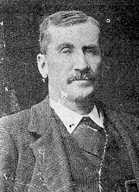
A “Salvo” For Tantramar’s “Mr. Canada”

In the days and weeks that followed the death of Peter Gzowski, tributes to his distinguished career in journalism and broadcasting flooded Canadian media. And rightly so. Of few people could it be said that they were icons of Canadian culture.

More personally, Gzowski was referred to as the Voice of Canada and sometimes as Mr. Canada. Given the depth of his understanding of this country revealed on so many weekday mornings; all of these tributes were appropriate. At his memorial service, one of the most incisive comments came from Sussex New Brunswick native, Sheree Fitch who said, as only a poet might: Without being there, Gzowski took us there.

Going beyond this well deserved rhetoric, there is a generation of Canadians who recall with affection, yet another who earned with equal qualification, the same title, Mr. Canada.

Like Gzowski, his career in journalism and broadcasting was shaped by long service with the CBC. He too, travelled the country from coast to coast to coast. In part, because of his many years as the CBCs chief roving reporter; few others of his time gained a better understanding of our country.

By now, many readers will have guessed the identity of the first Mr. Canada; Tantramars John Wiggins Fisher (19131981). He once recalled: Down in a part of Canada where the Atlantic Ocean makes its call, there is a romantic village known as Frosty Hollow. It has a little schoolhouse, a brook which joins the sea, and meadows between wooded hills I love this place for I was born in Frosty Hollow.

He was the son of F.A. Frederick Arnold Fisher and Nora Millicent Wiggins. Educated at Rothesay Collegiate School, Mount Allison University and Dalhousie Law School; he graduated from the latter in 1938.

A stint reading law with the Halifax firm of Pearson, Rutledge and Donald was followed by admission to the Bar. He then became legal counsel with the Rowell-Sirois Royal Comission on federal provincial relations. In John Fishers world, all the stars seemed to be in place; as a promising future in law beckoned.

Then suddenly, John Fisher switched careers. Those who knew him well were not surprised. Always outgoing and affable, with a natural curiosity and zest for life, he was attracted to journalism. Following an apprenticeship with the Saint John Citizen and the Halifax Herald he joined the CBC.

From 1943 onward there was no turning back for the man from Frosty Hollow. Within the space of a few years, the voice of John Fisher became one of the best known throughout Canada. Advertised as the CBCs Roving Reporter the country became not only his beat; but his audience. The unusual, the controversial, and especially stories of unsung people were all guaranteed to gain his attention. Criss crossing the country on assignment provided a wealth of material for his widely acclaimed radio series: John Fisher Reports.

On reading some of these radio scripts, one characteristic stands out. John Fisher had an uncanny ability to establish rapport with Canadians wherever they might be found on a wharf in a lumber camp or in an igloo. Further, John Fisher could be equally at home participating in a Pacific Coast potlatch, giving a university lecture or making a presentation in a boardroom on Bay Street.

Although deeply rooted in his native Tantramar, no part of Canada was ever neglected. In his interpretation of the country to all Canadians, John Fisher learned, as a young man, to speak French. This was a major achievement in an age when such a skill was uncommon among anglophone Canadians. He perfected his study of the French language at the University of Western Ontarios summer school at Trois Pistoles, Qubec.

Soon honors began to come his way. Several universities bestowed honorary degrees. These were supplemented by the Beaver Award (1946) for his outstanding contribution as a broadcaster and commentator. The LaFleche Trophy was awarded twice, in 1946 and 1947; followed by the Centennial Medal 1967; the Order of Canada 1968 and the Queens Jubilee Medal in 1978. Because of his keen interest in Amerindian and Inuit culture, he was named an honorary chief by a number of First Nation communities.

In 1957 John Fisher left radio to become Executive Director of the Canadian Tourist Association, a post for which his earlier career in broadcasting provided a perfect background. In this new role he continued his travels to all regions of Canada. As he went about, John Fisher often gave keynote addresses at conferences and conventions.

It was on occasions such as this, that the full power of his oratorical skills were put to the test. I was present on one such occasion. It was near the end of a busy five day conference and Fisher was the last speaker on the program. His assignment was to summarize the deliberations of the previous week. One might have expected the hall to be half empty. But not this time.

Speaking without notes as was his custom, John Fisher soon had the audience on the edge of their seats. The speech was not long; possibly fifteen minutes, no more. His wit, accurate sense of timing and gift of story telling earned him a standing oration; no ordinary achievement on a humid Friday afternoon in Toronto.

The next turn in his career took him, in 1961 to Ottawa, first as special assistant to Prime Minister John Diefenbaker. The centennial of Canadian Confederation was then on the horizon. Who might take on the role of organizing such an event? Obviously there was no one better equipped than John Fisher, and he took up this new assignment with customary gusto.

It was during the years from 1963 to 1968, when John Fisher served as Centennial Commissioner, that he became nationally known as Mr. Canada; athough in truth, the nickname had been coined as early as the mid-1940s. Once more, he travelled the country that he knew so well, coaxing, cajoling and convincing communities large and small to ready themselves for the greatest birthday party that Canada has ever seen.

That the 1967 Centennial Celebration was the success that it became, may be attributed, in large measure to the energy and boundless enthusiasm of the first Mr. Canada. As a fitting climax to these celebrations, during the autumn of 1967, two special honors came to John Fisher.

On October 29th, at the autumn convocation at Universit de Moncton, the university orator noted a coincidence in presenting John Fisher as a candidate for the degree: Docteur en sciences sociale. He commented in French: Ten days ago, a native son of New Brunswick, who has become a favorite son of all Canada, received the Doctor of laws, conferred by Mount Allison University. Today that same native son, is hereby acclaimed in the same way by lUniversit de Moncton. It is remarkable that these two neighbouring institutions had selected, quite independently and without prior consultation, to offer honor to the same individual. It is remarkable, but not surprising.

For the remaining fourteen years of his life, John Fisher continued his previous hectic pace as commentator and consultant on all matters Canadian. One of my last contacts with him was in 1979, when he chaired a panel discussion on Canadian unity at Thinkers Lodge, Pugwash, Nova Scotia. What I remember most about this occasion was the private, rather than the public figure; as he mixed easily with delegates from Canada, the United States and overseas. I recall not only the storytelling, but his considerable talent as a mimic. John Fishers imitation of Dief the Chief was more convincing than any tape recording.

While considerable attention has always been given to John Fisher the broadcaster and orator, his gifts as a journalist should not be overlooked. This is best explained by quoting from his introduction to Explore Canada: An Illustrated Guide; published by the Canadian Automobile Association and Readers Digest Canada, in 1967.

I have spent most of my life on a fascinating voyage of discovery up and down, back and forth across my country. The spread of Canada has at times overpowered me. Its diversity has ensnared me. The pulse of Canada I have felt in the speechless beauty of its face and in the promise of the people who inhabit it.

Too many Canadians wander to other countries without ever experiencing their own. They are losers. But Canada loses too, because the unity we seek can be woven only from the knowing, feeling and caring of all Canadians. How can we express our Canadianism without understanding our compatriots in other regions and being aware of their contributions to our rich mosaic of cultures and lifestyles? When will we terminate the tedious debate about Canadas identity?

One member of his extended family, a great uncle, Charles Fisher (18081880), was numbered among the Fathers of Canadian Confederation. Perhaps John Fisher had this relative in mind when he discussed the famous conferences that led to 1867.

If the Fathers of Confederation could look down now, they would be pleased. We stand at the judgement bar of world outlook, clean and fresh as the maple leaf. Blesssed are we in our dullness and love of the middle of the road. Neither are we a great power or a small one. Fortunate are we to have emerged from the shadow of two worlds. We are not a great power, but we are still a great force. The test of bigness is not in miles the test is in attitude outlook and goodness. Canada, here is your chance to lead the world. Such words bear repeating in 2002!

In reviving the memory of John Wiggins Fisher, late of Frosty Hollow and immortalized as Mr. Canada the first; this Flashback is inadequate. Only a salvo of artillery fire would do. Would that the now silent battery at Fort Beausjour could muster a 21 gun salute!

Mary Laura Wood: Sackville’s Star of Stage and Screen

Recently, while waiting in the lineup at a local bank, someone tapped me on the shoulder. A stranger asked: What’s the subject of the next Flashback? Since having my photo in the Trib is much like being depicted on a police most wanted poster; I was not surprised. I welcome such contacts, as they often lead to topics for future columns.

When I mentioned, Sackvilles star of stage and screen, there was an immediate response: Ive lived here all my life, and have never heard of anybody ever making it to Hollywood. At that moment, both of us were summoned from the lineup by the may I help you call. When I completed my errand I looked around, but the enquirer, served by another teller, had already disappeared.

This incident is mentioned because Ive found that few people are aware that an important stage and screen celebrity came from Sackville. However, it was to be in London, England, not Hollywood, where she would find her place as an actress.

In 1936, the Arts and Letters Club of the Mount Allison School For Girls sponsored a production of William Butler Yeats verse drama: The Land of Hearts Desire. In this play, a major casting problem was presented in filling the demanding role of the fairy child. In Yeats words, this character came from: The world of woods and waters and pale lights/ Where nobody gets old and crafty and wise/Where nobody gets old and godly and grave/Where nobody gets old and bitter of tongue.

Eventually, Mary Laura Wood, the 12 year old daughter of Sackville residents, William Trueman Wood and Mary Uniacke Wood, was selected. Contemporary reports indicate that she literally stole the show. The play was subsequently entered in the Provincial Drama Festival, where it brought words of praise from the adjudicator. With this positive reception behind her, a future star of stage and screen was born. Looking back, its clear, that from a very young age, Mary Laura Wood was destined for a career in the dramatic arts.

Early indications of musical talent led her to be enrolled as a piano student in the Mount Allison Conservatory of Music. At 14, she competed in the Dominion Music Festival held in Halifax. Placing first in her class, the young pianist drew warm praise from the adjudicator, Sir Ernest MacMillan. When interviewed on the radio afterward, Mary Laura demonstrated considerable poise, with her comment: I owe it all to my teacher, Mary Elizabeth Bell.

Mary Laura Woods sister, Faith Wood Breen, recalls growing up in Sackville during the 1930s. Since this was long before television and video games, we were largely responsible for our own entertainment. We made up skits and often performed for the family. I recall summers spent at our mothers ancestral home, Mount Uniacke, in Nova Scotia., where we staged skits for an array of cousins, aunts and uncles.

The same thing happened in the Wood home on York Street and at the cottage near Cape Tormentine. ML as she was known by her family, often organized neighbourhood children in impromptu plays. Her sister concluded the seeds were sown; ML knew that she wanted to become an actress.

Following graduation from high school, Mary Laura Wood enrolled at Mount Allison University. Although it had an active Little Theatre Society; the university lacked formal courses in drama. An institution with a recognized program in dramatic arts had to be found. But where?

The Wood family sought advice from a distinguished Mount Allison graduate, Dr. Frank Parker Day, then President of Union College in Schenectady, New York. He recommended that Mary Laura attend Carnegie Tech University in Pittsburgh, now Carnegie-Mellon University. At the time it was, and still is today, known for having one of the best and most rigorous programs in the field.

Days advice was sound and Mary Laura Wood excelled in her studies at Carnegie Tech. Throughout four years there, she managed to earn her tuition through scholarships. In her final year, Mary Laura won the prestigious Memorial Award… given to the member of the senior class in Drama, who has made the greatest contribution to the Department, taking into account professional standards, personal relationships and talent.

In addition to a heavy course load and participation in a wide variety of plays as prescribed by Carnegie Techs drama program, she was also involved in commercial theatre productions at the Pittsburgh Playhouse. One of the directors there was Robert Gill, later to achieve fame as a producer with the Canadian Broadcasting Corporation. Mary Laura Wood graduated in 1946 with a Bachelor of Fine Arts in Drama.

With this background and experience, the next question was: Where should she pursue her professional career? For any graduate of Carnegie Tech, Broadway, and then possibly sometime in the future Hollywood beckoned. However, ML very quickly made up her own mind. As Faith recalled, Her view was that the London stage was more committed to art for arts sake.

In October, 1946 it was off to England for the two Wood sisters. Faith, an artist, accompanied ML and they rented a walk up flat in Redcliffe Gardens, on the edge of Chelsea in London. Faith remembered it as a convenient location, with good light for my painting. For ML there followed endless rounds of the casting agencies. Throughout, she continued to hone her acting skills by participating in repertory plays, in locations as far away as Croydon.

Then, just as Mary Laura Wood was certain it would, her first break came. It began by being named understudy to actress Betsy Drake, in the play Deep Are The Roots. Based on a book by Arnaud dUsseau and James Gow; it portrayed the tense race relations in the Southern United States. Following a years run on Broadway, where it was regarded as a trail blazer; the play reached Londons West End. After a short period in the lead role, Ms. Drake abruptly left the show to marry actor Cary Grant. As a footnote, she was to be the third of Grants five wives. They were married on Christmas Day, 1949.

Immediately, Mary Laura Wood was propelled into the limelight. MLs solid performance in this play was the open sesame for other roles in a wide variety of productions. These included plays such as: The Dark Of The Moon, Death Of A Salesman and All My Sons. She was also Vivien Leighs understudy, in A Streetcar Named Desire. It was said that ML bore a striking resemblance to the famous Ms. Leigh; and she later took over Leighs role, when the play went on tour.

Valley of The Eagles was Woods first full length movie. This 1951 J. Arthur Rank production was an action/adventure movie that also starred John MacCallum (See accompanying illustration). Partly filmed on location in Norway and Sweden, it told the story of a Swedish professors search for his wife and one of his assistants. They had stolen some scientific data; and were eventually tracked to the Valley of The Eagles. The movie was so named because in this remote area Laplanders used eagles to hunt; as gunfire would precipitate avalanches. During their epic journey the two fugitives were attacked by wolves and eventually lost their lives in an avalanche.

As with her first West End stage production, this movie led to other contracts. These included: Raising A Riot,a comedy with Peter Toye and Kenneth More; Holiday In Spain along with movies in the famous Doctor In The House series of English comedies. In one of these,Doctor At Sea, the cast included actor Dirk Bogarde. The same movie also featured a cameo appearance by Bridget Bardot, then at the beginning of her career. Interspersed with movie contracts were stage roles in productions such as: Young Rennie by Canadian author Mazo de la Roche and an American play The Troublemakers.

A complete summary of Woods movie career in England, spanning as it did some twelve major productions, cannot be given in a single column. Ive been told by one cinema buff and insomniac, that movies starring Mary Laura Wood are occasionally to be found on late night television. Interested readers should check the movie summaries, to be found in the various television guides. Unlike many other actresses, she did not adopt a pseudonym so, just keep looking for Mary Laura Wood.

During this period, she married Irish actor Ronan OCasey, then a star in the London production of Kiss Me Kate. Unfortunately the marriage did not last. Following the breakup of her marriage she returned to Canada. Based in Toronto for a time, she played lead roles in such classics as: The Philadelphia Story and Duet For Two Hands.

After her retirement from stage and screen she returned to her native province to be near her mother, then living in Alma. What started out as a holiday, was destined to become a permanent residence. In 1973, she bought a cottage on Almas main street. Following a hectic and busy career in the world of film and theatre, in the words of her sister Faith, she was to enjoy the cool peace of this place by the sea. Mary Laura Wood died at Alma on March 30, 1990.

On reviewing Mary Laura Woods many contributions to the dramatic arts, two characteristics stand out. The first was her versatility. Not all actors or actresses can move from stage to screen and back again. Further, she was equally at home in Londons West End theatres, as on a movie set in Scandinavia or wherever. Nor was she ever typecast in a particular role. The variety of characters she portrayed underline this point. ML could move from the extremes of tragedy to comedy with the greatest of ease.

The second characteristic of Woods career, dedication to her profession, was clearly revealed in a 1956 interview. Mary Laura Wood had decided that it was time to go home for a typical New Brunswick Christmas. Shortly after, she was asked to give advice to young Canadians who may have aspirations for a career in the theatre.

Here are some of her comments: You have to love acting to be able to stick it out the acting life is a never ending struggle. On the London theatre: It is the healthiest English speaking theatre in the world its part of the life of the people. On her Canadian heritage: I am just as much a Canadian as I ever was.

Looking back, the title of the play that marked MLs first West End starring role Deep Are The Roots will surely stand as her epitaph.

Many people helped write this Flashback. In particular I would like to thank Faith Wood Breen, Bracebridge, ON and Pamela Black, Sackville NB, for granting interviews. Without their willingness to share reminiscences of ML, this column could not have been written. Martha Breen, Toronto and Dr. Gwen Black, Sackville were also of great assistance.

The White Fence, issue #18

February 2002

Editorial

Dear Friends,

Well, Santa has already come and gone (and he did find the cookies by the way… ), the new year is here and deep snows cover our lawns, weigh down the evergreens, and fill our driveways! So, since shoveling is not in the cards today, it’s time to put a few more coals on the fire and keep reading the Sackville Tribune of 100 years past which we had already started on our last stop at the White Fence.

As you probably remember since your last stop here, the Sackville Tribune of 18 December, 1902, (passed on to us by Ray Dixon who likes to keep up with the news of the day… ) featured the “Business Interests and Business Men” of Sackville in those busy times (women obviously played little role in the businesses of those days… so the men of that era must have rolled in their graves a few times since!). We managed to read the first page about prominent business men of the area and now it’s time to look at page 2: specific “businesses” of Sackville in 1902 as the town was well into completing the second year of the new century by that time. So grab a hot cup of tea or coffee and travel back in time with me; it’s a lovely journey!

Heritage Day Breakfast

On Saturday, February 16th, come and savor special bites of our delicious heritage at Tantramar High School. As in previous years, we’ll begin the festivities with a Heritage Breakfast ($5.00 for adults, $3.00 for children…including Bud White…!) Our speakers schedule is on the back of this newsletter.

Bring a heritage breakfast appetite with you and lots of stories to share with all present (who knows, a few of your stories could get into the next White Fence!).

On behalf of your Tantramar Heritage Trust board of directors – Best wishes to everyone and hope to see you on Heritage Day.

—Peter Hicklin

Sackville Tribune 1902

Sackville Tribune 1902

Sackville Illustrated — Part II

Its Business Interests — Business Men Thursday, December 18, 1902

Mt. Allison Institutions

The Academy — Mount Allison Wesleyan Academy was organized in January, 1843 and is one of the oldest and best schools for boys in the Dominion. The courses of study comprise: 1st, general elementary education; 2nd, preparation for matriculation; 3rd, a full business course. James M. Palmer, M.A., has been principal since 1894 and associated with him are W.H. Davidson, commercial department; Elmer Colpitts, B.A., mathematics and English; C. Homer Lane, science and commercial department; S. A. Worrell, English and commercial department; Miss Lillian Sprague, stenography and type-writing; and Laurie M. Colpitts, instructor in gymnastics. The term just closing has been a very successful one. The second term opens on Thursday, the 8th of January.

The Ladies’ College — The Mount Allison Ladies’ College was open for the reception of students on Thursday, the 17th of August 1854 and since that time good progress has been made. Dr. B.C. Borden has been the efficient principal for seventeen years. Instruction is imparted on subjects ranging from the primary English branches through the whole University curriculum. The Conservatory of Music employs seven teachers all of whom have had the advantage of foreign study. Courses in piano, vocal culture, pipe organ, violin, musical history, harmony, etc., are provided. Geo. Wilson, graduate of Leipzig Conservatory, is professor of piano, organ and theory, while Raymond Clare Archibald, M.A., Ph.D., is professor of violin and harmony. The Owen’s Art Institution, lately transferred from St. John, furnishes the opportunity for an art education unexcelled in Canada. Prof. John Hammond, one of the leading artists of America, is director of this department. An excellent elocution course has lately been added. It includes, besides oratory proper, three years of English and a year each of physiology and psychology. Miss Hortense Phillips, who receives her diploma next June will be the first graduate. This term has been singularly free from sickness and ranks among the most successful in th history of the institution. The second term opens on January 8th, 1903.

The University — This institution received its charter in 1858 and the first college class was graduated in 1863. The office of president has been filled as follows: 1862–1869, Rev. Humphrey Pickard, A.M., D. D.; 1869–78, David Allison, A.M., LL.D.; 1878–91, James R. Inch, A.M., LL.D.; 1891, David Allison, A.M., LL.D. The regular courses of study are: The Arts course, leading to the degree of Bachelor of Arts; and the Divinity course, leading to the degree of Bachelor of Divinity. Honor courses are provided in classics, mathematics, science, philosophy and in English Language and Literature. The faculty is a strong one and the opportunities for obtaining a liberal education are not excelled in the Maritime Provinces. The second term opens on the same date as the Academy and Ladies’ College.

E.H. Fowler — Merchant Taylor

E.H. Fowler

E.H. Fowler

With a successful experience of twenty-one years, with a competent staff of employees, it is no wonder that Mr. Fowler is meeting a large measure of prosperity. Beginning here in October 1899, his business has steadily increased until it has assumed large proportions. He carries a complete line of goods usually found in a first class tailoring establishment and guaranties both fit and workmanship.

H.R. Fawcett — General Merchant

Mr. Fawcett established his business in 1879, handling groceries, crockery, china, hardware, staple dry goods, drugs, patent medicines, flour, etc. He has always taken a great interest in the prosperity of the place, was several years warden in St. Paul’s church, is trustee and secretary for No. 9 school district, discharging his duties most efficiently.

H.R. Fawcett

H.R. Fawcett

C.A. Cole — Auctioneer

One of the best known men about town is Chas. A. Cole, for twenty-four years an auctioneer of exceptional talent and success. He is a son of the late Wm. Cole, a much respected farmer of Sackville. C.W. Cole in California and M.G. Cole, Sydney, are brothers and Mrs. C.C. Cook, Parrsboro, is a sister. Mr. Cole has been a speculator all his life in horses, cattle, etc. and is always ready to do business. His auctioneering area covers Sackville, Botsford, Westmorland and Dorchester where by his good nature, wit and fluency he is a most popular wielder of the hammer.

Intercolonial Hotel

Intercolonial Hotel

Intercolonial Hotel

A.W. Dixon, Proprietor — This house was built about 15 years ago by the late T.A. Kinnear. It was run for about two years by Clifford Chappell then purchased by Mr. Dixon who has since been manager. In consequence of increasing patronage, Mr. Dixon has been obliged to make extensive improvements on several occasions. Five years ago, the building was raised to three stories thus giving space to 14 additional rooms. Last fall, a balcony was built across the front and side, and seven more rooms were made ready for guests.The hotel, which is very conveniently situated at the junction of the intercolonial and N.B. & P.E.I. railways, is fitted up with all the modern improvements. Mr. Dixon expects to again enlarge his house next spring as the present building is still inadequate to meet the demands of his growing business.

A.E. Wry & Co. — Harness Makers

The firm began business February 1898. Mr. Wry learned his trade with J.R. Ayer being in his employ 20 years, fifteen of which was manager of the harness dept. Mr. Walter Bowser is the silent partner of the business. The grocery dept. was added two years ago and last year a 110 x 30 ft warehouse was built for carriages, machinery and feed. Beginning with nine employees, they now have 14 and have added a new no. (illegible) automatic Pearson harness maker that will do the work of fully 8 more men. The business is extending over the Maritime Provinces and has customers who have been patrons from the start. This Company are jobbers for Saskatchewan robes and horse blankets. During the past year, they have handled 600 horse blankets and 100 robes besides mitts and other Saskatchewan goods.

S & E. Duncan — Milliners

The Misses Duncan who formally did business in Saint John have been in Sackville four years occupying their present stand two years. Besides being satisfactory milliners they keep a varied assortment of fancy articles and have also gone into dry goods, making a specialty of children’s and ladies’ wear, skirts, shirtwaists etc. Their business, though small at first, has assumed goodly proportions, these ladies having always proved themselves, enterprising, obliging and agreeable business women.

R.S. Pridham — Photographer

Mr. Pridham has had a long and successful experience both at home and abroad. For years he was the leading photographer in Amherst with a branch here. In 1895 he built a new studio and settled in Sackville where his large and growing business made it necessary for him to enlarge his studio last year making it the most complete and best equipped in the Maritime provinces. Mr. Pridham is essentially an artist and produces very fine results. The “Professional Photographers’ Journal” which is ever chary of praise says: “No photographer is deserving of a higher reputation than Mr. R.S. Pridham, whose skill, taste and judgment place him in the front rank of artists.”

Geo. E. Ford — General Merchant

Imagine a small dark room containing a rough counter and a few rude shelves, upon which are placed a quantity of soap, a box of T. D. pipes, several pounds each of tobacco, saleratus, ginger, pepper, etc. and a few pieces of factory cotton and calico. Add to these a barrel of molasses and a box of candles and you will have some conception of the bulk of the stock-in-trade of the late Andrew Ford, Esq., father of Geo. E. Ford, when in 1861 he opened up business on Bridge Street. Having in mind this picture of a place of business forty-one years ago, it is interesting to visit Mr. Geo. Ford’s present large and convenient store. Here we find a three story building 75 x 90 feet, equipped with all modern appliances and divided into three big departments. Electric lamps have replaced the tallow dips, while the shelves replete with an almost endless variety of the newest and most up-to-date goods, bear unmistakable testimony to the fact that a great advance has taken place. From the time when Mr. Ford made syrup, hair oil and pomade in the olds store until to-day when he controls and directs the largest retail business in Sackville, there has been great progress indeed.

A few years after his father’s death occurred in 1871, Mr. Ford moved from an old stand to the building, previously occupied by Lindsay & Vickery and now used as the Sackville post office and custom house. He continued at that place until the completion of his new store in the fall of 1894. Since then two large wings have been built, thus giving space for boots and shoes, gents’ furnishings and custom tailoring. He has also added two warehouses in one of which has been constructed the largest refrigerator in the county. This affords ample facilities for handling fresh fish in which Mr. Ford deals largely.

In 1894 there were twelve employees while the present staff numbers twenty-five. Mr. Ford carries by far the largest stock of any business house in town, his principal lines being fancy and staple dry goods, millinery, cloaks, furs, ready-to-wear clothing, hats, caps, gents’ furnishings, boots, shoes and rubbers, carpets, room paper, oil-cloths, furniture, beddings, groceries, glass and crockeryware, flour, feed, fish, fruit and vegetables.

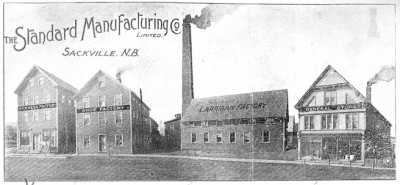
Standard Manufacturing Co.

Standard Manufacturing Co.

The Standard Manufacturing Company, Ltd. — Tanners and Manufacturers

The Standard Manufacturing Company Limited, successor to the Jas. R. Ayer Company Limited, are the largest employers of labor in Sackville having over one hundred men on the payroll. They operate a tannery, harness factory, larrigan factory, shoe factory, also general store.

The harness factory is the largest in the Maritime Provinces, and the larrigan factory is one of the largest in the Dominion. The “Standard” lines are well-known throughout the Provinces as thoroughly reliable goods at fine prices. The tannery turns out all the larrigan and shoe leather used by the firm and part of the harness leather, also an excellent line of belt lacing leather. The boots and shoes made are all heavy, hand-made goods, including men’s long boots of all kinds; men’s, boys and youths’ heavy bellows tongue boots, (as well as some lighter lines); and women’s and misses grain and pebble boots. The larrigan factory turns out a full line of oiled tanned footwear, and is the oldest concern of its kind in Canada. The harness business gives employment to about forty hands and is increasing so rapidly that the firm have difficulty in keeping pace in the matters of space and help. The factory is well-equipped with all the latest labor-saving machinery, including two Bosworth stitching machines. The Company’s store is a large building 45 x 100 feet, three stories. A full line of general merchandise is carried. The general offices of concern are situated in this building. The officers of the Company are: H.A. Powell, K.C., President; F. McDougall, Treasurer; Lt-Col. John M. Baird, Secretary. The Company have five travellers, three taking the Maritime Provinces and Quebec; and two, Ontario and the west. The firm has a most complete and efficient fire protection service of its own, including hose, hose reels, ladders, fire axes and buckets; and a well trained fire brigade drawn from the ranks of its employees.

During 1901–02 the plant was enlarged and improved at the cost of some $7,000. A new brick and wood, metal roofed power house was erected, a Robb boiler and Robb-Armstrong automatic engine installed, and a new leach house was built and equipped with a modern plant. A new larrigan factory was also erected, as the old one had become inadequate for the large business carried on. This factory contains a full equipment of machinery, consisting of sewing machines, eyeletting machine, riveting machine, punching machine, etc. Additions and improvements were also made to the tannery. As a result of these improvements the Company now has a most up-to-date plant, and are in better position than ever to carry on their increasing business.

Celebrating Heritage Week 2002

Schedule of Events

Saturday, February 16, 2002

Tantramar Regional High School, Sackville, NB

Morning Programme

7:30 to 11:00 am – Heritage Breakfast ($5 adults, $3 children) Enjoy a full breakfast of eggs, bacon, sausage, beans, and toast.

The Tantramar Historical Society presents:

10:00 a.m. – “All About Auctioneering” – Les Stiles, Professional Auctioneer

10:30 a.m. – The Antiques Roadshow – Keith Lewis – Mr. Lewis, an antiques collector, trader, and appraiser for more than 25 years, will appraise small items such as silver, china, and any antique odds and ends for which you would like to know the value. But no jewelry or fine art items please! ($2 – one item per person)

Afternoon Programme – Colonial Settlers

1:30 p.m. – Footprints of the “Planters” – Jim Snowdon, Acadia University, native of Woodpoint, author of “Footprints in the Marsh Mud”

2:15 p.m. – Singing Schools and Tunebooks – Nancy Vogan, Mount Allison University, native of Moncton, author of “Music Education in Canada”

A Tribute to Eunice McCormack: The Case of the Missing Avard Coin

This column, unlike many others, is not based on a single interview. Eunice McCormack has, since the beginning of this column, been one of my major sources of information on local history.

Whenever I reach a roadblock on a topic, more often than not, it is to Eunice that I turn for help. She has yet to fail me; and if she does not know the exact answer, I can count on her to point me in the right direction. Todays Case of the Missing Avard Coin is but one example.

Born in Sackville on November 9, 1905, Eunice (Dixon) McCormack was the daughter of J. L. and Louise (Avard) Dixon. She can therefore trace her ancestry to Charles and Suzanna (Coates) Dixon, 1772 Yorkshire immigrants who were among the founders of Sackville.

During a long and active life, Eunice graduated from Mount Allison and taught at Mount Allison Academy; later marrying Major Waldo McCormack in 1932. He was for many years coach and athletic director at Mount Allison. They had one daughter, Marjorie, now a retired school teacher. Today, she and Eunice share a home on Charles Street.

When I drop in to see her, Eunice is usually seated in her favourite arm chair, with a view overlooking Dixons Pond, home to numerous waterfowl. A pair of binoculars and a birding field guide, provide clues to one of her major hobbies. Last winter she and Marjorie took a trip to Sheffield Mills in Nova Scotias Annapolis Valley. Their mission was to bird watch in this well known habitat of the bald eagle.

They were rewarded with a number of spectacular sightings, one of which was attributable to Eunice, since her daughter was driving. As she explained: I spotted a lone bald eagle such a beautiful sight seeing this magnificent bird doing acrobatics It made the long trip worthwhile.

One does not have to ask Eunice McCormack the secret of a long life. It’s evident the first time you meet her; and is reflected in a warm and welcoming smile, a genuine interest in others and a willingness to share memories of a fascinating lifetime. As she modestly puts it: I try to keep busy and out of mischief.

Another example of her joie de vivre took place when a visitor to the McCormacks arrived on a motorcycle. Jokingly, he asked her: Eunice, have you ever ridden a motorcycle? No, she replied. But Ive always wanted to. Their subsequent ride was, to say the least, an achievement for someone 90+ years young. Now to the case of the missing Avard coin.

During one of my visits, I mentioned having spent part of that day on research in the Mount Allison Archives. Eunice asked me: Have you ever come across any information concerning the Avard Coin? It was given to Mount Allison for safekeeping. This was a totally new topic to me, and sensing a story, I asked Eunice for details.

Her maternal ancestors, the Avards, came originally from near St. Austell in Cornwall, England. Like many others of their day, they were converted to Methodism by Evangelist Rev. John Wesley (17031791). After moving about in England, they later emigrated, first to Prince Edward Island, then to New Brunswick. Prior to leaving England, a young son of Joseph Avard and Frances Ivey Avard was given a coin as a souvenir by John Wesley. This relic, carefully preserved in the family was, according to Eunice, eventually placed in Mount Allison Academy for safekeeping.

On my next visit to the Archives I made some inquiries re the Avard coin. Archivist Cheryl Ennals and her assistant Donna Beal were completely baffled. Neither had heard of such a gift. A search of the Acquisitions File revealed no trace of the donation of a coin. At the time, I was preoccupied with other matters and did not pursue the story of the now missing coin.

A few days later, I met Eunice at the VON Walking Club. Her first question was; Bill, have you found out any more information on the Avard coin? I explained my fruitless search. She then opened her purse and pulled out a note. Heres a reference for you. It will provide some details concerning the coin. The note read: See Wesleyan Magazine, Vol. IV, September 1845, p.121, Memoir of Mrs. Frances Avard. I thanked her, and said Im going to the library later today, Ill look it up.

Soon, I was seated at a microfilm reader, scrolling through the Wesleyan. June, July, August all went whizzing by but no September. What was wrong? Then the truth dawned. The September issue was obviously missing when the microfilming was completed. How could I find documentation for the story? Or was it possibly just another family legend? Knowing Eunice, I could not believe the latter.

The next day, I was in the Maritime Conference Archives and mentioned my problem to Archivist Judith Colwell. She responded: That microfilm was based on copies of the Wesleyan found in the Victoria University Library. Weve a set of originals in our vault. Ill see what is out there. Back she came with the bound volume for 1845 containing the September issue!

Not only that, Eunices reference was accurate in every detail. The article was a long one, written by Frances Ivey Avards disconsolate husband, [Joseph Avard] in the eighty-fifth year of his age. It traced the family history from Cornwall to Bristol, then the Channel Islands and eventually Sackville, NB.

Joseph Avard wrote: My wife was often favored with receiving her quarterly ticket and also the bread and wine from the hands of the venerable Mr. Wesley. On one of these occasions, she took one of her sons with her to class. After the meeting was ended Mr. Wesley entered into conversation with them He put his hand in his pocket and made the boy a present of a small piece of money, which has been kept in the family for fifty four years. It is now to be placed in the Wesleyan Academy in memory of the giver, Reverend John Wesley.

Later, on another visit, Eunice explained how she happened to have a copy of this important article. Once, while chatting with the then Mount Allison President Dr. George J. Trueman, he said Eunice, I know that you are interested in family history. I have an extra copy of the Wesleyan which tells the story of the Avard family. Id like you to have it.

However, one mystery remained. The existence of the coin was verified, and the gift to the Wesleyan Academy documented. But what happened to the coin?

At the time, Eunice and I were discussing the disastrous fire of March 1, 1933 when the old Academy building was burned to the ground. [See Flashback for December 5, 2001] It seemed logical to conclude that any details concerning the donation, and the coin itself, were probably lost in the fire.

A final postscript to this story. Last Christmas I received a gift from Dr. Fred Armstrong, a former colleague at the University of Western Ontario. Knowing my interest in urban history, he sent along a copy of his recent book on the Ivey family of London, Ontario. The internationally famous Ivey School of Business Administration marks this familys generous support of Western.

While reading the introductory chapter on Ivey family history, some details leaped off the page. The Iveys and Avards came from the same part of Cornwall. Both were converts to Methodism. Mrs. Joseph Avard was an Ivey; while another family member was named Ivey Avard.

Moreover, there were a number of interesting similarities in the story of these two important Cornish families. Later generations of both exhibited a strong entrepreneurial bent and achieved success in the business life of Canada. The Avard family, as well as the Iveys, were also strong supporters of post secondary education. In this context, note the Avard-Dixon Building on the Mount Allison campus.

Perhaps it is safe to conclude, that while the Wesley/Avard coin may have been lost; it paid a good dividend.

“It Was A School Like No Other” — Port Elgin’s Regional Memorial High School

The village of Port Elgin and surrounding area can lay claim to three important reformers in provincial education. The first two, originally from Murray Corner and Baie Verte, were to play key roles in establishing a new consolidated school in Port Elgin; a school that was destined to be described as like no other. The third member of this Tantramar trio built on their foundations and will be introduced later.

It all began in 1918. In an election held the previous year, a new government under the leadership of Premier W.E. Foster (1874–1947) took office. One of its promises was an overhaul of the educational system. The first major reform came from the report of a special committee on vocational training, chaired by one of the newly elected MLAs representing Westmorland.

The secretary of the committee was a career civil servant, and native of Murray Corner, Fletcher Peacock (1884–1949). Years later, he was to recall an occasion when an opposition MLA, opposed to reform of any kind, resorted to procedural delays in the committee. Not to be outmaneuvered, the chairman thundered: Were going to sit here until this report is adopted even if it takes until all Hell freezes over. By now, many readers will have guessed the identity of the outspoken MLA — Fred Magee (1875–1952).

The Vocational Education Act of 1918, later adopted by the legislature, called for instruction in industrial, agricultural and commercial subjects and where warranted; the establishment of agricultural and vocational high schools. Both Magee and Fletcher had attended rural schools and knew firsthand, that the traditional academic curriculum was unsuitable for many students. Before joining the Department of Education, Peacock had taught in one room rural schools. In 1911, the year of his graduation from Mount Allison, he was appointed Director of Manual Training and Home Economics for the province.

The new legislation, which was well ahead of its time, also called for the establishment of a Provincial Vocational Board of seven members. Four to represent various governmental agencies and three from the province at large. It was specified that two of the latter should be recruited from the ranks of capital and labour. To no ones surprise, one of these appointees was Fred Magee. Over the next few years educational reform was in the air; so much so, that Magee became known as the father of vocational education in New Brunswick. A major achievement was the founding of the renowned Saint John Vocational High School; one of the first of its kind in Canada. Later Fletcher Peacock took leave from the civil service to launch this school, and serve as Director of Vocational Education in Saint John. In 1932 Peacock, because of his many contributions to education,was awarded an honorary doctorate from his alma mater, Mount Allison. He later returned to the Civil Service.

Unfortunately this burst of educational reform did not last, and for several years, progress slowed to a crawl. Magee was defeated in the election of 1925 and refocussed his attention on business and industrial pursuits. Soon the province was in the grip of the Great Depression, to be followed by the Second World War; and other priorities prevailed. We have to fast forward to the late 1940s to find another period when vocational and technical education occupied centre stage.

Although retired from active politics, Magee never lost interest in educational reform. As a member of the Board of Governors of the University of New Brunswick he fostered the development of a degree program in Business Administration. Now he sensed an opportunity to do something creative for his native turf. Over 70 years of age, Magee also recognized this would be his last chance to see a school tailored to the needs of rural communities. By this time, fellow reformer, Dr. Fletcher Peacock was the provinces Chief Superintendent of Education. A friendship forged so many years earlier was reactivated.

Upon Magee’s insistence, a local advisory committee was established to assist in planning the new school and to act as a sounding board for many educational concepts dormant since 1918. This included a course of study designed to meet the special needs of rural students, and at the same time, to be relevant for both academic and nonacademic streams. In Magee’s view, education was a provincial responsibility; the Port Elgin area deserved a consolidated high school, and they were going to have it! Needless to say, at the provincial level, he received strong support from Dr. Peacock.

Named chair of the advisory committee, Magee threw himself into the project with all the gusto that characterized his earlier life. On one point he was immovable. The new facility must have sufficient grounds for outdoor athletic activities and a gymnasium. He also visualized the latter to be a centre for community activities. To ensure this, his wife, Myrtle McLeod Magee donated a fifteen acre lot for the new school; while Fred Magee provided $50,000 for a 700 seat auditorium-gymnasium.

On the evening of Sept. 7, 1948 all roads led to Port Elgin. The occasion was the official opening of the Regional Memorial School by the Lieutenant Governor Hon. D. L. MacLaren. It had been suggested that the new facility might be named in honour of Mageee; but he rejected the idea. Instead he suggested that the school be dedicated in memory of the fallen in two world wars. Estimates of crowds are often unreliable; however, there is agreement that on this occasion, the auditorium was filled to overflowing; as upwards of 1,000 people were in attendance. Mageee was in the chair and confessed with pride that he felt like Joe Louis after winning a championship boxing match. Dr. Fletcher Peacock was also present and reminisced about his long career in education.

Its time to introduce our third educational reformer, Dr. George Ernest Bennett (1901–1972) the first principal of the new school. Unlike Magee or Peacock he was not a native of the region; yet he had much in common with them. Born in Heckston, a small rural community in South Gower Township, Grenville County, Ontario, Bennett had come up through the ranks of one room country schools. But more important, as a graduate of the Ottawa Normal School, Ontario College of Education, and the Ontario Agricultural College [now the University of Guelph]. Bennett shared with both, a common approach in education. His strong academic background in both agriculture and education prepared him well for the principalship of RMS. While not neglecting the academic side; he fully understood the need for an alternative to the traditional high school curriculum. As events unfolded at RMS, Dr. G.E. Bennett was, to use a cliché, the right person, in the right place, at the right time.

An educational institution may possess the most modern facilities, as did RMS; but unless it has inspired leadership and a dedicated teaching staff, the school is but an empty shell. Fortunately RMS was not lacking in qualified personnel. The majority were experienced teachers and university graduates. For the record, the first staff included: Mrs. M. Allen, Ms. N. Bostwick, A.C. Collings, R.L. Danson, J.W. Fenety, Ms. M. LeBlanc, L. Legere, R. Mabee, A.P. Ryder, M.F. Stewart and Ms. A. Trueman.

To obtain background information concerning their Principal Dr. G. E. Bennett, I was fortunate to locate, both personally and via e-mail, a number of former students. After the passage of several decades, and recognizing that memories grow dim, I was struck by the almost universal agreement they expressed. One e-mail began: Its a distinct pleasure and privilege to provide some memories of my late mentor and friend… On discipline another wrote: As I recall, he was a strict disciplinarian, some might call him dictatorial but he was always fair. Again He was a hands on Principal with principles. He always taught one class, in order to get to know his students. A former Student Council President recalled his unfailing good humoured but firm and wise encouragement. A trait mentioned by more than one, was patrolling the premises. Dr. Bennett never shut himself away in the office he was always out and about; you never knew when he might appear and this included checking the dark hall behind the stage in the gym!!

Several former students mentioned their service in Army Cadet Corps #2335. Under the critical eye of Captain Bennett the RMS Corps was soon to achieve first rank standing in the province. One RMS graduate, Lieutenant Governor Marilyn Trenholme Counsell has commented on the importance of Cadet Corps #2335. In a recent address she asked the present generation to remember Dr. Bennett and his contributions to the Corps, and to recognize the wonderful training given many young men and women over the years.

Bennett’s rationale in forming the Corps, which held its first parade on Dec. 17, 1948, was straightforward. He saw it as an opportunity to build leadership and encourage physical fitness. However, it accomplished much more, as it led scores of RMS graduates to careers in the Canadian Armed Forces. Two of whom, Don Chandler and Owen Walton were instrumental in helping write this Flashback.

Dr. Bennett also knew instinctively when action was required and when it was not. Don Chandler recalled one such incident Shortly after Captain Bennett appointed me Company Sergeant Major, a box containing assorted rank insignia arrived. [Indiscreetly] I opened it when some fellow cadets were present we wondered out loud who might be receiving promotions when suddenly Captain Bennett appeared on the scene. He enquired frostily by whose authority I was making frivolous promotions. The box was hastily returned to the office and nothing further was ever said of my indiscretion.

Beyond the walls of Port Elgin’s RMS, Bennett was very involved in community affairs. Active in such diverse organizations as the Home & School Association, the Port Elgin Rotary Club and the Westmorland and Botsford Agricultural Society, he believed that the school should be freely available to adults in the community. In his first annual report in 1949, he pointed with pride, to the number of community organizations that were using the school on a regular basis.

On the personal level, Dr. Bennett was an active member of the New Brunswick Handicraft Guild. Owen Walton recalled paying him a visit long after he had retired. He knew I was interested in wood working. He took me to his workshop and showed me the wood turning projects he was working on I spent a pleasant hour with him. It was the last time I saw him. Don Chandler and his wife visited Dr. Bennett during the course of their honeymoon in 1957. They were the recipients of a beautiful wooden bowl, turned by Dr. Bennett on his wood lathe.

While it was probably not obvious to many of those who were RMS students in those early years, Dr. G.E. Bennett was an educational reformer and pioneer. It fell to him to implement the changes anticipated in the long forgotten report of 1918. In so doing, he was creating what one x-student appropriately described as a school like no other. Hundreds were to benefit from the diversified curriculum he helped put in place over a half century ago. Dr. G.E. Bennett’s place in the Tantramar trio of educational reformers was well and truly earned.

History That Isn’t in Books

Last summer history made the front pages of Canadian newspapers. Heres two examples of headlines from July 2001: Canadian Kids Flunk History Test screamed one; while another concluded: Our Young Show Dismal Ignorance of History.

What caused this sudden interest in the past? Results had just been announced of a Canadian high school test on key events in Canadian history. Conducted by the Dominion Institute and the Toronto Globe And Mail, the outcome was depicted as depressing.

Of the students polled, only one in four passed. This meant that they were able to correctly answer a mere 8 out of 15 questions. Among Atlantic Canadian students, only 21 per cent managed a passing grade. On reviewing the questions, it cannot be said that they were unusually difficult.

One asked students to identify the phrase referring to French colonists who were once foRCIbly resettled. The choices were: (Acadian Expulsion, Colonization, The Conquest). Another called for the name of the hockey player from among (Yvon Cournoyer, Paul Henderson or Phil Espisito) who scored the winning goal for Canada in the final game of of the 1972 Canada -Soviet Union series.

What can be done to rescue history? Clearly part of the blame lies in the demise of the subject as a essential part of the high school curriculum. However, the knee-jerk reaction of some educational bureaucrats to the abovementioned test was questionable. Their answer was to call for the institution of a compulsory course in Canadian history for all high school students. Such a course would restore our national heritage, and not only that; students would then know that John A. Macdonald, and not George Washington, was the first Prime Minister of Canada.

Many readers of this column will recall their high school days in mid-20th century Canada. Then there were compulsory courses in Canadian history. In addition, most provinces had externally based and graded matriculation examinations to make certain that that standards were maintained .

How many of you recall those dreaded matrics? More important, how much of that carefully memorized information have you retained a half century later? Small wonder that this approach led to a genuine dislike for history among a whole generation of students.

Another approach, and one that will resonate with readers of this column, was voiced by veteran Canadian broadcaster Patrick Watson. Heres what he had to say: History contains, but is not made up of great events, defining moments, crucial institutions. History, like art and music, begins locally and grows outward as its students grow in their capacity to look at a broader world. The exploration of history is a rewarding activity only if it produces meaning out of the chaos of experience.

To make his point, Watson cited examples of creative local history projects from coast to coast to coast. These were revealed during a series of Heritage Fairs held during 2001 under the sponsorship of the Bronfman Foundation. He concluded: I have seen Canadian students come back from a foray into the local community, their eyes glistening with the joy of having discovered meaning in researching local history.

Translated in plain language, Patrick Watson was calling for a 180 degree turn in the teaching of history at the elementary and high school level. Few regions of Canada are more fortunate the Tantramar in having a wealth of historical resources close at hand. Many local teachers are already enthusiastically incorporating these resources in their teaching. It is to be hoped that others will follow their example.

The revival of history must begin in the local community. Along the way, the subject will be transformed from something that is remote and often uninteresting, to that which is relevant and meaningful. There is considerable evidence to suggest that once students are caught up in the drama and excitment of historical investigation, there is no turning back. Be forewarned its addictive and it does not matter whether one is eighteen or eighty!

Interest and involvement in local history is underscored by the presence of three active historical societies in the Tantramar region. The oldest, the Westmorland Historical Society, covers the county; although the majority of its members are drawn from this area. The more recently formed Tantramar Heritage Trust and its offshoot, the Tantramar Historical Society, regularly attracts large audiences to its meetings. Watch for a number of their special events slated for Heritage Week in February. The Westford Historical Society, centered in Port Elgin, caters to residents of the old parishes of Westmorland and Botsford.

All three organizations boast long lists of volunteers who have helped make possible the operation of the Keillor House Museum in Dorchester, the repair and renovation of the Campbell Carriage factory in Sackville and the restoration of the Monro Heritage Centre in Port Elgin. Why do people volunteer for such activities? Is it civic pride? Most certainly, but there is also a deeper reason. Its to be found in an all abiding interest in local history and a desire to preserve something of the past for the cultural benefit of future generations. The many volunteers involved with these organizations, and others like them, constitute an important resource for local history.

Another illustration of this interest may be found in the work of the Historic Sites Identification Project sponsored by Renaissance Sackville and the Tantramar Heritage Trust. Readers wishing to learn about their activities, are encouraged to visit their website at http://heritage.tantramar.com/historic_sites/

Recently I spent some time reviewing letters and e-mails received from Flashback readers during 2001. Among several, I found a common theme. These correspondents admitted having developed a dislike for history during their school days.

Now, years later, many are happily caught up in researching family history, tracing lost relatives, collecting art and antiques, restoring older homes and furniture, even looking for lost musical scores. Still others are researching folklore and seeking out tall tales from the past. All have come to recgnize that not only is history interesting, it can be, as one correspondent expressed it: lots of fun. Theres a message here!

Any rescue operation for history is not likely to rest between the covers of a textbook. Theres so much more to be found that isnt in books! Nor will it be made palatable solely by prescribing a compulsory course in Canadian history. Instead, the solution put forward by Patrick Watson is to be recommended.

Nineteenth Century Journalism: History of “The Borderer” and “The Argosy”

In the June 19, 2002 centennial issue, the history of this newspaper was featured. During the course of researching the topic, information concerning earlier Sackville newspapers was uncovered. Although The Tribune and The Post dominated the local scene from 1902 through to amalgamation on June 3, 1946; their predecessors also merit attention. Two interesting nineteenth century examples will be highlighted in this Flashback.

The founder of journalism on the Tantramar was Edward Tryon Bowes (1813–1868). His weekly newspaper The Borderer and Westmorland and Cumberland Advertiser was established in 1856. With such an unwieldy name, the paper was usually referred to as The Borderer. For most of the next twelve years, it was the only newspaper between Saint John and Halifax. The sole exception was the Westmorland Times, published briefly in Moncton. The Borderer was later merged with the Chignecto Post in 1879 to form the new Chignecto Post and Borderer. The newspaper was renamed the Semi-Weekly Post in 1896. From 1905 until 1946 it was known as The Sackville Post.

Edward Tryon Bowes, son of one William Bowes, was born c. 1813, probably at Tryon PEI; which would explain his unusual second name. Unfortunately his place of birth cannot be verified, since provincial records do not extend this far back. Because the same information is also mentioned in a posthumous tribute to Bowes, [Chignecto Post, September 1895] it is no doubt accurate. His father was in the military and served for a time as an officer at Fort Cumberland before its decommissioning in 1833. Bowes came to Middle Sackville sometime in the 1840s and opened a private school in a building situated near the first store of Joseph L. Black. Later, the school was relocated nearer to Morices Pond now Silver Lake. This was an important phase in his early career, as he was later to use the columns of The Borderer to champion the cause of free public school education.

The content of The Borderer was summarized in a caption which claimed it included all the requisitions of a useful and acceptable fireside companion. A perusal of surviving copies illustrates that this was not an idle boast. The entire front page was usually devoted to literature and poetry. The second page contained local and international news, plus letters to the editor. Then as now, this correspondence encouraged debate on issues of the day. The subscription rate was six and three pence per annum payable in advance. If payment was delayed until the end of the year, the charge was seven shillings.

The remaining pages of The Borderer were given over to advertising and notices. Examples of local firms buying space were: Andrew Ford, J.L. Black, Abner Smith (tannery), Dixon and Company, Mariner Wood and Robert Hallett (photographer). Others from the Amherst side of the border included: Dunlap Bros., Ltd., W.D. Main & Co., Amos Page (watchmaker), Charles J. Townshend (attorney at law) and the Temperance Hotel operated by W. H. Rogers. Interspersed were notices of sheriffs sales, along with advertisements for patent medicines; each guaranteed to cure a wide variety of ailments.

The years of Bowes’ editorship (the late 1850s and 1860s) were crucial in the history of the British North American colonies. It was the time of the Civil War in the United States, the threat of the Fenian Raids and the debate over confederation. Unlike many of his contemporaries, Bowes always attempted to summarize all aspects of contentious issues. Reading between the lines, one suspects that Bowes leaned toward the anti-confederate cause, as witnessed by his report on the results in New Brunswicks provincial election of 1866. Noting that four anti-confederates had been elected in Westmorland, Bowes editorialized: We never felt hopeful that the people would endorse [confederation]. However, we kept our journal free and impartially allowed it to be a medium of communication on both sides of the question.

Two years earlier, Bowes briefly lowered his guard concerning confederation in a report on the Charlottetown Conference of 1864. As a staunch Methodist, he was shocked and appalled by what went on. This time he resorted to an editorial in verse:

Reader you know as well as I,
How there amid scenes of revelry,
At festive boards, at midnight balls,
With dance and song, in lordly halls,
Whereer they turned, on every hand,
They met the wizard with his wand,
He sparkld in the ruby wine,
He glittered in the dresses fine,
Yet there, amid such scenes they laid
The cornerstone of what they said,
Would make us all a mighty nation,
And christend it confederation.

Readers of The Borderer did not need an interpreter to guess the identity of the wizard. It was, of course, John A. Macdonald; soon to be prime minister of the mighty nation. While this doggerel verse would never win a poetic award; it did appeal to Borderer readers who relished Bowes cartoons in words.

Edward Tryon Bowes died Aug. 29, 1868, and without his experience and leadership, The Borderer was never quite the same. Although the newspaper ceased publication in 1879; memory of Bowes achievements lingered. Writing in 1895, an anonymous acquaintance paid the following tribute: Bowes was held in respect for his honesty, straightforwardness of purpose and personal charm Times without number, farmers and others in dispute would submit their grievances to Mr. Bowes arbitration, and very few if any of his decisions were ever disregarded. Many a lawsuit was avoided through his efforts. Unfortunately, we do not have a complete run of The Borderer during his tenure as editor. However, from the copies that are available, its clear that he took his role as an advocate of the people very seriously. The title: Founder of journalism on the Tantramar was well and truly earned.

Meanwhile, in January 1875, another Tantramar publication, happily still with us, was founded. The Argosy, or as it was more formally known at first, The Eurhetorian Argosy served the faculty and students at Mount Allison. Understandably, its main focus was the university community; however, some local events were covered. As a point of interest, the lead article in the first issue was an amusing sketch of Sachweil, a sleepy little town in the Duchy of Brunswick

Appearing monthly for several decades, The Argosy was heavy on original prose and essays. Of equal importance was the opportunity for aspiring writers to see their work in print. Many articles were undoubtedly reworked class papers and essays; nonetheless, they provide valuable insight on the social issues of the day.

By way of illustration, two articles in the May 1884 Argosy focussed on topics with 21st century overtones. One, entitled Ici Parlons Franais was a reasoned plea for bilingualism. The writer, identified only as DS, noted that there were few countries, such as Canada, where French and English were so freely spoken. Obviously drawing upon a visit to the gallery of the House of Commons, the writer concluded that Your average French Canadian member when speaking English, is apt to be constrained; he is often looking for a word. When he wants to have a genuine oratorical blow out, he uses his mother tongue.

Moral issues were frequently tackled by budding Argosy journalists. In the same issue the blight of bribery and corruption in federal and provincial politics was exposed. The author W asked rhetorically: When only wealthy men have the ability to buy their seats, how many members represent the political thought of their constituencies? Those elected by such means grossly misrepresent the majority of the people. W looked forward to the day when the high priests of corruption are ousted, disqualified, disenfranchised, and removed. Then and only then may we expect a more equitable result [in elections.] Its just as well that W is not around in 2003; as crime and corruption in high places still dominate the news.

In common with The Borderer, poetry held a place of importance in the columns of The Argosy. The March 1892 issue featured a tribute to Charles G. D. Roberts, written by Harry A. Woodworth. Entitled Roberts Poetry of the Tantramar; he compared Roberts with Bliss Carman. It was Woodworths view that anyone reading the poetry of Carman would never think of him as the poet of Grand Pr; while Roberts will be known to posterity as the poet of the Tantramar.

Journalism in the late 19th century was dominated by men. For the first quarter century of its existence Mount Allisons Eurhetorian Society, publisher of The Argosy, was an exclusively male bastion. The first female Allisonian to break this monopoly, was Lucy Dorothea Webb. A music graduate in 1897, she was to join the faculty of the Conservatory as an instructor in violin; and later taught at Lewisbury College in West Virginia. Clearly, by end of the 19th century, the winds of social change were beginning to blow across the Tantramar.

Newspapers such as The Borderer and he Argosy are valuable historical sources. Nevertheless, a cautionary note must be struck. Not everything that is seen in print can be taken as fact. Even the occasional error has crept into the pages of the Sackville Tribune Post! Canadian historian Peter Waite once summarized the significance of newspapers in our understanding of the past. They report and inform, they comment and criticize; and in the broadest sense they reveal the diversity, not only of people and politics, but of life itself.

I am indebted to Flashback reader, Edward C. Bowes (originally from Dorchester and now living in Saint John) for suggesting that his great-great-grandfather, William Tryon Bowes be featured in a column. Mr. Bowes also provided helpful information on the career of his distinguished ancestor. Thanks must also go to the staff of the Mount Allison Archives for their assistance.

Annual New Year’s Flashback Quiz

  1. Who was Nicolas Denys? (a) an Acadian settler at Tintamarre, (b) once commandant at Fort Beausjour, (c) a 17th century visitor to Cap du Torment (Cape Tormentine), (d) the first New Brunswicker to play in the NHL.
  2. What landmark was destroyed by fire on Ground Hog Day, Feb. 2, 1957? (a) Mount Allison Academy, (b) Sackville High School, (c) the University Mens Residence, (d) Holy Rosary School.
  3. Where was the first meeting of the Sackville Town Council held? (a) in the Music Hall Block, (b) the Old Tribune Building, (c) the Ford Block, (d) the Town Hall.
  4. What is the objective of the Bay of Fundy Biosphere Project? (a) harnessing Fundy Tidal Power, (b) reviving the Chignecto Canal venture, (c) completing the Fundy Trail, (d) having the Upper Bay of Fundy named a UNESCO Reserve.
  5. What is Dr. Barclay MacKay’s claim to fame? (a) his expertise on UFOs, (b) being named president of Mount Allison, (c) the discovery of a rare plant species at Cape Jourimain, (d) his archaeological dig at Fort Gaspereaux.
  6. When was Allison Gardens officially opened? (a) December 10, 1920, (b) December 12, 1931, (c) December 19, 1945, (d) December 4, 1946.
  7. During 2001 Fort Beausjour celebrated three anniversaries. One of the following choices is incorrect: (a) 250th anniversary of the building of the Fort, (b) 225th aniversary of the Eddy Rebellion, (c) 75th anniversary of its designation as a National Historic Park, (d) 50th anniversary of Fort Beausjour Museum.
  8. The Pointe de Bute Grange was once an important local organization. Was it: (a) a lodge dedicated to the improvement of rural life, (b) a branch of the Temperance Union, (c) a forerunner of the Womens Institute, (d) a chapter of the IODE?
  9. Which building is said to be the oldest in Dorchester? (a) Keillor House, (b) The Bell Inn, (c) Rocklyn (Chandler house), (d) Trinity Anglican Church.
  10. Who was the Monro Heritage Centre in Port Elgin named for? (a) Mary Chapell Monro, (b) Alexander Monro, (c) Hector Monro, (d) Henry F. Monro.
  11. Why did Kinellar Napoleon visit Sackville on July 13, 1956? (a) to promote the Maritime Beef industry (b) to officially open the first Tourist Bureau (c) as part of his Trans-Canada Bicycle Tour (d) to referee a lacrosse game at Allison Gardens.
  12. Douglas How (1919–2001) was famous for many things; one of which was a satirical novel based on a Tantramar community. Did Blow Up The Trumpet In The New Moon feature (a) Port Elgin (b) Westcock (c) Jolicure or (d) Dorchester?
  13. Which magazine was edited by Lyman T. Chapman (1897–1980): (a) The Family Herald (b) MacLeans (c) Canadian Homes & Gardens or (d) The Fisheries Gazette?
  14. Who was responsible for marking the first Thanksgiving in what is present day Canada? (a) Jacques Cartier, (b) Sir Martin Frobisher, (c) Samuel de Champlain or (d) Charles de la Tour.
  15. Of whom was it said: His monument is all around us, yet not in these handsome and commodious buildings but in the advanced state of education as it now exists in our land. (a) Dr. Humphrey Pickard, (b) Dr. Ralph Pickard Bell, (c) Dr. Winthrop Pickard Bell or (d) Dr. Alexander Graham Bell.
  16. Which Sackville Senator served with distinction in World War One? (a) Amos Botsford, (b) Josiah Wood, (c) F. B. Black or (d) A. B. Copp?
  17. Canadas Vimy Ridge War Memorial was officially dedicated in 1936. By whom? (a) King George V, (b) Prime Minister R.B. Bennett, (c) Prime Minister Mackenzie King or (d) King Edward VIII?
  18. Constable Reuben of Sackville’s Police Department made an important arrest in late February 1998. Where did this take place? (a) at the NB-NS border, (b) the Tantramarsh Club, (c) Sunken Island (d) Confederation Bridge?
  19. December 16, 1941 is etched in memory on the Tantramar. Why? (a) for the commissioning of HMCS Sackville, (b) the loss by fire of the University Mens Residence, (c) the US Declaration of War on Japan, (d) the loss, by enemy action, of the Canada-Newfoundland ferry Caribou?
  20. Which of the following Christmas Carols was undoubtedly sung on the Tantramar, Christmas Day 1776: (a) Hark The Herald Angels Sing, (b) The Huron Christmas Carol, (c) Adeste Fidelis, (d) I Saw Three Ships Come Sailing In?

Answers to the Flashback Quiz:

  1. c
  2. b
  3. c
  4. d
  5. a
  6. d
  7. d
  8. a
  9. b
  10. b
  11. a
  12. d
  13. a
  14. b
  15. a
  16. c
  17. d
  18. c
  19. b
  20. a

The answer to #5 requires clarification. Dr. Barclay MacKay was the creation of former Tribune Post editor, Lourdes Richard. A UFO specialist, avid photographer and computer guru, he reputedly visits Sackville only on April 1st.

The Carols of Christmas — from 1776 to 2001

The Christmas season was anything but merry on the Tantramar in 1776. During the previous autumn this region had been directly involved in the American Revolution. Although the Eddy Rebellion was over, its impact was still in evidence. A recent snowfall masked the remains of torched homes and farm buildings. These could be found not only along the road to Baie Verte, but throughout the countryside.

Desperation and starvation lined the faces of many homeless refugees (from both sides) who were huddled in Fort Beausjour; now renamed Fort Cumberland. Here there was some relief from the chilling winter winds, sweeping the marshlands.

Within the fort, a room had been renovated to serve as garrison chapel. However, it is unlikely that it witnessed any services on Christmas Day 1776. A few weeks earlier, the often inebriated chaplain, Rev. John Eagleson, had foolishly allowed himself to be be captured by the rebel forces in their raid on Cumberland Creek. By Dec. 25th, 1776, Eagleson was languishing in exile in Boston.

Despite all these adverse circumstances, we can be certain that Christmas 1776 did not go unmarked on the Tantramar. It fell on a Wednesday, and one or more Methodist class meetings would certainly be held in the homes of recently arrived settlers from Yorkshire.

Used to worshipping without the benefit of ordained clergy, the reading of appropriate sections of St. Lukes Gospel, followed by prayer and personal testimony would take place. Before a final admonition by the class leader, an uplifting hymn sing including at least one well known carol, would ring out over the marsh. Written by Charles Wesley (170788) in 1739, we know it today as Hark the Herald Angels Sing.

The original title was: Hark how all the Welkin [heaven] rings, Glory to the King of Kings. A new first line and title were suggested in 1753 by John Whitfield (171470) an early Wesleyan associate. The carol resulted from a Christmas morning walk through the streets of London by Charles Wesley. Along the way, he became inspired by the joyous pealing of hundreds of church bells.

Todays tune is more recent and dates from 1841. Dr. W.H. Cummings, then organist at Waltham Abbey, north of London, adapted the words by Wesley to a noble and spirited chorale composed by Felix Mendelsshon (1809–47). Even today, no Christmas service on the Tantramar would be complete without this familiar carol.

Peter Tiefenbach of CBC Radio Two has commented on the Methodist heritage in music. It is his belief that carol singing [which had suffered an eclipse in the 18th century], was rescued courtesy of the Wesley brothers, who brought congregational singing to their new religious movement.

In the formative years of Methodism, both in Britain and the Maritimes, chapels or churches were few in number. John Wesleys answer was to assemble a group of singers in a central location, such as a town square. Following a vigorous round of hymn singing a crowd would gather and then Wesley the preacher would take over. These hymns, written largely by his brother Charles became, according to Tiefenbach the folk songs of evangelism.

In 1999 the British Postal Service recognized this Methodist legacy by issuing an attractive 19 pence Christmas stamp. (See illustration.) Fittingly, the stamp marked the contribution of both Wesley brothers to the evangelical tradition. The stamp was the work of artist Brody Neuenschwander, a native of Houston Texas, who now lives in Belgium.

His design incorporated a mixture of written text and images; and highlighted Charles Wesleys Hark The Herald Angels Sing. As part of his research, the artist visited John Wesleys chapel in London as well as the Wesley Seminary in Bristol. One of the chapels stained glass windows served as inspiration for the left hand corner of the stamp. According to Neuenschwander it reminded [him] of stained glass in the Methodist Church in Houston. Fragments of a hymnal page and a letter from John to Charles Wesley were also included.

In the beginning carols were not only sung, they were danced. The word carol is of ancient origin and may be traced to the Greek choros– a kind of round dance. Eventually, it filtered through various Western European languages, including the Breton French karoll which meant a ring dance accompanied by song. The oldest English caroll dates from about 1410. English literature over succeeding centuries abounds in references to both carols and caroling; including several examples in the works of Shakespeare.

Christmas carols are an important part of our musical heritage. Especially is this true in 2001 as they help bring light to a dark and divided world. Unfortunately many carols (thanks to tasteless promotions in shopping malls) are sung without much thought. While there will always be a place for: O Come All Ye Faithful, While Shepherds Watched and the incomparable Silent Night; we should be open to more recent works and to new versions of older carols.

A personal favourite and one that fits this latter category is A Ceremony of Carols by Benjamin Britten (1913–76). This matchless choral work has an interesting link with Canada.

During the first part of the Second World War, Britten was living in the United States. Deciding to return home in 1942, he took passage on a neutral Swedish freighter. On a stopover in Halifax, Nova Scotia, Britten came across an anthology of mediaeval carols and hymns. Entitled The English Galaxy of Shorter Poems. Most of its anonymous songs dated from the 15th and 16th centuries.

Over the remainder of the trans-Atlantic voyage that lasted nearly a month, Britten completed the score for A Ceremony Of Carols. The premire took place in Wigmore Hall, London on Dec. 4, 1943. Ever since, its hauntingly beautiful music has been enjoyed around the world. It all began in Halifax…

Among the many local carol related events of the 2001 season, were two with a historical emphasis. At the Westford Historical Societys Open House on Dec. 2nd at the Monro Heritage Centre in Port Elgin, an old fashioned carol sing was featured. In like fashion, historic Trinity Anglican Church in Dorchester was the setting for the Westmorland Historical Societys annual Carol Sing on Dec. 15th. Charles Wesley would have approved! Check this issue of the Trib for notices of other carol services in the days leading up to Dec. 25, 2001.

Midst the uncertainty and atrocities of todays world, the caroling message: Peace on the Earth and Goodwill to All… rings true for everyone, irrespective of ethnic or religious background. A Happy Holiday Season to all readers!

Mount Allison’s Ordeal by Fires: Remembering March, 1933, and December 16, 1941

The 1930s and 40s were difficult years for Canadian universities. A depression that tightened traditional sources of funding was followed by the Second World War. Both had a deep impact upon Mount Allison. As if this were not enough, in the same period, the university suffered a series of catastrophic fires. It all began in 1933.

The month of March was ushered in by a fire that totally destroyed Mount Allison Academy. Beginning in the mid-afternoon of Mar. 1, the wooden structure, which stood on the site of present-day Palmer Hall, was quickly reduced to ashes. Classroom space and alternate accommodation for residents had to be found immediately.

A subsequent investigation was unable to pinpoint a reason for the fire; although the Sackville Tribune suggested that it might have been caused by an electrical fault in the attic. This point was rejected by Academy Principal Dr. J.M. Palmer who was convinced that the fire had been deliberately set. Later events were to add some credence to this conclusion.

Mar. 16th, 1933, was a typical late winter day on the Tantramar. A recent snowfall had blanketed the area; already well covered by previous storms. Nonetheless, as students made their way about campus there was a touch of spring in the air. But no one could imagine that 24 hours later, the old Science Building would be burned to the ground and that blackened stone walls would be the only reminder of Centennial Hall.

The fire in the Science Building was discovered at 3 oclock on the morning of Mar. 17th. The Sackville Fire Department responded in short order; however, by the time they arrived, both buildings were in flames and beyond saving. The loss of three important buildings in just over two weeks, stretched university resources to the limit.

The wooden Science Building dating from 1862, housed the Departments of Physics and Engineering, which meant that much valuable and expensive equipment was lost. Centennial Hall erected in 1884, marked the centenary of the entry into the Methodist ministry of Rev. William Black (1760–1834). He was the revered founder of the denomination in the Maritimes. Lost were many irreplaceable university records as well as the universitys chapel, also dedicated to the memory of Bishop Black.

Once again, investigators were unable to provide a reason for the fires. This uncertainty fueled the conclusion that all three were the work of an arsonist. Understandably, for several months, paranoia reigned in Sackville. University historian Dr. John Reid took a balanced view of the tragedies. It seems probable, he wrote, that the Academy fire and the other two fires were separate incidents, although, it may well be that [the first] provided the impulse for [those that followed.] Looking back, there was but one note of relief. No lives were lost.

Considering that these fires took place during a period of serious economic depression, a major miracle was to follow. A new and attractive Mount Allison Academy (built of stone this time) rose from the ashes of the old. By November 1933, Centennial Hall was also completely rebuilt. This was achieved by utilizing the stone walls and foundation of the original building. Both were officially opened at a special convocation held on Jan. 19, 1934.

Financing for the two ventures, hiring of architects, calling for tenders and selection of contractors, plus the actual construction and reconstruction, all took place in less than a year! Much credit for this achievement must go to an energetic building committee presided over by R. C. Tait, who was also chair of the Board of Regents.

Equally strong leadership was provided by President Dr. George J. Trueman. In addition to his regular duties, he had to respond on a daily basis, to the problems associated with the relocation of a large section of the university community. Unfortunately, before President Trueman was to leave office in 1945, he would again be tested by an even more horrific ordeal by fire.

This brings us to the events of nearly sixty years ago; to Dec. 16, 1941. University residences are seldom silent, especially when the end of term is near. However, on the night of Dec. 15, 1941, Mount Allisons University Mens Residence was relatively quiet.

At least two of the 225 students housed in the four storey residence were still awake at one oclock the next morning. After a long night of prep for an upcoming exam, the two Meyer Chernin and James Gould were hungry and decided that a raid on the kitchen pantry was in order. Little did they realize that this prank would propel them into heroism.

When the two reached the ground floor they were shocked to find fire blazing near the elevator shaft in the basement. All thought of food was forgotten as they quickly rang the fire bell. Acting by instinct, Gould spread the alarm on the first and second floors; while Chernin sprinted all the way to the third and fourth. Because of their quick thinking, many lives were spared. Meyer Chernin suffered surface burns before eventually making his escape from the now blazing inferno.

Meanwhile, residence dean C.A. Baxter assisted by several students used all available hoses and chemical fire extinguishers, but to no avail. By the time the Sackville Fire Department arrived, it was clear that the building was doomed. Efforts were concentrated on the rescue of occupants and in preventing spread of the fire to nearby buildings and homes.

At the height of the blaze, around 2 o’clock, sparks and flying debris were detected as far away as Squire Street. As one person remembered: The snow-covered roofs in the path of the flying embers was the only thing that saved half the town from burning down.

Fortunately the majority of students, once aroused, were able to escape by way of the two fire escapes, or by jumping from windows. Sadly, when a head count was made, it was found that three students were missing. By morning it was confirmed that Fred Farrer, Joseph Fraser and Melvin Green had perished. A fourth, James Creelman MacDonald died later, from injuries sustained when he jumped from a fourth floor window. Eight others had to be hospitalized because of severe injuries: Goodman Cohen, Nathan Cohen, Kenneth Coltas, John Davidge, Lestock Desbrisay, Lee Gallay, James Forbes MacDonald and Allison Stirling.

One question was uppermost: What caused this fire, with its terrible loss of human life? Once more, investigators were baffled. On the surface, the building, built of stone and brick in 1901, appeared safe. There were interior brick cross walls and a roof of slate. Chemical fire extinguishers and a standpipe with connecting hoses had been provided for added protection. There were fire escapes at either end of the building. There was a wide stairway in the centre with two additional narrower stairways, all reaching the fourth floor.

With the benefit of hindsight, it became apparent that the central stairwell was, at least partially to blame, for the rapid spread of the fire. It acted as a funnel for the flames, carrying them directly to the upper storeys. This flaw had been recognized in 1933, when a recommendation for the installation of a sprinkler system in the residence had to be shelved because of budgetary restraints.

Within the community, there was widespread belief that arson was the cause. The Sackville Tribune went so far as to suggest that it was the work of an enemy saboteur. Farfetched? Possibly, but lets place the fire in the context of December 1941.

By this time, Canada had been at war for over two years. The aerial Battle of Britain was in full swing. Dramatically, just a few days earlier, on Dec. 7, 1941, Japan attacked Pearl Harbour. Locally, on Dec. 13th, there had been a mysterious and unexplained fire at Enamel and Heating Products Ltd. This plant was producing munitions for the Allied war effort. Added to this, was the fact that several of the men in the residence were members of the RCAF, and being trained as radio technicians. No definitive explanation was ever found for this Ordeal by Fire.

One final postscript. Readers are reminded that criminology, especially as it applies to fires, has made significant advances in recent years. If modern technology had been available in 1933 and 1941 answers to questions relating to the origin of the four fires might have been found. Several individuals — including former students and towns people of the period — helped write this Flashback. Many Thanks!