The White Fence, issue #80

april 2018

Editorial

Dear friends,

The following article describes an exciting journey into the process of preserving an historic treasure: the Campbell Carriage Factory in Sackville, NB. I hope that, upon reading this newsletter, you will all appreciate the process, time and effort that were required to save, document, and establish this museum of national and international significance, always with the intention of ensuring its accessibility to the general public. I will take as little newsletter space here as possible in order to ensure available space for all the necessary text and photos which make up this fascinating adventure in historical conservation. I simply close by encouraging you to visit (maybe once more!) the site when it officially opens in June. Hopefully, upon reading this newsletter, you will fully enjoy and appreciate this very special historic structure even more had the information herein not been available to you. And to all who contributed financially toward this project, it would not have been possible without you! It has been a grand adventure! Read on, learn and…

Enjoy!

Peter Hicklin

Campbell Carriage Factory

The Early Years of Establishing the Museum (1995-2003)

By Al Smith, Rhianna Edwards, and Paul Bogaard

February 2018 marked the 20th anniversary of the Tantramar Heritage Trust’s acquisition of the Campbell family’s derelict carriage factory on Church Street, Middle Sackville, NB. With the donation of the building, contents and grounds, the fledgling Trust organization embarked on its inaugural project – the establishment of Sackville ’s first museum. This article will chronicle the endeavours that led up to the official opening of the Campbell Carriage Factory Museum in June 2003.

The Beginnings

In 1992, a small group of Sackville citizens began discussions centering on aspects of Sackville’s history. Two years later, the group was organized as the “Preserving Our Human Heritage” sector of Sackville’s community development organization, Renaissance Sackville. In 1995, at a public meeting of all Renaissance Sackville working groups, the Human Heritage sector announced that one of its major objectives was to establish a not-for-profit charitable Heritage Trust. The process of establishing the Tantramar Heritage Trust (THT) took about a year with its incorporation on 9 September 1996, and the founding meeting the next month.

For some time, there had been suggestions that the Middle Sackville derelict carriage factory building, owned by Will and Barb Campbell, should be saved; however, no action had been taken. The need to act became critical in summer 1995 when Will Campbell (who was Sackville’s Mayor at the time) confided in Town employee Mona Estabrooks that he was going to demolish the building due to concerns over liability issues. In fact, the factory’s original blacksmith shop and the elevator/storage building had already been demolished. Alarmed, Estabrooks asked for a tour of the factory, realized its potential value and contacted Colin MacKinnon who was also given a tour. Mackinnon concurred that the former factory was an extraordinary treasure on a national scale. It was the only remaining carriage factory in Canada and only one of two in North America! Active as a carriage factory for about 100 years (circa 1853 to 1951), the building still contained over 6,000 artifacts ranging from tools and equipment to handmade patterns, wheels, and all the component parts of carriage manufacturing. It even contained one Campbell-made sleigh.

Photo of Campbell Carriage Factory prior to restoration

Condition of the factory before ownership was transferred.

Realizing there was a short window of opportunity to generate interest to preserve the structure and its contents, MacKinnon invited Darrell Butler, Chief Curator of Kings Landing Historical Settlement, to provide an assessment of the significance of the former factory and to advise if it was salvageable. Butler visited the site on 13 October 1995, and four days later sent a follow-up letter enthusiastically advocating its preservation. He stated: “It is rare to see a craftsman’s work building preserved in such a relatively untouched condition,” and that it was the best example that he had ever seen. He described the factory as “an above ground archaeological site which should be carefully documented, catalogued and photographed in depth.” Especially relevant was his statement that, “It is important to the heritage community of New Brunswick and Canada that every effort is made to preserve and thoroughly study and document the Campbell Carriage Factory. I would strongly recommend that you consider applying to have it designated a provincial historic site and a national historic site.” Butler’s letter was immediately passed on to the Campbells and helped stave off any further thoughts of demolition. This was just the advice and encouragement the newly incorporated Tantramar Heritage Trust needed to move forward to attempt to preserve the building and its contents and to develop it as a museum.

At the Trust’s second Board meeting on 12 November 1996, the executive was authorized to undertake exploratory talks with the Campbells, seeking donation or other arrangements to preserve the carriage factory. The first meeting took place on 10 December when options for preservation of the site were explored. The letter from Darrell Butler and its steadfast insistence that the building must be saved settled the issue in the minds of the Campbells. It was agreed that the Trust would prepare a document to outline the specific options that had been discussed. A draft CCF Restoration and Research Plan was compiled and it proposed that the Trust acquire ownership of the factory and warehouse buildings, contents, and six acres of land, via donation. It was presented to the owners in January 1997 with a request for a follow-up meeting.

The Campbells had some reservations about the proposal but on 4 September made a counter proposal: they would retain ownership of the warehouse building but would donate the factory building and the lands immediately surrounding it. In addition, an agreement was reached with the Campbells whereby the Trust was allowed to use 2/3 of the warehouse building including a “right of first refusal” to purchase it. With these understandings in place, the Trust’s Board created a Project Advisory/Management Committee led by Al Smith. Rayworth Surveys was hired and by October 1997 had completed a subdivision plan to separate the six-acre site into two parcels and an application was submitted for re-zoning it from R3 to Heritage designation.

Finally the pieces were in place and during Heritage Week in February 1998, three members of the THT’s Board stood in a snow bank in front of the old factory building and received the deed transfer from the Campbell family. Thus began the formal process of establishing Sackville’s first museum.

Photo of deed transfer from Campbell family to Tantramar Heritage Trust

February 1998 deed transfer from the Campbell family to the THT. From left to right: Barb Campbell, Brian Campbell, Mary Campbell, Brian Campbell, Will Campbell, Al Smith, Phyllis Stopps, Colin MacKinnon

Public interest in the project was greatly enhanced by several articles in Sackville’s Tribune Post and on 25 October 1997, an in-depth article written by Meddy Stanton and entitled “History on Wheels,” appeared in the New Brunswick Reader (Saint John Telegraph Journal), garnering a lot of attention and support for the project.

Photo of factory with four rooms labelled

The two-story factory had originally been organized into four rooms.

Rescue and Registration of Artifacts

On 10 September 1997, the Trust’s Board of Directors had their first look inside the Campbell family’s carriage factory building. All were dumbfounded as the doors swung open. The periphery of the room was lined with workbenches and upon them, under them, hanging above them, and leaning against them, was a jumbled array of artifacts – made of wood, metal, paper, leather, and glass. Wooden components were stowed above straps between the ceiling joists, wall shelves were laden with tools and boxes, the wooden floor – the part still intact – was covered with objects of all shapes and sizes, cardboard boxes had split and the contents were strewn about and many fragments of deteriorating paper and cardboard littered the surfaces. And this was just the Benchwork Room; the main floor also had a Mill Room, and it and the Assembly Room, as well as the Paint Room upstairs, were all similarly full of materials.

Photo of how things were first found in Campbell Carriage Factory

Some examples of how things appeared when first found.

Jumble of items as first found at Campbell Carriage Factory

Quite a jumble to deal with!

With ownership of the site now transferred to the Trust, the objective for the summer 1998 project was to catalogue, remove and safely store all the artifacts residing in the factory in order for restoration of the building to start in spring 1999. Leader Rhianna Edwards consulted experts, wrote a procedures manual, applied for grants, sourced supplies, recruited volunteers, and hired and trained summer staff.

Recognizing the importance of documenting where artifacts were found, Edwards approached Chris Turnbull, the NB provincial archeologist, for advice. He sent two staff members to the site in April 1998 and they provided detailed procedures for cataloguing the artifacts. Their key message was that registers had to be kept to record the exact location from which individual artifacts had been removed, along with their relation to each other. The end product was to be a highly detailed account of the as found location of the entire building’s contents.

As had been suggested by both Butler and Turnbull, this contextual information was going to be critical for the interpretation and exhibit-creation phase of the project because none of us at this early point had any understanding of how a vehicle was built, what tools were used in what phase, or how and where the various components were assembled to either produce or repair a carriage, wagon or sleigh. Careful retention of the contextual information would preserve crucial evidence of the use of each artifact and how the layout of the building functioned to support vehicle assembly.

Our staff, John Holton and Christine Filion, began work on 2 June. To their credit, and despite the poor environmental and climatic conditions of the building (not to mention the scope of the task), they and many capable volunteers, cheerfully tackled the job.

Photo of John Holton

One of our employees, John Holton, beginning the task of identifying artifacts.

Photo of Christine Fillion

Another employee, Christine Fillion, whose contract was later extended.

The procedures were time consuming and complicated. First, each room, floor, ceiling, wall, workbench and shelf has to be assigned a location code. Then, starting with the Benchwork Room, each location code within in each room had to be gridded with fluorescent tape. The grids were to measure 6′ x 9′ (walls) or 6′ x 6′ (floors and ceilings) with allowances made for doorways, windows, and other obstructions. Once a grid was set and given a unique grid number, volunteer Ralph Stopps took a photograph of the grid that showed all the artifacts in situ, and then staff or volunteers sketched each artifact to scale and in relation to the others within the grid. Then each artifact in the grid was given a number (A1, A2, etc.) and tagged with the location code and artifact number. Only then could an artifact be removed from the grid. Each artifact was then photographed by staff, given a light cleaning and a catalogue record was made. The cataloguing record provided detailed measurements, type of material, proper name, function, etc. Finally, the artifacts could then be placed in a carton, which, along with larger items, was stored on shelves built in the Mill Room. Holton kept a detailed daily log of progress made.

Drawing showing plan for grid codes at Campbell Carriage Factory

Plan showing codes for locating each item on a grid.

Photo of grid sections at Campbell Carriage Factory

Grid sections identified, separated by tape, and smaller location tags tied to each artifact.

The time it would take to complete full registration on all the artifacts had been badly underestimated and, as the summer wound down, it became clear that procedural and staff adjustments would have to be made in order to get all the artifacts out of the building while still retaining the critical location information. Holton’s work term was extended by four weeks, Sandra Cant was hired part time for nine weeks, and the full registration process was abridged.

All of the approximately 6000 items were coded by location but only 800 received full registration. At least one more summer project was going to be necessary to revisit and complete the artifact registration and cataloguing. Finally, carton after carton of artifacts, as well as the larger items, were moved on 3 October to a 55-foot trailer, provided by Baughan’s Transport, and set on the property to provide temporary storage. The building was thereby cleared and made ready for restoration work to begin in spring 1999.

A grant allowed us to immediately rehire Filion for 12 weeks. She entered artifact registration data in the database she had designed, working from home on her own computer. Once the grant was exhausted, she continued the task on a volunteer basis.

While building restoration work started in spring 1999, THT again successfully applied for grants and rehired Christine Filion, as well as two students: Erin Balser and Erich Guthrie. They worked out of the Campbell’s warehouse building and completed registrations for approximately 3,000 artifacts. In October, with the building restored and its concrete floor finished, all the items stored in the trailer were transferred back to shelves set up temporarily in the Mill Room.

Staff at Carriage Factory summer 1999

Christine Fillion, erin Balser, and Eric Guthrie hired for the summer of 1999.

During summer 2000, Erin Balser and Erich Guthrie returned to work at the factory, along with a new worker, Marc Hamilton. By the end of the season, about 1,600 more registrations were finished. It is likely that the registration would have been completed during this summer but for a major mold problem that developed. Measures were taken to stop the infestation and clean the artifacts, but it was time consuming and very discouraging.

It took another couple of summers to fully complete the registration and cataloguing and to put all the information on the database. Erin Balser and Matthew Hickling worked on it in 2001. In 2002, the remaining data was entered by Colin Busby as part of his Heritage Assistant duties while Ian Alexander spent the summer in the Carriage Factory helping put artifacts back in their original locations. But this takes us well past the next two crucial steps: figuring out how to restore the carriage factory building and how we could possibly pay for it.

Capital Campaigns and Government Programs

The Tantramar Heritage Trust quickly recognized that developing the Campbell’s building as a museum was going to be an expensive proposition. From the outset, enthusiastic local supporters had donated the thousands of dollars necessary to make a beginning. In addition, as noted above, government programs that subsidized wages were successfully applied for and they were crucial. But despite this, it was clear that much more money was going to become necessary for the wages, materials, utilities and consultant costs associated with the restoration and interpretative phases of the project. As a result, two Capital Campaigns were launched. Beginning in October 1998, “Put Your Shoulder to the Wheel” was developed to offset restorations costs; it was followed by “Hitch Your Wagon to a Star” in 2001 to meet the costs of constructing exhibits.

With donation revenue from its campaign giving evidence of strong community support, the Trust was able to secure assistance from the Town, Renaissance Sackville, and the Crake Foundation and to continue to access employment and development programs through Heritage Branch and the Atlantic Canada Opportunities Agency. Between 1997 and 2003, the Trust raised $164,000 to meet expenses. For a fledgling organization launching its inaugural project, this was certainly a major achievement!

Building Restoration

Simultaneous with artifact registration and the launch of the Capital Campaign, the Project Committee, this time led by Blane Smith and Paul Bogaard, began to develop a strategy to restore the building. The Trust’s Board and Project Committee had members with experience in modern construction methods, but Kings Landing provided experience and advice specific to heritage building restoration. By the spring of 1999, through government programs, the Trust hired Chris Murray as foreman along with Troy Lorette and Tim Wells as his two-man crew.

The carriage factory building had been neglected for almost 50 years and while the front side sat on fairly stable ground, the back side (to the northeast) had sunk into the wet marsh muck. The first task was to permanently drain the water away from the building; the ground floor was cleared and rotted flooring and brick chimneys removed. Murray’s team then hand-dug drainage ditches and the Town brought in loads of shale.

Photo of drainage ditch along backside of Carriage Factory

Drainage ditch hand-dug along backside of factory.

Once the water issue was resolved, a way to reset the building on a solid and level foundation had to be found. Kings Landing advised that substantial concrete footings right near ground level would be sufficient, but the building would have to be lifted from its crumbling foundation in order to install them. It was simply too long to lift all at once; fortunately, the old timber-framed building had retained its structural integrity. Its joints were flexible enough that half its length could be lifted at a time using tall “cribs” of heavy timbers and strong 30-ton hydraulic jacks with diagonal cables and turnbuckles to keep the building from twisting further out of shape.

With the building suspended, the old foundations, rotted sills and lower portions of posts were removed. Concrete footings were then poured, original foundation stones returned, sills replaced and posts repaired. The 160-year-old timber frame could then be lowered onto its new, sturdy foundation. It creaked and groaned, loudly complaining while cables were tightened, but the timbers settled back into their intended places so effectively that the building regained its shape along the whole back side and up through the rafters. The building was level for the first time in many years and no further adjustments have ever been needed. Those old timber-framers knew what they were doing!

Photo of foundation at Carriage Factory

Foundation almost restored along end of the factory closest to road.

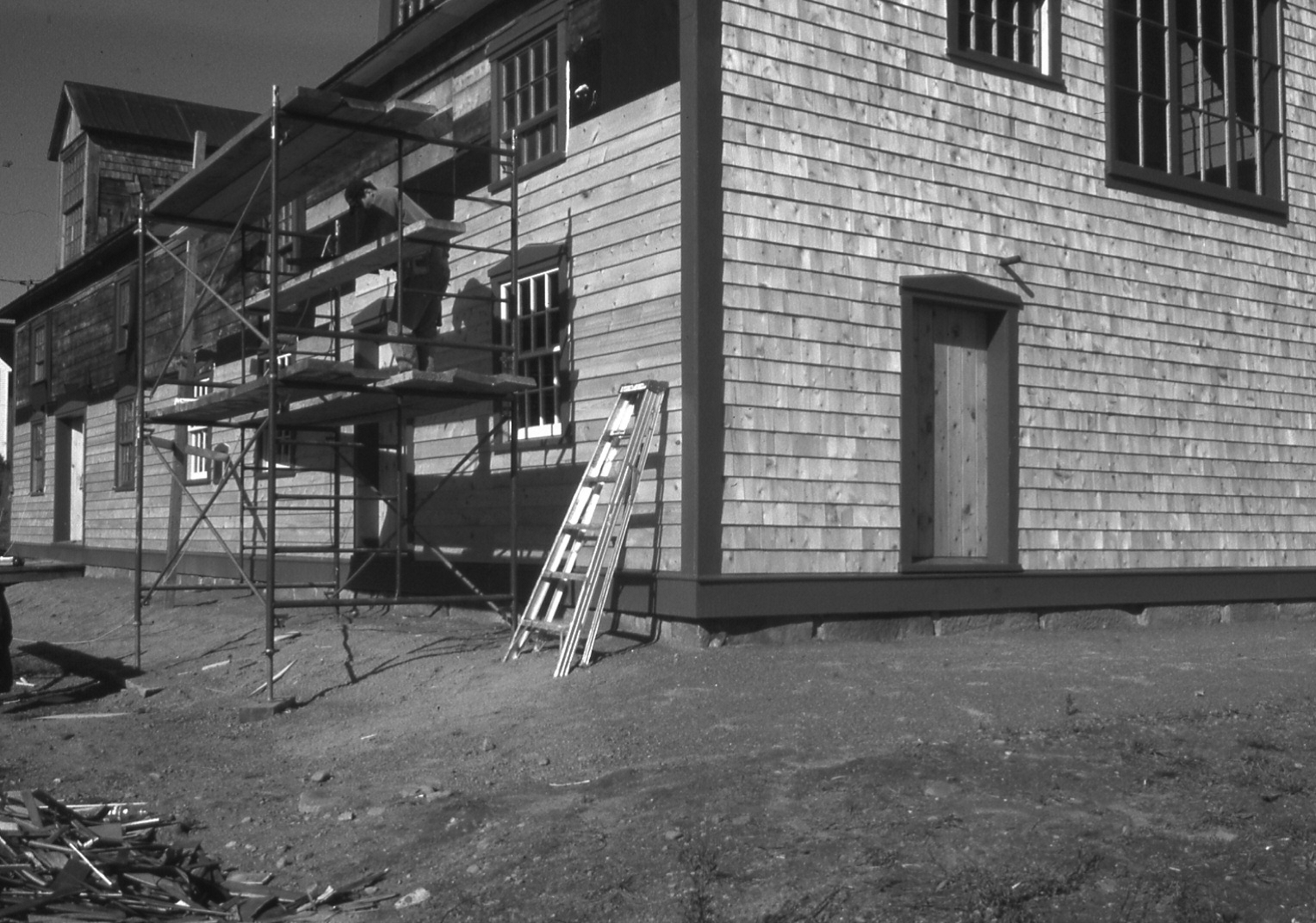
The most challenging part of restoration completed, it was a matter of re-cladding the building with board sheathing, exterior shingles, and clapboards. The back end of the building had been seriously damaged when an “addition” (from a century ago) had been torn off in the 1960s, requiring more work to restore the wall there than elsewhere. Anticipating the concrete floor that would be poured later, almost 2 feet of shale and 4 inches of new gravel were tamped into the old floor area. Soon thereafter the Town’s fire department brought a pumper truck to hose down the entire interior, especially upstairs and in the rafters, ridding the building of the filth that had accumulated over the years. Finally, after a bit of roof repair, windows (many of them rebuilt by Richards & Son of Amherst) were reinstalled and all the doors were replaced with new ones, built by Murray in the old-style way, including clinching over squareheaded nails. By the fall of 1999 the concrete floor was poured and the surrounding grounds re-graveled.

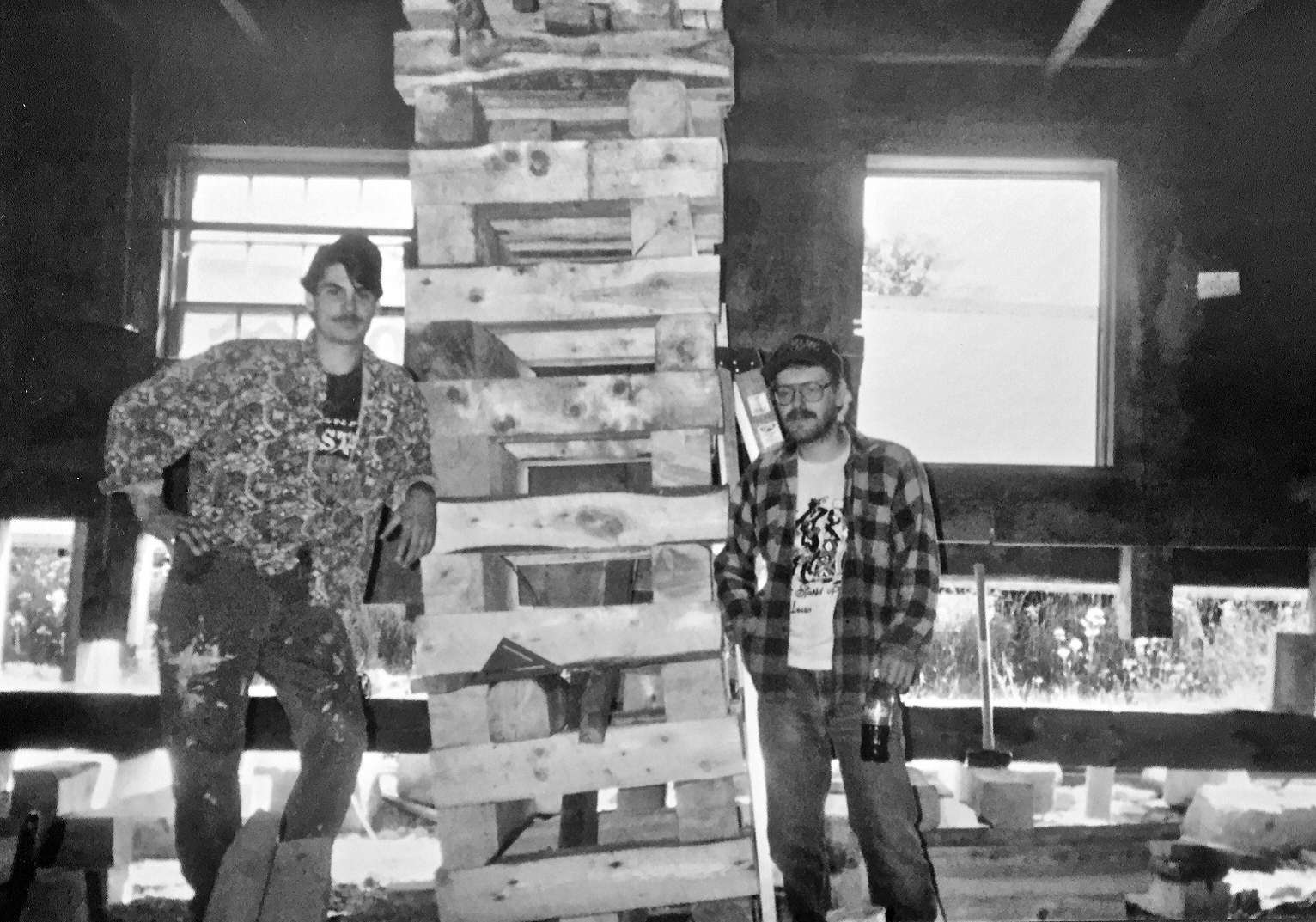
Photo of two workmen with cribwork needed to lift Carriage Factory.

Two workmen with the tall cribwork needed to lift the building.

Except for wooden floors to be mounted on the concrete (and electrical cables distributed
underneath –- which did not get done until the spring of 2001), this part of the restoration was complete. Marking that occasion, as noted above, on 16 October 1999 a volunteer crew, including a number of Mount Allison students, removed all the stored artifacts from the trailer and reset them on temporary shelves in the Mill Room (shown above).

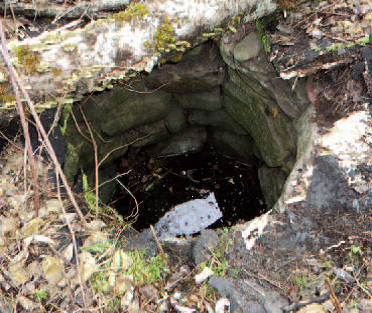
One day Paul Bogaard heard a scream from within the building and saw one of the workmen running out. Trying to fit a diagonal brace to steady the tall “crib” that had just been assembled, when the workman pulled the brace back out of the ground to reset it, he saw the sharpened end was covered with blood! Fortunately, it was not blood; when Bogaard asked colleagues at Mount Allison to analyze the dark red liquid, it turned out to be a tanning solution made from ground Hemlock bark. One of several tanning vats hidden beneath the carriage factory floor for 145 years had been relocated!

Photo of damage to Campbell Carriage Factory

Damage to the far end of the building needed to be cleared before being repaired.

Photo of restored windows and doors at Carriage Factory

Windows and doors restored, the exterior was reclad with shingles and clapboard.

From Factory Building to Interpretive Museum

With artifact registration on-going and with the building (itself an artifact) largely restored, it was time to begin the most intellectually complex phase of the project: determining how to display the artifacts and to astutely choose panels that would provide context for what took place in the carriage factory over time. This would be the key to turning what had been a derelict building into Sackville’s first museum. As a first step, it was necessary to figure out what each artifact was used for and how each artifact related to all the others in the production of horse drawn vehicles. Furthermore, it was important to determine where in the building each phase of this process took place.

The second step was to think through, carefully and strategically, how to present this knowledge to museum visitors in a way that was easily understood and visually appealing. For this, the Trust was very fortunate in being able to bring in consultants Greg Silver and his team from Cardinal Communications who had professional experience in the design and layout of museums. Charles Allain of the provincial Heritage Branch arranged to hire this firm and for the ACOA funding that made it possible. Allain, Bogaard and the Cardinal team met monthly through much of the year 2000 and into 2001. The Trust surely would have faltered at this point with so little experience in actually setting up a museum. Cardinal’s task was to determine the strengths of the artifact collection, identify themes and elements of the carriage factory story that should be told, outline short, medium and long-term steps and to give advice on the way interpretive panels might be used. Their enthusiasm and their sense of the issues and the opportunities and challenges they could see was most invigorating.

However, the first step, mentioned above, proved more difficult. The Cardinal team knew as little as the Trust did about how carriages were built and how manufacturing and assembly was conducted in this workspace. What they could do was lay out the steps that should be followed and the kinds of research that would be required, but in 2000 there were still so many unknowns. For instance, most of the artifacts that would provide knowledge remained in cartons or were pushed into corners; there was not a single wheeled vehicle to display and there was no sense of how the horse mill operated nor how machines lined up with the belts and pulleys. And although several years later an addition, warehouse and blacksmith shop would be added, at this point the Trust still only had the main factory building. Compounding the problem was the discovery that there were few, if any, reference sources that explained typical carriage factory work.

Photo of artifacts being moved back into Carriage Factory

By October 1999 all the artifacts were carried back into the factory.

Nevertheless, encouraged by Cardinal and extending over the next several years, Bogaard led the effort to pull the artifacts out of storage and to begin replacing them where they had been found. Only then did it become increasingly clear that all the effort put into recording precise, as-found locations was not uniformly informative: items found in the middle of the floors must have been moved around, perhaps repeatedly, and, while some items on benches seemed to be left where they had been used, many things piled on top seemed to have been strewn around haphazardly. Fortunately, templates and tools up on the walls and up in the ceilings seem to have been left where the workmen last stored them.

Of particular value was the growing awareness that amongst the items found in the factory were examples of almost every component required for a vehicle and that many of these were in different stages of completion. They gave an almost step-by-step understanding of manufacture and they could be tied to tools and templates and to the different kinds of work-stations found within the factory building. Bogaard also learned a great deal from interviews, early newspapers, reaching out to Mennonite carriage builders and by talking with folks at other museums. Gradually, an appreciation of the pattern of work began to emerge. This slow process of accumulating information continued over many years

Provincial Recognition and Opening the Museum

By April 2001, the Province had agreed that the Campbell Carriage Factory deserved to be designated a provincial Historic Site and, on the 30th of that month, the public was invited to an unveiling of the bronze plaque the Province had provided. After the ceremony, everyone reassembled at the Middle Sackville Baptist Church hall, just across the street, to hear Greg Silver present the findings and recommendations that Cardinal had developed over the preceding year.

Photo of presentation by Cardinal Communications

After more than a year of consulting, Cardinal Communications presented their recommendations for how best to proceed reorganizing what was a factory into a museum.

In September 2001, another Open House was organized, this time inside the factory itself. By then the wooden flooring was in place and an Express Wagon, which had originally been built at the factory, was on display; it had been donated by the Johnson family who had purchased it there decades earlier. Happily, that marked the beginning of many other tools, machines and vehicles returning to their home at the Campbell Carriage Factory.

And, finally, by 21 June 2003, the restoration and interpretation was far enough along to hold an Official Opening of the museum. The grounds had been cleaned up, the Town had helped establish a proper parking lot and Ray Dixon and his crew of volunteers had not only laid the wooden floors but had built some entry decks. The objectives of the new museum were still far from completion (and that remains true today!) however, it was time to celebrate what had been accomplished thus far. A large crowd gathered, speeches were made, a symbolic wagon wheel was rolled back from the entry way, cake was served, and from that moment on, those who had achieved so much in such a short period of time could look with satisfaction onto the historic Campbell Carriage Factory Museum, a prized landmark of the Town of Sackville’s history.

Photo of opening of Carriage Factory Museum

At the Grand Opening, the Campbell family helped rolls a wagon wheel back from the museum entrance.

Enjoy with us, once again, what these delightful photographs invoke. Be sure to visit the Campbell Carriage Factory Museum where you never know what exciting new discoveries you will find!

It has been an exciting voyage.

Horses and carriage at opening of Carriage Factory Museum

Celebrating the era of horse-drawn vehicles.

Announcements

Upcoming Events

Wednesday, April 18, 7 pm
Dramatic Reading: “Beaubassin Tavern” by Dick Beswick
Each act is a day in 1755. The first depicts a day in the time of relative peace between Fort Lawrence and Fort Beausejour, the second after the successful siege and capture of Beausejour by the British and the third day is after the first Acadian Expulsions. The play’s object is to portray the sequence of events in that year and the views of the Acadian, British New England militia and the Mi’kmaq in those times. Anderson Octagonal House, free admission, light refreshments.

Wednesday, May 30, 7 pm
Annual General Meeting
Anderson Octagonal House. Guest speaker: TBA. All are welcome. Light refreshments.

Sunday, June 17, 12-5 pm
Official Opening of Campbell Carriage Factory Museum
Opening for the summer. Entertainment, games, blacksmithing demonstrations and the very popular annual Plant Sale.

Sunday, July 1, 2-4 pm
Canada Day Strawberry Social
Boultenhouse Heritage Centre. Join us for games, tours, music, and delicious homemade strawberry shortcake.

Sunday, August 12, 12-5 pm
Heritage Field Day
At the Campbell Carriage Factory Museum. Blacksmithing demonstrations, live music, dancing, snacks, artisan demonstrations, tours and much more.

Make It Workshops
Our popular heritage-themed workshops for children will be available during July and August. Watch for details on our website, and follow us on social media.

Under the Sky Events
Community events held at the Campbell Carriage Factory Museum and Boultenhouse Heritage Centre are once again being organized for the summer months.

Check our website for details, and follow us on social media.

Twitter @TrustTantramar
www.facebook.com/tantramarheritage
www.instagram.com/tantramarheritage

f you would like to keep up with Trust activities and events by email, please contact our office and we’ll add you to our mailing list: tantramarheritage@gmail.com or (506) 536-2541


The White Fence, issue #79

january 2018

Editorial

Dear friends,

This special newsletter consists primarily of requests for your assistance. The working of the Trust is largely based on the efforts of a board of directors and numerous committees. Many of us have been on these committees since their creation. We could use some new blood! And I must be clear: these are not onerous tasks. Their activities are actually quite enjoyable and very fruitful. Some committees might meet once a year or once every few months – depending on the season. So please read carefully and join us in our efforts to preserve our past if you can. If this newsletter does convince you to do so, please contact Karen Valanne at 536-2541 or write to her at tantramarheritage@gmail.com and express your preference(s). You will be welcomed with open arms! And if you require some convincing that these efforts are indeed worthwhile, at the end of this newsletter read the letter and see the photos of a very special gift presented to us by Senator Stewart Olsen. It can’t get any better than this. Please join us!

We begin this newsletter with the story of a special photo. Ten years ago, Al Smith was given a copy of an old photograph taken across from his present home in Sackville. Any comments you may have about this photo and the family members it depicts would be most welcomed by Al (also via tantramarheritage@gmail.com). It is a beautiful historic photo and we encourage any of you who might have similar ones in your attics or family albums to pass them along to us with their respective stories.

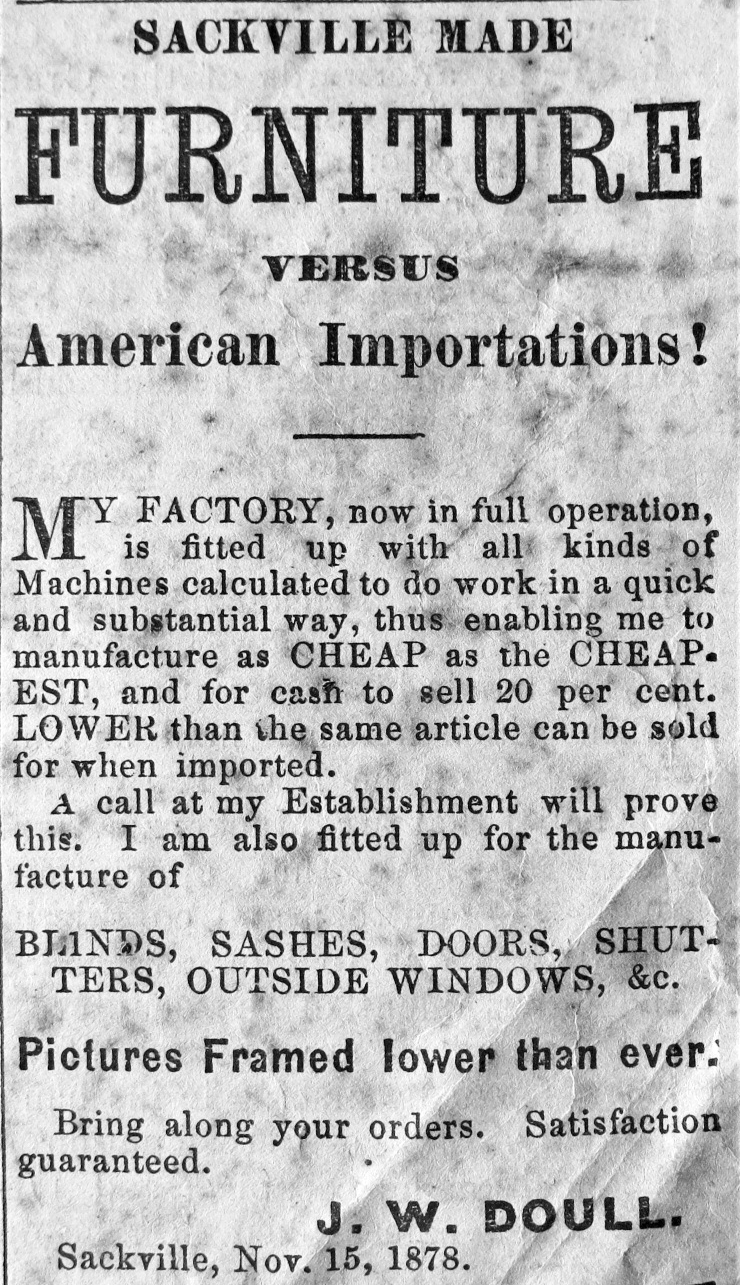
Similarly, Colin MacKinnon found old photos of ads in the local newspaper (1879 and 1902) from the Doull brothers, cabinet and furniture makers searching for work. Many older homes in Sackville may still have fine wooden (now antique) furniture (or fancy house renovations/ decorative additions) made by the Doull brothers near, or at, the turn of the 20th century. Any information regarding these special furniture makers/carpenters from olden times would be much appreciated by Colin (see contact information with Colin’s request).

We look forward to welcoming some of you to our organization and others to pass on information to Al and Colin regarding the Palmer and Doull families. Furthermore, any historic photos of family and friends (with their associated stories) that any of you may have to pass on to us would be much appreciated.

It is for all of us to enjoy and learn from.

Peter Hicklin

DEDICATION
This notice is to inform all of our readers that the board of Directors of the Tantramar Heritage Trust has chosen to dedicate our latest publication of 2017 on The Histories of Church Congregations in Sackville New Brunswick to the late Eldon Hay – a dear friend and mentor.

More than Just a Family Photo

by Al Smith

Photo of Palmer family in Sackville, NB May 1920

May 24, 1920 (Middle Sackville) Foreground left to right: Marion Palmer (age 15), Fannie Palmer (29), Helen Palmer (24), Gladys Palmer (21), Nita Palmer Ayer (31) holding baby Florences and in the back, to the left, is Ralph Palmer (age 12 or 13). Boy in front of Helen is unknown but possibly Truman Hoar.

It is rare that one comes across an historic photo that is not only dated but was from the neighborhood in which I grew up. The photo at right was taken on May 24th 1920 and shows members of the Palmer family standing under a large chestnut tree in front of their family home (currently corner of Main and Marshview Streets, Sackville).

There is a well-known old expression which states that “a picture is worth a 1000 words”; the photo tells a story well beyond being a family group photo. I was given a copy of this photograph over ten years ago while visiting the home of Lois and Sherman Estabrooks who lived on the old Robson property at the end of Bridge Street in Sackville. The lady in the centre of the photo, Helen Palmer (1896-1975) was Lois’ mother.

Descended from the Loyalist family of Gideon Palmer, the family grouping in this photo consists of the children of Frank (1862-1932) and Lois (Estabrooks) Palmer (1865-1946). Frank was the grandson of Gideon’s son Philip (1786-1873) who was known as “Philip the Squire”. He served 20 years as an M.P.P. for Westmorland and was also a Crown Land Surveyor and did many of the early plans in Sackville Parish. His son Charles G. Palmer (1817-1885) was also a Crown Land Surveyor and was likely the one who planted the chestnut tree in front of his family home. That tree, shown in the photo behind the group, was still there in the mid 1970s when my wife and I purchased the property directly across the street (256 Main Street). It was a tree that I played in as a child with the Kilcup children whose parents owned the old Palmer place at that time.

The 1920 photo shows a rutted and muddy springtime Main Street not paved until 1944. However, look carefully behind Ralph Palmer and you will notice a four plank wide sidewalk. That boardwalk went from downtown to at least as far as the Mariner Wood property (now the Doncaster Farm at 280 Main St.) whose buildings you can see in the distance above Ralph Palmer’s head. Possibly it went on further to Middle Sackville but as a boy I remember seeing evidence of a once functioning sidewalk only as far as the old Wood property. Plank sidewalks had long been a feature of Town streets and were fastidiously maintained by Captain William Pringle the town’s Road Commissioner. However, the town boundary at that time was near the present day Booster Pump so one wonders who paid for, and maintained, the walkways farther out.

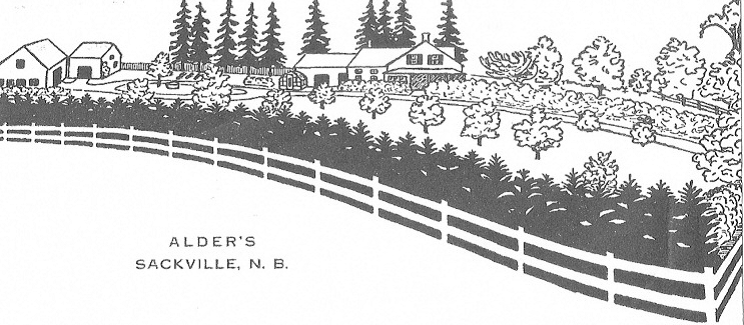
The interesting board fence and gate (just to the left of the hydro pole in the photo) was the entrance to the Alder Trueman home built in 1855 (260 Main Street). Trueman was the bookkeeper for Mariner Wood. The fence is long gone but the house and barns are still there.

Yes indeed, “a picture is worth a 1000 words”.

1950 sketch of the former Alder Trueman property

Circa 1950 sketch of the former Alder Trueman property by J. William (Bill) Black.

Sources: 2006 interview with Lois (Robson) Estabrooks; Palmer Family genealogy; The Palmer Brothers in the Chignecto by Helen Petchey published 1990; Early History of Dorchester and Surrounding Area by W.C. Milner – 3rd printing, 1981; Aboushagan to Zwicker by Al Smith, 2004.

Information Request

For an upcoming article, I am seeking information on brothers John Wesley Doull (1849-1954) and Charles Alexander Doull (1856-1903). These men “Cabinet Makers” from Prince Edward Island, lived in Sackville in the late 1800s. J. W. Doull made furniture in Middle Sackville while C. A. Doull had a furniture shop where Ove Samuelson’s law office now stands at the corner of Squire and Bridge Streets. I would be interested in seeing any documents or photographs of these families that may have survived. Specifically, receipts, trade labels, letters, ledgers, or examples of their work… would be appreciated.

I can be reached at 506 536 4283 or by emailing the Trust.

With thanks, Colin MacKinnon

C.A. Doull advertisement 1902

C.A. Doull advertisement (Semi Weekly Post, Sackville, NB, 31 January 1902)

J.W. Doull advertisement 1879

J.W. Doull advertisement (Chignecto Post, Sackville, NB, 6 February 1879)

The Tantramar Heritage Trust

Its Mission, Membership, Tasks and Goals

by Peter Hicklin

1. Mission Statement, Vision and Principles

Mission
Promote the preservation of heritage resources in the Tantramar Region.

Vision
Stimulate public interest in the history of the Tantramar Region and its heritage resources.

Principles
• Value the history, people, places and heritage properties of the Tantramar Region.

• Contribute to the knowledge and understanding of the Tantramar Region

• Bring about awareness through engaging and interactive programs.

• Facilitate outreach and new membership opportunities.

• Engage community members and visitors of diverse and multigenerational backgrounds.

2. Collections Management

In order to fulfill the terms of its mission, the Tantramar Heritage Trust acquires and manages collections of artefacts and holds these collections in trust for the public. The Trust aspires to maintain the integrity of its collections and the associated records in accordance with professional museum standards.

The Trusts’ permanent collections are housed in the Boultenhouse Heritage Centre, the Campbell Carriage Factory Museum, the THT Archives, and the Alec R. Purdy History and Genealogy Research Centre.

3. Your Board of Directors

Barbara Jardine (president), Geoff Martin (Vice President), Paul Bogaard (Treasurer), Rebekah Cant (Secretary), Al Smith (Publications), Peter Hicklin (newsletter), Wendy Burnett (collections), Bill Snowdon (Boultenhouse), Bob Bowser (Board of Management), Christiana Steeves and Demian Hammock.

4. Membership

In 2017, our membership attained a total of 210 members made up of 22 honorary, 71 household (with numerous memberships per household) and 45 individual memberships. Every paid member is regularly kept informed of all Trust activities and events and includes: i) a vote at the Annual General Meeting, ii) free admission to the Campbell Carriage Factory Museum and the Boultenhouse Heritage Centre, including the Alec R. Purdy Research Centre and iii) copies of The White Fence newsletter sent at least four times a year. Our 2018 membership campaign was launched before Christmas and, by mid-January, we were halfway to our goal of matching, or exceeding, our previous year’s numbers.

5. Committees, members and their Tasks

Collections – Chair: Wendy Burnett with members Paul Bogaard, Barbara Jardine, Christiana Steeves, Karen Valanne and Barb Jardine. The committee reviews items donated to the Tantramar Heritage Trust and approves the acquisition of artefacts of local interest, particularly those pertinent to the history of the Tantramar region. Following an accessioning process, the artefacts and archival materials are exhibited in the museums or stored at the Boultenhouse Heritage Centre and the Anderson Octagonal House.

Publications – Chair: Al Smith with members Carrie MacMillan, Leslie Van Patter, Sandy Burnett, Paul
Bogaard, Karen Valanne and Nancy Vogan. Copy editing assistance is also provided by Rhianna Edwards and Gerrie Baycroft. The Publications Committee determines which manuscripts to publish and decides on the style and binding for the publication, keeping in mind consistency as well as the look of the publication. The committee arranges for the printing, marketing, distribution and sales of all Trust publications. It also prepares Press Releases and facilitates book launches. Books are sold at our two museums and Trust functions plus at independent retailers via consignment agreements. Annual sales data and inventory are carefully maintained. The Trust has produced 32 publications over the past 20 years and sales usually accounts for about $5,000.00 in annual revenue.

Boultenhouse – Chair: Bill Snowdon with assistance from Al Smith and additional volunteer assistance for spring and fall clean-up work. This committee is charged with maintenance and upkeep of the buildings and grounds of the Boultenhouse Heritage Centre including repair needs in the accompanying apartment. For major items, the Committee sources contractors and monitors the work while in progress. Coordination of lawn-mowing and yard maintenance is also done in coordination with a Landscaping Committee.

Campbell Carriage Factory and Blacksmith Shop – Chair: Paul Bogaard with assistance from Al Smith and additional help during the spring opening and fall closure. Maintenance, upkeep, repair, lawn mowing and mower servicing etc. are all duties done by this Committee along with major duties such as shingling repairs on the Blacksmith Shop.

The White Fence – Chair: Peter Hicklin (editor) with Leslie Van Patter (formatting/layout). Volunteers submit articles to the editor and the goal is 4 issues per year although there have been years with 3 or 5 issues printed depending on circumstances.

Research Centre – Chair: Al Smith with assistance from David McKellor and Karen Valanne. The aim of this committee is to facilitate and assist people wishing to conduct research on local families. The committee gathers books, news articles, photographs and other documents related to local history and genealogy. All items are catalogued in a database.

Exhibits – Chair: Paul Bogaard with assistance from Christiana Steeves, Barb Jardine and Leslie Van Patter. With guidance from Leslie, Paul and Christiana, students and professional designers were able to create and build “The Profession of Housekeeping” exhibit that opened last October in memory of Pauline Spatz. A popular Quilt Exhibit was also organized by Barb Jardine and prepared by the Sackville Quilter’s Guild in 2017. Numerous additional interpretive panels were added in summer 2017 to augment the messaging on the Campbell Carriage Factory Museum. Also, new genealogical
panels about the Boultenhouse and Bulmer families were installed at the Boultenhouse Heritage Centre.

Workshops – Chair: Rebekah Cant. No other formal members but, depending on workshop needs, volunteers are often required. An example is the popular annual workshop on Old-Fashioned Christmas Decorations.

Events – Members: Bob Bowser, Rebekah Cant, Al Smith, Christiana Steeves, Karen Valanne, Barb Jardine (and others as needed).

Finance Committee – Members: Geoff Martin, Paul Bogaard, Mariner Black and Bob Bowser. This committee looks after Trust investments with outside professional help.

Capital Projects Fundraising – Chair: Geoff Martin with the assistance of 6 to 12 volunteer canvassers. Ad Hoc Website Committee – Members: Barb Jardine, Karen Valanne, Christiana Steeves and Demian Hammock. Our very capable webmaster is Charlie Scobie. A small website committee has been assembled and, advised by Chris MacKay, looks into recommending changes to update the website and make it mobile-friendly, among other things.

Student Hiring Committee – Karen Valanne, Paul Bogaard, Wendy Burnett and Barb Jardine are responsible for interviewing and hiring students for both museums during the summer months.

Personnel Committee – Barbara Jardine, as Trust President, provides oversight of the role of the Executive Director.

Nominating Committee – This committee is active in winter and early spring and consists of Barb Jardine, Bob Bowser, Rebekah Cant and Karen Valanne.

Membership and Volunteers Committee – Members; Barb Jardine and Karen Valanne. This committee’s function is to maintain the annual membership list, handle membership renewals and maintain the donor database. Additional volunteers would be helpful especially to assist in keeping membership, volunteer listings and the donor database updated.

6. Financial Assistance

Crake Foundation and Town of Sackville
In 2017, the Tantramar Heritage Trust received grant contributions from The Crake Foundation ($5,600) and the Town of Sackville ($5,000). Both are significant not only their generous financial  contributions but especially for their demonstration of confidence in the Trust’s activities in the Sackville community. Both are greatly appreciated! These financial contributions allow us to undertake many activities such as those described in this newsletter and others yet to be initiated in 2018.

Rotary Gold Mine Toonie Draw
The Rotary Club of Sackville collects loonies donated by Sackville residents and which are numbered; one is drawn once weekly with 50% of the donated loonies going to the person conducting the draw representing a school or institution and the remainder split, four times a year, between 13 community schools and organizations. In 2017, the Tantramar Heritage Trust was one of the community organizations chosen by the Rotary Club and we are pleased to report that the Trust received an average of approximately $600.00 each time for an annual total of approximately $2,500.00. We extend
our appreciation to the Rotary Club of Sackville for this much-needed and valued assistance. This past November, the Trust once again submitted an application for the Rotary Gold Mine Toonie Draw 2018 and we are pleased to report that our application has been approved! From all of us: Thank you Rotary!

7. Museum Visitation

As of December 2017, 1,653 visitors had explored the Boultenhouse Heritage Centre while 1,463 visitors walked through the doors of the Campbell Carriage Factory for a total of 3,116 visitors spending some valuable time at our two museums (and, we assume, the Town of Sackville!).

8. Committees currently not active and in need of chairpersons and volunteers

• Communications
• Historical Society
• Retail Sales (non-publication items for our gift shops)
• Discovery Committee

9. Heritage Events and Activities in 2017

April 11: The Battle of Vimy Ridge – interesting public presentation by Sandy Fairbanks.

May 31: Annual General Meeting – Rhianna Edwards was voted Volunteer of the Year and Dr. Hannah Lane made the presentation: Youth in Mid-Nineteenth Century New Brunswick.

June 18: Official opening of the Campbell Carriage Factory with blacksmithing demonstrations, plant sale, children’s activities and live music from Meredith and Miriam Hicks.

July 1: Annual Canada Day Strawberry Social at the Boultenhouse Heritage Centre.

July 5: Make it Bake! Children’s Workshop.

July 13: Close Enough Trivia at the Boultenhouse Heritage Centre hosted by our Crake intern Mitchell Gunn.

July 19: Make it Grow Children’s Workshop.

July 20: Baking Contest and Auction at the Boultenhouse Heritage Centre.

July 26: Make it Paper! Children’s Workshop.

July 27: Exploring the Stars at the Campbell Carriage Factory featuring a presentation by Dr. Catherine Lovekin.

August 13: Heritage Field Day at the Campbell Carriage Factory featuring live music, folk dancing, BBQ lunch, blacksmithing demonstrations and children’s games.

September 14-16: Canada 150 Quilt Show – in partnership with the Sackville Quilter’s Guild at the Boultenhouse Heritage Centre. Over those three days, 150 visitors enjoyed the museum and quilt display and many more throughout the following weeks. New Brunswick Premier Brian Gallant and MLA Bernard Leblanc visited the Heritage Centre and quilt display on September 15.

Fall Fair weekend – Saturday, September 16: The Campbell Carriage Factory was open between 10:00 am – 5:00 pm with guided tours and blacksmithing demonstrations. 130 visitors were welcomed by museum guide Aidan Legault and were given a tour of this historic carriage factory with assistance from Al Smith, Barb Jardine and Maria O’Leary. Paul Bogaard and John Kilpatrick opened the blacksmith shop and operated the forge, giving blacksmithing demonstrations and chatting with visitors about the blacksmithing process.

Tuesday, September 19, 6:00 pm – 8:00 pm: Karen Valanne, Aidan Legault and Krista Nix gave a tour of the Campbell Carriage Factory to the Girl Guides (12 Girl Guides with three leaders and parents and siblings for a total of 30) and sat around a campfire until darkness set in.

Thursday, September 21: 20 grade 5 students from Marshview Middle School were given a tour of the Boultenhouse Heritage Centre by Karen Valanne and Christiana Steeves.

Tuesday, September 26: Al Smith took 22 members of the Seniors College for a tour of the Campbell Carriage Factory.

Thursday, September 28: Barb Jardine began her series of four genealogy classes for the Seniors College in the Great Room of the Anderson Octagonal House. 18 people were registered and classes ran for 4 weeks.

Tuesday, October 9: Al Smith brought 22 students with the Seniors College for a tour of the Boultenhouse Heritage Centre and Christiana Steeves brought 16 Grade 5 students from Marshview Middle School for a similar tour and associated activities.

Sunday, October 15 – Book Launch: At 2:00 p.m. in the old Bulmer kitchen of the Boultenhouse Heritage Centre, Al Smith introduced Peter Hicklin who launched the Trust’s new publication entitled The Histories of Church Congregations in Sackville, New Brunswick along with the announcement that the book was dedicated to the memory of the Trust’s dear friend, supporter and mentor Eldon Hay. The launch was followed with a presentation by Christiana Steeves who spoke about upcoming exhibits at the Heritage Centre. Punch, tea, coffee and cookies were provided.

Sunday, October 22 – Genealogy Workshop for Families: Rebekah organized two sessions at the Boultenhouse Heritage Centre held at 1:30 and 3:00 pm.

Friday, November 17 – Fall Fundraising Dinner: 67 people attended the wonderful fundraising dinner held at St. Ann’s Church Hall in Westcock. Catering was by Laurie Ann Wesselby and featured a delicious Autumn Soup followed by Maple BBQ Chicken, Rice Pilaf and Apple Cheese Cake. The tables were beautifully decorated by Wendy Burnett and Carrie MacMillan with candles, evergreens and colourful maple leaves, all of which made for a wonderful meal, bringing fundraising up to an all new level of excellence and joy! In celebration of Canada 150, the evening was very ably emceed by Bob Bowser and featured presentations on three of Sackville’s Mr. Canadas: John Fisher, George Stanley and Alex Colville, by Charlie Scobie, Geoff Martin and Sandy Burnett, respectively. Rebekah and Aidan provided handouts of celebratory Canadian songs with everyone joining in with full volume! This was followed by a challenging game of Trivia organized by Al Smith.

December 8: Christmas Decoration-Making Workshop working with natural materials and held at the Anderson Octagonal House.

Heritage Week 2018 – February 12-19, 2018: New Brunswick has adopted the theme Heritage Now! – Le patrimoine au présent! for Heritage Week 2018. The period 12-19 February includes Black History month, National Flag of Canada Day (February 15) and National Heritage Day (February 19). The goal for Heritage Week is to provide New Brunswickers with opportunities to celebrate their history at local levels. This year, in the promotion of historical thinking, all interested community organizations, individuals, schools, museums, libraries, archives, senior’s centers and historic sites are invited to reflect upon the impact of the past on our present day.

Sackville’s Heritage Day – February 18: A major change this year will be that the traditional Heritage Breakfast will not be held at Tantramar High School (or anywhere else) although special presentations will be made in the afternoon. Members will be updated once a final Heritage Day activities program is completed.

9. Senatorial Endorsement – Letter to the Tantramar Heritage Trust from the Honourable Carolyn Stewart Olsen, Senator for New Brunswick.

The following letter from Senator Carolyn Stewart Olsen was received by the Tantramar Heritage Trust in November, 2017. We are especially grateful to Senator Stewart Olsen for her kind words.

Letter from Senator Olsen to Tantramar Heritage Trust
Senate Medal, front and back

Senate Medal, front and back. See Citation below.

Citation from Canadian Senate upon presentation to Tantramar Heritage Trust

The White Fence, issue #78

November 2017

Editorial

Dear friends,

Once again, our friend and colleague Colin MacKinnon enlarges our knowledge of the Tantramar. He informs us that in the 18th century, when not fighting wars or insurrections, soldiers sometimes got bored. And as for many of us today, competitive games served to help alleviate the boredom and enliven daily life.

Read about the ancient court used to play the “Game of Fives” by soldiers at Fort Lawrence and Fort Beauséjour. The game reminded me of squash (once a favourite of mine at Acadia University), handball and racket-ball (also favourites of mine at the Mount Allison gym when I came to work in Sackville, way back then in the 20th century).

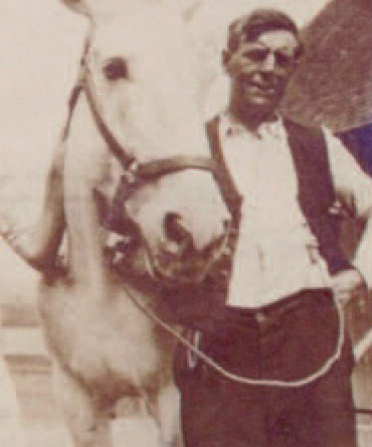
Photo of Private Arlington Dixon Ward

Pte. Arlington Dixon Ward (18 October, 1895 – 9 April 1917)

And in light of more recent military upheavals, Colin introduces us to Private Arlington Dixon Ward from Rockport, New Brunswick, who fought at Vimy Ridge in April, 1917. This story puts a unique perspective on the tragedies of war, especially for us living in the Tantramar region. Upon reading about “Arlie’s” family and friends along the windy shores of the Bay of Fundy, we become part of the Canadian family that owes so much to those young men who bravely fought for our freedom, exactly a century ago. We should remember them not only on Remembrance Day every November 11th, but every day of the year.

So absorb yourself in the lives of the local military in the 18th and 20th centuries in this region and remain thankful,

Always!

Peter Hicklin

The Fives Court
Entertainment at old Fort Lawrence in the mid-18th century

By Colin MacKinnon

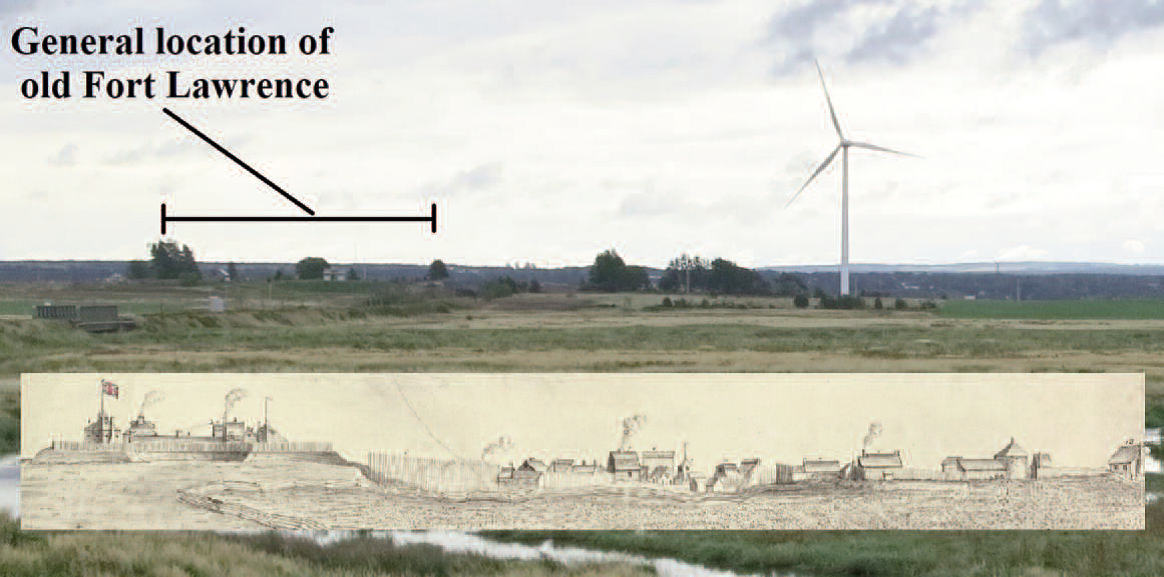
While pouring over old maps, photographs, journals and diaries, one often picks out details that perhaps were not of high importance to the original composer. This short note is an example of a drawing that provides an interesting insight into a rather small, and usually overlooked, part of this region’s history. The artistic and talented Captain John Hamilton (1724-1802) of His Majesty’s 40th Regiment of Foot, left us with detailed panoramic sketches of both Fort Lawrence and Fort Beauséjour (Figure 1) made during the tumultuous events of 1755.

Photo and map showing general location of Old Fort Lawrence

Figure 1. View of the Fort Lawrence Ridge, as seen from Tongue’s Island, with a very rough approximation of fort and building locations from teh Hamilton sketch of 1755 (inset). The row of “palisades” in the Hamilton sketch roughly concides with where the Canadian National railway now cuts through the ridge.

The Fort Lawrence drawing is particularly detailed as it shows the outline of the fort, its blockhouses and interior buildings, as well as a straggle of houses and barns immediately southwest of the fortification (Figure 2). Additionally, the legend that accompanies the drawing identifies most of the more significant structures including an odd feature labeled “The Fives Court” (Figure 3). I had noticed this detail many years ago but did not give it much attention other than being curious about the tall, box-like feature that was associated with the name and which appeared as an oddly out-of-place afterthought by the artist. Allowing for some latitude in scale, the Fives Court structure is depicted as being about the same height as an adjacent story-and-a-half house, with a mansard roof, owned by a Mr. Martin (presumably Captain Sennacherib Martin [1723-1781/1782]) suggesting a height of maybe 5 or 6 meters.

Portion of sketch of Fort Lawrence

Figure 2. Portion of a sketch by Captain John Hamilton (1724-1802) of His Majesty’s 40th Regiment of Foot; The North West View of Fort Lawrence in Chignectou 1755. Legend: 1 – Block houses, 2 – Commandant’s quarters, 3 – Officers’ quarters, 4 – Soldiers’ barracks, 5 – Commissary’s quarters, 6 – Line of tall Pallisades, 7 – Mr. Martin’s*, 8 – The Fives Court, 9 – Commandant’s summer house, 10 – Commandant’s Stable, 11 – Brew house and Mr. Huston’s**, and 12 – formerly Mr. Glazier’s. *Presumably Captain Sennacherib Martin (1723-1781/1782) and ** Captain John Huston (1710-1795).

Enlargement of a portion of sketch of Fort Lawrence.

Figure 3. Enlargement of a portion of the Fort Lawrence sketch. Note the tall, square, wall-like feature at the centre of the photograph (No. 8 – “The Fives Court”.

What is especially interesting here is that this is no “court of justice”, at least not in the traditional sense, but a playing court for the game of “Fives”. This game, also called “hand-tennis”, is somewhat like racquetball or handball. The Encyclopedia Britannica (1910) describes “Fives” as, “a ball-game played by two or four players in a court enclosed on three or four sides, the ball being struck with the hand, usually protected by a glove.” I don’t know if the game was only enjoyed by the officers and gentry or if the rank-and-file were also allowed to play. In the 18th century, the sport was taken seriously enough that considerable money was bet on competitions. An advertisement dated 10 March 1786, for an event in Wales at the “Brecon Castle Fives Court”, announces a winning purse of 100 Guineas (a huge sum in the 18th century) to anyone in the Kingdom who could beat two men from the town of Brecon. Successful athletes then, as now, are often celebrated; John Cavanagh (d.1819), an Irish house-painter, is said to have been the most famous “Fives”-player who ever lived.

The game was also played at Fort Cumberland (old Fort Beauséjour) as well, although the players may have lacked the formal court that they had enjoyed at Fort Lawrence. This caused some engineering concerns as noted on 7 June, 1760, in the Orderly Book at Fort Cumberland: “Whereas playing the game called fives which has been practised against Lowland batterys and the Magazine beats out the Pointing out of these works, that game for ye future may not be played against them, and the officers of the guards are to give the centrys charge that they suffer it not to be done.” (Will R. Bird, 1928, A Century at Chignecto, p. 211).

As an aside, it is interesting to note that other “activities” were also damaging the fort’s earthworks. The orders of 18 March, 1760, state: “Commanded all owners of swine to put rings in their noses to prevent their damaging the walls”. A further warning was issued on the 2nd May insisting that owners ring their swine (apply a nose ring). These warnings were apparently to no avail for on the 6th of May, 1760, the commanding officer ordered; “centrys are directed to kill swine digging at earthworks” (Will R. Bird, 1928, A Century at Chignecto, P. 210-211). The final threat may have reached the attention of the livestock owners as no further mention of the damage was noted. They may have reflected on similar concerns raised a year previously when hogs were damaging gardens near the fort. A notice for 28 May, 1759, reads: “Whereas Complant has Been made that the gardens are hurt by the Hogs and Small Swine those are owners of them are Either to Shut up or yoak them in order to Prevent them Doing so.” (Josiah Perry, An Orderly Book of Fort Cumberland 1759-1760, p. 7).

Whether the damage to the Fort Cumberland ramparts caused by the “Fives” players and aggravated by free-ranging hogs resulted in their own court being built is not known. Within the area that we now know as Canada, I doubt that the game of “Fives” was only played at Fort Lawrence and Fort Cumberland in the mid 1700’s. However, the former site may have been one of the few places that had an actual court built for that specific purpose. I did find a brief reference to a “Fives Court” in Quebec in 1832, but otherwise, references are scarce. Thus, Captain Hamilton may have unwittingly given us one of the earliest, or even the earliest, likeness of one of these sporting facilities in the country!

One of the Fallen
Pte. Arlington Dixon Ward (1895-1917) at Vimy

By Colin M. MacKinnon

Photo of brothers Private Arlington Dixon Ward and Corporal Parlee Hector Ward

Figure 1. Brothers (l-r) Pte. Arlington Dixon Ward (18 October 1895 – 9 April 1917) and Cpl. Parlee Hector Ward (1889-1958); only one would survive Vimy and make it back home. Parlee came back with his life but he left a leg and his brother in France. (Photos by E.P. Smith)

This year marks the 100th anniversary of the World War I battle of Vimy Ridge that occurred from the 9th to 12th April, 1917. Much has been written about the battle, in both minute detail and in-depth analysis. It has been described as one of Canada’s defining events and, in the words of Canadian Brigadier-General A. E. Ross: “In those few minutes, I witnessed the birth of a nation”. My purpose here is not to debate the battle but to honour just one of the three thousand five hundred and ninety eight Canadian soldiers who died over the four day battle. Please read the number again, 3,598! This does not include the additional 7,004 compatriots who were wounded in action. There must have been very few people in Canada who were not touched by these losses. To put this in perspective, Canada’s population in 1917 was 8,060,000. Thus, approximately 1 out of every 760 of this country’s populous were one of the dead or wounded at Vimy!

Early Days

Photo of Percy Ward

Figure 2. Percy Ward (1886-1960), Arlington’s oldest brother. (Photograph courtesy of Jeff Ward)

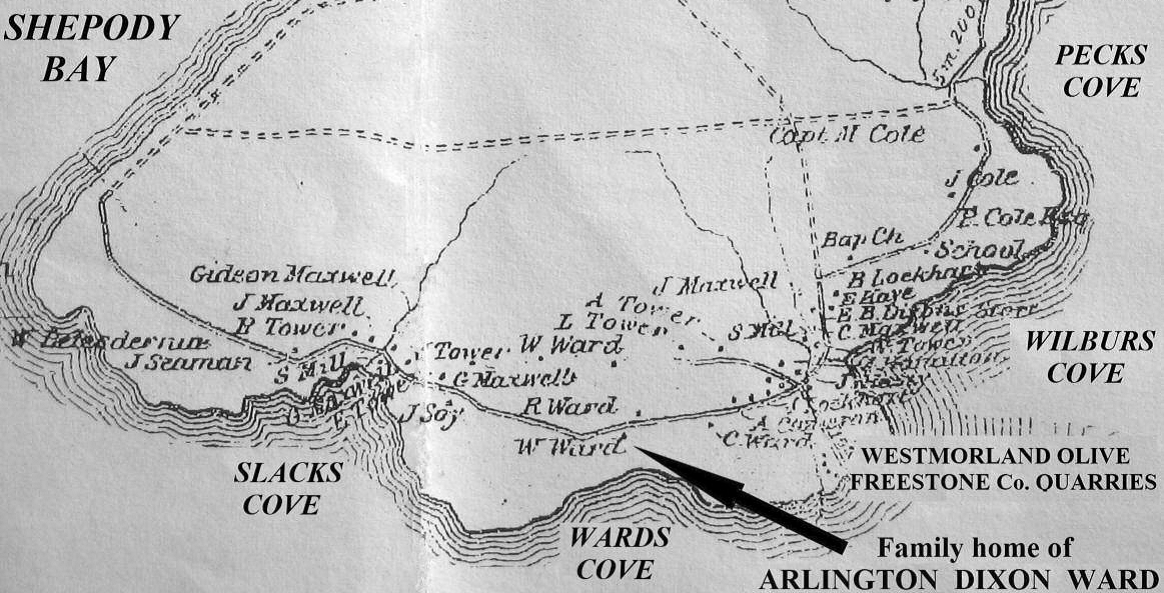
Map of households on Rockport peninsula, New Brunswick, Canada

Figure 3. A portion of the so-called “Walling” map of 1862 showing households on the Rockport peninsula, New Brunswick, and the family home of Arlington Dixon Ward.

Photo of remains of Ward farmhouse

Figure 4. Remains of the farmhouse of Beverly Tower and Edva Ward that once overlooked Slacks Cove. (Colin MacKinnon photo)

The soldier I would like to present is Pte. Arlington “Arlie” Dixon Ward who was born on the 18th October 1895, not far from Slack’s Cove, in Rockport, New Brunswick (Figure 1). He was one of six children born to Amos H. Ward (1851-1914) and Sarah Ann “Sariann” McKinnon (1863-1903). Amos and Sarah were married by the Rev. William E. Hall of Sackville on the 7th August, 1889. Amos’s parents were Thompson Maxwell Ward (1820-1880) and Emily Macfarlane (1821-1874) while Sarah’s were Hector McKinnon (1831-1910) and Rosanna Gough (1840-1917). Arlington’s six siblings were: Percy Ward (1886-1960) (Figure 2), Cpl. Parlee Hector Ward (1889-1958) (Figure 1), Edva “Evie” Mae Ward (1892-1967), Averil Iva Ward (1897-1987), Stella Christina (1901-1903) and an un-named baby lost in childbirth in 1903. The Ward homestead was situated on the shore side of the road at Ward Cove, a little more than one kilometre past the bridge at Wilbur’s Cove and not quite 400 m prior to the lane for the Rockport cemetery (Figure 3). As a snap shot of the family in 1901, the father Amos Ward (age 50) was employed as a Stone Cutter. At home was his wife Sarah (37) and children Percy (14), Parlee (10), Edna (9), Arlington (5) and Averil (3). Clearly the common Rockport livelihood of stone cutting, the mainstay of the local economy throughout the 1800s, was still being practiced. Of Arlington’s neighbours, Mariner Ward (aged 42), Joseph Tower (57), James Maxwell (45) and Henry Tower (60) were Stone Cutters while the younger men such as Herbert Ward (22), William Tower (24), Fred Maxwell (38) and Alton Maxwell (30) were sailors. Probably most of the Stone Cutters were employed nearby at the Olive Freestone Quarry where Irvin E. Tower (1885-1961), the son of Joseph Tower (above), was the engineer in charge of the boiler that ran the steam derrick. This is the immediate community where Arlington grew up. By 1911, after the loss of his mother in 1903, Arlington (now 15 years old) was still living at home with his father (age 56), brother Parlee (20) and sister Averil (13). At this time, Parlee was already often away from home while employed as a sailor on a coastal schooner. His older sister Edva (age 21), newly married to Beverly Tower, lived just down the road at the old Tower farm overlooking Slacks Cove (Figure 4). Her husband Beverly was employed as a labourer at the quarry wharf. As a teenager, one can easily imagine Arlington slipping away from school at noon, walking the half-kilometer trail (south-southeast) past the old Hagan place and the cut stone basement for the company store, to see what was going on at the wharf. Or maybe he would go hunting for partridge in the woods, lay in wait for waterfowl on the Pecks Cove marsh or maybe exploring the nearby gypsum sink hole called Pink Rock Lake.

The Ghost Cloak

When he was only eight years old, Arlington was to lose his young mother in the fall of 1903. Sarah (McKinnon) Ward (Figure 5) took ill due to complications of a premature childbirth and died on the 21st of November. She was only forty years old. Just five days previously, her two year old daughter Stella also passed away from scarlet fever. She was buried in the same grave with her mother in the Rockport cemetery. The family recalled stories of there being two coffins in the house at the same time. A strange story of her death has been handed down to us from Sarah’s sister Christy (McKinnon) Gamble (1881-1969) as recalled by her daughter Reva. At the time of her passing in Rockport, her father at the McKinnon home place in Woodpoint, witnessed an apparition of his daughter. The story, as told by Reva (Gamble) Marshal (1919-1995), goes as follows:

“Sariann was the favourite daughter of Hector McKinnon. She lived in Rockport, below Woodpoint, NB. One day while Grandfather was lying on the couch in the kitchen, the back door opened and in came Sariann (Figures 5 and 6). She was wearing a brown cloak with a hood and as she came through the door she flung back the hood and began to undo the frog fasteners (Figure 7). Grandfather said ‘why Sariann, where did you come from,’ and she disappeared. Grandmother came to the kitchen to see whom he was talking and he told her what happened and said he felt sure something had happened to her. Sure enough, later on that day Uncle Ame came in with the word that Sariann had died, also Stella (her daughter). My own mother (Christy) never believed in ghosts, and yet when I tried to pin her down, all she would say was that father never told a lie in his life.”

Photo of Sarah Ann McKinnon Ward

Figure 5. Sarah Ann (McKinnon) Ward (1863-1903), mother of Arlington Dixon Ward. (Colin MacKinnon collection)

Photo of old McKinnon home in Woodpoint, NB

Figure 6. The old McKInnon house in Woodpoint, where Hector witnessed the apparition of his daughter Sarah at the time of her death in 1903.

Photo of cloak worn by Sarah McKinnon Ward

Figure 7. The cloak worn by Sarah (McKinnon) Ward in the story, “She was wearing a brown cloak with a hood and as she came through the door she flung back the hood and began to undo the frog fasteners.” (Photograph courtesy of Jeff Ward.)

Arlington was only 19 when he lost his father on the 1st February, 1914, at age 63. The obituary in the Sackville Tribune provided these details:

“One of the best-known residents of Lower Rockport died with shocking suddenness. Mr.Ward had been in his usual good health, and worked all day on Saturday with his son in the woods getting firewood. He retired about nine o’clock on Sunday night. His son Arlington found him dead soon after ten o’clock on Sunday night, having gone into his room to speak to him. He died of heart failure resulting from nervous dyspepsia.” (Likely angina.)

When this happened, Percy was living in Amherst. With the loss of both parents, Parlee, Arlie and Averil were only able to remain in the home for a short time after this latest tragedy.

The War

When Arlington was a young man, he often followed in the footsteps of his older brother Parlee. As both boys likely went as far as they could in Rockport’s rural one-room school house (usually up to grade 8), Arlington followed his brother’s lead and, looking for employment and adventure, found work as a sailor in the coastal trade. He continued as a seaman, travelling between Bay of Fundy markets and New England until the losses of WW I called for more men. Parlee Ward enlisted on 18 November, 1915, with the 115th regiment in Sackville but was reassigned on 14 January, 1916, to the 145th Battalion. Arlington, who had been living in New Glasgow, just 21 years old, enlisted soon after on the 31st March, 1916. Pte. Ward was assigned military serial number 832524. At 5 feet 8 inches, with a maximum chest expansion of 36 inches, he was a slim and fit young man. In his attestation papers, he was described as having a light complexion with blue eyes and light brown hair. The enlistment was signed by Lt. Col. W. Forbes, commanding officer of the 145th Battalion “Overseas” C. E. F. (Canadian Expeditionary Force). A lovely photograph has survived of a confident Arlie, in his sharp new uniform, with a Miss Lillian Crossman, taken in the spring of 1916 on the Mount Allison campus with St. Paul’s church in the background (Figure 8). The tragedy of the photograph is that within a year of it being taken, Pte. Ward would die at Vimy Ridge, so far from home.

Photo of Lillian Crossman and Arlington Ward

Figure 8. Spring of 1916: Arlington Ward with Lillian Crossman (1899-1986) at the Mount Allison University pond. Lillian was the daughter of Alpheus Crossman and his second wife Ella Jane Dobson. She would marry Philip Cornell and is buried at Dartmouth, Massachusetts. (Photograph courtesy of Jeff Ward.)

Note from Arlington Ward

Figure 9. Dated 26 October 1916. Arlington Dixon Ward’s chilling declaration, “In case of my death,” granting his property to his sister Edva (Ward) Tower of Rockport. (Source: Library and Archives Canada, War records, RG 150, Accession 1992-93/166, 28 pages, Box 10075-41).

I have summarized Arlington Ward’s military career as interpreted from the typical terse military jargon as found in the records. After enlisting in the 145th Battalion (New Brunswick), Canadian Expeditionary Force, he was sent to Valcartier for basic training where he was laid up for five days in August due to complications from the mumps. On the 25 September, 1916, he sailed from Halifax on board the ship “S.S. Tuscania” (a luxury liner converted to a troop ship) and arrived in Liverpool, England, on the 6th October. The following day, Arlie was transferred to the 9th Reserve Battalion stationed at the Shorncliffe Army Camp (St. Martins Plain, Kent, England). Later that month, he made his sister Edva (Mrs. Beverly Ward) his beneficiary in case of his death (Figure 9). This occurred just prior to his being assigned to the 26th Battalion that was part of the 5th Infantry Brigade of the 2nd Canadian Division. There is a notation in the records that on the 22 November, 1916, he “left for 2nd Ent Battalion”. This, I assume, is the 2nd Entrenching Battalion (more knowledgeable readers may correct me if I’m wrong). At this point, the details become murky, with only a brief entry for 31 March 1917: “arrived unit”. With the 26th Battalion, Pte. Ward found himself on the front lines of the opening day of the assault for Vimy Ridge. On the 9 June, 2017, the 26th were situated just east of Neuville St. Vasst and occupied the first wave, of the left flank, of the 5th Canadian Infantry Brigade (Figure 10). What follows is a portion of the War Diary entry for the 5th Infantry Brigade, 26th Battalion, at Thelus Sec. and Vimy Ridge, for 9 April 1917:

“At zero hour (5 30 a.m.) barrage came down on German front line and Battn [Battalion]. Jumped off. At Zero plus 32 minutes the light signal (3 white Very lights) was fired showing that Bn. [Battalion] had reached and occupied their objective. The casualties in the attack were slight and during the rest of the day the Coys [Companys]. Spent the day in clearing the trench and making shelter for the men.”

(Source: https://www.electriccanadian.com/forces/VimyWarDiaryProjectCEFSG.pdf)

Note the portion of the above entry, “The casualties in the attack were slight”! Arlington Dixon Ward, the young lad from the small village of Rockport, New Brunswick, was to die that day. His body was either never recovered, or like so many soldiers, lies in an unmarked grave.

In honour of Arlington Dixon Ward and the others who fell at Vimy and made the ultimate sacrifice, I leave this question as written by Vimy author, Pierre Berton: “Was it worth it? Was it worth the cold and the lice, the rats and the mud? Was it worth the long hours standing stiffly in the trenches, praying that no sniper’s bullet would find its mark? Was it worth it to crawl out into No Man’s Land with a bag of bombs, seeking to mangle the men in the opposite trench before they mangled you? Was it worth that tense, chilly wait on Easter Monday morning…when the world finally exploded and the enemy was driven from the heights at a cost in lives and limbs the High Command and the press described as minimal?”

Map of Vimy Ridge, April 9-12, 1917

Figure 10. Vimy Ridge, April 9-12, 1917. The black arrow denotes the presumed location where Pte. Arlington Dixon Ward would have fought, and fell, on 9 April, 1917 (situated about 2 km due south of the present Vimy memorial). Inset [A-D-WARD]: his name as engraved on the Vimy memorial (Photo courtesy of Jeff Ward who visited the memorial with his wife in 2011), one of the 11,285 who were posted as “missing, presumed dead.” (Base map source: https://www.collections canada.gc.ca/firstworldwar/025005-1300-e.html)

Acknowledgements
I would especially like to thank Jeff Ward for his diligence in preserving the history of Rockport that culminated in his book, Head of the Bay, A History of the Maringouin Peninsula, and thank him for the use of his photos including those of Arlington in uniform. Details about Pte Ward’s short life, as well as his family and information about other local boys who served, are covered in greater depth in his book. I would also like to thank Helen (MacKinnon) Wheaton for use of her photo of Arlie’s brother, Cpl. Parlee Ward.

Note: Pte. Arlington Ward’s British War Medal was sold on ebay in September, 2008. Information on its whereabouts would be greatly appreciated as the family would like to have it back.

The White Fence, issue #77

november 2017

Editorial

Dear friends,

Back in the early 1970s, I took a course at Mount Allison University’s Biology Department entitled (if I remember correctly) “Land-use Ecology” taught by Dr. Hinrich Harries. On one of the September field trips to the “Tantramar Marsh” (the area we all know as the “High Marsh Road”), Dr. Harries took us over the covered bridge, along the road to Midgic, and described what this area would have looked like in pre-dyking times. He described an ancient landscape of mudflats and brackish marshes that few of us could visualize. It did, however, open my eyes to the extensive changes to natural landscapes wrought by mankind to “tame” nature and make it “useful.” And useful it was! Substantial financial returns came to those farmers who harvested the bountiful hay crops of the area in the late 18th and 19th centuries. Dyking also created an important dry roadway towards Jolicure and Nova Scotia. The changes also brought about other, perhaps unexpected, uses. Never did I consider this expansive and unique agricultural area as a fishing ground.

But Colin MacKinnon, over the next few pages, will tell you so! Colin’s article about fish weirs in this newsletter displays his diligence at uncovering important details about natural habitats (in this case the Tantramar’s “high marsh”) and the former human use of these areas. I warn you: it is very detailed. But at my first reading, I found myself totally absorbed not only in Colin’s findings but also the process he followed to discover the largely unknown activity of weir fishing along the Tantramar and Aulac Rivers, those tidal rivers which wind through the vast drained marshland still known today as the High Marsh. So read on and, through Colin’s admirable efforts, discover our ancestor’s past activities in areas that are now buried under pasture, hay fields and, in places, deep mud. And, I hope that, like me, you will be thoroughly enthralled. But most importantly,

Enjoy,

Peter Hicklin

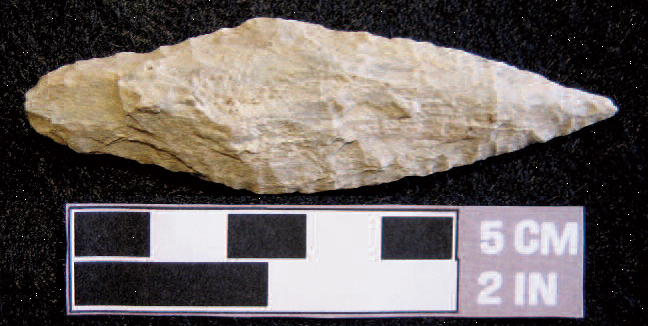
Photograph of chert bifaced knife

Chert bifaced knife recovered from the upper Tantramar. Although suitable for multiple uses, the thin and serrated blade could have been used to process fish (Colin MacKinnon photo).

In Search of the Fish Weir Lot

By Colin M. MacKinnon

Some time ago, while researching an unrelated topic, I inadvertently stumbled on a local place-name that was unknown to me. This happened while I was going over some old deeds and one of the documents mentioned a place on the Tantramar called the “Fish Weir Lot”. To aid in fleshing out the location of this parcel and to provide a historical context to this fish weir within the changing landscape of the Tantramar Marsh, I present below a number of interconnected topics.

The “Fish Weir Lot” was first encountered in a land transfer from Reuben Wheaton to Thomas S. Wheaton signed on 16 July, 1890. The parcel was described as follows: “all that certain piece or parcel of marsh land situated in Sackville aforesaid and known as the Fish Weir Lot so called and bounded as follows, Easterly by lands belonging to the estate of the late George Anderson, Southerly by the Dixon Ditch, so called, westerly by lands of Jesse Ayer and northerly by Commons Ditch, so called, and containing by estimation fourteen acres more or less” (Land Registry Office, Book U5, No. 58359, Registered 17 July 1891)

Presumably there was a fish weir on this parcel. It would have consisted of a series of vertical wood pickets, intertwined with brush or netting (as there are not many stones on the marsh) that were imbedded into the sides and bottom of a creek. Often the best place for such a weir would have been at the head of tide or at a natural restriction in the river. The weir would direct the intended fish into an area where they would be concentrated and thus easier to catch. The fishermen could have used seine or gill nets but dip nets, still used on the Tantramar today, were more likely if the targeted species was Gaspereau. This parcel has been frustratingly hard to pinpoint and although I had heard about the other features mentioned on the Wheaton deed such as the “Dixon Ditch” and “Commons Ditch”, I was uncertain as to their exact locations. Furthermore, the dyking and draining of the marshlands over the past few hundred years and the in-filling of many lakes has dramatically changed the landscape of the Tantramar, far more than many people realize.

1791 grant map of the upper Tantramar Marsh

Figure 1. Potion of the Grant map of 1791 showing the many parcels of land on the upper Tantramar Marsh between the Great Bridge and Sunken Island. Salient features: “High Marsh Road” [Solid dark line] and adjacent 4-acre lots, A. Outlet to “Rush Lake” entering “Dead Creek”, B., The 14-acre lot situated on a creek, C. “Fish Weir Road” and “Dixon Ditch” and D. “Commons Ditch” (Top of map is oriented north). (1791 Sackville township map, Mount Allison University Archives, donated by Richard “Dick” MacLeod)

One of the earliest detailed maps of the Tantramar, the Sackville Township grant map of 1791 (Figure 1), hints at the pre-dyking history of the marsh based on the way lands were allocated. When the English settlement era land grants were laid out, there was a serious attempt for an equitable distribution of marshland such that everyone would have a fair share of productive lands. Generally, the more valuable soils on the “high marsh” were divided into very small parcels (4 acres) so more people could have an equal share; the surrounding, comparatively larger, lower elevation waterlogged lands required more work and considerable improvements to render them productive. In the pre-dyking era, this “high marsh” would have been dominated by the saltmarsh cordgrass Spartina patens that is only flooded once or twice a month by the higher high tides. Today we have the High Marsh road. It would also be this type of higher elevation “patens saltmarsh” that would typically be the first (and easiest) to be dyked by early Acadian farmers.

Situated perpendicular to the High Marsh Road from Tolar’s Canal to the Great Bridge (Wheaton covered bridge), were a series of long and narrow, four-acre lots (see Figure 1), these parcels being within the best marshlands for agriculture. Between these small lots and the “floating morass” (bogs and lakes) to the north, were two tiers of these larger lots that were of less value. Although these are labeled on the map as “Twenty one acre Marsh lots”, the actual size appears to vary; again, this may have been an attempt to equalize the value of adjacent parcels. On Figure 1, I have noted the locations of the “Commons Ditch” and “Dixon Ditch” as well as the outlet to “Rush Lake” and the only 14-acre lot (actually 13.9 acres) that was situated between these two ditches as described in the deed. The map depicts a portion of a creek running through this specific parcel. Could this be the “Fish Weir Lot” mentioned in the Thomas S. Wheaton purchase of 1891?

Frequent travelers of the High Marsh Road may be confused by my reference to “Rush Lake” as no such body of water by that name exists there today. Likewise, other water basins such as the original “Goose Lake” (not the one on the road to Midgic) and “Long Lake” (not the one in Jolicure), all situated within the Tantramar Marsh, have vanished.

These were filled in by the technique called tiding, or warping, which turned wetlands into arable land. At this point it is worth taking a short diversion to explain how this technique works. Simplistically, strategically designed and positioned channels are dug such that during high tides, the silt-laden waters of the bay are allowed to flow into low-lying areas and lake basins. Once the velocity of the water has slowed, the load of suspended sediments  precipitates out. Over a series of very high tides, a shallow lake could be, in this manner, completely filled in. Before the creation of larger aboiteaus and tidal gates at the mouth of the rivers serving to impede tidal flow, this tiding process was used to rejuvenate fields on the dykelands. Tolar Thompson (c.1780-1846) is largely credited for refining and applying this tiding technology in the Sackville area although the idea was published in the Farmer’s Calendar in 1804 under the title “Warping” (Arthur Young Esq., Secretary to the Board of Agriculture, London, pages 389-395) and dates back to c.1730 in Rawcliffe, Yorkshire (and possibly earlier). The canal that bears his name can be located by travelling about 2.7 km east of the covered bridge on the High Marsh Road. This large ditch is reached just prior to passing the barn owned by the Tantramar Heritage Trust. Once you get to the culvert that crosses Tolar’s Canal at a slight rise in the road bed, the centre of the remnants of “Rush Lake” is situated about 1 km along this ditch, north of the road.

Details in the wording on early marsh maps often provide hints at where tiding took place. While some channels are described as drainage ditches or vent ditches, others are labeled as “tide feeder streams”. It is these “tide feeders” (such as Tolar’s Canal) that were purposely built to bring the silt-laden waters of the bay inland. However, many of these structures, such as Tolar’s, served a dual purpose and also facilitated drainage of the surrounding agricultural lands.

Although the details on the in-filling of “Rush Lake” are brief, the following short accounts, written around 1902 by Winifred E. Thompson (who was likely a relation to Tolar Thompson), provides us a glimpse into Tolar’s work at Rush lake as well as nearby “Goose Lake”; I assume that these descriptions were written by Winifred E. (Thompson) McLellan (1882-1919), the wife of J. A. MacLellan. Her account reads as follows:

“The first great canal he [Tolar Thompson] projected was the Tolar Canal, which ran from the Tantramar River to Rush Lake, a distance of two miles, and drained the commons and the lakes and bogs to the north and east. This was commenced in 1815 and by it about 900 acres of bog and lake were made marsh, and hundreds of acres on either side of the canal were drained and made valuable. The next great work Tolar Thompson undertook was the Goose Lake Canal. No sooner was this work done than the tide rushed in and began to rapidly fill up the lake and must have reclaimed 1,000 acres of lake and bog and greatly improved hundreds of acres of marsh adjoining this canal.” (Winnie E. Thompson, circa 1902 in Chignecto Post, 13 February, 1933).

Winifred provides additional observations in greater detail, probably from family tradition, on the draining and tiding that occurred on “Long Lake” on the main Tantramar River (see Figures 2 and 3)

Map of Long Lake in 1895

Figure 2. Map of “Long Lake” completed by the Commissioner of Sewers (Albert Cahill and W.B. Fawcett) in 1895. A copy of that map, shown here, was prepared by R. A. MacNaughton, 14 April, 1928. Note that the “CANAL” is now part of the upper Tantramar River and the old “Long Lake” is now called the “Long Lake Marsh”.

Aerial photograph of original Long Lake on the Tantramar River

Figure 3. Aerial photograph showing the approximate outline of the original “Long Lake”, on the Tantramar River. This area is now a hay field.

As the process and ultimate landscape changes at “Long Lake” would be similar to the environs following the loss of Rush Lake, it is worth noting in more detail:

“When Tolar Thompson contemplated and succeeded in digging his canal into Long Lake and a branch to Log and other Lakes he did so against the most bitter opposition. He was most firm that by draining these lakes and carrying in the tides of the Bay of Fundy they would all become marsh.

As evidence whether he was right or not, visit Indian Island and there you will see a barn of 75 or 80 tons capacity belonging to Albert Fawcett (see Figure 4). This island is situated about the centre of Long Lake some ten miles up the Tantramar River. Although still called Long Lake it is no longer the large body of deep blue water that it once was but a beautiful meadow of waving grass producing from three to four hundred tons of hay. So deep was this lake, the old men who rafted timber over it say that their 24 feet pole would not reach bottom in many places. In the days of the first settlers of Cookville this and other lakes formed the only highway from Cookville to Sackville, and many were the adventures of the old settlers as they paddled their canoes across these lakes to get the necessaries of life. On one occasion the late John Lund while thus engaged was overtaken by a great gale on Long Lake, his canoe upset, his supplies lost and he only saved his life by swimming to the island and remaining there until found” (Winnie E. Thompson, circa 1902 in Chignecto Post, 13 Feb., 1933).

Photograph of Long Lake Marsh bridge

Figure 4. Long Lake Marsh bridge over the upper Tantramar River and, in the background, presumably the same barn of 75 or 80 tons capacity (inset) which was situated on “Indian Island” and was once surrounded by “Long Lake”. This island was a place of refuge for the nearly drowned John Lund while on a canoe trip to Cookville.

As you can see from the above observations with the ditching and draining of the dykelands and loss of many bogs, lakes and fens on the Tantramar through tiding, tracing exact locations of long forgotten places (not to mention place names) can be problematic. Thus, my first clue to the location of the “Fish Weir Lot” was somewhat contradicted by the second and considerably earlier reference I encountered. In 1789, Nehemiah Ward sold marsh land (on oath of Phineas Ward) to William Easterbrooks for 8£. The transfer was described as follows: “One Lot of marsh bordering Northerly on the Fishwear Pond (sic) and Southerly on the road at the head of the four acre Lots and drafted with number fifteen and likewise all that part of lots No. 15 and 21 that lays on the North side of the Pond or Rush hole. All the aforementioned parcels of land laying on the north side of the main road that leads through the Great Marsh.” Signed 5 February 1789 by Nehemiah and Susannah Ward and witnessed by Phineas Ward and Nathaniel Phinney (1798, Book B1, No. 877, page 254, Registered 27 March 1799).

This deed is interesting in that prior to 1800, there was a commonly known place called the “Fish Weir Pond” and this was presumably adjacent to, or even considered part of, a wetland called “Rush Hole”. I believe this is an early reference for what was collectively, and later, called “Rush Lake”. Jumping ahead to 1966, when the Government of New Brunswick was securing land for the Community Pasture, situated immediately north of the High Marsh Road, there were a number of land transactions. One of these government acquisitions was from Eleanor Brooks of Middle Sackville, Parcel No. 2, and was described as follows: “Bounded on South west in part by the Fishwear Road so called and in part by lands of Vendor, formerly known as A. B. Copp estate; On the North east by Commons Ditch so called; on the south east by lands of David Oulton formerly Vernon Copp. Containing by estimation 21 acres more or less”. (Westmorland County, Deed Registry No. 272354, Page 762, 4 May 1966).

Annotated aerial photograph of Tantramar dykelands

Figure 5. Salient features and remnant tidal creeks (white lines) within the dykelands west of “Rush Lake” and immediately north of the High Marsh Road (Features annotated on a 1953 aerial photograph).

With this third document, I have now confirmed the existence of a “Fish Weir Road”, “Fish Weir Pond” and a “Fish Weir Lot”. Clearly there was once an important fishing site that was accessed by the “Fish Weir Road”. This fishing location (or locations) was (were) also somehow associated with “Rush Lake” (Fish Weir Pond). In Figure 5, I attempt to delineate these places, along with other salient features, that are mentioned in the various parcel descriptions. Although some of the detail is speculative, many of the old tidal creeks that once connected the main Tantramar River with inland lakes, such as “Rush Lake”, can still be traced on the landscape using early aerial photographs (Figure 5). Surviving lakes, such as the three Jolicure Lakes (Large/Big, Long and Front) support a diversity of fish species. Frequently-encountered fish are freshwater species such as Brook trout, White Perch, Yellow Perch and Brown Bullhead as well as the catadromous American Eel and anadromous Gaspereau (also known as Alewife). It is probably the harvesting of Gaspereau that was most likely associated with activities at the fish weir.

Spring fishing for Gaspereau from the Tantramar and Aulac Rivers, although still practiced today, was once far more commonplace. As an example, a farming family’s typical fishing diversion for Gaspereau is wonderfully preserved in the diary of Edward Anderson of Coles Island in 1875:

Wed., 12 May – Forenoon making scoop net, got it done at noon. Bliss got 32 fish. Albert ploughing for Ed Kinear.
Thurs., 13 May – Sharp claps of thunder this morning. George Beal had horse killed by the lightning. Boys got 170 fish at Etter Abito [Aboiteau].
Frid., 14 May – Ploughing and sowing some. Milton and Bliss scoop fishing, got 165.
Mon., 17 May – Boys fishing in the morning.
(In: Marshlands: Records of Life on the Tantramar. https://www.mta.ca/marshland/.)

Photograph of classic Gaspareau smokehouse

Figure 6. A classic Gaspereau “smokehouse” that was once used by William “Bill” Landry of Upper Sackville. Sadly, this iconic, and increasingly rare, structure was recently torn down.

Not too many years ago, one would frequently see small and vaguely outhouse-shaped buildings with slanted sides, leaking smoke. And if you did not see the building, your nose would quickly alert you that someone was “smoking Gaspereau”. I suspect that, years ago, there was hardly a self sufficient farm that did not have its own smoke house. However, a driving survey one Sunday afternoon revealed only a few of these mundane but iconic structures remaining in the Sackville area. The best surviving example that Nancy and I could find (that has recently been torn down) was situated on Church Street near the turn to the High Marsh Road that was once owned by William “Bill” Landry (Figure 6). Bill frequently fished and smoked Gaspereau with his friend Earl “Lovett” Carter (b. 1911) of Point de Bute. On more than one occasion, they were accompanied by “Montana Slim”, Wilfred “Wilf” Carter (1904 1996) when he was home visiting family. Wilf (born in Port Hilford, NS, with relatives in Pointe de Bute, NB) was a country singer and songwriter who was often called the father of Canadian country music.

This wonderful little building was a prime example of “form follows function”. The builder was less concerned with exact measurements than following a proven design that ensured properly smoked fish. Construction of the smoke house was both basic as well as creative. As noted above, there was less regard by the builder for exacting measurements and having perfectly square corners than as to have a structure that performed its intended function. The internal framing consisted of four vertical poles, one at each corner, roughly tapering from about 5 to 4 inches in diameter, from bottom to top respectively. The poles were connected horizontally by a series of standard 2″ x 4″ framing with the vertical planking (1″ thick boards were used) attached to these. The entire exterior was then covered with wooden shingles. The construction was presumably by prefabricating the skeleton for two walls (front and back) on the ground, and then standing them up to be joined together at the top. The boards that sheath the smokehouse were scavenged from whatever was available. Some boards were cut with a band saw while others were processed with a circular saw (Figure 7). Furthermore, some of the timbers were rough sawn while others were planed and one charred board was likely saved from a previous smokehouse that had been mostly lost to fire, a common fate to many of these buildings.

Photograph of interior of Landry smokehouse

Figure 7. Interior view of the Landry smokehouse. Note the many rows of nails, as well as suspended poles, where the fish would have been hung.

For hanging the fish, nails were spaced about every two inches along the horizontal boards that lined the interior. There were enough nails on just the back wall to accommodate the hanging of 150 fish. A possible later addition was the placement of an internal skeleton of smaller poles, maybe 2″ in diameter, to support a larger number of fish for drying. The small door (20″ by 54″) was barely large enough to step through and was secured by two small steel hinges and a padlock hasp. For those of you who would like to build your own smoker, the base was 8 x 8 feet square. All sides taper to a slanted roof that was about 4 feet square such that the front wall measures 10′ 4″ while the rear wall was 8′ 8″ high. The front side was about 15 inches higher than the rear. The door frame was 2′ 6″ wide by 5 feet high while the actual door measured closer to 1′ 10″ by 4′ 6″.

Pan-fried and smoked, Gaspereau may be an acquired taste to some. However, many of us still appreciate a feed or two every year. It is important to practice some careful observations when consuming Gaspereau as they are a notoriously bony fish. Whereas fried trout can be de-boned in one simple process, the consumption of Alewife needs to be done methodically otherwise one must contend with a number of tiny bones in each mouthful; definitely not a fish to eat when in a hurry.

Photograph of the Fish Weir Road

Figure 8. The “Fish Weir Road” as seen looking east from teh Goose Lake Road; what a story it could tell! The “Fish Weir Pond” (Rush Lake) as situated over 2 km, heading east, down this road.

So what of the “Fish Weir Lot”? My own deductions, followed by talks with Robert Estabrooks and Danny Doncaster confirmed the location of the “Fish Weir Road” (Figure 8). This road departs from the Goose Lake Road and is situated about 1 km north of, and parallel to, the High Marsh Road (Figures 1 and 5). It is interesting to note that the western continuation of the “Fish Weir Road” crosses not only the Goose Lake Stream but also what was once the old channel of the Tantramar River. This same road reaches the uplands of the Brooks family farm where, in 1998, I found in the vicinity evidence of what was an early aboriginal camping area and possibly a fish processing station (see page 1). Interestingly, the old “Fish Weir Pond”, mentioned in 1789, is presumably part of what was later called “Rush Lake” and is also at the “Fish Weir Road”. However, at this point, I still have not been able to conclusively identify the location of the “Fish Weir Lot”. It may be the 14-acre parcel marked “B” on Figure 1 and bordering on the north side of the “Fish Weir Road”. Or the weir may also have been located closer to the junction of where the outlet for “Rush Lake” meets “Dead Creek”. This creek once partly encircled Paunchy Lake and drained parts of the Jolicure Lakes and thus would have been a prime location for catching the Gaspereau moving into these inland lakes to spawn [As an aside, according to Lorna (Bellamy) Etter, “Paunchy Lake” gained its name from waterfowl hunters and trappers who noted the similarity with the spongy feeling of a paunch (stomach) of a moose, or cow, and the texture of the floating moss that surrounded the lake].

The fish weir would have been accessed from the “Fish Weir Road” (Figure 5). Also, as the “Fish Weir Pond” was a name in common use by 1789 it must have been in existence for some time prior to this date. It is very likely that this prime fishing location, situated at the head of tide and connecting to a number of inland lakes, was also known to the earlier Acadian settlers as well as the region’s earliest inhabitants: the Mi’kmaq of the Tantramar. It is interesting to imagine that the wooden remains of the fish weir are probably still entombed within the silt-filled creek bed on the marsh and laying there now, waiting to be discovered.

I would be most appreciative for any new information or family traditions regarding the “Fish Weir Lot” or any details on other poorly known placenames within the Tantramar.

Acknowledgements
A special thanks to the following people who answered questions and shared their knowledge of old place names on the Tantramar: George Coombs (1955-2016), Danny Doncaster, Robert Estabrooks, Lorna (Bellamy) Etter (1925-2017), Mike Green, Jeremy Landry and Helen (Read) Locke.

ANNOUNCEMENT – FUNDRAISING SUPPER
A Taste of History

Friday, November 17, 2017 6 pm
St. Ann’s Church Hall, Westcock NB
Celebrating Sackville’s “Mr. Canadas”: Alex Colville, John Fisher and George Stanley
Catering by Lauri Ann Wesselby, (Sandpiper Catering)
(Menu: creamy autumn soup, tea buiscuits, maple bbq chicken, rice pilaf,
fresh green beans and carrots, apple cheesecake, tea and coffee)
Cash Bar on site
and also
Canadian Classics Singalong
Trivia
Tickets: $50 each (includes $25 tax receipt)
Contact Karen at tantramarheritage@gmail.com or call (506) 536-2541

The White Fence, issue #76

APRIL 2017

Editorial

Dear friends,

We have quite a variety of stories for you in this issue although there is a common thread to all: Farewell. We say farewell to debt, to Bill Bowser who fought and died for our freedom at Vimy Ridge, to Colin MacKinnon’s great-grandmother Mary Jane (Goodwin) Read who lost her way in Frosty Hollow in 1899, and to Oliver Wry after whom the bog where Mary Jane disappeared was named. Furthermore, this issue of The White Fence helps ensure that we shall never forget those members of our community who support(ed) our heritage, financially or by volunteering their time. We also wish to recognize Joe Boyer from Westcock who devoted his short life to wildlife research and conservation in the Tantramar region and left a permanent legacy. We sincerely express our gratitude to all Heritage Trust members’ financial support, past and present, and for their confidence in our efforts. Via this newsletter, we gladly and fondly recognize those very special members of our community, with great respect and appreciation, for their many contributions to this special part of the country. Thank you all! For further details, read on and

Enjoy,
Peter Hicklin

The Anderson Octagonal House Capital Campaign – Final Report

by Geoff Martin
Trust Vice President and Chair, AOH Capital Campaign Committee

We did it! Long-time Trust members will be aware that part of the Anderson Octagonal House project involved the launching of a four-year capital campaign to bring in this project with no capital debt at the end. Most of the costs of the move and rehabilitation of the building were provided by the Town of Sackville’s gift of the house and some in-kind support and financial support of the Government of Canada, Province of New Brunswick and longtime Trust supporter Daniel Lund.

Other organizations and members have been generous, and in each of the years 2013, 2014, and 2015 calendar years, the Trust was able to raise and pay off $20,000 ($60,000 in total) of an $80,000 bank loan. I am happy to announce that our 2016 fund-raising effort was also successful and our local fund-raising yielded $10,660, which was matched by $10,000 as the final matching contribution from our generous anonymous donor. (The surplus of $660 will be used for our donor recognition plan that is currently in development). We can be proud that the financial costs of the campaign were minimal, represented only by some postage and printing over a number of years.

Importantly, the Trust is now debt free, thanks to all of our volunteers and to you who made financial contributions whether large or small. All told, this was a $345,000 project and upwards of $100,000 came from our local fund-raising effort. And it is this private support for our projects that provides the three orders of government with the confidence to make their major contributions. I am sure you will agree with me that, like so much of what the Trust does, the Anderson Octagonal House greatly enhances the Town and our understanding of both our built and human heritage.

In a multi-year effort like this, the organization has accumulated lots of debts to volunteers. Thanks to Leslie Van Patter for doing the design layout for the campaign materials. We would be a lesser organization without her commitment and effort over so many years.

Thanks to Al Smith for providing advice during the campaign and especially as we prepared written campaign materials. Also, thanks to him and to Paul Bogaard for their stewardship of some of our key donors.

The campaign would have been much less successful were it not for our canvassers, a group that included Michael and Vanessa Bass, Lorne Booth, Wendy Burnett, Bruce and Eugenia Coates, Nauman Farooqi, Bob Selkirk, and Donna Sharpe. Frank Chisholm, a life-long “fund developer” for worthy causes and a past Trust fundraising chair, was very generous in sharing his files and his insights with a relative novice.

It is worth noting that one of our long-time supporters has acted as guarantor, anonymously, of the bank loan, and he will be relieved that his faith in our organization has been realized. I am sure that our former and current Executive Directors, Ron Kelly Spurles and Karen Valanne, would say that they didn’t have much to do with this effort but they certainly did provide assistance at key times and for that we are grateful.

Given our unsettled and uncertain economic times, raising significant sums of money for an organization like the Tantramar Heritage Trust is certainly a challenge and that is a good reason for our Board of Directors and membership to be prudent in the projects they take on. I have every confidence that all concerned are approaching these issues with all necessary consideration.

Announcements

Calendar of Events

May 5 – Spring Clean Up, 9 am to Noon, Boultenhouse Heritage Centre. Volunteers needed. Please drop by for cleaning, coffee, cookies and conversation!
May 31 – Annual General Meeting, 7 pm, Anderson Octagonal House.
June 18 – Official season opening of Campbell Carriage Factory Museum.
July 1 – Canada Day Strawberry Social.
July & August – TBA – Children’s Heritage Workshops at both museums.
July & August – TBA – Under the Sky Events at both museums.
August 13 – Heritage Field Day, Campbell Carriage Factory Museum, demonstrations, exhibits, games, food.
November 4 – Annual Fundraising Dinner

Other events may be added during the year and there are many more details to come on those listed above.

Check our website at heritage.tantramar.com for more information. Please contact the Trust office at tantramarheritage@gmail.com or (506) 536-2541 or follow us on social media:

Twitter @TrustTantramar

www.facebook.com/tantramarheritage

www.instagram.com/tantramarheritage

Membership Renewals

Membership renewals for 2017 are now due. You can find your form on the THT website. If you’re not sure if you’re a member in good standing, please contact Karen.

Volunteers Needed

We’re looking for volunteers to help with tasks big and small. If it’s only an hour or two, a one time or long time commitment, we’d love to talk to you about how you can help preserve and promote the heritage of Tantramar. If you can categorize, arrange, bake, shingle, knit, clean, research, decorate, use a computer, hammer or a paintbrush, we have a place for you. Contact Karen to find out more! Email tantramarheritage@gmail.com or call (506) 536-2541.

A Generous Farewell

By Bob Bowser
Dorchester Island, New Brunswick

Photograph of Sergeant William Chase Bowser

My great uncle: Sgt. William “Bill” Chase Bowser prior to his deployment overseas in September 1916. Photo taken on Citadel Hill, Halifax with Clock Tower and Halifax Harbour int eh background.

Bill Bowser was one of five soldiers who jumped off the troop train as it puffed and wheezed up the grade at Evan’s Siding between Dorchester and Sackville in the wee hours of Sunday morning, September 24, 1916. The troop train was transporting the 145th Infantry Battalion from Camp Valcartier, Quebec, to Halifax where the Anchor Lines troop ship S.S. Tuscania waited to take them to England for final preparations prior to their deployment to the trenches of northern France. Thanks to the generosity of the local communities of Sackville and Dorchester, all five men escaped military discipline after going AWOL to spend time with their families.

As we come together in 2017 to celebrate Canada 150 there’s another anniversary worth noting. This year marks the 100th anniversary of the Great War’s Battle of Vimy Ridge, the battle which is considered to be Canada’s coming of Age. My great uncle William “Bill” Chase Bowser was one of the 140,000 Canadians who participated in this Battle. Bill’s story is similar to many of his generation. Raised in small town New Brunswick (he was born in Dorchester), he worked as a bookkeeper in his father’s mill and woodworking plant, and sang bass in a popular local musical group The Dorchester Quartet. When the Great War broke out, like so many others, he enlisted for King and Country. The “Sackville-Dorchester Boys” joined the 145th which was named the Kent-Westmorland Infantry Battalion. They completed their military training at Camp Valcartier, Quebec, where they developed the reputation of “being the kind of guys you were always thankful were on our side”.

With their training completed in September 1916, orders were received to move the men by troop train from Quebec to Halifax and then by ship on to Europe. Bill and his four army buddies had decided to jump from this troop train as it passed by their homes in order to see their families and friends one last time before their deployment overseas. It was so nice to be back home and everyone was so glad to have them there! The next day the local community of Sackville- Dorchester really pulled together as they took up a collection to purchase rail transportation to get the five to Halifax before they were missed by their officers.

It was a good thing Bill jumped off the troop train when he did; he had missed seeing his family when the train stopped in Moncton earlier that day. Bill Bowser would never return to his beloved Sackville Dorchester. He survived participation in the Battle of Vimy Ridge on Easter Weekend April 9-12, 1917, only to be listed as “Missing in Action” nearby during the Battle of Hill 70 on August 15, 1917. They never found his body. Bill was 27.

Lost at Oliver Wry’s Swale

By Colin M. MacKinnon

Many years ago my father told me a story about his grandmother getting lost in the forest around Frosty Hollow. Dad said,

“Well see, that’s when they first come from Rockport. I don’t really know how old mom was, about twelve. So she moved up when she was twelve. That’s when her mother got lost. See, across the road it was always pasture, hay land, and she went down to get the cows and she stopped on the way, picking berries. Can you imagine, after you drop down there a ways it all looks the same. But Anthony Fillmore found her some time through the night, around Oliver Wry’s Swale.”

This story had always intrigued me and particularly, what and where was the mysterious “Oliver Wry’s Swale”? And who was Oliver Wry?

The following story about Mary Jane (Goodwin) Read (1863-1916) (Figure 1) happened over a century ago. Mary was born on 3 March, 1863, to Stewart Goodwin (1841- 1913) and his wife Frances “Fanny” Carter (1836-1895). Her parents may have met while working on the farm belonging to James and Catherine Anderson as Stewart is listed as a “Labourer” and Fanny a “domestic servant” in the 1861 census. In 1887, Mary married Joseph Bedford Read (1856-1935) of Rockport (Figure 2), the son of John Gideon Read (1827-1907) and Mary Jane Tower (1829-1912). Joseph and Mary had issue: Florence (b. 1887), Myrtle (b. 1890), Russell (b. 1892), Charles (b. 1895), Frances (b. 1900), Arthur (b. 1902) and Edward (b. 1904) as well as two other children lost in infancy.

Photograph of Mary Jane (Goodwin) Read (1863-1916)

Figure 1. Mary Jane (Goodwin) Read (1863-1916)

Photograph of Joseph Bedford Read (1856-1935)

Figure 2. Joseph Bedford Read (1856-1935)

Joseph and Mary Read started their family in Rockport and may have rented at the old Cole house at Peck’s Cove, known as the “Squires”, where Joseph worked as a sailor (Figure 3).

Photograph of old farmhouse known as Squires in Rockport, New Brunswick

Figure 3. Old farmhouse known as “Squires” that overlooked Peck’s Cove in Rockport.

One late December, the schooner Joseph was working on was stuck in the ice in Cumberland Basin and he was not able to get home for Christmas. These types of events may have precipitated leaving the life of a seaman and the purchase of a farm in Frosty Hollow. On the 27 July, 1898, they paid Ainsley and Jane Atkinson one thousand dollars for a 40-acre parcel with house and barn, another 40 acres across the road and a 70-acre woodlot. Ainsley’s wife passed away a year after the sale and her failing health may have precipitated their leaving the farm. The Atkinson place was a good property, situated on the highest ground in the community, and was described as follows:

“Northerly by the post road leading from Sackville to Dorchester, Westerly by the Hill road, so called, Southerly by lands of Seth Bulmer and Easterly by lands of James Adams, and containing forty acres more or less, Second, all that certain piece or parcel of land situate in the Parish of Sackville aforesaid bounded as follows, Southerly by the post road leading from Sackville to Dorchester, Westerly by lands of Anthony Fillmore and in part by the Humphrey lot, so called, Northerly by lands of Henry Cousins and Easterly by lands of Henry Cousins and containing forty acres more or less, reserving the Barn facing the road on the north side of said post road, together with the right to remove the same. Third, all that certain lot of Woodland situate in the Parish of Sackville aforesaid bounded as follows – Southerly by lands of Seth Bulmer, Westerly by the Sterling Brook, so called, Northerly by lands of Seth Bulmer and Easterly by the Base line that divides the British Settlement lots from the lot herein described and containing Seventy acres more or less.” (New Brunswick Deeds, Westmorland County, Book T6, Page 26).

The couple may have originally intended to stay in Rockport as Joseph purchased for $500 a 32-acre parcel, on the 11th March, 1895, from J. L. Black of Sackville. The property was described as follows:

“Northeasterly by the road leading through Rockport, South westerly by lands in the possession of Leonard Tower, Southeasterly by the Bay shore and Northeasterly by lands this day conveyed by Joseph L. Black to Caleb Read”.

Presumably the chance to buy the large Atkinson farm was an offer he could not refuse. Likely to free up some much-needed cash, on 13 July, 1898, he sold the land he had just purchased three years previous to his sister-in-law Edith Alma (Fowler) Read, wife of Master Mariner Caleb Read (14 March 1862 – 18 June 1942) for $460.

Joseph and Mary Read’s new farm, still known today by older residents as “Joe Read’s Hill”, was on a high knoll on the south side of Route 106 between Sackville and Dorchester (Figure 4).

Homestead of Joseph and Mary Jane Read in Frosty Hollow, New Brunswick

Figure 4. Homestead of Joseph Bedford Read and Mary Jane (Goodwin) Read, situated on “Joe Read’s Hill” in Frosty Hollow, New Brunswick.

At the bottom of the hill, to the north of the farm and across the highway, was a low and wet area that supported an abundance of the large bog cranberry (Figure 5). In September of 1900, Mary Read put on a white apron and made one of her frequent trips to the bottom of the field to collect the milk cows for the nightly chores. As they had only lived in Frosty Hollow for a short time, she would not have been familiar with the dense woodlands that bounded the periphery of the farm. On this trip, she planned to spend some time picking a few cranberries in the wet area that bordered the woods and then, at dusk, bring the cattle up the hill. How or why she ventured into the forest is not known, but when she did not return home that evening, a search party was organized by the men of the community.

Photograph of densely forested lowlands where Mary Read got lost around 1899.

Figure 5. Densely forested lowlands where Mary (Goodwin) Read got lost around 1899. “See across the road it was always pasture, hay land, and she went down to get the cows and she stopped on the way, picking berries. Can you imagine, after you drop down there a ways it all looks the same.” (Jesse MacKinnon, 1985)

Mary was lost throughout the night and must have wandered around in the dark for some time. Her anxiety was compounded as she had a nursing baby (Francis) back at home that she was worried about. Anthony Fillmore (1854-1929), a close neighbor and hunter who knew the woods, eventually located her early the following morning. She was found over 1.5 kilometers from her home near a desolate place called “Oliver Wry’s Swale” (45° 53’ 07.12” N – 64° 25’ 41.23” W) (Figure 6). Frightened, exhausted and cold, she likely covered a far greater distance than this in her wanderings.

Map of Oliver Wry's Swale

Figure 6. Oliver Wry’es Swale, situated deep in the forest between Frosty Hollow and the Lower Fairfield Road, south-west of Sackville, New Brunswick.

Thankfully, the baby was fine, Mary’s young daughter Florence fed the child whole cream with a spoon while their mother was missing.

Oliver Wry’s Swale is a 3.45 hectare (8.5 acre) oblong shaped wetland (approximately 380 m long and 140 m wide) surrounded by dense woods and consists of a north-south oriented shallow peat deposit. The bog is dominated by a thick and water sodden bed of Sphagnum moss with scattered clumps of Labrador Tea around the edges and dense patches of cotton-grass in the middle of the open expanse (Figure 7).

Photograph of Oliver Wry's Swale

Figure 7. Oliver Wry’s Swale, 3.45 ha (8.5 acres), in situated between Frosty Hollow and the Lower Fairfield Road, south-west of Sackville, New Brunswick. (45° 53′ 07.12″ N 64° 25′ 41.23″ W)

I first found my way to the swale on a dreary and rainy fall day in the mid 1970s, following another story from an incident that happened many years ago, of a man who used to walk the roads through Frosty Hollow and could frequently be seen sitting by himself, on a large rock, across the road from the old “Frosty Hollow Inn”. The man went missing and his body was found by searchers near an old camp, immediately south of the swale. On my visit that overcast day, the remnants of this small, woodcutters cabin still stood in a grove of tall Red Spruce and reports of Oliver Wry’s Swale being haunted appeared quite plausible as I stood near the site where the unfortunate person was supposedly found.

As previously mentioned, I also wondered, who was Oliver Wry? It was just by chance that I stumbled on a headstone in the Sackville Rural Cemetery named to Oliver M. Wry (27 October 1846 – 30 January, 1920) and his wife Lalia Burma Chase (1850 – 1928) (Figure 8).

Photograph of tombstone for Oliver M. Wry and his family

Figure 8. Memorial for Oliver M. Wry (1846-1928) and his family. Situated near the eastern boundary of the Sackville Rural Cemetary.

Oliver died of a kidney ailment known as “Brights Disease” along with heart complications. He was the son of Newlove Wry and Hannah Wry. Also on the stone were the names of two of their children: John N. Wry (1870-1898) and Effie Wry (1891-1918). Other children of Oliver and Lalia were Georgina, Grace, Lena, Clarence, Isabella, Effie and Warren. Conveniently, this turned out to be the only Oliver Wry in the Sackville census records that I could find and thus I assume who the bog was named after.

He may have at one time owned the land around the bog or had conducted logging operations in that area. The late Otis Campbell once told me a story about Oliver Wry (as told to him by Oliver’s son Warren). Oliver was hauling logs for the Johnson family out of Second Westcock (the Johnsons had large land holdings in the area as well as a sawmill on Johnson’s Lake). John Johnson was having a brow of logs hauled to the Evan’s railway siding at the top of the hill, behind Frosty Hollow, on the Second Westcock Hill Road. Apparently Oliver Wry was going easy on the horses as he was not carrying a full load of logs. The foreman, Joe Johnson (presumably John Johnson’s son Josiah), who had a reputation as a hard taskmaster, said “Take your load out and don’t come back”. A similar story, regarding the hard-driving Johnson, concerned a young lad Jerry and his concern over the horse busting through deep snow under heavy loads. He suggested to the team boss “Jacob” that they should take a break and give the animals a chance to rest. Jacob sternly said to the young lad that if the horses did not break the trail, then he would have to do their work for them! A short poem, or “ditty” as they were called locally, has survived from this event: “So Jacob said to Jerry boy, I’ll tell you what we’ll do. We’ll let the horses stand a while and shovel a mile or two”.

Often when you see a young person’s name on a tombstone, the natural inclination is to wonder what happened. For Oliver and Lalia’s young son John, we find the following sad notice in the St John Daily Sun, 29 September 1898:

“Schooner Sackville Packet arrived at Sackville on the 21st from New York, and the captain reported that while at New York one of the crew, John N. Wry, was drowned on September 4, while bathing. The vessel was lying in City Island Harbor. The man went in with a life vest on and played in the water about a quarter of an hour; then took off the vest and swam about one length of the vessel. He appeared to be seized with cramps, and cried out: Oh boys!” These were the only words he spoke. A life vest was thrown him, but he took no notice of it, and sank before a boat could reach him, and did not reappear. Wry was 27 years old, unmarried, and was a son of Oliver Wry of Sackville”.

I have also tried to track descendants of this family to see if any photographs or stories have survived but with little luck. I did find an undated obituary notice (probably around 1970) for Clarence Wry, another son of Oliver and Lalia. Clarence Wry, age 85, had been living in St Stephen and operated a convenience store there for 12 years.

But what of Mary Read? When Anthony found her, she was still wearing her white apron wrapped in a tight bundle. Inside were the cranberries she had been picking when she got lost. Although she survived her ordeal, it had a lasting effect and according to family tradition, “she was never the same
after”. Sadly, Mary died in 1916 of Tuberculosis at the comparatively young age of 53, leaving seven children at home.

Every family has interesting stories and I encourage readers to record theirs. If they are not written down, and shared, they will be lost. I would like to acknowledge my father, the late Jesse MacKinnon, for instilling in me an appreciation for history and to my aunt, Helen (MacKinnon) Wheaton, for sharing some of her recollections about Mary’s tribulations in the Frosty Hollow woods.

Sackville’s First Birdman

By Tony Erskine
(edited by Sandy Burnett)

This fall will mark the 70th anniversary of the establishment of the Dominion Wildlife Service (now known as the Canadian Wildlife Service [CWS]) and of the selection of Sackville as its headquarters in Atlantic Canada (17 Waterfowl Lane, Sackville, NB). In recognition of the occasion, The White Fence is pleased to publish this article by Dr. A.J. “Tony” Erskine, retired CWS Research Scientist and administrator, profiling George Frederick “Joe” Boyer, the first research biologist at the CWS in the Tantramar region.

In November, 1947, by implementation of Order-in-Council P.C. 37/ 4333, the federal government reorganized the Department of Resources and Development, charging the newly re-named Dominion Wildlife Service with responsibility for national wildlife management. Earlier in that same year, George F. (“Joe”) Boyer, a UNB graduate student, was hired by the department to conduct summer migratory birds research in the Chignecto region.

Aged 31 and a veteran of overseas service during World War II, he was mature for a summer student, and he needed to be. He received only the most cursory briefing from Robie Tufts, Chief Migratory Birds Officer for the Maritimes, who was retiring after a career spanning close to 30 years, based in Wolfville, Nova Scotia.

Clearly Joe’s performance must have met expectations, for when the Dominion Wildlife Service came into being that fall, he was confirmed in a permanent position. Sackville became the base for his operations, partly because of its central location and partly because of the presence of Mount Allison University where it was hoped that a lone government scientist “might rub shoulders with other biologists occasionally.”

Economy being all-important in the new agency, Boyer established an office in his own home in Westcock, located on the Burying Ground Hill overlooking the dykelands at the head of the Cumberland Basin. That location kept the focus on water birds foremost in his mind.

The marshes of the New Brunswick/ Nova Scotia border were recognized as a major regional waterfowl production area. The dykelands, some dating back to the days of Acadian settlement, had declined in importance as sources of marsh hay after World War I. Some coastal dykelands (John Lusby, Coles Island, and Ram Pasture marshes) were abandoned and drainage efforts further inland at Midgic and Jolicure were neglected, resulting in an expansion of wetlands attractive to nesting ducks.

Boyer’s initial assignment was to study waterfowl production in just such regional marshes. The work was linked to broader, continental studies by the U.S. Fish and Wildlife Service, which reflected concerns dating back to the 1930s, when widespread Prairie drought had greatly reduced continental waterfowl populations. While monitoring many wetlands in the region, Joe concentrated his research efforts on the area between Sackville and Midgic, on the grounds that it was accessible year-round by road.

His work in 1948 and 1949 put the Midgic Marsh on the map in terms of Canadian waterfowl studies. Despite such a promising start, however, completion of his research was a challenge, as demands from Ottawa competed for his time and attention. He often found himself reporting on seemingly irrelevant topics; e.g., the fact that between 1932 and 1943, Prince Edward Island had paid bounties on 46,327 skunks and 1,092 Snow Owls. He felt a real sense of relief when, in 1950-51, he was granted educational leave to work up his waterfowl studies into a thesis that earned him the degree of Master of Science in Biology at the University of Illinois.

Returning to Sackville, Joe Boyer found himself frustrated again by the diversity of demands placed on his time. A brief summary of his field schedule for 1952 illustrates the point.
• March-April: monitor spring waterfowl migration.
• April-May: monitor Woodcock singing-grounds.
• May: waterfowl pairing surveys.
• May-June: monitor effects of forest spraying for spruce budworm on birds.
• July: assess efforts to control predation on young salmon by shooting mergansers.
• July-August: capture/band flightless young ducks and assess brood production.
• August-September: oversee student bait-trapping of waterfowl for banding.
• October-December: monitor/ enforce seasonal waterfowl hunt across the Maritimes.
• January-February: organize mid-winter waterfowl survey; prepare annual reports.

In addition to these seasonal duties he was required, year-round, to: visit/inspect migratory bird sanctuaries; respond to enquiries from the public; and complete the routine monthly reports required by CWS headquarters.

Boyer continued dashing from one task to another until the spring of 1956 when, fed up, he resigned. After an unsuccessful attempt to find work in waterfowl research in England, he returned to Canada in 1957 and took up a position in the CWS Ontario office, where he continued to work at just as frantic a pace.

In 1960, CWS undertook a reorganization exercise. I had recently been appointed to the Sackville office at the time and looked forward eagerly to a meeting of Eastern Region biologists (all seven of us!), to be held at Ault Island, near the St. Lawrence Seaway. I was especially keen to meet Joe Boyer, who had been so active during his years in the Maritimes.

I was surprised to find that he looked much older and more worn than his 44 years. Nevertheless, it came as a complete shock to all of us when, early on the last morning of the meeting, he dropped dead of a brain haemorrhage while out hunting with Chief Ornithologist Dave Munro and another colleague.

I asked if I might have his papers and notebooks from his Sackville days, and in due course a carton arrived, filled with materials, including the draft of his Master’s thesis. I updated that document and in 1966 it was published, with Boyer as author, as CWS Occasional Paper no. 8. My later compendium on waterfowl population studies in the Maritimes (CWS Occasional Paper no. 60, 1987) was dedicated to him and to another colleague, Charlie Bartlett.

Today, the conference room in the CWS regional headquarters in Sackville is named in memory of Joe Boyer — a belated recognition of the pioneering work he did here.


The White Fence, issue #75

JANUARY 2017

Editorial

Dear friends,

I first came to Sackville in September 1969 from the gently rolling hills of northwestern New Brunswick (Edmundston) to the flat marshlands of Sackville with its striking (it certainly was to me!) collection of numerous (at that time) and distinctive grey covered bridges and marsh barns. Up to this very day I knew very little about them – until now! Prepare yourselves to read the most interesting stories and documentation about the Tantramar’s covered bridges researched and written by Donna Sullivan. You will not only learn about where and when they were built (and sometimes moved!) but who built them as well! It’s a “must read” for anyone who has known and lived within sight of the Tantramar marshes for any length of time.

Then, dear friends, there are all those folks who volunteer their time and effort to make the Tantramar Heritage Trust a reality, especially after 20 very successful and productive years! Read Al Smith’s summary of those who have made it possible for us to write to you about the Tantramar, its people and history. And as all of us will happily declare, it has not only been interesting, but also a lot of fun! Thank you for supporting us for the last 20 years!

Peter Hicklin

Lino-cut (linoleum carved) print of the Goose Lake Road covered bridge circa 1950 by Sackville’s Ruth Henderson.

Tantramar’s Covered Bridges

by Donna Sullivan

Wheaton Bridge by Charles Scobie, ca. 1976

New Brunswick is renowned for its iconic covered bridges and our Tantramar region once had seven of them. Only the Wheaton Covered Bridge on the High Marsh Road remains and reached its 100th year in 2016. It is not the oldest or longest in a province noted for its number of covered bridges. Unique to the Wheaton Bridge is its location, an entrance to the Tantramar Marshes with a view that has captivated the minds and hearts of many poets, photographers and artists. New Brunswick’s many rivers, abundance of wood and skilled men contributed to its numerous covered bridges of which only 60 remain.

It was in June 1916 when Contractor W. R. Fawcett of York Co., New Brunswick, and a large crew of men started work on two bridges spanning the Tantramar River, one on the High Marsh Road, the other on the marsh road to Midgic, now called the Goose Lake Road. The covered span over the bridge on the High Marsh Road was lifted off and moved up river about a mile to be installed at what was formerly called Anderson Bridge, later Goose Lake Road covered bridge. New substructures for both bridges were built and a new span was then built on the High Marsh Road using the Howe Truss design, ensuring sturdy walls against the strong marsh winds.[1] The new bridge was named Wheaton Bridge #2 for Thomas Wheaton who lived in the last house on the left approaching the bridge from Church Street. Thomas probably owned the land that the two bridges were built on and would be seen driving his cattle up the road and through the bridge to pasture on the other side.

No records have been found to determine when the first covered bridge over the Tantramar River at the High Marsh Road was built. The earliest bridges were logs supported by beams thrown across the river. There is no record of a bridge during the Acadian period but a 1791 map does identify “Great Bridge” at that location.[2] At that time the roads were in terrible condition and not fit for wheeled traffic. There was no shortcut across the marsh for people living in the lower Sackville area. A person wishing to go to Amherst had to travel around by Middle Sackville across the marsh to Point de Bute and then on by way of Mt. Whatley. It was a good half-day journey. It is possible that the span removed from the High Marsh Road to the Goose Lake Road in 1916 was the first covered bridge on the High Marsh Road and would have been a substantial bridge to accommodate the stagecoaches that ran through it

The High Marsh Road was a part of the Westmorland Great Road developed shortly after 1816 to carry mail by stagecoach passing through Sackville from Saint John to Halifax. The route was shortened by five miles in 1840 when Bridge Street was established and a covered bridge was erected over the Tantramar River a little to the east of the present railway bridge. It was the first of three covered bridges to span the river at that location. Built by Timothy Gallagher, it lasted only 16 years when it fell into the river in the middle of the night without a trace the next morning. It was replaced by a bridge erected by Timothy’s brother Hugh Gallagher which burned in 1901. The third covered bridge, built by Whitman Brewer 1902-03, using the Howe Truss design[3], was torn down in the fall of 1940 to make room for a new 2-lane highway bridge.[4]

Bridge Street covered bridge 1930s, Mt. Allison Archives 8500/129

Map of Tantramar Covered Bridges

For a period of time Sackville Parish had seven covered bridges standing, five of which spanned the Tantramar River. A panoramic view of five bridges could be seen from the Forks Road. Familiar to the people of Sackville is the 51 meters (165 ft.) Wheaton High Marsh Road covered bridge. Some will possibly remember the slightly shorter Goose Lake Road covered bridge but not many remember the other smaller covered bridges. The one that crossed the Tolar Canal on the Cole’s Island Road was called the Cross Dyke Bridge. The road was used not only by farmers who owned marshland in the area but was also the road by which the people of Cole’s Island could travel to Middle and Upper Sackville. When the bridge over the Tantramar River at Bridge Street was down, the families of Cole’s Island had an alternate route to get supplies, do business and attend church. The Forks Road covered bridge gave the farmers and cattle access to the marshland across the Tantramar River. The covered bridge on Route 940, the road to Midgic just east of the White Birch Road, was also over the main channel of the Tantramar River. There was also a covered bridge over Allen’s Creek in Wood Point.

A wooden bridge left uncovered would last about ten years while a covered wooden bridge could be expected to last 80 years or more. They were usually built with pine or spruce plank, occasionally fir and or oak was used. The lumber would be well seasoned and reasonably free of knots. The contractor would hire a team of local men to work on the bridge, starting with felling the trees and framing the lumber.[5] The obvious reason for covered bridges was to protect the wooden substructure from the elements and the peaked roof would easily shed the snow lessening the weight on the bridge deck. Also, some horses refused to cross an open bridge when they saw the water. But with a covered bridge blocking the view of the water and daylight at the end of the bridge, there was no hesitation.

Maintenance of the bridges is presently the responsibility of the New Brunswick Department of Transportation. In the past, bridge caretakers were hired to keep the bridge clean of debris, especially hay and straw that could easily start a fire. During the winter months they shoveled snow onto the floor of the bridge so the sleds wouldn’t wear the floorboards. They also reported to the District Highway Engineer when the bridge needed repairs. Periodically the covered bridges would need a new roof and/or sideboards and abutments would have to be reinforced or replaced.

By the 1950s, the covered bridges of the Tantramar region were showing their age. Sideboards and shingles were missing and erosion, taking place around the abutments, was weakening the structures. Damage from road graders and snowplows was also evident. Skilled men and available lumber were not as plentiful as they had been when these bridges were built. Steel that could not be obtained during the war was now available. Steel culverts became the solution.

Goose Lake Road covered bridge 1968 by Phyllis Estabrooks RC2013/12

Forks Road covered bridge 1951

Allen’s Creek covered bridge January 1962 by Tony Erskine

By the late 1960s all but the Wheaton and Goose Lake Road covered bridges had been replaced with steel culverts. The bridge on Route 940 was temporarily replaced with a flat-top bridge to one side while repairs were made to the road and the new culvert installed.

At Wood Point, the covered bridge over Allen’s Creek had been replaced by the mid-1960s. Those living beyond Allen’s Creek remember the detour through Dorchester to Sackville while the steel pipe, encased in concrete to withstand the force of the Fundy Tides, was installed and the road rebuilt. The demise of the Goose Lake Road covered bridge began in the winter of 1976 when a grader, possibly with an attached snowplow, went into the side of the deteriorating bridge doing considerable damage. By the following year it was also replaced with a steel culvert.

Wheaton Bridge interior 2017 by Donna Sullivan

Wheaton covered bridge 2012 by Donna Sullivan

Still standing strong and very much in use today is the Wheaton Covered Bridge. The last major work on the bridge was in the early 1990s when it received new roofing and sideboards and two steel under supports. Also, an arch indicating the maximum load height was placed at the western entrance. The form of traffic has changed over the years from horse-drawn stage coaches and horse-drawn carts stacked high with loose hay to closed-in heated tractors and rubber-tired hay wagons piled high with rolls of baled hay. Improvements have been made to the High Marsh Road over the years and although the barns are slowly disappearing, it is still uplifting in all seasons to take a leisurely drive through the Wheaton Covered Bridge and enjoy the magnificent view.

Many thanks to all who contributed to this account, especially John & Judy Carlisle for introducing me to the Tolar Canal and bridge locations and for providing many other details.

NOTES

1. Sackville Post, June 13, 1916

2. Survey map of 1791 with updates to 1808, Mount Allison Archives 7933/6/4

3. http://www.mdcoveredbridges.com/howe.html; and for more on the Howe Truss design and the Wheaton Bridge see: https://tantramarheritage.ca/archive/historicsites/hs20_1916.php

4. For more on these bridges go to “Bridge Out” by Donna Beal (Sullivan). The White Fence, Issue #38, Feb. 2008: https://tantramarheritage.ca/2008/02/white-fence-38/

5. https://archives.gnb.ca/Exhibits/CoveredBridges/?culture=en-CA

Volunteers: The Heart and Soul of the Trust

by Al Smith

Entering its 21st year the Board of the Tantramar Heritage Trust can indeed be proud of the organization’s many accomplishments.

The Trust has:
• grown its membership to be one of the largest community organizations in the Town of Sackville.
• acquired six highly significant historical buildings.
• Restored, retrofitted and now operates two Museums (both opened in the first 10 years).
• established a Tantramar History and Genealogy Research Centre.
• published 30 books on local historical topics and publishes a regular, member driven, Newsletter filled with historical articles – 74 issues to date.
• maintained a comprehensive website filled with extensive historical materials on the Tantramar Region.
• acquired thousands of artifacts now organized into interpretative exhibits at the two Museums.
• accumulated a capital asset value in our buildings, artifacts and equipment of $1.17 million.
• organized and sponsored historical gatherings, plays, lectures, themed dinners, heritage day events and a wide range of programming for children.
• organized and hosted a major gathering (Yorkshire 2000) of descendants of settlers from the Yorkshire Immigration to Chignecto and which attracted 3000 attendees.

How was all this possible in just 20 years? Along with our very generous donors it was the contributions of dozens of volunteers contributing thousands of volunteer hours. Back in 1995/96 it was a small group of volunteers who had the vision and energy to create the organization and draft the required documents to establish a non-profit charitable Trust. Acquiring the old Campbell Carriage Factory buildings and artifacts in February 1998 a group of dedicated volunteers undertook the massive task of recording, sorting, mapping and storing the over 6000 artifacts prior to a major restoration.

To give some idea of the extent of volunteer participation I will single out a single project – the Boultenhouse property that the Trust purchased in July 2001. During a single fiscal year (1 April 05 to 31 March 06) on that project close to 50 volunteers logged some 2014 hours of volunteer time. During that year volunteers did everything from planning, creating exhibits, fund-raising, property maintenance and major retrofitting. On retrofitting the building to become a museum a group of 14 volunteers contributed 819 hours of work.

Looking at our annual programming, in addition to the volunteer Board of Directors, the Trust has numerous volunteers contributing. Events like our annual Heritage Day breakfast (25+ volunteers), Taste of History Fundraising Dinner (7-10), annual clean-up days spring and fall (6-8), capital campaigns (10-20 volunteers), then there is the Trust’s many programming committees, etc.

Simply stated, the Trust is our volunteers as their collective vision and energy over the past 20+ years brings us to where we are today. To all of our exceptional volunteers, a very sincere thanks.

To recognize the exceptional contributions of volunteers to the Trust the Board initiated a Volunteer of the Year award in 2011. To date eleven of our outstanding volunteers have been recognized:
2011 – Leslie Van Patter
2012 – Joanne and Gene Goodrich
2103 – Charlie Scobie
2014 – Ray Dixon
2015 – Nick Rodger, Emma Kean-Sanchez
2016 – Margaret Fancy, Donna Sullivan, Vanessa Bass, Mike Bass
(see photo)

Four outstanding volunteers (left to right: Margaret Fancy, Donna Sullivan, Vanessa Bass and Mike Bass) were recognized at the Tantramar Heritage Trust’s Annual General Meeting on May 25, 2016.

We all look forward to the next twenty years!

Want to Help?
Areas Where Volunteers Are Needed

• event planning
• publicity: writing articles on the Trust’s activities, future plans or on our significant artifacts (i.e. articles for newspapers and for social media)
• photography: creating photo essays to be used in our interpretive programming and on our website.
• property maintenance: landscaping and lawn care
• data entry in both Collections and the Research Centre
• transcribing and scanning archival documents to make them accessible to the public
• committee participation: join a committee: Events, Research Centre, Discovery, Exhibits, Publications, Fundraising, Building maintenance
• assist with sales control and inventory for our Publications and Gift Shop items
• become trained as a volunteer guide at one or both of our museums
• create items for our gift shops

If you are interested in assisting in any of the above please contact the Trust Office at 536-2541 or email tantramarheritage@gmail.com.

Heritage Day – Saturday, February 18
Theme: Canada 150

MORNING
Tantramar Regional High School
7:30-10:30 am
21st Annual Heritage Breakfast
The day will begin with our popular Heritage Breakfast at the TRHS Cafeteria featuring eggs, bacon, sausage, beans, toast, juice, tea and coffee. Tickets are $7 for adults and $4 for children to age 10 and can be purchased in advance from Trust board members, at the office at the Boultenhouse Heritage Centre, or at the door that morning.

Heritage Displays and Demonstrations
Visit us in the foyer for membership renewals, publications sales and more, presented by the Trust with other Heritage organizations from Amherst to Dorchester.

AFTERNOON
Sackville Town Hall
31 Main Street, Sackville, NB
2 pm
Book Launch: “Surrounded by Smart Women” by Larry Black
The Trust will launch its 31st publication, Surrounded by Smart Women, by Larry Black. This 168-page book chronicles the lives of two Maritime women, Statira McDonald and her daughter Gwendolyn McDonald Black. The author presents the very compelling story of these women who dealt with adversity while maintaining families and displaying extremely high standards as professionals. These two women were well ahead of the later feminism movements. Gwen Black (1911-2005) was well known in Sackville having mostly lived in the Town since arriving at Mount Allison University in the fall of 1928. The author details many interesting historical facts of life in the Town and linkages with Mount Allison University.

Dramatic Readings of a new play “Our Four Fathers of Confederation” by playwright Walter Jones.
This play gives a Maritime perspective on the Confederation process through the experiences of the four local Fathers of Confederation (Charles Tupper, Jonathan McCully, Edward Chandler and Robert Dickey) during that especially significant period of time in Canada. A lively and interactive dramatic presentation featuring Clare Christie, Dale Fawthrop, Dick Beswick, Walter Jones and Rod Ogden.

Light refreshments will be served.

The White Fence, issue #74

SEPTEMBER 2016

Editorial

Dear friends,

This is a special treat! History is best told by those who were there and lived it. This is one of those noteworthy occasions. The following are personal reminiscences of Sackville in the form of original typescripts discovered by Rhianna Edwards. Two women wrote of their memories of Sackville spanning the years 1844, when Charlotte Dixon Hart was 4 years old, and 1936, when Mary L. “Minnie” Cogswell wrote her “essay” at age 79, a spread of 92 years. Charlotte wrote her narrative in 1931, two weeks before her 91st birthday, while Minnie wrote of her clear memories of Sackville before 1905, the year she left to live in Boston. There is little more for me to say except to encourage you to read Rhianna’s commentaries about these documents and those two ladies’ first-hand memories of their lives in Sackville through the latter half of the 19th century. If you read closely, you will note that their stories span times, people and events presented and described in earlier newsletters. So, just sit, relax and…

Enjoy!

Peter Hicklin

Save the Dates!

A Taste of History Fundraising Dinner
Saturday, November 5, 6 pm
Speaker: Charles Burke, Parks Canada Archaeologist, on the recent work done at
Fort Lawrence.

Annual Holiday Open House and Volunteer Appreciation Night
Friday, December 2, 6 pm
At Boultenhouse Heritage Centre. Join us for music, food and great conversation.

Charlotte Dixon Hart Remembers

by Rhianna Edwards

Charlotte Dixon Hart, ca 1925 (Mount Allison Archives, Peter Penner fonds, 9014/1/6/2b)

Charlotte (née Dixon) Hart began writing the following reminiscence of her life in June 1930 and left off in May 1931, just before her 91st birthday. She died in November 1931 without completing it. The document I worked from is a typescript that may have been transcribed and typed by Charlotte’s daughter Lillian Hart from an original draft. As Charlotte noted in the text below, this is the second sketch or ‘letter’ she wrote; in 1920 she wrote a more complete biography of her parents.[1]

According to James D. Dixon, Charlotte Jane Dixon was born in Sackville, New Brunswick, on 9 June 1840, one of the eleven children[2] of Charles Dixon (1803-1864) and his wife Sarah Boultenhouse (1810-1884). She was a member of the first class at the Female Branch of the Wesleyan Academy (later the Mount Allison Ladies’ College) in 1854.3 On 24 August 1864, Charlotte married Methodist minister Rev. Thomas Davies Hart (b. 31 May, 1837, at Guysboro (Charlotte’s spelling), Nova Scotia) whom she had met when he attended the Mount Allison Wesleyan Academy. They had eleven children: C. Elizabeth (b. 1865), J. Arthur (b. 1866), Sarah L. (b. 1868), Louisa H. (b. 1870), Mary L. E. (b. 1871), Edward R. K. (b. 1874), Alice M. (b. 1875), Frederick W. (b. 1877), Lillian M. D. (b. 1879), C. May (b. 1882) and Emmeline who died in infancy.

Charlotte became known as the “mother of missionaries”4 because five of her six surviving daughters worked in Methodist mission fields in Japan, India and British Columbia. Rev. Hart served many Maritime towns and villages throughout his career but upon his retirement he and Charlotte returned to Sackville, NB, to live. He died on 12 July, 1923, at age 86 years and she died on 6 November, 1931, at 91 years of age. They are buried in the York Street Cemetery, Sackville, N B.

I have left the punctuation and spelling exactly as Charlotte wrote it. Where I felt it necessary, I added annotations; some were placed in [square] brackets within the text but most were put in footnotes. Although Charlotte did not complete the story, there is much good information about her family life, early Sackville, and the times in which she lived.

Second Letter

(begun June 29, 1930, Sackville, N.B.)

“A wonderful morning, a blue sky, a gentle breeze moving the leaves of the richly foliaged trees. The various shades of green in vegetable life. The soft green grass under one’s feet & the flowers: the wonderful flowers, can anything match the glory of nature in June? On a morning like this on the ninth of this delectable month in the year 1840 I entered the happy circle of Charles and Sarah Dixon’s family so full of precious memory.

In my 81st year I wrote a short sketch of my father and mother and shorter ones of each member of my own family all of which I suspect was rather imperfect, as I was just recovering from a serious illness, so now as I have entered my 91st year I will begin to write a brief account of my own life just because there is so little else that I can do.

My home: First I must begin this narrative with my home, it contained all that was desirable in the persons of my dear parents who with physical, mental, and spiritual qualities above the average conducted their home with a wholesome cheerful decorum. My brothers and sisters eleven in all of whom I even I only am left to tell the tale were about as nice a crowd as one would meet in a day’s journey, as the saying goes and those who grew to maturity filled the places they occupied in life with honor and integrity. My oldest brother died before my birth [Charles Dixon] but when my youngest brother was born [Frederic Allison Dixon] there were ten of us in our home but when baby Fred was nine months old my second oldest brother [John E. Dixon] thought he would like to see some of the world and uncle David Lyons[5] was in port here and going right back to England what better chance could offer itself to a boy of sixteen just out of school where he had done excellent work under the guidance of Dr. Pickard and his Staff of teachers [at Mount Allison Wesleyan Academy] in 1848 & 1849 and a few past years. So to England he went and falling in with a group of men going to California to seek gold he joined them and on arriving there finding himself about bankrupt he offered his services to a Boss who was loading a ship at the same wharf at which he had landed and he was set to work at five dollars an hour and in a very short time he had funds to proceed and we saw no more of brother John for twenty-one years from the day he left Sackville at which time I had entered my ninth year. 1849.

Up to this date or during these eight years I had been taught to sew, knit, read, spell and write and probably a number of other things and probably spent much of my time playing with and entertaining my baby brother. My schools days began when I was about four years old. I went with my brother to a one room schoolhouse near the corner of Bridge and Lorne Streets. It had a small porch taken off from the room in which to hang our wraps. On the East side a desk was attached to the wall, in front of which a high bench stood on which the pupils sat facing the wall when writing or using slates, and facing the Teacher the rest of the time with feet dangling in mid-air. A large stove occupied the center of the room, on two sides of which a low bench was placed where we could sit and warm ourselves in the cold weather. In front of the west window the Teacher’s desk and chair stood. My attendance must have been short as I have no remembrance of what I learned there. I probably learned my letters and how to make them and a few figures also. That schoolhouse has long since departed and lost sight of.

My next experience along educational lines was attending a Girl’s School in a private house between Fawcett’s Foundry[6] and the Fowler house. Miss Watts[7] was our teacher. My third attempt was at a mixed school on Main St. near Boultenhouse Corner, my fourth at what is now called the Ladies College Mt. Allison (Female Academy). My fifth was in the wide wide world where I am still at work studying at the age of ninety and one-half years old at this date ten days hence, this being November 29 1930 and tonight we are having a young couple Cecil and Isabel Hart[8] in for supper, bride and groom starting on their journey of life together. May their life be prosperous in the highest sense of the word.

Months have passed since the above was written. It is somewhat difficult to get time to think up and write down things that happened so long ago. One of the incidents of my thirteenth year was seeing a whale which had drifted up the river and grounded on its way back at the end of Dixon’s wharf. The monster stretching many feet beyond each side of it attracted much attention. I remember standing between its jaws and thinking there was plenty of room for Jonah and one or two more men in its immense body. I was nearly four and a half feet high and I did not touch the upper jaw while standing on the lower one.

I think it was during that year [1853] that I had my first overwhelming sense of the mighty power of God. I was reading an account of the size of the Sun in a book prepared for young people and the writer said it would take five hundred planets the size of this earth to reach across the sun, and in a moment I saw myself as a toy speck of dust to get out of sight through the floor, while the Word, “What is man that Thou art mindful of him?” passed through my mind, but I soon learned that after all man was the direct object of the Creator’s love and the crowning act of creation. Shortly after this I became a member of the Methodist Church with several of my girl companions, and not very long after that I began to teach in the Sunday School which was quite a simple act in those days. The S.S. pupils studied the catechism and after that lesson was heard we read a chapter in the Bible then with singing and prayer the time was gone and we all went into the Church for our morning Service which began at half-past ten summer and winter.

My father and mother had been leaders of the singing in the Methodist Church for a number of years. My father and his youngest brother [James Dixon, b. 1819] had played the bass viol[9], but when I was sixteen or there about they retired and a cabinet organ was installed which was played by my sister Sarah, so she with Uncle James became the leaders and I was one of the singers, my sister Mary was the chief alto. When I was seventeen I went to assist my sister Mary who was the wife of Professor Thomas Pickard and who was very ill and also her baby Humphrey, while there I took some music lessons both instrumental and vocal. I also met the man who was to be my husband seven years later. He was a student at the Boy’s Academy. We seldom met and never corresponded till about three months before our marriage. I remained with my sister two years, then after that my brother Arthur and I lived at home with our parents. My life was spent quietly with but few incidents of a special note occurring.

The two girl cousins I was most intimate with were Sarah Boultenhouse[10] and Mary Ann Lyons[11] and we had many a good time together, besides these two cousins I had three lovely girlfriends, Susan Allison[12], Janie Allison[13] and Minnie Crane[14]. Minnie’s father the Honorable William Crane died [31 March 1853] while she was quite young and her mother being an English lady returned to England, so after a time I lost sight of her. But Susan and Janie remained in Sackville until they married. Their homes here (they were cousins) are now owned by Horace Fawcett (later son-in-law CMP Fisher)[15] and Mt. Allison now Allison Lodge[16] (later torn down). Minnie’s home now Mrs. J. Wood (later son Herbert)[17] and my home was on the site of Mr. Blenkhorn’s house[18] we were very near together nearer than my two cousins. Sarah Boultenhouse home is now occupied by the family of Capt. F. Atkinson (later owned by town for School and rented to school teachers 2 apts.)[19] I don’t know who occupies Cousin Mary Lyon’s home but it is in good condition near the railway crossing toward West Sackville.[20] Mary Ann was the most literary one among us and became an excellent school teacher and her picture is or was hanging in one of the rooms of the High School building. The rest of us married and ran along in the ordinary line of life.

Thomas D. Hart and Charlotte Dixon Hart, ca 1860s. (Mount Allison Archives, Pickard, Dixon, Godfrey Family fonds, 2000.01/24/3)

Sarah B[oultenhouse] and I were married on the same day, she in the morning and I in the evening, Wednesday August 24, 1864. Sarah settled in Sackville and I went to Souris P.E.I. with my husband and I only saw my cousin Sarah once more for after a few years they moved away. The other three I did see occasionally. They all died in rather early life and I am the last of any of these families and except Minnie’s of which I know nothing. I am also the last one living both in my husband’s and my own family, and in two weeks time I will have reached my ninety-first birthday, this being the 28th of May 1931 and my birthday is June 6 [sic], (1840) 1931.

Charlotte Hart and four of her children, l-r: Lillian, Alice, Edward, and Elizabeth, ca 1920s. (Mount Allison Archives, Peter Penner fonds, 9014/1/6/2)

Mr. Hart and I only remained one year in Souris as it was a single man’s circuit, then we went to Nova Scotia[21] and served three years in North East Harbor. Two years in Shelburne, three years in Guysboro, not as a Pastor but recuperating from an illness. Then three years in Boylston, three in Pugwash, three in Selmah, three in Burlington, three in Berwick, one in Lockport, and three in Arcadia, then another period of rest in Sackville where supply work was done first in the Tantramar Mission, then a few months in Five Islands and perhaps a year at Louisburg, and a year at Ingonish. Four years of regular work at Sambro. One year visiting [son] Arthur and family at Port Mouton. Since that time we have lived in our own house in Sackville.[22]

Our first coming to Sackville in the summer of 1892 we lived in a rented house on Main St. a year and a half then we bought a house on York St.[23] now owned by our son Edward a Dentist. Then after coming back from Port Mouton we bought the house we are now living in from Mr. Charles Cahill.[24] To this has been added Electric lights, bath-room, a double sun-porch and a flower garden occupies the places of the gardenhouse and ice house, as neither of which was of much use to us.

Having made as it were a hop, skip, and jump over the years of my life in the foregoing pages I think I will begin and tell some of the many incidents that occurred during some of those years.

My first home was sold to a widow who opened it up as a private boarding house for ladies in 1851 or there about. It was built in 1833 or perhaps 1832 and was burned in 1866. This was a grief to my mother because of the sacred memories connected with that house which her husband had built and it was complete in every part from garret to cellar and in it all her children except her two eldest had been born [Charles and Sarah] and in which the first death had occurred and he was their firstborn [Charles]. Then the first break in the ordinary way by the second oldest boy [John E.] whom we saw no more for twenty-one years. Of the general life in that home I have recorded before. The year my father built the Cottage[25] opposite Walter Dixon’s residence, we occupied what was called the Crane house and while we were there Mrs. Crane and two of her children came back from England to make a final disposal of the property here.[26]

REFERENCES

1 The 1920 and the 1930 sketches/letters both can be found in the Mount Allison R. P. Bell Libraries and Archives at CS90.D5 1900z Bell.

2 Her siblings were: Charles (b. 1838) died at age 11 years, Sarah (b. 1830), the second wife of Edward Cogswell, Mary E. (b. 1832) married Thomas Pickard, John E. (b. 1834) left Sackville at age 16 years and lived in California, William B. (b. 1836) married Maria Hallet and was involved in the local Dominion Foundry (later Enterprise Foundry), Christopher E. (b. 1838) a shipmaster and then shipbroker who eventually settled in London, UK, Charlotte, (b. 1840), Robert Y. (b. 1842) a shipmaster, Charles (b. 1845) lost at sea in 1867 at age 23 years, Henry A. (b. 1847) died of cholera at age 19 years and buried at sea and Frederic A. (b. 1849) died in childhood. See James D. Dixon, The History of Charles Dixon: one of the early English settlers of Sackville, NB (Sackville, 1891), 172.

3 Ibid. 173f.

4 A.D. Smith, “Sackville News” in the Saint John Globe, 29 August 1904.

5 Charlotte’s Aunt Jane (sister of her father Charles Dixon) married David Lyons, a master mariner.

6 This foundry was located at the corner of Main and King Streets, Sackville, NB.

7 Probably Catherine Watts who started teaching in Sackville in 1850. (Journal of the House of Assembly 1851, appendix xci “Schedule of Warrants drawn in favour of Trustees of Parish Schools, in 1850”.)

8 Charlotte is referring to her grandson, Cecil Dixon Hart, born 8 May 1904 to Dr. Edward Hart and his wife Beatrice Trueman. Cecil married Alice Isabelle Soy at Amherst, NS on 14 June 1930 (Marriage license found at https://www.novascotiagenealogy.com/ItemView.aspx?ImageFile=59-859&Event=marriage&ID=190007 accessed 11 September 2015).

9 This bass viol is now part of the holdings of the Keillor House Museum, Dorchester, NB. See Ray Dixon, Sackville Built, Australia Bound (Sackville: Tantramar Heritage Trust, 2011).

10 Sarah Boultenhouse (b ca 1837) was the third daughter of Charlotte’s uncle, Christopher Boultenhouse, and his first wife Rebecca Harris. She married Robert Hallett on 24 August, 1864, in Sackville, NB. (New Brunswick Courier, 3 September 1864). Sarah died of consumption at age 47 years on 18 January, 1884, in Moncton, NB. (Saint John Daily Telegraph, 22 January 1884).

11 Mary Ann Lyons was the daughter of David Lyons and his wife Jane Dixon (see footnote 3). She was a teacher who never married and she died 2 March 1887 in Sackville, NB at age 47 years. (Chignecto Post, 3 March 1887).

12 Probably Susan Alice Allison (b. 22 October 1840) daughter of Joseph Francis Allison and Mary A. Cogswell. Susan married Dr. William Johnston in 1863 and, secondly, Herbert Crosskill. She died at age 49 years, on 7 September 1889. Her father was a brother of Charles Frederick Allison of Mount Allison fame. (Leonard Allison Morrison, The History of the Alison or Allison Family in Europe and America, A.D. 1135 to 1893 (Boston: Damrell & Upham, 1893)), 195.

13 Probably Jane Clark Allison, b. 10 June 1840, daughter of Henry Burbidge Allison and Sarah Abrams. Jane married Seward S. Paddings of Bermuda. She died at age 48 on 13 June 1888, without issue. Her father was also a brother of Charles Frederick Allison. (Morrison, 195).

14 William Crane had four daughters and one son by his second wife Eliza Wood. “Minnie” was the nickname for the eldest daughter Mary Susan (b. 1840). See W.C. Milner, History of Sackville, New Brunswick (Sackville: Tribune Press, 1934), 139.

15 Currently 131 Main Street, Sackville, NB.

16 Now the location of Jean Coutu and the Great Canadian Dollar Store at 97 and 93 Main Street, respectively, Sackville, NB.

17 Currently known as Cranewood on Main, 113 Main Street, Sackville, NB.

18 Currently 43 Bridge Street, Sackville, NB.

19 Currently 29 Queens Road, Sackville, NB.

20 The location of this home has not been determined.

21 There is some discrepancy between Charlotte’s list and other sources regarding the circuits Hart served. According to various copies of the Cyclopedia of Methodism in Canada and of Walkington’s Directory, the Harts were called to serve in the following churches: 1864 Souris, PEI; 1865-68 North East Harbour, NS; 1868-69 Shelburne, NS; 1870-73 Guysboro, NS; 1873-76 Manchester, NS; 1876-79 Pugwash, NS; 1879-81 Maitland, NS; 1882-84 Burlington, NS; 1885-87 Berwick, NS; 1888 Lockport, NS; 1889-91 Arcadia, NS; 1892-99 Amherst, NS; 1900 Chester, NS; 1901-04 Sambro, NS; 1905-1923 Sackville, NB, superannuated (i.e., on pension).

22 A.D. Smith, in his Sackville News articles published in the Saint John Globe, stated that after a year in Sackville (1905-1906), Rev. Hart was called to Ingonish, NS to take a charge, leaving Sackville in July 1906. By 1907, T.D. and Charlotte had left Ingonish and were staying with their son Arthur in Port Mouton, NS. They returned to Sackville in 1908. (Saint John Globe, 23 July 1906; 30 September 1907; and 24 August 1908.)

23 Currently 28 York Street. They bought it in June 1893. (NB Land Registry Office, Book B-6, p. 532.)

24 Currently 29 Weldon Street (NB Land Registry Office, Book L-6, p. 225.) The Harts bought it in July 1908.

25 Charlotte’s first letter of reminiscence states that in 1920 it was: ‘occupied by Alfred Scott’. Possibly current address 58 Charles St., Sackville, NB.

26 Cranewood on Main, 113 Main St. Eliza returned to sell the house in the autumn of 1866. (Mount Allison Archives, G. J. Trueman fonds, 8332/2). The house was purchased by Josiah Wood in 1867.

Minnie Cogswell Remembers Her Home and Family

by Rhianna Edwards

Minnie Cogswell. (Mount Allison Archives, Crane Family fonds, 7947/3/6)

Mary Gordon “Minnie” Cogswell lived in the house currently known as the Marshlands Inn (55 Bridge St., Sackville, NB) from her birth on 15 October 1857 until the property was sold in 1896. In the following essay, Minnie reminisces about her childhood home and her parents. She was the youngest child of Edward Cogswell (9 December 1825-24 June 1895)[1] and his first wife Ruth Crane (7 December 1813-11 November 1874). Her siblings were William Crane (4 May 1851-1938), Arthur Edward (15 September 1853- 7 March 1937), and Susan Eliza (21 September 1855-28 October 1941). On 25 January 1877, two years after the death of Ruth, Edward married Sarah Dixon (5 May 1830 February 1912); they had no children.

When Ruth’s father, William Crane, died in March 1853, she inherited £1,500 and a 40 acre marsh lot.[2] On 29 May 1854, Edward sold the house he and Ruth were living in[3] and bought the land upon which they built the Cogswell House (later named Marshlands), no doubt using Ruth’s inheritance. The Cogswell family lived there until circumstances forced the sale of their home. Edward disappeared on 24 June 1895, and his body was not discovered for several weeks.[4] There was speculation that a depressed Edward committed suicide due to his financial problems.

Flyer circulated during the time Edward Cogswell was missing and presumed dead. (Mount Allison Archives, R.C. Archibald fonds, 5501/6/1/4, p. 164)

After his death, Minnie was appointed administrator of the estate. With the approval of her stepmother and siblings, she sold the family home (on 24 acres) to Henry C. Read.[5] The sale of the home property, as well as all other real estate he owned, was necessary in order to cover Edward’s many debts.[6]

In December 1896,[7] Read sold Minnie and her sister Susan a lot carved from the home property; they had a house built the next year (currently 61 Bridge St.). Minnie never married and after her sister wed[8] and moved to New Hampshire Minnie remained in Sackville, but only until 1905.[9] She then moved to Boston, MA, where she spent the rest of her life. Brother Arthur E. moved first to Lunenburg, Nova Scotia, and later to Kingston, Ontario.[10] William emigrated to the US in 1884. He was living in Michigan in 1896 and thereafter in Wisconsin, always listed in the censuses as ‘single’ and a boarder.[11] Thus, with the departure of Minnie, the Cogswell name died out in Sackville. In fact, this branch of the Cogswell family died out completely as neither Arthur nor Susan had children. Minnie died in Boston in 1951. She is buried in the York Street Cemetery, Sackville, along with her father Edward, mother Ruth, brother William C., and stepmother Sarah.

On the 1901 (Canada) and 1910 (US) censuses, Minnie listed her occupation as ‘journalist’ and there are several examples of her writings in the Mount Allison Archives.[12] This essay was discovered at the Nova Scotia Archives[13]; Minnie wrote it in 1936 at age 79 years.

In transcribing the manuscript, I left the punctuation and spelling exactly as Minnie wrote it. Where I felt it helpful, I added annotations; some are placed in [square] brackets within the text but most are in footnotes.

Marshlands Inn, Sackville, N.B.

Minnie G. Cogswell

This undated photograph of the Cogswell House may have been taken during the Cogswell’s tenure; however, if not, its appearance is likely a close representation of how the house appeared when the family lived there. (Photographic image courtesy of Barry Dane.)

Marshlands was built in the early 50’s on land that belonged to the late William Crane[14], and inherited[15] by his daughter Ruth Crane, the only child by his first wife.

The lot extended from the Cape Tormentine railroad track to Charles Street on west and east, and on the south to the C.N.R. track. The name was not acquired until some time in the 80’s[16] but was eminently suitable as a large portion of Mr. Crane’s property was marsh land, and several acres of marsh stretched to the south of the house.

The story best known of Mr. Crane was closely allied to a marsh. Like his father Col. Jonathan Crane of Grand Pré, he had a ready wit and once was driving across the marsh to Amherst with a Mr. Fuller. The latter spied a marsh hen, which is by no means a handsome bird, and thinking to have fun at his companion’s cost asked, “Can you tell me the difference between a Crane and a marsh hen?” “Certainly”, replied Mr. Crane, “a marsh hen is fuller in the head, fuller in the chest, and, in fact, is fuller altogether.” This quip went far and wide, it appears in “Harper’s Monthly”, and an English officer told of coming across it even in India.

Life was primitive in the girlhood of Ruth Crane, travel even by the well-todo was chiefly on horseback. This did not prevent frequent gayeties between the Cranes of Sackville, the Botsfords[17] of Westcock, and the Chandlers18 at Dorchester. It is recorded that Mrs. Phoebe Chandler, wife of the late Governor Chandler, once rode on a pillion behind her husband ten miles to attend a party. She not only carried an infant in her arms, but the mud was so deep Mr. Chandler had to probe with a long pole for safe footing.

In 1851[19] Miss [Ruth] Crane married her second cousin, Edward Cogswell who was with the firm of Crane and Allison. They began life in the good old fashioned way in a small cottage that stood near the present George Ford house.[20] Here their first child [William C.] was born, and a little later they moved into what is now the residence of Hon. A. W. Bennett.[21] This was built for his daughter by Mr. Crane, and in it the second son [Arthur E.] was born. As this house faced north it never suited Mrs. Cogswell who craved sunshine, and a little later ‘Marshlands’ was built where the two daughters [Susan E. and Minnie G.] first saw the light. Mrs. Cogswell’s bedroom was the large one with windows facing north and east. At the left on entering was the door into Mr. Cogswell’s dressing room, at the right the door into Mrs. Cogswell’s dressing room with the double window over the porch. The walls of the bedroom were adorned with silhouettes in black frames of Mrs. Cogswell’s half sisters,[22] daughters of Mr. Crane by his second wife Eliza Wood, an Englishwoman.

Ruth Crane Cogswell, 1872. (Mount Allison Archives, Crane Family fonds, 7947/3/5)

Cogswell children, ca 1859. Top, l-r: William and Arthur; Bottom, l-r: Susan and Minnie. (Mount Allison Archives, Crane Family fonds, 7947/3/12)

Down stairs the room to the left (now an office) was first the nursery, then a school room, lastly, the library. The room to the right was for some years used as both parlor and dining room. Later the back room with the bay window was used for meals, and the larger one dignified with the name of drawing room. Some time in the 80’s the pipe organ was removed from this large room and a niche built for it in the south wall of the library. Changes were also made in the kitchen, notably that of removing the old fashioned brick oven.

The house was first heated by a large wood box stove, and grates in all the down stairs rooms. Later the stove for wood in the front hall was replaced by a coal self-feeder, and in 1875 a coal furnace was installed.

Water for domestic purposes was furnished by a pump and cistern in the back kitchen, and drinking water by a well some distance from the house. Later another well much nearer was dug.

Marshlands has more than once been threatened by fire. At the time that candles were the only lights used in bedrooms, Mrs. Cogswell’s uncle, Silas Crane, when he came to visit, had a bad habit of reading in bed, though warned not to do so. The inevitable happened, Mr. Cogswell, hearing cries for help rushed in and poured the water from the water pitcher over the blaze. Mr. Crane escaped injury but alas! for the bedding. The next morning Mrs. Cogswell took her uncle sternly to task, saying, “You must never read in bed here again.” “No, Ruth, no I won’t”, he answered, “it’s bad for my eyes.” “It has been bad for my best counterpane”, tartly responded his niece.[23]

The next fire was more serious. In the late 60’s Mr. Vickery, of the drygoods firm of Lindsay & Vickery, rented the large two-story house to the west of Marshlands, which was the property of the Cogswells. Mr. Vickery built a hay press next to the stable, and in the latter part of May, 1870, the place caught on fire. With no fire department save willing neighbors to help and with Ruth Crane Cogswell, 1872. (Mount Allison Archives. Crane Family fonds, 7947/3/5) Cogswell children, ca 1859. Top, l-r: William and Arthur; Bottom, l-r: Susan and Minnie. (Mount Allison Archives. Crane Family fonds, 7947/3/12) but one well, which soon ran dry, the whole establishment was doomed. There was little wind, and that away from Marshlands; otherwise the holocaust would have been widespread. As the insurance on the house had been allowed to lapse the loss to the Cogswells[24] was heavy, but it was a crushing blow to poor Mr. Vickery who died in about a year[25] after the disaster.

Some time in the 80’s[26] during an evening party, the guest room (that facing west and north) took fire from candles used for ornamental purposes on the dressing table. The guests and family were startled by Arthur Dixon bursting in the front door shouting, “Your house is on fire.” It was a cold winter night and Mr. Dixon had valiantly run at top speed from Crane’s corner,[27] so it was several minutes before he could explain where the flames were. One of the ladies jumped to the conclusion it was her house that was on fire and promptly fainted. There was an immediate stampede of all the men upstairs, the rear guard being the family cat. Water and brooms were hastily brought, and the blaze soon beaten out, but new paper, curtains and carpet were required, and the colour scheme chosen was blue, the keynote being the bedroom china with its Grecian pattern in blue.

The third fire, date uncertain, occurred before breakfast when Mr. Cogswell saw puffs of smoke coming up through the parlor carpet. The floor had caught fire from the top of the furnace which came too close to the woodwork. This was soon extinguished with small damage, and proper fire cautions taken for the future.

In the picture of Sackville taken in the 60’s[28] is seen in the foreground a small building with a lean-to. This was first a sweet shop kept by a Mrs. Webster, then rented to several workmen in succession, and finally was converted into Mr. Cogswell’s office. To the left of the picture is the northern gable of the Vickery house, in the middle distance what had been the store of Crane & Allison, the old Methodist Chapel, as it was called, and the back of the Crane house. Higher up is dimly seen the “Female Academy” with the old gymnasium, Lingley Hall of beloved memory, the original college building, and the first boys’ academy.

This is the photograph to which Minnie refers, above. It was taken in July 1862. (Mount Allison Archives, Picture Collection, 2007.07/105)

In 1871 when Mrs. Cogswell and the elder daughter [Susan] spent a year in England,[29] the house was thoroughly renovated, much papering and painting being done. Various other alterations were made in the following years, but the greatest improvements were realized when Mr. Henry Read bought the place in 1896, and brought it to its present state of utility and harmonious beauty.[30]

Ruth Crane Cogswell was a semi-invalid for a number of years before her sudden death in 1874. In spite of ill health, she still exerted much good influence on the community, having a kind heart, a ready wit, keen intellect and deeply religious spirit. What she was to her family can best be expressed in the exquisite lines of Rose Darrough:

“I have known beauty
In gold spilled by a
sudden autumn sun,
In hush of twilight
when the day was done,
In trees that sway by
hidden mountain streams,
In youthful eyes
envisioning long dreams,
But beauty’s self
I’ve watched as your soul trod
The brave white way that
you have walked with God.”

She was essentially one whose passing left the remembrance of many a good deed, and one “whose yesterdays look backward with a smile.”

REFERENCES

1 Edward Cogswell came to Sackville from Cornwallis Township, NS in 1842. He was the son of Oliver Cogswell and Sarah Alice Allison. By 1851 he was with the firm Crane and Allison and after the death of his father-in-law and until ca 1858, he was a merchant in the firm of Allison & Cogswell, with partner Charles F. Allison. In September 1866, widow Eliza Crane appointed him the agent for her husband William’s estate. In 1872 Edward was one of the founders and a major stockholder of the Dominion Foundry, Sackville, making stoves and tin ware. This company sold out to a syndicate in 1875 and changed its name to E. Cogswell & Co. This firm in turn sold out to the Enterprise Foundry Co. in May 1888, with Edward as a major shareholder. He sold all his stock in 1892 (Chignecto Post, Extra Number, “Enterprise Foundry”, September 1895).

2 Mount Allison Archives. Crane Family fonds, 7947/2/7

3 Currently 67 Bridge St. This house had been built for them by Ruth’s father, William Crane.

4 Chignecto Post, 24 and 27 June; and 4 andv 18 July 1895; Saint John Daily Telegraph, 2 July 1895.

5 New Brunswick Land Registry Office, Book M-6, p. 377ff and Book L-6, p. 225f.

6 New Brunswick Land Registry Office, ibid.

7 New Brunswick Land Registry Office, Book O-6, p. 114f.

8 On 23 July 1901, Susan was married in Lunenburg, NS to William W. Flint (1850-1945), a teacher from Concord, New Hampshire. Susan died in Concord on 28 October, 1941, and W.W. died there on 6 January, 1945.

9 While Minnie was in Boston, the house at 61 Bridge St. was rented to various persons for several years but on 24 July, 1911, it was sold to H. C. Read. (New Brunswick Land Registry Office, Book M-8, p. 62.)

10 According to the 1891 and 1901 censuses, Arthur was a bank clerk for the Halifax Banking Co., married to Kate Crookshank. By 1911 they had moved to Kingston, Ontario, where Arthur was a church organist. Arthur died in Kingston on 7 March, 1937, and Kate died on 9 March, 1955.

11 Even in 1930, when he was 78 years old, he was still working. On each census he was an ‘Abstractor’.

12 Mount Allison Archives. R. C. Archibald fonds, 5501/6/1/2 p. 25; 5501/6/1/3, p. 11; 5501/6/1/4 p.12; 5501/6/1/5 p.133; and George J. Trueman fonds, 8332/2/2/4.

13 Nova Scotia Archives. MG100, Vol. 216, #42b. The manuscript consists of 5 ½ typewritten pages.

14 William Crane was a merchant, justice of the peace, judge, and politician. He married first in 1813 to Susannah Roach of Amherst, Nova Scotia and they had one daughter, Ruth. William Crane died on 31 March, 1853, in Fredericton, New Brunswick.

15 As seen above, this statement is slightly incorrect.

16 Local lore states that upon purchasing the home in 1896, Henry C. Read gave it the name Marshlands.

17 William Botsford (1773-1864), lawyer, judge of the Supreme Court, and politician. He married Sarah Lowell Murray, née Hazen in 1802.

18 Edward Barron Chandler (1800-1880), lawyer, judge, politician and Lieutenant- Governor of New Brunswick between 1878 and 1880. He married Phoebe Millidge in 1822.

19 According to the 2 February, 1850, edition of the New Brunswick Courier, they were married on 24 January, 1850, not 1851.

20 Near current 68 Bridge St., Sackville, NB.

21 Currently 67 Bridge St., Sackville, NB.

22 William Crane married Eliza on 25 Oct. 1838; they had six children: Mary G. “Minnie” (b. 1840); William (b. 1842 but d. 1843); Laura (b. 1843); Eliza E. (b. 1845); Miriam (b. 1851); and William (b. 1853). Note that Ruth’s first two children were born in the same years as her father’s last two children.

23 Silas Hibbert Crane (b. 1787) was the brother of Ruth’s father. He died in 1872 and thus this fire must have occurred prior to that year.

24 Cogswell’s loss was $2,000 due to the complete destruction of the house and barn (Chignecto Post, 7 June, 1870).

25 Thomas D. Vickery, merchant, age 36, died on 30 July, 1871 (Chignecto Post, 3 August 1871). His personal loss was $500 and the loss to Lindsay & Vickery was $1,000 (Chignecto Post, 7 June, 1870).

26 By this time, Ruth had died and Edward had remarried Sarah Dixon on 25 January, 1877.

27 The corner of Main and Bridge Streets, Sackville, in the early years was popularly known as Crane’s Corner because the firm of Crane and Allison was located on the northwest corner. Also, around 1836 William Crane built a stone house nearly opposite his firm (113 Main St. and still standing).

28 See photograph below.

29 Among other things, they attended the second marriage of Eliza Crane. She married Dr. Richard Payne Cotton on 7 March, 1872, at Cheltenham, Gloucestershire. (Chignecto Post 18 April, 1872, and Mount Allison Archives, George J. Trueman fonds, 8332/2/3/1). She died at London, UK on 13 June, 1894.

30 The Read family carried out extensive renovations between 1905 and 1908 including the addition of a third level and a front porch. The home was converted to an inn in 1935 by son Herbert W. Read who renamed it Marshlands Inn. Under various owners, it has continued as an inn to the present.

The White Fence, issue #73

MAY 2016

Editorial

Dear friends,

The Tantramar Marshes: the namesake of a vast wetland first transformed centuries ago by the hand of man into arable agricultural land. I first visited the “high marsh” of Sackville back in 1972 on a field trip with Dr. Hinrich Harries of the Biology Department, Mount Allison University, as part of a course on Land-Use Ecology. I was astounded to learn that this great hayfield was once a broad marshland flooded daily by Fundy’s tidal rivers, such as the Tantramar and the Missaguash.

A very specialized tool was used by those early dyke-builders who originated from the Poitou region and the great seaport of LaRochelle, France, where such agricultural lands were prominently developed; that knowledge was then brought to our own lands, flooded by the great Fundy tides, and applied with remarkable success.

Join Colin MacKinnon and me to visit with three generations of modern-day blacksmiths/dyke-builders and learn about the tool they specially created to make that great endeavor possible: the dyke spade. Meet Joseph Saulnier (the original spelling), Bliss and Arthur Sonier and other family members from Memramcook who toiled at making those dykes that protected the landscape on the border of New Brunswick and Nova Scotia from the ocean tides. This summer, take a drive through the High Marsh Road and look for low, winding ridges in the fields, along the river edges, and see some of those original early dykes.

Dr. Harries always told a captivating story about those early days and their social, economic (especially for Sackville) and ecological significance. Colin met with some of the descendants of Joseph Saulnier who made and used these special spades. As the spring sun shines on those broad dyked fields along the Tantramar River, find a comfortable spot and read their story… and make some new friends, who helped shape this land.

Peter Hicklin

Remnants of an old hand-built dyke bordering the New Brunswick side of the Missaguash River. Colin MacKinnon photo

Joseph Saulnier, Bliss Sonier and Arthur Sonier* – Three generations of Dyking Spade makers from Memramcook

by Colin M. MacKinnon

*Please note that I have used the spelling of names as presented in the census and provincial vital statistics and, as expected, there are some inconsistencies. Although the surname originated as Saulnier, the alternate spelling of Sonier appears to have been used by later generations of this family.

Dyking spade made by Arthur Sonier (1916-1988) of Memramcook (overall length 38 1/8″). Author’s collection

Dyking spades were very specialized tools used to ditch and drain the marshes as well as in the construction of dykes and aboiteaus to keep out the tides. The fine silt deposits that comprise the Tantramar marshes, over ten meters deep in places, come from suspended sediments eroded from the sandstone bedrock that dominates the Upper Bay of Fundy. Thus, the resulting “marsh mud” is remarkably free of stones. Because of this uniform clay-like substrate, dyking spades with their thin blades are actually very specialized longhandled knives designed to cut both sod and mud into movable-sized chunks. The bricks of sod were often described locally as “permangs” (English slang for the original French word permangues) while blocks of clay, cut in squares, were called a “spit” of mud, blocks approximately the size of a “butter pat” or a square of butter. A spade was not loaded full of soil as when using a shovel but it carried a smaller amount of marsh mud on the blade such that it could easily be manipulated.

During a visit with Reg Acton a number of years ago, he demonstrated the use of his C.A.D.S. spade (described below) and could consistently flip a square of mud to the same spot maybe 20 or 30 feet away. He said that when moving mud, it helped to have just a little water as it allowed the “butter pat” to slip off of the blade. As he repeated the process, I noted that the final thrust of the spade was followed by a sudden twist, or snap, of the wrist that released the grip of the mud and sent it on its way. He emphasized the importance of having a light spade with a sharp blade made out of good steel.

In support of Reg’s advice, I was told a story of an older gentleman from Memramcook who was a member of a dyke-building crew. He treated his personal spade with great respect and each working day carried in his pocket a bottle of “three-and-one” oil, a piece of cloth and a small file. On every tea break, he would clean the dirt from the blade, re-sharpen the edge and then re-oil the metal. He obviously learned from many years of experience that such a tool, well maintained, reduced the fatigue of a long day bent over a spade.

In earlier newsletters of the Tantramar Heritage Trust, I reported on two blacksmithing families from Sackville who made dyking spades. The earliest was Charles Albert Desbrisay Siddall (1848-1921) and his son Thompson Avard Siddall (1883-1961) (White Fence no. 23). These men were followed by Leonard Estabrooks (1884-1968) and his son Lionel Estabrooks (1906-1989) (White Fence no. 32) whose shop still stands, overlooking Silver Lake, in Middle Sackville. But there was a third family that eluded me for some time as their wares were not marked with initials as the others but instead with a stamp of the ampersand symbol (&) placed into the top corner of the blade (Figure 1).

Figure 1. The ampersand mark (&), only 7/16″ high, was used by dyking spade makers Bliss and Arthur Sonier to identify their work. Author’s collection.

Any good blacksmith could make a dyking spade and many did. However, only those who specialized in the construction of these tools went to the effort of identifying their wares. Of the many dyking spades I have examined, only about half carry an identifying mark that can be traced to a maker. Frequently encountered initials stamped into the back of the metal blade of spades found in the New Brunswick-Nova Scotia border region and who they represent are as follows: C.A.D.S. (Charles A. D. Siddall), T.A.S. (Thompson A. Siddall), LE (Leonard Estabrooks) and LE [stamped upside down] (Lionel Estabrooks).

To complete this trilogy of spademaking families, one must mention the three generations of Saulnier/Sonier blacksmiths from Memramcook; it was this family that used the ampersand mark. The story starts with Joseph P. Saulnier, the son of Placide Saulnier who was born in June, 1852. In the 1891 New Brunswick census, Joseph is identified as a farmer, age 40, with his wife Obeline LeBlanc (37) and children Lillie (8), Placide (7), Bliss (6), Zellie (4), Christom (2) and baby Dorothy, all living at College Bridge in the Memramcook Valley. By 1901 and now at the age of 49, he no longer lists farming as his primary occupation but is employed as a blacksmith earning $313/year. In the household are Obeline (now 46) and children Placide (17), Blys (Bliss?) (15) Zelica (Zellie?) (14), Dorthey (Dorothy?) (10), Mada (8), and Edward (5) (they may have lost two children, Lillie and Christom, in the preceding decade). Also new to the household is Joseph’s mother-in-law Damtel LeBlanc (age 71) and a domestic, Mr. Amand LeBlanc (39) whose annual wage was $125. Was Armand assisting in the blacksmith shop or with the farm (or both)? It is noteworthy that Blys (Bliss) Sonier, at the age of 15, is already working as a blacksmith and had earned $112 in the previous year. I do not know if the father  and son team were making dyking spades at this time but it would be highly likely that they did.

Bliss Saulnier [Sonier] (1885-1945), the second generation blacksmith and now twenty six years old was married on the 20th February, 1911, to thirty two-year old Euphemie Richard (7 November 1875 – 29 April 1943) in the presence of witnesses Antony Belliveau and Cleophas LeBlanc. She was the daughter of Thomas Richard and Emelie LeBlanc of Memramcook. When Bliss married, he had been a blacksmith for ten years and it seems that he continued in this trade for the remainder of his life. According to his family, he made a number of dyking spades and was thought to be the first to use the ampersand mark to identify his work. At 11:00 pm on 16 July, 1928, blacksmith Joseph Saulnier the elder died due to complications following an appendectomy three weeks previously. His wife on the death certificate is Mary (Melanson) Sonier so he must have re-married after the passing of his first wife. In his will, Joseph left his homestead and land to his son Bliss.

The last will and testament of Joseph Saulnier reads as follows:

“This is the last will and testament of me Joseph Saulnier of College Bridge in the Parish of Dorchester in the County of Westmorland and Province of New Brunswick. I hereby revoking all former wills at any time heretofore made. I direct all my just debts funeral and testamentary expences to be paid and satisfied by exedutor, hereinafter named as soon as conveniently may be after my decease. I give and bequeath unto my son Bliss Saulnier of College Bridge aforesaid all my real and personal property, consisting of upland being my homestead and also two pieces of marsh land. The Upland contains about sixty acres more or less and it being the same that I now reside bounded on the south by Alfred LeBlanc and others, north by Dominique Landry, easterly by the back Settlement road, The marsh land is situate in the Old Marsh so called and estimated to contain five acres more or less, and in two dales, one of two acres and the other estimated at three acres being all my real estate wheresoever situate and howsoever bounded of which I shall be possessed or over which I shall have any power of appointment or disposition at the time of my decease for his own and absolute use and benefit forever” (Will #129593, prepared on 8 June, 1924, Province of New Brunswick).

It is interesting that in the 1911 census, Placide Saulnier, Bliss’s older brother, was also working as a blacksmith with their father Joseph. Also residing in the same house was Bliss and his new wife Euphémie who was employed as a teacher. In the previous year, Bliss Sonier worked full time as a blacksmith, averaging 60 hours per week, with an annual income of $700. On the 4th February, 1918, Placide Saulnier married Philomene Belliveau, age 36, of Memramcook. She was the daughter of Edouard Belliveau and Flanie Boudreau. On the wedding license, Placide’s occupation is “Engine Driver”; so it appears that blacksmithing was maybe not for him and he pursued another career.

Figure 2. Photograph of dyking spade maker Arthur Sonier (1916-1988) on display in the foyer of the Memramcook Institute. Attribution details: National Archives of Canada, Memramcook Institute Collection and Marc Bosse Collection 1982. Courtesy Claude Sonier, son of Arthur Sonier.

The story continues with Bliss’s son and third generation blacksmith, Arthur Sonier (1916-1988) (Figure 2). Arthur was married on 30 November, 1940, to Eveline Landry (1908-2001). He was a well-known and well respected blacksmith situated not far from College Bridge, just across the Memramcook River from the village of St. Joseph. His blacksmith shop still stands and the building has been nicely maintained as a private garage (Figure 3).

Figure 3. Arthur Sonier’s blacksmith shop at College Bridge in Memramcook.

Arthur’s son Claude Sonier (1943- 2015), a retired teacher and school principal, told me how, as a young boy in the mid-1950s, he helped his father in the shop. Claude operated the bellows that forced air into the forge to increase the temperature of the fire. He said, “It was very hard work” and while reflecting on the experience, added, “I did not become a blacksmith”. Claude described how his father would heat a flat sheet of steel that had been cut according to a spade template (often unique to the maker). Then, by way of a custom made press, he would insert the hot steel into the machine and, by pulling a lever, would shape the blade and, likewise, with a separate smaller piece of metal, shape the face plate (sometimes referred to as the “shield” or “shoe”). When these two pieces of metal were joined together to form the completed blade, held by the usual seven metal rivets, the resulting eye and socket were ready to accept the handle. The press, Claude described to me, sounded very similar to the type used by Sackville’s Charles Siddall and Leonard Estabrooks (Figure 4). Claude went on to tell me that his father ordered the rectangular sheets of steel (about 1/16″ thick) pre-cut to dyking spade length (from 10″ to 11″ for Sonier blades), directly from Chicago and that the heavy packages came by regular post.

Figure 4. Dyking spade press designed around 1904 by Charles A.D. Siddall (1848-1921) of Sackville and donated to Fort Beausejour/For Cumberland by his granddaughters Margaret and Helen Siddall. Thompson A. Siddall was an iron moulder (possibly at the Enterprise Foundry) when he was married in 1907 and may have formed the mould and poured the molten metal to make this device for his father.

Arthur Sonier was a keen follower of horse-racing and he was even more famous for his horse shoes. Horse owners, from as far afield as Prince Edward Island and Nova Scotia, often frequented Arthur’s blacksmith shop to seek his advice, have their horses shod and purchase spare shoes. With this other work to keep him busy, an activity he clearly enjoyed, his spade production was probably limited. His son told me that his father would fill an annual order of 20 spades from Dunlap’s Hardware in Amherst while others were sold through the Sackville Harness Shop. As Claude recalled, in the late 1950s, Dunlap’s paid his father around $5.00 per spade. Allowing for a 100% mark up on Sonier spades by Dunlap’s Hardware, this corresponds with Ernie Partridge’s recollections that he purchased twelve spades directly from Leonard Estabrooks for $11.00 each in 1953. Ernie worked for the Maritime Marshland Rehabilitation Administration (MMRA, established in 1948) and supervised a dykebuilding crew. As a comparison, I have an interesting and rare receipt for a “Dyke Spade” purchased from Dunlap Brothers & Co. in Amherst by Capt. J. B. Downey of Minudie in 1904 for the sum of $1.50 (Figure 5).

Figure 5. Rare receipt for a “Dyke Spade” purchased from Dunlap Brother & Co. in Amherst by Capt. J.B. Downey of Minudie in 1904 for the sum of $1.50. Author’s collection

It is also worth noting that Arthur did not make the wooden handles; this job was sub-contracted to an older gentleman, a Mr. Melanson who lived on the Old Shediac Road. Mr. Melanson made the spade from a wood he called “uphra” (spelling based on pronunciation). Claude did not know what this was and I have not been able to find a translation. We assumed it referred to a colloquial name for White Ash, Yellow Birch or Sugar Maple. The “T” handles on Sonier spades have a close resemblance to the style used by the Siddall blacksmiths but are different from those made by Leonard and Lionel Estabrooks. An exception (unique to Sonier) is that the wooden pin that retains the T handle is quite small, only 1/8″ in diameter. It does not appear particularly robust as compared to the 5/16″ thick plug found on an Estabrooks spade. The typical dimensions of a Sonier hand grip is 4½” long, 1″ wide and 1¼” high at the centre, dropping to 1″ high at each end (Figure 6).

Figure 6. Note the similarity of style, as well as the small size of the retaining pin, in “T” handles from two Sonier spades. The painted example (inset) is stamped with the number 58 suggesting it may have been at one time on the inventory of the Marshland Rehabilitation Administration. Author’s collection and inset, James West collection

It is interesting to note that there was a detached handle that had been stored in Claude Sonier’s garage for 35 years and came from his father’s shop. It strongly resembled the type used by Leonard Estabrooks and could have possibly been salvaged from a damaged blade that had been brought into the shop (Figure 7).

Figure 7. Claude Sonier (1943-2015), son of dyking spade maker Arthur Sonier (1916-1988), holding an “Estabrooks”-style spade handle that came out of his father’s blacksmith shop (2011 photo).

As a representative example, the complete Sonier specimen featured here has the following dimensions: overall length 381/8″, blade length 10″ long (other examples have 10½” and 10¾” blades), width at bottom 4½”, curved blade width at top 4½” (shortest distance, ear to ear), curved width of steel at top 5″, eye socket width ~1¾”, eye depth 1½”, spade shaft with an oval cross-section 1″ x 1¼”. It is hard to draw many conclusions from a small sample size but of the three Sonier spades in my collection, there are noted similarities and differences. All three are stamped with the ampersand mark but two have the stamp on the top right ear of the blade and the other on the top left (Figure 8). The overall shape of this later example is also different than the other two although the so called “shield” or “shoe”, which is held on by rivets, is essentially the same in all three. It is plausible that the location of the maker’s mark might differentiate father and son. After closely examining nearly one hundred spades, only about 6% carried the ampersand stamp.

Figure 8. Examples of three spades made by Bliss and Arthur Sonier. Note that the sides of blade B are not symmetrical and there are differences in the overall lengths of the three blades, likely due to extensive re-sharpening and wear. Spade A has the ampersand mark on the left “ear” while spades B and C show it on the right. Author’s collection

Hopefully, with the dissemination of this information and the recognition that spades marked with the ampersand mark are the work of the Saulnier/Sonier blacksmiths, more examples will come to light or at least be saved from destruction as being deemed worn out and useless. I can think of few other examples of material culture that better represents the history of the Tantramar region (and the centuries of human toil expended to tame the marshes) save the lowly dyking spade. Every piece, regardless of how rusty with age or seemingly damaged beyond repair, tells a story and should be preserved.

To my knowledge, the business ledgers for the Siddall, Estabrooks or Sonier operations have not survived. If any readers have knowledge of these records, items of marsh history, written material or even old and broken spades, I would be interested in seeing them.

Acknowledgements: I would like to thank Claude Sonier for talking to me in 2011 about his family. It is only recently, while working on this file, that I found out that Claude passed away in 2015. I must also acknowledge the late Laurie Leblanc (1944-2013), a good friend and fellow antique collector, who provided me with the link needed to connect the “&” mark with the Sonier family. I also very much appreciate the numerous discussions on dyking spades and marsh history with Ken Campbell of Westcock, Ernie Partridge of Dorchester, and the late Reginald “Reg” Acton (1916-2008) of Midgic.

REFERENCES
MacKinnon, C. M. 2004. Charles A. D. Siddall (“C.A.D.S.”) – Dyking Spade Maker. The White Fence no. 24, Newsletter of the Tantramar Heritage Trust, Sackville, NB, January 2004. https://tantramarheritage.ca/2004/01/white-fence-24/

MacKinnon, C. M. 2006. Leonard and Lionel Estabrooks; Sackville’s Dyking Spade Makers. The White Fence no. 32, Newsletter of the Tantramar Heritage Trust, Sackville, NB, May, 2006. https://tantramarheritage.ca/2006/05/white-fence-32/

Building an aboiteau on Good Creek, upper Tantramar, circa 1920.

Announcements

ANNUAL GENERAL MEETING
Wednesday, May 25, 2016, 7 pm

All are welcome to attend the Trust’s Annual General Meeting in the Great Room of the Anderson Octagonal House, 29 Queens Rd., Sackville, NB. There will be a short business meeting, the presentation of our sixth annual Volunteer of the Year Awards, and a talk by Brenda Orr, Director of Resurgo Place, who will be describing the transformation and rebranding process undertaken by the Moncton Museum in the last few years. All are welcome. Light refreshments will be served.

Still receiving The White Fence in the mail?

To save trees and postage, you can opt to receive it electronically via email. Just send a message to tantramarheritage@gmail.com. Of course we’re happy to continue to mail it to you as well, if you like.

Atlas of Acadian Settlement in the NB-NS Border Area: Tantramar HeritageTrust Launches 30th Publication

The Tantramar Heritage Trust launched a new publication: Atlas of Acadian Settlement of the Beaubassin 1660-1755, Mesagoueche and LaButte on Saturday April 30, 2 pm at the Nova Scotia Visitor Information Centre at Fort Lawrence, NS.

The 403-page book by Moncton researcher and author Paul Surette is well illustrated with full colour maps and photos, and chronicles the establishment of early Acadian settlements at the Head of the Bay of Fundy. This is the third in a series of Acadian settlement atlases researched and written by Paul Surette. The book covers the area between the ridges of Aulac and Amherst along the Missaguash (Mesagoueche) and La Planche Rivers. Surette was able to map out where families settled in specific areas by combining detailed genealogical data along with extensive census information. The author also describes how this local settlement story fits in to broader historical events of the 17th and 18th centuries. The book launch was well attended by 35 people and author Paul Surette gave a presentation on the book and was available to answer specific questions. This atlas will be of great interest to folks interested in Acadian history and especially to Acadian families with the surnames: Bourgeois, Cyr, Gaudet, Caissie/Cassie, Arsenot/Arsenault, Poirier, Chiasson/Chaisson, Richard, LaPierre, Mouton, Buhot and others.

In 2005 the Tantramar Heritage Trust published Paul Surette’s Atlas of Acadian Settlement Tintamarre (Sackville) to Le Lac (Aulac). The Trust is again pleased to be associated with this work which greatly enhances our knowledge of Acadian settlement history in the NS-NB Border area. The book is currently available at the Boultenhouse Heritge Centre, 29B Queens Rd., Sackville as well as at Tidewater Books in Sackville and Cover to Cover Books in Riverview. By early June, 2016 it will also be available at the Campbell Carriage Factory Museum, Sackville Craft Gallery, and the Cape Jourimain Nature Centre.

Lower Tantramar River and old RCI site. Colin MacKinnon photo

The White Fence, issue #72

FEBRUARY 2016

Editorial

The creation and building of an early log house was not an easy task; and once the basic log house was built, families had to live through nature’s vagaries and unpredictable behaviour through all four seasons of the year. See how our ancestors managed to undertake that first step of settlement, from log to timber-frame houses. Prepare yourself for an interesting journey!

– Peter Hicklin

Log Houses in Sackville?

by Paul Bogaard

When I first came across this sketch some years ago in the Memoir of LeBaron Botsford, M.D. (1892) I was interested in how St. Ann’s looked in the 1800s. How little it has changed! But what of the other things included in this sketch?

Since the church is portrayed accurately, even in detail, might it also be so for that little two-wheeled carriage? It turns out it is a pretty good sketch of a one-horse “Shay,” the kind imported to Sackville in the early 1800s. And what then of the fencing? Well, with few cedar trees growing in this area, the classic cedar “snake” fence was likely not used here; so, the type of fencing shown is more plausible. All these, and the vegetation, too, bolstered my confidence that LeBaron, his niece (who authored his Memoir[1]), or their illustrator were capturing accurately how things looked in Sackville Parish long before they could be captured in photographs. Only then did it occur to me that we could trust how early “log cabins” are depicted in this sketch. And I hope so, because, at least to my knowledge, the illustration in this Memoir is the only image we have of a log-built home in the Sackville area.

This image makes me wonder if the illustrator thought log cabins were as commonly seen as fences and carriages? And, since St. Ann’s was built in 1817, were there still log cabins around at that time? And then the questions just come tumbling out: can we trust that log cabins were of this size, with a modest door and a window of a least nine panes? Would they really have used boards on the roof (resting on top of poles it looks like) and leave the ends of the logs overlapping in the way shown? Notice that the little building to the right uses vertical posts, and runs its roof boards the other way. Is this simply artistic license, or were both these techniques utilized? And what about that cabin in the rear of the Memoir sketch? It is not very clear but it seems to have a central chimney and those might just be shingles on both roof and sides. How realistic is that? Could they have nailed shingles on top of a log construction?

In the May issue of The White Fence, No. 68, I made my case that the Tantramar Heritage Trust owns, if only by happy accident, the “first frame house in Sackville Parish.” If that is the case, folks must have been living in some other kind of house during the decades leading up to 1790 when George Bulmer built one using timber frame construction.

George’s son, Nelson, tells us that his father first built a log cabin to house his family and then began planning for a proper “frame” house [2]. Perhaps what Nelson describes was once the typical pattern repeated throughout the old Township of Sackville, and for that matter, all of old Nova Scotia and northern New England. These areas were all resettled at about the same time. But if there are few remaining log houses, despite their once being quite common, that seems puzzling. Several of the early timber frame houses, like George Bulmer’s, are still with us.

There are no surviving examples of log houses in Sackville for us to examine, and little seems to be known about them. So, in order to find some answers to these questions we will begin by reaching out to northern New England, then we’ll look elsewhere in the Maritimes, and finally to the area surrounding Sackville as we zero in on what can be said about log houses within Sackville.

Northern New England

A lot more work has been done on early houses down in New England, where they have faced the same puzzles about early log homes. James L. Garvin, who works for the New Hampshire Division of Historical Resources, issued a report in 2009 on a log house newly discovered, a few miles north of Concord, from under several layers of clapboard and more modern additions. His report is filled with interesting details, as is his more general A Building History of Northern New England (2001), but what I found most striking was his pointing out:

…this house is currently the only known log dwelling to survive in New Hampshire. As such, the building represents the sole example of a building tradition that was once predominant on the New England frontier.”[3]

It seems likely to have been a tradition once predominant throughout old Nova Scotia, and still predominant past 1784 when New Brunswick was partitioned off as a separate province. As common as log houses may once have been, apparently they did not survive the ravages of two centuries either here or in northern New England, unless incorporated into larger additions and covered over with shingles or clapboards.

From his examination of this rare example, Garvin was able to report that the carpenters were “using sawn boards where convenient (for floor and roof) but retaining the tradition of hewing the heavier elements of the building.” Apparently, the earliest sawmill in the immediate area was erected in 1761, so this log dwelling could only have been built after that. While a few log buildings are known in New England from a hundred years earlier, these were along the coast and exclusively built as “garrison” houses for trade purposes and especially for defensive protection.[4] Log construction began to be more extensively used for dwellings as New Englanders pushed up into New Hampshire and southern Maine. By the 1760s they were common enough to appear on inventories of houses and house types. These listings show: “The majority of buildings in frontier settlements were ‘logg’ or ‘poll’ houses and barns, with framed houses in the minority.”[5]

In his Building History Garvin cites the case of one community that listed 14 log houses, 20 pole houses, 3 “camps,” and 6 frame houses. His interpretation is that “pole houses” were those in which the logs were left in the round (with the bark sometimes left on) and overlapped at the corners. “Log Houses” in these listings referred to those where the time was taken to hew the logs square, so when overlapped at the corners the joints were tighter and the hewn logs stacked more closely. This latter type could easily be covered over with clapboards or shingles. Perhaps these match the two types we see in the illustration from LeBaron Botsford’s Memoir.

There is evidence from northern New England, as Garvin records, that such log dwellings “were supplanted by larger and more permanent framed houses as soon as possible, and their replacement was regarded as proof of progress in any settlement.”[6] As a result, between the 1760s and the 1790s, what had been predominantly log or pole houses shifted to frame houses. While we do not have (at least not yet) local inventories as complete as those Garvin relies upon, what he reports provides a good sense of what we might expect. And the motive he cites must have been what, in the early 1790s, encouraged George Bulmer to move his growing family out of their first log house into the first frame house in Sackville Parish. From that point on there was likely a similar shift to frame houses.

Doucet cabin near Rustico, PEI. Photo courtesy of virtualmuseum.ca

Maritime Provinces

Like northern New England there are very few log houses left in the Maritime provinces, however common they once were. But there are a few that enable us to see what they were like; not from Nova Scotia, curiously, where none are listed that are of log construction.[7] On PEI a few houses have been found in which earlier log houses have been imbedded within later additions and renovations,[8] but we cannot see much in these cases. There is one case, however, uncovered about 15 years ago near Rustico called the Doucet cabin.[9] It was likely built around 1770 when the Doucet family was allowed to return. You can see that it was built of logs that had been hewn square and had been covered over. I might add: neither PEI nor New Brunswick retain any Acadian houses – log or otherwise – that date from before the Expulsion.[10]

Mazerolle House at Village Historique Acadien. Photo by P. Bogaard

There are also a few examples that have survived in New Brunswick that are from the early decades of the 19th century. These can be seen at the Village Historique Acadien where two have been moved, and at King’s Landing Historical Settlement where two have been recreated. Both of the cabins moved to the Village Acadien are of square-hewn logs. The Mazerolle cabin (pictured above) has dove-tailed corners and had not been covered over, whereas the Robichaud cabin with notched corners was covered with hand-split shingles.

Killeen Cabin at King’s Landing Historical Settlement and a “pole” barn behind. Photo by P. Bogaard

A log cabin built by the Killeen family in the 1820s has now been re-created at King’s Landing. When I visited there this summer the guide was not only in costume but re-enacting the Irish mother who would have lived there in the 1830s. She explained that they first relied on a rude shelter while they built the log barn, leaving the logs in the round, and, she exclaimed, “we were well pleased to get into it!” (See it in the rear of the photo above.) Then they took more time with their present log home, hewing the timbers square, fitting them tightly and eventually covering them over with cedar shingles. From that point on the “pole” barn was used by their livestock.

Interior of a round-log cabin. Photo by P. Bogaard

Interior of the Killeen Cabin. Photo by P. Bogaard

One could carefully “chink” in between the round logs of a polestyle cabin (as seen in the photo above, top) and tramp the dirt floor flat, but living there would not have been as comfortable as with tightly fitted hewn logs, covered over weather tight on the outside, a wooden floor and a large stone fireplace inside (photo above, bottom). We should not impute too much to the illustrator of LeBaron Botsford’s Memoir, I suppose, but the difference between pole-style and hewn-log cabins seems to be represented in that sketch. A small cabin with notched logs still in the round is drawn on the lower right, and in the background we see what looks like a tidy cabin all covered with shingles. Since St. Ann’s was built in 1817, these Westcock cabins (whether imaginary or real) would have been contemporary with the Killeen cabin.

A search of the Provincial Archives of New Brunswick uncovered images that depict just these first steps towards a pioneering family’s first home.

Figure 1. Courtesy of PANB

Figure 2. Courtesy of PANB

An actual log cabin and small log barn, from central New Brunswick, thought to have been built sometime after 1830. Courtesy of PANB, P4-1-42 Ketchum photographs

The illustrations above make it easy to imagine what it might have been like to begin with a temporary “camp,” while preparing the logs for one’s first home, and then constructing a sturdy log house. Figure 1 looks to be more or less the same size as each of the cabins we have seen so far, with space for a loft, and a first rugged looking barn, all sitting amidst unavoidable stumps. The next stage would be to begin clearing out those stumps, the work of several years. With more crops and increasing livestock would come the need for a bigger barn, and in the meantime one could cover over the cabin with clapboards or shingles, and begin thinking of additions, or even a proper new timber-frame house.

Outside Sackville

As we tighten our focus to the area surrounding Sackville, we have to rely upon information that comes from the stories, reports and correspondence, because (so far as we know) there are no log houses that have survived. We have seen examples of what log houses looked like, that the logs were hewn square or could be left round, and that each would have needed a fireplace and chimney. Despite differences in detail, they seem to be roughly the same size. The smallest would still need to be big enough for a family to live in, and the largest could not be so large that it was difficult to find tree trunks of sufficient size. And as common as it once was to settle a new area relying upon log houses, within some years (over a thirty year spread in northern New England) we would expect a shift into more permanent houses, usually timber framed.

So, how well do these expectations fit the stories from our surrounding area?

From the 1760s: A report still exists prepared by John MacDonald in 1795 for Lt. Gov. Des Barres on the condition of the tenants living on his land in the Minudie, Maccan, Nappan area. Des Barres first brought tenants onto his large grant after 1765, and this report describes their situation 30 years later. The chimneys, MacDonald tells us, were of stone, topped off with wood sticks and clay. The houses typically had cellars… and in general:

The premises of every one seem to be a house from 18 to 25 feet long & as many in breadth without porch or partition but the outer door opening immediately into the sole room.[11]

So, we learn that these tenants either built or were provided one-room dwellings of roughly similar size, and since they had cellars, they likely also had board or split-log floors. These considerations plus the detailed description of their chimney construction all lend themselves to the likelihood these were log cabins. They may during the intervening years have been covered over with either clapboard or shingles. I wish he had clarified these matters, although in this, as we shall see, MacDonald was not alone.

From the 1770s: One Yorkshire settler, Nathaniel Smith, left a treasure trove of early letters dating from 1774 to 1789.[12] Nathaniel’s oldest son, Benjamin, had come over in advance and purchased 1500 acres that already included a house and barn. By June 20th of 1774 Nathaniel is writing back to Yorkshire explaining:

Our next house is not likely to be got up this year as we have so much oather work to do, the old one is better than expected. We intend adding to it this summer a pretty good foreroom and a lodging room backward. This may do very well for one of our families afterwards as the old house is strong and will make a very good kitching and milkhouse…

We are not told explicitly if the old house, presumably the one that came with the property, was built of logs but that seems most likely. That fits with the old house being strong, better than expected, and would make a good kitchen, the fate of many an early log house. After all, Nathaniel had come from Yorkshire never having seen a log house as there were none anywhere in England.

By November 6th, with their first harvest behind them, Nathaniel writes of progress with their new house:

We have just got the new House covered in and expects to go into it soon. …It is very expensive to build in Nova Scotia, a Mason 5 per day, a joiner the same. We have carried on our work with our own Family, the Sellar only excepted, which was done last year, I was glad when I came to know the expense of the sellar that the rest was laying level with the ground. Nails, door hinges, smocks, boards, etc is the chief expense, as we have plenty of the stritest and finest wood I ever saw.

One might expect Nathaniel to build his new house as a timber frame structure, since that is what he would have known, either that or brick or stone. But there are reasons to question that: joiners like masons are expensive, so the Smiths do the work themselves. That makes a brick or stone house highly unlikely, and a frame house would need a joiner, someone who not only had the skills to create the mortice and tenon joints required, but knew which type of joint was needed in which places and the especially tricky sequence required to raise a timber framed house. Whereas, anyone who could handle an axe could fell trees and notch the corners for a log house, and with a bit more skill they could hew the timbers square and make an even tighter and stronger house. And there’s more:

We seamed all tollerably adapted for our own turn and have so fare gone forward with some applase. The chimneys are four in number is looked upon to be as well constructed and firmly built as any in the Country. The woodwork is very little inferior to the best I see… this we must hire.[13]

One does not “seam” a timber frame house, but that is exactly what is required of a log house: you fill in the seams between the horizontal logs. This does not, I concede, settle the matter. As with MacDonald, I can only wish he had said, log or frame.

And then Nathaniel mentions chimneys “four in number.” Now, if he had meant to say four fireplaces (joined to one or even two chimneys) that would make good sense, and confirm this house not only had two rooms on the lower level but also had another two rooms above them. By comparison, four separate chimneys are not to be seen in even the grandest of homes in this area. While, even a lowly log house can have two or more fireplaces.

So, as likely as it still seems that most settlers began by making do with a log house, neither MacDonald’s report nor Nathaniel Smith’s letters confirm this explicitly. Fortunately, the next story does confirm the pattern of beginning with a log house.

From the 1780s: Gene Goodrich, who is soon to come out with a book on John Keillor and his building of the well-known “Keillor House,” has uncovered an accounting of what Keillor owed to one Harmon Trueman, 1801 Oct 28th to 2 ½ Days Work laying Floor 16/…

And 1803, Sept 10th To 2 Days Work hewing Timber @ 6/per day… To 9 Days Work @ Clapboarding @ 6/6 per Day…[14]

Gene has been able to establish, that when John Keillor moved to the newly established Dorchester Township in the 1780s, he first built a log house. Much later, he had built his fine stone house (renovated as a museum by the Westmorland Historical Society). Keillor’s log cabin was sold to Edward Chandler and his new bride. There they remained for some years while arrangements were made to have their even grander stone house built, just up the hill. What helps make sense of this sequence are these accounts suggesting Harmon Trueman was hired to lay wooden flooring (perhaps in an area of the Keillor cabin needing repair, after twenty years of use) and two years later to hew timber and put on clapboards. While this timber could have been for other uses, since it was hewn, it seems more likely that it would have been for repairs or an addition to the Keillor cabin. And the clapboarding is almost certainly to have been for covering Keillor’s log house.

In this case, too, we might wish the records were more explicit, but it is clear that the Keillors began with a log house, and so did the Chandlers, perhaps because it was expanded, repaired and dressed up in clapboard. In 1820 we have a story which leaves no doubt: It is a Trueman family story recounted by Howard Trueman in his The Chignecto Isthmus and its First Settlers (1902), quoting from a letter written by the daughter of Amos Trueman:

“When my father first came to live in the place now called Truemanville it was a dense forest. In summer the only road was a bridle path. In winter, when the snow was on the ground, they could drive a pair of oxen and a sled along the road. The winter my father was married, as soon as there was enough snow and frost, he and one of his brothers and another man set out to build a house.

They loaded a sled with boards, doors and windows, and provided themselves with bedding and provisions to last till the house was finished. They then hitched the oxen to the sled and started on their twenty-mile journey and most of the way on a trackless path.

When they arrived at their journey’s end, they erected a rude hut to live in and commenced building a house. They did not have to go far for timber – it was standing all around the site chosen for the house.

They built a very nice log house, 15 ft. by 18 ft. …

After they had built the house they returned home, having been absent about three weeks.”[15]

So, here we find a rude camp being set up, and learn that three men could put up a small log house in about three weeks. We don’t know whether the logs were hewn square, but the house was thought “very nice,” and they brought with them the boards, doors and windows they would not easily be able to fashion in the dense forest. And interestingly, even though you grew up in the Trueman’s large, brick family home, if you were determined to push into northern Nova Scotia and settle within what was still dense forest, you began by building a log house. And that was in 1820.

Back to the 1770s: There is one last report that I have skipped by, the account of two Yorkshire farmers, John Robinson and Thomas Rispin entitled A Journey Through Nova Scotia…(1774)[16] in which they reported back to other prospective emigrants on the conditions and opportunities they had found. Their report contains detail about the houses they saw that is useful: they were sometimes built with two stories, utilized a central chimney with multiple fireplaces, and were usually covered over with shingles on the roof and clapboards up the sides. But they also say some puzzling things about house construction that confuses what they encounter here with what they knew from back home.

Rather than attempt to sort this out here, we should at least mention what they include in the Appendix to their report. Wanting to reassure those back in Yorkshire of properties for sale, they provide a sort of 18th century real estate ad. It lists 56 different properties for sale located in Horton, Cornwallis, Annapolis, Granville, Amherst and Tantramar. While six of these properties listed no buildings (just the acres of marsh, cleared upland and woodland), the remainder all listed houses, many with barns, and of these many were said to be log houses and/or log barns.

It would be useful to compare this with the proportion of log houses mentioned by Garvin, but I don’t think we can trust Robinson & Rispin to give us an accurate inventory. What we can trust is that the use of log houses was common and widespread in all the early townships of Old Nova Scotia, and that includes what they list as Tantramar, that is, Sackville. And whatever the proportion in 1774 it was undoubtedly shifting away from log houses.

Inside Sackville

The most compelling evidence we have inside Sackville (other than LeBaron’s sketch) is the account from April 1820 provided by Mrs. Cynthia (Barnes) Atkinson and recorded by Milner in his History of Sackville.[17] It is a listing of inhabitants along the Main Post Road, beginning at the aboiteau between Sackville and Westcock, and working its way through lower Sackville (with a few detours) and on out to Middle and Upper Sackville. It often records who purchased the land, who built the house, and occasionally mentions the type of house. For the present we will confine ourselves to what she can recall about each house.

A sampling ⎯ of the third house up the hill from the aboiteau, she says:

Christopher Humphrey inherited from his mother the farm that he occupied. She had built there a commodious log house. It had four rooms downstairs and two chimneys with fireplaces. She kept public house there for some years. She brought up a family of five children…

From what we have learned, we can appreciate that this was larger than the average log house–well worth some extra comment on her part.

She continues:

The next house was west of Salem Street. It was occupied by a widow, Mrs. Richardson… It was a log house built by her eldest son, Christopher. … The next house—the first frame one built in the parish was owned by George Bulmer. It was located at Boultenhouse’s Corner and is still an architectural ornament to the plan.

We know already, that George first built a log house located, as it turns out, close to the two log houses mentioned above, in what Milner describes as the Salem district.18 Apparently, that log house was no longer there when Mrs. Atkinson generated this listing, forty years later. A couple of houses further along the road:

… was John Wry’s. It was a log house until about 1820 when Mr. Wry replaced it with a
frame house. He purchased it originally from Gershom Maxwell. …

Cyrus Tingley occupied a log house almost opposite the Charles Fawcett residence. …

Moses Delesdernier lived in a log house on one side of the highway and Major Wilson occupied a frame house on the other side.

And so it went from one side to the other, and from log house to frame.

Finally:

Charles Dixon built a log house … then he erected a brick house near the site of the residence of the late James D. Dixon – in Yorkshire style – on the side hill, two storeys in front and one in the rear…one of the very few that had chimneys at both ends and plenty of fire places.

In all, Mrs. Atkinson told Milner of about three dozen dwellings, of which eight are identified as log, and another eight as frame. That is fewer log houses than listed by Robinson & Rispin, but as with their report, it is hard to say. Atkinson mentions over twenty without indicating whether they were one or the other. So, while I am tempted to say there was a 50/50 split between log and frame houses in Sackville as of 1820, I suspect there were a great many more frame houses. And that is certainly what we would expect since the shift from log to frame was well underway. On the other hand, there must have been some log houses covered over, or built onto so effectively that not even the astute Mrs. Atkinson knew that an earlier log home lurked underneath. Since we know the first frame house was erected around 1790, it is quite a testament to Sackville’s “proof of progress” that frame houses had grown to the majority in only thirty years. So, even though log houses had once been the predominant style, they were quickly replaced and to a surprising extent have been largely forgotten. We hear more about early houses built of stone and quite a number of brick. But, that leads me into another set of questions about early houses that I will save for another occasion.

Conclusion

Much of the evidence we have on log houses is from outside Sackville itself. We have depended upon information from elsewhere in the Maritimes, both near and far, and even from northern New England. Those examples have been chosen which are the most likely to shed light on the situation in Sackville, and Mrs. Atkinson’s recollections seem to help confirm these choices. And at the same time, what is known about other houses in the region around us helps confirm that Mrs. Atkinson has recalled a most likely account.

We still do not know for sure who was responsible for that detailed sketch in the LeBaron Botsford Memoir, though a friend of his reported to LeBaron’s neice that LeBaron “had a decided talent for drawing.”[19] And we have now garnered enough evidence to confirm that what was included in that highly detailed illustration was plausible. The church is recognizably accurate, the two-wheeled carriage, the fence and vegetation are quite accurate, and now we have shown that both cabins are representative of what one would have seen at the time.

So, even if there are no surviving log structures in the Sackville area, it turns out we can glean a pretty good sense of how common they must once have been, and the strategically necessary role they must have played in enabling pioneer families to establish their households in this new land. And, who knows what we might find one day by peeking behind a few clapboards or shingles?

ENDNOTES

1 Memoir of LeBaron Botsford, M.D., by his niece, Frances Elizabeth Murray (Saint John: 1892). There is no indication who did the illustration on p. 27.

2 W.C.Milner in his History of Sackville (1932), relies upon Nelson Bulmer for several stories; the one which mentions that his father built a log cabin is on p.117.

3 James L. Garvin, “Report on a Log House in Franklin, New Hampshire,” Dec. 5, 2009 to the New Hampshire Division of Historical Resources, the State Historic Preservation Office; p. 1; the underlining was added.

4 Garvin “Report,” p. 9 and Building History, pp. 5-6; near Gagetown in NB, there are the remains of a curious older building, reputed to be from the 1760s. The story is that it was constructed as a “truck” house, or trading post, built heavily for protection. It has long called their “block” house, though it looks much like the “garrison” houses described by Garvin.

5 In his Building History, pp. 5-7, Garvin warns that the earliest settlers in southern New England in the 1620s and 1630s never used log construction (except for fortification) but were using English-style timber-framed houses. He refers to the landmark study by H.R.Shurtleff, The Log Cabin Myth (Harvard: 1939).

This early use of timber framing was embraced by the Acadians, who are known to have used this construction method, as shown in the reconstructed house at the Historical Gardens in Annapolis, N.S. Log construction, a technique that likely came later with Swedish and German immigrants into Delaware, began to spread when these new waves of settlers pushed west into Pennsylvania, and when residents of southern New England pushed north into New Hampshire, Maine, and Nova Scotia.

6 Garvin, “Report,” p. 11.

7 While this is consistently the information I have received from several individuals and institutions consulted, and there seem to be no log cabins on any of the online “heritage building” listings, it seems unlikely that there are none. As in the case of PEI, there are surely log cabins covered over or incorporated into larger houses.

8 See the website called “PEI Heritage Buildings” for a listing and photos of those houses found to contain earlier log houses.

9 There is a website for the Doucet cabin, but I recommend going to http://www.virtualmuseum.ca/ and searching for “Doucet.”

10 The Acadian historians Bernard Leblanc and Ronnie-Gilles LeBlanc have scoured the area for any possible remaining Acadian houses, of log construction or otherwise, and have found nothing dating from before the Expulsion. They do record a number of both log and frame houses all dating from the late 1700s and early 1800s as Acadian families struggled to reestablish themselves, and the variety of construction methods used. See their article “Traditional Material Culture in Acadia” in ACADIA of the Maritimes, ed. Jean Daigle (Universitéde Moncton: 1995) pp. 577-622.

11 Entries from the 1795 Diary of Captain John MacDonald Regarding his Inspection of the estates of Lt. Gov. Des Barres, transcribed by P. W. Orr (Riverview: 1994) from Des Barres papers in Public Archives Canada MG23.F1.Series 2.

12 Nathaniel Smith: Stranger in a Strange Land, ed. Pat Finney (Tantramar Heritage Trust: 2000) includes large portions of these letters organized around key themes.

13 These three quotes are taken from the original transcriptions of the Smith letters by Anne Calabrisi in her MA Thesis for Yale (1986), “Letters Home: The Experience of an Emigrant in 18th century Nova Scotia,” pp. 59, 62, and 66.

14 From the Loyalist Collection MIC FC LFR B6 P3 at the Harriet Irving Library, UNB.

15 The Chignecto Isthmus and its First Settlers, by Howard Trueman (Toronto: 1902) pp. 120-121.

16 A Journey through Nova Scotia containing a particular account of the country and its inhabitants, by John Robinson & Thomas Rispin (York: 1774) pp. 40-47.

17 Milner tells this story twice in his History of Sackville (1932), on pp. 23-25 and again on pp. 43-46; and while each account captures some information the other leaves out, they largely overlap and agree with one another.

18 For his one mention of the Salem district (where he associates it with the Christopher Humphrey farm) see Milner’s History of Sackville, p. 5.

19 This comment was reported to the author, LeBaron’s niece, and recounted by her in Memoir, p. 44.

The White Fence, issue #71

January 2016

Editorial

Dear friends,

This is a very special issue of The White Fence, one with news that helps to ensure our long-term future. But it contains both sad and good news. The sad news is that we have lost a valued friend and contributor; the good news lies in this late friend’s legacy to the Tantramar Heritage Trust. The details are described in the articles below written by Al Smith and Paul Bogaard based on their close friendship with Alec R. Purdy over many years. When we began discussions about creating the Tantramar Heritage Trust nearly twenty years ago, we realized that, in order to function properly and effectively, we would depend almost exclusively on whatever grants we could secure but especially the generosity of our friends and members. Well dear friends, you all came through! Over the last (nearly!) twenty years (officially the 20th this fall), we have benefitted from the generosity of federal, provincial and municipal grants but especially from our many valued members, most of whom prefer to remain anonymous. This issue of The White Fence is dedicated to one exemplary long-distance friend of the Trust who has recently passed on but left us a very tangible legacy to help ensure our fiscal future. Although we focus this newsletter on the generosity and legacy of Alec Purdy (at right), we thank all our many benefactors who have long supported us in our efforts to illuminate our past. As the saying goes: we could not have done it without you. All of our donors names are all listed on the “donor walls” at the Boultenhouse Heritage Centre and Campbell Carriage Factory in Sackville. Based on that long list of names and the two articles in this newsletter, I can only reach one conclusion: we must be doing something right.
Thank you all!
Peter Hicklin

Trust’s Endowment Account Gets a Major Boost

by Al Smith

As we start the year 2016 and enter our 20th year as a non-profit charitable organization, it is really nice to be able to announce a highly significant donation that will ensure the long-term sustainability of the Tantramar Heritage Trust (THT). The Trust as an organization has grown very quickly over the past 19 years, now owning and operating two museums highlighting Sackville’s rich heritage. These two museums house historical displays and artifacts in six highly significant heritage buildings which, in addition to restoration, require constant maintenance and repair. After opening the Boultenhouse Heritage Centre Museum in September 2006 (the Trust’s 10th anniversary as an organization), our planning discussions started to explore how we could ensure the long-term viability of the organization. Thus, in 2008, the Board established a THT Endowment Fund – the idea being that donations to that Fund would be of restricted use and be allowed to grow and eventually invested to accrue returns that could then be used to help offset annual operating expenses.

Despite a significant initial donation of $5,000.00 to establish that Endowment Fund, that account has grown very slowly over the past seven years. A total of $10,293.00 was in the fund at the end of fiscal year 2014/15. So it was with great surprise and excitement when the Trust received a letter on November 5, 2015, advising us that the Tantramar Heritage Trust had been named as a beneficiary of the Alec. R. Purdy Living Trust. Attached to that letter was a cheque for $100,000.00! The Trust could not immediately announce this amazing donation as ScotiaBank required 20 business days before they would release the funds. Everything has now been cleared and the funds are safely in the Trust’s account and under the watchful eye of our Treasurer, Paul Bogaard. So who was Alec R. Purdy and why would he have so significantly supported the mission of the Tantramar Heritage Trust?

Alec R. Purdy 1945-2015

Alec Raymond Purdy (1945-2015) was a great, great grandson of Henry Boultenhouse Purdy (1814-1888) the shipbuilder from Westcock who constructed 19 vessels over the period 1852-1878. Purdy family genealogists have traced the roots of the family back to Francis Purdy born in the mid-16th century (circa 1562) in Yorkshire, England. John Purdy, a son of Francis, immigrated to Concord, Massachusetts, around 1632 along with his wife and their son Francis. Sometime later, Francis moved to Fairfield County, Connecticut, where he married and raised a large family. Over the next hundred years there grew a very large Purdy clan in Fairfield County, CT, as well as in neighboring Westchester, County, NY. During the American Revolution, the Purdy family was divided with loyalties to both sides of the conflict. After 1783, the “Patriot” sections of the family remained in New York while the Loyalist branches (three Purdy brothers: Gabriel, Henry and Gilbert plus an uncle) settled in Nova Scotia including the founding of the community of Westchester in Cumberland County. All three Loyalist Purdy brothers had served in the British army and were rewarded for their loyalty and service by being awarded land grants in Nova Scotia. Henry Purdy settled in Fort Lawrence, Gilbert in Malagash (Remsheg) and Gabriel in Westchester.

    • Henry Purdy (born c1745 in White Plains, NY – died 1826, Fort Lawrence, NS)
      Married – Tamar Kniffen 16 Feb. 1773
    • James Purdy (born in White Plains NY, Sept. 12, 1781 – died Wood Point 1861)
      Married – Mary Ann Boultenhouse in 1814
    • Henry Boultenhouse Purdy (b. Wood Point 28 Dec. 1814 – died 22 Dec. 1888, Westcock)
      Married – Dorcas Snowdon 21 March 1837
    • Reuben Boultenhouse Purdy (b. Wood Point, 27 Oct. 1841 – died New Westminster BC 1925)
    • Belmont Russell Purdy (b. Sackville, 4 Aug. 1880 – d New Westminster, BC 15 June 1943)
    • Dwight Walker Purdy (b. New Westminster, BC, 1911 – died 17 Mar. 2009, Edmonton, Alberta)
    • Russell Matter Purdy (b. Lethbridge 1943 – died May 24, 2015, Edmonton)
    • Alec Raymond Purdy (b. New Westminster, BC 19 Oct. 1945 – died Indio, California 4 Jul. 2015)

The direct line to Alec R. Purdy – the subject of this story – is via Henry Purdy, an officer in the British army who joined the loyalist cause in 1776 and was commissioned in 1780 as a Captain of a Light Infantry Company under Colonel James DeLancey. Henry Purdy (circa 1745-1826) received a grant of 150 acres at Fort Lawrence, Cumberland Co., Nova Scotia, in 1785 and a shared additional grant of 400 acres in 1788. In addition to being a farmer and merchant at Fort Lawrence, he became a Colonel in the Nova Scotia Militia, a Judge of the Court of Common Pleas, acted as Town Clerk, was appointed High Sheriff of Cumberland County in 1794 and served as a member of the Nova Scotia Legislative Assembly from 1806-1820. Henry Purdy and his wife Tamar Kniffen had a family of nine. Their second son, and fourth oldest child, was James Purdy (1781-1861). James grew up in Fort Lawrence, was active in the local Militia and by circa 1810 was the captain of a small trading vessel owned by Bedford Boultenhouse of Wood Point, New Brunswick. That vessel, built in Hillsboro, traded between the ports of Sackville, Dorchester, Saint John and the Passamaquoddy area.

James Purdy was 32 when he married 15-year old Mary Ann Boultenhouse in 1814. It was considered by some Purdy family genealogists to have been a so-called “shotgun wedding” as their first child Henry Boultenhouse Purdy was born on Dec. 28, 1814. The couple had an additional 11 children over the next 23 years. Mary Ann was the daughter of Bedford Boultenhouse (1762-1848), a Loyalist carpenter from New Jersey who immigrated to Nova Scotia in 1784 and finally settling near Sackville in 1794. Bedford married Charlotte Harper, daughter of Yorkshireman Christopher Harper, and raised a family of six including Christopher Boultenhouse (circa 1802-1876), New Brunswick’s most prolific shipbuilder having constructed 60 vessels in his lifetime.

Henry Boultenhouse Purdy married Dorcas Snowdon (1817-1897), granddaughter of Yorkshireman Pickering Snowdon, on March 21, 1837, and raised a family of nine. Henry took over an existing small shipyard at Westcock that was established by John Boultenhouse (brother of Christopher) and his son Bedford. Between 1852 and 1878, Henry Purdy built and launched 19 vessels from his Westcock shipyard. The seafaring traditions of the Purdy family were carried on by his oldest three sons: John, Reuben, and James. John and Reuben were both Master Mariners. Reuben (see accompanying photo) went to sea in 1856 at the age of 14 and by the time he reached 19 he was a full-fledged sea captain. James was a shipwright having constructed three vessels at the family yard in Westcock. By 1890, with the end of the era of wooden ships, all three sons had moved out to British Columbia where they worked as sea captains in the Vancouver area.

Master Mariner Reuben Boultenhouse Purdy (circa 1870) from the collection of Alec R. Purdy

Alec Raymond Purdy was descended from Master Mariner Reuben Boultenhouse Purdy. Alec was born in New Westminster, British Columbia, on October 19, 1945. His father (Dwight Walker Purdy) was a professional engineer employed in the sugar industry; the family followed the father’s postings to places like the Dominican Republic, Vancouver and Lethbridge. In 1963, Alec returned to Vancouver to attend UBC where he obtained a degree in Mechanical Engineering in 1967. His initial employment was with Westinghouse working mainly on gas turbines but, since childhood, had always been interested in racecars. In 1970, he left Westinghouse and moved to Toronto where he purchased a Lotus 61 Formula Ford racecar. In partnership with Brian Stewart, a successful Canadian driver, they won the 1972 Formula Ford Championship and earned a place in the World Championships in England. Thus began a 42-year involvement in professional motorsports. Purdy’s extensive experience in engineering design, fabrication and testing, especially for new car development, made his expertise very sought after by numerous racing teams.

Alec moved to Hanover, Ontario, in 1973 and worked 10 years with Ferret Industries. Working with Fred Wilken at Ferret they designed a brand new racecar incorporating concepts that Alec had been toying with for several years. Alec’s incredible mechanical mind combined with his driving experience contributed significantly to the success of Ferret’s new Ferret Mk 4 Formula Ford racecar. With Purdy as driver Ferret claimed three Canadian Formula Ford Championships along with many regional titles.

Between 1984 and 1989, he worked for Ryan Performance Machine in North Carolina as a specialty engine builder. Purdy formed his own company (Ferret Inc.) around 1990 – a company that provided engineering consulting, motorsport parts and services to the general racing community. Throughout the 1990s and over much of 2000-2010, he was associated with numerous professional racing teams. In January, 2013, Greg Rice of the Rice Race Prep team managed to talk Alec Purdy out of retirement to develop new shocks for his racecars and to provide advice on technical matters.

The following quote from Greg Rice well illustrates the tremendous respect that the racing world had for Alec Purdy: “I had the privilege of working with Alec Purdy for 18 months…as I felt that my race preparation business needed a boost of engineering expertise. He came to some of our Pro F1600 and ProF2000 events, provided remote consultation when he could not attend, built our shocks, and applied his “Purdy” touch to our race cars. With Alec leading our group, our team won “Engineer of the Year” in the Pro F1600 Series in 2013. In June of 2013 we won the June Sprints at Road America. In June of 2014, we won at a Pro F1600 race at VIR, and just a month ago, we won another Pro F1600 race at VIR. Although we had not had Alec at the track with us for a year, his shocks, revised front geometry, and engineering foundation were a key part of that success. It is so fitting, that through all of Alec’s success in motorsport, his final contribution was in helping a ragtag group of Canadians, with an over-age Canadian driver, win a Formula Ford race against a bunch of young kids from around the world driving for multi-car mini Indycar teams. It was so cool to work with a Canadian motorsport icon – Alec was brilliant and maintained his sense of humor to the end…”

1970s photo collage of Alec Purdy with racing cars from teh Ferret Industries website: www.ferretindustries.ca

Alec Purdy

The photo (above) of Alec Purdy advising the Rice Race Team is from the team’s website (www.ricerace prep.com/team/) and is likely the last photo that illustrates his long involvement in motorsports.

Alec Purdy was diagnosed with cancer in 2014 and lost the battle with that dreaded disease in the early morning hours of July 4, 2015. He died at his residence in Indio, California, but was buried in New Westminster, BC, alongside his great grandfather Capt. Reuben Boultenhouse Purdy. Alec was never married and had no children. He was predeceased by his parents and his older brother Russell. Alec R. Purdy was in his 70th year.

So now you know quite a bit about who Alec Purdy was but why would this retired engineer from BC (and California), a motorsports legend, have named the Tantramar Heritage Trust as a beneficiary in his Living Trust? We certainly had no inkling that Alec had intended such an undertaking and the first that we heard of it was from the letter (earlier referred to) from the co-executor of his estate. Alec Purdy was passionate about his family’s genealogy and enthusiastically continued the earlier genealogical work that was started by his father.

Alec was certainly well connected historically to the local Purdy, Boultenhouse and Snowdon families and it was in that regard that he initially contacted the Trust office in 2006. He had discovered us on the Internet after we had updated our webpages and posted details of the opening of the Boultenhouse Heritage Centre. Prior to that, Alec had been corresponding with Jim Snowdon sharing genealogical information on the Boultenhouse, Purdy and Snowdon families. Since his initial contract with the Trust, Alec and I have exchanged more than 50 emails sharing genealogical information on the two families and also a lot about shipbuilding at both the Purdy and Boultenhouse shipyards. In his quest for family information he had visited this area three times and then again in early July 2008 specifically to see the Trust’s Boultenhouse Heritage Centre and our displays and information on shipbuilding and shipbuilders.

Although I never actually met Alec he was an extremely important contact for me (via email) in working out the complex interrelationships between the Boultenhouse and Purdy families and also with other early Sackvillearea families including Millidge and Botsford. Paul Bogaard also had extensive email contacts with Alec, as did one of our summer students, Angela Hersey. Much of our Boultenhouse family information on file in the Resource Centre at the Boultenhouse Heritage Centre (in the Anderson Octagonal House) is attributable to Alec.

In 2008, the Tantramar Heritage Trust published a book entitled Shipbuilding in Westmorland County, NB 1784-1910. I co-authored that work along with the principal researcher Dr. Charles Armour. I was in touch with Alec Purdy many times during the preparation of that manuscript and he contributed significantly not only genealogical data but also did copy-editing for me for the accounts on shipbuilders Christopher Boultenhouse and Henry Boultenhouse Purdy. After the book was published in May, 2008, I mailed a copy to Alec in appreciation for his many contributions.

Henry Boultenhouse Purdy’s three sons John, Reuben and James all migrated out to the Vancouver area. I had been in touch with Alec on several occasions asking him to consider writing up an article on those three sons for an issue of The White Fence newsletter. Alec did agree to do that and I know that he had researched material in Vancouver but unfortunately never got a chance to write up the article.

My last email correspondence with Alec was in June, 2013. I had no idea that he had been diagnosed with cancer in 2014 nor that he had passed away in July, 2015. Until researching this article I did not know that he was a famous racecar designer and driver. I do know from his emails that he was deeply appreciative of the work that the Trust was doing here in Sackville. Since receiving the letter and cheque from his estate last November we have been in touch, via email, with the estate’s co-executors. They have told us that his earlier connections with the Tantramar Heritage Trust meant a lot to him and that it brought great pleasure to him to include the Trust in his will. Alec established the Alec R. Purdy Living Trust that is dedicated to the Purdy family genealogy. The Board of Directors of the Tantramar Heritage Trust are deeply moved by his kindness and generosity but also saddened to realize that he is no longer with us.

Alec R. Purdy obviously believed strongly in the work of the Tantramar Heritage Trust. There is an old saying that “we must understand our past in order to pioneer the future”. The mission of the Trust is preserving the past for the future and now that our Endowment Fund is a viable entity in the organization’s long-term sustainability we are all very much relieved. This does not mean that we need to back off on fund-raising as we are very hopeful that this donation will be a stimulus to others to consider contributing via donation or estate planning. Continuing our annual fundraising as well as building the Endowment Fund will be necessary for many more years to come.

Thanks to Alec’s passion for delving into the past, and his willingness to share his research, we know much more about the early history of the Boultenhouse family. His extremely generous donation via The Alec R. Purdy Living Trust will ensure that the contributions of this family, that so influenced Sackville’s economic and social development for most of the 19th century, are forever remembered.

Thank you Alec Purdy – may you rest in peace, dear friend.

Sources

  • Bedford Boultenhouse Loyalist by Alec Purdy – unpublished manuscript
  • Boultenhouse and Purdy family information by Jim Snowdon – unpublished
    manuscript on file at the Resource Centre at the Boultenhouse Heritage Centre
  • Letter from Ann Lahey dated October 29, 2015
  • Email correspondence from co-executors (Ann Lahey and Mike Purdy)
  • Shipbuilding in Westmorland Co. NB 1784-1910 by Charles A. Armour and
    Allan D. Smith, 2008
  • A History of Fort Lawrence by G. Trenholm, M. Norden and J. Trenholm, 1985
  • Obituary of Alec R. Purdy published in the Burnaby Now and New West Record
    Sept. 23, 2015
  • Obituary of Russell M. Purdy published in The Edmonton Journal, May 29, 2015
  • Descendants of Francis Purdy: website www.yelland.ca/Descend/Purdy.pdf
  • Ferret Industries website: www.ferretindustries.ca/
  • A family divided by the American Revolution
    www.thefreelibrary.com/A+family+divided+by+the+American+Revolution%3A+S
  • Rice Race team website: www.riceraceprep.com/team/
  • The Purdy Family of Long Island
    http://longislandgenealogy.com/Surname_Pages/purdy.htm
  • Al Smith’s Purdy family tree on ancestry.ca

When Careful Planning Meets the Totally Unexpected

by Paul Bogaard, Treasurer, Tantramar Heritage Trust

Careful planning refers to the financial plans that have for several years allowed the Tantramar Heritage Trust to accumulate almost a million dollars worth of capital assets (buildings and artifacts). These efforts culminated in the Capital Campaign for 2015 and 2016 which represented our best-laid plans for retiring a $40,000 bank loan still outstanding. You will have received these campaign documents from our Capital Campaign committee chair and former Trust president Geoff Martin which also included a financial summary. These dollar figures were re-printed in The White Fence #69 in October 2015.

The plan centered upon a wonderfully generous offer to match dollar for dollar whatever we raised in donations to meet the 2015 loan payment to ScotiaBank. By the end of 2015, the target of $10,000 was raised by our membership for this purpose, matched by an additional $10,000 from an anonymous donor…and the payment for 2015 was met! According to the plan, we had only one more payment of $20,000 left to be paid by Dec. of 2016.

This seemed to us something like a rainbow of good fortune and promise for the future…until parting clouds revealed what awaited us at the end of our rainbow!

The totally unexpected bequest from the Living Trust of Alec R. Purdy arrived in a rather standard business envelope but one that also contained a cheque for $100,000 U.S.! As Al Smith explains in the preceding article: while we had known Alec and engaged with him in many email conversations, no one had anticipated his passing, nor his bequest, nor the amount involved. Now what to do?

Well, ScotiaBank clarified some things immediately: don’t count your chickens before they could confirm through Wells Fargo in California that there really was a pot of gold at the end of the rainbow. And that took several weeks. On the other hand, being patient was likely to pay off since the Canadian dollar was weakening against the US dollar and, as this extraordinary legacy from Mr. Purdy was in US dollars, it was likely to grow even larger.

So the Board of Directors of the Heritage Trust agreed on some things right away: first, assuming this unexpected bequest was going to become reality, its principal use should be to build up our Endowment. Secondly, that if we could find a way to do so, we should pay off the remaining loan as soon as possible. That would eliminate all remaining debt from our past projects (which, however careful the planning, become a millstone around one’s corporate neck) and relieve us of any further interest payments. And thirdly, since we face each year the challenge of paying for expenses (like summer employment) months in advance of the grants we are gratefully awarded being actually received, it would be most helpful to alleviate this annual cash-flow problem. Before Christmas, ScotiaBank confirmed that the funds from the Alec Purdy Living Trust were secured and at our disposal. We arranged, with their help, to convert just enough of these US $ to fully retire our bank loan. The Trust is now completely debt free! And the remainder (still worth more than $100,000 in Canadian dollars) is sitting in a US $ Account waiting for the day when we take full advantage of the exchange rate… which is still improving.

In effect, the Trust has paid off the loan a year in advance by borrowing against the funds destined to become our greatly enhanced Endowment. With that in mind, we have already approached the donor who had made the generous offer (and who prefers to remain anonymous) to match dollar for dollar whatever we raised to help, through 2015 and through 2016, the two final payments on this loan. The 2015 plan was met and carried through and this donor has agreed to continue this challenge: if we can raise up to $10,000 during 2016, that will be matched by an additional $10,000, and these two amounts can then be used to “pay back” what was “borrowed” from the bequest, to be invested in our Endowment.

Happily, this now becomes the Trust’s adjusted plan: place $100,000 in Canadian dollars into our Endowment Account before this fiscal year is over and pay off the remaining loan (which has now been done) with the expectation that this amount will be raised in the 2016 campaign and added back into the Endowment. Finally, whatever amount remains through the exchange from US to Canadian dollars be used to alleviate our annual cash-flow challenge. And, of course, our auditors will review all this and report on what has been done at our Annual General Meeting (AGM) in the spring.

To be clear: “Endowment” means that the Trust has a special account at the bank and any monies placed there will be held there, and invested, instead of being spent to meet immediate expenses. However, the interest (or any other earnings) from the funds in this account may be spent each year to meet on-going expenses. But the “principal” will be held in this account, ensuring that the Trust has some resources available to it over many years to come. This is assured by maintaining this special account, according to a policy established by the Board of Directors, which follows the guidelines for charitable organizations handling “endowed” funds and commits the organization to this long-term use.

In a small way, the Trust had already anticipated this special arrangement by setting up the account and carefully considering the proper use of such funds. It was an initial donation by our friend and generous contributor, Pauline Spatz, who made this possible some years back. And each year since, some donors have chosen to specify that their donation, or a portion of it, be directed to our Endowment.

At just over $10,000, we have learned how to properly handle these special funds even though the annual earnings from such an amount are not very significant. With the Purdy bequest, we can now be assured of a much more significant Endowment with earnings large enough to be woven into each year’s budget of expenditures, and for years to come.

By attending our objectives to preserve the Tantramar’s past, we have been granted the means to help us ensure meeting these objectives well into the future. We ask that each of you continue to find ways of helping us meet these worthy objectives.

Heritage Day – Saturday, February 13

MORNING
Tantramar High School

20th Annual Heritage Breakfast (7:30-10:30 am)
The day will begin with our popular Heritage Breakfast at the TRHS Cafeteria featuring eggs, bacon, sausage, beans, toast, juice, tea and coffee. Tickets are $7 for adults and $4 for children to age 10 and can be purchased in advance from Trust members, at the office at the Boultenhouse Heritage Centre, or at the door that morning.

AFTERNOON
Anderson Octagonal House
Boultenhouse Heritage Centre
27 Queens Road, Sackville, NB

Guest Speakers (1:30-3 pm)
Details still to be confirmed. Check the Trust website at heritage.tantramar.com. Reception with light refreshments to follow