The White Fence, issue #70

November 2015

Editorial

Dear friends,

Lest we forget. William Kinnear, Albert Carter and Carl Brown were there for us when it counted. We are here today to remember their actions, and those of countless others, with our profound gratitude. Mark Holton and Brent Wilson remind us of “Willie’s” and Albert’s bravery and youthful exuberances as well as their great sacrifice. Furthermore, Al Smith tells us of unknown citizens who chose to remember those who died for us in war by creating a very personal memorial. Al wants us to remember James O’Rourke for his monument by the Frosty Hollow railroad tracks so that, with him, we may remember those who died at Vimy. The monument is not in a town square; it is tucked away along railroad tracks in a spot probably very meaningful only to James and those he wished to especially honour and remember. In my mind, it is a very personal effort by O’Rourke, on our behalf, to say thanks to those special young men Mark and Brent describe and whom he would have known (perhaps family members) and who died in our service so long ago. Few of us reading this have any direct connections with those young men and the generation they represent. But they made it possible for you and I to vote in the national election slightly more than a week ago. I was free to vote as I wished and am free to write what I want in this newsletter. On your behalf, I thank those young men and those presently with the forces fighting for us, for making it possible for us to express ourselves freely and play a proud and important role in the world as Canadians.

We thank and remember them.

—Peter Hicklin

Holiday Open House and Volunteer Appreciation Night

The Tantramar Heritage Trust will be holding a holiday open house on Friday, December 4, 2015, from 6–8 pm at the Boultenhouse Heritage Centre, 29 Queens Road, Sackville, NB.

Drop by to sing some carols, tour the museum, visit with friends and enjoy some light refreshments. For more information, please contact the Trust office.

The Dead Man’s Penny

By Mark Holton

On a quiet autumn evening in Sackville, New Brunswick, one does not expect an encounter with the dead of the Great War … or a mystery from 1916.

An after-dinner walk is a welcome pastime for my spouse and me. The town cemetery on York Street is a large park-like area and the well-kept paths were inviting. Recently arrived in town and curious, we explored. Flowers, stately trees, chattering squirrels, argumentative birds, and some elaborate monuments: there was much for the eye and the ear. And memento mori.

One tombstone caught my eye, that of the Andrew Kinnear family. Tall and worn, it was hard to read the names. But affixed to this memorial column where names and dates were once sharply carved was a small Memorial Plaque, one of the many issued after the First World War to the next-of-kin of British and Empire service personnel who died in that great conflict. Close inspection revealed the name, William Kinnear. As we walked home that evening I wondered who he was.

Young William’s death must have come as a shock to his family and friends. It was front-page news in the Sackville Tribune. “Willie Kinnear Killed in Action. Word Received This Morning of Death of Popular Sackville Boy”. So it reported, October 19, 1916. A veteran of the Western Front and recently promoted to Acting Corporal, he had been sent off to Trench Mortar School to learn the deadly ways of the Stokes mortar, a nasty invention capable of distributing death and destruction for a considerable distance. Of course, this lethal capability made the mortar crew a priority target for the other side.

Then came the long and bitter summer battle now remembered as the Somme. William’s 15th Battalion attacked on September 26, 1916, a move directed toward the capture of Thiepval Ridge and Regina Trench. “Night passed quietly”, records the Battalion’s war diary, as soldiers made ready. Then came the signal to advance. With his mates, 23536 Kinnear W. moved forward toward Thiepval Plateau and was killed. According to the Battalion’s War Diary all objectives were achieved that day but the 15th suffered over 380 casualties.

Collectors of numismatic items will occasionally see these Great War Memorial Plaques offered at coin shows. Depending upon condition, they usually fetch $75 to $100 and unfortunately, fakes exist. Most people do not know what they are, or their history. Those who do know can recall their unofficial name: the Dead Man’s Penny. Made of bronze, like the English penny of the day, they are about 5 inches in diameter. They were not received automatically but were distributed to families once they had carefully completed and returned Form W.5080 provided by military authorities, countersigned by a magistrate or an ordained minister. Even in death there was order. Received with the plaque was a printed letter from the King: “I join with my grateful people in sending you this memorial of a brave life given for others in the Great War. George R.I.” A scroll enclosed with the Plaque went further: “He whom this scroll commemorates was numbered among those who, at the call of King and Country, left all that was dear to them, endured hardness, faced danger, and finally passed out of the sight of men by the path of duty and self-sacrifice, giving up their own lives that others might live in freedom. Let those who come after see to it that his name be not forgotten.” Nowadays the letter and scroll rarely survive. On the plaque, Britannia is standing with a lion while two dolphins, symbols of the navy or perhaps even life itself, appear near her shoulders. A trident is in her right hand and in her left Britannia extends a wreath, held over a rectangular space where the name of the deceased appears in raised letters. The legend reads: “He died for freedom and honour”. The word “She” appears in the case of 600 or so Memorial Plaques made for women. Below this scene and filling the exergue, a second lion (Britain and the Empire) is engaged in savaging an eagle (the Central Powers). The back of the Memorial Plaque is blank.

The idea arose in 1916, to create a vehicle of official acknowledgement of the service and sacrifice of the deceased. A committee was established, a competition was held, and Edward Carter Preston’s design was selected. He was a sculptor and medalist whose varied achievements include sculptures to enhance Liverpool Cathedral and the design of a new decoration known as the Distinguished Flying Cross. Announced in March 1918, production of the Memorial Plaques began later in the year and continued into the early 1930s. In all, 1.35 million were made using, according to one source, 450 tonnes of bronze. Not every next-of-kin received this bronze; you had to complete the form. Some didn’t, and some couldn’t.

And what of Willie Kinnear? Finding information about him has been a winter’s challenge. Presbyterian, a tinsmith by trade, dark complexion, blue eyes, 5” 9’ tall, the Sackville Tribune mentioned that he was “one of the first to go at the outbreak of war two years ago and has been in service ever since.” Described as “a bright, popular young man, an employee of the Enterprise Foundry before enlistment and the news of his death will be received with universal regret.” Another newspaper, the Sackville Post, stated on October 20 that Willie Kinnear “was a native of the town and was well known here” and had gone overseas with the first contingent. He had indeed signed his Attestation Papers at Valcartier on September 25, 1914, indicating three years’ service in the militia, and had been marked down for the 3rd Battalion. He had served at the front, according to the Post, and “had been wounded once or twice but never very seriously.” The Post carried news of many deaths in battle that summer. The October 20 editorial noted that “The great struggle is being brought very near to many homes…. Of late the casualties lists have been larger than ever before.”

Willie Kinnear was sent to the 15th Battalion in May 1915 and a year later he was at Mortar School. His battalion was initially a Toronto outfit drawing upon the 48th Highlanders but losses meant that reinforcements now came from all over Canada. According to Battalion records, Kinnear “rejoined as reinforcement from Base” in July 1916, was promoted to Corporal in August, and was dead in September. He is buried in Courcelette British Cemetery in France, in section VII, Row G, plot 21. He was 22 years of age.

Lest we forget.

Mark Holton is a retired art museum curator and teacher now living in Sackville and with an interest in things numismatic.

Announcements

Capital Campaign update

I am pleased to report that as of October 31st the Trust has received 2015 Capital Campaign donations for the Octagonal House loan repayment in the amount of $7,920. Thanks to our canvassers and all who have contributed, and we hope to continue to hear from members and supporters. As you will recall, our anonymous donor will match up to $10,000 in donations this year, for a total of $20,000 which is the total of our 2015 loan payment. Thank you all and, to those who have yet contributed, please help us to reach our goal!

—Geoff Martin, Chair, AOH Capital Fundraising Committee

Still receiving The White Fence in the mail?

To save trees and postage, you can opt to receive it electronically via email. Just send a message to tantramarheritage@gmail.com. Of course we’re happy to continue to mail it to you as well, if you like.

Major Albert Desbrisay Carter (1892–1919)

By Brent Wilson

Portrait of Major Albert Desbrisay Carter, RFC

Major Albert Desbrisay Carter, RFC. Photo courtesy of the Mount Allison University Archives.

In some ways, Major Albert Desbrisay Carter was representative of New Brunswick’s airmen of the Great War, while, at the same time, also stood apart. He was born at Point de Bute, Westmorland County, on July 3, 1892, the son of Leonard and Violetta “Ettie” (Goodwin) Carter. In 1914, when the war broke out, he was a student at Mount Allison University and had served in the 74th Regiment of the Canadian Militia for three years, being commissioned as a lieutenant on April 18, 1912. He joined the 26th New Brunswick Battalion of the Canadian Expeditionary Force as a lieutenant when it began recruiting in November 1914, and became a company commander until the unit was reorganized, whereupon he became its machine gun officer. He went overseas with the 26th in June 1915 and was seriously wounded in the right hip and thigh in the battalion’s first major action, the Battle of the Crater, on October 13. He was hospitalized in Britain for some time and never re-joined the 26th.

In time, Carter returned to New Brunswick to convalesce and, in June 1916, joined the 140th Battalion, one of the several infantry battalions raised in the province in 1915–1916 and was promoted to major. In September 1916, he returned overseas with the 140th and was later seconded to the Royal Flying Corps (RFC) where he underwent flight training.

By the end of November he had joined 19 Squadron at the front as a flight commander and, in a relatively short period of time, distinguished himself as a fighter pilot, eventually earning 28 victories by shooting down German aircraft. He was decorated with several prestigious awards for his service, including the Distinguished Service Order (DSO) and Bar (meaning he received the DSO twice, a singular accomplishment), the Belgian Croix de Guerre, and was also Mentioned in Dispatches.

Then, on May 19, 1918, Major Carter was shot down behind enemy lines, captured, and spent the rest of the war in German prisoner of war camps in Bavaria. At the end of the war he was repatriated back to Britain where he joined the fledgling Canadian Air Force (CAF). He became the commanding officer of 2 Squadron, the day-bomber squadron, a testament to his skill and record of service during the war. On May 22, 1919, Carter was killed when a German Fokker DVII airplane that he was flying (see photo) during a training exercise “collapsed” while coming out of a dive at an altitude of about 7,000 feet and crashed into the ground. He was buried at the nearby Old Shoreham Cemetery in southern England. He was 26 years old.

Albert Carter sitting in the cockpit of the German Fokker DVII

Albert Carter sitting in the cockpit of the German Fokker DVII aircraft in which he died on May 22, 1919. Photo courtesy of Library and Archives Canada, MIKAN no. 3390431.

Carter was one of the almost 200 New Brunswickers who joined the British air services during the Great War and was among their most distinguished fliers. He was also one of the earliest members of the Canadian Air Force. Tragically, he died in service to his country only months after the war ended, which added to the shock his family endured when they received word of his death in England.

Albert Carter is remembered today in several different ways. His name appears on the cenotaph in Port Elgin and on the memorial plaque, listing students from the university who died during the war, in Mount Allison’s University’s McCain Student Centre. He is also memorialized on the headstone marking his parents’ graves in the Point de Bute Cemetery. Finally, an exhibit that features his DSO and Bar and Belgian Croix de Guerre is found in the museum in the visitor’s centre at Fort Beauséjour. A copy of Major Carter’s service file can be found on the Library and Archives Canada “Soldiers of the First World War: 1914–1918” database website.

The Carter family gravestone on which Major Carter is memorialized in the Point de Bute Cemetery.

The Carter family gravestone on which Major Carter is memorialized
in the Point de Bute Cemetery. Photo courtesy of Bruce Coates.

Brent Wilson is the Director of the New Brunswick Military Heritage Project at the University of New Brunswick’s Gregg Centre for the Study of war and Society.

Our Vimy Monument

By Al Smith

Nestled beside the railway tracks just northwest of Frosty Hollow lies a unique and little known WWI monument. Carved into a large boulder it pays tribute to Canadian soldiers who fought and won the Battle of Vimy Ridge. That northern France battle of April 9-12, 1917 is considered by historians to be a defining moment in Canadian history. At Vimy Canadian troops earned a reputation as a highly capable and effective fighting force but the victory came at a horrific cost as over 10,000 were killed or wounded.

According to a Nov. 11, 2011 article by James Foster in the Moncton Times Transcript the monument was carved in 1928 by James O’Rourke using only a hammer and a railroad spike. Apparently O’Rourke was a CNR employee who did the carving in his spare time — possibly in remembrance for a family member(s) or friend(s) who lost their life at Vimy.

The Vimy tribute site is a 15 minute walk west along the tracks from where the old Westmorland Road crosses the railroad just east of the old Frosty Hollow Inn. An ATV trail follows parallel to the tracks and along the bed of an old railway siding. That siding was apparently once used by a shunter engine to help freight trains up and over the Westcock hill and was once known as Vimy siding. The tracks were removed years ago and now make a very solid base for the ATV trail and thus easy walking. Once at the monument site it is a very peaceful and serene setting. In addition to the uniquely carved monument which features a field artillery gun there is a signboard containing information on the battle and two rest benches where one can linger and remember. Many Canadian families have relatives who fought in that battle and in my case I sat there and reflected on my wife’s great uncle Willie Rosengren who survived the battle but lost his right hand. Killed in the battle were a number of Tantramar area boys including: Carl Brown (see photo), Lloyd Crossman, Virgil Gaudet, Hubert Kilcup, Walter Knapp, Alonzo Patterson, Christopher Piper, Harold Sears, Arlington Ward.

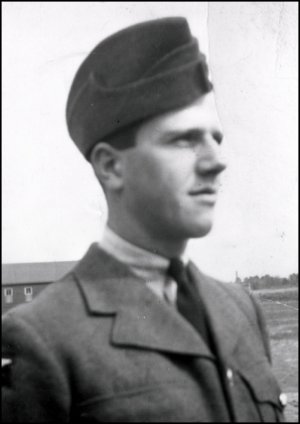
Carl Brown in uniform.

Carl Brown in uniform. Photo courtesy of Linda Fury.

WWI monument carved beside railroad tracks northwest of Frosty Hollow.

World War I monument carved beside railroad tracks northwest of Frosty Hollow.

The site is nicely maintained by local residents including 87-year-old Helen Wheaton of Frosty Hollow along with Alf Walker and other members of the Sackville Branch of the Canadian Legion. If ever you get a chance to walk into this unique war memorial do take the time to sit on one of the benches and remember our brave young Tantramar lads — soldiers like Carl Napp Brown (from Aulac) who fought gallantly with the 42nd Highlanders and died at Vimy April 11, 1917.

Sources

  • Moncton Times Transcript November 11, 2011 article by James Foster Veteran’s widow works to maintain monument
  • At the Crossroads — A History of Sackville NB by W.B. Hamilton
  • Brown family information from Linda Fury.

THT to Produce New WWI Play

The Tantramar Heritage Trust has received a grant from Canadian Heritage to embark on an exciting new project. Under the Commemorate Canada Program, the Trust has received money to research, commission, workshop, rehearse and tour a brand new play about Tantramar and the Great War. The play will describe what was happening on the home front during World War One, particularly in small Maritime towns. The town of Sackville, NB will provide a prism of the experience of residents and visitors to the wider region.

The project launched in May 2015 with the hiring of Emily Fuller, a Mount Allison student who combed the Sackville Tribune for articles, photos and ads describing the experiences of people in Sackville and area from 1914–1919. Under the guidance of Margaret Fancy, Emily created a database of over 1300 scans and 18 booklets of information on various themes (for example, women’s work, AD Carter, illness, quartering, poetry and letters). This research formed the basis of the play and gave the Trust a large amount of material to put into our Resource Centre for the future.

portrait of playwright Jamie Bradley

Playwright Jamie Bradley

In July, playwright Jamie Bradley was commissioned to write the play. Jamie is a Halifax-based playwright, stage, screen and radio actor, puppeteer, librettist, novelist and movie reviewer. He will be familiar to Sackville audiences for having played William Fawcett in Live Bait Theatre’s production of “Reader Be Thou Also Ready” last summer, which was directed by THT Executive Director Karen Valanne. Jamie is preparing to deliver a first draft of the script by mid-November and it will be workshopped, rewritten and ready for rehearsal in February 2016.

“I’m so excited about this project,” says Valanne. “My background is in theatre and I’m so happy to have the chance to use those skills here at the Trust to really bring history alive. Jamie is a wonderful writer, with a great passion for history. He’s bringing the heart and humour to scenes, while describing some very dark times.”

The Trust will be hiring three professional actors, a stage manager, a technical director and a design team for the production, which will tour Nova Scotia, Prince Edward Island and New Brunswick in March 201 .

“Our goal is to reach as many people as possible, so the show will be very accessible,” says Valanne. “It’s designed to go to schools, legions, church halls and museums. We can perform anywhere there’s a 12 × 12′ space and room for an audience. We’re planning to have admission by donation and engage audiences afterwards with discussions about their memories of relatives who served in the Great War.”

Performance dates are being finalized (fingers crossed for good weather in March!), so please contact the Trust office or check the website in January to find out when and where the show is playing. Or, to bring the show to your town or venue, please contact Karen as soon as possible at tantramarheritage@gmail.com.

This project has been made possible in part by the Government of Canada. · Ce projet à été rendu possible en partie grâce au gouvernement du Canada.

The White Fence, issue #69

October 2015

Editorial

Dear friends,

So Rhianna Edwards found an old ad … That single find resulted in a most fascinating explosion of information once it got into the hands of Eugene Goodrich! See below for an exciting tale of taverns, inns and hotels that once graced the Tantramar landscape from the now-extinct community of La Coupe on the High Marsh Road to Westcock (as it was then recognized) during the stagecoach days of the early 19th century. Furthermore, the builders and owners of these establishments are described in considerable and interesting detail and convincingly brought to life for us. I will not use further space for this editorial as Eugene’s tale is fairly long and deserves every inch of every page of this newsletter that we can provide for it. I hope that you will find it as captivating a story as I did. And as usual,

Enjoy!

—Peter Hicklin

‘Bass’ and afterwards Coll’s at Sackville — A tale of two taverns that were actually one

By W. Eugene Goodrich

At the London Tavern, in Sackville, New Brunswick… Abram Bass, 1821

During a research trip to the Nova Scotia Archives in search of materials on early Sackville schools, Rhianna Edwards, as often happens in such ventures, got “sidetracked by other interesting Sackville tidbits,” including this ad from the Acadian Recorder (at right), dated February 24, 1821. Having noticed that I talk about Bass’ in my Stagecoach Days on the Westmorland Great Road, she sent it to me with the suggestion that I submit it to The White Fence, together with some commentary.

I had indeed mentioned Bass’ in my earlier article about the “Stagecoach Days” but the ad revealed a rare error in that otherwise flawless work (well, nearly so). I had learned from a table of distances in a Nova Scotia farmer’s almanac for the year 1840 that a Bass’ Inn was located in Westcock eight miles from ‘Wells’ at Tantamar’. I also knew from the famous Walling Map of 1862, an exemplar of which hangs in the stairway of Boultenhouse Heritage Centre in Sackville, that there was a ‘W.P. Wells’ Hotel at La Coupe, just about where the High Marsh Road turns off to join what is today called the Point de Bute Road. In addition, I had obtained from the Provincial Archives of New Brunswick a digital image of a map of the Great Roads (the term used for ‘highways’) in 1852 with a scale in miles at the bottom of it. From it, I was able to measure, although not terribly precisely, eight miles in the Sackville direction from Wells’ Hotel. Probably influenced by the almanac’s reference to Westcock in ‘Bass’, Westcock’ I stretched it a bit and placed Bass’ “somewhere in the vicinity of St. Ann’s Anglican Church.” (Bass’ is not on the Walling Map.) However, I also found another table of distances, this one from 1844, giving the distance between stagecoach stops in ‘Tantramar’ and ‘Westcock’ as ten miles. Assuming that the Westcock stop was Bass’, I stretched it even further and raised the possibility that Bass’ Inn could have been closer to Frosty Hollow. But the discrepancy between the two distance tables always bothered me. I will explain how it got resolved later.

The ad that Rhianna discovered bothered me even more because it locates Bass’ London Tavern in Sackville, whereas since writing Stagecoach Days I had discovered yet another almanac with a table of distances, this time from 1835. It, too, lists ‘Bass’ at Westcock ‘ and gives the distance from thence to ‘Wells’ at Tantramar’ as eight miles. But it also supplied another piece of information that proved very helpful in locating Bass’ precisely, namely the distance between it and Weldon’s Hotel in Dorchester: nine miles.

Still somewhat confused but determined to get it right this time, I turned to Paul Bogaard whose expertise in old maps — and many other matters besides — is unrivalled in these parts. Having advanced far beyond the medieval methods of map-reading within my competence, he was able to superimpose the map of the Great Roads onto a Google map and trick it into measuring distances on the historic road with great precision. Measuring nine miles from Weldon’s Hotel (which still stands as the Payzant & Card Building across the street from the Bell Inn in Dorchester) and — starting at the other end — eight miles from ‘Wells’ at Tantramar’, the lines meet just about at the ‘Miller Block’ across the street from the old fire station — in what we would today call ‘Sackville’. Evidently, the almanacs were using the term ‘Westcock’ rather loosely, and they sure fooled me.

It was gratifying, if slightly embarrassing, to have found the exact location of Bass’ London Tavern, but as so often happens in research, it also raised further questions. The first was the connection between Wells’ Hotel and the “Hewson’s Inn on the Great Marsh” mentioned in the ad. From the statement that Hewson’s Inn was “between eight and nine miles” from the London Tavern I figured it was the same place under a previous ownership. This seemed to be confirmed by a sketch (that Paul had shown me) made by a descendant of James Hewson, one of the county’s early coroners, showing that the Hewsons owned land at La Coupe at this time. But when a search of the records in the New Brunswick Land Registry Office failed to turn up any sales by a Hewson to a Wells, and no family connection appeared in the genealogical records either, I began to wonder. On Paul’s advice I turned to Colin MacKinnon. He was able to show me that Hewson’s land was a little further along the High Marsh Road towards Sackville from Jolicure, near the sharp bend by the aboiteau where the road turns due west towards the covered bridge. He even said that, “a large crop of old pottery turned up at the site,” which seems like pretty good evidence of a tavern having been there. I also consulted Al Smith, who then corresponded with another Hewson descendant. She not only confirmed that, according to family tradition, Hewson ran an inn, but added the further interesting detail that it was actually “Jerushia, James’ wife who ran the establishment, and very successfully.” So”Hewson’s Inn on the Great Marsh” was an earlier and different establishment — I found another reference to it from 1812 — but for purposes of locating Bass’ London Tavern it might as well have been the later Wells Hotel, the two were that close.

The second ‘question’ was not really a question but another little embarrassment: If Bass’ London Tavern was about where the Miller block stands today, then it was also where King’s Hotel stood in 1862, according to the Walling Map. Now, I knew from my diligent reading of W.C. Milner’s History of Sackville that King’s Hotel had only a little earlier belonged to a William Coll, and was called, appropriately enough, ‘Coll’s Hotel’. Milner also mentions Coll’s Hotel in connection with Bass’ in an article he wrote on the first mail routes. Identifying the best places to eat on the route between Halifax and Saint John, he lists (among many others) “The Prince of Wales at Truro, Purdy’s at Westchester, Farrington’s and Coffy’s at Amherst, Bass’ and afterwards Coll’s at Sackville, Charter’s at Memramcook … etc.” Since I knew that Coll’s became King’s and (from the Walling Map) that King’s was located in downtown Sackville, whereas I had placed Bass’ nearly two miles further down the road in Westcock, I read Milner as meaning that first Bass’ and later Coll’s were the places to gourmandize in Sackville. In other words I thought he was saying they were two separate places. But Paul’s measurements were telling us that they were the same establishment under three successive owners, which also fits Milner’s words, perhaps rather better. So, another error in Stagecoach Days was exposed, something that was amply confirmed by a search in the Land Registry Office for evidence that might shed further light on the matter. There I found the deeds both for Abraham Bass’ purchase of the land on which he built his tavern and for his heirs’ sale of it to William Coll, as well as two other deeds of interest for our story.

I also found out a few things about Abraham Bass and his family, thanks to a lot of help from my friends. Being their nosey next-door neighbour, I knew that Vanessa and Michael Bass, although apparently not directly related to Abraham, have his tombstone under a tulip tree in their charming garden where Joanne and I love to walk our cats. Of erosion prone sandstone, it had stood more than a century and a half in the Westcock Burying Ground where time and weather effaced much of the epitaph but fortunately left the names (his wife’s name is on it too) and the year of their deaths — although not the day or month — intact (Milner had seen and recorded them when they were still fresh, so we have them confirmed; unfortunately, he didn’t record either the epitaph or the day and month of their deaths). A few years ago, the stone was replaced with an updated model and since the original was just going to be discarded anyway Michael and Vanessa were able to nab it — and a good job they did, as I would otherwise never have thought of using it for this article. David McKellar, a very accomplished genealogy buff, did some wonderful sleuthing on the family tree, and I just happened to re-read James Dixon’s History of his grandfather, Charles Dixon, for a reason that had nothing to do with this article and was hit between the eyes with some additional and very valuable information that had not registered before. So with the help of all the aforementioned folk as well as our old friend, W.C. Milner, I can now tell the tale of “Bass’ and afterwards Coll’s at Sackville” without further recourse to explanatory interruptions and learned asides — well, maybe a few.

Abraham Bass (1774–1842) and his wife, Margaret (1764–1842) were natives of Northamptonshire, England. Margaret was a niece of Charles Dixon and, according to James Dixon, he was the one who suggested they come to Sackville, which they did about 1810. In October 1815 they bought a one-acre square lot fronting Main Street (then called the ‘Great Road of Communication’) and extending from the Miller Block to about where Allison Avenue runs today. The seller was John Wry, a substantial farmer and frequently appointed pound keeper and hog reeve for Sackville Parish. There the Basses built a two-story brick building that no doubt served as their dwelling as well as a tavern and roadhouse (it is mentioned in one of the deeds and also by James Dixon). Abraham was a tailor by trade and I can well imagine him practicing his profession — for which there was considerable demand — while Margaret ran the tavern, looked after the guests and cooked the meals that made it locally famous. She was ten years older than her husband, an unusual arrangement then as now, and she would have been a little over fifty when they set up the business. But that didn’t keep her from family duties as well. The couple had two sons, James who was fourteen and Henry who was just eight — born when she was in her forty-third year. She must have been a busy woman.

The Bass’ lot was big enough for some barns and other outbuildings (I know from the deeds that they had them) where the horses, a milk-cow or two and doubtless some chickens would have been kept. Taverns in those days supplied almost all their own produce, so we also have to imagine a large garden and probably a pigpen as well. Earlier that year, in May to be exact, Abraham bought a ten-acre woodlot from Charles Dixon. Paul was able to locate it on Stephen Millidge’s beautiful grant map on display at the Boultenhouse Heritage Centre. It was roughly between Frosty Hollow and Lower Fairfield Road and, besides supplying wood for the tavern, it could have pastured a couple of steers for the table and maybe a few sheep as well (there were a lot more sheep than cattle in Sackville in those days).

No doubt the Basses worked hard to make a go of their businesses, but at one point — in 1821, the same year as the ad that Rhianna found — they seem to have run into some financial difficulty, or perhaps they just wanted to do some renovations and/or invest in some stock for the tavern. Whatever the reason for it was, in September they borrowed £395.12s.8d. (the price of a small farm) from Halifax merchant Martin G. Black. As collateral they put up their Main Street property, which proves that they had erected the buildings on it by this time, as they had paid Wry only £30 for the land six years earlier. They certainly paid off the loan, because everything was still theirs, or rather their heirs’, when Coll bought it. One reason may have been that the interest rate wasn’t too onerous. Six percent was the maximum allowed by law, and that’s what they paid. Another probable reason was that their hard work rewarded them. The London Tavern had a fine reputation and I bet they were proud of it. The name suggests a bit of nostalgia for the Old Country and it probably had considerable resonance in Anglophile Sackville. Another bond with England was St. Ann’s Anglican Church at Westcock where the Basses paid for a boxed-in family pew — a common if controversial practice at that time — and socialized with the Anglican county elite like the Botsfords and the Keillors (Paul found the record of this while searching the church archives for information on St. Ann’s in conjunction with his Seniors’ College course on Sackville’s historic buildings). I wonder what the Methodist Dixons thought of that!

In Stagecoach Days I noted that there were references to Bass’ tavern in almanacs for 1840 and 1841 (the latter was a Nova Scotia one, and not properly updated, as it turns out), but none for 1842 or later. The tombstone in Vanessa’s garden explains why. On February 7 of that year Abraham died and only about three months later, on May 9, Margaret followed him. As mentioned above, the day and month of their deaths are no longer legible on the tombstone, but Rhianna found notices of them in the New Brunswick Courier. Unfortunately, it offers no details on how they died, but their common tombstone suggests that they were buried together. Perhaps we may be permitted to imagine them as close in life as they were in death.

I really regret the loss of much of the epitaph. Too many words are missing to even guess at a sensible reconstruction and my favourite recourse, Google, also failed me for once (often, if you plug in three or four consecutive words the whole thing will appear as if by magic, but apparently this one is not yet online. I bet it will be at some point, unless it is a unique text — which I rather doubt). For what it’s worth, these are the words that seem reasonably certain. Even if the sense doesn’t quite come through, the mood is suitably sombre and admonitory (the words in Italics are conjectural.)

Each grave -as musing ……..y

Appears to warn me …. moment …..l?y

While voices from each ……d

Methinks reecho back th ……..und Methinks reecho back the sound Tomorrow thou may[st] ……. [be?] bound Tomorrow thou mayest thence be bound

Prepare to meet thy God

The boys were apparently not interested in tavern keeping. Henry married an Elizabeth MacDougall, took up farming near Murray Corner and fathered five children. His parents would have seen three of their grandchildren, at least occasionally, until they were six, four and one, respectively. James never married (or if he did, there is no record of it), but he, too, was a farmer living in Botsford Parish (I can’t be any more specific than that) when he and his brother sold the premises on Main Street to William Coll in November 1846 (there is no more record of the woodlot.) Did James live with his parents until their deaths, helping out with the business (his ‘mum’ was seventy-eight when she died and Abraham was no spring chicken either, by the standards of the day), or had he moved out earlier? We can only guess, but in any case the heirs must have rented the tavern to Coll soon after their parents’ death, because when they sold it to him in November 1846, it was “now occupied by the said William Coll, Inn Keeper.” The price was £287.10s., a considerable come down from what it had evidently been assessed for as collateral in 1821.

Whatever the reason for the modest price, Coll’s Hotel proved a worthy successor to Bass’ London Tavern. In describing it I can do no better than to crib a few lines from Stagecoach Days, not least because there I quote the testimony of much better sources. As I said, Milner — who knew it from personal experience — mentions Coll’s Hotel several times in his various writings. Of the old stagecoach days in Sackville he wrote: ‘These were the halcyon days for Coll’s Hotel, a great resort for the travelling public, where it was said the lights never went out and the fires never burned low. “ As with other fine establishments, the innkeeper and his wife were not the least of its delights: “The sods of a hundred years will soon cover the host and hostess, but the traditions are kindly that fit them into a pleasant place in the community’s history. “ Professor J.R. Inch, the Principal of Mount Allison Ladies’ College and later University President, also retained fond memories of Coll’s: “On Main Street, looking towards the south the spectator from the Ladies’ College would note as the prominent building in view Coll’s Hotel which stood nearly opposite the present (1904) Brunswick House (it stood where the old fire station still stands forlornly today.) This was a noted hostelry where the stage-coaches changed horses, and where for many years Mr. and Mrs. Coll dispensed a generous hospitality to the travelling public. “ It seems that Mrs. Coll had from an early age been brought up in the finer traditions of inn-keeping. She was a daughter of John Hickman, owner of Hickman’s Hotel in Dorchester, an important stagecoach stop. True to her Dorchester heritage (there was a reason why the village square was known as ‘the devil’s half acre’), she kept her establishment safe from the “Temperance heresy” (as Milner called it) that was raging across the street in the ‘Brunswick’, built as a Temperance hotel. In 1860, when still a fourteen-year-old student at the Mount Allison Wesleyan Academy, Milner took a stagecoach trip from Amherst to “The Bend,” as Moncton was commonly called at the time. The coach stopped for an hour at Coll’s to sort the mails and the young scalawag was happy to note that it was “a very homelike hostelry, not wanting in liquid refreshments.” Perhaps that was another reason why it, rather than the Brunswick, was the preferred stagecoach stop.

I promised to explain the discrepancy between the two distance tables, one from 1840 giving the distance from Wells’ to Bass’ as eight miles, the other from 1844 perversely insisting that the distance from Wells’ to the Westcock stop (which I assumed — wrongly as it turns out — to be Bass’) was ten miles, and now I will deliver. According to Paul’s measurements, ten miles from Wells’ puts you a little beyond St. Ann’s Church in Westcock. With this information in mind I searched through the New Brunswick almanacs again (many of them are now conveniently online) and found a distance table for 1841. It gave the distance between Hickman’s Hotel in Dorchester (which was pretty much right across from the courthouse — where the Town Office now stands) to an ‘Evans’, Westcock’ as seven miles, and from thence to Wells’ at Tantramar as ten miles. Although it wasn’t spot on, owing no doubt to subtle changes in the road that we don’t know about, measuring seven miles from Hickman’s in the Sackville direction got us very near to the house of Isaac Evans, which we know from the Walling Map was just inside the northeast corner of the Hospital Loop Road on what today is Malcolm Fisher’s property — right across from David McKellar’s lovely home. It was almost exactly ten miles from Wells’ Hotel and we know from Milner that for many years it served as an inn. He tells us that “ in 1812 Sackville had a visit in passing of Sir George Murray, Quarter Master General, and Admiral Yeo, in connection with mobilizing the militia … “Tim” Lockhart, representing the artillery branch of the Imperial Service, fired a salute with a brass cannon in front of the house of entertainment kept by the widow Evans at Westcock .” Before you get the wrong impression, let me explain that “house of entertainment” was the common term for a modest inn or roadhouse, in theory one that didn’t sell hard liquor. Such places were the livelihood of many a bereaved widow.

Mrs. Evans (née Lydia Jenks) had been bereft for some time. Her husband, Isaac — originally from Wales — was for many years the ferryman between Westcock Landing and Fort Cumberland, and also on occasion ran a schooner to Saint John. It was on it that he and all his crew met their deaths in a violent storm off Partridge Island that, according to the date of his death on his tombstone in the Westcock Burying Ground, must have occurred in 1798. Milner had seen the tombstone and recorded the date, but it is no longer standing; the Isaac Evans (d. 1904) whose stone still stands was a grandson, son of James. The elder Isaac was just thirty-four at the time of the tragedy.

A search through the deeds in the New Brunswick Land Registry Office revealed that Lydia remained in the house until her death in 1842 and she must have continued ‘entertaining’ the travelling public because one of her sons, the just-mentioned James, who had hitherto been identified in deeds of sale as a ‘yeoman’ (farmer), suddenly (in a deed of 1843) became an ‘innkeeper’. This strongly suggests that he inherited the inn-keeping business along with the house. The clincher is that the dates of all this fit the Bass story exactly. The fact that Evans’, Westcock first appears in the distance tables in 1841, while Bass’ was still going strong in 1840, suggests that Abraham and Margaret decided to retire in 1841 (it’s a shame they didn’t have long to enjoy it) and that Evans ‘, which had been around even longer than Bass ‘, took up the slack.

‘Evans’, Westcock continued to be mentioned in the almanacs until 1848 (inclusive), after which Coll’s Hotel — although not mentioned in any distance tables I have seen — would seem, if we follow Milner, to have become the main Sackville stop. Again, I couldn’t find any deed to prove it, but Milner indicates that it was sold to Arthur King not too long after 1860. So I guess the title of this article should have been “Bass’ and Afterwards Coll’s, and Afterwards King’s: A Tale of Two Taverns and a Hotel that Were Actually One, with a Couple of Asides on Evans’ at Westcock and Hewson’s Inn on the Great Marsh. “ But that might have been a bit too complicated … (editor).

References

  • Goodrich, W.E., 2010. Stagecoach Days on the Westmorland Great Road 1835–1872. Westmorland Historical Society (available at Tidewater Books in Sackville).

Annual Fundraising Dinner — “Here Stays Good Yorkshire”

Saturday, November 14, 2015

The Tantramar Heritage Trust presents its annual fundraising dinner on Saturday, November 14 at 6 pm at St. Ann’s Church Hall, 65 British Settlement Road, Westcock, NB.

Enjoy a roast beef dinner with all the trimmings, provided by Sandpiper Catering. Ray Dixon, Genie Coates and Al Smith will give short presentations on the Dixon, Trueman and Smith families respectively. There will also be musical entertainment to celebrate the 240th anniversary of the Yorkshire immigration to our region. “Dixon’s Landing” will be operating with beer and wine available for purchase.

Tickets are $50 each, including a $25 tax receipt. This dinner is one of two major fundraising events that the Trust holds each year (the other being the Heritage Day Breakfast in February) and money raised from it is used to keep Sackville’s two museums open and maintained throughout the year, as well as to support the many other activities of the Trust.

To book your tickets or for more information, call Karen at the Trust office at (506) 536-2541 or email tantramarheritage@gmail.com. You can also get tickets from any board member.

Looking forward to a wonderful evening and hoping that many of you will be able to join us.

A Unique Fund-raising Opportunity for the Tantramar Heritage Trust Dollars for Dollars Campaign

A supplementary campaign to Bringing History Home

A longstanding member of the Tantramar Heritage Trust has recently issued a very interesting challenge to the Trust. He has offered to match dollar for dollar, up to $20,000 total, donations made to the Trust in a special campaign to help to retire the remaining debt on the Anderson Octagonal House. That debt, in the form of a bank loan must be paid off in lump sums of $20,000 due on Dec.1, 2015 and on Dec.1, 2016.

In January 2012, the Trust launched our latest capital campaign “Bringing History Home” with a target of raising $90,000. While the Trust has been able to meet our loan payments on Dec.1, 2013 and Dec.1 2014 we need to raise the capital to meet the final two payments which makes this Dollars for Dollars campaign initiative so attractive.

We humbly solicit your continued support to help us realize this very generous challenge of matching funds for every dollar raised by the Trust in this very special campaign.

Please consider extending your past donation commitment, making an additional contribution, or for some of you, making a first contribution to the Anderson House Bringing History Home Campaign.

The six levels of contribution for the campaign are:

  • Deck Hand — up to $150
  • Quarter Master — up to $500
  • Boatswain (Bosun) — up to $1000
  • First Mate — up to $2000
  • Captain — up to $3000
  • Shipowner — over $3000

At the end of the campaign there will be donor recognition, including for extra donations made in 2015 and ‘16. The chart below shows the Trust’s major projects and how we have paid off our loans.

The capital projects add up to over $987,000 in assets, held by the Trust, and all within our first twenty years.

Several “capital” projects (those outside our normal operations, that leave the Trust with assets) were completed with grants ($100,000+) and donations ($60,000+), including the Blacksmith Shop, Marsh Barn (phase 1), re-roofing & re-painting Boultenhouse, etc.

The following three largest capital projects needed bank loans to allow us to meet payments, while we continued to raise the funds budgeted for that project.

Capital projects: Boultenhouse project; Campbell Carriage Factory renovation; Anderson Octagonal House move & renovation

Announcements

Our mission

The Tantramar Heritage Trust is a non-profit, charitable organization that promotes preservation of and education about heritage resources in the Tantramar Region. It depends on volunteers, both from the Trust membership and from the community at large, to keep the Trust vibrant and able to support museums and offer programming.

Opportunities for volunteering

  • Would you like to become more involved in the activities of the Trust?
  • Would you like to work with a terrific bunch of people?
  • Would you like to use your talents to help the Trust serve the community?
  • Do you have suggestions about helping the Trust to fulfill its Mission?

On-going activities

  • Research Centre
  • Exhibits
  • Museum Guide
  • Educational Programming
  • Fund Raising
  • Strategic Planning

One-time commitments

  • Heritage Day Breakfast (February)
  • Fund Raising Dinner (November)
  • Cleanup Days at Museums (Spring)
  • Open Houses at Museums (June/Dec)
  • Strawberry Social (Canada Day)
  • If you are able to commit to an on-going activity, you would decide how much time you are able to give.
  • We can fit volunteering around travel plans and work commitments.
  • Talk to us about what you would like to do to further the aims of the Trust.
  • Have a look at our web page: heritage.tantramar.com
  • Please call our Executive Director, Karen Valanne, at (506) 536-2541 to discuss volunteer opportunities or
  • email the Trust at tantramarheritage@gmail.com and we will get back to you.

The White Fence, issue #68

May 2015

Editorial

Dear friends,

The following article about Sackville’s first frame house, researched and written by Paul Bogaard, is probably best described as a case of investigative reporting. I think that the CBC would be proud to include this fascinating story into one of its detailed investigative reports. History does not always sit there, waiting to be found. Like archeological research projects, there’s a lot of digging to do. And Paul, over many years, patiently dug through many layers of archival soil and rock to get to the bottom of the secrets hidden by the Boultenhouses and Bulmers on their historic properties off present-day Queen’s Road, across Bulmer Lane and adjoining Marshview Middle School, in Sackville. Following my initial reading of the article, my first thought was “how many more?” So for those readers who may harbor similar research aspirations, read closely and use Paul’s productive efforts as a template for the work ahead. And when you solve the mysteries associated with a particular historic property or home, send us your story. Your newsletter is always happy to tell your stories, especially those that resolve long-standing mysteries and improve our ratings (or should that be readership?). I do not want to use too much space because Paul’s story and accompanying photos require valuable space and I close with my usual wish:

Enjoy!

—Peter Hicklin

Watercolour of Bulmer House

Figure 1. Watercolour of “Bulmer House” done for Trust by Rod Mattatal in 2007.

The First Frame House in Sackville Parish?

By Paul Bogaard

This is the saga of over twelve years research to confirm whether the Tantramar Heritage Trust really does own the “first frame house in Sackville Parish.” We had nothing like this in mind when the Christopher Boultenhouse property was purchased by the Trust in 2001.1 Our attention was focused on the handsome house of a Sackville shipwright, not on the back “ell” he used as a kitchen. All we found in the back was a storage area and a garage with a gravel floor.

Discovery

At the time of our early research on this property, we were excited to discover about Boultenhouse moving into “lower Sackville” from Woodpoint in the 1840s, and even relocating his shipyard onto the Tantramar River. All of this occurred when many enterprises were shifting into what we now take for granted was the centre of Town. As the home of Westmorland County’s most prolific shipbuilder,2 we were eager to renovate it as our second museum — the only shipwright’s house in New Brunswick now open to the public.

Before we began that restoration, however, we found ourselves in serious need of office space, and decided to make use of that back ell. Only then did we begin to realize that the ceiling, walls and floors being uncovered seemed much older than the front house built by Boultenhouse. We seemed to have discovered an earlier house, but how much earlier? And, had it come with the property? We had already determined that Christopher Boultenhouse likely purchased this property from the Bulmers, but tracking this down through the convoluted land transactions preserved in the Land Registry Office proved elusive. Untangling all the twists and turns that we found there has taken repeated efforts over many years.

We might have dropped the matter at that point, but as luck would have it, Mount Allison had recently hired a specialist in dendrochronology (dating wooden structures by analyzing the growth rings present in the posts and beams of historic buildings) and we had done him a favour by allowing extensive sampling at the Campbell Carriage Factory.3 In return, he agreed to analyze the age of the timbers in the house we had just acquired and also the back ell that looked even older. The results revealed that the trees used for framing the main house — Tamarack, like the timber used in his shipyard — were cut down around 1840 while the Red Spruce used to frame the back ell had been felled fifty years earlier! A house from the 1790s could not have been built by Boultenhouse. If not, it seemed most likely to have been built by George Bulmer. That prompted me to reach for my copy of W.C. Milner’s History of Sackville recalling the story he tells of George Bulmer building the “first frame house in Sackville Parish.” Could that be? Could the Heritage Trust have reached out for a handsome shipwright’s house and unwittingly snagged the oldest frame house in the parish? (See Figures 1, 2, and 3.)

timber frame structure illustration

Figure 2. Hand hewn timber frame structure hidden within Bulmer House. Drawing by Paul Bogaard.

Complications

Well, there were complications. It was clearly established that we owned a house dating before 1800; those are very rare in Sackville. Indeed there are hardly any houses of that vintage remaining in the whole region.4 But showing that this one was the same as the house in Milner’s story proved difficult. Registry office information about deed transfers from Bulmer to Boultenhouse were a confusing morass. Not that we couldn’t find such transfers, but rather there were so many: the Bulmers were swapping and selling many parcels during that period and Boultenhouse was purchasing dozens of parcels. (He ended his days with over 40 deeds!)

floor plan illustration

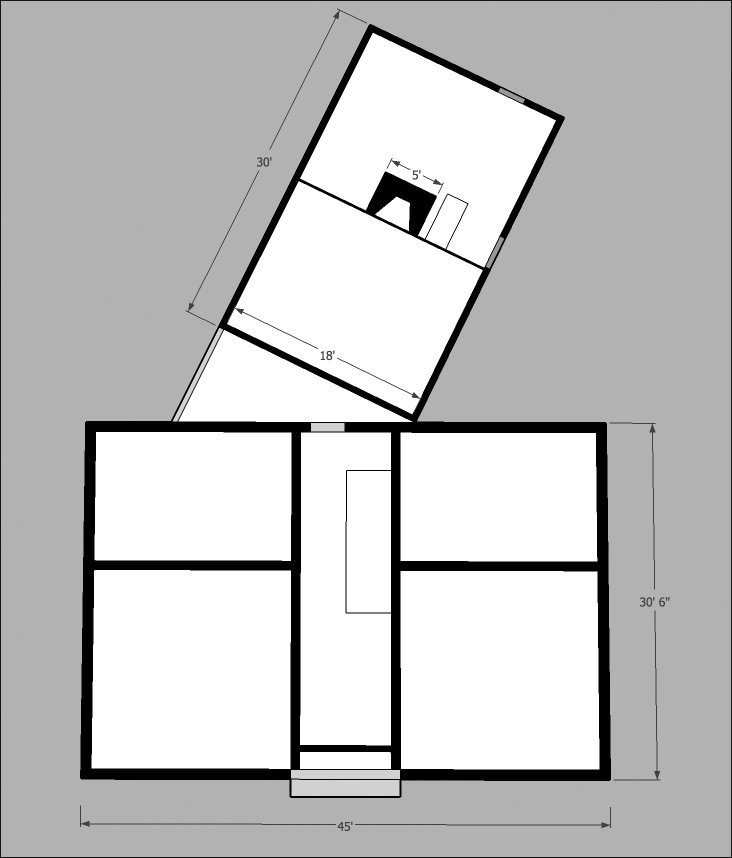
Figure 3. Bulmer built his 30 × 18′ house with central chimney to face the morning sun, but Boultenhouse added his 45 × 30′ house to face the street, creating this odd angle. Drawing by Paul Bogaard.

We found the deed whereby, in 1784, George Bulmer purchased three adjoining “rights” or “shares” originally granted to an early Planter family, but could not find any record of his selling it or any portions of it. Moreover, the story in Milner says that the house built by George Bulmer was eventually sold to and lived in by Jonathan C. Black. And as Phyllis Stopps (who has completed extensive research on early houses in Sackville) warned me, there were a number of Jonathan Black houses and therefore other candidates for the “first frame house” in the Parish.

Milner’s story is very valuable for anyone interested in the earliest stories about Sackville’s development. He got the story, he tells us, from “an old lady long since gone to her rest, viz.: Mrs. Cynthia (Barnes) Atkinson,” in which she identifies all the houses that were scattered along the Main Post Road by 1820. Milner so appreciated this story that he told it twice! In one telling, he relates that “the first frame house” was at Boultenhouse Corner (where today Bulmer Lane converges with Main Street and Queens Road). But was it on the northwest side of that corner, where the medical clinic now stands, or was it to the southeast towards our Boultenhouse Heritage Centre (see Figure 4)?

When I returned to the Registry Office to see if I could clarify any of these issues, I could begin to see some outlines through the fog. One very unusual item, recorded as an Indenture in 1837, was between one of George Bulmer’s sons, Nelson, and his other siblings. It did not shed any light on the house in question but did explain that by the 1830s their father, George, had fallen ill and was no longer competent to handle his own affairs. It even mentioned that, at his death (George did not pass away until 1841), then and only then would his own extensive land-holdings be passed along to his sons and daughters (or their husbands). A most unusual declaration, I thought, but it certainly helped explain why there were no recorded sales of land from George Bulmer himself.

Grant Map surveyed by S. Milledge in 1791

Figure 4. Grant Map surveyed by S. Milledge in 1791. Courtesy of Mount Allison Archives #2004.15.

With that in mind, I soon found one sale from Nelson Bulmer, and another from James, that transferred parcels of the Bulmer Estate to Christopher Boultenhouse. And there were descriptions that confirmed they were somewhere within the 12-acre holding that Christopher was known to have owned. They were each identified as Lots #7 and #8 on a subdivision plan drawn up by their “attorney,” Jonathan C. Black.5 So, we now knew that the Jonathan Black mentioned by Milner played a key role in the dispersal of George Bulmer’s holdings, although no one has been able to locate his plan for this subdivision and thus leaving those lot numbers of little use. And neither of these descriptions included any mention of their father’s house. Later records show Boultenhouse purchasing a number of parcels directly from Jonathan Black and one of them began by saying it was for a parcel in Middle Sackville… so I set that one aside (in retrospect, a serious blunder on my part). But at the time, that seemed to be as far as I could go.

Intermission

This may be a good point at which to flesh out some background. The person that built “the first frame house in Sackville Parish” had sailed over from Yorkshire when he was still quite young, twelve or thirteen years of age. He came on The Duke of York in 1772 along with his brother, William, the Freezes, Andersons, and notably Charles Dixon’s family who is said to have taken a fancy to young Bulmer. According to George’s son, Nelson, his father had come over apprenticed to Mr. Freeze, a stone mason. Apparently, they spent the next several years in Cumberland where there was likely plenty of work for masons rebuilding Fort Cumberland.6

The Fort was fully garrisoned by the British after it had been won from the French and for several years through prolonged guerilla warfare. But with British forces taking Fortress Louisburg on Cape Breton in 1768 and the Planter settlement of Sackville, Cumberland and Amherst townships well underway, the garrison was substantially reduced7 and little attention was paid to the upkeep of the Fort. At least until rebellious Americans began threatening British sovereignty in the 1770s; then there was need for repairing the stone fabric of the Fort and its buildings. Since a traditional apprenticeship lasted seven years, George Bulmer was likely kept busy there through the 1770s — his teen years. Thereafter, George’s prospects seemed to have improved and by 1784 he had successfully courted Charles Dixon’s second daughter, Susannah, and purchased a large tract of land between what today we call Queens Road and Union Street, extending from below Lorne Street to “the wilderness.” As recalled by his son Nelson, George purchased the “rights” or “shares” to the 1,500 acres granted to Nicholas Cook and sons and then immediately set about building a log house.

Portion of map produced by Walling in 1862

Figure 5. Portion of map produced by Walling in 1862 showing what we call Queens Road. When Bulmer built his log house, there were only houses to the Left of that arrow. Courtesy of Paul Bogaard.

What Susannah thought about living in a log home we do not know, except to say that since the early 1760s this was the sort of house in which most couples started their families.8 She might have had more to say about living over in the Salem district (where later the Salem Baptist Church would be built, and where George built his log home) where there were already several other early homes… as it was a long way from her parents’ home on what is now Charles Street (see Figure 5).

I have absolutely no way of knowing, but it just seems very likely to my romantic spirit that when George set about building for his bride a proper “frame” house, he would situate it just beyond where the Main Post Road turned across his land, out on the brow of that height of land where, from the front of his new south-facing house, Susannah could easily look across to the next hill and see her mother hanging out the wash. For her, he would build “the first frame house in Sackville Parish”! And it also seemed that if the timber for that new house was cut down around 1790, the timing would be about right. But if I wanted to confirm that Susannah’s frame house was the same one dendrochronology confirmed was built in the early 1790s, we still had some nagging discrepancies to sort out.

Portion of Stewart map of Sackville, 1899

Figure 6. Portion of Stewart map of Sackville, 1899, showing renamed streets: the Main Post Road had become Main Street; the road to Dixon’s Landing had become Station Street (with the coming of the railroad); and the Bulmers lane was made into a road called Boultenhouse Street. The latter two were renamed, yet again, by the newly incorporated Town of Sackville in 1903. Courtesy of Al Smith.

The Fog Lifts

Milner’s story claims that George and Susannah’s frame house went to Jonathan C. Black but the descriptions of the parcel purchased from Nelson Bulmer makes no mention of the house nor J.C. Black. It does, however, suggest that the land in the direction of the frame house was under the ownership of one Benjamin C. Scurr, and until recently, I had no idea who this was and I could see no way through these complications.

Until last summer, I must confess that the solutions were in the photocopies I had taken at the Registry office years earlier, sitting there sniggering at me from the folder labeled Bulmer House Puzzle. But it was only when we made an extra effort last summer, working closely with two of our summer students to refine the family trees for both the Boultenhouses and Bulmers, that a glimmer of light broke through. We had been encouraged by the public reception of our Anderson family tree as a key feature of the Octagon House exhibits, and so we decided it was time to do the same for the two houses built by Christopher Boultenhouse and (we hoped) George Bulmer. What the work of these students uncovered was that Benjamin Scurr had married George and Susannah’s second daughter, Mary, and that Benjamin & Mary’s daughter, Elizabeth Ann, had married Jonathan c. Black – the attorney who had done so much to sort out the George Bulmer Estate.

I will take some care in laying out why these additions to their family tree proved so important. When I reopened my file of registry documents and re-read the descriptions, this is the sequence that became clear (keep your eye on Fig. 6):

1) Firstly, from the Registry for January 15, 1842: “Nelson Bulmer…in consideration of 150 pounds…paid by Christopher Boultenhouse…has sold a parcel of upland situated in Sackville…and described on a plan made by Jonathan C. Black of the Real Estate of George Bulmer, deceased…North & West by lands of Benjamin C. Scurr, North & East by a Road leading to Dixon’s Landing, South & West by a Road laid out on the aforesaid Plan for the use of the owners of the land belonging to the aforesaid Estate…And containing 3 1/2 acres…w/appurtenances.”

While I had known for years that Christopher had bought a parcel from Nelson, I had not realized then that Jonathan Black, as the attorney who drew up the plan of George Bulmer’s Estate, was an in-law of the family. Similarly, I had not realized that Benjamin Scurr was married to George & Susannah’s daughter, Mary, and that it was they who held the portion of their father’s estate to the northwest. Otherwise, the reference to a road leading to Dixon’s Landing clearly located Nelson’s parcel to the southwest of what we now call Dufferin St. – roughly the land on which Marshview Middle School now stands. And finally, we now know that George passed away sometime in 1841 and his wife, Susannah, about 1836. It seems likely that it was just after Susannah passed away when their children registered their agreement concerning their father’s Estate, declaring him legally incompetent. And similarly, as soon as their father passed away in 1841, title to his lands passed to his heirs, and that’s when they began selling off portions of it.

2) The very next item in the Registry, on the same date: “James Bulmer…in consideration of 100 pounds…paid by Christopher Boultenhouse…has sold a parcel of upland situated in Sackville…and described on a plan made by Jonathan C. Black of the Real Estate of George Bulmer, deceased, as the lot number #8: North & West by lands of said Christopher Boultenhouse, lately purchased from Nelson Bulmer, North & East by a Road leading to Dixon’s Landing, South & West by a Road laid out on the aforesaid Plan for the convenience of the proprietors of the land belonging to the aforesaid Estate…And containing 5 1/2 acres…w/appurtenances.”

So, in this case, a parcel also to the southwest of Dufferin, now has Christopher as the owner immediately to the northwest (towards Main St. – as least he had now been its owner for an hour or so!) which clarifies that this parcel is downhill from Marshview Middle School and likely extended all the way to where Dufferin crosses Lorne and meets the other road, just prior to the railway line. And for the second time, we read that this was a road, or lane, used by George Bulmer and his family. At the upper end (at what came to be called Boultenhouse Corner), we now think a private lane came along the same way the street does today and then curved in to provide access to the house built there in the early 1790s. It makes sense that there would also be a lane from this farmstead down the hill to their marsh holdings. And as it happens, Nelson Bulmer recalled a time when “Grampa” Charles Dixon had been visiting. Nelson was only eight or so, but his father and brothers were elsewhere, so his mother asked him to hitch the oxen up to the cart and drive Grampa down the hill to the aboideaux (again, right about at the present day railway crossing). He was surely making use of the same lane described in the deeds from both Nelson and James.

3) The crucial evidence comes from this next one, which I had set aside years earlier. From the Registry for October 15, 1845: “Jonathan C. Black & Elizabeth, his wife…in consideration of 110 pounds…paid by Christopher Boultenhouse…has sold a parcel of upland situate in Middle Village…and containing 3 acres, bounded as follows: West by the Main Post Road passing through Sackville; North by a road leading from the Main Post Road to Dixon’s Landing (so called), East by lands of Christopher Boultenhouse; South by a road leading also from the Main Post Road to Dixon’s Landing, Together with all the Estate…with appurtenances…with all the improvements and privileges belonging to the same.”

There are several points about this that are relevant: one is that at 3 acres, this one added to the two previously listed adds up to 12 acres, and it is known from Christopher Boultenhouse’s own estate that his house (and its back ell) sat on a holding of 12 acres.

Of course, it was the reference to “Middle Village” which had thrown me off, years before, reading it as Middle Sackville. This time I realized it is intended as a reference to Middle Village in the original layout of the Township or Parish of Sackville – extending from the upper mill stream issuing from Silver Lake to the lower mill stream flowing down Frosty Hollow.[9] I should also have noticed that the description not only places it just along Main Street, but also along Dufferin Street…which means it must have been adjacent to the two parcels purchased from Nelson and James. There is even a reference to the old lane running down the other side (now listed as another road to the Landing) since Boultenhouse had already registered an arrangement with his neighbors to the south having agreed to a roadway being constructed – the one that came to be called Boultenhouse Street (and now referred to as an extension of Queens Road). That would neatly encompass 12 acres within these three streets (clearly named in Fig. 6).

This is of particular importance since these descriptions do not locate the precise boundaries. but they do give us the streets and we know exactly where those are. So, if one measures out 3 acres from Main Street towards Marshview Middle School, there is no way one can reach 3 acres without including the early Bulmer house. Or starting from the other end, when you measure out 5 1/2 acres from James and 3 1/2 acres from Nelson Bulmer, you have encompassed the school and probably the hosue that used to sit where the parking lot of the Boultenhouse Heritage Centre is now located, but not the Bulmer frame house.[10]

Family

And yet, I think there is a more human element involved than the geometric solution just given. It begins with the solution to how Jonathan C. Black gained possession of this parcel and house. Frustrated by this remaining gap, I recently returned once more to the Registry Office and almost immediately came up with a deed from Benjamin & Mary Scurr, selling their parcel (with exactly the same description as the parcel listed above as #3):

Unto the said Jonathan C. Black…All that certain piece or parcel of upland situate in Sackville and containing three acres, more or less, which the said Benjamin C. Scurr has or claimed in right of his said Wife, and she the said Mary has claimed by inheritance of in to or out of the real Estate of the late George Bulmer of Sackville, deceased, as one of the Daughters and heirs of the said George Bulmer and which fell to her as one of the upland Lots in the division of said Estate…with all the Estate, right, title, Dower right…To Have and to Hold…the lands and premises…with the appurtenances.

We can establish from this that Jonathan C. Black purchased the property he subsequently sold to Christopher Boultenhouse from his wife’s parents and that his mother-in-law, Mary, received this same parcel by inheritance from George Bulmer when he died. The description of the parcel is exactly the same and I can only wish it had been more explicit about “the lands and premises.” It does not say (but what I suspect is) that this hinges on George Bulmer becoming incompetent. Extraordinary measures had been taken to ensure the family’s inheritance (the registry declaration of 1837 mentioned earlier) when their father could not do so for himself. But more than that, someone surely had to care for him, especially once his own wife had passed away in the mid-1830s. And where more likely than in his own home. This might have fallen to one of their daughters but Jane had long since married a preacher from Maccan and had moved there, Elizabeth had married and moved to Lunenberg, and Mary was still nearby but had married Benjamin Scurr and they lived on the farm he inherited from his in-laws, the Cornforths.

Of the daughters, we know it was Mary who inherited the portion of George’s estate that included the frame house, and her own daughter, Elizabeth Ann, married Jonathan C. Black in 1833. So, my suspicion is that it was Jonathan and Elizabeth Ann who moved in with Grampa and Gramma Bulmer (Milner says that Jonathan lived there). Clearly, it was Jonathan who played the pivotal role in laying out and subdividing Grampa Bulmer’s considerable holdings. They would have been there when (or soon after) Susannah Dixon Bulmer passed away and stayed on until George Bulmer finally died in 1841.

Before 1841 was over, Jonathan had seen to it that George’s heirs inherited their portions, and he actually stepped in and purchased inherited portions from John, William, and George’s daughter Elizabeth, through her husband Henry McCellan. Most likely, these siblings had established themselves elsewhere by this time. And from the work of Phyllis Stopps on the house across Main Street – the one many of us can recall as the Nurse’s residence (where the Medical Clinic now stands) – this seems to be the lot Jonathan purchased from John Bulmer and one which he proceeded to build a house for himself and his family. Phyllis noted a newspaper account that suggests it was built in 1842.

The year 1842 is when Christopher Boultenhouse acquires the parcels from Nelson and James Bulmer and seems to be the most likely year in which he adds his handsome house onto the older house of the Bulmers. That’s what dendrochronology tells us and it happens to be the only year for a decade in which he does not have his carpenters busy building a ship. And this ties in with Jonathan Black moving his family across the road to their own newer house, also in 1842. A decade thereafter, a daughter of the Blacks is married to Christopher’s son, William. So, there were close connections between these families.[11]

Perhaps that explains why the final settlement for this land and the old frame house was not registered until 1845. It was not uncommon for titles to be registered at a later date, until there was compelling reason to do so. Or perhaps there were financial or other arrangements still unfolding (Christopher and Jonathan engaged in a whole series of land transactions). What is clear is that when the registration finally took place, the transfer from Mary and her husband Benjamin Scurr to Jonathan Black was registered on the very same day as the transfer of this same parcel to Christopher Boultenhouse. They are literally #12.145 and #12.146 in the registry. Clearly, this had all been planned ahead. In the meanwhile, no one in the family had any reason to doubt whose property and whose house was involved.

Conclusion

Some of this is surmise, but the facts we do have make a compelling case:

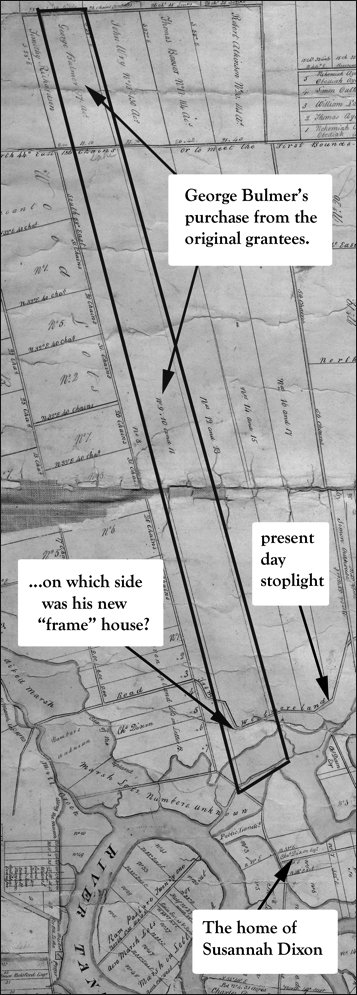
George Bulmer purchases a large tract from the original grantees, which we can locate on the grant map of 1791. After building a log house, within a few years, he moves his growing family into the first frame house in Sackville. We know this one was built in the 1790s so it has to have been George, as it was on his land, and his own sons were still too young. This frame house and the parcel on which it stands is inherited by his daughter, Mary, and subsequently sold to her son-in-law, who sold it to Christopher Boultenhosue. Then, Christopher builds a handsome new house attaching it to the Bulmer house, now 50 years old, to use as his kitchen. As a consequence, when the Tantramar Heritage Trust purchased this shipwright’s house in 2001, we inadvertently bought the first frame house in Sackville Parish. The donor who made this possible did us a bigger favour than he will ever know.

Endnotes

  1. The beginning of that saga was announced in issue #16 of The White Fence in October 2001. Issue #33 in December 2006 carried the opening of the Boultenhouse Heritage Centre and our first mention of the earlier back “ell.”
  2. See Shipbuilding in Westmorland County, New Brunswick, 1784-1910, compiled by Charles A. Armour with additions by Allan D. Smith, among the Trust publications.
  3. The timbers of that factory were large, accessible, and there were dozens of them. These were just what Colin LeRoque and the team needed to help establish a reference set of growth rings from trees harvested in this area and which enabled them thereafter to date other samples.
  4. Between the work carried out by Rob Summerby-Murray’s geography students at Mount Allison University over ten years ago and our own local historians, there are reasons to suspect that Sackville retains an unusual number of pre-1800 houses – often as back ells.
  5. Jonathan C. Black si listed in at least one place as their “attorney” but at this time it was unlikely he was an attorney-at-law (a lawyer) but rather was simply recognized as acting on Bulmer’s behalf. In some of the registered land transactions he is listed as a “merchant.” Why he was acting as their agent, at this stage, was not at all obvious to me.
  6. One of the places Milner tells Nelson’s story on p. 117 is the section about the Bulmer family. The other is on p. 28 where he is acknowledged as the oldest descendant of Charles Dixon on the occasion of their family celebration.
  7. Webster tells us in Forts of Chignecto that General Gage withdrew most of the soldiers, leaving only a small garrison in charge.
  8. We know from Charles Dixon’s “Memoirs” that when Susannah arrived as a small girl in 1772, ehr father immediately bought two or more farms which already had houses built on them. They must have been log houses. He later built a grander house for his family but Susannah herself likely grew up in a log house.
  9. These divisions and the circumstances of their being laid out are all told in The Struggle for Sackville published by the Heritage Trust on the occasion of Sackville’s 250th anniversary.
  10. You can try this yourself online, by calling up “GeoNB” at http://geonb.nsb.ca. Zoom in until you can see parcels outlined and then use the “Draw and Measure” tool.
  11. When Christopher passed away in the 1870s, he held part-interest in Jonathan’s house and land and owned ship builder’s good in the shop close by. Look again at Fig. 5 where you can see Jonathan’s house identified with his Estate (he had passed away in the 1850s) and even the shop nearby.

Anonymous matching commitment will help the Trust become debt-free

by Geoff Martin

Members who follow Trust finances will know that at the end of the move and rehabilitation of the George Anderson Octagonal House project, the Trust Board of Directors took out an $80,000 loan, repayable in four annual installments. The reason for the loan was two-fold. We began the octagonal house project while we were still paying off the most recent major improvements at the Campbell Carriage Factory Museum and, as any home owner who is doing high-quality renovations knows, the octagonal house project cost us a bit more than we anticipated. Thanks to donations large and small we have successfully made the first two annual payments and another two are due in December 2015 and December 2016. However, I am pleased to announce that thanks to an anonymous donor, every capital campaign contribution made in the 2015 and 2016 calendar years will be matched dollar-for-dollar up to a maximum of $10,000. That means that our challenge this year and next will be to raise the latter figure. We will be asking those who have made multi-year commitments that have ended to continue their commitments for this year and next, and this is a perfect opportunity for those who have not yet donated to this project to do so, knowing that your donation’s impact will be doubled. More detailed information will be provided in the coming months, but please do plan on some kind of special donation to this project as you consider your 2015 giving.

Calendar of Events

Wednesday, May 27Annual General Meeting, 7 p.m., Anderson Octagonal House. Guest speaker: David Mawhinney, Mount Allison Archivist, “Archival Narratives.”

Sunday, June 21 – Campbell Carriage Factory Museum opens for the season, plant sale

Wednesday, July 1 – Canada Day Strawberry Social, 3-5 p.m., at the Boultenhouse Heritage Centre, 29 Queens Rd., Sackville

July (dates to be announced) – Under the Sky Festival – a series of heritage-themed arts events, taking place outdoors at the Campbell Carriage Factory Museum. Details TBA.

July (dates to be announced) – Children’s MAKE IT! Workshops at the Campbell Carriage Factory and Boultenhouse Heritage Centre. Every Wednesday morning in July there will be a fun and educational heritage-themed workshop for children aged 7-15 at one of our museum locations. Details TBA.

Sunday, August 9Heritage Field Day at the CCFM.

Check our website for further details as plans progress. If you’re interested in helping out with any of these events, we’re always looking for volunteers, so please give Karen a call at the office at 506-536-2541.

The White Fence, issue #67

April 2015

Editorial

Dear friends,

Nature gives but also takes back. As a boy growing up in Edmundston, my grandmother used to fill me with stories of grandfather fishing the Two-Mile Brook near our house on the edge of town. Consequently, I spent many hours along that little brook for a “trout-feed” for granny to cook up. I was a very proud little boy at those special meals! When my own son was old enough to carry and use a small fishing pole, I took him to that brook and took a picture of him and I with his first brook trout. I still lovingly look at that photo every so-often. I have not walked the shoreline of that little brook for at least 25 years and likely never will again. And so Al Smith’s story of Bulmer’s Pond Fishing Club struck a chord with me and it will likely also bring fond memories to many of you. Some places will always be treasures in our hearts. And Clare Christie’s article about Fascinating Artifacts may also bring forth many fond memories to many of you while, for me, it was a very interesting learning experience. And furthermore, for many of us, the Tantramar area may be seen as a “Treasure Trove” (see Al Smith’s article about treasure in Tantramar), while for others it was not (see Anna Frances Willis’s 1890 viewpoint of Sackville). While we usually extol the virtues of this very special place that is Sackville, other viewpoints must also be given equal consideration. Anna Willis, the wife of John Willis, a brother to Clare Christie’s grandfather Charles Willis, had a very negative first-impression of Sackville in the few months she was here in 1890. So we must allow Mrs. Willis’s own opinion of Sackville to be given a public airing, even if it is 125 years too late! Whether you have ever fished or not, or ever heard of a Water Ram or Eye Stones or not, or ever found hidden treasure or not, or have a negative opinion of Sackville or not, you are quite likely to find something interesting to read in the pages to follow. And if you do, I urge you (as always) to…

Enjoy!

—Peter Hicklin

eye-stones

Eye-stones… see Clare Christie’s article below to find out what they are used for and how they’re stored in brown sugar, and sometimes rum!

Bulmer’s Pond Fishing Club

By Al Smith

Sometimes a little bit of paradise can be close at hand. Such was the case of a small private fishing club located at historic Bulmer’s Pond in rural Frosty Hollow. Ninety-four local fishermen where members (and shareholders) in the Bulmer’s Pond Fishing Club over its 83 years (1916–1999) of activity. After several years on a waiting list I became a member (the 75th) in 1991. While I was only able to enjoy the privileges of membership for 9 seasons, the memories of those many quiet evenings spent on “the pond” will last a lifetime. Ted Pulford’s watercolour painting of Doug Hamm fly-fishing off Poacher Point well illustrates the serenity of the landscape.

Ted Pulford watercolor

Ted Pulford’s watercolour painting of Doug Hamm fly-fishing off Poacher Point.

A maximum of 25 members were allowed membership in the Fishing Club during the 1990s but not all were active. The club’s boathouse accommodated four small rowboats for members’ use but rarely were all four on the pond at once. Fishing was best in May, June and September. The usual pattern was to arrive at the boathouse around 7 pm and row up the pond to one’s favourite spot and fish to nearly dark unless of course the daily catch limit of 5 had been reached earlier. It was a quiet setting with the near silence broken only by the occasional slap of the tail of the resident beaver. It was a perfect way to end a busy workday.

oil painting by Bessie McLeod

The Club’s boathouse — undated (likely 1930s); oil painting by Bessie McLeod

Charles W Fawcett (portrait)

Mr CW Fawcett

I was so looking forward to my retirement years when I would be able to spend more time on the pond, however, that was not to be. From September 21 to 23, 1999 a slow moving heavy rain system, fed moisture from post-tropical storm Harvey, dumped up to 150 mm of rain on the area. The resulting flooding, reported to be the worst in 40 years, completely washed out the dam and spillway pretty much destroying the old millpond that had been in existence at least since 1790.

With the demise of the pond and old mill dam the Fishing Club mulled over various scenarios of restoring the dam but in the end decided to disband.One of the final actions of the Club was to hire researcher and historian Phyllis Stopps to compile a History of Bulmer’s Mill Pond and The Bulmer’s Pond Fishing Club which was completed in March 2012. Club members were each given a copy and one was deposited in the Resource Centre at the Boultenhouse Heritage Centre. Readers interested in the full story should access that well researched document as only a very brief encapsulation of the history is given below.

Bulmer’s Pond Fishing Club was founded in 1916 when Charles W. Fawcett invited a group of Sackville men to establish a fishing club. Sackville businessmen Charles Pickard and Charles W. Fawcett had been leasing the Pond from its owner Seth Bulmer since circa 1891 for fishing. They had established several buildings on the property including a camp and fish hatchery. Charles Fawcett’s partner, Charles Pickard, died in late 1912 and that was likely one of the motivations that moved Fawcett to convene the founding meeting of Bulmer’s Pond Fishing Club on June 21, 1916. A club consisting of 15 members (although only 12 initially took up membership and purchased shares) was authorized with Charles W. Fawcett as its first President.The Bulmer’s Pond Fishing Club took over the lease and all assets formerly associated with Pickard and Fawcett.

sketch of Bulmers Pond

1983 sketch of the Pond by member Norman Rees-Potter.

Seth Bulmer continued on as operator of the fish hatchery and maintenance of the club’s boats and buildings. As early as 1917 the club began to buy trout-fry from outside sources and by 1920 the local hatchery was no longer in use. The old hatchery was sold for $35.00 to St. Ann’s Church and moved through the “Old Post Road” to the Church lands and used as a Sunday school and later as a meeting hall. Intermittent stocking of the pond continued until 1968 when 4000 fingerling trout were released into the pond. Since that time natural reproduction in the pond sustained an annual harvest by club members of between 300–500 trout plus an unknown number taken by poachers.

A Club House, originally built by Fawcett and Pickard, was located on Centre Island — the largest of four small islands located along the western edge of the pond. The fishing club maintained the clubhouse up to the 1950s when it was abandoned due to disrepair and constant damage by vandals. The milldam and spillway were repaired frequently by the fishing club. The last major repairs were done over a three-year period (1992–94) when the spillway, side walls, raceway and sluiceway were totally replaced. The dam and spillway was in excellent condition when the rainstorm hit on Sept. 21, 1999, but nonetheless a catastrophic failure resulted.

Gone are the quiet evenings on the pond and the chance to catch that big one — even if it was only a twelve or thirteen inch trout. Now there are only memories of chats with fellow fishermen — guys like Jim Purdy, Al Mitchell, Doug Hamm, Don Johnstone, Wally Minshull and George Chambers — all of whom spent many hours on the old millpond. Gone is the serenity of this special place.

Paradise lost.

Sources

  • History of Bulmer’s Mill Pond and The Bulmer’s Pond Fishing Club by Phyllis Stopps, March, 2012, 56 pages; Management Committee Reports — Bulmer’s Pond Fishing Club.
  • The Maritime Advocate and Busy East, Vol. 28, June, 1938.

Living in Sackville — July to September 1890

Transcribed with notes by Al Smith

The following transcription is a slightly shortened Chapter 43 — SACKVILLE — from a book The Days of My Pilgrimage — an autobiography of Anna Frances Willis published in 1967. Anna was the wife of John (Jack) L. Willis who was working in Sackville at the Merchants’ Bank of Halifax (which later became the Royal Bank of Canada). A copy of Chapter 43 was given to the Trust by Clare Christie of Amherst whose great grandfather, Charles Willis, was a brother of John. Anna Willis paints a very gloomy picture of Sackville, in sharp contrast to Charles Willis’s who moved his family to Sackville on November 5, 1890 to take up a position with George E. Ford as book keeper. Charles and his family lived quite happily in Sackville (see The White Fence #51: The Sea Captains). Bracketed insertions in the transcription are mine. Anna’s discovery of Sackville goes as follows:

After a six hour train journey we arrived, full of excitement and hopes, in Sackville. Let me remark that of all the places that I have ever lived in I think that Sackville was quite the most disagreeable. It is situated on the isthmus between New Brunswick and Nova Scotia and is flat and bare. About three quarters of the time it rains and the other quarter it blows. We arrived in the evening and went at once to the hotel, but we could not stay there all the time with two babies, so we began to scour the country in search of a boarding house, but no one appeared willing to take us. It was a “blowing” week and the sand, which dries quickly, was ankle deep on the roads. The sidewalks were formed of boards running lengthwise and the baby carriage, an old one of Aunt Vesie’s, fell into the cracks between the boards about every six minutes. It was a slow mode of getting about.

On the fourth or fifth day I heard of a part of a house to be rented and at once went to see about it. “It won’t suit you,” said the landlord, barely looking up from what he was doing — I think it was tailoring. “But why should it not suit me?” I enquired. “Oh I know it won’t,” he repeated. “Have you any objection to my looking at it?” — “Oh look at it if you’ve a mind to; it makes no difference to me.” So look at it I did. It was on a slight eminence and you could see the sea from both sides (possibly Charles Street, near Landing Road? — ed.). There was a large room downstairs and three funny little attic rooms upstairs. We felt that it could be made to answer and arranged to take it and also to hire furniture from one cabinet shop, whose owner seemed as indifferent as the landlord.

I went up to the house the next morning and cleaned the windows and otherwise began to prepare, but on coming home to dinner Jack met me with the news that he had got board for us in town and much more convenient to the bank. We went back to the landlord who remarked: “Do as you’ve a mind to; it’s no difference to me”. The furniture dealer made the same speech, so we finally moved into Mrs. Gray’s quiet little house. We had one largish room downstairs. Christopher slept with us and Dorothy had a stretcher which slipped under the bed in daytime. Our life was certainly very quiet and many a time I wearied of that one room. Christopher was far from well and I found it impossible to get any food which agreed with him. The milk he could not digest and I could not get suitable meat for broth. I tried to get a chicken and one was given to me, but no one would sell one. They were queer people, mostly United Empire Loyalists descended from old Puritan families and bearing the queerest old Biblical names. Most of them “followed the sea”.

Poor little Christopher; how well I remember he used to take my hand and lead me to the place where the chicken broth was, but it soon came to an end and I could get no more. Both children were very good, but those long rainy days were hard to get through. Dorothy was now three and a half and amused us much with her quaint sayings. Christopher was a winsome little lad and made friends with everyone. Mrs. Gray was very kind but she was ill a good part of the time and the house was “run” by her old mother Mrs. Angwine and her little daughter Jenny.

We heard that at Amherst, ten miles away and a good sized town, there was a brother (Plymouth Brethern — Evangelical Church — ed.), Mr. Angus Morrison. We knew his name well from the depot and decided to visit him. So one fine Saturday afternoon we hired an old white horse and set out. The animal was not as keen to get there as we were and it was almost dark when we reached Amherst. We were at a standstill, as we did not know where to find him. Just then a man passed and we asked him if he could tell us where to find Mr. Angus Morrison. “And what would you be wanting him for?” asked the man. We explained and he said “I am Angus Morrison”. It seemed so clearly the Lord’s leading that we were all amazed. He took us home for tea with him and we then turned for home. Later on we spent a Sunday with him and greatly enjoyed being once more able to remember the Lord.

About the beginning of September we began to wonder what to do for winter; we were undecided as to whether we should remain in Sackville or return to Toronto. After praying over the matter we decided to return to Toronto and trust to Jack’s getting employment in Ontario. The main reason for this was my mother as we felt we could not leave her alone. She had spent the summer in Huntsville, but would soon be coming home. This was on a Sunday. On Tuesday Jack got a telegram asking him to take the position of manager of Trader’s Bank at Port Hope and if he could come at once.

When the General Manager of the Bank heard of this he wired Jack to come to Halifax and see him, so we all went off to Halifax and spent Sunday with the Penningtons. We were greatly impressed with the beauty of Halifax. Mr. Pennington’s eldest son Will took us out in a boat on the Northwest Arm.

We left Sackville on September 18th. It was, of course, pouring with rain and a covered vehicle was not to be got, and as it was we nearly missed our train and the luggage had to be left behind. But how glad I was to be going home; home to good doctors and proper food and our own house.

Fascinating Artifacts

by Clare Christie

For the past two years the Tantramar Seniors’ College has offered a most interesting, and highly popular, course entitled So You Think You Know The Tantramar. The spring 2014 session included an in-depth look into the history of rural Wood Point, NB, with local resident and historian Bill Snowdon. The outing was on the afternoon of April 30, a gorgeous sunny day. The group of 25 seniors had a wonderful afternoon at Wood Point, following Bill around while he talked about shipbuilding, quarrying and the home-locations of early residents. One of our stops was at a circa 1845 house that he was restoring. In the yard, Bill (and his brother Dale) had laid out lots of old tools, grindstones and an old generator (I think it was) but the two things that fascinated me the most were:

A Water Ram — a pump that used only the force of gravity to pump water. The water came down, built up pressure in the pump, a valve let go and the water ran up the hill to the top floor of the house, closed again and it happened all over so there was a constant little thump, thump. So neat. The pump that Bill has was used for many years at the Barnes farm just up the road from his.

Even more extraordinary were the Eye-stones. They had five stored in brown sugar and they were alive. They are as big as the end of a pencil eraser and look like the end of a conch shell. If a man gets dust from steel or stone in his eye, he lies down, an eye-stone is put in his eye for about twenty minutes, it is removed and his eye is clear! Bill had an old article there about it from Cape Breton’s Magazine — One man in the article kept his in brown sugar, another in white and one of them fed his rum. The sugar has to be changed every year because it gets sucked dry.

Thank you, Bill, for a most interesting afternoon and especially for showing us these two fascinating artifacts from your collections.

Hewson Gold and other Accounts of Treasure Trove in Tantramar

by Al Smith

Childhood memories of visiting my Uncle Mariner’s farm in Fort Lawrence during the early 1950s are vivid. Wonderful memories of his delicious home-made ice cream but also of his stories of uncovering pewter and pottery items while plowing his fields. They were relicts presumably from habitations within the old Acadian village of Beaubassin that was quickly abandoned and burned in early May, 1750. I don’t recall that he ever found anything of great value but it was sure intriguing to a small boy.

Tales of Tantramar treasure have circulated for years but there are very few verified cases of treasure actually being found. One such verified case is described in Colin MacKinnon’s article “Rockport Gold and Other Mysteries” (The White Fence, #36, October 2007) where a treasure trove of coins was recovered from the cliff bank at Peck’s Cove in the mid to late 1930s. Since the recovered coins were from a site on the former Capt. Amos Pickering Ward farm (see article on Capt. Ward by Jeff Ward, The White Fence, #21, January 2003), and a single surviving coin is dated 1845, Colin speculates that the treasure was very likely buried by Capt. “Pick” Ward.

Most stories, however, relate to buried gold from the French era. Author Will R. Bird in his 1928 book A Century at Chignecto describes numerous accounts of Acadian and French gold:

  • A man named Bent lived in a house near Fort Cumberland that had been built by the French. In 1834 he noticed a strange schooner sailing into the bay one evening and anchoring just off his property. In the morning the schooner was gone but as he stepped out of his house he noticed the stone front step was moved aside and under it was the imprint of a three-legged iron pot.
  • A farmer in the Minudie area unearthed an iron pot of gold while plowing his fields in 1845.
  • When the Intercolonial Railway was being pushed through from Sackville to Amherst in 1872 railway workers uncovered a small chest of gold near the Beausejour ridge.
  • A farmer excavating a basement on the Beausejour ridge discovered so much gold that he moved away to the USA and lived very comfortably the rest of his days.
  • An old Acadian barn remained near the edge of the marsh. A stranger came by one night and asked permission to sleep in the barn overnight. In the morning the stranger was gone and a cavity above the doors was revealed and its contents obviously missing except for a small silver goblet that had been dropped on the barn floor.
  • In the mid 1800s a blacksmith living in Jolicure looked out on to his pasture to see one of his cows in difficulty having apparently partially fallen into a cavity. Rushing out to assist her he discovered that she had fallen through a timber covered pit that had been covered over with two feet of soil. Removal of the timbers revealed a proper shaft and some twenty feet down was another wooden platform that contained some mysterious markings. At thirty feet down the diggers struck another wooden platform then water poured into the shaft curtailing any further attempts to go deeper. An auger was eventually used to go deeper which apparently revealed traces of gold, silver and other metals, but the apparent “treasure trove” was never reached. Truly very intriguing as it sounds very much like the Oak Island, NS money pit scenario.

Will Bird states that “there have been at least a score more authentic accounts of Acadian treasure being found”. Certainly there may have been a possibility of buried gold on or near the sites of old Acadian villages. Acadian farmers, who traded with New England, Fortress Louisbourg, Fort Beausejour, and even the British at Fort Lawrence, were most often paid in gold for their produce. Will R. Bird claims that very little of that gold was ever circulated especially in the years leading up to 1755. Acadians apparently took no wealth with them when deported so it is possible that family savings were placed in hiding spots.

In addition to tales of Acadian gold there are stories of French officers plundering anything of value out of Fort Beausejour just prior to signing the terms f surrender to English forces. There is also a story from the Trueman family of locating a small barrel in the woods near the Trueman Mill Pond that may have contained French coinage destined to pay the soldiers at Fort Beausejour. One of the more intriguing accounts of a treasure find possibly relates to a hoard of gold that was being administered by the infamous French priest Abbe Jean-Louis Le Loutre. While I only became aware of this tale of treasure this past year, apparently the story has been passed down for generations by members of the Hewson family.

According to Howard Trueman (The Chignecto Isthmus and Its First Settlers) James Hewson and his mother were Loyalists who arrived in Nova Scotia in 1783. Mrs. Hewson’s husband Richard Hewson was an officer in the British army who had been killed in the south. They initially settled in Wallace but soon thereafter sold their property and moved to Fort Cumberland. Mrs. Hewson opened a small store near the Fort and taught school. In the early to mid 1790s they moved to Jolicure Point having purchased the farm of Spiller Fillmore. James Hewson married Jerusha Freeman of Amherst and had a family of six. The oldest son Richard established the branch of the family in River Philip. Son William inherited the family farm at Jolicure Point. The Amherst branch of the Hewson family is descended from this line.

The farm at Jolicure Point is now long gone but it was located at the bend of the High Marsh Road near the juncture of the Le Coup and Aulac Rivers. The farm itself encompassed much of the Acadian village of Le Coup. Janet (Hewson) Bone, a direct descendant of Richard Hewson provided the following account:

“In the spring of 1800 James Hewson was ploughing with oxen near the site of (the village) of Le Coup when one of the oxen sank into the ground. When he went to investigate he found a large wooden box filled with French gold coins. The wood had rotted and given way beneath the weight of the oxen. James and his wife removed the coins and hid them in the farmhouse. A special closet was later built in the main bedroom to hide the treasure. The family member who gave me this information remembered seeing the closet as a child. From that time on James Hewson showed signs of prosperity. Apparently he made regular trips over the years by horseback to New England carrying as much gold as he could in canvas belts. He went to New England to exchange the gold coins because he knew that if he tried it in New Brunswick questions would be asked. James educated his six children very well, bought large lots of land in the River Philip area and lived very well. The gold coins were speculated to have been money that Abbe LeLoutre buried when he escaped from Fort Beausejour in advance of the French forces surrendering to the British in mid June 1755”

The suggestion that the treasure found was that of Le Loutre’s is sheer speculation but is plausible. Le Loutre did go to France in 1753 and managed to convince authorities that they had an obligation to help resettle displaced Acadian families. He made a plea for assistance to construct dykes and aboiteaux and was granted 50,000 livres from the French court. Le Loutre was involved with the construction of a major aboiteau on the Aulac River at the time of the British attack on Fort Beausejour.

Fascinating stories from old Tantramar — and then there is that mysterious so called “money pit” on Cape Jourimain.

Alan McIver standing on the edge of the “Money Pit” at Cape Jourimain

1992 photo of Alan McIver standing on the edge of the “Money Pit” at Cape Jourimain. Colin MacKinnon photo.

Sources

  • Email correspondence with Janet Hewson Bone, June and August 2014, March 2015
  • Trueman, Howard — The Chignecto Isthmus and Its First Settlers, 1902
  • Bird, Will R. — A Century At Chignecto, 1928
  • Dictionary of Canadian Biography — Le Loutre, Jean-Louis
  • Trueman, William — Round A Chignecto Hearth, 2000
  • Milner, W.C. — Records Of Chignecto, Collections of the Nova Scotia Historical Society, Vol. XV, 1911

Trust News

With gratitude

The Discovery Committee of the Tantramar Heritage Trust gratefully acknowledges the financial support of the Mount Allison Faculty Association and the J.E.A. Crake Foundation. With the support of these two organizations, the Discovery Committee will expand the Discovery Loft at the Campbell Carriage Factory and hire an educational intern. Thank you so much for your support.

Summer Hours

Summer hours begin on May 19 at the Boultenhouse Heritage Centre and at the Campbell Carriage Factory Museum on June 21. Both museums will be open 10 am to 5 pm, Tuesday to Sunday until Labour Day. Admission is free to members of the Trust — otherwise by donation.

AGM

Please plan to attend the Annual General Meeting of the Tantramar Heritage Trust, Wednesday, May 27, 2015, 7 pm in the Great Room of the Anderson Octagonal House at the Boultenhouse Heritage Centre. Look for details of that event in the mid May issue of The White Fence.

Trust Publications Make Great Gifts!

Enjoy reading more about our historic region, add to your research collection, or give the gift of history to someone you know. All proceeds are used to fund projects of the Tantramar Heritage Trust. You can purchase Trust publications directly by visiting one of our Museums or download an order form online.

  • heritage.tantramar.com/thtpublications

Still receiving The White Fence in the mail?

To save trees and postage, you can opt to receive it electronically via email. Just send a message to tantramarheritage@gmail.com.

Of course we’re happy to continue to mail it to you as well, if you like.

The White Fence, issue #66

February 2015

Editorial

Dear friends,

This issue of the newsletter deals with the Golden Age of Sail that extended from circa 1850 to the early 1900s. The Tantramar area was at the heart of this noteworthy period. Shipbuilding at the Boultenhouse and Purdy shipyards in Sackville and Westcock was a major industry during the Golden Age of Sail. In this issue, Al Smith describes the research done by Belinda Lansley in her book In Sickness and in Health which details the travels of the full-rigged sailing vessel Brother’s Pride built by Christopher Boultenhouse in 1858. The Maritime Provinces are famous for their sailing vessels: think of the Bluenose and its continuing saga to this day. The book describes the tragic role of contagious diseases within the closed quarters of sailing ships in the 19th century and their tragic consequences. Another great danger for wooden sailing ships was the weather. The 26 May, 1941, issue of The Tribune Post presented a detailed (sometimes grizzly) account of the shipwreck in 1900 of the Nova Scotia-built barque the Angola written by a survivor who suffered 42 days with minimal food and water and witnessed the psychological effects in those who survived the shipwreck until death arrived. Throughout my schooling, up to my years at university (Mt.A class ‘73), I heard about wooden sailing vessels being shipwrecked throughout the age of sail. But it was left at that. An old sailing ship sank and everyone died. End of story. But it was not always so. Experience through the words of a survivor the tragedies of those times. How many, who survived such shipwrecks over periods of time, have we never heard from? These are but two stories which reflect why so many Maritime homes, near a coastal harbour, are topped with a “widow’s walk”.

Read and hang on tightly!

—Peter Hicklin

Below: Letters to Sally

New Book on the Ship Brother’s Pride

By Al Smith

With deep appreciation from author Belinda Lansley for granting permission to use material from her book.

Brother’s Pride and Bahia (book cover)

Following its departure from London, England, on July 23, 1863, the ship Brother’s Pride finally arrived at Port Lyttelton, New Zealand, on December 6 after having endured a long, horrendous voyage of 137 days. A new book (In Sickness and in Health) published in 2013 by New Zealand author Belinda Lansley, chronicles the story of two ships: Bahia and the Brother’s Pride which departed London, England, in late July, 1863, carrying immigrants to the New Zealand colony. Both ships endured the same weather conditions over the passage and arrived at Lyttelton on the same day, although they had vastly different stories to tell. The barque Bahia quickly tied up at the port disembarking healthy passengers while the ship Brother’s Pride was ordered into quarantine. Brother’s Pride had endured outbreaks of typhus, low fever and scarlet fever that had resulted in the deaths of 46 passengers and left many others in a very weakened and sickly condition. Accessing historic archives, passenger lists, and passenger accounts of the voyage, testimonies and records of a public enquiry into the tragedy, author Belinda Lansley chronicles this horrific 1863 journey of the approximately 400 brave souls immigrating out to New Zealand in search of a new life.

Brother’s Pride was the 48th vessel built by Woodpoint/Sackville ship-builder Christopher Boultenhouse.

One of New Brunswick’s most prolific ship-builders, Christopher built 60 vessels over the 50-year period 1825–1875. While the majority of his vessels were smaller brigs, barques and schooners, he did build 10 full-rigged ships ranging in tonnage from 692 to 1320.

The ship Brother’s Pride was launched from his Sackville shipyard on June 26, 1858, and was his ninth full-rigged ship. With a registered tonnage of 1236 t with dimensions 179.8 feet long, 37.7 feet wide and having a depth of 22.55 feet, she was the third largest vessel that he built.

Christopher Boultenhouse had an excellent reputation as of a builder of quality ships. Due to oversupply and the consequent collapse of the market for ships in 1856/57, he nonetheless had no problem selling his 1267-ton ship Empress in 1857 nor the Brother’s Pride in 1858. Shortly after its launching in late June, 1858, Brother’s Pride was sailed to Saint John, NB, and registered July 10, 1858, with official number of 35280. The July 16 issue of the of the Saint John newspaper The Morning News reported:

Mr. Boultenhouse of Sackville has a magnificent new ship lying at the Custom House wharf, finishing and taking in cargo — Mr. B is not discouraged by the dull times, but by the judicious economy in building and by securing first rate quality, he does not despair in making a fair sale. This vessel called ‘The Brothers’ will soon be ready for sea.

The vessel was purchased by Saint John ship-owner John Yeats, sailed to Liverpool, England, and registered there on November 2, 1858, having been purchased by Alfred Radcliffe.

The origin of the vessel’s name is somewhat of a mystery, but it was clearly chosen by Christopher and first registered as Brothers Pride without the apostrophe, but once it was registered in England, Lloyds registry added the apostrophe. Two of Christopher Boultenhouse’s sons, Amos and William, undoubtedly worked at their father’s shipyard in Sackville. In 1859, the two sons are the shipbuilders of record for the little 46-ton schooner Bella, launched April 30, originally built for the seafaring Anderson family. So one can speculate that they likely learned their shipbuilding skills by working closely with their Dad on the large ship which he named Brothers Pride, possibly to acknowledge the contribution made by his two sons and their pride of accomplishment. Tragically, son Amos died at home in mid-June, 1859, and William drowned in February 1860 in a shipwreck.

Brother’s Pride was built as a merchant ship and had to undergo refitting in Liverpool to accommodate passengers. The ship’s owners at the time of the 1863 passage to New Zealand were W & R Wright who leased the Brother’s Pride to the firm of Shaw, Saville and Co., operators of a fleet of packet ships carrying mail and passengers to British colonies around the world. Firms offering passage to New Zealand advertised in English newspapers, often embellishing the features of the vessels and stretching the truth. The two ads shown below that appeared in the London Times are good examples of a firm stretching the truth in order to entice passengers to book passage. Advertised fares for a space on the Brother’s Pride were £13 6/ for a single man or woman, £26 12/ for a couple and £6 13/ for a child. Part of that fare would be subsidized by the New Zealand government, eager to get settlers.

London Times ads

Two ads in the London Times, July 11, 1863, advertising passage on the Brother’s Pride.

Under the command of Capt Alexander Glendinning and overloaded with passengers, Brother’s Pride departed London on July 23, 1863, arriving at Gravesend near the mouth of the River Thames later that same day. The ship’s doctor mustered all passengers at Gravesend and discovered that a seven year old boy had scarlet fever and was sent ashore. At that point no one realized that the fever had already been transmitted to other passengers. Thus began the first of a long string of incidents that made for an abominable journey for both passengers and crew.

A few days after leaving Gravesend, a large number of children came down with scarlet fever with the first death recorded on August 5. Typhus was next to hit and by September 9 there had been nine deaths that was somewhat offset by five births since leaving England. The ship crossed the equator on September 16 and passengers had to endure the celebratory and rowdy antics of crew members as the Captain made no effort to control the situation. The sultry and oppressive weather, combined with the persistent fever, were causing panic amongst the passengers. On the 84th day out of London (October 18) the Brother’s Pride arrived in Cape Town, South Africa, having endured 14 deaths to that date — four adults and ten children. The ship stayed for 3 days in Cape Town while being re-provisioned.

Three days after leaving Cape Town, Capt. Glendinning discovered that in addition to provisions taken on board they had also at least 16 stowaways adding additional strain on the ship’s capabilities. After four days out to sea, a 13 year old boy became sick from a particularly acute case of scarlet fever and died a few days later. This acute and often lethal form of scarlet fever began spreading throughout the ship in some case wiping out entire families.

Entering the southern ocean, the weather turned vile adding significantly to the discomfort of the passengers. Medical supplies were in short supply and the onboard Doctor was often drunk. Finally, on Dec. 6, they sighted New Zealand. Typhus was still rampant on board and diseases were still very much present when they finally reached Port Lyttleton on Dec. 9 and ordered into quarantine. The hellish 4 1/2 month journey had resulted in the deaths of 46 passengers, far greater than any other immigrant ship to that date.

Petitioned by the passengers, a public enquiry against Capt. Glendinning was formally held to delve into the ill-fated voyage. That enquiry found many deficiencies of the ship for carrying passengers, poor conduct and misjudgments made by the crew, among other things. The Captain was also put on trial for misconduct after several incidents with authorities in Lyttleton.

Brother’s Pride remained in New Zealand until the end of February, 1864, finally departing for Callao, Peru, with no passengers on board but destined to take on a cargo of guano. The ship-owner, Andrew Radcliffe, kept the merchant vessel until 1868 when it was sold and renamed Sealkote. Afterwards, the ship was owned by The Merchants Trading Company when it floundered off Cape Seal near the Cape of Good Hope. The vessel’s register was closed on July 16, 1877.

A copy of the book (kindly donated by the author) In Sickness and in Health — Brother’s Pride and Bahia is located in the Resource Centre at the Boultenhouse Heritage Centre. If anyone is interested in purchasing a copy it is available at Amazon.

Sources

  • Lansley, Belinda, 2013, In Sickness and in Health: Brother’s Pride and Bahia, 120 pages, published by Belinda Lansley, Harewood, Christchurch, NZ ISBN: 978-0-473-25016-4.
  • Armour, Charles A. and Smith, Allan D., 2008, Shipbuilding in Westmorland County NB 1784–1910, published by Tantramar Heritage Trust, 138 pages.
  • The Morning News, St. John NB, July 16, 1858, in Mount Allison Univ. microfilm library

The Tragic Story of the Angola

Copy of original article submitted by Bill Snowden; transcribed/edited by Peter Hicklin with additional research by Al Smith

Introduction

This story is based on a newspaper article published in The Sackville Tribune on May 26, 1941, signed by Hjalmar Jonssen and Miguel Marticorena of Singapore, Straits Settlements, with the signatures dated April 16th, 1901. The story occupied three pages of the Tribune-Post in May, 1941, and thus too long to print here in its entirety. Unedited sections are presented word-for-word in regular print (including all original uncorrected mistakes) while all edited sections (including descriptions of what was omitted) are presented in italic bold. The 1672-ton Barque Angola was built by William Mosher and launched in Newport, Nova Scotia, in 1890. Its captain was Henry Crocker (1859–1900), son of Jacob (1834–1917) and Elizabeth (1835–1899) Crocker and grandson of Isaac (1806–1886) and Sarah (1816–1904) Crocker of Wood Point. Isaac Crocker came to Wood Point in 1825 as shipwright and, after marrying Sarah, settled on land owned by his father-in-law James Ward where grandson Henry was born. The Crocker home is now owned and occupied by Cheryl Read.

In the 1890s, Jacob bought the Captain Evander Evans property in Westcock and Henry and his wife Charity Milner of British Settlement moved there a few years later. The 1851 census listed Isaac as a farmer and shipwright and he most likely worked as a ship carpenter at the Boultenhouse yards in Wood Point and Westcock at that time and later for Henry Purdy when Purdy took over the shipyard from the Boultenhouses. Henry Crocker (and probably Jacob) lived on Barren Ground hill in Westcock in the house bought by Joe Boyer in 1947 and later occupied by John Wilson. More recently, the property was purchased by Peter Mesheau and, a few years ago, while the house was vacant over the Christmas holidays, the old house was irreparably damaged by fire. The remnants of the burnt house were cleared away and a new home built on the site. It is presently the home of Danny Bowser.

The Angola had a busy career making port in Cape Town, South Africa, Newcastle, Australia, and Manila and Iloilo in the Philippines. Captain Henry Crocker lost his life in the China Sea, October, 1900, aged 41 years. His wife died a few months later after learning of her husband’s death. She was 36 years old. Henry Crocker’s seafaring story is one worth re-telling and remembering.

The Tragic Story of the Angola Under Captain Henry Crocker of Wood Point

From an article printed in Sackville Tribune Post

May 26, 1941

The following “Sea Story” was brought to the attention of the Tribune Editor recently by Mrs. Minnie F Amos, of Sackville, and will be recalled by a few “old timers” and read with interest by younger readers. Captain Henry Crocker, the Captain o the ill fated Angola was born the son of Mr. and Mrs. Jacob Crocker of Wood Point. He married Miss Charity Milner, of British Settlement, and they had three children: Roland Crocker, of New Glasgow, N.S.; Miss Florence Crocker, in the U.S.A., and Murray Crocker, in Western Canada. He was a nephew of Mr. John Crocker who still resides at Wood Point, and was a brother of Mrs. Nettie Amos and Mrs. Minnie Amos, both of Sackville. Two brothers are still living: Charlie, in Vancouver, and Isaac, at Chase, B.C.

The tragic story of the wreck of the Angola was prepared for the World Wide Magazines by Edward E. Long, member of the staff of the Singapore Free Press, and is told in the simple language of Hjalmar Jonssen, a Swede, one of the two survivors, as follows:

I am an able seaman, Hjalmar Jonssen my name, a native of Hekingborg in Sweden. I am just over twenty years of age, and have been at sea for five years, having left Helkingborg in 1896. In August, 1899, I shipped at Cape Town as an A.B. on board the barque Angola, Captain Crocker, of Sackville, New Brunswick, and made a voyage in her to Newcastle, New South Wales. From Newcastle we went in the Manila run, making journeys from Newcastle to Ilollo, and thence back to Newcastle.

On October 12, 1900, we left Cavite, Manila, for Singapore in ballast, intending, if possible, to obtain a cargo at that port for Newcastle. There were nineteen hands on board, including the captain (Crocker), a Dane, and the officers. Their names were: Mr. Campbell, first mate, a Nova Scotian; Mr. Brown, second mate, a Norwegian; Bjorsen, the carpenter, a Norwegian, Alexander, the cook, a Madrassi Christian; myself; Miguel Maticorina, a Spaniard; Vhile and Brown, Germans; Bill and Tom, Englishmen; Pieder, a Russian; Antonio, an Italian; Emanuel, a Chilian; Lloyd, an American; Aegustus, a Frenchman; Emil, a Russian Finn; Hjalmar Inquist, a Norwegian; and Eulys, the cabin boy, a native of Mauritius.

About six days out from Manila a stiff gale began to blow, increasing in violence, and at 11:00 pm on the sixth night after leaving Manila the ship drove right on a reef. By the captain’s reckoning we were then about six hundred miles from Manila, a hundred and fifty from the coast of Cochin, China, and south-west of Manila. We were under close canvas at the time, carrying fore-topmast.

Fast on a Reef

Immediately she struck the Angola heeled right over on her lee side, and mountainous seas, which were breaking over the reef with terrific force, swept her decks from side to side, starting planks, ripping off stanchions, carrying away bulwarks and everything movable, and creating great havoc. All night the gale continued, and it was impossible for us to do anything to save ourselves. When day dawned we found we were in a perilous position on a coral reef, with no prospect of getting off, and the ship fast breaking up, strained as she was from stem to stern by the huge crested breakers, which continually crashed against her sides with a noise like thunder. Next morning, the 18th, the fore-mast went by the board, and at three in the afternoon the captain gave orders for the main and mizzen masts to be cut away, which was done immediately.

There were only three boats on board, and one of these it was impossible to get at, it being on the lee side of the vessel, which had now heeled over so much that the boat was under water. We attempted to launch one of the boats from the davits on the weather side, but before it touched the water a heavy sea came rolling in and smashed it to pieces against the ship’s side. Finally we managed to launch the third boat on the lee side aft and got the boat into the water all right, but the difficulty was to get into her. Eventually we had to swarm down the mizzen rigging. After me into the boat came five others. Some had lifebelts on, and they soon needed them, for though we bent to the oars and tried with might and main to pull off the reef away from the ship we were unable to do so.

Battling for Dear Life

Presently a huge roller caught the boat broadside and overturned it, and in a second all six of us were battling for dear life in a boiling sea. Pieder the Russian, and Vhile, one of the Germans, could not swim. Both disappeared almost instantly and never rose again. The other three, with myself, got back to the vessel safely, but all of us were terribly battered and bruised by the waves and thoroughly exhausted. Our only chance of taking to the boats was now gone and blank despair settled on us all. To add to our misery, that same day the ship turned completely over. All hands, however, managed to climb safely to her bottom. There we sat for four days, our only food some cans of meat saved from the wreck, but we had no water to drink.

To escape, as we thought, a lingering death, we decided on building rafts. We were lucky in securing some axes, and other tools from the ship, also sails and cordage, and we soon rigged up two rafts from the materials at hand, the spanker boom being knocked into one small raft, and a bigger one made from the planks from the Angola’s sides. Getting all we could from the wreck before we left — unfortunately there was only a little food and no water — we set out on these rafts. On the smaller one were Bill, Antonio, Brown, Emanuel, and Euleys; the remainder, including myself, were on the bigger one. All one day we floated together, but during the night we lost sight of the smaller raft and never saw it again.

Adrift on a Raft

Our raft was about forty-five feet in length and from nine to ten feet wide. Running down the centre was a long narrow well, a foot or so below the level of the raft, and capable of seating several men. For and aft we rigged up a mast, and on each we had a square sail, but we couldn’t fix up a rudder, and consequently were unable to steer.

For the next few days we drifted along before the wind and tide. On the fifth day a steamer passed us, but not within hailing distance. Then began a succession of cruel, burning days, with the food getting scantier and scantier. We lay listlessly about the raft, too weak to exert ourselves, saved when a vessel passed, as many did. I remember counting thirteen, but not one of them saw us, nor could we succeed in attracting their attention. The nights — beautiful starry nights — brought but little relief for our empty stomachs and parched throats. For twenty days this state of things lasted. We chewed our boots, tore barnacles from off the raft’s bottom and eagerly swallowed them, but no rain fell and there was nothing wherewith to slake the burning thirst that possessed us. At last, in desperation, Lloyd, the American, started to drink salt water, and on the twenty-first day he died raving mad, and we reverently threw his body overboard, where it was greedily seized by countless sharks that had persistently followed us from the first day, as if in anticipation of the awful feast that was to come. The next to go — he too had been drinking salt water, unable to resist the terrible cravings of thirst — was Hjamar Inquist, one of the Norwegians, who died and was thrown overboard the night after Lloyd died.

The remainder of the story focuses on the delicate state of mind of the crew and the madness that overtook nearly everyone. The end began on the twenty-fifth day after the ship capsized. On that day, Augustus, the Frenchman, grew “frenzied” and, seizing an axe, “rushed at the captain, with a murderous gleam in his eyes” but was stopped by Mr. Campbell, the first mate, who was felled and killed by Augustus.

We saw it all, but felt too weak and languid to do anything, nor had we much time to, for the whole thing happened in the twinkling of an eye. Presently, the crazy Frenchman shouted that he was going to kill the captain and the cook, but he did not proceed to carry out his threat. Instead, dropping his axe, he went to a corner of the raft and lay down to sleep placing his straw hat over his eyes to shield them from the fierce sun-glare.

Ghastly Deed

The captain, the second mate, and myself then held a conversation in Swedish, which we all understood. We agreed that, if we didn’t kill the Frenchman, now that he had once shed blood, he would murder all of us. We therefore decided to cast lots as to who should kill Augustus. We got three splinters of wood from the side of the raft, two long pieces and one short piece. These were put in a hat, shook them up and down and then drew. The second mate got the short splinter, and thus the terrible task fell to him. (The detailed account of “the terrible task” will not be recounted here, suffice it to say that it was completed successfully — ed.)

Soon after this double tragedy Providence came to our rescue, for by tearing up strips of canvass sail-cloth and using bent wire nails from the raft as hooks, with pieces of white shirting for bait, we managed to catch several large dolphins and other fish, and once more the pangs of hunger were appeased. We still had no water, however, and the sufferings of some of the weaker men were fearful to behold. On only a very few days did rain fall, and then only in small quantities, and though we saved all we could, it was little indeed.

Jumped Overboard While Crazy

Soon Emil, the Russian Finn, went crazy from the thirst and in his delirium jumped overboard (end of sentenced omitted —ed.). Very pathetic was the end of Tom, the Englishman. He was a good-natured chap, one of the best-liked of the crew. Soon after Emil had gone he developed madness. For hours together he would sit counting on his fingers an imaginary crew of nineteen. “Look” he would say “there’s Tom, Vhile, Brown,” — and then he would stop and begin over again, growing so frantic at last that I tried to quiet him, but all to no purpose. At last he threw off his clothes, and before I could prevent him he was overboard. In a thrice I hurried to the side of the raft and pulled him back again. Twice after this he jumped over the side, by sheer luck missing the waiting sharks, and each time I managed to pull him back. The fourth time was the last. Poor Tom had scarcely touched the water when a huge shark darted up like a streak of lightning (portion of sentence omitted —ed.) … and the next minute his cruel jaws had snapped and closed! This was the last we saw of poor Tom. Bjorsen, the carpenter, was a strong man, but at last he gave way. The cursed seawater he drank to quench his dreadful thirst drove him mad, and he, too, died and was thrown overboard to the sharks.

Attempted Death Three Times

For four or five days no one else died. There were only five of us left now — the captain, Mr. Brown, Marticocera, Alexander, and myself, and we were all so bad we could scarcely speak to each other. Three times, in my agony, I tried to drown myself and thus end my sufferings, but each time I found myself in the water, being a strong swimmer, the instinct to save myself became too strong and I struck out and reached the raft again. Then the cook sickened. I can see him now lying prone on the raft, smiling in spite of his awful suffering, because in his delerium, he imagined he was eating. He was shouting: “All right; have got mango, pigeon, dove, olive, bread, plenty eat, plenty eat.” At night he died, and the waves bore his body away in a gleam of phosphorescence. Two days after this the second mate went mad and died.

We had now been away from the ship about thirty-six days. Next the captain showed signs of insanity. Up top this time he had been the quietest of the lot. Sitting apart by himself, steadfastly gazing over the boundless expanse of sea with sunken eyes, in search of the rescuing vessel that never appeared in sight. Just before he died he said “I’m all right”. I asked him whether I should give him some salt water to drink, and he said “No, I can’t understand”. These were his last words for soon after this he passed away. Thus we two, Marticorena and myself, were left alone, so weak and helpless that it was as much as we could do to drag he captain’s body to the side of the raft and push it into the sea. We had not lost the use of our limbs and we could still fish; and now, strange to say, we caught numbers, when hitherto we had only secured one occasionally, but our sufferings without water were terrible to think of. Oh, it was an awful time!

Drifted Ashore

For several days longer we drifted aimlessly about the ocean, at the mercy of the wind and waves, and then, on the forty-second day after leaving the wreck, as near as we could make it by our reckoning, we drifted ashore on the island of Soubi, one of the south Natuna Group. By this time our bodies were in a frightful condition, blistered by the scorching rays of the pitiless sun, chapped and scared by the action of the waves, which at times almost submerged the raft, and covered with large boils. We were unable to walk ashore, being far too weak, so we were carried by the natives, who showed themselves very friendly. They took us to the Chief’s house, pleasantly situated amidst tall groves of cocoa-nut palms. His name was Haji Samman, and there we lived for about two months.

The Malays made a healing compound from certain herbs and leaves and smeared this on our bodies, and I a remarkably short time we became well and strong again. The healthy diet of cocoa-nut palms, mangoes, and fish helped, in a great measure, to achieve this. At first we could not converse with the natives, but after a few weeks we picked up enough to be able to ask for most things, and thus all our wants were attended to whilst we were on the island. It was a pretty spot, with rich tropical scenery common to so many islands at these latitudes, but after a while the diet became monotonous, and we grew lonely for the want of white companions. We longed to get back to civilization to let our relatives know of our safety and tell the awful fate which had overtaken our comrades.

Farewell to Malay Friends

Pleased, indeed we were one day when a Chinese junk was observed bearing down for the island. She brought a cargo of rice from Singapore, and the captain, a Chinaman by the name of Tan Boo Foo, readily agreed to take us to Singapore when he returned. Some time later, therefore, we bade our Malay friends — not without feelings of regret, for they had been very kind to us — and set out on a junk for Singapore. We were made as comfortable as possible on board, and, being able seamen, we gave our services in helping to sail the junk. After stopping at several places, we finally entered Singapore Harbour on April 3rd, after a lengthy voyage, and at once reported ourselves to the marine authorities, who kindly sent us to the Sailors’ Home, pending a Court of Inquiry. We each received a suit of clothes and under-linen, for we had lost our all in the wreck, and we were treated with every consideration.

I certify that the above is a true account of my experiences.

(Signed) HJALMAR JONSSEN

I also certify that the experiences in the above story are true.

(Signed) MIGUEL MARTICORENA
Singapore, Straits Settlements,
April 16th, 1901.

Still receiving The White Fence in the mail?

To save trees and postage, you can opt to receive it electronically via email. Just send a message to tantramarheritage@gmail.com. Of course we’re happy to continue to mail it to you as well, if you like.

Heritage Day — Saturday, February 14

MORNING

Tantramar High School

The theme of the morning session will be The Flag as on that day we will be celebrating the 50th anniversaries of both the Canadian and the New Brunswick Flags.

In light of the main theme for the day (Hope Restored), we ask if members could bring family memorabilia of the First and Second World War for a display. All members who may have such memorabilia and which they would like to share with other members on this special day, please bring your items to the Boultenhouse Heritage Centre (29 Queens Road, Sackville) on Tuesday-Friday (9 am-2 pm) or call Karen Valanne at 536-2541 and your items will be put on display throughout the day.

19th Annual Heritage Breakfast (7:30-10:30 am)

The day will begin with our popular Heritage Breakfast at the TRHS Cafeteria featuring eggs, bacon, sausage, beans, toast, juice, tea and coffee. Tickets are $7 for adults and $4 for children to age 10 and can be purchased in advance from Trust members, at the office at the Boultenhouse Heritage Centre, or at the door that morning.

Heritage Displays (7:30-11:30 am)

Heritage Displays in the foyer.

Antiques Roadshow (10-11:30 am)

Breakfast will be followed by an Antiques Roadshow in the TRHS lobby. Bring your favorite items for appraisal ($5 per item), particularly if they have a Sackville connection.

AFTERNOON

Anderson Octagonal House — Boultenhouse Heritage Centre, 27 Queens Road, Sackville

Letters Home (1:30-3 pm)

Book covers: ’14–’18: Allisonians at War; My Dear Alice; Letters to Sally

The afternoon will consist will consist of dramatic readings followed by the launching of a new book.

A selection of readings from ’14–’18: Allisonians at War by Alex Fancy; My Dear Alice: War Letters 1937–1950 by Clare Christie and the launch of the newest Trust Publication Letters to Sally by Eugene Goodrich. Reception with light refreshments and book sales included.

detail of hand-written letter

Letter from Stephen Millidge to wife Sally

For more information, please contact the Tantramar Heritage Trust at (506) 536-2541 or tantramarheritage@gmail.com.

The White Fence, issue #65

December 2014

Editorial

Dear friends,

In today’s world, we are entertained (on a daily basis for many) by television, radio, Netflix and whatever the Internet can bring to our computer desktops. We are not often left wanting for entertainment. But in the 1880s, following long days of hard work, where could interesting and stimulating entertainment be found in a small town like Sackville? You need not worry: with the state-of-the-art Sackville Music Hall on Main Street, the citizens of Sackville at that time enjoyed live entertainment of international proportions. Read the fascinating and detailed article written on this subject by Jeff Ward and discover a world of vaudevillian magic and music in this small university town that disappeared along with the original building in a blaze of fire in 1914.

I sincerely thank Donna Sullivan for providing the photo of the original Sackville Music Hall and Keith Estabrooks for the early photo of the Sackville Citizen’s Band on the stage of the Music Hall with Keith’s grandfather (born 1889) a tubist in the band (see photo: Keith, I hope that his spirit is watching as I am writing this!). Thank you all.

We are now at the ending of one year and the beginning of a new horizon. The world ahead of us can sometimes be frightful when one considers on-going wars around the world and climate change. But one can also find comfort in the words, joy and optimism of those who built the communities we now enjoy and prosper in. I had to read Jeff’s article twice before I could fully absorb the joy that live vaudeville, classic theater and music brought to Sackville over a century ago. I urge you to do the same. Happy Holidays! And most importantly, as always,

Enjoy.

—Peter Hicklin

One Night Only — Travelling Shows in Sackville 1880–1884

by Jeff Ward

Bruce McNab’s wonderful recent book Metamorphosis, about Harry Houdini and his tour through Maritime Canada in 1896 (a tour that included Sackville and Dorchester) got me thinking about what other shows may have come through town in earlier years. So when Paul Bogaard announced in The White Fence (No. 63) the discovery and subsequent purchase by the Tantramar Heritage Trust (THT) of a rare guest register from the Brunswick House hotel, I knew it was time to start digging. This article blends my research from three primary sources: i) the Brunswick House register, which covers about five years between 1880 and 1885 and which I had a chance to study this past summer, ii) a review of advertising and articles published in the Chignecto Post during the same five-year period (which I accessed at the Nova Scotia Archives), and iii) hours of Internet research to obtain insights about the names and personalities who passed through Sackville during this late nineteenth century period which was, coincidentally, the end of an era for one style of live performance and the beginning of another.

Most of the travelling shows that came through the town were attached to professional New York or Boston touring circuits which came through New England and eastern Canada, taking advantage of the Boston-to-Yarmouth ferry service and the extensive railway network that had been completed throughout the Maritime Provinces by the 1880s.

The period covered by the Brunswick House register represents the final years of the minstrel show era begun in the 1840s. Many of the shows were sentimental and many played on making fun of American stereotypes, particularly the American black. There were Uncle Tom shows that came through town for example, and it was common to feature dramatic scenes from Harriet Beecher’s 1852 novel, Uncle Tom’s Cabin, including what audiences today would consider horrifying: the running down of two black men by bloodhounds. Live dogs were frequently used for this scene.

It has been suggested that white promoters were aware of the power of black performers, especially in their rhythmic and sensual approach to dance, and, as a result, they were afraid of using authentic black performers in their shows. Instead, they used white performers in makeup to appear black. This was called blackface, the makeup Al Jolson famously wore in the 1927 film The Jazz Singer. Eric Lott, a scholar of the minstrel era, has written: “The counterfeit was a means of exercising white control over explosive cultural forms as much as it was an avenue of racial derision” (Love and Theft, Blackface Minstrelsy and the American Working Class, Oxford, 1995, p. 118.)

Variety shows, in contrast, featured a wide range of performances — music and dance, comedy, skits, pantomimes, acrobats and so on. By the early 1880s, variety shows had begun to displace minstrel shows and would come to be called vaudeville, which tended to feature more family-oriented entertainment. They redressed much of the discontent with the (by then) old-fashioned minstrel show, a discontent that was felt in Sackville as much as it was everywhere else that it was played. Though Sackville was a stop along the way, its people were not unsophisticated and they knew when an art form had run its course.

The only venue in Sackville big enough to host the travelling shows was the Chignecto Music Hall on Bridge Street, then also known as the Sackville Music Hall. Phyllis Stopps (in White Fence No. 63) wrote “this hall was formerly the Methodist Church and had been moved from Crane’s Corner in 1875 to the current site of the Miller Block.” The Music Hall stood until 1914 when it was consumed by fire. It was replaced the following year by the Wood Block housing a new music hall on its upper floors. That structure still exists and it hosted a live performance as recently as 2009.

Sackville Music Hall, 1895

The Sackville Music Hall as it stood on Main Street, Sackville. Chignecto Post, 1895

The old music hall was respectably large. It offered seating for 600 people and had a stage measuring 25 by 45 feet, with a proscenium opening of 22 feet wide by 14 feet high (see photo at right —ed.) (Jeffery’s Guide, Eleventh Edition, 1889). In April 1884, the directors of the Hall purchased a “set of new and beautiful scenery from Messrs. Sherwood & Johnson of Haverley’s Fifth Avenue Theatre, New York, and William Gill, of the Boston Museum”. Frustrated with what it perceived as a dearth of quality entertainment at the Hall, in a snide commentary, the Chignecto Post said soon afterwards: “The new Scenery is a great addition to the Hall. Let us now have Henry Irving” (Chignecto Post, May 1, 1884). Irving was an English Shakespearean actor who was at the height of his fame at this time and who had just completed a North American tour that failed to find its way to Sackville.

Sackville Citizen’s Band

The Sackville Citizen’s Band on the stage of the Sackville Music Hall. Eugene Crottier is the bandmaster (1906-1908) and “Charles Henry Estabrooks is the tubist on the left-hand side of the band with no one on either side of him” (as told to the editor by grandson Keith Estabrooks).

With this brief introduction, let us now look at who actually did come to town, what kinds of shows they presented and what became of them.

1880 and 1881

The first theatrical entry is dated June 28, 1880, when George Allen, an agent for Folies dramatiques, checked in. Agents tended to arrive about a week ahead of the troupe to look after advertising and other arrangements relating to the show and ensuring that necessary details were taken care of such that the performers could concentrate on their jobs when they arrived. A week after Allen’s initial visit, the troupe arrived in Sackville calling themselves “Our Folks”. Those staying at the hotel included: Horace Lewis, a noted character actor who was leading his first troupe through “the British provinces”; his wife, Portia Albee, often billed as “Little Portia Albee” (who had played Eva in productions of Uncle Tom’s Cabin for many years), Sidney Burt, a comedian and soloist, and Ebenezer Young Backus, an actor and stage-manager. Backus (1851–1914) was born in Connecticut and was a cousin of Lewis Comfort Tiffany. He was a young man when he came through Sackville and eventually appeared on Broadway in 1899.

This tour turned out to be an unfortunate one for Horace Lewis. According to the book Players of the Present (by John Bouvé Clapp and Edwin Francis Edgett [(1899]), “The most remarkable feat performed on this tour was the playing of Uncle Tom’s Cabin which (in the version then in use) required fifteen people, then played by only five actors. After the collapse of his company, he was engaged as leading man at the New Theatre, Charlottetown, where he received no salary and was obliged to return to Boston wearing his stage wardrobe.” It was a minor humiliation for Lewis but he continued to perform with much greater success into the twentieth century.

There were apparently no travelling shows again until late September when the Fairbairn Family of Boston arrived, playing for two nights — September 30 and October 1, 1880. The troupe was headed by Angus Fairbairn then publicized as the “Leader of the celebrated Fairbairn Family of Scottish vocalists.” The star of his show was his daughter, Bessie, a contralto. Bessie Fairbairn would appear in Broadway in 1898 as Katisha, one of the female principal roles in Gilbert & Sullivan’s popular operetta The Mikado and again in 1899 for the two-act burlesque musical Adonis, written by Gill and Dixey (Ovrtur database). Her sister Polly Fairbairn performed with the family as a soprano and she was still performing after the turn of the century.

An ad in the Chignecto Post announced their appearance and a review appeared the following week, stating: “The Fairbairn Family gave two concerts in Chignecto Hall last week, both of which were well attended. It was a treat, to lovers of the “Songs o” auld Scotia,” to hear the martial strains of the ‘Hundred Pipers’ and other good old airs, rendered in such spirited style by Mr. Fairbairn and his daughters. We hope they will visit us again.” (October 7, 1880.) The family had likely also passed through town the previous year as there is an ad in the June 28 edition of the Chatham Gleaner announcing two performances there on June 30 and July 1, 1879.

Mr. R.S. Jarvis and company checked into the Brunswick House on December 2 with a long list of British and American players including Violet Campbell of Cork, Lucy Cutler (Boston), J.D. Walsh of Black Hills (Arkansas), Walter Blacklock of Glasgow (Scotland), N.W. Malcolm of Donegal (Ireland) and P. Cunningham (San Francisco). I have been unable to find any advertisement or review to indicate the nature or quality of the show.

There seems to have been very little activity among travelling shows through Sackville for the next year until November 4, 1881, when a whole page of the Brunswick House register bursts alive with a dazzling display of artistry, announcing in blue pencil the “Col. Robinson Humpty Dumpty Show.” The ledger lists a company of seventeen including: L.M. Stayner, the manager, an acrobat named Bessie Randolph, Prof. May and his dog act, a blackface comic and crayon artist named John T. Byrnes (the Register artist), and at least three whiteface clowns named Monsieur Ventini, Max Hugo, and Monsieur Niblo. The show appears not to have chosen to advertise in the Chignecto Post nor is there any review of the show recorded in the newspaper. The following review from a Lebanon CT newspaper gives an assessment of the Robinson show when it passed through that American town a little later in 1882: “Robinson’s Humpty Dumpty Pantomime and Specialty company gave an amusing entertainment, to a fair sized audience, last evening. The pantomime business was very good, and afforded much amusement, though the audience really manifested more interest in the variety part of the programme, which included… comicalities by Messrs. Wade and McCarthy, hat spinning by Mons. Ventini and Bessie Randolph, Prof. May’s dog circus, (and) Max Hugo’s very clever exhibition of Egyptian sport… On the whole, the entertainment was well calculated to while an evening away to one’s satisfaction.”

1882 and 1883

There was another lull in activity until July 8, 1882, when the Bryan O’Lynn Comedy Co. arrived in Sackville for a one-night stand in the early summer. O’Lynn was known for his “Dublin Dan” persona and he was a noted singer and dancer. He had with him an “all star company” featuring Harry F. Hall, “the greatest Yankee character living”, Frank B. Duffy, “Dutch comedian, without a peer”, Annie Inish, “The Queen of Song, second to none”, and Kitty Bunke, “the charming vocalist.” The show was called Healey’s Hibernica and the reviewer for the Chignecto Post seems to have quite enjoyed it: “the performance was far above the average work done by companies that reach Sackville. Bryan O’Lynn, in his Irish Character was decidedly amusing, and Hall was a good Yankee, though he was certainly an exaggerated Yankee. Duffy as a Dutch phrenologist, was a good character. The ladies did not play important parts, but Kitty’s dancing was greatly applauded by the spectators. The farce, with which the entertainment closed, was laughable and well carried out” (July 13, 1882).

A month or so later, on August 17, the Shaffer Family Bell Ringers arrived in town. The troupe included Oscar Shaffer, his wife Louise Schaffer and four others. Oscar Schaffer was a ventriloquist as well as a songwriter. Allan Katz, a New York appraiser and antiques dealer who specializes in Americana and who sometimes appears on Antiques Roadshow on PBS television, recently featured for sale three of the dummies that Shaffer used on the road and which he may have brought to Sackville. The dummies were named “Jerry Doyle”, “Dolly Day” and “Sassafras Jones.”

Katz provides a description of a typical Shaffer Family performance: “Songbooks with original scores were handed out at each performance during ‘sing alongs,’ then collected for reuse. Louise Shaffer, who was billed as ‘The most versatile lady artist in America,’ was renowned for her cornet solos in addition to her xylophone and banjo skills.” Despite all this versatility, the troupe seems to have been best known for its bell ringers. The Chignecto Post said about their two-night stand, “Shaffer’s Bell Ringers gave performances in Sackville on Thursday and Friday evenings last week. Sackville has probably never listened to a more entertaining musical party. Both occasions were well attended and of both one hears nothing but unqualified praise and approval” (August 24, 1882).

It would be nearly a year before George G. Bentley signed into the Hotel as agent for the Cohan Sellen and Burns Skiffle Show, which was to appear at the Chignecto Hall. On June 7, 1883, Cohan and company arrived in town as the Jerry Cohan Irish Minstrels. Cohan is an Irish name and is derived from the Gaelic. There were eight others besides Cohan including Bentley. Jeremiah “Jerry” Cohan (1848–1917) is today best known as having been the father of George M. Cohan (1878–1942) who was a major Broadway star for decades. Jerry Cohan was played by Gerry Dodge in the 1968 biographical musical and George M. Walter Huston played him in the popular film Yankee Doodle Dandy. The family, Gerry, his wife, son George and daughter Jose performed for several years as The Four Cohans.

On July 30, 1883, the Shaffer Bell Ringers returned to Sackville on their annual circuit. The Post reported that they had a full house at Chignecto Hall. The next day, July 31, the Guy Family Troupe made its first appearance in the ledger and on the Sackville stage. They offered a mix of minstrel, comedy, opera, gymnastics and pantomime and the troupe consisted of 14 performers led by George Guy Sr. They noted in the Register, “1188th town visited.” The Post reported, “the Guy Family had a bumper house on Tuesday evening.” The Guy Family would return a year later on July 10, 1884.

1884

Spring and summer 1884 was a very busy time for travelling shows through Sackville. The year started earlier than previously and the level of activity never seemed to let up, with ten shows coming to town before the end of July.

On March 19, 1884, the Boston Comedy Company arrived under the leadership of H. Price Webber, Manager, accompanied by 10 players. Their show featured a performance of the popular Irish song Kathleen Mavoureen and The Rough Diamond, a farce.

Another appearance by the Boston Comedy Company was announced in the Chignecto Post less than a month later on April 17 with a drama called Not Guilty and a farce called The Dodge to get into the Masquerade Ball. Tickets were sold at G. J. Trueman’s Grocery for 35 cents. The company arrived on April 22nd and, according to the Register, there was one player missing. Contrary to the announcement earlier in the week, the register stated they would be playing Not Guilty and The White Slave. The register also contains a comment from the Boston Comedy Company: Regards to J. Cohan. Cohan would appear in the register two days hence.

Jerry Cohan was back on April 24 with a troupe including seven other players billed as Jerry Cohan and the Haylie and Frank Howard Specialty Company. The various entertainers seem to have put a joint show together while on the road. The ad in the Chignecto Post read in part: “Cohan’s New Hibernicon and Hazlie and Howard’s Star Specialty Company. The above combination will give one of their Highly Popular Entertainments.” Frank Howard had a male quartet and was still active as late as 1900. Two days later, April 26, saw the arrival of the Tavernier Comedy Company. Showman and actor Albert Tavernier and his wife checked into the hotel with 10 other performers plus their families. It was a large entourage for this remarkable 25-year old Canadian who had already been running his own touring company for two or three years before arriving in Sackville in the spring of 1884. He had earlier married Ida Van Courtland who was the star of his show, called The Mighty Dollar. The Post reported a little audience participation during the performance: “In ‘The Mighty Dollar’, Charley Brood’s diffidence and bashfulness under ‘Libby Dear’s’ attentions, became so exasperating to a young woman in the back seats (of the auditorium), that, in a moment of indignant of self forgetfulness, she shouted, ‘I’d push him off the seat,’ to the intense enjoyment of the stage as well as the house.” The Post took the high quality of the performance to admonish the directors of the Music Hall to do a better job in bringing acts to the venue. “The mere admission to the Hall of any travelling company,” it said, “ought to be a guarantee to the public of the character of the music and acting. Let the public taste be educated up to the standard of the best operatic and dramatic companies, rather than suiting the performances to the commonest tastes. The good house that greeted the Tavernier Company on Saturday evening proves that a good company is best, even in the matter of cash profits” (May 1, 1884).

Not surprisingly, that admonition seems to have fallen on deaf ears. On May 7, one H.N. Bellew came through town with an unusual and lurid show featuring an exhibition of art, called a Pinacothek as well as a Chamber of Horrors and one of the most popular freaks of the age, Zip. The Pinacothek was a travelling art gallery that featured (presumably) copies of famous works of art. The ad in the Post reads: “Parents, do not miss this treat. Your children may never again have a chance to view this Stupendous Collection of all that is best in the way of objets d’art and ‘bigotry and virtue’, chiefly the last. (This odd and thankfully obsolete phrase is apparently an Anglicization of the French bijouterie et virtu — loosely, jewels and art.) As a contrast to which is also on exhibition our absolutely unrivalled Chamber of Horrors, full of life-size portrait-busts of our most Celebrated and Notorious Characters you are ever likely to see.” But the main attraction was Zip, billed only as “What is It?”, licensed and on loan from the famous showman P.T. Barnum who that season was touring in England.

Second only in popularity to Tom Thumb among Barnum’s stable of unusual sideshow attractions, Zip was born William Henry Johnson, an American Black afflicted with microcephalus, a condition that gave him a small brain and oddly shaped head which may have resulted in some level of mental retardation. He lived from 1842 to 1926.

Three days after Bellew’s show, on May 10, I.W. Baird’s Mammoth Minstrels arrived. This was a big show, with 32 people registered at the hotel including the show’s manager, I.W. Baird, his wife and a roster of comedians and musicians including Lew Benedict, Johnnie Mack, and Billy Conway. Also joining the show was P.C. Shortis, a noted American banjo player who worked on both sides of the Atlantic. In its review, the Post was equivocal at best: “Baird’s Minstrels on Saturday night, at the Music Hall, presented a very good show — that is as far as the bills went that illuminated the fences and dead walls. The singing was voted only so-so; the jokes somewhat decayed; the instrumental music good and the clog dancing admirable. The next disciples of burnt cork that come along will have to put up with a slim house.” Burnt cork was used to darken the skin for blackface performances. The Sackville public was clearly growing tired of blackface.

On July 1, the Tavernier Comedy Co. returned after just three months for another performance this time performing for two nights, with “Under the Gaslight” on June 18 and “The Colleen Bawd” on June 19. The troupe would continue to tour well into the 1890s before Albert Tavernier and his wife settled in Guelph, Ontario, where Tavernier had accepted a job as manager of the Guelph Royal Opera House. (Wayne Fulks, “Albert Tavernier and the Guelph Royal Opera House” in Theatre Research in Canada, Volume 4 Number 1, Spring 1983.)

July 10 saw another returning act: The Guy Family. The register entry promised a “Moral and refined show” but it also announced, somewhat enigmatically, “$5,000 for the discovery of the party or parties who stole my band’s Careless Jane, the companion of Topsy.” The performance was to feature “Muldoons” and “The Village Coquette”. The latter was a comic opera by none other than Charles Dickens, the only theatrical piece he ever wrote. It was published in 1836 and set to music by John Hullah. The show was preceded by a band parade in the afternoon.

The last of the travelling shows recorded in the register arrived on July 22 when the Frank A. Robbins New Railroad Show steamed into town. This was a small circus with a contingent of 12 people. There were also animals but no indication of how they were stabled. The show was preceded nearly a month earlier by the agent, Henry Mann, who stayed at the hotel on July 1. He placed two huge ads in the Chignecto Post (on July 10 and 17) and no doubt plastered the town with posters announcing the big event. The Post, unfortunately, did not review the show. According to “Olympians of The Sawdust Circle” (an online circus history) in 1916 Robbins was the first showman in America to transport his show using trucks. He is quoted as having said, “I have been investigating the feasibility of motor truck transportation for upwards of a year and have convinced myself that it is the one and only proper method. I figure that we can save from $35,000 to $40,000 on transportation in a season and what is more, it will enable me to visit and show in towns where under ordinary conditions, by railroad haulage, it would be impossible.” The same source also notes that in 1910 Robbins’ daughter eloped with a candy butcher — a circus candy vendor.

To me, the Brunswick House register opens up a wonderful insight into the comings and goings of this little corner of Canada the way no other vehicle can, including the newspaper. But in and of itself, it requires the understanding of context and the personalities who signed their names. I hope this survey helps the reader obtain some new insight into the popular culture in which many of our ancestors were immersed and to gain some deeper understanding of how they lived their lives. It is clear that the Music Hall was a popular place and it performed a function not unlike today’s movie houses and of course, television. It connected people to places beyond their little town and it allowed them an opportunity for a bit of fantasy and disengagement from their often-difficult daily lives.

I would also add that the register remains filled with more gems (to quote Paul Bogaard) to be mined, including much to be gleaned about local performers from places such as Moncton, Dorchester and Amherst, who also came to town to perform at the Music Hall. There is more to be learned and more stories to be told about the Sackville Music Hall. Stay tuned…

A piece of 18th century Church silver attributed to Peter Etter of Halifax and Cumberland

by Colin M. MacKinnon

This past summer (2014) I received a surprising and intriguing call from an old acquaintance, historian Fidèle Theriault of Fredericton. Fidèle was researching an old piece of “Church silver” that was found in Caraquet some forty years ago and was destined for the museum there. He had been trying to ascertain the maker, with initials “PE”, via the internet and located the Etter article that had been published in The White Fence (MacKinnon and Wells, 2007).

Although the story is sparse, this silver plate definitely appears to be “of some age” based on its present condition. The marks are really all there is to go on and the “PE” hallmark may be of the Halifax and Cumberland silversmith and jeweler Peter Etter II. I say “may be” as to my knowledge, there are no known or published examples of his mark that I have seen. I checked my usual sources Langdon (1966, Canadian Silversmiths 1700–1900) and MacKay (1973, Silversmiths and Related craftsmen of the Atlantic Provinces) and neither showed a Peter Etter hallmark (or any other person that might match these initials). A web search also came up empty as well.

Fidèle suggested to me that the plate was possibly purchased or commissioned by Joseph-Mathurin Bourg, an Acadian missionary, who was in Halifax from 1784 to 1786 and served in Caraquet in 1790. At approximately this same time period Peter Etter II was listed as a merchant in Halifax and as a watch maker, clock-maker and presumably jeweler as well. Collaborating with Peter II was his younger brother Benjamin Etter (1763–1827). Benjamin and his son Benjamin B. Etter (1792–1867) remained in Halifax and became prominent jewellers and silversmiths (Figure 2) while Peter II left Halifax by 1787 to set up shop near Fort Cumberland. Considering the otherwise rare “PE” silversmith mark, the apparent age of the plate (lack of other marks), and corresponding dates with Peter Etter II and Joseph-Mathurin Bourg both being in Halifax during the same period, the existing evidence suggests the work was likely done by Etter. It may also be noteworthy, in the context of this story, that there was a silver crucifix valued at £0.2.0 in the collection of silver pieces accessed as part of Peter Etter’s estate in 1798 (see MacKinnon and Wells, 2007).

The silver plate carries no other hallmark except for the “PE” mark, or as typical for silver from Atlantic Canada, so-called “pseudo” hallmarks as found on other contemporary examples; these were made to imitate products imported from England. Unlike the plate discussed here, note that the Benjamin B. Etter example has the pseudo “Lion Passant” stamp for sterling silver as well as monarch’s head (for import duty). The meaning of the +C+F+B+ is unknown. Some early armourer’s used a cross mark as a division between initials or names. If this is the case, the letters CFB may be a person’s initials.

The oval plate measures 18.0 × 28.5 cm with a depth of 1.50 cm. The rim varies in width from 2.75 to 2.95 cm. The outer edge of the rim has been carefully decorated with a repeating series of 111 semi-circles that are separated by a series of parallel cut lines (ranging from 0.3 to 0.6 cm long and from 0.60 to 0.65 cm apart). Within each of these tabs is a small (0.46 × 0.60 cm) fleur-de-lis motif that has been stamped in place from the bottom of the plate. Of the original 111 tabs decorated with a fleur-de-lis, 17 are missing. Two single tabs as well as a group of 6 and 9 have been broken off. It would appear that tabs with particularly long parallel cuts made them more prone to damage or breakage. The slight asymmetry to the individual tab dimensions, as well as placement of the fleur-de-lis stamp is clear evidence of the piece being hand crafted. (Note: the above measurements are approximate as they have been calculated from the photographs of the artifact).

The silver plate has been donated by Mr. Fidèle Theriault to the Musée Acadien de Caraquet (Accession Number 2014.6.1).

Silver plate

Silver plate (1.50 × 28.50 × 18.00 cm) marked with letters “PE” and +C+F+B+ on the underside of the rim. Rim width ranges from 2.76 to 2.95 cm. Photograph by Sylvain Lanteigne of the Musée Acadien de Caraquet.

Hallmark on silver plate

Note that the “PE” stamp or Hallmark has more wear and is of a different strike than the “+C+F+B+” (CFB letters are approximately 0.16 cm high). The cross marks appear to have been cut, not stamped, into the silver. Photograph by Sylvain Lanteigne of the Musée Acadien de Caraquet.

Top and bottom view of a rim portion of the “PE” marked silver plate. Note that the raised fleur-de-lis mark was created by the repeated application of a stamp imprinted on the underside of the plate. The half rounded edge of the plate is non-symmetrical and appears to have been cut by hand.

Acknowledgement

I would like to thank Fidèle Theriault for bringing this silver plate, and the possible Peter Etter provenance, to my attention.

References

  • Degrâce, Èloi. 1979 BOURG, JOSEPH-MATHURIN, in Dictionary of Canadian Biography, Volume 4, University of Toronto/Université Laval. (Accessed 20 August, 2014). biographi.ca/en/bio/bourg_joseph_mathurin_4E.html.
  • Langdon, John E. 1966. Canadian Silversmiths 1700–1900. Stinehour Press, Toronto, 249 pages. MacKay, Donald C. 1973.Silversmiths and Related craftsmen of the Atlantic Provinces. Pretheric Press, Halifax, Nova Scotia.
  • MacKinnon, Colin and Marion Wells. The White Fence, Newsletter of the Tantramar Heritage Trust, Sackville, NB, Issue #34, February, 2007, pp 2–6.

The White Fence, issue #64

November, 2014 · ISSN 1913-4134

Editorial

Dear friends,

On the 11th hour of the 11th day on the 11th month each year we remember those who fought and died so that we may enjoy the freedom we too often take for granted. And in this issue of your newsletter on this day and throughout this month I ask you to remember those who battled for us, many of us yet unborn at the time, through the eyes and lives of two Sackville boys who fought and died for us. Donna Sullivan writes to us about Pilot Officer Joseph Albert Richard who, through his bravery and flying expertise, was recommended for the Distinguished Flying Medal. We shall remember. And Nancy Rourke contacted us about her uncle Robert C. MacFadden who assisted in a remarkable rescue operation serving as Able Seaman aboard the minesweeper HMCS Georgian. It is quite a tale. We shall remember.

—Peter Hicklin

Officers and men of the Canadian minesweeper HMCS Georgian

HMCS Georgian rescue: see below “Danger at Daybreak” (8 June, 1943) — Officers and men of the Canadian minesweeper H.M.C.S. Georgian who assisted in the rescue. From left to right they are (Front) Able Seaman Robert MacFadden, RCNVR, Sackville, N.B.; Electrician John Mahoney, RCNVR, New Glasgow; Able Seaman George Reid, Quebec City; Ordinary Seaman Clarence Wark, RCNVR, Truro, and Sto. Roland Himmelman, RCNVR, Bridgewater. [Back Row] Able Seaman Howard Sullivan, RCNVR, Canso; Ldg. Sto. Douglas Hockley, RCN, Dartmouth; Ldg. Stwd. Edward Lytle, RCNVR, Halifax, and Sto. Raymond Finlay, RCNVR, St. John.

Pilot Officer Joseph Albert Richard

by Donna Sullivan

Joseph Albert Richard, son of Dominique and Agnes Richard, along with his siblings Helen, Leo, John and Henry, lived on Walker Road in Middle Sackville. Joseph Albert graduated from the Middle Sackville High School and shortly after was employed by the Sackville Tribune Printing Company Ltd. as a pressman apprentice. He enlisted with the RCAF in Moncton, August 21, 1940, and was posted to No. 1 Initial Training School in Toronto. Upon graduation he was selected as a wireless operator/air gunner and posted to No. 2 Wireless School at Calgary, AB. Then upon completion of his training at No. 3 Bombing and Gunnery School in MacDonald, MB, April 14, 1941, he was promoted to Sergeant.

He went overseas, and after completing operational training in England was posted to the 407 Demon Squadron, a coastal strike unit of flying Hudson bombers. While with that squadron Sgt. Richard, F/S Majeau and Sgt. Cook were recommended for the Distinguished Flying Medal. The recommendation reads:

On the 12th February 1942, Flight Sergeant Majeau with his crew Sergeant Cook and Sergeant Richard, were despatched to attack an enemy force proceeding through the English Channel northwards up the enemy coast. Upon approaching the target the aircraft was attacked by three Me. 110s. While the gunners engaged the attacking aircraft the pilot and observer went into the attack on the largest ship which was probably the Scharnhorst. The aircraft was hit by cannon shell and machine gunfire from the attacking aircraft and the nose of the aircraft was sprayed with shrapnel from anti-aircraft fire from the ship. The attack was made from 1,500 ft. but the bombs hung up because the bomb doors were hit by a cannon shell at the moment of release. The pilot did not realize that his bombs had not gone off until he had returned part way back to base and they had driven off the attacking aircraft. By this time the rudder was jammed and the pilot had to jettison his bombs. The pilot then made a safe landing at his base.

At the time of the recommendation J. Albert had flown 81 operational hours and had attacked three merchant ships and damaged one of 3,000 tons. His recommendation for the DFM was downgraded. He was later commissioned as a Flying Officer and promoted to Pilot Officer.

It was learned through news dispatches that J. Albert Richard had suffered a fractured shoulder. At home the guys at the Tribune planned a banquet in honor of him, as well as another Tribune staff member on active service with the RCN, Able Seaman Arthur Wright. Toasts were made to Sgt. Richard’s health and well-being and later a parcel was packed and forwarded to him. Later that year the Richard family received the following missive:

Deeply regret to inform you your son, Can. R. Flight Sergeant Joseph Albert Richard is reported missing as the result of air operations on the 28th April 1942. Letter confirming this cablegram and giving all available information follows. Any further information received will be communicated to you immediately. Should any news of him reach you from any other source please inform me. The Air Council express their sympathy with you in your anxiety.

J. Albert Richard was mentioned in dispatches effective June 9, 1942, and the London Gazette, June 11, 1942.

Five years went by with no further word on their son. During that time Dominique and Agnes Richard learned that another son, Private Leo Richard, who had joined the army, was also badly injured when he was gunned down by a sniper. Then in 1947 the Richard family received the following from Overseas Headquarters:

Pilot Officer Joseph Albert Richard. Through the translation of captured German documents it has been ascertained that his body was recovered by the German ship Arctur and identified with his correct name and number which was marked on his Mae West. He was buried at sea, this being in the North Sea, a few miles out from the Frisian Islands. Permanent commemoration to the memory of all gallant airmen who lost their lives in the fight for freedom will be carried out as soon as details are complete and conditions permit.

In January the following year the Richard family received word that Pilot Officer J. Albert Richard had been honored by the Geographic Board of Canada by having the name Richard approved for a lake on the Chesterfield Inlet, Nunavut, 63°52N 091°46W (map sheet 550), in recognition of his services overseas.

Sources

  • The Sackville Tribune (issue unknown) 1942
  • The Sackville Tribune-Post, Jan. 30, 1948
  • Veterans Affairs Office, Ottawa
  • Family information and photos courtesy Henry Richard

Danger at Daybreak

Danger At Daybreak — True Comics #33, 1944-03

“Danger at Daybreak — the HMCS Georgian going into action (True Comics #33, March 1944).1

Able Seaman Robert C. MacFadden (1923–1996) and the HMCS Georgian

by Colin MacKinnon

Many Canadian men and women have served in this country’s past conflicts. As time moves on, many of the stories of these people and events that they were involved with are lost to us. Our last known Canadian WWI veteran, John Babcock, passed in 2010 and many of those who fought in WWII are also no longer with us. So, any story saved to remind us of past sacrifices is a legacy for future generations.

This story is about a Sackville boy who was involved in a daring sea rescue that occurred in 1943 off the coast of Newfoundland in the cold and unforgiving North Atlantic. Robert Clarke MacFadden was born on 28 March, 1923, the son of Charles L. and Edna Penniah (Doherty) MacFadden who lived on York Street in Sackville. As a young man, he loved the out-of-doors, and enjoyed a number of activities with his sister Phyllis who was near his age. He had another sister, Beryl, who was quite a bit younger and still lives in Sackville. In the late fall he enjoyed fishing at the nearby Mill Brook (see Newsletter #6, 1998) with Norman Doherty and Hilly Crossman. Although not a large brook, the family recalled that the small trout it produced made a delicious meal. In the winter, he set snares for rabbits along the edge of the fields and in the woods behind the pig barn. His sister Phyllis recalled that once he caught a muskrat in the cellar of their house and remembered seeing the pelt stretched and pinned on the railing of the back veranda. Other winter activities included coasting on the hill below Rayworth Heights and playing hockey at the Pickard Quarry.

All children like pets, and Robert was no exception. Nancy Rourke, Robert’s niece, recalled being told a story where he arrived home with this cute little black puppy he got from Hilyard Crossman. He and Hilly hid the puppy in the loft of the barn and Robert was crying because he knew his mother would not let him keep it! Bob’s sister Phyllis helped the situation and pleaded his case. Robert was allowed to keep the dog!

When he was quite young, maybe eight, he enjoyed boxing and built his own boxing ring in the yard behind his house; his bedroom walls were covered with pictures of boxers. He had two pair of boxing gloves and sparred with the neighborhood boys for fun. On one occasion he knocked his friend’s tooth out!

The threat of childhood diseases was always present and the family children had the usual bouts of mumps, measles and chicken pox. On one occasion, Robert, and his mother Edna, came down with Scarlet Fever. A sheet was hung across Edna’s door and a notice was posted saying they were quarantined. This isolation lasted two weeks. Robert MacFadden would have been about 16 years old when the war started and worked for some time at the 5¢ to $1.00 store in Sackville. He joined the Canadian Navy in March 1942, just shortly before his nineteenth birthday. He trained at Saint John, New Brunswick, and Halifax, Nova Scotia, and was assigned to the H.M.C.S Georgian in September 1942. The Georgian was a Bangor Class minesweeper built by Dufferin Shipbuilding Company of Toronto and launched on the 28th January, 1941. Not a large ship, it was 180 feet long, 28.5 feet wide and with a draught of 8.3 feet. Gross displacement was 672 tonnes. All hands on the ship included 6 Officers and 77 Crew.2

BANGOR class minesweeper the HMCS Georgian (J144)

Bangor class minesweeper the HMCS Georgian (J144)

Robert probably was employed at a number of tasks as he gained experience aboard ship. He would have started as an Ordinary Seaman and, with time, became an Able Seaman. His family recalls that at some point he was a radar operator responsible for searching for underwater mines as well as the “shooter” responsible for firing at mines to detonate them. On his off-duty hours he took on the job as ship’s barber and gained the nickname “Iber” because of it. He would cut the sailors’ hair in exchange for cigarettes. In 1943, at just twenty years old, he was to take part in a daring sea rescue that was to make international news. The following account that appeared in the Montreal Gazette (20 October 1943), and widely copied in the United States and Canada, described the details of the heroics:

H.M.C.S. Georgian Crew Rescues 10 U.S. Fliers Adrift in Atlantic

Ottawa, October 19. — Ten United States army fliers were rescued by the Canadian minesweeper Georgian after they drifted on two rubber rafts for 18 hours in the iceberg-dotted North Atlantic, Naval Service Headquarters announced today.

When the rescue was carried out was not stated. The airmen’s Flying Fortress had to be crash-landed after it developed engine trouble. It broke in two as it hit the water and sank in a few seconds, almost before the crew could get away.

“The crew of the H.M.C.S. Georgian are highly commended for the efficient manner in which they carried out the rescue of the 10 United States army fliers” said the U.S. Government in a letter. “The rescue which was made under trying conditions was a difficult job well done.”

The Canadian government’s official message to the ship was: “H.M.C.S. Georgian is to be commended for the efficiency shown in rescuing survivors of the U.S.army aircraft.”

Lt. Allan Boucher, R.C.N.V.R, of Halifax, Ottawa and Regina, Georgian commanding officer, said there was “actually very little to it,” except for the danger of proceeding through the treacherous waters and fog.

“We were on convoy escort duty at the time. Shortly before five in the morning I was called to the bridge when flares were reported off our port bow. The fog was still a bit heavy and it was rather hard to ascertain just what type of flares they were. As it’s a custom of enemy U-boats to set up rockets to draw convoy escorts out of position we were a little leery at first. When another flare went up I decided to chance it. I signaled to the senior escort for permission to investigate. As we made our way towards the flare we just missed a huge iceberg. For a moment we thought it was a sub.” There were several other close calls with icebergs and when located, the airmen’s rafts were crowded between two huge bergs.

“There wasn’t sufficient room for us to manoeuver between them so the trick was to get into position so they would drift down on us,” said Lt. Alex Grant R.C.N.V.R., of Montreal, who took charge of the rescue party on the quarterdeck. “I ordered the ship’s scramble nets to be lashed over the side.” Leading Seamen Albert Baker of Ottawa, Edward White and Edward Hitchin, both of Toronto, went over to help the airmen aboard. “They were so cold and numb from exposure they could hardly move,” said Engine Room Artificer Thomas Pate of Toronto who, with Sub-Lt. David Burt of Toronto, carried the first survivor to the Ward Room. The ship’s company to a man regarded the incident lightly. Able Seaman George Reid of Quebec classed it “only a regular day’s job at sea.” “Maybe it was routine for these sailors,” said James B. Crary, of Canton, N.Y., one of the American fliers “but God bless them and I hope they’re around every time I’m rescued. They work like fiends and really take risks. It was no easy chore getting us aboard and for a while we were afraid they wouldn’t be able to help us.”

The first thing the Americans did after their rescue was to search through soaked, sea-drenched clothing for pictures of wives or sweet-hearts, said Grant.

One of the sailors also recorded some of his involvement in the rescue:

I had been in the crows nest for quite a while and had just came down for supper. Having spotted nothing at this point. Another fellow and myself just happened to look to the side of the ship and spotted a speck in the water. We hollered and our ship headed in that direction. At last we had found them. There were 2 lifeboats lashed together and all 10 missing men aboard. Cold, wet and hungry, but alive. We put the scramble nets over the side and a couple of our guys climbed down to help them aboard. We got them into the Officers’ Ward Room and cleaned them up a bit. Two of them had a gash on their leg, but nothing serious. After getting dry clothes on etc., they were offered a rum and coke to warm them up internally but I can’t remember if they all partook of this or not.4  – Clarence Wark memoirs

The rescue itself may have been “only a regular day’s job at sea” as stated by Able Seaman George Reid of Quebec. However, the risk taken by the Georgian and crew cannot be understated. It could have just as easily been a U-boat trap to lure the ship into danger, or away from the convoy leaving the other ships unguarded. That the lives of the 10 airmen hung on the decision to go into harm’s way caught the attention of the media. With so much death and destruction throughout the war, the saving of these men from almost certain death was something to celebrate in the darkest days of the conflict. The rescue of the U.S. airmen was a significant enough news event to generate a cartoon page of the heroics with the title Danger at Daybreak featured in True Comics #33, March 1944.

The MacFadden family has a few rare photographs that were taken by Clarence Wark, Robert’s friend, while they were aboard ship. Officially, such photographs were not permitted, but the posing on deck in plain sight below the bridge suggests the ship’s officer allowed it. Wark took the pictures with a small Brownie camera and developed the pictures in the “Chain Lock” room (where the chain for the anchor was stored) as it was the only place that was dark enough and where he would not be disturbed.

Crew aboard the HMCS Georgian

Aboard the H.M.C.S. Georgian. Left to right: John Baker, Robert MacFadden and Herb Duncan (Photograph by Clarence Wark).

Although the details are scant, the Georgian was also involved in another sea rescue. In February 1942 the Norwegian ship Tyr departed Loch Ewe, Scotland, in convoy destined for Halifax. On 9 March, she was struck by a torpedo from a U-boat (U-96) and quickly sank. Three life-boats were launched from the stricken ship but were unable to stay together due to high wind and waves. “The 3rd mate’s boat with 9 on board was found after 16 hours by a Canadian patrol vessel and landed in Halifax that same evening. The 1st mate’s boat (also with 9 on board) was spotted by a Canadian aircraft and after having been in the boat for 52 hours its occupants were rescued by the Canadian HMCS Georgian on March 11 and landed in Halifax on the 12th. The captain’s lifeboat with 13 on board was never found. 18 had survived.”3

After her convoy escort missions, the Georgian was assigned to support the D-Day invasion in Normandy. On 18 February, 1944, she departed Halifax with other minesweepers Bayfield, Mulgrave and Thunder for Plymouth, via the Azores, and arrived on 7 March. Once in England, she was assigned to a series of minesweepers flotillas, particularly the 14th, and was present on D-Day 2. At this point in his Navy career, Robert had been trained as a radar operator to search for underwater mines.

Robert’s mother maintained a diary throughout the war and was constantly worried about his safety. She made the following notes in her journal:

  • March 13, 1944 — Wire from Robert, arrived safely in England.
  • May 15, 1944 — sent letter to Robert.
  • May 16, 1944 — sent letter and parcel to Robert.
  • June 4, 1944 — Sent card from bank to Robert.
  • June 10, 1944 — Sent cigarettes to Robert.
  • June 26, 1944 — Sent box to Robert.
  • October 11, 1944 — Sent box to Robert.

Mrs. MacFadden recalled that when her son was crossing the English Channel, heading to France in advance of the D-Day invasion, the officers gave the guys their mail to take their mind off of what was going happen. Robert’s sister Phyllis had sent him a can of peanuts and he ate them all at once; however, probably from the stress of the pending action, he could not hold them down.

After the war, Robert married Claire Murray on the 18th June, 1946. She was the daughter of Ward and Elizabeth Murray. Claire and Robert were dating during the war and she was a coding operator who sent signals to his minesweeper while working for the Navy in Halifax. They were married in Bright, Ontario, and moved to the town of Oliver in the southern Okanagan Valley of British Columbia just before 1954 where he operated the “Oliver Variety Store”. Robert and Claire had 5 children: Patricia Claire, Roberta Lynn, Mary Jane, Joanne Lee, and Larry Robert. Robert Clarke MacFadden died 28 September, 1996.

Acknowledgements

A special thanks to Nancy Rourke and family for their interest in the Robert MacFadden story. Nancy was responsible for sourcing many of the details and photographs regarding Robert’s life.

US airmen that were rescued by the HMCS Georgian

U.S. airmen that were rescued by the H.M.C.S. Georgian from their doomed Flying Fortress: (note: names are not in order of photograph) James B. Crary (Navigator), Canton, New York; Elinger Hall (Pilot), Des Moines, Iowa; Herbert Schudler (Bombardier), Richmond, Virginia; Kenneth Harland (Engineer), Philadelphia; Brad Summers (Co-Pilot), Marshfield, Oregon; Edward Keatley, Atlanta, Georgia; Clifford Spradlin, Witchita, Kansas; Max Verber (Left Waist Gunner), Kellogg, Iowa; Holgate J. Dean (Right Waist Gunner), Fall River, Massachusetts, and Donald Horden, Salt Lake City, Utah.

References

  1. Danger at Daybreak, True Comics, Volume 4, No. 33, March 1944, True Comics Inc., Chicago and New York, U.S.A.
  2. readyayeready.com/ships/shipview.php?id=1154&ship=GEORGIAN (Accessed on 8 October 2014)
  3. warsailors.com/singleships/tyr.html (Accessed on 6 October 2014).
  4. MS — Memoirs of Clarence Wark as transcribed by his daughter Diane Kivell (copy held by Nancy Rourke).

Announcements

Book Launch: Tuesday, November 25, 2014, 4 pm

The Trust’s new publication, A Duty Toward the Living; A History of Healthcare in Tantramar, by Sandy Burnett, is being launched at the Sackville Memorial Hospital Atrium. Pick up your copy of this fascinating story from the early days of herbal remedies to the challenges of building two hospitals. A copy of this engaging book, signed by the author, would make a wonderful Christmas present for anyone who loves history!

Open House: Friday, December 5, 2014, 6–8 pm

Please join us for our annual Holiday Open House and Volunteer Appreciation Night at the Boultenhouse Heritage Centre!

Membership Renewal

It’s time to RENEW YOUR THT MEMBERSHIP for 2015. Send your form and payment to Karen at our office at the Boultenhouse Heritage Centre in Sackville.

The White Fence, issue #63

May 2014

Editorial

Dear friends,

The process of preparing this newsletter is one of constant discovery. One of our major goals has always been to discover and learn about people and places in Tantramar’s history. And this is one of those times. Read the most interesting article by Phyllis Stopps about Sackville citizen and businessman Edward Read (1840–1914). In my 35 years in this town and with a lingering interest in its history, I had never heard of this man’s name. Yet, he, his name and family business were clearly an integral part of Sackville life through the mid- to late-1800s. And throughout the better part of Mr. Read’s life, the Brunswick House would have held a central place in the business community of Sackville and in welcoming visitors to our fair town. And much like my ignorance about Mr. Read, I had only nebulous conceptions of the “house” and/or “hotel” which stood on the site of Sackville’s former fire station, next to the Bill Johnson Park (presently under extensive construction/renovation). I now not only know about this most interesting building but I can actually see that it truly stood on the site and what it looked like! It clearly was an important part of the fabric of Sackville throughout the latter part of the 19th century and of Mount Allison University in its later years. It is an absolute joy to read the results of Paul Bogaard’s and Donna Sullivan’s research on this long-standing town building about which, I have no doubt, we have much more yet to learn. But then, we are not the only ones to discover of our past — others discover us! When Mr. Kent Young from Vermont visited the Boultenhouse Heritage Centre in June 2013, he informed us that his wife’s ancestors were once owners and masters of a vessel built by Christopher Boultenhouse — the Speck. So Al Smith researched the vessel and we close this issue with an article by Al along with a photo of this beautiful ship from Wood Point! There is always something new to discover! May you also continue to enjoy this process of discovery within, and around, our Tantramar region. And, as you do so, always remember to,

Enjoy!

—Peter Hicklin

A Hawker Hurricane

A Hawker Hurricane, as flown by Alex Trueman during the Battle of Britain in the No. 253 (Hyderabad) Squadron of the RAF… please see “Announcements”.

Edward Read — Butcher and Dealer in Provisions and Groceries

by Phyllis Stopps

The Edward Read store under renovations (c.1891)

The Edward Read store under renovations (c. 1891)

William Edward Read, or Edward Read, as he was more commonly known, was the son of Harris Read and his wife Amelia of Middle Sackville. Born in 1840, his life in early childhood revolved around the 2nd Baptist Church in Middle Sackville as his father and mother were both baptized by Father Crandall on 11th of December 1844. His father was a farmer but also served as a Constable, listed in the Sackville Parish Officers list of 1865.

The Chignecto Post of 1881 notes that he started his business of supplying beef to the public a year earlier. “Last year Mr. Edward Read, of this place, filled up an ice house to preserve beef for the local trade. He has recently added a fine large refrigerator, of Clark’s make, and will be able to supply his patrons constantly throughout the season with fresh meats.” By 1884 he had opened his first storefront shop, opposite the new Music Hall. In addition to fresh beef he also dealt in pork, lamb, turkeys, geese and ducks. In season, table vegetables were also for sale. Easter was a big celebration for families and Read purchased that year a celebrated steer from J.L. Black weighing in at 1,625 pounds. The local press noted that “the animal is inlaid with a marble mosaic of fat.”

A move was felt necessary in 1886 to access as many customers as possible. In the 1880s, Sackville merchants seemed to move their stores to access the traffic. The Argosy, the Mount Allison University student newspaper, in an ad, reported that Edward Read’s store was now located opposite the Chignecto Hall. This hall was formerly the Methodist Church and had been moved from Crane’s Corner in 1875 to the current site of the Miller Block. Edward Read, Dealer in Provisions and Groceries, appears to have been located in the present R.B. Estabrooks’ Insurance building at 48 Main Street, Sackville. The ad reports that he dealt in meat, fish, vegetables and fruit of all kinds in season. Other newspaper accounts of the day note that Read dealt in local products to meet the requirements of his increasing trade.

In the fall of 1891 Edward Read moved again, but still on Main Street. He took over the storefront in the Sackville Harness Shop which, by that time, had recently been occupied by Harry Dickson, a 24-year old entrepreneur from Nova Scotia who sold General Dry Goods, Hardware and Ready Made Clothing. Dickson had over $5000 in stock when he went bankrupt and after his sale Dickson left for the Pacific Coast. It is interesting to note that Dickson, while clerking at this site, lived at the Brunswick House as a boarder. The Chignecto Post noted that, in his move, Read had added crockery to his new store, freshly painted for the occasion (see photo, ed.). It is possible that the photograph reflects this site since the store originally housed two businesses, thus two doors.

By 1894, in addition to groceries and crockery, glassware and lamp goods, Read also dealt in boots, shoes and rubbers. The diversification of stock did not work; later that year Read declared bankruptcy and assigned his assets to Thomas Murray and Walter Cahill, trustees. A great bankruptcy sale occurred and, in addition to the groceries, a set of Scales, a nearly new safe, an 8-year old horse and buggy, pung, sleigh and even a wolf robe were advertised. By late 1894, the stock of Edward Read grocer, was purchased by his son James who would conduct the business in the future. In August, 1895 the Trustees’ Sale included all the book debts, accounts, judgments and notes of hands belonging to the estate of Edward Read. The Read family consisted of wife Barbara Murray, formerly of Botsford Parish, and five children who lived at the home in Middle Sackville near the Walker Road. Son James, who tried to save the grocery business, went on to be in charge of the banking end of the Amherst Boot and Shoe Co. which had a business of over a million dollars by 1916. The two Read daughters lived at this site until the 1960s.

Edward died May 30, 1914, and his wife Barbara on August 30, 1935. They are buried in the Four Corners Cemetery in Upper Sackville.

Brunswick House

by Donna Sullivan

The Brunswick House

Postcard: From this view (circa 1910) we can see the back dining room and stables. A veranda has been added and the bandstand was later moved further down the hill.

The Brunswick House was built in 1855-56 on the main road through Sackville, on the hill where the former fire station is located. It was built during Prohibition days by William McDonald and conducted by him as a Temperance Hotel. It was to be a boarding house for College Professors and their families, but in November 1857 William McDonald died suddenly leaving a wife and 5 children. The following year George Butler Estabrooks purchased the Brunswick House from the William McDonald estate and operated the hotel until his death in July, 1881. His son Thomas, although only 26 years of age, continued to operate the hotel with the help of his younger brother Arthur. In August 1883 the hotel was struck by lightning. Although the building was destroyed, no one was injured even though there were 52 residents in the hotel at the time.

Brunswick House advertisement (1906)

Brunswick House
advertisement (1906)

Thomas had the hotel rebuilt by John F. Teed of Dorchester, and was opened by February of the following year. Designed by engineer Richard C. Boxall, the building was 90 feet in length, a 2½ storey wooden structure with a mansard roof, and a 1½ storey 45 ft. extension at the rear for a dining hall. It also contained 30 guest rooms, parlours, smoking and sample rooms. It was outfitted with bathrooms, electric lights, and hot air heating. Beyond the rear of the hotel were out-buildings where horses, carriages and sleighs were housed. At that time the hotel boasted having an average of 12 guests per day, many of whom were commercial travelers, also groups performing on campus or in town. The hotel also provided meals and overnight accommodations for out of town bands playing at the local rinks and sport teams competing at Mount Allison. It was also the location for many special occasion banquets. The hotel also provided rooms and meals for single men who held jobs in the community.

Photo of Brunswick House register page for Tuesday, August 10, 1880.

Photo of Brunswick House register page for Tuesday, August 10, 1880.

The Brunswick House remained in the Estabrooks family until 1907, except for a 3-year period when it was occupied by George Wallace of Pictou. In 1907, it was bought by Alfred Lesperance of Montreal. Between 1905 and 1914 a 1-storey addition was made to the south and west sides of the building containing a combination of enclosed entrances, glassed-in sitting areas, and veranda. It changed hands again in 1922 when it was purchased by Patrick J. and Louisa Murphy.

In 1919, Mount Allison had rented the old Ford Hotel (where Jean Coutu is today, ed.) to house 45 female university students, but by 1925 they had outgrown the building. The university then rented the Brunswick House, which was able to accommodate 68 students, transferring the name Allison Hall from the Ford Hotel to the Brunswick House.

Following the fire that burned the 3rd Academy to the ground in March 1933, the university women volunteered to leave the Brunswick House and move back to the Ladies’ College so the academy students could have the old hotel for a residence until a new academy building could be built. Then, in December 1941, the university men’s residence burned down. Knowing that it would be a while before a new residence could be built, the university purchased the Brunswick House from Mrs. Patrick Murphy for the sum of $17,000. to serve as a men’s residence. The building was upgraded with a new sprinkler system, electrical wiring, heat pipes and bathrooms. Although the old hotel was capable of accommodating 65–70 students during the first weeks of 1942, it was reputed as holding closer to 100. Over the years the old hotel was affectionately called “The Barn” by the students.

Local cadets lined up in front of "The Barn". This photo is from the era when Brunswick House was used by Mount Allison (seen in the distant background) and re-named Allison Hall (circa 1941).

Local cadets lined up in front of “The Barn”. This photo is from the era when Brunswick House was used by Mount Allison (seen in the distant background) and re-named Allison Hall (circa 1941).

During the 1958–59 academic year, the university built 3 new men’s residences, Bigelow, Bennett and Hunton. As a result the Brunswick House was closed down in 1960 and in October that year, Levi Lerette of Sackville signed a contract to tear down the building for what material he could salvage from it. Although the town had offered to purchase the property from the university, the university leased the property to the Town for the building of a new fire station 1963–64.

Return address on a Brunswick House envelope

Return address on a Brunswick House envelope

Sources

  • History of Sackville New Brunswick, W.C. Milner (1934)
  • The Tribune, Dec. 18, 1902
  • Mount Allison University Buildings file, Mt. Allison Archives
  • R.C. Archibald fonds, 5501/6/1/5 & 6/1/10, Mt. Allison Archives
  • Mount Allison University: A History to 1963, John G. Reid, 1984
  • Province of NB Census records

Register of the Brunswick House, BHC

The Brunswick House Register and a plea for your help!

by Paul Bogaard

In late March, an auction in Amherst featured some interesting items including two 100-year old registers from the Windsor Hotel in Dorchester and a register from the Brunswick House here in Sackville. From our ever-vigilant members I received e-mail alerts and quick offers of help covering the costs, so I rearranged my schedule and made my way to the auction. The Tantramar Heritage Trust was able to acquire the Brunswick House register, which begins in 1880 and lists guests continuously till early 1885. It is a real gem, opening a small window onto Sackville life and commerce from 130 years ago (members of the Westmoreland Historical Society were able to acquire their registers, too!)

What was the “Brunswick House”? you ask. Donna Sullivan has been collecting information about Sackville businesses (not just ice-skating rinks!) for many years, and particularly this downtown hotel. So, she quickly agreed to write up a short account of its history. It is just an introductory sketch of one of Sackville’s several hotels, but it should set the stage for many more stories which will emerge from this detailed register: did Lydia Pinkham really stay in this Sackville hotel? Who were these many musical and entertainment troupes listed there? From how far and wide did the visitors come? How many had to stable their horse? When someone wrote in the register: “The House was struck by lightening this morning at 5 a.m. …” were they still in the hotel when they jotted this down?

There is much more to learn about this fascinating building beyond what we have been able to describe in this issue of The White Fence. We’d like your help in resurrecting and fleshing out such stories from Sackville’s early hotels. Do you have old photos? Does your family have relatives who worked there? What stories have your heard? Anything you can share with us about the old Brunswick House will help enrich our shared memories of Sackville’s past. If you can, contact me at pbogaard@mta.ca or the newsletter editor at peterhicklin@eastlink.ca.

The Brig(antine) Speck

by Al Smith

The Brigantine Speck

The Brig Speck, photograph courtesy of James Dyer’s great grandson, Anthony Gascoyne Dyer

Sackville Shipbuilder Christopher Boultenhouse constructed 60 vessels over his lifetime making him the most prolific shipbuilder in New Brunswick. Yet, despite extensive searching, we were not able to find a single painting of one of those ships — until last June. Kent Young from Stratton, Vermont, visited the Boultenhouse Heritage Centre on June 20, 2013, searching for information on the brig Speck and was delighted to learn that Christopher Boultenhouse had built the vessel in 1837. Kent’s interest in the vessel was due to his wife’s ancestor James Dyer (Gosport, England) who once owned the vessel and was its master. Kent advised that he was assembling a history of the vessel and that he was in possession of a photograph of at painting of the brig. Kent was very willing to share his information on the vessel and to provide the Trust with a photograph of the painting.

The Speck was built in 1837 by Christopher Boultenhouse and launched October 22 from his Wood Point shipyard. It was his 13th vessel and the 10th built at his home yard in Wood Point. Speck was registered in Saint John, N.B., as vessel #140 on November 29, 1837 — a 125-ton brigantine. The vessel was 73.3 feet long, 20.3 feet wide and 10.7 feet high. She was a smallish vessel typical of the early ships built by the young shipwright and curiously only the second with a brigantine rigging, although he was later to build 10 additional brigantines. Brigantine Speck was purchased by Saint John brothers John and Harrison Kinnear. She was sailed to Ireland in December, 1837, and registered in Belfast in 1838. The ship was purchased by Hugh Stewart of Holywood, County Down, Ireland, who also served as its master. Captain Stewart used Speck as a trading vessel between Belfast and Malta and in September 1839 she was in St. Petersburgh, Russia.

For the first few years the vessel was referred to as a brigantine, however, Lloyd’s register soon started referring to her as a brig. That implies a change in her rigging as a brig has at least one square sail on its after mast. In 1840, owner Stewart hired Capt. Hamilton to master the vessel and later Capt. Dennis Sullivan. The vessel made numerous trips between Liverpool or Newcastle and Alexandra, Egypt with cargos of coal or hemp, a passage each way of approximately 33 days.

Lloyd’s registry recorded that Speck was registered in Portsmouth, England in November, 1843, and had been purchased by a trading firm, Camper & Co. The brig continued trading between Liverpool and Malta under command of Captains Smithson and Black. In 1851 Speck was fitted with a special self-reefing top-sail — a unique new design that greatly impressed Capt. Black.

Speck was purchased in the early 1860s by George K. Smith, a wine and spirits merchant, who commissioned a local shipyard in Gosport to substantially upgrade the brig. The vessel was lengthened and rebuilt by Mr. Daniel Robinson and launched May 7, 1864. The new configuration of the ship added to her capacity, now rated at 156 tons.

The Dyer family, who own the ship’s portrait shown shown here, became associated with the vessel in 1863 when Edmund Dyer became its master, later giving charge to his brother Capt. James Dyer. Speck was used as a coastal trader and as such became known as “a lucky vessel” as she managed to survive numerous groundings and severe storms causing damage. Encountering an early December storm in 1881 the vessel was again substantially damaged and was put up for auction the following May. Capt. James Dyer was the successful bidder and between him and his brother Edmund, they were masters of the vessel until 1890 and owners until 1893. A coal merchant J.T. Crampton operated the vessel from 1893 to 1917 with Speck serving mainly as a hulk for coal storage and transport.

The vessel’s registry was closed in 1917 giving her a service record of nearly 80 years a most remarkable longevity for a wooden vessel. Christopher Boultenhouse had a reputation of building solid, durable vessels and the brig Speck is certainly a testament to that.

The Tantramar Heritage Trust is most fortunate that Mr. Kent Young paid a visit to the Boultenhouse Heritage Centre last summer and we are most appreciative of him allowing us to print a very much encapsulated version of his research on the vessel’s history.

In a later issue of The White Fence I will be telling you the story of ship Brother’s Pride built here in Sackville by Christopher Boultenhouse in 1858. Brother’s Pride became an emigrant ship carrying settlers from London, England to New Zealand in 1863. That voyage is now recorded in a new book published in 2013 by Belinda Lansley of Christchurch, New Zealand.

Announcements

Hurricane

Tantramar Heritage Trust Annual General Meeting 2014

Wednesday, May 28, 2014 — Boultenhouse Heritage Centre, 29 Queens Rd., Sackville

  • 7 pm — Business Meeting
  • 8 pm — Guest Speaker: Mr. Harold Wright, “Wings On The Marshes — the story of some Tantramar pilots.”

The illustrated talk will look at the story of some of the 300+ area boys and girls from the Tantramar area who wore the Air Force blue from 1917 to the present. Over 70 made the ultimate sacrifice and did not return home.

Summer 2014 Calendar of Events

  • June 7–8: Museums Across the Marsh & Plant Sale — both museums open Saturday and Sunday 10 am to 5 pm, unveiling of new RCAF exhibit at BHC
  • June 15: Campbell Carriage Factory Museum opens for the season
  • July 1: Strawberry Social, 3–5 pm, at Boultenhouse Heritage Centre, as part of the Town’s Canada Day Celebrations
  • July 9, 16, 23, 30: Under the Sky Festival — a series of heritage-themed arts events, taking place outdoors, evenings at the Campbell Carriage Factory Museum
  • July 9, 16, 23, 30: Children’s MAKE IT! Workshops at the Campbell Carriage Factory and Boultenhouse Heritage Centre, fun and educational heritage-themed workshop for children aged 7–15.
  • August 10: Antique Tool Collectors Show and Family Fun Day — 10 am to 4 pm at the CCFM
  • July and August: THT at the Market — every Saturday morning over the summer we will be at the Sackville Farmer’s Market on Bridge Street. Drop by for heritage demonstrations, hands-on activities and information about our upcoming activities.

For more information like our Tantramar Heritage Trust Facebook page or call our office at (506) 536-2541.

The White Fence, issue #62

January 2014

Editorial

Dear friends,

History is about people: people who write history and people who make history. One of our distinguished members, Mr. Daniel Lund, passed away last November. Daniel was one of those people who worked diligently to protect our local history. Al Smith and Paul Bogaard, in their article on Remembering Daniel, show Daniel Lund’s long-standing love for the Sackville area and his wish to protect and preserve its history, something that he valued dearly, especially in his later years. With text and photos (and on your behalf) we thank Dan Lund for his long-standing support to the Town of Sackville and the conservation effots of the Tantramar Heritage Trust (THT). We will certainly continue to document, preserve and protect our heritage with his spirit in mind. Al and Paul’s contribution makes it abundantly clear why we should continue to do so.

Daniel Lund, dressed as George Rogers

Daniel Lund, dressed as George Rogers for a ceremony at the compound of the Campbell Carriage Factory Museum in 2009, when he was recognized for his many contributions

But Daniel wasn’t alone in efforts to preserve and protect our heritage. A long-standing member and supporter of the Tantramar Heritage Trust, Mrs. Pauline Spatz, continues to encourage and support us at many levels of the Trust’s education and conservation activities and efforts. Our president, Geoff Martin, presents an overview of Pauline’s numerous and continuing efforts to support the Trust along with our sincere thanks for her faith in us.

And then there are those who physically contributed to protect our freedom during The Great War, as is the case for the late LL Col. Laurence (Laurie) Black of Sackville. Mr. Black’s son Larry has ensured that his father’s historic legacy with the 8th Hussars, New Brunswick, through those difficult times, is properly remembered. Larry Black and Galen R. Perras co-wrote a book on the exploits of Laurie Black over the war years entitled Black’s War. We have included in this issue a photo of the front cover of the book, co-authored by Larry Black to recognize the many contributions of Larry’s father in wartime. I have yet to read of Mr. Black’s exploits in those difficult times but it will surely be a project I look forward to remedying in this New Year.

—Peter Hicklin

Remembering Daniel

by Al Smith & Paul Bogaard

Daniel Lund, in his 93rd year, died suddenly on November 9, 2013, in Sackville. With his passing the Tantramar Heritage Trust not only lost a long-standing member, it lost an exceptional friend. Dan Lund has been involved with all the major restoration projects of the Trust over the past 13 years. Without his very considerable contributions, the face of the Trust would be vastly different today.

At the 2009 opening of the Campbell Carriage Factory Museum compound, Daniel is recognized by Paul Bogaard for his many contributions to the project

At the 2009 opening of the Campbell Carriage Factory Museum compound, Daniel is recognized by Paul Bogaard for his many contributions to the project.

Daniel Lund was born in Sackville on September 3, 1921. He attended Sackville public schools graduating from High School in 1938. Shortly after the outbreak of WWII he enlisted in the Royal Canadian Air Force and was trained as a radar technician. Graduating from Radar School in Clinton, Ontario in 1942 he was assigned to duties in England. Through the rest of the war years he served radar stations at three different installations in southern England. Following the war, he returned to Sackville and attended Mount Allison University earning his Engineering Certificate in 1948. He went on to Nova Scotia Technical College graduating in 1950 as an Electrical Engineer. After furthering his education at the University of Western Ontario for a year, he was hired by Northern Electric working on the installation of Distant Early Warning (DEW-line) radar sites through northern Ontario and Quebec. He returned to New Brunswick in the 1960s where he worked until 1986 mainly in the employ of NB Power in the installation and operations of the microwave communications towers that linked their electrical grid. After 35 years as an electrical engineer he retired to his childhood home on Squire Street in Sackville in 1986.

Daniel’s first exposure to the Tantramar Heritage Trust was in February 1996 when he joined a 12-member Heritage Working Group chaired by Al Smith. Over a series of meetings that group, with advice and assistance from lawyer Nick Rodger, quickly initiated the steps necessary for the incorporation of the non-profit charitable Tantramar Heritage Trust in September 1996. Dan’s intense interest and sage advice was respected by all who were associated with establishing the fledgling Heritage Trust. Attending the Trust’s founding meeting on October 9, 1996, he became one of its first members. In February 1998, the Trust took possession of the Campbell Carriage Factory on Church Street with a transfer of title, via donation, from the Campbell family. In the summer/fall of 1998 we began the arduous task of inventory and cataloguing of its 6000+ artifacts followed by a major restoration of the main factory building in 1999. Dan visited the site many times, asked lots of questions and was genuinely impressed by the planning and sequencing of the major restoration of such an historic, but seriously deteriorated, building. A capital campaign was initiated to complete the restoration and to enable the establishment of exhibits. Dan was a significant contributor to that campaign which enabled the old factory to be officially opened as Sackville’s first Museum in June, 2003.

The Carriage Factory was Dan’s first donation as a benefactor of heritage preservation, but we had no idea that it was just the beginning. In 1998, the Trust was given an offer of first purchase of the old Christopher Boultenhouse mansion and property on Queens Road in Sackville. The Trust undertook the preparation of an in-depth business plan for the property purchase and repurposing it as a community Heritage Centre. Even so, the purchase price of $100,000 was simply too much for the young organization to handle and the THT Board declined the offer to purchase, needing to focus instead on the development of the Carriage Factory Museum. The Boultenhouse property was sold to a local resident and continued to be used to house upstairs and downstairs apartments.

At the opening of the Boultenhouse Heritage Centre in September 2006, brothers Kenneth and Daniel Lund cut the ribbon

At the opening of the Boultenhouse Heritage Centre in September 2006,
brothers Kenneth and Daniel Lund cut the ribbon.

In late April, 2001, the Boultenhouse property was again, quite unexpectedly, listed for sale by Century 21. Dan Lund was well aware of the Trust’s earlier interest in the property and approached Al Smith and Paul Bogaard in early May 2001 suggesting that that the Trust should purchase the property and that he would finance it over five years. The Trust’s Board approved the acceptance of Dan’s remarkably generous offer, and thus commenced the arduous task of property purchase. We made a holding payment on the property purchase from funds raised by the Trust sponsoring the major Yorkshire 2000 event. Application was made for a five-year mortgage but was immediately declined by the Bank even though we had a document guaranteeing the repayment of the principal amount. Three other financial institutions were approached but none would issue a mortgage to a non-profit heritage organization. We had numerous meetings with Daniel keeping him up to date on each rejection and our growing frustrations with our inability to arrange financing. To complicate matters, our 30-day holding period had expired and the realtor had a second party wanting to purchase. Finally, after nearly three months of negotiations, the Trust was able to get a fully-secured bank loan, repayable in equal installments over a five year period. The property purchase was completed and the Trust received the title documents in July, 2001. Dan Lund’s “Yorkshire stubbornness” and persistence in sticking by us was the only thing that saved our dream of a Heritage Centre.

The Boultenhouse property’s two apartments continued to be rented by the Trust to generate funding for operations. However, in the late summer of 2002, we had to vacate our temporary office in the Atlantic Wholesalers’ building on Lorne Street. So, the Trust decided to refurbish the downstairs part of the back ell of the Boultenhouse property for office and meeting space. It was only during the restoration of the “back ell” that we realized with the purchase of one house, the Trust had actually gained ownership of two distinct buildings! The back portion proved to be an earlier house built by George Bulmer and dendrochronology established that it dated back to the early 1790s.

By the late summer of 2005, the downstairs apartment had been vacated and the Trust commenced a major retrofit to convert both portions of the old mansion into a Heritage Centre. The retrofitting was done with one paid employee (Blaine Smith) and many volunteers including Dan. He spent more than a few hours working with us to restore old flooring and tearing down ruined plaster for conversion back to original construction. Dan, wanting to take on an individual area of the building, chose the upstairs area that was to become the Resource Centre and artifacts storage and registration. Dan’s funding for that part of the restoration was the seed money we needed to garner access to the provincial Built Heritage Program. So those funds, along with funds raised by member contributions in a highly successful capital campaign, allowed us to open the Boultenhouse Heritage Centre, complete with exhibits, on September 24, 2006.

The opening of the Boultenhouse Heritage Centre Museum was an amazing milestone for the Trust for in just 10 years we were able to acquire and open two museums in our historic little town of Sackville. The Boultenhouse HC opening was memorable in many ways but especially due to the involvement of Daniel Lund and his younger brother Kenneth, dressed respectively as shipwrights Christopher Boultenhouse and Charles Dixon. Dan also wanted to speak at the ceremony and shared with the crowd of nearly 200 his vision of the landscape as it was 150 years earlier. It was a remarkable moment, one we will long cherish.

So with two substantial successes Dan was firmly on-side to work with the Trust on many more projects. He would often ask us “what’s next,” and when we suggested the Carriage Factory needed a small addition, he called within a few days asking to meet with us. It soon became clear that a “small” addition was not what Dan thought we needed, but something more substantial, something that would require old timber framing and be a full two stories. His engineering mind was quite remarkable even at his “advanced years,” and he delighted in applying all his long experience to this project in particular. (See below Daniel the Aging Engineer for a few examples.) Raising the timber framing became a major event for the Trust in June 2008, the year Sackville was celebrating being recognized as a “Cultural Capital” of Canada. The following year was devoted to completing the new addition,including much restoration work to the Factory and the old Warehouse. Thanks to Dan’s vision and a very substantial contribution from himself and his brother, Ken — along with the financial support of our members and the Built Heritage Program — the full Campbell Carriage Factory “compound” was opened in September 2009.

Daniel checks out the timberframe for the Carriage Factory addition

Daniel checks out the timberframe for the Carriage Factory addition

Daniel takes a spruce sapling up the ladder for a traditional "topping out" ceremony, to express gratitude to the Red Spruce that were felled to frame the Carriage Factory addition

Daniel takes a spruce sapling up the ladder for a traditional “topping out” ceremony, to express gratitude to the Red Spruce that were felled to frame the Carriage Factory addition

When Daniel asked “what’s next” we pointed to the remains of an old Blacksmith Shop, part of the compound, but which needed to be brought back to life. With a glimmer in his eye, he suggested we should make this happen. The now familiar combination of Dan & Ken Lund along with the Built Heritage Program made possible the restoration of this small building and more importantly the reconstruction of a completely operational forge. It was working at the new forge that brought the glimmer to his eye.

Daniel inspects the new working forge in the Blacksmith Shop of the Campbell Carriage Factory Museum

Daniel inspects the new working forge in the Blacksmith Shop of the Campbell Carriage Factory Museum

During this previous project it had come up in conversation that the Trust had been offered two different marsh barns by local farmers who no longer needed them and wanted them moved. Dan’s response was: “Once the forge is up and going, I want to have a look.” Increasingly frustrated that he could not “pitch in” with us the way he had in the past, Dan was determined to take that look, take the measure of the old barns, and to think it over. When later we sat down to talk, he explained how he had come to appreciate the significance of these marsh barns, so taken for granted when he was young. He wanted to help insure that one or two were saved, and through Dan’s generosity alone the Trust has now moved and fully restored one barn, the last one standing along the High Marsh Road.

Daniel doing measurements at the Scoggins barn prior to its reconstruction

Daniel doing measurements at the Scoggins barn prior to its reconstruction

With the moving of the Anderson Octagonal House and its restoration, Dan was less able to be so involved. But it was his donation that ensured the costs of moving that house could be met, and as so often it was his initial gift that encouraged us to approach our membership and seek out major government programs, multiplying his many gifts and multiplying the resources the Trust will now have available and long into the future. What a list of resources that is: the Boultenhouse Heritage Centre (now a complement of three houses), the compound of buildings that comprise the Campbell Carriage Factory, its addition, the Blacksmith Shop and, by extension, even a Marsh Barn. What Daniel has made possible for the Tantramar Heritage Trust is breathtaking. And there is more…

Daniel’s final gift to the Town of Sackville is yet to be realized, but when complete will see an 11 hectare (28 acre) addition to the Sackville Waterfowl Park. It is a project that Daniel had been working on since 1996 consolidating six parcels of land to be donated to the Town and to be known as the Daniel Lund Park adjunct to the Sackville Waterfowl Park. It will be a fitting and permanent memorial to a man who has given so much to his beloved hometown of Sackville.

Another of many tributes to Daniel’s dedication and support for the activities of the Trust, this time at the opening of the Blacksmith Shop, September 2012.

Another of many tributes to Daniel’s dedication and support for the activities of the Trust, this time at the opening of the Blacksmith Shop, September 2012.

Daniel Lund (1921–2013) may be gone, but his vision and generosity will never be forgotten.

Laurie Black’s War

Black’s War (cover)

Author Larry Black has a new book titled Black’s War , his father’s wartime diaries, that include mention of a great many Sackville and area soldiers. Any readers interested in obtaining a copy can do so by visiting the website of the Laurier Centre for Military Strategic and Disarmament Studies (LCMSDS).

Daniel the Aging Engineer

With so many years of planning and engineering design in his background, Dan could not resist bringing this experience to bear on the projects we worked on together — especially in the case of the Cambpell Carriage Factory “addition.”

When we had explained our need for washrooms and reception area for the museum, that was fine, but he wanted visitors to appreciate the freight elevator and that required two stories. From old photos and the original footprint of the building added on 100 years earlier, Dan made drawings… and from these, he actually constructed a cardboard model. If you look carefully, one can see that both drawings and the original model expected a slanted roof all around. We had some interesting discussions about fitting the gear-mechanism for the elevator into that limited headspace. So, Dan drew up special plans for the elevator, which allowed him to gage the headspace required. As a result, he went back and added full gable ends onto the model…and the Addition as it stands today was built this way. From these decisions, more detailed plans were devised with the timber framers — Acorn from Nova Scotia — and when these timber frames arrived on site, Dan was the first one out there checking to see that they matched our plans!

We also dreamed of restoring the original horse-powered mill inside the Carriage Factory, but could find very little information on this type. So, Dan worked away at the scraps of information we had found and designed how it might have gone, including gears ratios required. This particular dream has not yet been realized… but perhaps one day.

New Exhibits and Volunteer Appreciation go hand in hand

by Geoff Martin

During Sackville’s Midnight Madness, on Friday evening December 6, the Tantramar Heritage Trust held its annual Volunteer Appreciation Event. We also launched our renewed exhibits in the Wry Room and officially unveiled “Victorian Secrets,” our exhibit on ladies’ undergarments from the 19th and early 20th centuries. Too much to do in one evening? On the contrary, it was perfect. Why? Because launching new exhibits goes hand-in-glove with volunteer appreciation. Like everything we do at the Trust, it takes the efforts of volunteers and the charitable giving of our supporters. People like Juliette Bulmer and Wendy Burnett, who worked so hard to refresh the exhibits in the Wry Room, and Paul Bogaard and Inge Hansen, who were instrumental, along with our summer students, in putting together Victorian Secrets. But the greatest credit for so much of what the Trust has been able to do must go to Pauline Spatz; she has provided so many ideas, inspiration, and material contributions to our efforts over the years.

The Wry Room, focusing on domestic life in Tantramar’s past, exists because of Pauline’s donation of hundreds of items spanning four generations of her family. Also because of her continued financial support we can renew the Wry collection and we can also fund projects like Victorian Secrets (and we can keep the lights on!). It’s worth saying too that the Victorian Secrets display would have far fewer items in it were it not for the Wry collection. We also must not forget to mention the Dixon family, who also provided many wonderful items.

Well before the Tantramar Heritage Trust was formed in the mid 1990s, Pauline Spatz was a force as a volunteer in the community. After she and her husband Albert moved back to Sackville in the early 1970s, she became involved in the Sackville Art Association and the Sackville Memorial Hospital Auxiliary. In a tradition that continues to this day, Mount Allison music students can count on Pauline’s support to make sure they are exposed to visiting performers. She is also known as a strong supporter of Alzheimer’s research, to find a cure for the disease that took her beloved husband well before his time.

Surely among her biggest impacts in this community is her support for the Trust over the life of our organization. She has been there from the beginning, supporting every major capital campaign: at the Boultenhouse Heritage Centre, the Campbell Carriage Factory Museum and most recently for the Anderson Octagonal House. She provides us with annual support for our work and she was the one who got us started on building an endowment account to ensure our long-term sustainability. Anyone who attends our fund-raising dinners, general meetings, historical society talks, and annual Heritage Days knows they’ll see Pauline there because she always is. She has a generosity both in her spirit as well as her purse. She knows how to make sacrifices for the things that are important and in this she is an example for the rest of us.

So thank you Pauline and thanks to all our other volunteers and donors. You continue to inspire us and make us better people, better citizens and better supporters of our local communities. On behalf of our Board of Directors, I invite you to follow the examples of Pauline, the late Daniel Lund and our other volunteers and donors to do what you can to help us build a stronger community through appreciating our heritage.

In closing, I would like to thank our Administrator Karen Valanne, volunteers Vanessa and Mike Bass and all the others who donated food or helped in other ways to make the evening of December 6th such a success. The Trust is truly blessed to have such a large and supportive membership.

Announcements

  • We’re now accepting membership renewals for 2014! Forms were mailed out in late November, but you can download it off our website at heritage.tantramar.com or contact Karen at the office if you need a copy.
  • Regular winter hours for BHC are Tuesdays through Fridays,10 am — 2 pm, or by appointment. Just contact the office by calling (506) 536-2541 or emailing tantramarheritage@gmail.com.
  • Heritage Day is coming up on February 15, 2014. We’ll be having our popular breakfast, along with heritage displays, activities and guest speakers. Look for further details to come in January. If you’re interested in volunteering for this event, let Karen know. We can use lots of help!

The White Fence, issue #61

October 2013

Editorial

Dear friends,

In the course of our daily lives, we always lose something. These things may mean little to us at the time. But when these same items are found three centuries later, they take on a very different meaning! And so it was with Colin MacKinnon when he found a rusty metal fragment along the Missiguash River back in 2005. Read and learn about what Colin discovered around this lost piece of metal, especially when it potentially takes us back to the early 1600s in the life of the Tantramar region!

And then, when we were youngsters, we all had relatives who told us stories about various members of the family. But did we always listen? Sometimes… . Read Travis Tower’s story about his uncle Herb and Travis’s happy recollections of having listened to what uncle Herb had to say. Because, as Travis reminds us, oral history doesn’t always get written down… we just have to listen! Carefully! So looking down at the ground we walk on and listening carefully to those with a good story to tell us often captures bits of our history. And the Tantramar Heritage Trust, through your newsletter, is always out there looking to write it all down. I hope that you find the following stories as enjoyable to read as I did talking to Colin and Travis about them. Do you have any stories to tell? While you think about it, just read on and, hopefully, enjoy!

—Peter Hicklin

An early 17th Century “Snaphaunce” firearm lock recovered from the Missaquash Portage, NB

Text and photos by Colin M. MacKinnon

For untold centuries, travelers have canoed the waterways and traversed on foot along the narrow ridge of land at the head of the Missaguash River to the Baie Verte watersheds. This area, now the provincial border between Nova Scotia and New Brunswick, was the principal transportation and trade route across the Chignecto isthmus. As such, there were likely numerous resting points along the way. Based on the surviving evidence, some stopping places must have been used sparingly while others that contain native pottery are suggestive of more permanent camping sites. It is sad to think about how much history has been lost at such sites, either washed away or as yet undiscovered. Undoubtedly every turn in the river once carried an aboriginal name and associated story. When the French engineer Louis Franquet (1697–1768) travelled through the system in 1752, these names were already gone or at least not recorded. His map of this trip documents later European descriptions such as Pointe a la pipe and Lac a la tasse d’argent. Even the word Missaguash (an aboriginal name possibly referring to Muskrat) was nearly lost as, according to legend, Michelle Le Neuf, Sr. de la Vallière, who held the seigneurie for the area, changed the name to the River Marguerite after his daughter.

I suppose fortunate for historians, she became involved with a man of whom her father disapproved and the name was returned to Missaguash (Bird, 1928). A spot of particular interest along the navigation route is Black Island situated within the heart of the wetland (see MacKinnon and Colpitts, 2006). Marked as Île Verte on Franquet’s map, this place must have been of great spiritual significance to the area’s First People.

When M. de Muelles, the Intendant of Acadia, visited the region in 1686 and overwintered at Beaubassin, he conducted a census of the inhabitants. As part of this census, he reported that Michel LeNeuf Sr. de la Vallière, seigneur of Beaubassin, had not only his own armourer and gunsmith in residence (Me. Pertuis) but he also possessed 70 guns while an additional 32 were spread throughout the other inhabitants (de Muelles, 1686).

Figure 1:Exterior view of the Missaguash snaphaunce musket lock © Colin MacKinnon photo and sketch

Figure 1: Exterior view of the Missaguash snaphaunce musket lock © Colin MacKinnon photo and sketch

Figure 2: Interior view of the Missaguash snaphaunce musket lock. © Colin MacKinnon photo and sketch

Figure 2: Interior view of the Missaguash snaphaunce musket lock. © Colin MacKinnon photo and sketch

Table 1. Snaphaunce lock measurements
Description Measurement
*extrapolated original lock plate length of 229 mm (9″) as scaled to comparable examples
Length of lock plate* 128 mm
Width of lock plate 43 mm
Thickness of lock plate mm
Length of Buffer 35 mm
Hammer/Tumbler hole mm diameter
Rear retaining screw hole mm diameter
Top retaining screw hole mm diameter
Sear hole 3 × 8 mm

In 2005, I recovered the fragment of a rare and early “snaphaunce” firearm lock from along the Missaguash portage. The name “snaphaunce” derives from Dutch or German and refers to the action of the sparking mechanism. This fragment consists of only the rear half of a lock plate, the flat piece of metal on which the firing mechanism is attached (Figures 1 and 2). The lock has been damaged and bent with the forward portion of plate and mechanism having been sheared off. This could have been from past contact with a farming implement such as a plow, but this is purely speculation. The piece is severely corroded although portions of the lock sear, sear spring, hammer buffer and safety mechanism have survived. Measurements of the artifact and comparisons with other surviving examples suggest that the original intact lock could have been quite large (Table 1; see also Rimer 1987; Godwin, 1994; Gooding 1996).

It is noteworthy that this piece closely resembles the lock of a musket at Hardwick Hall in Derbyshire, England (see photograph by Michael Spencer in Godwin, 1994). The Hardwick Hall example resembles arms given by James I to Spain in 1604 (Lavin, 1992) and Godwin suggests a tentative date of circa 1610 to 1625. Recognizing that a study of these early mechanisms is particularly specialized, all I can suggest is that by visual comparison the Missaguash example appears very similar. The piece could have been functional for a considerable length of time as some snaphaunce were later converted and/or upgraded to the more conventional flintlock. It is also possible that the lock fragment is from a transitional piece, from snaphaunce to a more conventional flintlock. Sadly, so little has survived that it is hard to be absolutely certain. Even so, the artifact is still a scarce example of early weaponry. Surviving examples of the English-made snaphaunce are exceedingly rare. Brian Godwin, an authority of such guns, catalogued 70 examples of which only 9 were dated (Godwin, 1994). In North America, very few remnants have been reported with notable recoveries from Colonial Williamsburg, Virginia, and the “Colony of Avalon”, Ferryville, Newfoundland (the latter site was founded by George Calvert in 1621).

Figure 3: Example of an early 17th century snaphaunce lock mechanism —Colin MacKinnon sketch

Figure 3: Example of an early 17th century snaphaunce lock mechanism —Colin MacKinnon sketch

In brief, firearms development just prior to this period included the “match-lock” (as can be seen in replicas at the Habitation at Port Royal), followed by the technologically-advanced (and thus expensive to make) “wheel lock” (Boothroyd, 1961). The latter was only owned by the very wealthy and, being a complicated mechanism, was difficult to maintain and not likely a common arm in North America. The next advancement was the “snaphaunce” (Figure 3), as discussed here, developed in the late 1500s and early 1600s. This was followed shortly after by various advancements in the flintlock mechanism. More-developed mid-18th century examples (the common British military version being referred to as the “Brown Bess”) are on display at the Museum at Fort Beausejour/Fort Cumberland. The lock fragment also enforces the value of provenance. On first impressions, a seemingly insignificant scrap of metal becomes an artifact of some importance. Once removed from its “in situ” location, and without documentation, the historical worth of an item becomes quickly lost (the exact location has been reported to the New Brunswick Department of Archaeological Services). One can easily imagine this artifact as once being a part of Sr. de la ValliËre’s personal arsenal, but we will never know for certain. How it came to be damaged and lost is also open to speculation. All sorts of scenarios are plausible: it may have once been a gift to a Mi’kmaq leader or a family heirloom in the possession of one of Chignecto’s Acadian families. If the latter, it could have been one of many possessions carried while fleeing the border region for Isle St. Jean (Prince Edward Island) and other destinations just prior to 1755. On this trek, only the most useful items would be retained with broken or obsolete accoutrements being discarded along the way.

In summary, we have here an example of an early and rare firearm mechanism from the Missaguash Portage. Although how it might have been deposited there is unknown, its presence and age supports the importance and antiquity of this centuries old navigation route. The lock, and thus the firearm it has survived from, would have pre-dated the beginning of the settlement of Beaubassin by 50 to 75 years and must be one of the earliest European manufactured implements recovered so far from the Chignecto isthmus.

Acknowledgements

A special thanks to Nancy and family for supporting my many interests. The late Geoffrey Boothroyd (armorer to “James Bond”) graciously responded to many queries over the years while the late James Gooding echoed the significance and rarity of the snaphaunce lock fragment under discussion and suggested its existence be made known to a wider audience. I would also like to thank Don Colpitts for his assistance as we tramped or paddled over much of the Tantramar, often in company with my sons Andrew and Neil, while chasing elusive stories and pondering the regions early history.

References

  • Bird, Will R. 1928. A Century at Chignecto: the key to old Acadia.
  • Boothroyd, Geoffrey. 1961. Guns Through the Ages. Bonanza Books, New York, USA.
  • Lavin, J.D. 1992. The Gift of James I to Felipe of Spain. Journal of the Arms and Armour Society. Vol. XIV (2): 83
  • Godwin, Brian C. 1994. The English Snaphaunce — some newly discovered examples. Arms Collecting, Vol. 32 (4): 121–124.
  • Gooding, S. James. 1996. The Snaphaunce Muskets of al-Maghreb al Aqsa. Arms Collecting, Vol. 32 (3): 87–90. MacKinnon, C. M. and D. Colpitts 2006. The Black Island Knife; a proto-historic copper artifact from the Missaquash Marsh.The White Fence, Newsletter of the Tantramar Heritage Trust, Sackville, NB, Issue #31, Feb., 2006.
  • Rimer, Graeme. 1987. The Typology of 17th Century Flintlocks in the Popham Armoury at Littlecote House. Arms Collecting, Vol. 25 (4): 122–123.
  • De Meulles. 1686. Intendant of New France, Census of all the People of Beaubassin, RiviËre St-Jean, Port-Royal, Isle PersÈe and other Colonies of Acadia where he himself visited all of the Habitations at the beginning of the year 1686.
  • acadian-home.org/census1686.html (Accessed 15 February, 2013)

The Serendipity of History (Part 1)

“…remember the McHafee lot…”

by Travis Tower

More often than not, we find things we weren’t looking for while searching for something entirely different, and sometimes — just sometimes — these discoveries unlock a chapter of history all but forgotten. The discovery of the 1808 boundary line between Lots B and C in Rockport, New Brunswick, came about by accident; an accident that taught a lesson we can all learn from.

Learning the importance of oral history is critical to preserving stories and events that might otherwise be lost, a fact to which I can now attest. As a young boy, my great, great uncle Herb would take my cousin and myself for routine trips to Rockport, NB, and more often than not this required visiting family and friends where times of another era were discussed and reminisced. Not the sort of thing that really interests young boys, though somehow it was always fun to be with him on these short trips. On a few occasions while returning from Rockport, my uncle Herb would pull over his pickup truck and stop by a parcel of property and when we inquired why we stopping here he said “This is the McHafee lot”. And then he would seem to drift off into thought and, after a few moments of reflection, he said “I don’t know who owns this now”. He sat there staring out the window lost in thought, which was only broken by two young, impatient boys nagging to get going. He then responded by saying “You need to remember the McHafee lot; it explains where everything else is located”. Now there is no way I would have ever remembered this had he not done this same thing on more than one occasion. When I think about this now, I wonder if he achieved his goal of getting us to remember this information or not?

Twenty five-plus years would pass and the importance of the McHafee lot was all but a lost memory tucked far away in the recesses of my memory. It would take an unexpected event that would start a chain reaction that would ultimately lead me to realize the importance of oral history.

The unexpected event was a land encroachment issue initiated by a third party on a piece of property owned by my family and located at Green Creek. My brother Herb was quick to say: “you remember uncle Herb telling us where the property lines were located”. I respond: “yes I do; however, he is not here to state this or explain why everything is as it is”. Moreover, I explained to my brother Herb that neither his opinion nor mine of where the boundary lines are located were of much use. We required facts to substantiate what we were saying. My brother’s solution was to get a local surveyor to assist and it was this event alone that set in motion the events that followed.

1808 Grant Map: The forty four acre lots in the Divisions Letter B and Letter C in Rockport

1808 Grant Map: The forty four acre lots in the Divisions Letter B and Letter C in Rockport

The local surveyor visited the area in question and discussed his findings with my brother Herb. As well, he gave my brother a section of the 1808 Grant Map of this area with some notes on it. Herb showed me the section of the grant map with the notes and it was these notes that caught my attention. The local surveyor had written names on some of the grant lots (see the 1808 Grant Map below). I asked my brother Herb about how the surveyor knew that these names corresponded with these grant lots. My brother Herb had no answer to this.

Seeking an answer as to how the local surveyor knew who owned which lots led me to seek the advice of a colleague at work, Colin MacKinnon, who is rather knowledgeable of the area to say the least. Colin explained that if you follow the chain of title of a property back far enough, it should reveal an associated grant number. However, Colin warned me that properties sometimes transferred hands without a new deed being written or registered — which can hinder a search. Colin also explained that sometimes property was sold with little or no reference to where it came from. Then Colin said: “like all things, you need to find one piece of the puzzle and the rest will fall into place”. Furthermore, he said that there must be one piece of property that has not changed hands often and has well-established boundaries.

The only property I could think of with well-established boundaries that hadn’t changed hands often was Arthur McCreedy’s property nearby at Johnson’s Mills. This knowledge served two purposes: one, it revealed a grant number associated with a property, and two, it revealed a physical property boundary line associated with this grant number. Why was this important? Well, with this information it was possible to locate the 1808 Grant Map division line separating lots in B and C division in Rockport. This line went from one side the peninsula to the other, from Johnson’s Mills to Rockport. How was this done? With rough GPS coordinates of Arthur McCreedy’s property line, I was able to locate where the location of the division line should be — which by chance was located on a piece of property of an acquaintance of mine, Brian King, who knew this area well and had a camp at this location.

Next, I paid Brian a visit at his camp and inquired if he knew where his boundaries were; he was quick to explain that one boundary line of his property was the crown road (division line separating Lots B and C on the 1808 Grant Map). Brian then showed me where the division line was — just a short distance from his camp. The line was a well-established row of piled rocks. Not only did Brian know where the division line was separating Lots B and C, he also explained where it came out on the Rockport side. Brian told me that the division on the Rockport side was located right next to where Rupert Read had lived. Now this posed a problem since the 1808 Grant map showed that the division line came out at the mouth of Green Creek — a good kilometer, or so, from Rupert Read’s property. This meant either Brian was wrong or there was a cartography error on the 1808 Grant Map. If there was a cartography error and local surveyors were using it as a reference, this posed a real problem.

If the Division Line separation of Lots B and C did come out next to Rupert Read’s property as Brian King had said it did, I should be able to trace this property back to grant number — specifically Grant number 55. To my surprise, this property was easy to trace back and it did correspond with Lot 55 in letter C division. So there was a cartography error in this area on the 1808 Grant Map which meant that the property sizes of coastal grants would also be affected. Before going any further I wanted to make sure that the Crown Road next to Brian King’s camp and the line next to Rupert Read’s house duly corresponded.

To determine if the Crown Road next to Brian King’s camp and the line next to Rupert Read’s house corresponded, I rented professional GPS equipment from a company in Halifax, NS. I then went about taking the GPS coordinates of both lines, as well as other locations. With the assistance of Ian Dennis, a GIS Specialist with Environment Canada at the time, I was able to confirm that the line next to Brian King’s property corresponded with the line next to Rupert Read’s property. So I had found the original division line separating the lots in letter B and letter C division of the 1808 Grant map. Now, you most assuredly are wondering where the McHafee lot comes into all of this.

The McHafee lot is next to Rupert Read’s property and identified as Lot 47 in Letter B division (see Lot Map) which means that Rupert Read’s property is in letter C division. This knowledge allows a person to locate all other grant number properties in the area because they have a starting point — the division line between the Grants in B and Letter C division. This also meant that any surveyor using the 1808 grant map and assuming the coastal cartography to be correct, would be making a huge mistake, as well as anyone making up property descriptions for deeds — both of which occurred. Once I realized the importance of knowing where the McHafee lot was, I also realized the importance of oral history at the same time. Had I just paid a little more attention to my uncle Herb, I would have saved myself countless hours of research.

Now as I reflect on all of this, I realize it was all very serendipitous that I was taken on this journey of discovering where the division line was between Letter B and Letter C division. Moreover, it was even more serendipitous that I would personally learn the vital importance of oral history. This journey brought back many wonderful memories of my uncle Herb, and, for that alone, the time and effort I spent was well worth it. Let me close by saying that this is the quintessential lesson of why oral history is so important.

Stay tuned for Part 2 in the next newsletter.

Memories of bygone days: Bedford Cole and Percy Bowser cultivating a field in Upper Rockport, <abbr title="circa">c.</abbr> 1940s. © Colin MacKinnon collection

Memories of bygone days: Bedford Cole and Percy Bowser cultivating a field in Upper Rockport, c. 1940s. © Colin MacKinnon collection