The White Fence, issue #90

 April 2020

Closed for Now

These are certainly unprecedented and difficult times we’re living in. As you may know, our museums have been closed to the public since March 16, 2020, in accordance with the government’s directive. We don’t know what this means for summer programs and events, but at this time it looks like if we open at all, it will be in late summer. For now, everything, including our AGM that had been scheduled for May 31, is postponed. Our priority is the safety of our visitors and staff and we have been working on procedures to keep everyone safe when the day comes that we re-open to the public.

In the meantime, we’re looking for ways to stay in touch with you, including through this newsletter. Karen is still working and will respond to phone messages and emails. Our website (tantramarheritage.ca) has a wealth of information on local history, including all 90 issues of The White Fence! Also, we’ve recently reprinted several of our publications and these can be purchased by contacting the office or mailing an order form.

Stay safe, stay positive, and take good care. We look forward to the day we can welcome you once again to our museums.

Karen Valanne, Executive Director

Editorial

Dear Friends,

As you all know, this newsletter is about local history of the Tantramar region. However, in this particular issue, the word “local” should be capitalized and in bold. Once you start, don’t give up as it may all be unfamiliar to some of you. But keep reading, it’s worth it! Today, for those of you who, like me, may never have known him, it is my great pleasure to introduce you to Ern (Robert Ernest) Estabrooks. On May 20, 1970, the Sackville Tribune Post carried an article entitled “Oldest Resident of Home 97 and Still Going Strong,” along with a photo of Ern Estabrooks sitting at a table with a birthday cake covered in candles before him. Based on information from this newspaper article given to me by Al Smith, Ern Estabrooks would have been born in Middle Sackville in 1873. He was a student at Mount Allison for one year, then UNB for another and put in another at Provincial Normal School (as “Teachers College” was then known). He made his living as a teacher, merchant and general labourer. After Normal School he travelled by train to BC where he taught school and worked as a labourer. He and his younger brother Fred (94 years old at the time the Tribune Post article was published) opened a warehouse and store in Middle Sackville and dealt in produce. They travelled a lot in the course of their business dealings, including to the United States and South America and “they bought the produce where they could and sold it when they could” (Tribune Post). He left business when he was in his 80s (he would have been 85 years old in 1958). The two articles in this newsletter were written by Ern but not dated. Paul Bogaard informed me that the Mount Allison archive contains nine manuscripts written by Ernest Eastabrooks dated between 1951 and 1964, which indicates when he was probably most active pursuing work in local history. Please note that any additions/ corrections/substitutions in the text made by myself are presented in square brackets.

When I started working in Sackville in the 1970s, I recall getting my mail at a postal box in the Sackville Post Office and listening to seniors in the lobby discussing what Sackville was like in “the old days” (I always took my time to pick up the mail!). Reading Ern’s articles about Middle Sackville took me back to those times. As I read the articles, I can almost hear him speaking to his friends in the Post Office, although I never met the man. In the following articles, you will learn of Middle Sackville history “from the horse’s mouth,” if I may be allowed to put it in those terms. I left much of the writing as it was typed by Ern. I corrected some spelling errors (typos mainly, I could not help it!) but left most of the text and punctuation as received. I also added obviously missing words in square brackets and question marks by words that were difficult to make out. Those of you born and raised in Middle Sackville may be able to respond to Ern’s stories, especially if any family members are noted therein. I look forward to hearing from you. And, as you peruse Ern’s stories, as always, like me, enjoy!

—Peter Hicklin

Early Residents of Middle Sackville

By R. Ern Estabrooks

Section of Walling Map of 1862 showing Silver Lake and Four Corners New Brunswick

The “Walling” map of 1862 from the corner of Silver Lake (Morice Mill Pond) to the Four Corners (junction of Church Street and the High Marsh Road). Many of the homesteads and businesses discussed by Ernest Estabrooks can be found on this map.

When I was a boy, the Baptist Meeting House, Beulah, stood where Albert Wheaton’s barn now stands. There was a small house where Albert Wheaton’s house now stands and a harness-maker lived there and made and repaired harnesses for the farmers around. Baird & George had a store where Gerald now lives and Fletcher George lived in that house although I believe it had been built a short time before by Mr. Charles Ward.

Edward Thompson lived where John Read now lives and they had a small store on the corner. Across the road on the corner lived William Kinnear, J.P., a Blacksmith by trade. I do not recall his shop. He and his son Boyd were living there at my earliest remembrance. W. Albert Smith afterwards lived there and left the place to Austin Smith’s father. Various tenants have inhabited the small house where Laird Anderson now lives.

I do not recall who lived next on the opposite [side] of the road, but I believe it was the old Tolar Thompson house. Next [to] it was the house of Charles Ward, formerly the Lennox Kinnear house. Where Herman Ayer now lives was the home of George A. Read who ran a small grocery store.
Coming down the road was the old Briggs place. Luther Briggs who was born there went to the U.S.A. and finally became the mayor [of] Meriden, Connecticut.

On the Anderson Lane was a Cheese Factory. Farther along was the home of J.J. Anderson. This was the location of Valentine Estabrooks, one of the leaders of the first contingents of English Settlers. On the corner of that road was what I had always heard called “The Jim Main House”. For a long time it was a tenament house. Nearly opposite was the home of Alex. Johnson, a Blacksmith who migrated to Manitoba. Next to Johnson’s was the home and store of Reuben Chase. The house now belongs to Miss Ruth Brooks. The store was burned down and some years after a central School was built there. This annoyed both ends of the school district and later was sold to Mr. Gaius Richardson who cut it in two and made part of it into the house now occupied by Mr. Frank Brooks. Across the road from that is the home of Gerard Estabrooks. The house was built by Dr. Flemming before he went to the West. Adjoining this was the home and Blacksmith shop of Calvin Kinnear, and opposite that is the home of the late Freeland Estabrooks. This was formerly the home of Thomas Hicks. His son later built the residence on the hill now owned by Earl Trenholm.

This brings down to my own home which was bought by my father from his grandfather “Corner Jim”. Adjoining it was the house of a Mr. Sharp. It was used as a tenament house as long ago as I can remember until I tore it down; with the stones from the cellar I built a stone wall across the front of my lot. Opposite the Sharp house was the home of Barnhill Cahill. He had a blacksmith shop near the house of (blank; this space was actually kept blank probably with the intention of filling in the name later but Ern never got around to it—ed.).

Occupying the old Parsonage is the house of Elmer Oneal. My first recollection it was occupied by Mr. Edward Read and next to it is the home of John P. Sharpe and next to that the Parson’s. In 1939 a Parsonage was acquired by the church and a division in the church soon developed. This Parsonage was, I believe, the house where Mr. Elmer Oneal now lives. As nearly as I have been able to ascertain the split arose from a demand by the pastor Rev. Robert Davis, that the deed to the new parsonage be registered in his name. A large number left the church and built Beulah at the four corners. They claimed the name of the first Baptist Church on March 9th 1839. Rev. Father Crandall organized the Second Baptist Church with seven male and seven female members. They proceeded to erect a new church building and bethel was opened for Service on April 3rd 1842. This building had doors to the pews and the pews were sold and realized more than enough to pay off the indebtness of the Church. In 1880 this building was remodled and the doors removed from the pews and all pews were free to anyone. This caused another insurrection and some of the older (folks?) never attended church again.

In 1848, the Second Church organized Salem Mission and built a chapel at the end of Salem near the residence of the late J.M. Oulton. Owing to various reasons this branch grew more rapidly than the parent church and later became the Main Street Baptist Church in Sackville.

In 1903 the Church purchased the site of the present building from the estate of the late Edward Estabrooks and began the erection of the present edifice in 1905. It was completed at a cost of $8195.31. Brother Isaac Cook was the builder.

In 1882 Rev. D.G. MacDonald of Prince Edward Island assumed the Pastoral Care of both these churches without any stated salary. His avowed intention was to unite the two branches and it took several years to accomplish this. At last the branches voted away the names of First and Second and the membership was fused into one body. As soon as the union was accomplished the resident pastor resigned and Rev. W.E. Hall was called to supply for the United body. May I remark here that the builder lived at Mount View where our present pastor has recently built his new residence.

In 1902 another split occurred but this time it was carried out without animosity. The field had become too heavy for one man and each branch became an independent body but they were to be considered as twin sisters, each tracing its origin to the original church that had moved here from Swansea. This explains only each branch now claims to be the oldest Baptist Church in Canada (this sentence in bold was handwritten in the text—editor). The old Bethel building was torn down 1904 (1854? almost illegible and the 1854 date agreed to by Paul Bogaard—ed.) and re-erected into a barn on the property of G. Campbell and Sons Ltd.

Now, a few words about the early history of the plot of ground where the church now stands. The first proprietor I can find record of was “Corner Jim” Estabrooks, a son of William. A ten year old boy who came here in 1763 with his mother and step-father, Jonathon Cole who settled out on the marsh where the Voice of Canada is located (where the old CBC Towers once stood along the trans-Canada between Sackville and Amherst—ed.), and which ever since has been known as Cole’s Island. When this boy grew up and married Marion Thomlane (?) and settled at Lattimore Point where Bro. Lorne Brooks now resides. His son James married a Miss Wry and had a considerable family. One day in the autumn while the men were threshing grain by hand in the barn, a tramp entered the house and demanded liquor. When Mrs. Estabrooks did not comply with his request, he snatched the baby out of the cradle and started off. The men in the barn heard the scream and without dropping their flails started on the run for the house. Upon learning the cause of the outcry they started after the kidnapper and soon overtook him. They recovered the child and then threshed the tramp instead of the grain. On April 5th Brother Edward Read reported that the Committee appointed for that purpose had purchased an organ for the church. It was bought in St. John for $175.00 and was played at Church for the first time on Sunday April 6th 1873 by Miss Nancy Fitch a newly received member from Horton, N.S. A new organ was purchased for the church in 1888 or 1889. The old organ was then sold and is now in my possession. I believe the child that was snatched was the late Amos, father of the late Freeland Estabrooks.

Later James sold the lot to the Beales. John Beale lived there and built Campbell’s carpenter shop for a tannery. I believe the old tan-pits are still intact under that building. George Beal lived where Lloyd Estabrooks now lives and had a tannery a short distance back of Leonard Estabrooks’ blacksmith shop (note: Leonard Estabrooks’ anvil – donated to us by Mona Estabrooks – is now in the Campbell Carriage Factory Museum—ed.). William Beale lived where the Rogers house now stands and had a tannery there. One of my first mercantile ventures was to sell a sheepskin to Mr. Beal for Ten Cents.

When James Estabrooks sold this place he moved a short distance to the piece I now occupy, which place he later sold to his grandson, my father.

There is one other event I should like to chronicle connect (letters missing at end of page – i.e. “connection”?—ed.) with this place. Mr. Gideon Snowdon had a house and tailorshop where Mr. Timothy Richardson and Fran. now live. He had a number of boys and one of them, Alexander, when a boy, became a very expert skater on the nearby pond. As a young man he went to the U.S.A. where he became fascinated with roller skating which was much the raid (rage?—ed.) there at that time. Soon he became expert at this sport and entered a Six Day Race for a diamond belt and the World Championship which he won. Shortly after, he came home on a visit to his parents and, although only boy, I had the pleasure of meeting him and handling the Diamond Belt. Although he had to skate for six consecutive days, he gained a few pounds in weight during the race. I believe this is the only world championship ever won by a native of Sackville. Sad to relate, upon his return to the States, he started for Brazil to enter another such match and was never heard from by his family after. No one appears to know what happened to him. Mrs. Gas, Town Clerk in Sackville, is a niece of this champion.

Now I think I have talked long enough. Probably some of you will feel like asking “Why all this talk about the past.” I’ll ask such an enquiter (inquirer?—ed.), in the words of a great poet:

“How can man die better, Than facing fearful odds, For the ashes of his fathers, And the altars of his Gods?”

Recently I noticed in Lord Macaulay’s famous History of England:

“A people which takes no pride in the nobel achievements of remote ancestors will never achieve anything worthy to be remembered with pride.”

Some of the Buildings in Middle Sackville NB

By R. Ern Estabrooks

William Kinnear house at Four Corners New Brunswick

The William Kinnear (later W. Albert Smith) place at “Four Corners.” Colin MacKinnon photo.

Beginning at the Four Corners, the large colonial house on the south side of the road now owned by Austin Smith, was built by Mr. William Kinnear. He was a Blacksmith by trade but never followed his trade in my recollection. I remember him as a very old man living with his son Boyd who was a large farmer. I believe that the Paper on the Parlor is the first paper that was ever put on it and that it has been there for more than a hundred years. Some time before her death, my mother told me that that paper had been on that room for over 75 years and she passed away over 29 years ago. Boyd Kinnear sold the place to W. Albert Smith, a bachelor who operated a large farm. During his later years, Mr. Smith’s nephew, Arthur Smith operated the farm for him. At his death, Albert Smith left the place to Arthur in trust for Arthur’s children.

On the East Corner stands the new house built and occupied by Mr. James Wheaton. He, with his brother Albert, operated a large farm, keeping a very considerable herd of Dairy Cows. I believe this was the site of the church built by the early French Acadians and which was destroyed at the time of the Expulsion of the Acadians in 1755. The bell of the chapel and various articles belonging to the church are said to have been buried at that time and afterwards being recovered by the French. My first recollection of the place was that a Mr. Anderson lived there and made harnesses.

On the North Corner Gerald M. Ayer lives. I believe this house was built about 1875 by Mr. Charles Ward. I think Mr. Ward was living there at that time. Much earlier than that, a Mr. Thornton fath (father?—ed.) built a house there that was occupied by “Long” John Thompson, father of William Thompson of Mt. View. There still stands there a large building that was at one time occupied as a store. When I was a boy Merrssrs John Baird and Fletcher George operated a general store there under the name of Baird and George. They did not operate very long. I think Mr. F.L. Dobson then attempted to carry on but only for a short time. Upstairs in this building was a Hall which was sometimes used for public gatherings. I remember some Basket Socials being held there and the independent Order of Good Templars had it as their meeting place for a time.

On the West corner where John Read now lives there was once a store kept by Ed Thompson. Later, Elisha Tingley lived there and ran a small store. They also had the Upper Sackville Post Office for a short time just before it was transferred to James Wheaton’s. About 1890 the Tingleys went to Manitoba and various families occupied the house after that until it was bought by John Hargraves. After his death it was sold to the present occupant.

The next house down the road is now occupied by Mr. Laird Anderson. My earliest recollection of this piece, it was occupied by Ben. Boyce and family. I think he was a shoemaker. He had a son drown in the little brook that runs past the Cemetery. He had made a small dam at the roadside and was sailing little boats on his miniature pond when an older boy came along. No one knows just what passed between them, but the older boy threw the child in the water and his head caught under a stick and the child drowned. Among its occupants have been Horatio H. Kinnear, a bachelor who had spent many years in California, Johnson Mountain, a housepainter and others.

The next place down the road is the Thomas Anderson place, belonging to Roy Brooks except the house and garden which he sold. The first resident there that I can place was Joseph Thompson, a cousin of Tolar Thompson. Next door to him was where Tolar Thompson lived. It was later known as the Lennox Kinnear place. My first recollection of it is that it was the residence of Charles Ward whom I previously mentioned as the builder of the Gerald Ayer house. When I first knew him he was mail carrier from Sackville to Upper Sackville. The place is now owned by Mrs. Warren Smith.

George A Read, then Herman Ayer farm in Middle Sackville New Brunswick

The farm of George A. Read (1850-1912) then Herman Ayer (1921-2006), now Robert and Gladys Estabrooks. Colin MacKinnon photo

Next door to this is the house of Mr. Herman Ayer. This place has quite a record. It was first a part of the Read property. Later it belonged to Nath. Ward. Then it became the home of Samuel Hicks, the progenitor of all the Hicks in the country. When I knew it first it belonged to George A. Read who ran a small store and kept the Post Office of Upper Sackville. Then Bliss B. Ayer made it the home of his last years. From his it passed to his nephews and is now owned by Herman Ayer.

Adjoining Herman’s place and now owned by him is the Briggs place. This is where my Grandmother spent her first night in Sackville when she came out from Scotland in 1818. I remember the old buildings ready to fall down when I was a small boy. It eventually passed into the hands of Geo. Campbell & Sons Ltd. and was recently sold by them to Herman Ayer. The Briggs family went to Connecticut and one son, Luther Briggs, later became mayor of Meriden. During his term of office he made a visit to his old home. I remember seeing him and his wife driving about in an open barouche and span of fancy horses. He wore a Prince Albert coat and a silk hat and his wife was richly dressed. They had a coachman who also wore a Silk Hat but with a cockade in his.

Almost opposite the house of Herman Ayer there is a lane formerly known as the “Billsmith Lane” leading across the railway track. On the hill there stood until last year a large house until it was burned down. This was a part of Lot 23 of letter C division and at the FIRST SETTLEMENT was drawn by John Olney Jr. He soon thereafter returned to New England in 1762 and put Eliphet Reed in possession. This is one of the very first original lots that we can now locate definitely. In 1776 the land was granted to the said Eliphet Reed who had already built a house there. His son Joshua succeeded to the place and it was there that the FIRST Conference Meeting of the Sackville Baptist Church of which we have a written record was held. The place was later sold to Nathan Lowerison who in turn sold to William Smith. It was then inherited by his son W. Albert Smith and was sold by his heirs to Earl Trenholm who sold the house and a lot on the lane to Mrs. Damien Brian. She and her sons have two small houses there. The lane continued up the hill to the farm of James and Edward Estabrooks who lived in a small house on the Pond (?) Shore on the site now occupied by the modern dwelling of Mr. ____ Smith (note: the name of the person was left blank on the original document for some unknown reason—ed.).

Keystone from Squire Jim Estabrooks brick house in Middle Sackville New Brunswick

Keystone from “Squire Jim” Estabrooks’ brick house that once stood on the Anderson Marsh Road. The sandstone block at right is now nearly illegible and the inscription has been highlighted at left. Colin MacKinnon photo

Anderson Farm in Middle Sackville New Brunswick

Anderson Farm on the Anderson Marsh Road. Colin MacKinnon photo

Next we come to the Road to the West Marsh which passes the large home of Mr. James F. Anderson. This is also a historic spot. When the first New England Settler came here Mr. Valentine Estabrooks was appointed by the government one of a committee to locate the immigrants on their respective lots. He settled where James Anderson now lives. His son James, generally known as “Squire Jim” succeeded him and was for two terms a Member of the Legislature. He built a Brick house here. Mr. Anderson still has the Kewstone front over the door, marked “J.E.” Squire Jim was succeeded by his son James Jr. The property then passed on to the grandfather of the present owner.

When I was a boy, there was a Cheese Factory in operation on the west side of the lane about a third of the way to Mr. Anderson’s house. Mr. Zan. (?) Thompson was the man in charge of the work.

James Main built a large house at the corner of the Anderson lane where Alonzo Beal now lives. The property finally came into possession of Mr. Herbert Beal (father of the late Herbert Beal, ex-mayor of Sackville). The old house was burned and Mr. Beal built a new one on the same site.

Across the road from this, where Mr. Ernest Brooks now lives, Alexander (Sandy Johnson) ran a Blacksmith shop. The old house was burned about 1885 and the new one built. Almost before it was completed Mr. Johnson went to Manitoba and settled at Elkhorn. The place was bought by Albert Raworth, a Wheelwright who worked for Mrssrs Campbell. Soon after, he moved to the States and various families lived there until it was purchased by Mr. John T. Brooks, father of the present occupant.

Adjoining the property of Mr. Alonzo Beal is the home of Mr. Gerard Estabrooks. I believe this house was built by Dr. Flemming who with Dr. Paul R. Moore attended to the ills of the vicinity in early days. Mr. Zan Thompson lived there when he ran the cheese factory.

Leave a Legacy

A gift made through your will, called a bequest, provides you with the opportunity to support the Tantramar Heritage Trust once your needs and the needs of your loved ones have been met. Such a gift also reduces the taxes that will be owed by your estate, and has the advantage of permitting changes during your lifetime should your circumstances change.

As a thank you to persons informing the Trust in writing of a proposed legacy gift, the Tantramar Heritage Trust will give these generous patrons lifetime Honorary Memberships.

Bequests can be given in the following ways through your will:
• A percentage of the residue of an estate
• A specific sum of money
• Gifts of real or personal property
• Stocks or other securities

Bequests may also be given outside your will:
• Appoint the Trust as the beneficiary of a life insurance policy
• Appoint the Trust as the beneficiary of any of your Registered Retirement Funds

Please contact the Trust in advance, and in confidence, if you wish to:
• Direct a monetary gift for a specific purpose
• Donate real or personal property.

This will give you an opportunity to discuss the best language to use in your will in these cases, and also to ensure that the Trust can make appropriate use of any gift you might wish to donate.

It is recommended that you consult your lawyer or financial planner before making any legacy gifts.

The White Fence, issue #89

february 2020

Editorial

Dear Friends,

I take great pleasure in introducing you to very special people of our community – then and now!

First of all, I invite you to meet Marilyn (Wheaton) Keller, a very proud United Empire Loyalist descendant. Marilyn details the life of her Loyalist ancestor Thomas Wheaton who arrived at 25 years of age in Fort Cumberland by ship and settled in Sackville in 1786, where he lived for 44 years (1786-1830). It is a fascinating story and, as editor, I am pleased to say that the story arrived in very complete form and required by little editing! It was a pleasure for me to prepare Marilyn’s story for this newsletter and, furthermore, to introduce you to her ancestor, and especially interesting historical figure of the Tantramar region.

We follow this story with a photo from Colin MacKinnon showing the 1917-1918 graduating class of the Sackville High School, a photo which had hung on his late grandmother’s bedroom wall for many years. Thankfully, Colin’s grandmother transcribed the names of all her classmates and these are listed below the photo. I have little doubt that many of our Sackville readers will recognize family members in this photo and we would love to hear from you of any information you may have about any of the graduates. I was especially fascinated by Colin’s and Al Smith’s photos of i) an old circa 1910 steam locomotive behind which is pictured the high school attended by those 1918 graduates and ii) Al’s postcard of a close-up photo of the same high school, along with some of its history.

Both of these articles represent the “then” portion of this newsletter. Lastly, we present you with the “now” and introduce you to the first recipient of our Distinguished Service Award. I am quite certain that you will all agree with the choice we have made.

Hopefully, I will have the opportunity to discuss the contents of this newsletter with you if, or when, we meet on Heritage Day as advertised under the Announcements at the end of this newsletter. As usual, I can only hope that you will fully enjoy the contents of this newsletter as much as I did preparing it. I look forward to writing to you again when The White Fence number 90 rolls around! Until then, keep learning and enjoy!

Peter Hicklin

Thomas Wheaton – United Empire Loyalist

By Marilyn (Wheaton) Keller, UE

According to the United Empire Loyalists’ Association of Canada, “the United Empire Loyalists were generally those who had been settled in the thirteen colonies at the outbreak of the American Revolution, who remained loyal to and took up the Royal Standard, and who settled in what is now Canada at the end of the war” (Coldham, 1980). A lot of people may not be aware that they have United Empire Loyalist ancestors and for those in Westmorland County, many can claim Loyalist descent through Thomas Whaton (Wheaton).

In 1789, His Excellency the Right Honorable Lord Dochester proclaimed: “Those Loyalists who have adhered to the Unity of the Empire, and joined the Royal Standard before the treaty of separation in the year 1783, and all their children and their descendants by either sex, are to be distinguished by the following capitals affixed to their names, “UE”, alluding to their great principle, the Unity of the Empire.” The UE designation is Canada’s only hereditary honour.

In 2014, I submitted an application to the United Empire Loyalists’ Association of Canada (UELAC) through their branch in Saint John, New Brunswick. The application required that I provide acceptable documentation of my Loyalist Ancestor, Thomas Wheaton. (It should be noted that, in the past, his surname has sometimes been written as Whaton, including on his headstone. To be consistent, I have used the name “Wheaton” throughout)

The required information for my application necessitated three particular qualifications about Thomas Wheaton: i) his military service, ii) where he settled, and iii) proof that I am his direct descendant. My application was submitted and subsequently approved by the Dominion Genealogist and I, in turn, proudly received my UELAC certificate.

In 2015, I again submitted an application to the UELAC, Saint John branch, this time under their Loyalist Burial Site Project. I again had to provide proof of my Loyalist Ancestor Thomas Wheaton, his occupation, regiment, settlement history, and his burial site. Thomas Wheaton is buried in the Four Corners Cemetery in Upper Sackville, New Brunswick. After my application was approved, a plaque designating the cemetery as a United Empire Loyalist Burial Site was installed at that cemetery.

The Wheaton surname is still very prevalent in Westmorland Country, New Brunswick. Thomas Wheaton’s two eldest sons, Daniel and Benjamin Wheaton, founded Wheaton Settlement in Salisbury Parish in 1802-1803. The covered bridge crossing the Tantramar River on the High Marsh Road near Sackville, known as the Wheaton Bridge, is named after his great grandson, Thomas Sanborn Wheaton who lived in the last house on the left approaching the bridge from Church Street.

Furthermore, he probably owned the land where the bridge was built. So, who was Thomas Wheaton, United Empire Loyalist?

Memorial for Thomas Whaton

Figure 1. Memorial for Thomas Whaton (Wheaton), 1758-1830, Four Corners Cemetery, Upper Sackville, NB. (Colin MacKinnon photo)

Sign for United Empire Loyalist Burial Site in Four Corners Cemetery

Figure 2. Identification signage “United Empire Loyalist Burial Site” affixed to the fence of the Four Corners Cemetery, Upper Sackville, New Brunswick.

Thomas Wheaton was born about 1758 in Westchester County, New York, and he died at age 72 on 26 August, 1830. There are suggestions that his exact place of birth was Morrisania, a neighbourhood in the southwestern Bronx, New York City, New York. I have yet to find any proof to either confirm or refute this birthplace.

According to Gilroy’s “Loyalists and Land Settlement in Nova Scotia” (1937), he was a cordwainer by trade. A cordwainer is a shoemaker who makes new shoes from new leather. The cordwainer’s trade can be contrasted to the cobbler’s trade in accordance with a tradition in Britain that restricted cobblers to only repairing shoes.

He enlisted as a Private in the corps of Guides & Pioneers in May, 1777. In the muster roll of 20 October 1778, he appears to have served in that corps in Kingsbridge, New York. He did not serve long in the Guides & Pioneers; he was discharged, probably at his own request, a couple of months later on 24 December.

Soon after, he joined the Westchester County New York Militia then commanded by Major Mansfield Baremore, followed by Lt. Col. Isaac Hatfield and, by 1780, the famous Colonel James DeLancey. He continued his military duty in the Westchester County Militia until the evacuation of New York City on 5 June, 1783.

On 20 August, 1778, Thomas married Abigail Fillmore in Westchester County, New York. Their first son, Daniel, was born in 1783. In the 1861 census for Salisbury, Daniel’s citizenship is shown to be of the United States (American), so he would have been born in New York before the family evacuated.

Thomas Wheaton landed at Fort Cumberland on the New Brunswick/Nova Scotia border in June of 1783, as a passenger on a Loyalist ship. The ship was probably the Thetis under the command of Captain Robert Gordon; the passengers consisted mainly of Westchester Refugees. Unfortunately, there is no passenger list for the Thetis to confirm this. Previous Loyalist ships had landed in Port Roseway, Shelburne, Nova Scotia, on 4 May 1783, and Saint John, New Brunswick, on 18 May 1783. It is not known why the Thetis sailed on to Fort Cumberland.

Westchester Loyalist Returns of 15 October 1784, from Cumberland County, Nova Scotia, indicated that Thomas Wheaton had a wife and one child.

In 1785, the Loyalists received large grants in Cumberland County at Cobequid (Westchester) and Ramshag (Wallace). At Cobequid, 31,750 acres were distributed on the 2nd of June among 85 Loyalists, along with their families, for a total of 246 men, women, and children. As a Westchester Loyalist, Thomas Wheaton was granted 500 acres of land on the Cobequid Road. However, in 1786, he purchased land in Sackville, New Brunswick, and moved his family there. He bought the land (Lot 56, Letter C Division) for one hundred pounds from Jonathan Eddy. He purchased nearly all of the 500-acre grant as a few marsh parcels had previously been sold. Interestingly, he paid for part of his mortgage with “Merchantable grindstones.” This does not necessarily mean he was a grindstone cutter but possibly he worked as some type of broker.

Walling map showing Thomas Wheaton Jr homestead

Figure 3. The Walling map of 1862 showing the homestead of Thomas Wheaton Jr. (1795-1877) on the edge of the Tantramar Marsh on the High Marsh Road (see arrow).

In 1786, like many Loyalists, he also filed a claim for compensation for the loss of a house, horse, etc. He states he was a resident of New York and that, after the war, he settled with the rest of his corps in Cumberland County, Nova Scotia. Like many other Loyalist claims, his was rejected.

In 1788, he sold his original Westchester Loyalist land grant to Joshua Brundage. The Deed of Sale reads: “From Thomas Wheaton of Sackville Township, yeoman to Joshua Brundage of Amherst, yeoman, for the sum of ten pounds currently for 500 acres of land in the township of Westchester north side of main road from Amherst to Cobequid, number 5 granted by the plan of township.” It was signed on 8 December 1787, and also co-signed by Abigail Wheaton, wife of Thomas Wheaton.

On a list of the inhabitants in the Sackville Town Book dated January 1803, the Thomas Wheaton household consisted of 1 Man, 1 Woman, 5 Children above 10 years of age, and 3 Children under 10. Thomas and his wife Abigail remained in Sackville for the remainder of their lives where they raised nine children.

Thomas Wheaton died on 26 August, 1830. Fortunately, he left a very detailed Last Will and Testament dated 18 January 1825, proved 1 September 1830 in Sackville. It lists his wife Abigail and sons Daniel, Benjamin, Thomas, and David Wheaton and his daughters Mary Finny (Finney/Phinney), Charity Kay, Milleson Eals (Millicent Ayles), Jemmina (Jemima) Maxwell, and Martha Cornwell (Cornwall).

Furthermore, it appoints his friends William Fawcett, William Fawcett Jr., and his son David Wheaton as executors.

By the time of Thomas Wheaton’s death, his two eldest sons, Daniel and Benjamin, had already left the Sackville area to found Wheaton Settlement in the Parish of Salisbury. Consequently, he left the house and land to his two youngest sons, Thomas and David, and appointed son David as one of the executors of his will. On 1 September 1830, David Wheaton appeared before Judge Chandler as executor of his father’s will. But unfortunately, David, Thomas Wheaton’s youngest son and executor of his will, died sometime between 1 September 1830 and 15 January 1831, and his widow Martha Wheaton was acting as administratrix of her husband David’s will, as he had died intestate.

David and Martha (Wry) Wheaton were married in 1822 by Reverend Chris Milner. They had 3 sons: William (b. 1823), Isaac (b. 1828), and David (b. 1830). In the 1851 census for Sackville, Martha is shown as a widow. At the time of that census, her youngest son David was still living with her and she also had two daughters, Rebecca (b. 1835) and Mary Jane (b. 1837). As shown above, her husband David was dead by 1831. I have found no evidence as to the paternity of the two daughters.

In both the 1861 and 1871 census for Sackville, Martha was living with her eldest son William and listed as his mother. This proof of relationship was what I needed to continue my proof of descent from Thomas Wheaton, UEL. From then on, I could use birth, marriage, and death certificates, as well as obituaries, to prove my direct descent and hence obtain my UELAC certificate. If you have U.E.L. ancestor and can submit the requisite proof, as I have demonstrated above for Thomas Wheaton, you too can have the privilege and honour of adding U.E. to your name. For further information, you can visit their website at http://uelac.org/.

Wheaton covered bridge

Figure 4. The Wheaton covered bridge over the Tantramar River (Colin MacKinnon photo).

ACKNOWLEDGEMENTS

I would like to acknowledge the invaluable assistance provided by Douglas P. Ayer and Llewellyn Goodfield Jr. in the completion of my UELAC application and by my cousin, Colin MacKinnon, for his feedback on this article and providing the photographs.

SOURCES

Coldham, P.W. 1980. American Loyalist Claims Volume I. Abstracted from the Public Record Office, Audit Office Series 13, Bundles 1-35 & 37, National Geographical Society, Washington, DC, page 520.

Early New Brunswick Probate Records, 1785-1835, Hale, R. Wallace (Bowie, MD: Heritage Book Inc., 1989, Page 481ff).

Loyalist Ships – United Empire Loyalists’ Association of Canada: Taken from The Book of Negroes http://uelac.org/.

Loyalists and Land Settlement in Nova Scotia (Halifax, 1937) – Compiled by Marion Gilroy under the direction of D.C. Harvey, Archivist.

Milner, W.C. 1911. Records of Chignecto. Nova Scotia Historical Society Collections, Halifax.

Milner, W.C. 1934. History of Sackville, New Brunswick, Sackville Tribune Press.

Sullivan, Donna, 2017. Tantramar’s Covered Bridges. The White Fence, Newsletter of the Tantramar Heritage Trust, No. 75, Boultenhouse Heritage Centre, Sackville, NB. https://tantramarheritage.ca/2017/01/white-fence-75/

Wood-Holt, Bertha, 1990. The King’s Loyal Americans: The Canadian Factor – Marriage Licenses for Sudbury County 1788-1829. Passenger Lists and Other Lists. Saint John, New Brunswick.

United Empire Loyalists’ Association of Canada website: http://uelac.org/.

Westmorland County Land Records, New Brunswick, Book A, Pages 64-66, signed 13 March 1786.

Wheaton Settlement: Some accounts of pioneer settlements in Salisbury Parish, Westmorland County, New Brunswick – Collected by J.E. Humphries.

Announcements

Heritage Day 2020

DATE: February 15, 2020

TIME: 2 p.m.

PLACE: Town Hall Council Chambers, 31 Main St., Sackville, NB

Join us to celebrate Heritage Day with a talk by former CN employee Bruce Wood. Titled “All the Live Long Day,” Bruce will describe old and new methods of working on the rails and give demonstrations of some of the tools he used in his career. Light refreshments will be served. Free admission. All are welcome!

Following the presentation, everyone is invited to the Boultenhouse Museum for an open house and to see the new additions to the Railway Exhibit.

Presented in partnership with the Town of Sackville.

Foundry Workers Project

The Trust is starting an Oral History Project involving workers at the Enterprise and the Fawcett Foundries. If you or someone you know worked at a Sackville foundry, we would love to talk to you. We are also seeking artifacts, photographs, and archival records involving the foundries.

If you can help, please contact us at tantramarheritage@gmail.com or call (506) 536-2541.

A Rare Photograph of the Grade 8 Class of the Sackville High School 1917-1918

By Colin MacKinnon

The school photograph shown below, a cherished possession, was displayed in a simple white frame and resided for many years on the bedroom wall of my grandmother Norma (Crossman) Campbell (1904-1978). On the passing of my aunt Gwen (Sears) Crossman, this little photo was given to me by the family. I recognized it immediately, as well as the handwriting of my grandmother who meticulously transcribed the names of nearly all of her classmates in 1917-1918. Sadly, so many photographs like this example, now over one hundred years old, have no names attached to the faces, as no one took the time to record the details. Such is not the case here, and thanks to grandmother Norma, many of our readers may recognize past ancestors or relatives. For those who would like a closer look, a higher resolution copy of this image has been deposited at the Boultenhouse Museum.

Sackville High School Grade 8 Class 1917-1918

Front Row L-R: Ronald MacNaughton, Nita Wells, Violet Tingley, Dorothy Best, Minnie Randall, Carman Read. Second Row L-R: Irene Secord, Florence Edgett, Dora Johnson, Norma (Campbell) Crossman, Eleanor Copp, Gertrude Thomas, Hilda Tingley, ?, Ellen Seaman, Francis Siddall. Third Row L-R: Grey Steadman, Lila Carter, Helen Avard, Marion Fowler, Miss Miller (Teacher), Winnifred Goodwin, Frances Johnson, Lena Carter, Reynolds Blakney. Back Row L-R: Harold Jonah, Cecil Hart, Robert Ford, Thaxter Dixon, Jack Stultz, James Wry, Olaf Hanson, Crandall Steadman,. Note: Colin McLeod not in the picture.

Locomotive with old Sackville High School in background circa 1910

Photograph (circa 1910) of the old Sackville High School that once sat on the hilltop of Allison Avenue, Sackville, New Brunswick. The locomotive is No. 3 of the New Brunswick and Prince Edward Island Railway. (Tantramar Heritage Trust, Alec R. Purdy Research Centre, Mary Day Collection, RC2013.5.)

Sackville High School circa 1907

Sackville High School c1907 taken from Allison Avenue. The school opened in 1899 and was destroyed by fire o February 2, 1957. (Al Smith postcard collection.)

The Tantramar Heritage Trust’s Inaugural Distinguished Service Award

Charlie Scobie receiving Distinguished Service Award

Al Smith (r) presenting the Award to Charlie Scobie (l). W.M. Black photo.

At the Trust’s Annual General Meeting on June 2, 2019, Charlie Scobie was presented with its newest volunteer appreciation award. Below is the award citation prepared and read by THT board member Al Smith.

The many successes that the Tantramar Heritage Trust has had over the past 23 years are largely attributed to our many volunteers who have contributed many thousands of hours in support of our mission. In 2011, the Trust’s Board established a Volunteer of the Year award and to date 14 people have been recipients. However, this spring the Trust’s Publications Committee discussed the need to establish a new award, not to be awarded annually but only periodically, to recognize members who have made highly significant contributions over many, many years.

The new award is called a Distinguished Service Award and I am very happy to announce that Charlie Scobie is the first recipient. Indeed it was Charlie’s amazing service in preserving Tantramar’s heritage that prompted the inauguration of this new award.

  • Charlie chaired the Tantramar Historic Sites Committee;
  • He was chairman of the Town’s Heritage Review Board from 2005-2012;
  • He has served as the Trust’s webmaster for 21 years retiring this past winter. Taking over from the original tapnet site Charlie completely revamped the website and added much new material and annual undertook major updates;
  • He has authored five books on local history, three of which the Trust has had the privilege to publish – those being Roberts Country, Sackville Then and Now (co-authored with Kip Jackson) and his latest People of the Tantramar. Sackville Then and Now is the Trust’s all time best seller with 1797 copies sold to April 1, 2019 and People of the Tantramar has sold 408 copies in the first 6 months since the book launch. It is also destined to become a best seller.

It was Charlie’s gargantuan efforts to bring People of the Tantramar to print that prompted the Publications Committee to think that some special recognition was in order.

  • Charlie conceived of the idea for the book, brought the idea with sample biographical sketches to the Committee;
  • Researched and wrote all 47 entries;
  • Sourced all the images and secured permission to use them;
  • Liaised with his daughter Mary on the graphic design;
  • Organized the pre-sales campaign and secured private donations to help offset publication costs;
  • Along with the Treasurer and the Trust office, he liaised with the printer Friesen’s in Winnipeg;
  • Did the lion’s share of publicity for the book, including being the guest speaker at last year’s AGM.

The Trust did not have an Oscar or Juno-type award but now we have our very own, which we are affectionately calling a “Charlie.” The exceptional contributions that Charlie Scobie has made to the Trust make him an obvious choice to be the first ever recipient of our Distinguished Service Award.

I am extremely pleased to present our very first “Charlie” to Charlie Scobie.

The White Fence, issue #88

november 2019

Editorial

Dear Friends,

Some of you will be getting this Remembrance Day newsletter a bit later than was intended (i.e. beyond 11 November). Computer problems and a nasty cold made it impossible for your devoted editor to do otherwise under these circumstances.

In this issue, we introduce you to Norman Jesse Rogers of Middle Sackville who signed his Attestation Papers to join the Canadian Expeditionary Force overseas on October 27, 1914. The Tantramar Heritage Trust received three letters of Norman Rogers from Karen Eames, a Rogers family descendant who lives in Sako, Maine, and to whom we are very grateful. We present here two of the letters written by Norman Rogers during World War I. The first consists of extracts of a long letter from Norman (probably to his family although it is unclear) describing in detail what life on the front was like (or, as he says in the opening line of this extract: “to give you an idea of what fighting is over here”) in April, 1917, and the second, a shorter letter to his sister Rita. Upon reading the first one, I felt that this single powerful letter was enough to bring to life the reasons why we need to remember Norman Rogers and all those youth who fought in war and gave their lives in order to allow us to live in freedom and vote in national elections as we so recently did. The longer letter will surely pull on your heart-strings (as it did mine) and I, for one, will remember Norman and his letter every Remembrance Day from now on: if it doesn’t move you, nothing will! The shorter letter from Norman was written on October 24, 1918, primarily to inform his sister about his new bride and includes his responses about family news that Rita had passed on to him in her latest letter. This letter also includes an interesting short note on the Spanish Flue, spreading widely at that time. At this very dramatic point in Norman’s life, his future with his new bride, family, and friends back home, obviously all mattered considerably to him. Please note that all the spelling in the letters was left as I received it: these may be due to our errors in transcription although I am unable to confirm this.

Norman died in Winnipeg on October 27, 1940. He was 49 years old. We shall remember him.

Peter Hicklin

World War I – A Letter from Norman Jesse Rogers

Norman Jesse Rogers in uniform, 1890-1940

Norman Jesse Rogers (No. 71512, 27th Batt.) in uniform

Introduction

Norman Jesse Rogers was the oldest child of George Leban Rogers and Priscilla Estabrooks. He was born at the Rogers’ home in Middle Sackville on February 26, 1890, and went to school in Middle Sackville. He moved to Winnipeg, Manitoba, in his late teens (or early twenties) and was employed as an office clerk. He also joined a Militia unit of the 18th Winnipeg Rifles and, on October 27, 1914, he signed his Attestation Papers. In May, 1915, he embarked for England on the S.S. Carpathian as Private Rogers. On 2 May, 1916, he was appointed Lance Corporal in the field, promoted to Corporal on 26 June, 1916, and Sergeant on 22 September, 1916. On 22 August, 1917, he suffered a gunshot wound (or shrapnel) on his left arm. He was granted permission to marry on 1 August, 1918, and was Struck off Strength to Canada on 3 September, 1919.

Norman Rogers Attestation Papers

The Attestation Papers of Norman Jesse Rogers signed on October 27, 1914.

Rogers homestead, Middle Sackville NB

The old Rogers Homestead, Middle Sackville, NB

Extract from Sgt. Norman Jesse Rogers Letter from France

November 3, 1915

I want to give you an idea of what fighting is over here. Will say all that I dare and hope I will say nothing that will be scratched out by censorship. I cannot give you our position. You probably know pretty well where we are. Left England in the middle of September, landed in France safely passing the many mines in the channel that had been left afloat by the Germans when our battleships were shelling Ostend. Between that time and the first day of last month we were working our way curiously towards the long-looked-for firing line. All this time we were within hearing distance of our guns and within seeing distance of our firing line at night. The firing line can be seen a long way at night probably ten miles, on account of the continual ascension of star shells (flares). We came into contact with many of the first division battalions while in our travels. Being accustomed to the sound of guns and seeing the firing line at night we were not the least bit nervous when we were lead right up to the nearest point to the Germans, not more than 35 yards and within a few days we were like old soldiers, no fear whatsoever. I have learned since that a man is safer in the firing line than he is between the firing line and reserve trenches, providing he does not get curious or careless by looking over the parapet (front part of the trench). (Rear part is “parados”). We never look over the parapet in the daytime, we watch the German trenches by means of periscope. You know what that is – we are able to stay two or three feet below the top of the parapet and watch by means of glass projected above the parapet. We never fire over the parapet in daylight. We snipe with a periscope, which is a frame with a periscope attached into which we fix our rifle. It allows us to shoot with our head about three feet below the top of the parapet and rifle on top of the parapet. If you have never seen it you will hardly believe it, but with it we can get an accurate sight and the rifle is resting on the parapet and is steady. Of course, the rifle is in danger, if discovered by our enemy (as you will understand later).

At night when we are unable to see with a periscope, we have to get up with head above the parapet and watch. We do not stay up but dodge up and down, watch and fire, the majority of firing is done at night. We cannot be seen above the parapet in the dark except when the flare goes up, neither can we see them, but we can always see the outline of their trenches which we fire at and take a chance of hitting some German who is looking. They very often put out in front of their trench a working party; if we discover them we give them some rapid fire. They do likewise. Their style of trench fighting is practically identical to ours, something like – “You hit me and I’ll hit you.”

There are two classes of Germans that come into their trenches on our front – “Prussians” and “Saxons.” The Prussians are real fighters and the ones that hate the British. The Saxons seem to have a soft spot for us and do not try so hard to do as much damage to us as possible. We can always tell which are in their trenches by the nature of their fighting and movements. We could tell them by their appearance if we could see them but they are very seldom seen. The Prussians wear the helmet. The Saxons wear a Kharki cap similar to ours. Personally, I have seen the head and shoulders of one German since going into the firing line. He was in Kharki. I cannot understand his actions but he deliberately rose above the parapet and fired. I think he must have been dared by one of his mates. He was greeted with a few sniping shots by some of our fellows but I don’t think he was hit. Others have seen them occasionally but very rare. We can talk with them quite easily as is done sometimes. The Saxons seem quite friendly. The Prussians always swear at and curse us.

The Trench I could not give you a description of it as it is almost undescribable. You never could imagine what it is like except you had seen it. It really is not a trench but a fortification; rifle bullet cannot penetrate it. It takes considerable artillery shells to tear it down. It is built of sand-bags, both parados and parapet – some places ten feet high, other places twenty feet high. We have sidewalks in all trenches. This is on account of the mud getting knee deep in rainy weather. These star shells are fired from a gun, special for them. They are very large and give a very strong white light. One light will show a person any moving article within a radius of 100 yards at least.

Forgot to mention the length of the Communication trench leading to the firing line. It is anywhere from two to three miles. Imagine how well we keep covered going into the trenches.

There are so many weapons of war that I do not think I could name them all. Here are some, – Rifle bullets from both rifle and machine gun. The Germans also use a telescope sight, an automatic rifle and explosive bullets (Grenades). Both hand and rifle of all descriptions – dozens of different kinds, – Underground mines which are treacherous as we never know when we may go up in the air.

You, no doubt, have heard of the damage done to our neighbor Winnipeg battalion when one of these mines were exploded by the Germans beneath our trenches. Artillery is the heaviest weapon of all. It kills and wounds more than anything else. It is also of all descriptions. The two kinds used daily are shrapnel and high explosives. We are safe enough from shrapnel when under cover as they explode by time fuse generally in the air. The high explosives explode on percussion or contact and will kill dozens if it should light among them. It is impossible to make trenches and dug-outs to stand the blow of these shells. They will make a hole in the ground all sizes, – the largest I have seen is about 20 feet across and 10 feet deep. The short range guns fire a small shell, both shrapnel and explosive and we call them “Whiz-bangs” – that is what they sound like – no sooner out of the gun than they explode. The longer range guns fire larger shells, – they are sometimes in the air before exploding, can always tell which way they are going and have time to get under cover. The largest guns of all fire similar shells but larger and higher explosives. The German high explosive shells we call “Jack Johnstones” and “C.P.R. Coal boxes.” The nick name is a good description of them. They are fired so far behind the German lines that we cannot hear the report of the gun but we can hear them coming through the air, they sound identical of the C.P.R. freight train, as they rattle along – they explode when they strike the ground and it looks like an upheavel of a coal mine. Thus the name.

It is nice to be in the center of an artillery duel, shells passing both ways high over our heads and exploding both sides of us. Artillery shells are dangerous but they do not seem to worry me much. The only weapon that I do not like is the rifle Grenade. I will tell you why I do not like it later.

We are in the firing line 6 days at a time and out 6 days at a time. First we go into the firing line for 6 days and then we come out to camp a short distance behind the firing line for 6 days; we are still under fire at this place; we are held here as a first reserve, liable to be called out at any minute should anything happen in the firing line. We do considerably fatigue at this camp, such as carrying rations, etc. to the firing line. After that 6 days is completed we again go into the firing line and after doing 6 days there we go farther back from the firing line to a rest camp, held as a second reserve and not liable to be called out except that the battalion in the firing line gets wiped out and the first reserve are having trouble. We are quite out of range of the guns at this camp. That covers 24 days and we might say we are 18 days under fire and 6 days not under fire. That is the general routine of our trench duty. After this 6 days rest we again go into the firing line.

I forgot to mention in connection with the trench that we do duty there as follows, – 2 hours on and 4 hours off, that is we never get more than 4 hours of sleep at once – this we do from the minute we enter the firing line until we come out, day and night, we do not get our boots or clothes off, very seldom sleep in the same place twice, sometimes on the firing step, sometimes in a dug-out. Always have a great-coat, water-proof sheet and blanket, which is our bed. The muddier the ground beneath our water-proof sheet, the softer the bed. Sleep with our rifle and part of our equipment on, containing considerable ammunition.

The food in the firing line is good. It is brought up fresh every night. Drinking water is scarce. There is plenty of water but we are not allowed to drink it on account of so many bodies buried in the vicinity. The water we drink is sterilized and brought from a long way off the firing line.

The casualties which you no doubt hear of from day to day, of our battalion are few in comparison with those of the rest of the battalions. We have been extremely lucky I think, considering the bombs, grenades and artillery shells that have fallen in our vicinity. As mentioned before, when that underground mine blew up a section of our neighbor battalion, we, being the first reserve, were hurried out in the middle of the night to re-inforce them. Their casualties were many as you no doubt have heard. Arch, Tom and I were selected among 50 men of our battalion to go on this party – and Jack also, and our officer volunteered to take his platoon, which included us all. The Germans had blown up the trench, advanced – a few of them but soon returned as it was getting too hot for them. Men were blown to pieces, buried alive, suffocated to death, killed and wounded when that mine went up. There was no trench left. It was all filled in by upheavel of earth, men, sand-bags, rifles and the whole surface of the earth seemed to go up into the air and come down with a sprinkle, leaving the ground quite level. This is the place we held all that night and next day. We also volunteered to bury their dead. Tom and I were on this party of ten men. Arch missed this job. It was not a very pleasant job to start but being good and strong physically we soon got so that we did not mind it at all. We buried eight, laid them in “peace and in pieces”. Two of them had been blown 150 yards from where they were standing and killed instantly.

The weather since landing in France had been fine except the last ten days which has been quite miserable, as it has rained every day, making the mud very deep and the sides of the trenches very muddy which we are always up against. This, of course, makes us mud from head to foot, our clothes wet through which we have to wear day and night and sleep in. Our feet are always wet and the nights are very cold. I believe we are going to be issued with goat-skin coat, waterproof waders, knee leather boots, waterproof cap, and when we get these we shall be alright for the winter. We have not suffered any from the rain or cold but it has been slightly miserable, so much of it. Two or three days would not be bad but ten day is too much.

We got an issue yesterday. I think it is the most sensible issue we ever got. It is in the shape of a waterproof cape, made of duck, rubber lined and buttons down the front well below the knees. It is really a coat minus the sleeves, with a slit on each side to put our arms out. We can handle a rifle quite freely with it on. It is very flaring at the bottom and will cover our whole pack as well. It is a swell thing, nothing cheap either.

This country around here is very similar to England, hilly and lots of trees. The whole land is dotted with nice farms and villages. They were nice once but have all been shelled by the Germans and are now pretty well broken down. The villages in particular are practically destroyed, being a good mark for artillery fire. The inhabitants of the farms have all left their homes, of course, they also left their villages at the time of bombardment last year but some have returned since. The farms are inhabited by British troops. We are at present billeted in a farm, the house and one barn have each a shell-hole through them. We are sleeping in the barn with lots of straw, a swell place in comparison to the trenches. If the enemy knew we were here they would soon root us out with shells.

Since being under shell fire, there is no doubt but what we have all had many narrow escapes, as rifle bullets and shrapnel are flying around us all the time, we know not how close they come to us unless we are hit. We have all picked up shrapnel that has fallen with speed enough to ask us to move, right beside us. There is considerable more bullets and shrapnel that pass within a singeing distance from us, than what hits us. I cannot explain why this is but it is true.

Personally, I have had three narrow escaped that I am aware of. First while sniping with Tom’s rifle a German bullet delibrately aimed at me, hit the barrel and cut it in two pieces. I know not how close the bullet glazed my head.

Second, while sniping with my own rifle, a bullet glanced off the chamber carrying away the sight, very close to my head.

Third and worst of all, was a rifle grenade exploding within 6 feet of me and not one piece of shrapnel hitting me out of probably from one to 500 pieces of shrapnel flying in all directions. These rifle grenades can be heard ascending the air and a fellow had a few seconds to get under cover. They are forced up a blank cartridge from a rifle and fall with their own weight, therefore, they cannot be heard coming down. They explode in contact. The Germans had fired many of these and they had been going away over my head. This particular one I could tell was aimed shorter and I was sure it was going to fall right on top of me, so I made a dive for cover but instead of running away from it I ran right beneath it, it dropping on the firing step on a level with my head, exploding, and the shrapnel flying upwards in all directions. Shrapnel always flys upwards when it explodes in contact. Had it fallen into the bottom of the trench at my feet, I would have gone up with the shrapnel and came down in pieces also. I consider it a miracle and myself mighty lucky. The explosion gave me a slight shock, making me feel quite numb and dead for about 15 minutes. I have some souvenirs of that grenade among my collection. I do not want another to drop so close. They are the only thing that gets me nervous because you do not know where they are going to alight and explode.

Tom had one narrow escape when a bullet passed in front of his face hit a sand bag and filling both his eyes with sand. Arch and Jack I do not think as yet have had any close ones.

The health of us all has been good in general. Jack has had a cold which we have all had but his was a little worse than ours. Tom is now in the hospital with a slight attack of La Grippe but will be with us again in two or three days.

As to myself, I have not had a sick day since joining the army, don’t want any. Some would rather be sick than go into the firing lines you know. Arch has had nothing more than a cold. Must have another Yildiz and go to bed. Will finish this tomorrow.

—————————

Well, this is a nice sunny day, quite warm. Have been out all fore-noon fixing up caved in trenches caused by the rain and just now got word that I have to go on a bathing parade, a walk of about 8 miles return. This bathing parade is one good thing that we get and we have never missed one every 6 days as yet. The Army Corps have a large building for this purpose fitted up with about thirty large tubs, hot or cold water and plenty of soap. We leave our dirty underclothes and get clean ones. You can see that we can keep clean alright.

Another thing that might surprise you is – We have not as yet been troubled with lice or any other bugs. I do not think any of our battalion have been troubled with them. I do not know how other battalions are fareing in this respect.

I am getting fat , guarantee I weigh 160 lbs. at present. My mustache – started since landing in France, is coming along fine.

Have had some interesting letters on tennis from Herman and Lewis Booker. Believe you have had a very successful season but regret to hear that you did not come out on top of the Anglican League with all your good players. You will also miss Bill in Tennis and Church as well.

I will soon have both sides of these 9 pages finished so must wind up. This is a very long letter; in fact, the longest I have written in France. I have also taken a chance and have said considerable more than I dared to say when writing to others. Probably I have said too much. I hope not and I hope they do not happen to censure this letter. If they do and if any of the words or sentences are crossed out I wish you would let me know so that I will have an idea of what I should not say when writing again. You may show this letter to whoever you wish. I can trust that you will not show it to anyone who might by chance get any information for our enemy.

I must tell you that the mail from Canada comes over in good time. We are very glad to get it at any time, of course, but best of all it comes right up into the firing line while we are there. It is awful nice to be able to watch the movement of the Germans with one eye and read a letter from Winnipeg with the other.

Another thing. I know people in Canada are sending many things to the soldiers here and are anticipating sending much more. Many things received here have been useful and many things useless. The useless articles are generally left behind as the soldier cannot carry them The main things that strikes a soldier’s heard is EATABLES, SMOKING TOBACCO or CIGARETTES. SOCKS are also appreciated.

If this letter has suggested to you that we are downhearted or sick of the firing line, you want to forget it right now. We are just as happy and as well looked after as we ever were in Tuxedo or in England, the reason being, we have got into the long-looked-for firing line. We are just as happy there, 30 yards from the enemy, as we were 10 miles behind the firing line.

I could write for a week and could tell you many interesting trench secrets if I were allowed to do so.

Regards to Bill —

Memorial for Norman Rogers, Winnipeg, Manitoba

Memorial for R.S.M. Norman J. Rogers (1890-1940), Brookside Cemetery, Winnipeg, Manitoba (Photograph by JAS, Findagrave No. 111509911)

Letter from Norman Rogers to his sister Rita

Seaford, Sussex

October 24, 1918

Dear Rita:-

Your letter of Sept. 29th received a few days ago. Sure was pleased to hear from you, had begun to wonder whether all your husbands had gone to the war or not and you were all fed up. If you are, please have a heart, you have not the slightest idea in the U.S. or even Canada any idea what war means to the people at home. The people in this country are sure having their experience of it, but are getting along marvellously under such trying times. It certainly is wonderful the way they carry on their system of rationing, everybody, rich and poor alike get equal quantities, and I know they are all getting sufficient. There has never been a serious shortage of food, and the prospects for the coming winter look better than last. The only thing that I miss over here is chocolates or candy of any description. It is impossible to buy it anymore.

Now for a few words about my wife, which I know you are anxious to know. We were successfully married, and happily so far, on Sept. 7th. Had a honey-moon of two weeks, which I certainly enjoyed, have just returned from a four days leave with her. We are only allowed leave one every six months but I shall manoeuvre to see her at least once a month. She stays at her home. I would have her with me if this town was a little bit respectable and there was some half decent accommodations to get. She is very anxious to come with me and I am just as anxious to have her, but I know that a soldiers camp is no place for a wife of mine. I knew her a full year before we married and consequently know her pretty well. She is of a happy, good-natured disposition, agreeable in all things. I think she is quiet satisfied with her Canadian husband, and I feel that we shall live quite happy. I am just dying to get back to Canada with her, and make a home and show her some real live country. I know you will like her because she more like a Canadian girl than any other English girl I have met, not quite as independent as most Canadian girls. Her name is Ellen Laura (May) should you want to know. I have shown her your letter and photograph and she says you look like me so has taken a liking to you. She is going to write to you some time soon and also send you a photo of us as we were married. She slightly shorter than I am but not so much as you would think by the photo. Be sure and reply to her letter so that I won’t have to answer for your neglect.

Wedding photo of Norman Rogers and Ellen Laura May

Sgt. Norman Jesse Rogers and his bride Ellen Maura May, Digbate Camp, Shorncliffe Camp, England, 7 September 1918.

Quite surprised to hear that you had another girl. I am getting to be some uncle. You may think that you will be aunt to mine before long, well you are going to get fooled in that line, because there is nothing doing until I get back to Canada anyway. Shall have luggage enough to carry back without carry any kids.

Regret to hear George and Bea both have fallen victims to that epidemic sincerely hope that they recover alright. I imagine that it is the same epidemic that we are having in this country, the Spanish flu, it sure is attacking nearly everybody all over the world, and is carrying off many people in this country, especially young people.

Have not heard from Clinton since I got married, but my wife had, he has had quite a severe attach of the flue, but has passed all danger. Have not heard from Jack for a long time am beginning to wonder whether he had come through all the recent heavy fighting that the Canadians have had. Heard from home not long ago, they all seem to be getting along O.K.

Must quit now, the war situation looks pretty good these days, but I don’t think peace is as near as we would like it, but the Germans are getting cleaned up now and it cannot last much longer.

Kindest regards to all, and lets hear from you again soon.

With brotherly love,

Norman

ACKNOWLEDGMENTS

This newsletter of remembrance would not have materialized without the work, dedication, and assistance of Erich Zerb, Al Smith, and Colin MacKinnon. On behalf of Norman Jesse Rogers and his descendants, we thank you. – Peter Hicklin

Announcements

Please Pay Your 2020 Membership Now!

It’s that time of year again! As we look forward to 2020 and future projects and events, we count on the support of our members to keep us going. Your membership fees not only allow us to fulfill our mandate of promoting preservation of heritage in the Tantramar region, but guarantee you’ll stay informed of everything we’re up to.

Membership rates are $30 per household/institution, $20 per person, and $5 per student. There are many ways you can pay this.

  • You can send a cheque to Tantramar Heritage Trust, 29B Queens Rd., Sackville, NB E4L 4G4.
  • Drop by the office at the Boultenhouse Heritage Centre.
  • Call (506) 536-2541 and give your credit card number over the phone.
  • Pay on our website using PayPal at https://tantramarheritage.ca/join/.

While you’re at it, check out our new website and let us know what you think. And don’t forget there’s a Donate button on every page Any amount you can add to your membership fee will be gratefully received (and you get a tax receipt for it).

If you drop into the BHC to renew your membership (winter office hours are 10 am to 2 pm, Tuesday to Friday) take time to visit the new Railway Exhibit that heralds the arrival of the ICR to Sackville 150 years ago this month.

Next fall will mark the start of our 25th year of operations and a big part of our success and longevity is thanks to you, our members. We hope you’ll continue to support us!

The White Fence, issue #87

september 2019

Editorial

Dear Friends,

This issue of your newsletter includes three articles spanning a period beginning in 1686, through to 1788, and ending in the 1980s. All deal with “quirky” topics, which, once you absorb all the fascinating details, will carry you effortlessly through those times. As the saying goes “it’s all in the details.”

Long before the Confederation Bridge connected New Brunswick and Prince Edward Island, I heard of proposals to “bridge” the two provinces. But I never knew of all the efforts made to try to make this happen and how far back these efforts went. Maurice Mandale brings all these to life and I hope that you will become as absorbed in reading of them as I was.

And then there are these interesting agricultural peculiarities known as “Pounds” which would have been a necessary component of most farming communities in Tantramar over the centuries. Paul Bogaard will carry you back to 1788 with the solution of our ancestral farmers in dealing with stray cattle. With the help of Eugene Goodrich, Paul paints a vivid picture (literally!) of solving a common farm problem in the 18th century: the article really does take you back in time.

And, in more recent times, there are those quirky “Sackville Treasures.” I will not say more on these but let Janet Erskine tell you all about them: you may have also experienced them (as I did).

Overall, this newsletter spans a few centuries and, as you absorb the many details described, I hope you experience a few special trips back in time! Enjoy the journey…

— Peter Hicklin

The Other Crossing at Chignecto

By Maurice Mandale

Only about 24 km separate the head of the Bay of Fundy from the Northumberland Strait where Nova Scotia and New Brunswick meet at the Isthmus of Chignecto. This low-lying strip of land has long attracted the attention of engineers and politicians who saw a shortcut for shipping, if only a wide route across the isthmus could be created. Over time, two projects were proposed: 1) a ship railway, which was actually started but not completed and 2) a canal, which was never built although much studied.

These projects have been long-awaited: the first proposal for a canal appeared in 1686 when Jacques de Meulles, Intendant of New France, recommended a cut through the isthmus 10-12 feet wide and four feet deep, without locks so tidal action could further erode the width and depth. Much later, in 1822, Robert Minnette was instructed by a committee of the New Brunswick government to survey the isthmus to determine the feasibility of a canal. He recommended a canal four feet deep. After more extensive surveys, Francis Hall recommended a channel eight feet deep at an estimated cost of $289,000. Famed Scottish engineer Thomas Telford reviewed Hall’s report in 1826 and recommended a much larger channel, 14 feet deep and 90 feet wide at the surface and tapering to 45 feet wide at the bottom. The estimated cost rose to $685,952. New Brunswick, Nova Scotia, and Prince Edward Island failed to reach agreement on how to raise this amount.

More studies and reports followed. Prior to Confederation in 1867, the project was discussed at the Charlottetown, London, and Quebec conferences that began to lay the basis for the British North America Act. There was a pledge at the Quebec Conference in 1864 that the province of Canada would build the canal as an incentive for Nova Scotia and New Brunswick to join confederation. The canal occupied political and engineering discussions during the balance of the 19th century, including a report for a Royal Commission in 1871 by engineers Casimir Gzowski and Samuel Keefer. The Baie Verte Canadal (as it was then known) was one of a group of projects strongly recommended by the commission (chaired by Sir Hugh Allan) but it was the only canal in this group not built, despite making it into the speech from the throne in 1874 and in 1875, having an amount of $1 million in the federal budget allocated for start of its construction. Unfortunately, the great depression in trade also began about 1875 and would occupy most of the balance of the century.

By 1888, H.G.C. Ketchum had raised enough capital to begin the Chignecto Marine Transport Railway. Construction was stopped in 1891 when the project ran out of money although remains of it still exist in the form of docks below Fort Lawrence and in Tidnish, including an impressive bridge in a campground at Tidnish. The line of the railway is a popular recreational trail. Further studies on a canal followed in 1929 and 1931, increasingly wrapped up within the poor economy of the Maritime Provinces at the tie. A report in 1934 had a price tag of about $38.5 million. None of the reports over the years were in doubt of the technical feasibility of the project, although this was at a time when environmental impacts were virtually unknown, let alone even considered.

The economic development of the Atlantic Provinces has always been central to the canal project. Over the years, this argument became more and more of a selling point. A Chignecto Canal Commission was appointed in 1931 with a mandate to provide answers to 15 questions. It reported to the minister of railways and canals in 1933 although its report wasn’t published until 1939, almost certainly due to the Depression of the 1930s. The report recommended consideration of three different routes, roughly along the lines of the Aulac, Missiguash, and La Planche rivers at the Fundy end. All would begin in the Cumberland Basin, two at about the same point on the New Brunswick side of the border and the third about where Ketchum’s railway began in Nova Scotia. All would converge on the Tidnish River emptying into Baie Verte at the other end. The Aulac and Missaguash lines would join about two-thirds of the way across and the La Planche line would join these at the Tidnish River. The majority of the commissioners recommended the Missaguash line at estimated costs (depending on the dimensions of the canal) that varied between $20.5 million and $55.6 million (calculating the modern value of these figures is tricky but the range is roughly between $340 million and $920 million in terms of consumer spending today). It would be a freshwater canal with hefty locks at each end.

The debate continued until relatively recently. During the 1960s, two of the protagonists were Michael Wardell, publisher of Atlantic Advocate magazine, and L.L. Harrison of Saint John. Wardell, who had the ear of influential people in government and industry, was an ardent backer of the canal. In a speech to the Halifax Rotary Club in 1960, Wardell claimed a promised investment of $105 million in new industrial capacity in and around Saint John from no less a figure than K.C. Irving, if the canal were built. All the provincial premiers of the day (around 1960: Hugh John Flemming followed by Louis Robichaud in New Brunswick, Robert Stanfield in Nova Scotia, and A.W. Matheson in Prince Edward Island) were strong backers of the canal.

Harrison’s objections to the canal focused on what he regarded as false claims of the time saved for shipping from points south into the St. Lawrence. Shipping from Saint John, in particular, located well up Fundy, would benefit including the Irving interests. Rather than having to use the lock at the Strait of Canso or sail around the northern tip of Cape Breton, shipping could cut off a considerable distance by using the canal. Harrison prepared a report on the issue in 1960 to which was appended a series of testimonials from sea captains as to their thoughts on the proposed time-savings the canal would offer. Each one basically said the savings would be negligible, even under ideal conditions. Given a risk of fog in the Bay of Fundy, which could often mean arrival at Cumberland Basin when the tide was wrong for entering the lock, there would be a delay of 12 hours or more before the next opportunity. This would erase any time-savings offered by the canal. Proponents of the canal did not see this as an obstacle given modern shipping and navigation aids.

Wardell served as honorary chair of the Chignecto Canal Committee which commissioned a report from Economic Research Corporation of Montreal on the feasibility of the canal. This report downplayed the time-saving aspect of the canal in favour of its larger potential for stimulating economic development in the region, particularly as it would offer better transportation options for resource development of minerals, agriculture, and forestry. Mainly for this reason, political support for the canal remained strong throughout the 1960s. When the St. Lawrence Seaway opened in 1959 the canal was pitched as an extension. There was also a fair bit of “Central Canada got the Seaway, what’s in it for Atlantic Canada?”

Perhaps the last passionate advocate for the canal was Lloyd Folkins, MLA for Tantramar from 1974 to 1982. I had the opportunity to work with Mr. Folkins in the 1970s, helping a committee of the legislature to prepare its final report. Mr. Folkins was a member of the committee, a hard-working MLA eager to represent his constituents. He was also a politician of the old school, strong on economic boosterism. In a speech in the legislature in response to the budget in 1977, he devoted about a quarter of his time to why the canal was necessary: “The canal is a must for many and varied reasons, the most important being to prime the pump and pay our way into prosperity….The spin-off from [the canal] in new industry, increased trade to the local areas…boggles the mind….The towns of Sackville and Amherst would become cities; the villages on both sides of the provincial boarder would become towns.”

In one sense, the canal was actually dug. In 1961, a group of Mount Allison students (as recounted by local historian Bill Hamilton) began a token canal, using existing waterways and lakes but sticking to the overall proposed route. It took them two weeks of digging, after which a female student navigated a “very small boat” along the ditch. At the same time almost exactly, the federal minister of public works issued a statement rejecting the most recent canal proposal and not much has been heard of it since despite Mr. Folkins’ eloquence.

The following documents were consulted in preparing this piece:

Chignecto Canal Commission (Chair, Arthur Surveyer), Report, 1939.

Economic Research Corporation, Report on the Chignecto Canal, 1960.

Per Hall, Chignecto Canal, presentation to the Women’s Atlantic Council, 1958.

L.L. Harrison, Is the Expenditure on the Chignecto Canal Valid?, 1960.

Lloyd Folkins, speech in reply to the budget in Synoptic Report of the Proceedings of the Legislative Assembly of New Brunswick, session of 1977, vol. 1.

Bill Hamilton, The Digging of the Chignecto Canal, Sackville Tribune-Post, February 18, 2004.

Michael Wardell in a speech to the Halifax Rotary Club, May 10, 1960.

Visualizing a 1788 “Pound”

By Paul Bogaard

Visualization of 1788 cattle poundIn the records from the early decades of Sackville Township, there are occasional mentions of “pounds” for holding stray livestock. And the same would have been true for all the other early townships in old Nova Scotia, much as it had been back in southern New England. It was a common community practice in those days, one the Planters who first re-settled this area in the 1760s brought with them. But we have never had a clear idea of what those pounds were like. Until now…

Thanks to the work of Eugene Goodrich, we have detailed descriptions of local governments in the late 18th and early 19th centuries. And now with his more recent effort to transcribe the Townbook that survives for Cumberland Township (and after 1784 for the District of Fort Lawrence), we have minutes of the town meetings that, unexpectedly but happily, include a description of such a pound.

But first a bit of background: agriculture was the mainstay of these early communities, and we know that cattle, sheep, and hogs were important livestock.1 The fact that records were kept of the marks used to identify cattle and sheep means that they must have been allowed to forage in common pastures, mostly on the dyked marshlands. Hogs may have been allowed to forage even more widely. Fences were used more to keep livestock out of gardens and yards than for keeping herds separately in one’s own field.

We know from Gene’s work that it was common to have someone responsible in each community as “Fence Viewers,” “Hog Reeves,” and as “Pound Keepers.” These appointees were there to see to it that you kept your fences mended and hogs ringed and yoked. But, some livestock strayed. Gene writes:

“In spite of the best efforts of the fence viewers, however, livestock owners did not always keep up their fences to the highest standard, and animals were quick to take advantage, often to the detriment of the neighbours’ crops and gardens. Then recourse was had to the closest pound in the parish. This was an enclosure for holding stray critters until their owners paid the aggrieved party for damages and the pound keeper his fee for ‘room and board’.”2

Now, I have myself seen an 18th century pound down in New England, and it was constructed of stone fencing…with “Cattle Pound, 1793” carved into stone. (Of course, it may be only the stone enclosures that have survived, and very few at that.) Local records show that there were three pounds called for in Sackville Township – one near each village – and that Westmoreland Parish called for two. So, they would have been a common sight in our own landscape, but just what would one have looked like?

Then Gene discovered the following description in the Cumberland/Fort Lawrence Townbook:

Fort Lawrence November 3rd 1788

This day being the first Monday in November which is appointed by law for Town Meetings and according to a notification this Town or District being convened, unanimously agreed to have a pound erected in the form and dimensions following viz:

The pounds is to be 40 feet square, by way as (of) a frame 8 logs of Hackmatack 22 feet long by 10 inches squared. The length above 40 feet in each 2 is to answer for a share or half lap. These are to be for the mud or bottom sills.

And 8 Hackmatack logs 22 feet long by 8 inches square. These are to answer 2 on each side as the above for top sills.

Then 250 Hackmatack studes 6 1/2 feet long by 6 inches diameter to be let into the bottom and top sills by a 2 inch tenure [sic]. N.B. the bottom end shouldered. The top end either shouldered or not. There should be one Hackmatack log 41 feet long by 8 inches square and 2 logs Hackmatack 21 feet long each by 8 inches square. Those 2 should go from each end to the middle long joist as above mentioned 41 feet long – under the middle of this long joist should be a Hackmatack post set into the ground about 3 feet with a tennor [sic] at top put in the middle of said long joist.

Then 4 logs of Hackmatack about 17 feet long by 7 or 8 inches square for each corner a brace half-lapped on the top sills.

N.B. In the middle of the southwest front should be the doorway into said pound, the posts of which should be 5 or 6 inch tennants and not round as the studs.3

Determined to use this remarkably complete description to build up a picture of what this would have looked like – using the 3-D computer-aided-design program called SketchUp – I first puzzled over the 40 feet square,” since today that would mean an area, say, 10′ x 40′. But from the remaining description it became clear they called for two 22′ logs end to end, on each side, making for a square 40′ x 40′. And it explains that two 22′ logs, hewn to 8″ square for each side of the top sills. So, that is what I’ve drawn.

This drawing is done using all the measurements given, to scale, and you can see the lap joints in the middle of each side, and at the corners, where I have added the kind of wooden pins called tree-nails that would have been driven through each joint. What you cannot see are the “tenons” inserted into the bottom sills, and the top sills, to hold round “studs” into place. It is not clear exactly what they intended by these being “shouldered,” but I think this referred to a feature of these joints that would have allowed each stud to rest securely on the bottom sill. It would not have mattered as much at the top.

There are lots and lots of these vertical studs and I would likely have been chastised by the authors of this 1788 description for not including enough of them! I’ve spaced these at about 6″ apart, when they may have expected them to be closer. I hope you (and they) will forgive this small adjustment. In recompense, I’ve added a couple cows and a young pound keeper.

Top cross beams (one a very long log of 41′) have been added, with a vertical post supporting them right at the centre. And, with some hesitation, I have added corner braces half lapped onto the top sills (which you can see with their tree-nails). This was the only description of which I was unsure. In a house or barn using timber framing, there would typically be corner braces, but in the vertical walls. Usually these were placed at 45 degrees on either side of each corner. But the description specified that these were to be 17′ long, and that is just too long for these sides. Plus, placing them vertically would interfere with the studs. So, I’ve located them above, half-lapped on top of the top sills. Finally, add a doorway with square posts and the drawing is complete. Hackmatack was called for throughout (or tamarack, as we usually say for the same kind of tree) which we know were abundant and are said to be moisture resistant and long lasting.

Now we know how these early pounds looked and it seems reasonable to assume they were all fairly similar.

  1. See Culture and Agriculture on the Tantramar Marshes by Dr. Graeme Wynn (Tantramar Heritage Trust, 2012)
  2. W. Eugene Goodrich, Local Government in Early Westmorland County, Being an Annotated Edition of the Minute Book of the General Sessions of the Peace 1785-1809 Together with Explanation and Copious Commentary (Westmorland Historical Society, 2013/14), p. 56..
  3. Record for Fort Lawrence, County Cumberland, Nova Scotia, British North America, original held by Mount Allison University Archives, Webster Manuscript Collection 7001/331. Transcription annotated and with an introduction by W. Eugene Goodrich, available from the Mount Allison University Archives or from the Purdy Research Centre of the Tantramar Heritage Trust. Description of the “pound” to be erected was taken from pp. 17-18.

Announcements

Fall Fair Activities

Thursday, September 19 – Saturday, September 21, Boultenhouse Heritage Centre, 10 a.m. – 5 p.m.

With the generous support of the New Brunswick Railway Museum and Live Bait Theatre, we have a new exhibit on the Sackville Railway, covering the time from the Intercolonial Railway coming to Sackville 150 years ago through to CN and Via Rail in more modern times. We are excited to show you what we have but, as always, we’re especially interested in the hidden gems that people might have in their homes. If you have any items or documents relating to the railway in New Brunswick that you are willing to loan or donate to the Trust, please contact the office at (506) 536-2541 or tantramarheritage@gmail.com.

Please note that the exhibit will stay in place for some time after Fall Fair but the hours will be limited.

Annual Fall Fundraising Dinner

Sunday, September 29, The Music Barn, 18 Station Road, Sackville, NB, 6:30 p.m.

Our “Taste of History” fundraising dinner this year will centre on the Saxby Gale which took place October 4-5, 1869, almost 150 years ago to the day! There will be a dramatization of the events around the Saxby Gale, Al Smith’s famous Trivia competition, a Silent Auction, 50/50 draw, and more. The menu is a Hip of Beef dinner with catering provided by Laurie Ann Wesselby. Tickets are $50.00 each and a $25.00 tax receipt will be issued for each one. Tickets must be purchased in advance and can be obtained by contacting the office at (506) 536-2541 or at tantramarheritage@gmail.com or dropping by the Boultenhouse Heritage Centre at 29 Queens Rd. Seating is limited so don’t delay!

Top Hats and Tails: More Sackville Treasures

By Janet Erskine

Sackville is a place where you can discover treasures. Some examples of these are the delightful old customs which one encounters. Here are two that came right to our house.

Around 1980, when we asked a chimney sweep to inspect our chimney, he appeared at our front door in the costume of top hat and tails. His bushy beard and confident manner completed the picture of a local entertainment, come right to our home. Any pronouncement about the chimney was of course received with great respect, because the medium was the message: age-old custom carries with it age-old knowledge.

The traditional costume comes fro Europe – from Germany, England, and Scotland; for instance these days there are thousands in the United States who use it. Our local example, Darbyll Vincent, belongs to the Chimney Sweep Guild of North America and he saw four hundred in traditional dress at a convention. A red woolen scarf and red mitts are part of the winter costume. In olden times, some were often part-time funeral parlour helpers. They thus found that they could get tails that were somewhat worn and frayed, for nothing. And soot falls off them beautifully.

The second treasure that visited us came on New Year’s Day at 9:30 a.m. Claude Estabrooks, a very senior citizen, appeared at our back door, wearing a top hat, his black coat (substituting for tails) and white overalls. He wore a mask from Montreal with a furze of fake sideburns. He carried an umbrella for a little extra dash. Rubber boots completed his costume. The message was “Happy New Year!” And certainly that wish has so far come true, so it’s definitely and effective custom. He gave us a sprig of fir, a part of the ritual. He didn’t stay long because he had to visit his other neighbours. Besides, he was late getting up this morning. I saw my neighbour from across the street, wearing what looked like a red flannelette nightgown, watching him from her window as he progressed. She must have been late getting up that morning too! This is a very local custom from what I hear. Sometimes candy is given out in return for the fir twig.

It would be interesting to hear more from anyone who knows more about them.

Written up by Janet Erskine soon after that time. Claude and his wife both died in the next year, soon after their 70th wedding anniversary – to which we were invited. This year, we, in our turn, celebrated our 64th anniversary. The years still march on.

Images from 150 Years: Living by the Rails

A taste of the new exhibit opening at the Boultenhouse Heritage Centre this weekend.

Princess Elizabeth visits Sackville 1951 Mount Allison students at Sackville train station Train bridge in Sackville NB


The White Fence, issue #86

april 2019

Editorial

This issue of your newsletter contains two very interesting Maritime topics of our past: shipbuilding and the dangers of seafaring in the 19th century. In the mid-1800s, Sackville had three active shipyards: the Purdy, Dixon and Boultenhouse shipyards. As you read about the Purdy shipyard, you may find it interesting how the Purdy and Boultenhouse families collaborated in their respective ventures. This story is about family members who played important roles in Maritime coastal businesses that allowed for transport and trade in our region and beyond. These were family businesses carried on by the respective sons into the close of the century. Ship travel also represented significant dangers. The loss of the Bella, described below, is but one example. Here is a very personal and dramatic account reported by Mate James Outhouse of Wood Point in July, 1870, who survived the sinking of this schooner. I hope that these two reports carry you into the years of sailing which once dominated our coastline. I also hope that they allow you, as they did me, to be close to a time that was so important to our region.

Peter Hicklin

The Purdy Shipyard

By Al Smith

Photo of boiler from Purdy shipyard

Boiler from the Purdy Shipyard: 8′ long x 2′ diameter (C. Mackinnon photo)

Recently, a fellow history enthusiast, Colin MacKinnon, gave me a copy of a photo of an old abandoned steam boiler, discarded many years ago over the dyke on the Westcock Marsh. That boiler was once an integral component at the Henry B. Purdy Shipyard, used to generate steam for bending lumber used in ship construction. Following the closure of the shipyard in the 1880s, the old boiler was repurposed and used as a land roller by Don Johnson and, when no longer functional, it was discarded over the dyke.1

Map of shipyards in Sackville NB

Little remains today of Sackville’s rich shipbuilding history so the discovery of this relict from the past was a good segue into this article. Shipbuilding was Sackville’s first large industry and by the mid-1800s the three local shipyards: Boultenhouse, Dixon and Purdy were building and launching three to five vessels annually, and, at its peak, employed 300-400 men.

Sackville was the largest shipbuilding centre in Westmorland County constructing 176 vessels or just over 30% of the 580 vessels built in the county.2

The Christopher Boultenhouse shipyard was by far the largest, but the Purdy yard site lasted the longest. The origins of the Purdy Shipyard, located on Frosty Hollow Creek, date back to at least 1838 when Bedford Boultenhouse (son of John Boultenhouse and nephew of Christopher Boultenhose) purchased a 31-acre parcel of land from George Lawrence.3 Shortly thereafter, with his father John, Bedford established a small shipyard4 on the banks of Frosty Hollow Creek, originally known as Mill Creek (see map5). Bedford Boultenhouse (1816-1870) married Cynthia Barnes (1810-1905) on Feb. 25, 1840, and likely established their homestead on this property.

Bedford undoubtedly learned his shipbuilding skills from his father who built 9 vessels over the period 1835 to 1853. In 1846, at the age of 30, Bedford built his first ship, the 199-ton Brig Three Sisters. He constructed six more vessels at his Westcock yard with the last one being launched in early May, 1852. Soon thereafter Bedford, Cynthia and their two children left Westcock. By 1853, they had settled in Portland, Maine.6 Henry Boultenhouse Purdy (1814- 1888) was a first cousin of Bedford Boultenhouse as his mother, Mary Ann Boultenhouse, was his father’s sister. Henry Purdy married Dorcus Snowdon (1817-1897) on March 21,1837 and they raised a family of nine. On leaving Westcock in 1852, it appears that Bedford Boultenhouse left his cousin Henry Purdy to operate the shipyard. Henry’s first vessel was a little schooner called Merlin, a 79-ton vessel launched on July 3, 1852. It was built in association with Martin Cole who owned 40 of the 64 shares in the vessel. Henry Purdy was listed as a shipwright on the 1851 census so he was very likely employed by Bedford Boutenhouse and learned the trade under his tutelage.

Henry Purdy’s second vessel was a 138-ton Brigantine Hart launched in March, 1853. Then, strangely, no other vessels were built until 1858. Would that five-year hiatus have had something to do with the uncertainties of not actually owning the shipyard? However, on September 9,1859, Bedford Boultenhouse of Portland, Maine, sold the property to Henry Purdy for the sum of 700 pounds. The property description on the deed actually reads “now in the possession and occupation of the said
Henry Purdy”7 thus confirming that the Purdy family were resident on the property likely since the departure of Bedford Boultenhouse in 1852/53.

Now with full title to the property, shipbuilding resumed in earnest. An additional 17 ships were built by Henry Purdy between the years 1858 and 1878. Henry built mostly smaller vessels: seven schooners and five brigantines although he did build six barques and one full-rigged 1132-ton ship named the George H. Oulton, launched in 1872. Purdy built mainly for local businessmen and for the Saint John Oulton family. Seven of his ships were constructed under contract with Sackville merchant Mariner Wood. No photos or paintings of Henry Purdy’s ships exist except for the Barque M. Wood, built in 1866. Fortunately, that image is safely in the collections of the New Brunswick Museum in Saint John, NB. A copy of the beautiful watercolour painting of the Barque M. Wood by British artist E.L. Graves is shown on page 2. At the age of 64 years Henry Purdy constructed his final vessel in 1878, the little 76-ton schooner O.P. Barnes for Captain Oliver. P. Barnes of Sackville.8

Painting of M. Wood Barque

M. Wood Barque: NB Museum Accession #1954.169, estate of Emma Thurmon, 1954.9

The Purdy Shipyard was not huge in comparison to Christopher Boultenhouse’s large yard on the main Tantramar River. Purdy did not have his own sawmill but relied on purchasing lumber stocks from nearby sawmills.10 However, the shipyard had an excellent launchway that accessed deep water at high tide in a sheltered locale. A large pattern and sail loft building was located conveniently close to his residence and a steel mini-railway track way connected the main construction buildings to the slipways thus expediting movement of heavy components.11 The 1953 black & white air-photo shown at right shows the shipyard buildings to the right of the residence. It also clearly shows the two “notches” in the riverbank where the launchways were located. The shipyard employed a large number of workers and Dick McLeod relates a story told to him by his grandmother of watching men from Second Westcock walking by on the road carrying their boots heading to the shipyard; apparently, they walked barefoot to save the wear on their boots!

Aerial photo of Purdy shipyard

Aerial photo showing the location of the Henry B. Purdy shipyard by his home along Hwy 935.

By the late 1870s, the days of wooden sailing vessels was starting to wane but Henry Purdy’s three oldest sons carried on the family’s seafaring ways. Both John and Reuben Purdy were master mariners and son James was a shipwright. James built the 393-ton Barque Arda which was launched on May 17, 1878, as well as two small Steamer Schooners: the Sir John in 1886 and Dorcas in 1887. The Purdy Yard was possibly used by other builders of which there is at least one record.12 However, it is most likely that the little Steamer Schooner Dorcas, probably named after his mother, was the final vessel constructed at the Purdy Shipyard.

Photo of Dorcas Snowdon

Dorcas Snowdon (wife of Henry b. Purdy)

Listing of vessels constructed by Henry Boultenhouse Purdy

1858     Schooner             HAVELOCK                                100 tons
1859     Brigantine            CYGNET                                     100 tons
1860     Schooner             MINNEHAHA                                51 tons
1860     Brigantine            SEAMANS BRIDE                      167 tons
1861     Brigantine            GEORGE G. ROBERTS             162 tons
1862     Schooner             EMPRESS                                    89 tons
1863     Brigantine            MARTHA McCONNELL              207 tons
1863     Barque                 MARY E. PURDY                       288 tons
1864     Barque                 CHARLIE WOOD                       325 tons
1864     Schooner             JANE                                          130 tons
1866     Barque                 M. WOOD                                   550 tons
1866     Schooner             WILLIAM                                     140 tons
1867     Barque                 AMITY                                         535 tons
1871     Barque                 AMEDEO                                    565 tons
1871     Barque                 EMMA L. OULTON                     668 tons
1872     Ship                     GEORGE H. OULTON               1132 tons
1878     Schooner             O.P. BARNES                                76 tons

Vessels built by Henry’s son James Purdy

1878     Barque                     ARDA                                       393 tons
1886     Steamer Schooner  SIR JOHN                                  85 tons
1887     Steamer Schooner  DORCAS                                  120 tons

Reference: Shipbuilding in Westmorland County, NB by Charles A. Armour and Allan D. Smith, 2008, published by Tantramar Heritage Trust, ISBN #979-0-9784100-5-6.

The little shipyard at the banks of Westcock Creek was in operation for nearly 50 years but little remains today of that once active construction site. The mid-1950s aerial photo shown above clearly shows one of the last remaining buildings of the shipyard. The long, narrow, red roofed building in the photo was the original pattern, construction and sail loft. The second photo taken in 2018 shows the rubble pile of that building as it exists today.

Fortunately for us, author Sir Charles G.D. Roberts captured the descriptive details of the village of Westcock in his timeless historical-fiction novel The Heart That Knows. Published in 1906 and reprinted in 2002, the novel captures events in the Westcock community in the 1860s and includes the full story of the naming of the Purdy-built Brigantine George G. Roberts. That ship was named after Roberts’ father, the local Anglican rector, who, returning home late one night from visiting a parishioner, noted a fire that had started in a pile of debris under the stern of the vessel. He quickly raised the alarm, fetched buckets of water and had the fire under control before help arrived. In appreciation for his quick actions Purdy named the vessel after the good rector.13

Mid-1950s photo of the old Henry Purdy property

Mid-1950s photo of the old Henry Purdy property. (Johnson family photo courtesy of Mary-Jo Thompson)

May 2018 photo of Purdy property

May, 2018, photo of the property – the last remaining shipyard building has collapsed. (Al Smith photo)

Henry Boultenhouse Purdy died in 1888 but the property still remains in ownership of direct descendants. Henry Purdy’s daughter Amy Jane Purdy (1848-1914) married John P. Johnson (1842-1914), a carpenter from Pictou, NS who came to Sackville c1859/60. He most likely worked at the Purdy shipyard initially but later was heavily involved in lumbering. John and Amy Jane lived in the Purdy house at Westcock until 1899 when they moved to Sackville. Their son Seward Henry Johnson (1871-1959) inherited the property and passed it down to his son Donald Purdy Johnson (1907-1977).14 Donald’s son Larry Johnson is the current owner of the property.

Henry Purdy’s three sons, mentioned earlier, all left Westcock and by the early 1890s all three were settled with their families in the Vancouver area of the West Coast. Their stories will be the subject of a later issue of The White Fence.

Former Henry Purdy house and grounds

The former Henry Purdy house and grounds, March 2019. (Colin MacKinnon photo)

Endnotes

1. Conversation with Westcock resident Dick McLeod.
2. Shipbuilding in Westmorland County, NB by Charles A. Armour & Allan D. Smith ISBN 978-0-9784100-5-6.
3. Deed #8143 George Lawrence to Bedford Boultenhouse, Dec. 6, 1838 registered Feb. 26, 1839.
4. F.C. Jonah Early History of Sackville – The Tantramar, Vol.1, No, 5, April 1915
5. Map from Roberts Country: Sir Charles G.D. Roberts and the Tantramar by Charlie Scobie, 2008.
6. Boultenhouse Family genealogy – Ancestry.ca – Al Smith.
7. Deed #20545: Bedford Boultenhouse to Henry Purdy dated 9 Sept, 1859 registered 4 May, 1860.
8. Tall Ships and Master Mariners Sailing From The Port of Sackville by Colin MacKinnon, 1998.
9. Shipbuilding in Westmorland County, NB, page 33, by Charles A. Armour and Allan D. Smith, 2008.
10. Conversation with Dick McLeod, March 20, 2019.
11. Ibid
12. The Chignecto Post issue of Dec. 21, 1871, page 2, reported: Messrs. Amos and William Ogden are building a vessel of 300 tons at the Purdy’s Yard, to be launched next July. (Author’s note: There must have been a delay in finishing this vessel as the Odgen brothers Brigantine Otacilius, 232 tons, was not launched until July 10, 1873.)
13. The Heart That Knows by Charles G.D. Roberts 1906, reprinted edition 2002, Formac Publishing Co.; also Roberts Country by Charles Scobie 2002, Tantramar Heritage Trust publication.
14. Purdy family genealogy, Ancestry.ca, Al Smith’s Purdy tree. Family information from Mary Jo (Johnson) Thompson, unpublished manuscript, August 2016.

UPCOMING EVENTS

Sunday, May 26, 2 pm Annual General Meeting
Campbell Carriage Factory
Guest speakers: Sandy Burnett and Peter Manchester.
The Pickard Quarry: Past, Present and Future?
All are welcome, light refreshments to be provided.

Sunday, June 16, 12-5 pm Official Opening of Campbell Carriage Factory Museum
Entertainment, games, blacksmithing demonstrations and the very popular Annual Plant Sale.

Monday, July 1, 2-4 pm Canada Day Strawberry Social
Boultenhouse Heritage Centre.
Join us for games, tours, music, and delicious homemade strawberry shortcake.

July and August Make It Workshops
Heritage-themed children’s workshops – details TBA.

July and August Under the Sky Events
Community events at our museums – details TBA.

Sunday, August 11, 12-5 pm Heritage Field Day
at the Campbell Carriage Factory Museum
Blacksmithing demonstrations, live music, dancing, snacks, artisan demonstrations, tours and much more.

To keep up with what’s happening at our museums, follow us on Facebook or Instagram (tantramarheritagetrust) or Twitter (@TrustTantramar) or contact the office at tantramarheritage@gmail.com and ask to be put on our email list.

Particulars of Loss of Schooner Bella
The Statement of the Mate

Sketch of schooner Bella

The following account is transcribed from an article that appeared in the July 14, 1870, issue of the Sackville, NB, newspaper Chignecto Post. The little 46-ton schooner Bella was built at the Christopher Boultenhouse shipyard in 1859 and launched April 30. The builders were two of Christopher’s sons, William and Amos Boultenhouse. The Bella was the third schooner that the Boultenhouses had built for the seafaring Anderson family. The earlier vessels, both built by Christopher, were Temperance, the 87-ton ship built in 1831 and the 50-ton Jane, built in 1853. The Schooner Temperance was the vessel that got the Andersons into a seafaring occupation and was the first vessel commanded by Captain Titus Anderson (see The White Fence issue #59, February, 2013 https://tantramarheritage.ca/2013/02/white-fence-59/). Capt. Anderson was the father of Capt. George Anderson who built the Anderson Octagonal House which stands beside the Boultenhouse Heritage Centre on Queens Road in Sackville. The transcription of the newspaper article follows the original typescript and spellings. Anything additional by way of explanations are enclosed in brackets and italicized. The two graphics included with the transcript are from a display in the Anderson Room at the Octagonal House in the Boultenhouse Heritage Centre.—Al Smith, April 2, 2019

We have to record this week a sad calamity which has cast a gloom over Sackville and vicinity – the loss of schr. “Bella”, Capt. Titus Anderson, on her passage from St. John to this place, and the drowning of the Captain and one of the crew, a lad named John Ogden.

Mr. James Outhouse of Wood Point, Mate of the Schr. “Bella” came to St. John from Cape Spencer on Saturday night last, and we obtained from him the following particulars:

“The “Bella” left St. John on Thursday last at 4 o’clock P.M. The wind was S.S.W., and quite thick
(foggy). We were towed out to the Island and beat out the harbour. The last we heard of Partridge Island whistle was at 12 o’clock, bearing N. by E. The wind continued blowing same direction (S.S.W.) and quite strong. I was at the wheel, running her S.S.E. The Captain took the wheel and told us to take in the mainsail and outer jib (foresail). He said he would keep her on course up the Bay. About half an hour after I was standing forward and saw the breakers on the lee bow. We brought her to (put the bow directly into the wind) and put the mainsail on her. About this time the wind died out. There was a heavy swell. We were then so close to the shore; we let go the anchor. She swung around and began to thump against the rocks. After a while the stern post came up through her. The wind commenced to blow up stronger. About 1 o’clock the Captain lowered the boat, and got in her. The painter (bowline to the boat) was entangled with the main sheet (rope that raises and lowers the mainsail) block and the boat swamped and upset. We hauled the Captain on board. The Captain told Merrill to give her more chain (let out the anchor chain), which he did. I then jumped ashore on a rock. They threw me lines, but I could not get them. Nathan Merrill then jumped, and the waves washed him ashore and I picked him up. John Ogden got out on the main boom to jump ashore; John Liveson was standing by the tatirail (a wooden spar behind the rudder) waiting for him to jump when the stern of the vessel came off and he (Liveson) went with it. I picked up Liveson. Liveson and Merrill, just before they left, saw the Captain lying abaft (towards the stern) of the house (deck house) on his back. Supposed he had been struck senseless by the main boom. John Odgen called out he would throw a line, and for us to look for it. I called for him to go to the mast head. He was then on the main boom. I did not hear him again. It was about an hour after flood (rising tide) that she struck. The heavy sea and tide coming in stopped us from getting near the vessel. We went up the shore at daylight. In the afternoon we went back. At low water (tide) her stern was ten feet under. She was then nearly broken up. We saw nothing of the bodies. The spot is rather to the East of Cape Spencer, 12 miles from the city.”

Map of southeastern New Brunswick showing path of schooner Bella

Captain Titus Anderson was one of our oldest (he was 65) citizens, and almost ever since boyhood has sailed vessels up and down this Bay. Rugged, persevering and resolute, he has fought during a long life many battles with winds and storms on a proverbially dangerous coast, only, as it proved, to succumb in the evening of his days. We beg to tender to his family our sympathy which we are sure is shared by the whole community.

John Ogden, who shared the same fate with Capt. Anderson was quite a lad, aged about eighteen, and leaves a mother in this place to morn for an only son. She may feel some comfort in the reflection that he was a young man of exemplary conduct.

The “Bella” was owned by Capt. Rufus Outhouse of Sackville and others (George and Ammi Anderson). He has been running her this season, but Captain Anderson took his place for this her last trip. The “Bella” had a large quantity of freight for this place among which were 32 tons of pig iron, tin, zinc etc. belonging to C. Fawcett & Co,; 1 ton nails, Dickson & Bowser; safe, flour etc. P.M. Dickson; flour, S. Clarke; furniture, lime etc, Andrew Ford; bricks, Capt. Milner; household furniture, Rev. Dr. Stewart. There was no insurance.


The White Fence, issue #85

january 2019

Editorial

One hundred and fifty years ago, in the early years of Confederation, the Maritime Provinces largely consisted of a scattering of small communities. As the country grew and prospered, growing cities absorbed many of these. Some, such as Johnson’s Mills, Minudie and Midgic (to name just a few), are today remnants of once vibrant town-sites with rich histories which supported their own churches, schools, farms and businesses. Today, many others are just names on old maps with only traces of old foundations remaining, if even they can be found. To rediscover and reconstruct these formerly active family centers is not an easy task. But join me today and read about the detective work accomplished by our good friend and long-time contributor, Colin MacKinnon, as he seeks to document one such early community which was once favoured with two names: Fairfield and Fairview. More importantly, view the evidence or “ephemera” (which to me are “treasures”!) discovered by Colin which bring to life the hands of the writers from those communities of so many years ago. This is a story about place and people, a delight to read. Hopefully, others may be inspired by Colin to write about similar villages or town-sites now forgotten in which their ancestral families may have once lived and prospered. The White Fence will always have space for descriptions of such hidden Maritime treasures for all of us to rediscover. In the meantime, sit in your favourite chair, read on, and…
Enjoy!
—Peter Hicklin

Photo of Thomas Mitton farm Fairfield, New Brunswick

The Thomas P. Mitton farm, later occupied by George Mitton, in Fairfield, Westmorland County, New Brunswick. (Photograph by Phyllis Estabrooks c1970, Boultenhouse Museum archives)

Public Buildings and Community Volunteers at
Fairfield, Westmorland County, New Brunswick
in the late 1800s

By Colin M. MacKinnon

View south along Buck Road, Fairfield, New Brunswick 1964

Figure 1. View south along the Buck Road, Fairfield (Fairview), New Brunswick, in 1964. The Baptist church is at right while the red school house, situated just south of the junction with the Lower Fairfield Road, is farther along the lane at left. (Photograph courtesy Everett Mosher)

The once thriving rural community of Fairfield (also frequently referred to as Fairview in late 19th century records) rests along a ridge situated about 8 km west of Sackville, New Brunswick, with a wonderful southerly view of Shepody Bay. Few traces remain of the farms that once dotted this rural settlement (see Figure 1). Their presence is only indicated by small mounds encircling long abandoned cellars in the middle of the many blueberry fields that now dominate the landscape. In the later 1800s, Fairfield supported two churches (Baptist and Methodist), had its own school, as well as a community establishment called the “Sons of Temperance Hall” (Figure 2). It also supported its own Post Office likely operated out of a private dwelling from 1885 to 1909. A small burial ground associated with this community is located on the Buck Road and a list of the relatively few surviving memorials can be found on the find-a-grave website under the heading “Upper Fairfield Road” cemetery. The Walling map of 1862 (on view at the Boultenhouse Heritage Centre, Sackville) depicts this area prior to its expansion in the late 1800s which was driven, in part, by the development of a nearby mine that was operated for a time by the Intercolonial Copper Company. Prosperity of this rural community was not to last as the years following the end of the First World War, followed by the great depression, forced many of the following generations away from their farms with a significant departure of many families to New England. Fairfield youth such as Harriet “Hattie” Lois (Mitton) Ayer (1880-1957), a tailor and dressmaker, sought gainful employment and opportunities to the south (Figure 3).

Map of FairField Road and King Street, Sackville, New Brunswick

Figure 2. In the mid-1800s, the Lower Fairfield Road and King Street (formerly Upper Fairfield Road) terminated at the Buck Road and connected Fairfield (Fairview) with the Town of Sackville. The location of the more recent school is indicated by a “star” on the map while the two post-1862 churches are indicated by the encircled letters “B” (Baptist) and “M” (Methodist). (Source: Walling map of 1862)

Letterhead of tailor and dressmaker Harriet Ayer

Figure 3. Letterhead of West Somerville, Massachusetts, tailor and dressmaker Harriet “Hattie” Lois (Mitton) Ayer (1880-1957) formerly of Fairfield (Fairview), New Brunswick. She married Mariner Arnold Ayer (1880-1962) of Sackville. (Andrew MacKinnon collection)

Although there are various censuses that can be researched and genealogical details of some families can be found in the provincial birth/death/marriage statistics, the opportunity to glimpse into the personal lives of these people is largely gone. Fortunately, a small window into Fairfield’s past can be gleaned from a rare collection of ephemera pertaining to the family of Thomas Primrose Mitton (1857-1908). His farm, situated at the southern end of the Buck Road, still stands today, a rare survivor from a bygone era (Figure 4).

Photo of Thomas Mitton home

Figure 4. The old “Thomas P. Mitton” home still stands at the southern end of the Buck Road, Fairfield, New Brunswick. (Author’s photo)

Note that in the following transcripts, the spelling has been retained as found in the original documents. Furthermore, a forward slash [/] indicates line breaks in the original text. As Thomas P. Mitton’s father was also named Thomas Mitton (1821-1902), there is a chance that some of the documents presented may pertain to Mr. Mitton senior; the recipient is not always certain. The following account will touch on people and events pertaining to the community’s public buildings, the temperance hall, its two churches, and the Fairview (Fairfield) school.

Sons of Temperance Hall

Information on the “Sons of Temperance Hall” is scant. It is not on the 1862 Walling map but was said to have been situated just south of, and very close to, the Baptist Church on the Buck Road. The building’s date of construction is suggested in the following letter (see Figure 5):

Springvill May 22th 78 [1878] / Mr. Thomas Mitten / Sir Mr William Crofsman [Crossman] wished me to let you know that the / lumber for the Meeting house is at the / Station and he would like you would / haul it as the car has to be unloaded / right away yours / James D Livingsten.

Letter dated May 22 1878 concerning construction of a meeting house

Figure 5. Letter dated 22 May, 1878 regarding the construction of a meeting house, presumably the “Sons of Temperance Hall,” in Fairfield, New Brunswick. (Andrew MacKinnon collection)

Presumably, the term “Meeting house” would not have been used for a church thus the likely building date of Fairview’s “Sons of Temperance Hall” would have been the summer of 1878. I have no idea what happened to the building but a glimpse of the hall can be seen on a postcard that shows it mostly blocked by the adjacent Baptist Church. In this photograph, Harvey M. Mitton (1886-1970) is standing next to the church steps. Immediately to the left of the church, an exterior wall of a second building can be seen. Sadly, the image provides no details of doors or windows, nor any hint of the building’s dimensions (Figure 6).

Photo of Fairfield Baptist Church circa 1950

Figure 6. The Fairfield Baptist Church with Harvey M. Mitton (1886-1970) standing next to the front door circa 1950. A small sliver of a second building, presumably the “Sons of Temperance Hall,” can just barely be seen on the far left of the original image. (Andrew MacKinnon collection)

The Baptist Church

I cannot add much to the history of this church except for some wonderful surviving photographs. Much to my surprise, the remnants of the foundation, consisting of large hand-cut sandstone blocks, can still be partly traced. Although many of the stones have been moved or are missing, the building was substantial and a very rough estimate suggests it being upwards of 24 x 40 feet in size (Figure 7). While trying to obtain a measurement of the footings, a few shards of coloured window glass were discovered in the dirt. This cobalt blue glass formed the upper left and right panes in each of the gothic style windows while the middle “Y” section, at the top, was of a very dark red hue.

Fairfield Baptist Church 1970

Figure 7. Fairfield Baptist Church, Buck Road, Fairfield, New Brunswick, 1970. (Phyllis and Vernon Estabrooks collection, Boultenhouse Heritage Centre, RC2013.12/3/36)

The Methodist Church

I have only a vague recollection of the Fairfield Methodist Church. It was torn down around 1970 in what appears to have been a careful dismantling. I have located the church door and other remnants may yet survive in other buildings (Figure 8). The photograph of the edifice by noted Fairfield authorities, Phyllis and Vernon Estabrooks, clearly shows how the building was framed, a detail that usually does not survive. Of interest, I was told that David Crossman (1822-1896) was one of the original builders. I have digitally “restored” the church to provide a glimpse and maybe a better appreciation of its former glory (Figure 9). A “Quarterly Ticket” (Figure 10) for membership, issued in June of 1877 by the Wesleyan-Methodist Society, to church attendee Rebecca Fillmore (b. 1832), wife of Anthony Fillmore Sr. (1823-1895), suggests that the edifice dates to at least the mid-1870s and possibly earlier.

Old United Church in Fairfield NB being dismantled around 1970

Figure 8. The old United Church (Methodist Church) in Fairfield (Fairview), New Brunswick, when it was being dismantled around 1970. (Phyllis and Vernon Estabrooks collection, Boultenhouse Heritage Centre, RC2013.12/3/34)

United Church in Fairfield NB

Figure 9. United Church (Methodist Church) in Fairfield, New Brunswick (digital reconstruction by the author). Inset: the original door survives at a private residence in Sackville. (Original church photo from the Phyllis and Vernon Estabrooks collection: Boultenhouse Heritage Centre, RC2013.12/3/34)

Wesleyan-Methodist Society Quarterly Ticket for June 1877

Figure 10. A Wesleyan-Methodist Society Quarterly Ticket for June, 1877, issued to church member Rebecca Fillmore (b. 1832), wife of Anthony Fillmore Sr. (1823-1895) of Fairfield. (Andrew MacKinnon collection)

An interesting document, suggestive of a common problem with remote rural churches, hints at having limited access to a minister on a regular basis. A schedule for both morning and afternoon services at the Fairfield Methodist Church from June 13th to August 29th 1880, allots various times for men in the community to present the church services. The speakers include the Superintendent (possibly Thomas Mitton Sr. or Thomas P. Mitton), George King, John Bickerton, Joseph Bickerton and Burnham Crossman (Figure 11).

Schedule of Methodist Church services 1880

Figure 11. Schedule of Methodist Church services 13 June to 29 August, 1880, Fairfield, New Brunswick. Speakers include the Superintendent (1), George King (2), John Bickerton (4), and Burnham Crossman (5). (Andrew MacKinnon collection)

One of Thomas P. Mitton’s volunteer activities appears to have been acting as church treasurer as well as coordinating maintenance repairs to the building. On 12 July, 1892, he recorded in a small notebook: “Received from strawberry festival fifty eight fifty six $58.56.” This was followed by an unspecified deduction of $3.64 with $54.92 remaining. This event was presumably a community fundraising event for the church. In July of the same year, he recorded under the heading “Work for Church” 4 days ($2.40), Albert J. Crossman, 3 days ($1.80) and Thomas P. Mitton, 4 days ($2.40).” Further repairs may have been required later that fall to the chimney and window. Under the date,  “October 1892”, and heading “bought for Church”, he records purchases for nails, spikes, sheet lead, brick (50), two panes of glass, putty and other articles for $6.33.

Another rare tidbit is a receipt for payment for repairs to the church in 1898. Isaac W. Walker (1854-1930), noted below, was the son of Matilda Walker. He had worked as a sailor when he was young but in later years was employed as a house painter in the Dorchester area. The receipt for payment follows (Figure 12): Dorchester July 26 1898 / Received from Thomas P Mitton / the sum of Ten dollars and / forty seven cents as payment / in full for work / on Methodist Church Fairview / Isaac Walker.

Receipt for work on Fairview Methodist Church 1898

Figure 12. Receipt for work on the Fairview Methodist Church by Isaac Walker, 26 July 1898. (Andrew MacKinnon collection)

Still heavily involved with church affairs the following year, on the 26th December, 1899, we see Thomas P. Mitton paying a $5.00 bill on behalf of the Fairview Methodist Church to J. C. Palmer (Co.) of Dorchester (Figure 13):

Mr Thomas Mitten Tre’r [Treasurer] of Trustee Board of the / Fairview Methodist Church please pay to Mr J / C. Palmer in acc. For church the sum of / $5.00 five dollars. / WB. Thomas / Sec. to Board. / Dorchester Dec. 26th / [18]99.

Bill for five dollars to be paid by Fairview Methodist Church 1899

Figure 13. Bill for $5.00 to be paid by Mr. Thomas Mitton, Treasurer of Trustee Board of the Fairview Methodist Church, 26 December 1899. (Andrew MacKinnon collection)

Further details on Fairview Methodist Church members and donations by various households can be gleaned from the census records as well as the annual “Financial statement of the Dorchester Mission of the United Church of Canada”.

The School

I mentioned previously that there was an early school indicated on the 1862 Walling map. Of this structure I have no information. The later school, situated on the corner of the Buck and Lower Fairfield Roads, stood at least until the mid-1970s (Figure 14). I recall this building being clad in asphalt sheet siding and in a red brick pattern, a style that was once in vogue. Of pertinence to this history are a few letters and notes that shed some light on the administration of the Fairfield School. On 12th October, 1882, a meeting of the school trustees was called for School District No. 7 (Fairview). The notes of this meeting are as follows:

Fairfield School District No. 7
October the 12 1882

The meeting was called to order / by George W Milton with / John Mitten in the chair / moved and seconded that Thomas / Wry and John Mitten be trustee / Thomas Wry was elected for the / ensuing year moved and seconed / that George Crossman be anuditer [auditor ?] / for the next year moved and seconed / that James Wry bill be received / one dolar

Samuel Crossman / Two loads of Wood / 5.50 One load of wood soft 2.00 / William Mitten two loads wood 3.80

Moved and seconded (that there be some money) The head money collected moved and second that we ajurn
[back page]
William B Milton
John Mitten Sr

Fairfield School, New Brunswick, 1970

Figure 14. Fairfield (Fairview) School, New Brunswick, 1970. View looking northeast at the junction of the Buck and Fairfield Roads. ((Phyllis and Vernon Estabrooks collection, Boultenhouse Heritage Centre, RC2013.12/3/25)

Most of these names can be readily identified in the community and a few (with some certainty) can be matched with the names on the Walling map (see Figure 2). The school trustee’s meeting was called to order by George W. Milton/Mitton (probably George Washington Mitton who was a prominent mill operator) (see Figure 15). His establishment was on the Lower Fairfield Road where the so-called “Mill Brook” crosses the street and becomes the Reservoir Brook (site of the old CNR reservoir). Following confirmation and appointment of trustees for the upcoming year, the main order of business was to purchase wood for heating the school.

Photo of George Washington Mitton and Frances Bowser

Figure 15. George Washington Mitton/Milton (1847-1914) and wife Frances “Fannie” Bowser (1845-1926). (Photograph courtesy Marilyn (Wheaton) Keller)

As we shall see, having a good supply of firewood was a necessity. In an undated letter by schoolteacher Ms. M. E. Fawcett, to Thomas P. Mitton, a fuel shortage at the Fairview School became critical (Figure 16). Her letter follows:

Mr Mitten [Thomas P. Mitton, Fairview School trustee]

Dear Sir

No doubt you will be surprised to learn that there was no school yesterday and none today just because there is no wood. For the last fortnight we have just-been getting along as well as we could with picking up chips. But-it-was so very wet & cold yesterday, that unless we had a real good fire we could not stay in the school house without our health suffering. Even now myself and a (great) quite a number of pupils are suffering from colds. I do so hope we can have school tomorrow I cannot bear to “loaf”.

I hope you will not blame me. My hands are so cold now I can hardly hold the pen. I did not send any word to the other trustees yesterday, only sent their children home, And thought that would be enough. I saw Mr. Wry last week & sent word to him Friday night.

Please do try and have some for tomorrow

Your friend in trouble
M. E. Fawcett

Extract from letter between school trustee and teacher

Figure 16. Extract of letter to school trustee Thomas P. Mitton from teacher M.E. Fawcett: “No doubt you will be surprised to learn that there was no school yesterday and none today just because there is no wood.” (Andrew MacKinnon collection)

The probable identity of M. E. Fawcett is Mary Eleanor Fawcett of Sackville. In June 1886, she obtained her First Class teaching license. Of interest, she was granted $11.76 (3 cents per mile) in travelling expenses to attend school (Annual Report of the Schools of New Brunswick 1886). In the 1891 census for Sackville, Mary Fawcett (1862-1954) was the 29-year old daughter of John and Catherine Fawcett. Her occupation was recorded as “Public School Teacher”. Ten years later she was still teaching in the Sackville area although now residing with her younger brother William Fawcett. In 1905, at age 42, she married 65-year old merchant and widower John Alexander Humphreys of Sussex, New Brunswick.

It is not certain if the school conditions precipitated a departure by Ms. Fawcett but an interesting job application by Emma Goodwin (1869-1945) has survived for the school term starting in January 1886 (Figure 17). The best match to this name is the daughter of Stewart Goodwin and Fannie Carter of Wood Point, New Brunswick. If correct, she was not teaching in 1891 and on the 13th March 1895, she married 24-year old Burnham Tower (1871-1938) of nearby Rockport. It is interesting to note that she had taught previously at Fairview; her letter follows:

Wood Point / Nov. 23rd 1885 / To the Secretary of Trustees / Dear Sir / Hearing that you were in need of a school teacher for the term commencing Jan- / uary, 1886, I hereby make ap- / plication for the situation. / You remember me as teacher at Fairview a little over two years ago; I now hold a license / of the Second Class. / Should my application prove / satisfactory, please answer by return mail if possible as / I wish to hear before deciding / on some other school. In re- / ply, please state terms. / Yours truly / Emma Goodwin / Wood Point / Sackville / N. B. / To Mr Thomas Mitton

Signature of teacher applicants Emma Goodwin of Wood Point NB

Figure 17. Signature of teacher applicant Emma Goodwin (1869-1945) of Wood Point, New Brunswick. (Andrew MacKinnon collection)

This turnover of teachers may have been an issue in rural schools as we see in the following note regarding a search for yet another candidate (Figure 18). In this letter, Leander Crossman advises Thomas Mitton that Miss Ogden is willing to teach at Fairview. This is probably L. Alma Ogden who was a teacher, age 20, in the 1901 census for Sackville, New Brunswick. Leander’s note follows:

Mr Mitton / I was up to Beach / Hill yesterday and Miss. / Odgen is going to take / the school at $75.00 for the / following term / Yours Truely / Leander Crossman

Note seeking a new teacher for Fairfield NB

Figure 18. Note written by Leander Crossman (1855-1907) seeking a new teacher for Fairfield (Andrew MacKinnon collection)

We know with certainty that the above letter dates prior to 1907. Sadly, Leander Crossman (1855-1907) died while employed at the nearby copper mine. He is the only person known to have been killed there while working as a “blaster”. His father, David Crossman, we have already met above as one of the builders of the Methodist Church. Leander was also the father of well-remembered and respected Sackville centenarian, Mabel (Crossman) Tingley (1888-1898). Details of Leander’s funeral are as follows:

Funeral of the late Leander Crossman, Dorchester, April 15 [1907]. The funeral of the late Leander Crossman, the victim of a recent fatal explosion at the copper-mines, took place on Saturday last and was very largely attended. There was more than 70 teams in the long procession. The religious exercises were in charge of Rev. C. H. Manaton. At the house, brief scripture lessons were read and prayer offered. Rev. S. S. Poole assisted Pastor Manaton at the grave. A full service with memorial sermon was held at the Methodist Church. Fellow workmen and friends contributed some beautiful floral offerings. It was a sad day; the grief-stricken children, now fatherless and mother [less] have the deepest sympathy of all.” (Chignecto Post, 18 April, 1907).

Conclusion

These surviving documents provide a rare glimpse into the people and activities in late 19th century Fairfield as well as emphasizing the importance of preserving such ephemera. These short anecdotes are probably representative of similar events within many contemporary rural settlements. Sadly, the recipient and guardian of many of these papers, Thomas Primrose Mitton, “a kind hearted man” who “enjoyed the esteem of all who knew him”, died of a kidney ailment at a comparatively young age; he was only 51 years old (Figure 19). His obituary, transcribed from a newspaper clipping, reads as follows:

Fairview Feb. 18. – After a protracted illness. Mr. Thomas P. Mitton passed to the other shore, on Saturday last. Mr. Mitton had been to the Moncton hospital, if possible to secure relief, but his case being pronounced hopeless, he returned to Dorchester by train, and while being driven by one of his sons to his home in Fairview, passed away before his home and family had been reached. The deceased had lived on the old homestead, where he was born for many years, and was the father of quite a large family. Mr. Mitton was a kind hearted man, and enjoyed the esteem of all who knew him. He leaves a wife, four children, one brother and one sister to mourn their loss. The funeral services were conducted by Rev. B. O. Harman, of Dorchester.

Photo of Thomas Primrose Mitton 1857-1908

Figure 19. Thomas Primrose Mitton (1857-1908). (Photograph courtesy Pauline Hicks)

ACKNOWLEDGEMENTS

Special thanks to Donna Fillmore, Pam Hicks, Pauline Hicks, Marilyn (Wheaton) Keller, Andrew MacKinnon, Gladys (Crossman) MacKinnon (1926-2014), David Mawhinney (MtA archives), Ralph Mitton, Everett Mosher, Phyllis Stopps, Karen Valanne (THT) and Don Ward. For those researching Fairfield families, the Vernon and Phyllis Estabrooks collection held at the Boultenhouse Heritage Centre is an important source of genealogical material.

The author would be very interested in seeing other items (such as photographs, ledgers and letters) regarding the farms and people from this community as well as other rural settlements in the Tantramar region.

Saturday, February 16, 2019, 2 pm
Heritage Day

Photograph of train

Celebrate Heritage Day in Sackville
Council Chambers,
Sackville Town Hall

Presentation
The Intercolonial Railway: Ties That Bind
by Susan Amos
How vision and politics gave birth to Canada’s first national infrastructure project with a particular focus on New Brunswick and how the Intercolonial impacted life in and around Sackville

Memberships for 2019 and a selection of our publications will be available!

Light refreshments will be served
All are welcome!

The White Fence, issue #84

december 2018

Editorial

Over the years, numerous friends and members of the Trust have been generous with donations of artifacts that they considered significant to Tantramar history. In this issue, read about a chance discovery in the nearby state of Maine which resulted in a significant donation to the Boultenhouse Heritage Centre. Al Smith relates to us the homecoming of a Boultenhouse sampler returned to its rightful home about 150 years after its creation. As you will likely agree, we all owe a great debt of gratitude to Ken and Anita Upton! This is followed by a fascinating article researched and penned by Colin MacKinnon and of particular interest to me. In the fall of 1972, I took a course at Mount Allison University entitled “Land Use Ecology,” taught by Dr. H. Harries of the Biology Department. In late September/early October of that year, Dr. Harries led us on a field trip to the High Marsh Road, where he discussed the transformation of this ancient intertidal marsh habitat into modern agricultural land, primarily for the production of hay. Prior to hearing Dr. Harries’ explanation, I recall being somewhat confused as to why the dirt road passing through an extensive collection of pastures and hay fields was called the “High Marsh” Road. Where was the marsh? We all stood on the road near the intersection to Midgic where Dr. Harries pointed to old dykes which no longer functioned as such but were later replaced by much larger, newer dyke structures along the Tantramar River. Clearly, the early dykes were constructed to prevent the intrusion of brackish/salt water that flowed into the Tantramar River from the great tides of the Bay of Fundy. Before dyke construction, this land would have consisted of expanses of salt/brackish marsh along the river edges and accompanying tidal creeks. It was a landscape that I had difficulty visualizing as Dr. Harries described the natural habitat that once was. As I listened, a singular question remained with me: why was it important to direct so much time, effort and energy to “reclaim” this land from the Fundy tides in order to produce hay? If we recall our history in the 18th and 19th centuries, horses were the major means of transport and of primary importance to accomplish the necessary farm work in order for a family to survive and, similarly, cattle provided milk and meat. And, in those years (as now!), horses and cattle required hay for energy, especially through the winter months. As you keep these issues in mind, read below the fascinating research accomplished by Colin MacKinnon on “dykeland agriculture” in the late 18th century toward the production of Tantramar hay and the associated technology created to allow for its transportation, storage and export. You will see how hay in those days was of considerable value and will come to view the trading and selling of hay at that time as almost analogous to today’s dealings in energy stocks! Technology was as relevant then as it is today. Hay was certainly a valuable commodity and would have contributed significantly to the economy and growth of the Sackville township. Read on and the next time you drive across the High Marsh Road, think of the value of technological advancements such as Hay Screws and consider those farmers who created the new natural landscape we fondly know as The Tantramar. That drive across the High Marsh Road may never be the same.—Peter Hicklin

Boultenhouse Sampler Returns “Home”

By Al Smith

Since opening the Boultenhouse Heritage Centre in September 2006, the Tantramar Heritage Trust has received hundreds of donations of historical items related to the history of the Tantramar Region. However, very few of those many significant items can be directly traced to the Boultenhouse family. Therefore it was with great excitement when Anita Upton of Manchester, New Hampshire, contacted the Trust office on July 10, 2018, advising us that she had two items made by a Boultenhouse family member and that she and her husband Ken wished to donate them to the Heritage Centre. Anita forwarded photos of a beautiful sampler as well as a crocheted child’s bonnet made by eleven year old Marrimettee Boultenhouse in 1833. The sampler was especially precious as it contained a genealogical listing of her direct Boultenhouse family along with the more traditional elements of samplers from that time.

Photograph of Ken and Anita Upton with the Boultenhouse sampler

Ken and Anita Upton at the Boultenhouse Heritage Centre with the 1833 Marrimettee Boultenhouse sampler, August 15, 2018. – Al Smith photo

Marrimettee Boultenhouse was born in Westcock, New Brunswick, in 1822. She was the third child of John Boultenhouse (1795-1873) and Ann Evans (1794-1868) and the niece of Christopher Boultenhouse. Marrimettee (also referred to as Mary) was never married and lived with her parents. She died on July 19, 1875 at the age of 56 years and is buried in the Westcock Cemetery along with her parents and other members of her family. Her younger brother John Edmond was featured in the article Mrs. Boultenhouse Down a Well in Issue #81 of The White Fence.

True to their word, the Uptons traveled up from New Hampshire and met with an excited group of Trust Board Members on the morning of August 15, 2018, and donated the two items into the collections of the Boultenhouse Heritage Centre. Interestingly, Ken and Anita Upton are not related to the Boultenhouse family (as far as we have been able to determine). Anita discovered the sampler neatly folded under a bottom slat of an old seaman’s trunk in her husband’s family home in Maine over 40 years ago. She had the sampler cleaned and framed and it has hung in their home ever since with no knowledge of who this person with the strange name of Marrimittee Boultenhouse was. Her daughter discovered the Boultenhouse Heritage Centre while searching the internet and thus the contact with the Trust was made.

Marrimettee Boultenhouse sampler, 1833Close up of Marrimettee sampler

Marrimettee’s unique and original sampler now proudly hangs in the Wry Room of the Heritage Centre along with the 1831 Martha Barnes sampler and a third one from the Wry collection. All are wonderful examples of how young women of the time practiced their skills in fancy needlework. It is also most likely that Martha Barnes and Marrimettee would have known each other in the small communities of Westcock and Wood Point and now their labours of yesteryear are forever preserved and presented to the public who visit the Boultenhouse House Museum.

How this sampler, so painstakingly made by young Marimettee, ended up in Maine we can only speculate. Her older brother Bedford Boultenhouse (1816-1870) was a shipbuilder at his father’s shipyard at Westcock in the 1840s and then became a Master Mariner and moved to Portland, Maine, with his wife Cynthia Barnes (1810-1905). Possibly it was a little treasure from home that Bedford took with him and the seaman’s trunk that Anita found in the old Upton home might have been his. This is pure speculation, but possible!

The Trust is most appreciative of the very significant donation by the Uptons and as Anita Upton aptly commented “How many of these little lady’s samplers now actually hang in the home of their relatives? I would guess not too many.”

Haying, Hay Screws and
Late 18th Century Dykeland Agriculture
on the Tantramar Marsh, New Brunswick

By Colin M. MacKinnon

Hay being taken across covered bridge on Tantramar River

Figure 1. Load of loose hay being taken across the old covered bridge on the Tantramar River, Bridge Street, Sackville, NEw Brunswick in the early 1900s. (Courtesy Carmel (Wry) Miller, author’s collection)

The harvesting of hay on the Tantramar Marsh, although now heavily mechanized, has always been a time-consuming and laborious process (Figure 1). Dykes and aboiteaux had to be built and maintained, drainage ditches dug, cross drains (or laterals) cleared, and all done with the diminutive dyking spade. Hay, either so-called “English hay” (generally Timothy, Red Top and Red Clover), or “Broadleaf” (Spartina pectinata) was harvested, dried, transported and stored and all the work being done mostly by hand. In the “hay days of the Tantramar” (not heyday as used in the usual definition), a virtual small army of people must have spent weeks on the marsh and an old Tantramar refrain “gone haying on the big marsh”, when asking about someone’s whereabouts, would more often than not have been an accurate response.

We still have a rather poor understanding of dykleland farming during the time immediately following settlement by New England planters and the Yorkshire and United Empire Loyalists that followed in the last decades of the 18th century. Considering the paucity of surviving agricultural records from the Tantramar before 1800 and, as an attempt to extract some details of dykeland activities from a largely untapped resource, I have reviewed nearly two thousand deeds, memorials and Wills in Letter Books A (372 pages), B (364 pages) and C (519 pages), registered between 1785 and 1800, in the Westmorland County land records. Within these documents, containing sometimes near-illegible script, I have focused on the occurrence of the terms “Hay Screws”, “Hay Screws Landing” and “Hay Screws aboiteau” (see Appendix I). This wording only occurs as part of the description of parcels situated within the tier of sixty five, four acre marsh lots, Division Letter A, located south of and parallel to the High Marsh Road, east of the Tantramar River (Figures 2 and 3). Also associated with the “Hay Screws” are other features of interest called “Ward’s aboiteau”, “Broken Bridge”, “Dead Creek” and “Schurman’s Pond” (Figure 4). Of particular note, “Hay Screws” are first mentioned in a sale of 4 acres of land from William Olney to William Cornforth for £4 on 23 July 1776 (although the deed was not registered until 26 September, 1785). Known as lot No.7, this parcel is referred to as being “situate on the Great Marsh to the westward of the Boito [Aboiteau] by which the Hay Screws now Stands.” I think the importance of this document is that it says “by which the Hay Screws now Stands”, implying that this structure, or structures, is (are) relatively new. The wording “Hay Screws” (or just “screws”) was found in 11 deeds from 1776 to 1806 (see Appendix I for details). But, what are “Hay Screws”?

Map of the "Great Marsh", Sackville, New Brunswick

Figure 2. The “Great Marsh,” south of the High Marsh Road and on the east side of the Tantramar River, Sackville, New Brunswick. The “old Coles Island Road” is marked by a dashed line, ending at “Ward’s Aboiteau” (WA). Note the tier of 65, “Four acre Marsh Lots, Division, Letter A.” (Portion of the 1791 Sackville township map drawn by Stephen Millidge, Mount Allison University Archives, donated by Richard “Dick” McLeod)

Grant divisions in Sackville Township 1791

Figure 3. The approximate location of the various grant divisions as depicted on the 1791 grant map for the Sackville Township as overlaid on a 2001 aerial photograph. This area is within the main body of the Tantramar Marsh, Sackville, New Brunswick (see Figure 2). The area of four acre lots, immediately north and south of the High Marsh Road (H.M.R.) contained some of the higher quality and most valuable agricultural lands within this area. (Aerial photograph DNRE01512 385 07/29/2001)

Detail of marsh lots, Sackville, New Brunswick

Figure 4. Detail of the tier of “Four Acre Marsh Lots Division Letter A,” situated south of the High Marsh Road and immediately east of the Tantramar River, site of the “Hay Screws.” Note that Lot No. 32, to Caleb Schurman, is presumably the location of Schurman’s Pond (SP). Ward’s aboiteau was located at number 20 above. See text and Appendix I for details of numbered lots identified above.

In the never-ending quest for improvements and mechanization in agriculture, hay that was compacted (pressed) could be more easily transported, took up less storage space, and maintained its quality following transportation to market. The screw press is an ancient device, a coarse cut thread on a wooden pillar which, when turned like a bolt through a nut, was used for pressing a wide variety of produce such as apples and grapes to make juice. The same technology, with modifications, was also used to press hay and early references tend to use the plural wording of “Hay Screws” to describe the device. Horse power was used to turn the screw to press the hay. Loose hay would have been forked into an enclosed box situated beneath the screw. Horses, as many as four in some examples, were harnessed to arms leading to the screw and, by walking in a circular direction, this arrangement could raise or lower the press device. A screw press, made in 1857 by George Penman, an early pioneer in the Mohawk Valley, is on display in the heritage barn at the South Yuba River State Park, Penn Valley, California (Figure 5). Presumably the press that was once situated on the Tantramar resembled this type of device.
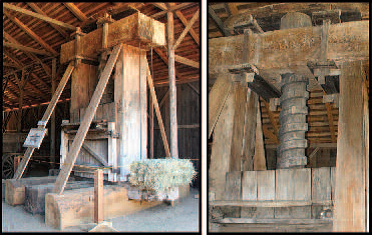
A screw press on display in Penn Valley, California

Figure 5. A Screw Press on display in the heritage barn at the South Yuba River State Park, Penn Valley, California. It was made in 1857 by George Penman, an early pioneer in the Mohawk Valley. (Photograph by Herb Lindberg)

Early references for hay screws are relatively rare. Historian Regina Marchi reported that in 1760 an East Boston (Noddle’s Island) resident, Henry Howell Williams, purchased a state-of-the-art screw press for baling saltmarsh hay. She further notes that this “was the only such use of this technology in America at the time” (Marchi, 2015, p. 107). This may or may not have been the very first of such device in the region as we also find in an account on the early history of Boston: “A True Account of the Loss Sustained by Jacob Bucknam in the late Great Fire in Boston in 1760: “210 hundred of Screwed Hay at 22/6 £236” and “1 horse £20 and 1 pair Hay Screws & tackling £45” (in A Volume of Records relating to the early history of Boston containing Miscellaneous Papers, Boston, Municipal Printing Office, 1900, page 61) (Note: 1 hundredweight = 112 pounds). This reference is of particular interest as it mentions the cost of a pair of Hay Screws.

During the American Revolutionary War (1775-1783), cattle (and thus hay), was vital to the war efforts on both sides of the conflict. Graeme Wynn (1979) in his paper on late eighteenth-century agriculture on the Bay of Fundy marshlands, noted, “Market conditions improved in the late 1770s, when British troops in Boston, and later Halifax, raised the demand for all types of fresh produce, and clandestine trade with the American colonists flourished” (Wynn, 1979, page 88). That Nova Scotia, and particularly the rich farmlands bordering the Bay of Fundy, supplied much of these needs, including hay, is well established. Although war also placed New England farmers in a difficult position, Nova Scotia was still seen as the traditional and best source of hay for their livestock. In a letter from Machias, Maine, by patriot Stephen Parker to the Honorable Council of the Colony of Massachusetts Bay (13 May, 1776) we read: “…if I could proceed to the Bay in Nova Scotia & procure a quantity of hay it would be of eminent service to our people, as a large stock of cattle must die if no hay could be obtained but what was cut in the place, we being supplied with hundreds of Tons from Nova Scotia yearly” (Baxter, 1910, page 347).

In Baxter (1910, pages 262-263), there is an interesting account in a letter from William Shirrif, D.Q.M.G. (Deputy Quarter Master General), dated at Boston, 29 May, 1775, and addressed to Thomas Williams Esq., keeper of the King’s ordnance at Annapolis, Nova Scotia (In the following extract from letter, the salient text is in italics): “The Hay will be most Acceptable and I hopes Captain Princes Vessel has taken a part on Board As he promised me he should return immediately, and I will send you another one, as soon as possible. I shall want three or four Thousand Tons of Hay and I wish with all my heart poor Annapolis could furnish it – but all it can furnish I will take, and if they are Industrious they may get a great deal of Money for their Vegetables Poultry Butter Eggs &c…..” and further in letter “I have wrote Messrs Day & Scott at Halifax respecting Forage, and have desired them to Consult with you about the Quantity that may be procured at Annapolis, as they are to furnish the remainder from Windsor, & that Neighbourhood. Procure Hay screws at any rate, and the whole should be carried to a particular place most convenient for that purpose as Also for Shiping of it.” William Shirriff signs the letter and then adds “P/ S If you can possibly add to the Quantity of Old Hay pray do and don’t mind the Expence – W.S” [Note: 4,000 tons of hay at ~ 2-2½ tons/acre would require approximately 1,600 to  2,000 acres of land]. The above request for hay, and need for “Hay Screws” from the Bay of Fundy dykelands in early 1775 is of particular interest as the following account suggests the importance of the Tantramar in supplying this demand for hay and possibly even the above request.

In The Documentary History of the State of Maine (page 315), the following orders were issued to Captain Isaac Danks in October of 1775. Keep in mind that Isaac Danks (1748-1819; buried in Onondaga Valley Cemetery, New York) was the son of Benoni Danks who lived at Westmorland Point (the family dwelling was close to present-day Fort Beausejour/Fort Cumberland). Isaac’s father, leader of Dank’s Rangers, was to side with the American cause and lost his life in 1776 following the failed raid on Fort Cumberland by supporters of Jonathan Eddy. In 1784, Isaac sold his father’s home lot and other lands to Henry Stultz for £170 (Book A1, Deed No. 196, page 201). The following letter addressed to Captain Danks is clearly in response to the demand for hay by William Sherriff, the Deputy Quarter Master General at Boston, as provided by Halifax merchants Day & Scott. Note the “Bundles of Hay” (presumably pressed hay) specified in the cargo. An extract of the letter follows and salient points are underlined:

“Captain Isaac Danks, you are to proceed Immediately with ye Schooner Falmouth Packet now under your Command, to Boston, taking Care to keep Under the protection of the Man of War, who Convoys you; When at Boston you are to wait on William Sherriff Esq. the Deputy Quarter Master General, Whose Orders you are afterwards Implicitly to follow. Respecting the Cargo, on Board of you, please to Observe the following Instructions — 1stly Eight Bundles of Hay Stowed in the Hold and two Barrels of Potatoes, are to be Delivered to Daniel Chamier Esq Commissary General. 2dly The Fifteen Oxen together with the Remainder of the Hay are to be Delivered to the Order of Major Sherriff. 3dly Two Barrels of Potatoes are to be Delivered to Major Martin of the Royal Artillery. 4thly The Potatoes and Turnips which are lose In the Hold you are to Acquaint Major Sherreff thereof and Deliver them to his Order; provided he wants them, either for him-self, Friends or Hospital; If he Does not want them you must dispose of them, and pay the proceeds Into the Hands of Mr Archibald Cunningham.

I sincerely wish you _ prosperous Voyage and _ your Real friend_ Day & Scott

October 20th 1775 Cumberland”

In confirmation of Isaac’s home port, we note the following reference: the schooner Falmouth Packet of 50 or 60 tons “from Fort Cumberland, in Nova Scotia, Isaac Danks, master, bound for Boston laden with cattle, butter, cheese, roots, etc” was seized by John Bunker of Mount Desert Island, Maine on the 24th November, 1775 (Forces, 1843, page 1255).

The link between the above documents and the “Hay Screws” on the Tantramar is somewhat conjectural. From the references, we see that there was a huge demand for Nova Scotia hay in 1775 and the need for “Hay Screws” to press the product for shipment. The location of where the screws were erected is not specified. Further, as a Tantramar link, Captain Isaac Danks who, as previously noted, hailed from the Chignecto Isthmus, was one of the charters to have this hay delivered to New England. It was also on 23 July, 1776, when William Olney sold 4 acres of land to William Cornforth that was described as “situate on the Great Marsh to the westward of the Boito [Aboiteau] by which the Hay Screws now Stands.” As Hay Screws were a comparatively expensive item, they were thus not likely an abundant mechanism in the late 1700s. I make no assertion that the screws requested to be erected by Shirrif in 1775 are the same as those mentioned in the deed of 1776; the timing and connections may be purely coincidental. However, what is clear is the demand for large quantities of hay would likely have been the impetus for the construction of “Hay Screws” on the “Bend of the River  Marsh” at the east side of the Tantramar River, by the summer of 1776.

Loose ends

A few other place-names have been uncovered during this research that have been lost to us and their addition here rounds out our understanding of the landscape in the vicinity of the “Hay Screws” in the late 1700s. About 500 m north of the “Hay Screws” a large, once tidal, creek enters the east side of the Tantramar River. Where the dykes once crossed this creek lies the site of “Ward’s aboiteau” (Figure 2). This aboiteau was presumably named after Nehemiah Ward, an early marsh owner in that area. Furthermore an old trail, beginning just east of the covered bridge, followed a sinuous course parallel to the river until reaching “Ward’s aboiteau”. This is still known locally as the “Old Cole’s Island Road”. The records are not clear, but the site of “Ward’s aboiteau” may have also been close to a feature mentioned in old deeds as the “Broken Bridge”. The road past “Ward’s aboiteau” is now barely discernable and there is an inexplicable break in the depiction of this lane on the 1791 map with only a short series of dots connecting the gap (see Figure 2 and in Figure 4; note the row of dots immediately below the number 20 on this map). I wonder if this break represents the location of the “Broken Bridge”. At one time the road continued southerly until it eventually crossed the “Hay Screw aboiteau” at which point it veered easterly and connected with the modern “Coles Island Road”. At this intersection, the continuation of the “Old Cole’s Island Road” became the “Sunken Island Road”.

Some of the place names encountered in early legal documents describe what once must have been easily recognizable features on the landscape. One of these was “Schurman’s Pond”, likely named after early Tantramar settler Caleb Shurman. This lost wetland was presumably situated in the vicinity of Lot No. 32 within the tier of four-acre lots (Deed, Titus Thornton to John Harris, Book B, Page 154, No. 700; see Appendix I). Of biological interest, Schurman’s pond may suggest the past existence of a brackish or bog pond such as are still frequently found at the head of tide in the upper Bay of Fundy.

Another structure of interest depicted on the 1791 map is the “Cross Dyke” that divides the higher quality dyked lands to the north from the un-dyked salt marsh, or “Out Marsh”, to the south. This dyke extended from the western bulge of Sunken Island, following the northern edge of the Sunken Island ditch, and on crossing the present day “Coles Island Road”, connected with the eastern bank of the Tantramar River (Figure 3). Remnants of this old feature have recently been lost due to agricultural improvements in the area.

The value of agricultural improvements to saltmarshes, through dyking, ditching and draining, is well represented in land transactions of the period (Table 1) and the differences in valuations between salt marsh and dyked-lands was specifically noted by Robinson and Rispin as part of their investigative journey through Nova Scotia in 1774: “They value their marsh land that is diked in, and their best cleared land, at three pounds an acre, and their undiked marshes at one pound [per acre]” (Robinson and Rispin, 1774, page 12). For comparative purposes, they further note that, “a pretty good Cow and Calf is valued at £5.10 or £6” (Robinson and Rispin, 1774, page 24).

Conclusion

Surviving records point to the existence of “Hay Screws” on the Tantramar Marsh in the late 18th century as well as an emphasis on the economic importance of the dykelands throughout this period. Although no specific details of the “screws” survive, we are left with an impression of a substantial mechanical device, possibly associated with a storage facility (barn?) as well as a modest dock, or even a brush-work landing on the river bank, to facilitate loading of bailed hay onto small ships or scows that could be navigated up the circuitous Tantramar River (Figure 6). As erosion continuously alters the route of rivers, it is important to emphasize that the specific site of the “Hay Screws” may now be lost (Figure 7). Remnants of an old aboiteau survives today that could be the original, or later rendition, of the “Hay Screws aboiteau” (see Appendix II for details on this structure). Furthermore, the resurrection of once commonly referenced place-names that surround the “Hay Screws”, (such as “Hay Screws aboiteau”, “Wards aboiteau”, “Broken Bridge”, “Old Coles Island Road” and “Schurman’s Pond”) enhances the richness of our Tantramar landscape.
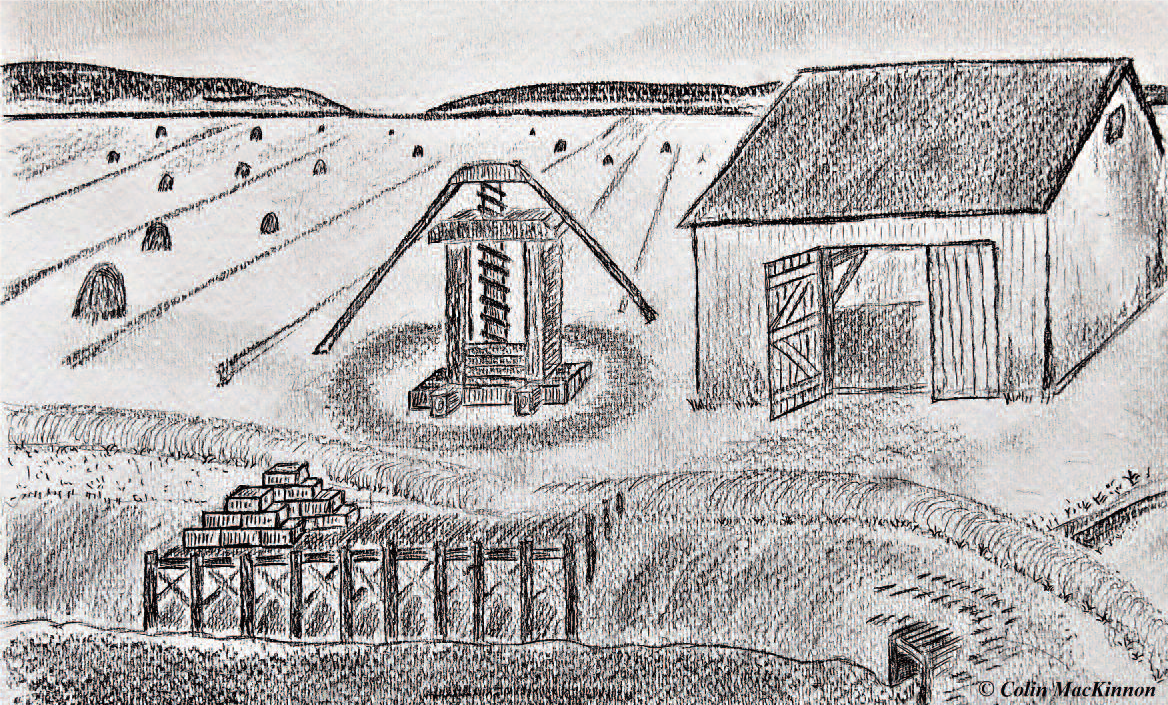
Sketch of Tantramar Hay Screws

Figure 6. Highly conjectural sketch of the Tantramar “Hay Screws,” “Hay Screws Landing,” and “Hay Screws aboiteau” as they may have looked in the late 1700s on the “Bend of the River Marsh,” Tantramar River, New Brunswick.

Table 1. Comparison of land prices within the tier of Four Acre Marsh Lots, Division Letter A, from 1776 to 1806, Tantramar Marsh, Sackville, New Brunswick.

YEAR     Lot No. (acres)         Price     Price per acre (decimal £)
1776        7 (4 acres)                £4         £1
1787        27 (4 acres)              £7         £1.75
1789         ½ 21 (2 acres)         £1 10    £0.75
1790        10 (4 acres)              £5         £1.25
1791         23 (4 acres)             £9         £2.25
1791        35 & 36 (8 acres)     £14       £1.75
1796        26 & 29 (8 acres)*    £25       £3.13
1800        2 & 3 (8 acres)         £20       £2.5
1805        22 & 23 (8 acres)     £60**    £7.5
1806        11 (4 acres)             £15       £3.75

* Located by Shurman’s Pond
** The large price of £60 for 8 acres (Lots 22 and 23) may suggest some other improvement to the parcel or missing data in the deed.

Photo of general location of Hay Screws on banks of Tantramar River

Figure 7. General location of where the “Hay Screws” likely stood on the banks of the Tantramar River in the late 1700s.

Remains of old aboiteau on Tantramar River

Remains of an old aboiteau in the area of the “Hay Screws landing” on the “Bend of the River Marsh,” Tantramar River, New Brunswick. Although missing the flapper gate, the wooden aboiteau is still largely intact (sluice interior, inset at right, 18″ x 33″). Note the treenails (wooden pegs – see arrow, inset at left) used in construction of the aboiteau.

Literature Cited

A Volume of Records relating to the early history of Boston containing Miscellaneous Papers, Boston, Municipal Printing Office, 1900, Page 61.

Baxter, James P., Ed. 1910. Documentary History of State of Maine containing the Baxter Manuscripts, Vol. XIX, The Maine Historical Society, Portland Lefavor-Tower Co.

Force, Peter. 1843. American Archives (Fourth series), A Documentary History of the English Colonies in North America from The King’s message to Parliament, of March 7, 1774, to the Declaration of Independence by the United States.

Marchi, Regina. 2015. Legendary Locals of East Boston, Arcadia Publishing, page 107.

Robinson, J., & Rispin, T. 1774. A journey through Nova-Scotia, containing, a particular account of the country and its inhabitants: …By John Robinson, farmer at Bewholm, in Holderness, and Thomas Rispin, farmer at Fangfoss, both in the County of York. York: Printed for the authors, by C. Etherington. South Yuba River Park Adventures, http://www.syrpa.lindberglce.com/barn/haypress.htm (Accessed on 2 February, 2018)

Wynn, Graeme. 1979. Late Eighteenth-Century Agriculture on the Bay of Fundy Marshlands. Acadiensis 8, 2: 80-89.

APPENDIX I

Details of property sales from within the tier of “Four Acre Marsh Lots Division Letter A.” Parcels are listed in chronological order from date of sale (the registry date in some cases may be years later). Individual lot numbers, as shown in Figure 4, are underlined and in bold in the following accounts. Salient notes of land features have been underlined.

William Olney to William Cornforth, Book A1, Page 20, Signed, 23 July 1776 (Registered 26 September 1785), Price £4
“One four Acre lot of land be it more or less No. 7 lying on Sackville first Division Letter A belonging to the right No. 52 and is situate on the Great Marsh to the westward of the Boito by which the Hay Screws now Stands.”

Jonathan Cole (under power of attorney from Benjamin Thurber of Providence, Rhode Island) to Daniel Fletcher (Labourer), Book A1, Page 205, Signed 8 June 1786 (Registered 12 March 1789). Price £34.
Various lots, including: One four acre lot on the Great Marsh, being number one westward of the Old Hay-Screws landing, all belonging to number seventeen aforesaid.”

Joseph Brown to Mark Patton, Book A, Page 118, No. 73. Signed 28 June 1786 (Registered 21 August 1787). Price £10.
Two lots of marsh land containing four acres each and laying on the Great marsh, one lot laying nigh the Screws Aboideau and a crofs Dead Creek the other by the side of the Crofs Dyke, be them more or less, situated laying and being in the Division Letter A. so called in the Township of Sackville aforesaid being the lots known by the numbers Twenty and drawn by me Joseph Brown”

Jonathan Eddy to William Cornforth, Book A, Page 129, No. 96. Signed 26 March 1787 (Registered 24 August 1787). Price £7.
“One Lot of Marsh Land containing by estimation four acres, be it more or less, lying on the Great Marsh near Dead Creek, numbered Twenty Seven, and belonging to the Right or Share number Twenty Eight in Letter A. Division.”

John Barns to William Fawcett, Book A, Page 204, No. 189, Signed 17 February 1789 (Registered 12 March 1789), Price £1. 10. 0.
One half lot of marsh Land containing two Acres and laying on the Great marsh laying near the Screws crossing the dead Creek and bounded Westerly by No. 20. Be it more or less, situated laying and being in the Division of Letter A. so called in the Township of Sackville aforesaid being the one half of the four acre lot known by the name of No. 21 and granted to Andrew Waterman”

Charles Dixon Esq. to Jonathan Burnham Esq., Book B, Page 132, No. 688, Signed 19th August 1790 (Registered 5 April 1796). Price £5.
One four acre lot upon the Great Marsh known by number ten in Letter A Division laying a little to the West of the place known by the Hay Screws.

Hezekiah King to Gideon Smith, Book A, Page 307, No. 347. Signed 2 May 1791 (Registered 10 May 1791). Price £9.
“One four acre lot of land lying on the Great Marsh and belonging to the Right or Share and half number twenty five in Letter A. Division in said Sackville and lying across dead creek drawn by the number twenty three.”

Jonathan Barlow (Yeoman) to Thomas Anderson (Farmer), Book B, Page 121, No. 666, Signed 1st November 1791 (Registered 5 April 1796). Price £14.
Two lots of land containing four acres each more or less, agreeable to the Plan of the Township belonging to number ten in Letter A Division on the Great Marsh now numbered thirty five and thirty six laying both together in the Tier of Lots leading from the Hay Screws.

Titus Thornton to John Harris, Book B, Page 154, No. 700. Signed 11 March 1796 (Registered 5 September 1796). Price £25.
A lot and half of marsh land lying on the Great Marsh and by a Pond known by the name of Shurman’s pond and a half lot laying near the Screws at the South end known by the number twenty six the whole lot known by the number twenty nine the other half lot known by number twenty six the whole lot drawn by William Alverson containing eight acres more or less.”

Thomas and James Easterbrooks to Michael Grace, Book B, Page 174, No. 736, Signed 9 August 1796 (Registered 11 April 1797). Price £21.
“Two half lots of Marsh lands number twelve, one laying between the Screws Aboideau and Ward’s Abyto and the other near cross Dike”. Letter A. Division.

Gideon Smith to John Fawcett, Book B, Page 363, No. 1056. Signed 23rd March 1800 (Registered 20 June 1801). Price £20.
Two four acre lots of land on the Great Marsh numbers two and three in letter A. Division in the bend of the river near the Screws.”

Gideon Smith (Blacksmith) to John Fawcett Jr. and William Fawcett Jr., Book C, Page 200, No. 1375. Signed 5th September 1805 (Registered 27th Jan., 1806). Price £60.
Two four acre lots situate and laying and being on the Great marsh in Sackville aforesaid known by the name of numbers twenty two and twenty three laying together in letter A. Division butting on Tantramar division and laying across the Screws Abt [Aboiteau] creek containing eight acres more or less.” [Note that the high price of £60 for these eight acres parcel may suggest some other improvement on the property or missing data in the deed].

Thomas Anderson Sr. and John Anderson to Jonathan Cole, Book C, Page 212, No. 1393, Signed 3rd Feb. 1806. Price £15.
“One four acre lot of land on the Great Marsh number eleven in the letter A. Division of said Township of Sackville situate in the Screws bend of the river so called, bought by Ira Hicks and Gideon Smith.”

APPENDIX II

Remains of an old aboiteau in the area of the “Hay Screws landing” on the “Bend of the River Marsh”, Tantramar River, New Brunswick.

Remains of old aboiteau on Tantramar River

Remains of an old aboiteau in the area of the “Hay Screws landing” on the “Bend of the River Marsh,” Tantramar River, New Brunswick. Although missing the flapper gate, the wooden aboiteau is still largely intact (sluice interior, inset at right, 18″ x 33″). Note the treenails (wooden pegs – see arrow, inset at left) used in construction of the aboiteau.

Details of aboiteau construction (see photograph above and schematics below). Dimensions are given in inches to reflect the units likely used in the original construction. The tide/flap gate is missing and the entire exposed structure has suffered considerable wear from ice scour. Construction consists of a rectangular box-like pipe. Surviving length of the aboiteau is about 28 feet. Sides are built from two 8″ x 9″ squared timbers that have been stacked one on top of the other and then joined together with 2″ diameter treenails (dowels). This larger dowel (only one example visible) does not appear to project through the top and bottom planking. The top and bottom planking, 2″ x 10½” x 49″, is affixed to the sides by 1″ diameter treenails that are off-set from the centre line of the plank as well as apparently being staggered in their position on each plank (this observation is based on two visible dowels as well as one dowel hole). Note that of the six planks measured, widths varied from 9½” (one), 10″ (two) and 10½” (three). These 1″ diameter dowels extend through the planking and go only about half way through (4″) of one of the 8″ x 9″ side timbers. The bottom of the structure is supported on two large planks (3″ x 10″) that appear to run along both sides of the bottom of the aboiteau. There were no metal fasteners used in the construction. I don’t know the age of this work. As wood survives for a very long time when buried in marsh mud, this remnant likely dates to the mid 1800s and could conceivable be contemporary with the late 18th century Hay Screws.

Schematics for old aboiteau, Tantramar River, New Brunswick

Schematics for the old aboiteau in the area of the “Hay Screws landing,” “Bend of the River Marsh,” Tantramar River, New Brunswick. See text for details.

Attention!
2019 MEMBERSHIP RENEWALS

It’s that time of year again! Don’t miss an issue of The White Fence by renewing your THT membership. It’s only $30.00 for a family and $20.00 per individual. In addition to the newsletter, you get free admission to the museums, free use of the Alec R. Purdy Research Centre and a vote at our Annual General Meeting (AGM). You can renew online using PayPal, over the phone with a credit card (call Karen at 506-536-2541) or in person at the Boultenhouse Heritage Centre (29B Queens Road, Sackville). Thanks for your support!

OBITUARY Brian Campbell

Brian Campbell

We were deeply saddened to hear about the recent passing of Brian Campbell. Preserving the Campbell family heritage through the Campbell Carriage Factory Museum is a main focus of the Tantramar Heritage Trust. The reconstruction of the factory compound, and the continuing work to tell the stories of carriage fabrication in the Tantramar region, is a project that was dear to Brian’s heart. We send our sincere condolences to Brian’s family and friends, and especially to Barbara, Erin and Avery.

April 10, 1981–November 15, 2018

It is with profound sadness that we announce the sudden passing of Brian Campbell on Thursday, November 15, 2018 in Calgary, AB. Brian passed away unexpectedly, following a brief illness, at the age of 37. Born in Moncton, N.B. on April 10, 1981, Brian was the son of Barbara (Rees–Potter) Campbell and the late William Ronald Campbell.

Brian attended local schools in Sackville, NB. Upon graduation from Tantramar Regional High School, Brian first attended Bishop’s University and then transferred to Mount Allison University, graduating with a Bachelor of Arts in Political Science and Economics in 2005. After graduating from MtA, Brian headed west to Alberta where he worked for several years in the oil and gas industry. Brian held a number of management positions and worked on many significant pipeline projects at Canadian Natural Resources Ltd., Fluor Corporation and Enbridge Pipelines Inc.

In 2013 Brian returned to the East Coast to attend law school in Fredericton. He was a summer law clerk at Cox & Palmer in Saint John in 2016 and he obtained his MBA and his Law Degree from the University of New Brunswick in 2017. After he graduated from law school, Brian returned to Alberta where he articled with Stikeman Elliott in Calgary. After being admitted to the Alberta Bar in September 2018, he joined Stikeman Elliott as an Associate Lawyer.

In recent years, Brian was involved with the family business, Campbell’s Funeral Home in Sackville. He was extremely proud of his family history in the community and his New Brunswick heritage.

Mild–mannered, even–keeled, kind and funny, Brian had a positive impact on everyone he met. His strength of character, perseverance and quiet intelligence were an inspiration to his family, many friends and colleagues. Brian loved cats, in particular, Rosie and a crazy Bengal named Audrey Catburn. Following in his father’s footsteps, Brian had a passion for old vehicles, including restoring vintage Corvettes.

Brian will be deeply missed by his mother, Barbara (Rees–Potter) Campbell; his sister, Erin Morgan Campbell; his niece, Avery Rees Campbell, all of Sackville; his girlfriend, Caroline McAvity, Saint John, NB; his Aunt, Mary Campbell, Riverview, NB; his Uncle, David (Carolyn) Rees–Potter, Perth, ON; his Godmother, Susan Jenkins (Beverly Smith), Rexton, NB; several cousins and other extended family in the Maritimes, England and Australia, as well as by many great friends across the country.

Brian was predeceased by his father, William Ronald Campbell in 2000, as well as by his maternal and paternal grandparents.

Arrangements were handled by the family business he loved, Campbell’s Funeral Home, 89 Bridge Street, Sackville, N.B. (506) 364–8188. A celebration of Brian’s life was held on Saturday, November 24, 2018 at 2 pm at the Mount Allison University Chapel, 63B York Street, Sackville, when individuals shared memories and words of gratitude for Brian’s life. A reception followed at Tweedie Hall, located in the Wallace McCain Student Centre.

If so desired, donations in memory of Brian may be made to the Campbell Carriage Factory Museum (through the Tantramar Heritage Trust Inc.) or to the charity of one’s choice. Online condolences may be forwarded to the family through the website https://campbellsfuneralhome.com/ or by visiting the funeral home Facebook page @campbellssackville.
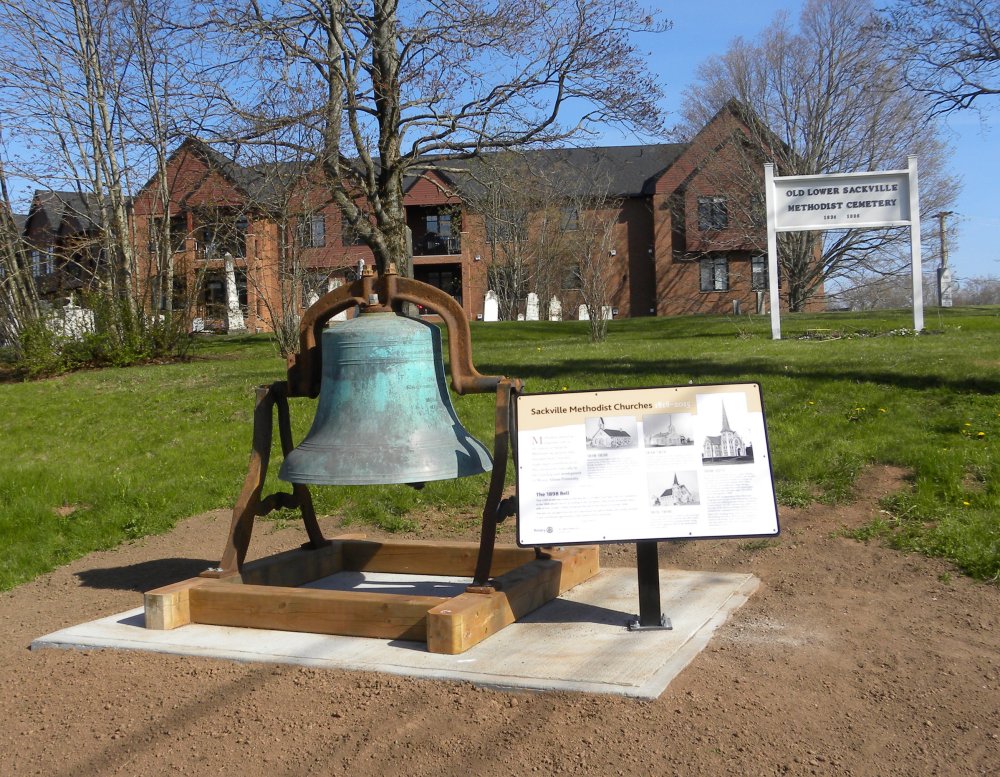
The White Fence, issue #83

november 2018

Editorial

Dear friends,

We do remember them. Join me on two trips of military remembrances, each one in a different World War! Colin MacKinnon remembers Private Lloyd Estabrooks from Middle Sackville who signed up to fight in WWI. Follow Lloyd’s ambitions to join the war effort and how the times stepped in to intrude on his quest. Lloyd Estabrooks was in Saint John when a photo of Sackville’s Victory Parade was taken on 11 November, 1918 (see below).

Then join the friends of Major Laurie Black who wrote to him from the European battle-grounds of World War II and discover how a deep personal family tragedy affected Laurie’s own ambitions to contribute to the fight. Read carefully the names of the people mentioned in these letters, some of whom may be distant relations. I wish also to direct your attention to the letter dated 10 February, 1943, from Major G. Robert (Bob) Ross to Laurie in which Bob mentions that he includes “a few snaps” with his letter which he had “on hand” while the training area was “a sea of mud.” Laurie’s son, Larry Black, provided both the letters and photos to us, of which four of the photos are included here.

Furthermore, with the letter and “snaps” sent to us, Larry Black included a copy of a letter sent to his father, then OC of “C” Squadron, 8 Hussars, Sackville, and every member of “C” Squadron, from Lt. Col. Keltie Kennedy, then CO of the Regiment, thanking them for volunteering “to go active” (8th Hussars was then still a reserve regiment). As Canada did not proclaim a state of war until September 10, 1939, this correspondence of September 1, 1939, shows the readiness of New Brunswickers to serve their country. It is worthwhile to include here a transcription of this letter in its entirety:

Hampton, N.B.
1st Sept. 1939

Major J. L. Black
O.C. “C” Sqdn.
8 Hussars
Sackville, N.B.

ACTIVE SERVICE

Please convey to the Officers and Other Ranks of your Squadron my appreciation of their offer to serve with this Unit in the event of Mobilization. I have already offered our Services to Defence Headquarters.

K. Kennedy
Lt. Col.
8 P.L. (N.B.) Hussars

Two World Wars lead us to where we, as proud Canadians, are today. We all owe a great debt to those who fought in both wars and lost their lives. We do remember them.

Peter Hicklin

Private Lloyd Estabrooks (1896-1918)
No. 4063177, 1st Depot Battalion, New Brunswick Regiment

By Colin M. MacKinnon

First World War memorial plaque

First World War memorial plaque (about 4.75 inches in diameter/120 mm), known informally as the “Dead Man’s Penny”, was sent to the family following the death of Private Lloyd Estabrooks (1896-1918) of Middle Sackville, New Brunswick (the discrepancy in spelling of family name on the plaque and in the text is described below).

Lloyd Estabrooks, born on the 9th April, 1896, was the son of Thalbert and Alice (Estabrooks) Estabrooks of Middle Sackville, New Brunswick. Coming from a large farming family, he was one of the oldest of eleven children. Lloyd’s siblings were brothers Raleigh, Corey, Atwell, Gerard and Ralph and sisters Helen, Louise, Evelyn, Greta and Dorothy. During his early years, Lloyd likely attended the Middle Sackville Central School on Church Street, considered one of the province’s superior schools. The teacher at this school was hired with a first class license and the school’s first teacher was possibly G. Talbot Morton (born circa 1871) whose annual salary was $122.00 in 1896. I don’t know to what level Lloyd attained in school but his wonderful script signature is done with a confident and steady hand (see Figure 1). The First World War (28 July, 1914-11 November, 1918) was raging throughout Lloyd’s late teen years and the horrific loss of life throughout this conflict resulted in a perceived need by the Canadian government to raise new troops. Caught up in the controversial “Military Service Act” of 1917 (that allowed for the conscription of people for the war effort), Lloyd Estabrooks received a
call-up to serve in the summer of 1918 (letter number 663186 FC).

Signature of Lloyd Estabrooks

Figure 1. Signature of Lloyd Estabrooks in 1918.

On the 21st day of August of that year, Lloyd went to nearby Moncton for his military physical exam. His hearing was considered “Normal” and Lloyd had adequate eyesight (right eye 20/30 and left 20/40). His vision was fine for a soldier but he did not have the acuity required to be a pilot. He received a medical grade of A2. Someone attaining the overall category of “A” was considered “Able to march, see to shoot, hear well and stand active service conditions” while those in subcategory A2 were “Fit for dispatching overseas, as regards physical and mental health”. Lloyd received an overall evaluation of “Good” for physical development.

On 29 August, 1918, Estabrooks travelled to Saint John, New Brunswick where he enlisted and was assigned to the 1st Depot Battalion of the New Brunswick Regiment (reserve battalion). While there, he was described as being age 22 years and 4 months, weight 125 pounds, height 5 feet 6 inches, having a 34 inch chest and with blue eyes, light coloured hair and with a medium complexion. He prepared and signed his will on the 29th October, 1918, leaving his possessions to his father.

Sadly, shortly after arriving in Saint John, Pte. Lloyd Estabrooks took sick on the 12th November, the day following the end of the war! He was on parade but had not been feeling well. On the 13th, he complained of “headache, cough, soreness in chest, fever and malaise”. By the 19th November 1918, just 8 days after the armistice came into force, his condition deteriorated rapidly and Pte. Estabrooks died at 11:45 p.m. of Influenza and Lobar Pneumonia (see Figures 2 and 3).

Death certificate for Lloyd Estabrooks

Figure 2. Death certificate 19 November, 1918, for Lloyd Estabrooks of Sackville, New Brunswick. This soldier’s passing was just eight days after the end of World War I.

War records for Private Lloyd Estabrooks

Figure 3. War records for Pte. Lloyd Estabrooks, page 15 of 18. Government of Canada, Library and Archives Canada, https://www.bac-lac.gc.ca/eng/discover/military-heritage/first-world-war/personnel-records/Pages/search.aspx (Accessed 10 June 2018).

Lloyd Estabrooks was one of the many thousands of Canadians who succumbed to the 1918 flu pandemic, the so-called “Spanish flu”. The ravages of the disease were so dire in New Brunswick that “in October of 1918, Dr. William Roberts, the minister of health in New Brunswick, outlawed the gathering of more than five people. Schools and churches were closed for five weeks in an effort to combat the spread of the Spanish influenza.” (Daily Gleaner, Fredericton, 9 October 1918.). Being a young soldier and stationed on a crowded base with many other young people was a recipe for disaster from the spread of a respiratory virus.

Canada lost approximately 61,000 soldiers in World War I and the many names on the cenotaph in Sackville attest to the sacrifices from the Tantramar area. In the closing days of the war, Lloyd’s parents must have developed some hope, if not confidence, that their son would not have to serve overseas and would soon be able to safely return home. How could they possibly foresee the loss of their son at a time when most were rejoicing the end of such a bitter conflict? On the death of Pte. Estabrooks, his body was returned home. His body lies next to those of his parents at the Four Corners Burying Ground in Upper Sackville, New Brunswick (Figure 4).

Grave of Private Lloyd Estabrooks, Upper Sackville, New Brunswick

Figure 4. Final resting place of Pte. Lloyd Estabrooks (1896-1918), Four Corners Burying Ground, Church Street, Upper Sackville, New Brunswick.

Throughout Lloyd’s brief time in the military, the spelling of his surname was plagued with errors that were never completely corrected. Although he was sworn in as “Lloyd Estabrooks”, later documents sometimes had his name written as Esterbrook. This error appears to have been rectified by the battalion but his medical records continued with the incorrect spelling. A memorial cross was sent to his mother as well as a memorial plaque to the family. The name discrepancy of “Esterbrook” instead of “Estabrooks” was perpetuated on the bronze medallion that they received (see frontispiece).

This year marks the one hundredth anniversary of Lloyd Estabrooks’s death. This loss is all the more tragic (if that is possible!) due to the circumstances and timing of his passing. Although his military service was brief, Lloyd was willing to serve. His name is not memorialized on the cenotaph in Sackville but his service and sacrifice should not be forgotten.

Photo of parade in Sackville, NB celebrating end of WWI.

November 11, 1918, parade in Sackville celebrating WW1.

Letters to Laurie Black During Wartime (WWII)

By Larry Black

The following are a few remaining letters sent to Major J.L. (Laurie) Black from fellow officers and NCOs with the Princess Louise 8th (NB) Hussars in 1942 and 1943 while they were stationed in England training and waiting to be sent into battle.

Major Black joined the 8th Hussars (then a reserve regiment) as a Lieutenant in 1921 shortly after he graduated from Royal Military College in Kingston. On promotion to Major in 1927, he was given command of “C” Squadron which won “Best in Regiment” in 1935. Most members of “C” Squadron were from Middle Sackville or Sackville. The Regiment was activated in 1940 as the 4th Canadian Motorcycle Regiment (8th Princess Louise Hussars) and Laurie went overseas in October 1941 as its second-in-command. Shortly after the regiment arrived in Britain, the Canadian Army Command assigned him to a special staff officertraining course at Oxford’s Brasenose College. On its completion, he was promoted to Brigade Major of “E” Group, Canadian Reinforcements Unit (CRU). The first of these letters was sent to him while he was at Brasenose.

Laurie’s rapid rise was cut short in 1943 when, back in Middle Sackville, his six-year old son Frankie was killed in an accident. Laurie requested compassionate leave. Denied that, he applied for a temporary transfer and, four months after the tragedy, returned to Canada. After a very brief stay with his wife in Middle Sackville, he was posted to Fort Esquimalt in British Columbia where he served variously as training and intelligence officer.

With the full support of his commanding officers in BC, Laurie applied regularly to be returned to his regiment in Europe but was turned down each time. His one chance at action came when he was named senior Canadian liaison officer attached to the staff of Alaska Task Force (ATF) under the command of US Major General G.H. Corlett (known as “Corlett’s Long Knives”). Laurie was with the ATF when it invaded Kiska against the Japanese in August 1943 only to find (presumably to his relief!) that the Japanese had withdrawn.1 In August, 1944, he was promoted to Lt. Col. and transferred to the Directorate of Military Training, Ottawa as a GSO 1 and then retired from active service in November.

* * *

These four letters below are remnants of extensive correspondence between Laurie and his fellow officers and NCOs with the 8th Hussars, many of whom he had known since they were boys in Middle Sackville or young reserve officers in the 1920s. The first letter begins with a reference to an odd circumstance: when Laurie was attached to the Jr. War Staff Course at Oxford he was struck off strength (SOS) of what was by then the 5th Canadian Armoured Regiment (8th NB Hussars) by Lt. Col. H.S. Gamblin, leaving him without a regiment. The SOS was subsequently “cancelled in its entirety” by General Headquarters.

In addition to some personal information on 8th Hussar officers, NCOs and troopers, these letters also reveal both the high level of competency and comradery among 8th Hussar personnel and a limited insight into the daily lives of these young men as they prepared to go into battle.

All letters were carefully censored so no locations are mentioned and the envelopes had their examiner’s number on them. Many of the men mentioned were promoted as the war went on but the ranks given here, for the most part, are the ranks held at the time the letter was written.

1. For details see Larry Black and Galen Roger Perras, eds. Black’s War. From New Brunswick’s
8th Hussars to California’s Corlett’s “Long Knives”, 1941-1944. Waterloo, ON: LCMSDS Press of Wilfred Laurier University, 2013; and Canadian Army (Active). Certificate of Service and Record of Service, Lt. Col. J.L. Black.

Letter No 1

(All spelling and punctuation in these letters are as in the originals.)

Major J.B. (Jack) Angevine
to Laurie Black, 16 February 1942*

Dear Laurie,

Rec’d your letter this P.M. and glad to have heard from you.

Some time after you left Capt Hunter discovered that someone had pulled a “boner” in instructing us to strike you off strength. Therefore the SOS entry was cancelled and a new entry put through attaching you. As I see it now you are still on our Strength and simply away on course.

I am enclosing copies of the paras, affecting you, from Part II Orders. You will note that there were evidently two letters sent out from the War Office under different dates.

I heard the C.O. asking the B.M. on the phone to-day if he had anything definite on your return, etc. So I asked him to-night what information he had. He said the B.M. had no official information but that it was his opinion that you would be going to a Staff job after completion of the course.

Therefore, the latest we have is that you will return here unless you receive orders to the contrary prior to the completion of the course. Then again there is the chance that you might return and get an appointment later. That’s about all I can tell you Laurie — nothing very definite, but you will at least know how the land lies.

We are pretty well settled here and the sgns seem to be doing a pretty good job in their own admin. Everyone is getting an hours P.T. every day now and the cross-country runs commence again on Sat.

We are leading the whole Bde in the qualifications of Part II drives and are well ahead of the GG’s who are next. We had several M’3’s in a Worship Week parade to-day & it went off without a hitch.

All the clerks & cooks, tech storemen are qualified, as well as 20 more Dr. ops.. In addition I’m just now sending in rolls of a large number of Drs mechs — motor mechs and fitters for test. So you can see that we have not been standing still.

Four of our chaps won bouts in the Bde boxing semi-finals and are boxing in the final to-night.

Bob [Major Robert S. Black] & Coll [perhaps D. Colin MacDougall] are in Scotland on 7 day leave, also [Capt] Harry Gilmore & Dale (?).

The Col expects to go on leave next week. Don’t see how I can get away until March. The work has been busy, however, in the orderly room and I’m pretty tired with so much night work. Everyone seems to want returns or rolls of some description. The L.A.D. [acronym unknown] is here now & I have all their rations to supervise too. We also have a Dentist. For want of a suitable place we had to put him in the 2 i/c’s office.

No-one has taken over that appt, except that Bob Ross [Major G. Robert H. Ross] has more or less acted in that capacity. However, he has all he can handle with his own Sqn & he is head of the Bde Class II trade test Board.

Sgt [A.D.] (Doc) MacRae is C at E
and SOS to the N.E.T.D.

Suppose you have heard that [A.C.] Spencer is out and [C.R.S.] Stein is our new Brig? Also Turnbull goes to 1st Bde as BM and [J.D.B.] Des Smith to CO of RCD’s. Johnston of BCD’s gets G-III and I believe Philips who was at HQ in Borden in Canada will be BM. [F.F.] Worthington gets new Armd Div — and so it goes.

Lt. Col. [F.D.] Dodd Tweedie was in the other day. He is C.O. C+ Y’s now as Lawson is out. Gillespie of RCD’s in E.

Guess I have rambled long enough for now — I hope the course is going OK.

Sincerely,
Jack**

P.S. Let me know if there is anything I can do for you or send you at any time — I don’t mean money.

* Letterhead
** Major “Jack” Angevine, from Montreal, joined the Hussars in 1922 and went overseas with the regiment as a Captain. He served as Adjutant in 1940-41.

Canadian soldiers pose in front of tank

L-R: George Lawrence, unidentified soldier, Bob Ross, and Col. MacDougall pose in front of tank.

Letter No 2

Major G. Robert H. Ross
to Major J.L. Black, 10 February
1943, on 8th Hussar Letterhead.*

England 10/2/43

Dear Laurie,

Received your air-mail yesterday. Pretty quick crossing. Mailed at Victoria on Jan 28th and arrived here on Feb 9th. I will look after the cigs when they arrive and thanks very much for thinking of us. Some of the boys have been doing very well on cigs lately but there are big gaps in the shipments and there is usually a few who are buying the English variety at the canteen. One really has to have the habit to smoke them though. So many horses have been shipped out of the country that the quality of the tobacco has fallen off.

Glad you got my card OK. We presented all the men with eight or ten cards apiece and there was a mighty heavy mail out of here for a few days. We bought 10,000 cards altogether. Seemed like a hell of a lot but they were all purchased or distributed and mailed. The men appreciated them very much. We thought it was a nice card. The local selection available at the shops for purchase were pretty awful.

I will get after [Major D. Colin] MacDougall about answering your letter. He is now at #3 CACRU on a four (?) months tour of duty with our reenforcement Sqn. He has been there about a month and seems to rather like it I think. Occasionally homesick for the Unit no doubt. He was down here last Saturday night to a dance we held. His love life has been very successful of late. Believe it or not old Mac is the heart-breaker of the Unit.

Photograph of Colonel MacDougall

Col. MacDougall enjoying a cigarette.

Just got back from the S.O.S. myself on Friday last. That reminds me: I wrote a bit of verse while there which received notices favourable and otherwise. Sorry I haven’t got a copy right now but will strike one off and send along to you within a few days. I can hear you saying “Why, the dammed fool.” Very undiplomatic I assure you. Didn’t get a bad report though, although it could have and should have been better. Some day, sometime, somehow, I shall develop the ability to osculate the posterior and then the sun will rise in all its splendor and the garden will bloom again or something no doubt.

The poor old Padre (Markham) [Rev. Capt C.J.] has eventually been eliminated from the Unit and is now functioning at #1 CACRU. He was considerably over age and had been expecting the move for some time. [Capt. C. Douglas] Doug Everett has returned to the homeland as instructor at an Infantry Training Centre. Over age also. Jack Angevine is at CMHQ in A.G.Br. [Major Sim R.] Sim Jones is G-3, Armd Bde – 4th Div. [Capt. C.W.] Bill Gilchrist has gone to North Africa as P.R.O. (Capt). Have had a lot of other changes also and there are only seven officers left of the original 4 Cdn Armd Regt: “So sad, so sweet, the days that are no more.” They are as follows:

[Capt. A.G.] Sandy Merritt
(still QM).
[C.F.A.] Kit Graham (Lt)
[P.M.] French Blanchet
(Maj – 0C “A” Sqn)
[H.G.] Howard Keirstead
(Capt – 2 i/c “HQ” Sqn)
[J.S.] Jack Boyer
(Capt – 2 i/c “A” Sqn)
[C.A.] Cliff McEwen
(Capt – 2 i/c “C” Sqn)
[Capt. B.M.] McAlary
(still the best P.M. in the army),
and myself still 2 i/c.

Of course we have [Major Frank L.] Price here so that is one more of the old familiar faces.

We are fairly well up on equipment now but are in the throes of reorganization on the new British establishment of one Armd Bde per Div. You will be glad to know that the Regt remained with the Armd Bde in this Div. Bde now composed of L.S.H., ourselves and BCD’s. GGHG now Div. recce regt. 1st H [Hussars] and F.G.H. to Army Tank Bde with Sherbrooke Fusiliers.

Did you meet [Brig. George William] Robinson, our new CO? He is a really fine chap and liked by all of us.

I am enclosing a few snaps which I have on hand and will try to have some more to stick in letter with
alleged poem. We are in a Hell of a wet section of the country now — rains every day and training areas are a sea of mud.

Oxford was very nice and very little wet weather there (SOS), but it rained regularly here. We hear that Bob [Major R.S. Black] is coming back. Presume you knew about it.

Will close now Laurie and give you some more of the dope when I can get another letter away.

Adios,
Robert

* G. Robert (Bob) H. Ross joined the Hussars in 1927 and went overseas with the 8th Hussars as a Captain. After the war, he was promoted to Lt. Colonel and in the late 1940s served as CO of the Regiment.

Letter No 3

Major G. Robert H. Ross
to Major J.L. Black, 6 April 1943,
on 8th Hussar Letterhead.

England 6/4/43

Dear Laurie,

Rec’d cigarettes OK and am distributing them to the needy as and when anybody’s stock becomes exhausted. Thanks very much for the kind thought, cigs are always appreciated. Am enclosing acknowledgement card and sent note to your man [Norbert] Cormier who wrote me when he made shipment.

Everything fine here. You must know of course that Bob [Black] is back here now. He is at present at #3 CACRU as we have no vacancies for field rank in the Reg’t at the moment. Bob, MacDougall and [Major S.R] Sim Jones all arrived here last Saturday for one of our famous unit dances. Was sorry that I couldn’t stay to see them but had some knitting to attend to in London and was away for the week-end attending thereto. Called then up from London at the height of the festivities though and from the general incoherence was satisfied that a good show was in progress. Will get to CACRU shortly to see I hope. Sim Jones is now on staff of 4th Armd Bde – 4th Div. and I understand he is going on a course shortly. MacDougall is running our Sqn at #3. Has had about 3 months of it now. I think I told you before but I am not sure that we have a man in his place — Maj G. Carrington-Smith. Was in P.F. before the war and for awhile was with [Maj. Gen., F.F.] Worthington at Camp Borden with A.F.V. School. You may know him — not a bad chap.

Frenchy [P.M. Blanchet] is still commanding “A” and Frank Price “B”. We now have Angevine back commanding HQ Sqn. You may have heard something about our recent large scale manoeuvres “Spartan”. It was a big show and I am glad to say that the Regt acquitted itself admirably. The official report said: “A thoroughly reliable Regt, always at the right place on time.” Quite true too and not applicable to a number of other units, etc. The men came across in fine style and I am convinced that there is no finer crowd in the show.

Laurie, I hear via Madame Rumour that there is a possibility that you may return here to England. What about it? Hope it is true. As you say returning to Canada was a mistake from a military standpoint although it was almost dictated by family affairs at the time. Let’s have the news when you learn anything and we may have a full-scale reunion yet.

I am enclosing copy of some verses I perpetrated when at the SOS which caused a mild buzz at the time and from what I hear has achieved some further circulation since. Just in explanation: (1) Brasenose College is where course was held. (2) Reference to drink and “have another tomorrow” alludes to fact that you could purchase only one drink per day at the bar. (3) Burmese Nats are Burmese Gods, Devils and what have you and busts of these carved in teak lined the walls of the Indian Institute where we held many of our lectures.

Intended to send you some snaps with this letter but regret that I have no prints at the moment. Will send shortly. Best regards to yourself and family,

Robert

DEMENTIA PRAECOX IN C SHARP MINOR
or
NOSTALGIA AD NAUSEUM

Brasenose College old in story,
Synonym of Learning’s glory,
Now behold the great transition
Tis a hot-bed of ambition

No longer student treads the quad
With aquiline nose inclined to God,
But earnest men in khaki brown
Striving to add a pip to crown.

No longer now the mortar-board,
But scions of the gun and sword.
Oddly meek and strangely quiet,
On a rigid mental diet.

Defend, withdraw, advance, attack;
The Staff solution or the sack,
Seize high ground for observation,
Show interest at the demonstration.

Cross a river, fight at night,
Use your tanks before its light,
As commander know your duty,
Make your TEWT a thing of beauty.

Concentrate on narrow front,
Don’t let Recce bear the brunt,
Use everything you have ancillary
And don’t divide the Div artillery.

Surprise and speed, quick penetration
Depends on keen co-operation,
And never have the least complicity
In anything but extreme simplicity.

Drive the Boche’s recce back,
Send firmly home your main attack,
Finally to obtain salvation:
Consolidation, exploitation.

Use your tanks with gay abandon,
Shove them out to fight at random,
Tremble at the stands so muddy
Maybe you forgot to study.

If you should chance to be the chief
Answer questions clear and brief,
Never do that thing so awful
Never, Never, Never WAFFLE!!

Never question THE solution,
The Staff might think of retribution,
They stand with D.S. Notes unfurled
The Moguls of another world.

When the thread is near to snapping
Do not stat your forehead tapping,
Take a drink to drown your sorrow
Have another ONE . . . . . tomorrow.

Students pale and students wan
Heads in hands and minds near gone,
Seeing things that are not there,
Plucking Burmese Nats from air.

Cease to bewail your dreadful plight
Another week-end is in sight.
Get a girl, a room, some essence,
Eschew your fear of obsolesence.

Reach for the higher things in life,
i.e., someone else’s wife,
Forget for a time the martial law,
Attack. Withdraw, attack, withdraw.

Forget that quickest penetration
Requires full co-operation,
Forget the point of least resistance,
Forget attack by the shortest distance.

Forget the Burmese Nats and things,
Remember only that time has wings,
Recline in the hollow Lotus Land,
Forget discussion at next stand.

Remember the Staff with dreamy kindness,
God will cure them of their blindness,
Their hearts are not as hard as vanadium,
They are sorely tried by things Canadian.

The Canuck knows not the art of war,
His head is empty to the core,
But think of him not in thoughts baronial,
Deal gently with the poor Colonial.

Now this is the end and no one grieves
And I only hope that the Staff believes,
That on my brain there grows a tumour,
And saves me by a sense of humour.

GRHR
Rachmaninoff

[Spelling and punctuation in poem are exactly as found.]

Photo of Bob Ross in a military jeep

Robert (Bob) Ross in a military jeep.

Letter No 4

Letter from G5 RQMS Frank B. Ayer
to Laurie Black on Salvation Army Letterhead.*

England, 26 April 1943

Dear Laurie,

Rec’d your air-mail letter of April 7th on Saturday but did not get a chance to answer it on Saturday or Sunday night it being Easter time. I was beginning to wonder if you were getting my letters or not but I think most of them got there sooner or later. I received the cigs and still have them as at the present time we have two other outfits with us in the mess and one is western and we do not pull so well, so will keep them until we are on our own again.

Most of the regiment is out on scheme for three days so the Q.M. staff is catching up on its work.

I expect at this time you are in New Brunswick on leave and are glad to see the old familiar place once more, it certainly must be quite a change from Victoria. It is very pretty over here now, everything is so nice and bright and at times one stops and wonders if war is as bad as our mothers and wives (I have’nt one) seem to think it is.

Dave Gass is with the regiment now. I don’t believe I would have known him if someone had not told me he was here.

Sky McPhee and I just came back a short time ago from nine days leave – on a couple of occasions got quite tight and nearly got in a row but managed to squeeze out none the worse.

I expect Mrs. Black will be glad to get back to her own home again. Expect you will miss the family but as you say one never knows what will happen or where you will be tomorrow.

Ronald Butcher was up to visit us over last week-end and I got one of the fellows to take him out and show him how a tank worked – before the days was over Butcher was at the controls and doing a pretty good job at driving. He seems to be a lot heavier than when he was at home but guess maybe he could stand it.

How are all your family these days? Did you by any chance see Elijah Hicks while you were home on leave?

All the boys from home are fine. Have not seen Bob [Black] yet.

Hoping you are well and that you get the break that you have coming to you.

As ever,
Frank

* Frank B Ayer, from Middle Sackville, went overseas as Squadron Quartermaster Sergeant and was promoted to Regimental QMS.

Thirteen Canadian soldiers in Europe.

Thirteen Canadian soldiers in Europe – the men are not individually identified although the handwritten note on back of photograph indicates the presence of MacDougall, Angenine, Everett, and Mac Grant and that McEweb was away on leave. Frank B. Ayer is not noted here although he may have been part of the group (but not identified).

The White Fence, issue #82

OCTOBER 2018

Editorial

Dear friends,

When I first came to Sackville as a Mount Allison freshman on 10 September, 1969 (obviously a happy day never to be forgotten!), the fork in the road at Salem/ East Main (as we knew it at that time) was a centre of activity. Naturally, Mount Allison was a busy spot, but the location where the large parking lot on the corner of King and Main now rests was equally frantic when the Fawcett Foundry occupied that space and workers came to work in the morning or left work in late afternoon. It was a busy spot!

Today, incoming students (and perhaps new Mount A professors) would be unaware what a centre of industrial activity this fork in the road once was. I remember it well. Furthermore, the large space at the end of Lorne Street, beyond the train station, or at the tip of the well-named Enterprise Street (across from Marshview School) is where the remains of the former (and busy) Enterprise Foundry once billowed smoke and hired a large number of employees.

Many Sackville families depended on these factories and related businesses for their income, over a few generations in some cases. Both sites no longer support either industry and only the remains of the Enterprise Foundry provide any indication of this foundry’s once-iconic presence in this town. But Scott Browne, who was hired as interpreter for the Campbell Carriage Factory by the Tantramar Heritage Trust in the summer of 2018, took on the special project of providing us with a report on the histories of Sackville’s two foundries. Scott did a marvelous job and the main article of this newsletter consists of his report to the Trust on this subject. Please note that Scott frequently used direct quotations from the references provided to him by the Trust; as these would have created too many footnotes for the ends of each page (the normal space for footnotes), they are listed separately with the numerous references as “References and Citations” at the end of the article. This story will bring back numerous memories to many of you while providing new information to others. Either way, read and enjoy!

Peter Hicklin

A Brief History of The Sackville Foundries

By Scott Browne

One of the most important characteristics of early industry was the ability to take on new challenges caused by the changing political, social and economic environment of the times. Sackville’s early industry was no exception. Indeed, the early industrial period was marked by times of economic excess and downturn, fights for workers’ rights, and, possibly the most significant events: two world wars. Wartime in Canada saw many industries adopting contracts to assist in the war effort. In fact, the effort made by Canadians all across the country was felt internationally and it is said that “no eleven and a half million anywhere in the world produced more or did more”1 for this effort. Reports suggest that “by 1943, thirty-four industrial plants were working on some war contracts while eleven others were at maximum capacity for the war effort.”2 What did this mean for Sackville foundries? It turns out that the two foundries in Sackville had many wartime contracts both from Canada and the United States and both plants dedicated the majority of their capacity to war efforts. In fact, these war efforts may have been one of the main reasons for the foundries’ survival. Aside from the wars, many periods of rapid technological innovation and social change coincided with the operation of the foundries and had important effects on their operations. This paper will document the multitude of experiences that the foundries endured and the changes made thereof from inception to closure.

Sketch of Enamel and Heating Foundry, King Street, Sackville, NB

Enamel & Heating (Fawcett) Foundry, King Street

The Beginnings

The Fawcett Foundry was the first foundry established in Sackville. Technically created in 1852, John Fawcett and his son, George, established a small tin-working shop, which, in the 1870s, would begin to
fulfill its larger historical purpose as one of the largest employers in Sackville, manufacturing stoves. One of the principle reasons for its coming into being was the construction of the Inter-Colonial Railway as a part of the agreements involved in Confederation.3 This railway granted national and even international access to what once seemed to be strictly local industries. As a result, Fawcett Stoves were made available all across Canada and even internationally. In 1872, the Fawcett Foundry’s competitor was established by R.M. Dixon and was called the Dominion Foundry Company which would change management a couple of times before being permanently named the Enterprise Foundry in 1888.4

The initial years of the foundries were troubling yet promising. On May 10th, 1889, a workers’ strike was organized and targeted the Enterprise Foundry, a response to 10% wage cuts. The union prevailed and the workers returned to their jobs.5 On December 24, 1893, the original foundry owned by Fawcett was destroyed by fire and was subsequently rebuilt in February of the next year.6 There is evidence of another strike involving the Fawcett foundry in response to more wage cuts – most likely due to the incumbent costs of rebuilding the foundry.7

After this rather chaotic period, both of the foundries were beginning to establish themselves as substantial sources of industry for the town and the potential for the foundries to succeed and grow was coming ever closer to being actualized. A major debate at the time was the inclusion of PEI in confederation and, as such, extending the Inter-Colonial Railway to Prince Edward Island. Competing bids were made, one that would save Sackville as a major station stop and one that would reroute the railway. In the end, Sackville’s bid was accepted and the railway was not to be rerouted.8 This was a big win for the foundries which now had guaranteed access to the PEI stove market. The future looked bright. Both foundries were readied for operation by the turn of the century, a time characterized by both great progress and great uncertainty.

Photo of the old Fawcett plant, circa 1870

The old Fawcett plant, circa 1870.

The Early 1900s

Before the first World War, the foundries’ businesses were expanding. The railway provided access to all of Canada and the process of achieving national and even international success began to take its infantile form. In July 1908, however, the Enterprise Foundry was struck by a devastating fire that “left the plant in ruins.”9 Facing the unemployment of approximately 250 workers, the decision to rebuild the foundry was made in August of the same year. Aside from this event, the early 1900s were characterized mainly by steady growth in the foundries. Indeed, this steady growth in industry translated into an increasing civic movement towards incorporating the town in 1903.10 But then, the war came.

The First World War

The First World War brought challenges never before faced by the newly industrial municipalities in Canada. One of the results of the wartime effort was that many factories and foundries were given temporary contracts for the manufacturing of munitions, engines and other necessary military supplies. Fawcett Foundry, “almost entirely” committed itself to the production of “high explosive shells.”11 Many buildings were added during this time to accommodate for the wartime surge in employment and responsibilities. The Enterprise Foundry also dedicated much of its wartime work to military technologies. In the Enterprise Foundry however, the majority of this work was in making oil-burning stoves for the Royal Canadian Navy and the Royal Navy.12 Although there was ample work to be done in these foundries, labour shortages were a big problem during the war as many of the foundry workers were conscripted. As a result, the Fawcett Foundry “made history when, for the first time in Sackville, it employed women.”13 Women were a huge part of the war effort in Sackville and elsewhere and this event serves to show the extent to which people at home during the war effort were willing to go to support their country: they had engaged and/or allowed others to engage in types of labour they never before had access to or experience with.

As the war came to a close, workers and other citizens alike were optimistic about the future. In fact, Sackville was “spared the worst of the economic slump during the early 20s, thanks in part to the business success of the Enterprise and Fawcett foundries.”14 The horizon seemed bright as soldiers, husbands and workers returned from the war, many of whom resumed their work uninterrupted.

The Interwar Period

The optimism and prosperity of the 20s would be short-lived and would eventually dwindle as the Great Depression came around. However, before this economic collapse, Fawcett Foundry acquired an Amherst building location, expanding their operations beyond Sackville. At this time, they renamed to Enamel & Heating Products, Ltd.15 This occurred in 1928. In 1929, a further acquisition was made by Enamel & Heating Products Ltd.: a foundry in Victoria, B.C. which was to start manufacturing “a portion of Fawcett stoves and furnace lines for the Western provinces.”16 Additionally, in 1929, Enterprise foundry owner F.A. Fisher appeared in front of the Town Council to arrange for a land acquisition in Sackville – to be used for the construction of a new brick building to expand the foundry.17 It appears as though the Great Depression had not yet showed itself to Sackville. And indeed this was the case: “… Sackville slowly awakened to a growing depression”, instead of a particular “cataclysmic”18 event revealing it.

In the 1930s, “unemployment [increased] daily, particularly during the first half of the 1930s” and, as such, an increasing amount of “labour unrest became evident in Sackville.”19 What also occurred in the 30s was the prominence of export trade outside of Canada. Exports to “South Africa, New Zealand, Argentina and other distant countries”20 became commonplace for Enamel & Heating Products Ltd. and exports to South Africa were also common for Enamel & Heating’s competitor, the Enterprise Foundry.21

A quote from the General Manager of the Royal Bank, in correspondence with Fawcett Foundry, illustrates the rough economic conditions of the times:

The situation calls for drastic action on the part of the company in the reduction of overhead, curtailment of production and a vigorous collection campaign. Everything possible should be done to speed up sales and get inventories reduced to lower figures rapidly. Impress upon the officials that the affairs of the company must be so ordered from now on that the liability to the Bank will be reduced to substantially lower figures by the end of the year.22

This letter progresses to quite explicitly call for “reduction in … wages”23 which usually results in increased layoffs and thus unemployment. And indeed, from the outset of the depression through to 1935, Sackville struggled through increasing unemployment and strikes.24 By 1936, however, the foundries were operating again at full capacity. C.W. Fawcett – owner of the E&H Ltd. and also town mayor – predicted that the foundries would stay at full capacity through the new year.25 However, this was not the case. By 1937, “the recovery that had started in mid-1936 began to falter.”26 Only modest projections were made the following years.

In Enamel & Heating Ltd.’s record book, it indicated that “no dividends were paid from 1932 to 1947”.27 This means that nothing was paid to shareholders during these years. This aligns rather well with the outset of the Great Depression through to the end of World War II, indicating predictably troubled times for industry.

World War II

In World War II, the foundries yet again took to manufacturing war munitions and other wartime technologies. There is something to be said about the war’s positive effect on Sackville’s economy, which was struggling before wartime contracts were issued. “The two foundries”, along with other manufacturers and businesses in town, “bent their efforts to winning the war.”28 For the Enamel & Heating foundry, this meant that “approximately 80% of the plant’s capacity … was devoted to fill war orders.”29 In fact, an additional building was made just to fulfill a need for cartridge case boxes, “2000 per day.”30

Additionally, they acquired many contracts for repairing aircrafts and manufacturing sub-assemblies. The repair of the “Hudson aircraft … Ventura aircraft … manufacture of parts for Helldiver aircraft … steel ammunition boxes … wooden ammunition boxes, windlasses and bilge pumps”31 occupied Enamel & Heating’s Sackville plant. Again, the war effort saw a large surge in women employed “by businesses ranging from the Saint John shipyard to the two Sackville foundries.”32

Photo of Fawcett Enamel and Heating Foundry, circa 1965

Facades of the Fawcett/Enamel & Heating Foundry, corner of Main and King St., Sackville, NB, circa 1965.

Post WWII to Closure

Enamel & Heating’s record books indicate that even after the war, the military was still contracting E&H to make aircraft parts at their Amherst plant.33 Even the U.S. Air Force contracted E&H to manufacture “the complete tooling and production of empennage components for the T36 Beech Trainer.”34 Additionally, around this time, relationships strengthened between the Lewis Appliance Corporation of South Africa and Sackville’s Enamel and Heating Ltd. Following South Africa’s adoption of import restrictions in 1949 a deal was concluded with Lewis Appliances to enable the manufacture of Fawcett products in that country.35

By 1953, records show that there only existed three stove manufacturers in all of New Brunswick, two of those being Enterprise and Enamel & Heating.36 At Enamel & Heating, “production … flourished, reaching its peak in the 1960s.”37 Enterprise foundry was finding success in the post-war economy as well and it is said that “by 1962, Enterprise Foundry was considered to be the largest privately owned and second largest Canadian-owned Stove Company in Canada.”38 In the 50s and 60s, Enterprise Foundry, “every year, [had] approximately 150 full car (train) loads … shipped out … for distribution.”39 Also during this time, exports and close alliances continued to be established between Enamel & Heating Ltd. and South Africa which ran a contest for a free stove to be awarded to the South African resident who penned the best letter as to why they deserve the ‘Ellis-de-Luxe’ stove.40 The contest received over 2000 entrants, indicating the reach of Sackville’s industrial production. The winner was a man who penned a creative work about a failing marriage that was saved by the efficiency of the Ellis de-Luxe.41

Aerial view of the Enterprise Foundry, Sackville, NB, circa 1965

Aerial view of the Enterprise Foundry, Lorne Street, circa 1965.

In the late 70s, financial troubles struck the foundries, and in particular Enterprise foundry: the management attempted to adopt “Big Blue”, a piece of chemical bond which was supposed to revolutionize the foundry’s moulding shop. During this time, significant investment was also made in the development of commercial microwaves. The money lost during these two projects, coupled with the declining wood heating industry and the recessionary economy, ultimately led to the foundry’s demise.42

Enterprise began to consistently lose money year-to-year. The plant was officially closed down after an attempted campaign by David Hawkins to save the foundry failed.43 In 1983, the Province of New Brunswick bought Enterprise’s assets for $1 million and launched a project to re-open the plant temporarily to show potential shareholders the productive capacities of Enterprise.44 From then on, the Enterprise foundry was taken under the ownership of Enamel & Heating Ltd. They were combined under the name Enterprise Fawcett Inc. and the culminated foundry went through a series of downsizings before eventually being destroyed in a “devastating fire” in January, 2012.45

Footnotes and Citations

1 “New Brunswick At War”. Provincial Archives of New Brunswick (no date) https://archives.gnb.ca/Exhibits/WWII/?culture=en-CA. (page 1).
2 Ibid.
3 Hamilton, William B., At The Crossroads. Gaspereau Press (page 108). 2004.
4 Hamilton, William B., At The Crossroads. Gaspereau Press. 2004.
5 Forsey, Eugene. Trade Unions in Canada: 1812-1902. University of Toronto Press, 1982.
6 Brief History of Enamel & Heating Products Ltd. (no author nor date of publication). Record book of financial statements and correspondence; available at the Boultenhouse Heritage Centre, Sackville, NB.
7 Forsey, Eugene, Trade Unions in Canada: 1812-1902. University of Toronto Press (Chapter 10), 1982.
8 Hamilton, William B. At The Crossroads. Gaspereau Press (page 110). 2004.
9 Ibid. (page 126)
10 White Fence, Newsletter #37 (May, 2016). Tantramar Heritage Trust.
11 This is Sackville. “Enamel & Heating Corp., Ltd.” Unpublished Report, Boultenhouse Heritage Centre, Sackville. NB.
12 Ibid.
13 Hamilton, William B. At The Crossroads. Gaspereau Press (page 141). 2004.
14 Hamilton, William B. At The Crossroads. Gaspereau Press. 2004.
15 Milner, W.C. History of Sackville, New Brunswick.
16 Ibid.
17 Cooper, George L. Sackville, New Brunswick During the Great Depression, 1929-1939. Honours Thesis (page 10), Mount Allison University, Sackville, NB. 1989.
18 Ibid. page 11)
19 Hamilton, William B. At The Crossroads. Gaspereau Press. 2004.
20 Milner, W.C. History of Sackville, New Brunswick.
21 Ibid.
22 Brief History of Enamel & Heating Products Ltd. (no author nor date of publication). Record book
of financial statements and correspondence; available at the Boultenhouse Heritage Centre, Sackville, NB.
23 Ibid.
24 Cooper, George L. Sackville, New Brunswick During the Great Depression, 1929-1939. Honours
Thesis (page 34), Mount Allison University, Sackville, NB. 1989.
25 Ibid. (page 61)
26 Ibid. (page 65)
27 Brief History of Enamel & Heating Products Ltd. (no author nor date of publication). Record book
of financial statements and correspondence; available at the Boultenhouse Heritage Centre, Sackville, NB.
28 Milner, W.C. History of Sackville, New Brunswick.
29 Ibid.
30 Ibid.
31 Brief History of Enamel & Heating Products Ltd. (no author nor date of publication). Record book of financial statements and correspondence; available at the Boultenhouse Heritage Centre, Sackville, NB.
32 Hamilton, William B. At The Crossroads. Gaspereau Press. 2004.
33 Brief History of Enamel & Heating Products Ltd. (no author nor date of publication). Record book
of financial statements and correspondence; available at the Boultenhouse Heritage Centre, Sackville, NB.
34 Ibid.
35 Fawcett Foundry-Lewis Appliance Corp. correspondence between the two companies; available at the Boultenhouse Heritage Centre, Sackville, New Brunswick.
36 “Enterprise Foundry”. Canada’s Historic Places. Parks Canada.
37 “Sackville NB – Enamel and Heating May 30, 1931”. Marshland: Records of Life on the Tantramar. Mount Allison University. https://www.mta.ca/marshland/topic7_marsheconomy/marsheconomy.htm
38 “Enterprise Foundry”. Canada’s Historic Places. Parks Canada. https://www.historicplaces.ca/en/rep-reg/place-lieu.aspx?id=7181
39 George, Jeff A., The Management of Process Technology Adoption: A Case Study of Enterprise-Fawcett. Honours Thesis (page 134). Mount Allison University, Sackville, New Brunswick. 1995.
40 Fawcett Foundry-Lewis Appliance Corp. correspondence between the two companies. available at the Boultenhouse Heritage Centre, Sackville, New Brunswick.
41 Ibid.
42 George, Jeff A., The Management of Process Technology Adoption: A Case Study of Enterprise-Fawcett. Honours Thesis (page 47). Mount Allison University, Sackville, New Brunswick. 1995.
43 Ibid. (page 135)
44 Ibid. (page 136)
45 “Historic Sackville Foundry in Flames”. CBC News (January, 2012). https://www.cbc.ca/news/canada/new-brunswick/historic-sackville-foundry-in-flames-1.1261856

Annotated Bibliography

1. Brief History of Enamel & Heating Products Ltd.
From the collection of books made available to the author from the Boultenhouse Heritage Centre such as financial and managerial records, board meeting minutes and correspondence between the Royal Bank and Enamel & Heating Ltd. With regards to detailed financial figures, I do not have sufficient knowledge to infer much from these numbers. However, the correspondence and other written communications were very useful.
2. Cooper, George L. Sackville, New Brunswick During the Great Depression, 1929-1939. Honours thesis, Sackville, NB. 1889.
A detailed account of Sackville’s experiences in the Great Depression – significant insights into the role that the foundries played at that time along with other economic/social conditions. However, the amount of actual information on the foundries was rather scarce although the information available seems to be quite unique; did not come across any of the more detailed discussions of the foundries anywhere else.
3. “Enterprise Foundry”. Canada’s Historic Places. Parks Canada.
4. Fawcett Foundry-Lewis Appliance Corporation Correspondence.
From the collection brought to the author from the Boultenhouse Heritage Centre. Correspondence between Fawcett Foundry and Lewis Appliance Corporation (LAC) in Johannesburg, SA. The contents of the correspondence detail a contest held by LAC and Fawcett. The prize of the contest is a stove and the contest itself is a written letter or story explaining why one deserves the free stove. A copy of the winning entrant is attached as well as multiple pictures from an event in which they award the winner the stove.
5. Forsey, Eugene. Trade Unions in Canada: 1812-1902. University of Toronto Press. 1982.History of Trade Unions in Canada and their movements, negotiations and strikes. Sackville is mentioned a number of times.
6. George, Jeff A., The Management of Process Technology Adoption: A Case Study of Enterprise-Fawcett. Honours Thesis (1995), Mount Allison University, Sackville, NB.
A rigorous exploration of the actual business workings of the Enterprise-Fawcett foundry and mainly with regards to the more modern experiences of the foundry (1960s till closure). It provides an interesting timeline of events for Enterprise foundry which otherwise was difficult to find information on. However, there was not much information with regards to wartime. In fact, the timeline skipped over, or ignored, both wars. Information is gathered largely from personal interviews which makes it quite unique.
7. Hamilton, William B. At The Crossroads, Gaspereau Press. 2004.
Possibly the best book for general information which assisted greatly with timelines.
8. Milner, W.C. History of Sackville, New Brunswick.
Deals mainly with settler families although there was some information on the foundries.
9. “New Brunswick At War”. Government of New Brunswick Archives.
Brief discussion of New Brunswick during World War II. Covers the eve of the war, recruitment and mobilization, civil support for the Effort (including industrial war-time production of munitions, etc.) although nothing specific on Sackville.
10.“Sackville NB – Enamel and Heating May 30, 1931”. Marshland: Records of Life on the Tantramar. Mount Allison University.
11.This is Sackville. “Enamel & Heating Corp., Ltd.”
This is a tabloid-like information booklet with a couple paragraphs on each of the foundries

Upcoming Events

Wednesday, October 10, 7 pm
“The Ballad of Jacob Peck”
Part of our series on Local History Mysteries in partnership with the Tantramar Family Resource Centre. Reverend John Perkin will be talking about the murder of Mercy Hall, who was killed by her brother Amos Babcock in 1805. The murder had several witnesses and was committed when Babcock was in a religious frenzy. Among many intriguing aspects of the case is whether or not Jacob Peck, an itinerant preacher whose sermons are thought to have contributed directly to the killing, should have been charged with murder as well. Join us at the Anderson Octagonal House, 29 Queens Rd., Sackville to learn more about this and to have a chance to win a copy of a book about the case. Admission is free and light refreshments will be served.

Tuesday, October 16, 7:30 pm
Book Launch, “Stephen Millidge, the Surprising Life of a Sackville Loyalist” by W. Eugene Goodrich
The author will give a 50 minute presentation on aspects of Millidge’s life, followed by questions and the launch of this, our 34th publication. Based on a variety of previously uninvestigated original source material, the author presents a very comprehensive study of Sackville Loyalist Stephen Millidge, merchant-trader, storekeeper, High Sheriff and Deputy Crown Surveyor. The book is extremely well researched and presents detailed information on economic, legal and intellectual life of Sackville in the 1790s and early 1800s. It will be of great interest to all who are interested in the Town’s historical beginnings. Light refreshments will be served. Admission is free and all are welcome.

Wednesday, October 24, 7 pm
“Reader Be Thou Also Ready: The William Fawcett Murder”
The final in our series on Local History Mysteries in partnership with the Family Resource Centre. In 1832, wealthy Sackville farmer William Fawcett was shot through his kitchen window. His murder remains unsolved to this day, but the family dynamics and events that led to his death are fascinating and were recounted in a book by Robert James and a play produced by Live Bait Theatre in 2015, both titled “Reader Be Thou Also Ready.” Local author Charlie Scobie will read from the book and talk about the events around the murder at the Anderson Octagonal House, 29 Queens Rd. Those in attendance will have a chance to win a copy of the book. Admission is free and light refreshments will be served.

Tuesday, November 6, 7:30 pm
Film screening, “Unnatural Landscapes”, and presentation on MMRA
Producer and researcher Ron Rudin will screen for the first time his short documentary film (22 minutes in length) and talk about his work on the MMRA. Unnatural Landscapes tells the story of the marshlands of New Brunswick and Nova Scotia, particularly during the period after World War II, when the Maritime Marshland Rehabilitation Administration (MMRA) was tasked by the federal government to rebuild or replace the region’s dykes and aboiteaux. Building on interviews with individuals with a variety of connections with the marshlands, the film encourages reflection on what it means for a landscape to be “natural.” Join us at the Anderson Octagonal House, 29 Queens Rd., Sackville, NB. Admission is free.


The White Fence, issue #81

may 2018

Editorial

Dear friends,

Diaries are personal keepsakes that provide first-hand accounts of events which, over time, become important historic treasures. They are the gold that history-prospectors seek. One of today’s prospectors is Charlie Scobie who was handed some of these treasures by David Fullerton whose late mother Marcie (maiden name Morice) had collected and carefully stored them in her attic. Rather than just dealing with issues of their personal lives, the two diaries cover events in the community over a period of 42 years ending at the death of Kate Morice in 1930. Kate alone dutifully maintained her “log book” over a period of 33 years! We should be grateful to all these members of the Morice family for informing us, not only of their business affairs but also of the community in which they lived at the time they wrote.

Marcie also collected newspaper clippings of interest, and one of these clippings (another special treasure!) documents an accident suffered by Mrs. M. A. Boultenhouse while retrieving a bucket of water from her well in Westcock in 1903. Both articles provide information on interesting local events across the long history of Sackville. I wish to use this opportunity to remind all readers to prospect their attics for similar treasures that assist us in illuminating historical events within the boundaries of the Tantramar region over time. This newsletter would not have materialized without those special efforts by Marcie (Morice) Fullerton to conserve and protect historical documents and her son David’s careful examination of her archival information after her passing. Thank you Marcie – this issue of The White Fence is dedicated to your memory. And, dear readers, as you take the opportunity to pour through these interesting accounts of historic events, I hope that you will recognize the value of conserving important documents to be unearthed at a later time and which serve to inform community members of aspects (both large and small) of our local history. The Tantramar Heritage Trust has an archive to preserve these important documents to be made available to anyone interested in undertaking some historical prospecting. So, sit in your favourite chair, read on, and as always,

Enjoy!

Peter Hicklin

The Morice Diaries
An Introduction

By Charlie Scobie

University of New Brunswick Professor Emerita Gail G. Campbell has recently published an in-depth study of 28 nineteenth-century diaries written by women in the Province of New Brunswick.1 The Mount Allison University Archives hold the diaries of three of the women: Annie Trueman (1851-1914), her sister Laura (Trueman) Wood (1856-1934), the wife of Josiah Wood, and Laura Cynthia Fullerton (1870-1953). Another diary, that of Helen Catherine “Kate” Morice (1864-1930), which has remained in the hands of her family, also deserves a place in any list of New Brunswick women diarists. The diary of her uncle, William Morice, is also worthy of attention.

Photo of Kate Morice, 1864-1930

Kate Morice (1864-1930). The picture was taken by G.W. Freeman, “Photographic Artist,” Charlestown, Mass. (No date.)

The Morice diaries are contained in two substantial, hard-cover, leather-bound ledgers. The first of these contains 500 pages, measuring 32.5 x 20 cm. On the spine are the words “DAY BOOK.” The first 368 pages contain the day-by-day business transactions of a country store operated by the Morice family, covering the period from 1880 to 1890. Pages 2 through 48 had been used at some point as a scrapbook with newspaper clippings and containing mainly illustrations of contemporary events, pasted over the original Day Book entries. In 1888, the ledger had been reversed and the blank pages at the back of the book were used for some notes (one page is missing); then starting at page 495, these pages were used for a diary written by William Morice (1815-1897), son of John Morice (1785-1860) who came from Aberdeen, Scotland, and, in 1821, purchased the north easterly part of the mill pond, including a grist mill and saw mill.

Morice Daybooks

The two “Day Books” which contain the Morice diaries.

William Morice took over the family business and only started a diary in 1888 at the age of 73, by which time the third generation of Morices was running the mills. Page 495 of the ledger is headed “Diary and Memorandum of Occurancies Notes by the family of Morices Commincing May 1 1888” (quotations from the diaries are transcribed as written, regardless of spelling or grammar). The handwriting is small and William seems to have been determined to get as much into each page as possible, so that deciphering it can be a challenge at times.

The diary continues into 1894, but on page 475 (one has to read the page numbers backwards) the handwriting changes and the page that begins with 23 April is penned in a more elegant and readable hand, that of William’s niece Helen Catherine Morice (1864- 1930), always known as “Kate.” The entry announces that Uncle William had a fall in his bedroom and “hurt himself quite badly.” Since William was unable to write his diary, Kate takes over for the next page and a half until the entry for 7 August 1894, when the original handwriting resumes. William comments that since his fall, he is “going yet on 2 Sticks but getting stronger and much better.”

William’s diary continues for another three years until 12 March 1897, the date which marks the transition to Kate’s diary. The first part of page 450 reads:

“Uncle William passed peacefully away on Friday evening at eleven o’clock March 12. Appeared as well as usual until Sunday when the disease he so much dreaded ‘Grippe’ set in, which took him from us so sudden and unexpected. He knew us all up to a short time before he died. Several of his old friends called in to see him. Mr Howard was in to see him during his sickness & talked very nicely with him. On Monday March 15th the funeral services were conducted by Rev Mr. Howard. He was the last surviving partner of the old firm of John Morice & Sons. The Morice family carried on a grist mill, saw mill and carding mill for many years with great success and they were one of the most substantial and respected commercial firms in this part of the country. Uncle was never married and the business has devolved upon his nephews. Uncle William was an exceedingly well read man and so bright and genial in his manner and always ready with a joke. He was in his 82nd year. Uncle commenced his diary in May 1888, took great pleasure in keeping it – he often expressed a wish that it might be continued.”


Page of Kate Morice's diary

Page 450 in the first ledge, the point where Kate Morice records her uncle William’s death and commences her own diary.

Kate was obviously close to her uncle, and having already kept the diary going during his illness in 1894, seems to have had no problem taking it over in accordance with her uncle’s wishes. Her diary then continues until page 368 when she runs out of space, as this is where the original Day Book entries ended. The page is headed “This ends the year of 1908. To be continued in another volume.”

Kate seems to have been as canny as her uncle; rather than going to the expense of buying a new book to continue her diary she found a second ledger that had been used in the family store. This too is a hardcover, leather-bound volume of 500 pages, but with pages 40.5 x 16.5 cm, i.e. taller and narrower than the first volume. It also has the words “DAY BOOK” on the spine. Pages 1-181 contain Day Book entries for 1891 and 1892. Kate’s diary begins on page 182 with the entry: “Diary and Memorandum of Occurences. Commenced by Uncle William Morice in the year 1880. To be continued in this volume from Vol I. January 1909.”

The diary then continues until page 292 where the last entry is for 3 January 1930 (a notice of the death of Mrs. David Estabrooks). There follows, in a different hand, this note: “Kate Morice took very ill on Jan 20th with [blank] of the brain and passed away Jan 28th 1930, aged 66 years.” The rest of this ledger remains unused. Thus while William kept his diary only for the last nine years of his life, Kate kept hers from 1897 until her death in 1930, a period of over three decades.

William’s diary is not a personal one; with a few exceptions, it says little about his own experiences or opinions. Rather, as a “Memorandum of Occurancies”, it chronicles happenings in the local community – everything from concerts in the Music Hall to horse racing on the frozen pond. He does record happenings in the Morice family, mainly the children of his brother John Morice (1823-1878): Kate Morice, her brothers Frank, John, Charles and William, and her sister Margaret. In January, 1892, he reports that Frank is in bed and has “the Grip,” which is “quite rife through the Country.” (The reference
would be to the “Asian flu” pandemic of 1889-1894). On 26 February, 1892, he writes that “Frank H. Morice died this morning: at the age of 33.”

Not surprisingly, William’s diary contains many references to the family business, especially the various mills. One matter seems to have weighed heavily on his mind: the burning of the grist mill in 1882. Shortly before his death, on the last page of his diary, in February 1897, he gives his account of the event, making clear that he was in no way responsible for the fire. He writes, “The Grist Mill burned in 1882, on Sunday. Was in my opinion caused by over heating the water wheel shaft. The Journal was not greased as it should have been. Ferguson told James Mair some time before that the Rats eat off the Grease. If Ferguson had told me I would have at once remedied that… Our loss on up to this date 1897 cannot be less than $10,000. I blame laziness for nearly all of it… this is my opinion of the matter… William Morice Senior.”

As in many diaries, there are frequent references to that perennial topic, the weather. It has to be remembered, however, that weather conditions could often have a bearing on the operation of the mills – from the state of the ice in winter, to the level of water in the pond during the summer. William did take some interest in politics, particularly the federal election of 1896. The contest in the Westmorland constituency was particularly close, with Conservative candidate H.A. Powell and Liberal candidate C.N. Robinson running neck and neck. On election day, 23 June, 1896, “They made Bon fires at Cranes Corner – made by the Grits – and burnt Dr Tupper in Effigy” and “Reported the Yankees sent on to help the Grits in the election about $10,000.00 which is now reported it was counterfeit money. Quebec went all for Gritism.” As William reports on 10 July, in Westmorland, after a recount, Powell won by a majority of 15 votes (nationally, the Tories under Sir Charles Tupper won a plurality of votes, but the Liberals under Wilfred Laurier won a majority of seats, and formed the government).

Kate Morice was the daughter of John Morice Jr. (1823-1878) and Ann W. Wilson (1826-1913). She attended the Mount Allison Ladies’ Academy from 1879 to 1882 where she studied painting. One sketch and several oil paintings of hers have survived, though only one page in her diary, which refers to “sketching in a lake scene,” suggests that she may have  continued painting in later life. She never married and lived all her life in the Morice family home beside the mill pond, along with her brothers John and Charles, and sister Margaret, none of whom married either.

In her diary, Kate follows the general pattern established by her uncle William; she applies his term “Diary and Memorandum of Occurences” to her own work (page 182). She recounts events occurring in her own family, in the Tantramar community and, to a lesser extent, in national and international affairs. There is no indication that she was ever employed in any way, though she does maintain a close interest in the family business, with most of the work now being done by her brothers Charles and William. Like her uncle, there are many references to weather in her diary, but perhaps even more than he, she is aware of how the weather has a bearing on the operation of the family business. Most years she notes when the pond freezes over and when the spring thaw allows the mills to resume operations. She also notes when “the boys” (her brothers) are able to cut ice from the pond and store it in the icehouse for sale within the community during the rest of the year. She monitors the water level in the pond, especially when very heavy rain might pose a threat to the mill dam. In summer she notes when the weather is favourable for cutting hay on the marsh.

Kate led a busy social life which involved entertaining as well as being entertained by a wide circle of family and friends. Visitors were invited to tea and, if they came from a distance, they often stayed for several days. Similarly, she enjoyed travelling to visit and sometimes stay with friends. This “endless round of visiting and being visited” was very characteristic of the period.2

In her diary’s earlier years, travel was by carriage in the summer and sleigh in winter; later it was by automobile. She and her family made frequent use of the Intercolonial Railway especially for visits to Amherst and Moncton. Given today’s train service, it is interesting to note that she could go to Amherst to shop or visit friends and return on the same day – by train!

Much more so than her uncle, Kate provides a rich source of information on the life of the local community. In many ways she adopts the stance of an impartial observer, seldom revealing where her own sympathies lie. Churches played a central role in society, and Kate reports equally on events in the life of the Methodist, Baptist and Church of England (Anglican) churches, and to a lesser extent of the Roman Catholic Church. A feature of the life of many groups (church and otherwise) was an annual excursion, sometimes to Cape Tormentine but often to the Morice property that catered to picnickers and offered sails on the lake in a launch. Present at many of these excursions was the Citizens’ Band. There is also an occasional mention of the Sackville Cornet Band.

As a graduate of the Ladies’ College, Kate maintained an interest in “the Mount Allison institutions,” often reporting on the annual “exercises” and noting who preached the Baccalaureate Sermon. At the May, 1897, event, Lieut. Governor McClelan, who was in attendance, “made some remarks about life at Mt Allison in the long, long ago, reviving pleasant memories to many of the old students.” She reports the celebration of the Jubilee of the Ladies’ College on 4th and 5th October 1904 when “over three hundred old students attended.”

The entry for 11 June, 1899, provides a graphic account of one of Mount Allison’s disastrous fires:

“The University Residence in a little over an hour this Sunday morning was rendered a mass of blackened and broken walls and crumbled bricks. And not only was the building itself destroyed but practically everything in it fell a prey to the flames. The fire was discovered between five and six o’clock by Matthew Pringle. The greater part of the parlor furniture was saved. With great difficulty the Hospital apparatus was saved. Mrs Mundy’s loss was very heavy. She lost a very handsome piano besides clothing, bedding etc. Prof Tweedie lost his library valued at $2,000 dollars. A great many of the students lost their winter clothing. There was $40,000 insurance on the building and $5,000 on the furniture. The total loss will be about $65,000 so that the loss will be in the vicinity of $20,000.”3

While there is no indication in the diary that Kate played a musical instrument, the fact that she appreciated good music is attested by references to musical events at Mount Allison, e.g. a concert in Beethoven Hall in April, 1901, when the guest artist was the renowned pianist Leopold Godowsky. “His mastery of the piano is perfect,” she notes; “he seemed to make it live.”

Kate took an interest in national and international affairs and was obviously a keen reader of “the papers.” Her diary covers the period of the Boer War and World War I. She takes note of such events as the death of Queen Victoria (1901), the San Francisco earthquake (1906), the sinking of the Titanic (1912) and the sinking of the Lusitania (1915). Occasionally she will summarize the latest news in her  own words, as for example, her account of the Halifax Explosion written on 7 December 1917, the day after the event:

“Horrible disaster happened in Halifax on Dec 6th as the result of an explosion of the French munitions ship Mont Blanc, when she was rammed by the Belgian relief ship Imo here yesterday – was steadily increasing early today with the work of rescue progressing slowly, estimates made by city officials at nine o’clock this morning place the dead close to 2,500. The scene as dawn broke over the city was indescribable. About the smouldering ruins of what had been their homes men and women scantily clad, and with bloodshot eyes, clawed at the wreckage [with] bleeding hands in an effort to find lost relatives.”

A feature of William’s diary is the frequent reference to deaths of members of the community, usually in brief form, giving the name of the deceased and age at death. Kate’s diary also gives numerous notices of death but in a fuller form, usually providing the name of the deceased, date of death, age at death, cause of death, location of the funeral, name of the clergyman conducting the service, and a note of the attendance. Causes of death include typhoid fever, scarlet fever, small pox and influenza. She does not shy away from recording accidents (industrial and otherwise) and suicides. Dr. Gail Campbell notes that the diaries she studied are full of accounts of illness and death but argues that we should not conclude from this (as has sometimes been assumed) that the diarists were obsessed with death and dying.4 This is a valid comment on Kate Morice’s diary. Death could strike at any age: medical science was much less advanced in the early 20th century than it is today and industrial accidents seem to have been more common. Funerals were important events, enabling members of the community to come to terms with loss. Moreover, references to death are often juxtaposed with accounts of happier events.

The Morice diaries constitute an invaluable source of information on life in the Tantramar area in the late 19th century and the first three decades of the 20th century. The “Day Book” portions of the ledgers (which would repay detailed study), along with the references to the mills in William’s diary and to a lesser extent in Kate’s, shed important light on the operations of the Morice family businesses at what is one of the oldest industrial sites in Canada. Kate’s diary is a treasure trove of material relating to the social history of the period. Transcribing and editing the diaries would be a major challenge but would add greatly to our knowledge and understanding of an important period in Tantramar history.

1. Campbell, G.G., “I wish to keep a record”: Nineteenth-Century New Brunswick Women Diarists and Their World (Toronto: University of Toronto Press, 2017).
2. Campbell, op.cit., p. 153.
3. Cf. the account In: Reid, J.G., Mount Allison University: a history to 1963, Vol. I (Toronto: University of Toronto Press, 1984), pp. 233-4.
4. Campbell, op.cit., pp. 284-302.

Grateful acknowledgment is made to David Fullerton for access to the Day Books containing the diaries and to Kate’s autograph book, for use of the photograph of Kate, and for much helpful information on the Morice family.

Mrs. Boultenhouse Down a Well

By Al Smith

This past March, David Fullerton of Sackville was sorting through some items from his mother’s (Marcie Fullerton 1920-2015) collections and passed on an interesting newspaper clipping to the Trust. The clipping was from a 1903 issue of a local newspaper, possibly the semi-weekly Sackville Post, dated September 1903.

Newspaper clipping "Down a Well"

The clipping recounts an amazing story of a somewhat elderly Mrs. Boultenhouse falling into an open, 16 foot deep, hand-dug farm well after trying to draw a bucket of water for household use. The article does not say how she was found but her sister was living with her and likely discovered the mishap when she did not return. When finally discovered, she was holding onto the water bucket that was fastened by a rope to a windlass at the top of the well and only her head was above water. Neighbours were advised and immediately came to the rescue. A ladder was put down the well and William Barnes descended and fastened a rope around the unfortunate lady and she was raised to the surface – unconscious but revivable… a happy ending to a scary incident.

The newspaper did not identify who the Mrs. Boultenhouse was and only gave information that she lived with her sister, a Miss McCrum at a “cottage” in Westcock. So through a combination of genealogical research and local knowledge provided by Wood Point resident Bill Snowdon, we have been able to recover the missing information while speculating on some.

The Mrs. Boultenhouse of the story was Margery Ann (McCrum) Boultenhouse (1825-1904), widow of John Edmund Boultenhouse (1828-1883). The property where the incident took place was on a section of the original homestead of John Boultenhouse (1795-1873) the father of John E. Boultenhouse. That property is located just off Route #935 at the top of the hill just before entering the community of Wood Point. The property is currently a vacant lot next to the home owned by Jerry Ward and Debbie Stewart – civic # 243.

Photo of Boultenhouse tombstone

Tombstone of John Edmund Boultenhouse and Margery Ann Boultenhouse in Westcock cemetery. Note the spelling on the stone is Marjory not “Margery” which all references in genealogical searches list as the correct spelling of her first name.

Eager to see if we could find the site of the 1903 incident I checked with both Bill Snowdon and Jerry Ward and was advised that the old well site could still be found. So on Tuesday May 1st, Jerry Ward escorted Colin MacKinnon, Peter Hicklin, and myself across his back fields and up an old crown-reserve road to the site where the “cottage’ once stood, but now heavily grown over with regenerating forest cover. To my amazement, we easily found the well, still open and accessible, perfectly round, three feet across and lined with cut stones. Colin measured its current depth at 12 feet. Close by were foundation cellars of two small dwellings. It was an eerie feeling standing beside the site of a near tragedy some 115 years ago.

Photo of well

The site of the near tragedy – still an open well in perfect shape after all those years.

Colin MacKinnon measuring depth of well

Colin MacKinnon measuring the depth of the well, May 1, 2018.

John E. Boultenhouse was a nephew of Christopher Boultenhouse, the prolific shipbuilder featured at the Boultenhouse Heritage Centre. John E. was a ship’s carpenter and was likely employed at his father’s small shipyard in Westcock. According to the shipping registers he was the builder of the little 92-ton Brigantine Rose in 1846. He was 19 years old when he married Margery McCrum in Liverpool, England, on November 30, 1847. How and when John E. Boultenhouse got to Liverpool is not known. However, it was very common for Sackville-built ships to be loaded with lumber and sailed to Liverpool where both cargo and ship were sold and the crew would stay in Liverpool until passage could be secured for a return trip back. We can only speculate on how John E. got to Liverpool but a good guess would be as a crew-member of the Brig Three Sisters. That vessel was built by his older brother Bedford Boultenhouse (1816-1870) and owned initially by his father John and brothers Bedford and Reuben Boultenhouse (1820-1848). Initially registered in Saint John, NB on May 12, 1847, it was sailed to Liverpool and sold and registered there in April, 1848. The other possibility is that he sailed with his own vessel, the Brigantine Rose, as it was sold in Greenock, Scotland in 1846.

The 1851 Census lists the couple in Canada and shows an immigration date of 1848 for Margery and lists John E.’s occupation as Mariner. The young couple lived on a property near Westcock Landing and in 1854 Margery’s younger sister Ellen McCrum immigrated to Canada and moved in with them. The 1861 census lists John E. as a Ship’s Carpenter so he was likely employed in one of the local shipyards. John and Margery had one son George W. Boultenhouse, born on July 10th, 1866.

John E. Boultenhouse died in 1883 and sometime thereafter the Westcock Landing property was sold, and Margery and her sister Ellen McCrum moved in (or had built) a small “cottage” on a small parcel of the original property of John Boultenhouse Sr. When John Boultenhouse Sr. died in 1873, that homestead property was subdivided and the original farmhouse section transferred to Joe Cook, a son in-law. Joe Cook married Beriah Ann Boultenhouse (1832-1879) in 1854.

George W. Boultenhouse was living with his mother and her sister in 1901 (according to census returns) but Margery Boultenhouse died in 1904 and shortly thereafter George W. moved into Sackville. He married Mary Goodwin (1884-1968) and they lived on the corner of Queen’s Road and Bulmer Lane, just 100 yards or so from the original home of Christopher Boultenhouse. George died in 1951 and Mary in 1968, the last of the Boultenhouse line here in the Tantramar region. Sadly it was the end of a once very prominent and influential family in our community.

Acknowledgements
We are all very grateful to David Fullerton to making the Morice diaries available to Charlie Scobie and for passing on his late mother’s preserved newspaper clipping to the Tantramar Heritage Trust (Marcie would be proud to see this issue!). Furthermore, Al, Colin, and your newsletter editor are especially thankful for Jerry Ward for showing us where this now-famous Boultenhouse well was located.

Sources
Boultenhouse Genealogy on Al Smith’s Boultenhouse Family Tree (Ancestry.ca), Shipbuilding in Westmorland County NB by Charles Armour and Allan D. Smith – THT publication in 2008 and emails from Bill Snowdon.

Upcoming Events

Wednesday, May 30, 7 pm
Annual General Meeting – Octagonal House
Guest speaker: Charlie Scobie on his new book People of the Tantramar. All are welcome, light refreshments.

Sunday, June 17, 12-5 pm
Official Opening of Campbell Carriage Factory Museum
Entertainment, games, blacksmithing demonstrations and the very popular annual Plant Sale.

Sunday, July 1, 2-4 pm
Canada Day Strawberry – Boultenhouse Heritage Centre
Join us for games, tours, music, and delicious homemade strawberry shortcake.

July and August
Make It Workshops
Heritage-themed children’s workshops.
Details TBA.

July and August 
Under the Sky Events
Community events at our museums.
Details TBA.

Sunday, August 12, 12-5 pm
Heritage Field Day – Campbell Carriage Factory Museum
Blacksmithing demonstrations, live music, dancing, snacks, artisan demonstrations, tours and much more.

A BOOK TO TREASURE
AN IDEAL GIFT

Book Launch date: 21 September 2018
Price: $25.00

Published by the Tantramar Heritage Trust

Cover of book People of the Tantramar

People of the Tantramar

By Charlie Scobie

Hardback, full-colour, glossy paper,
108 pages, 10 x 8.5 inches

Biographical sketches of 47 men and women who lived in the Tantramar area of south-eastern New Brunswick. A sequel to the best-selling Sackville Then and Now

ORDER IN ADVANCE AT PRE-PUBLICATION DISCOUNT PRICE !

An advance sale is offering copies of People of the Tantramar at the pre-publication price of $22.50 per copy if ordered and paid for by 31 July 2018. For details and order forms please go to heritage.tantramar.com.

Also available at : Robert Lyon Graphics, 10 Weldon Street, Sackville, N.B., Monday-Friday 9- 5 , Saturday 10-4.