The White Fence, issue #50

February 2011

Editorial

Dear friends,

Join us on a pre-Confederation journey into aspects of the judicial life of Westmorland County as discovered by Eugene Goodrich when he obtained a “minute book” of the Court of General Sessions of the Peace for Westmorland County. Eugene presents us with a slice of judicial life in Tantramar in the late 18th/early 19th centuries that we hear, or read, little about (and some may wish not to!). I found it to be a most interesting journey in that part of our past. And as many of you who read this newsletter, and those of us who contribute to it, are devoted to the better understanding and protecting our area’s history and heritage, Charlie Scobie, chair of the Town of Sackville’s Heritage Board, provides us with the progressive means by which the Town of Sackville aims to accomplish the protection of its Heritage sites. As I wish to see Eugene”s complete document in this issue of The White Fence along with Charlie’s and his committee’s article on protecting our town’s heritage, this editorial must use as few lines as possible, contrary to my usual lengthy meanderings in this space! So, without further delay, read of the many interesting pre-Confederation legal issues of Westmorland County that Dr. Goodrich was able to extract from this little book, as well as the Town of Sackville’s efforts to protect its heritage. And, as usual (I hope), enjoy!

—Peter Hicklin

Tales from the General Sessions of the Peace:

Some Glimpses into the Early Legal Life of Westmorland County 1785–1809

By Eugene Goodrich

One of the minor guilty pleasures of historical research is unexpectedly finding interesting tidbits that have little to do with the subject at hand. Case in point: I have lately been doing some research into John Keillor who built Keillor House in Dorchester in 1813. Among other things, Keillor was a Justice of the Peace, one of about twenty local magistrates appointed for each county in the province by the Lieutenant Governor in Council. The need to learn more about his work as a magistrate eventually led me to the discovery of a minute book of the Court of General Sessions of the Peace for Westmorland County from 1785 to 1809, a copy of which is preserved in the Mount Allison University archives. Like its counterparts in other counties, the Westmorland “Court of Sessions”, as it was called for short, met twice a year (first in January and July, later in December and June) at the county court house originally located at “Westmorland Point” near Mount Whatley, and, after 1802, at Dorchester. Presided over by the county sheriff, it was made up of the Justices of the Peace for the county (although not all of them attended every session), together with a Grand Jury of about twenty four and (usually but not always) a Petit Jury of about twelve, both of them drawn by lot from among the more substantial of the county’s landowners.

Among other things, the Grand Jury indicted violators of the King’s Peace, nominated the officers for each township or parish1 in the county, and made recommendations on various matters of local importance. As it had been doing for centuries, and still does, the Petit Jury heard the evidence and gave the verdict in the cases brought before it. Thus, the Court of Sessions2 was both a law court for trying lesser offences such as assault and battery, petty larceny, rioting, etc., and an administrative body with control over all aspects of local government. Besides appointing the local officers nominated by the Grand Jury, it licensed stores and taverns, regulated weights and measures, fixed certain prices such as bread, levied taxes, supervised the building and maintenance of roads and bridges, oversaw prisons, hospitals and schools, regulated livestock running at large, regulated the local fishery and did much more besides.

Given the court’s multifarious activities and functions, the value of its surviving records as a source of local social history will be obvious. Unfortunately, the minute books, which in any case survive only sporadically, are not as detailed as one might like — often, all we get is the charge to the jury and the verdict, or a simple list of offices or licensees without further elaboration. Nevertheless, besides finding out things I didn’t know before about John Keillor, my laborious transcriptions of a sometimes faded and difficult hand were also occasionally rewarded with fascinating glimpses into at least some aspects of life in the early days of this community. Readers of The White Fence may be interested in the following:

The Parish offices

One surprise, to me at least, was the sheer number of different parish offices. There were upwards of twenty, although not all of them were filled every year. Many had several occupants and all of them were for one year only, with the possibility (and in many cases the likelihood) of reappointment. At the same time, one man often held several offices simultaneously. This meant that the citizens, or at least the more prominent among them who also happened to be of the male persuasion, actively participated in their own governance to an extent that is scarcely imaginable today. Thus, for example, there were generally two or three Commissioners of Highways to administer the government road grants, let out contracts and organize the statutory labour with which much of the road work was done. The Commissioners were assisted by some three to five Surveyors of Highways whose function is vague in the records. Two or three Assessors determined the amount that each freeholder in the parish was obliged to pay on the relatively rare occasions when the county levied a tax, while the Constables, usually a pair, did rudimentary police work. The Town Clerk was one of the few offices generally filled by only one man at a time, and who often served year after year. John Keillor, for example, besides holding many other offices at various times, was Dorchester’s Town Clerk from 1789 at least until 1809 when our minute book abruptly ends, and probably long after that. One of his functions was to register the marks that farmers carved on the ears of their sheep and cattle for identification purposes.3 He received a small fee for each registration.

The Overseers of the Poor were an early version of the social worker. Usually two in number, they identified indigents and paid local families out of county funds to board them. Young people whose parent(s) couldn’t afford their keep were often apprenticed out as domestic help; essentially, they worked for their board in what amounted to abject servitude until age eighteen. As we will see more fully below, the Overseers also brought charges against miscreants who refused to acknowledge their illegitimate children.

The names alone of many of the offices hint at the economic life of a community intimately bound up with the land. Thus, there were Surveyors and Weighers of Hay; Cullers and Surveyors of Fish; Surveyors of Lumber; Guagers; Surveyors of Cordwood; Sealers of Leather; Surveyors of Lambs; Examiners of Butter, etc.

Little Boy Blue, Come Blow Your Horn…

Two offices, in particular, suggest that large numbers of cattle, sheep and swine roamed not only the marshes and meadows but also the streets and roads, where they menaced crops and gardens alike. To combat this nuisance, the Court of Sessions appointed Fence Viewers to ensure that fences were kept up. When they found them in ill repair, they were authorized to have them fixed at the owner’s expense. When that didn’t solve the problem the next recourse was to the Pound Keeper and Hog Reeve (usually one and the same man). As early as 1787, there were no less than four livestock pounds (essentially jails for stray animals kept by the Pound Keeper until the fine was paid) in the immediate area around Sackville alone. In its summer session of 1789, the Court passed a set of bylaws forbidding mares, geldings and “neat” (domestic) cattle to be run at large between November 15th and April 15th under penalty of ten shillings for each offence. Apparently they were free to do so in other seasons. The owners of roaming stallions were fined forty shillings (two pounds), a substantial amount in those days when thirty pounds a year was a workman’s wage, while loose rams cost their masters thirty shillings each. Much to the satisfaction of the local cows, no doubt, a partial exception was made for bulls if the owner obtained a certificate from a Justice of the Peace to the effect that Ferdinand was travelling ‘on business’.

By law, no swine whatsoever were to run at large on Westmorland Point or within one mile of Fort Cumberland; in other places they could do so if they were “sufficiently ringed and yoked.” Where they were not, the remedy was to report the misdeed to the nearest Hog Reeve, who would do the job and bill the owner. In addition, the animals were liable to be impounded until the penalty was paid, along with the “customary poundage.” The fines were levied on the oath of one credible witness before any Justice of the Peace. One half went to the tattle tale, the other half “to the use of the Poor of the Town” — an example of restorative justice 18th century style. For this reason, the Overseers of the Poor were particularly enjoined to prosecute every case they knew of “for the purpose of easing the Inhabitants of the Poor Tax.”

The battle against loose livestock seems to have been an uphill one, as only four years later the court found it necessary to pass a new bylaw, which it did at the June Sessions of 1791. The original fines were also lowered, suggesting that the inhabitants considered them a trifle too stiff: “To prevent Nuisances: It is ordered that for the future no neat cattle or Sheep be suffered to be yarded or lay on the Public Highways under penalty of four shillings (rather than ten) per head by the owner who shall so yard them and of being impounded until payment.”

An Important Office: The Inspector of Thistles

Perhaps the most curious town office was that of Inspector of Thistles. It first appears in the minute book for 1797 and, lest it be thought a trivial one, consider that one of the first two thistle inspectors for Dorchester was John Wheldon, Esq. (later spelled Weldon), easily the soon-to-be shiretown’s most prominent citizen. In Sackville, the inspectorate of thistles was first held by Charles Dixon, Esq., likewise one of his township’s largest landholders. His colleague in office was Amos Botsford, Esq., one of the most important men in the whole province. None of these worthies ever stooped to being a lowly Hog Reeve, but it was not beneath their dignity to serve as an Inspector of Thistles.

Urban sophisticates will no doubt wonder why thistles needed to be inspected. The minute book is silent on this weighty matter, but perhaps I can offer some enlightenment based on memories, now more than half a century old, of my boyhood on an Alberta farm. At that time, thistles were considered to be a terrible weed. If not checked (and apart from good summer fallowing, there was no way to check them in the days before 24D), they could almost take over a crop; at the very least they made stooking4 a most unpleasant task. I haven’t investigated this, but I assume that thistles were an unwanted import from the Old Country, probably arriving in the seed bags of the earliest settlers. It is somewhat curious that, although the first Court of Sessions was held in 1785, no thistle inspectors were appointed until twelve years later. I theorize that it took some years for the thistles to get a good start, and that the appointment of thistle inspectors was an attempt to eradicate, or at least control, the menace, probably by ordering the owners of infected fields to dig them out. This is definitely a topic that needs more research.

There was a Tavern in the Town (and also in the Country)

Besides appointing the parish officers, the Court of Sessions licensed retail stores and taverns, for a modest fee, of course (£1). The ratio of the latter to the former is really quite astonishing to anyone not familiar with the bibulous habits of early New Brunswickers. Retail stores were more common than one might think, as coastal communities had ready access to goods from Britain, the West Indies and New England, but it seems that everyone and his dog had a tavern licence. Of the twenty licences issued in 1802, for example, no less than sixteen were for taverns. Even some presumably teetotaling Methodists like Squire William Black, father of ‘Bishop’ Black, the virtual founder of the faith in the Maritimes, did not scruple to keep one. Before the rise of the Temperance Movement in the 1840s, ‘ardent spirits’, which in the Maritimes chiefly meant rum imported from the West Indies, were considered a staple of life for all but the very young and the very abstemious. It was also as cheap as it was consequently abundant. New Brunswick’s first historian, Peter Fisher, calculated that, in 1824 alone, enough was imported to supply every male over the age of sixteen with nearly twenty gallons. To judge from the records of the court, it appears that Westmorland County tavern keepers did their bit to keep up the ‘spirit of the age’.

Ferries

Another interesting licence issued by the Court of Sessions was for ferries, which were apparently operated by private entrepreneurs under rudimentary regulations (safety was not among them). The first ferry licence to appear in the minute book was granted in January of 1790 to Isaac Evans to run between Westmorland5 and Westcock, “across the River O’Lac,” but it seems likely (although, again, I have not researched the matter), that similar licences had earlier been granted by the Court of Sessions for Cumberland County when the Tantramar was still part of Nova Scotia.

We are not told what type of conveyance it was, only that Evans was to “keep a good and sufficient Boat for transferring Fort passengers and give regular attendance at all proper Seasons for that purpose.” Most likely, it was a sailing vessel, probably some kind of sloop. The Court did not prescribe a fixed schedule at this session, but for the convenience of passengers Evans was instructed to “erect a Pole at the point of O’lac on the Westmorland side and provide a Flag that may be hoisted on the same as a Signal, [and to] cause a horn to be blown also as a signal ten minutes previous to leaving Westmorland or Westcock to give notice of the Boat’s departure.” The rates were established as follows: “For one single persons in case of one passenger only: One Shilling and six pence — if more than one passenger, one shilling each — for all Bales, Boxes & Packages the rate of eight pence per hundred weight.”

The regulations were to be in force for one year and the ferryman was threatened with a 20 shilling (= £1) fine for each transgression.

The ferry business seems to have been rather competitive. Either that, or it was so hard to make a shilling at it that no one wanted it for very long — the evidence will admit of either interpretation. Evans evidently ran between Westmorland and Westcock for seven years. Then in 1797 John Simonds was appointed, the only difference in his terms being that he was instructed to sail every Monday, Wednesday and Friday, and that the fine for each transgression of the regulations was doubled to 40 shillings. Simonds was followed by Benjamin Tower in 1798. The next year “at a special Session of the Peace holden in the third Tuesday of April, 1799” Edward Buck was licensed to run on Tuesdays and Saturdays.

There is no more mention of the Westmorland-Westcock ferry before the minute book disappears into the mists of time in 1809, but there seems to have been a similar story for other parts of the county. In 1797, Thomas Wheldon was appointed ferryman to operate between Dorchester and Hopewell Cape (the rate for a single passenger was five shillings), while William Black Esq. petitioned for leave to “keep a ferry over the Memramcook opposite his house.” In 1798 Elijah Ayer Jr. was licensed to run between Dorchester and Hopewell Cape but he was replaced in 1803 by Hugh Boyd. By 1808, ferrymen in, and around, Dorchester included Hugh Boyd, James Black, Peter Poirer, Baptiste Vautour and Samuel ‘Robeshow’.

A Fish Story

The early communities of Westmorland County were closely knit by ties of blood and marriage (as indeed to some extent they still are), but this did not prevent disputes from arising, none of which, apparently, were more acrimonious than those over the local shad fishery. An ordinance of the Justices issued in January of 1790 illustrates what seems to have been a common cause of the trouble, as well as the even-handed judiciousness of these rural Solomons:

frequent disputes happen among the Inhabitant of Sackville respecting their claims in the Shad Fishery, to prevent for the future such disputes, it is ordered by the Justices in Sessions, that whoever intends building a Weir on any Cove or Creek in said Township, give in their names to such Justices as shall attend at Mr. Nehemiah Ward on the second Thursday in May 1790, naming the Creek where they propose to erect such Wear (sic); and in case more apply for any particular Cove or Creek than may be thought convenient, Lots shall be cast that no more may be admitted than may be beneficial: and at the same time a Day shall be fixed when to build such Wears (sic); any whoever does not appear to do his proportion of such Wear (sic), or cause the same to be done, shall be intitled (sic) to no share in such Wear (sic) for that Season and whosoever shall transgress this Regulation shall be dealt with according to the Laws of the Province.

Petty Crimes and Misdemeanors

As noted above, besides being an administrative and regulatory body, the General Sessions of the Peace was also a court of law, with jurisdiction over the more minor offences. I did find one instance of an indictment for murder and a warrant for the suspect’s arrest, but, like all other major felonies, the case was referred to the provincial high court.6 The first criminal case to come before the Court of Sessions was at its very first sitting in July of 1785 when Christopher Harper Esq. and four others were charged with Riot, Assault and Battery. Given the local prominence of Squire Harper, it is a very curious case indeed, and, unfortunately, the minute book offers no further details, apart from the fact that the jury found the rioters not guilty. One of the wealthiest and most able of the Yorkshire settlers, Harper was a Justice of the Peace in Cumberland County before New Brunswick became a separate province7 and, along with Charles Dixon, one of the most courageous and loyal supporters of the Crown during the Eddy Rebellion of 1776. It is impossible to believe that he was involved in mere hooliganism. I suspect that he and the lads were settling scores with certain local ‘patriots’ who had supported, or at least sympathized with, Eddy, perhaps some of the ones involved in the burning of Harper’s beautiful farm. I expect that some readers will know more about this than I do. This first sitting also gave notice that it intended to enforce the ‘blue laws’ prohibiting the profaning of the Sabbath: “The Grand Jury Present the Disorders on the Lord’s Day by People following their Common Callings, and Diversions and Amusements.” The warning was either very successful, or else given up as a lost cause, as no similar injunction is recorded in any subsequent session.

Readers may be interested in some data and statistics on petty crimes and misdemeanors, at least as they came to the attention of the Court of Sessions: The riot of 1785 was the only such case in that year. In 1786 John and William Rowles were found guilty of assaulting Constable Thomas Carter in the execution of his office, while William Jones was charged with assaulting Daniel Ryan and “rescuing” a horse. (‘Rescuing’ is a legal term defined as “taking and setting at liberty, against the law, either goods or imprisoned persons”). There seems to have been some dispute over ownership of the horse. In 1787 John Thompson and Robert Scott were up for a breach of the peace, but then there were no more cases involving violence or thievery until 1795 when Jacob Tritz (presumably of Hillsborough, to judge from his name) was indicted for stealing a horse from Daniel McDonald. He pled not guilty and was acquitted by the jury, one of whose members, Tantramar Heritage Trust patrons will be interested to learn, was Bedford Boultenhouse.

A similar case of petty larceny in 1798 ended in a less happy experience for the accused. He was brought into court as a prisoner and also pled ‘not guilty.’ The jury convicted him and sentenced him to “thirty nine lashes on his naked body.” Perhaps the discrepancy is partially explained by the circumstance that he was from Cumberland County, and thus considered fair game. In any case, his was the only instance of corporal punishment during the years covered by the surviving minute book. In 1800, ‘native son’ Jonas Allan was indicted for the same offence, but was merely bound over to the next session of the court upon posting a bond of £100. His brother [?], Matthew Allan, was similarly bound over to the next session on an unspecified charge. We will learn more about the Allan boys below.

There were no more cases of violence or thievery for another four years, but in 1802 Joseph Smith, David Howe and Israel Thornton Jr. were indicted for obstructing and damaging a mill wheel belonging to Christopher Harper (now of Sackville). They pled guilty and paid a fine of ten shillings and costs. It seems that “boys would be boys,” then as now. Beginning in 1804 things began to pick up again. William and Robert Scott were acquitted of an assault on George Blakney, possibly because Blakney was at the same time indicted for stealing four sheep from Robert. He pled not guilty and posted a bond for his appearance at the next session, but nothing more seems to have come of the matter. At the same session John Gould beat the rap on a charge of stealing two tons of hay.

In the following year John Beckwith pled guilty to assault and battery on Sarah Davidson and was fined £9.10 shillings. This was the only instance recorded in the minute book of male on female violence. We can only speculate on the circumstances. Two cases of assault, battery and resisting a Constable in the execution of his office were tried at the December 1806 session, suggesting that Constables making arrests were not always accorded the respect due to their office. The Grand Jury also returned an indictment against Daniel Sears for assaulting Thomas Wheaton, but agreed to let him settle out of court after paying the costs of prosecution. The only other indictment that year was against John Downing for retailing spirituous liquors without a licence. The clerk made a note: “the Defendant to be notified,” but we hear nothing more of the case. I expect this was a common occurrence.

In the December Session of 1807 John McFadden set a bit of a record by being indicted for no less than three assaults. He pleaded nolo contendere to the first and was fined a trifling two shillings and six pence. At first he pleaded not guilty to the other two charges, then withdrew the plea and confessed. That maneuver cost him a bit more: ten shillings and six pence for each conviction, plus costs.

Sex and Lies, But No Videotape

In the same session, and the ones immediately following, we meet the egregious Allan boys again, both of whom seem to have been rakes as well as ruffians. Matthew was indicted for an assault but pled not guilty. Upon posting a £100 bond, with sureties, he was ordered to appear at the June session for trial. However, that wasn’t the only charge facing him in June:

On a complaint against the said Matthew Allen of having begotten a Bastard male child, on the body of Violet Flushing, it is therefore ordered that the said Mathew Allen enter into a recognizance of £20 with two sufficient sureties of £10 each, conditional that he shall appear at the next June Sessions and abide such order or orders as the Justices shall then and there make concerning the maintenance of the said Bastard child, whereupon the said Mathew Allen, Eliphelet Reed & Thos. Estabrooks enter into a recognizance, himself in £20 and his sureties in £10 each.

At the June Session a jury duly found Matthew guilty of assault and battery. He was fined £15 and costs and “committed” until they were paid. The hearing for bastardy was postponed to December, possibly because there were three other assault cases in the docket and the jurors were anxious to get back to their farms. It was, after all, haying season.

When the court met again in December of 1808, there was a new wrinkle. It seems that brother Jonas (if that’s what he was) had been up to similar mischief. Robert Trenholm, one of the Overseers of the Poor for the Township of Botsford, laid a complaint against Jonas Allan of being “the Putative Father of a Bastard male Child, begotten upon one, Margaret Boys, of Botsford aforesaid, which child is likely to become chargeable to the said Parish of Botsford.” Jonas,however, contended that there were other possible candidates for the honour, and so it turned into a case of “he said, she said.” The minute book records that “the court went into an examination of the said Margaret Boys on oath — and having heard the Evidence produced by and on the part of the said Jonas Allan — and it appearing on mature deliberation that there was not a majority of the justices for finding the defendant guilty of being the father of the said Bastard Child,” Overseer Trenholm therefore moved that the case stand over until the next session for further proof. The court was equally divided on the motion, and no order was made, so it looks as though Botsford Parish was stuck with the tab for maintenance.

Perhaps discouraged by this outcome, the court ordered that Matthew’s case of bastardy stand over (once again) “until the next General Quarter Sessions of the Peace” in June, 1809. Perhaps unsurprisingly, it did not come up at this session either, and since this was the last one before our minute book ends, I cannot say if and when it ever did. By this time, the child must have been at least two years old, so it looks like Matthew got away with being a “dead beat dad,” not the first of his kind — or the last.

A Violent and Unruly Society?

It is, of course, easy to paint a lurid picture from court records, but when viewed in perspective the tones become more muted. In all fourteen years covered by the surviving minute book there were only about a dozen cases of assault and battery and about half as many of petty larceny, for an average of about 1.4 per year. Moreover, a good percentage of those ended in acquittal. To be sure, the population was also very much smaller than it is today, and that must also be taken into account when estimating the crime rate. By a somewhat circuitous, and possibly tenuous, reasoning, I was able to estimate the total number of adult males (the main ‘persons of interest’ in this context) living in Westmorland County in 1803 to be about 770–800,8 which works out to about 0.18 indictments per hundred (or 1.8 per thousand) per year for petty crime. I have no idea how that compares to today’s figures, but it seems rather low.

Another piece of indirect evidence that things were relatively quiet in these early days was the fact that the court met only twice a year, although its original English (and perhaps American) version met quarterly. In fact, its original, and still full official, name was actually the General Quarter Sessions of the Peace, but that soon dropped out of popular parlance for obvious reasons.

On the other hand, it would be naïve to believe that these were the only such incidents. Given the rudimentary nature of the police services and the general cultural acceptance of, indeed even admiration for, the manly art of fisticuffs, many others must have occurred which never came before the court. But, whatever the case, we can say with certainty that really violent crime was very rare. From the founding of the province in 1784 to the disappearance of the county as a legal entity in the 1960s, there were only six hangings for murder in Westmorland County. That certainly suggests a peaceful society, even if, as in all ages, boys would occasionally be boys.

Footnotes:

  1. The terms ‘township’ and ‘parish’ were used interchangeably, at least in informal parlance, until the early 19th century when ‘parish’ replaced its rival. Based on English usage, the parish was a subdivision of the county and had nothing to do with church boundaries. By 1808 Westmorland County had eight parishes: Westmorland, Sackville, Dorchester, Moncton, Salisbury, Botsford, Hillsborough and Hopewell. Hillsborough and Hopewell became part of Albert County when it was carved out of Westmorland in 1845.
  2. The Court of General Sessions of the Peace is often and easily confused with the Inferior Court of Common Pleas. The latter also met at the county court house and many of the Justices of the Peace were also Judges of the Inferior Court. The distinction was in the kind of cases heard. The Sessions of the Peace were for lesser crimes and were prosecuted by the Crown. (The King vs. John Doe). Common Pleas was for civil suits between subject and subject for amounts over a certain minimum (John Doe vs. Richard Roe).
  3. Squeamish readers may be comforted to learn that, under a penalty of 20 shillings for each offence, no one was to “take off the upper sides of both ears, but that the end of one shall be entire.”
  4. This consisted of standing up tied bundles of grain stalks (called ‘sheaves’) in bunches of six or eight to dry in the field before threshing. I did plenty of it as a teenager in the 1950s and I am sure it was done here in the 1700s, as it had been for centuries in Europe.
  5. It probably left from the creek below the fort.
  6. Murder trials and hangings, such as the famous Babcock Trial in Dorchester in 1804, did in fact take place at the county seats, but they were conducted by the circuit judges of the Court of King’s Bench, a division of the Supreme Court of New Brunswick.
  7. And became one for Westmorland thereafter; in fact he attended the court in that capacity during this same session.
  8. An 1803 census of the Parish of Dorchester identifies a total of 162 adult males. In 1801 the Court of Sessions levied a tax of £300 on the county to pay for the new court house and jail at Dorchester. The share of the respective parishes was: Dorchester £65; Sackville £60; Westmorland £55; Hopewell £50; Hillsborough £45; Moncton £35; Salisbury £10 (Botsford was not yet a parish). Assuming that the share of each parish roughly reflected the relative number of its inhabitants, I calculated the number of adult males in each parish as a corresponding portion of 162. Thus, Sackville, for example would have had 60/65 × 162 = 149.53 men. In the interests of humanity, I rounded it off to 150.

Conserving Our Heritage

By Charles H.H. Scobie, Chair, Town of Sackville, N.B. Heritage Board

Scarcely a day seems to pass without news of a heritage building somewhere being scheduled for demolition, or of desperate efforts by citizens to prevent the loss of a structure of historical and architectural significance. Sackville is no exception. Located in an area that is steeped in history, unfortunately many of its heritage buildings have already been lost. Concern came to a head around the year 2000 after the loss of a series of buildings in the Sackville area. Since then, as the result of a long, slow process, the Town of Sackville, in December 2010, took action to afford a measure of protection for heritage properties in the central area of the town by passing the Town of Sackville Municipal Heritage Conservation Area By-law (By-law 219) and by designating two Municipal Heritage Areas.

Acting on the recommendations of a Heritage Advisory Committee that met from 2001 to 2004, in December 2004 the Town appointed a Heritage Review Board under the then New Brunswick Municipal Heritage Preservation Act (1978). Public consultation found widespread support in Sackville for the need to conserve for future generations our significant heritage sites, buildings, structures and landscapes. The Board carried out extensive research and created an inventory of heritage properties in Sackville. With the help of two provincial grants a Sackville Register of Historic Places was compiled in 2005 and 2006. Some 50 sites were accepted for listing in the New Brunswick Register of Historic Places, then for entry in the national Canadian Register of Historic Places. Much of the information gathered by the Board is readily available on the Tantramar Historic Sites website which is now part of the Tantramar Heritage Trust website: go to heritage.tantramar.com (or Google “Tantramar Heritage Trust”) and click on “Tantramar Historic Sites.” The website has over 100 entries, and includes links to the 50 entries in the Canadian Register of Historic Places.

A major concern of the Board was what could be done to conserve our surviving heritage properties. Seven municipalities in New Brunswick (Moncton, Fredericton, Sussex, Saint John, Rothesay, Bathurst and Caraquet) already had heritage by-laws and this seemed to be the best way to go. The result was a long and detailed report to Town Council in December 2006 recommending the adoption of a heritage by-law and the designation of two conservation areas. Unfortunately, at this point the province decided to work towards replacing all its existing heritage legislation with one brand new heritage act. This involved extensive consultation in which the Sackville Heritage Review Board took part but, unfortunately, it also involved a lengthy delay. A new NB Heritage Conservation Act was introduced in the legislature in November 2009, passed in February 2010, but not proclaimed until the summer of 2010. On the basis of the new Act the Heritage Board rewrote their proposals to Council, and after the required public consultation, Council passed the new heritage by-law at their December 2010 meeting.

Full details of the Heritage By-law are available on the Town of Sackville website; click on “Our Community” then “Heritage Board.” Hard copies are available on request at the Town Hall, as is a brochure explaining the by-law. The text of the provincial Heritage Conservation Act is also readily available online (Google “NB Heritage Conservation Act 2010”). The by-law designates two Municipal Conservation Areas: Area A, consisting of parts of Bridge Street, Main Street and York Street, and Area B, consisting of part of York Street. Once some experience has been gained, the Board is prepared to consider designating other areas within the town.

The heritage by-law applies to the following types of development within the designated areas:

  1. construction of new buildings;
  2. alterations to existing buildings;
  3. additions to existing buildings;
  4. relocation of buildings into or within the areas; and
  5. demolition of existing buildings.

In all cases (except demolition) the by-law applies only to the exterior of buildings. When any of these types of development are undertaken a Municipal Heritage Permit is now required (in addition to a Building Permit or Demolition permit from the Tantramar Planning District Commission). Broadly speaking the aim will be to ensure that any alterations respect the heritage character of a building, and that any additions are visually compatible with the character-defining elements of the existing building. Contemporary design of new buildings is encouraged provided that the design is compatible with the size, scale, materials and character of existing buildings within the conservation area. The Board is more than willing to meet with property owners in a spirit of friendly dialogue to discuss plans for their properties and to offer help and advice.

The Heritage Board will make every effort to encourage the preservation of heritage buildings. However, where preservation is simply not viable, the Board will (however reluctantly) issue a demolition permit provided that a) where possible, the building is offered for sale for a nominal sum on condition that it is removed from the site; b) the Heritage Board has been provided with any photographs, plans, or historical documents relating to the building, or copies thereof; and c) provision has been made for salvaging any items of historical or architectural interest or significance.

Hopefully the new heritage by-law will play a role in encouraging owners to preserve and maintain their properties, and in maintaining the heritage character of parts of Sackville’s downtown. However, a Heritage Board cannot work miracles, and it has no funding at its disposal. It can and will continue its programs of education (an aim it shares with the Tantramar Heritage Trust), recognizing that an aware and concerned public is the best guarantee that our heritage, that which we inherit from the past, will be preserved for future generations.

Enquiries are welcome; please contact the Town’s Department of Community Development and Programming at 364-4930.

The White Fence, issue #49

January 2011

Editorial

Dear friends,

Much like archeologists seeking information about the prehistoric past, where fossils and artifacts are critical sources of information, we at the Tantramar Heritage Trust must rely on written “artifacts” to open the many doors to our colourful history. Dr. Jennifer Harris of Mount Allison’s history department has provided the Trust with such a particularly valuable jewel, recovered from the university’s deep archival mine. This gem (as described in the article on page 2) was delivered to Jennifer by Mr. Clyde Gabriel from Amherst and, on behalf of the Trust’s membership, we pass on our most sincere gratitude to Dr. Harris and Mr. Gabriel for making this rare and rich source of knowledge available to us in this issue of our newsletter. Their kindness opens a large door which has remained shut for too long: a historical look at the black residents of Westmorland. As February is Black History Month, it is especially appropriate for this issue of The White Fence to be carrying Jennifer’s interesting and detailed article.

In part, Jennifer’s fascinating story informs us of the importance of schooling and literacy in the nineteenth century for the descendants of the Martin family. Her article is appropriately followed with Pauline Atkinson’s first-hand account of schooling and teaching in Johnson’s Mills, Lower Rockport and West Sackville (Westcock) during wartime and the immediate post-war years and under some difficult conditions which teachers today (and the rest of us!) would consider far too demanding. However, such demands were clearly no impediment to Pauline at the time. (See Figure 3 in The White Fence No. 36 for a photo of the Johnson’s Mills school in Colin MacKinnon’s article Rockport Gold and Other Mysteries — see the small building above the Cole family farm.) Read her first-hand account and consider if you could have taken on such demanding responsibilities without the amenities (like a car!) we consider “normal” today. And on your behalf, I thank Dr. Charles (Charlie) Scobie for assembling this story with the many pictures which grace our pages. Thank you so very much Pauline and Charlie for a most interesting and revealing story!

And, dear members, I know that many of you have many similar interesting stories locked away in family histories and attics! Please “dig them out” because many of you have much to teach us of our history, like the Martins and Pauline Atkinson. We wait for your call (536-2541) or note (29B Queens Rd., Sackville) with anticipation.

—Peter Hicklin

Tracing the Black Past in Nineteenth-Century Westmorland

By Jennifer Harris, Mount Allison University

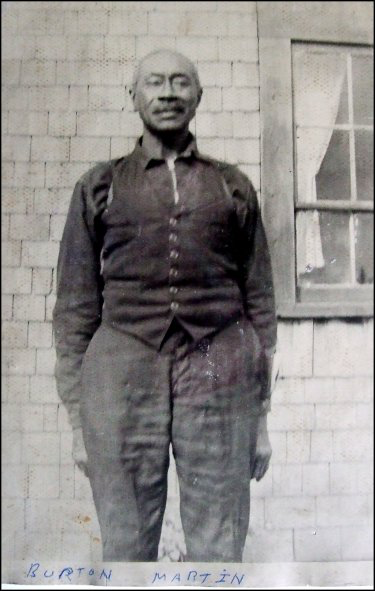
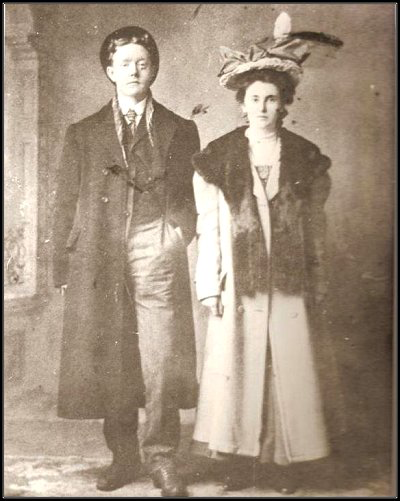
Recently, the Mount Allison Archives received the donation of a handwritten book documenting early and mid-twentieth century black life in Westmorland County, and recording details of the families who lived in the black neighbourhood of Green Hill, at Mount Whatley. The book was a gift of Clyde Gabriel of Amherst, a grandson of its keeper, Burton Martin (1877–1948), whose regional ties in turn can be traced to eighteenth century Westmorland. Mr. Gabriel’s donation presents a rare opportunity to consider what life was like for early black residents in this area.

Burton Martin

Burton Martin. Photo courtesy of Clyde Gabriel

Burton Martin was a direct descendent of Peter Martin (circa 1790–1851). Peter was in all probability connected to the Martins mentioned in Howard Trueman’s The Chignecto Isthmus and Its First Settlers (1902). As Trueman wrote, “Sennacherib Martyn was a captain in Winslow’s expedition to capture Fort Beausejour. He brought with him to Westmoreland Point, as slaves, a negro family, to whom he afterwards gave their freedom, and gave them also his name (now spelled Martin).” According to Peter, he was born in the United States, almost a decade after Sennacherib’s death (circa 1782), only arriving in British North America in 1798. Thus it would seem he was either informally adopted by those the captain held as slaves, or acquired the last name by proximity.

Certainly a Peter Martyn/Martin was the subject of several sales in the region. The Mount Allison Archives holds a copy of an 1804 bill of sale in which James Law agrees to “bargain and sell unto the said Titus Knapp a Negro boy about twelve years old named Peter, to have and hold said Negro boy to himself and his heirs forever.” While Peter’s last name is not mentioned here, another record speaks of Titus Knapp, resident of both Westmorland and Fort Cumberland, who owned at various points Sippio Milligan, Peter Martyn, Lucy Martin, Bacchas Newton and several others whose names are forgotten.

Then, in 1810 Knapp sold Peter Martin to James Isaac Hewson for $42. It is possible that Hewson then sold Martin and later repurchased him: as one resident noted, “When I lived with Dr. Smith I was familiar with the Fort… Cl. Gay lived and had a large establishment there. He had a large farm and he had a bunch of negro slaves. He traded in them. They were cheap. He sold one named Peter Martin to James Hewson for $40.” Regardless of whether the raconteur misremembered, the fact remains that Peter Martin was, from a very early age, subject to upheavals, familial ruptures, and adjustments to the expectations of new masters and mistresses, with little or no agency in the matter.

It is said that Peter Martin remained with James Isaac Hewson “until after emancipation of slaves,” in all probability meaning after August 1, 1834, when the Slavery Abolition Act of 1833 outlawing slavery in the majority of British holdings took effect. At that point Peter would have been just past forty. Peter would have celebrated freedom not only on his own behalf, but on that of his eight children as well, all but one of whom had been born pre-Emancipation. Whether or not his children were born enslaved is unknown: the general convention was that children followed the state of the mother. In this case, their mother was Margaret (circa 1792–September 1880), a New Brunswick-born woman about whom little is known. Circumstantial evidence and oral history suggests she may have been owned by the family of Robert King, schoolteacher at Mount Whatley, but no documents have survived which would verify this. However, whether she and the children were free or not, various episodes in United States history demonstrate that as long as slavery existed free black men, women, and children were vulnerable to kidnapping and enslavement. Thus emancipation came as a relief to black individuals and families of every legal status.

By the mid-nineteenth century Peter and Margaret were entrenched in Westmorland, surrounded by children and grandchildren. The 1851 Census identifies Peter as African and a laborer, living with a white family on the one side, and as the head of the first of several black households on the other. In each instance, the black men are identified as laborers, perhaps for the nearby Trueman families. While Peter’s date of death is unrecorded, it seems likely that he died sometime between 1851 and 1861, as he is absent from the latter census.

If Peter’s life was one of upheavals, that of his son, Archibald (circa 1828–February 1910), appears to have been more stable. Archibald, also an unskilled labourer, was rooted in the Aulac community of Green Hill where he had been baptized, and where he would eventually be buried. There appeared to have been nothing to distinguish Green Hill from Mount Whatley, except the skin colour of its residents. (As an area, it started just past the Mount Whatley Loop Road, and continued west over what is now the Trans-Canada Highway, Route 2.) Black and white families attended the same church, and were buried in the same cemetery, as early as the second decade of the nineteenth-century (though strangely, black couples seemed to marry elsewhere). That said, residence in Green Hill may have been less a matter of choice than of necessity. As one elderly Westmorland resident noted, well into the mid-twentieth century, there was a gentleman’s agreement that one did not rent or sell land in Sackville proper to black men or women. This is not to say that Sackville did not have black residents: as of the 1824 Westmorland Census, there were 26 black adults and children in Sackville Parish, and 39 in Westmorland Parish (compared to Botsford: 1; Hillsborough 11; Moncton: 2; Salisbury: 1; Hopewell and Dorchester: 0). Later censuses, such as the 1861, are less reliable on this matter, as race was not consistently recorded. Nonetheless, the black population in Sackville & Westmorland Parishes appeared to be maintaining its numbers at that date. However, that was soon to change as some Sackvillians moved elsewhere in search of better financial and educational opportunities. Green Hill would soon become the geographical locus of black life in late nineteenth-century Westmorland and Sackville Parishes, its numbers rivaled only by Dorchester.

No doubt as a day laborer Archibald Martin was among those who lived in Green Hill and worked in Sackville on occasion. It did appear he owned his land, but seems unlikely he possessed livestock, as no black residents of Sackville did at the time. He probably did not earn much, but he was confident in his ability to support a wife and family, marrying a Miss Miller (circa 1825-February 1905). Years later William Albert Trueman would recall her: “Palmela Miller married Archibald Martin. With pride she would say “I’m Mrs. Archibald Martin, she that was Palmela Miller.” We called Mrs. Archibald Martin “Millie”. She was a religious woman. When called to lead in prayer at prayer meetings, she would do so very nicely. I have also heard her at family worship in her own home.”

Millie’s pride in her marriage was no doubt tied to the protection and respectability it afforded. Surviving records show a striking number of illegitimate and mulatto children born in local black families, no doubt a by-product of the sexual vulnerability of black women, especially those sent out to work in the homes of better-off families from as young as ten. Such labour practices highlight another unfortunate reality: the majority of black residents of nineteenth-century Westmorland County appear to have received little, if any, schooling. While in the nineteenth-century black children are recorded as students in Dorchester, preliminary research suggests schools for Sackville and Westmorland Parishes were uniformly white. Certainly Archibald Martin was illiterate, and while Millie claimed to have been able to read, she was not able to convince at least one census taker of her ability.

Still, Archibald and Millie’s son, Hanford (circa 1856–1901), somehow managed to achieve basic literacy. When he married Alice Louisa Cook on June 2, 1875, they no doubt agreed that their children would be educated. By 1901 all of Hanford and Alice’s offspring, including Burton Martin (with whom we began), were able to satisfy the census taker of their literacy, a skill of which they could be rightfully proud given that none of them — not even twelveyear old Martha Maud — had attended school in the last year. The family appeared proud of their accomplishments: the obituary of Burton’s brother noted that “he was educated in his birthplace” [Aulac], a coded way of attesting to his literacy.

Burton Martin’s book is not a standard diary or scrapbook. Indeed, it seems to have served a variety of purposes. Martin recorded the births and deaths of family members and neighbours, the dates of family visits, and financial transactions. H. F. Carter paid $20.00 one July 3rd; on June 7th 7lbs of butter was churned. And yet alongside such domestic details are events of world importance: Martin appears to have used his book to compensate for the broader education he did not receive. One example of this is a handwritten list of important and seemingly unrelated events:

Halifax Explosion December 6 1917
Spain ceded Gibraltar to England 1713
Australia used as convict colony 1788 to 1840
first rail road cars in England pulled by horses
Canada’s debt Dec 1942 $1.892.400.00.

The list continues: the spelling is perfect, suggesting Martin copied details from newspapers. It also seems likely some notes — especially about family matters — were recopied from earlier books or documents, as a comment about a 1929 trip to Truro suggests. All in all, the book appears to be not only as form of record keeping but also a document to be consulted, preserved, and passed on. It thus is fitting that after Burton Martin’s death his book was maintained and added to, probably by his daughter, Minnie.

At a basic level, the book reveals day-to-day life in Westmorland, and sheds light on the routine work a labourer might perform, from hauling wood to digging graves — which might account for Martin’s seeming preoccupation with death. But it also provides insight into daily domestic details and the reality of poverty: in February of 1945, at almost sixty-eight years of age, Martin and his common-law wife were working daily. On February 16th, 1945, Martin was able to record he had $25.00 in the bank. A month later he indicated that he had purchased a battery radio. This was an event of some importance in a family where getting new socks was deemed noteworthy. Given how rare it is that personal records of hardscrabble families survive, Martin’s book promises to be incredibly interesting to regional historians studying working class families.

And yet, if the records of regional working class families are scarce in archival repositories, the records of Black New Brunswick families are almost entirely absent. Mount Allison is not unusual in having a dearth of such materials. For this reason, Burton Martin’s book is additionally compelling. It is not simply that it documents a presence and a community that has been forgotten; it also adds to our understanding of a historic black community with its intricate web of family ties, suggesting the support and sustenance such relations enabled. But perhaps most compellingly, it attests to a desire of a marginalized family that was absent from the record books to be remembered, and to rememberthose who came before.

Jennifer Harris would like to thank Clyde Gabriel, CultureWorks (Mount Allison University), the Cumberland African Nova Scotia Society, Genie Coates, and Rhianna Edwards of the Mount Allison University Archives. She welcomes any leads on black history in Westmorland, and can be reached at 506.364.2170 or jharris@mta.ca.

How Times Have Changed! — Reminiscences of a Teacher

By Pauline Atkinson (née Brenton)

I grew up and went to elementary school in Cape Tormentine where my father was a section foreman with the railway. In 1942, I graduated from Port Elgin High School at the age of 17. I had been accepted to enter Normal School in Fredericton to study Education. I was looking forward to this when the Superintendant of Schools came and asked if I would consider teaching on a Local Licence. Male teachers had gone to war so teachers had to be found to take their place. Thirty dollars a month sounded like a lot to a teenager, so I accepted the challenge. I would make $30.00 a month and pay $4.00 a week for board.

Johnson’s Mills was my first school. I did not know where it was, but off I went. I boarded with the Houghtons and their daughter Frances, a tall girl with red hair. There was no running water, no phones, no electricity and no inside bathrooms. Each night Mrs. Houghton would heat bricks in the oven of the Fawcett stove, then wrap them in old socks and use them as bed warmers; no electric blankets in those days! Each morning a jug of hot water was placed outside my door and I learned to make do with a sponge bath. I had a two mile walk to school and we did not have snow-days so at times it took a long while to walk the distance. The teacher had to go, even though the parents did not send their children.

The school had no blackboard, but the boards of one of the inside walls were painted black, and they were used instead. About 15 to 20 pupils attended, and they were spread over Grades 1 through 8 — a real one room school house! In my first year I taught one pupil who was older than myself (she was 18 years old, and I was 17). The school house is no longer there; it was bought by Aubrey Steeves for use as a cottage and moved off the site.

The secretary of the School Board collected taxes from the local families to pay the teacher. I got paid twice that year, at Christmas and in June. My mother sent me stamps so I could write home, and before Christmas she sent me a box of different kinds of candy, nuts and fruit so that I could treat the pupils. At Christmas I got enough to pay my board for the term, and to buy my ticket on the train to go home for the holiday. The mailman had a very small car and he ran me (with my suitcase) to Dorchester, where I got the train to Cape Tormentine.

Pauline with horse Old Silver

Pauline with Old Silver, Johnson’s Mills, 1942 (“The only horse I ever trusted”).

It was during war time so we had ration books. It was the teacher’s job to give out these books; so on a Saturday I had to be at the school house from 8:00 a.m. to 6:00 p.m. to give out the books. The people came from Rockport and Johnson’s Mills. Some of them were uneducated so I had to write their names after their X. It was a long day, but there was no such thing as overtime.

The community had to do fund-raising for the war effort by holding a Box Social. Mrs. Houghton beautifully decorated a couple of boxes, one for herself and one for me. Everyone seemed to want to buy the teacher’s box! It was the duty of the teacher to help the auctioneer, Emery Ward. At one point, instead of taking the box, he took me and lifted me high in the air and said, “What am I offered?” One old guy said, “25 cents”, and I was sold!

I learned how to drive a horse and buggy that year. One time, Mr. Houghton was away so I had to go to Dorchester with Frances for groceries. On the way “Old Silver” was not going fast enough so Frances stood up and whipped her. The horse jumped and threw Frances out of the buggy; her feet and legs got tangled in the traces, and she was dragged along the road. Silver stopped and I managed to get Frances back in the buggy but her head was hurt and she was suffering from concussion. I took the reins and continued the rest of the way to Dorchester to get the groceries, but I was worried about going back. The grocer told me to hold on to the reins and say “Gee” to go right and “Haw” to go left, and hold tight to go straight. We got home, but Mrs. H. needed the cows brought home. Frances was not able to go so I had a choice — to stay home with Frances or go for the cows. Even though I was scared of cows, I preferred to go for them. I don’t need to tell you that I walked so far behind the cows, they were home and in the barn partly milked before I arrived!

The Houghtons had another daughter who lived in Dorchester and on occasion Frances and I would walk from Johnson’s Mills to Dorchester, stay overnight, and walk back the next day. They did have a phone, and one of our favourite forms of entertainment was quietly lifting the phone and listening in on the party lines. No TV or DVDs in those days! On Sundays we walked to church — south from Johnson’s Mills along the shore, then east crossing the width of the peninsula, then finally down south from there to the United Church in Upper Rockport. The return journey was broken at 3:30 p.m. when Mrs. Reid, who lived on the cross road, invited us in for supper. The early hour ensured that we had time to walk back to Johnson’s Mills before dark.

R.B. Mattatall sketch of Lower Rockport School

R.B. Mattatall — Lower Rockport School (from Yesterday Rockport New Brunswick, Sketches by R.B. Mattatall, no date)

In the summer of 1943 I went to Fredericton for 6 weeks to study. I received a Wartime Emergency Licence which enabled me to teach until the war ended. I then went to Rockport for two years (1943–1945). I boarded at what is now the Wilbur Cove House for one year, and then up the road at Harry Ward’s place for the second year, so I didn’t have far to walk. Teachers had to attend funerals and sing in the choir. When the organist, Mrs.Stephen Ward, approached me about this, I protested that I was no singer. My objections were overruled, and Mrs. Ward showed me how to keep my hymnbook up in front of my face so that no one would see that I was not singing. So I took my place up front, along with the other four members of the choiróall from the same family. I also attended my first auction sale in Rockport.

School hours were still 9:00 a.m. to 4:00 p.m., and students had to walk to school. School buses had not been invented. There were no Professional Development days and, if I was sick, time had to be made up on Saturdays. I made $400.00 a year in Rockport. The school house still stands, although the building now has a tree growing up through it!

The next year (1945) the County Finance Board took over paying teachers. I was appointed to West Sackville School where I received a pay cheque each month amounting to $55.00. “West Sackville” was the area better known as Westcock. The school house stood on the corner of Wood Point Road and Old Hospital Loop Road. The building still stands, and is now used as blueberry storage facility. The second year I was there, Wood Point had no teacher so the pupils came to West Sackville (walking). That is where the term “Full House” originated.

West Sackville School in Westcock (now serving as a warehouse facility)

West Sackville School in Westcock (now serving as a warehouse facility)
Photo: Charlie Scobie

In January 1947 the roof of the school house burned. The Sackville Fire Department responded. The pupils and I had gotten the desks and books out. Fortunately only the roof burned. School was closed for a month but I had to go every day to check the school and mark the register. How times have changed! I went back to my lodgings for lunch when I lived close to the school. I don’t remember any great problems leaving children on their own.

Westcock school students (1946–1947). Back row, left to right: Orland Estabrooks, Harry Milner, Murray Milner, Margaret Atkinson, Oena Estabrooks, Ruby Snowden. 2nd row: Douglas Snowden, James Milner, Robert Ward, Ervin Akey, Barbara Ward, Barbara Snowden. Front row: Charles Atkinson, Ronald Goodwin, Benny Goodwin, Betty Atkinson, Ruth Snowden, Irene Goodwin, Joyce Snowden, Ruby Amos.

Westcock school students (1946–1947). Back row, left to right: Orland Estabrooks, Harry Milner, Murray Milner, Margaret Atkinson, Oena Estabrooks, Ruby Snowden. 2nd row: Douglas Snowden, James Milner, Robert Ward, Ervin Akey, Barbara Ward, Barbara Snowden.
Front row: Charles Atkinson, Ronald Goodwin, Benny Goodwin, Betty Atkinson, Ruth Snowden, Irene Goodwin, Joyce Snowden, Ruby Amos.

The war was now over so I decided to do something else. In 1967, the Premier of New Brunswick, Louis J. Robichaud, made it possible for those who held a Wartime Emergency Licence to make it permanent. You could do it through correspondence or the Quick way. I chose the latter and from October until January, I studied hard. The subjects were: Language, Literature, School Law, Methods and Mathematics. I wrote the exams in January 1968 and, in April 1968, I received my Teacher’s Licence. I finally achieved my goal — I had a First Class Licence and could teach permanently if I wished.

Upon receiving my licence I had 5 years pension held back from me and my experience was cut in half. The men who served their country were rewarded with double service whereas those of us who took their place in the classroom had their service cut in half. However, I had my licence and in September 1968 returned to teaching until 1984. When I retired I requested and had my five year pension which was held back reinstated.

I always wanted to be a teacher. I feel those five years without a permanent licence helped to make me a good teacher. My licence was a goal I strived for. It didn’t make me a better teacher — just gave me a certificate I am proud of, and a better pay cheque.

Can you help?

In the course of research for Pauline Atkinson’s article, Jeff Ward provided this photo, taken around 1905, upon which is noted “Slacks Cove Lower Rockport NB” — although Jeff isn’t aware of a school there at that time. Can you tell us more? Do you know any of the children in this photo? Call us at 536-2541 if you do!

school children, Slack’s Cove, Lower Rockport, NB, ca. 1905

Back row, left to right: unknown, unknown, Electra Maxwell, unknown, Twila Tower, unknown, Alleda Lockhart, unknown, unknown, unknown teacher, Ada Maxwell, unknown (teacher’s assistant?). Front row, left to right: unknown, unknown, Fred Ward, Preston Tower, Art Lockhart, Russell Maxwell, unknown, unknown.


15th Annual Heritage Day, Schedule of events, 2011-02-12

The White Fence, issue #48

November 2010

Editorial

Dear friends,

There are, and have been, so many special people amongst us, lest we forget. The Canadian Navy has fought in world wars on our behalf and continues to serve us along our shores to this day. The democratic lives we experience today we owe to some of these special people from across our great country. Three special Sackville men were on duty at times of war and are recognized in this issue. Yesterday, November 11th at eleven o’clock, I attended Memorial Day ceremonies at the cenotaph at Memorial Park, Sackville. Hundreds of citizens attended; I was moved by the numbers present and the words spoken by legionnaires that morning. And at three o’clock that afternoon, I attended the opening of a special exhibit at the Boultenhouse Heritage Centre commemorating the contributions of Charles Fawcett, Joe Atkinson and Jim Purdy who had served in the Navy at times of war, along with the corvette HMCS Sackville. The Heritage Centre was packed, just like Memorial Park had been a few hours earlier. No one had forgotten. I was most impressed all day by these special activities about important memorials to the tools of war (a corvette in this case) and the men who fought on our behalf. In this issue, read about these Sackville men who placed themselves in mortal danger for us and country. There are, and have been, so many special people amongst us, lest we forget.

—Peter Hicklin

Canada’s Navy celebrated its 100th year in 2010. Last summer the Tantramar Heritage Trust assembled a special exhibit on corvette HMCS Sackville at the Boultenhouse Heritage Centre as our contribution to the naval centennial. On Remembrance Day 2010 the Trust added information to the display to highlight the lives of three Sackville citizens who served on convoy escort warships during WWII. The content of this issue of The White Fence newsletter is entirely dedicated to the Navy and to those lads from Tantramar who served with our naval forces. More than 250 Sackville area citizens enlisted in the forces during WWII, but only 12 of have been identified as serving in the Navy.

There would be a story associated with each of those twelve individuals and unfortunately I have only had time to research and present to you the war service of three of them. They are the stories of an officer, Lt. Charles Fawcett, and two seamen, James Purdy and Joseph Atkinson, all now deceased.

The Royal Canadian Navy played a pivotal role in the Battle of the Atlantic. The corvette HMCS Sackville is an enduring national memorial to the men who bravely fought the enemy and the elements escorting convoys of vital supplies to Great Britain. This issue of our newsletter is dedicated to them.

—Al Smith, November 11, 2010

The Remarkable Life of Lt. Charles Cavour Fawcett, 1910–1942

By Al Smith

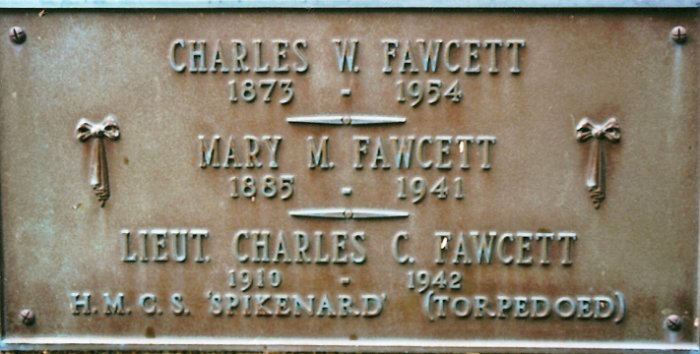
A bronze plaque on the base of a large grey granite Fawcett family tombstone in the Sackville Rural Cemetery records simply:

Lt. Charles C. Fawcett 1910–1942 HMCS Spikenard (Torpedoed)

A tiny memorial perhaps to one of the Fawcett family’s most beloved sons and a loss of life that saddened the entire town.

photograph of a plaque, reading CHARLES W. FAWCETT 1873–1954, MARY M. FAWCETT, 1885–1941, LIEUT. CHARLES C. FAWCETT, 1910–1942, H.M.C.S. ‘SPIKENARD’ (TORPEDOED)

Plaque on the Fawcett family tombstone at Sackville Rural Cemetery [stating: CHARLES W. FAWCETT 1873–1954, MARY M. FAWCETT, 1885–1941, LIEUT. CHARLES C. FAWCETT, 1910–1942, H.M.C.S. ‘SPIKENARD’ (TORPEDOED)]

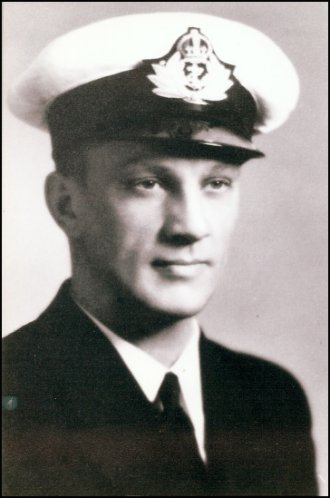
Charles Fawcett was born in Sackville, NB, on January 29, 1910, the son of Charles W. and Mary (Chapman) Fawcett and a grandson of the founder of the Fawcett Foundry. His early education was in Sackville public schools, but he later attended Rothesay Collegiate private school and Mount Allison University. He acquired an interest in boats at an early age having spent summers at the family cottage in Cape Tormentine. He designed and built his first yacht when he was 22. By the early 1930s he was becoming a promising naval architect. He is credited with much of the organization and success of the Shediac Bay Yacht Club, which in 1934 had grown to a squadron of 18 boats, including 5 racing boats, four of which had been designed and built by Fawcett. He also designed the flagship for the Yacht Club’s Commodore Weldon. It was a 30-foot auxiliary yacht built in Shelburne, NS, by the Etherington Company and sailed to Shediac in June, 1934, by Charles Fawcett and two friends from Sackville. In 1937 he designed a large racing yacht for Dr. Allanach of Moncton. Fawcett-designed boats were fast, possibly due in part to a collaboration that the young architect had with William Roué — the designer of the famous Bluenose.

Charles Fawcett and Bunny Black standing on one of the Fawcett built yachts at the Shediac Bay Yacht Club August 30, 1936

Charles Fawcett and Bunny Black standing on one of the Fawcett-built yachts at the Shediac Bay Yacht Club August 30, 1936

Lt. Charles C. Fawcett

Lt. Charles C. Fawcett

Charles Fawcett also had a fascination with aircraft and was flying biplanes when he was just 18. Charles had a reputation within the family of being a bit of a hellion and it was likely no surprise that he quickly got into stunt flying. Charles would often borrow a plane from Moncton Airways and fly over Sackville to thrill his friends with aerial stunts.

On November 9, 1931, Fawcett had rented a gipsy moth biplane to do some advertising for Mount Allison prior to a football game between Mt. A and UNB. After buzzing the stands and doing aerial loops and swirls over the football field he dropped a football with the college colours attached. At that point an engine cowling came loose and began flapping threatening to damage the wing. Fawcett had to make an emergency landing in the marsh below the present day Tim Hortons. With the cowling secured and his load lightened he attempted to once again get airborne but had difficulty getting altitude and quickly realized he could not clear the road and wires ahead (Main Street, by the current highway overpass) he crash landed in the marsh, severely damaging the plane, but he escaped unharmed.

During the summers of 1932-33 he was enrolled in an officers training course at Camp Borden in Ontario were he secured a formal pilot’s license. Back in Sackville in the summer of 1934 he narrowly escaped death in another plane crash. On July 30, while doing aerial stunts over the old Moncton Airport at Leger’s Corner, he failed to come out of a tailspin and crashed nose first into the marsh mud just below the airfield. Fawcett was thrown from aircraft and spent several days in hospital but miraculously escaped serious injury. Earlier that summer Charles had expressed interest in seeking a commission in the either the Royal Canadian Navy or Royal Air Force and undoubtedly this incident was a severe setback.

In 1935 he moved to Montreal after accepting a position with Canadian Vickers Co. in their airplane manufacturing department. With the onset of WWII Charles joined the Royal Canadian Navy Volunteer Reserve (RCNVR) in Montreal and was stationed there when he married Ella Grant in July 1940. Having been an ex-officer of the RCAF at Camp Borden he entered the Navy as a First Lieutenant, initially serving as an instructor then transferring to Saint John, NB, in the spring of 1941 in the examining and signaling service. Later in 1941 he was stationed in Halifax and in January, 1942, transferred to St. John’s, NL, to join the crew of corvette HMCS Spikenard.

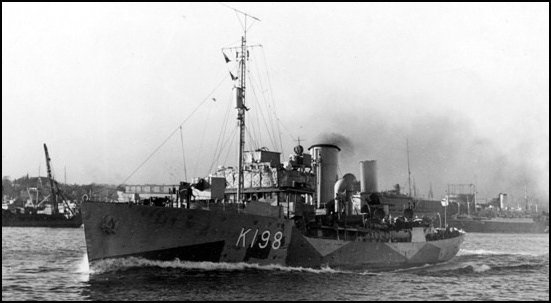
HMCS Spikenard (K-198) was a flower class corvette built at Davie Shipbuilding Co. in Lauzon, QC, and commissioned on December 8, 1940. She was one of ten Canadian-built corvettes originally destined for the Royal Navy, but retained and manned by the RCN. British corvettes were named after flowers, whereas Canadian corvettes were named after towns. Those ten corvettes retained their flower names — the only ones in a total eventual fleet of 123 ships. Such was the rush to get these early ships to war that they were commissioned incomplete and sailed on their first escort duty to the UK lacking the main 4-inch gun armament. Crews affixed a dummy wooden “gun” until a proper gun could be installed at a British yard. Spikenard was launched in December and had to break ice all the way down the St. Lawrence River to get to Halifax. In January 1941 she made a North Atlantic crossing escorting convoy HX-104 and went on to South Shields to complete fit-up.

HMCS Spikenard

HMCS Spikenard

With fitting out and the crew workups completed Spikenard entered active service in May, 1941. She was assigned to the UK-Iceland run escorting North American bound convoys as far as Iceland and incoming convoys back to the UK. She spent much of the latter half of 1941 on that run until early January 1942 when she escorted convoy ON 52 from Iceland back to St. John’s. She was then assigned to the new, more southerly and direct, convoy routing the “Newfie-Derry” run. Lt. Charles Fawcett joined the ship when she arrived in St. John’s from Iceland in early January, 1942. It seems likely that the fun loving and adventure seeking Charles Fawcett fit in well with the crew of HMCS Spikenard. The ship had the reputation of being a happy vessel under the command of Lt. Cmdr. Bert Shadforth, who was very highly regarded by the crew. In late January, 1942, Spikenard did anti-submarine patrols off southeast Newfoundland before putting in to St. John’s for provisions for escort duty on eastbound convoy SC 67. The ship cleared St. John’s harbour on February 1, 1942, to join the convoy headed to Londonderry.

U-136 under command of Kapitanleutnant Heinrich Zimmermann departed the northern German port of Kiel on January 22, 1942, and headed north along the Norwegian coast and into the North Sea heading for the north Atlantic convoy routes south of Iceland. His new U-Boat had been commissioned just five months earlier and Zimmermann was sailing on its first active patrol. On February 5, 300 miles west of Ireland, Zimmermann attacked convoy SC 63 with a spread of three torpedoes, one of which hit and sunk the British escort corvette HMS Arbutus. Following that action he continued his patrol northward. Convoy SC 67 departed Halifax on January 30, 1942, and added additional ships from Sydney, NS, on February 2, meeting its mid-ocean escort fleet of 6 RCN corvettes just off the Grand Banks. The small convoy consisted of 22 merchant vessels aligned in a rectangle of seven columns. HMCS Spikenard was the command ship for the convoy since Lt.Cmdr. Shadworth was the senior officer. Other corvettes screening the convoy were; Chilliwack, Shediac, Louisburg, Dauphin and Lethbridge.

The convoy was 500 miles south of Iceland the evening of February 10, 1942. Fairly heavy seas were running that very dark night as Spikenard was zigzagging ahead of the convoy’s right hand column, her radar inoperable. Just before midnight the convoy was attacked by at least two U-Boats. Zimmermann’s U-136 fired a bow salvo of four torpedoes at the convoy hitting HMCS Spikenard and the Norwegian freighter Heina at almost the same moment. Spikenard was hit between the bridge and the forecastle destroying everything above it including the bridge. It seems likely that ship’s five officers, including Lt. Fawcett, were killed in that initial explosion. The explosion caused such extensive damage that the ship sank within five minutes and was not able to send an emergency signal. A second explosion as she sank caused additional casualties.

Of the 65 officers and men who sailed on Spikenard that fateful crossing only 8 enlisted men survived. The survivors endured a grueling 19 hours crammed into a rescue raft until picked up by the Royal Navy corvette HMS Gentian.

News of the sinking reached Sackville on February 19. The Sackville Tribune reported on February 23: “News of the death of Lt. Charles Fawcett, son of C.W. Fawcett of Sackville, through enemy action in the sinking of the HMCS Spikenard in the North Atlantic, cast a feeling of gloom over this community”.

The ship and men are gone forever, but Spikenard lives on in several communities. In Halifax’s Maritime Command Museum a small model of the ship is displayed. In St. John’s, NL, the Crow’s Nest Officer’s Club proudly displays “Spikenard His Spike”. The club first opened in January, 1942, in a fourth floor warehouse. The night before embarking on escort duties on his first “Newfie-Derry” run Spikenard ‘s captain, Bert Shadforth, challenged officers of four other corvettes to a contest to see who, with the least number of blows, could drive a six-inch spike into the floor which was hard three-inch-thick pine. Shadworth won the contest and shortly afterward he and his ship were lost at sea. The club’s owners had a brass ring with the inscription “Spikenard His Spike” fastened around the spike as a memorial. It still exists to this day.

The Province of British Columbia has named two features after Spikenard victims to honour their native sons killed in action: Shadforth Creek (1990) and Milthorp Point (1956). Possibly the Town of Sackville should consider renaming Fawcett Avenue to Lt. Charles Fawcett Avenue to honour the life of this remarkable man and to further the Town’s association with the corvette that bears its name.
Sources cited:

  • The Fawcetts of Sackville, Vol. III by Kathryn Fawcett Lewis, 2000
  • Corvettes Canada by Mac Johnson; 2008, John Wiley & Sons, ISBN 979-0-470-15429-8
  • Website: Ready Ayeready.com — The Canadian Navy
  • Website: uboat.net
  • Website: ubootwaffe.net U-boat operations
  • Website: Convoy SC 67 — warsailors.com
  • The White Fence – Newsletter of the Tantramar Heritage Trust, Issue #2, May 1997
  • Remembering Spikenard: A Corvette Wake by Lt. Pat Jessup, Action Stations Mar./Apr. 2007

“I was a T.O. on the Wet-Ass-Queen” — Seaman Jim Purdy’s Wartime Service

By Al Smith

Interviewed two days before his 85th birthday, Sackville’s Dr. James Purdy recalled his wartime naval experiences to the Trust’s Al Smith.

At the tender age of 17 Purdy joined the Royal Canadian Navy Volunteer Reserve (RCNVR). Living in Truro at the time and attending the Nova Scotia Agricultural College Jim traveled down to Halifax in March, 1943, to join the Navy’s war effort. Why the Navy? “Because I’ve always liked the ocean… Seventeen was too young for full service, but you were allowed to sign up as a boy seaman and when you were 18 you became a sailor.” Jim turned 18 on August 10, 1943. Basic training was completed in Toronto then back east to the training base HMCS Cornwallis in the valley for advanced new entry training. Since Jim was a college student his superiors encouraged him to join the officer’s corps, however, he wanted to complete his training as seaman. He chose communications as his specialty training and was sent to St. Hyacinthe, QC, for training as a wireless (Telegraph Operator or “T.O.”).

With wireless training completed he shipped off to Halifax in May, 1944, and was immediately assigned to the corvette HMCS Wetaskiwin (K-175), a sister ship to HMCS Sackville. “Yep I was a T.O. on the Wet-Ass-Queen,” quipped Jim. HMCS Wetaskiwin, affectionately know by the sailors as Wet-Ass-Queen, was named after an Alberta town south of Edmonton. She was a Flower Class Corvette, built by Burrard Dry Dock Co. in Vancouver, BC, in 1940 and commissioned on December 17, 1940. She was the first corvette built on the west coast.

Seaman Purdy

Seaman Purdy, upon leaving St. Hyacinthe, Quebec, after specialty training to become a Telegraph Operator.

Painting of HMCS Wetaskiwin

HMCS Wetaskiwin

Crammed into the tiny wireless shack behind the bridge, Able Seaman Purdy got his first taste of sea sickness when K-175 encountered the Atlantic swells off Halifax Harbour as the Corvette headed to St. John’s, NL, to join the escort fleet. HMCS Wetaskiwin was assigned to the “Newfie-Derry” run where escorts picked up their convoy off the Grand Banks and escorted them across the North Atlantic to Londonderry. The late spring 1944 run to “Derry” was filled with times of horrible weather and numerous encounters with U-boats which at night “would routinely fire on the convoy at a distance to try to lure the escorts away from the convoyî. But the convoy made it “across the pond” and HMCS Wetaskiwin steamed up Loch Foyle into Londonderry just before the D-day landings in early June. The ship’s crew got shore leave in “Derry” where Jim met up with two of his buddies from wireless training in Quebec.

From Londonderry the ship sailed to Greenock, Scotland, to await orders, and shortly after, the Corvette joined an escort group to shepherd a large convoy of merchantmen in ballast back to “Newfiejohn” (St. John’s). The convoy included two hospital ships loaded with wounded from the D-day landings and the escorts were kept busy fending off U-boat advances that tried to penetrate the escort screen on many occasions to target the hospital ships. The convoy was especially vulnerable in mid-ocean where there was a “dead area” in communications and no air cover. However, Jim says that “he never missed a message for his ship”. One day reports were received of a sub on the surface some distance from the convoy and the Convoy Commander sent up two Swordfish aircraft to check it out. The sub did not respond to code signals so the aircraft was ordered to fire across its bows and the sub returned fire on the aircraft, so the commander ordered depth charges to be dropped. The sub was sunk and Wetaskiwin was sent to retrieve survivors. Only one sailor was retrieved from the water who reported that they had just sunk a Free French Submarine, not German. Navy brass ordered silence on the sinking.

Back in Halifax the crew was given leave and when he returned for duty he discovered that his ship had departed. Purdy was then assigned to HMCS Border Cities, an Algerine Class Minesweeper built by Port Arthur Shipbuilding and launched in May, 1943. Canadian-operated Algerines were mainly used as convoy escort vessels and never fitted with mine sweeping gear. The Mine-sweeper was larger than the Corvettes and most often were used as the command ship for the convoy’s escort fleet. The ship was assigned to the “Triangle Run” collecting convoy ships in New York or Boston, then in to Halifax to form up the full convoy in Bedford Basin. The convoy would then depart Halifax and rendezvous with the mid-ocean escort group 300 miles off Newfoundland. Triangle Run escorts would then proceed to St. John’s for refueling and provisioning and wait for a westbound convoy to be escorted to New York or Boston and then bring the a convoy up to Halifax.

Jim spent the remainder of his sea time on HMCS Border Cities escorting convoys on the Triangle Run and encountered numerous U-boat contacts. As the war was winding down he was given shore service and assigned to a communications base at HMCS Shelburne, spending two months there before being discharged from service in October, 1945.

left to right: Don Mackey, Cdr. Wendall Brown, Ray Soucie from the Canadian Naval Memorial Trust (HMCS Sackville) in Halifax with Al Smith at the November 11, 2010, reception at the HMCS Sackville exhibit

left to right: Don Mackey, Cdr. Wendall Brown, Ray Soucie from the Canadian Naval Memorial Trust (HMCS Sackville) in Halifax with Al Smith at the November 11, 2010, reception at the HMCS Sackville exhibit at Boultenhouse Heritage Centre

Jim's wife Susan (sitting) with their son Tim Purdy, daughter Charlotte Purdy Weir and grandson Benjamin Weir

Jim’s wife Susan (sitting) with their son Tim Purdy, daughter Charlotte Purdy Weir and grandson Benjamin Weir at the November 11, 2010, reception at Boultenhouse Heritage Centre

Note: Jim passed away September 21, 2010, following a lengthy battle with kidney disease.

Sources cited:

  • Interview with Dr. Jim Purdy August 9, 2010
  • Corvettes Canada, by Mac Johnson; 2008, John Wiley & Sons, ISBN 979-0-470-15429-8
  • Website: Ready Ayeready.com — The Canadian Navy

“A Stint in the Navy” — Signalman Joseph Austin Atkinson

By Al Smith

Graduating from Sackville High School in the spring of 1943, Joe Atkinson decided he wanted to join the war effort and sign up with the Royal Canadian Navy Volunteer Reserve (RCNVR). Enlisting on November 22, 1943, at HMCS Brunswicker in Saint John, he trained as a reservist until January 17, 1944, when he was assigned on active service with the rank of Ordinary Seaman.

Seaman Joe Atkinson

Seaman Joe Atkinson

Joe in full uniform

Joe in full uniform

Formal training began on January 21, 1944, at HMCS Montcalm in Quebec City for six weeks of basic training, then back east to HMCS Cornwallis. After two months of advanced new-entry training he was sent back to Quebec — to St. Hyacinthe for specialty training as a signalman. Training at St. Hyacinthe was intensive as signalmen had to learn Morse code, semaphore, flag-hoist signaling, use of Aldis signaling lamps, and were responsible for encoding, transmitting, receiving, decoding and distributing messages through visual communications with other ships. After five months training Signalman Atkinson shipped east to Halifax and on October 21, 1944, was assigned to a brand new river class Frigate HMCS Prestonian (K 662).

photograph of the HMCS Prestonian

HMCS Prestonian

HMCS Prestonian was built by Davie Shipbuilding in Lauzon, QC, and launched on June 22, 1944. She was commissioned on September 13, 1944, just a month before Signalman Joseph Atkinson joined her crew. Joe sailed with Prestonian until August 17, 1945, and was discharged from naval service on September 26, 1945.

Canada built and manned 123 Corvettes during the war. Those 205-foot ships, originally designed for coastal patrol, were quickly pressed into service as convoy escort vessels. Lacking speed and space to carry sufficient anti-submarine weaponry it was not a particularly effective U-boat hunter so naval planners quickly looked for an improved design and the frigate was born. At 301 feet in length the frigates were a much more stable platform from which to launch weapons and had a much longer range before refueling. Their twin engines gave them 4 knots more speed than the corvettes while carrying twice the depth charge load and newer anti-submarine weaponry. They were also a much more livable warship for the crew than the notoriously wet and rolling corvettes. Canada built 60 frigates that saw war service from 1943 to 1945.

HMCS Prestonian was Halifax based and among other duties saw service on the “Triangle Run” escorting ships from New York or Boston to Halifax then on to the North Atlantic handing them off to the mid ocean escort group. Joe Atkinson recalled being into Bermuda on one occasion but never made it “across the pond”.

Joe’s wife Pauline recalled him telling her of off-duty times lying in his hammock in the forward seaman’s mess watching his messmates playing bridge for hours on end. He could not understand how they could waste so much time on such a game. Later in life Joe became a very avid bridge player. Joe Atkinson became a skilled navy signalman — a communicator at the tender age of 18 years. Communications was an endearing life long attribute of this gentle and highly respected man. His weekly words of wisdom at meetings of the Sackville Rotary Club were a feature for many, many years. Sadly Joe passed away suddenly on May 1, 2010.

Sources cited:

  • Military Service Records of Joe Atkinson — provided by son Logan Atkinson
  • Obituary of Joseph A. Atkinson 1925–2010, Jones Funeral Home Website: Ready Ayeready.com — The Canadian Navy
  • HMCS Swansea — The Life and Times of a Frigate by Fraser M. McKee
Mary McOuat and Anne Fawcett

Mary McOuat and Anne Fawcett reading the display panel on Charles Fawcett

Joe's wife, Pauline Atkinson

Joe’s wife, Pauline, at the November 11, 2010 reception

Visitors to the November 11, 2010 reception at Boultenhouse Heritage Centre.

Visitors to the November 11, 2010 reception at Boultenhouse Heritage Centre. Over 60 people attended the event

The White Fence, issue #47

October 2010

Editorial

Dear friends,

In keeping with my health, much of the contents of the accompanying articles in this newsletter are connected with my (almost) daily walks between our house on Main Street, Sackville, and the Middle Sackville Baptist Church on Church Street, near the Campbell Carriage Factory Museum, in Middle Sackville. This walk has helped make me familiar with this stretch of Sackville known as Middle Sackville. And this familiarity has allowed me to appreciate the former activities of this part of town in the late 19th and early 20th centuries. For example, in 1905, the Campbell Carriage Factory, next door to the church, would have been a very active business at that time. And folks not only required horses and carriages for transportation in those years, but they also needed many basics: clothing, food and furniture, just to name a few necessities. This newsletter seeks to inform you of some of the centres of those activities at that time in Sackville, which were probably not dissimilar to the daily activities of many Maritime towns near the turn of the 20th century. I am most grateful to Nev and Janice Garrity for providing me with the 1978 booklet on the history of the Middle Sackville United Baptist Church and for the church to allow me to reprint it here (just the historical sketch and not the many church by-laws as listed in the original document); it is a very fine historical “sketch”, presented here with no editing whatsoever on my part.

You may view this newsletter as a small slice of Sackville history between 1894 and 1905, with citizens shopping at J.R. Ayer’s, J.L. Black’s and Burwash Robinson’s and (presumably) attending the local Middle Sackville church. This church was my main source of inspiration. It is a large beautiful wooden structure with the date 1905 inscribed below the main window, by the original entrance. For a congregation to construct such a large church at that time clearly reflects the presence a much larger neighbourhood than we find there today. See the Sunday School contingent of the church membership in 1947, provided to us by Al Smith (who is in this photo by the way) and perhaps you can help provide us with a few names of the folks on this photo. And read about Burwash Robinson who was clearly a very active member of the business community in this part of town for many years in the early 1900s. I consider this slice of Sackville life, and particularly Burwash Robinson’s role, as Part I of this story. I owe a great debt of gratitude to Mona Estabrooks who really made this article possible (and accurate, especially following a few mis-directed drafts on my part!). Responses on this article from you, the readership, will help define what Part II will look like.

Please note under Correspondence the letter we received from Susan (Ayer) Barylo who demonstrates connections between the Ayer and Harper families in response to White Fence No. 45. Susan provided me with a sketch of her family tree showing the connections between the Ayer and Harper families. However, we noted some problems with the family tree which are marked with a “?” where we lacked some clarity. I submitted the draft shown here to Susan but still await her response for corrections. These will hopefully be made available to you in the next White Fence.

I also wish to take this opportunity to introduce you to a new member of the Tantramar Heritage Trust. Note under Correspondence the letter we received (via THT President Geoff Martin) from this new member, the Prime Minister of Canada, Stephen Harper, who commented on our April newsletter (no. 45) when we reported on the Harper family’s Tantramar roots. Since Prime Minister Harper and his family will from now on be receiving a copy of this newsletter, it is my pleasure, on behalf of the membership, to welcome him and his family to the Tantramar region via the pages of the White Fence and the activities of the Tantramar Heritage Trust. Please note, Prime Minister, that we thank you for taking the time to write to us, and, furthermore, if you know of any connections that the Harper family may have had with Burwash Robinson’s store and moccasin factory (see below), we would love to hear about it!

In the meantime, have a look at the photos below your letter showing the original land grant made to Christopher Harper in 1809, discovered by my friend and colleague, Colin MacKinnon, for me to include here. These help solidify the historic connection between the Harper family’s history and the Tantramar region.

Welcome aboard our great ship Prime Minister and family and, equally to all THT members, as always, enjoy!

—Peter Hicklin

An Historical Sketch of the Middle Sackville United Baptist Church 1905

Compiled by Margaret Beal and David H. Snell (printed in 1978)

In order to understand the history of our church one must go back in time and location to the early settlement of the state of Massachusetts by the Puritans. A man by the name of Roger Williams arrived in Boston, Massachusetts Bay Colony early in 1631. There he was shocked to discover that the Puritans had come to obtain religious liberty only for themselves. Non-Puritans suffered for their opinions in Massachusetts. Although Roger Williams was a Puritan minister, he believed no government had the right to interfere with the religious convictions of anyone else. Mr. Williams was banned, because of his beliefs, from the colony of Massachusetts to what is now Providence, R.I. In 1639, he became a Baptist and founded the First Baptist Church of Providence, which claims the title “First Baptist Church in the United States”.

One principle of this church was, “Everyone should have liberty to worship God according to the light of their conscience”. Mr. Williams’ teaching soon spread throughout Rhode Island and parts of Massachusetts and Connecticut.

The first Baptist Church to be formed in Massachusetts was at Swansea in 1663. People coming from Providence and other places settled east of this old church and in 1693 formed the Second Swansea Baptist Church. From this church have come several ministers who have removed to other parts; among them are Nathan Mason who went to Nova Scotia. You can trace this in “History of the Baptists” by Benedict.

April 21st, 1763 Mr. and Mrs. Nathan Mason, Mr. and Mrs. Thomas Lewis, Mr. and Mrs. Oliver Mason and Experience Baker from the 2nd Church of Swansea, Massachusetts and Mr. and Mrs. Benjamin Mason, and Mr. and Mrs. Charles Seamans, and Mr. and Mrs. Gilbert Seamans from nearby churches resolved to move to Nova Scotia (which then included what is now New Brunswick).

These thirteen persons were formed into a church and Mr. Nathan Mason was ordained their pastor. They sailed in a group to Tantramar, Nova Scotia, which was the name then given to the area around what is now Sackville. We find these names listed among the very early settlers in what is now Middle Sackville.

These settlers did not find conditions here altogether to their liking and in 1771 most of them returned to their old homes. During their stay, however, they built up the church to some 60 members. Deacon Charles Seamans one of the original members of the church, was buried here in 1771. His son Job Seamans, was given a license to preach by this church. He went to the States in 1772 and it is alleged that a Mr. Joseph Read was called to the ministry in this church.

We do not have record of what happened to Mr. Read, but in 1781 Henry Alline visited this area. He wrote in his journal, under the date July 31st, 1781: “This day, after visiting some people, I preached in the evening and God was there with such power that some who had known the truth before were almost overcome with joy.” It would seem that the persons here spoken of as “having known the truth before” were the remaining members of the original Baptist Church, who, though pastorless were still interested in spiritual affairs.

The period between Mr. Alline’s visit to Sackville and the close of the century is also one of obscurity. It would seem that the people had no permanent pastor but the religious services continued to be held with some regularity.

In Sackville Baptist Church, an Historical Sketch written by Rev. W.H. Warren, a former pastor of the Church we read: “At the age of 27, Joseph Crandall came as a licentiate to Sackville, in the year 1798. The people received him very cordially — It was decided to call a council to consider the propriety of setting him apart to the work of the gospel ministry’î “The council consisted of Elder Edward Manning and myself, then seventeen years old, chosen and sent from the church; Elder Theodore S. Harding, from Horton; Elder Joseph Dimock, and Deacon John Bradshaw from Chester. We met at Sackville, N.B., on October 4th, 1799 and continued there seven days, during which time the gospel was preached daily, both publically and from house to house, and a revival of the religion was the result, and a time of much rejoicing by the Lord’s people.”

A church was constituted consisting of about twenty members. On Monday, Oct. 8, Bro. Joseph Crandall was ordained pastor over them. Elder T.S. Harding preached the ordination sermon …”. “A host of people were in attendance, and thirteen were added to the church before we left the place”.

It would seem that the twenty persons formed into a church and the thirteen added to their group must have been members of the original church founded by Nathan Mason. This view is confirmed by Mr. Chipman’s remarks, “saints rejoicing and backsliders returning”. These saints and backsliders were plainly the scattered and wandering members of the old church. Also, Elder Dimock describes the same event in similar words.

It seems evident that the members of the original church were gathered together and revived, and that they chose Joseph Crandall as their pastor, called for his ordination, and united earnestly in supporting him. It was the same church, having the old members and the same doctrines and practices as it had from its beginnings in 1763.

In 1839 a parsonage was built a short distance above the present parsonage. The question as to how the deed should be drawn led to trouble. This led to a split in the church.

So, on March 9th, 1839, the second church was organized and the next day they began to build Bethel Chapel. It was open for worship in 1842. In 1844 First Church built Beulah at Four Corners.

In 1848 Salem Chapel was built by the members of the Second Church. This was not considered a separate church but a mission of Second Church. Salem Chapel was opened for worship on July 27th, 1849. In 1850 the Point de Bute and in 1859 the Midgic Churches were organized by members who took their letters of dismission from the first church for that purpose.

Rev. D.G. MacDonald, from P.E.I., comes on the scene with the avowed purpose of uniting the two churches. In 1883 First and Second Churches united and used first Beulah and later Bethel for their meeting place. Both churches voted away the names “First” and “Second” and became fused into one body.

The mission work known as the Salem branch of the church had been growing so rapidly that in 1890, the Main Street building was erected. The work in this field became too heavy for one man and on September 22nd, 1902 the church decided to divide and the present day Main Street Church and the Middle Sackville Churches were organized.

October 6, 1902 an organizational meeting was held in the Middle Sackville meeting house (Bethel), and a “resolution as follows was carried: That the members formerly belonging to the Sackville Baptist Church residing above or to the north of the territorial line mentioned in the above report (Ogden Mill Road) do constitute said members into a church to be known as the Sackville Baptist Church, and further resolved that we at once proceed to the election of the necessary officers to complete the organization of the church”.

Officers were elected at this organizational meeting including seven trustees who later applied to the N.B. legislature for incorporation, and on May 9, 1903 an act to incorporate the trustees of the Middle Sackville Baptist Church was passed.

Mr. R. Earnest Estabrooks is to be commended for the work he did in writing the history of our church. His book is most interesting and a copy is on file at the Acadia Library.

This historical sketch will be concluded by listing all of the pastors of our church from the time of our 1902 organization.

  • Rev. A.T. Robinson 1902–1904
  • Rev. E.L. Steeves 1904–1909
  • Rev. A.E. Estall 1909–1911
  • Rev. David Price 1911–1916
  • Rev. J.W. Brown 1916–1918
  • Rev. E.R. MacWilliam 1918–1921
  • Rev. David Price 1921–1925
  • Rev. N.A. Whitman 1925–1929
  • Rev. O.E. Steeves 1929–1935
  • Rev. Wm. Alton White 1935–1940
  • Rev. W.G. Killam 1940–1948
  • Rev. H.F. Fenwick 1948–1953
  • Dr. Boothroyd 1953–1954
  • Lic. Edgar Patriquin 1954–1957
  • Rev. S.C. Crossman 1957–1961
  • Lic. Allan Barnett 1961–1962
  • Rev. H. F. Fenwick 1961–1971
  • Rev. Gordon Driscoll 1971–1975
  • Rev. David H. Snell 1975—

April 10, 1952 a form of constitution was adopted in a booklet entitled, An Historical Sketch, Constitution and By-laws of the Middle Sackville United Baptist Church. The committee that worked on this first constitution was Rev. H.F. Fenwick, Margaret Beal, Wilfred W. Wheaton, Wm. L. Wheaton, Donald Harper, and James F. Anderson.

After some 20 years it was felt that a revised constitution was in order and the following committee was appointed to work on it: Rev. David H. Snell, Barbara Wheaton, Gerald Wheaton, Lorne Brooks, Fred Estabrooks, Winifred Brooks, Carol Wood, Albert Trenholm, Richard Brooks, and Fred Fillmore. The constitution and by-laws which follow (not included here —ed.) are the result of the work of this committee.

Al Smith discovered the names of 42 of the 65 (?) church members shown in this 1947 photo above. If you know of the members shown here, send in your guesses to the Heritage Trust and once all are identified, the photo with all the names will be shown in a later newsletter. Identify members by row (first row on bottom) and number, from left to right

Al Smith discovered the names of 42 of the 65 (?) church members shown in this 1947 photo above. If you know of the members shown here, send in your guesses to the Heritage Trust and once all are identified, the photo with all the names will be shown in a later newsletter. Identify members by row (first row on bottom) and number, from left to right.

Burwash Robinson Store and Post Office — Middle Sackville

by Peter Hicklin

When I was first hired by the Canadian Wildlife Service (Environment Canada) in Sackville back in 1978, I rented a small house on Harper Lane in Middle Sackville. And across the road from Harper Lane was an abandoned building (see photo taken by Al Smith in 2000 before the building was demolished in 2004). I always had an interest in learning something about this interesting building and, now that I am retired, I have the opportunity to search for answers. What I have learned so far is written below but there is obviously much more to be written about this building and its former owner. Readers who might know more are encouraged to contact me via the Tantramar Heritage Trust (tantramarheritage@gmail.com) or me personally at peter.hicklin@ec.gc.ca or write to Tantramar Heritage Trust, 29B Queen’s Road, Sackville, NB E4L 4G4.

Abandoned Burwash Robinson store and Post Office

Abandoned Burwash Robinson store and Post Office; photo taken by Al Smith in 2000.

Starting either in the fall of 1902 or early spring 1903, the building first functioned as a General Store and, soon after, the Post Office became operational. Both were run by Mr. Burwash Robinson. My neighbour and friend, 80-year-old Éloi Lirette, remembers Burwash when Éloi was (at least) a 10-year old boy. According to Éloi, Burwash’s store was known locally as a General Store which sold “bits of this, bits of that” (nails, horseshoes, milk, bread, candies (jawbreakers) and gas with a hand pump) and also served as a Post Office. As you look at Al’s photos of the abandoned building presented here, the General Store was on the left and the Post Office on the right.

As a 10-year old boy, Éloi remembers Burwash as a man who was strict with the kids. He informed me that when Burwash was busy sorting the mail and the boys got a little rowdy in the store, he would look at them from the counter and “when he lowered his glasses to the tip of his nose and looked at us, we knew to be quiet!”. But Éloi also informed me that although Burwash came across as “sharp and all businesî, he was well-respected by his patrons such as the elder Lirettes (Éloi’s parents and others of their generation). As a young man, and during an especially mild winter, Éloi recalls working at George Johnson’s store across the road and he remembers Burwash coming into the store and Éloi telling him: “Burwash we’re not going to have a winter”, to which Burwash responded: “stick around!”. As Éloi informed me, Burwash Robinson was “a fair-sized man (remember, these are the memories of a 10-year old boy; see photo at right —editor), with a good sense of humor, but when he spoke, you knew to listen. He was smart with a great memory, well-liked and respected by all”.

Burwash Robinson (left) and Mel Hicks (undated).

Burwash Robinson (left) and Mel Hicks (undated). Photo provided by John and Judy Carlisle

Photo of an original Burwash Robinson receipt

Photo of an original Burwash Robinson receipt provided by Colin MacKinnon

Burwash was a busy man. Apart from the store and Post Office, he also ran a tannery on Harper Lane where he made moccasins which sold widely throughout the Maritimes. And throughout those busy years, Burwash lived nearby in the small house across, and near, Harper Lane (now 352 Main St., Middle Sackville) and was ably assisted by his son-in-law George Creasy and Cecil Grant. (Remember Cecil? see The White Fence no. 44, February, 2010, for Cecil’s memories of his days working at the tannery: “Hair Today, Hide Tomorrow”.) After Burwash retired, Cecil Grant took a job with J. L. Black’s and George Creasy took over the store. George Creasy was (by all accounts) well-liked and the store’s last owner. When Burwash retired from the daily grind, he built a house at 319 Main St., a short walk from his old store; this house was later purchased by the late Charlie Cormier and stands today under new ownership.

While George Creasy ran the business in the early 1950s, Annie Estabrooks (married to Lionel Estabrooks) took over the postal business and opened the small building next door (344 Main Street, now privately owned) as the Middle Sackville Post Office where they also sold candy and children’s clothing. As a young man in 1967, …loi remembers buying his centennial coins from Annie (remember 1967?) in the “new” Post Office. And this small building was the Post Office that I used when I first moved to Sackville in 1976 as new Wildlife Biologist with the Canadian Wildlife Service. When Annie created the new Post Office next door, George Creasy continued to run Burwash’s old store and was its last owner. Mona Estabrooks (Annie’s daughter and presently Assistant Director Alumni Relations at Mount Allison) recalls going to George Creasy’s store as a pre-school youngster in 1962 to get hard candy. She remembers walking into the old store which had two big glass display cases with hardwood tops (where the hard candy was!), on either side of the door. She remembers the store as being attractive, but dark, with poor lighting and dark wooden floors and walls. As the original store was on left side of the building when you entered, that was where most of the wall shelving for food products was located, behind the long glass display case on that side. Mona has a very clear memory of George Creasy walking to the store each morning with a basket of fresh eggs to sell at the store.

When Annie retired (year unknown), Burwash Robinson’s granddaughter, Irene Trenholm, took over as post-mistress. And when Irene retired (year unknown), the Post Office in Middle Sackville was closed and mailboxes were set up at the Middle Sackville Variety Store (on the corner of Main Street and Walker Road).

Similarly, Al Smith has fond memories of this building when he was a young boy. His commentary to me on this subject goes as follows: “I remember the old store well as we used to get our mail there and I would often go up on my bike to get it. The store was a typical old general store with shelving going right up to the ceiling on both sides. The post office was a series of “pigeon holes” behind the sales counter to the right as you entered the old store. I can remember going up for mail in the late 1940s and 1950s but… (it) was moved next door (I think in the mid- to late 1950s) into a new building…operated by Lionel Estabrooks for a number of years. One of the outstanding features of the old store was the two cylindrical old-fashioned gas pumps in front. It was (as I recall) the only place in Middle Sackville where you could get farm gas (marked with a red dye) which was substantially cheaper than regular gas used in automobiles.”

Burwash Robinson’s store and Post Office were clearly an important centre of activity in Middle Sackville in the first 50 years of the 1900s. The building was torn down in 2004 but another generation lives on: Burwash Robinson’s daughter Margaret (Robinson) Estabrooks, at nearly 100 years of age, lives across the street from where Mona now lives in Middle Sackville and, next door to her, lives Burwash’s grandson and his wife — Gary and Heather Trenholm. And the house that Gary and Heather live in was originally owned by George Creasy and wife Hestel… small world!

Burwash Robinson store ad in the local paper (year unknown, but probably around 1915–1920)

Burwash Robinson store ad in the local paper (year unknown, but probably around 1915–1920)

Anyone with memories of Burwash and his store/Post Office please contact me via Heritage Trust email or postal addresses above or to me personally at 229 Main St., Sackville NB E4L 3A7. I look forward to learning more from you about the kind of person Burwash Robinson was and his businesses in Middle Sackville back those many years ago (photos would be especially appreciated!). Middle Sackville was obviously a much busier part of town in those days than the quiet suburban stretch of road it is today. I extend my grateful thanks to John and Judy Carlisle for the photo of Burwash Robinson and Mel Hicks. From the first time I saw this photo, it just made me want to know more about this interesting person about whom we knew so little about. The bulk of the information written above came to me via Mona Estabrooks. On behalf of the readership, thank you Mona for taking the time from your busy schedule and typing up all this interesting information for us to read about! And, as per usual, my grateful thanks to Al Smith for always being so actively interested in Sackville history! And to all, stay tuned for Part 2 as new information comes in!

Program of Events for 2010

  • October, November — History Talks on Wednesdays in October and November; to be announced.
  • The Trust will be holding a second celebration of our HMCS Sackville exhibit, with added details on people from the local community who served on Corvettes, around the Remembrance Day holiday. Please contact us or visit our website for details on this and other upcoming events in the coming months.
  • December — watch out for our Christmas events; including possibly a dramatic (!) surprise…

Phone 536-2541 for confirmation of dates, and more events.

Correspondence — Harpers on the Tantramar

Photo of the Christopher Harper building lot 56 (44 acres) in Letter B Division of Upper Rockport, N.B., granted in 1809

Photo of the Christopher Harper building lot 56 (44 acres)
in Letter B Division of Upper Rockport, N.B., granted in 1809

May 25, 2010

Mr. Geoff Martin
President,
Tantramar Heritage Trust
Sackville, NB E4L 3A7

Thank you for your letter of April 16 and the enclosed article, “Prime Minister’s Tantramar Roots” I sincerely appreciate your thoughtfulness and generosity in sending me a copy of the article and providing me with a one-year subscription to The White Fence. Please pass my sincere thanks along to Al Smith and Donna Beal for their hard work in putting together this wonderful portrait of one family’s journey to and settlement in Canada.

I am very proud of my maritime heritage, and I am pleased to have this article as a reminder of the Harper family’s Tantramar roots. I look forward to sharing more about the vibrant history of our family with my children, Benjamin and Rachel.

Once again, thank you for your thoughtfulness.

Sincerely,

Stephen Harper
The Rt. Hon. Stephen Harper, P.C. M.P.
Prime Minister of Canada.


— …Forgot to mention that I read your piece in The White Fence on the Harper family roots and found it very interesting. If you told Stephen Harper that one of his Maritimer relatives was a Liberal politician, he would probably cover it up! As a young teenager, I spent part of one weekend repairing a barbed wire fence between our back field and Donald Harper’s, working all day with him, to keep his cattle in. He was, of course, a lot older than me, but he showed me what to do, outworked me, and laughed when I kept tearing my shirt on the barbs. He said that was the only way a Conservative would ever give up the shirt on his back…

—Larry Black

— …My paternal grandmother was a Harper, descended from the same Christopher Harper that your most recent issue described. The irony in my (family) tree is that descendants of Christopher Harper and Elijah Ayer (both Sr. and Jr.) ended up marrying one another in Sackville in 1913 (see family tree —ed.).

Susan Ayer family tree diagram

A further irony is that the Ayers (1760–61), as Planters, and the Harpers (1774) were brought in to settle the farms vacated by Acadians after the expulsion and one branch of my husband’s ancestors were those Acadians from Beaubassin (Amherst area)!

—Susan (Ayer) Barylo

The White Fence, issue #46

May 2010

Editorial

Dear friends,

This issue contains fascinating flashbacks of special events in the years 1854 and 1894 in Sackville: a ship-launching and James Inch’s reminiscences of 1854 (published in 1904) and another day of shopping at the J.R. Ayer Ltd. Boot and Shoe Company in Middle Sackville on 18 January, 1894. And, with an eye on significant recent events, read carefully the news release on the celebrations of the Canadian Navy’s Centennial celebrations next month in Sackville, with a special emphasis on the corvette HMCS Sackville.

And for those of you interested in researching your family tree, read about the resources that the Boultenhouse Heritage Centre in Sackville has to offer. We may live in a small town but, if you plan it right, there’s never a dull moment!

So find a comfortable chair, and sip on a bit of history while it’s still hot! And, as always, enjoy.

—Peter Hicklin

Sackville in 1854

by Al Smith

Recently, Donna Beal passed along to me a copy of an article from Allisonia (Vol. 1, #3, March, 1904) written by former Mount Allison professor James R. Inch. The document provides details of his impressions of Sackville and Mount Allison on his arrival in Sackville in the fall of 1854. Readers of The White Fence will no doubt be interested in Inch’s reminiscences and I have chosen to divide the long article into three portions, the first being his account of a ship-launching transcribed below (bracketed insertions in italics are mine).

A Ship-launching in Sackville circa 1854

In 1854, “there were a number of small stores situated apart in widely separated localities but it is doubtful whether the aggregate business of them all would amount to as much as is now (1904) transacted by any one of the leading business concerns. There was one flourishing industry, however, which was shipbuilding. There were three ship-yards; Charles Dixon situated near the public wharves and those of Christopher Boultenhouse and Henry Purdy further down the (Tantramar) river. From each of these yards a considerable number of vessels of various tonnage and rigging were launched during the prosperous years of this industry.

The launching of a large vessel was always an event of great interest, not only to the people of the surrounding country, but especially to the teachers and students who occasionally were granted a half-holiday to watch the stirring scene. It was a great privilege, eagerly sought after but granted to but a few of the students, to be allowed on board; for accidents occasionally occurred. I remember on one occasion when a large ship, after having a quick start, stuck upon the ways. After several attempts to move her, about thirty or forty men and boys, including some of the older (Mount Allison) Academy boys, were taken on deck where they were marshaled three abreast and the word of command ran with measured step the whole length of the vessel. On the second or third race the vibration caused by running set the great hulk in motion and the launch was successfully completed. Those who never witnessed a launch can form but a faint conception of the excitement aroused. The interest increased from moment to moment during the preparation. Men with heavy mauls were placed in order under the bilge of the vessel to drive the wedges which loosen the shores. Longfellow (poem: The Building of the Ship) describes the process in a very realistic way:

Then the Master,
With a gesture of command,
Waived his hand;

At the word,
Loud and sudden there was heard,
All around them and below,
Knocking away the shores and spurs,
And see! She stirs!

She starts, — she moves — she seems to feel
The thrill of life along her keel,
And spurning with her foot the ground,
With one exalting, joyous bound,
She leaps into the ocean’s arms!

Then an exultant shout from the excited crowd rends the air;
Hats and caps are flung on high;
Owners and mechanics heave a sigh of relief;
The multitude disperses, and the great event is over.

Reminiscences of Sackville in 1854

by James R. Inch

Transcriptions from Allisonia Vol. 1 #3, March, 1904 (contributed by Al Smith, Part 2 of 3)

Arrived at Mount Allison on August 10th, 1854

I had reached Sackville by stage from Dorchester Island, where I had disembarked that morning from the old “Maid of Erin” (a small steamer) which made two trips a week (from Saint John) to the “Head of the Bay” calling at Dorchester and Sackville alternately. The tide of travel between Saint John and Halifax in 1854 consisted of a tri-weekly — soon after a daily — line of stage coaches carrying mails, and a few passengers. Business communication with Saint John, in addition to the tri-weekly trips on the steamboat and stage, was carried on by one or two sailing packets. I recall the Jane (50-ton schooner built in 1853 by Christopher Boultenhouse) Capt Anderson (Titus) master.

View from the roof of the Ladies’ College in 1854:

The gazer from the roof of the Ladies’ College in 1854 would have seen in the place of the present York Street only a narrow lane terminating where the house of Mr. Pickard now stands [house currently at 90 York Street], and so much frequented by horned animals that the first company of lady students gave this outlet from their residence the significant name of “Cow Lane” — a name that clings to it yet in the mouths of the irreverent. There were only two houses up on that street, that which now forms part of Mr. Pickard’s residence, and a small brick house which was removed in 1893 to make room for the College Residence.

Casting our glance eastward we see in the immediate foreground the pretty residence and grounds of the Founder of Mount Allison Institutions, Charles F. Allison. The only other buildings near Crane’s Corner (corner of Main and York) in 1854 were the Methodist Church, the old store in which Crane and Allison accumulated wealth, the stone residence (Cranewood), then vacant, now occupied by Senator Wood, and a farm house (Thomas Bowser — Yorkshire settler) and barn which stood upon part of the grounds now covered by the mercantile establishment of George E. Ford. The present site of Senator Wood’s store (M. Wood & Sons — located on the site of the current Bank of Nova Scotia), of the railway station, of the NB & PEI railway, and of the skating rink and adjoining buildings was an un-reclaimed bog or marsh frequently overflowed. A solitary house (George Bulmer’s?) occupied a conspicuous position on the hill to the left of the highway (present-day Weldon Street) where now scores of residences are clustered forming a little town by itself. Between the present railroad crossing and the covered bridge there were only nine residences. The Post Office then in charge of the late Christopher Milner, was a small building about 12 x 16 which stood on the site of the present Chignecto Post Printing office. A little window with a swinging pane served the purpose of delivery. A shutter hinged on the top, when lifted into a horizontal position and supported by a brace — was the only protection, in all sorts of weather, which the patrons of the office enjoyed when waiting for their mail. How well I recall the noisy assemblages of academy boys waiting for their letters in the morning. The principal mails usually arrived at night. The breakfast hour at the academy was 7 o’clock winter and summer. After breakfast a crowd of boys would start for the Post Office which was supposed to be open at 8 AM. As the school-bell rang at 8:30 and the students were supposed to be in their school room at 8:45 there was but half an hour for obtaining the longed-for letters. The waiting minutes were occupied with all sorts of horse-play, interspersed with such shafts of wit and repartee as school boys are wont to fling at each other. But as the moments passed and no post master appeared, a few of the bolder ones would act as a deputation to pay a domiciliary visit to the tardy official for the purpose of hastening his advent. This usually had the desired effect, and Mr. Milner would be seen coming with hasty steps, grumbling good-naturedly and denouncing the impious rascals for disturbing him at his morning prayers.

On Main Street looking south one would note as the prominent building in view Coll’s Hotel which stood nearly opposite the present Brunswick House. This was a noted hostelry where stage coaches changed horses, and where for many years Mr. and Mrs. Coll dispensed a generous hospitality to the travelling public. Some of the stores which now occupy the site of the old hotel are located in the old Methodist Church which was moved (in 1876) from Crane’s Corner to make place for its successor and refitted for commercial purposes. The first “Brunswick House” was built in 1855 or 1856 by William MacDonald and was conducted by him as a Temperance Hotel. The only residences I remember in that part of town in 1854 were of Silas F. Black (house beside or just behind the Sackville Harness Shop) and a farm house on the site now occupied by the residence of Mr. W.B. Dixon.

Reminiscences of Mount Allison

by James R. Inch

Transcriptions from Allisonia Vol. 1,#3, March, 1904 (contributed by Al Smith, Part 3 of 3)

A Trek down East Main Street in 1854

Where now stand the shops, foundry, tenement houses and other plant of the Charles Fawcett manufacturing Company was an open field with a boggy marsh in front. The only houses in that locality were a plain structure of two stories on the site now occupied by the handsome residence of Alderman Ryan, a small dwelling nearer the front built against the hillside and a house farther back in the field still used as one of the Foundry tenement houses. Near the entrance to Foundry Street — then known as Fairfield Road, stood on the left a dilapidated black smith shop and nearly opposite an unpretentious tin shop, the chrysalis from which was evolved, by the enterprise of Charles Fawcett and his father, that magnificent industrial establishment whose finished products have been distributed to all parts of the dominion and beyond.

On the main street leading to Upper Sackville there were probably less than half the number of residences which face that busy thoroughfare at present. A conspicuous and picturesque object was the large wind-mill which drove the lathes and saws in Silas Black’s carriage shop (corner of Ogden Mill and Main). Its revolving fans glinting in the rays of the sun as the (Academy) boys took their walks in that direction always attracted attention. A little farther, on the left side of the road (current site on Danny Doncaster’s farm), was the modest store in which Mariner Wood, the father of Senator Wood, laid the foundation upon which was built the prosperous business now conducted by the firm of M. Woods & Sons. A short distance beyond Mr. Wood’s place of business stood a small harness and shoe shop, and a hundred yards farther a tannery. These have developed into the extensive works of the Standard Manufacturing Company and the widely known shoe manufacturing concerns of Abner Smith and son James. On the crest of the hill beyond, overlooking the fine expanse of water known at that time by the un-poetical name of ìMorice’s Mill Pondî, Joseph L. Black had just started business in a little building which stood nearly opposite his present fine store.

The first Sackville newspaper “The Borderer” which was afterwards merged with the “Chignecto Post” was started the same year by Edward Bowes, whose printing office was not more than a hundred yards to the south of Mr. Black’s store.

Shopping at the J.R. Ayer Ltd. Book and Shoe Company, Middle Sackville, 18 January, 1894

Shopping at the J.R. Ayer Ltd. Book and Shoe Company, Middle Sackville, 18 January, 1894

For Navy Veterans and the Love of Rhodies

On 15 May, the town of Sackville recognized the 100th anniversary of the Canadian Navy. But of most significance to the town of Sackville, on this date 69 years ago, in 1941, the corvette HMCS Sackville was launched from her berth in the Saint John Drydock and Shipbuilding Company. The Sackville Town Council of the day travelled the 150 miles in a driving rain as the ship was christened and slipped into the Courtenay Bay. There were approximately 123 Canadian-built corvettes in service during the Second World War and the HMCS Sackville is the only remaining corvette, carefully maintained by the Canadian Naval Memorial Trust in Halifax. And so, on May 15, 2010, in commemoration of the special relationship between this special ship and the community of Sackville, NB, a new memorial garden was unveiled in Memorial Park. The Tantramar Heritage Trust, through this newsletter and its publications, has long recognized the history of shipbuilding and ship-related commerce in the Tantramar area and the town now has a living memorial to remember this significant part of the town’s early history.

In preparation for this important event, the Sackville Garden Club requested the botanical expertise of Dr. Harold Popma who was provided with the necessary funding from the Sackville Garden Club and the Town of Sackville to purchase plants and establish a special garden in commemoration of the Canadian Navy at Memorial Park in Sackville on May 15. Many rhododendrons and flowering Magnolias were donated by Dr. Popma and Sandy and Wendy Burnett in Sackville. Many members of the garden club, as well as former members of the Canadian Navy, donated their time assistance to help Dr. Popma create this garden prior to the May 15 celebrations. But of very special importance was the planting of Navy Lady Roses in the garden by World War Wrens, shown in the photo below.

Valda Fisher and Mary McOuat, both Second World War Wrens. Lt. (N) Deanna Wilson and Lt. (N) Natasha Smith

The honorary planting of the new Navy Lady Rose on May 15th, 2010, at Memorial Park, Sackville, during the celebration of the Canadian Naval Centennial celebration. Seen here are Valda Fisher and Mary McOuat, both Second World War Wrens. Lt. (N) Deanna Wilson and Lt. (N) Natasha Smith assisted as the roses were planted by the Navy Ladies.

The Navy Lady Rose was developed by the Canadian Association of Wrens as a special tribute to the 2010 Canadian Naval Centennial. Dedicated to HMCS Sackville and the special relationship between the Town of Sackville and the namesake corvette, the garden will provide spring colour for the citizens of Sackville for years to come.

Purchased with Garden Club funds, Dr. Popma and volunteers planted Rhododendron olga, capistrano, roseum elegans, haage, mikelli, English roseum, University of Helsinki, Pohjol’s Daughter, two azaleas: Northern and Lemon Lights and the Magnolias: Anne, Royal Star and Leonard Mesell. From his own garden, Dr. Popma donated Rhododendron ramapo, everestianum, barmstedt, Boule de Neige, Grand Pré, Richard A. Steele, and Daupin/Mahogany Red and Azaleas grown from seed, including Schleppenbaccia (grown from seed by Dr. Popma and collected by Sandy Burnett from an 8 ft. plant in his garden). Furthermore, Sandy and Wendy Burnett donated a Magnolia kobus, grown from seed collected and donated by the late Captain Dick Steele. Of the non-rhododendron plants introduced to the garden were two Microbiota plants and eleven Navy Lady Roses.

In total, 48 plants were incorporated into this beautiful garden, many of which have since bloomed and we are not yet in the month of June at the time of writing (26 May)! May citizens of Sackville and visitors to our town enjoy the beautiful flowers of this garden, in commemoration of this special centennial celebration, for many years to come.

Commodore Andrew Smith presents a framed image of the HMCS Sackville to mayor Pat Estabrooks and the people of the town of Sackville on May 15th, 2010, during the Sackville celebration of the Canadian Navy Centennial. Commodore Smith was born and raised in Sackville, graduating from Tantramar Regional High School in 1979; he has served 31 years in the Navy.

Commodore Andrew Smith presents a framed image of the HMCS Sackville to mayor Pat Estabrooks and the people of the town of Sackville on May 15th, 2010, during the Sackville celebration of the Canadian Navy Centennial. Commodore Smith was born and raised in Sackville, graduating from Tantramar Regional High School in 1979; he has served 31 years in the Navy.

Tantramar Heritage Trust: Program of Events for 2010

We’ve an exciting summer (and year) of activity coming up — some of which were already mentioned in the previous newsletter — so here is a list of all our summer/fall activities and please join us for these interesting and educational activities.

  • June 12–13 — We will be holding our popular Museums Across the Marsh event (with six other area museums).
  • Also in June — the Campbell Carriage Factory Museum will open for the season.
  • July 25 to August 17 — Sundays and Tuesdays Under the Sky at the Campbell Carriage Factory — an expanded Heritage Arts Fair, featuring fine arts, music, theatre and literary arts. Also a Heritage Camp with the Town of Sackville’s Summerquest programme.
  • September — watch for our Harvest Tea at Fall Fair.
  • October, November — History Talks on Wednesdays in October and November — to be confirmed.
  • December — watch out for our Christmas events — including possibly a dramatic (!) surprise…

Phone 536-2541 for confirmation of dates, and more events.

Researching Your Family Tree? Check out the Resource Centre

Resource Centre Ron Kelly-Spurles in the Resource Centre

Folks interested in researching their family tree or in delving into local history should check out the Resource Centre at the Boultenhouse Heritage Centre. The Centre started three years ago with a rich collection of materials from the estate of Lloyd (Bud) White. The rapidly growing collection of historical publications, family histories and other documents of historical significance in the region, have been meticulously organized and indexed by Trust volunteer Donna Beal. So drop into the Centre and check out the holdings and if you are interested in volunteering at the Centre, please contact Donna.

Location: Upstairs in the historic c.1792 George Bulmer home that is part of the Boultenhouse Heritage Centre, 29 Queens Road, Sackville, NB.

Telephone: (506) 536-2541, or (506) 536-4620 to make arrangements to view.

Email: dlbeal@eastlink.ca, or tantramarheritage@aibn.com

Hours: Vary — please phone.

Fees: $2.00 (2 hour session); $5.00 (full day); cost for photocopying; members of the Tantramar Heritage Trust get free access to the Centre, but must pay for photocopying.

Services: Open year round. A comfortable research facility equipped with computer with Internet access, a microfiche reader and photocopier. The Resource Centre was established in 2007. All publications and some of the genealogical and local history material are recorded in a card catalogue. Our holdings are presently being recorded in a database for future easier access. The Resource Centre would be delighted to receive copies of Sackville area family histories not currently in our collection.

Holdings include:

  • Over 170 publications on local and family history.
  • Periodicals of various genealogical associations.
  • Anniversary issues of local newspapers.
  • Genealogical material for over 60 families of Sackville and nearby communities.
  • Westmorland County Census records, 1770, 1820, 1851, 1861, 1871, 1881, 1891.
  • Westmorland County Marriage records, 1790–1901.
  • Westmorland County Cemetery records — Sackville Parish (2007).
  • Albert County Marriage records, 1846–1887.
  • Microfilm of United Church Pastoral Charge records containing Sackville Stewards records 1799–1813; Baptisms 1800-12, 1816-38; Marriages 1880-95; and Anderson Settlement Church records l875-1901.
  • Picture collection is beginning to develop.
  • Early maps of Sackville.
  • Early business records of Sackville in digital format.

Letters

The Tannery and Cecil Grant’s Old Pipe

I have just read the latest White Fence, with the pieces on the Tannery and the interview with Cec Grant. Very interesting. I assume that both Cec and his brother Mait are dead now (?). Cec was a very nice man, and took me under his wing when I first worked in the warehouses at the Store — got me out of trouble several times. He smoked a pipe, spent most of his time lighting it and placing hundreds of ‘dead’ wooden matches on the wood beams that lined the elevator shaft from the top floor to the loading bays. He never used the stairs. Everyone joked about the fire he would start, but it never happened.

I also used to drive on the truck with Mait, as his ‘helper’, which meant in practice that I did the unloading while he chatted up all the women on the road to the shore, and elsewhere. Mait and Cec Grant were very good men, both with a real sense of humour. I went to school in Middle Sackville with the kids and grandchildren of many of the men who worked at Standard, and remember Frank Lirette (I think the next generation spelled the name Lorette at school) walking every day between Sackville and Middle Sackville as quite an old man (at least he seemed old to us!). I think also that one of the Standard buildings in the picture lasted quite a long time and became George Johnston’s first store in the 1940s, and then Gerry Landry took over the spot with a smaller store when Johnston’s was torn down. The “pits” were still there when we were kids (as was a big smokestack), covered over with big boards, and the Middle Sackville kids were told not to go near them because they were “filled with acid” and would leave nothing of us except bones! Probably not true, but it worked, we never went near them.

—Larry Black

The White Fence, issue #45

April 2010

Editorial

Dear friends,

This issue celebrates the beautiful 1830 sampler of Martha Barnes, described here by Jennifer Harris and donated by her to the Trust as a wonderful new addition to the artifact collection of the Boultenhouse Heritage Centre. On behalf of the membership, we thank you Jennifer for this very special donation and the most interesting article and photo of the sampler that you provided for this issue of The White Fence.

This newsletter also contains a special treat written by Al Smith: the family history of our country’s prime minister, Hon. Stephen Harper, and his family roots in the Tantramar region. Whenever you get a chance, please thank Donna Beal for compiling the Harper family genealogy presented at the end of Al’s article. As it was for me, the results of Al’s research and Donna’s sleuthing of the Harper family genealogy will likely be an interesting surprise to many of you!

I was especially pleased to receive the letter from Richard Snowdon (included in this issue) about the shopping day at J.R. Ayer’s Ltd. in 1894 which was described in our last newsletter (no. 44). However, because of lack of space, I was unable to add another day of shopping; I’ll make up for it Richard in the next newsletter (see inside). We have a lot to learn yet from that very special shopping list!

I also received some clarifications regarding the J.R. Ayer and Standard Manufacturing Limited article in White Fence No. 44. Instead of listing the number of issues and corrections here, I’ve added a Clarification near the end of the newsletter so that Al’s important points could all be clearly made. His note makes the point that we have much more to learn about the many business activities of Middle Sackville more than a century ago. If anyone else could tell me more, please drop us a line at tantramarheritage@n.aibn.com or contact me at peter.hicklin@ec.gc.ca.

And read the short summary on the results of our Capital Campaign. There is a lot said in Frank’s short summary!

Now please note that I had to do something with this issue that I never had the opportunity to do before. I had too much information for a single newsletter! So, I had to divide it all to fit into two newsletters. So, prepare yourself for a very interesting May issue to appear at your door and/or in your mailbox soon!

More and more gems just continue to sparkle in this deep Tantramar mine. Keep digging fellow prospectors and tell us all about the treasures you keep finding. We just love to hear from you and show them off to everyone!

—Peter Hicklin

Unraveling Martha Barnes

by Jennifer Harris

Recently, with Daniel Vogel, I purchased and donated a nineteenth-century sampler to the THT (shown below).

nineteenth-century sampler

It reads simply “Martha Barnes’ work, Sackville, N.B. 1830.” This sampler joins one other, by Sarah Ann Estabrooks, in the Trust’s collection, as well as several quilts from the late nineteenth and early twentieth century, together exemplifying the ways in which women’s domestic arts have historically married both the functional and decorative. It also increases the representation of women’s work in the Boultenhouse Museum, something oddly under-represented given that it is a house museum, and nineteenth-century thought celebrated the house as a sphere created and ruled by women. Admittedly, the sampler itself is worn. Some thread colors have faded while others have either disintegrated or been destroyed, though the pattern remains clear in such places. But as a historical document, it is a crucial record of the life and education of young girls in Sackville in the early nineteenth century.

Early on, two candidates named Martha Barnes presented themselves in relation to the sampler. The first, Martha Ann Barnes, was born to John Barnes and Hannah Dixon in 1830. (A sister, Rhoda, is notable for being one of a number of Sackville residents who converted to Mormonism, relocating to Utah, U.S.A.) However, the custom is to date a piece of work upon its completion, not by date of birth of its author. Thus it seems unlikely that Martha Ann Barnes was the maker.

The second Martha Barnes (Nov. 18, 1817–1885), a first cousin to the other, is the far more likely candidate. The fifth of approximately ten or more children born to Lucretia Ayer and Oliver Barnes, in 1830 Martha would have been exactly the right age to produce a work of this quality and subject matter. That said, it is difficult to reconstruct Martha’s early life. Her existence appears to have been ordinary for a woman of her time, following a pattern of marriage, childbearing, and death. Because of this, she is fundamentally absent from the historical record and no writings by or about her survive. The sampler is therefore the only marker of her as an individual.

“ We do have an idea of where she lived: her father is described by one historian as “Oliver Barnes of Wood Point”, and Cynthia (Barnes) Atkinson recalled that, as of 1820, he was one of only six men who resided beneath Westcock Aboideau. In 1809, Barnes himself noted that he “has never obtained any lands from Government, that a few years since, he purchased some wilderness lots, about thirty acres of which he has cleared and are now under cultivation, and on which he has built a house and dam.”

With so few neighbors, we can assume that Martha Barnes spent the majority of her time with her family, especially in winter months. As the middle of many siblings, she would have been the responsibility of those older; in turn, as she grew, she would have assumed care for those younger than herself. It seems likely that her elder sister Rebecca, who married into the Boultenhouse family, would have had particular care of her, given the twelve-year age difference. Martha was in all probability part of a close-knit extended family and community. It seems fitting, then, that she shared her name with her maternal grandmother, Martha Rounds, a woman clearly admired by her sons.

While she is described as literate in numerous census records, whether or not Barnes had any formal schooling is unknown. The earliest Sackville school records mention only the male students. But in early nineteenth-century middle-class families, girls were generally expected to be literate, even if how we understand literacy might have shifted. In the case of many, it did not include the ability to write or write well. Being able to read — particularly the bible — was deemed far more important, especially as women were not expected to engage in business transactions. (That said, I’d like to believe Martha could write; certainly her cousin Rhoda did, evident in her penning a short history of her life and travels.) Yet, despite what we might see as this oversight in female education, in the early nineteenth century, mothers were often responsible for ensuring their children mastered basic reading skills — the boys before starting school. And while women who could write might pass this skill on to their daughters, it was not deemed as crucial as instruction in sewing and other domestic arts. Such skills were considered both valuable and essential to young women who would be responsible for making everything from bed sheets to quilts and clothing.

Thus in sitting down to stitch such a sampler, Barnes would have not only been engaging in an artistic tradition passed down among women for generations, but also mastering life skills that she would in turn pass on to her own daughters. Moreover, in tracing Barnes’ ancestry, an interesting fact arose: Barnes was the eighth generation of a direct matrilineal line of women who lived to see their daughters to adulthood. This trend begins with Hannah Reyner (1632–1704), born in Gildersome, Yorkshire, who arrived in New England with her Puritan parents in the 1630s. This means we can trace a direct bequeathing of skills from mother to daughter, from seventeenth-century Yorkshire to nineteenth-century Sackville. Given the female mortality rates in or following childbirth before the mid-nineteenth century, this trend is undeniably remarkable.

What Barnes inherited is in some ways dubious: her work is not as advanced or sophisticated as that displayed in other extant samplers of the time, including the Estabrooks example. Possible explanations abound: there may have been little opportunity in a large household to instruct daughters in such arts; if there was little time to instruct, there may have been even less time to practice or refine; moreover, Barnes might even have found such domestic arts boring, or been not so good at them. Additionally, the issue of education could have been a factor: girls who completed samplers at schools, rather than at home, consistently produced more refined work. Likewise, economics is not to be ignored: if houses were staffed by servants, daughters had more time to master such arts. Whatever the case, there is a charming naivet&eacute to the piece. It is dominated by the alphabet, the majority of the thread disintegrated, but the holes in the fabric still visible. A Grecian motif separates letters and images. Barnes has made an attempt at symmetry, but none at scale: two decorative urns contain spiraling plants, disproportionately large when compared to the houses they loom over. And yet, this lack of proportion is evident in other works of the period. Notably, a 1818 sampler by a collateral relative of Barnes, Lydia Harriet Lane, reveals the degree to which Barnes’s composition may have been less a matter of individual choice and more a matter of tradition. The Concord Museum — where the sampler is held — notes of Lane’s sampler that it “has several elements that resemble those wrought in a Concord school at the end of the eighteenth century, i.e. the house, cursive alphabet, and trees.” It is in this way that I suggest we read Barnes’s houses: substantial two storey dwellings with attics and double chimneys. On the one hand, it might appear that they anticipate Cranewood, completed in 1836. And it could be that they are meant to represent Barnes’ own Wood Point home. But given that the house in the Lane sampler is identical to that of Barnes, it seems more a matter of tradition, an ideal house standing in for an often less elegant reality. Finally, letters and pictures alike are contained within a border of flowers on a vine, a traditional motif found in much eighteenth-century work, although, again, Barnes’ execution is less skilled.

It is possible that, in the interval between her completion of this sampler and her marriage to Thomas Christie in 1835, Barnes gathered some time to perfect her craft. But with at least seven children to raise, it seems doubtful that she gained much time following that. Still, she would have been expected to train her three daughters (Sarah Jane, Augusta, and Clara B) in the skill of needlework, daughters who no doubt produced samplers of their own.

*Jennifer Harris is currently researching Northumberland County’s nineteenth-century black population and would welcome any leads. She can be reached at jharris@mta.ca.

The 2009 Capital Campaign

This significant fundraiser by the Tantramar Heritage Trust (THT) had $150,000 as its main goal. Through the efforts of Frank Chisholm and your generosity, we collected $72,362 to date (February, 2010) with another $50,812 in pledges remaining to be collected. That means that once all the pledges are received, we will have achieved over 82% of our original goal. This effort led by Frank shows that you clearly wish to see the Tantramar Heritage Trust remain a significant part your interest in heritage and, on behalf of the Board of Directors, we thank you all for your support and promise to continue to do our utmost to continue to earn your confidence. And our sincere thanks to Frank for undertaking this very successful and important project!

—Peter Hicklin

Prime Minister Harper’s Tantramar Roots

by Al Smith

Stephen Harper

Most Canadians know that our 22nd Prime Minister, Hon. Stephen Harper, is an Albertan representing the constituency of Calgary South-West. What is much less well known is that he has deep Maritime roots that originate right here in the Tantramar region.

The Yorkshire Immigration of 1772–1775 brought over 1000 settlers from Yorkshire, England, to Nova Scotia, most settling in the Chignecto region, the area that today spans the inter-provincial boundary between NB and NS. One of those emigrants from Yorkshire was Christopher Harper, a tenant farmer from the village of Sledmere, 25 miles north of the port city of Hull. Like most of the Yorkshire immigrants to Nova Scotia his rents had been substantially raised by his landlord and he wished to “seek a better livelihood”. So on March 7, 1774, Christopher embarked from the port of Hull on the 110-ton Brigantine Two Friends together with 102 fellow passengers bound for Nova Scotia.

After a grueling nine-week passage, the ship landed in Nova Scotia on May 9 likely discharging its passengers at Cumberland Creek just below Fort Cumberland (Beaus&eacutejour).

Christopher Harper, age 44 years, had traveled from Yorkshire by himself leaving his wife Elizabeth and family of seven (four girls, three boys) behind in Sledmere. Typically, the father, or eldest son of a family, would travel out to Nova Scotia to select and purchase a property for the family then return or send for the family to join them the following year. Harper wasted no time in selecting and purchasing his new home immediately SE of Fort Cumberland. Yorkshire-man Nathaniel Smith who arrived with his family on the Brigantine Albion a week after Harper, wrote home to his brother Benjamin on June 20, 1774, reporting that (note: Nathaniel’s original spelling is maintained; bracketed italicized insertions are mine — Al Smith):

“…one Mr. Harper, from near New Malton (town just NW of Sledmere) hath purchased since we came for £550 a very pleasantly situated jentlemans mannor house with all the household furniture, livestock, which is no little, utentials of Husbandry (farming tools), garden, orchard, etc. In short all things within and without fit to accommodate a jentleman and 100 acres of very fine Marsh and upland, lying in one body contguous to said House and to the backwards of it all a fine opening onto the common of Fort Cumberland, called the Kings Common, where he may, if he chouses keep 50 head of cattle very well. The common is as good land as any I have seen in the place and upon this common the poor people have the opportunity of keeping cows. This I think is a very cheap purchase. The house and common have laid in a great deal more that he hath given for the whole.”

Map of Yorkshire showing the location of Sledmere

Map of Yorkshire showing the location of Sledmere

“Mr. Harper is returning to England in the vessel Mr. Forster came in (150 ton Brig Providence), for his family, and hopes to return next spring.”

Yorkshire farmers John Robinson and Thomas Rispin who traveled through Nova Scotia in May and June 1774 and on return to Yorkshire published Journey through Nova Scotia containing a particular Account of the Country and its Inhabitants as a guide to potential settlers. Robinson and Rispin also commented on Christopher Harper’s purchase:

“Mr. Harper has made a purchase here of a considerable quantity of fine cleared land, with a good house upon it, elegantly furnished, with barns, and other conveniences, besides woodland at a distance, and twenty cows, with other cattle, etc. for which, we are told he gave five hundred and fifty pounds. He lets out as many cows as bring him in twelve pounds a year.”

Having made a sound purchase of valuable real estate for his family, Christopher returned to Yorkshire in August 1774 to collect his family. Departing Hull, Yorkshire, on April 10, 1775, Christopher and Elizabeth Harper and their family of seven children were among the 80 passengers aboard the 500-ton brigantine Jenny bound for their new home in Nova Scotia. Christopher Harper brought his nephew Thomas King, a 21-year-old blacksmith, out with him. Apparently before striking out for Nova Scotia, Harper had hired King to work for him for three years for £40. Shortly after settling the family in Nova Scotia Harper realized that wages were much higher in this new country and he released his nephew from the working agreement. Thomas King was employed for several years at Fort Cumberland and married Fannie Harper (his cousin).

Christopher Harper and his family arrived in Nova Scotia at a time of brewing unrest and outright rebellion. With the rebellion of the American colonies to the south, the authorities in Halifax ordered a re-establishment of the garrison at Fort Cumberland which had been militarily idle since 1768. On June 4, 1776, Col. Joseph Gorham and 200 men of the Royal Fencible Americans arrived at the Fort. On July 1, 1776, Yorkshiremen Christopher Harper and William Black sr. were commissioned as justices of the peace. Halifax hoped that those appointments and the military presence would help maintain law and order in the Chignecto region. Such was not to be the case as local residents and patriots Jonathan Eddy and John Allan recruited a small rebel force. By late October 1776, that force had grown to nearly 200 and the uprising, known as the Eddy Rebellion, began a siege on Fort Cumberland.

Map of Fort Cumberland showing the location of the Harper estate (from surveyor's plan at PANB - The Siege of Fort Cumberland).

Map of Fort Cumberland showing the location of the Harper estate (from surveyor’s plan at Provincial Archives of New Brunswick — The Siege of Fort Cumberland).

Since moving his family to Nova Scotia, Christopher Harper had worked industriously to improve his lands. He built and operated a store on the property and his estate was considered a “model farm” much to the envy of his largely New England neighbours. That, along with the officious way that he carried out his duties as magistrate, made him a target for the rebels and their local sympathizers. An armed rebel patrol visited the Harpers’ farm during the daytime on November 6. The boldness of the patriots so close to the fort clearly frightened the Harpers. Christopher gathered friends and family and moved them into the Fort. He also recruited 12 men from the community to take up arms to help the garrison fend off the rebels. Rebel forces engaged the Fort’s defenders with near nightly gun battles and on November 9 the patriots torched the Harper farm. Christopher and Elizabeth watched from the protective works of the Fort as their cherished homestead was reduced to ashes.

The Eddy Rebellion ended on November 30, 1776, when the patriots were routed by recently-arrived British forces. Presumably, Harper rebuilt on the site below Fort Cumberland but shortly after 1783 he sold the property to loyalist Gideon Palmer who had married his daughter Catherine. The Harper family moved to Middle Sackville where he had obtained title to the lands of Elijah Ayer. In 1780, Christopher Harper had obtained a judgment in the Supreme Court of Nova Scotia against Capt. Elijah Ayer who was on the side of the rebel forces and allegedly involved with the burning of his farm at Fort Cumberland. He was awarded £585 to satisfy the judgment and was levied against the Ayer’s property holdings of lots 53, 54, 55 in Sackville Township; that property included the mill pond (or a portion of it) and a large tract of land in Middle Sackville.

Upon taking possession of the Middle Sackville properties, Harper discovered that although the Ayer family had long held possession of lots 54 and 55, they had never been granted and remained the property of the Crown. Additional legal actions were instituted by Harper against the Ayer family over rights to the mill and mill stream which had been given to Nehemiah Ayer, son of Elijah and, in 1786, Harper took possession of Ayer’s interest in the Mills. Such actions created animosity between the families and there were generally poor relations between loyal Yorkshire men and some planter families following the Eddy Rebellion. W. C. Milner in the History of Sackville states that there were suspicious fires set in Middle Sackville, including at the Harper home that was burned when Christopher and Elizabeth were away at Fort Cumberland attending a military ball.

Christopher Harper and his son John operated the mills at Middle Sackville and on May 18, 1807, petitioned the government to obtain clear title to the mill-pond property. Harper claimed that he had erected two new mills, two new houses and three new barns on the property at a cost of upwards of £1000. In 1809, the government granted him title to the property and it stayed in the Harper family until 1821 when John Harper sold the mill property to John Morice and John Humphreys.

At Middle Sackville, Christopher continued his role as Justice. He was also active in civic and church affairs. In 1785, he was elected to the Nova Scotia legislature to represent Cumberland County. However, by that time New Brunswick was severed from Nova Scotia and the election was declared void on the grounds that Harper was not a resident of Nova Scotia. It is recorded that Harper owned the first two-wheeled chaise (a light-weight horse drawn buggy with a collapsible top) in Westmorland County.

Harper Tall Case Clock at Kings Landing Historical Settlement (M96.28.1)

Harper Tall Case Clock at Kings Landing Historical Settlement (M96.28.1)

Elizabeth Harper died in 1808. Christopher lived to be ninety, passing away in 1820. Both are buried in the old Methodist Burying Grounds in Middle Sackville. Interestingly, the original tall case clock that the family brought over from Yorkshire still survives. For some time it was exhibited in the office of Premier McKenna in Fredericton but is now part of the Kings Landing Historical Settlement and is located in Long House. How this clock survived the fire(s) that reportedly leveled their home is not known. A very similar clock to the Harper one is the Dixon tall case clock exhibited at the Boultenhouse Heritage Centre in Sackville. There is also a Harper family connection to the Boultenhouse Heritage Centre, as Christopher and Elizabeth Harper’s daughter Charlotte married Bedford Boultenhouse — the parents of shipbuilder Christopher Boultenhouse.

The Sackville street named Donald Harper Road was named after a prominent Middle Sackville farmer, member of the NB legislature and appointed Provincial Secretary in 1963. His farm was on part of the land that Christopher Harper took title to in the early 1780s and Donald’s son Jamie still lives on the property. Donald Harper (1904–1965) was descended from Christopher and Elizabeth’s youngest child William (1771–1842), the same line as our Prime Minister.

William Harper’s son, Joseph Crandall Harper 1st (1824–1872) was born on the family farm in Middle Sackville but, by 1849, had moved to Baie Verte where he was a merchant operating a retail business under the name of “Black and Harper”. He became a large property holder in the Port Elgin area and operated the first saw mill in that community.

Joseph Harper and his wife Susan Crane had a family of eight, the youngest being Joseph Crandall Harper 2nd (1872–1953) who was PM Stephen Harper’s great-grandfather. Joseph C. Harper 2nd and his wife Agatha Blanche Chapman raised a family of five.

The youngest child, Harris Harper (1902–1950), was born in Port Elgin, but became a teacher and school principal (Prince Edward School) in Moncton. Harris and his wife Fay Coy had two sons; the youngest was Joseph (Joe) Harris Harper (1927–2003) the father of our 22nd Prime Minister.

In a series of letters written to Lloyd (Bud) White in 2002, Joe Harper relates stories of living in Sackville for “3 or 4 summers” in the late 1930s when his father (Harris) attended Maritime Summer School at Mount Allison University. The Harper family rented a small three-room apartment in the home of William Fawcett in Upper Sackville and became close family friends with the Fawcetts. Coincidentally, Fawcett is another Yorkshire family whose ancestors arrived in Nova Scotia on the Brigantine Two Friends.

Joe Harper became a chartered accountant and, in the late 1940s, spent a lot of time in Sackville as an articling student for the Moncton firm of Hudson McMackin & Co. He stayed at Marshlands Inn and worked on accounts for the Town of Sackville, Randworth Apartments, and several other businesses. He moved to Toronto in 1951, married Margaret Johnson in 1954 and raised a family of three boys: Stephen, Grant and Robert.

The roots of this historical town of Sackville run deep in this nation. In July, 2012, the Township of Sackville will observe its 250th anniversary — a time to celebrate and remember the early families who pioneered this community.

Sources consulted

  • Lloyd White collection files RC 2004.1 3/8 H — Resource Room, Boultenhouse Heritage Centre, Sackville, NB.
  • Nathaniel Smith — A Stranger in a Strange Land, publication of the Tantramar Heritage Trust, Sackville, NB, August, 2000. W.C. Milner, History of Sackville NB, Tribune Press Ltd. 1934 — reprinted 1994.
  • Ernest Clarke, The Siege of Fort Cumberland, McGill Queens University Press 1995.
  • Howard Trueman, The Chignecto Isthmus and its First Settlers, Toronto, William Briggs, 1902.
  • Allan D. Smith, Aboushagan to Zwicker — an Historical Guide to Sackville, New Brunswick Street Nomenclature, Tantramar Heritage Trust, May, 2004.
  • The White Fence #15, April 2001, Newsletter of the Tantramar Heritage Trust.
  • Biographical Directory of the Legislative Assembly of Nova Scotia, 1758–1983, PANS 1984.
  • John Robinson and Thomas Rispin, Journey Through Nova Scotia containing a particular account of the country and its inhabitants, C. Etherington, York, 1776.
  • Chapman Family genealogy provided by Don Chapman

Descendants of Christopher Harper of Sledmere,Yorkshire, England (compiled by Donna Sullivan)

Christopher Harper (1730–1820) m. May 15, 1759, Elizabeth Leppington (1834–1808)

  • Ann (1760–1825)
  • Elizabeth (1761–1797)
  • John Harper (1762- )
  • Thomas (1764)
  • Mary I d. in infancy (1765)
  • Mary II d. in infancy (1767)
  • Catherine (1768–1832)
  • Charlotte (1770–1836)
  • William (1771–1842) m. 1810 Phebe Halliday (1791–1842)
    • Christopher (1812–1876)
    • Richard (1816–1819)
    • William Layton (1817–1902)
    • Elizabeth (1819–1904)
    • Frank (1822—)
    • Joseph Crandall 1st (1825–1872)*
    • Bedford Boultenhouse (1827—)
    • Margaret (Mary) (1832–1897)
    • Annie (1834–1914)

*Joseph Crandall 1st> (1824–1872) m. Susan Crane of N.Y. (1830–1907)

  • Bedford (1853–1930)
  • Frederic Crane Harper (1855–1936)
  • Frank (1857–1928)
  • William Leonard (1860–1864)
  • Frances Maria (1862–1915)
  • Christopher (1864–1897)
  • Margaret Elizabeth 1870–1937)
  • Leonard H.(born c. 1869)
  • Joseph Crandall 2nd (1872–1953)**

**Joseph Crandall Harper 2nd (1872–1953) married Apr. 29, 1896 Agatha Blanche Chapman (1874–1953)

  • Russell Joseph Harper (1897—) married Hazel Cole
  • Dorothy Carlisle Harper (1900–1982) married Albert Jesse Peters
  • Harris Chapman Harper (1902–1950) married Lena Faye Coy Nov.14, 1925***
  • Christopher Harper (c. 1905—) married Cora Field
  • Walter Frederick Harper (1908–1960) married Almira Thorne

***Harris Chapman m. Faye Coy (b. 1902) Upper Gagetown, NB

  • George
  • Joseph Harris (1927–2003) m. 1954 Margaret Johnston
    • Hon. Stephen Harper
    • Grant
    • Robert

Letters

To: Hicklin, Peter [Sackville]

Subject: Article in The White Fence

Good afternoon … just finished the interesting article on the 1894 ledger of Ayers store … the “2 pairs glasses” is actually “2 pains glass”… the correct spelling would be ‘panes’ but a lot of words were spelled like they sounded in those days and more so today with kids on the internet. The fellow was installing new glass in some windows as he purchased putty which was necessary to install the glass in the frames. The “2 chimneys” would be the glass top part of an oil lamp … I have heard my grandmother who lived in Wood Point state that she had to “clean the chimneys” in the days before we had electricity. She would remove the smoky and sooted chimneys and wash them, trim the wick, and place them in their usual place for another few days of use before doing it all again. The purchase by Thos Mark appears to be a meat order for 12Ω lb of roast and what appears to be two 6lb steaks. I would think that Mr Mark would recut this meat order when he got home into smaller portions for table use. Broad leaf hay was the hay that grew naturally on the marshes and was fed to non-milking cows as it was coarser than the “English” hay that was grown from seed that was sown on the upland in previous years. This hay was apparently sweeter and more nutritious and was fed to milking cows.

Regarding the 100 lbs of bran, I can recall my mother buying white flour in 100 lb bags, baking bread every day for 8 kids, and that flour did not last very long. I would think in 1894 that bran was more available than white flour and that if this was a large family the bag would probably just get them through the winter. In reference to the hay orders, it appears as if the hay was being delivered by Mr Estabrooks and Mr Landry from the barns of Mr Cole who had probably sold the hay to Mr Ayer after he had harvested it.

This is very interesting and a lot of fun trying to put it into real life more than a century later. Thank you for the article.

Regards,

Richard Snowdon

Clarification

Following the printing of White Fence. No. 44, we received clarifications and interesting additions from Al Smith on some issues in the article about J.R. Ayer — A.E. Wry Standard Manufacturing Company. Al indicated that many of the issues discussed below can be found in earlier newsletters (nos. 18 and 25). For those of you who may not have copies of these earlier newsletters, these particular issues noted by Al are listed below:

James R. Ayer Company Limited became Standard Manufacturing Company Limited sometime on, or before, 1902. The business produced harnesses, shoes, moccasins (Larrigans) and operated a general store, which is the building still standing. …the building in the picture with the employees taken in 1896 is the shoe factory with the harness factory to the left.

A.E. Wry & Co. began business in 1896 (Wry had learned the business from J.R. Ayer, being in his employ for 20 years) and established a factory and warehouse on Lorne Street (where Al’s grandfather worked for a time; see his photo [along with other employees] on the cover of the White Fence Compendium [our first 30 issues] produced a few years ago-ed.).

The opening paragraph of the article on the J.R. Ayer Boot and Shoe Company is slightly incorrect. J.L. Black & Sons store was farther up the road (see White Fence no. 19). That store burned down in 1939 and Black’s purchased the old store of Standard Manufacturing Ltd. (the building still standing) and moved their operations to that site soon afterwards.

Upcoming events

  • Wednesday, April 14, 2010 — Sara Beanlands will give a presentation on “Andrew Brown and the Acadian Manuscripts”. Visit our website for location details: heritage.tantramar.com.
  • Saturday, May 15, 2010 — A Taste of History Fundraising Dinner
    NB at Sea: Our 400-Year Naval History
    6 pm, Live Bait Theatre
  • Wednesday, May 26, 2010 — Tantramar Heritage Trust
    Annual General Meeting
    Visit our website for location and speaker details: heritage.tantramar.com.

The next issue of this newsletter (May) will have all the details for events coming up for you throughout the Summer and Fall of 2010.

The White Fence, issue #44

February 2010

Editorial

Dear friends,

Éloi Lirette and Élise (Tootsie) Landry at Peter Hicklin’s on January 30, 2010

Éloi Lirette and Élise (Tootsie) Landry at Peter Hicklin’s on January 30, 2010

I have recently had the great pleasure of spending some most interesting time with two very special citizens of Sackville, two members of the resident French community: Élise (Tootsie) (Légère) Landry and Éloi Lirette. Being partly of French Acadian family roots myself (don’t be misled by my very English name!), my connection with Tootsie and Éloi occurred not only because of our shared cultural heritage but also because of their intimate knowledge of a part of Sackville’s commercial history which few in Sackville know much about (I certainly knew nothing about it!): The A.E. Wry Standard Manufacturing Co. (formerly the J.R. Ayer Ltd. Boot and Shoe Company) in Middle Sackville.

Sixty-six years ago, as a young boy of 13 playing in the abandoned A.E. Wry store, Éloi Lirette found a ledger which had been left behind and which he kept and preserved all these years (see photo of ledger below). Eloi has kindly donated the ledger to the Trust, the contents of which will become a semi-regular column in later issues of The White Fence when space allows. So read on and learn what was purchased at at this commercial establishment on a typical winter’s day in Middle Sackville on 17 January, 1894, the first shopping day described in the ledger.

See the photos provided to us by Élise and Éloi and read of her account of the work conducted at these companies when she was a young girl.

And to round things off, read Mr. Cecil Grant’s account “Hair Today, Hide Tomorrow” of his work in the A.E. Wry Standard Manufacturing Company for a first-hand description of the preparation of the hides for the making of shoes and moccasins. His memories were captured during an interview with Mrs. Margaret Henderson when Mr. Grant lived at the Drew Nursing Home in Sackville; Margaret kindly gave me permission to print the account here.

This preliminary investigation in the early industrial life of Middle Sackville has been an eye-opener for your editor. I can foresee a future full issue of The White Fence devoted to the early days of both Upper and Middle Sackville. Thanks to those who were here before us and built a very special heritage for us to follow and build upon. Thank you Élise and Éloi for opening this first door of that unique heritage for us! Much of our heritage, and many other doors, still remain to be discovered and opened.

—Peter Hicklin

The J.R. Ayer Ltd. Boot and Shoe Company and A.E. Wry Standard Manufacturing Co., Middle Sackville

by Peter Hicklin

Blair Leblanc in late 1940s standing in front of the old abandoned tanning shop

Blair Leblanc in late 1940s standing in front of the old abandoned tanning shop

There was a time 100–150 years ago when Middle Sackville was a hub of commercial activity. J.L. Black and Sons in Middle Sackville (building standing but now abandoned) was a three-storey General Store where one could purchase groceries, furniture, lumber and clothing (to name but a few of the products sold there). At one time, if you needed good boots and shoes, you just ambled to J.R. Ayer Ltd. (later A.E. Wry’s Standard Manufacturing) next door, on the corner of Walker Road and Main Street (where the Middle Sackville Variety is now located), a business the family of Blair Leblanc would have known well (see photo of Blair standing in front of the old tanning shop where Cecil Grant would have worked).

In the old days, when many a Sackville family’s wage came from working in the woods over the winter months, a lumberjack’s feet, warmly wrapped in straw and snugly fit into tall leather moccasins, was the way to go!

From the late nineteenth century, right up to the 1930s, workers on the second floor of the J.R. Ayer Boot and Shoe Company, incorporated in 1865 in Middle Sackville, cobbled together leather moccasins for the Tantramar populace and beyond.

The J.R. Ayer Ltd. Boot and Shoe Company on the corner of Walker Road and Main Street, Sackville, in June, 1896

The J.R. Ayer Ltd. Boot and Shoe Company on the corner of
Walker Road and Main Street, Sackville, in June, 1896.

After the company came to be known as the A. E. Wry Standard Manucturing Co. (Albert Edward Wry was a book-keeper/manager at J.R. Ayer’s and, with others, bought out J.R. Ayer’s in 1902), Mathias Légère worked there as a Moccasin “stitcher” while wife Edmé stitched shoes. Both worked on the second floor of A.E. Wry’s (see photo), each occupying separate halves of the floor space (shoes and moccasins didn’t mix then!).

The tanning shop, where the leather was prepared and from which the moccasins were made, was located behind the factory (see photo of group of workers at A.E. Wry’s, circa 1910). It was there that the hides were soaked in pits with a solution containing ground hemlock bark which rendered the leather flexible and gave it color. Once the leather for the moccasins was cut to size, the stitcher used “waxed ends” (twisted, waxed leather “threads”) with an awl to stitch the tops and sides of each moccasin (see photo showing group of workers at A.E. Wry’s Standard Manufacturing with William Bourque, third from left, holding a moccasin and an awl).

Workers at the A.E. Wry Standard Manufacturing (circa 1910). Note William Bourque (third from left) with moccasin in left hand and an awl in his right

Workers at the A.E. Wry Standard Manufacturing (circa 1910). Note William Bourque (third from left) with moccasin in left hand and an awl in his right.

Key to previous photo, identifying Tom Landy, Archie Lirette, William Bourque, Pat LeBlanc, Angus Lirette, Frank Lirette, Edgar Bourque, Mac Légère, Blair LeBlanc, and George “Dode” Read.

Key to previous photo, identifying Tom Landy, Archie Lirette, William Bourque, Pat LeBlanc, Angus Lirette, Frank Lirette, Edgar Bourque, Mac Légère, Blair LeBlanc, and George “Dode” Read.

Shopping at the J.R. Ayer Ltd. Boot and Shoe Company, Middle Sackville

17 January, 1894

Here is a list of items (and prices) purchased on that day, long ago, and by whom. This note is written in the original order and with the original spelling in the ledger. Where I could not make out the writing (see photo), I added a question mark and an asterisk (*) where extra explanations were required and provided to me by Éloi and Colin MacKinnon.

Here is a list of items (and prices) purchased on that day, long ago, and by whom. This note is written in the original order and with the original spelling in the ledger. Where I could not make out the writing (see photo), I added a question mark and an asterisk (*) where extra explanations were required and provided to me by Éloi and Colin MacKinnon.

So, that winter’s shopping day at J.R. Ayer’s developed as follows in the 1894 ledger.

So, that winter's shopping day at J.R. Ayer’s in the 1894 ledger.

Summary of the day’s shopping

Well, you could certainly get all the nuts and bolts at J.R. Ayer’s. It is unclear to me what the 8 x 10 “pairs of glasses” were, especially since they cost much less than the price of a few bolts! Were those “pairs of glasses”, ones that could be otherwise obtained at an optometrist’s? or were they drinking glasses? or two 8 x 10 panes (?) of glass to protect a framed picture? The latter is the most likely explanation.

As these orders were made in the depths of winter, I can see how 100 lbs of Bran purchased by M. Grace, along with two extra chimney sections for Thompson and Sons, would be important to keep the house and kitchen warm and healthy baked goods coming out of a hot oven. But could the bran have been needed for cattle feed as well as for baked goods (100 lbs would last awhile!)? Similarly, as this shopping day occurred in the middle portion of a Sackville winter, it”s not surprising that barrels of coal (at 45¢ a barrel) and oil (4 gals at 80¢; I assume lamp oil) were two of the most expensive commodities purchased.

And there would have been much bartering going on. Did Chase Fawcett pay for Philip Lerette’s purchase “by check” as part of a bartering deal between the two men or was Chase just being neighbourly? Similarly, was the trading in Broad Leaf hay between C.L. Cole, the Burk’s (Bourque’s?), Mark Landry and Herb Estabrooks, a form of serious bartering, involving an important commodity of the day (Broad Leaf hay — not just any old roadside hay!). It certainly looks to me as though a lot of “wheeling and dealing” was going on via J.R. Ayer’s little registry (i.e. cash register).

Now, I must admit to some difficulty I had with this old ledger. As shown in the accompanying photo, all of it was handwritten with pencil and I found some parts difficult to read. For example, near the bottom of the list you will see a note regarding “3 Mutton”; instead of two t’s, one might be an “l” (L) followed by a “t” but I can’t tell. If anyone can make an educated guess at what this might be (or any other commentary regarding this list), call me at 364-5042 (mornings), 536-0703 (evenings) or drop me a note at peter.hicklin@ec.gc.ca. So keep an eye out for the next newsletter! We will then all see what the next shopping day can tell us about life in Sackville in 1894. Or maybe we can talk during the Heritage Day festivities (see facing page). I look forward to it all!

—Peter Hicklin

Hair Today, Hide Tomorrow

by Cecil Grant*

Years ago, I worked in the A.E. Wry Standard Manufacturing Company which was situated from the corner of Walker Road along the road through Middle Sackville. In this establishment were a number of different businesses such as the collar making shop, a shoe store etc. I was mostly involved in the tannery and the making of moccasins. Hides were shipped in by rail to supply the business which employed nearly one hundred people. The process of tanning began by first getting rid of the hair. The hides were hung from racks and dipped into lime pits. Each hide was put into a lime pit for so long and then moved to another of weaker concentration. At the end of their time in the pits, the hides were put on a beam in the shape of a half-moon and they would use a blade about two feet long, sharp on one side only. The blade would be pulled over the hide taking the hair off as slick as you please. The sharp side was used for fleshing and the dull side for taking the hair. Afterwards, the hides were put on a great big wheel to remove the lime. They would run the wheel through fresh water to drive the lime out because leather isn’t any good with lime in it. The moccasin leather was put in a pit and changed over from day to day in a mixture of gambier and salt. The leather for shoes went through six different pits of hemlock bark solution. The bark was ground up and then steeped just like tea and what was left over was burned in the engine room along with the coal. As the hides were moved from one pit to another, there would be a gradual change in temperature. If you moved it too fast the leather would tan but it would crack so it had to be started at a low temperature and moved slowly.

I remember one time a fellow brought in this hide to Moody Wilson who was the foreman then, and it was all wired up tight. After it had been weighed the fellow left, taking his money, so much a pound. Well sir, Moody cut the wire and unwrapped the hide and there was a good-sized rock. The fellow made sure he got all the hide was worth, that’s for sure.

Someone brought a seal pelt in there once and they are awfully fat. Anything that’s fat will not tan so Moody had it tacked out on the floor upstairs and I asked him how he was going to get rid of the fat. He said he would use ordinary flour; sprinkle the flour around, scrape the hide and so on until it was clear. He told me that if he wanted to he could get that hide so dry you would have to use oil on it. Sometimes we would get Caribou in, and they were a nice skin. At the tannery they would use some kind of liquor as people would just want it tanned, they didn’t want the hair off it.

Anyway, the tanning process was only the first step in making a pair of moccasins. With practice one could cut out a pair pretty quickly. The moccasins were all sewn with a lock stitch for more strength. Before the leather was handled, tallow and oil were beat into it. It’s a little hard to explain but there’s the general idea of tanning.


*Mr. Grant was born April 28, 1890, in Little Shemogue. He came to Sackville as a youngster and from there, moved to Middle Sackville. He worked at everything from picking strawberries to being the shipper at J.L. Black and Sons.

On behalf of our readership, thank you Margaret Henderson for conducting this interview with Cecil Grant and allowing us to print it in this issue of The White Fence.

Heritage Day 2010 – The Global Village

Heritage Day Breakfast, Antiques Roadshow, and More in Sackville on February 13

Heritage Day ad

Enjoy a hearty breakfast, browse through heritage displays, have your prized antiques appraised and learn about an interesting historical topic. Those are some of the events that await you as the Tantramar Heritage Trust hosts the 14th annual Heritage Day celebrations in Sackville on Saturday February 13, 2010.

The morning session, held at the Tantramar Regional High School, will feature a Heritage Day breakfast (7:30–10:30 am) that annually attracts between 300–350 participants.

Joanne Goodrich and her dedicated crew of volunteers will serve up a wholesome breakfast to start your day — a day in which you have an opportunity to enrich your knowledge of the region’s heritage. Tickets for the breakfast are available at the door or at Trust’s Office at the Boultenhouse Museum on Queens Road.

Displays (located in the alcove off the TRHS cafeteria) will feature exhibits from Fort Beausejour National Historic Site, Westmorland Historical Society, Cumberland County Museum and Archives, Tantramar Heritage Trust, the New Brunswick Sports Hall of Fame (focusing on the Olympics) and others.

Publications will be available from the Tantramar Heritage Trust and will include the most recent ones: Head of the Bay (second printing), Lord of the Land, Roberts Country — Sir Charles G.D. Roberts and the Tantramar, and Shipbuilding in Westmorland County NB.

Rounding out the morning session at TRHS will be the ever popular “Sackville’s Own Antiques Road Show” (10 a.m. — noon) again organized and emceed by Trust volunteer Ray Dixon. So bring along your treasured family heirloom, tell about your item and have the professional appraisers evaluate your antique. This is a highly educational and entertaining portion of the annual heritage day celebrations so come out and enjoy a great breakfast, browse the displays, chat with fellow heritage enthusiasts and stay on to take in the antiques appraisals — it’s a fun morning.

The venue for the afternoon session is Owens Art Gallery where the program will focus on sports history in the area (tying in with the provincial Heritage Week theme of “The Global Village” and also coinciding with the Olympic games). Commencing at 1:30 pm, Margaret Fancy, Librarian Emerita at Mount Allison University, will officially launch her new database, “The Chignecto Isthmus: Its History and Culture”, with a demonstration of sports-oriented searches. Margaret has been working on compiling this information for several years, and has just recently made it a live link on the Mount Allison Library website.

Steve Ridlington, well known Sackville sports enthusiast, will follow this presentation with “Sackville Sports History: Two Fans and a Top Ten List”, compiled by Steve and Wallie Sears.

The final event of the afternoon will be a presentation by Kip Jackson, “Three Cheers for Old Mount A: A multimedia presentation”, detailing extensive work done by Kip and others on archival materials pertaining to Mount Allison University sports. There will also be a raffle of a beautiful antique tea set donated by Barb Jardine, along with other items. The afternoon is sure to be an entertaining and enlightening experience for all, providing a colourful local context to coincide with the Olympic Games.

For further information or updates (or breakfast or raffle tickets — also available at the door) please call the Tantramar Heritage Trust office 536-2541 or drop in to the Boultenhouse Heritage Centre, 29 Queens Road (open Tuesday to Friday), or visit the Trust’s website, heritage.tantramar.com.

Heritage Day Volunteers

The Tantramar Heritage Trust salutes the volunteers who have helped make past Heritage Day events successful. We hope we haven’t missed anyone — all volunteer efforts are appreciated. As usual, thank you all for your continuing interest, support and willingness to volunteer your time and assist us. And grateful thanks to Michael Bass for putting together this list.

  • Leslie Van Patter
  • Eugene and Joanne Goodrich
  • Rob Summerby-Murray
  • David and Dianne Fullerton
  • Pearl Stone
  • Meredith Fisher
  • Richard and Vivien Sullivan
  • Linda Estabrooks
  • Eileen and Mitchell Smith
  • Ray Dixon
  • Blaine and Heather Smith
  • Don Colpitts
  • Al and Elaine Smith
  • Sandy and Wendy Burnett
  • Phyllis Stopps
  • Barb and Ed Bowes
  • Charlie Scobie
  • Lorne Booth
  • Jean Rawlins
  • Mary and Paul Bogaard
  • Alan Pooley
  • Kim Beale
  • Colin MacKinnon
  • Michael and Vanessa Bass
  • Peter Hicklin
  • Scouts and Guides
  • Barb Jardine
  • Rhianna Edwards
  • Marilyn Prescott
  • Donna Beal

The White Fence, issue #43

November 2009

Editorial

Dear friends,

Sackville has long used the image of a duck as an icon for the township. Remember the Atlantic Waterfowl Celebration held in Sackville in the 1980s? Or why Sackville developed a Waterfowl Park as a tourist attraction? In part, this issue of The White Fence will help you to understand and appreciate why this is so.

When I was an undergraduate (biology minor) student at Mount Allison in the early 1970s (class of ‘73), field trips to the High Marsh Road with Dr. Harries invariably touched on the history of shipbuilding and waterfowl hunting in that very special place. As we learned of the tidal history of the Tantramar River and watched ducks and geese flying overhead, we heard of the ecology and human history which shaped this area, along with explanations of why we had to conduct this field trip in September before the duck-hunting season started in October!

Duck-hunting has a long history in the Tantramar area. Historically, it was not just a noble sport but a way to get fresh meat on the table. But no one ever thinks of the ingenuity required to travel shallow tidal marshes in order for the hunter to get at his quarry. But Colin MacKinnon and Don Colpitts are two people who did and who, with their experience and interest in waterfowl, salt marshes and local history, pieced together the fascinating story associated with the local craft which made it possible for early settlers to get at their quarry each fall. Not only will you learn about this tract of history, but Colin and Don also provide us with the “recipe” to making our own small craft. Could we ask for more to fully appreciate this story? I think not.

Whether you are interested in this topic or not, matters little. I assume that you read this newsletter because of an innate interest in history. I hope that you appreciate the details in this story because you won’t find them anywhere else! You don’t need to be a hunter to appreciate this piece; it is a fragment of local history which will help you appreciate this unique Tantramar landscape and better understand another of the many aspects of its history. And then Colin brings us to another part of our history: shipbuilding. History lies all around us! We just have to look…

In White Fence No. 22 (many years ago!), we discussed the travels of Capt. William Pringle of Sackville. But recently, Colin looked closely…very closely… and found some interesting history. See what Colin’s “browsing” lead to and read of that section of The Sackville Tribune, August, 1915, on Captain Pringle’s last voyage. There’s so much for us to learn, right there in front of us. Like Colin and Don, we just have to look… closely!

Soak it up, and, as always… enjoy!

—Peter Hicklin

Traditional Boats of the Tantramar and Missaguash Marshes

by Colin M. MacKinnon and Donald W. Colpitts

John “Johnny” Robinson’s boat of 1922. C. MacKinnon photo

John “Johnny” Robinson’s boat of 1922. C. MacKinnon photo

When looking across the broad fields of the lush green hay-lands of the Tantramar and Missaguash marshes, it is easily forgotten that these were once flooded wetlands. Not just salt marshes which existed in abundance before the advent of dyking; the landscape consisted of a diverse matrix of freshwater bogs, fens, lakes and interconnecting streams: the haunt of waterfowl and muskrat alike. These interior wetlands and backwaters are less-travelled today but remembered, sometimes in great detail, by only few people.

John “Johnny” Robinson’s boat of 1922. C. MacKinnon photo

John “Johnny” Robinson’s boat of 1922. C. MacKinnon photo

For generations, it has been the resort of sportsmen, hunters and trappers, who spent countless hours “poling” the shallow marshes in search for their quarry.

These men were not boat-builders by trade; their homemade craft often lacked the finesse of the trained professional. These vessels were created by local artisans with whatever materials were at hand.

Form followed function as these marsh boats needed to be durable, light (when a “haul” across a bog was required) and able to operate in shallow waters. Since the Chignecto marshes have small watersheds, their streams follow a short course to the sea such that there is no need to be concerned of running rapids, or having a craft designed for such conditions. But what the marshes present to the user is an abundant dense vegetation and strong winds sweeping across the wide open areas. The skilled boatman here often prefers to “pole” his craft rather than paddle. In this way, it can be readily navigated into a headwind, with the added advantage that the standing pilot can better see the path ahead. On a brisk morning, many years ago, while the authors were travelling the Missaguash (DWC controlling the push-pole) we met Albert Jones heading down the big canal. Albert was then over eighty years old and still “working” the marshes. On passing, there was a polite and gentlemanly, “good morning Don”, followed by a “good morning Albert” from the pilots of each boat.

Marsh boats: Example on left built in 1922 for John Robinson and, on right, boat built (c.1950) by Edgar Jones. C. MacKinnon photo

Marsh boats: Example on left built in 1922 for John Robinson and, on right, boat built (c.1950) by Edgar Jones. C. MacKinnon photo

These marsh boats were as simple as they were ingenious: four wide boards formed the shell of the boat. With support from stout posts at the bow and stern, as well as “knee braces” spaced strategically along the sides (full ribs being more or less absent), little else was required. These boats could be built with a modicum of skills and assembled with tools readily available on the family farm. Although they must once have been quite common in the Tantramar region at an earlier time, the availability of production canoes, at a modest cost, probably accelerated the demise of these locally-built craft.

The Point de Bute ridge straddles the Tantramar and Missaguash marshes and it is here that a few of these old boats have survived. Most of the older men that once relied on these for their livelihood are now gone. John Tingley (1882–1982) was Head Warden for many years and knew every inch of the Missaguash. Frank Dixon (1890–1959) was an avid trapper, and in the early 20th century was probably the closest thing this area had as a “professional trapper.” He owned a boat of the type described here. So too did John Dixon (1903–1987) who also hunted and trapped this area. Graham Cole (1909–1975) worked for some time for the Missaguash Fur Company and he also had two or more of these boats. Cole used to store his boats for quick access to the water and often had one at Large Lake and others at Front Lake (Jolicure) and at Goose Lake on the Missaguash. Edgar Jones (1909–1986), also a local trapper, was at one time (c.1965–1971) the only paid staff by Ducks Unlimited in the border region. One of Edgar’s boats has survived and is presently in the possession of DWC. The late Albert Jones (1911–2008), Edgar’s brother, who was “Mr. Missaguash” (if anyone deserved the title he was it!), had at least three similar boats as well as two that were wider, with a square stern, for use with a motor. Many years ago, one of the three boats noted above, had been stored for use on the Trueman Mill Pond on the Etter Ridge and its remains are still to be seen there today.

Some of the sketches made while examining Johnny Robinson's boat

Some of the sketches made
while examining Johnny Robinson’s boat

The “Johnny Robinson” boat featured here is as simple as it is complicated. Although built of only four large boards, the art is in the details. The more one investigates this old vessel the more one is impressed with the skill of the original artisan and the thought and planning that went into its construction. The boat has an overall length of 12′–6″. The bow and stern are essentially symmetrical. The flat bottom of the boat flares to 24″ across at its widest point while the sides of the boat angle outwards such that the widest point between the gunwales is 30″ (see chart). Each side of the boat consists of a single plank 154 ½″ long and ⅜″ wide, that widens from 10″ wide at the bow and stern to 11″ wide along the middle half of the boat. The floor is supported by, and connected to, the sides by three sets of parallel, partial ribs. The ribs are actually much like the “knees” found on old sailing ships and were made from the natural right angle growth found where the roots or limbs of a tree meet the trunk; this provides the strongest joint where the grain of the wood is maximized. These partial ribs only extend part way across the bottom of the boat but run the full length up the sides. Adjacent to each set of ribs is a 2 ½ × æ″ board, about two feet long, that lies across the two floor boards, perpendicular to the axis of the boat, “tying” everything together. The first of these boards is set immediately behind the aft set of ribs while the other two boards are situated just forward of the other two sets. The top of each rib is notched, where required, to accept a 1 ½ × ½″ interior strip of wood that runs parallel with the sides of the boat. This interior strip is referred to as the “inwale” (the innermost gunwale). This wooden strip is affixed tight against the sides, near the bow and stern, but held slightly away from the sides along the middle where the tops of the ribs act as a spacer. At each of these junctions between rib and inwale, a 3/16″ diameter round-faced bolt runs through the hull from the outside and is held in place with a square nut against a ⅝″ diameter washer. The rear-most of the ribs is actually a single solid board with a crescent shaped area, 5″ deep, cut away from across the top. Of interest, the right-hand side of the boat has a 59 × 4 × ⅜″ board affixed along the outside of the gunwale. At first, we thought this had been an old patch (one of many!) however on closer inspection the original bolts carried through this piece as well. Our best guess is that this piece provided added protection from abrasion along the gunwale from a right-handed operator poling or paddling on that side.

Close-up of the stern. Note the enclosed area just ahead of the stern post. C. MacKinnon photo

Close-up of the stern. Note the enclosed area just ahead of the stern post. C. MacKinnon photo

Top view of bow section

Top view of bow section

Partial rib

Partial rib

Stern post

Stern post

The bottom of the boat is not perfectly flat but slightly upturned (about 3″) at bow and stern respectively. As the width of the sides vary (wider in the middle) and the outline of the boat along the gunwales flares out, our guess is that any surplus wood would have been planed away after the sides were bent to fit the contour of the bottom. This would be easier than trying to pre-cut the sides of the boat in advance.

Dimensions of John Robinson’s boat of 1922
Distance as taken from the stern post Width across gunwale Width across bottom of hull
0″ 0″ 0″
12″ 11″ 9″
24″ 19 ½″ 15 ¾″
36″ 25 ¾″ 20 ½″
48″ 28 ¾″ 23″
60″ 30″ 23 ¾″
72″ 30″ 23 ½″
84″ 29 ½″ 24″
96″ 28″ 23 ½″
108″ 25 ½″ 21 ¾″
120″ 20″ 18″
132″ 13″ 12″
144″ 5″ 4″
149 ½″ 0″ 0″
Floor and gunwale outline of John Robinson's boat (stern at top)

Floor and gunwale outline of John Robinson’s boat (stern at top)

The bow and stern posts are each made from a single piece of wood; the stern post has an oval-shaped knob carved at the top and the sides of the boat are attached to a 3″ wide face on the post. The interior facing portion of the posts are rounded and, at least for the sample with the knob, follows the natural shape and growth rings of the tree from which it came. A wide flat keel (2 ½ × ¼″) covers the junction between the two boards that comprise the floor and runs the entire length of the boat.

This boat belonged to Albert Jones (1911–2008) and was used for many years on the Missaguash Marsh (Dimensions: 12′9″ × 31 × 11 ½″). C. MacKinnon photo.

This boat belonged to Albert Jones (1911–2008) and was used for many years on the Missaguash Marsh (Dimensions: 12′9″ × 31 × 11 ½″). C. MacKinnon photo.

The boat has no place for a seat as the operator would traditionally have had a bag filled with straw, or grass, to sit on. The “Robinson” boat has seen a lot of hard use. To keep it serviceable, a number of ribs have been replaced, there is a patch in the floor, and the exterior has had liberal applications of paint and tar over the years. We can say with some certainty that this example was finished in mid-September, 1922. John Robinson was born in 1908 and, at 14 years of age, took this boat duck-hunting on opening day at Front Lake in Jolicure.

Many years ago, Mr. Robinson told DWC that the paint was still tacky on his new boat and that the feathers from the waterfowl he had shot got stuck in the new paint. In 1956, DWC acquired this boat from Johnny Robinson for ten dollars. The boat was then used on a continuing basis until being retired around 2000. How many more of these home-made canoes which once travelled the local waters are still extant, is impossible to say. They must have been common but, like so many utilitarian wares, were disposed of when they had outlived their usefulness. Once, there were a number of duck-hunting clubs associated with these marshes. For example, descriptions of boats used by the Goose Lake Club in Midgic appear similar to those we describe here. A perusal of old hunting books and examples of craft used on the low-lying marshes of England and France have more than a passing similarity to the boats described here. It is not impossible that, at some point, an enterprising individual adapted a design that he had seen elsewhere. The interesting question for us now is to find out when the basic dimensions we see in the four surviving examples was originally decided upon. Albeit a small sample size, the surviving Tantramar and Missaquash “marsh boats” averaged 12Ω feet long by 30″ wide and 11″ deep. When these specific measures were decided upon (and by whom?) is a question we continue to explore.

>

Dimensions from surviving marsh boats from the Tantramar and Missaguash
Past owner (year built) Total length Width Height
John Robinson (1922) 12′6″ 30″ 11″
Edgar Jones (c. 1950) 12′0″ 29 ½″ 11″
Albert Jones #1 12′9″ 31″ 11 ½″
Albert Jones #2 12′6″ 30″ 11″
Graham Cole (1909–1975) worked for the Missaguash Marsh Fur Company and used this boat on the local marshes (Dimensions: 12′ 1 ½ × 31 ¾ × 10″). C. MacKinnon photo

Graham Cole (1909–1975) worked for the Missaguash Marsh Fur Company and used this boat on the local marshes (Dimensions: 12′ 1 ½ × 31 ¾ × 10″). C. MacKinnon photo

It is noteworthy that the remains of the only surviving boat from the hunting club on Jolicure Large Lake was a larger, more traditional, row boat. It was likely chosen to withstand the heavier waves that one frequently encounters on this larger body of water. This is not to say that the smaller craft were not used there as well.

Remains of the fine old rowboat that once belonged to the Jolicure Lake Hunting Club. C. MacKinnon photo

Remains of the fine old rowboat that once belonged to the Jolicure Lake Hunting Club. C. MacKinnon photo

One of us (CMM) found an interesting painting of a local scene depicting two people constructing a duck-hunting blind, likely on the marshes bordering the Jolicure Lakes, with a small boat just in view to the right of the hunters (see below). The craft depicted in this watercolour looks remarkably similar to the traditional boats of the Tantramar and Missaquash marshes and which we describe here.

Building a duck blind on the Jolicure Lakes (c.1950). Note the boat to right of painting. Artist unknown

Building a duck blind on the Jolicure Lakes (c.1950). Note the boat to right of painting. Artist unknown

Should any readers of this issue of The White Fence know of any other examples of these boats, the authors would be interested to hear about surviving examples, the stories associated with them or see any old photographs. We can be reached through the Tantramar Heritage Trust or call the senior author at 506-536-4283.

A Rare Find — The Ship Masters Certificate for Capt. William Pringle of Sackville

by Colin M. MacKinnon

This past summer, I happened to stop at an antique store in Moncton, browsing mostly, and not really looking for anything in particular. I did not have much time but a water-damaged parchment, in a glass frame on the wall, caught my attention. There, in faded letters, was the inscription “American Ship Masters Association, New York, January 16, 1872, William Pringle.” The price was not insignificant but I thought that this document should be returned to Sackville. I told the proprietor of the local connection and he said that the piece had surfaced in Woodpoint. I departed the store without the certificate and in quick time posted a couple of emails to Peter Hicklin, Paul Bogaard and Al Smith about the significance of the find and the need to secure the document for the Tantramar Heritage Trust.

Shipmasters certificate No. 6170 granted to Captain William Pringle 16 January 1872. THT Accession Number - 2009.19.1

Shipmasters certificate No. 6170 granted to Captain William Pringle 16 January 1872. THT Accession Number — 2009.19.1

Signature: "Captain William Pringle, Sackville, NB" (signature enhanced)

Signature: “Captain William Pringle, Sackville, NB” (signature enhanced)

I needed little coaching and, in short time, Captain Pringle’s certificate found a new home at the Boultenhouse Heritage Centre.The document requires some professional restoration but survives as a testament to Sackville’s marine heritage.

Close-up of the wonderful detail on the "Pringle" certificate

Close-up of the wonderful detail on the “Pringle” certificate

Official stamp of the "American Shipmasters' Association"

Official stamp of the “American Shipmasters’ Association”

The American Ship Masters Association certificate was granted to ships’ captains who passed a rigorous test on nautical science and seamanship. The certificate was not a “Master Mariner” license but a supporting document of competency. Those who held the American Ship Masters Association certificate were supposedly able to get better terms on insurance, thus reflecting on the financial significance of qualifying for this certificate.

Some readers may recall a short note on Captain Pringle in the March, 2003, issue of The White Fence (no. 22). His obituary, as printed in that article, reads as follows:

Captain William Pringle gone to his reward

Died Friday night as he was about to retire — A Highly Respected Citizen — Funeral at 2 O’clock Today.

The town mourns the loss of a most highly respected and widely known citizen, Capt. W. Pringle, who has been a well known resident for some time and died Friday night while on his way to bed. He had been in failing health for about three years, but his death was not looked for at such a time. He, as usual, ate his supper and had been around the house until his usual bed time and was being assisted to his room by his sister, Mrs. William Fillmore, with whom he resided when he was seized with a fainting spell and died without saying a word. He was 74 years of age.

The deceased had sailed the seas for about 20 years and during that time had entered many ports throughout the world. After the death of his wife, Sarah J. Cole, sister of Mr. Charles Cole, he gave up his seafaring life and retired, taking up his residence in Sackville, where he has resided ever since. About ten years ago, he was engaged by the town of Sackville as commissioner of Water and Sewerage, a position he held until about three years ago when failing health compelled him to give up the position. His thorough knowledge of the workings of the water and sewage system often brought him into service afterwards, as those who succeeded him were not able to execute work as it was required. Capt. Pringle has been one who has made perhaps the best of life and during his many years has accumulated considerable wealth, being one of the largest property owners in the town of Sackville. Two children, a boy and a girl, blessed his marriage, but both died young. He is survived by three sisters and two brothers. The sisters are Mrs. Louis Tingley, New Hampshire, Mrs. William Hicks, California, who is here to attend the funeral of her brother, and Mrs. William Fillmore of this town. The brothers are George of Boston and Mathew of this town.

Among his vast acquaintances there was not one who could say that the late Capt. Pringle was not a man of sterling qualities. He has gone from our midst and while we shall miss him, we are glad to know he is finished his work and has been called to his reward.

The funeral will be held from the residence of Mr. William Fillmore this afternoon at 2 O’clock. Rev. Dr. Bond will officiate.

Capt. William Pringle (born ca.1841 — died 20 August, 1915), Master Mariner Certificate No. 1247.

(Sackville Tribune, 23 August 1915)

Announcements

Book launch November 25

Head of the Bay [cover]

The Trust is pleased to announce the launch of its 19th publication Head of the Bay a comprehensive history of the Maringouin Peninsula. Author Jeff Ward has been studying the history of the Rockport region for about ten years, ever since his old friend Rupert Delesdernier told him his great-grandfather was a stone cutter. Jeff had no inkling about this aspect of his family history so he set out to learn more. Since then he has devoted much time ferreting out details on the peninsula’s natural and social history.

That has resulted in a wonderfully written history of the region, well illustrated with photos and maps. Plan to attend the book launch at 8 PM, November 25, 2009 at Live Bait Theatre and learn more of this fascinating peninsula just south-west of Sackville.

The White Fence, issue #42

June 2009

Editorial

Dear friends,

In this newsletter, we learn of new events (our new administrator and the Capital Campaign) and finish off an old story: the long trip by sea with Walter Dutton. I now know, better than ever, how important and significant it was to first see the lighthouse! You’ll see what I mean… you’ll never see another lighthouse from a boat or ship in the same light again after reading this story!

We are very grateful to all who participated in Heritage Day on February 14. Check out Ron Kelly Spurles’ summary and you’ll see why the THT’s board of directors was especially pleased! It will allow us to do so much more for our membership.

And Colin MacKinnon introduces us to his great-grandfather Hector and grandfather Charles and the purchasing of a new mode of transportation back in May, 1907, when Charles was getting ready for summer and marriage! You will see that it was probably not much different back then from the day many of us bought our own first car!

—Peter Hicklin

A Warm Welcome to Ron Kelly-Spurles

Ron Kelly Spurles

The Trust is pleased to announce that Ron Kelly-Spurles as been hired as our new Administrator. Ron began work with us in January following the birth of his daughter Anna on December 31st! He comes to us after having run the Festival by the Marsh for four years and remains involved with the Festival on a part-time basis. He holds a BEd and BFA in Drama in Education degrees as well as an MFA in Theatre Directing. Ron is originally from Fredericton (but we won’t hold that against him!) and has traveled, studied and worked in several locations, including Montreal and Illinois.

His past work experience includes several summers at King’s Landing Historical Settlement in Prince William, NB, the Crake fellowship in Drama at Mount Allison University, and he is currently Chair of the Sackville Tourism Advisory Committee. He is married to Patricia Kelly-Spurles who teaches Anthropology at Mount Allison and is the very proud father of Peter and Anna. His mother, Pat Spurles, also resides in Sackville.

“I was very excited when I saw that the Trust was looking for an Administrator”, Ron said. “I have had some interaction with Paul and Al and the other members of the Trust for years, and I’ve always been impressed with the work they do. The position opened up at a perfect time for me, and I’m really excited to be a new member on this excellent team.”

The board of directors of the Tantramar Heritage Trust is very pleased to welcome Ron aboard and introduce him to the membership. Between us and your new baby Ron, we’ll keep you busy!!

The Journal of Walter Dutton — Part III: On board the Sarah Dixon

Continued from White Fence Nos. 40-41

August 29-December 5, 1858

Nov. 29. The wind is against us, so that we can form no idea when we shall be at Melbourne, they are hauling up the chain cable as if in anticipation of soon being there, God speed the time, the other night we saw several whales, spouting up and last night we saw a fog bank, which looked exactly like land.

Nov. 30. The wind still the same, the weather very unpleasant, and windy.

Dec. 1. The wind has changed a little in our favour it is very stormy and rough, so that we can stand on the deck it knocks the vessel about a great deal, but our ship although not a fast vessel is a seaworthy stout ship, she carries a very heavy cargo. 1000 tons of railway irons, 2 steam engines of 20 horse power with their boilers, several hundred cases of plate glass and 2000 firkins (9 gallon casks) of butter, with numerous other things.

Dec. 2. Last night was terribly stormy, myself and Wm. Heap stayed up until 3 o’clock in the morning and went on deck to watch the sea as it poured over the bulwarks and swept the decks, the ship was pitching and tossing until it was impossible to think of sleep, the ship staggered and creaked as if it was about to fall to pieces — we could hear the sliding of the passengers chests and boxes as they broke loose from their fastening and slipped backwards and forward against the sides of the birth. Today is a deal smoother, and we are going along in our right course, and expect to see land soon.

Dec. 3. This morning a little before 4 o’clock I was awakened by Joe who thought the vessel was going down, he asked me to get up and see how things were going on; he is the most timid fellow I ever saw or knew in my life — When I got out on the deck sure enough there was a heavy storm and the wind was blowing frightfully, the lower bulwarks were level with the sea and the water was above 1 yard deep on the deck, but for all this I was a unmoved and calm as if I was on my own hearthstone: The wind and sea is still very high and this morning about 11 o’clock the wind broke the foretopsail yard in two although 20 inches thick and 5 feet in circumference; and it still blows very hard. All the provisions that I brought with me are done, I finished my bacon last week, and the onions last night; the mint I found very useful to use with the pea-soup but I am sorry to say that some prig has walked off the greater part of it some days ago — and this is the only loss that I have had while on board, and I consider that I have fared and got off firstrate, but I had to keep my eyes open. — 4th going along very well.

Dec. 5. Sunday morning — At about 3 o’clock this morning the man on the lookout called out “light on the lee bow” and then the signal gun was discharged off immediately — so I got up out of my bunk and went on deck, and there sure enough was the lighthouse seen — it was a very joyful sight I can tell you and this forenoon at about 11 o’clock we got the Pilot on board — and we shall cast anchor this afternoon after a passage of 99 days — we have heard from the Pilot that the ‘Wm. Jackson’ and the ‘John & Lucy’ have not yet arrived but the ‘White Star’ which left the Mersey 8 days before us, got in 3 weeks ago — They have been round with a testimonial for us passengers to sign in favour of Capt. Salt and his crew, but I have refused to sign it on pure conscientious grounds as this vessel has been neither more nor less than a floating House of ill fame at least in our cabin, and all this under his very eyes, even after he had been repeatedly told of it. We have now cast anchor at 6 o’clock p.m. and are within sight of Melbourne, Williams town, Sandridge, and St. Kilda — it is beautiful weather, and we are in the middle of the Bay. The Health Officer came on board before we entered the heads, — and the Government Inspectors will come on board tomorrow morning after which we shall leave the vessel and its many grievances for ever. I shall not stay in Melbourne more than 1 day, but shall set off to the Ovens, which is distanced 197 miles from here; I shall post this as soon as I get on shore, and write again when I arrive at my destination: I hope this long epistle will find you all well, as for myself, I was never better: I must now conclude and may this God who watches over the land as well as the sea, guide and protect you all my dear wife and children, is the constant prayer of your affectionate husband and father,

Walter Dutton

I wish you were thus far on your journey.

Postscript

The following was added on 24 February 2009 from information provided by Walter Dutton’s great-great grandson, Stephen Simpson. The information originates from stories passed down in the family.

Shortly after arriving in Melbourne, Walter and his partner Joe (as mentioned in the journal) did in fact make it to the Australian goldfields. They traveled to the Ovens Valley 250 km northeast of Melbourne, in the northeastern corner of the state of Victoria — the alpine region of Australia. The main town at the upper end of the valley is called Bright. Around it sprang up many segregated tented communities housing the gold seekers.

By the time Walter arrived at Ovens, mining in the Valley had been largely industrialized. It is not known if Walter and Joe staked their own claim but they did in fact find gold and deposited their savings in a local bank in Bright. Funds were then transferred back to England in order to keep their families going. Sadly for all of them, the bank over-extended itself and crashed.

At some stage Walter was killed and a native Australian was tried for his murder since he was wearing Walter’s wedding ring. Joe continued to work on both their families’ behalf — his response to the debt he felt owed to Walter’s efforts on his behalf during the passage out on the Sarah Dixon. Walter was buried in Australia — he will be there forever. The fate of his partner Joe is not known.

An Exciting Summer of Activities Planned at Both Museums

The Tantramar Heritage Trust has a busy summer season lined up for our two museums (Boultenhouse Heritage Centre and Campbell Carriage Factory) and final touches are now being put on the schedule of events and activities.

Our summer season will begin in June with the grand re-opening of the Campbell Carriage Factory, celebrating the completion of an ambitious Capital Campaign (as mentioned by Frank, at right) which has seen impressive improvements in the museum. The opening will be held on two Sundays: June 14 and June 21. The 14th will be the formal opening with dignitaries’ speeches and a performance by the Sackville Citizen’s Band, and the 21st will be designed for families, with games and other activities being offered. Both days are open to the public — please visit our website or phone for details. In addition, there will also be several new programs at the museum including “Tuesday Nights at the Carriage Factory in July” (featuring a “Carriage and Wagon Drive-In Movie”, a star-talk with Robert Hawkes, a concert with Janet Crawford and Friends, and an evening of short plays and other entertainments), and “August Weekends at the Carriage Factory” with special guests and events, and more! The Trust is also offering a Heritage Daycamp in August in collaboration with the Town of Sackville. “It’s going to be a really exciting summer”, said Trust Administrator Ron Kelly Spurles. “We are really looking forward to having people visit the Carriage Factory to see how it has been developed. And we’re certain that people won’t want to miss our new series of programming and activities — it will offer something for everyone”.

Capital Campaign

by Frank Chisholm, Chair

In late October, 2008, the Tantramar Heritage trust launched the Capital Campaign, a fund-raising campaign centered on the Campbell Carriage Factory Compound. Since that date, we have experienced a great effort by our canvassers and we thank them for their participation and, in many instances, their patience and perseverance. But more importantly, we also want to thank you, the contributors, for your generosity with this on-going commitment. We are presently two-thirds of the way to our overall goal. This ultimate goal is indeed now on the horizon and, given some possibilities now open to us, certainly attainable! But follow-up is the key to our success in this venture. For those of you who have already honoured your pledge, we sincerely thank you. And for those of you who still plan to contribute, we need you as well. Our sincere appreciation and gratitude to all!

For further information on the any of the Trust’s upcoming activities can be found on the Trust’s website heritage.tantramar.com or by phoning 536-2541.

Charlie MacKinnon’s New Carriage

by Colin M. MacKinnon

Anyone who has worked on compiling a family genealogy is aware of the rewards in finding a new name for the ‘tree’, yet at the same time wishing for something more.

black-and-white photograph of Hector MacKinnon

Hector MacKinnon — Master Stone Cutter (born: 26 March 1831 Lake Ainslie, Cape Breton — died: 6 Jan. 1910 Woodpoint, New Brunswick) C. MacKinnon photo

It is so much better when we can find personal bits of information about our ancestors; what they did and how they lived. Such information can surface in the most interesting of places and this is just such a story about “Charlie’s New Carriage”.

My grandfather, Charles MacKinnon (3 November 1882 – 3 August 1952) was born on Mary’s Point, in Albert County, New Brunswick, where his father Hector was a stone cutter. Around 1887, the family moved to Woodpoint where Hector worked at the Read stone quarry and his wife Rosannah (Gough) operated a boarding house for some of the workers. I have been told my grandfather had a sharp mind and was quick to take action. As a young child, and shortly after arriving in Woodpoint, Charles’s sister Christie recalled the following story:

“When they moved to Woodpoint, sailing across the turbulent Bay of Fundy from Harvey in Albert County, they had no beef to eat. Apparently uncle Charlie had been used to better fare in Albert County because one day he asked for meat. When told there was none, he asked where it came from. Grandmother said (very sharply, I gather) from a cow! After a little while in came uncle Charlie. He took his mother to the door and sure enough there was a cow! He said, “take a slice off her, she’s so big Mr. Clark will never miss it, then I’ll take it back to the pasture”.

Wedding photo, 3 September, 1907, of Charles Chesley Earl MacKinnon and Florence Ethel Reid. C. MacKinnon photo

Wedding photo, 3 September, 1907, of Charles Chesley Earl MacKinnon and Florence Ethel Reid. C. MacKinnon photo

As a young man growing up in Woodpoint, Charles loved to roam the woods and was an avid sportsman all his life. One of his earliest jobs, accompanied by his brother Watson, was putting up telegraph poles and lines in New York State. A country boy at heart, he used to tell his family that, “while walking down the streets of New York City, surrounded by hundreds of people, I never felt so alone!” With aging parents, Charles decided to return home and assist in running the household. On his return, he met and married Florence Reid, the daughter of Joseph Bedford and Mary (Goodwin) Reid of Frosty Hollow.

One of the major projects of the Tantramar Heritage Trust has been not only the conservation of the Campbell Carriage Factory, but also the corporate records of the business. These documents contain a treasure trove of information about the day to day workings of the operation that is a valuable resource to the historian and genealogist. One day, while gleaning over the records and noting many useful ‘references’ for file, I came across entries of both my grandfather and great-grandfather. On 6 May, 1907, Charles MacKinnon was purchasing a new carriage for the then princely sum of $75; however, the purchase was accomplished by 11 promissory notes.

I suppose like many young men, he wanted to make a good impression for his bride-to-be and that meant having ‘wheels’; not the motorized type, but a carriage from George Campbell & Sons. Charles was married later that same year (3 Sept. 1907) to Florence Read and I suppose the new carriage transported the happy couple on their honeymoon.

Charles and Florence had eight children; the youngest was Arnold (1908–1911) and he died very young. We never knew the date of his death but the Carriage factory records shows where Charles pays for a “Coffin and Attendance” on 12 September, 1911. What a sad day, for this must have been the funeral expenses for his young son.

This short note exemplifies the importance of preserving old records, even business records, as it tells us ever so much more than a name and date in a genealogical tree. This note also emphasizes the importance of supporting heritage institutions, archives and libraries as these types of documents are so easily discarded as ‘unimportant’. If you happen to have old records, gathering dust and taking up space, please consider donating to the Tantramar Heritage Trust for others to enjoy and learn from.

Hector MacKinnon entries for 1903 and 1904 (for repairs to carriage and pung) and 7 January, 1910 (the time of Hector's death), for "Coffin and Attendance". The entry reads "Cash per Charlie" as his son paid the funeral expenses. THT Archives #1998.06.01, Andrew MacKinnon photo

Hector MacKinnon entries for 1903 and 1904 (for repairs to carriage and pung) and 7 January, 1910 (the time of Hector’s death), for “Coffin and Attendance”. The entry reads “Cash per Charlie” as his son paid the funeral expenses. THT Archives #1998.06.01, Andrew MacKinnon photo

Charles MacKinnon entry in the Campbell Carriage Factory records. Note the new carriage purchased 6 May, 1907, and the two entries for "Coffin & Attendance" on 10 Jan., 1910 and 12 Sept., 1911 (his father and his infant son, respectively). THT Archive #1998.06.01, Andrew MacKinnon photo

Charles MacKinnon entry in the Campbell Carriage Factory records. Note the new carriage purchased 6 May, 1907, and the two entries for “Coffin & Attendance” on 10 Jan., 1910 and 12 Sept., 1911 (his father and his infant son, respectively). THT Archive #1998.06.01, Andrew MacKinnon photo

Latest publication Selling Well

The Trust launched its 18th publication Lord of the Land — The Reign of Amos “King” Seaman in February 14, 2009. As of March 31, we had sold 146 copies! With assistance from the author, Jamie Heap, the publication got excellent exposure in the Amherst Citizen, Sackville Tribune Post, Halifax Chronicle Herald and The White Fence. Since launch day, Jamie has made several presentations on the life of Amos Seaman; his promotional efforts resulted in good launch-day sales and a continuing strong demand for the book, especially in the Amherst area. Pugsley’s Pharmacy in Amherst purchased a quantity of the books and the Cumberland County Museum will offer the book via a consignment agreement with the Trust.

The Trust’s publications program is part of our continuing education and outreach activities providing a printed record of our history to all members of the Tantramar Heritage Trust and the general public. We are very appreciative of the public’s response to our publications. Our book sales now constitute the highest revenue line (except grants) of the Trust’s multi-faceted operations. In the past fiscal year (1 April 2008 to 31 March 2009) 593 publications were sold for a total sales revenue to the Trust of $8,523. We thank you all for your continuing interest, commitment and support!

Heritage Day 2009

On 14 February last, the Tantramar Heritage Trust catered to 321 people for the Heritage Breakfast and over 125 attended the afternoon presentations. The total revenue for everything (including book sales, raffle, breakfast tickets, membership renewals and Antiques Roadshow) amounted to $4,285.90! Overall, that special day brought in approximately $3,100.00 in profit to the Trust! Thank you all for participating!

Fundraising Dinner Postponed

We apologize for any inconvenience, but the Committee organizing the dinner that was to be held on May 2 has decided to postpone it until the Fall — there are just too many conflicting events these weeks.

We’re looking at either September 26 or October 3, and a date will be set soon. The event will remain the same — below are details. Tickets can be purchased anytime, but must be bought in advance of the dinner.

The annual fundraising dinner will be held at St. Paul’s Anglican Church. The theme this year is “Railroads”, and there is an exciting speaker lined up — Jay Underwood, author of several books on the railway including Ketchum’s Folly , an history of the ill-fated Chignecto Ship Railway, Full Steam Ahead , a biography of Wallace, Nova Scotia-born locomotive designer Alexander Mitchell, and Built for War , a military history of the Intercolonial Railway. Jay will speak on “The human history of the Intercolonial Railway through the Tantramar; the civil engineers who laid the rails, and the locomotive engineers who rode on them”. There will also be an original short play on the railroad, a silent auction, and other surprises. There will be a delicious roast turkey dinner (with all the trimmings and dessert) catered by Laurie Ann Crossthwaite of Sandpiper Catering (who catered last year’s “Rum Running” dinner).

Donations for the silent auction are also being collected. If anyone has any items to donate, please contact Wendy Burnett at wburnett@mta.ca, or phone the Trust office at 536-2541.

The ticket price is $50, and this will include a tax receipt for $25. Tickets can be reserved and/or picked up at the Trust office at Boultenhouse Heritage Centre, 29 Queens Road. You may also reserve by email: tantramarheritage@nb.aibn.com or call 536-2541.

Where have all the marsh barns gone?

by Colin M. MacKinnon

Marsh barns by dirt road

Not that many years ago a number of barns lined the High Marsh Road; none have survived. C. MacKinnon photo

Marsh Barns of the Tantramar
Year Number of barns
1955 362
1963 274
1979 100
2000 28
2009 20

It is hard to believe that it has been nine years since I wrote the short note on the decline of Tantramar’s Marsh Barns (“The Marsh Barns of the Tantramar; End of an Era”, The White Fence No. 11). This update has been prompted by the collapse of two more of these iconic structures over this past winter and the re-surfacing of a fantastic photograph taken from atop the CBC towers on Cole’s Island. As best I can trace the story, Mr. Moe Smith, the regional CBC engineer, asked an employee (possibly Hedley Estabrooks) to take the photograph from the top of the tower, and we are indeed fortunate that he did. The picture shows upwards of 70 barns straddling the Tantramar River (see photo below).

What is deceiving is the gradual attrition rate of these hay barns. Should one venture on the marsh today there are still a number of buildings to be seen. From year to year, the mind quickly forgets ‘what has been lost’ and everything looks normal, as if there has been little change. However, at the current rate of decline, the last of the Tantramar marsh barns is likely not that far in the future. Enjoy them, while you still can, before they are gone completely from this heritage landscape.

Map

Topographic map of the Tantramar, c. 1950, indicating the general area covered by the photograph below (small rectangular icons indicate barns).

Photograph taken from atop the CBC towers on Cole's Island c.1945. View is looking north along the meander of the Tantramar River. There are upwards of 70 marsh barns in the photograph; also note the covered bridge across Tolars Canal along the extreme right of the photo!

Photograph taken from atop the CBC towers on Cole’s Island c.1945. View is looking north along the meander of the Tantramar River. There are upwards of 70 marsh barns in the photograph; also note the covered bridge across Tolars Canal along the extreme right of the photo!

Cumberland 250 — Celebrating Our Heritage

Cumberland Genealogical Society invitation to celebrate Cumberland County’s 250th anniversary

Cumberland Genealogical Society invitation to celebrate Cumberland County’s 250th anniversary

The White Fence, issue #41

February 2009

Editorial

Dear friends,

This newsletter comes to you from the quarrylands of “King” Seaman in Minudie and aboard the Sarah Dixon on her way to Melbourne, Australia. Amos Seaman’s story is a maritime tale with a family-owned business growing from nothing to riches and, later, stumbling along amidst squabbling family disagreements and, ultimately, fading into obscurity. Jamie’s story is quite fascinating. Watch for the book launch!

As in the previous issue, I found Walter Dutton’s story quite interesting and very moving. Travelling at sea for months with a “rum lot” is a scary notion for any civilized person. But it was quite likely a very commonplace occurrence throughout 100 years of travelling by sea. Walter’s notes aboard the Sarah Dixon really bring the experience to life.

We dedicate this issue of The White Fence to Bill Godfrey. I think he would have enjoyed the stories herein. Bill fostered a love of history in many of us and particularly of local history. Jamie Heap, Bill’s last Honours student at Mt A, presents us here with a fascinating article about Amos “King” Seaman, based on his thesis work supervised by Dr. Godfrey, now a book to be published by the Heritage Trust later this month. It is because of people like Bill Godfrey that the Tantramar Heritage Trust came into existence and why we value our Maritime past and enjoy so much learning, and discovering, more about it.

Thank you Bill — you will never be forgotten.

—Peter Hicklin

Lord of the Land — Amos “King” Seaman

by Jamie Heap

Prior to 1755, the Acadians in the community of Minudie, along the muddy shores of Nova Scotia’s Cumberland Basin in the Bay of Fundy, traded with the local Mi’kmaq. But they also dealt with traders from New England and Louisburg in order to obtain the goods required to survive a subsistence economy based largely on agricultural activities such as collective dyke-building. Small Beaubassin communities like Minudie were devastated by the Seven Years’ War (1756–1763). While re- settlement did occur under British military surveyor Joseph Frederick Wallet DesBarres and his New World common-law wife Mary (Polly) Cannon after 1768, Minudie failed to reach pre-expulsion levels of agricultural productivity. Enter Amos Seaman… Amos Peck Seaman was born in Sackville Parish in 1788 to poor parents Nathan Seaman and Zena (Zeniah) Thomas, New England Planters with Welsh heritage. His grandparents (on his mother’s side) were John Thomas and Elizabeth Peck. They lived in a log hut in “Wood Creek” and later moved to “Long Marsh”; both locations are in Wood Point where the family lived from 1791 to 1796.

Portrait of Amos (King) Seaman

Amos “King” Seaman

The story goes that in 1796, when Amos was 8 years old, he paddled a birchbark canoe from Maccan to the shores of Minudie. One interpretation is that his canoe had a hole in the bow and he was taken in by the Minudie Ferry Operators (the Brines) for the night and later returned home. But our late friend, Bud White, wrote (White Fence no. 11) that Amos Seaman did make it across in the same canoe, with nothing but the clothes on his back, and was taken in by an Acadian family. Either way, Amos Seaman made it to Minudie and grew up to become the owner of an extensive commercial empire including the quarrying of grindstones which he shipped far and wide. Later Amos dropped the name Peck because he thought it was too insignificant (!).

Amos Seaman’s formative years were spent in Boston where he learned the art of being a shrewd and successful entrepreneur despite lacking any formal education until he was well into adulthood. In 1814, he married Jane Metcalf (1793–1866) and, through their 50 years of married life, produced 11 children. All the children were well educated although Amos was unable to get a formal education himself.

In 1816, he built a wharf and a general store in Minudie. By 1818, he had built a home on his first half-acre of land in Minudie. As time went on, Amos began to export such goods as hay and timber, a commodity which was greatly valued in Britain following the Napoleonic Wars (1792–1815). This war involved attacks on his own ships. In 1834, he purchased the Minudie estate from DesBarres including exclusive access to the grindstone-rich quarries of Minudie and Lower Cove.

In 1837, Amos Seaman constructed his opulent mansion “Grindstone Castle” which contained eight fireplaces, marble floors, a winding mahogany staircase and a wine cellar: a kitchen ell fit for royalty. In 1843, Amos constructed Nova Scotia’s first steam-powered mill to support his grain and timber industries. That year, he also built a new one-room school house which today stands in Minudie as the Amos Seaman School Museum. In 1848, the Saint Denis Roman Catholic Church was built on land donated by Amos Seaman and, finally, he constructed the Universalist Church in 1863. What is most stunning about all of this is that Amos Seaman’s successful years during Minudie’s golden age of economic and community development occurred in the midst of a world-wide economic depression! Alas, all good things must come to an end…

Amos Seamon

Images courtesy of the Amos Seaman School Museum, Minudie

Over the years 1855–1860, Amos Seaman leased the Lower Cove quarries to his three sons Gilbert, Rufus and James. For awhile, this arrangement seemed to work out fine until Amos interfered in Gilbert’s and Rufus’s improvements to the Lower Cove quarries. This interference eventually led to the breaking of the lease between Amos and his two surviving sons, Gilbert and Rufus, and, along with the confusion over the red book and the black book, this was the principal cause of the financial ruination of the Seaman commercial empire at Probate.

Tragically, four of Amos and Jane’s eleven children died between 1855 and 1861; James had died at age five in 1837. For all intents and purposes, Amos also “lost” sons Gilbert and Rufus through their fallout from the leasing of the Lower Cove grindstone quarries.

Amos Seaman died in 1864. The prosperous community of 600 soon dwindled into a tiny hamlet after his passing and the end of the costliest court case in the history of Nova Scotia up until that point in time. While “Grindstone Castle” no longer stands and the shad fishery is all but extinct, the Amos Seaman School Museum, the Saint Denis Roman Catholic Church and the Universalist Church all remain as a living legacy and reminder of Minudie’s golden age under their beloved and benevolent Grindstone King, Amos Seaman.

The Journal of Walter Dutton — Part II: On board the Sarah Dixon

Continued from White Fence #40

August 29–December 5, 1858

Note: The following is a transcription of the journal of Walter Dutton who, in the Fall of 1858, took passage on the Sackville built ship Sarah Dixon from Liverpool, England to Melbourne, Australia. It is an exact transcription keeping Walter’s use of old English spelling and terms. Bracketed insertions have been added by Al Smith to explain some of the terms to the reader. This journal was kindly made available to the Tantramar Heritage Trust by Walter Dutton’s great-great-grandson Stephen Simpson. The journal was received by the Trust in October 2008, exactly 150 years after the voyage.

Sept. 9. The crew are all right today, but we have very little wind. We shall be a long time before we get to our destination.

Sept. 10. Calm and warm, 11th also.

Sept.12. Head wind. Dressed up today and attended prayers on the poop (upper rear deck), which were ready by the captain.

Sept. 15. A storm set in on Sunday night and it has continued blowing and raining until this afternoon. It is now a little better though most of the passengers have been sick again.

Sept. 16. The wind right against us and going very slowly.

Sept. 17, 18, 19. Calm weather and nothing going on worth mentioning.

Sept. 20. A little wind. We can see the Canary Islands on one side and peak of Teneriffe on the other, rising like a great sugar loaf out of the sea. We have seen a great number of fish there last few days. It is also getting very hot. The sun rises at about half past six o’clock and sets at about five o’clock, and it is dark at half past six o’clock.

Sept. 21. Got up early this morning to look at the comet (Haley’s Comet appeared in 1758 —A.D. Smith) which was very plain to be seen. We have had a regular row on board today the carpenter was going to strike the black cook with his axe but the sailors set upon him and nearly killed him. There is very little wind yet and one can still see the peak of Teneriffe. It is a great height, being nearly 2Ω miles above the level of the sea.

Sept. 22. Fair winds, going 9 knots.

Sept. 23. We have got fairly into the trade winds.

Sept. 24. Going about 10 knots. We have had another fight today between one of the crew who is a Scotsman and one of the steerage passengers who is an Irishman.

Sept. 25. Not much wind, all quiet, nothing worth naming.

Sept. 26. Honley Feast (a local annual celebration in the Huddersfield area of England — A.D. Smith) for you and I hope that you have enjoyed yourself. We have had today a good raisin pudding to dinner.

Sept. 27. Saw a great number of fishes.

Sept. 28. Going at about 8 knots.

Sept. 29. We have had a storm today accompanied by thunder and lightning but the wind is now in our favour. One of our sailors has had a misfortune; by falling from the main yard, and is seriously ill in the back. He is a Portuguese and is a favourite with all the passengers and a very sharp and active young man. We have spoken with two homeward bound vessels today.

Sept. 30. Calmer today. We were very near catching a shark but the hook broke just as we had got him up to the bulwarks (ship’s side above the water).

Oct. 1st. Calm and hot nothing worth mentioning has taken place.

Oct. 2nd. Hot, and a deal of rain, which has found us water sufficient to wash our clothes.

Oct. 3rd. Sunday — We had no prayers to-day on account of the unfavourable weather.

Oct. 4th 5th 6th. – Calm.

Oct. 7th. A little wind but it comes from the wrong quarter but we have had plenty of rain these last three days. I never saw it rain half so fast in England — We can see the Comet to-night very plainly. It looks to be about half the size of a Rainbow, I wonder if you can see it at home; we have had two fights to-day and the captain has stopped half their rations as a punishment. I will just say a word about our passengers, they are a rum lot, especially the women, there is one in our cabin who is a disgrace to her sex, and which makes the matters worse she is a married woman going out to join her husband, poor devil he has been kuckled some hundreds of times already.

On the 8th 9th and 10th – there has been but little wind, to-day it is calm also, we shall never be there; we have been at sea 44 days and not crossed the line (equator) yet spoke a ship to-day from London to Melbourne only 32 days out.

Oct. 12th. Plenty of wind, but it blows the wrong way for us.

Oct. 13th. The wind still in the same quarter, we have row to-day, some of the sailors got beastly drunk and one of them went up to the Captain and asked him to put him in irons and told him if he refused, he would stab him, and he flourished his knife about to the terror of all the passengers; with a little persuasion the Captain got him to his own place without him carrying his threat into execution, three or four of the crew are desperate villains, and the Captain is afraid of them; we can see the Comet plain to-night.

Oct. 14th. We have crossed the line to-day after a long and dreary passage of 47 days from Liverpool, there was some fine sport with the sailors shaving and other sports; most of the passengers paid 1/- each to the sailors for drink, and they kept the sports up until a late hour this morning, but I did not take any part in the proceedings, and it passed off without an serious row.

Oct. 15th. We have a steady breeze but not quite in our favour.

Oct. 16th. Fair wind, our water is very bad and stinks awfully I would not wash myself in it at home.

Oct. 17th. Nothing of importance yesterday the 16th dressed up to-day and attended divine service, prayers read by the Captain, although he was slightly elevated with liquor last night, the wind still in our favour.

Oct. 18th. Fair wind, spoke (to) a vessel from Rio Janeiro, and our Captain told the Captain of the homeward bound vessel to report us.

Oct. 19th. Nothing of importance going 9 knots an hour one of the sailors slept with a woman last night of course she was married, going out to join her husband, the married women are ten times worse than the single women.

Oct. 21st. Nothing of importance yesterday — We had a death last night, a little boy about the same age as our Earle, and he was buried today, the Captain read the funeral service and the affair was very impressive, the people standing with their heads uncovered, the body was launched overboard and sank immediately as it was weighted — I don’t want to see another funeral at sea.

Oct. 22nd. We are going along very well we have had two fights today.

Oct. 23rd. We are going very fast about 12 knots, and we have had an increase in the number of our passengers today in the shape of 8 young pigs and the old sow and her family are doing very well.

Oct. 24th. Sunday — No service the wind and sea very high but we are going along first rate.

Oct. 25th. There is a very strong wind, almost a hurricane but rather against us.

Oct. 26th. We have had one more passenger, today, the wife of a Dutchman, who is an Englishwoman, having given birth to a little girl, bothe are doing well the sea is very high, but rather against us.

Oct. 27th. Calm — Cape pigeons (Cape Petrels — a seabird) in sight today, we have now been at sea 60 days, and have not yet got to the Cape — Our vessel requires as much wind as it takes to move a castle.

Oct. 30th. It was calm on the 28th and rather windy on the 29th. We are now opposite the Cape after a long and dreary passage of 63 days. — We had a birth yesterday, an English woman her husband is a German, the woman has been ailing since she came on board. A young man on getting up this yesterday morning found himself without his coat, waistcoat, watch and chain, and a Meerschaum pipe (a smoking pipe made of a rare hard white clay mineral), there has been a deal of searching among the people in the steerage, which has occasional rows, — We are indeed among a lot of rouges and thieves, and robberies take place continually one young man has had a pair of top boots stolen, another a gold ring, while our mess is continually having its few things borrowed by some prigs who never return them. We have just had a nice loaf taken which we had thought to enjoy tomorrow at our breakfast time.

Oct. 31st. Sunday morning no service on account of the stormy weather, some of the passengers are sick again and Joe is among the number, it blew very hard and rocked the vessel about very much.

Nov. 1st. We have had another death today the child that was born last and they have interred it this afternoon it was sewed up in canvass and it floated like a cork.

Nov. 2nd. The wind is rather more in our favour it is very cold we are going in our right course, that is South East by east.

Nov. 3rd. Calm weather, nothing worth mentioning. A little wind but not in our direct course.

Nov. 4th. A little wind but not in our direct course.

Nov. 5th. Smart breeze and very cold, we have about fifteen hours day- light, saw a ship at day-light this morning.

Nov. 6th. The weather the same last night we saw a ship which is supposed to be the “William Jackson” which signalled with blue lights which we answered — This morning there has been a fight between the second and third cabins under-stewards; they fought very furiously for some minutes the one being backed by the storekeeper, and the other by his intended father-in-law, while his sweetheart encouraged him with her smiles and told him to “mind he did not get hurt.” We have had two more fights to-day, there is some rum goings on, on board, card playing, dice, dominoes, and indeed gambling of every description and drink, — One young man a Scotsman has spent about 30 pounds since he came on board, your brother William saw him in the ship — The Captain is much to blame for selling the drink to such an extent, no matter to whom it is, whether passengers or crew, they can have drink for money. Last night the second mate was drunk, but I am happy to say that I have not troubled them once. Nearly all the grog (rum) is now sold, and all the tobacco, I have had my share of that and no mistake.

Nov. 7th. Sunday morning — no service on board on account of the weather, the wind is very strong and it is awfully cold — two men have staked some money to fight a wager as soon as the anchor is dropped in Hobson’s Bay, the one is Irish and the other comes from London, there are a great many cockneys on board.

Nov. 8th. The wind the same as yesterday, the passengers can scarcely stand on deck. The vessel is sailing so very much in one side.

Nov. 9th. The weather very misty and windy and last night the same sailor who committed the excesses and used his knife a short time ago, came into the next room to mine, and threatened to stab somebody at the same time he was brandishing his open knife it was with difficulty that he was taken away — This morning the Captain offers to keep him in irons if any of the passengers will be witnesses against him when at Melbourne, — however it would not be policy to do an such thing, as they would probably get half killed by the crew who with hardly one exception are a lot of ruffians.

Nov. 10th. Not much wind, but in our right direction.

Nov. 11th. Some of the sailors are drunk again, the Captain is very much to blame in selling them the drink, but he derives a profit from the sale of grog and I suppose our lives are not of much consequence. This morning 2 large whales were seen about a quarter of a miles off spouting water into the air. I forgot to mention on Sunday the 7th that we saw “William Jackson” which left Bristol the same time or nearly so that we did Liverpool, she came very near alongside but in consequence of the wind howling we were not able to speak by mouth so we hoisted the mame of our mizen royal, and they hoisted their Spanker sail, and then commence a race and we went through the water at the rate of 13 or 14 knots an hour. In about an hour we left her behind, and as if ashamed of us and was soon lost in the fog. Although too far from each other to speak or exchange greetings, the passengers on both ships waved their hats and cheered each other as long as they could, and altogither it was the most pleasing little incident that has taken place since I have been on board.

Nov. 13th. One of the passengers who was drunk last night found himself robbed of 2 pounds odd this morning.

Nov. 14th. Sunday morning, no service, very strong wind, we had been going very quickly these last few days, the Captain says that we shall be in Melbourne in 15 days, we have now been at sea 73 days and I do assure you that it is long enough for it is as bad as being in prison, with this in your favour you have the chance of being robbed killed or drowned here. Today we had a nice dinner of fresh pork for the first time since we left England through the good nature or perhaps policy of our Captain, who as we are drawing nearer to our journey’s end may be wishes to leave a favourable impression on the minds of the passengers, as they will all be required to give a testimonial of his kindness when at Melbourne; all other live stock is almost used up but it has been for the use of first class alone. Our mess (living space) is in good spirits from the knowledge that it is not long to undergo the many disapeerables which it has endured for so long a time. Our mess consists of myself, Joe, and those two young men whom your brother William dined with in Liverpool, and we all four agree very well but I cannot say the same for two other messes adjoining ours — there is a Mr. Walker (who is an associated cockney) and his wife who is a tall, robust and course woman, these two scarcely let a night pass over without keeping us awake by their cursing, swearing and abusing each other in all the choice language used in the London dialect, however Mrs. Walker generally comes off victorious, in these squabbles. There is also another person who occasions more amusement than displeasure by his droll and singular behaviour; his name is George Roebuch a respectable woollen manufacturer from Huddersfield, on one occasion this Mr. Walker attacked him with all the abominable expression commonly used in Gin Vaults and tap rooms, but Mr. Roebuck like a true Yorkshireman kept on quickly eating his biscuit and drinking his tea, and never taking the slightest notice. We have also another rather out of the way character for a woman who says she is married, a Mrs. Barber, who is a most disgraceful woman there are indeed some very bad reports about her which are but too true; and when I make the contrast in my own mind with my own wife and this wretched creation I am filled with thankfulness. It is very terrible to think of the drunkenness and wickedness which is going on, especially when I consider that there is only a plank between us and eternity. The above named Mr. Roebuck I have got misgivings about, I cannot help thinking that he has left his native place against his will, I have several times tried to draw him into conversation but to no purpose — he is very close and seldom commits himself in speaking. He is about fifty years of age with a sound red face, and very stout; Good tempered and rather good natured, and I have good reason to believe that he is from Huddersfield, or at least from the neighbourhood of it.

November 15th. Fair wind, going 12 knots, some of the passengers got very drunk, and kicked up a real disturbance last night, Sunday that it was — the Captain is very much to blame for selling his spirits especially on Sundays.

Nov. 16th. We are going along at a good speed, but it is awfully cold, I had no idea that we should have had it half so cold; this morning the decks are covered with snow, and the wind is most bitter cold — Last night we lost our fore topmost, studding sail, the boom snapped like a carrot although of great strength and thickness. It was with great difficulty that we kept in our beds, the ship was so pitched and tossed about so — sleeping was out of the question. We are still 4000 miles from our destination.

Nov. 17th. Strong fair wind, and the sea rises very high, it keeps dashing the water over the bulwarks and it is very unpleasant, owing to the intense coldness of the weather.

Nov. 18th. Nothing of importance my little woman.

Nov. 19th. This morning at 1/2 past 1 o’clock, the poor English woman who is the wife of the German, has as I expected followed her little child, her husband has been very attentive and kind, and nobody could be more tender. She was buried this afternoon, at about three o’clock, the ships bell tolled, and the British flag was hoisted half mast high, and the body was served up in canvas wrapped round with the Union Jack, and carried out of the hospital on a plank, the Captain read the funeral service over it and the husband was very much affected, the corpse was lowered into the sea in 45. South latitude, and about 1.3 east longitude, a little to the North of Herguclen’s Land or the Island of Desolation (Kerguelen — a volcanic sub-antarctic island), and in the middle of the Great Southern becan (ocean?). Five minutes after the funeral the chasting, laughter, joking, swearing and cursing, went on as if no such event had ever happened; The poor creature was a Roman Catholic and had the comfort and consolation of her church administured as much as possible. Our ship is very badly laid out, (at least to my thinking) for the Hospital is down in the Intermediate among the provisions and where the water is served out; it ought to be in the dick (deck) house; Both the Captain and the Doctor will have to answer to a deal at Melbourne as there are a few passengers who are determined to not let the matter rest, with regard to the poor woman, of whom it is said that she has been sadly neglected and had no proper treatment it is even said that our Doctor asserted that she was not in the family way; and that she had to die before he would believe that she ailed anything she is supposed to be about 33 years of age, and it is a comfort to know that she leaves no children to mourne her loss.

November 20th. The weather is much warmer, we hope to see Australie in 14 days.

November 21st. Sunday morning we had service, on deck, read by Captain Salt, it is pleasant to have service, as it brings up old associations in one’s mind.

November 22nd. Very fine weather, going about 12 knots an hour.

Nov. 23rd. The sea is rougher today than we have ever had it before, and the passengers can scarcely stand upon deck. I saw one woman have a very awkward fall this forenoon, one of the sails was blown in ribbons during the night.

Nov. 25th. Yesterday a large whale was seen spouting up, at about 2 miles distance. Last night the people in our cabin had a sort of party, they had 3 bottles of rum besides ale; I was asked to join them, but refused, although Mr. Roebuck offered to pay for me. There were present a married couple from the dick house, she is a very handsome, and I always took her to be a decent woman but I am sorry to say that she along with the other female was with them got beastly drunk. The wife of the Londoner who sleeps in the next berth to ours, was also far gone in drink, she kept us awake for a long time after the party had broken up, with the most earnest and long winded protestations of love, and friendship, the grog had evidently opened her heart, and made her talkative she likewise offered to share her last farthing with me; We have made very little progress in sailing these last two days.

Nov. 26th. They are fresh turning the rigging and scraping the spars, so that the ship will appear to advantage; all is uproar and confusion the boats are being repainted and mended, and all together it is very sloppy and filthy on the decks.

Nov. 27th. It is exactly thirteen weeks today at 12 o’clock since we left Liverpool and we have good hope of very soon seeing land, it will be a most welcome sight, as all is filth, misery and confusion on board.

Nov. 28th. Sunday No service it is always a disappointment when we have no service, as it helps to do away with the sameness, and causes, Sunday, to appear more like the Sabbath just imagine how you at home would feel, if you were 13 weeks and no Sunday.

To be Continued


Tantramar Heritage Trust proudly presents the 13th Annual Heritage Day in Sackville

Grindstone Stories

Saturday, February 14, 2009, Grindstone Stories — Rockport’s Rise & Fall; Amos Seaman, the Grindstone King

Schedule of Events

Morning Activities: Tantramar Regional High School

  • 7:30 to 10:30 am — Annual Heritage Day Breakfast in the TRHS Cafeteria featuring eggs, bacon, sausage, beans, toast, juice, tea & coffee.
  • 8:00 am to 12 pm – Heritage Displays: Fort Beausejour NHS, Westmorland Historical Society, Sackville Heritage Review Board, Cumberland County Museum and Archives, Marshview Middle School, Live Bait Theatre, Westford Historical Society. THT publications for sale including our newest ones: Shipbuilding in Westmorland County and Roberts Country. THT Exhibits: Barn Raising and extensive additions to the Campbell Carriage Factory Museum; Donated artifacts including a “mystery object” display.
  • 10:00 am to noon – Antiques Road Show With antiques appraisers Keith Lewis and Geraldine McGraw. Bring your favourite Sackville antiques! $5.00 fee/item.

Afternoon Activities: Live Bait Theatre, 1:30 to 3:30 pm

  • Early Explorations and Maps of the Upper Bay of Fundy — Paul Bogaard
  • Raffle Draw – Wall MIrror made by Ray Dixon from an original window sash, Campbell Carriage Factory. Tickets $2 or 3/$5, available at the THT Office & Tantramar Pharmacy
  • The Rise and Fall of the Rockport Grindstone Industry — Jeff Ward
  • The Life and Times of Amos Peck Seaman — Minudie’s Grindstone King — Jamie Heap
  • Official Book Launch — Launch of the THT’s 18th publication: Lord of the Land – The Reign of Amos “King” Seaman by Jamie Heap

Publication Dedicated to Bill Godfrey

The Tantramar Heritate Trust has dedicated its 18th publication, Lord of the Land, to the memory of William Gerald Godfrey, BA, MA, PhD (1941–2008).

Portrait of Bill Godfrey

Bill passed away on March 19, 2008, at age 66 years, after a long struggle with cancer. Born in Stratford Ontario, he grew up in Kitchener and attended the University of Waterloo completing a BA and MA in history and later a PhD from Queen’s University.

In 1970, Bill began a 36 year career in the History Department at Mount Allison University. He served as Department Head for eight years, Dean of Arts for seven years, and Director of Research Administration for three years. A particularly effective teacher and administrator, Bill was pleased with his many students, 49 of whose theses he supervised. Jamie Heap, was the final student, and the subject material in this publication was drawn from his extensive research for his honors thesis completed in 2006.

Thus it seems most appropriate that his publication be dedicated to Bill Godfrey. Indeed the Trust has been most privileged to have published two other theses that were supervised by Bill: Dean Jobb’s The Life and Times of Josiah Wood 1843–1927 and Lorna Milton Oulton’s The Botsford Men of Westmorland County.

Despite his own heavy teaching and supervisory load, Bill published a substantial list of publications. Bill was twice honoured with the Paré Award for Excellence in Research and Teaching; he also received a Corpus Christi College visiting Fellowship at Cambridge University, and the Stiles-Bennett Professorship of History at Mount Allison University. After his retirement from Mount Allison, Bill was awarded the Kwansei Gakuin Professorship of Canadian Studies in Japan. Bill was one of a number of Mount Allison faculty who successfully demonstrated the combination of research and teaching at the undergraduate liberal arts and science level that provided Mount Allison with its excellent reputation.

Bill was a person who had an impact on his community, his colleagues, students and friends. The dedication of this publication to his memory helps remind us of his deep interest in local history and his significant contributions in preserving Tantramar’s past.