The White Fence, issue #60

May, 2013 · ISSN 1913-4134

Editorial

Dear friends,

As I began preparations for this newsletter, it was (and still is!) wonderful to ponder that we have already reached the 60th issue of The White Fence. As the old saying goes: how time flies when you’re having fun! It is certainly very fitting here.

We are at a very special time of our existence since the birth of the first issue of The White Fence in January 1997. Since the creation of the Tanramar Heritage Trust (THT) in the mid-1990s, we have established two museums in Sackville (Campbell Carriage Factory Museum and the Boultenhouse Heritage Centre) and, with the assistance of Heritage Canada, the Town of Sackville and special benefactors devoted to preserving the history of this beautiful Town, helped to secure and move the Anderson Octagonal House (previously a Tourist Centre and Craft Gallery) to a new site. As described in detail in The White Fence no. 59, this very special and unusual building was moved from the corner of King and Main Streets to become neighbor of the Boultenhouse Heritage Centre on Queen’s Road. And once there, a new stage was reached: renovations!

Some renovations are more significant than others. Our latest endeavours to move and renovate the Anderson Octagonal House were especially significant activities. The 59th issue of this newsletter was devoted to “the move”. And the present newsletter is to show and describe to you the many steps needed to bring this marvelous and beautiful structure to a new phase in its long life (i.e. “the renovations”). Please note that the article was not only compiled and written by the present THT treasurer (and former THT President) Dr. Paul Bogaard, but, more importantly, all members should be aware that Paul was also instrumental in making both the move and renovations possible. On behalf of all members: thank you Paul!

The renovated Octagonal House will not only be a very useful structure for meetings and historical presentations, it will also house interesting displays about the history of Sackville since its founding as well as a new Resource Centre which will open many new doors towards our further understanding of this fabulous part of the world known as the Tantramar Region. So, as the preparations of displays for the Octagonal House are being prepared for the upcoming summer months, do plan to someday visit this new and significant part of the Town of Sackville. Announcements will appear in the Sackville Tribune as the final touches are being applied. So dear friends, stay tuned and, as always,
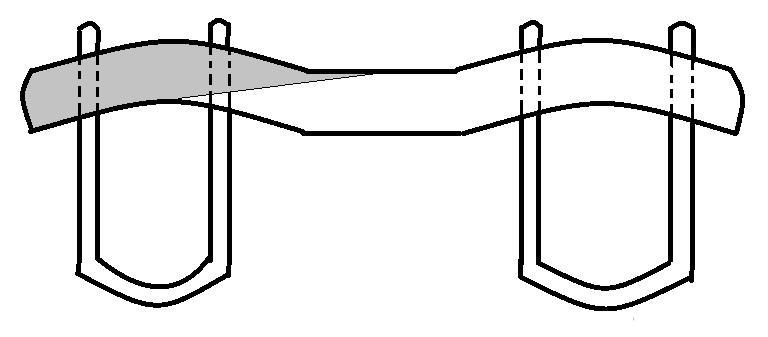
Enjoy!

—Peter Hicklin

An Octagonal Renovation

By Paul Bogaard

The renovation of the Anderson Octagonal House proved to be a mix of restoring what could be salvaged from its former lives and rehabilitating the rest to serve present-day purposes. Over the decades the house served as family home, widows’ refuge, rental property, industrial storage, tourism bureau and now museum. Each of these stages can be seen in features of the house we were able to restore, including much from the 1850s when it was built by Captain George Anderson. About half restoration and half rehabilitation, as it turned out… a product of circumstance, generous support and thoughtful planning.

Earliest photo of Octagonal House (1931 McCully aerial)

Earliest photo of Octagonal House (1931 McCully aerial)

The Decision

It began with the decision to move the octagonal house back across town, for the second time (see “The Second Time Around” in: The White Fence #59, February 2013, pp. 4–6). The Town of Sackville was willing to donate the house but could not include the land on where it stood for the last 25 years since this piece of land was part of the Mount Allison campus. The Tantramar Heritage Trust was willing to take on this octagonal renovation but only if we could move it near our existing museum (The Boultenhouse Heritage Centre).

The challenge of renovating this eight-sided house prompted the Trust to formulate an eight-part plan. It has required a full year of reconstruction to carry out this plan (from the spring of 2012 through the winter of 2013) and it had taken a full year from the spring of 2011 to work out the plans and secure the funding required. By April of the year in which Sackville reached its 250th anniversary, the Trust knew that (with thanks to its loyal donors, the Town and the Province of New Brunswick) there would be enough support to match a major contribution offered by Canadian Heritage. Taken together, this would be sufficient funding to enable this project to proceed, and so the decision was finalized to begin the most expensive and most challenging project the Heritage Trust has yet undertaken. It also meant the whole project could become part of the 250th celebration and house a permanent display on our resettlement as a British township.

The Plan

The eight-part plan, like the renovation itself, began with the move. If the old post-and-beam structure could be moved and restored, then it would need a proper foundation. Originally sitting on foundation stones, a full basement would be a completely new feature, and one which would come with very useful new space.

Similarly, the roof would have to come off to permit moving the building under power lines. This time the roof would need to be completely dismantled, and then reconstructed according to modern standards. This structural requirement, as it turned out, opened up an intriguing opportunity for much needed meeting space.

The hope for the main floor, as well as the exterior, had always been to save as much as possible and retain as many of its character-defining elements as possible where restoration was unavoidable. Where one crossed from restoring the old to replacing with new would have to be determined as the project unfolded; the expectation was that the main floor would serve as an extension to our museum space at the Boultenhouse Heritage Centre, featuring i) the octagonal house itself, ii) the Anderson family who had built and lived in it, and (iii) the story of Sackville’s founding 250 years ago.

The Results

The photos we used here serve to illustrate how this project unfolded — an eight-part renovation — and, like the procedure for reconstruction, it began with the bottom and the top, and then filled in-between.

1 Providing a full basement for the house’s foundation meant we were able to provide extra space. We have developed two museum sites, but both were desperate for storage and space for conservation work. Once the move proved successful, this needed to be the first step in renovation.

Construction of new roof with new reconstructed cupola

Construction of new roof with new reconstructed cupola

2 Once securely on its foundation, reconstructing the roof was the next priority. However, dismantling the old roof had left us with the original hip rafters and the upper octagonal ring, but little else that was re-usable. So, the roof required completely new materials and current construction techniques, allowing for up-to-date insulation and ventilation. And with careful planning we were able to refit the octagonal ring and hip rafters… giving us an eight-sided cathedral ceiling! To top it off, we replaced the cupola, originally part of the Anderson’s octagonal house, although the new one is fitted with windows (not just ventilation louvers) filling the upstairs with light. Dismantling the original roof proved that most of it could not be reused. But we learned a lot about the old house. Fortunately, the upper octagonal ring and hip rafters could be salvaged, though getting them down was tricky. Once on its new site, new rafters and a new “ring” were constructed due to rotting of the original aged wood. As the new roof took shape, a drawing which had been made of the original cupola was used to establish the shape & size of the new cupola. Initially constructed inside, the new cupola was then re-attached onto the roof; with footholds & safety harness in place and the finishing touches applied.

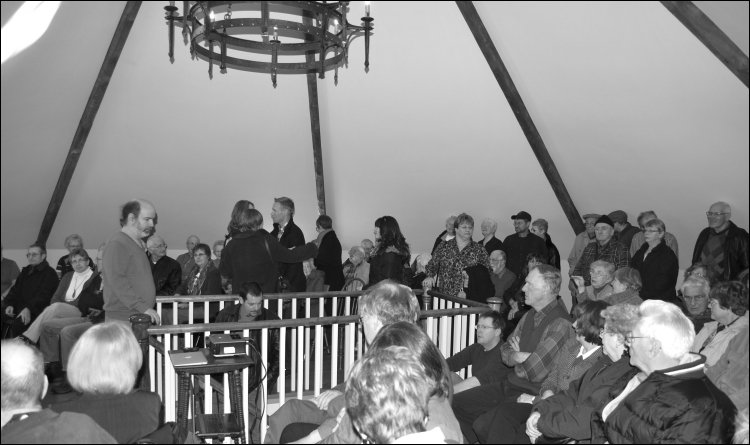
3 By comparison to the upper half of the upstairs, the lower half, which includes the original floors and exterior “knee” walls, were fully restored (the interior walls having been removed in the 1980s). The dormer, the floor-level windows and banister were features of the original house…but all had to be rebuilt. The upstairs has become, as a result, a combination of restoring the old along with new construction, including the provision of a dramatically new meeting room — worthy of being called the “Great Room” — with space enough for a variety of uses.

The Great Room with its first guests on Heritage Day

The Great Room with its first guests on Heritage Day

4 On the main floor, the front entry, front hall and two front rooms with their bay windows were all original and could be restored. Some features had to be rebuilt (and the stairway had already been replaced 25 years ago) but most of the front half of the house was a matter of careful restoration.

Of the two front parlours, one has now been reserved for displays featuring the remarkable seafaring Anderson family who built this octagonal house and lived there for over forty years.

5 The other front parlour provided one entire room to house the Resource Centre which had already outgrown its cramped space above the Heritage Trust office. A special grant from the Crake Foundation made possible fully restoring and fully furnishing this space for researchers working on local history.

6 The front hall originally led to a hallway between two back rooms, and on through a rear door leading into an extension housing the main kitchen (and likely included a cellar). The rear extension is long gone, taken down with its chimney and the two main chimneys decades ago. Indoor toilets were added into these rear rooms at some point (along with a bathroom upstairs by the dormer) and all these contributed to considerable rotting of flooring and structural timbers. Although the exterior walls remain, keeping the octagonal shape of this house intact, much of the floorboards and supporting structure had to be completely replaced.

The hallway and the remains of these two rear-rooms have been transformed into a special space displaying the commemoration of Sackville’s founding as a Township in 1762. The central portion of the rebuilt area has been reconstructed as the major feature of this display — the old tavern in which Sackville’s founding meetings were held.

7 Otherwise, this rear area of the house has been converted into washrooms and a small kitchenette, confining these contemporary functions into areas that had to be rebuilt, anyway. One washroom will meet the needs of anyone in a wheelchair and is next to the rear entrance now enlarged to accommodate wheelchairs.

Including both upstairs and on the main floor, about half of this renovation represents a restoring of original space with original floors and walls, right out to the octagonal exterior. The roof above, like the basement foundation beneath, however, are all new and able to meet current needs for security, insulation, utilities and so forth. Roughly half-restored and half-replaced has been a good compromise, both for the integrity of this octagonal house and for all the modern uses to which it can now be put.

8 The last portion of this octagonal renovation will be the exterior, much of which is already completed. The remainder will depend on what the weather will allow. The siding and roofing has all been replaced with materials that retain the distinctive features of this octagonal house.

Most of the doors, windows and trim were able to be restored from what was there originally, and everything now carries a new coat of paint — in the old colours revealed during this octagonal renovation.

The exterior of the new basement, and the deck and wheelchair ramp remain to be completed. The landscaping we hope to complete as weather permits and, while not original, it should complement the wonderful façade of this extraordinary Anderson Octagonal House.

At the outset we acknowledged that major donations needed to be secured to allow this project to proceed. But that is only half of the story. We also relied upon the talents of local artists, historians, graphics designers and many tradesmen. These workers all put much more into this project than was asked of them. Peter Manchester, Rob Lyon and Angelica DeBenedetti lent their artistry to our displays, as did Leslie Van Patter and John Crawford to their design and installation. A remarkable list of volunteers lent their time and enthusiasm to painting, cleaning and meeting endless small needs. Within the Heritage Trust, I was repeatedly assisted by Al Smith, Margaret Fancy and Kip Jackson. And then there was the skilled work of moving, restoring and reconstructing. For this we will ever be grateful to the tradesmen and women of MacDonald Movers, Pooley Electric, Heritage Wrought Iron, Sackville Plumbing, Fundy Environmental, and at the heart of it all: Energreen Builders Cooperative.

Announcements

  • May 4, 9 am to noon — Volunteers welcomed to assist with spring clean-up at the Boultenhouse Heritage Centre.
  • June 1–2 — Museums Across the Marsh
  • June 3 — Tantramar Heritage Trust Annual General Meeting (Anderson Octagonal House, Boultenhouse Heritage Centre, Queen’s Road).
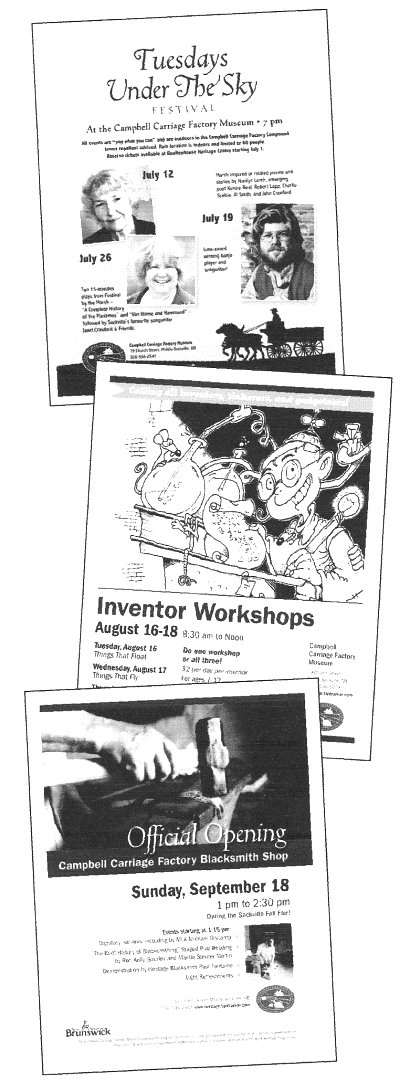
  • June 15 — Opening of the Campbell Carriage Factory Museum
  • July 2, 9, 16, 23 and 30 — Tuesdays Under the Sky (events to be announced).
  • August 11 — Antique Tool Collectors Show and Family Fun Day at the Campbell Carriage Factory Museum.
  • September 19-22 Fall Fair — Planned Book Launch (Sackville Then and Now)

The Discovery Committee of the Tantramar Heritage Trust

By Dodie Perkin

In this issue of The White Fence, we would like to introduce you to our Discovery Committee. The Discovery Committee consists of Alex Fancy, Vanessa Bass, Lucy MacDonald, Rebekah Cant, and Dodie Perkin (chair). We have been a formal committee since the autumn of 2010, after the Trust received funding from Canadian Heritage under the Community Museum Assistance Program to develop its Education, Outreach and Programming goals.

Our first task was to develop a policy to govern the educational activities of the Trust. After meeting regularly to discuss and formulate our policy, it was formally adopted by the Trust’s Board in October 2011. The policy was presented to the 2012 Annual General Meeting of the Trust.

Since then, the Committee’s focus has moved to improving and developing a range of exciting activities for our visitors. The Committee made a successful grant application to the Government of Canada’s Career Focus Program last year, and subsequently hired Charlotte Gleave Riemann as our first Education Intern. Charlotte worked in this capacity from January to August 2012. If you were at either museum last year, chances are that you benefitted from Charlotte’s involvement with the Trust. Under the Discovery Committee’s direction, Charlotte reviewed all existing programming and developed several new educational and programming activities. We are hoping to be able to receive funding to hire a second Education Intern to follow up on the work that Charlotte began.

Over the past couple of years, members of the Discovery Committee visited several museums in the Maritimes, and met with curators, program planners, and other staff to discuss their experiences with educational programs and best practices. In addition, we have assembled a large file of resources from other museums across the continent regarding programs that they provide, and given some thought to adapting some of these programs for our own needs. The Discovery Committee has been in contact with local teachers and organizations such as the Girl Guides and Scouts to explore opportunities for collaborating with them on specific themed programs. In September, we hosted a group of Girl Guides at the CCFM for activities to help them meet requirements for their Heritage Home Skills Badge. The Trust is also eager to investigate collaborative projects with other groups in the area, and our committee has had initial conversations with several groups.

With Charlotte’s input and the Committee’s guidance, summer employees over the past two summers have developed several new projects. The popular “mouse hunt” at the Campbell Carriage Factory, the development of our first children’s activity book for the CCFM and a second booklet for the BHC, and a quilting and banner activity presented at our popular Heritage Day are just a few examples. In addition, the Discovery Committee oversees events such as the popular Tuesdays Under the Stars, and heritage-themed workshops held at the Carriage Factory.

Plans for the future include the development of more children’s activity books, developing activity planning kits (jackdaws) for each of the five founding groups of Sackville to be used in local schools, planning activities for school vacation days, creating a heritage-themed literacy event, developing special events featuring the Boultenhouse Heritage Centre, developing space and interpretive opportunities presented through the acquisition of the Anderson Octagonal House and two marsh barns, and continuing to develop and codify all of the Trust’s education, outreach and programming activities. We have recently gratefully received funding from the Mount Allison Faculty Association to assist us in creating a Discovery Loft on the second floor of the Campbell Carriage Factory. This loft will provide a welcoming bilingual reading and activity space for visitors of all ages, with chairs, books, and other appropriate activities. Finally, we are tentatively hosting a group of home-schooled children in the spring for a day of heritage activities, and we are very excited about that possibility. We are excited by the potential that our sites have, but like many volunteer organizations, we are limited by finances and personnel. If you are interested in educational and programming opportunities at the Tantramar Heritage Trust, there are several ways to become involved. Our biggest need is for volunteer interpreters to run programs throughout the year, with training provided by the Trust. We are also looking for donations of items (see inset). And of course, we are always looking for financial support to make our programming dreams come true!

Would you like to help furnish the Discovery Loft?

The Discovery Committee is looking for the following donations:

  • comfortable rocking chair
  • old trunks or chests suitable for storing books and extra seating
  • an old bookshelf
  • floor cushions
  • small old fashioned rugs
  • old fashioned wooden blocks, toys or models
  • anything else that might fit into traditional children’s activities

If you would like to sew floor cushions or fashion us some wooden toys, or if you can help with donations or in other ways, please call the THT office for more information!

The Discovery Committee is always open to hearing new ideas and considering suggestions. If you would like more information, please feel free to contact the Trust office. You can also speak with any of our Committee members for more information. We have much planned for 2013–2014. The next issue of The White Fence will summarize for you all the many changes and new activities the revitalized Discovery Committee (with new membership) have planned to initiate over the coming year (editor). Stay tuned!

The White Fence, issue #59

February 2013

Editorial

More love letters and a special move

Only in Canada

Dear friends,

I am in the midst of an editor’s dilemma! I have too much information to pass along to you and, therefore, suffer the accompanying fear of running out of space! So this editorial, by necessity, will be short. We continue this issue of our newsletter with another of Stephen Millidge’s 18th century (1795) letters to Sally Botsford. Due to a lack of clarity owing to the age of the letters, please read carefully Eugene Goodrich’s descriptions and interpretations of these ancient letters which will allow you to better understand their contents as much of the original writing was illegible (i.e. see footnotes). This is followed by the seafaring adventures of Titus Anderson on the Sackville-built schooner Temperance. Titus was the father of Captain George Anderson, the builder of Sackville’s own octagonal house, also featured in this issue.

Author Al Smith has long made sure that Sackville does not forget its seafaring past. Hence, Anderson father and son are both highlighted in this issue. And then see what Colin MacKinnon found along the muddy shores of the Bay of Fundy’s tidal creeks… always interesting surprises!

At this time, we should all commend the Town of Sackville for saving the historical eight-sided octagonal home of Captain George Anderson. Beyond the Town’s important contribution, funding was also received from many local donors, New Brunswick Tourism, Heritage and Culture Canada and Canadian Heritage’s Building Communities through Arts and Heritage program. All made this “move” and upgrading of the octagonal house possible. On behalf of the board of directors and all the members of the Tantramar Heritage Trust, we extend our most sincere gratitude to these kind benefactors for seeing the value of preserving our past at this especially meaningful time: Sackville’s 250th anniversary. Furthermore, the Tantramar Heritage Trust’s member and former President, Dr. Paul Bogaard, was the facilitator who made it all possible. Thank you Paul!

So, make yourselves comfortable and read another of Stephen Millidge’s love letters to Sally as well as two very special stories connected with father and son of the Anderson family. Both stories encompass over two centuries of Tantramar history. Only in Canada!

And, as usual (I hope),

Enjoy!

—Peter Hicklin

Letters to Sally — An Early Sackville Love Story

Continued from The White Fence #58

By W. Eugene Goodrich

4. Fragmentary but dated; May 24th 1795

There are too many pieces missing to attempt much of a textual reconstruction, although I was able to guess at a few words. However, with the help of some background information and a little imagination, we can discern the general outlines of the letter, although not without a good deal of uncertainty. This time, it is Sally who is away on an extended visit, while Stephen is at home with the children. I think she went to Granville, N.S. where, as we will see in the Epilogue, the Millidges had friends. Besides the ‘Gr…’ in the first line, the word ‘Granville’ occurs later in the letter where Stephen seems to be hoping that it will arrive there before she does, bringing one more proof of his love and devotion. She appears to have Ann with her, as Stephen only talks about Mary and Jane.

In any case it is clear that Stephen misses Sally and wants her to come back as soon as possible. In the meantime, he reports on things at home. Mary, who must have been about two at the time, is an affectionate child who also misses Sally, but, like any two-year old, she can be recalcitrant. One of her favourite words is ‘no’ (this can hardly refer to Jane who is just cutting her first teeth), which someone — not her mother — taught her. She was briefly disconsolate after Sally’s departure but soon bonded with Mrs. Cornforth who seems to have come to the Millidge home to help out with the children. This may have been Mary Cornforth, the mother-in-law of Jonathan Burnham who, according to Milner, was close to the Millidges. Stephen seems a bit worried that both Mary and Jane could become too attached to Mrs. C. at the expense of their mother. Again, he seems to allude to Sally’s sorrows and tribulations, and there is even a hint — although this is a bold speculation — that she was away for more than a visit. Was she going through some kind of a crisis? Was their marriage? It certainly appears that Stephen is trying to convince her that he is always thinking of her, and that she is a little skeptical. On the other hand, her return seems certain, as he wants to know what route she will be taking on the way home. The letter closes with some more detail on the domestic routine in Sally’s absence. Jane is in bed with her ‘governess’, probably Mrs. Cornforth, while Stephen has been busy in the kitchen, the “steward having also retired”. I think these lines were meant humourously, given the Millidges’ economic circumstances at the time. Mary will take her mother’s place in his bed, but he would prefer the original proprietor. Finally, there is an interesting reference to a shortage of paper that limits what he can write. It had to be imported and was, I imagine, periodically in short supply.

1. May 24, 1795

Mary says “Ma is gone to Gr[anville …] to see Ann, you go along with me next Sum[mer…]. She adds “She loves Ma 3 Bushels and every bo[dy… ] a great many.” Jane has got so attached [to Mrs.] Cornforth, that’s when I desire her to come to [you. Mary] seems perfectly to recollect her former short An[swer…] “No”, which you no doubt recollect your […] first taught her. For two days after yo[ur…] departure, she appeared to have no friend he[re] but, some way or other, Mrs. Cornforth has been [a very] successful rival, and you must be sensible […] great sorrow ingross all her affections — She […] is more obedient to my word of command, tha[n…] under your Protection — and only to ther[…] …since you let[……] side of the paper, my dear Sally, […]the domestic business, at least, with regards […]children, which has yet occurred — and I flatter [myself … th]at, notwithstanding the variety of sad […]passed over, and the multiplicity of […]you have seen — you will not receive […]st this invitation to return to your old… [……] to your old Friend — it may perhaps […] Granville before yourself — in which case […] have one more proof that at 10 o’clock on […[n]ights, you are not out of my mind — and […] I cannot personally convince you so — […] (so situated) all opportunity of doing […] mode or other — believe me I want […] We know not the value of a Gem […] delivered of its … It is really the apprehension of not meeting again […] reason, I wish your stay as short as […] moreover I beg to be informed, with regard […] rout[e] you purpose to take on your return[…] expect to have finished this token of affection and […] Jane is cutting more teeth — (perhaps a sign that … to be prepared to eat her own victuals) and [crossed out] I h[…] her to Bed with her Governnant, and am […] kitchen, the s[t]eward having also retired — […] and I can write on the scarcity of Paper […] me to add little more — Mary until the […] has been your s[…] constant companion […] attached to her — I begin to think after her […] and William’s1, which is expected to take place […] I shall give your little daughter your […] my bed — with this declaration however, that […] original proprietor would fill it with more […] but it … necessary that we […]

  1. Probably Sally’s brother. One might be tempted to interpret this as a reference to an upcoming wedding, except that William did not get married until 1802.

TO BE CONTINUED

Temperance — the schooner that launched the amazing sea faring adventures of the local Anderson family

By Al Smith

Edward Anderson’s (1822–1887) diary1 states: “I here note that the Schooner Temperance was built in my father’s cow pasture in the year of our Lord 1831, launched June 8th. Authority for the above is the widow of Titus Anderson. I pen this while here in affliction” — Sackville, NB August 1886, Edw. Anderson”. The cow pasture mentioned above was located on the farm of Thomas Anderson (1775–1852) on Cole’s Island (where the CBC Towers between Sackville and Amherst are located — ed.) so the vessel would have been launched into the Tantramar River. That schooner was possibly the first entry into marine interests of the Anderson family.

Shipwright Christopher Boultenhouse (c.1802–1876) built the 87-ton schooner Temperance which was launched June 8, 1831 (dimensions: 38′-6″ × 18′-7″ × 8′-1.5″ and registered in Saint John July 18, 1831 as #292). The vessel was owned by Titus Anderson (32 shares) and Thomas & James Anderson (32 shares). Temperance was the fifth vessel constructed by Christopher Boultenhouse. Most of his first sixteen vessels were constructed at his Woodpoint shipyard but at least three, including Temperance, were constructed elsewhere.

Capt. Titus Anderson (1805–1870) was the schooner’s master and Temperance may have been Titus’ first command (he was 26 years of age and could well have had his master’s certificate by 1831). The other owners of the Temperance were Titus’ father and brother, both farmers with adjoining properties at Cole’s Island. The schooner was used as a trading vessel mainly between ports in the upper bay and the city of Saint John. It is interesting that George McAllister traveled3 on the Temperance4 on Dec. 1 & 2, 1831, from Saint John to Wood Point with sails, rigging and supplies for his new brig Woodbine which he was purchasing from shipbuilder Christopher Boultenhouse. The Temperance was lost April, 25, 1837, at Mount Desert Island, Maine.

Capt. Titus Anderson ran a coastal trade and was the master of several vessels. He owned at least one other vessel built by Christopher Boultenhouse: the 50-ton schooner Jane launched April 27, 1853, and named after Titus’ wife Jane (Bulmer) Anderson. The Jane was lost in ice near Sackville on January 2, 1859, and the family immediately contracted the Boultenhouse shipyard to build the schooner Bella. The 46-ton schooner was built by Amos and William Boultenhouse (sons of Christopher) and launched April 30, 1859. Titus died when the Bella was wrecked off Cape Spencer, NB, at 2 am, July 8, 1870.

Capt. Titus and his wife raised five sons, four of whom became master mariners: George (1830–1873), Charles Marshall (1838–1895), Thomas Reese (1840–1918) and Gaius (1842–1903). After lengthy careers at sea, Charles Marshall settled in New Zealand, Gaius in Fiji and George and Thomas R. are both buried in Sackville.

Three sons of Capt. George Anderson and Arabella Ayer (builders and original owners of the Octagonal House) also became master mariners: Rupert Titus (1858–1922), Ernest Laurence (1861–1912) and Jesse Edwin (1863–1936). Rupert eventually settled in New York, Ernest stayed in Sackville and Jesse ended up in Ketchikan, Alaska.5 Three generations of the Anderson family gave rise to 8 master mariners who roamed the oceans of the world. Their exploits added greatly to the cultural fabric of Sackville.

  1. Mount Allison Archives, Albert Anderson Fonds, 8317/3/2 — Edward Anderson (1822–1887) was Capt. Titus Anderson’s youngest brother.
  2. Shipbuilding in Westmorland County – Charles A. Armour and Allan D. Smith
  3. The Journal of Captain George C. McAllister Jan. 1, 1831 to July 27, 1833
  4. The Anderson Family by Florence (Anderson) Wheaton
  5. The original family; Thomas and his wife Mary emigrated from Yorkshire, England to Sackville Township in 1772.

The Captain George Anderson Octagonal House — The Second Time Around

By Paul Bogaard

The Anderson Octagonal House really gets around. It has actually traveled down Bridge Street twice: in 1987, it was moved up Bridge Street and 25 years later — as part of Sackville’s 250th anniversary — it was moved back down Bridge Street.

Original configuration

George Anderson originally built this unusual house on Bulmer Lane, Sackville, back in 1855. As a shipbuilder and sea captain (from a family of sea captains) George somehow picked up on a new fad for building houses with eight sides. Hundreds were built across North America around 1850-70 but only a scatter of these extraordinary houses remain. There are only two or three others in the Maritimes and none remains as close to its original condition as George Anderson’s.

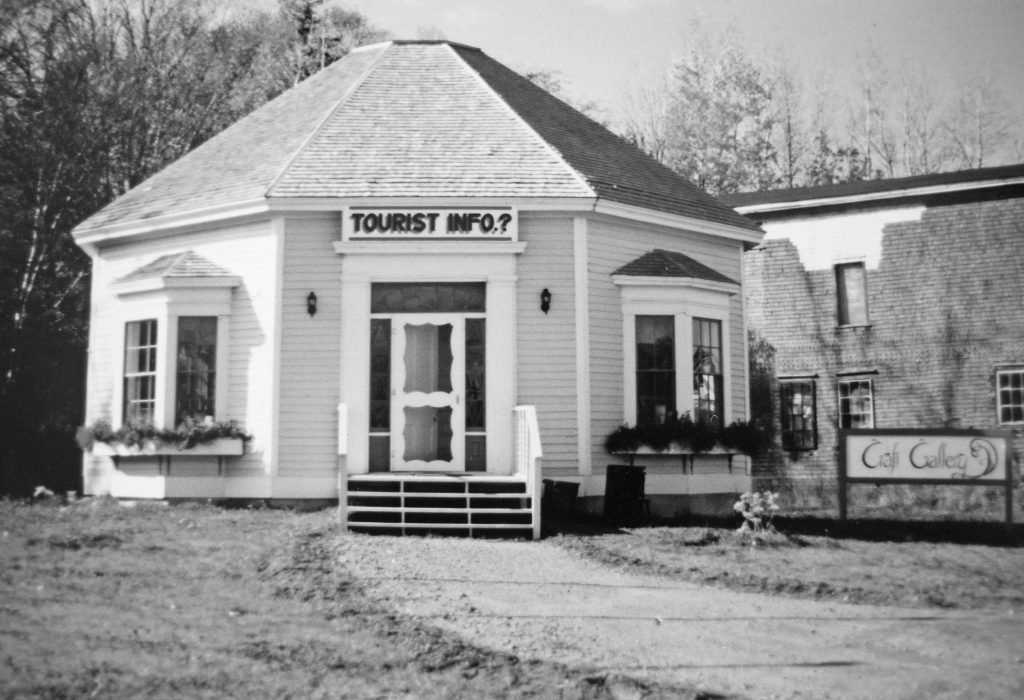
In 1987, the Town of Sackville took ownership of the Anderson Octagonal House, moved it onto the site that had been cleared of the Fawcett Foundry on the corner of King and Main Streets (now a Mt. A. parking lot) and converted it into the town tourist bureau (Tourist Info above main door) and Craft Gallery. Twenty-five years later, with a new facility for tourist information built at the bottom of Mallard Drive, easily visible from the Trans-Canada highway, the Town was looking for someone to take the now-unused octagonal house off its hands. The Tantramar Heritage Trust offered to re-purpose it once more, but only if it could be moved yet again, back to its old neighbourhood next to the home of another 19th century shipbuilder, Christopher Boultenhouse.

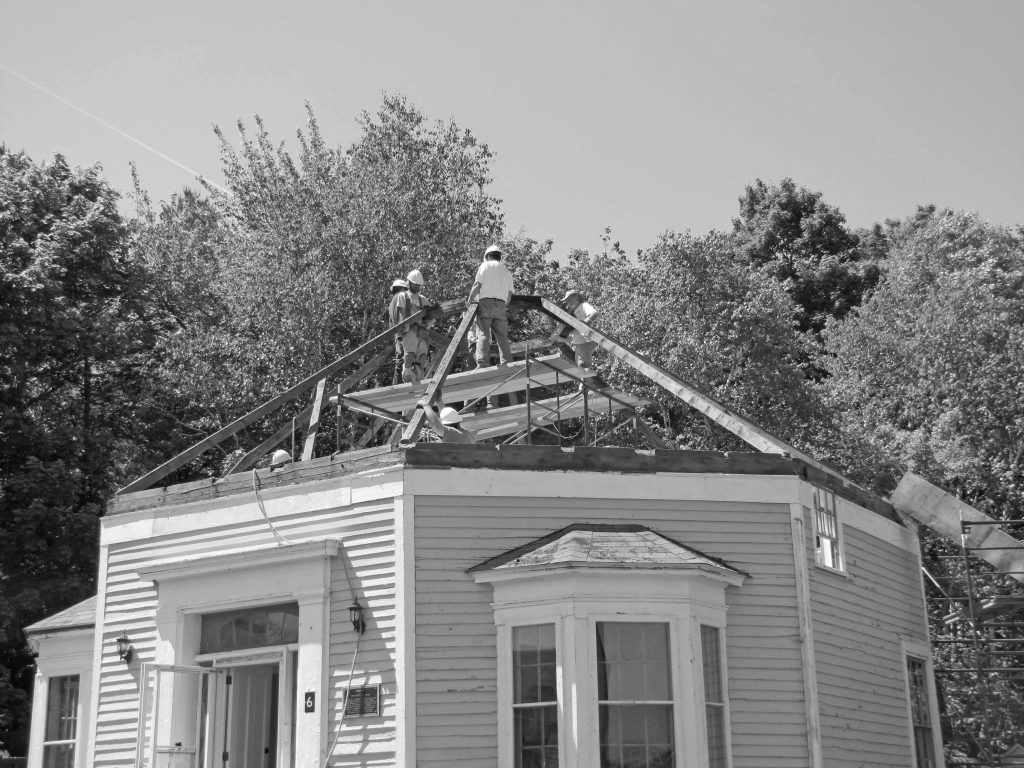
After 130 years of sheltering many different families and boarders, the Anderson House still retained three chimneys and a back extension that we assume was the kitchen. But before the Town could move the building to its new location, the chimneys and rear portion had to be taken down…and the roof lifted off and removed in order to allow the building to fit beneath power lines once the house was fitted onto a set of wheels (see photos). The house survived, kept its rather jaunty octagonal character, and became both Tourist Bureau and Craft Gallery at the back portion of the parking lots on the corner of King and Main Streets.

Raising the roof 1987

1987 move

Fast-forward another twenty-five years. As in the earlier move, if the Trust were going to move the octagon a second time around, it too would have to deal with the roof. The difference was that this time the roof would need to be completely dismantled in order to permit for the construction of a fully modern roof structure with some surprising new features. (For that transformation, you’ll need to wait till our second article on this subject.)

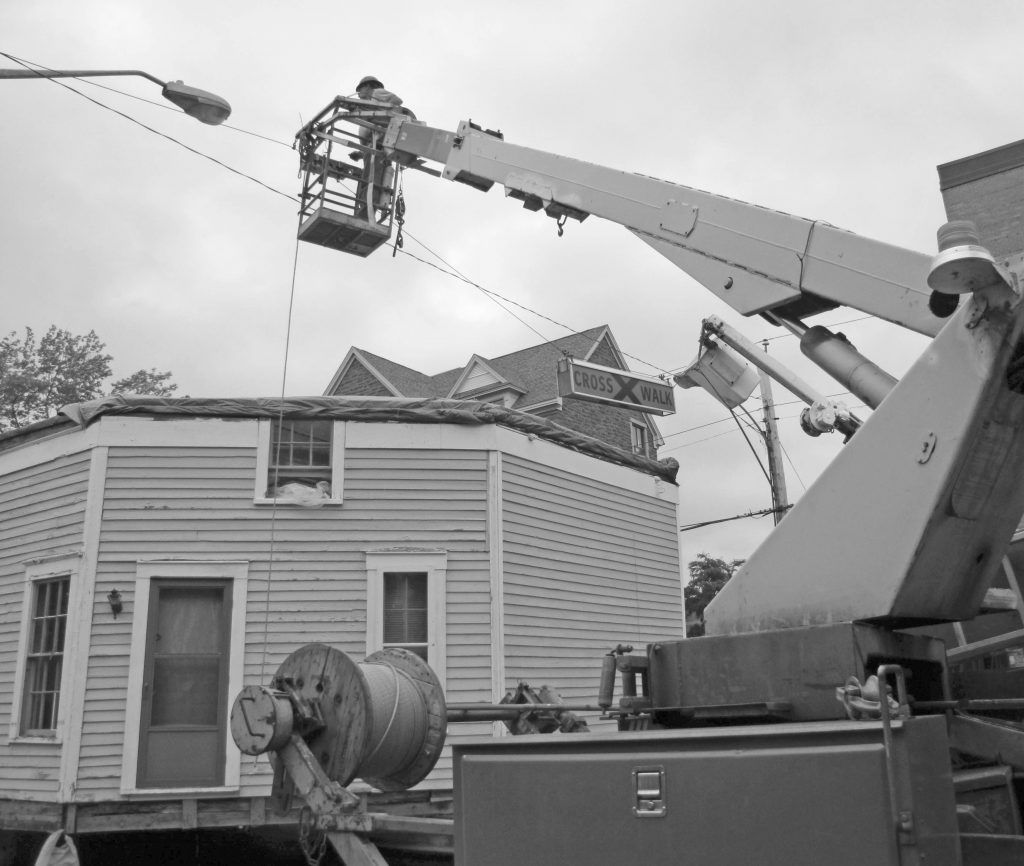
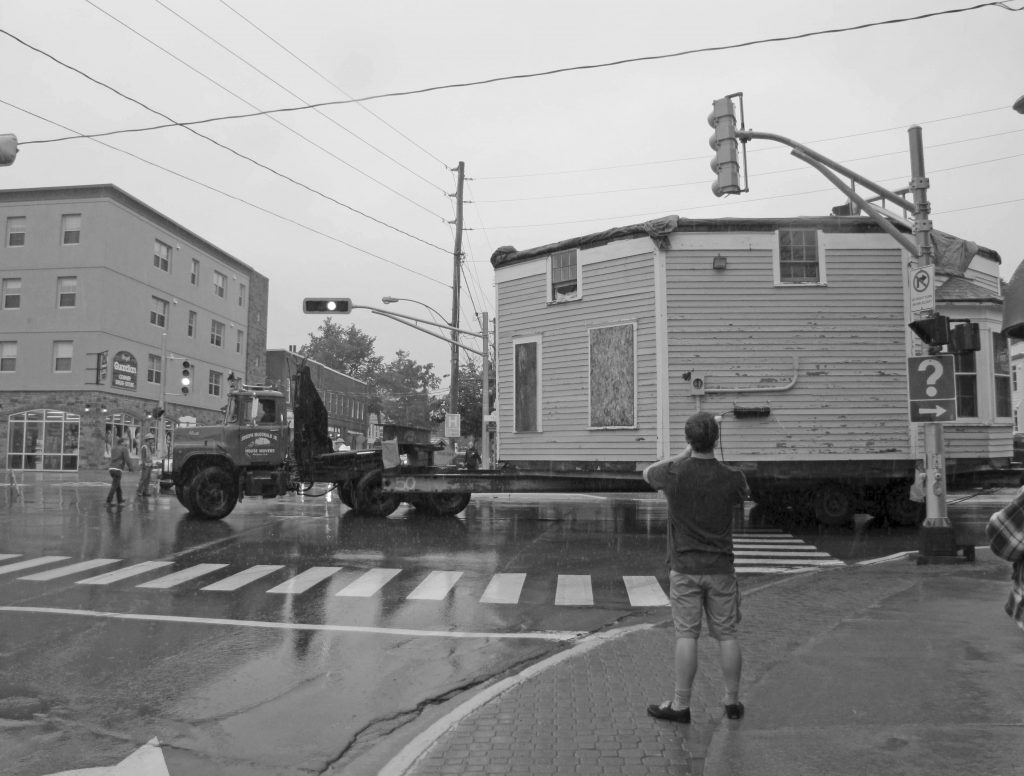
At that point, the old Octagon began running a remarkable obstacle course! First it had to stop for a crosswalk (don’t we all!) where the sign had to be lifted out of the way and the building banked sharply around the stoplights (turning on a red light?) only to pause again for NB Power to lift the power lines. You can tell from the photos that it was really raining!

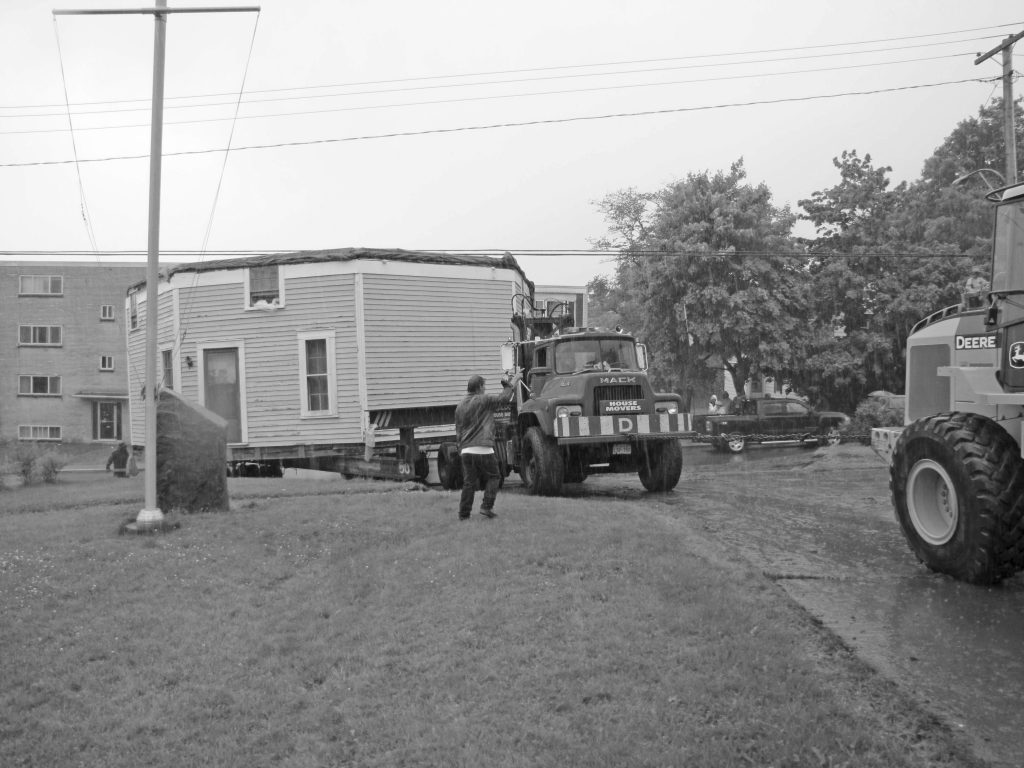
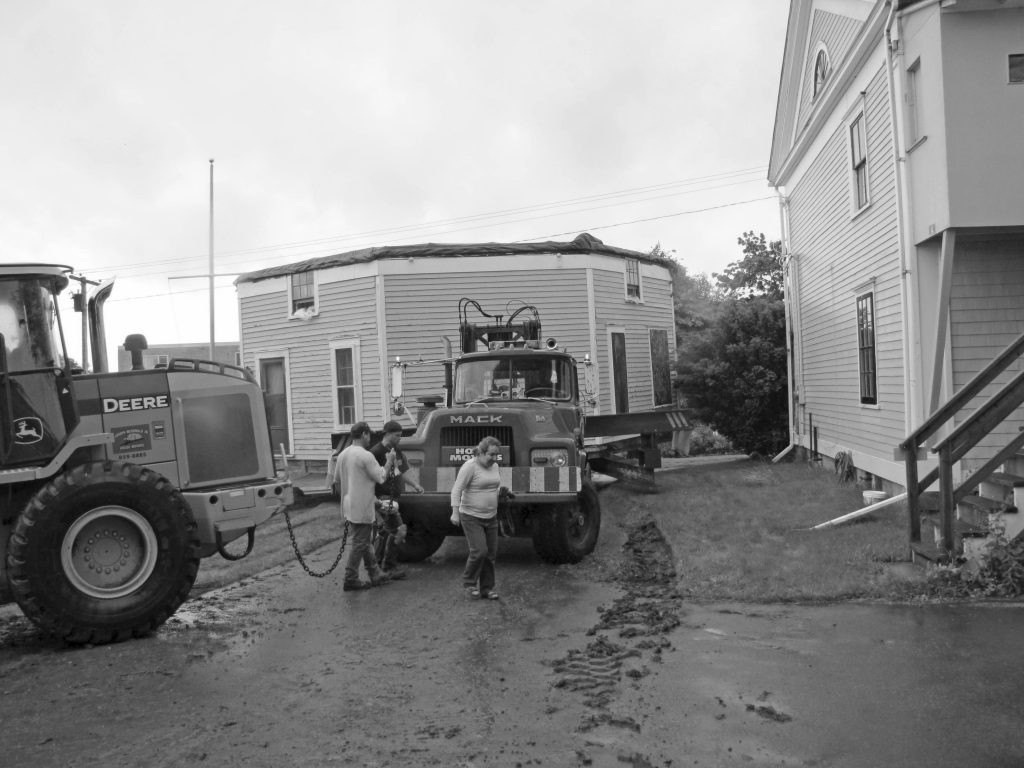
I don’t think the RCMP would let any of us take a corner quite like that but a big tractor with an 8-sided house takes whatever space it needs! Next, it was up the hill towards Marshview Middle School where the building had a narrow miss with a telephone pole! Finally, the moving crew struggled up the driveway at the Boultenhouse Heritage Centre (29 Queens Road) and brushed closely by Boultenhouse which was soon to be the Octagon’s new neighbor. At that point Joe MacDonald and his movers, wet and weary, left Anderson House near its future location and headed home to get dry. When they returned next day, it was bright and sunny and the Octagon was clearly pleased to be nestled into its new location!

Raised up on cribbing, the house was carefully located, leveled and stabilized so the excavators could dig directly beneath the elevated building and prepare for a full basement to be poured.

When she was nestled back down on her solid new foundation, the carpenters moved back in and began erecting a brand new roof. But that’s the beginning of our next installment: the renovation of the Anderson Octagon that can reclaim some of its original dignity and at the same time begin a new life serving quite different purposes than ever before.

As tourist bureau

Dismantling the roof 2012

Onto the mover’s rig

Easing onto Main Street

Heading down Bridge Street

Raising the cross walk

Taking the corner on red

Raising more wires

Another close call

Trying to get up the driveway

Brushed by Boultenhouse

At its new home

Getting a brand new roof

Discovery of an Ox Yoke at Cumberland Creek

By Colin MacKinnon

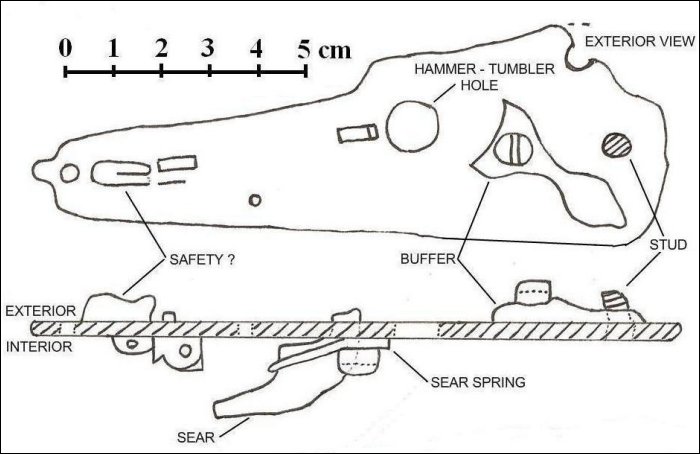
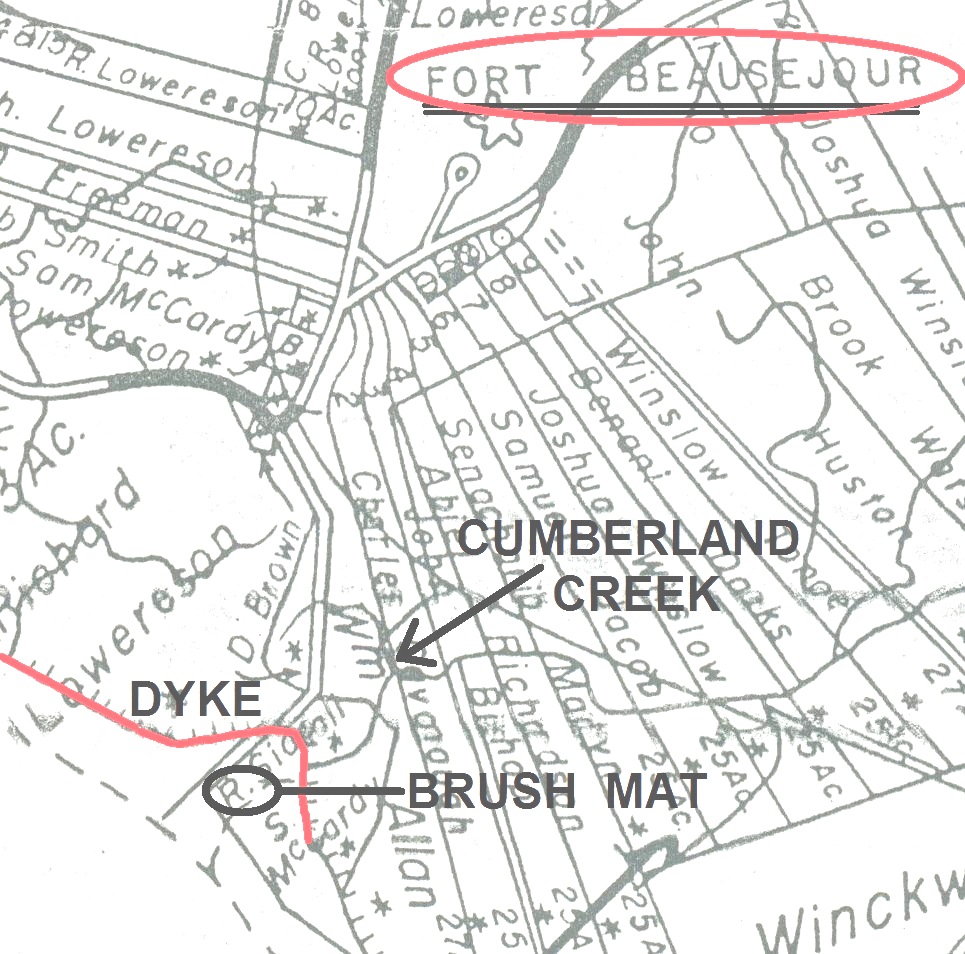
In 1995, I visited the site of Cumberland Creek, situated below Fort Beauséjour, traditionally known as the landing place of some of the area’s Yorkshire settlers in the early 1770s (see Figure 1).

Figure 1. Location of the “brush mat” and portion of the “fort road”, outside of the dyke, along Cumberland Creek below Fort Beausejour (Crown Grant Map).

At that time, the remains of a “brush mat” was exposed along the edge of the saltmarsh, outside of the dyke. This feature may have been associated with a very old aboiteau that was situated here or, possibly, as part of a marsh road built to access a place where smaller ships were unloaded. This brush mat was buried nearly one meter under the marsh and as the upper bay has a silt deposit rate of approximately 30 cm/year, the mat could easily be well over 200 years old (Figure 2).

Figure 2. Cumberland Creek, Ban of Fundy. The Ox Yoke was discovered just to the right of the “brush mat” (just outside of the photo). This mat is buried nearly one metre below the top of the saltmarsh. (Colin MacKinnon photo)

While exploring the protruding fragments of this “mat”, I noticed, sticking out of the mud, a rounded piece of wood with two mud-filled eyes staring back at me! The artifact was “in situ”, thus of contemporary age with the mat and on closer examination turned out to be a fragment from a likely 18th century English Ox Yoke (Figures 3 and 4).

Figure 3. Side view of the Yoke, approximately two feet long, cleaned with mud washed off. (Colin MacKinnon photo)

Figure 4. Top view of Yoke, cleaned with mud washed off. (Colin MacKinnon photo)

I refer to it as an English Yoke because of the way the oxen were attached. In a French Yoke, the horns of the oxen were strapped to the yoke while in the English type, the heads of the oxen protruded through wooden hoops which were connected through the two holes in the main beam of the yoke (see figures 4 and 5).

Figure 5. Yoke sketch and fragment (shaded) found along Cumberland Creek.

The ox yoke fragment is a tangible link to many past events witnessed below the ramparts of Beausejour. Ancestors of many of Chignecto’s early families first stepped foot in the New World at Cumberland Creek and one can easily imagine a heavily laden ox-cart, filled with a settler’s carefully chosen supplies and cherished possessions, plodding along the track that connected the creek to Fort Cumberland. This scene must have been replayed many times and this fragment of wood reminds us of those struggles. The Cumberland Creek ox yoke has been deposited with the Tantramar Heritage Trust.

A Note On Andrew Kinnear

By Peter Hicklin

In our last newsletter (No. 58,December, 2012), reference was made of “Mr. Kinnear” in Stephen Millidge’s letter to Sally dated either January 20, 1792, or January 18, 1793 (see Eugene Goodrich’s notes about this letter on page 7 of The White Fence no. 58, but also see below). Soon after the newsletter was distributed, I received a call from Mrs. Mary Day, a young and vivacious 91-year-old from Midgic, who informed me that that this reference to “Mr. Kinnear” in the newsletter was a reference to Mr. Andrew Kinnear, a distant relative of Mrs. Day’s via her maternal grandmother. She informed me that she had much information on Andrew Kinnear about whom she had intended to write a book. Would I be interested in seeing the information that she had accumulated? It certainly did not take long for me to reach Mrs. Day’s back door! In fact she passed on a large folder to me filled with
information about the Kinnears. The present note merely brushes the surface of the meaty collection of
information she passed on to me. Mrs. Day possessed sufficient information about the Kinnears to easily write a series of books about this most interesting family with fascinating characters of past years in our region. From this large collection of information, I extracted a few interesting bits about Mr. Kinnear which are described below:

Andrew Kinnear was a native of Ireland, born in 1750. He was an officer of the British forces in Canada for most of his adult life and served at Fort Cumberland in 1777. He served as Barrack-master and Commissary at that post for seventeen years (Letter from Thomas Carleton to the Rt. Hon. Lord Dorchester, dated 1794) Kinnear settled in Westmorland Co., New Brunswick, and was a member of the House of Assembly in 1786 and 1792. In 1792, Kinnear wrote a “Memorial” with respect ot the purchase of marshland where he made reference to Stephen Millidge:

Respectfully sheweth,
That your memorialist having in consequence of a resignation in his favor on the part of B. S. Williams of a lot of land in the Township of Westmoreland in Letter C. Division on No. 7, made application for the home marsh of said lots together with the marsh of the adjoining Lot No. 8 applied for by Spilller Fillmore but purchased of Fillmore by your memorialist which with the home lot No. 9 and 10, your memorialist has got a vote of cancel for. Your memorialist finding that said B.S. Williams not withstanding his resignatiom in favor of your memorialist, has in your memorialist’s absence when in Europe, disposed of said lot for the sum of 5 pounds and the above mentioned Spiller Fillmore refuses to accept this, as the surveyor Mr. Milledge, who is now in town, can testify – Your memorialist therefore respectfully prays for a grant of the said upland lot as they are contiguous to your memorialists marsh and your memorialist will if thought necessary consent to the indemnifying the purchase from Williams to the amount of 5 pounds and your memorialist as in duty bound will pray.
Andrew Kinnear
24th February, 1792

In 1792, Andrew Kinnear sat as a representative in the Assembly of the newly-formed Province of New
Brunswick along with Amos Botsford (Speaker), Charles Dixon and Samuel Grey.

In 1803, he lived in Westmorland with his wife and two children over the age of ten and two children under the age of ten. He died at the age of 67 in Westmorland Co. in 1818; his wife Letitia Boyd, born in Litterkenny Co. in Donegal, Ireland, died in Saint John.

I am most grateful to Mrs. Day to allow me to peruse the large collection of information that she had lovingly accumulated over many years of thoughtful research.—P.H.

Another Note on William Allen Esq.

Also in the December issue (see page 8, footnote no. 6), Eugene Goodrich wrote a clarification about William Allen in relation to a reference to “Allen” made by Stephen Millidge in his letter to Sally on 20 January, 1793. In his footnote, Dr. Goodrich indicated that William Allen “was the father of John Allen, one of the original fomenters of the Eddy Rebellion”. However, Mr. Charles Thompson wrote to us indicating that “William Allen is brother to John Allen the Rebel and not father”. Mr. Thompson seems to have important historical connections on this subject. He wrote: “The piece of land our farm now sits on here in Oxford, Nova Scotia, was purchased from William Allen in 1791 by Richard Thompson (of Jolicure) and registered in 1799.” However, looking at the genealogical history of the Allens (I thank Colin MacKinnon here for his assistance), we find that there were two William Allens over the years when Stephen Millidge wrote to Sally Botsford. William Allen Sr. died in 1785 and his son Judge
William Allen Jr. died in 1806. Hence, neither Eugene Goodrich nor Mr. Charles Thompson was wrong: there were two William Allens: William Allen Sr. was the father of William Allen Jr. who was the brother of John Allen. What was missing in Stephen’s original letter were the qualifiers “Sr.” and “Jr.”

My! My!….how details matter! Readers, please correct me if I am wrong. I will provide an update in
the next newsletter. I thank Mr. Thompson for giving attention to this important detail! It is nice to know
that our newsletters are read so critically and seriously by readers such as Mrs. Day and Mr. Thompson. Your commentary, phone calls and emails are very much appreciated!

Marion T. Wells Collection Donated to the Resource Centre

By Donna Sullivan

A large collection, compiled by Marion T. Wells (1917-2010) of Sackville, rich in historical and genealogical material, has been donated to the Resource Centre at the Boultenhouse Heritage Centre. The donation that began with Marion in 2009, was continued by her sons following her death. Although Marion Wells was born in Vancouver, British Columbia, and grew up in Moncton, New Brunswick, she became an avid historian of the communities of Point de Bute, Jolicure and Aulac. Following graduation from Aberdeen High School in Moncton, and the Provincial Normal School in Fredericton, she taught school in Taylor Village, Moncton, and Point de Bute where she met Harold C. Wells, a descendant of the Etter family, who later became her husband. While living on a farm in Point de Bute where they raised three sons, Chesley, Roger and Keith, Marion involved herself in community activities such as the Point de Bute Women’s Institute.It was at such events that she became familiar with the people of the community. She had a passionate interest in the history of the families of the area, their homes, schools, land holdings, and occupations. Marion took great care in collecting, recording and compiling information about her husband’s ancestors, the Etters, and her adopted home. Harold, Marion and sons lived in Point de Bute for 17 years before moving to Sackville where Marion was bookkeeper for the Sackville Medical Centre for over 20 years. She continued to be involved with various organizations such as the United Church Women, the Fort Beausejour IODE, Tantramar Heritage Trust, St. Mark’s Anglican Church Women, Westmorland Historical Society and the Sackville Business and Professional Women’s Club.

A 25-page finding aid has been compiled listing and describing all the records related to the Etter/Wells and related families, and the community of Point de Bute containing family trees, historical sketches, photographs, letters, deeds, baptism records, marsh records, estate inventories, maps, programmes and clippings. Anyone wanting to view the records is advised to call the Boultenhouse Heritage Centre at (506) 536-4521, or email sullyd@eastlink.ca for an appointment. Artifacts related to the family have also been donated to the Boultenhouse Heritage Centre Museum.

Then & Now COMPARISON AND CONTRAST

Contributed by the “Then & Now” Committee of the Town of Sackville Heritage Board

1895 THEN – Berton Allison astride a horse next to his pond on his Main Street, Sackville, property. His house Brookside is barely visible in the trees on the left side of the photo. Note the wooden sidewalks and unpaved street. Photograph courtesy of Mount Allison University Archives, R.C. Archibald fonds, 5501/9/2/1/70

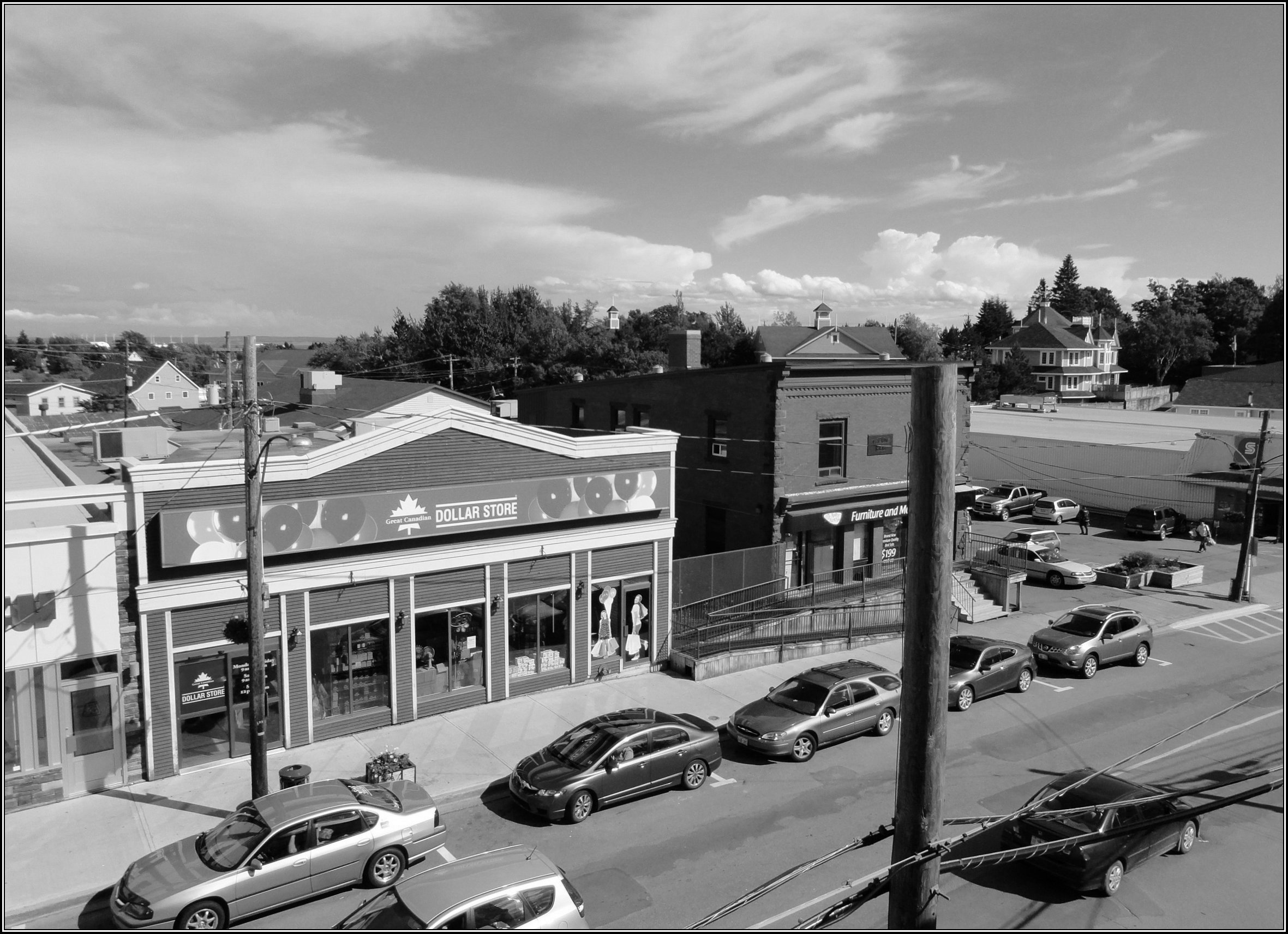
2012 NOW – Current photo taken from the same angle as the ca. 1895 photograph. Jean Coutu now occupies the site where Allison’s home (later the Ford Hotel) stood. Note that the pond no longer exists and Save Easy now occupies the sport where the pond once was. Photograph courtesy of Donna Sullivan.

The body of water in the 1895 Then photo was situated where the Save Easy grocery store is now located in Sackville (at extreme right of 2012 Now photo, with parking lot). In its early days, it was known as Allison Pond or Willow Pond. Henry Allison’s house Brookside was built in 1854 where the Jean Coutu pharmacy is now located (extreme left of 2012 Now photo); his property extended from Bridge Street to the Miller Block (beyond Save Easy). Allison constructed a dam in the brook which flowed through his property thus creating an artificial pond as clearly shown in the 1895 photo. The dam was destroyed by the Saxby Gale in 1869 and, after Allison died, his son H. Berton Allison replaced it in 1893. As Main Street grew with new business centres, the dam was removed and the brook was piped underground (see Donna L. Sullivan, Skating on Steel-Shod Feet, pages 13-14 (2011). It was a much “greener” site in 1895!

The White Fence, issue #58

December 2012

Editorial

Dear friends,

In this issue, we (via Eugene Goodrich) bring you a very different approach to local history. Ancient (read historical!) friendly correspondence between citizens always brings about interesting details and insights about an area’s past, its people and customs. But in this case, it’s not just “friendly” correspondence that we refer to here. Herein, we present you with the love letters written in the late 1780s and early 1790s between a young man in Westcock and the woman he loves on Dorchester Island and later Sackville. Look closely at the family names referred to throughout the letters and read carefully Eugene’s fascinating additions/interpretations throughout the many footnotes provided at the bottom of each page. To simplify the process, Eugene’s commentary is in plain type while all the letters are presented in bold. We were unable to fit all the correspondence in this issue of the newsletter and so the remaining letters will be added onto the next issue. There is little more that I can add except to ask that you open your hearts to this young couple, often separated by long distances, and to the many other people of the time that they represent, in similar situations, throughout our long history. I was quite captivated by this historic relationship so vividly brought to life for us via Eugene Goodrich and I use this moment to remind all our readers that any historical correspondence they may have stowed away in their attics, desks and cupboards is just begging to see the light of day through the pages of this newsletter. Just let me know via peterhicklin@eastlink.ca or through the website of the Tantramar Heritage Trust or by electronic mail (tantramarheritage@gmail.com) and we can let these voices be heard. There is so much that they want to tell us.

Enjoy!

—Peter Hicklin

Letters to Sally — An Early Sackville Love Story

By W. Eugene Goodrich

A. Background

While searching for information on a prominent early Sackville resident, Stephen Millidge, in connection with a study I recently completed on local government in early Westmorland County, I found among the voluminous papers of W. C. Milner preserved in the New Brunswick Museum, six letters Stephen wrote to his wife, Sarah Botsford Millidge, eldest daughter of Amos Botsford, between 1789 and ca. 1795. Of a personal and intimate nature, they should be of interest to readers of The White Fence as they offer a glimpse not only into the intellectual culture and family relations of this elite Loyalist couple, but also into some of the conditions of life in the Sackville area during the late 18th century. However, in order to fully understand these rather charming epistles, we must first meet Stephen and Sarah.

Stephen Millidge (1761–1803) was a son of Major Thomas Millidge, a prominent New Jersey Loyalist who settled in Digby where he received a large land grant, thanks in part to the efforts of his friend and fellow Loyalist, lawyer Amos Botsford, one of the agents appointed to seek out lands for the Loyalist refugees in that part of Nova Scotia. Thomas did very well for himself in his new home. Not only a substantial landowner, he was also a highly respected deputy crown surveyor, a leading justice of the peace and a member of the legislative assembly. However, with much of the best agricultural land long since taken by the Planter predecessors of the Loyalists and opportunities for public office (a constant quest of the Loyalist elite) increasingly limited, the prospects in the Annapolis Valley were not as bright for his talented and ambitious sons. All of them ended up in New Brunswick, newly created as a land of milk and honey for elite Loyalist office-seekers. I don’t know when Stephen moved here but it wouldn’t surprise me to learn that it was around the same time as Amos Botsford, and possibly together with him. Amos came in 1784 hoping for a high provincial office such as Solicitor General. In this he was disappointed, but consoled himself with appointments to most of the important county offices in Westmorland. He also won one of the county’s four seats in the provincial legislature and was soon afterwards elected Speaker, a position he held until his death in 1812.

Stephen’s connections with the Botsfords, as well as his own family connections, no doubt played an important role in his becoming High Sheriff of Westmorland County in 1787 at the impressively young age of twenty-seven. Appointed by the Lt. Governor on recommendation of the Chief Justice, with probable input from the county’s representatives, the High Sheriff enjoyed a de facto lifetime sinecure barring incapacity or egregious misbehaviour. However, he received no salary but only modest fees for his services, which were many and often onerous. Besides leading the posse that pursued fugitive criminals, he summoned juries to the General Sessions of the Peace and the Inferior Court of Common Pleas (the county courts presided over by the justices of the peace) and executed all their judicial decisions. He collected the fines they imposed, ensured the safe custody of all felons and debtors committed to prison and presided over any hangings that were carried out in the county (there were none during Stephen’s tenure). He also exercised general supervision over the county jail, supervised elections to the provincial legislature, served writs on the owners of forfeited property, and did much else besides. About the same time that he became High Sheriff, Stephen was also appointed one of the province’s deputy crown surveyors, an office that was probably even more burdensome. As readers of Amy Fox and Paul Bogaard’s recent study The Struggle for Sackville will know, about 1791, he drew up a beautiful detailed plan of Sackville Township, a copy of which, thanks to the efforts of these authors, has now become a precious record of its early settlement history. Three years before that, he completed an even more comprehensive survey for Moncton Township which included mapping and the history of land transactions that is similarly valuable to local historians. As if that wasn’t enough, he was appointed to a similar task in Northumberland County in the same year. And those are just the records of his surveying activity that survive.

Something more than his father’s undoubted skills in the surveyor’s art must have qualified him for this office and indeed the letters reveal that he was fairly well educated. Since he was already twenty-two or twenty-three when he came to Nova Scotia with his family (who were among the elite of New Jersey), he could well have attended college in his homeland. Besides his work as High Sheriff and deputy crown surveyor, Stephen also kept a store at Westcock in partnership with his father-in-law, which, according to W. C. Milner, was the first one in Sackville Township (before the creation of New Brunswick in 1784, all the stores in this area were in Cumberland Township, near the fort). The late Jake Fisher always maintained that it was located just below his house (the former Blair Botsford house) and Paul Bogaard says that other research seems to bear this out. We also know from the letters to Sarah that he farmed but they don’t suggest that it was on any large scale.

Given his and his father’s close relationship with Amos Botsford, it was probably inevitable that Stephen should court Sarah, whom he called ‘Sally’ in the letters — presumably the name she usually went by and the one I will use here. They were married on January 10, 1790. Following a common pattern of the time, the Millidge and Botsford families were further bonded seven years later with the marriage of Sally’s younger sister, Ann, to one of Stephen’s younger brothers, Rev. John Millidge, the first rector of St. Mark’s Anglican Church at Mount Whatley. Born in 1771, Sally spent her childhood years and received her early education in New Haven, Connecticut, where her father had been a wealthy lawyer and office-holder before losing everything in the King’s cause during the American Revolution. However, in spite of his exile as a Loyalist, Amos maintained cordial relations with family and friends in his homeland and, once the dust had settled, had no difficulty sending his children back to New Haven to finish their education. His only son, William, who was three years younger than Sally, completed a Master of Arts degree as well as some legal studies at Yale University and came home to a very successful career in law, government and, after his father’s death, gentleman-farming at Westcock. To his great credit, Amos was also determined to give his daughters a good education, although, of course, college was out of the question for girls in those days. Sally and Ann appear to have attended a school for young ladies in New Haven; Sally was back in her hometown before William came down for college. She probably returned to New Brunswick in the spring of 1788 with her father who himself went to New Haven in 1787 to visit family and settle some business affairs.

There is some hint in the letters that Sally was not altogether thrilled at the prospect. Rural New Brunswick must have seemed a pretty bleak place to a refined young lady of sixteen recently re-accustomed to the lively social round, elegant homes (her family had owned one of the best of them) and other amenities of New Haven, a fine example of a charming New England town. The new Loyalist Promised Land also had associations of family tragedy. In March of 1787, her maternal grandfather, the once very wealthy New Haven Loyalist, Joshua Chandler, together with an uncle and an aunt, died very unpleasant deaths as the result of a shipwreck near Saint John. They were coming from Annapolis to deliver documents proving their claims to compensation from the British government for losses suffered as a result of their loyalty to the King. To make matters worse, there was a domestic crisis in the Botsford household. Just before he left for New Haven, her father kicked her mother out of the house for adultery. She admitted to the transgression and was thoroughly repentant, but in spite of all her tearful entreaties, he refused to reconcile. So Sally returned to live with her sire in what must have been a tense and gloomy atmosphere in the Botsford house, located in splendid isolation on what was later called Dorchester Island, but at the time was known as Botsford’s Island. The family, or what was left of it, did not move to the impressive new brick mansion ‘Westcock House’ until the spring of 1790, shortly after Sally and Stephen were married.

Given these circumstances, we can imagine that Sally might have entered marriage with some trepidation, and, to judge by the tone of his letters, Stephen seems to have been sensitive to this. The red thread running throughout them is his wish to assure her of his love and devotion to her and their children, and his anxious desire (at times bordering on uxoriousness) to see her happy and confident of his fidelity. It also seems that he was trying to impress her with his writing style and command of the language. The complicated syntax, the use of ‘big words’ where simple ones would do, indeed the sheer verbosity of some passages, especially those expressing his tender feelings for her and the children, are an obvious straining for effect — and the literary results are not always happy ones. But we can forgive Stephen. He was still caught up in a young man’s ardour, and, anyway, it was a compliment to Sally that he assumed enough literacy on her part to appreciate his efforts. Most importantly of all, his feelings were sincere, and altogether worthy of a good man, a good husband and a good father.

B. The Letters

hand-written letter hand-written letter, heavily damaged

Written in a clear and obviously well-practised hand, the letters are easy to read, or at least those parts of them that survive intact. Unfortunately, two of them have gaps that reduce them to gibberish (albeit very legible gibberish) with occasional flashes of meaning if read as received. However, in one case the size and shape of the missing pieces is easy to discern from the surviving fragments, allowing the number and length of the missing words on each line to be estimated and the words themselves guessed at with varying degrees of confidence. Even where a full reconstruction of the text proved impossible, at least for my limited skills at ‘hangman’, I was able to make out the general sense once I had filled in the background of biographical information and tracked down some of the people and places mentioned therein. Readers may wish to amuse themselves by supplying some of the missing words that I could not, or replacing my conjectures with others of their own devising. Three of the letters are undated, but I was able to establish the approximate time of their composition from internal evidence. Internal evidence also allowed me to put the undated letters in chronological order with reasonable confidence, both in relation to each other and to the three that are dated. I will present the arguments when we come to the letters in question.

1. Fragmentary but dated December 24th 1789.

Readers may convince themselves (or not) of the general plausibility of my reconstruction by comparing it with the photocopy of the original two pages. My interpolations are italicized in square brackets. Where I was unable to come up with anything sensible, I just inserted the brackets.

Regardless of the accuracy of the reconstruction, it is clear that this is a Christmas love letter, written less than three weeks before the wedding. On the first page, which seems relatively easy to figure out, Stephen tells Sally that he is looking forward with the greatest imaginable pleasure to a long and happy marriage. He then semi-apologizes for possibly distracting her from more important things than reading his letter, thus striking the first note of a deferent, solicitous anxiety audible throughout the letters. The second page is more difficult to reconstruct, and in the end I couldn’t make complete sense of it. However, if read in the context of Sally’s general situation at the time, the gist of it comes through. The first three lines complete the thoughts of the first page and express the hope that Sally will welcome his letter. In the second paragraph Stephen seems to speak to her dissatisfaction with her isolated life on Dorchester Island after experiencing the ‘bright lights’ of New Haven and to promise that he will make things better for her in the future. As he will do repeatedly in subsequent letters, he ends with a declaration of his entire devotion to her (“I could talk of you incessantly”). The postscript is too fragmented to discern any meaning except a repetition of his sentiments.

Dec. 24, 1789

The greatest pleasure I can po[ssibly] anticipate is the happiness I now think I [have the] certainty of enjoying, in a long continuatio[n of your] indulgent and affectionate society — convince[d that this] kind of intercourse bears a strong affinity [to the most] superlative comfort, I do not hesitate to [impose] myself, even at the hazard of detaining you[, albeit for a] short time, from your more necessary and w[omanly] avocations. Any thing from those we esteem [worthy as a] consequence of honorable motives — a strict [adherence] to truth, and conveying sentiments of respect [love and] regard, is generally acceptable — On this pr[esumption] (you see I am a little vain) I trust my Le[tter will] [deserve to] meet that welcome, which the exertions of a [hand obe]dient to the dictates of a Heart most [sincerely] devoted to you may convey.

In a place like this, where home [inte]rests are the only variety, and where even (part of line crossed out)… ty when a person is [only par]tly satisfied with his situation, you must [not expec]t anything gay or novel — indeed, whenever I […]re the importance of the Cause is so [indeli]bly established in my mind that I cannot [turn] my fancy to any other object — had I one […]t, I could talk of you incessantly — as [it stands] my only pleasure arises from a conviction, [that so]me future period will attone (God knows when) [allo]wing me to talk with you.

I have inclosed […] to your Father, a […] hand, which can […] health and happiness […] estimation of yo[…]

2. Intact and dated November 6, 1791.

Stephen is away in Hillsborough on some protracted business that seems to be associated with surveying — although I would not have guessed this had I not learned from Paul Bogaard’s work that he was a deputy crown surveyor. That would certainly explain “the several applications for my services.” Most of the letter is straightforward enough, but I can’t resist making a few comments. Given what we know of the socio-economic status of the Millidges and Botsfords, Stephen’s intimation that he really needs this work “as an alleviation to our minds” comes as a real surprise. Surprising too, is the small number of sheep and cattle he appears to own. At first glance, Fanny and Mrs. Taylor appear to be milk cows, simply because they have names, but a closer reading suggests that they are being fed outside and are not even at home. Thus — unless they are dry cows waiting to calve — they could be beef cattle, in which case their having names would be another indication among many that Stephen was a sentimental man. Notice also his empathy for the sheep that will “meet the common fate of us all tomorrow.” Again, he assures Sally of his undying devotion and makes veiled reference to her “difficulties.”

This letter also sheds some interesting light on how private letters traveled in the days before postal service. Mr. Lane of Hillsborough — whom I was unable to identify — was going to Westcock on some business and he carried Stephen’s letter to Sally and (hopefully) her reply back to him.

Hillsbro Sunday Nov. 6 1791

I shall ever, my dearest Sally, while the power of recollection remains, and your merit appears on its present view, hold you uppermost in my mind — in the evening when I go to rest and before I rise in the morning, you and our little Ann are the subjects of my most fervent ejaculations. The late Storm on Friday last rendered my business here more perplexing, tedious and laborious than it would otherwise have been, and the several applications for my services will oblige me to be absent from my dearest girl longer than I first expected. I am however convinced that this necessity of my being constantly, honestly and honorably employed, will operate as an alleviation to our minds and finally render us independent of the demands & superior to the insolence of rapacity or longer suffering. Was I not certain that you or your neighbours would be a little attentive to the cattle, I should feel very anxious on their account, for this merciful man is merciful to his beasts. Before I left home, Mr. Burnham1 promised to give Fanny the same allowance of Hay that he served out to his own cattle, she therefore cannot suffer; but I am most at a loss to know how Mrs. Taylor is provided for — a fat cow without particular care will greatly fall off in one or two storms — will my dear Sally ask her father to let Sam2 stable her with his Hay and Barn until my return? The expense cannot be much and that added to the trouble shall be paid. When I left you I had two sheep. One, I suppose, will meet the common fate of us all tomorrow for the maintainance (sic) of my dearest Facino3 the other I offered to Michael Pen4 should he want it. Isaac5 will shew him which to kill and we can agree on the Price when I return.

If your uncle Tom6 comes over, be so good as to know whether he takes the mare, and when, as it is quite time some provision was made for her winter sustenance and payment. I write this at the House of Mr. Lane, the Bearer, with whose repeated solicitations to spend a little time I last night complied. He will return from Westmorland in a day or two and I shall call at this place on my way homeward about the same time, where I hope to meet an account of your health and Ann’s. You know my dearest Sally, that my usual stile (sic) of writing is more to convey my real sentiments than from a wish to flatter; believe me then, when with the most unequivocal sincerity and strictest truth, I declare I prize you above all women, that I sympathise in all your difficulties and rejoice when you are happy and have no doubt but those feelings are reciprocal toward your sincerely affectionate.

(Signature and part of a post script missing)

Should the W [ ] meet your kind and [ ] Saturday at first [ ]

  1. Probably Jonathan Burnham, another prominent Sackville citizen. He was a justice of the peace and, according to W.C. Milner, “settled with Stephen Millidge who lived near the Botsford place in West Sackville.” I recently found some evidence that he lived at Westcock Landing, near the store.
  2. Obviously difficult to identify, but possibly Samuel Gay, another justice of the peace as well as a member of the legislative assembly and a man whom, as High Sheriff, Stephen would have known well, as would his father-in-law. One problem with this guess is that Gay was a resident of Westmorland Parish, but he could have had some marshland near Westcock.
  3. I have no idea who this was. It seems like some kind of a nickname, but for whom? Sally herself might be a logical choice, but Stephen uses it nowhere else in the letters.
  4. I was unable to find any trace of him in the records available to me.
  5. Probably a hired man, but possibly a slave. A number of prominent families in this area had a few slaves at this time. We will see later that the Millidges were among them.
  6. Thomas Chandler, one of the four children of Joshua Chandler who did not die in the 1787 tragedy. Thomas was a prominent lawyer who also occasionally deputized for his brother-in-law, Amos Botsford, as Clerk of the General Sessions of the Peace. It appears that he and Amos were on good terms in spite of what had happened to his sister, also called Sarah, who seems to have been shunned by all the family. His brother, Charles H. Chandler, was for many years the High Sheriff of Cumberland County. More famously, he was also the father of Edward Barron Chandler, Dorchester’s Father of Confederation. We will briefly meet Joshua’s other surviving daughter, Mary, in Letter 6.

3. Intact but undated.

However, this letter can be dated from internal evidence together with some other information I found on genealogical websites, as well as from my above-mentioned study on local government. It is known that Stephen and Sally produced seven children and that the eldest, Ann, was born in 1791. This is clearly the Ann that Stephen asks Sally to kiss for him, but the important point here is that she is the only child so far. We also know that Ann was followed by Mary and later by Jane. From the next letter (number 4), which is fragmentary but dated, we can deduce that Jane was born about six months before May of 1795, meaning that Mary, the second child, who was already talking by that date, must have been born in 1793 or sometime in 1792 after this letter was written — otherwise she would have been mentioned. From the addendum to the present letter (number 3) we learn that Stephen is attending a General Sessions of the Peace at Westmorland Point (Green Hill) where the county courthouse was located until 1800 when it burned down and the shiretown was moved to Dorchester. We also learn that the Sessions will end in one more day, and that there is a lot of snow on the ground. The General Sessions met twice a year and during the years we are concerned with here, it always began on the third Tuesday in January and June. Obviously, Stephen was attending the January Sessions. The third Tuesday in January of 1792 fell on the 17th, and in 1793 on the 15th. Now, by law, the General Sessions was required to finish its business in five days. From this we can conclude with reasonable confidence that the letter was written either on January 20th 1792 (and this would be my guess) or on January 18th, 1793. If it were written on the former date, it would be a response to Sally’s reply to Letter 2. Again we learn that the letters were carried opportunistically by friends or trusted acquaintances that happened to be going in the right direction, this time by Captain Eddy. The close relationship between Stephen and his father-in-law is particularly evident in this letter. It’s rather pleasant to observe them taking time off from their busy affairs for an occasional ‘night on the town’. We mustn’t be too shocked at the dancing in the courthouse. I don’t know about the one at Westmorland Point, but its replacement in Dorchester hosted a full-time tavern, and quite a lively one it was, too, so I understand. Stephen’s letter follows:

I did not till this instant know that I should have an opportunity so shortly to answer my dear Sally’s letter but Capt. Eddy1 has informed me that he is resolved to see the metropolis of Sackville if possible this night. We called at Mr. Kinnear’s2 on our way over and bought from his house about two Bottles of Port each, which rendered us in fine order for any event that might happen. On our way towards Green Hill3, observing an uncommon light in the Court House, we agreed to stop and know the cause. We found a number of People collected to dance at the invitation of a Mr. Goliden4, on whose salutation we staid till about three o’clock this morning. I drove off to Wethereds5 where I slept and your Father remained at Green Hills. Allan6 is better & likely to recover. Since my arrival here I have received a piece of information which is that Phebe7 is married to a Mr. Wheaton or Whidden of Cornwallis — a steady, active [smart?] fellow and of some property. How true it may be I know not, but suppose such a story could not have made itself. Poor girl, don’t you pity her!8 Kiss Ann for me and I wish I could kiss her mother for myself. Don’t, my dearest best of girls, be afraid that anything in this or any other place can make me forget your industry and attachment. The Court is now closing and everything in a Bustle. Believe me most sincerely and affectionately your

S.Millidge

Wednesday: The Court has this moment finished all Business that requires the attendance of a Jury and we have only one Day more to attend the Business of the Sessions, when I hope to pay my respects to my dearest girl at Westcock. Should your father’s engagements prove as numerous as I am at present induced to apprehend, I think I shall leave him and march over on snowshoes. I have some accounts to settle and other matters, which done, expect your Steph.

  1. Probably Jonathan Eddy, son of the leader of the Eddy Rebellion. Alone of the Eddy sons, Jonathan Jr. continued to reside in Sackville after the Rebellion ended in collapse. He appears several times in the record of the Westmorland County Generals Sessions of the Peace as a juror and was even appointed to a couple of parish offices.
  2. Most likely Andrew Kinnear, a justice of the peace and, along with Amos Botsford, Charles Dixon and Samuel Gay, one of the four original members of the legislative assembly for Westmorland. As a Loyalist he would have been a good friend of Amos and Stephen. For what it is worth, he does not appear in the lists of those licensed to sell liquor by the General Sessions of the Peace, but apparently that didn’t stop him from doing so to the High Sheriff and the leading justice of the county (Amos). I suppose rank had its privileges, then as now.
  3. Paul Bogaard learned from members of the Martin family, who lived there for years, that Green Hill(s) was on the south side of Mount Whatley, now cut through by the Trans Canada Highway.
  4. I have no idea who he was, or what his authority was for using the courthouse. Certainly, he held no county or parish office at this time, and I have never run across the name in any of my researches. It was also unknown to W. C. Milner and Howard Trueman.
  5. Joshua Wethered, Deputy Sheriff for the county. He succeeded Stephen as High Sheriff.
  6. Very likely William Allan, another justice of the peace and sometime Deputy Clerk of the General Sessions of the Peace. Allan was on close terms with the Botsfords and Millidges. Milner tells us that it was he who, in his capacity as a justice of the peace, married Rev. John Millidge to Botsford’s youngest daughter, Ann, in the Botsford home at Westcock. Interestingly enough, he was the father of John Allan, one of the original fomenters of the Eddy Rebellion (although John distanced himself from Eddy when he saw how little chance his rag tag force had of succeeding.) William and the rest of his family remained loyal to the crown and were duly rewarded. Was Allan seriously ill, or was Stephen making a joking reference to a hangover?
  7. Again, I was unable to identify her. Obviously, she was familiar to both Stephen and Sally and, since she was living in the Annapolis Valley, she might well have been a Millidge relative.
  8. I wonder whether this was meant ironically. It’s hard to see why Sally would pity a girl who had snagged such a good catch.

TO BE CONTINUED

All the best for new year!

The White Fence, issue #57

October 2012

Editorial

Dear friends,

As recently as two days ago, I had nothing to present to you for this newsletter! Yes, for those of you who follow events in the town of Sackville, you are well aware (as I am) that much has happened in recent months in connection with this town’s 250th anniversary, of which one event is (partly) reported below. But before the year is out, we will be reporting on these many glorious heritage events which occurred in Sackville over 2012, many of which are still ongoing at the time of writing. But, just a few days ago, with nothing to report for this newsletter, I was panicking! Then I spoke with Colin MacKinnon. Within minutes, he told me of articles he was hoping to present to me for The White Fence at a later time; I informed him immediately that this “later time” was “now”. Consequently, I am able to write an editorial introducing you to Colin’s historical diggings and explorations! On behalf of this newsletter’s readership, THANK YOU, COLIN! And so, dear friends, based on the kindness and dedicated interest of this great colleague and historian, I am now able to write an editorial introducing you to some fascinating discoveries (quite literally) associated with the Tantramar region as well as from some of the town’s near-neighbors along the Bay of Fundy. In researching the history of any region, many artifacts discovered by interested parties tell us much about an area’s particular history. Many museums have been built to preserve such artifacts and relate to us the stories they tell. Some of these artifacts, of centuries ago, were probably what was considered then as “garbage”. Check out below what digging in the Tantramar soils of historic properties, such as the Boultenhouse Heritage Centre in Sackville, can uncover. There are surely many such artifacts across this township and at many historic properties (whether officially recognized as such or not) across the region.

Furthermore, I am quite certain that, in the course of your lives, many of you have been informed of some issue and told that it was “carved in stone”. In other words, it will always remain. Whatever it may be will never go away; it is to be with us forever. In other words, it is “carved in stone”. Read below of the historic messages, carved in stone, that Colin has discovered. If you find it as interesting as I did, you will be looking more carefully at your surroundings from now on! And if you make discoveries similar to Colin’s, please report to us as soon as you can, especially if it’s “carved in stone”.

Whenever reporting about historical events or facts, we are often simply expressing an interest in what was “then”. But what is often missing is a visual representation of “what was” and letting our imagination illustrating what “might have been”. But since French inventor Joseph Nicéphore produced the first permanent photograph in 1826, we are now able to compare photographs of places “then” and “now”. In a remarkable convergence of ideas, initially inspired by Kip Jackson and Rhianna Edwards working at the Mount Allison archives in 2008 and followed by an article by Colin MacKinnon in The White Fence, October 2011 (no. 52: Dorchester Cape: Then and Now), I introduce you to a new column further developed by Charlie Scobie, and which, from now on, will be (of course!) entitled “Then and Now” and which will, hopefully, appear in every issue of The White Fence from now on. There is little more that I can add except to encourage you to read on and,

Enjoy!

—Peter Hicklin

Tableware in the 19th century Boultenhouse kitchen

By Colin M. MacKinnon

In early July of this year I received an interesting phone call from Peter Hicklin. He asked if I was free to look at some old pottery. With a positive response, Pete quickly showed up at my door with a shoe-box cradled in his arms. Apparently, one of the sharp-eyed assistants involved in the recent move of the “octagonal house” (Anderson House) from the end of King Street to the Boultenhouse Heritage Centre on Queen’s Road, Sackville, had uncovered some ceramic fragments at the bottom of the excavation, near the Boultenhouse museum, for the building’s new basement. The context of the find suggests that the artifacts had been buried for some time although it is unclear if the deposit was a rubbish heap, an old well or even a privy pit; all typical destinations for broken dishes in a 19th century home. Although few pieces were uncovered, they offer an interesting insight into the typical table-ware of the period as well as the very likely possibility that they graced the table of Christopher Boultenhouse in the mid-1800s. The pottery samples consisted of bottom portions of a large Mocha Ware water jug and a transfer print bowl or platter, a fragment of a so called “ABC” or “Alphabet” dish, the cover for a ceramic tea pot (brown glaze), a small decorated rim sherd (also with a transfer print) and a dark-coloured glass bottle and a clear glass storage jar.

On handling the pottery fragments, especially the ABC dish, one can imagine a series of Boultenhouse children learning their alphabets from this bowl and maybe wanting a pet pheasant of their own as depicted in the image. The following photographs of the more interesting artifacts include short descriptive captions.

The Boultenhouse Heritage Centre is located in a house built in the early 1840s by Christopher Boultenhouse, shipbuilder and ship-owner. Christopher Boultenhouse was born about 1803, probably in Sackville, NB; he was the son of Bedford and Charlotte (Harper) Boultenhouse. A brief summary of the family follows:

Christopher Boultenhouse was married on 2 March, 1824, to Rebecca Harris (b. about 1804). They had ten children:

  1. John, born about 1825, died 9 January 1849
  2. Jane, born about 1827, died 12 May 1849
  3. James W., born 21 January 1827, died January 1855
  4. William, born about 1829, died 1860 (at sea)
  5. Mary M., born about 1831
  6. Amos, born about 1833, died 13 June 1859
  7. Charles, born about 1835
  8. Sarah, born about 1837
  9. Bedford, born about 1839
  10. Elizabeth, born 1845, died 1871

Rebecca died on 15 January 1849. Christopher then re-married on 29 October, 1850, with Arabella Morice (born about 1823), with issue:

  1. Ellen, born about 1854, died November 1886
  2. William, born about 1860, died October 1884

Christopher died on 2 December, 1876, and Arabella died on 4 September, 1880. They are both buried in the Westcock Cemetery, Sackville, NB.

References

  • Collard, Elizabeth. 1967. Nineteenth-Century Pottery and Porcelain in Canada. McGill University Press, Montreal, 441 pages.
  • Curtis, Anthony. 1997. Lyle, Price Guide to China. The Berkley Publishing group, 200 Madison Avenue, New York, 511 pages.
  • Vienneau, Azar. 1969. The Bottle Collector. Petheric Press, 42 pages.
Transfer print container, probably a type of vegetable bowl

Transfer print container, probably a type of vegetable bowl, marked “J. Clementson, Rustic Scenery, Granite Opaque Pearl”. This was made by Joseph Clementson (1794–1871) of the Phoenix Works Potteries, Staffordshire, England. Joseph was a master potter who apprenticed under J & W Ridgeway. The piece features a rural scene of a lady holding a child with two other children at her feet. A small cabin, bordered by a fence, can be seen in the distance. Other surviving examples of this design are registry dated c. 1839–1848 and this fragment likely approximates these dates. Of interest, Francis Clementson (the oldest son of Joseph) expanded the family business in North America with a shop at No. 11 Dock Street, Saint John, N.B. —Colin MacKinnon photo

Mocha Ware jug

Fragments of a large, bulbous body, Mocha Ware jug decorated with a series of bright and colourful bands. These wares, also called dipped ware or banded cream ware, were common utilitarian pieces in 19th century homes. Although inexpensive when new, Mocha ware pieces have become very collectable. This is in part due to the diversity of designs found such that really no two examples are exactly alike. —Colin MacKinnon photo

Fragment of an ABC or Alphabet dish

Fragment of an “ABC” or “Alphabet” dish that was popular in the 1820s to 1860s although other examples widely bracket these dates. These dishes, bowls and cups featuring the alphabet were designed to promote and encourage reading. The scene depicts a gentleman feeding or admiring a pheasant. The missing text on the plate would read “CHINESE AMUSEMENT” and “MY PRETTY PHEASANT”. This small plate was probably made in Staffordshire, England c. 1850. —Colin MacKinnon photo

Trade label for J. CLEMENTSON RUSTIC SCENERY GRANITE OPAQUE PEARL

Trade label for J. CLEMENTSON “RUSTIC SCENERY GRANITE OPAQUE PEARL”. —Colin MacKinnon photo

Enlarged portion of the ABC dish

Enlarged portion of the ABC dish. —Colin MacKinnon photo


A Captain’s Corner Dinner annual fundraising supper, Nov. 2012

Mysteries Carved in Stone

on Mary’s Point and Grindstone Island

By Colin M. MacKinnon

Due to the connection with building stones and grindstones, Mary’s Point and Grindstone Island along the shores of the Bay of Fundy are a part of Tantramar’s history. These two sites, situated in nearby Shepody Bay, have been the source of high grade sandstone for well over 300 years. Grindstone Island is shown as I aux Meulles on the wonderful Franquelin and de Meulles map of 1686 and this area features prominently on 18th century charts and maps (Figure 1). The peak of stone quarrying at both Grindstone Island and Mary’s Point was likely throughout the third quarter of the 19th century. By circa 1880 there were upwards of 75 people (workers and families) living on Mary’s Point and conducting stone extraction visits to Grindstone Island. My own great-grandfather, Hector MacKinnon, married into the stone-cutting Goff family and was one of the quarry men who lived on the point. Grandfather Charles, as well as his sister Christine and brother Malcolm were also born on Mary’s Point. It is one of those fates of history, once common knowledge, that is often lost to later generations.

1788 grant map showing Mary’s Point

Figure 1. Portion of the 1788 grant map, re-drawn by W.F. Ganong (1906), showing Mary’s Point (Mary’s Island on map) and Grindstone Island (at the lower right).

Robert Hale

At one time, the mysteries related below were likely no mysteries at all. The first “what if” regards a name carved deeply into a sandstone block near the old wharf at Mary’s Point (Figure 2). The letters are approximately 8” high and the text has a horizontal length of 27”. The name engraved is that of “R. HALE” in neatly cut block letters. How long this name has been there is the mystery. I recall a date of 1877 carved on a cliff on Grindstone Island. Similarly, sandstone grave memorials in the Upper Sackville Cemetery have very legible writing on stones from the late 1700s. I raise the question of age because there was a noted “R Hale” who visited this region and left a written record 281 years ago! This was Robert Hale (1702–1767) of Beverly, Massachusetts. Hale was a colonel as well as a medical doctor and, in the summer of 1731, he visited Beaubassin and the environs around Chignecto and Shepody bays. He reported about the country, complained about the mosquitoes and mentioned the extraction of coal along the coast. It is quite plausible that he might have landed at Mary’s Point although, as far as I know, this is not mentioned in his journal. It is a miracle that the writing on this stone could have survived for so many years.

“R HALE” carved into a rock at Mary’s Point, New Brunswick

Figure 2. “R HALE” (8 × 27″) carved into a rock at Mary’s Point, New Brunswick; could this be the Robert Hale from Beverly, Massachusetts, who visited the region in 1731? Inset shows outline of letters. © Colin MacKinnon photo

Au Nord

The next mystery may equally be a hoax; ideas please! On a rock at the north-easterly tip of Mary’s Point is carved the following 1822 Mai 3 AU NORD 1505 $ (Figure 3). This translates to “1822, May 3. To the North, 1505 $”. In the 1974 World Book Encyclopaedia listing for New Brunswick, this remote carving was listed as one of the “17 Places to Visit”. The article included the following description:

Mysterious inscription in French appears on a rock near Albert. Translated, the inscription reads: “1822, May 3. To the North, 1505 $”. Some persons believe that the rock indicates the way to some buried treasure.

World Book Encyclopaedia, 1974, p. 166


I have no idea what the true intent was for this carving and will leave the final interpretation up to the reader’s imagination.

Rock carving at Mary’s Point

Figure 3. Rock carving at Mary’s Point 1822 Mai 3. AU NORD 1505 $. © Colin MacKinnon photo

Grindstone Keepers

The next carving is really no mystery at all. It records the names of past lighthouse keepers on Grindstone Island (Figure 4). These are carved into the sandstone ledge that leads to the remains of the old government wharf on the island (Figure 5). The monument reads:

KEEPERS.NAMES.
JiM CLARK
JOHN STiLES.  W.W.WESTON
GEORGE. E. RUSSEL  50 - 70
JOHN. M. ’ ’
EGBERT. C. PECK.
JOHN. M. CANNON.
HUGH. C. WRiGHT.
G.E. COPP
MARK S

As can be seen on the carving, the last keeper was W.W. (Pappy) Weston. Mr. Weston recalled to me a story of how a past keeper was answering a call of nature during a particularly nasty storm. The outhouse was perched precariously over the edge of the cliff and, on departing the rickety old building, he slammed the door shut. The last thing he saw was the privy disappearing over the bank in a swirl of fog and spray! Mr. Weston recorded other memories in his book Stories About Me and People I Have Known.

 Lighthouse keepers’ names carved into rock

Figure 4. Lighthouse keepers’ names carved into the rock adjacent to the old government wharf on Grindstone Island. © Colin MacKinnon photo

sketch of the Grindstone Island wharf in 1989

Figure 5. Author’s sketch of the Grindstone Island wharf in 1989. The “Keepers’ Names” are carved into the rocks on the far left of the image. © Colin MacKinnon photo

The Thibodeau Stone

The final carving I will mention is a powerful link to the early days of the Acadian Seigneuries. Although not on Mary’s Point or Grindstone Island, the material was likely sourced from one of these sites. This tangible piece of Acadian history from old Chipoudy is a sandstone millstone in the possession of Mr. James West (Figure 6). Jim has carefully preserved this artifact along with the provenance of how it came into his possession. The label on the Thibodeau stone follows:

THIS STONE AT THE FALL ON THIBODEAU BROOK DURING THE 19TH CENTURY. MR. HENRY TINGLEY REMEMBERED IT AS A BOY. IN 1922 HE MOVED IT DOWNSTREAM TO HIS SHINGLE MILL. HE DRILLED 2 HOLES AS YOU CAN SEE. THIS WAS TO HOLD A NEW GASOLINE ENGINE. HE RELATED THIS STORY TO ME IN 198–.

J.W. West 1996

This millstone was actually witnessed and measured by W.F. Ganong while conducting his research for Historic Sites published in 1906. An extract of this work follows:

The most interesting is at Tingley Brook (next east of Church Brook), on which, some one-fourth to one-third of a mile north of the highway, there is a fine little fall of some 7 or 8 feet in a deep ravine. Some 20 yards below it there still lie in the brook-bed the two millstones, one of freestone (3 feet 2 inches in diameter and 5 inches thick, with the marks of the iron attachments) and the other, of which only one-half remains, of coarse granite” (Ganong, 1906, p. 119)

Apparently some people have questioned the authenticity of the piece, stating a millstone should be of granite. It is true most imported millstones would likely be of granite but Ganong’s description of the Thibodeau Stone (one of freestone) should erase any doubt.

Millstone from the Thibodeau Mill

Figure 6. Millstone from the Thibodeau Mill. © Colin MacKinnon photo

The above inscriptions and artifacts are but a few of the many lesser known sites of historical interest within the greater Tantramar. Some tell a story we understand while all are linked through a common geological history and leave us with a lasting story carved in stone.

References

  • Ganong, W. F. 1906. Additions to Monographs. Transactions of the Royal Society of Canada, Sec. II, pp. Vol. 6.
  • Martin, Gwen L. 1990. For Love of Stone, Volumes I (Story of the New Brunswick’s Building Stone Industry) and II, Report No. 8, Mineral Resources Division, Department of Natural Resources, Fredericton, NB.
  • The World Book Encyclopaedia, N–O, Vol. 14, Field Enterprises Educational Corporation, Chicago, London, Paris, 1974, USA.
  • Wagner, Robert L. 2012. “Hale, Robert.” Dictionary of Canadian Biography Online. Accessed 11 September 2012. biographi.ca/en/bio.php?id_nbr=1392
  • Weston, Wainwright (Pappy). 2000. Stories About Me and People I Have Known. Privately Published, 186 pp.

Then & Now Comparison and Contrast

Readers of The White Fence may not immediately recognize this photograph of downtown Sackville taken some time between 1910 and 1919.

Downtown Sackville

Courtesy of Mount Allison University Archives, acc. 8137 Folder 98

If you are puzzled about the location, the NOW photo, taken from the same spot today, should give you the necessary clue. In both photos, the location of the United Church is clearly shown at centre-right with a side profile of Mount Allison’s Convocation Hall at the centre of the NOW photo (behind the new apartment building at centre-left).

present-day photo of Sackville

Courtesy of Donna Sullivan

My, my, how things have changed … (ed.).

This pairing of an historical “Then” photo with a contemporary “Now” was one of the main features of a major exhibition organized by the Town of Sackville Heritage Board this past summer as a contribution to this year’s celebration of the 250th anniversary of Sackville Township. Photographs and descriptions of Sackville buildings and spaces (residences, businesses, schools, parks, streetscapes, rural life, infrastructure, etc.) were featured.

A “Then and Now” committee chaired by Rhianna Edwards, assisted by Donna Sullivan, Phyllis Stopps, Kip Jackson and Charlie Scobie, searched archives and private collections for the most interesting and valuable historical photos. The display was presented on 19-22 July 2012, at the former Fire Hall on Main Street in Sackville and was very successful.

Any readers of this newsletter, or members of the public, with similar photos which could be presented in this new section of The White Fence are encouraged to submit them to Charlie Scobie at cscobie@eastlink.ca. The photos for the first issue of this new column were submitted to The White Fence by Charlie Scobie.

Special Presentation

On Sunday, October 28, 2012, at 7 pm, there will be a very special presentation by Rosalee Peppard: Living Titanic & More!. It will be held in Brunton Auditorium at 134 Main Street, Sackville, NB.

Living Titanic is a one-woman musical show, based on the true account of one woman’s dramatic survival of the Titanic disaster. The show has been met with rave reviews in Nova Scotia. Sackville is the first stop on a tour to points west. Rosalee is an alumna of Mount Allison University music program: she is pleased to be bringing her latest work here. This maritime musical oral historian has created the work to commemorate Titanic’s centennial. She says: “Living Titanic is the remarkable musical story of a survivor from Halifax, Hilda Mary Slayter, in her own words and song edited from her journal; the story of an unsinkable Canadian Maritimer who lived a life of character and integrity.” The second half of the concert will be Maritime HERitage in Story & Song.

Rosalee will kindly be donating a portion of the proceeds towards the effort to restore and revitalize the historic Sackville United Church building.

Tickets are $15; Seniors 60+ & Students 12+ are $10; and Children under 12 are $2. Available at Tidewater Books or Blooms or call 536-4906.

Rosalee Peppard is a maritime musical oral Herstorian who, through her art, collects and transcribes an authentic living echo of the voices of maritime-Canadian women she interviews and researches. She crafts their stories into song, and shares them powerfully, often in couturier costumes by Lark, in her “Hauntingly beautiful live performances”. Rosalee has published 3 CDs, has internationally toured her “Maritime Heritage In Song”, and has received 2 Dr Helen Creighton Folklore Research Awards and a Colchester Heritage Award for her ongoing contribution to maritime oral heritage. Rosalee graduated in Music from Mt. Allison University.

rosalee.ca

The White Fence, issue #56

May 2012

Editorial

Dear friends,

As I have long known since I first walked on the Tantramar marshes and met people of this region, this small part of Canada is full of interesting and innovative people. Jeff Ward has also known this for a long time and over the next few pages, follow Jeff’s account of some of these folks and their accomplishments, from the invention of Berry Boxes to a possible cure for cancer! This special issue begins back in the 1890s with the exploits of Jeff’s “Grandpa Ayer” and extends to the present time with the ongoing work of Soricimed Biopharma Inc. in Sackville. Did you know that the railway snow plow was invented in Sackville? Had you heard about Norman Hesler’s unique bathtub? And can you recall our story of W.B. Fawcett’s highly successful and wide-ranging Sackville strawberry business written up in The White Fence No. 30 in 2005? Well look no further if you have long wanted to know where and when “Berry Boxes” were invented. It’s all right here!!

In The White Fence issue no. 13 (December, 2000), we published a copy of a letter, transcribed by Rhianna Edwards, which had been written in 1851 by Sarah Pride in Dalhousie NB to Lois Estabrooks of Middle Sackville. In that newsletter, Rhianna had asked readers if anyone had any information about Sarah Pride. Eleven years later, Rhianna got an answer… see below.

And then we received this fascinating letter from Don MacNeil of Ottawa who told us about the exploits of his father, a pilot who flew with the Tantramar Air Services based in Amherst. Yes… you heard me correctly… the Tantramar Air Services!?! Furthermore, not only were the stories of these innovative people brought to us by Jeff Ward but one especially interesting letter that we received prior to the completion of this issue was based on Jeff’s publication Head of the Bay. We present this letter to you here, more as a full article than just a piece of correspondence. It fully deserves that treatment! You”ll see what I mean… Thank you Don for this fascinating story of your father and for forwarding this beautiful photo of him, his assistant, and that beautiful craft!

So, from this time on, I will be referring to this most interesting issue of The White Fence as the Jeff Ward issue…

Enjoy!

—Peter Hicklin

Grandpa Ayer Had a Harness Shop

by Jeffrey P. Ward

“Grandpa Ayer had a harness shop.” So said my grandmother, Mary Smith Lockhart in August, 1998, less than a month before she died. Born in 1906, she remembered J.R. Ayer clearly, even though he died when she was very young. “He sold shoes” she said, ìand we would take our skates to him to have them sharpened. We loved Grandpa Ayer; he was a real grandfather to us.”

James Ross Ayer had, in fact, been highly successful in his field and was much more than a simple shoe and leather merchant. In his History of Sackville, W.C. Milner states that he was “a very energetic business man; he built up a large manufacturing concern giving employment to many hands. He was the first to introduce the steam engine and boiler into the tanning business. He was the inventor of the tanned oil moccasin which became a standard article of trade all over Canada.” Unfortunately, I have not been able to find evidence of any Ayer patents. By 1895, his operation in Middle Sackville was a very successful business. In a letter to the editor of the Sackville Tribune that year, he said he employed a staff of 175. The Tribune also reported that “J.R. Ayer is moving to his new store in Middle Sackville in time for the Christmas trade” (12 December 1895).

Lucy Black Ayer, first wife of J.R. Ayer

Lucy Black Ayer, first wife of J.R. Ayer

J.R. Ayer was born in 1835, the son of James Ayer and Elizabeth Chase. He married Lucie Black who was born around 1838. They had two daughters, Mabel (born in 1871) and Emma (born about 1878). Lucie died in 1887 at the age of 49. A few years later, James married Annie Ogden. They had two daughters, Mary Marjorie (born in 1894), Doris (1896–1915), and a son, Amos who was born in 1898.

Ayer sold his business to A.E. Wry in 1902 (see The White Fence No. 44) and it carried on for several more decades under the name Standard Manufacturing. Given Mr. Ayer’s prominence in the community, when he died on Valentine’s Day, 1910, remarkably little about his career was told in the Tribune. Of his business, all the paper said was, “Mr. Ayer possessed much native ability and his business enterprise was notable.”

Meanwhile, it reported the details of his passing with more vigor: “James R. Ayer dropped dead at his home in Middle Sackville about half past eleven this morning. A short time before his death he was in the office of the Standard Company where his apparent good health was commented upon. Then he returned home and a little later while in the yard of his property he fell to the ground. When picked up by Mrs. Ayer and one of his employees, Mr. Ayer was beyond help. Medical aid was summoned but it was too late.î Parenthetically, this event was one of Mary Lockhart’s earliest memories.

As she told my cousin James Blight in a recorded interview in 1994, “He fell dead. And I recall Mother calling her maid to come and get me. I didn’t want to leave.” She would have been about four at the time. Ayer”s widow, Annie died in 1938.

Postscript

When Ayer remarried, it is believed that his daughter Emma became estranged from her father and soon after she fell in love with Aubrey Smith, son of the Mount Allison Professor of Classics, A.D. Smith. The following news item from the November 21, 1895 edition of the Saint John Daily Telegraph tells of their marriage on November 9, 1895.

A Sackville Romance

Society circles in Sackville and Truro are just now discussing a wedding that took place Saturday in Acadia Mines, N.S. The bride Miss Emma Ayer, is a daughter of Mr. James R. Ayer, of Sackville, and the groom Mr. Aubrey Smith, son of Prof. Smith of Mount Allison institution, Sackville. He has held a clerkship in the Merchants Bank of Halifax agency at Truro. The young couple had been lovers for a long time. On Saturday Miss Ayer left her home, telling her parents she was going to Dorchester and would return in the evening. She did not get back until Monday and enquiry showed that she had gone to Acadia Mines and had there been married to Mr. Smith. The intention of the young couple was to keep the affair quiet for a year or two, until the groom was in receipt of the salary which banks require clerks to have before marriage is permitted. The facts leaking out rendered it necessary for him to resign his position, which he did at once. Mrs. Smith is now at her father’s home and her husband is in Truro, her father having declined to receive him.

Fortunately, the animosity caused by the dramatic elopement was not long-lived. Aubrey Smith soon became an employee in the Ayer family business and he worked as a commercial traveller for most of his career, selling products for his father-in-law and later for Joseph L. Black & Sons.

Those inventive Sackvillians!

by Jeff Ward

After Bill Snowden’s article about the inventor Charles Barnes in last issue of The White Fence (no. 54), I thought it might be interesting to take a look at what other inventions might have come out of Sackville over the years. As a university town, you might expect Sackville to be full of inventive types and technological innovation. But Mount Alison is not a technical university; it is mainly an arts university, and most professors and students are more interested in abstract ideas than concrete ones. There is a chemistry department, which has generated some patents, but while you could probably document a whole library of books and papers coming out of Mount Alison over the past century and a half, you will find fairly few inventions stemming from the university itself. Instead, it is elsewhere in the town that the technical innovations have tended to occur. And Sackville had many, it turns out, mundane though some of them might seem today. Indeed the most fertile source of ideas seems to have been the Fawcett Foundry, which produced stoves, furnaces and plumbing fixtures for many years. It is these products for which the most frequent innovations seem to have occurred.

In this article, I will enumerate some of the many patents that were granted by Canadian and US patent offices. All the numbers below are US, though usually there was also a corresponding Canadian patent. The list I present does not pretend to be exhaustive; rather it tries to cover the breadth of patents from the distant to the very recent past. Presented chronologically, it provides an interesting view of the changing technological perspective within the town, and society in general, over time. I would like to acknowledge the contribution of Al Smith, who provided the information about Azor Wentworth Davis and his Berry Box.

Type-Carrying Belt for Addressing Machines (Patent No. 870,778), patent granted to Frank Allison Harrison, on November 12, 1907. In the days when typesetting was carried out by hand, any innovation to simplify the chore was welcomed. Frank Harrison developed this innovation to simplify the repetitive task of adding addresses to printed materials, in this case, no doubt, the Tribune.

Railway Snow Clearing Machine (Patent No. 924,902) awarded to Frederick Clinton Harris on June 15, 1909. This was an improvement on the railway snow clearing machine pushed in front of an engine to clear snow from the railroad track. The device was essentially a pair of adjustable deflectors mounted to the side of the machine to widen the cut. The adjustable nature of the device allowed it to be retracted when passing a narrowing up of the passage, as at a bridge. Mr. Harris (1851–1927) was identified in Cyrus Black’s family genealogy as having been at one time a mechanical superintendent at the Peters Combination Lock Company in Moncton. He was married to Emily Crane Chapman, daughter of the barrister Thomas Carter Chapman.

Oscillation Generator (Patent No. 1,624,537) applied for on February 1,1918, and patent obtained on April 2, 1927, by Edwin Henry Colpitts of Point de Bute. This was an electrical circuit he devised for broadcasting radio signals on a specific frequency. It is part of a large family of oscillators, many of which are named after their inventors. To this day, the circuit he designed is known as the Colpitts Oscillitator and patents are still being filed which improve upon and expand the functionality of this invention. The Colpitts Oscillitator remains popular due to its simplicity. Born in 1872, Colpitts attended Mount Allison University and later studied physics and mathematics at Harvard. He worked for Bell Laboratories and in 1907 joined Western Electric. Between 1900 and 1920, he filed about 20 patents either alone or with others. Colpitts spent his entire career in the US, becoming a US citizen, and achieving the position of vice-president of Bell Labs, but after his death his body was returned to Canada where it was interred in Point de Bute cemetery.

Design for a Bathtub (Patent No. D93716) obtained by Norman Hesler on October 30, 1934. This is a design patent featuring hand grips at the midpoint of a bathtub. A very practical design, it is interesting because the patent was cited in 1982 in an American Standard patent and by several others subsequently as this style of tub became trendy at that time! Dr. Hesler was president and managing director of Enamel and Heating Products Ltd. (Enheat). Phyllis Stopps notes in her historical walking tour of Sackville that Hesler was also the Mayor of Sackville for four terms and the first president of the Sackville Rotary Club, founded in 1931. He lived at 42 York Street.

Hesler tub

Pipeless Furnace (Patent No. 1,520,900) obtained by Louis Wheitzel Daman on December 20, 1924. This was an important improvement to the home furnace, which eliminated pipes at the top of the furnace and effectively allowed it to push air directly into the living space from the basement. It had a grill in the floor, and as Mario Theriault wrote, “Many a child lost marbles and crayons through the openings of the large floor grill.” Mr. Daman was probably of German birth and he was likely employed as a designer by the Fawcett foundry. Previously, in 1907, Mr. Daman had obtained a patent for a type of flask used in foundries for molding and casting objects. By 1930 he was living in Outremont, Quebec where he continued to make improvements in the field of home comfort technologies.

Berry Box (Canadian Patent #377240) was issued Oct. 18, 1938 to Azor Wentworth Davis (1862–1944), the owner and operator of the Sackville Paper Box Company Limited. The patent was for an improved one quart berry box container. Cut out of a single piece of waxed cardboard, then folded and stapled, the container was considered to be one of the best in the industry for its construction, appearance and rigidity. Production runs at the factory ran over 1,000,000 boxes as it was widely used in the wild blueberry industry. The Sackville Paper Box Factory opened in Sackville in January 1907 in a three story building originally built as a carriage factory. For many years it housed Sackville Home Hardware and is presently the home of Mr. Movie, Downtown Digital and Black Bowser Comics. Originally equipped with modern machinery, the factory produced a wide variety of boxes for Ganong Brothers, T. Eaton Co., LaSalle Confectionery of Shediac and a number of other prominent businesses. The business closed in the early 1960s. A small display on the business and a copy of the original patent document can be seen in the Merchants & Manufacturers Room at the Boultenhouse Heritage Centre in Sackville.

Berry box

Automatic Control for Aircraft Equipment (Patent No. 2,342,184) awarded to Charles C. Fawcett on February 22, 1944. Interestingly, the patent application was filed on May 20, 1940, but it was not awarded for more than three years. By that time, the recipient was dead. Charles Cavour Fawcett was a Lieutenant in the Canadian Navy during World War II when the corvette he was serving aboard was torpedoed at sea. He and the rest of the crew perished. Before the war, he was a naval designer and an avid aviator. (See Al Smith’s interesting article on Mr. Fawcett in The White Fence No. 48) It was likely while Fawcett was working with the Canadian Vickers Co. in Montreal that he developed this device to control “in response to the true airspeed of the craft or its altitude, equipment which the pilot customarily operates manually.” The invention was intended to come into play during takeoff and landing when operational complexity is greatest. The patent was cited as recently as 1976 when the Boeing Company found it helpful in filing their patent on an engine control system for STOL aircraft.

Sill Kit Assembly (Patent No. 4,156,325), patent obtained by Gerald W. McMullen of Sackville and Harold Upham and Edgar Edgett, both of Moncton on May 29, 1979. The invention features adjustable extruded aluminum wedges attached to the exterior door sill and the door that “align the crown of the sill with the bottom wedge of the door”, thus providing a better seal when the door is closed. The patent was obtained at a time when Canada was leading the way in innovation in home design for northern climates, a role it still excels in.

Underground reinforced soil/metal structures (Patent No. 6,050,746), patent granted to Michael W. Wilson on April 18, 2000. This is a method for filling soil around and over a corrugated steel culvert as a low cost alternative to building concrete bridges, especially in remote areas where concrete is difficult or costly to obtain. The technique uses layered soil reinforcements to provide a stable finished condition and to reduce the tendency of the soil to crush the steel culvert. This is one of several patents owned by Mr. Wilson who is president of the AIL Group (Atlantic Industries Limited) of Dorchester Cape.

Drip Counter (Patent No. 7,414,255) Associate Professor of Chemistry at Mount Allison, William Alexander Whitla was co-recipient of this patent issued on August 19, 2008 for a device that uses light-emitting diodes to accurately count liquid droplets over a specific period of time. The drop is an important quantity in experimental chemistry.

Antibodies to a Paralytic Peptide (Patent No. 7,745,588) granted to John M. Stewart and others on June 29, 2010. This is one of several recent patents obtained by Prof. Stewart based on his discovery and development of the peptide soricidin, derived from shrew venom. His company, Soricimed Biopharma Inc. (formerly BioProspecting NB Inc.) is developing the peptide for use as a cancer treatment, in neuromuscular therapy and as an insecticide. The peptide works by reducing cancer cell viability and volume. Soricimed’s laboratory is located in Sackville.

And there were other inventions and technological innovations from the area. In Head of the Bay, my book about the Maringouin Peninsula, I wrote about the Joggins Boat, an innovation in boat technology particularly suited to the production of grindstones in the Upper Bay of Fundy region. Designed like a dory on steroids and strong enough to withstand the weight of one ton of rock, its origins are lost in the mists of time. If anyone has a photo of this boat, many people would be pleased to see it! Another old design is the dyking spade, adapted from French and English antecedents and which Colin MacKinnon wrote about in The White Fence nos. 23 and 32. Colin also wrote about the ingenious marsh boat in The White Fence no. 43.

Postscript

It is one thing to invent; it is another to patent. Simply stated, we apply for a patent to protect our ideas and to ensure that if others use them, we get proper credit and presumably a fee. It takes time and expense to get that protection, as the inventors must wait for the patent office to search other patents already on file to ensure it is a true innovation. But patent protection is not forever. Once a patent expires, if it has not been renewed it enters the public domain.

Sackville and the War of 1812–14

By Al Smith

On June 18, 2012 we will mark the 200th Anniversary of the declaration of war by the US Congress on Britain and its Colonies. Recently I have been asked by several members of the Trust if Sackville was in any way impacted by the War of 1812-14. It is a difficult question to answer as very little documentation is available.

Fort Cumberland (Beauséjour) was still an active military establishment but did not see any military engagement during the war. However, with the outbreak of war, privateering was rampant in the Bay of Fundy and that did apparently impact Sackville interests. Joshua M. Smith fully explores the naval war of 1812 in his book Battle for the Bay1 but the focus of that book is mainly on the region of Saint John and the western part of the Bay. According to Frederick William Wallace in his book Wooden Ships and Iron Men2 “Duncan Shaw was an early shipbuilder at Sackville, and built two vessels which were captured by American privateers during the war of 1812”. There was a Scotsman by the name of Duncan Shaw living in Sackville in the early 1800s but the shipping registers do not record the builders of most of the early vessels. However, if Wallace is correct, the two vessels in question were likely the 138 ton brigantine Rover built in 1811 and the 133 ton brig Susannah & Jane built in 1813. The shipping register specifically states the Susannah & Jane was “destroyed by enemy action in 1814.”3

Another case of plundering by privateers was reported by Sackville’s Frederick Jonah: “During the war of 1812 Commodore Ayer appeared on the Tantramar with an armed schooner and sacked the Dixon homestead. This was said to be wipe off an old feud between the Ayers and the Dixons which sprung up during the Eddy Rebellion of 1776”.4 It is difficult to say how accurate this statement is as Jonah does not give the source of his information. However, there was an individual named Elijah Ayer Jr., better known as Commodore Ayer, living in the area at that time who was the son of one of the 1776 rebel leaders Elijah Ayer Sr. Elijah Jr. married a daughter of Sackville’s Samuel and Thankful Hicks as did the son of Jonathan Eddy — the 1776 rebel commander. So clearly Ayer had strong connections to Sackville and likely also allegiance to the Americans.

Elijah Ayer is recorded to have constructed vessels, initially at Dorchester Island after he purchased the Island from Amos Botsford5 and possibly later at Sackville or Westcock. In 1807 he built the 113 ton schooner Dolphin and it was likely that vessel that he converted to an armed privateer. W.C. Milner also mentions that Commodore Ayer “was busy privateering”6 in 1812. So possibly Ayer did plunder the Dixon household but it seems strange that no mention is made of that in James D. Dixon’s 1891 book on the Dixon family.

Sources:

  1. Smith, Joshua M, Battle for the Bay, NB Military Heritage Series Vol. 17, 2011, Goose Lane Editions
  2. Wallace, Frederick William, Wooden Ships and Iron Men, page 23, White Lion Publishers, 1973
  3. Armour, Charles A., Shipbuilding in Westmorland County, page 113, Tantramar Heritage Trust, 2008
  4. Jonah, F.C., “Early History of Sackville” in The Tantramar, Vol. 1 #5 published by the Sackville High School Association
  5. Bowser, Reg. B. Dorchester Island and Related Areas, 1986
  6. Milner, W.C., History of Sackville, N.B., Tribune Press Ltd. 1934

Correspondence

Hello,

A cousin of my mother’s, Jean Cole of Sackville, sent us a clipping from the book entitled: “Head of the Bay” by Jeffery P. Ward. In it Ward describes what is thought to be the first mercy flight into the Maringouin Peninsula by aircraft (see below -ed.). This flight was conducted by my father, John A. MacNeil, co-owner of Tantramar Air Services of Amherst, N.S. We were very pleased to see this documented as it has been many years since I last remember my Dad talk about flights like this one. Your readers might like to know what happened to my Dad and his business so the following is a brief summary.

It was a struggle to keeping a fledgling air services business going after the war and eventually economic conditions led to Dad and his partner, Wally Allen of Amherst, going out of business. Dad re-enlisted in the RCAF having served as a photo reconnaissance pilot during the war flying the famous deHavilland Mosquito. Dad stayed in the RCAF for several years first flying Lancaster bombers with the Air Navigation School in Summerside, PEI, and then as a personnel selection officer in London, Ontario, where he sat on a panel with other officers and doctors to select personnel for officer commissions in the RCAF. At this time he also flew P-51 Mustang fighters from California to RCAF reserve squadrons in Canada. In the early 50’s, the RCAF let him go and he then enlisted as a helicopter pilot with the Royal Canadian Navy (RCN). With the RCN he flew helicopters, fixed wing transports and fighter aircraft such as the Sea Fury T-33 jet trainer. He was also assigned to be the Officer in charge of an air detachment which operated three helicopters off HMCS Labrador, Canada’s only ice breaker to serve in the RCN during arctic exploration work in the summer of 1956. He then went on to do the first flight trials of the first flight deck to be mounted on a Canadian warship other than HMCS Labrador. These trials were conducted using an experimental flight deck mounted on the Canadian frigate, HMCS Buckingham. This lead to flight decks being added to Canadian destroyers in order to operate the new helicopter of the time, the venerable Sea King (50 years old next year).

The RCN also decided to not give my Dad a permanent commission and offered him a much more attractive position in civilian life as the first Canadian Test Pilot for Canadian Pratt & Whitney. He left the RCN in 1956 to take up this new position in Montreal. Over the next 30 years he would grow Pratt’s flight operations department from himself as their only test pilot to an operation consisting of six pilots, office and maintenance staff who under his management were engaged in helicopter flight test work, corporate executive transport and experimental engine flight test operations.

I would have liked to follow in his footsteps and pursue a career as a pilot as well but a colour deficit put an end to that dream. However, our son is a fighter pilot in the RCAF, following his grandfather’s career path.

Attached is a photo of my Dad taken at the time of the mercy flight article in Mr. Ward’s book. Dad was a twenty-two years old at the time with what would be in today’s dollars a quarter of a million dollar business investment in aircraft, hangar, office equipment and aircraft maintenance tools and equipment.

Sincerely,

Don MacNeil, Ottawa, ON

Quotation on the Maringouin Peninsula Rescue from “Head of the Bay” by Jeffrey P. Ward:

“One of the other doctors who made house calls on the peninsula was Dr. W.E. Hirtle, partner in the Sackville Medical Centre. He went to Rockport one wintry day in February 1948 to attend Herbert Tower who was ailing. Driving as far as Wood Point and travelling the rest of the way by sleigh. While at the Tower home he learned from Mr. Tower and his wife that their granddaughter in Johnson’s Mills was not well. Rather than travel to Johnson’s Mills and risk being storm stayed he returned home to Sackville.

There he made arrangements with John A. MacNeil of Tantramar Air Services who agreed to fly the doctor down the peninsula the next day. The weather was by now fine and the flight was uneventful. Equipped with skis, the plane landed in a field owned by Edith L Read, just a mile or two away from his destination. From there, the doctor got a lift by sleigh to the home of Mr. and Mrs. Laurie Smith, parents of the ailing child. After helping with their infant, he was returned to the plane and was back home before the afternoon was out. The newspapers touted this as the first mercy flight to the peninsula. There is as far as I know, no evidence of any similar flights.”

Pilot John A. MacNeil, owner of Tantramar Air Services

Pilot John A. MacNeil, owner of Tantramar Air Services

Update on the Sarah Pride letter

In Issue #13 of The White Fence (December, 2000) was published a letter that I had transcribed, the original of which is in the family archives of Barb Campbell. The original letter was dated 27 June, 1851, and was written to Lois Estabrooks of Middle Sackville; Lois later married George Campbell, owner of the Campbell Carriage Factory. The letter was from Lois’ friend Sarah Pride and she mailed it from Dalhousie, NB. Sarah and her family had recently travelled from Sackville to settle in the Dalhousie area and her letter is a delightful description of the trip and her first impressions of the place she would call home. The 1851 New Brunswick census return captures the Pride family shortly after their arrival in Dalhousie.

At the time of publication, I did not know who Sarah Pride was and I asked that if anyone had any information about her to please contact me. Fast forward 11 years and Bill Snowdon was reading back issues of The White Fence. He came across the transcription and contacted me because he could help solve the mystery. He provided information about Sarah, her family, and some of the people she mentioned in the letter.

Sarah Pride was the 19 year old daughter of Ann (née Barnes) and William Pride. William Pride was a blacksmith from Minudie, NS, and Ann Barnes was from Wood Point, NB. After marrying, they lived in Amherst Point, NS, and later in Minudie. For some reason, in the summer of 1850, they pulled up stakes and with their eight children moved to northern New Brunswick. They were accompanied on the trip by at least two other families, that of Rebecca and William Boultenhouse (shipbuilder) of Wood Point, and Sarah and John Bent of Sackville, NB. Bill Snowdon’s research was able to provide the link between the families: Ann, Rebecca and Sarah were sisters, daughters of Lucretia and Oliver Barnes of Wood Point. The Charlotte mentioned in the letter was probably Rebecca and William Boultenhouse’s 22 year old daughter.

Initially the Pride family was to settle in Escuminac, across the Chaleur Bay in present-day Quebec. The route described by Sarah makes it clear that she was not talking about Escuminac, NB. Sarah said in her letter that she went over to “Escuminac, our future home” and she found it to be a lovely place with a lovely river running down the mountain. But this must have fallen through because the family eventually settled in Jacquet River (Durham), NB.

There are still some mysteries. Who were Deborah Price? Uncle and Adebabe Biggs? And Thomas Carret? In fact, who was Submit Ayer, the co-recipient of the letter? I’ve checked the 1851 census for all of the above and so far haven’t found them. So, once again, if anyone has any information about these mystery people, I would be glad to hear about from you.

Rhianna Edwards
redwards@mta.ca or 506-364-0011

The White Fence, issue #55

February 2012

Editorial

Dear friends,

As I prepared the final draft of this newsletter, I quickly realized that we just had more information than the newsletter spacing allowed us to use! The only solution was to eliminate many of the beautiful photos which were submitted with each article, especially Paul Bogaard’s remarkable collection of photos of the reconstruction of a working forge for the renovated blacksmith shop (described in detail in The White Fence No. 54)! This accurate and very detailed reconstruction was an effort requiring the efforts of many talented people. I agonized over how this could possibly be accomplished since each one of these excellent photographs was worth “a thousand words”! Then a bolt of light (“inspiration” would be the correct word here) struck me. We can include all the photos but just divide the single newsletter into two issues! So, dear readers, enjoy the efforts of Paul Bogaard documenting the remarkable renaissance of the Job Anderson/Campbell blacksmith shop’s forge and see for yourself how our valued donor contributions have been used to accomplish this and preserve Tantramar’s heritage. And once you have absorbed all this detailed information, just prepare yourself for another wonderful issue with more of Jeff Ward’s fascinating contributions about many of the region’s inventive characters. If you derive as much pleasure reading both issues as I did editing them, you will not only remember them for many years to come but, like me, will read them many times over, before putting them away… if ever!

Enjoy!

Peter Hicklin

Blacksmith


Reconstructing a working forge

The late Hum Amos fashioning a horseshoe at his forge

By Paul Bogaard

In The White Fence No. 52 (October, 2011), Al Smith’s article (“Our Blacksmith Shop”) explained how the old Job Anderson Blacksmith Shop came to replace the shop that once was a crucial feature of the Campbell Carriage Factory. My article in February (“Resurrecting the Campbell Carriage Factory Blacksmith Shop,” The White Fence No. 54) detailed the steps leading to the Anderson Shop’s thorough renovation. All these efforts were aimed at providing a home for a brand new blacksmith’s forge. This story is the last in the series.

The forge we wanted to reconstruct was meant to be new… but also old. The masonry and fit-up of our forge are all brand new, and the work was completed last summer. But we also did everything we could to make it as “old” as possible. We set quite a challenge for ourselves by insisting that today’s Museum should have an operating forge just like the two that would have served Jimmie O’Neal and Herb Beal and all the other blacksmiths who fitted out carriages, wagons and sleighs with a remarkable array of wrought iron fittings at the original Campbell Carriage Factory. Part of our challenge arose from no one being able to remember exactly what the two Campbell forges were like, certainly not in the kind of detail we would need to rely upon. The other part of our challenge was not being able to find anyone who had actually built an old-style masonry “side-draft” forge. Actually, that’s not quite fair. Our mason — Darrel Morice — had many years of brick-laying experience including fireplaces, and he certainly understood the principles that applied to forges. But he told us, up front, that he had never actually constructed a working forge. We also made contact with one the handiest blacksmiths around — Paul Fontaine — a working blacksmith specializing in heritage wrought iron. Paul had very successfully designed and constructed a working forge of his own. But he had chosen to construct the key inner chambers for his forge out of the material he knew best — iron. A jacket of bricks was added around the outside, but it works well because of its iron interior, not because of the handsome bricks. We owe a lot to the experience and generosity of both these fellows.

3-dimensional illustration of a forge

Our other sources of inspiration and advice were completely local. Dick MacLeod — author of one of THT’s very first publications, Tales of the Horse – and a long-time friend to the Trust, grew up in a family of blacksmiths. Over a century ago, his grandfather had served as blacksmith at the Purdy shipyard. Dick and others around town had much to teach us and forewarned us of possible pitfalls. Everyone local agreed that, in the old days, the side-draft forge was the style most blacksmiths relied upon. The final stroke of luck was being able to locate photographs of the Hum Amos blacksmith shop, the last old-style shop to keep a fire in its forge anywhere near Sackville. Sure enough, the photo showed clearly a side-draft forge and that settled the matter as far as what we hoped to reconstruct.

In a typical fireplace, the fire (and most of its heat!) goes straight up through a “smoke chamber” and then up the chimney. With a side-draft forge, the fire is located on a workbench and there is no masonry chimney directly above it to get in the way of larger items the smithy might need to heat up. The iron rims being welded for a 52” cartwheel, for example, would need lots of space above. Some blacksmiths who know they will only be working on smaller items, might place a hood and chimney directly above the fire… but not at a carriage factory! As must have been the case with the two forges the Campbells had built by 1860 (and at the Hum Amos blacksmith shop), the chimneys were constructed to one side of the fire. They could get away with this only if the opening in the masonry was just beside the fire, the size of the opening was just right, the distance up to the smoke chamber had to be just so, and even the height of the chimney was critical. If everything is just right, something quite wonderful, almost magical, happens. The fire leaping up from blazing coal turns abruptly to the side and is completely drawn up the chimney. When everything goes just so… there is little or no flame and smoke going, as you might fear, out into the shop.

normal air flow in sidedraft chimney hand-drawn illustration of side draft forge hood

This was all a very exciting prospect, but the gamble was whether we could construct everything so that all the proportions and correlations were just what was needed. By mid-August, when Paul Fontaine helped me light the first fire in our forge, we knew (and only then!) that we had managed it. It was truly a beautiful sight, watching that flame blaze forth, the bellows encouraging it to leap out of the coal, only to turn precisely into the masonry opening waiting for it, and disappearing safely up the chimney.

So let me take us through some of the steps that led to this happy conclusion: Relying on the best technical specifications we could find, we worked out detailed plans. Dick MacLeod pointed out that the Hum Amos forge made use of local sandstone for the base, so we incorporated that feature into our plans.

We also needed the means for securing in place a “fire pot” with the traditional device hidden underneath — still called a tuyere — which directs the forced air from bellows up into the fire pot. Our biggest problem here was finding a fire pot. The only ones still around were the wrong style or broken. Paul Fontaine was willing to lend us one he was not currently using… but the plan was to have a replacement re-cast for our own forge at the local foundry. Darren Wheaton confirmed they would be able to do this for us, but as most readers will appreciate, our local foundry — the only foundry still in operation throughout the Maritimes — had a roof fall in from snow load last winter. And, as if that wasn’t bad enough, more recently there’s been a huge fire. There is still some hope the foundry will spring back from these ashes, but in the meantime we have Fontaine’s fire pot and tuyere installed.

Illustration of a side-draft forge showing brick chamber and chimney, old bellows, firepot (tuyere), and a base of stone and concrete illustration of clinker-breaker which keeps passageway open for air

Darrel Morice was confident all these features could be built into a masonry forge and once EnerGreen’s carpenters completed renovations on the old Anderson Blacksmith Shop, we were eager to get started. This sequence of photos, with captions, will take you through the highpoints of this reconstruction.

By August we had reached the point where there was nothing left but to give it a try. We were able to obtain a supply of “smithing coal” which has to be of a particularly high grade and ground into bits of the right size. This makes it easier to handle, and more likely that the coal will efficiently burn off its impurities, leaving “coke.” It is the burning coke, at the centre of the fire pot, that produces the temperatures required to forge iron.

Our very first fire was tried out on August 12th (just in time for the grand opening on the 14th!) and that afternoon made all our planning and a summer’s work worthwhile. Dan Lund, whose generosity (along with his brother, Ken) made this project possible, was there that afternoon, and he and I could not have been more pleased. Paul Fontaine was on hand to help light the fire, and then to make the anvil ring. Dan made sure that the very first iron object “wrought” in the new forge and hammered out on Hum Amos’s old anvil — a simple hook, handsomely twisted, and brought to a point permitting it to be nailed into a beam — has been saved, so that we can put in on display. Paul Fontaine made it all look so simple, just as Darrel Morice had made it seem like just a job of bricklaying. But we knew better!

Rescheduled Heritage Day on March 3 (New Date)

The Tantramar Heritage Trust will be presenting their popular annual Heritage Day celebrations, this year with a theme of “Glimpses From our 250 Years”, referring to the 250th anniversary of the founding of Sackville Township in 1762. Activities were originally scheduled for February 11, but because of a winter storm they had to be rescheduled to Saturday, March 3rd.

The day will begin in the morning with a breakfast, displays and other activities, at Tantramar Regional High School. The delicious breakfast will feature eggs, bacon, sausage, home-baked beans, toast, orange juice, tea, and coffee from 7:30 a.m. to 10:30 a.m. Tickets for the breakfast are $7 for adults and $4 for those 10 years old and under, and they can be purchased at the Trust office or at the door.

In addition to the usual roster of interesting and fun activities that occur at every Trust Heritage Day, this year a special set of activities (from 8 a.m. to 10:30 a.m.) have been designed to allow young people to have fun while their parents visit the displays and enjoy other aspects of the morning.

The Owens Art Gallery will be on hand to present an activity centred around Colville House, using a computer where people can explore the interactive timeline of Alex Colville’s life and work that the Owens is developing, and she will have copies of the Colville House Sketchbook to give to anyone interested in doing some drawing. Along with this activity, the Trust will present activities especially aimed at young people and families.

The morning part of Heritage Day will also feature displays by the Tantramar Heritage Trust, the Town of Sackville Heritage Board, Fort Beausejour/Fort Cumberland NHS, Marshview Middle School, Westmorland Historical Society, and several others from 8 a.m. to noon. And Tantramar’s own popular version of the Antiques Roadshow will be hosted by Ray Dixon from 10:30 a.m. to noon. Members of the public can bring in their antiques and have them appraised for only $5.

Afternoon activities for Heritage Day will feature interesting talks on local history, and the launching of a new Trust publication. Starting at 1:30 p.m., at the Sackville Visitor Centre on Mallard Drive, Paul Bogaard will present a talk titled “The Struggle for Sackville” which will kick-off the Trust’s celebration of the 250th anniversary of the founding of Sackville Township with some historical highlights and an overview of Trust events for the year. The book The Store and More — History of J.L. Black and Sons, by Larry Black will also be launched, and Sandy Burnett will speak on the book and related history.

The Trust is also still looking for volunteers for the day, for a wide variety of activities ranging from kitchen work to selling books and everything in between. For information on these events, or to volunteer, please contact the Trust at 536-2541.

black and white photograph of Victorian/Edwardian cyclists

The White Fence, issue #54

February 2012

Editorial

Dear friends,

History is sometimes discovered via diaries and letters. At other times it requires reconstruction, as in buildings and/or their foundations, or compilations of oral histories passed on through generations. And special folks are required to make it all happen! All these tools of the heritage trade, including those special folks, are all discussed and described throughout this issue. The resurrection of the Campbell Carriage Factory Blacksmith Shop required special talented people to make it happen.

The carpenters of Energreen in Sackville cared about the reconstruction of the old blacksmith shop this past summer because they are equally interested in our local history. And it shows: just visit the resurrected Blacksmith Shop at the Campbell Carriage Factory next summer! Walk through this blacksmith shop and see and feel that special part of Tantramar history: the days when the horse was king! The Energreen carpenters’ talents and patient work is detailed in the title article of this issue and we are most grateful for their efforts. Author Paul Bogaard spent nearly every waking hour on the site last summer (whenever I dropped by anyway!) arranging for and supervising all aspects of reconstruction. We all owe him a great debt for making this happen! Read of these gallant efforts below. And did you know inventor Charles Barnes’ invention from Sackville? Likely not — learn about the invention of country-store owner Charles Barnes which was patented almost 140 years ago and is still in use today! Our sincere thanks to Bill Snowdon for unearthing the story of the Vickers Vane Pump. And dear readership, please welcome Charlotte Gleave Riemann as the Trust’s new Education and Outreach Intern. Charlotte intends to provoke, relate and reveal much to you over the coming months! Fasten your seatbelts, we have a great year ahead of us! See you on Heritage Day… we’ll talk about it!

—Peter Hicklin

16th annual heritage day ad

Resurrecting the Campbell Carriage Factory Blacksmith Shop

By Paul Bogaard

newspaper clipping (illegible)

In an article printed by The Tribune on 22 January, 1903, we read that Ronald Campbell and son George began their carriage factory in the 1850s and “a few years later they opened up a blacksmith shop.” Blacksmiths like John Brooks, Herb Beal, and Jimmie O’Neal kept two forges busy for many decades providing a surprising assortment of iron fittings for all of the Campbell’s carriages, wagons and sleighs. The fires were finally extinguished for the last time in 1951 when O’Neal decided he had fashioned and repaired quite enough iron items during his 53 years at the Campbells’ forge.

Twenty years later, as you can see in the old photos featured in Al Smith’s preliminary article (The White Fence #52, October 2011), the Campbell’s blacksmith shop had fallen into such disrepair that they had it burnt down. Nothing remains of that earlier shop except the tyring stone, which still rests half buried in the turf where for many decades it served as the platform needed for the blacksmiths to pound a heated tyre (the iron rim) onto an otherwise wooden wheel.

As that earlier article explains, we could hardly portray the work of a carriage factory without showing how closely it depended upon forged fittings. So when Allison Ayer offered the old Job Anderson blacksmith shop to the Tantramar Heritage Trust, it was exactly what we needed. Job Anderson’s shop was just as old and authentic as the Campbell’s shop. Within days of his offer, it was moved down the road and placed in the same location as the original Campbell-built Blacksmith Shop. (For those who compare closely the photos in this article with those in Al’s article from last October, you might notice that the Anderson blacksmith shop was placed on the same spot but turned 90 degrees because of the placement of its doors.) Once in place, unfortunately, it just sat there for nine long years serving little purpose other than storage. It survived because Ray Dixon and his handy band of volunteers gave it a new roof of spruce shingles and built a ramp to the front, double doors.

A more thorough restoration had always been our hope, but it wasn’t until late in 2010 when Daniel Lund and his brother Ken provided us with a generous donation which allowed us to realize this dream. We also approached the Heritage Branch about the eligibility of their “Built Heritage Program,” and when that too began to look feasible, we set to planning for thorough renovations and even the resurrecting of an operating forge. So, it is misleading to say (as suggested in the title) that we’ve been able to resurrect the Campbell’s blacksmith shop — it’s really Job Anderson’s — but we have resurrected one which had once been one of two operating forges of similar age and in close proximity to one another.

Long before this cooperative was formed, we had hired Chris Murray to lead an odd assortment of labourers to salvage the original Carriage Factory building. Years later, in 2008, with an opportunity to recreate the addition to the factory building (and other repairs), we turned back to Chris Murray and his colleagues at EnerGreen. These earlier phases had been such great successes that during the winter of 2010/11, we once again approached Chris for advice on our plans for renovating the blacksmith shop; he also provided cost estimates to enable us to apply to the Built Heritage Program.

In April 2011, we began clearing out the old Job Anderson Blacksmith Shop. It had come to us empty, but over ten years it filled with artifacts (still to be registered; many of them from the Hum Amos blacksmith shop waiting for a new home), building materials and much else.

black and white photograph of blacksmith’s shop artist’s rendering of proposed work on the blacksmith shop

Once cleared, we could properly check the structural integrity of this 150 year-old building and it looked pretty solid. But the floors were not. Our original hopes had been to re-use much of the original flooring but we realized that rotting beams and unusable floorboards would change that. With EnerGreen’s advice, we agreed to redo much of the wooden flooring for the visitor-half of the building; the flooring of the working-half of the building would be concrete — a much stronger and safer working surface for the new forge.

First, however, we needed to set the building on new foundations, following the scheme we had learned from King’s Landing that had worked so well for us on each of our other buildings. So, beginning in June, the building was jacked up (there’s Mark Spence, another of the co-op builders from EnerGreen, whose enthusiasm and experience saw us through many challenges) and a heavy concrete footing poured all around the perimeter.

Onto this concrete perimeter were placed a carefully selected set of foundation stones (local sandstone blocks salvaged from other foundations), mortar applied between them and then the building lowered onto this combination, so that when landscaping is completed, it simply looks like a sandstone foundation.

In these next photos we see Bill Cook, another EnerGreen veteran from earlier phases of carriage factory restoration, replacing the front doors (newly made, but in exactly the same manner as the originals), while inside the wooden floor is being replaced and concrete poured into the rear half to provide an especially strong pad for the forge. Before that concrete had set, sandstone slabs (from R. Brooks just down the road) were carefully placed to recreate the blacksmith’s work area.

Meanwhile, Allan Pooley (another well-known local tradesman who has worked on all our projects) worked out a scheme whereby we could provide electricity for lighting and exhibits, but so cleverly hidden you’d never know it was there! Finally, Jeff Carter can be seen finishing up some steps, the new windows (from Richards & Sons of Amherst, the only ones in our area who can still produce wooden windows to match the originals) have been installed, trim boards painted, and with some additional gravel and cleanup… the project is nearly complete.

Well, it would be complete… but there is still the new forge, and for that we’ll ask you to wait for our third article in this series.

We do not want to wait, however, to thank our friends at EnerGreen for another job well done!

Charles C. Barnes — Farmer, Fisherman, Ship-builder, Inventor

By Bill Snowdon

This article describing the life and achievements of Charles C. Barnes was initiated by a request to the Tantramar Heritage Trust from a gentleman in Vancouver. He was interested in knowing about the inventor of the Vane Pump, Charles C. Barnes of Wood Point (Sackville), who patented the pump in 1874. The response to this request is as follows.

Charles C Barnes was born in Wood Point in 1813, the son of Captain Oliver and Lucretia (Ayer) Barnes. He had two brothers and eight sisters.

Charles’ grandfather, John Barnes, was one of the first settlers in Wood Point having arrived in the Sackville Parish from Rhode Island in 1767.

Charles grew up on the land his grand-father settled in the late 1700s, the property extended from a point on the Bay back to the second tier lots, near the present day CN rail line. The point on the Bay shore was later named Barnes’ Point and was the site of a lighthouse built in 1910. Charles inherited the home property of his father, Oliver, which included wood land, cleared farm land and a long section of marsh known as “Long Marsh” at Wood Point. We would assume that at a young age Charles was acquainted with farming, shad fishing, and had been at sea with his father, perhaps travelling to foreign countries. In 1835, Charles married Jane Estabrooks and they had four boys and five girls.

Living near the sea (Cumberland Basin) and having a “Sea Captain” father, Charles would have had a fondness for ships. In 1842, William Boultenhouse, Charles’ brother-in-law and shipbuilder in Wood Point, built him a schooner called Julia Ann. In 1847, Charles built a schooner himself called “Jane”, named after his wife. Another Wood Point sea captain, Timothy Outhouse, was co-owner probably providing financial assistance. Timothy Outhouse lived up the road from the Barnes farm on property presently owned by Dale Snowdon.

In 1873, Charles Barnes built a 218-ton brigantine, a ship he called “Westmorland” down at the shore below his home. Although Barnes was the major shareholder his record book indicated the other shareholders as follows: R.C Boxall, Sackville 1/8 share; Gideon Palmer, Dorchester 1/8 share; Edwin Botsford, Sackville 1/8 share; William Black, Sackville 1/8 share; Samuel Black, Sackville 2/64 share; William Sutherland, New Glascow 2/64 share; Capt John Campbell, Wood Point 1/16 share; Capt E. Kersten, 1/8 share.

Charles Barnes also operated a country store at the rear of his home; his record book dated transactions between 1873 and 1890, showing he was selling hardwood planks and lumber to the Walter J. Roberts quarry. Furthermore, he bartered barrels of shad to merchant James Ayer of Sackville in return for boots and moccasins and also barrels of shad to the female academy (Mount Allison).The local barter system was also active in the area as his record book showed that Owen Wood of Wood Point sheared twenty sheep for Barnes in return for 1 gallon of molasses, 3 pecks of potatoes, and 116 pounds of hay. Another local man, William Ward, worked on Barnes’ dyke for 2 weeks in order to pay for his tobacco, a pig and 2 pounds of butter. Remnants of Barnes’ dyke are still present to this day; the posts protrude from marsh along the shoreline.

Owning a store meant Barnes could sell to the shareholders of the ship Westmorland the supplies necessary to put the ship and crew to sea. On December 9, 1878, his record book shows the following transaction:

To Brig Westmorland and owners

  • 2 barrels of pork @ $13.00: 26.00
  • 62 pounds of pork @ 6 Ω c: 40.30
  • 2 barrels of beef @ 12.00: 24.00
  • 65 pounds of beef @ 6 c: 3.90
  • 8 bushel potatoes @ 60 c: 4.80
  • Ω bushel beets @ 60 c: .30
  • 2 Ω bushel turnips @ 40 c: 1.00
  • Ω bushel beans @ 2.00: 1.00
  • Ω bushel peas @ 2.00: 1.00
  • Ω barrel shad: 5.00
  • 1 bushel salt: .40

The bill was paid in cash by Edwin Botsford.

It appears that around 1860 Charles Barnes built a wind-powered sawmill. Most mills in those days were built on a river or stream to provide water power but Barnes did not have a suitable stream on his farm. Wind provided the alternate source of power. Because we do not have a picture of the sawmill, we would need to make some assumptions as to its design. The windmill would have had wooden blades much like the old wind mills in Holland. In order to face prevailing winds, the prop may have been mounted on a turret so the prop could be turned to face the wind. Belts and/or wooden gears would have transferred the rotary motion down to the saw, probably an offset crankpin and rod changing rotary motion to a linear (up and down motion) of the saw. A circular saw could also have been a possibility. We don’t know how effective this mill was for sawing logs but we suppose Barnes could “saw logs when the wind blew” or “make hay when the sun shined.”

One would assume that Barnes had an interest in education, not only for his own children but for the community as well. A school house was located on his property. In the 1851 census, the teacher, William MacDonald, was boarding at the Barnes’ home.

In 1871, the New Brunswick government passed a “Common Schools Act” which meant that property-owners in a county would be taxed for the support of schools. In 1875, Barnes sold a parcel of land where the old school was located to School District #5 for $50 for the erection of a new school. Over the next 25 years, 1,600 one-room schools were built in the Province and Wood Point had one of them.

The Barnes home was the first in Wood Point to have running water. A device known as a “Water Ram” was used to pump water from a spring down across the road approximately 200 yards from the house up to a tank in the attic of the home. Water could flow by gravity down to the bathroom and kitchen taps. Because a water ram works continuously, an overflow pipe from the tank in the attic carried water out to a hogshead near the barn where the cattle and horses could be watered. Overflow from the hogshead ran down to the road ditch.

A water ram is a device used to pump water without any source of power other than a “head” of water. The flow of water into the water ram causes it to pump or ram water to a high elevation or great distances. They were commonly used in the days before electricity especially on farms located near a stream of water. Perhaps the desire to pump water to his home from the spring or pump bilge water from his ships may have led Barnes to experiment with methods of pumping water. On June 15, 1874, Barnes patented a “Rotary Vane Pump”. As described in Mario ThÈriault’s Great Maritime Inventions 1833–1950 (Goose Lane Editions, 2001 (page 53; with diagram of the pump shown): “The invention consisted of a wheel with diametrical sliding leaves which revolved in a casing that had segmental enlargement. During operation, this formed a suction and pressure chamber that communicated with inlet and outlet openings. When the wheel rotated, the leaves slid in and out against the casing, causing a continuous suction through the inlet opening and a pressure flow through the outlet opening. A check valve was installed on the inlet pipe to resist back pressure and to keep the inlet pipe full. The same design is still in use today.”

One must realize that in 1874 there would have been limited means of driving a pump. Gasoline engines had not been invented and electric motors and electricity were not available; so wind, water power, or a steam engine would be the methods of propelling a pump.

Being involved in the automotive industry for a number of years, I was familiar with the vane pump and its use on the automobile; a power steering pump being most common. We often referred to the pump as a Vickers Vane Pump; Vickers was the trade name and the Vickers still manufacture vane hydraulic pumps today. At the time I did not know that the vane pump was invented by a “man who had lived down the road”, that man being Charles C Barnes whose descendants still own part of the farm where he once lived.

Charles C Barnes died February 12, 1884, after a life time of achievement no doubt not knowing how useful and important his invention, the vane pump would be to future generations.

Provoke, Relate, Reveal — The Nuts and Bolts of Heritage Interpretation

By Charlotte Gleave Riemann

“I never realized that!”

“I had always wondered how that worked!”

These, and thoughts like them, are what I come away with when I pick up a copy of The White Fence. I would hazard a guess that you’ve had them too. They are prize words every museum interpreter hopes to hear — at least, they are words I hope to hear!

I am writing to you as the Tantramar Heritage Trust’s new Education and Outreach Intern. In November, the Trust ratified the policy of its Discovery Committee, the committee responsible for education, outreach, and programming. Over the next eight months, we will be working together to support and expand the ways in which the Trust interprets the rich heritage of the Tantramar region.

What do I mean by interpret?

James Cross, editor of A Sense of Place: An Interpretive Planning Handbook, states simply that “Interpretation is all about helping people appreciate something that you feel is special.” Dandy. But how?

Freeman Tilden, whose 1957 book Interpreting our Heritage continues to be the book on interpretation, defined the practice of interpretation in three words: provoke, relate, and reveal. That is, interpretation should provoke thought rather than overwhelm with facts. I wonder what it felt like to live through Rockport winters in the 1920s? It should relate the event or object being described to the personal experiences of each visitor. I remember waiting two days for the snowploughs to clear our road in Thunder Bay. And finally, interpretation should reveal new insight. The invention of snow ploughs had an incredible social impact on rural Canadian communities.

Physically, interpretation can be signage and displays, interactive activities, a guide who tells great stories, or a special event.

This year at the Heritage Trust, our interpretation goals include:

  • developing a permanent orientation plan that enables summer employees to exhibit best practices in interpretation (provoke, relate, reveal!)
  • increasing permanent activities for youth and families at both museums
  • further developing events, special programming and relationships with the community (e.g. summer and school holiday programming for children, Scout and Guide events, demonstration days at both museums)
  • expanding opportunities for meaningful short-term volunteerism.

If any of these thoughts tweak your curiosity or spark ideas of your own, let us know! We’d love to hear from you and have an “I wouldn’t have thought of that” moment of your own.

thtcharlotte@gmail.com, (506) 536-2541

Tantramar Heritage Trust proudly presents the 16th Annual Heritage Day in Sackville — Saturday, February 11, 2012

The Tantramar Heritage Trust is once again presenting its popular annual Heritage Day celebrations, this year with a theme of “Glimpses from our 250 Years”, referring to the 250th anniversary of the founding of Sackville Township in 1762. All events will be held on Saturday, February 11.

The day will begin in the morning with a breakfast, displays and other activities, at Tantramar Regional High School. The delicious breakfast will feature eggs, bacon, sausage, home-baked beans, toast, orange juice, tea, and coffee from 7:30 a.m. to 10:30 a.m. Tickets for the breakfast are $7 for adults and $4 for those 10 years old and under and they can be purchased at the Trust office or at the door.

In addition to the usual roster of interesting and fun activities that occur at every Trust Heritage Day, a special set of activities have been designed this year to allow young people to have fun while their parents visit the displays and enjoy other aspects of the morning.

Lucy MacDonald from the Owens Art Gallery will be on hand to present an activity centered around Colville House, using a computer where people can explore the interactive timeline of Alex Colville’s life and work that the Owens is developing; she will have copies of the Colville House Sketchbook to give anyone interested in doing some drawing. Along with this activity, the Trust’s new Education and Outreach Intern, Charlotte Gleave Riemann, will present activities especially aimed at young people and families.

The morning part of Heritage Day will also feature displays by the Tantramar Heritage Trust, the Town of Sackville Heritage Board, Fort Beausejour/Fort Cumberland NHS, and several others from 8 a.m. to noon. You can view the displays along with live music performed by Cecelia Jennings on fiddle and Bernard Soubry on bodhran and guitar. And Tantramar’s own popular version of the Antiques Roadshow will be hosted by Ray Dixon from 10:30 a.m. to noon. Members of the public can bring in their antiques and have them appraised for only $5.

Afternoon activities for Heritage Day will feature interesting talks on local history as well as the launching of a new Trust publication. Starting at 1:30 p.m. at the Sackville Visitor Centre on Mallard Drive, Paul Bogaard will present a talk titled The Struggle for Sackville which will kick-off the Trust’s celebration of the 250th anniversary of the founding of Sackville Township with some historical highlights and an overview of Trust events for the year.

The book The Store and More — History of J.L. Black and Sons by Larry Black will also be launched and Al Smith will speak on the book and related history.

The third speaker for the afternoon will be from Acadia University. Sarah Story, chief student researcher, will speak on Acadia University’s historical research into the Beaubassin area (and their research station on the Tantramar marshes) in a talk entitled Historical Research on Beaubassin, the Tantramar, and the Chignecto Isthmus. Sarah will discuss her activities as a student researcher involved in the Beaubassin Project, with particular emphasis on the oral history of the Tonge’s Island site upon which the Beaubassin Research Station now stands, and the marshlands and uplands that surround the island. Acadia University’s Beaubassin Project is a study of the human history of the Beaubassin Research Station site, dating back to first habitation by aboriginal peoples and progressing through settlements by Acadians, Planters, Yorkshire settlers, and 19th- and 20th-century farmers.

The Trust is also still looking for volunteers for the day, for a wide variety of activities ranging from kitchen work to selling books and everything in between. For information on these events, or to volunteer, please contact the Trust at 536-2541 or visit heritage.tantramar.com.

group with bicycles

A Country Store and More — Joseph L. Black & Sons, 1830s–1960s

A Maritime Family Enterprise, and Beyond

The Tantramar Heritage Trust is thrilled to be launching its 22nd publication on Saturday, February 11, 2012. A Country Store and More is the story of three generations of a Middle Sackville, New Brunswick, family in business, military, political, church, education, and community affairs.

History is more than the sweeping saga of great events, it is also the daily record of how people lived, worked, and interacted — the context that gives meaning to the whole. In A Country Store and More, Larry Black has integrated these two levels of historical analysis in a readable and compelling account of one Maritime family’s experience over a period of nearly two centuries. As merchants, farmers, lumbermen, soldiers and industrialists, the Blacks of Middle Sackville, New Brunswick, influenced the economic, social and political evolution of their times, not just locally, but regionally and, at times, nationally.

Joseph Laurence (Larry) Black is uniquely qualified to tell this tale. As a member of the family he has had unequalled access to their story, both oral and written. As a distinguished historian and scholar, he possesses the insight and ability to craft from this material a vibrant portrait of a community and a society making the transition from pioneer village to modern times.

  • 251 pages.
  • Launch date: February 11, 2012, during the Tantramar Heritage Trust Heritage Day activities
  • Place: Sackville Tourist Information Centre, Mallard Drive, Sackville, NB
  • Time: 1:30–3:30 pm

The White Fence, issue #53

November 2011

Editorial

Dear friends,

To many of us in Canada, World War I and the Korean War are distant events. In this issue, Colin MacKinnon brings these historic international conflicts closer to home, both temporally and geographically. Once I read the two stories about Walter and Stanley, I drew close to them and felt that I should address them by their given names for my commentary, as we draw close to Remembrance Day, 2011. I was deeply touched by Stanley’s letter to his aunt Helen, transcribed here. I too wondered if she had dug her potatoes. It was that time of year after all… I could not imagine her opening that letter, probably knowing full well what it contained. But many good folks over two World Wars, the Korean conflict, wars in Bosnia, Afghanistan and the Middle East, had, and have, to open such letters. “Chaplain Roberts” letters are, to this day, being sent out to parents, spouses, siblings, aunts and uncles. We must never forget.

Walter Knapp was a son, nephew, friend and close acquaintance to many. He used to get seasick, just like I do. His dad had arthritis, as I do. WWI was an event that I, and many of us today, have never experienced. But I did hold back tears when I read each young man’s story, as if I could have easily bumped into them, and members of their families, yesterday. We must never forget.

Private Walter Russel Knapp

Since we began writing this newsletter (many years ago now!), we have tried to bring you close to Tantramar history, events and people. But I don’t think I ever got closer to two young people, whom I never met, as much as I did with Walter and Stanley, when preparing for this newsletter. And they are but two of a large number of young men and women lost through military conflicts over 93 years since 8 August, 1918, when Private Walter Russel Knapp permanently left our shores. There are many other Walters and Stanleys, before and since, whom we shall never have the opportunity to meet and thank for their efforts to protect us and our freedoms. We must never forget.

Over this coming Remembrance Day, please honour them, and those who died at their sides. In your prayers and thoughts, tell them that “we will never forget”.

This effort is but one small way for Colin and me to remind you to remember and thank all the veterans you meet on that important and significant day. They sacrificed much for us. Read on…

—Peter Hicklin

In Memory of Private Walter Russell Knapp (13 September, 1896 – 8 August, 1918)

By Colin M. MacKinnon

Regi Patriaeque Fidelis

Private Walter Russell Knapp

Private Knapp (Service No. 832080) is of no relation. His photograph, in the form of a Post Card, is affixed to a page in an old album that I own and that once belonged to the Wry family who used to live on Charlotte Street here in Sackville. The photo was taken at Colin Campbell’s studio at 31 Princess Street, Edinburgh, Scotland. Campbell was a professional photographer who operated a business from c.1914–1925. Thank goodness someone had the good sense to write the person’s name on the photo! Unfortunately ink is splattered across the picture; but at least we have no doubt as to the identity. In comparing the signature on his papers for overseas duty, it is quite likely that the writing on the photo is by Knapp himself.

Walter was the son of Dr. Titus W. Knapp (Knapp is an old family name on the Chignecto isthmus) and when he signed his attestation papers for the Canadian Over-Seas Expeditionary Force he gave his occupation as a painter living in Port Elgin. He was described as 5 feet 7Ω inches tall with blue eyes, fair complexion and dark hair. Walter was eventually assigned to the 4th Battalion, Canadian Machine Gun Corps that was organized in France on 16 April, 1917, with soldiers assigned to the respective companies on 8 September, 1917. I don’t know the details of what happened to Private Knapp; he was reported killed on the first day of the “Battle of Amiens” during the closing months of World War I. On that fateful day, 45 of his fellow soldiers with the Canadian Machine Gun Corps also gave up their lives. Knapp is briefly mentioned in Memories of the Forgotten War — The World War I Diary of Pte. V.E. Goodwin. Goodwin writes about the trip overseas and many men getting very sea-sick. He goes on to say, “One of them, Walter R. Knapp, vowed he would never cross the ocean again. He kept his vow. Once overseas he joined the tank corps and was later killed manning a gun in a tank operation. He had signed up with the 145th Infantry Battalion when I did in December, 1915. Walter Knapp’s father, Dr. T.W. Knapp, practiced medicine in Sackville, but arthritis had crippled him. Consequently, Walter stayed with his uncle Walter S. Chapman, a Port Elgin undertaker and carriage builder” (David Beatty, 1986, p. 64).

Private Walter Russell Knapp’s name is on the Vimy Memorial and he is also commemorated on page 443 of the First World War Book of Remembrance.

This is all I know about Private Walter Russell Knapp who, at too young an age, gave his life for his country. His photograph has been deposited with The Canadian Virtual War Memorial (CVWM) of Veterans Affairs Canada.

Stanley Arthur Ward — Royal Canadian Regiment (7 July 1932 — 23 October 1952)

Korea

By Colin M. MacKinnon

Private Stanley Arthur Ward

Private Stanley Arthur Ward, Royal Canadian Regiment

My parent’s respective families were fairly close. Aunts and uncles frequently got together on weekends and special occasions and some went on holidays together. With such frequent family gatherings I got to know most of my cousins quite well and although we may not keep in touch like we used to, I have a good idea where they are living and what they are up to. All of them, I should say, except one. One cousin in particular I never got to know as he died before I was born. Stanley Arthur Ward was killed on 23 October, 1952, as part of a counter attack by D Company, Royal Canadian Regiment on Hill 355, Korea.

Stanley Arthur Ward was born on 7 July, 1932, to Wallace and Stella Blanch (MacKinnon) Ward. Wallace was the son of Clarence and Mabel (Maxwell) Ward while Stella’s parents were Charles and Florence (Read) MacKinnon. Stanley was the second of four children, his brothers and sisters being Ruth, Charles and Faye. On 22 December 1936, the family suffered the tragic loss of Stanley’s mother from tuberculosis.

As was typical of the day, the children were raised by various members of the extended family with Stanley and his older sister Ruth raised by their maternal grandparents Charles and Florence “Flossie” MacKinnon in Frosty Hollow.

By all accounts, Stanley was an active boy. He attended the little one room Frosty Hollow School, played with neighboring children and frequented the local “swimming pool” called “the deep hole”; located under the CNR rail-line that crosses the Frosty Hollow Creek. As the Frosty Hollow School only went to grade eight, most young men started work early in life. Stanley took a number of odd jobs. He worked at various places such as a lumber camp that operated in Second Westcock as well as a stint at the Enterprise Foundry. To say that Stanley (known as “Buddy” to his friends) had restless feet might be an understatement. On one occasion, he headed to work only to “disappear” for a few days, showing up shortly after with a job in Oshawa, Ontario. This change of scenery did not suit “Buddy”. He probably missed home and his friends as he left Oshawa for Sackville telling his latest employer a false-hood that he had to return home as there had been “a death in the family”. I suppose that as a teenager, the repercussions of his prank were not fully anticipated until flowers and cards of condolences started showing up, rather unexpectedly, at his grandparent’s home!

Like many young men, looking for adventure, Stanley and some other Sackville boys joined the Canadian Army when there was a call for volunteers for the pending con?ict in Korea. Stanley enlisted in October of 1951 and was assigned to the Royal Canadian Regiment (RCR). At the same time a close friend of Buddy’s, Robert (Bob) Turner (author of Moments That Forever Haunt Me), joined the RCR. As they enlisted together, I assume they probably received similar military instruction. If so, Stanley would have been sent to Petawawa, Ontario for basic training and then on to a Wainright, Alberta, for more advanced courses. This was followed by even more time in Jasper for “mountain training”, likely to experience topographic conditions they would soon encounter in Korea. Bob Turner and Stanley travelled by boat together on their trip overseas.

In August, 1952, three Canadian Regiments; (R22eR, RCR and PPCLI) lay in a battle line between the Korean villages of Paujol-gol and Kojanharisaemal. The R22eR were on the left, PPCLI on the right, while the RCR was positioned on Hill 355 (known as “little Gibraltar”) in the centre. Throughout September, enemy action had increased with heavy fighting along the American lines to the east of the Canadian position. Enemy shelling during the first of October had disastrous affects on “A Company” such that “D Company” (of which Stanley Ward was attached) was sent in to relieve them.

As noted above, Robert Turner was a close friend of Buddy’s and they witnessed much of the same action. His recollections emphasize the horrors of war that many of the men endured. The following are two excerpts from Turner’s book:

“When your name is called for patrol the fear increases; you feel naked and unprotected in the valley away from the trenches.” (Robert Turner, 2005)

and

“Before you’re at the front long, you see buddies getting killed or wounded. The longer you remain in the line the harder it becomes. You carry the fear with you every day as your tour of duty gets longer the fear becomes stronger.” (Turner, 2005)

Similar thoughts must have been at the forefront when Stanley sent a letter home to his aunt Helen (MacKinnon) Wheaton dated 2 October, 1952. This was likely written that day and posted before he took his position on Hill 355 on 2/3 October. In the letter, he refers to the heavy losses of ìA Companyî and a rather chilling analysis of his own situation:

Dear Helen:

2 October, 1952

I thought I would drop you a few lines to see how you all are, as for us we are still in the world of the living, ha ha! How is Dougie making out? Tell him to be a good boy. I wrote a letter to mum* and Ruthie yesterday, so I thought this would be a good time to write to you. We are leaving for another position tonight; where there has been about a hundred kills in the last week. There was seventeen went out, yesterday, and seven came back so it don’t look very good. The ch . . took the hill again last night, and we are going to take it back tonight if we can.

I didn’t tell mum anything about it so don’t say anything until you hear from me, or if I do get it you’ll get a Telegram. Helen, if anything happens, mum will get my money and gratuity. And, I want you to write to R. Whitters in Sussex and tell her. Well it started to rain but I think it will clear up. Have you got your potatoes dug yet? I got a letter from Janie yesterday… . Did you receive Bob’s letter and the joke, pretty good A. Bud A is still on the loose and is working in the Motors in Oshawa. I sure wish that I was still there but things do happen. I got a letter from mum yesterday and she sent me the piece where Dick McLeod got married… . If you hear anything, write and tell us. I also received a piece in the Tribune where D. C. has returned home from the Far East and he said it wasn’t a bad place. Well he must have been so God damn far back in the lines that he was drinking Canadian water! I would like to see him. I’d tell him just what it is like up here in the line. Robert Crossman is in Charlie Comp. now. I hope to see him soon. Bob wrote a letter to mum today and one to his sister. Well Helen the news is pretty scarce over here. So I guess that I’ll close for now and will write later.

All my love

Your old Friend, Buddy.

Be sure and take care of yourself.
Korea

*He referred to his grandmother, Florence MacKinnon, as mum

However, in early October the enemy increased their focus on the area around Hill 355 and “The Battle of Kowang-San (Little Gibraltar)” was fought on 22–23 October, 1952. Shortly after this action, the family received the following letter:

To Mrs. Florence McKinnon

It is with deepest regret I write to inform you of the passing of your grandson Stanley.

Although Stanley has only been with First Battalion for a short time his quick wit and understanding won him many friends who miss him greatly.

On the 23rd of October B Company was subjected to an enemy attack preceded by a vicious concentration of artillery and mortar fire. The position was overrun and D Company, of which your grandson was a member, counter attacked and recaptured the position. It was during this counter attack that a shell landed near Stanley. He died instantly and did not suffer.

His body was carried by his comrades to the Regimental Aid Post where Major Jaffey, the Medical Officer, examined him. Captain Johnson, the Protestant Padre, conducted a service, which was attended by many of Stanley’s friends.

Your grandson was always willing to undertake any task regardless of the difficulties. His perseverance and courage did much to inspire his fellow men. In his passing The Regiment has lost a ?ne soldier.

On the 9th of November The Battalion held a Memorial Service in honor of your Grandson and his many comrades, who have given their lives here in Korea.

On behalf of all ranks of First Battalion, The Royal Canadian Regiment, I offer you at this time of sorrow, our most sincere sympathies.

Lt. Col. P.R. Bingham, 1st Battalion
The Royal Canadian Regiment

Only years later did the family discover that Stanley had volunteered for this fateful action. Robert Turner writes: “The night after the position had been secured, a corporal told me my best buddy was killed before the counter attack. Though I was saddened, I didn’t mourn. I just kept going. I found out that a man cracked before going on patrol and my friend Stanley volunteered to take his place.”

Mrs. Florence MacKinnon
Sackville, New Brunswick.

Dear Mrs MacKinnon:

The last act of the 1st Battalion, The Royal Canadian Regiment in Korea was to honour the fallen.

A memorial Service was held in the beautiful United Nations Cemetery at Pusan, when the Battalion paid respect by laying a wreath on each grave with the usual ceremony. The Commanding Officer Lt. Col. P. R. Bingham delivered a most fitting tribute.

We remembered your grandson by name and prayed for you that you would be comforted and strengthened in your bereavement. A copy of the service is enclosed.

We believe that these young men who so unselfishly gave their lives for their loved ones and the defense of the freedom of mankind have gone forward to a life of greater service and joy in the Master’s home of many mansions above.

May God bless you and Yours and give His eternal rest and peace to Your grandson Stanley Arthur Ward.

Yours sincerely

Matthew K. Roberts
Chaplain (P)

SF 6244, PTE S. A. Ward, 1 RCR, 23.10.52 — UNITED NATIONS CEMETERY (BUSAN), South Korea.

SF 6244, PTE S.A. Ward, 1 RCR, 23.10.52 — UNITED NATIONS CEMETERY (BUSAN), South Korea. There are 2,267 servicemen buried in the United Nations Memorial Cemetery. Of these 1,538 were Commonwealth soldiers, including 378 Canadians.

Acknowledgements

I would especially thank my aunt Helen (MacKinnon) Wheaton for safeguarding photographs, documents and mementos pertaining to Stanley Arthur Ward.

References

  • Giesler, Patricia. 1982. Valour Remembered, Canadians in Korea. Veterans Affairs, Canada, Ottawa, 27 pages — also this website
  • The Korean War, Veterans Affairs Canada
  • Turner, Robert. 2005. Moments That Forever Haunt Me. Robert Turner’s account of one of the worst periods of the Korean War. Veterans Publications, Box 672, 419 Rideau Street, Kemptville, Ontario, K0G 1J0.

Dedicated to the memory of Stanley Arthur Ward — PRO PATRIA (For one’s country)

The following photographs provide a short vignette of Stanley’s life.

At the MacKinnon home in Frosty Hollow. Kneeling (behind): Myrtle (MacKinnon) Brown. Left to right (in front): Helen MacKinnon, Doris MacKinnon, Stella (MacKinnon) Ward (holding Stanley) and Ruth (Ward) Bulmer, c.1933. Stanley's mother, Stella, died of tuberculosis on 22 December 1936. (C. MacKinnon collection)

At the MacKinnon home in Frosty Hollow. Kneeling (behind): Myrtle (MacKinnon) Brown. Left to right (in front): Helen MacKinnon, Doris MacKinnon, Stella (MacKinnon) Ward (holding Stanley) and Ruth (Ward) Bulmer, c.1933. Stanley’s mother, Stella, died of tuberculosis on 22 December 1936. (C. MacKinnon collection)

Left to Right: Edward Read, Freddie Read, Stanley (Buddy) Ward (1932–1952) and Jesse MacKinnon (Stanley's uncle) at the "deep hole" under the CNR line in Frosty Hollow c.1942. Stanley's mother died when he was just six years old so he was brought up by his MacKinnon grandparents in Frosty Hollow (Photo by Charles C.E. McKinnon). (C. MacKinnon collection)

Left to Right: Edward Read, Freddie Read, Stanley (Buddy) Ward (1932–1952) and Jesse MacKinnon (Stanley’s uncle) at the “deep hole” under the CNR line in Frosty Hollow c.1942. Stanley’s mother died when he was just six years old so he was brought up by his MacKinnon grandparents in Frosty Hollow (Photo by Charles C.E. McKinnon). (C. MacKinnon collection)

Stanley "Buddy" Ward

Stanley “Buddy” Ward
(C. MacKinnon collection)

On the ship to Korea. Left to right (front row), Stanley (Buddy) Ward, Robert (Bob) Turner and Harold Mitton. Robert was author of "Moments that forever haunt me". (C. MacKinnon collection)

On the ship to Korea. Left to right (front row), Stanley (Buddy) Ward, Robert (Bob) Turner and Harold Mitton. Robert was author of “Moments that forever haunt me”. (C. MacKinnon collection)

Stanley Arthur Ward (1932–1952) and his United Nations medal. (C. MacKinnon collection)

Stanley Arthur Ward (1932–1952) and his United Nations medal. (C. MacKinnon collection)

Stanley Arthur Ward’s United Nations medal. (C. MacKinnon collection)

Stanley Arthur Ward’s United Nations medal. (C. MacKinnon collection)

Stanley Ward (at right) and chums digging in Korea 1952. Note the rugged terrain. (C. MacKinnon collection)

Stanley Ward (at right) and chums digging in Korea 1952. Note the rugged terrain. (C. MacKinnon collection)

Stanley Arthur Ward, Royal Canadian Regiment, Korea, 1952. (C. MacKinnon collection)

Stanley Arthur Ward, Royal Canadian Regiment, Korea, 1952. (C. MacKinnon collection)

Life of an infantry soldier. Stanley Ward, RCR, digging a trench in Korea. (C. MacKinnon collection)

Life of an infantry soldier. Stanley Ward, RCR, digging a trench in Korea. (C. MacKinnon collection)

Base camp, A Echelon — behind the lines, Korea 1952. (C. MacKinnon collection)

Base camp, A Echelon — behind the lines, Korea 1952. (C. MacKinnon collection)

Stanley Ward (at left) and friends — overlooking camp — Korea 1952.

Stanley Ward (at left) and friends — overlooking camp — Korea 1952. (C. MacKinnon collection)

There were few personal effects returned to the family: an ornate bottle opener, a dainty handkerchief embroidered From Old England and his dog-tags with a pen knife attached. (C. MacKinnon collection)

There were few personal effects returned to the family: an ornate bottle opener, a dainty handkerchief embroidered From Old England and his dog-tags with a pen knife attached. (C. MacKinnon collection)

Korea — Kowang-San, Hill 355 (nicknamed Little Gibraltar by the Americans) where Private Stanley Ward (RCR) was killed on 23rd October 1952. (C. MacKinnon collection)

Korea — Kowang-San, Hill 355 (nicknamed Little Gibraltar by the Americans) where Private Stanley Ward (RCR) was killed on 23rd October 1952. (C. MacKinnon collection)

The White Fence, issue #52

October 2011

Editorial

Dear friends,

As the saying goes, there are two sides to every coin. When dealing with heritage, we can sometimes renovate and protect while, in other circumstances, time takes its toll and demolition becomes the only option. The summer of 2011 presented both options to Sackville — great joy and hope with the move of “our blacksmith shop” to the Campbell Carriage Factory Museum and its renovation (see accompanying article) and disappointment for others with the demolition of the J.L. Black General Store (see the 21 September, 2011, issue of the Sackville Tribune Post and the 5 October issue of The Argosy for photos and brief accounts of this building’s history). On a happier note, a book about the J.L. Black enterprises will soon be published. In the present newsletter, I bring you only good news! Ron Kelly Spurles reports on the many accomplishments of the Trust over summer 2011, while Dodie Perkin reports on the work of the Trust’s Boultenhouse Landscape Committee, hopefully encouraging other members to join this (or other equally productive) committee to do useful heritage work for the Trust.

In this issue, read of the histories of past and present Campbell and Anderson Blacksmith Shops. We also have much to tell you with regards to all the interior renovations to the transposed Anderson Blacksmith Shop but this will come to you at a later date, most likely in the December issue. I must also take this moment to most sincerely thank Mr. Dan Lund for his contributions to make the “re-creation” of the Job Anderson Blacksmith Shop on the Campbell Carriage Factory a reality. On behalf of the Board of Directors and our entire membership I extend our sincere thanks to you Mr. Lund for your long-standing interest in the Tantramar region and the protection of its history.

Colin MacKinnon kindly provided two photos of the Dorchester Cape area, shown on the back page of the newsletter, taken from the same spot, but 90 years apart! See for yourself how small Maritime communities have changed over that time period, this being but one example of many communities that have undergone similar changes. And for our upcoming November (Memorial Day) newsletter, Colin MacKinnon will provide us with compelling stories about two Sackville boys who represented us well in the service of our country in times of war. Colin’s contribution deserves an issue of the newsletter all its own over this important memorial period and so it will be. Over the next few months, expect to read more of our dynamic history and conservation efforts; there never is a dull moment in this most interesting part of the country! Read on and, as always (or so I hope), enjoy!

—Peter Hicklin

Our Blacksmith Shop

By Al Smith

David Fensom’s early 1970s sketch of the Campbell Carriage Factory (below) shows the old Campbell blacksmith shop neatly nestled into the factory complex — an integral component of the manufacturing site for nearly 100 years.

D.S. Fensom’s sketch of the Campbell Carriage Factory in the 1970s. The Blacksmith Shop is the third building from the left.

D.S. Fensom’s sketch of the Campbell Carriage Factory in the 1970s. The Blacksmith Shop is the third building from the left.

Ronald Campbell built the original blacksmith shop soon after taking over the factory building (originally built as a tannery) in the 1850s. The blacksmith shop’s two forges produced all the custom-built metal components needed in the manufacture of sleighs, wagons and carriages.

The old factory closed for good around 1950–51 and the defunct blacksmith shop fell into disrepair. By the mid-1970s it was a liability to its owners who had the local fire department burn it down.

The old factory closed for good around 1950–51 and the defunct blacksmith shop fell into disrepair. By the mid-1970s it was a liability to its owners who had the local fire department burn it down.

The original Campbell Blacksmith Shop on site at the Campbell Carriage Factory in Middle Sackville photographed in the 1920s.

blacksmith shop
The original Blacksmith Shop at the Campbell Carriage Factory burning down (note the back-ell of the factory which had seriously deteriorated since the photo was taken and re-built by the Trust).

The original Blacksmith Shop at the Campbell Carriage Factory burning down (note the back-ell of the factory which had seriously deteriorated since the photo was taken and re-built by the Trust).

The Tantramar Heritage Trust received title to the Factory property in 1998. The Carriage Factory Museum was officially opened to the public in June 2003 and, after five years of careful inventory, artifact registration and major restoration of the main building were completed. But still incomplete at that time were the renovations to the blacksmith shop and the back ell that housed, among other things, the freight elevator.

1920 photo of the Job Anderson Blacksmith Shop on its original site. The shop is the small building to the right of the old school at the centre of photo

1920 photo of the Job Anderson Blacksmith Shop on its original site. The shop is the small building to the right of the old school at the centre of photo

In the fall of 2002, a neighbor, Allison Ayer, was renovating his property 1 km up the road and advised the Trust that he wanted to get rid of an old blacksmith shop located on his property. That shop was about the same size as the old Campbell shop and about the same age, or possibly older. The Trust accepted the donation and moved the building down the road and placed it on the site of the original Campbell blacksmith shop. It is difficult to exactly place a date on the old blacksmith shop; the property that Allison Ayer purchased in 2001 may be one of the oldest homes in Sackville. That house was (to my knowledge) once a stagecoach stop on the inter-provincial “great” road that, prior to 1840, went through Middle Sackville and on to the High Marsh Road. The Walling Map of 1862 shows the property belonging to an H. Anderson who may have acquired the property about 1850.

The Job Anderson blacksmith shop on Campbell Carriage Factory Museum property awaiting renovations

The Job Anderson blacksmith shop on Campbell Carriage Factory Museum property awaiting renovations

In 2004, Lloyd (Bud) White donated a ledger book from this blacksmith shop to the Trust. That book dates to 1893 and was apparently the account book of Blacksmith Job Anderson (1838–1910). Job was the son of John Anderson (1798–1866) and Elizabeth Read (c. 1800–1891) and a great-grandson of the original Yorkshire family of Thomas and Mary Anderson who arrived in Sackville in 1772. Job Anderson married Emma R. Harris on March 30, 1864. Their daughter Nellie married Walter W. Tingley who moved to the property in 1907. This property stayed in the Tingley family for another 80 years.

Paul Bogaard introduces Mr. Dan Lund who made the renovations to the blacksmith shop possible on the day of its official opening on 18 September, 2011.

Paul Bogaard introduces Mr. Dan Lund who made the renovations to the blacksmith shop possible on the day of its official opening on 18 September, 2011.

Job Anderson was both a farmer and generalist blacksmith, shoeing horses and making items for local farmers. The ring of the blacksmith’s anvil in the old shop has been silent for many decades but returned this past August as it took on a new life as a functioning blacksmith shop at the Campbell Carriage Factory Museum. The coming summer will be the first time the fully-renovated Blacksmith Shop will be open to the general public for viewing. Don’t miss it!

Geoff Martin with MLA Mike Olscamp officially opening the renovated blacksmith shop to the public on September 18

Geoff Martin with MLA Mike Olscamp officially opening the renovated blacksmith shop to the public on September 18

Sources:

  • Sackville Tribune Post, August 1987 — article by Wally Sears “One of Oldest Homes In Province Is Now Being Sold”
  • Census Returns: 1851, 1871, 1891
  • Westmorland County Marriage Register Part 2 1857–1888

Summer 2011 — A Busy Time With Much Accomplished

By Ron Kelly Spurles, Executive Director, Tantramar Heritage Trust

summer workshops

Summer 2011 already seems far away with the sudden onset of cooler weather. It was a busy one, but probably the best of the three I’ve spent at the Tantramar Heritage Trust.

We had an outstanding group of student workers this year. Sarah Underhill did exemplary work as our Collections Assistant, working on our database and organizing a variety of collections-related files. All of our other students served mainly as tour guides/interpreters, but were also active with ongoing research and other projects for those times when not busy with visitors. At the Boultenhouse Heritage Centre (BHC), Kenzie Robinson worked on our Resource Centre database and fielded queries from the public while Marilla Steuter-Martin worked on a variety of projects including assisting me on promotions and drama-related activities as well as database transference and updating. Jessica Pellerin, the Lead Student at the BHC, transcribed Boultenhouse family genealogy and scanned photos for an upcoming book on the J.L. Black General Store as well as assisting with sales in our gift shop.
In addition to these students, Natasha Niles also did a second successful year of research on our healthcare history project, generously funded by Pauline Spatz and the Crake Foundation.

Charlotte Reimann was the Lead Student at the Campbell Carriage Factory Museum (CCFM) where she worked on a wide range of educational activities including the Tool Show and Family Fun Day as well as the Inventors Workshops. Mira Chiasson assisted Charlotte and created a CCFM Activity book. Finally, Lea Foy transcribed a thesis on agriculture in the area in the 18th century to be published next year.

Summer 2011 also saw us present our third annual “Under the Sky Festival” on Tuesdays at the Campbell Carriage Factory Museum. The festival played over three Tuesdays: July 12 (Writers, with Robert Lapp, Kenzie Reid, Marilyn Lerch, Al Smith, Charlie Scobie and Ron Kelly Spurles); July 19 (Old Man Luedecke); and July 26 (Janet Crawford and Drew Moore). The Writers night attracted about 40 visitors and was very moving as was Janet Crawford’s music. Old Man Luedecke attracted 180 people, the most we’ve ever hosted at an Under the Sky event!

This summer we again teamed up with the Atlantic Tool Collectors for a Tool Show which was added to a Family Fun Day and featured the unveiling of our “new” blacksmith shop with many thanks to Paul Bogaard, Paul Fontaine and Dan Lund. This was another very successful activity with approximately 200 people in attendance.

One of the final activities of our summer of 2011 was the Inventors Workshops — very successful three half-day workshops for young people on the themes of “Things that Float”, “Things that Fly” and “Things that Move”.

Students from both Museums were also involved in a variety of other activities as well, including: Bridge St. Café Saturday Market — for approximately six Saturdays in the summer we had a student attend the Saturday market as well as the Cumberland Genealogy Conference August 19-21, where we sent a representative to be present at a conference table for two of the three days; Mount Allison Day Camp (Time Travel) where the THT sent at least one student/day to assist with this week long camp. We also hosted the camp at the CCFM for a full day.

We’re already planning a very exciting summer 2012 program, including a community play celebrating 250 years since the founding of Sackville Township and the fourth edition of the “Under the Sky Festival”. Stay tuned for more details.

Boultenhouse Heritage Landscape Committee

By Dodie Perkin

The Boultenhouse Heritage Landscape Committee was set up in June 2006. Its mandate was to prepare a heritage landscape plan for the Boultenhouse property and the adjacent leased parking area. Since 2006, and working with a small committee, we have achieved a great deal! Past members have included Vanessa Bass, Meredith Fisher, Sandy Burnett, Harold Popma and Don Crenna. The present members are Al Smith, Paul Bogaard, Laurel McIntyre, Heather Smith and Dodie Perkin, with Sheelagh Callaghan as a recent addition. We also had a number of volunteers who assisted during fall and spring yard clean-ups, worked at the plant sales, and helped with many other projects. The Town of Sackville also provided considerable support towards larger tasks such as the preparation of the BHC’s parking lot, which is leased from School District #2.

Don Crenna (who has since moved from Sackville) spent many hours developing a landscape inventory of the BHC property which detailed the location of the building, trees, and other relevant features of the property. It can be viewed at he Trust office. Inventories of the plants growing on the property were also completed. Since its beginnings, committee members have had many discussions on appropriate long-term landscaping and gardening plans and some research has been done on heritage plants and gardens.

Aquilegias (Columbine)

Aquilegias (Columbine) along parking lot

Honeysuckle

Honeysuckle near stone steps

Over the past few years, the look of the property has changed quite a bit. Several trees have been removed, either because of damage or, like the Manitoba Maples on the property, are considered invasive and not “true” to the time period of the house. Other trees and shrubs have been moved: two young oak trees were relocated to the back of the property; eventually they will provide ìbuffers” between the BHC and Marshview Middle School. A third oak, planted in memory of former director, the late Peter Bowman, thrives at the Campbell Carriage Factory. Spireas and Potentillas formerly growing in the yard were relocated to Memorial Park in town. A lovely lilac was transplanted to make it more visible to visitors. A small Honeysuckle hedge was planted between the parking lot and the front of the BHC property. Most notably, a rose garden (Rosa bonica) now borders the street-side of the BHC.

Other tasks completed under the direction of the Landscape Committee were: pruning the Yew bushes and the old Mountain Ash, removing the fence which was inappropriate for the time period, digging out and moving the large old boiling pot which now makes its home in front of the BHC sign, installing lattice around the front steps, building new window wells, installing stone steps leading from the back of the parking lot to the Trust’s office door and organizing seasonal yard cleanups. Urns at the front steps are planted each year with attractive annual flowers, as is the iron pot. A small resource collection has been started, housed at the BHC, thanks to donations of heritage gardening books and the collection of information on heritage plants. Under the guidance of Laurel McIntyre, the committee has resurrected the annual Plant Sale which was formerly organized by Sackville’s Garden Club. For the past two years, the Plant Sale has raised significant funds for the ongoing use of the Landscape Committee.

Lilac

Lilac near the cairn

There remain many projects still to be completed. In the short term, the walkway leading to the front steps of the BHC will be replaced with a wider, brick walkway. Within the next year or two, a composter will be built to help break down yard and garden waste and a Tamarack tree will be planted on the property at a yet-to-be-determined location. Tamaracks were important to the shipbuilding industry in our region; the oldest part of the house is constructed from Tamarack wood.

Other possible projects include planting a Peony garden by the front steps, installing a low stone wall or a hedge behind the flagpole and monument, building a fence behind the rose bushes, cleaning out the dead wood from the oldest part of the Honeysuckle hedge, building an arbour, turning a large old hearthstone into an outdoor bench, planting a small nursery for plants to be incorporated into the gardens at a later time and removing the large stumps from the side of the driveway. Longer term projects might include eventually burying the hydro lines, removing the asphalt from the driveway and replacing it with more appropriate material, resloping the front yard and continuing research into appropriate types of plants, garden types and landscape design.

Working with a heritage property presents unusual challenges. First, the time period of the house has to be considered in all decisions. The long-term landscape plan for the BHC must focus on the period 1840–1870. Decisions will need to be made regarding whether the plan will focus on truly authentic heritage plants or more modern plants that might be hardier, but still have a heritage feel to them. Also, since Mr. Boultenhouse was a ship builder and Sackville a port town, there is the potential to include some exotic plants of the time which might have been imported on ship voyages. The maintenance of gardens and plants are other factors to be considered, especially in the absence of an employee whose primary responsibility is gardening. And the available budget is always a critical factor for a non-profit organization such as ours.

Speakers related to the work of this committee have included Stephen Smith, a Mount Allison student who presented his work in a heritage garden at Bellevue House, and Bob Osbourne, of Cornhill Nursery and CBC Radio fame, who spoke at the Trust’s annual meeting about heritage apple trees.

We have accomplished a great deal in a short period of time, but we still have lots to do. We warmly invite you to consider joining our committee and helping us plan for a beautiful gardening future at the Boultenhouse Heritage Centre. Please contact the Trust office for more information.

Dorchester Cape Then and Now!

By Colin MacKinnon

The following two photographs taken at the same location, Dorchester Cape Cemetery, approximately 90 years apart reveal how our landscape has changed. Typically, many images of local farms a century ago showed far fewer trees and hedgerows. I have often wondered if this was a conscious trade off between minimizing the attacks of merciless mosquitoes in the summer versus chilling winds on an unprotected homestead in the winter.

Mrs. Albert Holtz in carriage

Mrs. Albert Holtz in carriage, drawn by horse Nellie, next to the Dorchester Cape cemetery c.1920 (courtesy Herbert Holtz). The large farm on the cape is that of Ebenezer Cole

The same view taken 23 June 2010 (C. MacKinnon photo).

The same view taken 23 June 2010 (C. MacKinnon photo).

The White Fence, issue #51

May 2011

Editorial

Dear friends,

People are our greatest resource. For example, Rupert Delesdernier knew Rockport like few others. Following his recent passing, Rupert’s sister Sharon Bainbridge wrote a eulogy for Rupert which she kindly allowed us to print here. And when Jeffrey Ward published Head of the Bay — A History of the Maringoin Peninsula, Bay of Fundy, Canada (Tantramar Heritage Trust, November 2009) he wrote the following note about Rupert in the Introduction and Acknowledgements (page vi) of this volume: “I have had the great pleasure of knowing and talking extensively with Mr. Rupert Delesdernier in the course of this project. Rupert is among the last residents of Lower Rockport who was also born there. Rupert’s great love of the place will affect anyone who takes the time to call upon him. He is a treasure.” Indeed.

Rupert would have enjoyed reading of Eugene Goodrich’s discovery of another special treasure: Fisheries Commissioner Moses Henry Perley and his fascinating activities with various fisheries in Atlantic Canada but especially his detailed report about the Shad fishery written in 1851, a fishery in the upper Bay of Fundy that Rupert would have known well. Eugene tells us about Mr. Perley’s many activities and presents us with a slice of (unedited) history with the story of George Buck and John Barnes and the part they played in this special fishery which distinguished this portion of the Bay of Fundy for many years, right to the present.

And then Al Smith introduces us to Point de Bute’s Stephen Tingley who pioneered the west and left his mark in British Columbia in the mid- to late-1800s. We have been known to stray occasionally…

Then there are those seafaring captains of Atlantic Canada. Clare Christie of Amherst submitted her grandmother’s short 1890 “Memories” of a farewell dinner to Captain Amos Atkinson of Sackville. The text may be short but pay particular attention to Al Smith’s footnotes; they are especially informative.

So, with us, do honour the memories of the folks upon which our history is built. I hope to hear from many of you with similar stories, letters and diaries which document our past and provide us with the reasons why our present here in Tantramar is so interesting. Do write us, and, in the meantime, sit back and enjoy!

—Peter Hicklin

Eulogy for Rupert Walter Leslie Delesdernier

February 6, 2011

By Sharon Bainbridge

Each of us gathered here, hold different memories of this special man, and of the Delesdernier family. Rupert often quoted his mother’s maxim “self praise is a poor recommendation”, but maybe we can pause for a few minutes and praise him.

Rupert Delesdernier

Rupert Delesdernier photographed by Jeffrey Ward at his house in 2007

Rupert was my mother’s baby brother, six years younger than her, and I’m not sure how “happy” she was to relinquish her place as the youngest child. In fact, Rupert claimed she threatened some dire consequences for him. Two years later Aunt Beulah was born and my Mum had two younger siblings to spoil and tease.

Rockport and Uncle Rupert have been a part of my life, “all my life”. Some of my favorite childhood memories are our trips to see Grammie, Uncle Jack and Uncle Rupert. We loved the smells in the barn, the hay mow, and watching the “boys” take the huge horses past the house and down to the spring. On a hot summer day, the cooler temperature of Rockport was so refreshing. Memories of Grammie’s dinners still can make my mouth water, hot homemade biscuits, with homemade butter, salt pork, and baked beans and, for dessert, Bog cranberries, with lots of sugar, a pinch of cinnamon and rich, thick cream.

The way to Rockport was always a dirt road, sometimes dusty, other times slick and slippery, but always beautiful. Leaving Dorchester, we could hardly wait to see the salt water and the mud flats, Grindstone Island, Hopewell Rocks, Mary’s Point and a glimpse of Cape Maringouin off in the distance. A tree hanging precariously on a cliff had a special meaning to my mother. In later years when her vision was so poor, and unable to see for herself, but sensing we were near it, she asked “Is the tree still there?” If we were lucky we’d get to see the sandpipers doing their graceful dance over the chocolate water.

Getting up Squires Hill was often a challenge, even more so on a wet Mother’s Day, and we were a bedraggled group that finally made it on foot. The drive back to the car with Jack and Rupert, in a wagon, went much faster.

The lane to the farm now proudly boasts the Delesdernier name, the history of which was a source of pride to Uncle, and has been documented in various books and manuscripts, over the years, by authors who have patiently interviewed him. I believe he had a photographic memory and his ability to remember names, dates, and families was phenomenal.

The old Rockport School, of which he was a student until Grade 8, and also the janitor, held so many memories, even the initials carved into the faded shingles, and the scar on the wall where the slate landed when a teacher, in a fit of temper, threw it at a student. Not Uncle Rupert.

Rupert also was an author. In February, 1974, the Atlantic Advocate published one of his submissions, about Rockport and a piece of poetry by Bedford Seamans, “Old Field Woods” (another name for the Rockport Cemetery). Rupert has requested the poem be read at his burial. Behind the school is the worn path to the beach and the old chimney, the site of the rock quarry that was so vital to the economy during the 1800s. On a tour through those woods, we would see the ruins of the company store, the old road, the well, and all the wild flowers. He had his own name and supporting story for the various places, coves, and cliffs along the way.

Being the youngest son of a family of seven, he well remembered, and spoke often, of their care toward him over the years. Helping him study by lamplight, making valentines out of scraps of lace and paper, and rescuing him after a wild ride on the crusty snow in Jack’s box sled that instead of landing him in the creek took a sharp turn and upset in a big drift. In later years Aunt Hester would send him letters and Valentines and Phyllis remembered every birthday.

Rockport was home to Rupert except for a short time in the early 1960s that he spent learning the ins and outs of the Dairy Queen business in Saint John and Fredericton. Man, did he love crème de menthe milkshakes. But a choice had to be made, leave the farm for good, or go back and help Jack. He chose Rockport.

Grammie (Rupert’s mother) passed away in 1967, and after that it was two bachelors, cooking, cleaning, farming, and I suspect a lot help from Maria and Beulah in the cooking department.

Now we will fast forward a few years. Lots of changes are taking place. Jack is now living with Aunt Maria, in Sackville and Rupert is alone at the farm, but is he really alone? Jim, Edna and family are next door, the Tea Room opens, Bert moves into the Vogel house, Marie Cadieux is living in the house across the field working on a documentary for the National Film Board. Rupert is the centre of attention. An invitation for a day in the woods with Jim, is one of his highlights. Rod Mattatal has been preparing his sketches of Rockport, using Rupert’s knowledge of the area. Clarence Nowlan is preparing his Images of Rockport, quoting Rupert extensively. James Snowdon drops by for his research on the grindstone industry. Jeff Ward will soon be gathering information for his book The Head of The Bay and visits Rupert often.

Many others travelled down the Rockport road to visit Slacks Cove, the chimney, the cemetery, hike to Cape Maringouin and a chance encounter with Rupert was a bonus. With Uncle, I begin to realize, that things were not just names and places, names had character and places had situations.

So many things could be told about Rupert: Like his great love for the Rockport Cemetery: he had stories for almost every plot. Like the time we took him to see some of his old friends in Port Elgin, where he bought some new Rubber Boots, and we all know how much he liked rubber boots.

And other times we were off to Amherst Shore, Tidnish, Minudie, Joggins, Parrsboro, and so on. He found it so easy to talk to strangers, who often became friends. Like the time we asked directions to the Seaman Museum and Rupert talked for a half-an-hour; when asked if he farmed, Rupert, who was now in eighties, put his hand in his pocket, stuck out his chest and said “Yep, I’ve got four head.”

Like the time he was interviewed by the TV newsman, after the whale got beached and died at Slack’s Cove. For days, Rockport was in the news and the road was busy with people coming to see where it was buried. Rupert loved it.

Like some of you gathered here, many of our informal, personal, refreshing visits were in the dooryard of the Delesdernier home. I can still see the big wave goodbye, as we started down the driveway and he headed into the house with a dozen College Bridge Rolls and tears in his eyes. In closing, I’d like to paraphrase a verse or two of a poem by Joyce Kilmer (below). It seemed so fitting when I thought about 41 Delesdernier Road.

Uncle Rupert, we love you and we are going to miss you so!

The Rupert Delesdernier house in Lower Rockport

The Rupert Delesdernier house in Lower Rockport (photo by Colin MacKinnon)

But a house that has done what a house should do
A house that has sheltered life
That has put its loving wooden arms around a man and his wife
A house that has echoed a baby’s laugh and held up his stumbling feet
Is the saddest sight, when it’s left alone, that ever your eyes could meet.

So, whenever, I go to Rockport along the dusty track
I never go by the empty house without stopping and looking back
Yet it hurts me to look at the crumbling roof and the shutters fallen apart
For I can’t help thinking the poor old house is a house with a broken heart.

The Shad Fishery around Dorchester and Sackville in 1851

By Eugene Goodrich

Since the earliest European settlement of eastern North America, shad fishing has been a feature of Maritime coastal life and the first meal of shad and fiddlehead greens a sure sign of spring. Beginning anytime from the end of April to the end of June, depending on water temperature, great numbers of Alosa sapidissima, ‘most delicious shad’, came in great numbers out of the sea to spawn in river estuaries from Florida to Labrador.(1) They were particularly abundant in the upper Bay of Fundy during the summer. At this time, a large portion of the entire species migrated here, not to spawn, but to feed in the nutrient rich and extremely turbid chocolate brown waters where they found their preferred light intensity at shallow depths of thirty feet or less, making them both obvious and accessible to fishermen. Fundy’s famous high tides and long mud flats were ideal for weirs, which native peoples had been using since time out of mind, as well as for stake nets, essentially very long ‘badminton’ nets set up at low tide and emptied of their catch on the following ebbs. Offshore fishermen used (and still use) drift nets with floats attached to a rope running along the top and weights hanging from another rope running along the bottom.

The abundance of shad, and indeed of many other species, in and along the upper Bay of Fundy was once legendary — even primitive capturing methods could take 100,000 fish or more on a single tide, thus supporting a large export trade to the eastern United States. Of course, like so much else that once defined this region, that is all gone now, thanks largely to pollution and habitat loss in the major American spawning rivers like the Delaware and Susquehana. However, we are afforded a glimpse into the Maritime shad fishery during its heyday in the mid 19th century by a series of reports laid before the New Brunswick legislature by Moses Henry Perley (1804-62), who may be one of the province’s minor unsung heroes.

Although a lawyer by profession, Perley developed a life-long interest in the fisheries and other natural resources as a result of his boyhood summers spent hunting, fishing and trading with the Indians living along the Saint John River and its tributaries. It was these formative contacts with natives, together with a tragic accidental shooting of one of them, that led to another of his abiding passions: the welfare of these unfortunate peoples. By the time he was established as a successful lawyer in the 1830s, his reputation as an expert on aboriginal affairs was such that he was appointed Commissioner of Indian Affairs, an office without salary. In this capacity he visited all the Indian settlements in the province and prepared a series of reports filled with many enlightened recommendations, most of which, perhaps unsurprisingly, were more admired than followed, despite his major role in drafting New Brunswick’s Indian Act of 1844.(2)

As a result of his travels and familiarity with native ways, Perley became New Brunswick’s leading (white) expert on rivers, natural resources and fisheries. Far from wishing to leave them in their pristine state, however, like most people of his time, he was a strong believer in development and immigration (he even served for a time as agent for British emigrants, and was also involved with railways). It was in this context that he began his own private studies of the fisheries, a resource he believed the government had not done enough to develop. Both the New Brunswick and British governments were sufficiently impressed with his preliminary reports to instruct him to make further inquiries whenever he could find time away from his other unpaid duties as emigration agent. The New Brunswick government even rewarded him further by appointing him a fishery commissoner, without salary, of course. Travelling hundreds of miles, many of them by canoe, he visited just about every coastal and river fishery in the province, compiling statistics, filing reports and making recommendations which eventually found their way into legislation, which he helped to draft. Perley’s devotion to his duties as fishery commissioner was complete, and led to his premature death as something of an administrative hero. Taken ill aboard ship while inspecting the Labrador coastal fisheries, he rejected the captain’s offer to sail to Shediac for medical attention until he could complete his surveys and died while still at sea.

What follows is an excerpt from one of his reports, describing the shad fisheries in the Sackville-Dorchester area. The punctuation is that of the original.

Report upon the Fisheries of the Bay of Fundy, by M.H. Perley, Esquire,Her Majesty’s Emigration Officer at Saint John, New Brunswick.

Government Emigration Office, Saint John, New Brunswick, 11th March, 1851.

M.H. Perley, Esquire

Between the mouth of the Memramcook River and Cape Maranguin, the Shad fishery is carried on by weirs, and stake-nets. The settlers do not drift for Shad; it takes too much time from farming, and they have no shelter for boats. Last year there were only three weirs; but nearly every settler had a string of stake-nets. From Red Head, below Dorchester, to Grande Anse ledge, there were 15 strings of nets; and at least 25 strings more from that ledge down to Cape Maranguin. The strings average about 100 fathoms each in length; the mesh, 4 inches; and the net, 30 meshes deep. The stakes are placed 15 feet apart, on the mud-flats, and the nets are entirely dry at low water. Some fish mesh on the flood, but the greatest numbers are taken on the ebb tide. The fair average catch of each string of nets, in Grande Anse, was stated to be 20 barrels during the season.

Mr. George Buck, an intelligent fisherman, who resides 4 miles below the Village of Dorchester, has fished there for Shad during the last 30 years. He stated, that Shad strike in at this place, from the 1st to the 15th June; they are then large, and pretty fair fish; the next run comes in the heat of summer, these are not so good. As the autumn advances, the fish grow better and fatter; those caught latest being the best. The Shad come to these flats to feed, not to spawn; and Mr. Buck is of opinion, that the Shad which ascend the Saint John in the spring, after spawning, go up the Bay to fatten. Whenever there is a large run of Shad up the Saint John in the spring, there is always good fishing at Petitcodiac in the autumn. It is unusual to find any roe in Shad, caught at this locality; it sometimes occurs, but that is very seldom; he has often found slug-worms in the stomach of the Shad, some of them nearly as large as a man’s finger — these are now called ‘Shad-worms.” Mr. Buck usually catches 30 barrels of Shad each season, in his string of nets; he exceeded that quantity last season, as on the 26th September his nets were still down. His nets are tarred, and they last nearly a whole season; he thinks it is the mud which does the mischief, and causes them to rot so quickly. Cotton thread takes the tar well, and therefore stands longest; herring twine fishes well, but only lasts a few weeks.

The mode of curing here, Mr. Buck described as follows: he cleans the fish as quickly as possible; washes twice — drains quickly — and salts down, once for all. He uses generally about 11 bushels of salt to each barrel of Shad; the past season he used 50 bushels of salt to 30 barrels of Shad, and these fish will keep any length of time, anywhere. The necessity of strict inspection was strongly urged by Mr. Buck, who expressed his anxious desire to employ, at that moment, an Inspector and cooper to pack his fish for exportation.

Fishing boat in Highland Village, Nova Scotia

Fishing boat in Highland Village, Nova Scotia 1960 (Colchester Historical Museum and Archives)

Hanging and repairing nets at Spencer's Point, Nova Scotia, 1958

Hanging and repairing nets at Spencer’s Point, Nova Scotia, 1958 (Colchester Historical Museum and Archives)

From Cape Maranguin to the head of Sackville Bay, on the New Brunswick side, the Shad fishing is followed both by drift-nets and stake-nets. Each boat has usually 100 fathoms of drift-net; the mesh 4 to 5 inches, and the net 60 meshes deep. The average catch during the last five years has been about 20 barrels to each boat, during the season.

Mr. John Barnes, of Sackville, who understands the Shad fishing of Sackville Bay exceedingly well, stated that he fishes both with drift and stake-nets; the latter are 30 to 40 meshes deep, and set on stakes, 15 feet apart, between high and low water mark. He takes Shad in his stake-nets on the ebb tide; the nets are therefore on the lower side of the stake, fastened at top and bottom. If the tide runs strong the nets must be allowed to bag a little; but if it is not strong, they are better stretched tight.

One set of stake-nets will not last during the season, as they rot out very soon — a new net of herring twine has been known to rot out in eleven days. No net will last more than a month, unless oiled with new linseed oil, or tanned; tanning the net, to be effective, must be repeated every week.

Mr. Barnes concurred in the opinion, that there are three distinct runs of Shad, the first and last being by far the best fish. It is very rare, he said, to find any roe in a Shad, and when it was found, the fish was poor and thin, like the Spring Shad caught at Saint John.

The usual mode of curing Shad at Sackville was thus described: the fish are cleaned as soon as possible after being taken from the net; they are split, scraped, and washed, after which they are soaked a short time. A second scraping and soaking next takes place, when the fish are hung up to drain for half an hour, and then salted down once for all. Mr. Barnes does not approve of too much soaking; he thinks the fish should be washed sufficiently to take the blood out, as it is the blood that does the mischief. A bushel of salt is not enough for a barrel of Shad, unless they are for immediate use; a larger quantity is necessary if the fish are intended for shipment, or to be kept for any length of time. The necessity of a rigid inspection was much insisted’ upon by Mr. Barnes, especially as regarded Shad intended for exportation.

Sharks appear in Sackville Bay, at the end of August;(3) one was taken there in September last, nine feet in length, by Mr. Boultenhouse. The greatest obstacle to Shad fishing in Sackville Bay arises from the southwest gales, which rush through this narrow part of the Bay of Fundy, as through a funnel, and occasionally blow with much violence; when these meet the ebb tide, they cause a very heavy sea, which puts fishing wholly out of the question.

Footnotes

  1. Although a member of the herring family, shad follow the example of salmon in that they are born in freshwater, mature at sea, and return to freshwater to spawn.
  2. Besides protesting the encroachments of white squatters, he advocated village settlements where schools could be built and doctors make regular visits; he even insisted that this should be done without interfering with the Indians’ way of life, although he didn’t explain how that could be accomplished. They, at least, appreciated his efforts. The Malecite and Mi’kmaq both made him a chief.
  3. To dine on shad. Apparently, they are not put off by the bones!

Pioneering the Wild West — Point de Bute’s Stephen Tingley

By Al Smith

Stephen Tingley

Stephen Tingley (BC Archives photo B-14915)

Stories of out-migration from the Tantramar Region have long been a part of our history. During the mid-1800s, the lure of gold and adventure saw local lads leave for places like New Zealand, Australia, California and Canada’s west. Through email correspondence with Glenna Metchette of 100 Mile House in British Columbia, I learned of a fascinating story of a young lad from Point de Bute who made his mark (and fortune) on the Cariboo Gold Rush Trail in central BC. It is a story of ingenuity and hardship (also a love story) that Glenna has researched. She has also written a book manuscript Driving Wild Horses — California to BC 1868 that she hopes to publish soon. She has kindly given the Trust permission to print a brief version of the story in The White Fence ; the following is mostly gleaned from her recent emails.

100 Mile House is an important historical area in BC. It was so named because the original roadhouse on the Cariboo Gold Rush trail was 100 miles from the beginning of the trail. Stephen Tingley (1839–1915), was one of the most important stagecoach drivers on the Cariboo Road during the two Gold Rushes (1858 and 1862), driving for Barnard’s Express — known as ‘the BX.”

He eventually became owner of the company as well as a property baron, owning much property along the Cariboo Road, including many sites now officially named historic sites. Stephen married a Sackville, NB girl, Elizabeth Harper (1839–1873), daughter of Christopher Harper and Ann “Nancy” Ward. Christopher was a son of William Harper and Phoebe Halliday. William was a son of Christopher Harper and Elizabeth Leppington, the original family that emigrated from Yorkshire to Nova Scotia in 1775. This is the same genealogical lineage as our Prime Minister the Hon. Stephen Harper (see The White Fence Issue #45).

Tingley family genealogy: Josiah Tingley, Jemima Crabtree, William Tingley, Elizabeth Horton, Caleb Tingley, Deborah ?, Stephen Tingley, Elizabeth Harper, Clarence Harper Tingley, Frederick Chipman Harper Tingely

Stephen Tingley was born in Point de Bute, Westmorland County, New Brunswick, on September 13, 1839. He was a great grandson of Josiah & Jemima Tingley, a Planter family from Attleborough, Massachusetts, who settled in Sackville, NB, in 1763. Their son William and his wife Elizabeth Horton settled in Point de Butte in 1794 and descendants of that family still live in the area (see attached brief genealogical chart). Stephen left Point de Bute, either in 1858 or 1859, when the first BC gold rush on the Fraser River began, presumably to make his fortune. He traveled via the Isthmus of Panama, then up to San Francisco, and from there to Fort Victoria, BC. He didn’t have much luck searching for gold, so he started a harness shop in Yale, BC. He had apprenticed in the saddlery trade in NB. After the Cariboo Road was completed in 1861, he was hired on by Francis Barnard of Barnard’s Express Co. (stagecoaches) where he became the top driver in British Columbia and later owner of the company.

Barnards Express at Yale, BC

Barnards Express at Yale (BC Archives photo A-01559)

In 1868, Stephen was sent south by Barnard to go as far as Mexico to find 500 wild horses for the BX stagecoach line as well as for a breeding programme. They apparently never used broken horses to drive the stagecoaches. In her research, Glenna discovered a small, unpublished notebook Stephen carried with him on the trip where he recorded names, places, dates and the odd comment about his trip. Stephen found the horses at Nicholas Den’s Los Dos Pueblos Rancho and Thomas Bloodgood Dibblee’s Rancho San Julian, the former kitchen rancho for the Santa Barbara Presidio. He managed to purchase the horses and hire local vaqueros (cowboys) from there as well as men along his route to help drive the horses to Barnard’s “BX” ranch in Vernon, BC. The eight month trip to California and back with the 500 wild horses was a harrowing experience as they were attacked by Indians, survived climbing rugged mountain peaks and swimming raging rivers. Nonetheless he managed to drive the horses all the way back to the BX Ranch.

BX Express stage at Ashcroft (BC Archives photo A-60929)

BX Express stage at Ashcroft (BC Archives photo A-60929)

His success with securing the wild horses earned him enough money to convince Elizabeth Harper’s father to let Elizabeth marry him. He returned home to New Brunswick, married Elizabeth on Feb. 24, 1869, and brought her out to BC. She died tragically in a horse and buggy accident near Yale, BC in the Fraser Canyon on Sept. 22, 1873. Stephen was driving his two-horse carriage, taking Elizabeth to view the newly-constructed bridge over the Fraser River. On the way home to Yale, one of the horses shied at a group of Natives on the narrow road who were pushing a wheelbarrow. Stephen, Elizabeth, and five month old son, Fred, plus horses and carriages went over the cliff, landing in the Fraser River. They all survived, but Elizabeth was severely injured and died two days later. Stephen returned to NB with her body for burial. She was interred in the Upper Sackville Cemetery on Oct 27, 1873. His two young sons, Clarence Harper and Frederick Chipman Harper, were left in the care of their grandparents until old enough to return to BC. He is quoted as saying it was his only driving accident and it wouldn’t have happened if he had remembered to bring his whip.

Stephen returned to BC where he remarried Frank Laumeister’s daughter, Pauline, in 1877. Frank was the man who brought camels to the Cariboo to carry gold, unsuccessfully. In 1894, Tingley bought the Hat Creek Ranch where he built the BX Barn and large stables for the stagecoach horses. It’s now a BC Government operated tourist site. Stephen’s youngest brother Alex Tingley (1860–1883) also went out to work with him on the stagecoach line, but died in Yale on September 5, 1883, and is buried there. Stephen’s two sons also went west to work with their father. One worked as a stagecoach driver and one managed the horse ranch at 108 Mile House, which Stephen owned.

In 1896, Stephen partnered with Captain John Irving of Victoria and Senator James Reid of Quesnel and formed the North British Columbia Navigation Company. They built a sternwheeler to work on the upper Fraser Fiver, the Charlotte. It ran from Soda Creek to Quesnel and was the only sternwheeler on the upper Fraser until 1909.

Stephen Tingley died on Oct. 9, 1915, and was buried at Mountain View Cemetery in Vancouver.

Sources:

  • Emails from Glenna Metchette to Al Smith: Feb 19 and March 3, 2011
  • Wright, Ester Clark: Planters and Pioneers, Lancelot Press Ltd. 1978
  • Trueman, Howard: The Chignecto Isthmus and Its First Settlers, 1902
  • Sackville Parish Cemetery and Marriage records Website: www.cariboogoldrush.com
  • Wikipedia — Stephen Tingley

announcements

The Sea Captains

By Edith Avis (Willis) Atherton (1880–1951), transcribed by Judy Atherton 2010, footnotes by Clare Christie 2011

Editor’s note: Clare Christie of Amherst contacted me in late January with a transcription of a note in the back of “Memories” written by her grandmother in the 1940s. It was an interesting little story about meeting seven sea captains and Clare wondered if her grandmother could be writing about her time in Sackville. It turns out that it was indeed Sackville and the corner that she refers to as “Boulton’s” Corner was actually Boultenhouse Corner or better known to older Sackville residents as Captain’s Corner — the corner where Main Street intersects Queens Road. The author of the story, Edith Willis, was just 10 years old when her father Charles J. Willis moved his family from Bridgetown, NS to Sackville NB to take up a new position as book keeper for George E. Ford. The date of the move to Sackville was November 5, 1890 (ref. article in The Daily Times, Moncton Nov. 10, 1890). That dates the story below to likely November 6 or 7, 1890 and describes a farewell dinner for Captain Amos Atkinson who was leaving to relocate to British Columbia. —Al Smith

Captain Frith Atkinson house, Captain's Corner

Captain Frith Atkinson house, Captain’s Corner (photo by Donna Sullivan spring 1988 just prior to the demolition of the building)

The first time I met the Seven Captains (1) was the night after we moved into our new home (2) at Bolton’s Corners (3). A lovely large white house set well back from the street, equal distances from the back gate and the front gate which faced streets at right angles. We were a large family and happy to have got such a nice home at so a cheap a rent. The owner, Captain Frith (4), rented us the N&W. half of the place, heated, for $8.00 a month, halls were nicely furnished but we were to do our share of keeping them in order. Minnie Frith (4), his wife, knew I was excited over seeing so many Sea Captains together and hearing their talk of far countries so asked Mother (5) to let me help her serve the dinner. We waited on them but stood around in the dining room and enjoyed the talk and laughed at their jokes.

This was a farewell dinner for Captain Amos and all his likes of food had been remembered so the table groaned under the good cheer provided by his brother and wife. Soup, vegetable of course, but a meal in itself. Salmon from the net at the river’s mouth, Roast chicken and fixin’s. Lemon Pie, Jellied Shape with cream and Strawberry Shortcake, Tea, Coffee. Six decanters placed at intervals provided all needed refreshment but cheese, crackers, nuts, raisins and candied ginger were added to the board. That is when the talk was at its most animated.

Captain Amos was a handsome man but not as tall as he should be in my mind. He never returned from that trip. I got to know his wife real well and often thought he stayed away between voyages on account of her high handedness and joy in other’s company.

One evening I went to see her with my mother, there wasn’t any response to our knocking so we walked in and found the rooms downstairs partly empty of furniture. On a rush trip about Mother saw the cellar stair door open and went down in time to put a newly started fire out among chairs, small tables, easels and other small furnishings.

Footnotes:

  1. “Three of the ‘Seven’ captains who lived on the corner were brothers: Captain Frith Atkinson, Captain Amos Atkinson whose house was on the corner of Queens Rd and Bulmer Lane — so diagonally across the street from Captain Frith Atkinson and the third brother Captain Stephen Atkinson who owned the Christopher Boultenhouse property (now the Heritage Centre). Next door to Capt. Frith was Capt. Thomas Reese Anderson and next to him (I think) was Capt Ernest L. Anderson. The other two captains (to make the seven) were likely the Egan brothers Captains Thomas and William Egan.”, or possibly Captain Wilson Estabrooks who lived just up the street —Email from Al Smith, Sackville, NB 4 Feb. 2011.
  2. “In 1903 Captain Amos Atkinson was at Steeveston, near Vancouver…His wife was with him and he was a prominent farmer. It said in the article that he left Sackville 12 years ago so that dates Clare’s story to (no later than) 1891.” —Email to Al Smith from Phyllis (Atkinson) Stopps, incorporated into email from Al Smith, Sackville, NB 4 Feb. 2011
  3. “the corner was Boultenhouse Corner (Captain’s Corner), but Phyllis (Stopps) correctly locates the house that she moved into being across the street from the current Joyce and Laing Ferguson house (that was originally the Capt Thomas Egan house built in 1892). The house that your grandmother’s family rented was directly in front of the current Sackville Memorial Hospital on the corner of Main Street and Queens Road. It was built in 1842 by Jonathan Black and torn down around 1990 to make way for the new Medical Centre that currently occupies that site.” —Email from Al Smith, Sackville, NB 4 Feb. 2011
  4. “Captain Frith B. Atkinson and Minnie Dixon were married at Saint Paul’s Anglican Church on June 22, 1881” —Email to Al Smith from Phyllis (Atkinson) Stopps, an Atkinson family descendant, incorporated into email from Al Smith, Sackville, NB 4 Feb. 2011
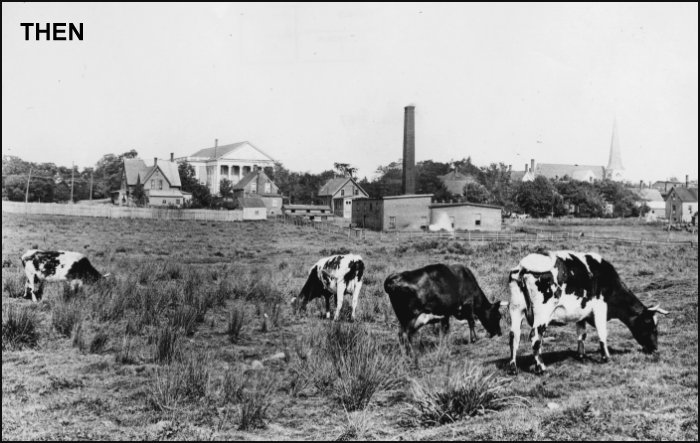
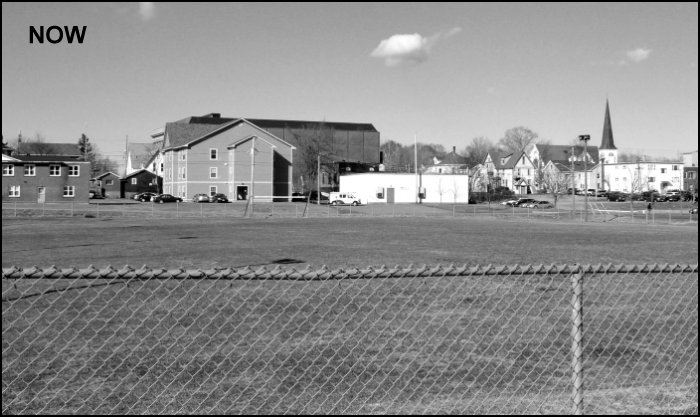
  5. Louisa Goldsmith (Beard) Willis (1858 or 9 — 1918)