The White Fence, issue #30

December 2005

Dear friends,

Little did I know that this year I would be celebrating Christmas with strawberries in mind! And, once you read this newsletter, I hope that you too will think of celebrating Sackville of the 1920s with strawberries gracing your holiday table. Because that was the last decade when strawberries were still being gathered in Middle Sackville from the fields of W. B. Fawcett by the children of this town. In 1928, the Sackville Tribune of 13 August wrote a cover article on this extensive and successful strawberry business run by W. B. Fawcett and of which little remains today.

To the folks of Hedge Court in Sackville: did you know that that the “hedge” referred to in your street’s name relates to spruce hedges which were originally planted as wind breaks for the extensive strawberry fields located where your houses and paved driveways now sit? And on the other side of Main Street, where the Doncasters have their farm (Highfield Farm) there were once acres and acres of Fawcett strawberries.

Hearty xmas greetings

Hearty Xmas Greetings

Read about the man who originally owned the land from which he produced basket upon basket of these juicy red berries; berries grown, picked, packaged and sold from our small town. My great surprise about this is that it was not that long ago … and virtually nothing remains of it! Our dear friend and colleague, Al Smith, remembers picking berries on those lands as a child. I am quite sure that many other very successful businesses once existed within our borders and of which we know little-to-nothing about, nor the good folks who ran them. So I ask you readers to let me know about these so that I may tell our growing readership about interesting businesses of past years that Tantramar fostered and of which many of us know too little about. And the sources might surprise you. While digging into the old newspapers in the Mt A†archives, Al Smith came upon the W.B. Fawcett story and passed it on to me. And by painting those words on the White Fence , everyone can now read about this fascinating story.

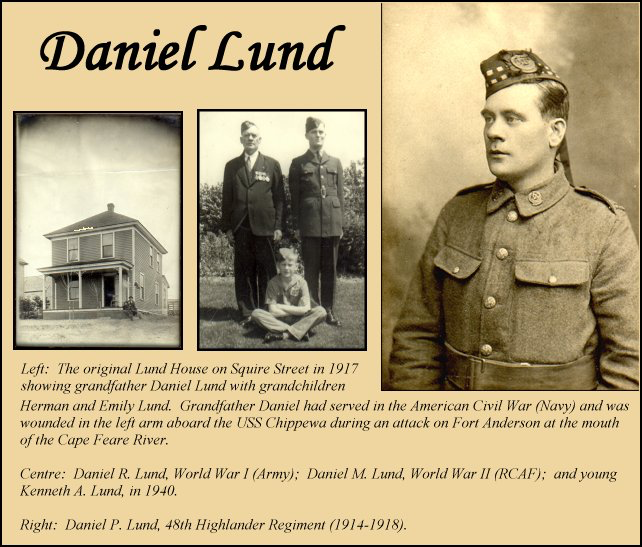
And speaking about fascinating … in our last White Fence, Kenneth Lund told us about his father and grandfather and now that you have all been informed about these fascinating gentlemen in issue no. 29, I now have the honor of introducing you to them. After the article was written, Kenneth’s brother Daniel Lund showed Al pictures of his dad and granddad in uniform and when Al showed them to me, I felt that it was important to introduce them to you. So please look at the photos herein but then have another read in The White Fence No. 29 and learn again about these fine gentlemen from our recent and proud past.

Throughout this issue, you will notice attractive little Christmas cards which were provided to us by Mrs. Helen Smith. These are Christmas wishes received by the Hicks family between 1916 and 1920. What I find especially interesting about them is that inside the cards are individually-printed Christmas wishes, attached to the folding covers with either a ribbon and/or colorful piece of string and, in some cases, the senders’ family name was printed. This shows how much time and attention (and cost!) was devoted to producing these good wishes and, consequently, probably sent to just a few friends and family rather than en masse mail-outs which have become more traditional today. Thank you Mrs. Smith for sharing these family best wishes with us and, to you and all our readers, please accept the Tantramar Heritage Trust’s most sincere good wishes for a happy and healthy holiday season.

And please continue reading The White Fence throughout 2006 … and, if you can, enjoy some fresh strawberries over Christmas and throughout the new year!

Best wishes to all

—Peter Hicklin

Boultenhouse Heritage Centre Capital Campaign

fundraising bar graph
  • Fundraising target: $60,000
  • Raised to date: $42,386
  • Friend of Boultenhouse: 28
  • Schooner: 21
  • Brigantine: 5
  • Brig: 2
  • Barque: 1
  • Full Rigged Ship: 2

Pioneer Strawberry Grower of the Tantramar

Interesting Sketch of the Career of Mr. W.B. Fawcett, Who Has Always Dearly Loved to Play at the Game of “Doing Things”

(By Samuel Clarke in “The Farmer’s Guide”)

Mr. Frank W. Wry, farm manager for W.B. Fawcett with berries for sale (1923)

Mr. Frank W. Wry, farm manager for W.B. Fawcett with berries for sale (1923). This photo was given to Colin MacKinnon by Carmel Miller, the daughter of Frank Wry. Please note that Frank’s parents were William and Arabelle (Inglis) Wry shown in White Fence no. 28, Figure 3.

Whether he was the first or not is perhaps not open to much doubt, but history certainly records Joseph de la Loutre, that determined opponent of British rule in Acadia caused aboideaux and dykes to be built for the reclaiming of some small sections of the tide washed lands along the Cumberland Basin and its tributary waters.

De la Loutre was evidently in large measure aware of the fertile nature of these tidal deposits. His astuteness in this regard has been amply confirmed by the British settlers who came to occupy these lands many years after. Soil fertility the equal of the dyked lands of Tantramar exists in few places, but the reclaiming of these lands from the mighty tides of the Bay of Fundy has been a job of real pioneering.

After about a hundred years after de la Loutre made his attempt at reclamation, there was born in the village of Upper Sackville, William B. Fawcett, probably none of the old pioneer farmers of New Brunswick (now living) have a wider experience in livestock, and mixed farming.

His seventy years of life is only a short space of time. But into its swift passage have been crowded more of the wonderful changes in our everyday life, than were witnessed by four or five such lifespans of former generations.

Industry and Thrift Fashionable

From the profit and pleasure now derived from all our modern modes of speedy travel and transport, he can look back to his own, and the common use of ox-teams, home-made wagons, sleds, saddles and wooden skates, for all such purposes, up to forty years ago.

He commenced at an early age assisting in clearing a farm out of worthless upland brush, and reclaiming bogs and lakes, into fertile hay lands, by the skilful manipulation of the muddy tidewaters of the Tantramar River.

Always frail and delicate, his school years were irregular and badly broken into with sickness, and enforced staying at home, “doing chores” and other light work, both winter and summer.

Rigid economy and untiring industry were fashionable those days, both indoors and out.

Many a day he spent helping his mother picking wool, winding yarn spools, and passing the warp through the reeds of the big old wooden loom, to weave into the “unshrinkable” homespun, which she cut and tailored into suits, and overcoats, worn by father and the three boys.

The only cash crops his father had to sell in those strenuous days, were a pair or two of fat steers, two to five fat hogs, a few turkeys, and five to eight firkins of prime butter mother managed to save from four to six cows, pasturing in the bush.

Industry Rewarded

In a few years, however, those magical tides brought a considerable acreage of the bog, and lakes into heavy crops of hay, which (with what turnips could be grown) enabled his father to increase his annual sale of fat cattle to two, or three carloads, besides a few cars of market hay occasionally.

When a bit past twenty years old, he worked his passage on a cattle steamer from Halifax to Liverpool, just for fun and “to see the world”.

In the next few years he was sent on seven or more trips to different parts of Great Britain, entrusted with the care, and sale of one hundred to one hundred and fifty fat cattle, each time, belonging to his father, uncle, and two or three neighbors.

These trips afforded him wonderful opportunities of personally inspecting in all the best stock markets the results obtained by generations of British farmers in their experimental breeding of all the standard breeds of beef and dairy cattle, horse, sheep and pigs.

Keen Public Interest

Before these trips ended he was repeatedly elected as one of the three Commissioners, in charge of the Tide Canals, ditches, roads, and fences on the Seven Thousand acres of Hay Lands, called No. 6 in Upper Sackville.

The standard wage paid to expert tradesmen in those public works was $1.25 per nine-hour day. The men traveled often three to six miles from home. The Commissioners were limited to $2.00 per day. Certainly these were no great extravagances.

Meanwhile, he was actively assisting until thirty years of age in adding to the home farm as well as buying other property for the two younger brothers, and two sisters. About this time his father and mother retired to live nearer town. As the younger ones had all left and settled; it seemed necessary for him to marry, or go it alone.

Operating largely on borrowed money, and with farm produce bringing small prices, progress was slow the next ten years. Quitting the European trips, and the Commissioner’s duties, and with closer application and hard work, the annual output grew to three or four carloads of beef cattle, and one hundred tons or more of market hay and a few acres of strawberries.

Success and Disaster

In the meantime further borrowings were made by him, and his second brother, and invested in cattle ranching in Alberta in partnership with the third brother lately settled there.

The next ten years of extension both East, and West, was easier, and at times afforded some recreation. In all, twelve trips were made to the Western ranch being several times accompanied by members of his family.

For six consecutive years he and his brothers sold annually from the ranch 200 fat cattle, and a carload of horses. But in 1906 when the stock had increased to 1000 head, and everything looked bright with the American market opening up, he met his “Waterloo” in the loss of his only remaining child, a fine boy of eighteen, who, at the time, was visiting the ranch with his father.

William B. Fawcett

William B. Fawcett

strawberry farm in Sackville (circa 1930)

Picking strawberries in Sackville (circa 1930)

Broken but Undismayed

Utterly broken in health, and courage, sadly shattered, the ranch was eventually sold, and he continued to operate the home farm in beef, hay, and small fruits. His berry patches were soon increased to eight or ten acres, not so much for the money he might make, as for the diversion that constant work afforded toward living down his grievous family losses.

Inside of the two years more, the doctors ordered him to quit work immediately, or prepare for his own early funeral. Leasing the farm for three years, he moved to town, but could not be persuaded to remain so long away from his berry fields, or to give up his “hobby” of exporting strawberries to United States markets. Calling in twelve of his neighbors, he urged them to plant their best fields to berries, and to help him to load iced carloads for Boston. Four or five responded handsomely, but still there were only half enough grown to load full cars.

Further Expansion

In 1914 without consulting his friends, he purchased the late Governor Woods 200 acre homestead farm, the best in New Brunswick, as he himself will admit. Just to carry out his “fad” of making Sackville the best, and largest “strawberry point” east of Toronto. To better ensure his purpose, he incorporated this fine property, along with his other Sackville lands, as “Tantramar Fruits Limited” For the next few years, with two large farms producing, his annual crops ran up to 400 tons of stock and market hay, 100 head of beef cattle and 2500 bushels of strawberries, and as many or more bushels of oranges and grapefruit in Florida.

Although there were soon enough berries grown to load a few cars, the prices and demand in local markets were so good, it was not until 1921 that the first three iced-carloads were exported to Boston. One of these cars was entirely loaded by himself, and the larger part of the other two.

Seeing this old “hobby” fast growing into a profitable success, fully a hundred of his neighbors rushed into planting berries, little thinking these war-prices might soon drop to the level of other farm crops.

To the general surprise, Sackville’s soil, climate, and the skill of her farmers, all proved so very congenial to strawberry culture, that sixty five carloads were “billed out” from the depot in 1923, besides hundreds of crates from adjoining parishes.

Completely satisfied, at seeing “small fruits” added, as one more of Sackville’s farm crops already outstripping the production of this industrious manufacturing town in value of product, he was forced by severe ill-health to curtail operations, and to lease his Tantramar Fruit Farm, and other Sackville lands to his nephew three years ago.

When asked as to financial success he replied in characteristic reminiscent vein “while mistakes and losses have been many, on the whole, I have made some money, but labor, transportation, capitalists, and promoters of all kinds have got every dollar I ever made. No, not wealthy by any means, just land poor.”

And yet he manages, by careful planning and close attention to detail to dig up a paltry twelve hundred dollars in cold cash each year to meet the taxes assessed against the valuable properties which he has developed by tireless energy and acquired by purchase. Indeed as he would express it, the chief himself wealth he has, is in the experience he has gained, the land which he has made to produce better and the satisfaction which he has enjoyed in knowing that the pioneering work which he has done and even the financial losses which he has borne have in some measure shown the way to his neighbors and friends.

A review of the mature years of W. B. Fawcett, would not be complete without reference to his other activities. As a student of public affairs, he has few equals in his ability to blow aside the chaff of popular public opinions so frequently inspired by interested parties and winnowing out the plain underlying common sense truth of public interest.

A.R. Fawcett letterhead advertising A.R. Fawcett berries dated August 1st 1923.

A.R. Fawcett letterhead advertising A.R. Fawcett berries dated August 1st 1923.

The Game of “Doing Things”

While he has never felt that he had time to join his friends in the more fashionable pleasures and sports of the day, yet he has always dearly loved to play at the game of “doing things.” His highest ideal of a “true sport” is the man who best wins out in the strenuous race of service to his own community. His definition of a “crank” is, that which makes the wheels of progress go round.

While serving as Commissioner of District No. 6, Mr. Fawcett persistently advocated the further extension and of the Six Tide Canals on the Upper Tantramar so well designed and promoted by Tolar Thompson (and those pioneers who followed) to transform another ten thousand acres of bog and lake into prime dykeland.

Later on, during the few years he spent in the Town of Sackville, as an invalid, he was twice elected as Alderman in East Ward, and took an active part in doubling the reservoir capacity of the Town Water supply, as well as other improvements.

It was only natural that his energetic manner of promoting public improvements, which usually mean increased expenditures should meet with the usual oppositions and censure — even though the money be well and judiciously expended.

Occasionally, when relating old time incidents, Mr. Fawcett will mention what he terms the very best compliment among the few ever thrown his way. It came, he said, from a certain local newspaper, which publicly accused him of “dominating the Town Council.”

Sturdy Fighter

But he has not only been a thoughtful student of questions pertaining to the public well-being, but he has been a frequent contributor to the press. His letters have been universally lucid in expression, robust in style, as well as unequivocal and positive in their meaning and purport. His ndependence of thought has not tended to make him popular with those who claim for themselves an almost divine right to dictate public opinion but his sturdy courage has always commanded respect, even from those whose gods he has shattered.

As a sturdy fighter of three score years and ten who has achieved with and against the forces of nature more than an average measure of success, one can easily picture him as he becomes reminiscent of his fruitful years, repeating to himself —

Twas a glorious game from the opening bell, Good plays, bad plays and thrills pell-mell; The speed of it burned my years away, But I thank Great God that He let me Play.

The Lund Family

Daniel Lund. Left: the original Lund House on Squire Street in 1917 showing grandather Daniel Lund with grandchildren Herman and Emily Lund. Grandfather Daniel had served in the American Civil War (Navy) and was wounded in the left arm aboard the USS Chippewa during an attack on Fort Anderson at the mouth of the Cape Feare River. Centre: Daniel R. Lund, World War I (Army); Daniel M. Lund, World War II (Royal Canadian Air Force); and young Kenneth A. Lund, in 1940. Right: Daniel P. Lund, 48th Highlander Regiment, (1914–1918).

Lund military service medals

Left: Medals display the proud military service of Daniel P. Lund and Daniel M. Lund during World Wars I and II.


Please note that on Heritage Day in February 2006, a compendium of the first 30 issues of The White Fence will be made available to all. So when the 2006 Heritage Day rolls by, please support your Tantramar Heritage and pick up copies for family and friends! In the meantime, have a great (strawberry) Christmas!

—Leslie Van Patter and Peter Hicklin on behalf of the Tantramar Heritage Trust Board of Directors.

The White Fence, issue #29

October 2005

Announcement

It is with great pleasure that the Tantramar Heritage Trust Board of directors wishes to announce that Rhianna Edwards has accepted the position of Administrator with the Trust. She will be working at the Trust Office on Tuesdays and Wednesdays. Welcome back, Rhianna!

Tantramar Historical Society Meeting

  • Thursday, November 10th, 8:00 pm, Sackville United Church
  • Paul Surette will be speaking on The Resettlement of Memramcook after 1755

Editorial

Dear friends,

Welcome to a new season of Tantramar discovery! Our first White Fence of the fall season 2005 begins with a remarkable coat of new paint with lots of bright new colours! Back in The White Fence No.13, we had printed a photo of a picnic poster and I had asked if anyone had information about this very public picnic which was being announced at the time. Well, Al Smith knew all about the annual Labor Day Picnic in Sackville and went out and dug out old newspaper articles describing those very special events in Sackville. So join Al and I in reading articles from the 1928 and 1929 Tribune about the annual picnic at Silver Lake as well as notes about “the old days” in Sackville as told back in 1929. Thanks so much Al! And, as you will soon see, you thought that the Town and Gown “conflicts” in Sackville were a quiet affair! The accompanying story on this subject may surprise you as much as it did me! And on a completely different playing field, the fascinating story of Daniel Lund will bring the American Civil war much closer to home than you ever thought! Thank you so much Kenneth Lund (brother of Daniel Lund in Sackville) for telling us about your most interesting ancestor! Furthermore, Colin MacKinnon takes us back to Tantramar’s native history as more of his discoveries from the banks of the Tantramar River continue to make their appearances on our pages. I hope that many other readers will respond to our continuing request for information as Al and Kenneth and Colin did and that many of our readers will follow your examples and send stories about historic events and family stories in Tantramar. Always remember that The White Fence cannot exist without your participation! But I cannot waste more space here with my words as I am starting to worry how Leslie will fit it all in!

So I welcome you all to a new season of Tantramar stories and may you, as I continue to do myself, discover more about this fascinating region of Canada that we are all so lucky to call home! Read on and, as always (I hope), discover and enjoy!

—Peter Hicklin

PS: And a special note, on behalf of all the members of the Tantramar Heritage Trust to congratulate one of its founders and regular contributors, Mr. Al Smith, on being voted Sackville’s Citizen of the Year. Congratulations Al! We owe you much and thank you even more! This issue of The White Fence is all yours, dear friend!

Atlas of the Acadian Settlement of the Beaubassin 1660 to 1755

Now available from the Trust.

Atlas of the Acadian Settlement of the Beaubassin 1660 to 1755 [cover]

Atlas of the Acadian Settlement of the Beaubassin 1660 to 1755

The Trust is pleased to see the completion of a project that has been in the works for over two years. Author/Researcher Paul Surette has completed a 204-page atlas that is a momentous work which presents a detailed chronology of events leading to the settling of villages. The atlas maps the locales of families who founded these new settlements along the edge of the Tantramar Marsh and can be used as a road map to visiting these historic locations. It will be of great interest to all readers interested in Tantramar’s early settlement history, particularly during the period 1660–1755. The English edition of the Atlas is currently available from the Tantramar Heritage Trust at the price of $35.00 Cdn. The French version is expected soon.The Trust office is open Tuesdays and Wednesdays or you could call 506-536-2541 or email tantramarheritage@nb.aibn.com.

Tribune articles

The Labor Day Picnic

Thursday, August 23, 1928

PICNIC FOR LABOR DAY

Posters are out announcing the annual Catholic Picnic, which has been held on Labor Day for many years. It is the last big outdoor event of the season and this year it is the only one to be held at Silver Lake. As usual a well chosen committee will take care of the hungry and supper will be served.

All the usual attractions will be found along the midway. Swimming and running races will be conducted. Big Jumbo is again ready to take the air during the afternoon and for the evening a new attraction is being provided.

PICNIC ATTRACTION FOR LABOR DAY

Monday, 27 August, 1928

Catholic Picnic at Morice’s Lake Will Provide Entertainment

Once more Silver Lake will be a scene of action for it is on the banks of this beautiful lake that the annual Catholic Picnic will be held next Monday afternoon and evening. Strange to relate it will be the only picnic held at this ideal place this season, although scores of young people are to be found either swimming or boating there each day. Students attending the summer school passed many pleasant hours there. Next Monday an opportunity will be given all to enjoy the beauties of the lake. Motor boats will be operated, while sail boats and small craft will be out on the water. A live midway with new features will give you a chance to play your favorite game. Band concerts will be given by the Citizen’s Band. Swimming and running races, open to all, and prizes for the winners, will prove interesting. In fact, it is to be a real old time get-together picnic, and, do not miss seeing the elephant hit the clouds, or, the balloon ascension; both are worth the trip to the lake. Come and bring the family.

Afternoon and Evening Programme

1.45 — Running races, four classes
2.00 — Band Concert — Midway attractions of every description during the afternoon
4.15 — Swimming races, two classes
4.30 — Band Concert
5.00 — Big Jumbo takes the air
7.00 — Midway in operation during the evening
7.30 — Balloon Ascension
9.30 — Prize drawing and auction


Thursday, August 30th

Labor Day Picnic

AT SILVER LAKE (MORICE’S POND)

AFTERNOON AND EVENING

GAMES AND AMUSEMENTS OF ALL KINDS
BAND CONCERTS AND FREE ATTRACTIONS
BOATING AND BATHING
SUPPER SERVED AT 4.30

The last big picnic of the season


September 6, 1928

BIG CROWD AT SILVER LAKE ON LABOR DAY

Catholic Picnic Was Pleasant Affair, But Rain Cut Short Evening Program

The Catholic Labor Day picnic held at Silver Lake, Middle Sackville, on Monday last, attracted a big crowd in the afternoon, but unfortunately rain started about 5 o’clock, putting a damper on the celebrations which were concluded at an early hour.

Swimming, boating and races were the principal attractions of the afternoon, and the midway was well patronized. Hundreds of visitors sat down to a delicious supper daintily served by the ladies, and delightful music was furnished by the Sackville Citizens’ Band. The balloon ascensions did not materialize on account of the rain.

Mrs. John Carter and Mrs. Hector Sutherland had charge of the organization work and with the able assistance of the various committees carried on the work in a very efficient manner.

Winners in the sports were:

  • Running races, girls under 12 — 1st, Florence Stokes; 2nd, Jean Ayer; 3rd, Margaret Lorette. Girls under 14 — 1st, Vera Stokes; 2nd, Elsie Lorette; 3rd, Hazel Phinney. Girls under 16 — 1st, Nora Hicks; 2nd, Fay Balsar; 3rd, Alma Bulmer.
  • Running races, boys under 12 — 1st, V. Beal; 2nd, F. Carter; 3rd, A. O’Neal. Boys under 14 — 1st, E. Hachey; 2nd, A. Fullerton; 3rd, T. Best. Boys under 16 — 1st, W. Hicks; 2nd, G. Fullerton.
  • Senior race — 1st, J. McDonald; 2nd, R. Milton; 3rd, J. Estabrooks.
  • Swimming race, 50 yards, boys under 16 — 1st, H. Fagan; 2nd, L. Dupuis; 3rd, E. Rogers.

Daniel Lund — American Civil War Veteran

Editor’s note: Most Sackville residents have little knowledge of Sackville’s contribution to the American Civil War. A conflict that pitted North against South during the years 1861–1865 seemed very distant from our shores, but at least one Sackville-built vessel, the steamer Westmorland, from the Boultenhouse Yard, was used as a troop transport. Additionally, at least 25 Sackville-area men served in military units associated with the conflict. One of those veterans was a young lad from Cookville and we are most privileged to have a brief account of his life researched and written by Kenneth Lund, a grandson.

Daniel Lund 1845–1919

Daniel Lund was born in the community of Cookville, County of Westmorland, Province of New Brunswick, in 1845.

Cookville was then a subsistence-farming area with emphasis on tending the ditches of the nearby Tantramar marshlands and harvesting its nourishing salt marsh hay at the end of the summer. With the coming of winter, attention shifted to the cutting of virgin evergreen forests, sometimes on the farm woodlot for next winter’s fuel, and sometimes working for wages in the area’s lumber camps. To perform both, horses were essential and their care and feeding underlay all farming life.

The sea was also nearby, pressing to force its way through the laboriously-maintained dykes during the spring and fall high tides or calling the young men to go down to the sea in the ships that docked at the recently-constructed Sackville wharf (1841), or slid from the slips of the many shipyards in the great ox-bow of the Tantramar River.

Family oral history has it that Daniel listened to the call of the sea and shipped out of the Port of Sackville with Captain Lise (Elisha Stiles) Towse, Master Mariner, a relative and close family friend. In the Lund family, the exploits of Captain Lise Towse were legendary and young Daniel could not have a more protective and knowledgeable seaman under whom to learn the rigours of sailing.

On one voyage, the crew tested their Captain who boasted that he could recognize any harbour in the world in a fog if given some muck from the anchor to smell. Young Daniel had previously taken a handful of earth from an aunt’s flower garden and smeared it on the anchor in the dense fog of Boston Harbour.

“The saints preserve us!” Captain Towse yelled with the anchor mud stillat his nose. “We’ve had a terrible flood in the night and we’re tacking directly over Aunt Alice’s geranium patch!”

Daniel made a number of voyages including at least one along the Maine coast to visit Lund relatives who had settled there. In the fateful year of 1865, he was in Brooklyn Yards, New York, when an apparently golden opportunity presented itself. He was made a substantial cash offer to serve in the northern forces for a three-year term in place of the son of a wealthy merchant. At that time, the war was coming to a close. Wilmington, guarded by the formidable fortifications of Fort Fisher, was the only port kept open by the Confederates and their sole lifeline to supplies from the outside world. He accepted the offer and joined the Northern navy on January 3rd, 1865, appearing on the Muster roll of his vessel (#287 Roll 3) as having a dark complexion, with dark brown hair and hazel eyes, standing 5 foot 7 ½ inches. His occupation was shown as mariner.

At that time, the Northern leaders were massing to attack, for a second time, the stronghold of Fort Fisher. Included in this preparation were several gunboats including the U.S.S. Chippewa, a wooden screw-steamer gunboat of 507 tons armed with one 20-pounder and two 24-pounders. Able bodied seaman Daniel Lund first served on the U.S.S. Malvern but was later assigned to this ship and sailed on it with the attacking flotilla to the mouth of Cape Feare River.

Before Fort Fisher could be attacked, the outlying Fort Anderson at the river’s mouth had to be traken. So, on February 18, 1865, the Chippewa and the other gunboats moved to within a thousand yards of Fort Anderson and opened a rapid and well-directed fire. The defending Confederates returned fire for about half an hour before seeing that their position was untenable and retreated to Wilmington.

Unfortunately for Daniel, the defender’s shells were well-fired and the Chippewa was hit. Lieutenant-Commander David D. Porter wrote the following: “I have to report that on board this vessel (U.S.S. Chippewa) in the engagement of today, William Wilson, 1st (captain of forecastle), was killed and Daniel Lund (ordinary seaman), wounded in the left arm (arm since amputated).” The amputation was above the elbow leaving a short stump. He also sustained a 4 ½” flesh wound in his left thigh and a bowel rupture which would later be contained by a truss. After less than seven short weeks and one long day in the service of the Northern navy, the seafaring career of Daniel Lund came to a painful end.

After convalescing at the U.S. Receiving Ship, Vermont, Daniel was discharged from the U.S. Navy on June 2, 1865, with a Navy pension of $8.00 per month. He initially directed that it be sent to Portland, Maine, where it is presumed he went immediately following discharge. Some of his later pension papers show him living for a period in Calais, Maine, but he eventually returned to his birth community and began the difficult task of reshaping his life as a one-armed farmer and woodsman.

His pension must have helped greatly as it increased over the years to $15.00 in 1866, $18.00 in 1872, $20.00 in 1874, $24.00 in 1875, $30.00 in 1885 and finally $35.00 in 1903. This would have been a substantial sum in the then cash-poor communities of Cookville and Sackville.

He continued to enjoy good health and learned to use his stub left arm for holding objects or the reins of his horses by pressing it tightly to his body. He prospered sufficiently to persuade Amy McPhee, a young woman from Upper Sackville, one year his junior, to marry him on December 25, 1869, and to start farming on a homestead on the Aboushagan Road. His farming life thus began shortly after the creation of the Dominion of Canada in 1867 and he appears to have prospered as the country did: slowly and with much hard work. He and his wife remained there for more than 30 years and raised a family of five sons (Thomas, Seth, Gordon, Frank and Daniel Jr.) and two daughters (Mrs. Richard Smith and Mrs. Norman MacLeod).

He was a muscular man with great vitality and his sinews were kept strong by his active farm labour. He once borrowed a steel plow from a neighbour and hoisted it to his shoulder to carry home. At the Four Corners, he met Reynolds Weldon and chatted with him for half an hour, and, all that time, he kept the plow high on his shoulder. He was also a strong swimmer and on annual picnics by train to Cape Tormentine, he would swim out of sight into Northumberland Strait.

He was strict with his sons and would not allow them the luxury of a horse to drive to drive to Sackville to court their girl friends; he believed that after a day’s work, his horses had earned their rest.

He was a community man who regretted that there were often not enough young people in the school to justify hiring a teacher. If Daniel Jr. is an example, his high-spirited children may not have made easy students. Daniel Jr. told of reporting to school with this boast: “Look at what I did! I came in through the window even though the door was wide open!”.

He did take a leading role in the building and maintaining the church hall. During its construction, an argument arose about which denomination the church hall would be. Some threatened to lay down their tools and go home if their denomination was not chosen. Daniel resolved the dispute by stating that it should be a church for all denominations, and, in this spirit, it was erected. He was a staunch conservative throughout his life, voting for, and vocal in, his support of the administrations of Sir John A. Macdonald, Sir Charles Tupper, Sir John Thompson and Sir Robert Borden. His ability to present a point of view forcefully resulted in his being asked by less articulate neighbours to speak on their behalf; he earned the reputation of being able to plead a case of law as well as any lawyer.

By 1866, the wound in his thigh began to cause problems. He suffered numbness and pain to the extent that his ability to walk became restricted. His oldest sons were now able to help and he continued to farm his homestead until the turn of the century.

On leaving his farm, he bought a house outside the Town of Sackville, on Squire Street Extension, and began to operate a meat and fish store on Bridge Street. He appears to have had a good business sense and bought additional property, on which he built another house as the clouds of the First world War began to gather. He sent one son, Daniel Jr., to that war.

As he and Amy grew older, he withdrew from business. He knew, and was known by, most of the residents of the town. His obituary was to say that he was well-respected and highly-regarded. He had astutely prepared for his death by distributing his assets among family members so that at the time of his death, he had nothing except his war pension and the agreement of his son Daniel Jr., to maintain Amy and himself for the remainder of their lives.

By the end of his life in his 74th year, his war rupture caused increasing trouble. On May 24th, he took the train to Moncton to the nearest hospital and surgeon. He was operated on immediately and the operation appeared, at first, to have been a success. But the ordeal was too much for his ageing body and he died on that day in 1919.

He was the first of three generations of Daniels who served in the armed forces. He, of course, served in the navy and was badly wounded. His son Daniel served in the Canadian army in World War I and was also wounded but not so severely. His grandson, Daniel, served in the Canadian Air Force in World War II and was the only one of the three not to suffer wounds.

The Sackville Tribune — 28 February, 1929

TELL OF OLD DAYS IN SACKVILLE

Lads at Wood Point Way and Upper Sackville
Rather Resented the Academy Settlement — Organized Squad Attacks ______________

A writer in the Moncton Times tells of old days at the Sackville Academy, and incidentally refers to things around Sackville seventy five or eighty years ago. For instance, the writer says the year after the Academy started (1843) a shipbuilder at Wood Point, Christopher Boultenhouse, opened a shipyard on the banks of the Tantramar. During the next thirty years it was rarely his yard did not contain two or three vessels on the stocks. He sold them in the Liverpool markets. Charles Dixon commenced building about 1850. His last vessel built in 1856 was the Sarah Dixon — 1400 tons. To show the ups and downs of the business, he refused £14 per ton for her, but later sold her for £8. Six-oxen teams with huge logs from the forest were seen continuously passing the Academy to the shipyards. Broad axemen and pit sawyers fashioning timbers were much in evidence, and on Saturday nights gangs of ship carpenters visited the taverns, filling themselves up with rum then commencing their real enjoyment in playing the game of raw heads and bloody bones, making the nights hideous.

It is recorded that the lads at Wood Point way and also Upper Sackville father resented the Academy settlement as an intrusion which they manifested by organized squad attacks. These were vigorously responded to by the Academy boys while the slugging was spirited, no real damage was done. Capt. Thos. Robson at the Great Bridge was highway master and he warned out the boys to do highway work. Some went; others did not. The leader of the latter was one Harry Tuck. He was summoned and fined. He refused to pay the fine and in default was arrested and conveyed to the jail in Dorchester, where he served out his time. When he returned he was acclaimed as the hero. He later became Chief Justice of New Brunswick. The chief games of the boys were hurley and handball. The champion of the former was a tall lad named Howard Sprague. The ball from his stick flew like a cannon ball, clearing a track through the avenue of boys. The Principal, Dr. Pickard, was an expert handball player. He was then, coat off, on springs, every bit of a broth of a boy.

A Heritage Centre for Sackville

by Al Smith

Christopher Boultenhouse's gracious old Georgian mansion

The Boultenhouse Mansion on Queens Rd, Sackville, NB

In July 2001, the Tantramar Heritage Trust acquired Christopher Boultenhouse’s gracious old Georgian mantion, constructed by the shipwright in the early 1840s. The property, located at 29 Queens Road, was purchased by the Trust thanks to the generosity of an anonymous donor with the final installment on our four year bank loan being paid off in July 2005. Rental income from the two apartments in the building has offset the costs of maintenance and restoration of this historic property and since the fall of 2002 the back section has housed the Trust’s office and meeting room.

When the property was purchased in 2001 the Trust announced that its long-term plan was to develop it as a Heritage Centre commencing in the fall of 2005. Thus, during the winter of 2004/05 a planning committee was very active developing details for a phased conversion of the property to a Heritage Centre for Sackville. Initially the downstairs main floor and the 2nd story above the Trust office will be retrofitted to accommodate exhibits and displays, an education room, the Family History Centre and a research library and depository for donated artifacts. The upper level of the main house will continue to be rented for quite some time to generate rental income to help offset costs of operation of the Centre/ Museum.

When open to the public in the fall of 2006, the Heritage Centre will house year-round displays and exhibits. Visitors will be able to relive the days when Sackville was a busy seaport and shipbuilding center, and depictions of our industrial past will focus on quarries (grindstones, building stone), foundries, leather goods and agriculture. Early settlement history will be highlighted around a rich collection of Wry family artifacts dating back four generations of residency in Sackville. Additionally, early maps and charts will help illustrate our glorious past.

Opening of the Heritage Centre will allow the Trust to establish a permanent administrative home with a full time staff person augmented by volunteers. That will greatly benefit all of the Trust’s many heritage projects as it will permit a more focused approach to planning, securing of grants and access to various employment programs.

In order to facilitate the conversion of the Boultenhouse property to a Heritage Centre the Trust is launching a one-year major capital campaign with a target of raising $60,000. Those funds will be necessary to retrofit the space (using contractors and up to 300 hours of volunteer labour). Work will include upgrading of wiring, heating and plumbing along with the installation of security and humidity controls. Carpets will be removed and floors, walls and ceilings restored to the near-original appearance. The funds will also allow for exhibit design and installation along with development of large-scale models of the Port of Sackville and of the Boultenhouse shipbuilding yard.

The capital campaign will commence in November 2005 with six levels of suggested categories of giving. All contributions will be tax receiptable and can be spaced over a period of five years if the donor requests. Donor recognition plaques will be prominently displayed at the Heritage Centre.

This is a major new endeavour for the Trust and we are most hopeful that the membership will respond positively to our request for assistance. Canvassers will be going out to the community in November and will provide much more detail on the capital campaign and its intended use. For those of you outside the immediate Tantramar area a capital campaign brochure will be mailed to you.

Sackville is a community with nearly 300 years of settlement history. Help us establish a unique Heritage Centre that will bring to life many aspects of Sackville’s storied past. Please consider making the Trust’s Boultenhouse Heritage Centre project a priority with your charitable giving over the next year.

For more information contact the Trust office at 506-536-2541 or any member of the Heritage Centre Capital Campaign: Peter Hess (chair), Frank Chisholm, Leslie Van Patter, Al Smith.

The “Coles Island Site”

Evidence of late archaic–early woodland people on the Tantramar River, New Brunswick

by Colin MacKinnon

It is well known that early inhabitants of this land used the waterways much as we use roads today. The larger river systems in New Brunswick, such as the Saint John and Miramichi Rivers, are dotted with aboriginal camp sites of great age. Nearly every fishing hole, portage route and headland showed evidence of prehistoric use. Small flakes of stone found scattered on the beach, refuse from the aboriginal artisan, is all that remains to tell the story.

We don’t often think of the Tantramar River as having a beach. The steep sides and muddy bottom generally hide any evidence of past human use. It is for this reason that as part of the author’s ongoing search for evidence of aboriginal use in the Chignecto Isthmus, the “River Brouillée” (the early French name for the Tantramar river meaning muddy or murky) was not a likely site to yield positive results. So, it was of some surprise that while searching for waterfowl along the edge of the river above Tingley Neck and adjacent to Cole’s island (site of Radio Canada International), I not only found an exposed beach but a beach not covered with mud but with sandstone cobbles and bedrock. At this location, the exposed face of the river bank was a snapshot of the history of the Tantramar Marsh. There, buried under about 3.5 m of tidal silt and mud, was the remains of an ancient tree (a hardwood of some type) made visible by erosion. The roots were still buried in a compressed layer of peat and grey soil while the trunk was encased in marsh mud (Figure 1).

Under this shallow peat/soil layer was a bed of sandstone, probably the an extension of the rise of land that constitutes present day Cole’s Island.

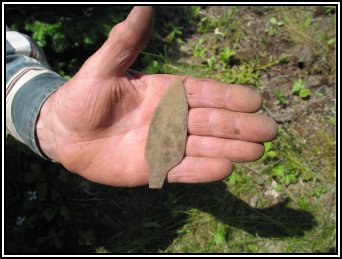
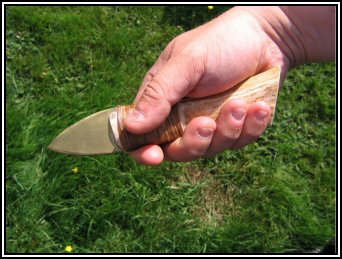
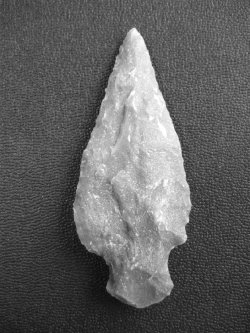
The result of my search of the beach was a very sparse lithic scatter, and an oval stone knife made of what is probably a local material commonly referred to as chert. On a later trip, I found a beautifully well-proportioned yellow/tan colour knife of sugar quartz (Figure 2). The few associated stone chips were a high quality, possibly exotic, unidentified material.

Especially noteworthy was the look of some of these stone fragments which resembled true flint, a relative rarity in New Brunswick. These few samples, discards from the flint knapper, are not at all common from other sites I have found in the border region and more closely resemble materials I have seen originating from Cape d’Or or Blomidon in Nova Scotia. My impressions that the stone chips were probably not from a local source was supported by the following observation on the quartz knife (Figure 2) provided by Michael Deal of Memorial University: “I am almost certain that the specimen is made from White Rock quartzite which is found in an extensive geological deposit that runs from the Gaspereau Valley to Middleton [Nova Scotia]. The lithics from the St. Croix site (near Windsor) consited of more than 30% of this material and it is probably more common on sites along the Gaspereau River (where it was likely collected). You often see the colour change that is present in your piece (i.e. a reddish brown to tan)”.

The estimated age of the above artifact, based on the typology, or shape characteristics, points to the Late Archaic or early Woodland period. This would suggest sometime between 0 and 1,000 BC (2,000 to 3,000 years old). Sadly, there was no associated charcoal, or other materials, that could be more closely dated or provide evidence of a more complete history of use of the site. However, the past history of this beach, as suggested by the buried tree and peat/soil layer, resting on a raised bed of sandstone, suggests that the “Coles Island Site” was once much drier and two to three thousand years ago would likely have been an area of comparatively high and dry ground to the river, maybe even at the head of tide. This short note on prehistoric human use of the Tantramar River, and potential trading or transporting of lithic materials from the Annapolis Valley of Nova Scotia, adds yet another small and fragmentary piece to the prehistoric puzzle of the Chignecto Isthmus and hints at the extent of regional trade, or transportation of goods, that occurred thousands of years ago!

Acknowledgements: A note of thanks to Pat Allen, Albert Ferguson and David Keenleyside for their speculations on site age based on the typology of one artifact and to Michael Deal thanks for identifying the potential lithic source of the quartz point. Provincial designation for the site is “MacKinnon — Coles Island”, and Borden designation is “BIDb-22” (Map 21H16).

Figure 1. Tree stump exposed along the banks of the Tantramar River.

Figure 1. Tree stump exposed along the banks of the Tantramar River.

Figure 2. Stone chert knife uncovered along the banks of the Tantramar River.

Figure 2. Stone chert knife uncovered along the banks of the Tantramar River.

The Sackville Tribune — July 12, 1928

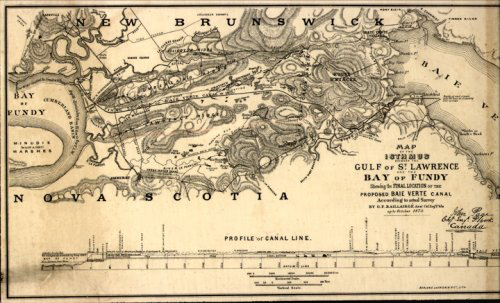
WORKED ON BAIE VERTE CANAL SURVEY 57 YEARS AGO

Mr. Dominic Leblanc, of Moncton, Tells of the Survey Made by a Party of Quebec Engineers in 1871

Moncton Times — Recent discussion on the Baie Verte canal project recalls to the mind of Mr. Dominic Leblanc, veteran employee of the M.T.E. and G. Co., of this city, the time he worked on the survey of the proposed Chignecto canal some fifty-seven years ago. Speaking to The Times in reference to survey made away back in 1871, Mr. Leblanc said he was employed on the work some eighteen months. The survey party, composed principally of Quebec engineers, was headed by a man named Bélanger. He recalls names of a number of members of the party such as Walsh, Thompson, Rosier, Sauvé, Giroux and an engineer named Munro, who belonged to Baie Verte. The late Geo. P. Thomas, who later became a barrister, also worked for the party about eight months, taking the data as to the rise and fall of the tides at Baie Verte.

A complete survey was made of the country through which the proposed canal was to run. The engineers three lines, the shortest of which was about fourteen miles. Crews of men worked at distances about 500 feet apart and they bored to a depth of 500 feet to ascertain the nature of the soil and rock. Extensive soundings in Baie Verte Harbor and in the Bay of Fundy were made, Mr. Leblanc says, and very complete data as to the feasibility of the scheme was recorded in maps made during the operations.

In all the survey party had 30 or 40 men employed on the work for nearly two years and at the finish the crew was increased to 150 men to rush the survey to a conclusion before winter set in. Soundings at Baie Verte at the last were made through the ice, Mr. Leblanc recalls.

At that time the railway between Sackville and Amherst had not been completed. Prior to going on the canal project survey Mr. Leblanc, who was then a young man of 21, had worked eight days on railway construction in that vicinity.

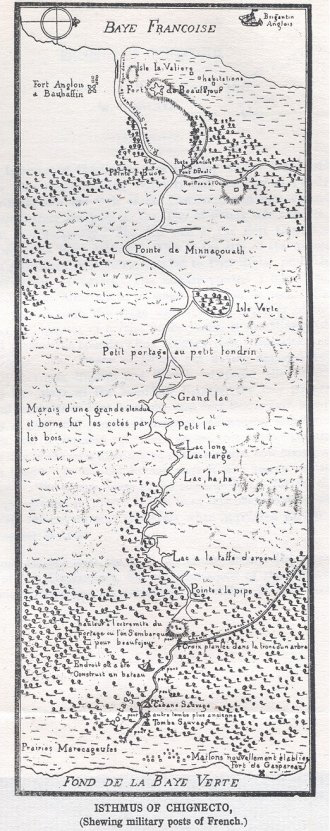
Map of the canal line

Map of the canal line

“Mission Accomplished… Really Accomplished”

New Brunswickers will long remember the date Jan. 06, 2005, marking as it did, the death of Hon. Louis J. Robichaud, premier from 1960 to 1970. His distinguished career was well documented in this newspaper by staff reporters Katie Tower and Joan LeBlanc. Because of this, it is not my intent to trespass on ground already covered. However, on looking over my schedule of columns for February, I noted that I had, much earlier, penciled in: 40th Anniversary of N.B. Flag, as a potential topic for this week.

I then realized that there was still time for a few additional comments concerning Mr. Robichaud’s career, and its transforming effect on the province. The adoption of New Brunswick’s provincial flag was yet another achievement of the Robichaud years. It took place in 1965, midway during his term and was very much in keeping with the vision that propelled Louis J. Robichaud forward.

Older readers will recall that Canadian politics was dominated during the early 1960s by the famous or infamous national flag controversy. Parliamentary debate was tied in knots for weeks on end, causing one commentator to call it the Great Canadian Flag Flap. Finally, and only after invoking closure, was the objective achieved in late 1964.

The distinctive Maple Leaf flag was raised for the first time on Feb. 15, 1965. Its fortieth anniversary was marked yesterday, on a day that has been designated National Flag Day. Also of interest, is the fact that the New Brunswick provincial flag was officially proclaimed a mere nine days later, on Feb. 24, 1965. The near coincidence of these events should not go unnoticed. Both call for recognition in New Brunswick on National Flag Day.

The two flags that date from 1965 differ in one important aspect. The Canadian Maple Leaf flag was first outlined from scratch on a table napkin at the Royal Military College in Kingston during a meeting attended by Dr. George F.G. Stanley (1907–2002), then Dean of Arts at RMC, and J.R. Matheson, MP for Leeds and confidant of Prime Minister L.B. Pearson.

Following this meeting, at Mathesons request, Dr. Stanley forwarded a four page memorandum outlining the rationale for the flag, accompanied by a sketch of what was eventually to become the new Canadian flag. Fortunately for posterity, the original copy of this historic document was accidentally uncovered in 2002 by Glenn Wright, a researcher at the National Archives. It had been misfiled!

As the majority of readers will know, Dr. Stanley, a longtime member of faculty at Mount Allison, later served with distinction, as New Brunswicks lieutenant governor from 1982 to 1987.

The design of the provincial flag of New Brunswick is a very different story as it combines various aspects of provincial heraldry. The flag design may be traced to the Coat of Arms originally granted the province by Queen Victoria on May 26, 1868.

Across the top there is a gold lion on a red field. This symbol goes back to Sept. 10, 1784 and the creation of the province of New Brunswick. The gold lion honours the royal house of Brunswick the source of the provincess name. (King George III was a member of the House of Brunswick.) The remainder of the flag depicts a stylized galley with oars in the water. It represents New Brunswicks place during the Golden Age of Sail.

Occasionally various organizations and individuals have suggested the addition of symbols to the flag in order to reflect the contemporary racial diversity of the province. What is not realized, is that this diversity was recognized on the occasion of the provinces bicentennial. On Sept. 25, 1984 during a royal visit to New Brunswick, Queen Elizabeth II officially authorized the addition of several features to the Coat of Arms. These honour the various ethnic groups within the province.

The next time you drive across the frontier to Nova Scotia, look for the distinctive red and gold New Brunswick flag as it flies proudly above the Missaguash Marsh. You cannot miss it, as in every season, the wind is always blowing!

To return the career of Louis J. Robichaud. During the 1960s we were living in London, Ontario; thus my impressions of the Robichaud years were largely gleaned from outside. However, I did meet him once. It was during the summer of 1960, just a few weeks after he took office.

The occasion was one of the Pugwash Conferences organized by Cyrus Eaton, the Canadian/American billionaire-industrialist. At the time, I was a member of a committee struck by Mr. Eaton to assist with local organizational details for the conferences. The previous 1959 Conference had attracted international attention and not a little controversy, as it dealt with the threat of chemical and biological warfare.

This era was the height of McCarthyism in the United States and Mr. Eaton was vilified and called a Communist for daring to invite distinguished members of the Soviet Academy of Scientists to the conference. The irrational opposition which he endured merely convinced Eaton, like Robichaud, a man of vision, passion and courage, that he was on the right track.

The theme of the 1960 Conference was the role that Education might play in advancing international peace. This was a topic close to Mr. Eaton and he never forgot his roots in rural Nova Scotia and the need for upgrading education. It was this background that led him to invite the four Atlantic Canadian premiers to the Conference. His hope was that rubbing shoulders with internationally renowned scientists and educators might have some impact.

Regrettably the only premier to accept the invitation was New Brunswicks newly elected Louis J. Robichaud. Mr. Eaton gave him a place of honour at the conference and requested that he bring greetings on behalf of the people of Atlantic Canada. That Premier Robichaud rose to the occasion would be an understatement. Although he spoke extemporaneously (in both official languages) for a mere ten minutes or so, he captivated his international audience. In congratulating Mr. Eaton on his choice of theme, Robichaud reminisced about his personal stuggle for education and assured the conference that reform in this field would be a priority for his new administration.

I remember little else about the occasion, except that Mr. Eaton made one prophetic comment: I am convinced that one day, this young politican will make a difference. It was to come true, much sooner than anyone might have then imagined.

During the Robichaud eulogies, one CBC documentary ended with a clip from a 2004 interview. Mr. Robichaud was asked if he had any parting thoughts. He smiled and replied Mission accomplished really accomplished.

Memories of a Dorchester Traveller: Part Five

More than six months have passed since my promise to present another travel adventure of the Dorchester traveller, Alexander Black. At the end of his extended trip to Europe in 1884–85, he confided in his diary (one might guess, with a slight trace of guilt) that he had been away much too long — a total of 369 days.

For the next two years he was content to supervise his farm, give attention to business interests and keep an eye on the legal dramas that always seemed to be unfolding at the Dorchester Court House. In between these pursuits, Alexander Black did not overlook two of his main interests — the welfare of the local Methodist church and the fortunes of the Liberal party in Westmorland County.

There was a federal election on February 22, 1887. Blacks disappointment with the result, both locally and nationally, was conveyed in a cryptic note in the diary: Mar. 1, 1887 — Declaration Day for the Dominion election. Conservative Josiah Wood re-elected in Westmorland County. Predictably, by the autumn of 1887 the lure of travel was, once more, asserting itself; and Black began to contemplate another trip.

But before this was to take place, Alexander Black opted for a short voyage, from Wood Point to Philadelphia on the schooner Arabella. [Mark the name of this vessel, as it will appear later under tragic circumstances.] Although he did not state a reason for the trip, it was obviously a test run, for he was part owner.

Toward this objective, Black made arrangements to haul a cargo of stone from Wood Point to Philadelphia. On Sept. 30, 1887 the Arabella started on her voyage; however, the southward leg of the trip was plagued by bad weather. First, rain, and a nasty headwind forced the schooner to lay to at Grindstone Island. The next day, the reverse happened off Quaco Head, when they were becalmed. Once Grand Manan was cleared, the weather settled down and reasonable progress was made. A straight course was set for Cape Cod via Matinicus Light [located on an island off the Maine coast.] Right on target, the famed Cape Cod lighthouse was sighted, and on Oct. 10th, the Arabella reached Vineyard Haven, Marthas Vineyard, and safe anchorage.

The remainder of the voyage to Philadelphia was routine, as the Arabella skirted the coastline. Black, always interested in navigation, recorded major landmarks enroute: The clay coloured cliffs of Gays Head, Barnegat Lighthouse, and Cape May, at the entrance to Delaware Bay. The Arabellas dropped anchor at the mouth of the Schuylkill River, and on Oct. 15 was towed to Grays wharf in Philadelphia, where the unloading of the cargo began.

The next day was Sunday and Alexander Black decided to explore the city. As soon as the Arabellas cargo was unloaded and replaced by ballast, the schooner weighed anchor for home. The northward trip was much faster, thanks to good sailing weather. As a result, the diary entries become brief, mentioning only familiar landmarks along the coast. Very early in the morning of Oct. 26th, Saint John harbour was sighted, and by 4 oclock that afternoon, the Arabella was safely docked at Dorchester Island.

The ballast was discharged and the Arabella immediately crossed Cumberland Basin to Downings Cove on the Nova Scotia side. Over the next several days the schooner was loaded with a cargo of lumber. Following a quick trip to Dorchester Island to take on additional crew, the Arabella set sail for New York on Nov. 12th. On the way, two days were spent anchored in the lee of Mount Desert Island, due to stormy weather. Alexander Black, never one to miss an opportunity, went ashore to mail letters and to purchase an oil suit for $2.75.

By Nov. 18th the schooner was headed for Cape Ann on the coast of Massachusetts. At one point, contact was made with another Dorchester built schooner, the Ethel Emmerson. Black went on board, undoubtedly to exchange gossip, but also to send some letters back home. Nov. 22nd saw the Arabella passing Cape Ann and Cape Cod on the same day. The schooner was anchored in New York and discharging cargo by Nov. 25th. When in New York Alexander Black never missed the opportunity to visit an old friend, Captain Samuel Etter, a native of Westmorland Point. The two were to spend a pleasant weekend catching up on nautical news. Black also arranged a charter for the Arabella to convey to Halifax a cargo of coal, oil and lumber. On Dec. 12th the Arabella left New York bound for Halifax.

Unlike his usual custom of combining business with pleasure, Black was planning some personal travel over the next few months. He decided to forego a return trip back on the Arabella and opted to miss a Dorchester winter. Instead he made arrangements to visit relatives in Florida. In particular, it was his wish to spend time with his brother James P. Black, whom he had not seen in over forty years. The trip south from New York was partly by steamer and later by rail. If he had not decided on this pleasure trip the saga of Alexander Black might well have come to an abrupt end. On its way from New York to Halifax, the Arabella was (as Black later found out) lost at sea and never heard tell of again.

On Dec. 17th he set sail for Savannah, Georgia on board the steamer Nacoochee. The first night was destined to test the mettle of even a seasoned sailor such as Alexander Black. In his words: the Nacoochee rode through a fearful southeast gale with very high seas. Later on he was to reach the tragic conclusion that Probably the Arabella and her crew were lost in this same gale. A combination of steam and sail, plus good seamanship was sufficient to save the Nacoochee and Savannah was reached on Dec. 19th. Following a day spent exploring the streets and squares of this historic city, Alexander Black took the train for Defuniack Springs on the Florida Panhandle. After a change of trains, he continued on to his destination, the town of Holt, where his brother and family resided.

In retrospect, the next two months became one of the most pleasant interludes in Alexander Blacks many travel experiences. Not only was he able to spend Christmas and New Years with his brother and wife and their extended family, Black availed himself of every opportunity to see as much as possible of the Panhandle Country. His frequent references to the delightful climate… abundance of tropical fruit the flowers in bloom, with butterflies and bees flying about everyday… all contributed to a very pleasant winter.

Holt was situated close to what is today the Blackwater National Forest. Boasting the largest holding of long leaf pine trees in the world, Black spent considerable time exploring the forest, noting in addition to this rare species of pine, dogwood, holly, magnolia and cypress trees. His one major excursion outside the Panhandle area was a trip with his niece Tippie Black to Jacksonville where they visited the Sub-Tropical Exposition.

Unfortunately our diarist was sparse on details regarding one highlight of this visit. Alexander Black and his niece had invitations to attend a reception for American President Grover Cleveland and Mrs. Cleveland — who were visiting the Exposition at the same time. While in Jacksonville they also managed two out of town excursions to Palatka on the St. John River south of the city and Fernandina Beach on the Atlantic seaboard.

By the end of February 1888, the call of business affairs caught up with Alexander Black. He was forced to bid farewell to Florida and start the long trip back to Dorchester via New York and Boston. Enroute, he spent considerable time in the latter city looking after the brigantine Bessie May. Repairs were necessary to outfit the vessel for its next charter. Also, by this time the loss of the Arabella was confirmed and both time and energy were taken up by matters relating to the loss of this ship and cargo.

On Apr. 16, he left Boston on the steamer New Brunswick bound for Saint John. From Saint John to Dorchester he travelled by rail and arrived home on Apr. 20. 1888 after an absence of six months and twenty days. Even though the roads were very bad, and there was snow on the ground; one conclusion was clear. The Dorchester Traveller was glad to be home safe and sound.

Tantramar’s Military Heritage III

The previous Flashback published on March 16 traced the origin and early years of the New Brunswick Yeomanry Cavalry. Tradition and history would continue to intersect as the Hussar story unfolded during the late 19th and early 20th centuries. In particular, the year 1884 was destined to be of great significance for the regiment. The story begins in August 1879, when the newly appointed Governor General of Canada, Sir John Campbell, the Marquis of Lorne (1845–1914) visited the province. Such a visit, while common today, was something of a rarity in the nineteenth century.

Of more than passing interest to the public, was the Governor Generals wife, Her Royal Highness Princess Louise, the fourth daughter of Queen Victoria and Prince Albert. Nicknamed by the press, the rebel princess, she was noted for her beauty, independent spirit and genuine interest in people. For example, when a scarlet fever epidemic struck Rideau Hall, the staff refused to serve the quarantined patients. The Princess single-handedly took over the nursing duties.

In 1879 while the couple were travelling by train from Moncton to Saint John, a stop was scheduled at Sussex, where a large crowd of spectators and a guard of honour was at the ready for inspection. You guessed it, resplendent in their Hussar uniforms, the latter were members of the New Brunswick Yeomanry Cavalry. As the train approached Sussex, the Marquis and Princess Louise readied themselves to take part in the ceremonies.

What happened next is best explained by another member of the party, Lady Mary Campbell: Suddenly, with a screech-whiz, we were rattling past Sussex and saw [the soldiers] lined up quivering and wavering like colours in a many coloured top. Someone had forgotten to tell the engineer that Sussex was on the itinerary!

To the credit of the Marquis, the train was halted, and with considerable delay, forced to slowly back up to the railway station. The crowd was already beginning to disperse when a lone piper started to play The Campbells Are Coming. The honour guard got its act together, the Marquis of Lorne performed his duties and made a short speech. HRH Princess Louise charmed the crowd. They then boarded the train with a hop, skip and a jump and rushed to Saint John where they had to keep the boat waiting for half an hour.

This incident is mentioned partly for comic relief, but more important, it guaranteed that the famous or infamous stop in Sussex would not soon be forgotten. It is not known who came up with the idea of asking HRH Princess Louise to grant permission for her name to be incorporated with that of the regiment. In any event, this took place in 1884 when it was officially listed as The 8th Princess Louises New Brunswick Regiment of Cavalry. With the name change came authorization to include in the regimental badge, a garter surrounded by the coronet of Princess Louise. The numeral 8th was simply military code for the District.

Gradually training for militia units was becoming organized on a more formal basis. The backbone was the summer camp, which was always strategically scheduled to occur between planting time and the haying season; or if after the latter, before the harvest began. It was soon a rite of passage for every able bodied young male to volunteer for the militia and thus qualify for the camaraderie and experience of summer camp. As time went on, the camp was to be held most often in Sussex, which was fast becoming the heart of Hussar country.

The next highlight in the history of the regiment came during the Boer or South African War (1899–1902). By the standards of twentieth century wars, the regiments participation in this conflict was small. Because of its status as a militia unit, members of the 8th Princess Louises Cavalry were forced to volunteer for service in other Canadian regiments. An unfortunate foreunner of later wars, was the first Hussar casualty resulting from active duty. Russell Hubley, a native of Sussex, was wounded in battle and forced to return home. Shortly afterward he died and was buried with full military honours.

During the period 1900 to 1914, the drama and excitement associated with getting ready for camp was captured by one spectator in Middle Sackville. The mustering point was always Blacks Store where a veterinarian would certify the horses as being fit for service. Then saddles and uniforms were assigned. When the day of departure arrived, all would gather from Midgic, Point de Bute, Middle and Upper Sackville and all points between and proceed to the railway station in Sackville. In addition to the Hussars, the infantry units were waiting, while the Sackville Citizens Band played martial airs. Sometimes the horses would balk at getting on the train and being tied up three abreast at either end of a boxcar. Once loading was over, the riders would stay with their mounts and play cards or sleep until the train arrived at Sussex.

During World War One members of the 8th Princess Louises Cavalry were again denied the opportunity to serve together as a unit. However, hundreds of Hussars fought at Ypres, the Somme and Vimy Ridge, to mention but three major encounters. A large number joined the Canadian Mounted Rifles and many paid the supreme sacrifice.

Within the ranks of officers, Lieut.-Col. Frank Bunting Black of Middle Sackville served overseas as Brigade Major, and Brigadier, suffering wounds during the Battle of Messines in Belgium. Prior to the war, Black had been elected MLA for Westmorland and became Mayor of Sackville in 1919. On Nov. 25, 1921, he was named to the Senate and for many years before his death in 1945, was his regiment’s Honorary Colonel.

Black’s military service covered more than half a century and established a precedent to be followed by several other members of the family. At one stage, no less than three of the six officers of the Hussars bore the surname Black. These included his son Major (later Lieut. Col.) J. Laurie Black, a graduate of Royal Military College, who was to serve overseas in the Second World War. Two sons of Major Walter Black (Lieut. Col. Frank B. Blacks brother) Capt. Robert and Lieut. John Black were also Hussars. The latter was killed in action during the Second World War, while serving with the Canadian Grenadier Guards.

The inter-war periods from 1918 to 1939 were destined to be difficult for the 8th Princess Louise’s Cavalry. It was also a time of transition for the regiment. The period has been well described by regimental historian Douglas How: These years were a jungle of dark things, of a depression such that men had never known before, of the rise and spread of dictatorial rule that pointed like ugly arrows to an ever growing menace to the free world. Poverty, pacifism and public indifference all helped to turn the eyes of government away from the brute facts of international life.

Within the regiment a major turning point was reached in 1935. Belatedly armed tanks had caught up with the cavalry. Mounted soldiering, which had been the norm for more than a century came to an end. The long military ride traceable as far back as 1825 and before that to 1775 was forever over. The age of mechanization had arrived. The old regiment was disbanded to be reborn as the 5th Armoured Regiment (8th Princess Louise’s New Brunswick Hussars.) The next Flashback, to be published on Apr. 13 will continue the Hussar story from World War Two to the present.

The White Fence, issue #28

April 2005

Editorial

Dear friends, Welcome once more to Tantramar’s historical watering hole. And in this issue, we deal specifically with one of Sackville’s long-standing watering holes; one that we’ve all known for a long time and, for many of us, still use on a regular basis: the Booster Pump along East Main St. in Sackville. You will likely be as surprised as I was to read what a long history, and the many transformations, this source of pure refreshment has undergone in this Town.

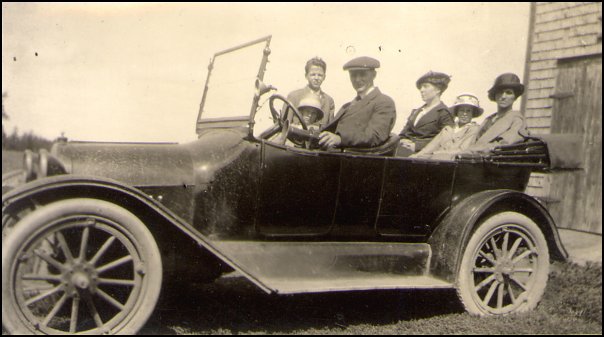
And then follow Al and his mother on a journey our ancestors regularly undertook by sail but, once Henry Ford came into the picture, we continued to pursue by motor vehicle once the necessary roads made it possible. It is a journey that I am sure many of you have undertaken before the trans-Canada and the I-75, as we know them today, were completed and paved (and likely used more than once!). Remember it one more time with us and let us know about your own travel experience(s) to the city of Boston.

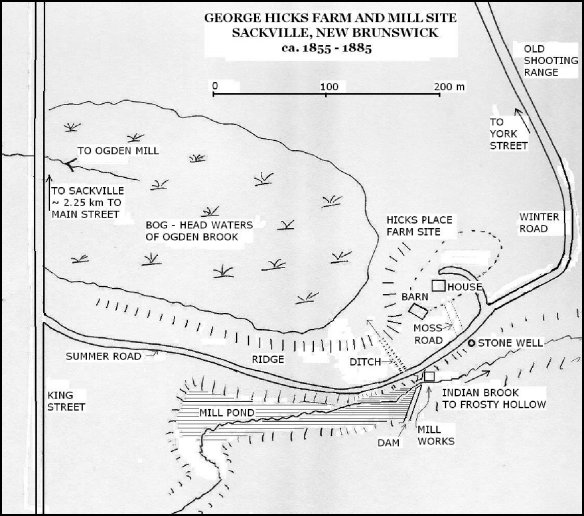
And then there is Colin MacKinnon who continues to discover and paint for us scenes and the personalities of pioneer life when grist mills and saw mills were part of the now-reclaimed Tantramar landscape… a landscape which had its very own Swamp Elephant!

Read on…

—Peter Hicklin

Did you know…?

  • Did you know that by June 1909, there were eight motor cars in steady use in Sackville? D.W. Fawcett had two, and F.B. Black, J.W. Black, F. Ford, W.T. Wood, R. Ryan and H.E. Fawcett had one each?
  • Did you know that Town Council first adopted Daylight Saving Time in 1934 and that it only applied to the months of July and August?
  • Did you know that in 1926 no motor vehicles were allowed on any of the streets, roads, highways, lanes or alleys of the Town of Sackville in the spring of the year when the frost was coming out of the ground without the permission of the Mayor?
  • Did you know the first STOP signs in the Town were erected in 1926 on Sackville’s principal streets where they joined Main and Bridge Streets?
  • Did you know that Sackville has been a “ducky” Town for quite some time? At the Town Council Meeting held on April 12, 1954, Alderman Warren asked — can anything be done about the ducks quacking in the Town, and disturbing people early in the mornings?
  • Did you know that efforts to build a Chignecto Canal across the Isthmus were still active in 1960? On March 14, 1960, Sackville Town Council authorised $40 in support of the expenses of the Cumberland County Chignecto Canal Committee?
  • Did you know that Frosty Hollow was formerly known as Mapleburg until the name was changed in May 1927? A post office operated there from 1910 to 1938?
  • Did you know that Fairfield was also known as Fairview? A post office, known officially as the Fairview Post Office, was established there in 1885 and operated through to 1909?

The Booster Pump

by Al Smith

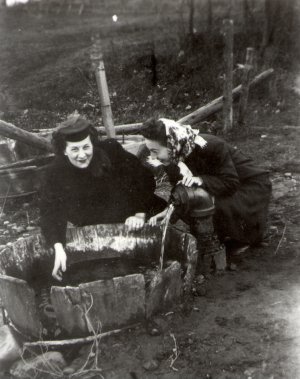
Twice weekly, the late Harold Geddes walked to the Booster Pump with his 4-liter plastic jug in hand. Upon filling the jug he would often hitch a ride back to his Bridge Street apartment and several times during the past few years I would pick him up on my way into town. Harold often commented about the “foul taste of town water and remarked that “the only place to get a decent drink was from the Booster Pumpî. It never occurred to me to quiz that long time resident of Sackville about the history of “the pump” nor did it ever cross my mind as to why an old overflow well should have the strange name of “Booster Pump”. Like many other residents of town I have been stopping at this watering hole since I was old enough to drive a bicycle, but until recently had no knowledge of the history of this Sackville landmark.

The Booster Pump

Bea Cormier (left) and Margaret Sudds at the overflow well at the Booster Pump site ca. 1950.

The story of the Booster Pump goes back to the year 1901 when Josiah Wood led a movement to incorporate the Sackville Water and Sewage Company. The Village was growing rapidly and needed water and sewer services along with better fire protection. A 14,000,000 gallon reservoir was constructed at Beech Hill and an eight inch water main supplied water to the town and a network of 20 fire hydrants. When the Town incorporated in 1903, one of Council’s first actions was the purchase of the assets of the privately-owned Sackville Water and Sewage Company. Since Josiah Wood was both mayor of the Town and president of the utility company, the sale went through with ease in October, 1903 for the price of $66,500.00.

With the town population growing in the early 1900s, along with an increased need for water to service the expanding foundries and Mount Allison institutions, water supply and pressure problems were soon evident. By 1913, water pressure at several fire hydrants within town was so slight that firemen had difficulty operating more that one fire stream (hose) from a hydrant. Larger fires would usually require four streams and, if the firemen did that, the pressure was reduced to about 25 pounds, not enough to throw water onto the roof. By 1915, water pressure woes were so critical that a joint committee of the Sackville Board of Trade and Town Council was formed to investigate corrective options. That committee reported to Council on May 6, 1915, strongly recommending that Council seek expert advice on a scheme that would see the purchase of a piece of land at Mahoney Brook upon which to erect an automatic electrical pump in connection with the water main. Later that summer, Town Council hired the firm of Doane Engineering of Halifax “to investigate the condition of the water system regarding quantity, available fire pressure and the best means of increasing both”.

The engineering firm reported its findings to Council in September, 1915. They found the water system suffering from neglect and in very poor condition. Simply by flushing and cleaning of the mains a noticeable increase in pressure was obtained at all hydrants. Doane Engineering also recommended that in order to increase the quantity of water supplied to the town one of the following steps would be necessary:

  1. Purchase of a fire engine to connect to a hydrant and pump water for fires.
  2. Install a distributing reservoir near town to be a source of water for fires.
  3. Secure an additional source and supply of water to be brought to town at good pressure.
  4. Install a new supply main from the reservoir and increase the size of some distribution mains.
  5. Install a “Booster Pump” at Ogden’s Mills on the present 8-inch supply main to force more water up over the hill at Ogden’s Corner and into town.

Of the five options listed, the installation of a booster pump was by far the cheapest. The engineering firm suggested that a 60 horsepower pump, either gasoline or electrically driven, would boost the pressure in the present system to about 64 pounds with four or five fire streams in operation. That would be a vast improvement over conditions that existed in 1915.

Town Council and the Fire Committee chose to further study the problem of increasing water pressure. Finally four years later on September 2, 1919, Council recommended “that a booster pump and electric motor be purchased and installed at or near Mahoney Brook” and that the cost “will not exceed $2000.00”. Subsequently, the Fire Committee was empowered to purchase an Allis Chambers “automatic booster pump” with a 40 horsepower electric motor at a cost of $1600.00. Once the pump was ordered, tenders were then solicited for the construction of a 14 x 12 foot concrete block pump house. Only one tender was received, that of $375 from Harry Cogell. The Fire Committee considered that amount excessive and after a chat with Mr. Cogell, and minor changes made to the plan, a more reasonable contract for $350 was signed — a saving of a whopping $25!

The recommended site near Mahoney Brook (the small brook that crosses Main Street just west of the booster pump) was apparently chosen by the local Fire Committee. Unfortunately the Fire Committee did not have the foresight to secure the land before signing the tender for the construction of the building. The preferred site to erect the pump house was on the side of the road on the town side of the brook near the Ogden farm. So with the contract signed for the building in late October, and the pump due to arrive within two weeks the push was on to secure a piece of land and get the pump installed before winter set in. The Chairman of the Fire Committee met with landowner Willard Ogden to secure permission to erect the pump house. But Ogden adamantly refused to co-operate with the town. With their “backs to the wall” the committee investigated a site on the other side of the brook in a field owned by Mrs. F.J. Wilson. After numerous meetings with Mrs. Wilson and the Road Commissioner, the matter was resolved. Mrs. Wilson refused to sell the 25 x 25 foot square property but agreed to a 20-year lease at ten dollars a year.

Contractor Cogell completed the pump house in late November 1919, but delays were experienced in completing the foundation and installing the pump. The Allis Chambers Company, the pump supplier, was very slow in providing the pipe fittings to connect the pump to the eight inch water main. Finally, in the spring of 1920, the necessary connections were made and the pump installed. However, connecting the pump’s 40 horse power, three-phase electric motor to the Electric Light Company’s supply lines was another matter. Such a connection required the purchase of two transformers and the utility company advised the town that it “could not afford to spend $500 for the purchase of same”. The matter was finally resolved with the town agreeing to share the costs of the transformers. Power was connected to the pump in late August, 1920.

Tests of the system were made on September 2, 1920, under the supervision of Mr. Smart from the Allis Chambers Company. Water entering the pump from the 8-inch main was at 55 pounds pressure and with the pump operating a delivery pressure of 130 pounds was achieved with the discharge pipe closed. When the discharge pipe was opened to the distribution system the water pressure was boosted to nearly double. Readings of 96 pounds were recorded at three gauges at the Fawcett foundry. Fire hoses were connected to the hydrant at the foundry and splendid streams obtained with a sustained pressure of 80 pounds with hoses operating. Similar tests were conducted at a hydrant at the Post Office again with excellent results. The pump was turned over to the Fire Department with great optimism that a very valuable piece of equipment was finally in operation.

The Fire Department supplied an operator for the pump, installed a telephone at the pump house for better communications during fires, and added an electric heater to prevent freeze-ups. The first big test of its effectiveness came on June 9, 1921, when a major fire broke out in the McKenzie building on Bridge Street. The Sackville Tribune reported “Booster Pump Saved Situation”. Mr. Thomas Ehrhardt, who worked the pump during the fire, stated that a steady pressure of 85 pounds was maintained throughout the fire. The general comments around town was to the effect that the Booster Pump paid for itself in providing a good pressure of water with which to fight a fire that menaced the whole town “. The booster pump also proved useful during a prolonged dry spell in the summer of 1921 when it was operated for an hour a day so that homes in the higher elevations of town could get water for domestic use.

Despite the obvious usefulness of the booster pump to the town’s fire fighting arsenal, it was the subject of much debate. As early as January 1921 Fire Chief F.W. Wry reported to Council that “this pump will never prove the success intended until it has sufficient water to feed from, the only way to get this extra supply of water is a new main or have a supply stored near the pump for fire use”. Many options to improve water supply were looked into including the use of the basin in the Pickard Quarry and even Morice Lake. Some time during the 1920s, a steam-driven well drilling outfit was commissioned to drill an artesian well at the site of the booster pump. It was thought that if such a well could produce sufficient water it would augment the supply to the pump. Unfortunately, the well did not produce a sufficient quantity of water to make any meaningful difference to the water supply.

In the late fall of 1921, the Town purchased its first fire engine — a new Bickle Fire Truck with a gasoline pump. Immediately, some town aldermen suggested that now the booster pump could be disposed with. In early February, 1922, Alderman Charles McKenzie shocked the town by giving notice that he intended to introduce a motion at the next Council meeting to dismantle the booster pump. McKenzie contended that the pump was an unnecessary expense to the town. In response to McKenzie’s action, Sackville Tribune editor C.C. Avard wrote a very pro-pump editorial in the newspaper and the Fire Chief scrambled to produce evidence of the value of the pump. The Fire Department conducted tests on March 1, 1922, at the hydrant in front of the Methodist Church (now United Church) which showed that the 40 pounds pressure at that hydrant could be boosted to 80-90 pounds within five minutes of switching on the booster pump. Firemen connected a fire hose to the hydrant and with out the booster pump working the fire stream could not reach the eaves of the church. With the booster pump turned on, the stream would go right over the belfry. The Fire Chief reported that he was much in favour of keeping the booster pump. Alderman McKenzie withdrew his motion to “kill the booster pump” at the March meeting of Town Council.

Concerns over the possible increase in fire insurance rates for the town was likely the leading reason for McKenzie’s change of heart. The new Bickle Fire Engine could not operate for most of the winter months and the only way to achieve sufficient water pressure for fire fighting was to engage the booster pump. Tests conducted in May 1922 by the NB Fire Underwriter also showed the increased effectiveness of the new fire engine if the booster pump first boosted the water supply pressure. Thus the death knell for the pump was staved off until ten years later.

Early in 1929, Council again began debating the need for a larger supply main from the reservoir and engaged the services of Moncton city engineer, Mr. Eddinton. Sackville town engineer Professor Frank West reported to Council in October 1929 that “no real satisfaction could be expected without the construction of a new water main”. In February, 1930 Council approved a motion to borrow $150,000 and issue debentures for the purposes:

  1. Increasing the water supply to the Town, enlarging and improving the present reservoir, and erection, if necessary of a second reservoir.
  2. Replacing the present water main with one of much large size to supply ample water for fire, water and sewage purposes.
  3. For generally extending and improving the water sewage systems of the town.

In June, 1930, Town Council approved a plan to construct a new 14-inch water main from the reservoir to town and to construct a second reserve reservoir above the old one. It was suggested that such a system should supply water for a population of 7,500 and that it would no longer be necessary to operate the booster pump, thus effecting a considerable saving each year.

Tenders for the construction of the new system were called in July 1930. Successful bidders were Stephen Brothers of Halifax for installation and the Canada Iron Foundries pipe supply. Construction proceeded through the fall of 1930 and was completed during the spring/summer of 1931. Three new artesian wells were drilled at the reservoir site in the spring of 1933 to ensure an adequate supply of water during summer months. Thus at long last supply and pressure problems that had plagued the town for over twenty years had finally been resolved.

After thirteen years in service, the Booster Pump was no longer necessary. Council passed a motion on May 1, 1933, to remove the pump, demolish the building and to discontinue the lease on the land.

The 40 horsepower Allis Chambers pump was initially stored at the fire hall then in 1939 reconditioned and sold. Council neglected to cancel the lease on the land until July 1935 when Mrs. Wilson was advised that the town no longer had any use for the land.

While the pump and pump house were removed in the early 1930s, the old overflow well remained at the site. An old wooden catch barrel served as water trough for horses and humans traveling to and from town. The old (c1950) photograph of Bea Cormier and Margaret Sudds at the artesian well shows the site as it appeared through the 1940s and 50s. In 1962, the overflow was cleaned out and, with the addition of piping, was relocated about twelve feet closer to the street.

The Rotary Club of Sackville and the Town gave the site a boost in 1987 when a small shelter and parking lot were completed. A new stand pipe was installed and landscaping and tree planting completed in 1988. The project was dedicated in July 1988.

Like Harold Geddes, generations of Sackvillians have enjoyed the refreshing taste of the chemical-free water provided free by the overflow at the old booster pump. But like many other landmarks in this historic community there is a fascinating history and its kind of nice to know “the rest of the story”.

Later this summer, the Tantramar Historic Sites Committee will unveil a bronze plaque at the site that briefly encapsulates the history of Sackville’s “Booster Pump”.

Boston Bound in 1925

by Helen Smith

The 1923 Chevrolet Touring Car that carried the Hicks family to Boston in 1925.

The 1923 Chevrolet Touring Car that carried the Hicks family to Boston in 1925.

Even today traveling to Boston by automobile is considered by many to be a major trip requiring some ten to twelve hours. But imagine making that trip in 1925 over roads that were in places barely more than a cow path. One of my fondest memories of growing up in Sackville was just such a trip with my family and a great adventure for me, a young girl of twelve.

Dad (Harvey Hicks, 1883–1953) was the second oldest of ten children in the family of Albion and Cecilia (Scott) Hicks of Midgic, NB. Four of the ten children married and moved to live in the United States in the early 1920s. Dad’s sister Nita married Tom Oulton and they moved to California, while his sister Ada and husband John Snowdon settled in Newburyport, Mass. Two others, Walter (married Mabel Richardson) and Gertie (married Leslie Fillmore) resided just outside of Boston in Norwood, Mass. Going off to the “Boston States” to seek employment opportunities was a common occurrence for young folks from this area during the 1920s.

Early in the summer of 1925, Dad announced that the family would take a vacation trip in August to go visit relatives in the Boston area. Since no one from Sackville had ever undertaken such a trip by car, our neighbours and friends thought that we were very foolhardy to ever attempt such a venture. Undeterred, father commenced preparing our 1923 Chevrolet touring car. Since the car did not have a trunk, a large cargo carrier was constructed and attached to the running board on the passenger side to carry our suitcases, food and other essentials. A large tent was rolled up and stored at our feet in the back seat. Extra spare tires and a hand pump were tied on the back. In early August, 1925 the family, two adults and four kids, set off on our great adventure.

Dad did most of the driving, but brother Hollis who was 19 at the time, also helped out from time to time. Amazingly at the end of the first long day on the road, and over endless miles of twisty and dusty gravel roads, we stopped just outside St. George, NB. Dad went to a farmhouse and asked permission from the farmer to put up our tent in his field. The farm folks were very accommodating and even allowed Mom to use their stove for cooking. Bright and early the next morning we departed St. George and soon after entered the USA at Calais. Just outside Augusta, Me. the car broke down and we had to be towed into town. We stayed at a campground while the car’s transmission was repaired, which took all the next day. I remember going on walks in the town and Dad gave us a bit of money to visit a “dime store”. I purchased a little amber glass boat that I still have.

After our unexpected lengthy visit to Augusta we continued on without incident to Newburyport Mass., arriving on a Friday night and were greeted warmly by Dad’s sister Ada. We stayed overnight at Aunt Ada and Uncle John’s, and promising to stay longer on our return trip, we pressed on to Boston encountering very heavy city traffic on Saturday afternoon. While stalled in Boston traffic a policeman on horseback came by enquiring where we were from. Intrigued that we had come all the way from New Brunswick, the policeman gave Dad advice on routing through the city to the suburb community of Norwood. We were all greatly relieved to arrive at Uncle Walter’s home later that day.

We spent a wonderful week in Norwood and I experienced many new things. Aunt Mabel had a brand new electric stove — the first one that I had ever seen. We made several trips into Boston from Norwood but didn’t attempt to drive in the city again opting instead to travel on the city transit system. For ten cents you could travel almost anywhere in the city on the elevated trolley cars. Imagine how wide-eyed a little Sackville girl of twelve must have been in the big city.

After a week of visiting we headed home, this time by-passing Boston and directly on to Newburyport where we spent the weekend. The remaining trip home was without incident except for one time, in an area of new road construction, the car slipped off the road into the ditch. We had to be rescued by a local farmer who pulled us back onto the road. Mother was quite frightened by that particular experience and threatened never to do the trip again. However, in the summer of 1930, in Dad’s brand new Chevy, we again made the trip to the “Boston States”.

Editor’s Note — At 91, Helen Smith has been a life long resident of Sackville; she is an active supporter of the Trust and has been a member since its inception. This story was recently told to her son Al who recorded it for the newsletter. We very much encourage other Trust members to contribute their stories of life and times in this historic community. The White Fence is your newsletter and we would love to hear from you.

The George Hicks Mill Pond and the Swamp Elephant

by Colin MacKinnon

map of George Hicks farm and mill site, Sackville, New Brunswick

Figure 1. Map of George Hicks Mill and Farm, Sackville, New Brunswick, ca. 1855–1885. Scale and locations are approximate.

The 1851 Census for the Parish of Westmorland lists 20 sawmills and 8 grist mills. Along with the blacksmith, these occupations were an essential part of pioneer and farming life. The following article sheds some light on just one of these mill owners; Mr. George Hicks (ca. 1815 – 11 Jan., 1894).

The “Hicks Place” (see Figure 1) was once the site of an active farm and grist/saw mill. Most traces of the dwelling and works are now gone, the basement has been reclaimed by the forest and traces of the old mill dam are covered in raspberry, alder and wire birch. I don’t know much about the Hicks family. George Hicks, the miller, was born ca. 1815. He was married to Mary Lowe (b: ca. 1813). They had at least seven children (Sarah E., Amos, Elizabeth, Rebecca, Frances E., William and Jane); although there is some discrepancy in the census records.

I believe Mary Lowe was a daughter, or near relative, of Tom Lowe who operated a nearby mill (see The White Fence, No. 6, May 1998). The Hicks mill was located on a separate lot from the farm and I think possibly that the mill parcel once belonged to Thomas Lowe. It appears likely that it was through marriage that George Hicks entered the mill business.

Figure 2. Hilyard and Norma (Campbell) Crossman and children. Family picnic at The Hicks Place ca. 1946/1947.

Figure 2. Hilyard and Norma (Campbell) Crossman and children. Family picnic at The Hicks Place ca. 1946/1947.

A few interesting stories have been passed down regarding the “Hicks Place” as it was a regular site for Crossman family picnics (Figure 2). Where once children played, and there was a field large enough for a game of soft-ball, there is no trace. The Hicks family gained access to their farm through two roads. One, more recently referred to as the “fire road”, leads from King Street to the site of the Hicks farm. The other road, known as the “winter road”, followed a trail that once existed, across a swamp, as an extension to York Street. During the WW II era, this trail formed part of a formal ìShooting Rangeî with elevated mounds located at various distances from the target area. The backstop for the target was the hillside adjacent to the brook. This range was used by both the military as well as a local shooting club; the scores being published in the local newspaper.

The Hicks house was situated on a raised piece of land overlooking the Indian Brook. This brook is un-named on area maps; however, the story of its origin is that an Indian was buried on the brook bank. During the depression there were migrant Mi’kmaq family groups who often travelled through the area; one family had a cabin on the Crossman Road where the sand pit is located today. Two of the boys from that family were Peter and Edward Francis. It is not known if the brook got its name from an incident during this period or much earlier?

A short driveway leading from the house towards the brook was evident in recent years as a shallow, linear, depression lined with moss. Where the “driveway” met the “fire road” was a well lined with stone; it was destroyed by enlargement of the road a few years ago. The mill dam was located on the same brook as the house; however, it was situated about 100 m upstream. The earth filled dam ran at an angle to the stream across a narrow floodplain. The remains of this dam are only a meter or so high, so either it once was once much higher, or more likely the mill was operated by a bottom draw water-wheel. There is an interesting ditch that cuts through a rise in land immediately to the south of the mill site. This ditch, about 2 m wide by 1 m deep, was once probably much larger. As the story goes, George Hicks had finished his milling for the year but still hade a large reservoir of water behind the dam. The Ogden Mill was still operating and was running short of water (the Ogden Mill was situated on a different stream and watershed, located next to the Trans Canada Highway where the Ogden Mill Road makes a 90 degree turn at the bottom of the hill). The above ditch was dug by hand to transfer the Hicks Mill surplus, across the divide separating the two watersheds, and thus allowing the water to make its way downstream to feed the Ogden Mill (Figure 1).

I am sure at this point the reader is wondering, who or what is the “swamp elephant”. Again we are fortunate to have a short story written by Frank W. Wry who grew up near the Hick’s Mill and had fond memories of George Hicks who was “the swamp elephant”! Frank was the son of William and Arabelle (Ingles) Wry and they lived at an earlier residence that was at 176 King Street. Frank Wry (6 Sept., 1880 — 27 Dec., 1963) recorded the following;

“I must have been very young… I remember opening my eyes to find my mother wrapping a good warm quilt around me. She took me outdoors into the cold, frosty night. Peeking through the opening left for my face I was aware of the darkness, stars and snow. We got into a box sled with straw on the bottom, which was pulled by a single horse. Mother sat down on the straw with me on her lap, and my father [William Wry], who, as I later learned, was a nurse, when one was needed, got in beside her. Mr. George Hicks had come to our house to get my father for Mrs. Hicks was sick and needed help. Mr. Hicks’ home was back in the woods, off the regular road. There were trees on both sides and it was like going through a tunnel. In later years I thought of it as a path like the blacksmith’s glowing forge when the sparks fly in the twilight. The sleigh bells stopped ringing as we came to the door of the house. We went inside and I was aware of Mrs. Hicks on a bed… then my eyes must have closed in sleep for I awoke the next morning back in my own home. As time went on I learned that Mrs. Hicks died and that my father had remained with her until the end. There were doctors in those days, but they were not always available when needed as distances were great.

“Mr. George Hicks was known as the ‘Swamp Elephant’, because of his large feet. It was claimed that his feet were so large that he could walk through a very muddy swamp, while others could not; and that he had no need for snowshoes. In selecting a homestead he chose a strip of rolling forest land, with a small brook with steep banks. He had cut his own road in from the main road and maintained this mile long length. He chose this site because of the brook, where he put in a dam between the narrowest banks, backing up the water. This became known as the ‘George Hicks Mill Pond’. Here he sawed logs into boards and ground wheat and other grains into flour. This pond of water contained lots of speckled brook trout. My brother Will, two years older than I, used to catch many here. The Hicks name was well known in those days. He was a good trapper and hunter. Mr. Hicks was always very kind to the Wry boys. Often after father died he told stories to us… mostly hunting adventures. I spent many happy hours in the vicinity of this Mill Pond.”

What I find interesting about this story is that the incident regarding the passing of George Hick’s wife can be precisely dated. Mary (Lowe) Hicks died on 4 March, 1883 (age 70) and she is buried next to her husband near the east side of the Sackville public cemetery on York Street. Frank Wry would have been around three years old at the time of this incident. It is only recently, however, that I compared the date of William Wry’s death to that of Mrs. Hicks. William Wry died on the 17 March, 1883; just 13 days after Mrs. Hicks! I have a copy of the bill for Mr. Wry’s funeral expenses, also dated 17 March 1883, from Mr. C. Freeman. The hearse and coffin cost $19! One has to surmise that nursing of the dying woman ended in his contracting something that resulted in an untimely death! (Figure 3). As Frank writes of fishing in the mill pond as a young boy, it must have still been operating, or at least still holding water, well into the 1880s.

Figure 3. William and Arabelle (Ingles) Wry ca. 1862/63. William Wry was a nurse at the Mount Allison Academy.

Figure 3. William and Arabelle (Ingles) Wry ca. 1862/63. William Wry was a nurse at the Mount Allison Academy.

We think George Hicks moved into town late in life as his abandoned house was frequented by university students as a “meeting place”. Aylmer Crossman, now deceased, had been told by his neighbour Delmar “Del” Crossman that one day he could see wood smoke coming through the trees from the direction of the Hicks’ Place. Del saw George Hicks on the Upper Fairfield Road (now King Street) and said, “I think there is a fire in around your house”. George apparently said, “it is, I lit it”! George Hicks died on the 11 January, 1894 so the house was probably destroyed in the early 1890’s.

I know nothing of George and Mary’s family and often wondered what happened to their descendants? Is there more to the story? Did a picture of the mill or farm survive? I would be interested in hearing from anyone who has additional information on the family and mill of George Hicks. I can be reached through The White Fence or at 506-536-4283.

250th Anniversary of the Fall of Beausejour

On Thursday, June 16 (the actual anniversary) staff at the Fort will host an event involving local schools.

On Saturday, June 18, 11 a.m., the Tantramar Historic Sites Committee, Tantramar Heritage Trust, and Fort Beausejour will host an event at Mount Whatley, including oral presentations, a meal, and a walk along the campaign route from Mount Whatley (where the British forces were encamped) to Fort Beausejour. At the Fort, there will be readings by lantern-light from the French and British journals that were kept during the siege. So far, speakers include Dr. Marc Milner on the Siege of Fort Beausejour; Ronnie-Giles Leblanc on the Acadians of the Chignecto/Beaubassin area and, more specifically, the Acadian refugees from the 5 years preceding the Deportation; and Charles Burke on archaelogical findings from Beaubassin.

More details will be provided as planning continues.

Tantramar’s Military Heritage in Three Parts

A Renowned Military Heritage: Part One — The Early Years

If someone were to ask: What was the oldest cavalry unit in the Canadian Armed Forces? How would you respond? My guess is that many readers would admit that they were unable to answer. However, those with a military background, might come up with the correct reply The 8th Canadian Hussars. This unit, with a proud history that dates back 150 years and more, has strong associations with the Tantramar. All will be revealed in a series of three Flashbacks — the next two will be published on: Mar. 30, and Apr. 13.

Although the official history of the 8th Canadian Hussars dates from April 4, 1848, its roots may be traced as far back as the American Revolution. Within the population of Virginia (then one of the most important of the thirteen colonies) there were bitter divisions of public opinion. While many were in favour of the revolutionary cause, others were just as strongly opposed. One of the latter was John Saunders I (1745–1834), who invited his friends to volunteer for a cavalry unit to serve on the British side. Soon thirty mounted soldiers, joined the Loyalist cause and became known informally as Saunders Horse..

Later, they were to be merged with the Queens Rangers. Regimental historian, Douglas How described the Rangers as one of the most effective fighting units on either side during the Revolutionary war. In 1784, many of its officers and men, along with their families joined the Loyalist migration to the newly created colony of New Brunswick. Some were granted land in York County, in the parish of Queensbury (named in their honour); while others settled in the Kennebecasis Valley.

Meanwhile, the now Captain John Saunders, whose legal studies had been interrupted by the war, sailed for England. He studied law at the Middle Temple, and in 1767 was called to the bar. In 1790 Saunders was appointed an assistant judge of the Supreme Court of New Brunswick. Promotion to Chief Justice of the province came in 1822. Over the years the tie between the Saunders family and the cavalry unit would be reinforced. A grandson, Lieutenant Colonel John Saunders II, assumed command in 1865, and a great-great-grandson, Lieutenant Colonel Charles Montgomery Campbell took over the same position in 1899.

The New Brunswick Militia Act of 1825 formally provided for the raising of cavalry units to be attached to the various county infantry battalions. By legislation adopted on Apr. 4, 1825 these troops were united to form a regiment to be called the New Brunswick Yeomanry Cavalry. It is this date that is officially recognized as the beginning of the 8th Canadian Hussars.

Part of the mystique associated with the Hussars may be traced to the meaning of the word. It stems from the Hungarian Hussar and means twentieth. An ancient custom was to recruit every twentieth male in each village, for service in the cavalry. Once selected, these first Hussars developed and lived up to a dashing, if sometimes unruly reputation. While this swashbuckling role became modified over the centuries, a colourful uniform was always characteristic of every Hussar unit or regiment. In New Brunswick, continuously from 1870, they donned the Hussar uniform consisting of a blue cloth tunic with gold braid. For reviews and ceremonial occasions, a busby was worn. On parade the soldiers wore pillbox type hats. Informally, they continued to be known as The Hussars. Following 1825, the first stint of active duty for the Yeomanry Cavalry came in the so-called Aroostook War of 1839. It resulted from a clash between New Brunswick lumbermen and their counterparts in the Aroostook River Valley of Maine. In reality, the issue was an ill defined boundary between the two jurisdictions. During four months in 1839 the cavalry rode between Woodstock, Fredericton and Saint John, bearing messages and guarding communications links between these points. The matter was not settled until the Webster-Ashburton Treaty of 1842 which reached agreement on the boundary that is still in place.

From the mid-nineteenth century onward, the future of the various militia units within New Brunswick was to be influenced by a series of external and internal events. In 1860 the New Brunswick legislature confirmed by law the adoption of an voluntary system of military training. Now an organized militia would be established to defend the province from possible attack.

The reason was close at hand. The United States was about to be engulfed in the Civil War of 1861–65, and already the drums were beating to the south. In the midst of this unfolding drama, during the summer of 1860, the Prince of Wales (the future King Edward VII) visited New Brunswick

His arrival was described as follows: As H.M.S. Styx steamed into the harbour of Saint John on Aug. 2, 1860, three signal guns blazed a welcome and multitudes crowded the city. All through the next day, joy and excitement prevailed, and the loyal New Brunswick militia was on hand. Included in their numbers was a troop under the direction of Captain John Saunders II. They were given the honour of escorting the Prince during his visit.

We pick up the remainder of the story, when the royal party reached Fredericton by steamer, early in the evening of the next day. The horsemen guarding the Prince were dressed in their distinctive blue Hussar uniforms. Swords swung at their sides and the horses were restless with the excitement of the hour. They were young country men, bronzed from working in the summer fields, sure on their horses, if not in all of their military drills. By the time they had accompanied the Prince around Fredericton for a week, they were accomplished in their task. They saw the royal visitor to the cathedral, and to a levee and ball, where the Prince danced until three oclock in the morning.

One outcome of the royal visit was the stimulus given to recruiting, not only in New Brunswick, but in the other British North American colonies. Men enlisted even though they had to buy their own uniforms. The ranks of the militia in New Brunswick swelled to nearly 2,000. Included in this number was an enlarged New Brunswick Yeomanry Cavalry. Where did these recruits come from? The majority lived in the southeast section, roughly encompassing Saint John, Sussex, Moncton, Shediac and Sackville. There was a reason for this.

Early in the century, a blazed trail from Saint John to the Nova Scotia border had evolved into the Westmorland Road. One of the earliest railroads built between 1853 and 1860, connected Saint John with Shediac. These communications links helped make this area Hussar Country. As Douglas How commented: The people the Hussars built upon have remained, as they were from the beginning, quiet, undramatic and loyal. They were and are, essentially a country and small town people, as solid as the rocks that rim the Fundy shores. From the menfolk of this solid breed have come, for generations now, the 8th Hussars no regiment could want for better stock. The next Flashback will extend the Hussar story through to more contemporary times.

Tantramar’s Military Heritage II

The previous Flashback published on March 16 traced the origin and early years of the New Brunswick Yeomanry Cavalry. Tradition and history would continue to intersect as the Hussar story unfolded during the late 19th and early 20th centuries. In particular, the year 1884 was destined to be of great significance for the regiment. The story begins in August 1879, when the newly appointed Governor General of Canada, Sir John Campbell, the Marquis of Lorne (1845–1914) visited the province. Such a visit, while common today, was something of a rarity in the nineteenth century.

Of more than passing interest to the public, was the Governor Generals wife, Her Royal Highness Princess Louise, the fourth daughter of Queen Victoria and Prince Albert. Nicknamed by the press, the rebel princess, she was noted for her beauty, independent spirit and genuine interest in people. For example, when a scarlet fever epidemic struck Rideau Hall, the staff refused to serve the quarantined patients. The Princess single-handedly took over the nursing duties.

In 1879 while the couple were travelling by train from Moncton to Saint John, a stop was scheduled at Sussex, where a large crowd of spectators and a guard of honour was at the ready for inspection. You guessed it, resplendent in their Hussar uniforms, the latter were members of the New Brunswick Yeomanry Cavalry. As the train approached Sussex, the Marquis and Princess Louise readied themselves to take part in the ceremonies.

What happened next is best explained by another member of the party, Lady Mary Campbell: Suddenly, with a screech-whiz, we were rattling past Sussex and saw [the soldiers] lined up quivering and wavering like colours in a many coloured top. Someone had forgotten to tell the engineer that Sussex was on the itinerary!

To the credit of the Marquis, the train was halted, and with considerable delay, forced to slowly back up to the railway station. The crowd was already beginning to disperse when a lone piper started to play The Campbells Are Coming. The honour guard got its act together, the Marquis of Lorne performed his duties and made a short speech. HRH Princess Louise charmed the crowd. They then boarded the train with a hop, skip and a jump and rushed to Saint John where they had to keep the boat waiting for half an hour.

This incident is mentioned partly for comic relief, but more important, it guaranteed that the famous or infamous stop in Sussex would not soon be forgotten. It is not known who came up with the idea of asking HRH Princess Louise to grant permission for her name to be incorporated with that of the regiment. In any event, this took place in 1884 when it was officially listed as The 8th Princess Louises New Brunswick Regiment of Cavalry. With the name change came authorization to include in the regimental badge, a garter surrounded by the coronet of Princess Louise. The numeral 8th was simply military code for the District.

Gradually training for militia units was becoming organized on a more formal basis. The backbone was the summer camp, which was always strategically scheduled to occur between planting time and the haying season; or if after the latter, before the harvest began. It was soon a rite of passage for every able bodied young male to volunteer for the militia and thus qualify for the camaraderie and experience of summer camp. As time went on, the camp was to be held most often in Sussex, which was fast becoming the heart of Hussar country.

The next highlight in the history of the regiment came during the Boer or South African War (1899–1902). By the standards of twentieth century wars, the regiments participation in this conflict was small. Because of its status as a militia unit, members of the 8th Princess Louises Cavalry were forced to volunteer for service in other Canadian regiments. An unfortunate foreunner of later wars, was the first Hussar casualty resulting from active duty. Russell Hubley, a native of Sussex, was wounded in battle and forced to return home. Shortly afterward he died and was buried with full military honours.

During the period 1900 to 1914, the drama and excitement associated with getting ready for camp was captured by one spectator in Middle Sackville. The mustering point was always Blacks Store where a veterinarian would certify the horses as being fit for service. Then saddles and uniforms were assigned. When the day of departure arrived, all would gather from Midgic, Point de Bute, Middle and Upper Sackville and all points between and proceed to the railway station in Sackville. In addition to the Hussars, the infantry units were waiting, while the Sackville Citizens Band played martial airs. Sometimes the horses would balk at getting on the train and being tied up three abreast at either end of a boxcar. Once loading was over, the riders would stay with their mounts and play cards or sleep until the train arrived at Sussex.

During World War One members of the 8th Princess Louises Cavalry were again denied the opportunity to serve together as a unit. However, hundreds of Hussars fought at Ypres, the Somme and Vimy Ridge, to mention but three major encounters. A large number joined the Canadian Mounted Rifles and many paid the supreme sacrifice.

Within the ranks of officers, Lieut.-Col. Frank Bunting Black of Middle Sackville served overseas as Brigade Major, and Brigadier, suffering wounds during the Battle of Messines in Belgium. Prior to the war, Black had been elected MLA for Westmorland and became Mayor of Sackville in 1919. On Nov. 25, 1921, he was named to the Senate and for many years before his death in 1945, was his regiments Honorary Colonel.

Blacks military service covered more than half a century and established a precedent to be followed by several other members of the family. At one stage, no less than three of the six officers of the Hussars bore the surname Black. These included his son Major (later Lieut. Col.) J. Laurie Black, a graduate of Royal Military College, who was to serve overseas in the Second World War. Two sons of Major Walter Black (Lieut. Col. Frank B. Blacks brother) Capt. Robert and Lieut. John Black were also Hussars. The latter was killed in action during the Second World War, while serving with the Canadian Grenadier Guards.

The inter-war periods from 1918 to 1939 were destined to be difficult for the 8th Princess Louises Cavalry. It was also a time of transition for the regiment. The period has been well described by regimental historian Douglas How: These years were a jungle of dark things, of a depression such that men had never known before, of the rise and spread of dictatorial rule that pointed like ugly arrows to an ever growing menace to the free world. Poverty, pacifism and public indifference all helped to turn the eyes of government away from the brute facts of international life.

Within the regiment a major turning point was reached in 1935. Belatedly armed tanks had caught up with the cavalry. Mounted soldiering, which had been the norm for more than a century came to an end. The long military ride traceable as far back as 1825 and before that to 1775 was forever over. The age of mechanization had arrived. The old regiment was disbanded to be reborn as the 5th Armoured Regiment (8th Princess Louises New Brunswick Hussars.) The next Flashback, to be published on Apr. 13 will continue the Hussar story from World War Two to the present.

The Museum Called Tantramar — Part Two

In the Flashback published on Jan. 16, 2005, I introduced Dr. Charlotte Gray’s recent book The Museum Called Canada: Twenty Five Rooms of Wonder. In it, she presented an historical panorama of Canadian history as revealed through the rooms of an imaginary museum. Following Dr. Gray’s lead, The Museum Called Tantramar: Part One highlighted: The Joggins Fossil Lawn, The Founders Hall, The Point de Bute Archway, The Keillor House Museum, St. Ann’s Church and the Campbell Carriage Factory. The remaining six rooms will be featured today.

(6) The Ghostly Gallery of Sail: One difficulty experienced by visitors to this area is their acceptance of the fact that Dorchester and Sackville in particular, were thriving seaports and that shipbuilding was once a major industry at the head of the Bay of Fundy. During the peak of the Golden Age of Sail as many as eight shipyards were operating in the vicinity of Dorchester alone. Three of the major builders were: R.A. Chapman, William Hickman, and Gideon Palmer.

Shipbuilding came to the Sackville area in 1824 and lasted until the 1870s, with at least 118 vessels being launched. The principal local shipyards were operated by Christopher Boultenhouse, Charles Dixon and Henry Purdy. Smaller operations were to be found at Port Elgin, Cape Tormentine and Shemogue. Today there is little evidence of this once thriving industry. Sackville is landlocked due to silting and a change in the course of the Tantramar River, while few people are aware of the nineteenth century importance of Dorchester Island as a shipping centre.

All this may change in the near future, when plans projected by the Tantramar Heritage Trust for the Boultenhouse Heritage Centre are completed. Once the home of Christopher Boultenhouse a sea captain and shipbuilder, this handsome mid-nineteenth century building at Captain’s Corner in Sackville will, it is hoped, give new life and meaning to the regions Ghostly Gallery of Sail.

  1. The Fort Beausjour Bastion: Arguably Fort Beau is the most important historical site within the region. On a clear day, while strolling the ramparts, one can easily see why French military engineers selected this location for fortification. Since its years of military importance are on public record, they need not be repeated here. What is not so well known is that the museum, which dates from 1936, is a treasure trove of local history. The story is conveyed through creative displays and collections of artifacts. Once the tourist season rolls around, look for announcements in this newspaper for special events taking place at Fort Beausjour. One popular program, Soldier For A Day designed for visitors aged 6 to 12 years, was launched last year and will be continued in 2005. Where else, but at Fort Beausjour, could children experience a day in the life of a soldier in the Compagnies Franches de la Marine? Wearing period costumes, they march, perform drills, games and maneuvers, and end their service with a snack not unlike that of a French soldiers daily ration. Following the simulation, participants receive a certificate and a colour photograph depicting them in uniform.
  2. The Monro Heritage Centre: If Fort Beausjour and its Museum are one of the oldest historical rooms in the region; then the Monro Heritage Centre in Port Elgin can lay claim to being one of the newest. This Gothic Revival style building was once the home of surveyor, author and journalist Alexander Monro (1813–96). The structure was rescued from demolition and purchased by the village in 1997. Thanks to many hours of volunteer labour, plus grants from the provincial government and the support of the Westford Historical Society, this museum has become a model for other communities to follow. In addition to imaginative displays depicting various phases of Port Elgins long and colourful history, there is a genealogical section for visitors who may wish to research their family history. Keillor House Museum in Dorchester has a similar facility. However, the major source for genealogical information relating to the Tantramar is to be found in the Mount Allison University Archives. In addition to primary source material relating to the University, there is much material that is of importance to genealogists. Families with a Methodist background should also consult the holdings of the Maritime Conference Archives located in Sackville.
  3. The War Memorial Hall: In addition to the cenotaphs in Sackville, Dorchester and Port Elgin, there are further reminders of twentieth century wars in the names of the fallen inscribed on plaques, memorial windows and rolls of honour in churches and public buildings throughout the Tantramar region. Still another link with World War Two is HMCS Sackville, the only surviving Royal Canadian Navy corvette. Following the 1939–45 war, it was decommissioned to become part of the Maritime Museum complex in Halifax, Nova Scotia. Launched in Saint John on May 15, 1941, HMCS Sackville saw service on convoy duty in the North Atlantic. Two local institutions were also erected in memory of fallen service personnel the Sackville Memorial Hospital (1946 & 1988) and the Port Elgin Regional Memorial High School (1949). Taken together, all of these symbols of remembrance, and others like them, form part of the War Memorial Hall in The Museum Called Tantramar.
  4. The Cape Jourimain Entrance: For visitors coming to southeastern New Brunswick from Prince Edward Island, their introduction to the province is the state of the art Cape Jourmain Nature Centre. Local history and the environment come together in this facility and its surrounding 675 hectares of natural habitat. Of particular interest are the architecturally interesting and environmentally friendly buildings. Natural materials such as cedar shingles and hemlock decking are combined with colours reflective of the earth, water and sky throughout the complex. From the historical standpoint the displays relating to the Ice Boat Era are of particular note.

While the Cape Jourimain Nature Centre was designed to welcome tourists to New Brunswick, its significance to the immediate Tantramar area ought not to be overlooked. Special features include dining in the restaurant with its stunning view of the Confederation Bridge, walking the 15 km of nature trails or visiting the lighthouse c.1870.

Once the various historical facilities mentioned above are open to the public, usually during the Victoria Day weekend in May, I hope that readers will take time to visit some or all of the many rooms in the Museum Called Tantramar during 2005.

The Significance of February Second

If someone were to ask What is the significance of todays date? How would you respond? Before writing this column, I decided to put this question to some customers at a local supermarket. Selected at random they were simply the first people that I happened to encounter during my walk around the store.

Im happy to report that all who were asked, came up with the same answer: Feb. 2nd is Groundhog Day! One or two were prepared to tell me what they thought about this silly superstition. Others simply expressed the hope that the groundhog would not see his shadow, and that after all this [… censored… ] winter weather, spring might come early. They were the true believers!

If nothing else, these responses prove the point that Feb. 2nd is deeply rooted in Canadian folklore. This is all the more remarkable as Groundhog Day is not a public holiday, nor is it associated with a major catastrophe such as 9 11 or the Boxing Day tsunami of recent memory. It does not even mark a turning point in local or national history. Despite this lack of background, whenever Feb. 2nd is mentioned, people instinctively associate it with the lowly groundhog.

Is the response merely wishful thinking in midwinter? Possibly, because in the folklore of several countries, the groundhogs activities are weather related. Simply put, when this animal comes out of his burrow on Feb. 2nd, if the sun is shining and he sees his shadow, he returns underground for six more weeks of winter. If, however, the day is overcast and he cannot see his shadow, an early spring is just around the corner.

It will not be a surprise to learn that this folkloric tale has its roots in mediaeval Europe. In the Christian calendar, Feb. 2nd marks the celebration of the Purification of the Virgin Mary and the presentation of Jesus in the Temple. Candles are blessed on this day, giving rise to the name Candlemas Day. Since this date also marked the midpoint of winter, halfway between the winter soltice, and the spring equinox, the notion arose that the weather on Candlemas Day might foretell what would take place during the rest of the winter.

Thus a bright and sunny Candlemas Day suggested that there was more winter to come; while a cloudy overcast day meant that winter would soon be over. Over time this concept became enshrined in a rhyme: If Candlemas be fair and bright, winter has another flight./If Candlemas is cloudy and grey, winter soon will pass away. Variations of this rhyme were to be found in many European countries.

One Candlemas tradition imported from England, and still observed in outport Newfoundland, is unrelated to weather. It involves the serving of a special Candlemas bread or cake. The cake is then served at a party that takes place on the evening of Feb. 2nd. Sometimes the social gathering is also referred to as the Candlemas Cake.

Insertion of the groundhog in the Candlemas story seems to have originated in Germany. Punxsutawney, Pennsylvania, USA was settled by Germans immigrants, and since groundhogs were plentiful in the area, this animal took the place of the bear or other hibernating animals, who had been linked to the legend in Europe. The first Groundhog Day, took place in this community, when the local newspaper reported: At the time of going to press on Feb. 2nd, 1886, the groundhog has not seen its shadow. The groundhog was named: Punxsutawney Phil, Seer of Seers, Sage of Sages, Prognosticator of Prognosticators and Weather Prophet Extraordinary. For the record, Phils first prediction was correct. In his debut performance there was no shadow and an early spring followed.

During the twentieth century, media attention guaranteed that Groundhog Day would emerge in Canada. Today, this date is unofficially recognized from coast to coast. In British Columbia the weather groundhog is Nanimo Ned, Alberta has Balzac Billy and Manitoba, Brandon Bob. The only groundhog of record in Atlantic Canada is Shubenacadie Sam. He holds forth every Feb. 2nd., in the Shubenacadie Wildlife Park. Not so well known is Gary the Goundhog, who inhabits a burrow near Kleinburg, Ontario.

Undoubtedly Canadas most famous weather-predicting groundhog is Wiarton Willie, to be found in a village on the Bruce peninsula in Ontario. Willie is the fifth groundhog to to take centre stage in Wiarton since 1956. His predecessors were: Grundoon, Muldoon, Dandune, Wee Willie and Willie. Each year there is a Wiarton Willie Festival and the rodent even boasts his own web site. If you check it out you will find the festival details plus an official record of his predictions.

According to the Canadian Press, weather forecasting based on the groundhogs appearance is, scientifically speaking, slightly suspect. Over the last forty years, when theres been roughly an equal number of sunny and cloudy days on Feb. 2nd., the groundhog has been accurate only thirty seven percent of the time. When I mentioned this statistic to a true believer, his retort was: Well the Canadian Weather Service forecasts are not always accurate.

The origin and evolution of the groundhog legend has been summarized above; however, one question remains. Why has a folkloric tradition of this type survived so many centuries? There is no easy answer, for such traditions not only have deep roots; they have a habit of adjusting to fit changing circumstances.

While it can never be proven, one possibility for the recent surge of interest in Feb. 2nd might be the popularity of the American movie Groundhog Day. Released in 1993, it was a box office hit, and may still be found in stores that rent older films or on televisions late night movie circuit. The actor Bill Murray, plays a weatherman for a television station. The story begins with his trek to Puxatawney, Pennsylvania for the appearance of the groundhog.

On this occasion, due to a sudden storm, cast and crew must stay on location until the weather improves. But something strange happens when the weatherman awakens in the morning it is Groundhog Day all over again! He makes several drastic attempts to leave town, but on every occasion, the next day is always Groundhog Day. I will not reveal the ending and thereby spoil the story; however, if you are interested in the lore and legend associated with Feb. 2nd, its worth watching.