The Significance of February Second

If someone were to ask What is the significance of todays date? How would you respond? Before writing this column, I decided to put this question to some customers at a local supermarket. Selected at random they were simply the first people that I happened to encounter during my walk around the store.

Im happy to report that all who were asked, came up with the same answer: Feb. 2nd is Groundhog Day! One or two were prepared to tell me what they thought about this silly superstition. Others simply expressed the hope that the groundhog would not see his shadow, and that after all this [… censored… ] winter weather, spring might come early. They were the true believers!

If nothing else, these responses prove the point that Feb. 2nd is deeply rooted in Canadian folklore. This is all the more remarkable as Groundhog Day is not a public holiday, nor is it associated with a major catastrophe such as 9 11 or the Boxing Day tsunami of recent memory. It does not even mark a turning point in local or national history. Despite this lack of background, whenever Feb. 2nd is mentioned, people instinctively associate it with the lowly groundhog.

Is the response merely wishful thinking in midwinter? Possibly, because in the folklore of several countries, the groundhogs activities are weather related. Simply put, when this animal comes out of his burrow on Feb. 2nd, if the sun is shining and he sees his shadow, he returns underground for six more weeks of winter. If, however, the day is overcast and he cannot see his shadow, an early spring is just around the corner.

It will not be a surprise to learn that this folkloric tale has its roots in mediaeval Europe. In the Christian calendar, Feb. 2nd marks the celebration of the Purification of the Virgin Mary and the presentation of Jesus in the Temple. Candles are blessed on this day, giving rise to the name Candlemas Day. Since this date also marked the midpoint of winter, halfway between the winter soltice, and the spring equinox, the notion arose that the weather on Candlemas Day might foretell what would take place during the rest of the winter.

Thus a bright and sunny Candlemas Day suggested that there was more winter to come; while a cloudy overcast day meant that winter would soon be over. Over time this concept became enshrined in a rhyme: If Candlemas be fair and bright, winter has another flight./If Candlemas is cloudy and grey, winter soon will pass away. Variations of this rhyme were to be found in many European countries.

One Candlemas tradition imported from England, and still observed in outport Newfoundland, is unrelated to weather. It involves the serving of a special Candlemas bread or cake. The cake is then served at a party that takes place on the evening of Feb. 2nd. Sometimes the social gathering is also referred to as the Candlemas Cake.

Insertion of the groundhog in the Candlemas story seems to have originated in Germany. Punxsutawney, Pennsylvania, USA was settled by Germans immigrants, and since groundhogs were plentiful in the area, this animal took the place of the bear or other hibernating animals, who had been linked to the legend in Europe. The first Groundhog Day, took place in this community, when the local newspaper reported: At the time of going to press on Feb. 2nd, 1886, the groundhog has not seen its shadow. The groundhog was named: Punxsutawney Phil, Seer of Seers, Sage of Sages, Prognosticator of Prognosticators and Weather Prophet Extraordinary. For the record, Phils first prediction was correct. In his debut performance there was no shadow and an early spring followed.

During the twentieth century, media attention guaranteed that Groundhog Day would emerge in Canada. Today, this date is unofficially recognized from coast to coast. In British Columbia the weather groundhog is Nanimo Ned, Alberta has Balzac Billy and Manitoba, Brandon Bob. The only groundhog of record in Atlantic Canada is Shubenacadie Sam. He holds forth every Feb. 2nd., in the Shubenacadie Wildlife Park. Not so well known is Gary the Goundhog, who inhabits a burrow near Kleinburg, Ontario.

Undoubtedly Canadas most famous weather-predicting groundhog is Wiarton Willie, to be found in a village on the Bruce peninsula in Ontario. Willie is the fifth groundhog to to take centre stage in Wiarton since 1956. His predecessors were: Grundoon, Muldoon, Dandune, Wee Willie and Willie. Each year there is a Wiarton Willie Festival and the rodent even boasts his own web site. If you check it out you will find the festival details plus an official record of his predictions.

According to the Canadian Press, weather forecasting based on the groundhogs appearance is, scientifically speaking, slightly suspect. Over the last forty years, when theres been roughly an equal number of sunny and cloudy days on Feb. 2nd., the groundhog has been accurate only thirty seven percent of the time. When I mentioned this statistic to a true believer, his retort was: Well the Canadian Weather Service forecasts are not always accurate.

The origin and evolution of the groundhog legend has been summarized above; however, one question remains. Why has a folkloric tradition of this type survived so many centuries? There is no easy answer, for such traditions not only have deep roots; they have a habit of adjusting to fit changing circumstances.

While it can never be proven, one possibility for the recent surge of interest in Feb. 2nd might be the popularity of the American movie Groundhog Day. Released in 1993, it was a box office hit, and may still be found in stores that rent older films or on televisions late night movie circuit. The actor Bill Murray, plays a weatherman for a television station. The story begins with his trek to Puxatawney, Pennsylvania for the appearance of the groundhog.

On this occasion, due to a sudden storm, cast and crew must stay on location until the weather improves. But something strange happens when the weatherman awakens in the morning it is Groundhog Day all over again! He makes several drastic attempts to leave town, but on every occasion, the next day is always Groundhog Day. I will not reveal the ending and thereby spoil the story; however, if you are interested in the lore and legend associated with Feb. 2nd, its worth watching.

The Museum Called Tantramar — Part One

One of the most interesting books that I received this past Christmas was Dr. Charlotte Gray’s The Museum Called Canada: Twenty Five Rooms of Wonder. Consisting of 705 pages, the book weighed a hefty five pounds. It also turned out to be a fascinating page turner.

The author introduced her theme with a question: Do you keep your own private museum? A handful of objects that have quietly collected in a corner of your study, kitchen or cottage? Objects that are powerful reminders of past relationships and events? Objects, that, when you cradle them in your hands, are tangible reminders of a much larger story? Im certain that the majority of readers would answer these questions with a resounding yes.

It was partly for this reason that I decided to compile a list of twelve rooms for one of Canadas most historic regions the Tantramar. While this area receives attention in The Museum Called Canada, it could not be expected to have star billing in a volume that covers the entire country. More importantly, a few moments of reflection leads to the conclusion that within this region, there are many museums, monuments and/or rooms of local and national significance. Unfortunately, this fact is often overlooked because of their everyday familiarity. Today’s Flashback will spotlight the first six, while the remainder will be featured in a later column.

Where do you think Dr. Gray found her first Room of Historical Wonder? Was it at L’Anse aux Meadows? Ile Sainte-Croix? or perhaps Port Royal? Wrong on all three counts! The first was located but a few kilometres from the Tantramar. While walking along a beach in Nova Scotia Dr. Gray picked up a small stone with thin black lines scoring its surface the imprint of a prehistoric leaf from a primitive conifer. This event took place on a UNESCO World Heritage Site — Joggins Beach. Stretching geography a bit, this location also qualifies as the first room in the Museum called Tantramar.

  1. The Joggins Fossil Lawn: Although Joggins is located in Nova Scotia, it is sufficiently close to be considered a Front Lawn for the Tantramar. As Dr. Gray explained: Our earliest history is written in stones, stones that are among the oldest rocks ever found on the surface of the earth. Many pre-historic stone fossils are on display at the Joggins Fossil Centre and the Fundy Geological Museum in Parrsboro. A long time Sackville resident and Mount Allison Professor Emeritus (Geology) Dr. Laing Ferguson was among those who drew attention to this site. His book The Fossil Cliffs of Joggins, published by the Nova Scotia Museum, explains why the area is known internationally for fossils that date back 300 million years.
  2. The Founders’ Hall: As part of Sackville’s centennial celebration in 2003, a memorial to its five founding peoples was unveiled Sept. 24, 2004. Honoured were the Mikmaq, Acadian French, New England Planters, Loyalists and Yorkshire Settlers. Located on the edge of the Mount Allison campus, and near the signature Swan Pond, plaques on the two entry pillars tell the story of these founding groups through to c.1800. Individually, each is represented by a block of black marble. Local artist Peter Manchester, responsible for the design, is to be congratulated for his creative and imaginative approach to the topic.
  3. The Point de Bute Archway: One of the lasting contributions of the Yorkshire migration was the introduction of Methodism to the Tantramar. The first Methodist chapel on mainland Canada was erected at Point de Bute in 1788. This site was marked by the dedication of a memorial archway in 1925. It also honours Revd. William Black (1760–1834) who was known as the father of Methodism in the region. Often referred to as Bishop Black, he was largely responsible for the spread of the denomination throughout the three Maritime Provinces and Newfoundland. Later in 1839, Methodists took the initiative to found in Sackville an academy that became a university Mount Allison.
  4. The Keillor House Museum Dorchester: Dating from 1812, this imposing stone building was built in the Regency style for John and Elizabeth (Weldon) Keillor. The family was part of the Yorkshire migration to the Isthmus of Chignecto during the 1770s. In 1967 the Westmorland Historical Society took over the house, and restored it, as their part of Canadas Centennial celebrations. Since then it has become one of the most visited museums within the region. And rightly so. Its many rooms are furnished with artifacts, period furniture and even some items belonging to Keillor family. During the year several special events, sponsored by the Westmorland Historical Society, take place within its walls. For example: Halloween is marked by a popular Ghost Tour when mysterious apparitions frequently appear. However, it is during the Christmas season that Keillor House may be seen at its best. A cheery log fire in the main fireplace and a mug of mulled cider are added touches to a memorable visit.
  5. St. Ann’s Church Westcock: This important reminder of the Loyalist era is also Tantramars oldest church building. Dating from 1817 and built to last, it has for nearly 188 years been witness to the Museum Called Tantramar. Within the near future, St Anns will be embarking on a major addition to its facilities with the construction of a Church Hall. It will be located to the back and slightly to the left of the church and, thanks to the sensitivity of the architect, compliment the older structure. St. Anns, with its distinctive lantern shaped belfry, was once described by Sir Charles G. D. Roberts as the old grey church in the wood. With the new addition and landscaped grounds, historic St. Anns can look forward to the future with confidence. As a footnote, many other communities throughout the region also contain important examples of church architecture. Here lies an opportunity for local tourist authorities to develop a Tantramar Church Tour featuring this significant segment of our architectural heritage.
  6. The Campbell Carriage Factory Middle Sackville: A visitor to the Campbell Carriage Factory before it was acquired by the Tantramar Heritage Trust in 1998, could be forgiven for concluding that the aging eyesore ought to be torn down. The exterior clap boarding was loose and windows were boarded up in a haphazard fashion. However, the exterior presence masked what was to be found within. The building was structurally sound, but more important, it contained a treasure trove of equipment and artifacts. Described by one outside expert as an above ground archaeological site it called for restoration and renewal. Thanks to the hard work of dedicated Heritage Trust volunteers aided by government funding, the rejuvenated building today houses a one of a kind nineteenth century factory. The carriage trade was once the mainstay of the local agricultural economy. This firm manufactured carriages of all kinds, sleighs, wagons and pungs. Heavy duty farm wagons suitable for hauling hay and sleds used in lumbering were also produced. Repair work for all kinds of farming equipment was an important side line. Officially opened on June 21, 2003, the positive reaction of hundreds of visitors since then attests to its value as an important room in the Museum Called Tantramar.

To be continued on March 02, 2005.

The White Fence, issue #27

January 2005

Editorial

Dear friends,

The more time I spend painting and re-painting this fence, the more I realize how alive our Tantramar history is. This past October, I received a lovely note from Mr. John Bayfield along with a lengthy article about Admiral H.W. Bayfield which had been originally published by the Fisheries and Marine Service in 1976. It goes into great detail about the significant survey and mapping work Admiral Bayfield had undertaken in Canada during the early to mid-1800s but further explained why the small community in New Brunswick, near Cape Tourmentine, was named after him.

I could not publish the entire article here. Admiral Bayfield probably considered the mapping of the Great Lakes as his most significant contribution; consequently, I extracted the most relevant snippets of his work which I thought would be of most interest to you. But I also included the summary on Bayfield obtained from Dr. Bill Hamilton’s Place Names of Atlantic Canada as it focuses primarily on the admirals contributions here in the Maritime Provinces. And I do so to ensure that every picket on this fence gets a full coat of paint!

But I must end this editorial on a sad note. Our dear friend and most loyal supporter, Mr. Lloyd (Bud) White, passed away since the last newsletter was written. He will not have the opportunity to read the note written below that he had passed on to me to include in The White Fence. But I know that his spirit is with me today as he prods me to get on with it because he always made sure that I knew that he always waited very impatiently for the next issue of The White Fence to appear in his mailbox. I do miss you Bud and will make sure that there are not any errors in your note as I know how strict you always were about such things! And you were always so proud of Sackville and its folks! I write your note below just the same way as you sent it to me dear friend:

The Mt A Record Winter 2004 on page 23, there are listed names of Rhodes Scholars. Five of them are Sackville boys. They are:

  • Edmund Tucker 1946
  • Kenneth Lund 1951
  • Murray Mundle 1954
  • Angus Cameron 1961
  • David Cuthberton 1962

We should brag about that, right? —Bud

On Bud’s behalf, we will brag as much as we can and start first of all by dedicating this issue of The White Fence to Lloyd G. (Bud) White who always gave us a lot to brag about… one of them being the outstanding support of our membership of which Bud White is number one on the list! Thanks Bud…although I don’t agree with graffiti, one picket of this White Fence will always have your name on it!

I thank Al Smith for the interesting Did-You-Knows, Shirley Ann Brooks for passing on Bud’s note to me, Sean LeMoine’s information about his great grandmothers deed of sale and John T. Bayfield for his note and article on Admiral Bayfield. Thank you all. Best wishes to all you for 2005!

Enjoy!

—Peter Hicklin

Celebrating Heritage Week 2005

Saturday, February 19 — Tantramar Regional High School

  • 7:30 to 11 am — Annual Heritage Day Breakfast in the TRHS Cafeteria featuring eggs, bacon, sausage, beans, toast, tea & coffee. Adults $5; Children to 10 yrs. $3
  • 10 to noon — Antiques Road Show Antiques Appraisals in the TRHS foyer ($5.00 fee/item) with 4 antique appraisers:
    East Coast Antiques (Scott & Carl Robinson) — watches, bottles, coins and and signs
    Angel Mist Treasures (Denise Ward, Jackie Steeves) — jewellery, dishes, furniture
  • 1:30 to 3:30 pm — Sackville Remembers Two of Her Greatest Canadians:
    • John Fisher — Mr. Canada: Canada’s Greatest Storyteller — Presentation by George Fisher
    • George Stanley — A Prairie Boy and A Maple Leaf: The Story of George Stanley’s Part in Shaping Canadian Identity — Presentation by Dr. Della Stanley

Did you know…?

  • Did you know that by 1767 the Province of Nova Scotia had been subdivided into 30 Townships and that the township of Sackville had a population of 349 persons, 343 of them from New England? That same year, Sackville was given the right to elect a member of the Legislature in Halifax and Mr. A. Foster was selected as the first representative?
  • Did you know that Sackville began developing as a merchant community in the 1840s? In order to expand their export and import capabilities the merchants began construction of the first Public Wharf in 1840–41 and the N.B. Legislature granted £25 towards its completion?
  • Did you know that in the early days of Sackville, profanity was considered an offence? On August 25,1775, William Wood was summoned to appear before judge Charles Dixon and was fined £2 for swearing one or more profane oaths?
  • Did you know that 1113 gallons of rum were imported into Sackville during the period 1 April, 1787, to 1 April, 1788?
  • Did you know that the Purdy shipyard launched a Brigantine in 1861 and named it George G. Roberts after Charles G.D. Robert’s father who was the rector at St. Ann’s Anglican Church? It seems that the Reverend discovered a fire in the shipyard and raised the alarm just prior to the time that the vessel was to be launched. The fire was extinguished with little damage and the Purdy Yard honoured the parson by giving the ship his name?
  • Did you know that the first paved sidewalks in Sackville were installed to replace the old plank ones on portions of York and Main Streets? During the war years (1914–1918), the issue of sidewalks was a common item of discussion as well as a controversial one. The completion of the Main Street sidewalk was divisive as was the York Street sidewalk. Council was split over the issue of the Main Street sidewalk and the taxation, contract, cost and grading issues associated with its construction. It was so divisive that some aldermen suggested a referendum which was quickly moved out of order by council?
  • Did you know that the first street light in Sackville was erected on Bridge Street near the railroad crossing of the N.B. and P.E.I. Railway? It was kept up by private subscription with each person in the neighborhood contributing a small sum towards it?
  • Did you know that Lorne Street was completely underwater during the infamous flood of early April, 1962? Lorne Street was totally flooded from the CN Station to Lounsbury’s (now Dooleys). There was over 4 feet of water over the street near Black’s Hardware Store?
  • Did you know that Sean LeMoine has the 1942 deed of sale for a 7 acre property that his great grandmother sold to the Canadian Broadcasting Corporation for placement of the radio towers along the highway between Sackville and Amherst? The deed of sale specifies “…that certain lot of marsh situate, lying and being at West Coles Island.” The property was sold for $30.00/acre?

Bayfield (Westmorland)

Admiral H.W. Bayfield, R.N.

Ruth McKenzie, Fisheries and Marine Service, Ottawa, 1976.

Admiral Henry Wolsey Bayfield pioneered hydrography in Canada. From 1816 to 1856, he surveyed the Great Lakes, the St. Lawrence River and Gulf (islands, inlets and bays) and the coasts of the Maritime Provinces. Admiral Bayfield provided navigation charts, detailed maps of shorelines, and the first Sailing directions for the Gulf and River of St. Lawrence. This is the biography of the man who surveyed practically the entire shoreline from Lake Superior to the Atlantic Ocean, and who retired 11 years before Confederation.

“I freely own that I am ambitious to complete the great labor which you have mentioned, extending from the head of Lake Superior to the western shores of Newfoundland”, Commander Henry Wolsey Bayfield wrote in May 1832 to Captain Francis Beaufort, Hydrographer of the British Admiralty. When Bayfield retired from the surveying service 24 years later, he had achieved his ambition. He had surveyed lakes Superior, Huron, and Erie, had assisted in the survey of Lake Ontario and the St. Lawrence River as far east as the Galops Rapids, and had completed the survey of the river from Montreal to the Gulf. Finally, he had surveyed the coastlines, bays, and harbor inlets of the provinces and islands washed by the Strait of Belle Isle, Chaleur Bay, the Northumberland Strait, and the broad waters of the Gulf of the St. Lawrence.

This magnificent achievement was the result of 40 years’ hard work by a skillful, dedicated, and imaginative nautical surveyor whose career had begun in the Royal Navy at the age of 11.

Henry Wolsey Bayfield was born January 21,1795, in Hull, England, an important harbor on the North Sea. Little is known of his parents except their names — John Wolsey Bayfield and his wife, Eliza Petit. Henry had one sister to whom he was devoted, and who became the wife of Sir G. O. Turner. Henrys education was apparently by private tutor. His childhood was spent under the cloud of threatened invasion by Napoleon Bonaparte, whose army defeated the combined forces of Austria and Russia at Austerlitz in 1805, and the army of Prussia in Jena in 1806. But the British fleet was strong, and Admiral Lord Nelson’s victories, culminating in the Battle of Trafalgar on 1805, inspired in every British schoolboy the desire to join the Navy. Henry Bayfield was accepted as a “young gentleman” volunteer (supernumerary) on HMS Pompey two weeks before his 11th birthday. In the next nine months, Henry served also on the Queen and the Duchess of Bedford, and was slightly wounded when the Duchess beat off two Spanish gun boats in the Strait of Gibraltar.

Summer of 1816 found Acting Lieutenant Henry Bayfield on HM Sloop Star assisting in the survey of lake Ontario, and sounding the channels in the St. Lawrence River among the Thousand Islands as far east as the Gallops Rapids, 10 miles beyond Prescott. This was Bayfields training period as a naval surveyor. Captain Owen (Captain W. F. W. Owen, Senior Officer Commanding on the Lakes and Naval Surveyor- ed.) was greatly pleased with the progress of his apprentice surveyor.

Unexpected advancement came in June 1817 when Captain Owen was abruptly recalled to England. Twenty-two-year-old Henry Bayfield was placed in charge of the surveys of lakes Erie and Huron but with a greatly reduced establishment. He was left with an inexperienced assistant, Midshipman Philip E. Collins, and two boats, the Troughton and the Ramsdan.

On Lake Huron, and later Lake Superior, the surveyors had to take provisions for six weeks at a time, as there were no settlers living on the shores of those lakes. “Two Boats, not larger than ships cutters, carried our whole stock of conveniences, of which we had fewer than the native Indians”, Bayfield wrote years later. “I had not room even for a mattress, but slept, in all weathers, in the Boat, or on the shore upon a Buffalo robe under the Boats mainsail thrown over a few branches placed on the ground. Many a night have I slept out, in this way, when the Thermometer was down to Zero, and sometimes even below it. Yet even this was not so wearing as trying to sleep, in vain, in the warm nights of summer…in the smoke of a Fire to keep off the clouds of Moschettoes which literally darkened the air”. Sometimes the surveyors and crew suffered from ague, sometimes from scurvy, and they had no medical aid.

When Lieutenant Bayfield returned to his winter quarters at Penetanguishene in late October 1822, he reported that he had completed “…the Survey of Lake Huron up to the rapids of the Neepish, at the entrance of Lake George”.

In the three summers of 1823 to 1825, Bayfield and Collins circumnavigated Lake Superior in their small survey boats, examining all the bays and islands. Hitherto, this lake had been almost unknown except to Indians and fur traders. At the end of the 1825 season, the two surveyors returned to England.

In recognition of their services, the two Great Lakes surveyors received promotions — Bayfield to commander in 1826, Collins to Lieutenant in 1827. By this time, Bayfield, aged 32, had developed great skill in surveying. He was highly disciplined, his moral fiber toughened by years of enforced self-reliance and the constant battle with the elements. He saw a challenge in the prospect of connecting his survey of the Great Lakes with a survey of the St. Lawrence River and Gulf.

Bayfield spent 14 years, from 1827 to 1840 inclusive, with headquarters in the city of Quebec, conducting the St. Lawrence survey. It covered the entire north shore of the St. Lawrence River, Lake St. Peter, Montreal and Quebec harbors, the Saguenay River as far as navigable, the northern coast of GaspÈ, the Strait of Belle Isle, the coast of Labrador from Belle Isle to Cape St. Lewis, part of the west coast of Newfoundland, Anticosti, the Magdalen and other St. Lawrence islands, Chaleur Bay, the New Brunswick coast of Northumberland Strait, and the rivers Miramichi, Restigouche, and Richibucto with their main harbors.

In his years as a surveyor on the Great lakes, Bayfield’s life was almost devoid of female society. He was shy and reserved. Nevertheless, after moving to Quebec, he mingled “…in the pleasures of the festive season”, as the Quebec Mercury put it, and at the age of 43, in April 1838, he married Fanny, only daughter of Captain (later General) Charles Wright of the Royal Engineers. Mrs. Bayfield assisted her husband in the early years of their marriage by copying his official letters (all handwritten, often several pages long, and in duplicate), and the manuscript for some chapters of his book on sailing directions. Captain and Mrs. Bayfield became the parents of four sons and two daughters. Bayfield was a devoted husband and father.

West of Cape Tourmentine The name marks the career of Henry Wolsey Bayfield (1795–1885), who was responsible for surveying much of the coastline of New Brunswick, Prince Edward Island, and Nova Scotia during the 1840s and 1850s. The name is fitting since, during the summers of 1842 and 1843, Bayfield charted this coastline and adjacent waters. It is possible that members of the survey crew landed near the community which bears his name; certainly he sailed within sight of the location on several occasions.

William Hamilton

In May 1841, Captain Bayfield transferred his headquarters from Quebec to Charlottetown, Prince Edward Island, a harbor that had a longer navigation season than Quebec and was more central to the projected surveying activities. Before Bayfield’s departure from Quebec, the Master of Trinity House (the body that regulated St. Lawrence shipping and the conduct of river pilots) presented him with a testimonial expressing appreciation of his “talents and scientific acquirements” and thanking him for “the advice and assistance he has on different occasions rendered to this corporation”. The surveyors concentrated their efforts on the coasts of Prince Edward Island and Nova Scotia for the next 15 years.

Bayfield was anxious to obtain the exact measurements of distances between the meridians of St. John’s, Charlottetown, Halifax, and Quebec, and he repeated his observations several times to ensure accuracy. Similarly, when his former commander, Captain W. F.W. Owen, was surveying the Bay of Fundy, Bayfield went to Baie Verte twice (in July 1843 and July 1844) to assist Owen in measuring with rockets the meridian distance across the Nova Scotia isthmus from Baie Verte to Cumberland Basin. Bayfield also established the meridian distance between Boston and Halifax, with the cooperation of Captain Owen and the Cambridge Observatory in Boston.

By 1848, Bayfield and his assistants had surveyed the entire coastline of Prince Edward Island with its bays and deep harbor inlets, the Northumberland Strait coast of Nova Scotia, and the northeastern extremity of the Gaspé coast (it had been incompletely surveyed before). In the fall of 1847, they began work on Cape Breton Island, a major task which, including the Strait of Canso, Île Madame, the coast and harbors of Cape Breton, and the Bras d’Or Lakes required five years to complete. The traffic in the Strait of Canso impressed Bayfield. He wrote in October, 1847, “The importance of an accurate survey, on a large scale of this Strait will appear evident, when I state, that no less than 7,000 vessels were recorded on the books of the Light-House Keeper to have passed through it last year.”

Bayfield’s career as a surveyor was now drawing to a close. His vigor was declining and he suffered from rheumatism. His last major undertaking was the survey of Halifax, 1852–53. This work included the entire harbor of Halifax with the adjacent headlands and bays — Bedford Basin, Sambro harbor and ledges, and Dartmouth harbor. Later, the survey was extended along the southern coast of Nova Scotia from Halifax to Cape Canso.

Henry Bayfield retired from the surveying service in 1856 when he became a rear admiral. He was promoted to vice-admiral in 1863 and to admiral in 1867. Admiral Bayfield continued to live quietly in Charlottetown until his death, February 10, 1885, at the age of 90. This exceptional man provided the foundation for hydrography in Canada, and his successors have built on his pioneering work.

The Canadian Hydrographic Service traditionally names one of its ships in Bayfields honor. His service to Canada has been commemorated by plaques in Charlottetown and Penetanguishene, and by the adoption of his name for a river and village in Ontario, villages in New Brunswick, Nova Scotia, and Prince Edward Island, and for Bayfield Sound off Manitoulin Island.

A special note of thanks

On 13 November, the Tantramar Heritage Trust held its 3rd Annual Fall Dinner (and auction) — “A Taste of History” (theme: “The Age of Sail”) hosted by David Fullerton and Ray Dixon. I attended as an ordinary member (I had nothing to do with the organization, auction or food preparation/presentation). But we were deeply impressed and can only say that the attendees at our table, my wife and I certainly felt we got our money’s worth! It was a wonderful evening and delicious dinner. On behalf of the Tantramar Heritage Trust board of directors, I thank all who attended for their enthusiastic bidding throughout both the open and silent auctions. Marilyn Prescott kindly put the silent auction together which comprised a beautiful collection of items. Thanks so much, Marilyn. And on the membership’s behalf, I extend the most heartfelt thanks to auctioneers David Fullerton and Ray Dixon who outdid themselves and motivated participants to bid without hesitation. But then Mike and Vanessa Bass’s centerpieces, named after historic Tantramar ships, were difficult for the bidders to resist! Furthermore, the H.M.S. Raymond Dixon provided a backdrop that made us feel seated next to the historic Sackville Warf and ready to sail by the time desert arrived! Thanks for mooring the ship so securely to the wharf Ray! And Charlie Rhindress and David McLelland entertained as no others can, which, I do believe, put us all into a hearty bidding mood. The Tantramar Heritage Trust earned over $4,000.00 that evening to put towards its many programs! Thank you Joanne Goodrich for ensuring that a great meal and evening were enjoyed by all and Gloria Estabrooks, we could not have attended if you had not paid special attention to ensure that we got our tickets. Mary Bogaard and Wendy Burnett brought beauty and peace to the eventful evening with songs that we bundled up warmly with and took home with us. Thank you all dear friends for memorable tastes and sounds of history which make life on the Tantramar the very special experience that it is.

Your fellow member, editor (and occasional fence painter) —Peter Hicklin

The White Fence, issue #26

October 2004

Editorial

Dear friends,

I had originally promised you this issue of your newsletter by June 2004… but you may have noticed that we are now in October! I had not intended to be so late… the sandpipers made me do it! So, without any further delay, Part 2 of Mrs. Norma Campbell’s copy of the history of Sackville (1913; see White Fence no. 25) is presented for you below (with the original spelling mistakes included!) along with some special announcements of coming events. Remember, this is 1912; I never knew that our forefathers lived in such a paradise in New Brunswick!

Enjoy!

—Peter Hicklin

Tantramar Historical Society Meetings

  • Thursday, October 21, 8 pm — St. Paul’s Anglican Church Hall, Speaker Dr. Paul Bogaard on “The History and People of Cape Jourimain”
  • Wednesday, Nov. 17, 8 pm — St. Paul’s Anglican Church Hall, speaker Dr. Bill Hamilton on “At the Crossroads – A History of Sackville, New Brunswick” — some anecdotal material. Copies of the book will be available for sale ($32.00) and the author will be happy to autograph them (think of Christmas presents here folks! – ed.).
  • 3rd Annual Fall Dinner — “A Taste of History” Join us on Saturday, Nov. 13, 6 pm, at Live Bait Theatre for our fall banquet, entertainment and silent auction. The theme this year is “The Age of Sail” so come and relive the glorious days of the tall ships when Sackville was a bustling seaport and a significant ship-building center. Tickets are $40/person (with $20 tax receipt). For information on tickets call Vanessa Bass 536-2015.

Sackville, New Brunswick, Canada

Sackville, New Brunswick, Canada

The geographical, Educational and Industrial Center of the Maritime Provinces of Canada — Part 2

The Geographical, Educational, and Industrial Centre of the Maritime Provinces of Canada – Part 2

Recreation and Sports

In a country so well favoured by climate the conditions are unsurpassed for outdoor recreation, sports, and various pastimes, which are thoroughly enjoyed.

Golf, Tennis, Baseball and Football are the principal athletic games of Summer and Autumn. While Skating, Hockey and Curling provide sport for the winter months, being carried on indoors under large rinks in the evening as well as the day, and arouse a great deal of interest.

Our Golf, Curling and tennis Clubs possess well equipped properties and Club buildings, and our horsemen have one of the very finest race-courses in the whole of Eastern Canada. Sackville being a University town our citizens are spectators of many famous contests for athletic honours between intercollegiate teams.

A magnificent stretch of seashore with ocean bathing is found at Cape Tormentine, the terminus of the local branch railway, about thirty miles from Sackville. During the summer, Excursion and Picnic trains under the auspices of church or fraternal organizations, are frequently run from Sackville to this beautiful seaside resort thus providing delightful and inexpensive outings within the reach of all.

Sackville and Middle Sackville each possess a large and superior organized band. During the summer open air concerts free to all are given weekly by these bands.

Topography

The Parish of Sackville extends from the head waters of the Bay of Fundy thirty-five miles inland and comprises one of the finest agricultural tracts in the world. Its surface is gently undulating, no part rising to a great height. The soil is a light loam, well watered and generally free from stone.

Few countries afford the diversity of scenery, which unfolds itself in a day’s drive through this Parish. Verdure-clad hills, parks of stately timber, rippling streams and sparkling lakes yield in quick succession to the smiling meadows and cultivated fields of the abutting farms, whose beautiful dwellings, great barns, orchards and herds give ample testimony to the solid comfort, quiet independence and prosperity, which here reward the industrial tiller of soil. This is a parish of peace and plenty.

In addition to the varied gifts, Nature has endowed Sackville Parish above all other agricultural districts. Along the Eastern boundary stretch her farfamed marsh lands. These comprise thousands upon thousands of valuable hay bearing acres, which, dotted with countless barns and stacks, follow by dyked ramparts the tortuous courses of the Tantramar, a tidal river, whose waters rich in alluvial deposits supply to these marshlands a natural and inexhaustible fertility.

The Tantramar marshes, made famous in song and story by the writings of the great Canadian poet, Charles G. D. Roberts, are a heritage of which to be proud. The native of Sackville, exiled from home, sees in imagination the wind swept plains of Tantramar.

Agricultural Conditions and Possibilities

To men in Great Britain, who desire to settle where they can their homes as freeholders, Sackville Parish has much to offer. Large and small farms and properties of intermediate size are for sale in different parts of the Parish. These properties run from 25 acres of the value of say £120 to the farm of 150 to 200 acres worth £1200 to £1500. In most cases these farms large and small include the dwellings, barns and outbuildings necessary for the man, who wants to farm.

There is no landlord or rent system in this country. Practically every farmer owns his farm. Purchases can be made upon convenient terms, and any balance of purchase price unpaid remains by way of mortgage security on the property, at simple interest of six to seven per cent.

What kind of farming would you like to follow? Mixed Farming is the most common in New Brunswick. Our farmers raise hay, grain, potatoes and roots in large quantities and raise cattle, horses, sheep, swine and poultry. Some make specialty of raising hay and send to market what is not fed on their farms. Many specialize on beef raising or dairy products; while poultry, hogs, potatoes, garden truck or small fruits receive the special attention of others. Our soil is capable of producing in great abundance any roots, grasses, grains, fruits, berries, trees or shrubs that can be grown in a temperate climate.

Potatoes can always be depended on for a good crop, four hundred bushels from an acre being not an unusual yield in this Parish. Few products present greater possibilities for profit. As a result of the increasing attention now given by our farmers to potatoe raising, a number of storage warehouses have been erected in Sackville to accommodate the export business in this commodity.

Turnips give enormous yields in this soil, One Thousand Bushels to the acre being frequently produced. They are profitably used to fatten cattle for market during the winter months, and to feed milking cows.

MANGOLD WURTZELS also are raised for Stock Feeding purposes. The soil seems specially adapted to such roots, and in it they attain a size unequalled in other parts of Canada.

BEETS, CARROTS and PARSNIPS also produce excellent crop returns and command a steady and satisfactory price the year round. CABBAGE, CAULIFLOWER, CELERY, CUCUMBERS, LETTUCE, SQUASH and TOMATOES all grow readily and in great profusion and bring good, steady profits.

Market Gardening

Market gardening offers unlimited possibilities in every part of the Parish. The early varieties of Rhubarb, Peas and Beans, Beets, Carrots, Cucumbers, Tomatoes and Celery, etc., are in great demand in the Town Markets of Sackville during the summer months. But notwithstanding the inducement of high cash returns this market remains unsupplied year after year, for the reasons that our farmers, lacking the necessary help, attend only to the seeding and cultivation of their staple crops and harvest vegetables.

GRAINS — Grains of all kinds yield abundantly. The kernel is plump, hard and well matured. Wheat, Oats, Barley and Buckwheat are the varieties most commonly grown, while Rye, Flax and Corn are also produced successfully. There are a number of verified records of wheat yielding 36 to 40 bushels per acre. Barley gives a large return, while Oats and Buckwheat yield still more heavily, and all are harvested with splendid profit.

HAYS — Hay gives more than ordinary returns, yielding three tons to the acre on well tilled lands. Timothy and Clover are the standard varieties, but in this Parish the farmers who own marsh, or dyked lands also have the advantage of a number of native grasses, which grow readily and are of good feeding value and commercial profit. Some of our farmers make hay the staple crop. One farmer here, who also deals in hay, sold last year to one firm in Sydney, Nova Scotia, sixteen hundred tons of Timothy, Clover and Couch hay grown on the marsh or dyked lands of Sackville. The soil of these Marshes or dyked lands, consists of a deposit from the tidal waters of the Bay of Fundy. The old high marshes will grow wheat and oats, timothy, clover and couch. In most case to renew these marshlands they are ploughed and seeded again, generally with timothy and clover, and occasionally with oats and grass seed. After this it will continue to produce good crops of grass for half a dozen years or more. Timothy and Clover grown on these marshlands are equal in all respects to the product of the upland farms. Upon the lower and newer marshes good crops of coarser grass, locally known as Broadleaf are grown with a yield of as high as four tons to the acre. This hay is a valuable fodder for cattle, milking cows doing well upon it, especially when fed a little, mashed grain or roots.

APPLES — Apples, notably the winter varieties, can be grown to great advantage in the Parish of Sackville, where the soil, sub-soil and elevation all contribute the best conditions necessary for successful production. Great opportunities await man with proper knowledge of this branch of horticulture. All the leading varieties of choice stock are obtainable at low prices, delivered on the premises by reliable nursery firms. Few countries in the worlds possess conditions equal to those of New Brunswick for extensive apple raising. The Provincial Government is now actively engaged in developing and stimulating this industry through the aid of horticultural experts, whose counsel and assistance are available to the people free of charge.

PLUMS AND CHERRIES — The growing of plums and cherries is equally easy of success in this section. Many varieties of plums, green gages, purple and reds, are raised on our farms with little attention and effort and without any extra cost other than setting out the original shoots. This fruit alone will yield any farmer handsome returns from a small outlay and reasonable attention. Cherries are ready to pick about the first of august; plums, the middle and latter part of September.

SMALL FRUITS — Sackville Strawberries have a high reputation throughout these Provinces, and are in great demand in the Town and City Markets. Only a few years ago one or two of our farmers in Upper Sackville tried the raising of strawberries as a commercial venture. So much success attended their experiment that now a large number of farmers are engaged in this business. Each succeeding year the areas under cultivation have been increased, until from beginning so small and recent this industry, still in its infancy, has reached proportions sufficient to advertise Sackville and its strawberry products throughout the Provinces. The market for strawberries seems to be unlimited and the price as a rule is very satisfactory indeed.

Raspberries and gooseberries are also cultivated with profitable results.

Strawberries, raspberries, blueberries, cranberries, blackberries and other fruits, grow wild in abundance in Sackville Parish and cost nothing except the effort required to gather them. They are all very delicious and form a welcome addition to the table of both rich and poor. Blueberries are especially abundant and many children, during the school vacation, gather these berries for home use or to sell. In some parts of the province large quantities of blueberries are canned for winter use.

FARM STOCK — The favorite breeds of horned cattle in Sackville Parish are Durham and Ayrshire, many of these being pure bred. Men who keep only one or two cows to supply milk for the family usually keep Jerseys or Guernseys. The government makes frequent importations of choice cattle for breeders and these are sold at public auction so the farmer has an opportunity to always breed good stock, which commands a much better price than the poorer kind.

HORSES — Clydesdale and Percheron horses are raised in large numbers while driving horses and racers are bred to a lesser extent. Horses bring good prices and can be raised with good profit.

HOGS — There is a good opportunity in this parish for raising hogs, which usually command satisfactory prices. In producing pork the farmer turns his skimmed milk, unmarketable vegetables, grain and other by-products into money. Nearly every farmer here raises two or more hogs.

SHEEP — Some parts of the parish are particularly favorable for raising sheep and the sheep farmer has a sure profit when his lambs are ready for market for the price is always good. Sheep experts state that sheep farming, if properly conducted, is the most profitable branch of farming operations in the Maritime Provinces. Little capital and labor are required, the climate is remarkably well suited for the growth of mutton of the best flavor and the production of the best grade of wool. The market too is unequalled by any other country in the world.

POULTRY — There are excellent profits in raising poultry. Geese, ducks, turkeys, chickens and eggs always command good prices in the local market. Moreover it takes but little capital to engage in poultry raising. A few acres of land suitable for the purpose can be purchased for a small amount of money and a man with a knowledge of the business will undoubtedly be able to realize excellent returns for his labor. At present Sackville Parish does not supply enough eggs to meet the local demand. In 1911 one Sackville man imported 2500 dozen eggs. If a poultry raiser gets the right breeds of hens he can sell many eggs for hatching.

GAME — If you wish to have an occasional day’s hunting in the autumn you find conditions here very different from those in the old country. Here the poor man has an equal chance with the rich. There is no gun license to pay, but for the larger game a small license fee is charged which costs less than a gun license in England. In our woods are found the large game animals, moose and deer. Having a license, which costs two dollars (about eight shillings) you can kill one moose and two deer. The moose is a large animal that frequently yields five hundred ponds of choice meat. Of small game there are partridges and rabbits, the latter very abundant. Around our lakes in the fall and spring, wild geese, ducks, bran, etc., are shot. Altogether this Parish ranks well among the other portions of the province of New Brunswick, which is one of the greatest moose and game countries in the world.

FISH — In nearly all of our brooks and ponds trout and other fish are found in more or less abundance, and as a rule can be fished without let or hindrance. In the spring a kind of herring, known as Gaspereaux, are caught in the Tantramar river, while shad, a fish weighing from one and a half to seven pounds, mackerel, cod and other fish are caught in the Bay of Fundy. Lobsters are caught in Northumberland Strait, about thirty-five miles from Sackville, and can usually be obtained in Sackville market for fifteen to thirty cents.

BEES — It is well for a man who understands them to have a few hives of bees for the clover and buckwheat fields and the numerous wild flowers furnish plenty of honey for those busy workers.

Our Forest Trees

For lack of space no adequate description of our magnificent trees and forests can be here given. We have a great variety of trees and shrubs among which are many useful and ornamental ones. The coniferous trees are the pine, spruce, fir, cedar, hemlock and tamarack, all of which are evergreens except the tamarack. Among the deciduous trees may be mentioned the maple, oak, elm, birch, ash, beech and poplar. Of maple, birch and ash there are several varieties. The maple, cedar, oak and elm are much used for shade and ornamental trees. The pine, spruce, fir, beech, birch, maple, oak and hemlock are all used for lumber and many other purposes.

To those who love nature our forests are exceedingly beautiful. Nothing can be prettier than a side hill covered with evergreen trees viewed from a distance. New Brunswick, of which Sackville parish forms a part, is one of the most amply wooded countries of the world, although much is now cleared, yet the forests are still of immense extent and supply nearly three fourths of the exports of the province. The trees in our forests grow very rapidly and even if the timber is cut or destroyed by fire it will reforest itself without any planting within a comparatively few years. There is no tree that will stand cutting and fire and re-forest itself so rapidly as the spruce. Unfortunately our forests have suffered much from the axe and fire in recent years, but with proper care in cutting and prevention of fires we have still a splendid domain and a source of immense wealth for all time.

Lumbering

Next to Agriculture, Lumbering is perhaps the greatest industry of Sackville parish, and under the conservation methods now being adopted, the great forest areas on the outskirts of the Parish, will not be exhausted. Lumbering operations are conducted principally in the winter, the snow being the lever furnished by nature whereby great timbers are removed with ease from the forest depths. During the early winter months, large crews of men are sent into these timbered districts, where they are housed in comfort during the season’s work. The chopping and felling of timber is prosecuted by these men with great vigour. The trees when reduced to logs by the choppers and trimmers, are hauled out by logging teams to some nearby forest stream or lake and piled alongside the banks in great piles or “brows” containing thousands of logs. Soon a portable steam engine and saw mill outfit is moved alongside and set up. The logs, large and small, are then quickly sawed and manufactured into deals, boards, laths or shingles, which in turn are sledded or carted out to the N.B. & P.E.I. Railway, whence they are freighted to the Sackville wharves or to Cape Tourmentine. Here again they furnish work in loading vessels for the United Sates or Great Britain. As will readily appear, these successive operations involve the employment of a small army of men. The choppers, sawyers and some teamsters are necessarily expert men. But the work of piling in the woods, at the mills and stations and wharves does not call for particular skill, and in many other parts of the work, willing, able bodied men can find steady remunerative employment.

Perhaps, the particular value of this industry is that it gives employment during the winter months, when work on our farms, other than the care of livestock, is practically suspended. The men who work in these crews are housed in comfort and well fed as part of the hire. The opportunity for accumulating a substantial sum in wages by the end of a Season proves so attractive, that many young farmers of means follow this agreeable and healthy work during the months of each winter.

As there are a number of these portable steam mill outfits owned in Sackville, which operate in other parts of the province during both winter and summer, there is an opportunity of employment in this line the greater part of the year. Another opening afforded by Sackville Parish for winter work is found with the Portable Hay Presses. The immense quantities of hay, which are harvested in our marsh barns during the Autumn months, are pressed by these portable machines into bales, during the winter, and sledded out to the railway stations of Sackville, for shipment. This is clean, healthy work, which to willing and steady men, gives employment at good wages, during the winter months.

Work and Employment

The prudent immigrant naturally desires to be assured that employment of some kind is open to him if he does not enter at once into farming. To such persons we say that Sackville is not dependent upon the fortunes of any one large industry. The great stove foundries and large leather industries here, give employment in many forms to unskilled labor which is willing and honest intentioned. These manufacturing plants are open to take on skilled moulders, harness makers, shoe and leather workers. Frequently they are obliged to advertise for help in the newspapers of other Provinces. Quite often they have openings for reliable night watchmen and firemen for stationary steam engines. Each summer there is great scarcity of unskilled labour in this town, despite the offer of high wages. An abundance of work is open on all sides in water and sewer and street work, or concrete construction, and in the large freestone quarries. A few men who are experienced gardeners, with some ability as landscape gardeners, would find very remunerative work on private lawns and gardens and in our cemeteries. The opportunities for winter work are set out herein under the title of “Lumbering”. Skilled and Rough Carpenters, Bricklayers, Masons and Painters will find steady work here during the building months of the year and there is work in plenty the year around, for paper-hangers and decorators.

The man from the Old Country, who has a family and is ambitious to give his boys and girls a start, will find no place offering better chances than Sackville to give them clean, respectable trades of to educate them for a business calling. Our stove and leather industries have openings for deserving apprentices at self-supporting wages. Our woodworking, carriage factories, masonry, plumbing and concrete works also give excellent opportunities for acquiring good trades with wages from the start.

The field of Employment for Women is very large. Our printing offices, telephone exchanges, shoe factories, paper box factory, restaurants, bakeries, stores and millinery and dress making establishments all offer steady employment at good wages and chances to learn a valuable art or self-supporting trade. Stenographers are in constant demand in our business houses and the Mount Allison Commercial College, being situated here, people of very small means have an unexcelled opportunity to fit a boy or girl for profitable business employment as an accountant or stenographer.

Farm Labour and Domestic Help

There is always a great demand for farm labour in Sackville Parish. However, we feel obliged to add that the labourer who is not steady and willing and who cannot reasonably adapt himself to our methods of agriculture, will not succeed in farm service here. But men who are willing and can adapt themselves so as to be of value to their employers will find steady work, good wages, liberal encouragement and opportunities for advancement and in time such men should be able to achieve independence as farmers of their own freeholds.

There is a constant call, the year around in both the town and parish of Sackville for industrious and tidy domestics. There seems to be no limit to the demand for this branch of help. Wages are good and the conditions accorded domestic help are of the highest character. If a girl is willing to work, faithful in the discharge of her duties and tries to please her employers, she will soon command very satisfactory wages.

The Cost of Living

To give the current prices of various articles of food, clothing and fuel which are necessary for a family, would not likely be the best way to give an idea of the cost of living. It would perhaps be better to show what the unskilled laboring man enjoys from his earnings. The standard of living her is not by any means a low one. Barring luxuries, the laboring man has on his table about the same articles of food and pretty near the same quality of food as his wealthy neighbor. Bread, butter, meat or fish, potatoes and other vegetables, eggs, milk, sugar, tea and fruit are regarded as necessities, and are enjoyed by all. Clothing affords room for a greater difference. Little or much may be spent on that, but it is frequently remarked how well dressed the laborer, with only his wages at his command, keeps himself and his family. Fuel is abundant and fairly reasonable in price. There are several coal mines within fifty miles, some with half that distance, so that a coal famine is unknown. Wood, too, is a common article of fuel. Refuse from the lumber mills is often available, while other kinds of wood can be obtained from the owner of forest lands or from the wood and coal dealer.

Taxes both in the Town and Parish are low, the people having little to complain of along this line. Rents are as a rule pretty moderate, and a comfortable home is within the reach of every man who is able and willing to work.

Letters from Satisfied Settlers

During the past few years a number of men from England have come to New Brunswick and settled in Sackville and vicinity. The opinions of these persons, who have been some time in the country should prove of interest to those who are looking to Canada as the land of promise. A goodly number of letters from satisfied settlers could easily be obtained, but space forbids us giving more than a few, which tell the story briefly, yet forcibly. Several letters follow:

Secretary of Sackville Board of Trade

Dear sir: I am writing you to let you know what I think of New Brunswick, after a year in the province, and the districts. As you know I have seen a fairly good part of this globe of ours, Africa and Egypt and the Soudan amongst other parts, but I never saw one that can surpass this province and I should think it would be hard to beat this district of Sackville anywhere as I must say that from the time of my arrival I have been treated with the utmost courtesy and everyone was pleased to give a helping hand. I think that this district with its many opportunities should be more fully known and hope that it will be.

I remain, Yours truly, William Beal, Fairfield, Sackville Parish, March 21, 1912.

Secretary of Sackville Board of Trade

Dear sir: Having been asked to write a few lines for this book, I should not have consented to do so if it were not for the fact that I am well acquainted with those who are responsible for this work and I know that it has been their aim to stick to plain and true facts, which I fear is not always the case with literature that is sent over to the Old Country from Canada. Before I left England everyone told me that November was the wrong time of year to come to Canada, but as I had something in view, I decided not to remain in England during the winter and so be spending my capital. I arrived here with the ground covered with snow on November 22nd, 1911, and we have had some sharp snaps since then, the thermometer going down to ten degrees below zero, but even under such conditions I can honestly say that in my opinion the Canadian winter is delightful. The Canadian people cannot be beaten in any part of the world that one chooses to set his foot, for they are kindness itself and extend a hearty welcome to us Englishmen. I have never been West, but I strongly urge those who contemplate going there to look before they leap, for I am certain in the great rush West that the opportunities in the East are passed over. The longer I am here the more I feel that immigration should be encouraged more than ever to this country. Here we need population and in England you are suffering from over population and thousands are working for a mere pittance and dare not ask for more, well knowing that if one position becomes vacant there are twenty-five or more after it. Here it is the reverse; the employer of labour cannot complain, for fear of being left without help. I am well aware that Canada has a great drawback in the eyes of some, namely those who come out here and expect to make a fortune without working for it, but let me tell you now that the Canadians will not tolerate such men. As a rule these are the men that return to the Old Country and upon whose words the opportunities of Canada are gauged. In conclusion I would strongly advise the man with a trade in his hands, especially the man with an all round knowledge of that trade, who is prepared to work and not play at it, and who is unable to obtain a good living in England, to come to this country.

Yours faithfully, Edgar P. Smith, Sackville, N.B., March 27, 1912.

Secretary of Sackville Board of Trade

Dear sir: In response to your invitation to write a letter telling of my impressions, etc., of this locality, I may state briefly that I am very much pleased with this part of the Province. I have been here about two years and hope to be here a good many more. There is a good opening for a goodly number, especially agriculturalists, beside mechanics and artisans. Of course conditions are somewhat different from the other side, but patience and perseverance to adapt oneself to them soon surmounts them. My advice to intending farm settlers, is, if possible, before purchasing a farm, to work for a farmer. Living is about the same as it is in England, some things cheaper and others higher. There is a good market for everything produced locally — eggs, butter, milk, cream, poultry, etc., and I do not think a man with the intention of emigrating, could do better than give Sackville and vicinity a fair trial. There is less class distinction than in England and the people are very friendly.

Yours faithfully, Alexander T. Abbott Sackville, N.B., March, 1912.

New publications

Looking for a unique Christmas gift? In addition to our previous publications these new ones are available from the Trust.

At the Crossroads — A History of Sackville, New Brunswick [cover]

At the Crossroads — A History of Sackville, New Brunswick

At the Crossroads: A History of Sackville New Brunswick by Bill Hamilton. The Tantramar Heritage Trust was the sponsoring agency for this magnificent new book on Sackville’s proud history. The Trust has purchased 150 copies from the publisher (Gaspereau Press) and will have them for sale to our membership (and the public) at our fall and winter meetings and at the Carriage Factory Museum next summer. Purchase a copy from the Trust and have the author autograph it at the Historical Society meeting on November 17th.

Aboushagan to Zwicker: An Historical Guide to Sackville NB Street Nomenclature [cover]

Aboushagan to Zwicker: An Historical Guide to Sackville NB Street Nomenclature

Aboushagan to Zwicker: An Historical Guide to Sackville NB Street Nomenclature Researched and Written by Al Smith. This new Trust publication includes a significant amount of historical information and early maps of the Town as it explores the origins of Sackville’s 131 street names.

The White Fence, issue #25

May, 2004

Editorial

Dear friends,

This newsletter will take you into Sackville’s past in the present tense! Let me explain. The first draft that I received was a handwritten copy of the Town of Sackville’s past business history (appropriately written in the past tense!) and entitled: “Reminiscences of a Busy Sackville — circa 1810 to 1920” by Mrs. Margaret Henderson, who has been part of Sackville’s recent business history (re: Henderson’s Drug Store). And as we exchanged drafts, I constantly badgered Margaret for more names and dates which required confirmation and so on…

Then, out of the blue, my historical gold mine, known as Al Smith, approached me with a 60-page photocopied undated document he had received from Meredith Fisher simply entitled:

Sackville
New Brunswick
Canada

It was authored by the Sackville Board of Trade and contained a major section entitled Our Industries. Could Margaret and I have asked for anything better on a silver plate? Although the document was not dated, it contained in the back section, two Letters from Satisfied Settlers dated March 21 and 27, 1912. But the booklet probably appeared on store shelves in 1913 since on page 21 it states (regarding the Sackville Paper Box Company) that “the output for the year 1912 was about $12,000”. So, on that basis, it’s probably safe to assume that it was published in 1913.

Unfortunately, as I devoured it with my eyes, I quickly noted that 27 pages were missing! But on the front page, I had noticed the signature of “Norma Campbell”. So I contacted Barb Campbell who informed me that the booklet had belonged to her late mother-in-law and that she remembered seeing it fairly recently when she put away her late husband’s (former mayor Will Campbell’s) book collection. Soon thereafter, I received a welcome call from Barb to tell me that she had found the original! And below, you will find the first fascinating 30 pages and (lo-and-behold!) much of it was about the same businesses that Margaret had written about but with all the names and precise dates (with pictures!) in great detail.

At the time it was written, it was clearly for a very special audience. Obviously, over the first decade of the new century, many folks of British origins were arriving on the east coast and obviously going for the golden promise of the new west opening up in Canada (see the “Foreword” below). And Sackville clearly wanted more of their British brothers and sisters who landed along this coast to stay around. So, to keep them here, what better thing to do than brag about the great prosperity and business opportunities in Sackville, New Brunswick! Note how the text talks about the situation “now” (i.e. 1912–1913) and assumes significant growth ahead. Upon reading it, you will note some slight “exaggerations” which are especially notable. For example, it’s cold in winter in Sackville in 1912 but there are never any blizzards! Figure that one out…

But note, as you read, how it is written and where emphasis is placed. First of all, women were obviously not considered particularly important in the business community of those times as the anonymous writer(s) constantly addresses men or “men and boys”. The only workplace where the other gender is noted is reference to the “girls” who are hired at the Sackville Paper Box Company and the two papers in the town which employ 22 “people” and other businesses which have so-many “hands” in their employ. It was a different time.

This is a very telling document at many levels. I am certain that many of you may read it slightly differently and note other innuendoes that I missed. To make sure you get all of the original document, I even left in the spelling errors and all capital letters are as I found them in the original text (I know that “wagon” doesn’t have two g’s!). It’s all there! It is a document worthy of reading many times over. Because of its length, I could not have all of it printed in this newsletter. So, for the first time, expect to find a summer White Fence in your mailbox with Part 2! After all, I can’t leave you all hanging for another year before finishing the story!

Thank you Barb for making this wonderful document available (via The White Fence) to all of us. Your willingness to take the time to search and uncover this document is much appreciated by all of us at the Tantramar Heritage Trust.

But before I end, it is my pleasure to dedicate this issue of The White Fence to Mrs. Margaret Henderson. Thank you Margaret, I believe that the story you wanted to tell us is all here!

Enjoy!

—Peter Hicklin

I have just been informed that we lost one of our favourite Trust members this morning, Mr. Bud White. Thanks for your confidence in us Bud; rest well dear friend. You will be missed by many.

—PH

Sackville, NB, Street Names — Tantramar Historical Society Meeting: Thursday, May 27 at 7 pm, St. Paul’s Anglican Church. Al Smith will be introducing his new Trust publication regarding the history of Sackville street names.

Antiques Road Show — During next February’s Heritage Day ANTIQUES ROAD SHOW, we would like to feature special items from Sackville’s past. These will be singled out for special attention from our appraisers. If you have a special item pertaining to ships, ship-building or ship’s cargo, or any antique piece which you think would be of special interest to the audience, please send a picture to, or contact, Ray Dixon at 12 Morgan Lane, Sackville NB E4L 4E3 or phone 536-0848.

Sackville, New Brunswick, Canada

Sackville, New Brunswick, Canada

The Geographical, Educational and Industrial Center of the Maritime Provinces of Canada — Part 1

This booklet is addressed by the Citizens of Sackville to those in Great Britain who intend seeking homes in Canada, and is compiled under the authority of the Sackville Board of Trade, a guarantee that the information is accurate and thoroughly reliable.

A truthful statement of great resources and opportunities offered to those seeking desirable homes under the British flag. Correspondence is cordially invited, and any further information in regard to Sackville town and parish will be gladly supplied.

Address: — The Secretary, Sackville Board of Trade Sackville, N.B., Canada

A foreword — to readers in Great Britain:

THIS BOOKLET is not designed to serve any private interests, or for pecuniary gain. It is published by the citizens of SACKVILLE, New Brunswick, and offered by them to intending settlers from Great Britain, as a truthful description of one of the finest sections of Canada.

SACKVILLE PARISH, like many other parts of the province of New Brunswick, has unoccupied farms, which comprise fertile lands with good dwellings, commodious barns and outbuildings which, in all respects, are well adapted to profitable agriculture, whether it be Dairying, the Rearing of Cattle, Sheep, Swine or Poultry, Fruit Culture or General Mixed Farming.

Every Spring great numbers of Emigrants from England arrive at our nearby Seaport Cities of Halifax and Saint John. But, after leaving the steamers, they proceed at once upon a railway journey of four or five days and are transported thousands of miles inland to become settlers on the lonely prairies of the West, where success is attained only through the stern hardships of pioneer life. In this hurried journey these British Home-seekers are rushed by train through the many beautiful counties of this Eastern Province, which offer opportunities unsurpassed the world over.

In the past few years, however, some British Settlers, more leisurely and shrewd in their selection, after a personal examination of the much advertised West, have settled by choice in New Brunswick. Here they have attained prosperity; while they also share those advantages and refinements, which are enjoyed only in established and long settled communities.

We value highly the industry and citizenship of these newcomers among us, and we are moved to advertise our resources by the regret that more people in the United Kingdom are not aware of the great opportunities this section of Canada has to offer them.

WE have the COUNTRY, the SOIL, the CLIMATE, and the OPPORTUNITIES. YOU have the PEOPLE and the INDUSTRY and you are SEEKING HOMES UNDER THE BRITISH FLAG.

YOU ARE WELCOME
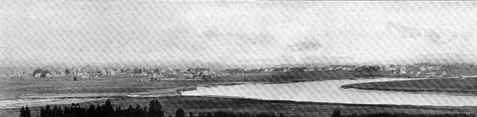
A Bird's-eye View of Sackville, showing the Tantramar River

A Bird’s-eye View of Sackville, showing the Tantramar River.

SACKVILLE, the geographical, educational and industrial centre of the Maritime Provinces of Canada, is situated in Westmorland County, New Brunswick, on the Isthmus of Chignecto, a few miles northeast of the boundary line separating the Provinces of New Brunswick and Nova Scotia. It is on the line of the Intercolonial Railway, about midway between the cities of St. John and Halifax, and is the junction point of the Intercolonial with the New Brunswick and Prince Edward Island Railway, which commands the shortest route between Prince Edward Island and the mainland.

Sackville has unsurpassed water and sewerage systems, splendid common schools, the Mount Alison Institutions, and a number of important manufacturing industries, including two large stove foundries, which send their products all over Canada; three harness factories, two boot and shoe factories, important stone quarries, a paper box factory, two woodworking factories, shook, grist and carding mills, two carriage factories, a machine shop, a factory that manufactures concrete building blocks, fence posts, etc. These industries are making excellent progress and employ a large number of men. Several new industries are in contemplation, our people are becoming imbued with the spirit of optimism, and the outlook for the town is bright.

The Town of Sackville was incorporated in the year 1902 and contains about 2500 people. Middle Sackville is an important village with about a thousand inhabitants, situated about two miles from Sackville, while Upper Sackville, an exceedingly prosperous agricultural community is about four miles remote from the town. West Sackville, Wood Point, Rockport, Midgic, Centrevillage, Cookville, Anderson Mount View and Fairview are some of the most important hamlets in Sackville Parish.

Sackville lies about a mile from the mouth of the famous Tantramar, a river navigable for ships of a thousand tons capacity. A fine new wharf, costing about $30,000, is now nearing completion. Stretching out to the east and south are the far-famed Tantramar marshes, a vast area of very fertile lands.

The Town of Sackville has four churches, eleven fraternal societies, wholesale and retail grocery firms, grain and seed stores, departmental stores, a hardware store, a photograph studio, three barber shops, four tailor shops, four hotels, two banks, two semi-weekly newspapers, two meat markets, three bakeries, two plumbing shops, three restaurants, several variety stores, monument works, two telegraph offices, two express offices, two drug stores, several furniture stores, a skating rink, real estate offices, etc.

Sackville and Middle Sackville are lighted by electricity, a local company giving an all day and all night service, as well as supplying power for local industries, including the Sackville Freestone Co., Ltd., A.E. Wry Limited, etc.

Sackville has an excellent mail, telephone and train service. Ten Intercolonial express passenger trains, besides numerous freights and specials, stop at Sackville station every day in the week except Sunday. Mails are brought to town by eight of these expresses, while mail carriers cover well the outlying parts of the parish. A passenger and mail train makes a round trip each week day between Sackville and Cape Tourmentine, the eastern terminus of the N.B. and P.E.I. railway. Practically the whole of the parish is covered by telephone lines, and telephones can be obtained at reasonable rental.

Sackville has neither workhouse nor poorhouse, and poverty is almost unknown. Nearly all are in comfortable circumstances and for the most part are contented and happy.

The growth of Sackville, while not rapid, has been steady. When other towns complain of “hard times,” Sackville is unaffected, and pursues the even tenor of its way, each year seeing progress and development.

Our industries

SACKVILLE has many important industries, of which a much larger town could well be proud. Their progress has been steady and in some cases rapid. Sackville manufactured goods have gained an enviable reputation, notably our stoves, ranges and furnaces, boots, shoes and moccasins, our grindstone and building stones. Many of our stoves, ranges and furnaces and leather goods are sent as far as Vancouver, British Columbia, our grindstones are largely sent to the United States, our freestones to various points in the Maritime Provinces, to Quebec, Ontario and the West. Sackville is a splendid location for new industries, because of its central location, as will be seen by reference to the map, which appears at the beginning of this booklet, its excellent shipping facilities both by rail and water. These advantages have done much to assist the growth of our present industries and will prove of inestimable value to industries, to be established in the future. Every year additional men are required for these industries.
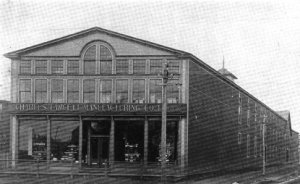
Offices and Warehouse, Charles Fawcett, Limited, Sackville, N.B.

Offices and Warehouse, Charles Fawcett, Limited, Sackville, N.B.

The business of the CHARLES FAWCETT, LIMITED, was established something over half a century ago by the late Charles Fawcett. From small beginnings this industry has grown until it is now the largest stove foundry in eastern Canada. From one hundred and twenty-five to one hundred and fifty men are employed and the company now have important branches in Montreal, Winnipeg and Vancouver. They manufacture high grade stoves, ranges and furnaces. Employees of stove foundries receive good wages and many boys and young men become apprentices and learn the trade.

The STANDARD MANUFACTURING COMPANY, LIMITED, is one of the largest and most important industrial concerns in Westmorland County, and indeed of a wider section. The company carries on a tanning business and manufacture harness, boots and shoes and oil-tanned moccasins. The company’s plant includes five factories, three warehouses and a general store. About one hundred men are employed, the pay roll is over $55,000, while the total output is nearly $300,000 annually. Workers in leather are well paid and the company are on the look out for good men and offer excellent openings to apprentices.

The Factories of the Standard Manufacturing Company, Limited, Middle Sackville, N.B.

The Factories of the Standard Manufacturing Company, Limited, Middle Sackville, N.B.

THE ENTERPRISE FOUNDRY COMPANY, LIMITED have one of the best equipped stove foundries in Canada. Their buildings are of brick, built in 1909 to replace wooden structures destroyed by fire in July, 1908. They employ one hundred men and their annual pay roll is $55,000. From eight to ten thousand ranges of different kinds are manufactured every year besides furnaces and open fireplace goods. The industry, which is an important one, is steadily growing and adding to the number of its employees.

A practically inexhaustible supply of freestone of a superior quality and an equipment of machinery admirably suited for quarrying advantageously and economically — it is this that makes the plant of the SACKVILLE FREESTONE COMPANY, LIMITED, a particularly valuable one and gives the company a place as one of the foremost industrial concerns in Sackville. Fifty to sixty men are employed and the pay-roll is a very considerable sum indeed. Last year a railway siding to the quarries was built and the company expect to double its output during the present year, necessitating the employment of a larger number of men. The product of the company is one of the best building stones in Canada and has been used in many of the public buildings in Ottawa, Toronto, Halifax, St. John and other Canadians towns and cities.

Store of J.L. Black and Sons, Middle Sackville, N.B.

Store of J.L. Black and Sons, Middle Sackville, N.B.

The A.E. WRY LIMITED, organized in the fall of 1909, manufacture harness, men’s, women’s and children’s boots and shoes. This concern has made splendid progress and bids fair to become a very important industry indeed. Fifty hands are presently employed; the annual wages amount to $16,000 and the output for the past year was $125,000. Within a few years no doubt fully a hundred men will be given employment by this company, whose goods are fast winning their way into popular favor.

Harnesses of various kinds are manufactured by EDGAR AYER, who employs about five or six men, pays out upwards of $3,000 in wages and has an output of about $16,000 a year.

The SACKVILLE PAPER BOX COMPANY, LIMITED, organized in 1907, manufacture all kinds of paper boxes, which find a market in the Maritime Provinces. About a dozen hands are employed and the output for the year 1912 was about $12,000. The majority of the employes are girls, who have steady work, good wages, at a clean, healthy trade.

SACKVILLE WOODWORKERS, LIMITED, manufacture all kinds of building materials, interior finish, office and store fittings and cabinet work. They make a specialty of hardwood flooring, which finds a ready market. About twenty-five men are employed, the annual pay-roll amounts to about $15,000 and the output about $40,000. There are good openings in this business for men and boys.

B.C. RAWORTH manufactures carriages, truck waggons, sleighs, etc, and runs a machine shop, where considerable work is done. During the year 1911 Mr. Raworth employed twelve men and paid out in wages over five thousand dollars.

Sackville possesses a well-equipped laundry, which attends satisfactorily to the needs in this line of the people of Eastern Westmorland County. Mr. Leslie C. Carey, who is a member of Sackville Town Council, is the owner of this industry, which is known as the SACKVILLE LAUNDRY. About seven hands are employed.

Sackville has two eight-page semi-weekly newspapers, the TRIBUNE and the POST, which cover well the eastern parishes of Westmorland County. The two papers employ about twenty-two people and are on the watch for more hands to look after increasing business.

GEORGE CAMPBELL AND SONS, LIMITED, of Middle Sackville, founded over half a century ago by the late George Campbell, manufacture carriages, waggons, sleighs, etc. They employ about nine men and pay out a considerable sum in wages. They are always on the lookout for the right sort of apprentices.

MORICE BROS., of Middle Sackville, conduct a shook, grist and carding mill, and employ about six or seven men. They own a gasoline launch, sail boats and row boats, which are utilized by picnic parties on the beautiful sheet of water known as Morice’s or Silver Lake.

At West Sackville MR. SETH BULMER conducts a grist mill and a saw mill, both of which are run by water power. Mr. Bulmer owns a large pond, which has been well stocked with beautiful trout from a hatchery situated near the mills.

The READ STONE COMPANY, LIMITED, have extensive stone quarries at Rockport and Wood Point. About thirty-six men are employed seven months of the year and the annual output of grindstones and building stones is about $15,000.

Departmental Store of George E. Ford & Sons, Sackville, N.B.

Departmental Store of George E. Ford & Sons, Sackville, N.B.

Educational facilities

Every village and hamlet in this large Parish has its district school, which is managed by the people who live in the district. Once a year the ratepayers meet in the school meeting, choose from their number those who shall act as trustees and decide how much money they will tax themselves to support the school. The balance of the money required is granted by the government of the province.

The district school is not under the control of any religious body, nor is the teaching of any denominational principles permitted. Loyalty to Canada and to the British Empire and reverence for the British flag are instilled into the minds of the young. In many schools the flag floats over the school building each school day. No charge is made to any parent for sending his children to school in his own district. The schools are free.

In Sackville and Middle Sackville there are High Schools, which are founded on the same non-sectarian principles. Besides being well supplied with public schools, Sackville may well claim to be the educational centre of the Maritime Provinces, for here are situated the Mount Allison Institutions, consisting of the University of Mount Allison, Theological College, McClelan School of Applied Science, Mount Allison Ladies’ College (including colleges of Literature, Science and Fine Arts, a Conservatory of Music, and Massey-Treble School of Household Science), Mount Allison Academy and Mount Allison Commercial College. Mount Allison possesses magnificent buildings, splendid libraries, unexcelled equipment, and a professoriate that ranks with the very best to be found in Canada to-day. Students from the Maritime Provinces, from Ontario, from Quebec, and from various other parts of the world, attend Mount Allison and receive a liberal education. Mount Allison students who attend other colleges, stand very high, and included in her alumni are men occupying some of the most prominent positions in Canada and the United States. About six hundred students attend Mount Allison.

In these days everyone is willing to admit the great value of an education. Parents want to give their boys and girls a better education than they themselves have. If you settle in Sackville Town or Parish you will be able to educate your children for a nominal sum. The tuition fees are small. At the University students take courses in Arts, theology and electrical and civil engineering; at the Ladies’ College, courses in Literature and Science, violin and piano, oratory, household science, and fine arts; at the Academy, courses leading to matriculation into the colleges of medicine, dentistry, law, engineering, etc., courses in business, shorthand and typewriting.

One of the chief reasons for the popularity of Mount Allison lies in the fact of its splendid residential accommodations for students of both sexes. The spacious University Residence for young men, the commodious dormitories of Hart hall and annexed buildings for young ladies, and the large and roomy Academy building for the boys, afford comfortable and very pleasant homes for the students, who attend these institutions.

The engineering school, established a few years ago, is undoubtedly the best in the Maritime Provinces. Students, who having taken the two years engineering course at Mount Allison, go to McGill College, Montreal, make splendid records, a credit to themselves and their Alma Mater.

The climate of Sackville

We enjoy a temperate climate without extremes of heat or cold. Cyclones, blizzards, droughts or hailstorms are never experienced in New Brunswick. Our Summers are marked by bright sunshine, relieved by gentle breezes with frequent rains of a day or night’s duration. The parching effects and discomforts of extreme heat are unknown to us, and work is never suspended by reason of great heat even in the open fields. The evenings are long, cool and delightful, free from frost and very invigorating. A man would be very difficult to suit indeed if he were not greatly charmed with our beautiful summer evenings. Hay fever and malaria are unknown here.

Autumn or Fall commences in September and extends through October and November. By many it is considered the most beautiful of our seasons. Then the days are distinguished by a peculiar warmth and purple glow, succeeded at night by the chill of occasional light frosts, which lend a bracing exhilaration to the atmosphere.

Winter sets in during the first week of December and extends into March, when it gives way to Spring, which becomes well advanced before April. The average winter in this section brings enough snow for steady sleighing and sledding traffic, to the great advantage of the Farmer and Lumberman.

While the weather is sufficiently cold to maintain the snow during these months; yet we do not suffer the extremes falls of temperature and intense cold, which distinguish the winters of Northern Canada and the Prairie Provinces, and which too often are imputed by the uninformed to other Provinces of Canada.

In conclusion let it be said that, although the winters in this part of New Brunswick are undoubtedly more severe than those in England, and the snowfall for the season is far more heavy; yet, the Summers are much warmer and more genial. Even in winter what is called zero weather often does not set in till the end of December. And it is not unusual for the farmers to be ploughing up to Christmas. The excellence of our Summer Climate is well shown in the fact that cucumbers and tomatoes are commonly grown in profusion in the open air. The former begin to ripen their fruit early in August and their season is not over, as a rule, till the third week in September and frequently runs into the month of October.

All in all the climate of Sackville has a great deal in its favor and very little against it. There are certain times, of course, when the weather is not all we could wish for but taking the good with the bad, the bitter with the sweet, our climate is all right, and will stand the test of comparison with many places which have much more written and said about them than have the town and parish of Sackville, about which we are giving a few facts in this booklet.


At the Crossroads: A History of Sackville, New Brunswick by Bill Hamilton

This much-anticipated publication will be available in the Fall for $31.95. Use this order form to pre-order your copy and SAVE $1.95!

Please return this form and a cheque for $30 to Tantramar Heritage Trust, Box 3554, Sackville, NB E4L 4G4

The White Fence, issue #24

January 2004

Editorial

Dear friends,

It takes time and tools to dig a well. But the clear waters that you find at the bottom is what maintains life and keeps us all going. Keep reading and you will discover how and why the past eight years of digging into Tantramar’s history have gone by so quickly! The waters we found were sparkling, pure and absolutely delicious! Over 200 Tantramarians (and beyond!) have helped us dig this well and enjoyed its waters.

But to dig a well you need the desire to work and good tools to make it all happen. As you will see below, Al Smith has kindly prepared a “calendar of events” of the Tantramar Heritage Trust. He shows how wisely we used our time digging a mine for gems and a well for water. He reminds us how deep we’ve dug into our history and how much has been accomplished… but also how much soil remains to come to the surface.

And over that time, we all needed tools to work with. This newsletter is one of our tools. Libraries, archives and attics are promising lands which need to be explored with these tools.

Also, the men and women who created the Tantramar landscape we live in, needed tools to create it. The dykelands we use and see every day, were not made by nature, like marsh hay. It took strong hands and backs… and tools. Tantramar-ians made the tools they needed to create dykelands. Dyke shovels were the knives needed to cut the sod and place each one in its special place on the dykes along the Tantramar and Aulac Rivers, for example. And Colin MacKinnon has long appreciated these tools and the men who used them.

In preparing for this issue, Colin introduced me to Charles Siddall. I feel I know him well as I’ve admired his work since 1969, when I first came to Sackville, never knowing who had put in the time and sweat to create this beautiful landscape.

Farmer

So, join Al and Colin to see how time has been spent in this remarkable part of the world. Leslie and I are just showing off the gems and pure waters those two prospectors and well-diggers have brought to the surface for us to see and drink. And like us, once you finish, your eyes will sparkle and your thirst will vanish.

Enjoy!

—Peter Hicklin

Did you know…

Did you know that the Town of Sackville purchased its first fire engine in 1921, but they could not use it in winter, although they did try to fit it with “runners”? Back then the local Fire Brigade used a Winter Hose Sled drawn by the Town Horse “Duke”, but in 1922 Duke was getting old and had a hard time to handle the heavy sled.

Did you know that in 1861 a total of 33 men from Sackville Parish were involved in the Shad Fishery in Cumberland Basin? At that time boats were known to take 1000 shad on one drift. Most of the catch was exported to the USA.

Did you know that shipwright Christopher Boultenhouse built a 192-ton steamship in Sackville in 1856? The steamer Westmorland was fitted with a 100 HP engine and was initially to ply between Saint John and Sackville. In the winter of 1860 Boultenhouse refitted the steamer at Pictou, N.S. to be transferred to the Shediac N.B. to Summerside P.E.I service where the vessel became a mail-boat and was sold to the Crane estate. The Westmorland remained in that service until about 1862 when she was sold to the United States government for use as a transport in the American Civil War.

Did you know that in 1894 Sackville’s two foundries (Enterprise & Fawcett) employed a total of 65 men, while the tanning/leather goods factories in the Parish employed 189 workers?

The Trust Turns Eight — A Short History of the Tantramar Heritage Trust

by Al Smith

Established back in 1996, the Tantramar Heritage Trust is now entering its 8th year. Members of the Board of Directors are often asked about the early roots of this organization that has become the largest community organization in the Town of Sackville, and thus the reason for this brief article.

The need for a heritage organization in Town was born in the fact that Sackville as a community has nearly 300 years of settlement history; yet we did not have a Museum nor any organization dedicated to preserving the Town’s heritage. Early suggestions of the need for a Heritage Trust date back to discussions within a small and informal Historical Working Group formed in 1992. However, it was the umbrella organization “Renaissance Sackville” that served as the catalyst to make this idea a reality. One of 10 Sector groups struck by Renaissance Sackville in April 1995 was the Environment Sector which was chaired by Al Smith. In the sector report to a Renaissance Sackville public meeting in June, 1995, Smith identified “Preserving Our Human Heritage” as one of the sector’s objectives with the action item of establishing a Heritage Trust. Following an Environment Sector meeting and workshop on February 21, 1996, five working groups were struck for the Sector in order to advance its objectives. The 12-member Human Heritage Working Group immediately initiated steps towards the incorporation of a Heritage Trust. Name selection, drafting of objects, bylaws, anticipated projects listing and first year budget were completed by May 1996. With the advice and assistance of lawyer Nick Rodger, the documents were forwarded to Revenue Canada on 21 May 1996 for an initial screening of our acceptability for non-profit charitable status. Revenue Canada advised in late July that all appeared to be in order and the next steps were to file for formal incorporation.

The road to incorporation was speedy, with outstanding legal service from Nick Rodger. A Provisional Board of Directors (Al Smith, Colin MacKinnon, Steve Ridlington) was struck and the required legal documents and fee forwarded to the NB Companies Act on 19 August, 1996. Letters Patent issued 9 September 1996 established the Tantramar Heritage Trust Inc. and the Trust’s founding meeting, chaired by Al Smith, was held on October 9, 1996. At that meeting the first Board was elected (10 Directors – expanding to 11 in 1998 and to 12 in 2003) and a motion accepting the Company’s by-laws was approved.

The first Board meeting was held immediately following the Founders Meeting to elect the year’s executive, establish banking procedures, create a Tantramar Historical Society Committee and set up a date for its first meeting. Smith was elected the Trust’s first President. The Board set a first-year membership target of 50 at its founding and within 6 months the number had exceeded 120. Today the Trust membership is annually maintained at over 200 individuals making it the largest community organization in Town. Much has been accomplished over the past eight years – here are some of the highlights:

Logo and Look of the Trust — Graphic design for everything connected with the Trust has been done by Leslie Van Patter. Artwork for the logo was contributed by Robert Lyon and the design adopted in December 1996.

Historical Society — The education/outreach arm of the Trust is the Tantramar Historical Society with the Trust organizing five public meetings per year with guest speakers on Tantramar’s rich heritage. The first meeting of the Society was held on November 27, 1996, and attracted 50 attendees. Since then, there have been 37 meetings held, mostly at the Anglican Church Hall, and have attracted between 45–125 people.

Newsletter — The first issue of the Trust’s newsletter (The White Fence) was produced in January 1997 and since then 3-4 issues appeared annually. There have been 23 issues to date (January 2004) of this very popular, newsy, member driven news- letter that highlights Tantramar’s historic past. The one and only editor since inception had been Trust Director Peter Hicklin, whose infectious enthusiasm for the region’s rich history has been largely responsible for the newsletter’s success.

Website — The Trust established an internet website in the summer of 1997, initially under the old community “tapnet” project. The Trust acquired the old tapnet domain in 2001 and maintains a very comprehensive website currently under the supervision of Trust member Charlie Scobie. heritage.tantramar.com

Campbell Carriage Factory Museum — The Campbell Carriage Factory Museum became the community’s first museum on June 21, 2003. The 150 year old factory (built circa 1838) was acquired via donation from the Campbell family in February, 1998. A major phased restoration project began in 1999 and was largely completed by 2003. With its collection of over 6000 artifacts, it is a designated Provincial and Municipal Heritage building and is one of the finest sites of 19th century manufacturing anywhere in North America.

Heritage Centre — The Trust is in the process of establishing a Heritage Centre in the historic Boultenhouse property, circa 1840. A Business Plan was developed in 1998 and in July 2001 the Trust purchased the Boultenhouse property and it is scheduled to become the Boultenhouse Heritage Centre (Museum) in 2005/06. The Trust offices relocated to the back ell of Boultenhouse in September 2002 following extensive renovation of the old country kitchen and garage area of the home.

Yorkshire 2000 — On August 3–10, 2000, the Trust was the host for Yorkshire 2000, a major gathering of descendants of the Yorkshire settlers in celebration of the 225th anniversary of this historically significant immigration into Canada in 1772-75. With nearly three years in planning, the event attracted more than 3000 participants to a week-long series of activities and events. A Yorkshire 2000 Legacy Committee continued aspects of the gathering including: developing a Yorkshire Studies centre at Mt. Allison, installing plaques and monuments and publishing.

Trust Office — The Trust operated for the first two years without a formal office facility. With the planning for the major Yorkshire 2000 event, the need for an office and meeting facility was obvious and in June 1999, the Trust moved into facilities donated by Atlantic Wholesalers Ltd on Lorne Street. Those modest offices became the Trust’s home until the building was sold in summer of 2002 and the Trust moved into its own space at the Boultenhouse Heritage Centre on Queen’s Road.

Publications — The Trust has developed an energetic publications series on local topics. The first publication was Tales of The Horse by local farmer Dick MacLeod in November, 1997.The initial printing (500 copies) instantly sold out and had to be reprinted. The Trust sponsored a number of publications in support of Yorkshire 2000: Footprints in the Marsh Mud, Nathaniel Smith Letters, Bibliography of Early Settlement History, reprinting of Short Stories by W.R. Bird – Here Stays Good Yorkshire, and Tastes of the Tantramar. The latest (fall 2003) publication is Dale Alward’s Down Sackville Ways, a very exhaustively researched document on Sackville’s ship-building heritage.

New publications to help celebrate Sackville’s centennial (2003) are: a new History of Sackville (fall 2004), and a research project delving into the origin of Sackville Street Names (spring 2004). The Trust is also currently facilitating the research and publication of an atlas of Acadian settlement sites in Tantramar.

Community events

Heritage Day — For the past seven years the Trust has organized a full one day program to celebrate Heritage Week in mid February. Commencing in February 1997, an annual Heritage Day breakfast (usually serving approx. 300) has been held along with an Antiques Road Show and lectures on historical topics.

Fall dinner — “A Taste Of History”, The fall fund-raising dinner was first organized in 2002 by Trust Director Vanessa Bass and committee. The dinner usually held in late October, has been very successful and has become an annual fall event for the Trust.

Research — The Trust is sponsoring historical research, assisting with the installation of plaques and cairns, assisting with conducting an inventory of historical buildings, working with the Planning Commission on heritage landscape protection, and hosting workshops and gatherings. Additionally the Trust has a committee working on the development of a proposal for a Family History Research Centre in Sackville. For a fledgling organization, the Tantramar Heritage Trust has an extensive list of accomplishments over the past 8 years. That would not have been possible without the support of many volunteers and donors of both funds and artifacts. For that we are truly thankful.

The Trust is now embarking on the development of a new Strategic Plan to guide our future directions. We would encourage our membership to participate in that process as it unfolds over the next few months.

Trust Presidents

  • 1996/97 — Al Smith
  • 1997/98 — Al Smith
  • 1998/99 — Paul Bogaard
  • 1999/00 — Paul Bogaard
  • 2000/01 — Rhianna Edwards
  • 2001/02 — Barb Jardine/Peter Hicklin
  • 2002/03 — Barb Jardine
  • 2003/04 — Barb Jardine
dyking spade

Figure 1. (Above) Dyking spade made by Charles A.D. Siddall (length 104 cm, 41 in.). C. MacKinnon photo

Charles A.D. Siddall (“C.A.D.S.”) — Dyking Spade Maker

by Colin MacKinnon

Most of our readers in the Tantramar region need no introduction to the dyking spade (Figure 1). This unique digging tool has roots in a design that goes back hundreds of years. Spades used for centuries along the coast of France and the moors of England are the ancestors of the Tantramar dyking spade. Our Bay of Fundy dykelands are unique in that the silt deposits that make up the marshes come from the sea, not the land. This results in marshlands free of stones within a uniform sediment known locally as “marsh mud”.

To move this heavy mud around requires a special tool that functions not just as a shovel, but as a knife as well. For a long day’s work, the tool must be light, well balanced and sharp enough to easily slice through sod and mud. The tool that meets all these requirements is the dyking spade. There is no set pattern for a dyking spade; each maker probably had his own ideas on how the spade should look and function. No doubt the farmer ordering a spade from the blacksmith could also impart some of his wisdom into the design as well. The following is a short, and admittedly incomplete, history of one of these craftsmen.

Charles A. D. Siddall (CADS) was the fifth child of Charles Siddall (b: 1809 – d: 1905) and Louisa Chappell (b: 1814 – d: 1899) of Baie Verte, New Brunswick. The Siddall name traces back to Yorkshire England. The great grandfather of CADS was Ralph Siddall (b: 1737 – d: 27 Nov., 1824) who immigrated to the Chignecto Isthmus during the Yorkshire migrations of the 1770’s.

Charles A. D. Siddall was born in 1848 and we believe he worked as a blacksmith for most of his life. William Trueman (in “Round A Chignecto Hearth”, pp. 22-23) tells us that “There was a blacksmith shop built by Charles Siddall just south west of the Pointe de Bute Temperance Hall in which Mr. Siddall carried on the blacksmith trade for a few years. In the early eighties (1880’s) he sold the shop to Arthur Snowdon and he moved to Great Shemogue where he carried on the blacksmith trade”.

Charles A. D. Siddall was married twice, first to M. Rebecca (b: 1855 – d: 1899) and second to Etta Stevens (b: 1872 – d: 1940). One of Charles’s children, Thomas A. Siddall (b: 1883 – d: 1961) lived in Sackville, on Lorne Street, and at least in later years worked as an iron moulder at Enterprise Foundry and sold insurance for Metropolitan Life.

Thomas Siddall married Alice P. Wry (b: 1886 – d: 1967). Thomas and Alice had at least two children; Helen S. (Siddall) Sawyer (b: 1912 – d: 1998) and Margaret (Siddall) McMath (b: 1907). These grand daughters of Charles A. D. Siddall donated his tools, used in the making of dyking spades, to the museum at Fort Beausejour. I have seen a couple of spades marked “T.A.S.” (One in the Albert County Museum) and have no doubt that these were made by Tom Siddall.

Figure 2. Examples of the "C.A.D.S." (Charles A.D. Siddall) stamp found on the back of his dyking spades (letters about 5 mm high). C. MacKinnon photo

Figure 2. Examples of the “C.A.D.S.” (Charles A.D. Siddall) stamp found on the back of his dyking spades (letters about 5 mm high). C. MacKinnon photo

Figure 2. Examples of the "C.A.D.S." (Charles A.D. Siddall) stamp found on the back of his dyking spades (letters about 5 mm high). C. MacKinnon photo

Figure 2. Examples of the “C.A.D.S.” (Charles A.D. Siddall) stamp found on the back of his dyking spades (letters about 5 mm high). C. MacKinnon photo

Charles A.D. Siddall was a well known and well respected maker of dyking spades and his work was highly regarded by those who worked the marshes and appreciated quality. Examples of his work are clearly marked on the upper back of the blade with his initials “C.A.D.S.” (Figure 2). In most cases, each letter, followed by a period, was stamped into the metal.

Figure 3. Reg Acton, of Cookeville, with his old, and much used Charles A. D. Siddall spade. C. MacKinnon photo

Figure 3. Reg Acton, of Cookeville, with his old, and much used Charles A. D. Siddall spade. C. MacKinnon photo

However, on at least one example, the letters appear to have been “pecked” with a fine punch rather than stamped. Marsh managers, such as Reg Acton of Cookville, told me that the quality of the steel in Siddall blades was better than that of other makers and thus kept an edge longer when sharpened. Reg still has his “C.A.D.S” spade; the blade is well oiled, wrapped in burlap and given a place of honour over his work bench (Figure 3). The makers of dyking spades were always on the look out for good steel for their blades and apparently CADS (and probably others) would cut down old cross-cut saws for this purpose. This might partially explain why the CADS spades would stay sharp longer than others.

One example of a Charles Siddall spade blade I have remains unused. The “as new” blade had been painted gold and mounted on a walnut display plaque. My guess is that this display may have been offered as some type of award; maybe for a farming competition? This example recently came out of Aulac so maybe one of our readers might be able to shed some light on this mystery!

If CADS started his blacksmith career as a young man, and worked at his trade for most of his life, this could potentially span upwards of fifty years. This translates into probably hundreds of spades carrying his initials. Many of these spades have survived, some with their original handles, and stand as the mark of a man who clearly took pride in his craft and was willing to put his name on his work. From a sample of 40 spades I have examined, 17.5% were marked “C.A.D.S.” while 5% were marked “T.A.S.”. Nearly one of every four spades encountered was a “Siddall” spade; a remarkable achievement from this father and son team. Charles A. D. Siddall, the maker of quality dyking spades, died in 1921; age 73 years. He is buried in the Sackville Public Cemetery on York Street.

This short note has been gleaned from census and cemetery records as well as talking to those few who remember working long hours, under a hot sun, building dykes or cleaning drainage ditches on the dykelands. I would be interested in obtaining more information on Siddall, other spade makers, related photographs and examples of their work. Feel free to contact me by phone 506 536 4283 or by mail at 176 King Street, Sackville, N.B., E4L 3C2.

tools

tools

nails

nails


Members of Tantramar Heritage Trust may have received a notice and breakfast tickets for Heritage Day in the mail over the last several days. Please see the updated agenda below and note the afternoon session will take place at the Wu Centre on Mount Allison University campus.

The day starts early at the Tantramar Regional High School with a hearty Heritage Day Breakfast and an exciting antiques road show. In the afternoon, join everyone at the Wu Centre for lively and interesting presentations on local history. Come join friends and neighbours for a fun day!

Celebrating Heritage Week 2004

Schedule of events — Saturday, February 14, 2004

Morning Session — Tantramar Regional High School

  • 7:30 am: Heritage Breakfast — Cafeteria at Tantramar Regional High School; Breakfast ends at approximately 10:30 am. $5 adults, $3 children
  • 10:00 am: Antiques Roadshow — Foyer of Tantramar Regional High School. Bring a treasured antique or family possession for an appraisal by our road show experts. $2 per item.

Afternoon Session — Wu Centre at Mount Allison University (the Wu Centre is at the corner of Salem and York Streets in the Dunn Building)

  • 1:30 pm: Early Mapping of Chignecto — Presentation by Paul Bogaard, Mount Allison University. Hear about early European mapping of the Chignecto area including early explorers, Acadian settlements and the township of Sackville… with stories about the role of the Mi’kmaq.
  • 2:30 pm: A Glimpse into Our Past! — Friendships and Relations with the Acadian Settlers. Presentation by Sandra Belliveau, Culture and Heritage Coordinator, Fort Folly First Nation. Learn about the culture, heritage and history of The Fort Folly First Nation and a project currently underway entitled “Establishing an Artifact Display and Heritage Interpretation Project”.

Presented by the Tantramar Heritage Trust.

The White Fence, issue #23

November 2003

Editorial

Dear friends,

Did you think I had gone missing? Well, no… it’s just that chasing history often comes into conflict with life in the present! The present (which as of this moment is now the past seven months!) has been very busy, and, unfortunately, Tantramar history has had little to do with it, other than take a back seat!

But now the fall winds are returning me to that world of early Tantramar, a world which can envelop and fascinate us all. That austere, but comforting power is coming all over me again… The march to understand our past, with its warm embrace, blocks those northerly cool winds blowing at my window, and, as I sit before this editorial page, I feel the warm coal-fired heat of Tantramar history at my side.

The spirit of the late Mr. J.L. (Laurie) Black is also sitting beside me, gently poking my ribs to get my attention. He tells me that it’s 1954, and he has a story to tell the Rotary Club (and us too!). It’s a story which shows very clearly how closely inter-dependent were local businesses and the small communities they were in. Furthermore, the business owners clearly played a “hands-on” role in all aspects of the businesses under their control in the community. I suspect that this story applies to many Maritime towns and businesses of days gone by. Today, in the larger world around us, cities and townships are often just viewed by business (often, by necessity) not as communities but simply as “markets”. Mr. Black’s views, in his “Classification Talk”, nearly 50 years ago, clearly valued the important and close relationships developed between business and community. With respect to this topic you might be interested to return to White Fence No. 19 (May, 2002) where we learned of a devastating fire which destroyed the original J.L. Black store in Middle Sackville.

And then, Colin MacKinnon approaches me with another fascinating story about the aboriginal communities which populated our shores long before Champlain came to them. This time, it’s the Susquehanna — a fascinating tale based on Colin’s sharp eyes and his wish to get to the bottom of the story. Nice digging Colin!

And my sincere thanks to Gwen Black for bringing her late husband’s address to Rotary to my attention. And please note that I transcribed the presentation just as J. L. had written it (with the same spelling, most of the punctuation and use of capital letters) although I modified punctuation where periods were mistakenly typed in for a comma or vice versa.

And Al Smith is trying to get my attention with a boxful of Did-You-Knows to pass on to you. So before the wrath of Mr. Black and Al are unleashed in my direction I better get to work! So, set yourselves in your favorite chair, in a comfortable spot, and let us continue our conversation with Tantramar history. Glad to be back! Enjoy.

Enjoy!

—Peter Hicklin

Presentations

The Tantramar Historical Society will hold its next meeting at St. Paul’s Anglican Church on 19 November for a presentation by Dr. Marc Milner, Chair, Dept. History, University of New Brunswick entitled: “The Siege of Fort Beausejour: What We think We Know.”

On November 10 – January 11, the fascinating display “Charting Chignecto” can be seen at the Owens Art Gallery at Mount Allison along with a display of “The Street Names of Sackville.” Don’t miss it! I’ve already spent about four hours at these displays and have only managed to get through a fraction of it! There’s a lot there to learn!!

It’s early yet, but keep in mind that HERITAGE DAY will be on February 14, 2004, at the Tantramar Regional High School.

Membership Renewal & Fundraising Campaign

Please support the Trust’s Annual Membership Renewal & Fundraising Campaign. Take a moment to renew your membership, which includes a subscription to the The White Fence, and consider making a donation to the Trust in support of projects like the Campbell Carriage Factory and the Boultenhouse Heritage Centre.

Did you know…

Did you know that Sackville’s first traffic lights were ordered by Town Council in August 1946 and installed the following summer (1947)? The lights were recommended by Police chief Jim Bowes and were erected on Crane’s Corner and Boultenhouse Corner. On July 7, 1947, Tribune editor C.C. Avard wrote “long may they flash in their effort to prevent accidents.”

Did you know that paving of the highway from the Sackville town line (at Wry Lane) to Middle Sackville (now Main Street) was not to be paved, as planned, in 1941 because of work to be done on the trunk highways? However, paving resumed in the following years, with the road nearing completion in September, 1944. Tribune editor Avard praised the work in the 28 September, 1944 edition, calling it a “real joy and comfort for the motorist, the pedestrian and to all others who use the road… Of course, there are some people who wouldn’t vote liberal if the road was paved with gold.”

Did you know that Parking Meters were once installed in the Town of Sackville? In the summer of 1950 some 200 Parking Meters were installed on Bridge, Lorne, Main, and York Streets with 50% of the total revenue going to the meter company. Council opposed the operation of parking meters and unanimously passed a motion for a trial period of only one year. The Sackville Board of Trade decided to remove the meters in December, 1951.

Did you know that the cost of parking in downtown Sackville in the summer of 1950 and ’51 was enforced at the rate of five cents an hour, with one dollar fines for offenders!

Did you know that at the 8th May, 1903 meeting of the Town Council, the Streets Committee was authorized to make expenditures on streets and sidewalks not exceeding the huge sum of $300.00?

Did you know that the original name for Enterprise Street was Shipyard Lane? Shipyard Lane was the access roadway to the Christopher Boultenhouse Shipyard – the largest of three Sackville shipyards and connected the shipyard directly to his residence (now 29 Queen’s road and owned by the Tantramar Heritage Trust).

Did you know that three of Sackville’s streets are named after former Canadian Governor Generals?

Did you know that Dufferin Street was named after the Earl of Dufferin: Frederick Temple Blackwood, Canada’s 3rd Governor General from 1872–1878?

Did you know that Lorne Street was named after the Marquis of Lorne: Douglas Sutherland Campbell, Canada’s 4th Governor General from 1878–1883?

Did you know that Lansdowne Street was named after the Marquis of Lansdowne: Henry Charles Petty Fitzmaurice, Canada’s 5th Governor General from 1883–1888?

Did you know that Wright Street in Sackville is named after Dr. James Goldwin Wright, mayor of Sackville from 1960 to 1967 (except for ’62)? He was an engineer, researcher, long-time public servant, superintendent of the eastern Arctic and Secretary of the Northwest Territories Council. He retired in 1953 and accepted the post of assistant professor of Engineering at Mount Allison University. His early research led to the development of the Forest Fire Hazard Index, known as the Wright System, and still used today. Dr. Wright also hired author Farley Mowatt who worked in the arctic as a summer student. Mowatt’s experiences led to the writing of two of his earlier books: People of the Deer and Never Cry Wolf.

Classification Talk — Rotary Club of Sackville (1954)

by J. L. Black

It is, I believe, a rule of Rotary that each member gives before his own Club a “Classification Talk”. Whether we have followed that practice here I do not know but I am going to talk to-day about the Business in which I am engaged. This will constitute my Classification Talk and I hope all the others of you will get even with me by taking your turns.

When our business was founded over a century ago, and throughout more than half its history, it was one of hundreds of similar businesses which were operating all over the Province of New Brunswick. These businesses consisted of three, and in some cases four, complimentary industries one of which was merchandising (and) the others were the basic industries of that area in which the business was located. In our case, it was merchandising, farming and lumbering. In other areas, the fishing and mining industries came into the group either with, or instead of, the ones we had here. Today, due to our changing economy, periods of depression and other causes, this type of business has almost disappeared. Ours is one of the few left in operation.

The Owner or Founder of the business usually started in a small way as a merchant, lumber operator or farmer and with hard work and thrift expanded and built up his business with the type of community industry of which I speak.

On our case, Jos. L. Black started in Middle Sackville in 1847 as a merchant, he gradually expanded his business, acquired farm properties, consisting of both marsh and upland, and lumber properties until he was operating a business of three mutually supporting industries. The Store became the H.Q. of the business, it was there that the Owner had his office and did his buying and his selling and the administrating work for all three operations. Through the store, supplies and equipment for the farming and lumbering operations, were bought at wholesale, and certain of the products from both the other industries came into the store to be sold.

The Farming Operation in our case was a fairly simple one typical of our area. The cash crops were hay and beef. The farm produced oats to feed the horses which went to the woods in Winter, roots for the cattle and hay for both horses and cattle. The ordinary rotation of crops was roots, grain and hay with an area of land producing an average and average of four crops of hay before being turned to roots or grain. Beef for the most part was purchased in the Spring or Fall and either fattened on grass and sold in the Fall or, as was more common, fattened on roots, hay and grain through the Winter and sold in the Spring.

The Lumbering Operation, in what we might call the old days, was very different from to-day’s operation. There were no bulldozers or tractors, it was entirely a seasonal operation with the logging being done in the Winter and the sawing in Spring and Summer. Operators depended on frost and snow on which to move their logs short distances and on water to move them longer distances to the mills which were normally placed on a river bank.

The normal procedure in a business like ours was as follows: The Owner tried to build up by purchase or lease an area of timberland from which he could take a crop of comparatively uniform quantity each year for an indefinite period. An area of 20,000 acres, for example, if kept free of fire and disease would yield an annual crop of 1,000,000 feet and might run to 2,000,000 if it were the right type of land.

A saw mill was located on the river or stream which was the main drainage artery of the Property, a dam was built to form a mill pond and in some cases to provide water power with which to run the mill and frequently another dam was built well up the river to store water for the Spring log drives.

The logging operation was started in the early Winter as soon as there was sufficient frost and snow to move camp materials and supplies to the area which was to be logged. Logs were cut, then as now, by yarding crews consisting of three men and a horse. Logs were piled in the woods from where they were logged by teams to the river bank somewhere below the so-called savings dam and there they waited for the Spring break up.

When the ice broke up and the freshets came the logs were rolled into the river and carried down-stream to the mill pond, helped along by extra tons of water let loose by periodically opening the gates of the savings dam.

Perhaps a typical mill of those days was one which we operated at Aboushagan. It sawed lumber and lathe, nearly all of our local saw mills in those days made lathe out of the waste wood from the lumber. To-day it is sold as slab wood for fuel.

The mill always started its operation shortly after this drive was completed in the Spring. The logs floating in the mill pond were directed by men with long pike poles to the haul-up chain (from) which they went into the mill and out as lumber at the other end. The lumber was piled in the mill yard close to the bank of the river below the dam. From there it had to go to Point du Chene where it was loaded on rail or on vessels for export. One method of getting it to Point du Chene was to haul it there with teams, a distance of about 14 miles; another method was by rafting it there.

A series of long narrow rafts were built in the river by experts who cross-piled the lumber and roped it together in such a way that it didn’t break up easily. When tide and wind conditions were considered to be propitious, these rafts which, as they grew heavier with more and more lumber, had settled to the bottom of the shallow river, were lifted by a flood of water from the dam and floated down-stream with a crew of men on board to keep them to the centre of the stream. It took from 12 to 24 hours to reach the mouth of the river. There, the rafts were moored along the bank of the river and, again when conditions were right, teams of horses were hitched to them in tandem (and) they were hauled out into the Northumberland Strait to Point du Chene. There the lumber was taken out of the water and piled on the wharf or alongside rail for shipment.

I might explain in a little more detail what I mean by saying that the component industries of these businesses were complimentary or mutually supporting. When these businesses were so common in the Province, there were very few Banks and very little cash in circulation. Employees were in many cases paid their wages in household supplies rather than cash. If an Owner of one of these businesses had 100 employees working in his lumber operation and a few men working on his farm, he had a proportionate number of families buying all their house-hold requirements from his store. This was of obvious benefit to the business as a whole and to the community in which the business operated. If the business prospered and expanded, the community prospered and grew larger. If the business became depressed and curtailed its operations, the community was depressed and people who could move away did so.

The situation in this respect is quite different to-day. Perhaps this is one of the reasons why these businesses have disappeared from the scene.

Visitors to Our Shores — The Susquehanna Tradition

by Colin MacKinnon

Over the centuries, the Chignecto border region has witnessed a series of distinct groups washing against our shores. From the early French settlers, to New England Planters, Yorkshire and United Empire Loyalists, this land has felt the ebb and flow of different cultures. Most came to stay, settle the land and make a home. Recent evidence suggests there may be at least one other group of people missing in this list. But did they come to visit or stay?

Sometimes little can be deduced about the lives of aboriginal peoples that existed before the time of recorded history. The archaeological evidence, partly based on stone tools, tells us only a little of the whole story. Much of the interpretation of early peoples is based on their “tool kit” assemblage or, basically, how a collection of stone implements from one place and time compares to another. The type of tool, how it was made and from what type of stone, tells the expert something about the way of life of the people who carried it.

A few years ago, I located a small scattering of worked stone and charcoal fragments along the shores of Cumberland Basin. Radiocarbon dating (graciously provided by David Keenlyside, Canadian Museum of Civilization) from the wood charcoal provided a date of around 3,300 years (+ or – 100 years).

While processing the charcoal sample I sent for dating, David found bone remains and had them identified by Dr. Francis Stewart; a faunal remains specialist. The sample was identified as the knuckle bones, from the paw, of a Black Bear. The Black Bear is a powerful religious totem in many aboriginal groups and this find may suggest a similar significance to the people who sat around this fire so many centuries before.

Even more interesting is the story told by the scatter of stone tools at this site. They were made by a people known to archaeologists as the “Susquehanna Tradition”. Susquehanna people manufactured a unique, and diagnostic, type of broad-stemmed spear points. These spear points, as well as knives and scrapers, were often made from slates, argillite and other stones that came from the Piedmont plateau of the eastern United States. Also, the burial practice of these people is different than that of local Maritime people. The dead were cremated and the bones and ashes were then buried in a secondary pit; often accompanied by red ochre (Tuck 1984, p. 35).

Stone knife, about 4″ long

Stone knife, about 4″ long

Most of the more northerly Susquehanna sites are scattered along the coast of Maine and southern New Brunswick. To my knowledge, this site on the shores of Cumberland Basin represents the only such find east of Saint John, in the Bay of Fundy, and suggests a range extension of the travels, and potential influence, of these peoples. While doing research for this article, Pat Allen, Archaeological Services, New Brunswick, told me that her department recently received reports of Susquehanna material being found in the Tracadie area of the province; thus the travels of these people may be even more widespread than originally thought. The interesting question about the Susquehanna people is their level of impact on the local population. How much interaction took place? All we know is that although the Susquehanna people made their first appearance in the Maritimes around 3,500 years ago, their unique cultural signature appears to have disappeared within 500 years. Two theories have been proposed: one, that the Susquehanna peoples eventually spread throughout the Maritimes and were the ancestors of what became the Mi’kmaq and Maliseet (Wolastoqiyik) people, or that they gradually became extinct (Tuck, 1984, p. 36). Standing at one of my favourite spots, on the ramparts of Fort Beausejour, with a panoramic view of the marshes and basin before me, one can only wonder at the history of this land. The story told by this one small campsite adds another chapter to the history of the Chignecto Isthmus, those little known visitors we call the Susquehanna people.

Reference

Tuck, James, Maritime Provinces Prehistory, Ottawa, Ont., National Museum of Man, Canadian prehistory series, 1984.

Stone adze, chipped then ground, about 4.5″ long

Stone adze, chipped then ground, about 4.5″ long

Susquehanna broad points, longest point about 2.5″

Susquehanna broad points, longest point about 2.5″

Christmas gift ideas… — new!

Down Sackville Ways [cover]

Down Sackville Ways

Down Sackville Ways: Shipbuilding in a Nineteenth Century New Brunswick Outport by Dale. E. Alward

This new Tantramar Heritage Trust publication will be available in November. Dale Alward’s 1978 honours thesis records the significant contribution of Sackville shipbuilders to the Maritime marine industry between 1821 and 1898. As the evidence of this vital part of our history is mostly gone, Alward’s exhaustive research brings back to life the “Golden Age of Sail” and records its impact on our community.

Don’t forget…

Books

books

The Trust has several publications that would make great gifts for the history buffs on your list!

Remembering Dr. Palmer of Palmer hall

In the late 1950s Mount Allison University was still experiencing a period of expansion following World War Two. As each year passed, it became more obvious that existing residence space was inadequate. In 1957 enrolment exceeded the 1,000 mark for the first time, with the result that many students were being housed off campus. To address the situation, the Board of Regents developed plans for the erection of three new residences. The first was named for university benefactor Captain R.V. Bennett, while the remaining two honoured distinguished former professors: Harold E. Bigelow and S.W. Hunton.

Meanwhile on the east side of campus, the former Mount Allison Academy was converted from a mens to a womens residence and the refurbished building was named Palmer Hall. The choice of this name met with widespread approval. Although James Marshall Palmer (1861–1945) had died 12 years earlier, he was still remembered affectionately by his nickname The Doctor and as a longtime Principal of Mount Allison Academy.

Lets now fast forward to May 2003. As those who travel East Main Street (once known locally as the Academy Stretch) will be quite aware, Palmer Hall, one of the most architecturally interesting buildings on the Mount Allison campus, is being demolished. This is not the time or place to consider this contentious issue. It is, however, an occasion to recall the history of the building and the career of the person for whom it was later named.

One part of the story begins 70 years ago, in March of 1933. In a time span of less than three weeks, (often referred to as Mount Allisons ordeal by fire), three buildings were lost. On March 1st, Mount Allison Academy (located on the site of Palmer Hall) was totally destroyed. On March 16, the Science Building was burned to the ground and by 3 AM the next morning, Centennial Hall was ablaze; to be reduced to blackened stone walls in a matter of hours.

Looking back on this triple tragedy two points stand out. Thankfully, no lives were lost, as was to be the case with the Mens Residence fire of Dec. 16, 1941. And Mount Allison, despite the Depression, quickly rebounded to overcome this adversity. By November 1933, Centennial Hall was completely rebuilt. This was achieved, in part, by utilizing the stone walls and foundation of the building erected in 1883 to mark the centennial of Methodism in the Maritimes.

The construction of a new Mount Allison Academy residence was another matter, as nothing was left but charred remains. On one decision there was no debate; the replacement would be built on the same historic site as previous Academy buildings. In this way, an important link with the past would be maintained, as the first Mount Allison Academy, was the forerunner of the University. It was officially opened 160 years ago this year [2003] on June 29, 1843 and was burned to the ground Jan. 16, 1866. The same fate was to befall the next two Academy buildings as all were wooden structures. In contrast to its three predecessors, the fourth replacement was destined not to undergo an ordeal by fire.

In 1933 no time was lost in dealing with the situation caused by the fires. Within a few weeks a building committee was appointed and architects hired to prepare plans for Centennial Hall and a completely new Mount Allison Academy. An Academy old boy Charles A. Fowler of Halifax was selected as architect for the latter contract. The spring 1934 issue of The Record unveiled plans for the new Academy as it will be. Of Tudor Gothic design, it was built of local sandstone with grey stone trim. Throughout stone, steel and concrete were specified for a completely fireproof building.

The centrepiece was the residence building (see illustration). On the left side was to be a completely separate wing to house classrooms and on the right (site of the present Windsor Hall) a second matching wing was to include a gymnasium and swimming pool. Regretably, the latter two wings were never constructed, due to financial constraints. Both Centennial Hall and the new Mount Allison Academy were officially opened at a special convocation held on on Jan. 19, 1934.

During the ceremony two members of the Building Committee participated. Both were Allisonians and members of the Canadian Senate. Senator Frank B. Black, of Sackville, presented the keys for the reconstructed Centennial Hall, while Senator C.W. Robinson, from Moncton did the honours for the new structure. The citation for the latter read as follows: The building of the new Academy residence is now completed, a former student has made the plans, the stone has been hewn from the Mount Allison quarry and a beautiful building has been constructed. It is fireproof and exceptionally well planned and built. In retrospect, much credit must go to the Building Committee for completion of a daunting task in less than a year.

Now back to the career of the Academys longest serving principal,The Doctor. In the spring of 1894 following the resignation of S.W. Harrison, a new principal of Mount Allison Academy was appointed. James Marshall Palmer, was a native of Canning near Gagetown, NB and an honours graduate of the University of New Brunswick. At 33 he was already an experienced teacher, having taught high school in Campbellton, Chatham and Fredericton.

Immediately prior to his appointment, Palmer was on the staff of Fredericton Collegiate as a teacher of French and Classics. At the time, there were few who would predict that this comparatively young man would remain in this post, until ill health forced him to resign in 1930. Principals of Mount Allison Ladies College might come and go, but as one alumnus recalled: The Doctor he just went on forever. There had to be a reason for this longevity, and further investigation was in order.

University historian Dr. John G. Reid provided an important starting point in his assessment of Palmers long career. Slight in appearance and reserved by nature [he] was sometimes underestimated by colleagues and students. He was seldom underestimated for long, for over his thirty six years as principal, he achieved distinction as a teacher, as a strict disciplinarian, and as a tireless advocate of the best interests of Mount Allison Academy.

One example from many will be cited to illustrate the last point. Soon after his appointment, Palmer was involved in a controversy that spilled over from his predecessors tenure. It was actually a contributing factor in Harrisons resignation, and Palmer was determined to meet it head on. The dispute was twofold and involved the place at Mount Allison of commercial subjects, then being taught at the Academy. Should these subjects be transferred to the Ladies Collge or stay where they were? If part of a joint venture, how might the appointment of faculty and registration of students be accommodated? For the next several years, another strong willed individual Dr. B. C. Borden, principal of the Ladies College and later university president, jousted with Palmer on these matters. In the end Palmer won. The year 1906 saw the Board of Regents give exclusive control over secretarial and commercial training to the Academy.

To obtain personal information about Dr. Palmer, I had the good fortune to interview Eunice Dixon McCormack. A graduate of both the Ladies College and Mount Allison University, Class of 1928, she later taught English and Typing in the secretarial program at the Academy. During Dr. Palmers last year as Principal, she served as his secretary/assistant. and had an opportunity to witness him in a variety of roles. Now a sprightly 97 years old, and a member of the VON Walking Club, Eunice enjoys reasonably good health and is blessed with a clear memory. She was pleased to reminisce about the old days at the Academy.

While agreeing with the assessment that Dr. Palmer was a strict disciplinarian; she was quick to emphasize that this was balanced by a good sense of humour. On one occasion he was returning to his quarters from a meeting down town. It was about 10:30 and well past lights out. Dr. Palmer looked up, and there was a male student coming hand over hand down a rope, leading from a third storey window. Dr. Palmer stopped in his tracks to watch. When the student reached the ground Dr. Palmer said: Now, young man, let me see you climb back up again. The shaken and speechless student fled into the darkness.

Eunice also mentioned that after a long day of teaching, she would work after hours in the Academy office on correspondence and reports. In those days it was the custom to mail to parents an evaluation of each students progress. These always took a lot of time and required burning the midnight oil. As a final note, Eunice made reference to Dr. Palmers kindness and thoughtfulness He made an effort to get to know each student personally. Surely this was one of the secrets of a successful thirty six year career in administration.

In preparing this Flashback I also had the opportunity to read scores of tributes to Dr. Palmer. Throughout all of these there was a common thread. Former students remembered the sterling character of the Doctor. One old boy S. A. Worrell of Saint John spoke for many when he wrote: I learned to respect Dr. Palmer not only on account of his tact, fairness and sound judgement but also by reason of his character. No more need be said. The late Palmer Hall was well named.

John Wesley and the Chignecto “Connexion”

In case you are wondering, today’s title does not contain a typo. The word connexion is deeply implanted within the Methodist denomination and refers to a system of inter-related congregations. In a few weeks, people of Methodist heritage around the world will mark the birth date of John Wesley (1703–1791), the founder of Methodism. Born on June 17, 1703 at the Rectory in the small market town of Epworth, Lincolnshire, England, John Wesley was the son of the Revd. Samuel and Susanna Wesley.

At first John Wesley was instructed at home by his mother. Later he attended the famous Charterhouse School in London on scholarship and eventually went up to Christ Church College, Oxford in 1720. Wesley was ordained a deacon in 1725 and admitted to the priesthood three years afterward. A masters degree followed in 1727. This background is significant as it serves to underscore both his scholarly background and place within the Established Church.

John Wesley returned to Oxford in 1729 as a Fellow of Lincoln College. It was here that John and his brother Charles became involved with a small group who were known by the nickname the Holy Club. They were later labelled Methodists for their methodical rules for fasting, prayer and study of the Bible. It is to this gathering that the beginning of a new denomination may be traced. Modeled on the Holy Club, the Methodist concept of small group or class meetings, crossed the Atlantic in the 1770s, and helped introduce Methodism on the Isthmus of Chignecto.

John Wesley was described as a small man, weighing about 128 pounds and just over five feet tall. Many of his evangelistic services were held in the open air when hundreds would gather to hear him speak in a high pitched, penetrating voice. No modern amplifiers or microphones for him! During his long career he managed to crisscross England, Scotland and Ireland on horseback, sometimes traveling as many as 7,000 kilometres per year. The evangelical zeal of John Wesley was responsible for Methodism taking root, first in England, and later aided by his followers, throughout the English speaking world. The Methodist Church did not, however, separate from the Established Church until after its founders death.

As the crow flies, the distance from the Rectory at Epworth to the East Riding of Yorkshire is but a few kilometres. It is not surprising that John Wesley paid particular attention to nearby Yorkshire. At the time, this area of England was experiencing an agricultural revolution. Scattered farm holdings were being consolidated into large estates, and the imposition of major rent increases by landlords soon followed. To make matters worse,the rural population was increasing faster than agricultural growth.

The Methodist emphasis on conversion and righteous living, its stress on Bible study and fellowship, appealed to an economically depressed population. Yorkshire became fertile ground for evangelist John Wesley, and Methodist class meetings sprang up throughout the East Riding. As they gathered each week in homes, their economic plight was undoubtedly a topic of concern. What was the solution? Too many people and too little land meant emigration. But where?

About the same time, Michael Franklin (1720–1782) the lieutenant governor of Nova Scotia visited the East Riding to recruit settlers for his vast land holdings. The land hungry Yorkshire folk listened carefully to his pitch. Although only a few answered his call, Franklin did much to publicize the possibilities on this side of the Atlantic. During the years 1771 to 1775 it is estimated that some 1,000 to 1,200 Yorkshire migrants settled in Nova Scotia. By far the largest number selected land on the Isthmus of Chignecto and nearby areas.

In April 1775, one of the last ships to set sail from Hull for Halifax was the Jenny. On board was a Huddersfield linen draper, William Black Sr., his wife Elizabeth Stocks and family of five children. Black could not have foreseen that he was to establish a family dynasty that would make its mark in the New World. Nor could he have imagined that his second son, William Jr., was destined to be the founder of Methodism in the Maritimes.

The Blacks were early converts to Methodism and within a few years young Billy was to experience a conversion during a class meeting. In later life, writing to John Wesley, he recalled the event: While they were praying, my heart began to throb within me, my eyes gushed with tears, and I cried aloud for mercy what if the Day of Judgment be coming? On the following Sunday, Mr. William Wells [a lay preacher] gave an exhortation his words were like a dagger in my heart. Then another old Methodist, after praying with me said, I think you will get the blessing before morning. About two hours after, while we were singing a hymn, it pleased God to reveal his Son in my heart.

From this point onward, William Black Jr., never looked back While not as well educated as his mentor John Wesley, he did have the benefit of a sound education at the Olney Grammar School before leaving Yorkshire. For the rest of his life, he was content to be a roving evangelist stressing the sinfulness of man and the need for regeneration through faith. He was ordained a deacon in the Methodist Episcopal Church in Philadelphia on May 7, 1789 and the following day became an elder.

Until his death in 1791, John Wesley and William Black carried on a lively correspondence. It was encouraging for the latter to be able to call on Wesley for advice in the dark days. Some of this important correspondence may be found in the Maritime Conference Archives. Heres an example. The letter is from Wesley to Black and is dated May 11, 1784. This was a crucial time in history, as the American Revolution was nearing its end.

My Dear Brother: I am glad that you have given a little assistance to our Brethren in Halifax and along the Coast. There is no Charity under Heaven to be compared to this, the bringing Light to the poor heathens who call themselves Christian, but nevertheless sit in darkness and in the shadow of death. I am in great hope that some of the emigrants from New York [the Loyalists] are really alive to God. And if so, they will be every way a valuable acquisition to the Province [Nova Scotia] where their lot is now cast. This may be one of the gracious designs of Gods Providence in bringing them from their native country.

Blacks wide ranging career did not mean that he neglected his first flock in the Chignecto Connexion. From Amherst to River Philip and from Sackville to the Petiticodiac he was responsible for establishing a strong Methodist presence. In the year of his ordination, Black was appointed Superintendent of the Methodist Church in the Maritimes and Newfoundland, a post he held until his retirement in 1812. He died full of honours on Sept. 8, 1834 in Halifax.

Readers interested in more detail regarding Revd. William Blacks career on the Isthmus are directed to Dr. Peter Penners well researched book: The Chignecto Connexion: A History of Sackville Methodist/United Churches. During the month of June, the Maritime Conference Archives in Sackville, will be mounting a display pertinent to Methodism in this area. It will be well worth a visit during the Wesleyan Tercentenary.

Two important legacies of the Methodist movement started by John Wesley, and carried on by William Black, need to be underscored. Most of the Yorkshire emigrants to the Chignecto region were literate, as shown by their ability to sign legal documents, carry on extensive correspondence, read their Bibles and exhort when called upon in Methodist class meetings. As soon as adequate shelter was provided for their families, they turned their attention to the erection of chapels. Schools soon followed. This zeal for education peaked in 1839 with the founding of Mount Allison Academy and later in 1862, the University. Were it not for a strong Methodist presence on the Isthmus of Chignecto and throughout the Maritimes, Mount Allison University would not exist today.

The second legacy relates to music. It has been said that music was the soul of Methodism. Check any contemporary hymnal and count the number of Wesleyan hymns still in use. Although a few were written by John Wesley, the vast majority came from the prolific pen of his brother and associate, Revd. Charles Wesley. The latter has been credited with the composition of no less than 6,500 hymns! To note but two familiar examples: what Christmas service would be complete without Hark the Herald Angels Sing,or can you imagine an Easter service not featuring Christ the Lord is Risen Today?

As part of the Wesleyan Tercentenary, there will be a special presentation in Sackville United Church, next Monday evening May 26th at 7 PM. Entitled My Affectionate Husband: Reflections of Molly Wesley, it will provide a vivid picture of the early Methodist movement and its leader, John Wesley through the unconventional lens of his wife, Molly. The performer is Dr. Marilyn Fardig Whitely, a well known Canadian church historian, whose specialty is the study of Methodist women. Those who attended the Yorkshire 2000 Conference on Immigration and Impact will recall Dr. Whiteleys paper on Cumberland is a Wicked Place: The Changing Lay Witness of the Yorkshire Methodists.

What follows is a preview of how the Reflections of Molly Wesley will unfold. The time is September 1774 and the place, Bristol. John is away as he is so much of the time, preaching and directing the business of his Methodist Societies. The relationship of the couple is at a low point, and Molly prepares to leave John Wesley for the last time. She looks through Johns letters, and reminiscences about her marriage

The performer, Marilyn Fardig Whiteley, will appear in authentic costume and, before taking on the role of Molly Wesley, speaks to the audience. Then putting on a cap suitable to the plain and modest apparel of a late 18th century Methodist woman, she assumes the role of Molly. At the end, Dr. Whitely will return to answer questions from the audience. The performance will last one hour and a free will offering will be taken. This is an event not to be missed!

Do You Remember Arbor Day?

If your answer to the question in the title of today’s Flashback was yes, then its a safe bet that you were in school some time during the early to mid-decades of the last century. From roughly 1900 to 1950, Arbor Day, which simply means Tree Day, and usually held on a Friday in May, was encouraged by provincial Departments of Education. Since 1950 in some provinces, it has been dropped from the calendar or absorbed by Earth Day. Just recently Ive been checking the annual reports of the New Brunswick Department of Education. During the early twentieth century, each county school inspector reported with pride on the manner in which Arbor Day was marked in their schools.

It started out as a time for planting trees and gradually, as time went on, other conservation ideas became incorporated in the days events; such as establishing a school garden. I have been told by several former teachers with experience in one room rural schools that it was also a day when the girls thoroughly house cleaned the classroom; while the boys raked the yard and washed the windows. Then everbody planted a tree, either at home or sometimes on the school premises.

The observance of Arbor Day may be traced to the United States and the state of Nebraska in the year 1872. Such a day was the brainchild of one J. Sterling Morton and from there it was duplicated throughout the United States and around the world. In 1884 a few Canadians began marking Arbor Day. On May 10, 1893, the Council of the North West Territories officially recognized the day. From there, it spread across the entire country. In some provinces such as Alberta, it is still listed on the school calendar and will be observed this coming Friday, May 09, 2003. On this day spruce or lodgepole seedlings will be made available to all grade one students to plant in comemoration of their first year in school.

To illustrate its world wide appeal, Arbor Day was first marked in Australia as early as 1889 in Adelaide, South Australia. From there it expanded to other parts of Australia and New Zealand. In Japan the event takes place over several days and is known as Greening Week. In Israel it is the New Years Day of Trees, while India has an annual Festival of Tree Planting. Obviously in the Southern Hemisphere the date is at a different time of the year, to correspond with their spring season.

In addition to being observed in Sackville schools, for a number of years Arbor Day was also officially recognized by the town. The driving force behind this move was a new womens organization founded in Sackville in April, 1910. It was known formally as the Local Womens Civic Council,and for the next half century it was a force to be reckoned with, according to C.C. Avard, then editor of this newspaper.

While there were other womens organizations in the town, the vast majority were dedicated to temperance or church related objectives. The Local Womens Civic Council was unique in being unrestricted as to membership. The organizational meeting was held at the home of its first president, Mabel Fawcett Ryan, and from day one, it became a dedicated lobby group on all questions of public interest.

One of its most effective committees was early off the mark with a presention to Town Council for improved Parks, Streets and Lawns. In response, May 12, 1910 was officially designated by Town Council as Arbor Day in Sackville. The purpose was to encourage civic beautification through the planting of trees. The day had the full support of the Board of Trade and, to no one’s surprise, the LWCC.

As Arbor Day approached, it became apparent that there was an informal contest taking place throughout the town. The objective: to see who might plant the largest number of shade trees. The clear winner was Henry C. Read who was responsible for planting 75 trees along Bridge, Charles and St. James Streets. Some of these, in the vicinity of his home The Marshlands still stand, a silent testimony to Sackvillles first fulfledged Arbor Day. The runner up was Charles W. Fawcett who planted some 50 trees in other locations throughout the town.

In all probability one of the trees planted by Henry C. Read was an elm at 59 Bridge Street. Unfortunately this tree had to be removed recently. The owner of the property, Ms. Donna Sharpe, came up with a ingenious solution to the problem. A fourteen foot stump was left to be turned into a work of art. Thanks to the skill and artistry of wood sculptor Albert Deveau, from Saint-Basile, NB, the elm stump has been transformed into a Sanderling Sandpiper, a unique signature sign for the Sanderling Bed & Breakfast Inn operated by Ms. Sharpe. Sometimes even shade trees can be recycled!

Visitors to Sackville often comment on the beauty of its tree lined streets, the carefully manicured lawns and the tree studded Mount Allison campus. The latter did not happen by chance. During the building boom of the 1960s a number of trees were planted because of the personal interest of the then Chancellor Ralph Pickard Bell. In the years since then, a policy of tree replacement has evolved. If a tree has to be removed because of storm damage or disease, its automatically replaced.

In conversation with Mount Allison’s Grounds Supervisor Ms. Andrea Ward, I discovered that she is a graduate of the Nova Scotia Agricultural College and an ardent arborist. When asked about this interest, her immediate reply was: I just love trees! Proof that she is in the right occupation can be found in a few statistics. Since her appointment in September 2000, no less than 100 new trees have been planted, plus some 250 shrubs and approximately 1,400 ground cover shrubs and plants.

At present, she is working on an inventory of campus trees and noted with enthusiasm the discovery of a few in the rare category. These include one species, a magnificent Swiss Stone Pine found only, to her knowledge, on the Mount Allison campus and in the Public Gardens, Halifax. There is also a Columnar Oak, which is not found elsewhere in the Maritimes. A third example, not quite so unusual, since there is at least one other example in Sackville, is a Copper Beech. Its the arborists conclusion that approximately 65 to 85 years ago, there was someone at Mount Allison with a keen interest in tree planting and who was responsible for these and other examples of rare trees. To date, her research has not revealed any clues.

Looking to the future, Ms. Ward noted that the University has a Memorial Tree Program in place. This means that a class might donate funds earmarked for tree planting to commemorate a reunion, or an individual may wish to honour the memory of an alumnus or some other person. A similar program has been implemented with great success at other universities, most notably at the University of Western Ontario. Later this spring, when the trees are fully in leaf, take a stroll on campus and note the many improvements that have taken place.

In addition to initiating Sackvilles first Arbor Day, the Local Womens Civic Council may be credited with another major achievement. At the time of its founding, a large lot on the south corner of Weldon and Bridge Street had degenerated into an eye sore. Rumours were floating that a storage warehouse was about to be built on the site. Immediately, the Parks, Streets and Lawns Committee of the LWCC swung into action. After some study, they decided that this would be an ideal location for a Town Square or Public Park. Their request that Town Council purchase the lot for this purpose was granted in May of 1911. When the plot was filled in and seeded to grass, the LWCC paid for the trees and shrubbery. The rest is tree lined history.

To bring this topic up to date it should be noted that one objective of the present Town Council is the planting of 100 Red Oak trees to mark the 2003 Centennial. For details contact Sackville’s Community Development Department (506-364-4930). If you have not already planted your Centennial Oak (or anther tree of your choice) there is still time. Future generations of Sackvillians will be glad that you did.