Remembering Sackville’s Founder Josiah Wood

There were many reasons why Sackvillians voted in favour of incorporation on January 12, 1903. The need for improved streets and sidewalks, a water and sewerage system, fire protection, local policing and the attraction of new industry were among the factors that swayed ratepayers.

Yet, there was another and equally important explanation for the outcome. It was the intervention and political skill of one individual — Josiah Wood. Without his leadership, this achievement might well have been delayed by several years. Wood’s role as the towns founderwill placed in context by a brief biographical sketch.

Born in Sackville on April 18, 1843, he was the son of Mariner Wood and his wife Louisa Trueman of Point de Bute. After attending public school in Sackville, he entered Mount Allison Academy; later becoming a member of the first graduating class of the newly founded university, then known as Mount Allison Wesleyan College. Woods Bachelor of Arts degree (with honours) was conferred on May 20, 1863. In 1866 he was awarded a Master of Arts degree with admission to the Bar of New Brunswick occurring later in the year.

Fate then intervened through the illness and death of his brother Charles Wood. A career in law was put aside, and he entered the family business. As events unfolded, this was a sound move. A natural entrepreneur, Josiah Wood was able to build Mariner Wood & Sons into a successful wholesale and retail operation. In addition, the company became heavily involved in shipbuilding, shipping, farming and lumbering. On his fathers death in 1875 Josiah Wood assumed full control of the firm.

Meanwhile on Jan. 14, 1874 Josiah Wood married Laura S. Trueman of Sackville. Already a man of considerable wealth, he purchased the handsome Georgian style stone mansion near the intersection of Main and Bridge Street in Sackville. Later to be named Cranewood for its first two owners, William Crane and Josiah Wood, the house is today the official residence of the President of Mount Allison University. Over time, Wood became involved in a variety of enterprises such as: banking as agent for the Halifax Banking Company and real estate, including a large farm in Midgic plus the Wood Block in downtown Sackville. To this was later added investments in a variety of enterprises in Moncton.

But beyond these activities, it was his promotion of a branch rail line from Sackville to Cape Tormentine that will always be linked with his name. By 1882 Wood was president of the NB & PEI Railway Company and was able to use his position as a newly elected MP for Westmorland to further the cause of the railway. Readers interested in following the political trail of this railway are directed to an informative article by Dean Jobb inPeople and Place: Studies of Small Town Life In the Maritimes pp. 31 56.

Josiah Wood’s election to the House of Commons on June 20, 1882 was noteworthy because he defeated the incumbent Liberal member, Sir Albert Smith, a former premier and federal cabinet minister. Wood was to be re-elected in the elections of 1887 and 1891. It is significant that the 1882 federal election was not his first political contest. Four years earlier, in the provincial election of 1878, Wood was defeated in Westmorland, when he ran on the Liberal Ticket. Given the widespread nature of his business interests; a conversion to the Conservative party was not too surprising. His biographer Dr. Bill Godfrey has concluded: It was the tariff protection and railway building policies of the Conservative party that drew [Wood] into federal politics.

Throughout Wood’s long public career from 1882 until 1917, as a member of parliament, senator and finally lieutenant-governor, he was often unwilling to automatically follow the party line. This may help explain why he always enjoyed a measure of bi-partisan support. It was also a factor behind his endorsement of the campaign for Sackville’s incorporation.

A political realist, Josiah Wood recognized that support for incorporation crossed party lines. It also followed that any vote on the subject must recognize this situation. On December 18, 1901 he called a meeting in his Sackville office. Attending were the leading Liberal and Conservative supporters of town status. Shrewdly chairing the meeting and first calling for an exchange of views; Wood introduced his guest W. S. Fisher of Saint John, and invited him to address the group. The latter was a co-owner of the Enterprise Foundry and an active member of the Saint John Board of Trade.

Describing the Board of Trade as a businessmans parliament; Fisher went on to explain how the organization cut across traditional party lines in acting for the common good of the community. The bait was taken, and out of this informal meeting, a Sackville Board of Trade was organized. The new organization went to work immediately by establishing a number of working committees. Some examples were: New Industries, Railways and Shipping, Agriculture, Good Roads and Advertising Sackville. This political move on the part of Josiah Wood, helped set the stage for incorporation. Although the concept was defeated in the first round of voting, on Feb, 20, 1902; it was to be approved a year later.

Following the yes vote and the signing of the proclamation by the Lieutenant-Governor Hon. Jabez Snowball on Feb. 5, 1903, a public meeting was held to nominate a mayor and town council. To no ones surprise Josiah Wood was acclaimed Sackvilles first mayor; a post he was to hold uncontested for the next five years. It had been his hope that a non-partisan slate might also be acclaimed for the first Town Council. This did not happen; however, party politics was largely absent from civic elections over the next few years.

Two other incidents may be cited to illustrate an independent streak in the psyche of Josiah Wood. Prior to the federal election of 1896 Wood accepted an appointment to the Senate. For the first few years he kept a low profile in the Upper Chamber. In 1908 a bill came before the Senate calling for a substantial raise in the salaries of MPs and Senators. The matter caught the attention of the press and soon there was a public outcry that the Senate was too expensive and ought to be abolished. Its of interest that this refrain may still be heard today.

On March 24, 1908 Senator Josiah Wood entered the debate. In his speech he mounted a defense of the role of the Senate in Parliament. However, to the dismay of his colleagues, Senator Wood vigorously opposed the proposed salary scale. When the increase was later approved by both Houses, to the amazement of many, he refused to accept the extra stipend. Instead he ordered that the money so earned be invested in a special trust fund for some future worthy cause.

The most striking example of Woods non-partisanship and independence came during his tenure as lieutenant-governor of New Brunswick. On March 6, 1912, he was appointed to this post by fellow Maritimer, Prime Minister Sir Robert Borden. He could be forgiven if he looked upon this honour as a political reward for long time service to his party. Since the Conservatives were in power in both Ottawa and Fredericton, what could go wrong?

As events transpired, Wood soon found himself in the middle of a constitutional controversy. In 1914 a Royal Commission was appointed to investigate alleged fund raising irregularities on the part of the provincial administration of Conservative Premier J.K. Flemming. It found him to be guilty. Considerable pressure was placed on Lieutenant-Governor Wood to put the telescope to the blind eye. Instead, Josiah Wood insisted that under the circumstances the Premier must resign. This action has been described by political analyst, Arthur T. Doyle, as Josiah Wood’s finest hour Wood had a clear dedication to the responsibility of his office… his resolution was as hard as granite.

While these two incidents have nothing to do with civic politics in Sackville, they tell us a great deal about the towns first mayor and founder, Josiah Wood. Incidentally, the worthy cause mentioned in his refusal to accept a Senatorial pay raise was not revealed until just prior to his death on May 13, 1927.

The money was invested in a trust fund at Mount Allison University. Its purpose was to establish a lectureship to bring to campus persons who have contributed to public life. Provision was also made for the publication of their lectures. The first Josiah Wood lecture was given by Dr. Robert Falconer (1867–1943), a Maritimer and long time President of the University of Toronto. Since 1928, 15 other distinguished individuals have been invited to follow in his steps. One of the most recent, was the distinguished Canadian-born American academic, and confidant of Presidents, Dr. John Kenneth Galbraith. In 2003 Sackville has every reason to salute Josiah Wood, who may truly be called founder of the town.

Certain Municipal Offenses in Sackville’s Early Days

Recently while researching at the Provincial Archives of New Brunswick, I spent some time reviewing the Statutes of the Province along with documents relating to incorporation of towns. In particular, I was interested in checking the legislation concerning Sackville. Dull work it was; however, there were occasional moments of relief…

By way of background, its important to emphasize that the provincial government was encouraging incorporation. Prior to 1896, such legislation was complicated because each incorporation required a special act to be passed by the legislature. These differed widely, and had little consistency one with the other. To streamline the process, in 1896, the government of Premier H.R. Emmerson introduced a Towns Incorporation Act. This legislation consolidated a number of items that would apply to all towns seeking incorporation. It also helps explain a curious phrase Act of 1896 that appears on Sackville’s Town Seal.

Reading between the lines, it’s clear that the province was anxious to off load some responsibilities on the municipalities. On the other hand, many areas considered the achievement of town status a matter of civic pride. As the population of a district reached a certain point, incorporation fever became almost an infectious disease. This was NOT the case with Sackville; as two elections were required before incorporation became a reality. Nevertheless, in the years between 1898 and 1905 eight towns were incorporated: Newcastle 1899, Sackville, Shediac and St. Andrews 1903, Sussex and St. George 1904, Edmundston and Dalhousie 1905.

Section 109 of the Towns Incorporation Act specified the common offenses that were to be the responsibility of local police forces in the towns contemplating incorporation. If nothing else, the following clauses will serve to illustrate how the world has changed, or not changed, over the past century. In the interest of time and space, I will not quote the entire document. What follows is very much an abridged version of Section 109.

Herewith Certain Municipal Offenses:

  • Every person shall be liable to a penalty of not more than eight dollars, who within the limits of the town, shall commit any of the following offenses, that is to say:
  • Every person who shall discharge a gun, pistol, blunderbuss, or other species of firearms of any nature in any public street, thoroughfare, alley, road or by road;
  • Any person who shall make any bonfire, or set off any rocket, squib, cracker, or any other species of fireworks in [Add the following concluding phrase to the next twelve articles: any public street, thoroughfare, alley, road or by road.]
  • Any person who shall throw snowballs, stones, dirt, or other missile in;
  • Any person who shall coast a sled, or who shall make or use any slide upon ice or snow in;
  • Any person who shall play at pitching coppers, or any game or games of any nature or kind whatsoever in;
  • Any person who shall use obscene or profane language, any violent cursing or swearing, or shall indecently expose his person or any part thereof, in;
  • Any person who shall use insulting or abusive language or behaviour, taunting epithets, or threatening gestures in;
  • Any person who shall be found drunk, or feigning to be drunk, or making any loud bawling, yelling, screaming, singing or shouting in;
  • Every person who shall turn loose any horse or cattle, or suffer to be at large any unmuzzled ferocious dog, or other animal in;
  • Every person who shall ride or drive furiously, so as to endanger the life or limb of any person, or be the common danger in;
  • Every person who, without the consent of the owner or occupier shall affix any posting bill or other paper upon any building, wall, fence or pole in;
  • Every person who, without the consent of the owner or occupier shall inscribe or delineate anything with chalk or paint or in any other way whatsoever, willfully break, destroy or damage any part of any building, wall, fence or pole in;
  • Every person who, with or without the owners consent, shall write or draw any indecent or obscene word, figure or representation on any building in;
  • Every person who shall willfully and wantonly disturb any inhabitant, by pulling or ringing any doorbell, or kicking at any door without lawful excuse, or who shall willfully and unlawfully extinguish any lamp in . . .;
  • Every person who shall throw or lay any dirt, litter or ashes, or any carrion, fish, offal or rubbish, or cause any such thing to fall into any sewer, pipe or drain or into any well, stream or watercourse, pond or reservoir for water.
  • Every person who shall cause any offensive matter to run from any manufactory, slaughter house, butcher shop or dung hill, into any thoroughfare.
  • It shall not be deemed an offense to lay sand, or ashes or other materials in any thoroughfare in time of frost to prevent accidents, or litter or other materials to prevent the freezing of water in pipes, or in the case of sickness, to prevent noise, if the party laying any such things, shall cause them to be removed as soon as the occasion for them shall cease.
  • It shall be lawful for any constable belonging to the said police force to take into custody without warrant any person who shall commit any of the foregoing offenses within view of any such constable.
  • [There were two additional clauses clarifying the discharge of firearms into the street, and fighting or quarreling in any house or premises.]
  • In all cases where a gun, pistol or any species of firearm of any nature or kind, is fired from any house, shed or barn into any street, thoroughfare, alley, road or by road, it shall be lawful for the constable to arrest the person or persons and take him or them before said police magistrate to answer for such offense, and in the case of conviction, [they] shall be liable to a penalty of not less than twenty dollars.
  • It shall be lawful for, and it shall be the duty of, the said police force, or any constable thereof to enter into any house or premises in which they or he may hear any fighting or quarreling going on, and attempt to allay or repress the same, and failing to do so, to apprehend and take into custody the party or parties so fighting or quarreling, and to carry him, her, or them before the police magistrate to be dealt with according to law.

I’ll admit that reading these clauses provided a change from the legalese encountered in such documents; however, great care must be exercised in drawing conclusions. There is always a danger in interpreting regulations from another century with conditions as they exist today. 1903 was a far different world from 2003. A glance at newspaper headlines provides the necessary evidence. It also has to be recognized that at least some of the problems confronted in the quaint 1896 legislation are still with us. Sometimes the wheel comes full circle.

Sackville’s Enterprise Banquet of 1903

Although the event has been forgotten and the participants are no longer in our midst; it must have ranked as one of the most important events of the year. Since it took place just over a century ago, on January 14th, 1903, you may wonder how it came to my attention or what its significance might be today.

Each morning, I make a point of checking incoming e-mail. Seldom am I disappointed, as readers have taken seriously my request to forward ideas for and comments about Tantramar Flashback. Thanks to the Internet, most reader reaction reaches me via e-mail. Since the Tribune Post is online, Ive become acquainted with readers not only throughout the Atlantic Provinces and across Canada, but in many parts of the USA, and from such far flung countries as Switzerland, Australia, and Israel.

Further, since there is an accessible archive, the comments received may well be about a column written several years ago. Other suggestions reach me by way of a tap on the shoulder in the Post Office, or I may be stopped by someone on the street. A number of people make contact by regular mail or telephone. All are welcome! The tip for todays Flashback came from Riverview, NB. A telephone call from Pat Kilcup Hicks, a former resident of Sackville, was most intriguing. She had in her possession a menu card in the shape of a stove. Would I be interested in seeing it? I was, and she offered to loan it to me. What made me especially interested was the date: Jan. 14, 1903. By coincidence, I received her call just a few days following the 100th anniversary of the event.

Meanwhile, I had an opportunity to investigate the banquet, at which the menu card was featured. Fortunately it was covered by C.C. Avard, then editor of this newspaper. Held at Siddalls Restaurant, it was sponsored by the Enterprise Foundry management to honour their employees. The card was described by him as a particularly appealing and artistic piece of work. It represented an Enterprise stove; the oven of which contained a list of employees and the tempting menu. (See Illustrations).

The names of the employees reads like a page from todays telephone directory. How many can you identify? Avard concluded that those present would save it as an excellent souvenir of an enjoyable occasion. We are grateful that the Kilcup family did just that. Pat pointed out that both her great grandfather Walter, and grandfather Tupper Kilcup, were among those listed. The surfacing of this item a century later, underscores the fact that Sackville was once the foundry capital of the Maritimes. Today a brief summary of the history of the Enterprise Foundry will be featured. Ill save the story of the older Fawcett Foundry for another occasion.

It all began in 1872. Sackville was to have a second foundry specializing in the manufacture of stoves. Called the Dominion Foundry Company, the site selected was near the old Intercolonial Railway station and not far from the Sackville harbour and wharves. This meant that transportation of both the required raw material and the finished product would be near at hand. The manager was Robson M. Dixon, a direct descendant of Charles Dixon, one of the Yorkshire founders of Sackville. Associated with him were: W.F. George, Harmon Humphrey, Edward Anderson, George T. Bowser and Edward Cogswell.

Over the next few years the firm was to change ownership more than once. In 1888 it was purchased by W.S. Fisher and R.B. Emerson of Saint John and renamed the Enterprise Foundry Company. By 1895, according to the Chignecto Post, the principal officers were: W.S. Fisher, President, W. Bedford Dixon, manager and John McMeekin, foreman. By this time there were some 30 employees and shipment of stoves was well distributed throughout the Maritime Provinces. Over the next decade the Enterprise Foundry prospered and expanded to meet the needs of its customers.

Suddenly, a mere five years following the 1903 banquet tragedy struck. On the night of July 29, 1908 a fire broke out on the Enterprise Foundry premises. Soon out of control it left the plant in ruins; destroyed the Intercolonial Hotel, and the old railway station. There was also some damage to the exterior of the new Intercolonial Railway Station, erected three years earlier. [The latter is the present VIA Rail Station.]

The scene is best described by an on the spot observer: The fire was first discovered about 1 AM. At the time rain was falling and a very strong wind was blowing from the west. Although the alarm was immediately sounded and the Fire Department responded quickly, the force of water was not equal to the demand. It was impossible to do anything but check the progress of the blaze. Through the hard work of local firemen, volunteers and the assistance of the Amherst Fire Brigade, whose members came to Sackville on the Night Express, the new station was saved and the fire prevented from spreading even further. Happily, no lives were lost and no one sustained serious injury.

But this was only part of the story. Upward of 100 employees were out of work; and the question on all sides was: Would the Enterprise Foundry be rebuilt? Following a brief period of uncertainty, a decision was made on August 20, 1908, to construct an up to date facility with new machinery. The replacement plant went into production in 1909. Complete new lines of ranges, furnaces and heaters were developed and the firm moved ahead. Over the years, other members of the Fisher family joined the ranks of management. In 1905 Fred A. Fisher, son of the founder became Plant Superintendent. In 1911 and 1912, D.S. Fisher and C.M.P. Fisher joined the firm; with Fred A. Fisher later assuming the presidency. The founder, W.S. Fisher died in 1931. During the Second World War, in common with similar firms in other parts of Canada, the Enterprise Foundry played an important role in producing items for the war effort. Of special interest was the design of oil burning equipment for the Royal Canadian Navy and the Royal Navy.

A Flashback reader recalled for me a unique wartime contribution of the Enterprise Foundry Company. At the time, Radio Station CFCY Charlottetown had one of the strongest transmitters in the region. Known as the Friendly Voice of the Maritimes it broadcast a special summary of war news each evening at 7:30; sponsored by the Enterprise Foundry. What made these broadcasts special was the personable newscaster, Stuart Dickson, whose voice became one of the best known in the region. There was a special reason: Because of his English accent and voice of authority, many people would not believe the news unless they heard it from Stuart Dickson. How many Flashback readers recall his nightly introduction: This is the Enterprise Foundry News, Stuart Dickson speaking?

During the post war period there was considerable diversification as the Enterprise Foundry added new production lines. At one point it could make the claim that it was the only company manufacturing a complete line of cooking products using wood, coal, gas, oil, electricity and microwave energy. Unfortunately trouble was brewing in the wings. The popularity and convenience of electricity for both heating and cooking, the almost demise of the wood cook stove and the ability of large multinational corporations to market and service their products spelled trouble for smaller competitors.

Matters came to a head in 1982. The layoff of 160 employees for an indefinite period added to the feeling of uncertainty then gripping Sackville. On Dec. 2, 1982 the company went into receivership. The remainder of the employees were given their notice at noon on Dec. 23, 1982. Meanwhile an organization to save the Foundry encompassing the entire community interested in its past and future was formed. Spearheaded by David Hawkins of Hawk Communications, it drew widespread support from citizens, including representatives from both union and management.

Despite great effort, including extensive lobbying of all levels of government; organizing petitions and an attempt to find new investors; their efforts did not succeed. Later, Enterprise Foundrys assets were sold to Enheat Inc. In turn, its Fawcett Division, the remainder of the first Sackville Foundry established in 1852, became part of a new entity to be known as Enterprise Fawcett Limited. The two rivals in the foundry capital of the Maritimes had become one.

Memories of a Dorchester Traveller: Part II

The Flashback published on Feb. 26th provided background on the life and times of the travelling man from Dorchester, Alexander Black (1838–1902). Today’s column, also based on his informative and interesting Diary, will feature an account of an extended trip by rail to Canada.

On Feb. 26th, 1878, Alexander Black wrote: I started for Ottawa on the 3 oclock train from Dorchester. Had tea in Moncton and continued on to Bathurst. As was his custom, he frequently made stops when traveling by train. At Bathurst, he visited a farm and toured the town. On Mar. 1st, he left Bathurst for Point Levis and Qubec City, where he spent two days sightseeing. A tour of the city included the Provincial Parliament buildings and the Methodist Church. Then it was off to Montreal for a brief stopover and a walkabout in the down town.

Mar. 6th found Black on the train bound for Ottawa a focal point for this trip. Not only anxious to visit the capital city; he wanted to see the House of Commons in action. Were Alexander Black alive today, he would be described as a political junkie. Although never a candidate for public office; he had a keen interest in politics. A staunch Liberal, he seldom missed a political meeting be it in Dorchester, Sackville or Moncton.

On the Tantramar in the late 19th century, politics was a blood sport. It was then the custom for a public rally to be held in the shiretown of Dorchester on the day when candidates filed their nomination papers. Following these formalities, each candidate was expected to address the gathered throng. In anticipation of a good time; a chance to heckle opponents and encourage their candidate, hundreds would travel by special train to Dorchester. These public debates were not for the timid, or the ill prepared, and elections were won or lost by the manner in which candidates handled hecklers. Alexander Black seldom missed such an occasion.

It was therefore with great anticipation that our traveler arrived in Ottawa at 3:30 PM on Friday, March 7th [and] went directly to the Parliament Buildings. Of one thing we may be certain. He was carrying a letter of introduction to the Visitors Gallery, penned by his MP, who also called Dorchester home, Hon. Albert J. Smith. A former Premier of New Brunswick, Smith had switched to federal politics and was Minister of Marine and Fisheries in the cabinet of Prime Minister Alexander Mackenzie.

Black could not have picked a better time to visit the House of Commons. The Liberals were in the final year of their mandate and the inevitability of a federal election was in the air. For the next five days Black was to spend most of his time in the Visitors Gallery overlooking the government benches. While there, he observed the consideration of departmental estimates, three days of debate on the Budget, followed by a motion of non confidence in the government. It was defeated 115 to 77.

The text of the non-confidence motion put forward by the Conservative opposition, was destined to be of long range significance. It called for a National Policy [i.e. higher tariffs] to protect Canadian industry. On the part of the opposition, this was a trial run for the much anticipated federal election. Canada was then experiencing a depression and the Mackenzie government was later to be defeated, largely on the tariff question, in an election on Sept. 17, 1878.

Not only did Black attend each session of the House while in Ottawa; he was treated to several marathon debates. The House opened at 3 PM and often did not adjourn until well after midnight. One session lasted until 2:50 AM! All the giants of late 19th century Canadian politics were in their place. The wily leader of the opposition, Sir John A. Macdonald sat slouched in his chair, ready to pounce at a moments notice; while directly opposite, the reserved and staid Mackenzie rallied his members in response.

Blacks only break from the Commons Gallery was a walk through town; a visit to the falls on the Rideau River and service at the Methodist Church on Sunday Mar. 10. On his last day in Ottawa, after a final trip to Parliament Hill, he visited Montmorency Falls and then strolled through the snow covered grounds of Rideau Hall; official residence of the Governor-General, the Earl of Dufferin. By 3:30, Mar. 16th Alexander Black reached Toronto.

Altogether, he was to remain in the Toronto area for nearly three months. This was a departure from his usual travel pattern. Following a serious round of sightseeing, Black was usually ready to move on. The Diary reveals predictable visits to museums, historic sites, libraries, auctions and art galleries; along with side trips to Burlington, Dundas and Hamilton. On one of the latter excursions he traveled to Burlington to walk over Mr. Springers farm of 70 acres, 40 in orchard. Offered $2,000. He may have considered investing in real estate; however, this possibility would seem remote; considering his deep Dorchester roots. The offer was not taken. There had to be another reason for the lengthy delay in Toronto. It will be revealed later.

Alexander Blacks first full day in Toronto was Sunday Mar. 17th, St. Patricks Day. As was his custom he attended service in the nearest Methodist meeting house. In this instance, it was Metropolitan Methodist Church, a High Victorian style building, referred to, even then, as the cathedral church of Methodism. Dedicated in 1872 and with a seating capacity of 2,000, our Dorchester traveler was impressed, for he attended this church faithfully during his visit.

The next day provided a stark contrast with the tranquility of a Toronto Sabbath. During the 1870s relations between radical Irish Roman Catholic and militant Protestant groups were strained. On Mar. 18th, Alexander Black witnessed one of the largest riots ever to occur in Toronto. Rossa O’Donovan, a visiting Irish lecturer, was scheduled to speak in St. Patricks Hall, on King Street East. Hundreds of protesters attempted to prevent this from happening. Fighting broke out, the lecture did not take place and O’Donovan escaped; disguised as a woman.

During his stay Alexander Black thoroughly explored on foot, the area that is now the downtown core of Toronto. Interspersed were frequent visits to the Mechanics Institute on the corner of Church and Adelaide Streets. This building provided him access to a free public library and reading rooms. Occasionally he would take a day for writing and catching up on his business interests and correspondence.

At least once a week, Black took time to explore the waterfront. Rowing competitions were then a popular spectator sport not only in Ontario, but also in New Brunswick; especially on the Kennebecasis River. On May 15, 1878, a competition between Canadian champion, Ned Hanlan and his American rival, Luther Plaisted took place on Toronto bay. Another of Hanlans rivals, Wallace Ross, was a native of Memramcook, and Blacks next door neighbour back home. The latter was a member of the famous Canadian Rowing team dubbed the Paris Four; for winning the 1867 World Rowing Competition in Paris. In the 1878 Toronto match, Hanlan won; and went on to later capture the World Individual Rowing title.

Occasionally more ordinary matters took over. As a farmer and skilled butcher he arranged a visit to a slaughter house and a meat packing plant. Very much interested in auctions of all kinds, he attended two horse auctions at the Crystal Palace. Officially this building was known as The Palace of Industry and was modeled on Londons more famous Crystal Palace.

While exploring the Toronto waterfront, Alexander Black discovered that the SS Chicora was advertising excursions between Toronto, Hamilton and Niagara. (See Photograph) He made arrangements for a short trip on Toronto Bay. Having enjoyed this experience, he decided that this would be an appropriate way too mark the forthcoming Qneens Birthday. (See advertisement for details)

Following his Victoria Day excursion on the SS Chicora, Alexander Black was ready to move on. Whirlwind visits to Dundas, Burlington and Port Colborne, and an obligatory trip to Niagara Falls were made. Then it was on to Buffalo and New York. Our diarist provides few details on this portion of the trip, except that from Buffalo to New York [May 31] it was a beautiful train ride.

Immediately he went to the office [of his ships agent P. J. Nevins,] at 11 South Street, New York. Alexander Black the tourist was, transformed overnight to become a man of business. His arrival in New York had been timed to coincide with that of the Dorchester brig Bessie May. Having a major financial interest in the latter, he had extended the Canada trip so that this might happen. As soon as the ship was released from quarantine in Jersey City, he was busy overseeing discharge of cargo and ballast, arranging purchase of stores and working up a [new] charter. His only respite was to attend the fireworks in Central Park on July 4th. On July 6, 1878 the Bessie May sailed for Leith, Scotland with a cargo of oil cake.

Alexander Blacks trip from New York to Dorchester was easy to arrange. The brig Matilda Buck was due to arrive in New York on July 16 to take on a cargo of flour for Dorchester; permitting him to sail back home. In his remaining days in New York he became a tourist once again with visits to Coney Island, Brooklyn and a night at the theatre. On July 24th, the Matilda Buck departed New York, dropping anchor off Dorchester, July 28 at 7 PM.

On July 31st, he watched a familiar scene, the launch of the barque William H. Hickman. The next day, Farmer Black was mowing hay on the marsh crick [sic] with J.W. Tingley. The Dorchester travellng man was home at last! It is my intent to return to the adventures of Alexander Black later in 2003. He has many more stories to tell.

The White Fence, issue #22

March 2003

Editorial

Dear friends,

You must have all wondered where I’ve been since last Christmas! Well, I’m quite sure that you won’t be surprised when I tell you that I could not find the White Fence. It’s been buried in snow since Santa flew off my roof last December (laughing quite hilariously I might add!) and only this morning did I see a corner of it appear from under the snow plow’s trailings and remind me that there are people to meet and stories to tell! And so we return to our familiar meeting place and I do have some “mining” stories to tell you about.

Now, as you all know, the Tantramar is mined, by prospectors from across the Tantramar region, on a daily basis. But as many prospectors know, in the course of digging, we often come up with beautiful minerals, many of which are gems while others have little value. During our searches, we don’t push aside piles of stone chips and come up with as finished manuscript. Oh no! A lot of rubble has to be removed before a treasure is found.

Sometimes, a sharp-eyed prospector will pick up something off the ground, something that may have been walked over many times by others but was simply missed or ignored. And that “something” can sometimes be a very special treasure, of significant historical value. And, in my opinion, prospector Colin MacKinnon is one such sharp-eyed prospector! I won’t say any more… just read on (because you won’t believe me!).

And our good friend Al Smith arrived with a box of Did-You-Knows for me to open and for all of us to discover and enjoy. I did on both counts and I think you will too! Thanks Al.

Another discovery is the photo shown below of the hay wagon and bridge.

Covered Bridge over Tantramar

Bridge over the Tantramar (photo courtesy of Carmel Miller)

This is an old post card (~1910) shown to Colin MacKinnon by Carmel Miller. Colin scanned it so I may show it to you (warm thanks to Carmel and Colin). It is the bridge from which Bridge Street in Sackville gets its name. To me that photo encapsulates the history of the Tantramar region: a farmer on a bridge over tidal waters (the Tantramar River), probably riding a ampbell-built hay wagon, with sandstone embankments (likely from a Reid family quarry) and hay from the high marsh. To me, this picture is worth a thousand pages of Tantramar history.

Enjoy!

—Peter Hicklin

Presentations

  • Sackville’s Past 100 Years: Through the Decades Since 1900 by Dr. Bill Hamilton; Anglican Church Hall, Sackville, April 23rd, 8 p.m.
  • Acadian Dykeland Agriculture by Dr. Sherman Bleakney; Anglican Church Hall, Sackville, May 28, 8 p.m. Note: This presentation will be part of the Annual General Meeting of the Tantramar Heritage Trust. Dr. Bleakney is presently writing a book on the history of dyke-building in the maritime provinces.

Membership renewal & fundraising campaign

Please support the Trust’s Annual Membership Renewal & Fundraising Campaign. Take a moment to renew your membership, which includes a subscription to the The White Fence, and consider making a donation to the Trust in support of projects like the Campbell Carriage Factory and the Boultenhouse Heritage Centre.

Stories wanted!

If you have information or stories for The White Fence, please contact Peter Hicklin at 364-5042, or write to the Tantramar Heritage Trust, Box 6301, Sackville, N.B., E4L 1G6.

Did you know…?

Did you know that by 1767 the Province of Nova Scotia had been subdivided into 30 Townships and that the Township of Sackville had a population of 349 persons, 343 from New England? That same year Sackville was given the right to elect a member in the Legislature in Halifax and Mr. A Foster was selected as the first representative.

Did you know that Sackville began developing as a merchant community in the 1840’s? In order to expand their export and import capabilities, the merchants began construction of the first Public Wharf in 1840-41 and the NB Legislature granted £25 for its completion.

Did you know that in the early days of Sackville profanity was considered an offence? On August 25, 1775, William Wood was summoned to appear before judge Charles Dixon and was fined £2 for swearing one or more profane oaths.

Did you know that 1113 gallons of rum were imported into Sackville during the period 1 April 1787 to 1 Apr 1788?

Did you know that the Purdy Shipyard launched a 162 ton Brigantine in 1861 and named it “George G. Roberts” after Charles G.D Roberts’ father who was the rector at St. Ann’s Anglican Church? It seems that the good Reverend discovered a fire in the shipyard just prior to the time that the vessel was to be launched and he raised the alarm. The fire was extinguished with little damage and the Purdy Yard honoured the parson by giving the ship his name.

Captain William Pringle, Master Mariner

In the last White Fence, Jeff Ward introduced us to Captain Amos Pickering Ward who shipped lumber to faraway places from Rockport. At the time Jeff sent me the story of Captn Pick, Colin MacKinnon was digging up information about another captain: Captain William Pringle. Here’s Colin’s interesting story about another sea captain from our area:

Growing up in Sackville, I frequently heard my family point out various places as we went on Sunday drives. The names often referred to early owners of a property on the site who have long gone to their reward. One of these sites that always interested me was the “Pringle Place”. This property is situated on the top of a hill on the north side of the Upper Fairfield Road (now King Street), about 3.5 km from East Main Street in Sackville. Jim & Sue Purdy now reside on this property with its panoramic view of the Burrying Ground Hill and Cumber-land Basin. What a beautiful place for a sailor to have lived! Surprisingly to many people, Sackville in the 1800’s was a bustling sea port and over 115 ships were built here between 1829 and 1872. The sailors to captain and crew these ships were often from the area and Captain William Pringle was one of these men.

Let’s start this story with Captn Pringle’s parents: William Sr. (born ca. 1814 — died ca.1880) and Mary (born ca.1818) Pringle. William and Mary immigrated from Ireland in 1840 and by the 1851 census they lived at the “Pringle Place”. William, aged 37 (?), was listed as a “gardener”. William and Mary had the following children:

  • Jane (born ca. 1840)
  • William (ca. 1841)
  • High (ca. 1844)
  • Mathew (ca. 1849)
  • Mary A. (ca. 1851)

William Pringle Sr. died on 29 February 1880 at the age of 73. He is buried in the Sackville Cemetery. At the time of his death, William Pringle Jr. would have been about 38 years old and probably had already spent many years at sea. It is quite possible he had obtained the rank of Captain by this time. Captain Pringle was married around 1870 to Sarah Jane Cole (born ca.1845 – died 28 October, 1884). She was probably the daughter of William and Sarah Cole. In the 1851 Sackville census, William Cole was listed as a farmer. Captain William and Sarah had two children: Annie Pringle (born ca. March 1872 – died 25 September, 1872) and Willie G.C. Pringle. (born ca.1873 – died 6 January, 1878).

Sarah did not long survive the death of her second child and she died in 1884. They are both buried in the Sackville Cemetery. Captain Pringle remarried Mary (last name not known; born ca. 1817-died 30 December, 1899). About half a kilometre up King Street, off East Main, there is a dead end street to the right: Pringle Street. The second to last house on the left of Pringle Street is believed to have been built by/for Pringle. Captn William Pringle’s obituary stated that after the death of his wife, he took up residence in Sackville. It would appear that after the death of his first wife and children, he moved to a new residence at the end of the Street that now bears his name.

Interestingly, in the 1881 census, we find Captain William’s brother George Pringle (age 21) listed as a carpenter and head of the household at his father’s place. Also still residing at the family home is George’s mother Mary (now 63), Mathew (age 32) and Rebecca (age 24). Perhaps George Pringle built the house for his brother William.

Captn Pringle’s second wife died at the age of 82 on 30 December, 1899. The Captain outlived his second wife by fifteen years and he died on 20 August 1915. His obituary reads as follows:

Captain William Pringle gone to his reward

Died Friday night as he was about to retire — A Highly Respected Citizen — Funeral at 2 O’clock Today

The town mourns the loss of a most highly respected and widely known citizen, Capt. W. Pringle who has been a well known resident for some time died Friday night while on his way to bed. He had been in failing health for about three years, but his death was not looked for at such a time. He as usual ate his supper and had been around the house until his usual bed time and was being assisted to his room by his sister, Mrs. William Fillmore, with whom he resided when he was seized with a fainting spell and died without saying a word. He was 74 years of age.

The deceased had sailed the seas for about 20 years and during that time had entered many ports throughout the world. After the death of his wife, Sarah J. Cole, sister of Mr. Charles Cole, he gave up his seafaring life and retired, taking up his residence in Sackville, where he has resided ever since. About ten years ago he was engaged by the town of Sackville as commissioner of Water and Sewerage, a position he held until about three years ago when failing health compelled him to give up the position. His thorough knowledge of the workings of the water and sewage system often brought him into service afterwards, as those who succeeded him were not able to execute work as it was required. Capt. Pringle has been one who has made perhaps the best of life and during his many years has accumulated considerable wealth, being one of the largest property owners in the town of Sackville. Two children, a boy and a girl, blessed his marriage, but both died young. He is survived by three sisters and two brothers. The sisters are Mrs. Louis Tingley, New Hampshire; Mrs. William Hicks, California, who is here to attend the funeral of her brother; and Mrs. William Fillmore of this town. The brothers are George of Boston and Mathew of this town.

Among his vast acquaintances there was not one but what could say that the late Capt. Pringle was a man of sterling qualities. He has gone from our midst and while we shall miss him we are glad to know he is finished his work and has been called to his reward.

The funeral will be held from the residence of Mr. William Fillmore this afternoon at 2 O’clock. Rev. Dr. Bond will officiate.

(Sackville Tribune, 23 August 1915)

Mathew Pringle, Capt. William’s brother, remained at the family home and did not marry. My mother, Gladys (Crossman) MacKinnon remembers when she was a young girl seeing Mathew drive by in his carriage. She remembers him with a wispy, long white beard. As Mathew remained unmarried there is a story of Ern Crossman, Willard Crossman’s son, possibly obtaining a piece of land on the promise of one of his daughters in marriage to Mathew. As Mathew remained unwed, the exchange didn’t go through, although as the story goes, “Ern still got the land”. Mathew Pringle died at the age of 86 years in 1935. The following are a few extracts from my “Captains” file on Captain Pringle.

Capt. William Pringle (born ca. 1841 — died 20 August, 1915) Master Mariner Certificate No. 1247. Buried in Sackville Cemetery, first wife Sarah Jane (born ca. 1845 — died 28 October, 1884), second wife Mary (born ca. 1817 — died 30 December, 1899).

No date — Master of the Barque John Black (Registry No. 54543) of 563 Gross Tonnage (545 tons net). Built at Port Elgin, N.B. in 1871.

1870 — The brigt. Vic— Pringle which arrived here from St— on the 2nd inst, left this port yesterday for Dundalk but put back in last even (ing?) and in coming in collided with the —an bark Argo carrying away her — topmast and all the gear attached. (Chignecto Post, 29 Sept., 1870 — parts illegible).

1877 — Brig Otter, Pringle, from Cow Bay to New York, 20 days, with coal, had heavy NW and NE winds the entire passage; split sails, &c; crew badly frost-bitten; Dec. 17th, lost a man overboard; passed large quantities of ice. (Chignecto Post, 4 January 1877).

—Colin MacKinnon, 12 November, 2002

Heritage day

Last month, on 15 February, we celebrated Heritage Day at the Tantramar High School. And what a wonderful day it was, from the great breakfast, the Antiques Road Show to historic Pioneers and Personalities of the Tantramar region! For those of you who missed it, you probably were not aware that we at the Tantramar Heritage Trust have learned how to harness magic in order to inform and entertain. That is correct: the Tantramar Heritage Trust was able to bring to the stage of Tantramar High School fifteen historic figures, from Rene Bernard who built some of the first dykes in the area, to Josiah Wood who read for us the Speech from the Throne when he was Lieutenant Governor. They all looked as if they had just driven in from Amherst by horse and buggy and stopped by to tell us stories and read to us some of the letters that formed an integral part of our interesting history (except for Rene Bernard who didn’t have time to say much because he had a dyke to build and the tide was coming in!). By the way, in the course of writing this, I just received a psycho-kinetic call and was asked to pass on a message to all readers: On behalf of the 15 historic people brought on stage on Heritage Day, Rene Bernard wishes to thank Ma (Charlie Rhindress), Grandma (Dave McClelland) and Auntie (Sandy Burnett) for bringing them back to the land they so loved and re-introduce them to the community. On Heritage Day, 2003, the Tantramar Heritage Trust truly brought history back to life!

But there are many stories to tell and without any further hesitation, put away that snow shovel, find your favorite chair in a warm, cozy spot and read on. Because, like me, I bet many of you never even knew what a plummet was, let alone what one looked like…

The Beausejour Plummets

by Colin MacKinnon

I have always been intrigued with the “sunken forest” below Fort Beausejour in Cumberland Basin, Bay of Fundy. At extreme low tide, along the erosional face of the ‘red crescent’ that makes up the shore between the mouth of the Missaguash and Tantramar Rivers, lie clusters of old tree stumps. These ancient tree stumps (in a remarkable state of preservation), exposed twice daily by the receding tide, are still anchored in glacial till and surrounded by ancient leaf litter from the forest floor. Wood samples have been radiocarbon-dated to around 4,000 years ago. Predominantly hemlock and white pine, these trees grew in what once was a wooded valley, when sea levels were much lower. Rising sea levels have since created the Tantramar marshlands.

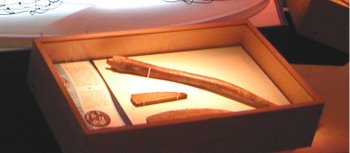
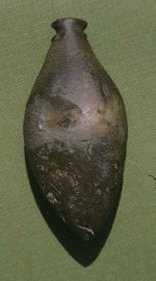
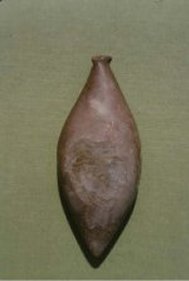
A number of years ago, on one of my forays to photograph the sunken forest, I chanced on a walrus bone embedded in the mud at the bottom of the basin. This bone was identified as a walrus “baculum” and was probably used by ancient visitors to these shores as a “club” (the baculum is presently on display at the New Brunswick museum as part of the ‘Lifelines’ traveling exhibition). Even more intriguing were 48 stone plummets or net weights, found in the same context as the walrus bone. These plummets (pecked and/or ground out of stone) closely resemble in size and shape the traditional carpenters plumb bob used for marking a vertical line. They were probably used as a net or line sinker. There is also a possibility that some may hold decorative, ceremonial or even religious meaning as well.

Dr. William Ritchie [1], following a lifetime of studying native artifacts, made the following observations:

“The remarkable stylistic constancy in the modes or attributes, which undeniably can be demonstrated within a series of points collected over a wide geographical range or from numerous components of the same cultural complex, indicates the reality of a stylistic model in the mind of the prehistoric maker. Clearly they were working not from caprice but from a “cultural compulsive” which impelled them to conform to current fashions or established norms for their particular area and period.”

And furthermore,

“It is further assumed that the typological configurations reflect standardized behavior and the fixation of motor habits, through traditional or culturally approved ways of doing things in the aboriginal society concerned.”

Although his observations were directed at projectile points, the same may be said for plummets. Although there is some notable variation in the collection, I would attribute some of the differences in shape and mode of construction to the base material. Quartzite, for example, is very hard compared to sandstone, which is relatively soft and would presumably be easier to shape. Even with these subtle differences, they all appear to be made with a “model” in mind (see photos). David Keenlyside, archaeologist with the Canadian Museum of Civilization, has helped in interpreting these finds (and providing the carbon date for the walrus bone), had this to say regarding the plummets:

“The similarities in style do suggest a single maker or perhaps one ‘artifact template’ which might be associated with a family, band or community. They kind of remind me of historic bird decoys where ‘sets’ of decoys were made; at other times, various birds/decoys collected from various manufacturing times put together for hunting sets… Must have been similar for floats, weights where multiples were needed.”

These artifacts come from an aboriginal cultural complex known as the “late Archaic”. The term Archaic is a term applied by archaeologists to define a time period characterized by hunting, fishing and gathering cultures and distinguished from the subsequent horticulturalists [2]. This artifact assemblage is especially important to the early history of the border region since we now have confirmed human presence coincident with the formation of our famous marshes at the head of Cumberland Basin, some 4,000 years ago.

Plummet 1

Beausejour walrus “baculum” (elongated object in display box). Atlantic Fisheries exhibit, Canadian Museum of Civilization (CMC). The baculum has been radiocarbon dated to approximately 4,000 years BP (before present).

Plummet 2

Plummet 2

Plummet 3

Plummet 3

Plummet 4

Plummet 4

Plummet 5

Plummet 5

Four of the Beausejour plummets. Plummet 2 is particularly well crafted. Plummet 4 still shows abrasion marks from when it was made. Plummet 5 is interesting as there is a “brachiopod” (shell) fossil imbedded in the specimen.

[1] New York Projectile Points, New York State Museum, Bulletin 384, Albany, 1971, pp. 7–8
[2] Tuck, James Maritime Provinces Prehistory, Ottawa, Ont., National Museum of Man, National Museums of Canada, Canadian prehistory series, 1984.

Some significant dates in Sackville’s past

  • 1708: Arrival of first permanent settlers — eldest sons of five Acadian families from Napan/Maccan area (Michael Hache, Rene Bernard, Michael Bourque, Martin Richard and (?) Gaudet)
  • 1755: English forces capture Fort Beausejour and destroy Acadian settlements.
  • 1758: Governor Lawrence issues proclamation inviting settlers from New England.
  • 1760–61: Arrival of first English settlers — “planters” from Rhode Island; Tower, Easterbrooks, Cole, Finney, Seaman, Robinson, Brownell, Ward & others.
  • 1762: First Town meeting was held (20 July 1762). On 29 July 1762, first steps taken towards municipal government — the name of Sackville was chosen for the Township in honour of Lord George Sackville (1716–1785), commander of the British Forces.
  • 1763: Baptists arrived — 13 Baptists from Swansea, Massachusetts headed by Nathan Mason arrived and established a church — the first of its denomination in Canada.
  • 1762–63: Additional waves of immigrants from New England: some family names were: Ayer, Oulton, Tingley, Richardson and others.
  • 1765: First land grant for Sackville township, 32,250 acres, all to New England people
  • 1767: Sackville’s population was 349 persons (343 New Englanders).
  • 1767: Sackville secured the right to send a member to Legislature in Halifax (Sackville had a population of 80 families at the time).
  • 1772–1775: Yorkshire Settlers arrive: Dixon, Bowser, Atkinson, Anderson, Bulmer, Harper, Patterson, Fawcett, Richardson, Humphrey, Wry & others settle in Sackville.
  • 1783–84: United Empire Loyalists came to the Province — among those who settled in the Sackville area: Fowler, Knapp, Palmer, Purdy, Boultenhouse and others.
  • 1784: New Brunwsick established as a Province (separated from Nova Scotia).
  • 1790: Methodist Chapel in Middle Sackville, along with the chapel at Point de Bute, are the first Methodist churches in Canada.
  • 1818: Opening of a new “turnpike road” (Upper Fairfield Rd.) connecting Sackville directly to Dorchester.
  • 1821: John Morice and John Humphries purchase the Mills at Middle Sackville and expand the business, creating an environment for strong economic growth in the area.
  • 1840: Opening of new bridge over the lower Tantramar and “Great” Road to Nova Scotia.
  • 1841: Establishment of the Port of Sackville with first public wharf.
  • 1841: Relocation of the Boultenhouse Shipyard from Wood Point to Sackville, following which other shipyards established (Dixon/Wood, Purdy).
  • 1843: Opening Mount Allison Male Academy founded by Hon C.F. Allison in 1839.
  • 1854: Ladies College (Academy) opened.
  • 1852: Fawcett Foundry (Enamel & Heating)established by John & Charles Fawcett.
  • 1856: First Newspaper “The Border” published by Edward Bowes.
  • 1856: Launching of the ship Sarah Dixon (1468 tons) at the Dixon/Wood shipyard, the largest vessel to be built in Sackville. A total of 165 ships were launched from local yards.
  • 1862: Mount Allison Wesleyan College established later to become Mount Allison University.
  • 1872: Dominion Foundry (Enterprise) founded by Capt R.M. Dixon & others.
  • 1893: Owens Art Gallery moved from Saint John to Sackville, new Gallery opened in 1895.
  • c. 1900: Population of 2000, most downtown business blocks constructed.
  • 1903: Sackville was incorporated as a Town.

Memories of a Dorchester Traveller Part I

Browsing through tourism brochures, visitors to Dorchester have been known to question references to the villages role during the Golden Age of Sail. Statements such as: It was shipbuilding that made Dorchester famous around the world, cause the skeptical to ask: How could there be shipbuilding without a harbour?

Tour guides, having heard this before, point to a map, and patiently explain that the centre of the community was once Dorchester Island. It’s just down the road. And yes, although landlocked today; it was a bustling home port for ships that sailed the seven seas. Age of sail historian Stanley Spicer attests that at least 109 vessels were built in Diorchester. Of these, 68 came from Dorchester’s three major shipyards; owned by the Palmer, Chapman and Hickman families.

Dorchesters shipbuilding heritage was brought to my attention recently through a remarkable diary. Covering the last phase of the Age of Sail, from January 01, 1870 through to December 31, 1894; it records how and why, shipbuilding and international trade became the lifeblood of a prosperous community, once the shiretown of Westmorland County.

On the surface, the diarist was an unlikely recorder of this era. A farmer and businessman; he once sailed aboard the barque John Hickman as ships carpenter. But for Alexander Black (1838–1902) this was not all; for he possessed many talents and mastered more than one occupation. In addition, Black had an interest in music, art, politics and law. If an important trial was in progress at the old Westmorland County Court House, Alexander Black was certain to be a spectator. Well read, and largely self educated, he had an excellent command of language and always expressed himself in a cryptic, but engaging manner.

Beyond these achievements, Alexander Black was a staunch follower of Methodism. This is not surprising when his family background is known. His father James A. Black (1790–1863) was a half brother of the Revd. William Black (1760–1834), founder of Methodism in the Maritimes. In his time, Alexander Black was a prime mover behind the building of the Dorchester Methodist (now United) Church, dedicated on Nov. 26, 1882. As revealed in his Diary, wherever he traveled, it was his custom to worship in the nearest Methodist Church. While Blacks Diary provides valuable insight concerning late 19th century life in Dorchester and the Tantramar region; this Flashback and the one that follows on March 12th, will focus on Alexander Black the traveling man.

In order to understand this aspect of Blacks life its necessary to delve into his business interests. Growing up in Dorchester during the Age of Sail he could not help being influenced by the call of the sea. Ship launchings were important highlights in the community and he witnessed many of these events, from early boyhood onward. .How were shipbuilding ventures financed? Commonly, most contracts were divided into units of 64 shares, based on the total cost of the vessel. The shipyard usually held the controlling interest; while the remainder might be sold to the captain, the ships agent, or to local businessmen such as Alexander Black. These investors received dividends, based on profits made and their number of shares. Starting in a small way, Black was able over time, to reinvest his profit in ever larger numbers of shares. Later, as his financial involvement increased, he made frequent trips to Saint John, Boston and New York; the chief ports of call for the ships in which he had an interest. Here he would confer with local agents, supervise the unloading of cargoes and negotiate future contracts.

Important though these trips were from the business standpoint, they did not fulfill Alexander Blacks yearning for overseas travel. Unmarried, and without family responsibilities, he was able to take off when the spirit moved him. Normally these longer voyages were made over the winter months when farm choring was not so pressing.

During October of 1875 attention in Dorchester was focussed on a new ship about to be launched. Christened the Bessie May, and built by Edward Chambers, it was successfully launched on October 21st. Just over a month later, on Nov. 25th, Alexander Black, having earlier placed his trunks on board, set sail from Dorchester Island, on the maiden voyage of the Bessie May. The brigantine was bound for Glasgow via Queenstown (Cobh) Ireland. Lets pick up the story from the Diary

Nov. 25 sailed for Queenstown at 10 AM; passed Saint John and anchored in Beaver Harbour at 3:30 PM on the 26th. Set sail at 10 AM on the 27th. Passed to the west of Grand Manan and then lost sight of land. By the 28th, we were off Cape Sable. Sighted four steamships and a brig. Weather fair. During the next three weeks, the Bessie May crossed the North Atlantic by way of the Grand Banks of Newfoundland. Enroute considerable rain, squally weather and eventually fair winds were encountered; otherwise the voyage was uneventful. On Dec. 18th at 11:30 PM, the light from Cape Clear lighthouse, on a small island off the southern tip of Ireland, was sighted. At 7AM the next day, the Bessie May was abreast of Kinsale Lighthouse and by 11:30 dropped anchor in Queenstown Harbour. This seaport, located a few miles southeast of Cork, is today known as Cobh. The first leg of the voyage was over.

Happy to be on dry land, Alexander Black made good use of his time over the next few days as the Bessie Mays cargo of lumber was unloaded. Always the curious traveler, he spent Dec. 20th exploring the nearby city of Cork. While anchored in Queenstown, arrangements were made for the Bessie May to proceed to Greenock, Scotland to pick up a load of coal. On Dec 23, the ship set sail through the Irish Sea and Firth of Clyde, reaching a point 28 miles below Greenock at daybreak on Christmas Day. A tug towed the brig into port, where an unspecified cargo, picked up in Queenstown, was unloaded.

Once more Alexander Black opted to go exploring, this time in nearby Glasgow. Unfortunately, the Diary mentions only the highlights. Chief of these was St. Mungos Cathedral, which made a lasting impression. He also singled out West Park, the Arcade and Bazaar as being of interest. Alexander Blacks one regret was an inability to find a Methodist Church. Nevertheless, on Sunday Jan. 2, 1876, he starts the new year right by worshipping in a Presbyterian Church. A delay in departure of the Bessie May provided another opportunity. He was able to hop on a train and travel to Edinburgh, where he spent several packed days visiting all the noted places in the New Town and all the noted places in the Old Town.

By Jan. 12th, Black was back in Greenock. A contract to carry a cargo of coal for Havana was signed and the brig hauled to a crane to be loaded with coal. On Jan. 31st he was on board the brig awaiting fair wind to sail for Havana. Finally, on Feb. 5th the Bessie May weighed anchor at 4 AM, with a fair wind… Another trans-Atlantic voyage had begun.

Thanks to the northeast trade winds, and a good sailing breeze a smooth crossing was made. The only problem, a dead calm, meant an eight day delay in mid-ocean. Eventually on Mar. 25th, the island of St. Domingo was sighted and the Bessie May arrived in Havana at 11 AM on April 2nd our passage from Greenock was 57 days. Strangely, the Diary is blank for the next six weeks; mentioning only that the coal was unloaded and a cargo of sugar secured for New York. We can only speculate that illness prevented Alexander Black from exploring the Cuban countryside.

On May 24th the Bessie May sailed for New York, arriving on June 8th, to be met by Mr. Chambers from Dorchester. Undoubtedly, much time was spent in catching up on the news from home. By now, Alexander Black was back in form and took several days off to travel to Philadelphia to attend the American Centennial celebrations. 1876 was a notable year, as the United States observed the centenary of the Declaration of Independence. Although Black does not tell us, we may be certain that he made the rounds of the many historical sites in this city.

By July 2nd, Alexander Black was homeward bound. The Bessie May remained behind in New York to await another cargo; forcing him to travel by rail, first to Newport, Rhode Island. Once there, a drive in the country was followed by a visit to Mount Adams. In one Diary entry, made while in Newport, Alexander Black was unusually candid. He confessed to having spent a day walking to Purgatory and Paradise with details being left to the readers imagination. He then travelled from Newport to Boston for a brief overnight stop. On July 12, Alexander Black caught the train for Portland and Saint John; arriving home in Dorchester on July 15th, 1876. His long journey of almost nine months was now over.

Do We Need a February Break?

A recent headline in the Globe & Mail highlighted the most universal of all Canadian greetings: Bon jour, cold eh? For whatever reason, winter 2003 has witnessed a deep freeze of unprecedented proportions. This conclusion has been proven by record breaking cold temperatures throughout the Maritimes. Even the weather forecasts have heightened our awareness of the cc-oo-ll-dd by their emphasis on the wind chill factor. To add insult to injury the January cold snap was followed by a Groundhog Day ice storm. For many of us, there is little consolation in the conclusion of author Robertson Davies that … its winter that establishes the character of Canada.

There have been a variety of explanations for the recent erratic weather patterns. These range from global warming, melting of the polar ice caps, to the long range impact of El Nio. Others, who may be reading too much science fiction, attribute weather swings to visitors from outer space. Its worth noting that strange and unusual weather is by no means limited to Canada; as shown by the drought and alarming bush fires so prevalent during the present Australian summer.

Nor is Winter 2003 an exception. When it comes to recalling past weather conditions, our memories tend to be selective and unreliable. More often than not, cold winter memories remain the sharpest. The Tantramar region has had its share of every swing of the weather pendulum. For example: in January 1932, spring like conditions prevailed in January. The mercury soared well above freezing, and skipping ropes and baseball games were enjoyed on school playgrounds.

Possibly as a result of our cold weather preoccupation, Canadians have, for several years, been debating the possibility of a midwinter statutory holiday. Recently the Saint John Telegraph Journal decided to sample on the street opinions on the matter. Heres two interesting responses: Other than Canada Day, we dont have anything to celebrate who we are. Winter is such a part of our heritage we should have something to mark winter. Another respondent expressed similar views: Winter is a big part of our national fabric. We should have a holiday thats celebrating the fun of snow some kind of Winter Festival Day.

Its a reasonable assumption that a mid winter holiday would be welcomed by many Canadians. Further there is a consensus that it should occur sometime between Christmas and Easter and fall on either a Friday or Monday to create a long weekend. Since the date of Easter fluctuates, this means that mid-February would appear to be the ideal time. How about this coming weekend its still cold eh?

For the record, other reasons for a winter holiday have been put forward. Many countries commemorate the lives of famous personalities through statutory holidays. January 11, 1815 was the birth date of the leading Father of Confederation and first Prime Minister Sir John A. Macdonald. Another important Prime Minister and the first French Canadian to hold the post, Sir Wilfrid Laurier, died on February 17, 1919; creating the possibility of a Macdonald Laurier Day. Others have pointed out that such a holiday should honour all Prime Ministers; however, since some have been eminently forgettable this might not be too popular.

Another suggestion that would have resonance on the Tantramar is the raising of Canadas National Flag Day to the status of a civic holiday. The now familiar red and white flag with a stylized maple leaf in its centre, was approved by Parliament in late December 1964. The Royal Proclamation, officially designating the flag, was signed by Queen Elizabeth II and took effect on February 15th, 1965. Personally, this is a date that I will always remember, as I witnessed the ceremony when the new Canadian flag was unfurled at the Commonwealth Institute in London, England. Many readers will recall that the late Dr. George F.G. Stanley, former lieutenant governor of New Brunswick and Sackville resident, was responsible for the design of the flag.

For a number of years, the town of Sackville has celebrated its natal day on the first weekend in August. This is appropriate, since summer is the season when many people have their vacations. For this reason, the weekend has become a time for family gatherings and reunions. The weather is also more conducive to outdoor activities such as parades and athletic events. The date neatly coincides with New Brunswick Day, enabling more people to have time to travel for a homecoming. A second civic holiday, as suggested below, is not meant to interfere with this summer celebration.

2003 is Sackville’s Centennial year. This event will be celebrated, as it should be, in a variety of ways. The anniversary of the towns incorporation might be marked in the future by combining the existing Heritage Day, which usually falls on the second weekend in February, with a civic holiday to mark the incorporation of the town. Technically Sackvilles natal day is Feb. 5th; however, a holiday that coincides with a mid-February weekend might be a welcome antidote for the February blahs.

In proclaiming this occasion a civic holiday, two objectives would be achieved: the provision of a winter break as mentioned; and the focussing of attention on the towns unique history and heritage.

In recent years, an important initiative in this direction has been undertaken by the Tantramar Heritage Trust in their marking of Heritage Day. An outline of the creative program to take place Feb. 15th, at Tantramar Regional High School, will be found elsewhere in this issue of the Trib. A Winterlude atmosphere could well be combined with seasonal sports activities, such as hockey, to provide a focal point for the holiday. Since there is lots to celebrate, this might well become an annual event.

For many years, Sackville was known as a hockey town. Few people are aware that the first New Brunswicker to play on a winning Stanley Cup team was a native son. Bill Red Stuart was born in Sackville in 1900 and went on to play defense for the Toronto St. Pats. In 1922, the team won the NHL championship. During his career, Stuart played seven seasons in the NHL, first with Toronto and then Boston. Later he turned to coaching. Two of his teams in Halifax and Sudbury went on to win the Allan Cup.

More recently, during the 1950s through to the 1980s, Allison Gardens was often filled to the rafters with cheering hockey fans. This was the heyday of the game; when teams such as the Sackville Combines and Sackville Eagles, along with the Mount Allison varsity hockey team would attract 1200 or more people to games. Many a provincial and regional championship came to Sackville as a result of the efforts of these talented teams.

What better centrepiece for Sackville’s first Heritage Winterlude Weekend in 2004, than a Centennial Hockey Tournament in the new rink? Remember it’s winter that captures the character of our town as well as our country.

The White Fence, issue #21

January 2003

Editorial

Dear friends,

As we hunker down for Winter, this issue of The White Fence hopes to entertain you (we hope!) with some historic bickering (of sorts!) and eavesdropping via fascinating family correspondence. In our last issue, I had informed you about the treasures Marcie Fullerton had dug from the rich Tantramar mine. I had received some information from Capt. Pickering Ward’s ships’ log for 1912 (what was left of it!) but I had also mentioned some historic letters that Marcie passed on to me and to relate to you. They are something else! Marcie had some letters which were exchanged between her great great great grandfather John Morice and his brother, her great great uncle, William Morice. These are beautifully crafted letters by fountain pen on 17 February and 5 and 10 March, 1860! Although the letters appear to be mainly an exchange of personal and business news between brothers, the letter of 5 March informs us of the unfortunate sinking of The Hungarian and the sad passing of William Boultenhouse. This is very timely for all of us as we prepare the home of Christopher Boultenhouse to house our museum and genealogy center. These fascinating letters were found by Marcie in a box in the attic of the ancestral home where John had lived on the corner of Morice Drive and Main Street near Silver Lake in Middle Sackville. This lovely home is presently occupied by the 6th generation of Morices and the letters of its previous occupants are all in exceptional condition!

But John and William’s handwriting, though graceful and beautiful penmanship, was not always easy to read. Some words used therein are not commonly used today and, furthermore, in those days, the letters “f” and “s” were often interchanged. For example the word business, for some reason, was spelled “businifs” and “Mrs.” was either spelled “Mirs” or “Mifs” (the difference between Mrs. and Miss?). Other words were simply misspelled and I wrote them just as I read them (so don’t blame me!).

handwriting (illegible)

But, even with all the able assistance I received, there were some words that no one could recognize. Those words are simply written here with xs, In other words, an unrecognizable 3-letter word was simply written in as “xxx”. But with the help of Ann Koval, Owan Corrigan, Gerry Parker, Al Smith and my dear wife Carrie Macmillan, I was able to transcribe the letters with most of the wording intact, as they were read by the Morice brothers 142 years ago!! But to fit them all in, we had to use a small font. So some of us will need the magnifying glass to read them all !!

Also included is the following account about the life and correspondence of Captain Amos Pickering Ward which was researched and written by descendent Jeff Ward. I asked Jeff if he was distantly related to “Capt. Pick”. His interesting and informative response goes as follows:

“We are both descended from Nehemiah and Susannah (Salisbury) Ward but he descends from a son named James and I descend from a son named Jonathan. Most people from Rockport were descended from Jonathan. Amos was the first of his line to find his way to Rockport, via Wood Point”.

I do hope you enjoy reading this issue of The White Fence as much as I enjoyed compiling it from all the rich sources mentioned above! And special thanks to prospectors Jeff Ward and Marcie Fullerton for their sharp eyes and concerns for our rich historical resources allowing us to re-live those years long ago! Consequently, I feel as though I’ve already met the Wards, somewhere in Rockport, and the Morice brothers in the grist mill last Saturday or was it Friday… ?

—Peter Hicklin

And so here follows the results of Jeff’s research on Capt. A. P. Ward, based primarily on the good captain’s correspondence which allow us to follow up on the few morsels Capt. Ward’s log book provided us during our last stop at The White Fence. So now you can help yourselves to longer stopover and a full meal of rich history which you can only get when you stop at The White Fence!

Captain Amos Pickering Ward

by Jeff Ward

Around the turn of the century, the upper Bay of Fundy region was an important source of timber for the New England markets. This was particularly true through to 1907 when the stock market crash in New York caused the business to falter and fall off rapidly thereafter.

Captain Amos Pickering Ward was among the well known local captains at this time. His last vessel was the Carrie C. Ware which he sailed between 1913 and 1915. He sailed between New Brunswick and New England for many years, carrying pilings, deals and scantling as the markets demanded. At his home in Upper Rockport, he also built or reconditioned several vessels. This article tells a little about his life and provides some insights into the timber business during the last days of the Age of Sail.
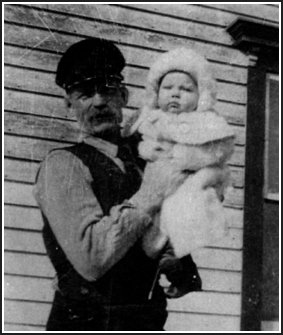
Captain Amos Pickering Ward

Captain Amos Pickering Ward

Captain Pick, as he was sometimes known (see White Fence no. 20), was born in Maine in 1849 to Seth Ward and Eunice Cole, originally from Wood Point. About 1878, he married Loretta Tower from Rockport. They had eleven children between 1879 and 1903. Captain Ward appears to have moved to Upper Rockport because of favorable shoreline conditions there. The land, which contained a stream inlet, was gently sloping and well-suited for a small shipyard (Lorne Booth’s property, presently for sale —ed.). He had several sons who all helped work on the ships in their youth. Their youngest child, Charles, would take over the family property years later.

A substantial amount of Captain Ward’s correspondence has survived and is preserved at the Dalhousie University Archives (Amos P. Ward Papers MS-2-200). These papers include letters and other materials sent and received during the period just after the turn of the century. During the period covered, he was captain of several vessels including the Rowena (1903–07), Lizzie Rich (1905), Stella Maud (1907–10), and the Carrie C. Ware (1913–15). A sampling of the letters reveals something of his character, family, local events, and of the businesses he came into contact with. He did business with several companies and brokerage houses including such timber suppliers as Robinson, Wright & Co. of Shulie; C.S. Hickman of Dorchester; F.W. Pickels Co. of Annapolis Royal; and J. Newton Pugsley and B.L. Tucker of Parrsboro. Buyers included Suncook Valley Lumber Co. and Stetson, Cutler & Co., both of Boston.

In 1903, he purchased the vessel that he would christen the Rowena, after one of his daughters. It was an 84 ton schooner. That year, oak would ship at $3.50 per 1,000 board feet, a good price. Communications were by mail, telegram or even by phone if Ward was in the right place; telephone service was available in Moncton and Dorchester. A typical order by mail might read, “We have lots of lumber ready for shipment and would like to have you come and load” (Robinson, Wright, October 28, 1904) or “We understand that you are to report at Rufus Seaman’s mill at Rockport and load scantling and plank for Boston at freight of $3.25 per thousand feet” (Suncook, March 23, 1906). Sometimes, he would be asked to confirm the order by phone or telegram. All of his dealings were charters.

Sometimes communications were not as clear and the good captain must have been frustrated from time to time while waiting for orders. Long after the crash of 1907, when markets had improved somewhat, he got into a shouting match of sorts with Stetson, Cutler & Co. In a letter dated April 23, 1914, an officer of the company wrote:

“We have your letter of the 22nd, reading as follows: — ‘went to Sand River [Cumberland County] after that cargo I wired you about. Called up the manager at Shulie. He said he had never heard tell of it.’

We don’t know why you ever went to Sand River, as we certainly never chartered you to go there. The only communications between us are shown in the following telegrams. Our telegram to you April 8th: — ‘we have all the Windsor tonnage wanted at present … possibly we can load you at Sand River near Shulie … answer if wanted.’

Your Telegram to us April 9th from Hantsport — ‘will accept Sand River … will proceed today.’

Now we took your message to mean that you would accept and proceed on the date of your message, providing we confirmed the charter. We certainly did not suppose you were going ahead anyway, as we had never told you positively that we could load you. Our message simply said ‘possibly’ we could load you at Sand River.”

The confusion ended when Stetson, Cutler & Co. offered to ask the manager of the Shulie operation to make up an order of spruce and laths. But his dealings with Stetson, Cutler seem to have been often testy. An earlier letter, form 1908, reveals some of their frustration with him. It would appear he threatened them in some way:

“We see you ignored our reference to our having given you half of the River Hebert towage to which you were not entitled under terms of the option given us on your vessel. This would be equal to $15.00 or better and we note you offered to settle with Alexander for $5.00. We think this is a case where both sides of the matter should be weighed. If you care to come in here and talk with writer when you are next in Boston, we will go into the matter in detail but we don’t care or propose to call in 3 or 4 captains to settle our business as we believe we are capable of attending to it ourselves. You can do things in an amicable way which you cannot accomplish by threat and your statement that a settlement will have to be effected with you before you discharge your cargo does not jar us a particle. If you fail to deliver the cargo we shall immediately libel* the vessel. We are willing to talk the matter over with you but this is the last letter we shall write. You have no right to claim that your carrying capacity is 140M (140,000 board feet) as you didn’t carry it on your prior trip and the cargo of hemlock you mention carrying to Wickford was planed boards and if I deduct 1/8 for the planing you only had the equivalent of 120M of rough lumber.”

As we can see from these letters, and from Ward’s entries in the log book excerpted in the last issue of the White Fence, that it is clear that he was a tough businessman, not afraid to employ a little bluster in his dealings. This toughness did not apparently translate into his home life, however. Several letters between he and his wife are also among the Papers, and they reveal a more conciliatory, domestic side to the man. Here is an excerpt from letter he wrote in September 1913:

This has been a fine long lonesome day. Received your letter Friday night — would have written before. Will have the hull full tomorrow. Lumber very heavy. We will be all loaded by Wednesday and will be round home if the wind is southwest. You better have the potatoes dug right away. Will write you before we leave and send you that $500 cheque and the one that we got last night. Hope we will get around home. This ain’t half what I want to say. Excuse this writing. Goodbye from Father to Mother.

His wife Loretta appears to have played a large part in his business because the two discuss business matters frequently, as can be seen from the following message, dated April 7, 1914. The letter also reveals that while he may have been tender with his wife, he was not always forthcoming:

It is a nice day here today. There is a big bill from Jonesport. Something more to worry about. You told me that you paid every cent on her the time you stopped in Jonesport. I don’t know why you tell such stuff. Why didn’t you pay it last summer and have it done with? And here is another bill. This is two of these that’s come from New Haven. You had better draw some money out the Bank at Sackville and pay it and stop interest. I don’t know where Lester is. Haven’t heard a word since they were in Portland [their son Lester appears to have been captaining the Genevieve at this time —J.W.]. We don’t more than get it in the bank before we have to draw it out. But it don’t matter as long as we have it to draw … Well, write as often as you can and let me know how you are getting along. Don’t get out of patience. You will get loaded sometime as long as you are well. So long from Mother to Father.

Not long after this letter Captain Ward got a letter from the Boston commission merchants known as Splane Bros. who advised him of “very few freights from the Bay of Fundy and rates are ruling ridiculously low and there are no immediate prospects for improvement.” Such were the ups and downs of the business. He must have prospered in his later years however, possibly from the sale of a vessel, as he is said to have purchased a car in 1918 (see Nowlan, Rockport Portraits, 1989). He could not have enjoyed it long, however, as he died the same year. He is buried in the Rockport Cemetery along with his wife Loretta, who died in 1938, and two of their sons, Hibbert and Bedford who both died as youths in the 1890’s.

* The use of the word ‘libel’ here refers to the written claims presented by a plaintiff in an action under admiralty law (Websters).

Historic letters

Aberdeen — Feb 17 1860

Dear family,

I write you by the way of Portland last week. I came from Liverpool to New Castle and could not find Meff from that to Glasgow could not find him there – arrived here last night and xxxxxxxx of uncle William talking about Jackson. I found him and took tea there last evening. He says Meff is at New Castle and will get the addrefs. I shall shortly go back. Jackson says he lost his wife last November and Christie Meff was married about 3 weeks ago to a respectable farmer about 20 miles out from here. I cannot tell any thing xxxx just now as the mail is just leaving or I would have called on him this morning. I do not think there will be any trouble about the insurance. Mr. Dickenson says their agent writes from London that the businefs is prospering. And in our case after a forfeit is made out they require a months notice. They will let me have what money I may want. And appear very friendly. I will expect a letter from you by the Cunard Line. I trust you are all well. I am very anxious to hear from you. I know since I landed I have a bad cold but am now considerably better. I trust you are getting along well with the businefs. As is expected that the government here will take off the duties on the Baltic Lumber & if so it will involve (include? —ed.) our deal and timber of half price and all parties here seem to think act very prejudicially against our wood trade. I am surprised to see such a Country as is here and such large population in the Cities. Glasgow contains they say ½ million of people and Manchester not much less known. they are very kind to me — wherever I go. I found Mr Hyan at Glasgow and he took me round some. and XXXX in haste. Respects to you and Most Affectionately

W Morice

To John Morice, Sackville, Westmorland, New Brunswick

EDITOR’S NOTE: the mailing address on the envelope read as follows:

Via Cunard Line to Halifax, N.S.
Mr. John Morice
Sackville
Westmorland
New Brunswick
British North America
(postmarked Feb. 18, 1860)

Sackville — March 5 1860

Dear Brother,

We received your letter by way of Halifax and glad to hear you are well. The one you sent by the Hungarian was not received. Am sorry to inform you of Wm Boultenhouse being one of the passengers in the illfated Hungarian. It is supposed all hands lost — his hat box came ashore with his name marked on it. It is a great shock to his Father a loss that he can never make up.

In all his trials and troubles through life nothing can be compared with this. He wrote to his Father saying that he dreaded his cumming out in the winter but was very anxious to come home and see his family. We ought all to be thankful that the ship was so well insured but trust you will succed in getting the insurance to your satisfaction which we think will no more than cover the bills.

Boultenhouse is very anxious to have money but seems he cant wait till you come home – now will write you about our own affairs Margaret is a great deal better than when I wrote you last and think by good care she might recover. Mother is well, Father is about the same as when you left but his feet swells when he goes out to much. Elizabeth is quite smart – tending on the sick. Ann is well Humphrey is healthy running about Uncle John makes his visit same as usial is well Uncle Wm Morice quite Smart – going about Uncle Wm & C. Humphrey is all well. Weight is down and is getting on very well with his boat Bell and Boultenhouse is very much down on account of Wm B.

We are getting on very well with the machines but expect will have them done by last of April or sometime in May – if nothing happens. We have sent £50 to Woodcock and have ordered 2 selts of cards. The money we received from the Glenns came in play very well. There has not been many logs come yet to the Mill to buy but other people have drawn logs to get sawed on shares -. Have been busy in the Grist Mill this winter but at the same time the people do not like Alx having so many boys round him. It seems that he cannot do anthg in the mill till he is surrounded with them. Wrote you in our last letter if you could make arraingements with a good young man to come out in case he did not keep Alx to do so – I think we have to many Andersons about us now. We have done quite a businifs in the barley this winter. We have nearly all our wood and poles out -. If the wages should keep good for one week longer – will be done since March came in there has been a great thaw and the roards nearly bare and on the whole very little sleding done this winter.

To my dear son William

I take the opportunity of writing you a few lines. We have been setting up with Margaret every night since you left untill the first of March. And now she is so far recovered thank God that by Elizabeth laying in the room with her she makes out without any more assistance and she is getting stronger every day – And Dr Knapp has attended her every day since he commenced. As for Boultenhouse I cannot tell how he will get over this shock but the loss of his son Wm he cannot set himself to any kind of businifs he has been all winter in Picto preparing the Westmorland and not done yet. One of his sons has been at home all winter and they have got out 2 frames of spruce. They have done well. They say they will be about 300 tons each I have been thinking if you have money to share to get a carding machine 30 in cylinder a good selt of cards – and to have the doffer to shift end ways and addition to the carding machine to have a stock or comber for xxxxx all complete and I should like to get a thustle frame say about 50 or 60 spindles and a sluban to match for drawing out boles you will not forget the kiln top. I cannot mention any more for fear your money will not hold out. And if you get that machinery if you can engage a smart boy xxx 14 or 15 years old that used to attending such work will be very useful in the carding mill. As I consider the addition will be a great advantage to our concern. I hope you have met in with Mr Meff by this time. Give all our best respects to him and family. And hopes you will find them all well. Let Mr Meff know that my old mentor is in Glasgow his name is James Watts he had a shop in Anderston and if he is alive he will be glad to see you or any of the family. He will be able to give you a great deal of information that you might want in his line. We hope you will get out safe and would rather you come out in a wooden boat as we think they are safer than Iron – You had better wait a little longer – until the weather gets more settled we have but little news to send you but we shall send you a few of our news papers and you will get more news from them than I can send you. I forgot to inform you if you come across a young man a good farmer you had better indent him for 3 years or more if you can Bargin you had better get one or more to come out to this Country in the spring… This is what Father wrote to you and wishes you to get ahead for doubling (?) and twisting (?) which he forgot to put in case you get the machinery but will leave that to your self –

John Morice Sen

No doubt you was expecting a letter from us last mail but we missed the mail – till to late. But – endevour to remit you a letter after this by every mail from Halifax and trust you will do so to, McConnel is going to move his old store at the corner of his barn and I forbid him before xxxx he says that he will put it where he pleases – and says that we do not own a foot of land xxx When you come out you better take the Cunard Boats – will expect a letter by this mail from you trust you are wll – we all send our kind respect to you – from your Affectionate Brother

John Morice Sen

To William Morice
Care of Mefrs John Bramley Moore
Liverpool England

Liverpool — March 10 1860

To John Morice Sackville NB

Dear Father & Family

Expect you have xxx this job and my letters excepting the first one sent by the Hungarian which was mainly stating the loss of the ship and my safe arrival here. William Boultenhouse sailed on the Hungarian and from accounts here all on board must have been lost. I have sent you and C. Boultenhouse a newspaper giving a list of passengers by the Boat of to day the Canada. Mirs Bramley More and Co. state there will now be no doubt but the insurance will be all right as the insurance company in London have written off. And the credit notes from the underwriters are expected here they say shortly which will then finally fix up the whole matter. The Hiphias (?) has been spoken 2 or 3 times since the time she was abandoned but Capt Miles thinks that now she must be broken up. All those things may deter the underwriter from settling fast now but all parties here state that should she be found and brought into port, the insurance would have to take her. but Mefs Bromley & co (?) state I may not be always uneasy about the businefs… under these circumstances not having it finally arranged I have so far deterred from making any purchases but have been through Sheffield and Manchester and some Cotten Shops machine & hardware & co. and think I have learned something. Lathes here are dear that is going to a machine shop and getting one made. I think I spoke in my former letter of a second hand nearly new lathe which W Meff showed me at New Castle. It is small but very handy back motion to completely made to cut screws to turn self acting turn taper – Complete slide rest can be turned by foot or power will turn up nearly 4 foot long and could be extended. The heads are about 5 in turn about 10 in diameter. The lathe was made by a first rate workman in Armstrong Girven manufacturing for his own amusement. Meff thought he offered it for about £17 which Meff says is very cheap. I have written Meff to inquire more particularly and also to find out what they would ask to put on a 3 jawed chuck. Speaking about lathes I priced one about the size of our Jack lathe yesterday in Manchester it was £95.00 and chucks and other stuff I wanted they asked about £12.10 more which would have made a very dear thing of it. As to the Common lathe without Rack they are nearly as high in performance.

So I think without I can get something cheap I shall not get any from here as I could get them cheaper in Boston hardware. If the lathe shown by Meff can be got around here for about £20 I would take it as it is a very useful article as would be to us.

I have fallen in with a tool maker in Sheffield he has a very good small hand drill either for hand or power can be used for either. one size is £11 and larger £13 ,, it will assume all the purposes that Harris & Alen would charge £20 for. If I get this I shall get a little improvement made on it; and have the bottom to turn which would make it able to drill out small xxxx by a verticle drill I do not think anything can be lost by the machine I have also got in with a large house which makes Cutting file saws and cast steel of all qualities. I shall get a few dozen of files to try them. Then sell at whole sale. But I have endeavour to get the insurance matter all right before I do much. As to getting cottens they are high just now. May bring out a few but will so arrange that if he should want could in future send. Wire is very cheap at Manchester. I have forgot the two which would answer for fans xxx xxxx you might write the no. in case I should not be away when it arrives as in case we make forms we would have to purchase minimum cloth in St John. As to the kiln plates we can get them as cheap from Pictou and xxxx covering as I wrote you soon rusts out.

This neat work I shall probably go to Suds and will see barly and will make particular enquiring about the Barly bolt. I find that almost Every improvement as also Cheapxxxx is confined to England and particularly about the manufacturing districts for nearly all articles. As barly knows about any improvements in Boultings. I shall also see something in the woolen line as Manchester is all in the Cotton. I may go to London. Bramly Munn who say I ought to go there by all means. Railway travelling is not very dear by taking the 2 or 3 Cars – and can go from here to London in 5 hours.

I wrote you I believe that I had seen Meff. he will go out to New York. Sometime in the spring. I recommended him to go there in preference to coming to St. John. His wife and family he will leave in Aberdeen or Glasgow. I shall write to parties in St. John to give him referances in New York so that he may get a situation if possible at once. His oldest boy with leave Gorden’s Hospital this summer and intends to be an Engeneer and from some of his mothers friends think he can get into as apprentice the Napius (?) Establishment in Glasgow which no doubt will be a good place he is rather a smart boy – Miff himself xxxxx is in Armstrongs Celebrotio Gun factory for the Government a few miles from New Castle and gets pretty fair wages – but he says he has made up his mind for America and thinks he can do much better there than here ,,,, I am much disappointed in not getting a letter from you this mail. if you knew how anxious I am to hear from you, I think you would have taken the trouble to have written a few lines. Only if no more than to let me know how Margaret is – you mention in your letter about going on with 3 sets of machines. All very nice – but you had better be sure that you can get the orders. Butcher in Charlotte Town if he does not & has not written by the last of January he does not intend to have the machinery till next year. And if xxxx does not agree for the Frenchman without some other orders which I do not know of. You have the last one from P.E.I. a xx ,, which you xxxxxx which you will have to be particular about and Eugene of Stewart I wrote xxxxx from here when I got your letter to make enquiry about him. And your ,, deal here is supposed will not be very high. they are now falling in price and no fresh arrivals. So it is just as well not to exert our selves in getting logs – you had better let the businefs take (further pursuit) its own course and get what you can XXXX or settled (?). And keep the Shop (?) in operation as that is genering (?) xxxx sure.

I have written to Mr Milne to Enquire for a miller around about Aberdeen not to hire but to know if he at short notice could get one to come out to America as you mentionned. And also ploughman businefs here generally is brisk. And wages are getting up which is rather against getting xxx – I have been very sick since I have been here, some troubles with a slight cold but it is getting better. My love and kindest wishes to you all. Shall next (?) week (?) by xxxxx.

And Remain x xx Wm Morice

From our president

December, 2002

Dear Members and Friends,

This is membership renewal time for the Tantramar Heritage Trust and I wanted to take this opportunity to ask you to renew your association with the Trust and to think about making a donation to one of our projects.

The summer of 2002 has been extremely busy with five students working on various projects. Under the capable leadership of Paul Bogaard and Al Smith, we had two students concentrating on finishing the cataloguing and starting the displays at the Campbell Carriage Factory. A great deal was accomplished and we now have the beginnings of displays which show how carriages were made. Some of you saw these at the open house we held in conjunction with the Sackville Fall Fair. Work has also continued on improving the “physical plant” with Ray Dixon and his wonderful team of volunteers. However, we still have much to do at this site and hope for your continued support.

The Trust office was moved this summer from Lorne Street to a renovated space in the Boultenhouse Heritage Centre. With direction from Al Smith and Paul Bogaard, Blaine Smith and his team of two students and some volunteers worked a miracle on the ell at the back of the house, giving us office space and meeting/work space. They managed to combine efficiency with an atmosphere consistent with the age of the house. Those who were able to come to the open house on November 10, 2002 were pleased with the results. Once again, there is much still to be done to turn the house into a Heritage Centre, including, we hope, a family history centre, for the Tantramar region. Please continue to support this project.

Over the summer, the Trust also had a student working with Bill Hamilton on a History of Sackville, one of our centennial projects. In addition, we are very pleased that researcher Matt Fullerton has been working with Bill this fall. This project also needs further support.

Directors Vanessa Bass, Marilyn Prescott and Ray Dixon and member Joanne Goodrich and their committee had a great success with the fall “pig roast” dinner, enjoyed by everyone in attendance. Thank you for supporting this event and we hope to have more in the future.

As always, Peter Hicklin and Leslie Van Patter have been doing an excellent job of writing, editing and lay-out for The White Fence. Please contact Peter if you have ideas or information he could use. The newsletter is a joint effort of all our members and we are lucky to have new director, Anne Koval involved also.

The Trust is now working on plans for Heritage Day on Saturday, February 15, 2003 as part of the celebration of Sackville’s centennial year. We are hoping to portray some of the town’s history through the eyes of its citizens. If you would like to be involved, you can get in touch with David Fullerton or me.

Mona Estabrooks has undertaken the job of treasurer for the Trust with the backup of Mariner Black who put our financial accounting system on computer last year. Thanks to both of them.

Paul Bogaard and Al Smith, representing the Trust, have been working closely with Renaissance Sackville and the historic sites committee. We are also working with nearby communities to try and coordinate our efforts to preserve the past and bring our joint history to life.

Please consider these options for participating in the work of the Tantramar Heritage Trust:

  1. Renew your membership using the form found in the last White Fence or by contacting Donna Sharpe, Membership.
  2. Make a donation, either to the general fund of the Trust or to a particular project. For donations received before the end of December, 2002, you will be given a receipt for the 2002 tax year.
  3. Volunteer your time and expertise. Fill in the appropriate area on the renewal form or give Donna Sharpe a call. Suggest an area where you might like to contribute or ask where you might be needed.
  4. Write an article for our Newsletter or give Peter Hicklin some interesting information about the Tantramar area.

The support shown by its members has been the reason that the Tantramar Heritage Trust has been able to accomplish so much over the last six years. With your continued support, we will be able to do much more.

Yours sincerely,

Barbara H. Jardine, President, Tantramar Heritage Trust

Is What You Read Always Correct? The Case of the Mysterious Town Seal

In previous Flashbacks published on Aug. 14 and Dec. 4, 2002, the steps leading to the incorporation of Sackville were outlined. Today, and still with the same subject, The Case of the Mysterious Town Seal takes centre stage.

Recently, on receiving a telephone call from a local resident, I realized that there was another story waiting to be told. He asked me to explain How the town celebrated its incorporation on Jan. 4, 1903. Since the ratepayers had not by that date voted in favour of incorporation, there was some doubt that this information was accurate. Following my request for evidence the caller suggested that I take a look at the Town Seal.

This advice was followed. Before going further, each reader should stop and look carefully at the accompanying illustration. At first glance, it seems clear that incorporation took place in January of 1903. Assuming for the moment that this is correct; two questions emerge: What was the actual date in January, 1903? Why was the phrase Act of 1896 included?

To make certain that I was not missing something, I requested help from a totally unscientific sample of seven local citizens of repute. They were asked to study the seal closely and tell me the date of incorporation. Four replied with certainty in their voices: Some date in January 1903. The remaining three said: It must be 1896, because Act of 1896 is printed in bold type. I then realized that any public opinion survey, even one with a 2.8 margin of error, 19 times out of 20, would not help. I would have to go back to the archival catacombs.

My first discovery came in finding the record of a Town Council meeting in Fords Hall on April 24, 1903. It had been earlier recognized that an appropriate seal was, for legal reasons, required by the new town. A special committee of Council under the chairmanship of Alderman Frederic Ryan had completed its work. Tenders were called; and responses from two Saint John printing firms were considered at this meeting. The tenders filed would amaze any 21st century communications or advertising agency. Barnes & Company quoted a price of from $7.00 to $15.00; while the successful bid by R.H. Green & Sons came in at $7.50.

The symbolism on the proposed seal was both striking and appropriate. The shipbuilding era was remembered in the sketch of a brigantine in full sail. An open book transposed on the globe highlighted the importance of Mount Allison University; while a parlour stove and plow focussed attention on two of Sackvilles important industries; the manufacture of stoves and agriculture.

Now the plot begins to thicken. On motion of Alderman Frank Harrison, seconded by Alderman Alexander Ford, Greens design was adopted subject to a slight change. Around the outer edge of the seal the words: Incorporated Jan. 1903, should appear. Was this the end of the mystery? Not yet; as I was soon to find out. There was obviously something behind the addition suggested by Town Council.

To make matters more complicated, I had by this time, uncovered the actual date of Sackvilles incorporation. Proof was found in the Journals of the House of Assembly and Sessional Papers. Following legal requirements, the Westmorland County Sheriff Joseph A. McQueen officially informed the Provincial Secretary that: An election [on the matter of incorporation] was held Monday, January 12, 1903 A.D. The number of ballots marked For was 167; and the number of ballots marked against was 137 with one rejected. Communication was slower in 1903 than today; thus some time elapsed before this official notice was acted upon in Fredericton.

Eventually an order-in-council was prepared for signing and proclamation by the Lieutenant Governor. It read as follows: I do therefore proclaim that the said town of Sackville, comprised of boundaries herein before described, be incorporated under and by the provisions of the Towns Incorporation Act. Given under my hand and seal at Fredericton, the fifth day of February one thousand nine hundred and three and in the third year of His Majestys reign.

In a ceremony held in Fredericton on the above date, His Honor Lieutenant Governor Hon. Jabez Bunting Snowball (1837–1907) affixed his signature and Sackville was now officially incorporated. Incidentally, His Honor, a lumber baron from Chatham, and former MP and Senator, had a number of interesting links with the new town.

A graduate of Mount Allison Academy, he was an active supporter of that institution and after 1862, the university. His father Rev. John Snowball, a prominent Methodist clergyman, served as minister of Sackville Methodist (now United Church) from 1861 to 1863. At this point Rev. Mr. Snowball retired from the ministry but continued to live in Sackville.

The Lieutenant Governors sister Mary Ann married Joseph Lawrence Black (1829–1907), a prominent Sackville businessman. Later their son, Hon. Frank Bunting Black (1869–1945), became president of the family business; J. L. Black & Sons Limited. He served in turn, as a member of Town Council and Mayor. Black rounded out his political career as an MLA for Westmorland and from Nov. 25, 1921 until his death he was a member of the Senate.

Meanwhile, a further check of government documents for 1896 revealed that during the legislative session of that year, a bill entitled The Towns Incorporation Act was passed by the legislature. It provided the ground rules for incorporation of towns throughout New Brunswick, and explains the presence of the phrase Act of 1896 on the seal.

Still one question remained. Why did Town Council insist on the additional wording Incorporated Jan. 1903? By April 30th, they most certainly had in their hands a copy of the order-in-council and proclamation by the Lieutenant Governor. The solution to this aspect of the mystery must be credited to journalistic sleuthing by a former editor of the Tribune — C.W. Scoop Moffatt.

Because of his interest in local history, I reasoned that Moffatt might have had something to say concerning the mysterious town seal in his Tribune column When Was That? After scrolling through several issues, I discovered that he was very much aware of the discrepency in dates on the Town Seal.

Ever the investigative reporter, Scoop set out to determine what had actually happened. In his quest, he enlisted the help and support of Lloyd Folkins, then MLA for Tantramar. The latter had more than a passing interest in the subject. Before entering provincial politics, Folkins had served for ten years on Sackville Town Council and was elected mayor in 1952. He, in turn, sought the aid of the Provincial Archives staff. The documents uncovered proved that Sackville’s natal day was Feb. 5, 1903.

But even more, the Moffatt/Folkins investigation revealed why the date Jan. 1903 was so permanently and incorrectly fixed. It was because of a typographical error in the Royal Gazette of Feb. 11, 1903. The usually reliable Gazette in an example of sloppy editing had substituted the date January 4th in place of February 5th. The 1903 Town Council, did not correct the error; and merely copied the date as printed in the Royal Gazette.

The last word must go to Scoop: All of which proves that you cant always believe what you read. Although the Trib and Town Council of the day accepted the date in the Royal Gazette without question, an alert editor would have caught the discrepancy in dates. The proclamation of an event eight days before it actually happened could not be made even by order-in-council. So for all future historians, the town of Sackville was officially incorporated February 5th, 1903. Q.E.D.

During 2003 it is my hope to devote several Flashbacks to highlights of the past century in Sackville. If you have topics to suggest; or better still, material, photographs or information to share, please get in touch.

Remembering Past Christmases: Home for the Holidays in 1932

Only a few readers will recall Christmas as it was celebrated seventy years ago. For many on the Tantramar and elsewhere, Dec. 25, 1932 was unmistakably grim. The Great Depression that began with the Stock Market crash of 1929 was now a fact of life. Yet despite harsh economic times, and a much simpler life style, the true spirit of Christmas was everywhere apparent. Lets go back and sample Christmas when the season was much shorter. Unlike 2002, it did not start immediately after Halloween; only to end in a whimper with the January sales. In 1932 the beginning was signaled in early December when practices for Christmas concerts began in earnest.

About the same time, advertisements for Christmas Specials appeared. By comparison with today, merchants in Dorchester, Port Elgin and Sackville might seem to be offering bargains galore. Some examples were: Grapefruit selling at 4 for 25 cents; Red Grapes 2 lbs. 25 cents; Green Grapes 20 cents per lb. A box of Moir’s Chocolates cost $1.29. Electric irons were $2.35; while table lamps ranged from $1.35 to Deluxe Models at $12.50.

Bargains? Not really. When the prevailing low wages are factored in; for untold numbers, the season was anything but merry. The Sackville Post encouraged all who could afford to support the annual Christmas Stocking Fund for the needy. C. C. Avard, then editor of the rival Tribune spoke for many when he editorialized: The main idea on this Christmas of 1932 is to carry on and live one day at a time, doing our duty as we see it, with the hope that the skies will clear and that the storm of Depression will soon pass.

Both rural and townspeople shared adversity during the 1930s; yet those living on farms had one advantage, they seldom went hungry. A preoccupation then as now, was with the weather. In 1932 the Tantramar was experiencing an unusually mild spell. The downside was the problem of muddy roads. However, at least one rural correspondent reported that the usual activities of the season are in evidence cars and carriages are moving too and fro on either side of the Isthmus. Despite a Green Christmas, Santa Claus was scheduled to make his appearance at the Imperial Theatre. Admisssion: Boys and Girls 15 cents; Adults 25 cents. All children were guaranteed a bag of goodies.

It was noted in the newspapers that Prime Minister R. B. Bennett would not, as was his custom, spend Christmas in Sackville at his brothers [Captain R. V. Bennetts] home on York Street. Instead, the Prime Minister was then on his way back to Canada, from an official visit in England. Radio was still a novelty in 1932. The annual Christmas message by the reigning monarch, a tradition that continues today, was eagerly awaited. Relayed by short wave and transmitted locally by the Moncton radio station; the reception was reported loud and clear on the Tantramar.

To fully appreciate Dec. 25th, 1932, I would like to share an account by someone from away who decided to return home and experience, once again, a Chignecto Christmas. The writer was Lyman T. Chapman (1897–1980), a native of East Amherst, whose ancestry may be traced to William Chapman, a Yorkshire settler at Point de Bute in the mid 1770s. Reputedly, this family can claim more direct descendants than any other of Yorkshire origin on the Tantramar. Chapman was then based in Winnipeg where he edited The Nor-West Farmer. Later, he was to succeed Point de Bute native, Dr. John M. Trueman as Principal of the Nova Scotia Agricultural College. Following service in the RCAF during the Second World War, he returned to journalism, and will be remembered both locally and across Canada, for his longtime editorship of the popular Family Herald. The story is best told in Chapman’s own words.

As the festive season of 1932 approached, I had a sudden longing for a Christmas at home, something I had not experienced for 15 years. It is said that nostalgia is the strongest of human emotions and looking back over the years, there is a danger of becoming sentimental. Yet, we are more likely to appreciate such occasions in times of adversity, rather than in times of prosperity. In 1932 we were certainly in the midst of adversity.

Although relatively well paid as a magazine editor; because of payments on the mortgage, radio and car I was obliged to borrow on my life insurance to finance the trip. My wife, young son and I set out with high hopes; looking forward to my parents [Alexander and Minnie Chapman of East Amherst] meeting their first grandson. We traveled by rail to Toronto, then Montreal and finally Amherst. As always, the family Christmas tree was a welcome sight. 1932 was the first time in many years that a stocking had been hung by the chimney with care. Another touch of the good old days was the Christmas concert in the one room schoolhouse. Like those of earlier years, it was a mixture of reverence and revelry. The babe in the manger, the three wise men and the star of Bethlehem were all there. The little schoolhouse was packed with fond parents and visitors.

My brothers [Curtis and Ross Chapman] reminded me of incidents during our childhood Christmases. When the family circle was assembled, they kidded me about the times I put out a tub of water on Christmas Eve for Santas reindeer. The tub was always empty on Christmas morning. Christmas Day routine had hardly changed over the intervening years. Children were wide awake early to find out if their fond hopes had been realized. As soon as the morning chores were done, the extended family began to gather for Christmas dinner at noon. The men sat in the kitchen until mother had too little elbow room at the range and kitchen table. When she gave the word, everybody moved to the living room.

By this time, the food began to appear on the dining room table. The carving of the turkey was done in the kitchen and plates were passed along in an assembly line. The vegetables were all home grown. The cranberries were picked on our own Tantramar Marsh. Maybe the Christmas pudding had some spices from town, but the summer savory in the dressing was the real thing. Dessert and the pudding came later, as well as fruit, nuts, tea, coffee and milk; not forgetting the choice of mince or apple pie — the latter being smothered in whipped cream.

After dinner there was storytelling and a discussion of family events and tales of Christmases past. The new grandson was well in the foreground with the contents of his stocking. As chore time again approached, the horses were harnessed and the relatives departed. On New Years day there was a repeat performance at my grandfathers farm three miles away. After New Years celebrations were over, we returned to Winnipeg. Of course, the grandson held centre stage right to the finish. As his grandmother was fastening his coat, he sang a childhood song, complete with lisp. This put the finishing touch on my best Christmas.

Unfortunately, as the dirty thirties wore on, the skies were not to clear; and the economy worsened; only to be rescued by World War Two. And yet, Lyman T. Chapmans observation that people appreciate Christmas even more in harsh times, continued to ring true. The essential character of a Maritime Depression Christmas was also captured in Ernest Bucklers classic novel The Mountain And The Valley. By contrast, he portrayed a family struggling to make a living on a marginal farm; not on the fertile Tantramar or in the productive Annapolis Valley, but on the barren soil of Nova Scotias South Mountain.

Heres how Buckler explained the true magic of the season: There were the three days: the day before Christmas, the day of Christmas and the day after. Those three days lamplight spread with a different softness over the blue-cold snow. Faces were all unlocked; thought and feeling were open and warm to the touch The yellow lamplight soft-shadowed faces like a flood and gathered the room all in from outside the windows. In that instant suddenly, ecstatically, burstingly, buoyantly, enclosingly, sharply, safely, stingingly, watchfully, mountingly, softly, ever so softly, it was Christmas Eve. What a difference the glow from a kerosene lamp can make! Compliments of the Season to all Flashback readers!