The White Fence, issue #40

November 2008

Stagecoach Days on the Westmorland Road

November 19 · United Church Parlors · 7 pm

Eugene Goodrich, President
Westmorland Historical Society


Executive Directors 2007–2008

  • President: Paul Bogaard
  • Vice-President: Michael Weldon
  • Secretary: rotating
  • Treasurer: Geoff Martin

Staff

  • Administrator: vacant
  • Exhibits Assistant/Researcher: Jana Parks, Kellan Barrett (part-time)
  • Curatorial Assistant/Researcher: Marianne Lagacé (contract)
  • Bookkeeper: Joy Banks

Editorial

Dear friends,

With the approach of winter, a new historic year is at our doorstep. Consider this, the 40th issue of The White Fence, as the dependable key to once again open a new door towards a better appreciation and understanding of Tantramar history.

We begin this new season by introducing Trust members to a new addition to the family (literally!). Back in the early 1990s, when a number of us dreamt of turning the Campbell Carriage Factory (CCF) into a museum, we were aware that a part of it was missing. But this past June, the Trust held a “Barn-Raising”, the first step to re-creating the post-and-beam structure which had been added to the original factory in 1905 but demolished by the Campbells in 1962 when it was no longer in use and in serious decay. With the help of Dan and Kimberley Reagan of Timberhart Woodworks of Nova Scotia, we were able to fit together a post-and-beam timber puzzle and rebuild an important part of the region’s carriage history. See the article which follows with photos showing how this puzzle was put together.

And, on your behalf, I commend Heritage Trust president, Paul Bogaard, for taking on this important project and for doing so in such a way as to protect the historical integrity of the site. Believe me, much work needed to be done for this new addition to become reality and Paul jumped in head-first! And the finished product is one for all of us to be very proud of!! Watch for an official grand opening sometime next June. The article on the re-construction of the old “Addition” contains just some of the many photos taken by Paul in the course of this exciting project. See also the accompanying article that presents the Tantramar Heritage Trust’s board of directors’ vision for the future of the Campbell Carriage Factory Compound, as we introduce you to our Capital Campaign to make it all happen!

And in another article in this issue, we celebrate the 150th anniversary of Walter Dutton’s travels aboard the vessel Sarah Dixon as described in copies of his journal written aboard this great ship. And very appropriately, we also include a piece written by Al Smith on the construction of the Sarah Dixon in Sackville. To make this anniversary extra special, we transcribed the first page of Mr. Dutton’s daily journal written aboard the Sarah Dixon which travelled from Liverpool, England, to Melbourne, Australia. Al received copies of this journal from Mr. Stephen Simpson, Mr. Dutton’s great-great-grandson, who had read about a reference to the Sarah Dixon on the web from a 2006 copy of The White Fence while travelling off the coast of France (as far as we can understand!). He kindly emailed Al about his great-great-grand-father’s voyage aboard the Sarah Dixon and attached a copy from his journal. We include our first excerpt from this journal in this issue. My, my, we do get around…

On behalf of all Trust members, we thank you Mr. Simpson (wherever you are!) for making your great-great-grandfather’s informative journal available to us. We hope that you will keep reading about us, including the excerpts of your ancestor’s journal in many issues to follow. And if you ever visit our area some day, we would love to introduce you, your friends and family, to the Campbell Carriage Factory as well as the Boultenhouse Heritage Centre. Until then, once more, please accept our thanks and our very best wishes.

With so much focus on the ship Sarah Dixon in this issue, it is very fitting that, with permission, we add a copy of Cole Morrison’s recent review of a Tantramar Heritage Trust publication Shipbuilding in Westmorland County, New Brunswick, 1784–1910, originally written for the Westmorland Historical Society Newsletter.

And may all members enjoy reading what follows as much as I have enjoyed putting this very special issue together.

—Peter Hicklin

Re-birth of an old addition to the Campbell Carriage Factory

by Peter Hicklin and Paul Bogaard

This past June, we and many members of the Tantramar Heritage Trust got together on the Campbell Carriage Factory property to put a puzzle together. And this was no ordinary puzzle! The parts of the puzzle (i.e. timbers) originated from a barn that was built in Sussex, N.B., in 1795, dismantled in situ in spring 2008 by the Timberhart Woodworks staff and all parts numbered and labeled for a later re-fit in Sackville. And this re-fit was held on June 10-12 on the carriage factory grounds with 66-year Campbell Carriage Factory employee George Rogers (alias Dan Lund) to make sure that this very special barn-raising was done correctly!

The timbers were re-assembled at the Middle Sackville carriage factory museum and, over a couple of sunny June days, THT members, along with Timberhart staff (and George Rogers!), raised the fitted structures against the original (upgraded) tannery/carriage factory building.

Once the old timber frame was up, Energreen was hired by the Trust to put up walls, doorways, windows, staircase and a roof in the two- storey building.

Upon completion, a part of the region’s carriage history was finally recaptured and brought back to life! Prepare for an official opening next spring/summer which a later news-letter will announce to you. By this time next year, many of you will have visited and learned about a part of our history after having stood at the second-floor window of the new addition and gazing at the grand fields of the reclaimed Tantramar Marshes, the source of iron-rich hay for which Campbell hay-wagons were constructed.

For members who might disagree with a new building representing a historical one, there is an important (very practical) reason for the board of directors to have accepted this significant undertaking. A museum open to the general public cannot function effectively (nor can it be publicly advertized!) without a reception area nor washrooms. Many visitors over previous years had commented on the lack of such facilities. So, as we wished the public to visit our museum, new accommodations to fulfill these needs, had to be constructed.

Over the next few weeks, selected THT members will be canvassing the membership asking for your assistance to help us finance this significant undertaking (see the note about our Capital Campaign which follows). We hope that those who might have wavered in the past about making financial contributions to the Trust, will view this recent project as a positive development for our town and support our efforts with a contribution. And stay with us; there’s lots more to learn and do along the shores of the Tantramar!

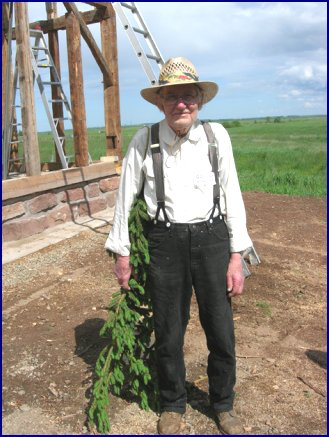
George Rogers (alias Dan Lund)

George Rogers (alias Dan Lund) overseeing the barn-raising at the Campbell Carriage Factory

Two visitors at the re-constructed "addition" to the Campbell Carriage Factory

Two visitors at the re-constructed “addition” to the Campbell Carriage Factory

Dan Reagan fits a corner frame onto the larger building frame

Dan Reagan fits a corner frame onto the larger building frame

New re-constructed "addition" to the Campbell Carriage Factory as seen from the road

New re-constructed “addition” to the Campbell Carriage Factory as seen from the road

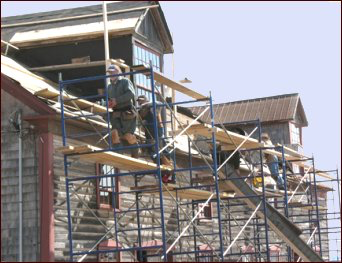
Thaddeus Hollownia takes a photo as volunteers add the last beams to the roof of the re-constructed 1905 addition to the Campbell Carriage Factory

Thaddeus Hollownia takes a photo as volunteers add the last beams to the roof of the re-constructed 1905 addition to the Campbell Carriage Factory

Roof re-construction begins once all four walls have been re-assembled and stabilized

Roof re-construction begins once all four walls have been re-assembled and stabilized

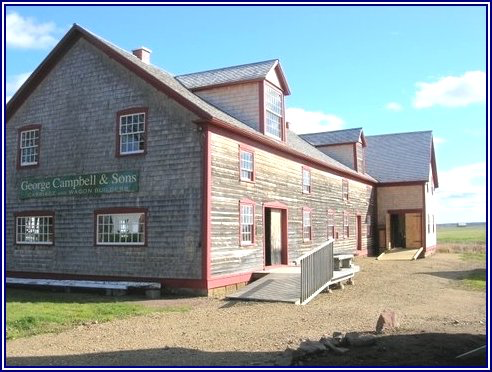
George Campbell & Sons as it probably appeared following the completion of the new addition in 1905

George Campbell & Sons as it probably appeared following the completion of the new addition in 1905

Regaining the Campbell Carriage Factory Compound

A Unique Property

Ronald Campbell, with his son George, established their carriage factory sometime around 1850, in a converted tannery, originally built in 1841. As his late great-great grandson Will Campbell said in an interview: “It was Ronald who started up the business, but it was George who really made her go!”

George Campbell and Sons, makers of Carriages Waggons & Sleighs grew this business into the largest in the region. They soon added a blacksmith shop in a separate building, built a warehouse in the 1880s, and finally added a building at the back of the original factory which featured a freight elevator. In other words, the Campbell Factory developed over the decades into an entire compound… a business which lasted for 100 years! We do not know of another carriage factory that lasted for so long, and, throughout the course of its long and prosperous life, in the hands of the same family. And, more importantly, there is not a single factory of this kind remaining in all of Canada and New England! The Campbell Carriage Factory is the last still standing, in its original location, and with much of its original equipment… a living memorial to the crafts tradition of manufacture before its transformation into the industrial age.

The Vision

Ten years ago, the Campbell family generously donated what remained of this 100-year legacy to the Tantramar Heritage Trust. The warehouse was still standing but the blacksmith shop and rear building were already gone. Only the main carriage factory building and its contents were made available to us, creating an inventory of over 7,000 items, many of them completely unique to the work of special craftsmen.

Since June 21, 2003, the main carriage factory building has been open to the public as Sackville’s first museum. During these years, the story lines and interior arrangements of the old factory have been discovered and refined. Volunteers, local historians and summer students have invested countless hours in bringing it back to life. We were also able to bring in a local blacksmith shop to replace the long-lost original building on the site. But it had also become increasingly clear that fully realizing the potential of this wonderful resource would require much additional work. We needed to retrieve the full compound!

And restoring the full compound has required (and will still require) several steps:

  • re-roofing and structural support for the main (original) building (done!).
  • re-building the rear building housing the freight elevator with required space for washrooms, new reception/sales area, office/storage space with room for educational activities (done but without the elevator (yet!), nor completed washrooms nor reception area (yet!)).
  • re-arranging the grounds with gravel paths and decks (not completed).
  • re-furbishing both the blacksmith shop (now on site but as yet incomplete) and the warehouse (not completed but the foundation has been repaired and new windows, much like the originals, have been constructed and put in place).
  • tying it all together with original style fence and gates (not yet done).

We certainly need the washrooms and other practical facilities this will provide, but our vision of all this restoration really focuses on re-capturing the sense of a full compound of functioning buildings. The full story of the products that this unique factory once provided to the people of Tantramar needs to be taught to coming generations and its physical setting fully restored for all to appreciate the very different world our ancestors once lived in, a world where horses ruled the landscape. Your Board of Directors decided over the winter of 2007-08 to tackle this task. We have begun with the main building, now complete, and, following this past summer’s once-in-a-lifetime “timber-frame raising” (see photos) have completed the envelope of the rear building, and should soon have its interior fitted out. It will take the remainder of this winter and spring (’08-’09) to bring in the new exhibits and information panels.

With the cooperation of the Campbell family, we have also made considerable progress towards restoring the warehouse which will allow us to turn our attention to the blacksmith shop and surrounding fence.

Soon, you will emerge from your tour of this historic carriage factory building to the ringing of the anvil, the display of horse-pulled hearses, and other similar vehicles, donated back to the museum as well as many other projects underway in the courtyard.

Our Capital Campaign

As you can well imagine, we require funding to meet these many obligations and it is our hope that you will all respond to our Capital Campaign to help us make it all possible. We have already raised $60,000 in donations plus $35,000 through provincial “Built Heritage” grants and a bank loan sufficient to get this great restoration underway. We now need the remaining funds to pay back the loan and complete our vision. So, please welcome our canvassers who will visit in search of contributions, no matter how large or small. Without your support, we would be unable to tell of Tantramar’s history to you, our members, and to the wider world, who show an interest in learning more of the great past of this very special place in this grand country of ours.

artist’s rendering of The Campbell Carriage Factory Compound

The Campbell Carriage Factory Compound

The Pride of the Dixon Ship Yard — The Sarah Dixon

Author’s note: This slightly reworked article on the ship Sarah Dixon first appeared in the Sackville Tribune Post on Wednesday, September 21, 2006. On October 19, 2008, an email was received at the Trust office from Stephen Simpson in England requesting information on the ship Sarah Dixon as he had seen a reference to the vessel in the December, 2006, online issue of The White Fence. Mr. Simpson’s great- great-grandfather Walter Dutton had traveled to Australia in 1858 on the Sarah Dixon. I emailed Mr. Simpson a copy of this article and other information on the ship and asked if perhaps his great-great- grandfather had kept a journal of the voyage. To my great delight, on October 25th, I received a scanned copy of Walter Dutton’s fascinating journal, chronicling, near daily, the events of the 99-day passage from Liverpool to Melbourne. Written exactly 150 years ago it is an incredible account of life aboard this Sackville-built ship engaged in transporting people and supplies to the Australian gold fields. It is our intention to introduce you to the vessel and include introductory excerpts from Walter Dutton’s journal in this issue of The White Fence, with further excerpts in later issues throughout this 150th anniversary of the journal.

by Al Smith

One hundred and fifty-two years ago, the ship Sarah Dixon slid down the launch ways of the Dixon shipyard and into the muddy waters of the Tantramar River. The launching, on September 18, 1856, was so momentous an occasion that a half day’s holiday was given by the Mount Allison colleges so students could witness the event. At 1465 tons, the ship was the largest vessel ever constructed in Sackville.

Shipbuilding in Sackville Parish commenced in the 1790s and over the course of the next hundred years, nearly 200 vessels constructed of local timber, were launched. The largest Shipyard, operated by shipwright Christopher Boultenhouse, was established on the banks of the Tantramar River in 1840 when he moved to Sackville from Wood Point. Charles Dixon, a grandson of the original Yorkshire immigrant family of Charles and Susannah Coates Dixon, constructed a second large shipyard in Sackville in 1850, at the end of Landing Road. Dixon had been persuaded to go into partnership with Sackville merchant Mariner Wood and over the next six years he built eight vessels. Under the supervision of yard foreman Oliver Boultenhouse, a nephew of Christopher Boultenhouse, the partners were very successful. The sale of the second last ship (brigantine William Hyde) brought in exceptionally large revenues and encouraged the partners to build even a grander ship. Thus, construction on the full-rigged ship Sarah Dixon began with great interest from the public in such a large vessel. Measuring 206 feet in length, 39.8 feet in width and 22.7 feet from keel to gunwale, she was indeed an impressive sight.

As launching day approached (September 18, 1856), the community was a buzz of excitement. Charlotte Dixon, daughter of shipwright Charles Dixon provides an eyewitness account of the launch: “The day of victory came at last and was a perfect one. The tide was at its highest, the steam tug was at the wharf ready for action, the college gave a half-day holiday, people came from all directions. The ship was complete in every particular, cabin and forecastle finished, furnished and stored for the voyage, masts were fully rigged, sails furled and flags flying from bow to stern. The wedging up is done, and the command is given to knock away the blocks. While the people held their breath she settled calmly on her ways and gently glides away from her nest on the shore and dips gracefully into the deep. As she rises upon the water, the huzzas that break from the vast multitude on the shore are wonderful to hear. Then the tug hastened to her side, attached herself to the ship and they sailed away amid the rejoicing and congratulations of all the people. It had been a marked and beautiful event and was the talk of the folk for some time”.

The ship had been christened Sarah Dixon after the wife of Charles Dixon, Sarah (Boultenhouse) Dixon. Sarah was the daughter of Bedford and Charlotte (Harper) Boultenhouse, and sister to shipwright Christopher Boultenhouse. When the ship was still under construction the partners had been offered $40/ton for the ship, but partner Mariner Wood, who owned 48 of the 64 shares in the vessel, refused to sell. Instead they loaded her with 750,000 ft. of lumber and sailed her to Liverpool, England. Unfortunately by the time the ship reached England, the market for wooden ships was temporarily glutted. The partners were forced to sell for $15/ton, thus suffering a heavy financial loss. That event bankrupted Charles Dixon and his business partner (M. Wood) foreclosed on him thus ending his shipbuilding days. The yard did, however, continue to operate for some time under the direction of several shipwrights.

The purchaser of the Sarah Dixon was a Liverpool firm headed by John Chesshyre Blythe. Registered in Liverpool on May 30, 1857, the vessel was immediately re-fitted for the passenger trade between Great Britain and Australia. Once remodeled, the ship was capable of carrying up to 600 passengers plus cargo. Commanded by Captain William Salt, the ship operated the route between Liverpool, England, to Melbourne, Australia, carrying mostly outbound passengers eager to seek their fortune in the Australian gold rush. Nearly 400 passengers made the trip out in the fall of 1857 and, the following year, 188 souls braved the hardships of the 99-day ocean passage to Melbourne, Australia, arriving December 5th, 1858. Unfortunately, on March 17, 1859 (possibly on her return trip to Liverpool) the ship struck the Baroguy shoal in the Gulf of Marinban, near Rangoon, Burma, and was lost.

While the pride of the Dixon shipyard sailed for less than three years, her life will fortunately live on in a book currently being researched and written by Ray Dixon of Sackville. Walter Dutton’s journal entries encapsulate the essence of one of her last major ocean voyages. We begin with the first page of Mr. Dutton’s journal; watch for future issues of The White Fence and relive this arduous journey of 150 years ago.

References cited

  • Armour, Charles A. and Smith, Allan D. 2008. Shipbuilding in Westmorland County NB, Tantramar Heritage Trust Publication, Sackville, N.B.
  • Alward, Dale E. 2003. Down Sackville Ways, Tantramar Heritage Trust Publication, Sackville, N.B.
  • Dixon Papers. Mount Allison University Archives, Mount Allison University, Sackville, N.B.
  • Dutton, Walter — Journal of his voyage on the ship Sarah Dixon August 29 to Dec. 5, 1858, received from Stephen Simpson, Tantramar Heritage Trust, Sackville, N.B.

The Journal of Walter Dutton

August 29–December 5, 1858

Part I — On board the Sarah Dixon

My dear wife and children,

I now take up my pen to write a few lines to amuse myself and interest you. We have had a very rough day of it; the steamer has left us off Tusker and many of the passengers are sick. I have just been up to the doctor about Joe, for he is very bad and I feel a little queer myself. About 3 o’clock this afternoon a stowaway turned up. He could not stay below any longer; he looked very ill and the passengers made a collection for his fare, which amounted to about £8.

Sept. 2. I cannot say what has taken place during the last few days, as I have been confined to my bed through sickness. The weather today is beautiful, though we have had a bad beginning with contrary winds. Four more stowaways turned up and one of them is the young man from Nottingham that your brother William saw in Liverpool. My mate, Joe, is very bad in health and the doctor is of no use. Indeed, he is worse than any old woman.

Sept. 3. A very wet and dirty day and much colder than with you. We are not far from Liverpool as the wind has been against us ever since we started. Our passengers consist of nearly all nations, English, Scotch, Irish, Welsh, Germans, Italians, Dutch, French, and one or two spaniards; in all, 188. Our provisions are not so good, especially the beef, but I don’t eat a deal myself, as I think it be better for my health. I am very sorry to say that Joe is still in bed very ill and I don’t know what he is going to make of it. Your brother William would not know him for he cannot eat anything and his spirits are down.

Sept. 4. Fair wind today for the first time since leaving Liverpool and Joe is a great deal better. We killed a sheep today of which we have 14 on board, 18 pigs and 100 poultry. Nearly all the passengers are well again and I am first-rate, for which I feel very glad and thankful.

Sept. 5. Sunday morning. Light winds today, but we have had prayers twice and we ought to get along faster, for they prayed for a fair wind.

Sept. 6. Fair wind at about 7 knots, and fine weather. Sept. 7. Light breeze; killed another sheep; passed the “John and Lucy” that left the Mersey three days before us.

Sept. 8. Fair wind. We had a row on board last night amongst the crew and they broke into the ship’s stores and stole four dozen of wine and two barrels of ale and all refused to work.

(to be continued)

Book Review by Cole Morrison: Shipbuilding in Westmorland County New Brunswick, 1784–1910

Shipbuilding in Westmorland County, New Brunswick, 1784–1910 [cover]

Compiled by Charles A. Armour with additions by Allan D. Smith
ISBN 978-o-9784100-5-6, 2008
Tantramar Heritage Trust, Sackville, New Brunswick

This outstanding publication by Tantramar Heritage Trust, May 2008, is the authoritative guide for information on the 580 vessels built in Westmorland County during the period 1784 to 1910 and on the great shipbuilders of Westmorland County (Boultenhouse, Chapman, Hickman, Ogden, Palmer, Purdy and Salter). Its great merit is the ‘friendly’ organization of material, which allows the reader to safely navigate the oceans of data, and the intriguing sketches of the seven leading builders. The 45 illustrations include 25 stunning images of ship portraits — one of the special highlights of the book. After a short survey of the period (1784–1910) and a description of the nature and limitation of registry — and other, information sources, the core material appears in two chapters:

The Pre-Eminent Shipbuilders of Westmorland County (Ch. 3) Only seven builders (out of 220) in Westmorland were responsible for 30% of ship construction in the county — their biographies (2-3 pages) make fascinating reading.

Chronological Listing by Port of Vessel Registration Data (Ch.5) Here you search for a vessel by the port (or area) of construction, then by name. If you are looking for a specific vessel, you can refer to the alpha listing in Appendix II to determine the port, then scan down the Chronological Listing for the specific vessel.

For a copy of Shipbuilding in Westmorland County, contact Tantramar Heritage Trust (Boultenhouse Heritage Centre is open Monday to Friday) or the Gift Shop at Keillor House. The cost of the publication is $28.00 and would make a wonderful gift for Christmas.

painting of 3-masted sailing vessel

The White Fence, issue #39

May 2008

AGM & Book Launch

Shipbuilding in Westmorland County

compiled by Charles Armour with additions (and editing) by Al Smith

Wednesday, May 28, 7:30 pm, Sackville United Church Parlours

THT members and new members are cordially invited to attend the Trust’s Annual General Meeting and Book Launch. Following the business portion of the meeting, President Paul Bogaard will provide a brief update on restoration and construction activities at the Campbell Carriage Factory Museum. Refreshments will be served.

Executive Directors 2007–2008

  • President: Paul Bogaard
  • Vice-President: Michael Weldon
  • Secretary: Barb Jardine
  • Treasurer: Geoff Martin

Staff

  • Administrator: Adèle Hempel (full-time)
  • Exhibits Assistant/Researcher: Angela Hersey (contract)
  • Curatorial Assistant/Researcher: Marianne Lagacé (contract)

Editorial

Dear friends,

In the course of history, times of joy are often tempered with periods of sadness. This issue of The White Fence provides you with both: sad news about special departures of those who sowed and cultivated the grand fields of the Tantramar, both natural and academic, and great news of reconstruction and a barn raising! Like me, you will be deeply affected by both conflicting emotions.

Dr. William (Bill) Godfrey came to Mount Allison’s History Department when I was beginning my second year as a student at the same institution. Fellow students of history always spoke warmly of Bill’s classes, his knowledge and fairness. He was a widely-published and respected Canadian historian, married to Rhianna Edwards, Mount Allison archivist and former president of the Tantramar Heritage Trust. With Bill’s recent passing from the Tantramar landscape, and on behalf of the Trust’s membership, I pass along our most sincere sympathies to Rhianna and family.

Another member of the Tantramar Heritage Trust, Bud Doncaster, also passed on to greener pastures. Bud was a neighbour of ours on (East) Main Street in Sackville, a local farmer with a love of farming and antique farm implements. Like Bill, he loved to teach and did so by holding annual shows of antique farming implements in Sackville. And at that special time, he would inform visitors about the history and values of his beautifully-preserved machinery, many of which could still function effectively because of the love and care he applied to them. Ray Dixon shares his memories of Bud with us in the pages which follow.

Bill would have been familiar with the Wesleyan Academy of 1844 which his former Mount Allison University colleague, Eugene Goodrich, informs us about in the pages which follow. Furthermore, Eugene also tells us the story of the old bridge across the Tantramar River; not the old bridge that Donna Beal wrote about in the last issue of the White Fence, but the one before it!! A fascinating step-by-step description of the construction of that original bridge, based on the original documentation, is set for you by Eugene, like a rich historic dinner table, covered with local delicacies, waiting for you to feast!

On your behalf, I dedicate this issue of The White Fence to two special bridge-builders, Bill and Bud, in thanks for their devotion to our history and their affection for the land and people of the Tantramar. They will both be deeply missed by so many. Read on, continue to enjoy our stories, and remember fondly our past members, off on a new journey.

—Peter Hicklin

Robert (Bud) Doncaster — 1931–2008

by Ray Dixon, Organizer, Antiques Road Show; THT Heritage Day Committee

portrait of Robert (Bud) Doncaster

Robert (Bud) Doncaster

I first met Bud Doncaster in the fall of 2006. Someone told me that Bud had a ship’s half model. I phoned with a request to photograph the model and I was warmly welcomed into his home. I saw the Trojan for the first time. Every one of the 100 or so ships built in the Sackville area was created from a half model of the actual ship. Measurements were taken from the model and expanded to create the finished measurements for the ship. The Boultenhouse Heritage Centre did not own even one half model for display.

ship half-hull model

Trojan ship’s half model

Bud decided after the Trust’s 2007 Heritage Day Antiques Road Show that he would lend the Trojan half model to the museum for display in the Marine Room. Bud was shy enough that, when I held up the Trojan at the Road Show and talked about it, I looked around for Bud and couldn’t see him in the back and he wouldn’t come up to the front.

This year Bud phoned me about two weeks before the “Antiques Road Show” to share with me the bad news that he had received about being seriously ill with cancer and stated that, after talking to his family, he wanted to donate the “Trojan” to the Boultenhouse Heritage Centre. At the “Antiques Road Show” last February, he stood proudly with the microphone (see photo) and presented the treasured half model to the Trust.

We will all miss the huge Christmas tree in Bud’s yard, the antique farm implements day, and most of all we will miss Bud Doncaster.

The Mount Allison Wesleyan Academy in 1844

by Eugene Goodrich, Sackville, N.B.

While going through the Journals of the New Brunswick House of Assembly for a totally unrelated project, I happened upon a school inspector’s report, dated November 1844, describing the Mount Allison Wesleyan Academy which had been founded the previous year. Since it describes the fledgling institution in some detail and concludes with an assessment that should appeal to local pride, I thought it might be of interest to readers of The White Fence. It should be noted that the Academy had not yet become a degree-granting college, but was rather a combination of primary, secondary and preparatory school, and in its first years open only to boys.

MOUNT ALLISON WESLEYAN ACADEMY IN 1844

The following is the original text, with report title, in full:

Report from J. Brown, Esquire, on Wesleyan Academy, Sackville (1844)

The Academy stands on rising ground (which in honor of the noble hearted founder is called Mount Allison) in a most delightful situation, between the Tintramar Marsh and the Great Road from Saint John to the Nova Scotia Line. The building is of wood, one hundred and fifty feet long, forty feet wide, and three stories high. The exterior has a substantial and pleasing appearance, and the inside arrangements are comfortable, convenient, and complete.

The branches of Education taught are Reading, Writing, English Grammar, Geography, English History, Arithmetic, Algebra, Geometry, Navigation, Chemistry, French, Latin, Greek, Declamation and English Composition.

There are 84 Students in attendance — 31 Readers, 74 Writers, 48 in English Grammar, 36 in Geography, 13 in English History, 53 in Arithmetic, 5 in Algebra, 17 in Geometry, 2 in Navigation, 31 in Chemistry, 28 in French, 45 in Latin, 12 in Greek, and 80 in Declamation and English Composition.

Of the number in attendance, six are under 10 years of age, eleven are over 10 and under 12, thirteen over 12 and under 14, twenty four over 14 and under 16, fifteen over 16 and under 18, seven over 18 and under 20, and eight 20 years old and upwards; one of these is from England, one from Canada, four are from Prince Edward’s Island, seventeen from Nova Scotia, and the rest from almost all parts of New Brunswick.

The conductors consist of a Governor, a Principal, a French Tutor, an English Master, and two Ushers. So far as I can judge, the mode of instruction is calculated to give the pupils the most thorough knowledge of the several branches of study, a great portion of it being communicated by way of question and answer, and by oral and visible demonstration by means of Maps, Black Boards &c.

The class in Chemistry was taught by question, answer and explanation. Geometry, Algebra, and the higher branches of Arithmetic, were orally taught and demonstrated; the Students by turns, under the eye of the instructor, and in the presence of the class, drawing their own Geometrical Figures, or working out the Algebraic and Arithmetical examples, with chalk on the Black Board, and then severally subjecting the same to audible and ocular demonstration. Many useful portions of Arithmetic were performed mentally in answer to questions put by the Tutor, and much was also done with slate and pencil. Geography was taught chiefly by means of Maps and Black Boards; in the latter case, the most prominent features and outlines of certain portions of the earth were drawn out and represented with chalk by the Students, and afterwards minutely pointed out and described. Reading and English Grammar were taught carefully and thoroughly. Writing was taught in the usual manner, and the specimens were generally very good.

The supply of Books is quite sufficient for all the immediate purposes of study and instruction, but the Library is yet small. There are also, for the present, a sufficiency of Philosophical and Chemical apparatus, Globes, Maps, Black Boards &c.

The Students were dressed in plain, clean and comfortable clothing, and appeared to be cheerful, healthy, and happy.

The interior arrangements of the building are excellent, not only for the purposes of instruction, but also for the comfort and accommodation of the Students as a home or place of residence during the continuance of their studies.

It so happened that that time of my visit was immediately after the commencement of one of the terms, and therefore somewhat unfavourable; it also fell on a Saturday, when according to custom, the labours of the week were closed at noon. The bell soon after rang for dinner, at which, by invitation, I also attended. It was a good substantial meal, consisting chiefly of bread, meat, and vegetables, and pure water to drink. The Governor, Principal, Tutors, Ushers, and Students, all sat down together in the same apartment; the repast was received thankfully and cheerfully, and every thing was conducted decently and in order.

The greater part of the afternoon was spent in examining the building. It contains, besides all the Class Rooms, Library &c. a large Lecture Room, or place for Public Worship, with seats for an ordinary Congregation; convenient apartments for the use of the Governor and his family, similar apartments for the Principal, and excellent Bed Rooms for all the Students.

I am unable to describe the numerous apartments, with the several purposes to which they are adapted; but taken altogether, with its pleasant, healthy, and retired situation, the comfortable and commodious condition of the building, the Religious, Parental, and Moral character of its Government, and the moderate price of Board and Tuition, the Wesleyan Academy is, perhaps, the very best Educational Establishment in the Province (italics mine).

26th November, 1844
JAMES BROWN, School Inspector.

Sackvillians and Allisonians may take the more satisfaction from Brown’s glowing description in that the same report found most of the public schools in New Brunswick to be in a deplorable state. It was, in fact, a general indictment of public education in the days before teacher training and certification, regular revenues in support of schools, prescribed curricula and adequate pay. The inspectors found teachers who did not know the difference between a vowel and a consonant, schools in which reading and spelling were the main subjects taught and indeed had no books beyond the Speller and the New Testament. In one case at least, there were no pens, ink, paper, slates, pencils or desks; in another, children shivered in the cold because fifteen panes were broken out of the windows. One hapless teacher even complained that he had lost pupils by insisting on trying to teach them arithmetic and writing! Of course some other schools besides the Wesleyan Academy received praise in the report, but it appears to have made an especially favourable (and, given the general state of things, welcome) impression on the inspectors, and reminds us again of the enormous contribution to the life of this community made by Charles Frederick Allison, Humphrey Pickard and all the other dedicated souls of that pioneering generation who laboured so faithfully and fruitfully in that “most delightful situation between the Tintramar Marsh and the Great Road.”

Readers interested in learning more about education in early New Brunswick will find an excellent account in Katherine MacNaughton, The Development of the Theory and Practice of Education in New Brunswick 1784–1900 (Fredericton, 1946).

The Saga of the Tantramar Bridge

The prelude

by Eugene Goodrich, Sackville, N.B.

In the February issue of The White Fence Donna Beal wrote an interesting article on the burning of the covered bridge over the Tantramar River in 1901 and its subsequent rebuilding over the next two years. She mentions that it had been in a decrepit state for some years and that residents were not unhappy to see it go before it could fall and injure someone. Readers may be interested, although perhaps not surprised, to learn that this was not a new problem with the Tantramar Bridges. The tides, wind, ice and salt water had made maintaining them a challenge from the beginning. A number of annual reports to the New Brunswick House of Assembly from Supervisors of Roads and Commissioners of Public Works tell a long tale of frustration and neglect in the face of wind, water and limited resources to combat them.

The first bridge on this location, near the present railway bridge, was built in 1840 when the “Great Road of Communication”, also known as the Post Road, was altered from its route over the High Marsh road. The reasons are explained in a report, dated 1839, written by Commissioners Rufus Smith, George Oulton and E. Botsford:

… the alteration…will shorten the Great Road of communication…seven miles and nine tenths in a distance of fourteen miles and six tenths… Independent of the advantages that the public will derive thus so materially shortening the Post Road…..all the proprietors of the lands adjoining will be greatly benefited and ought to be disposed… to contribute liberally, and as there are a great number of wealthy individuals thus interested in the undertaking, it would aid in no small degree towards its accomplishment.

The bridge seems to have been planned with considerable care; at £2,450, its cost was four or five times that of a normal bridge in this period. By January,1840, the Honorable E. Botsford, who was also “Supervisor of the Great Road from Sackville to the Nova Scotia Line” was: happy to have it in my power to state, that five hundred pounds has been raised by individual subscriptions towards the work, and land to the value of £200 given by the owners for the use of the Road….I have entered into a Contract for the erection of a Bridge upon Colonel Town’s improved Truss principle, over the Tantramar River, being 580 feet wide and 36 feet deep, to be completed by the 1st day of October in the present year, for the sum of £2,450, with two substantial Sureties for the faithful performance of the work.

As Donna noted, the contract went to Timothy Gallagher, younger brother of the Hugh Gallagher, who will build the second bridge. W.C.Milner claimed that the Hon. William Crane, who was a member of the House of Assembly at that time, was “instrumental in effecting this public improvement” and remarked sardonically that he was “rewarded at the next election by a smashing defeat at the polls.”1 I did not find any trace of Crane’s lobbying in the Journals of the House of Assembly but the story is plausible enough, and Crane was certainly defeated in 1842 after holding his seat for eighteen years.

It was normal for the smaller, poorly-built bridges (of which there were about 1400 in the province in mid century) to fail within ten or twelve years2 but something better was expected of the larger and more expensive ones. In this respect, the first Tantramar bridge was a decided disappointment. In 1851, after only ten years in service, the Supervisor of this section of the Great Road, Silas C. Charters of Dorchester, had to report:

The bridge over the Sackville River,on the postal route, is considered in a dangerous state, and will probably require a large amount in repairing the same….In making the above estimate, [of the total cost of repairing his section of the Great Road from Hayward’s Mills (east of Moncton) to the Nova Scotia border] I have not taken into consideration any accident happening on the Sackville bridge.

The reports of the Supervisor and Chief Commissioner for Public Works (after 1855) over the next several years tell a tale of mounting anxiety:

1853 — Dorchester, 25th February, 1853

… The bridge over the Sackville River, on the post road, having been built eleven years, is in a very decayed state. This bridge is partly built on piles which are frequently out of repair from the heavy quantity of ice accumulating on the bank and around them. A considerable sum was expanded last season in repairing the same; this year other repairs will be required.

I have the honor to be, Sir, your most obedient servant,
SILAS C.CHARTER, Supervisor

1854 — Dorchester, 10th February, 1854

… A new bridge will be required over the Sackville River; I reported the same last year as being in a very dilapidated state; any further expenditure on the same in repairs would be a waste of money. I would recommend the bridge be built on piles similar to the present bridge; the cost of which I estimate at £125. The cost of the bridge might be some less if the material was procured this winter, when the snow is on the ground.

I have the honor to be, Sir, your most obedient servant,
SILAS C.CHARTER, Supervisor

Dorchester, February 10

… I have frequently brought under the consideration of the Government the state of the Great Bridge over the Tantramar River on the new line of Road; from the late inspection, it requires something more than repairs, the top works of the large abutements are in a very decayed state, and the bottoms are a good deal injured, and it is impossible to resheath them in consequence of the corners being wholly broomed up by the ice; also some of the stringers which receive the flooring are in an unsafe state.

I have the honor etc…

1855 — General Report of the Chief Commissioner of Public Works

… The Bridge over the Tantramar River, built on “Town’s Truss principle” fifteen years ago, at a cost of £2500, has been racked by the wind, and is in other respects seriously out of order; it is doubtful whether it will stand another year.

1857 — General Report of the Chief Commissioner of Public Works

… The Bridge over the Tantramar River, on Town’s lattice principle, has been for some time in a bad state. Last spring the centre pier was again badly damaged by the ice, and several of the beams and braces of the truss were broken. Its reconstruction next year will be necessary. The remaining large Bridges [on the post road] are in very fair condition…

Before work could begin on the new bridge, Tantramar tides and winds did yeoman’s service in demolishing the old one. According to the article in the Saint John Globe, June 24, 1901 cited by Donna, it met with a much less spectacular fate than [the one that burned in 1901], collapsing unostentatiously in the night under the influence of wind or tide or both… Fortunately it did so at time when nobody was on it, but there was apparently a near miss. Avid and attentive readers of W.C. Milner’s History of Sackville may recall a story he tells about Miles Hoar, a well known driver of the mail stage between Moncton and Amherst with a gift of the gab:

He [Miles] used to tell how his coach was once saved by the sagacity of a horse. It was at night when the darkness was intense. The leaders suddenly stopped. One of them kicked and “flared up”. He dismounted to find out the trouble. A bridge on the Tantramar had been carried out by the tide. A few feet more and there would have been a disaster.

Curiously enough, there is no mention of the collapse in the reports of the Commissioner of Public Works. Perhaps this was because of bureaucratic embarrassment, unless Miles was even more of a storyteller than Milner realized, and the Globe story was itself based on Milner (a distinct possibility).

Whatever the case, the new bridge was begun with the usual optimism:

From The Saint John Weekly Chronicle and Colonial Conservative, April 24, 1857

SACKVILLE BRIDGE TENDERS will be received at the Office of the Board of Works until SATURDAY the 11th day of April, at noon, for building a new BRIDGE and APPROACHES at Sackville, over the Tantramar River, according to Plans and Specifications to be seen at this Office, and at the Office of Joseph F. Allison Esq., Sackville. Satisfactory security will be required for the performance of the Work; and each Tender must be accompanied by a Letter from two responsible parties satisfactory to the Government, willing to become Sureties. Further information can be obtained at the Office of Mr. Allison aforesaid. C. MacPherson, Chief Commissioner, Office of Board of Works, Fredericton, 6th March, 1857.

1857 — Report of the Chief Commissioner of Public Works: Sackville Bridge

A contract was let on the 11th day of April to Mr. Hugh Gallagher, of Sackville, in the County of Westmorland, for £4,500, for this Bridge, to be completed by the 1st of October. The general plan is for two abutements of 107 and 98 feet respectively, and two piers in the channel 12 feet wide at the top, supporting a lattice truss Bridge of a total length of 428 feet in three spans, the centre one being 140 feet and the others 120 feet.

The piers and abutements up to high water mark, are faced with square timber, fitted close, the corners dovetailed, and protected by birch planking and iron straps. From the level of high water neap tides, the piers and abutements are carried up with masonry, laid dry and filled solid with earth and stone. As this is the only part not constantly wet with salt water, the durability of these piers and abutements may be considered almost equivalent to rubble masonry. The lattice truss work over the spans contains an unusual amount of timber, and is of a stronger description than the old Bridge, and being covered from the weather ought to be durable and permanent for a number of years. When this fails the cost of renewing the Bridge will be confined merely to the superstructure, and be very much less than the present outlay. Though the Contractor had not completed the Bridge at the time specified, yet the old Bridge kept up the communication, and the public did not suffer any inconvenience on consequence. At the present time it is finished except the covering, approaches, and ornamental fronts at each end of the truss.

The Tantramar Bridge then drops out of the reports until 1862 when we learn that it cost $80.00 to repair its roof (the change to dollars and decimal currency having been instituted in this year; $80.00 would have been £20 in the old currency, a relatively trifling sum). Unfortunately, the Commissioners’ reports after 1859 become much less detailed, giving only bare figures and no description of conditions. The Sackville Bridge is mentioned regularly in the annual list of bridges repaired, but no large amounts are expended. In 1863, it was $123.00. I did not search all the records before 1901, but in 1899, two years before the fire, only $165 was spent. This seems to indicate that the second bridge was much better built than the first one, which should have been the case, considering that it cost almost twice as much, and for some time did not require so many expensive repairs. But from two items forwarded to me by Donna, it is clear that before too many years had passed, it was, on the contrary, a case of “déja vu all over again”:

Amherst Daily News, June 22, 1901

The Sackville Post says that a feeling of general satisfaction seems to prevail that the old wooden bridge was destroyed in the manner it was by fire. For years it has been considered unsafe, and of late many people have become timid about crossing it. They did so only because they were obliged to. A few years ago a high wind gave it a bad shaking. Traffic was suspended for a short time while the structure was patched up, but the placard “unsafe” was not taken down.

From a letter written June 23, 1901

by Katherine J. Stark, Music Faculty, Mount Allison University (married John Hammond of the Art faculty in June 1902):

…so the old bridge has gone. I think it was just as well it should go before it had time to collapse, probably causing some loss of life.

In defense of the Department of Public Works, it may be noted that the Tantramar bridge was only one of some 500 larger and probably over 1500 smaller bridges on the more than 1700 miles of “Great Roads”3 in a province whose government was almost perpetually strapped for revenue. A similar story could probably be told of many other New Brunswick bridges, and, while the Romantics among us may regret the loss of the old “kissing bridges”, perhaps our little “Saga of the Tantramar Bridge” will make us look a somewhat less unkindly on the bone-jarring potholes and heaving expansion joints of today’s roads and bridges. At least it’s not quite “déja vu all over again.”

Footnotes

  1. W.C. Milner, First Mail Routes and Post Offices in the Maritime Provinces, read before the NS Historical Society on 5th November, 1929, republished from the Halifax Chronicle, p. 10.
  2. Report of the Chief Commissioner for Public Works, 1857.
  3. The Commissioner’s Report for 1856–57 states that there are 470 larger and about 1400 smaller bridges on 1,630 miles of Great Road. I assume that by 1900 the numbers were considerably larger.

Membership Report

We regret the passing of Trust Members

  • Jean Steeves
  • Robert (“Bob”) McLeod
  • William Godfrey
  • James (“Jim”) Snowdon

We welcome these New Members in 2008

  • Sabine Dietz (Honorary Member)

Reminder ~ Membership Dues

Membership fees for the calendar year 2008 are now past due. To ensure continued service, please remit at your earliest convenience.

The Campbell Carriage Factory

Rebuilding an Old Addition

by Paul Bogaard, Mount Allison University and Tantramar Heritage Trust

In 1908, the Tribune noted: the first and only meeting house of the Second Baptist Church, sold three years ago to George Campbell & Sons and is doomed doubtless to be converted into a paint shop. It seems the Campbells purchased a 66-year-old meeting house, which they attached to the backend of their Carriage Factory providing space for finishing and trim work, storage of lumber and materials, and the addition of a large hand-operated freight elevator for raising materials and lowering finished carriages. Decades later, the Campbells had the workman captured in this photo [one of three] taking down this old addition to the Carriage Factory.

The old addition being torn down.

Plans are now underway to rebuild this old addition, roughly the size and shape of the one joined to the CCF in 1905, with windows and walls that look much like the remaining CCF, but fitted out with completely modern functions: washrooms, a proper reception area, office and storage space for summer staff, and all without needing to steal space from the original building. In fact, it will allow us to reclaim the corner long used to greet visitors and to begin restoring the horse mill which powered the old factory, and, in the long run, to reestablish the freight elevator in the new “old” addition. Meanwhile work has begun by the EnerGreen Builders Co-op refurbishing the existing CCF.

It desperately needed a new roof and various repairs. By early June a foundation should be in place for a major timber frame raising scheduled for the second week of June. We’ve been able to rescue a 200 year-old timber frame, which is being reconfigured by TimberHart Woodworkers into the plan shown below. Once all is prepared, they assure us it will all go up in about three days! Come join us for a good old-fashioned barn-raising on 10–12 June!

Barn construction

New construction by EnerGreen Builders Co-op.

3-dimensional model

New “old” addition

Spring Dinner Fundraiser

by Marilyn Prescott, Board of Directors

An enjoyable “Taste of History” was presented by the Trust at its annual fundraising dinner, held at Tantramar Civic Centre on April 12. Before-dinner music was played by Jennie Wood on the keyboard. The roast pork dinner, catered by Laurie Anne Crossthwaite, was delicious and enjoyed by all.

Guest speaker for the evening was Dr. Bill Hamilton, who entertained everyone with his information and tales about the theme of the evening, “the Saga of the Rum Running Days”. As well, guests were treated to an amusing and lively skit on the topic, performed by Ron Kelly-Spurles and the MARSH Troupe.

Bidding was brisk at the Silent Auction table on a wide variety of items donated by various businesses in Town and by a number of Trust members. We raised a considerable amount of money and want to thank all those who either donated or bid on these items.

The evening was rounded off with Trivia Questions and prizes arranged by Al Smith. A number of door prizes were also given out. Master of Ceremonies, Dave Fullerton, kept things moving along smoothly. We want to express our appreciation to Dr. Hamilton, Ron Kelly-Spurles, Al Smith, and Dave Fullerton for their participation in making the evening a great success.

We also want to thank all who supported our efforts. Besides the many members and guests, our MLA, Mike Olscamp, and our Mayor, Jamie Smith, along with their wives, and several town councillors, were in attendance. We appreciate your support.

We especially want to thank the organizing committee consisting of Marilyn Prescott, Joanne Goodrich, Ray Dixon and Mike Weldon who worked hard to bring it all together. Thanks also to the girls from the Trust Office, Angela Hersey and Marianne Lagacé, who helped out during the evening, and to the very helpful staff of the Civic Centre. We must not forget our thanks to Laurie Anne who put on an amazing meal. All worked together to present a very enjoyable and successful evening!

Welcome to our incoming summer students!

by Adèle Hempel, Administrator

This is always an anxious time of year, waiting to find out that we will be granted enough positions to cover both museums. Fortunately this year, we are in great shape, with four positions approved and two others pending. Three students have already started work – in addition to our veteran students, Angela Hersey and Marianne Lagacé, so things are really gearing up. A warm welcome to our four newly-hired students: Jana Parks, Kellen Burnett, Ina (“J.J.”) Steeves, and Theo Holownia!

Group photo of Marianne Lagacé, Ina ("J.J.") Steeves, Jana Parks; Angela Hersey, Kellen Barrett

Front row (left–right): Marianne Lagacé, Ina (“J.J.”) Steeves, Jana Parks; Back Row (left–right): Angela Hersey, Kellen Barrett.

Jana Parks is a 3rd year Mount Allison University student working on a B.A. in Environmental and Religious Studies, returning to the Carriage Factory because, as she admitted to us,
she really enjoyed her summer there last year. In the senior position of Operations Assistant, Jana will be the lead student, overseeing day-to-day operations and student scheduling at the site.

Kellen Burnett will be Jana’s counterpart at the Boultenhouse Heritage Centre. Kellen is also a 3rd year MtA student working on a B.A. in English and Philosophy. Kellen is a talented musician, whom we look forward to hearing in performance at our various events this summer.

Ina (“J.J.”) Steeves has just completed her B.A. in Photography and English, and will bring much creative talent to us in her capacity as Collections Assistant. “J.J.” will be photographing artefacts in the collection, cataloguing, entering data into the Virtual Collections database, and assisting researchers in the BHC Resource Centre.

Theo Holownia is a 1st year History major at MtA, with a passion for the Tantramar Marshes and animals. As a Museum Interpreter at the Campbell Carriage Factory, Theo is looking forward to helping out in any way that he can, even as a painter!

Without a doubt, our visitors will be able to enjoy some very informative site tours this summer. Be sure to drop by and say “hello” to our fine team — they’re getting ready to greet you! Remember, summer hours start June 14, Tuesday to Sunday, 10 am to 5 pm.

The White Fence, issue #38

February 2008

Executive Directors 2007–2008

  • President: Paul Bogaard
  • Vice-President: Michael Weldon
  • Secretary: Barb Jardine
  • Treasurer: Geoff Martin

Staff

  • Administrator: Adèle Hempel (full-time)
  • Exhibits Assistant/Researcher: Angela Hersey (contract)
  • Curatorial Assistant/Researcher: Marianne Lagacé (contract)

Editorial

Dear friends,

Travel is something we largely take for granted today. Who would ever think of going from Sackville to Amherst (and vice versa) as a big deal? But it depends what year you live in! Read below Donna Beal’s fascinating story of the old wooden bridge that once connected Sackville and Amherst, a critical connection between the two towns at the turn of the century. Read how losing such an important road connection could affect the citizens of both townships when getting around wasn’t as routine as today. We should never take our daily travels for granted. Our ancestors never did.

Connections are important. We are connected by infrastructures such as highways and bridges. But we are also connected by family linkages. Read how Ray Dixon and his cousin Chris “rediscovered” their Sackville ancestor Hiawatha Dixon in Australia after 148 years! We all remain connected, one way or another.

And may this newsletter and our annual Heritage Day continue to keep us all closely connected with Tantramar history for many more generations to come.

As always, we are grateful to the Mt. A archive for information and especially for the photos of the old bridge for this issue.

—Peter Hicklin

Bridge out

by Donna Beal, Sackville, N.B.

The following is an account of the rebuilding of the Tantramar River bridge in Sackville, 1901–1903, and a glimpse into the affect it had on community life.

wooden covered bridge across the Tantramar River

The old bridge taking on a hay wagon load of freshly-cut hay

The covered bridge over the Tantramar River burned on June 18, 1901. The fire was noticed around 3:00 pm just after a locomotive from Halifax had gone through the nearby railway bridge. It was assumed that a spark from the train started the fire.1 There was a high wind blowing, not uncommon for the area, and in less than a half-hour after the fire was discovered, the wooden structure fell and was carried down the river.2

Built by Hugh Gallagher in 1856, it was the second highway-bridge to be built over the Tantramar River.

The first bridge was built about 16 years earlier by Hugh Gallagher’s younger brother Timothy.3 Unlike its successor, it fell silently into the river in the middle of the night without a trace of it remaining the next morning. It was presumed that a high tide or high winds had taken it down.4 Forty-five years later, the piles of the first bridge could still be seen at low water a few feet south of the burned timbers.5

One would think the loss of the bridge would be considered a tragic event. But considering its decrepit state no one was surprised. On June 22nd, 1901, The Amherst Daily News reported “A feeling of general satisfaction seems to prevail that the old wooden bridge was destroyed in the manner it was by fire. For years it has been considered unsafe, and of late many people have become timid about crossing it.”

A few years before, a strong wind had caused damage to the structure. It was closed briefly for repairs, but the “unsafe” sign was never taken down. Katharine Stark, Music Instructor at Mount Allison, writing to John Hammond from New York on June 23rd stated “so the old bridge has gone. I think it was just as well it should go before it had time to collapse, probably causing some loss of life.”6

The detour for crossing the Tantramar Marsh, the only route between the provinces was five miles out of the way through Middle Sackville and the High Marsh Road. A few weeks earlier government engineer Mr. Wetmore had been in Sackville examining the bridge and rumour was that the government was considering replacing the wooden bridge with a steel structure.7 Public opinion was that a new bridge would soon be built and the travelling situation would be much improved.

Almost two months went by and there was no move to replace the bridge. The extra distance to the marsh properties made the haying season more difficult for the farmers, but only one small complaint appeared in the August 5th Saint John Globe; “The people of Sackville, especially the merchants and farmers, are getting quite annoyed at the delay in the reconstruction of the Tantramar Bridge.” The patient endurance exhibited by the public during the following months was the opposite of what one would expect today. It was a matterof making the best of a difficult situation. The Anderson and Patterson families at Cole’s Island discovered they could get their cheese and other farm products to town by taking them to the Railway Bridge where C. W. Cahill, a local merchant, would receive the delivery. When the residents of Cole’s Island travelled to town or attended church they would often tie their horses at the Railway Bridge and have someone meet them on the other side, or walk to their destination. When the Sackville Annual Exhibition was held in September that year (1901), the residents of Cole’s Island delivered their calves to the Exhibition Grounds on the Northwest side of the river by way of the Railway Bridge.]8

The reconstruction of the bridge did not begin that summer or fall. The November 30th issue of the Globe reported: “As it was work that had to be done, it is hard to understand why the rebuilding of the Tantramar Bridge was not taken in hand last summer immediately after its destruction. Practically nothing so far has been accomplished, to the infinite discomfort and inconvenience of our farmers, our businessmen and of the traveling public generally. Work has now been entirely suspended for the season and, for aught that appears, it may be this time next year before the bridge, possibly the most important one in the province will be ready for use.”

At the December meeting of the newly formed Sackville Board of Trade, W. C. Milner stated that one of the pressing needs to bring new enterprise to the town, along with a new station, street lights, and a sidewalk, was a bridge.9 But winter had settled in and nothing could be done until spring. So the public endured the detour through the harsh Maritime winter with few complaints.

The following spring came early. By March 10, 1902, the Tantramar River was clear of ice and fit for navigation. No one could remember conditions like that at so early a date before.10 The residents of Sackville expected the construction of the bridge to soon be underway. Later that month in the local legislature, A. B. Copp, MLA for Westmorland, questioned Hon.C. H. Labillious concerning the delay. His reply was that tenders were asked for on August 2nd and the contract was awarded to Whitman Brewer on August 31st. Since then, foundations had been prepared for abutment faces and foundations: supplies had been delivered and Howe Truss spans constructed. Other supplies delivered were freestone, dressed birch sheathing, planking, birch square lumber and spruce lumber, cast iron rods, the total value estimate being $4,894.00. The contractor had already been paid $2,600.00. Mr. Labillious said as soon as the weather permitted, instructions would be given to Mr. Brewer to push the work with vigour. He also stated he expected the bridge to be completed by early that summer.11

By the middle of April, with no evidence of work beginning on the bridge, the following appeared in the local paper: “The Post is in receipt of a letter from ‘A Farmer’ who perhaps gives expression to the feelings of a large number of our readers when he says that rather than have the Sackville bridge down for another year he would be willing to contribute $100.00 out of his own pocket to have it built at once.” The paper also stated that Contractor Brewer had arrived in town and work on the bridge would start at once.12 A week later Mr. Brewer had resumed work on the bridge.

By the middle of May it was predicted that the new bridge across the Tantramar would be ready for crossing by July 1st, but a tragic accident occurred delaying the construction.13 Early in the morning June 2nd, Andrew Kinnear, Robert Stone, Robert Gillis, and Eben Morrison climbed into a boat and pushed off from the bank of the river to go to the first pier. Approaching the pier they ran into a line. Robert Stone caught the line, but he lost his balance and fell into the water. Eben grabbed Robert and tried to pull him into the boat, but the boat listed, filled with water, and capsized throwing them all into the river. Foreman Charles Dunphy and D. H. Porter, who were working at the site, heard cries from the men in the river. By the time they discovered what was taking place and got a line to throw to them it was too little too late. All except Andrew Kinnear were able to swim against the strong current and make it to the temporary or to the shore. News of the accident spread swiftly and large crowds gathered along the river. Andrew’s body was found around noon the same day 800 yards above the bridge. It was at an inquest held that same day that the details of the accident were revealed.14

It wasn’t until June 16th that the first span was ready. It was blocked up on two large scows ready to be put into place at high tide. The mason work on the piers and abutments was almost done.15 The anniversary of the burning of the bridge passed with only the western span of the bridge in place. The July 3rd issue of the Tribune reported “The second span of the Sackville Bridge was successfully floated into position at 8:30 last evening. This is the central span, the largest of the three, and is said to weigh in the vicinity of 75 tons. Hundreds of people witnessed the span swing out from the shore and gave a hearty cheer as the ponderous structure took its place upon the substantial stone abutments.”

By the middle of July the last span of the bridge was put into place and work began on the floor.17 On a Saturday evening, July 19th, after dyking all day on the Sunken Island marsh, Thomas Patterson of Cole’s Island recorded in his diary that he crossed the unfinished bridge for the first time, even though there was only a “temporary” over the approach on his end.18 The 1st of August, Dr. B.C. Borden, Principal of the Mount Allison Ladies College, and his twin daughters Gladys and Elaine, started out on a driving tour to Hantsport, NS. He wanted to put himself on record as being the first to cross the new bridge, but when they arrived at the river they were turned away and had to take the five-mile detour.19

The wooden bridge as it stood beside the railway bridge (right) across the Tantramar River (date unknown). Mount Allison University Archives 8500/129.

The wooden bridge as it stood beside the railway bridge (right) across the Tantramar River (date unknown). Mount Allison University Archives 8500/129.

Without any fanfare, the new bridge was finally open to traffic by September 1st, fourteen and a half months since fire destroyed the former bridge. At the time of opening, it had not yet been covered or painted. Since it was built mainly of spruce, there was also a concern that it would not last long if left in that condition.20 The bridge was left exposed to the harsh winter elements during one of the coldest winters on record.21

It wasn’t until June, 1903, two years after the former bridge was destroyed by fire, that Contractor Brewer returned to Sackville to complete the work on the bridge.22 By July 23rd the Sackville Tribune reported: “The roof of the Tantramar Bridge is about completed adding materially to the appearance of the fine structure.” The completed bridge must have made an impressive backdrop for the September 30th opening of the Annual Exhibition held at the nearby Exhibition Grounds. Although repairs were needed at various times, the bridge remained over the Tantramar River until 1940 when it was replaced by the two-lane steel highway-bridge.23

Footnotes

  1. Saint John Globe. June 19, 1901
  2. Hand-written account, author unknown. Mount Allison University Archives 5501/6/1/12
  3. Globe June 21, 1905
  4. Ibid: June 24, 1901
  5. Ibid: June 19, 1901
  6. R.C. Archibald fonds, Mount Allison University Archives 5501/3/2/60
  7. Globe June 19, 1901
  8. Albert Anderson diaries, Mount Allison University Archives 7832/2/1/2 and 8317/4/1/6
  9. Sackville Board of Trade minutes, Mount Allison University Archives 4801/1
  10. Globe Mar. 10, 1902
  11. Sackville Tribune Mar. 20, 1902
  12. Semi-Weekly Post Apr. 15, 1902
  13. Tribune May 22, 1902
  14. Tribune June 5, 1902
  15. Globe June 16, 1902
  16. Ibid: June 23, 1902
  17. Ibid: July 14, 1902
  18. Thomas C. Patteson diary, Mount Allison University Archives 7832/2/6/3
  19. Globe Aug. 4, 1902
  20. Globe Sept. 1, 1902
  21. Ibid: Dec. 15, 1902
  22. Globe June 8, 1903
  23. Tribune Oct. 21, 1940

Thanks to Bill Hamilton and Phyllis Stopps for their suggestions.

Dixon’s return to Sackville after 148 years in Australia

by Ray Dixon, Sackville, N.B.

In 1999, Chris Dixon was in Perth, Australia, and searched the internet for some family information. There, he discovered the “Yorkshire 2000” website and e-mailed Al Smith. Al passed the e-mail address onto me to update Chris on any family history I might have. From that small beginning came an exchange of information that will blossom into a book on the ship “Sarah Dixon” and a pilgrimage to Sackville by Chris and his wife Linda to retrace their ancestor’s steps.

Their Sackville ancestor was William Coates Dixon, a great grandson of Charles Dixon who emigrated here in 1772. William’s mother Martha (Anderson) died suddenly in 1855. Edwin, his father, married Jerusa Anderson (his mother’s niece) six months later. Although a lot of people in Sackville thought this was shocking, Edwin’s father, Edward, blessed the union because she was from a good Yorkshire family! Family lore states that William did not get along with his stepmother so, in 1858, he left for Australia — about as far away from Sackville that he could get! William was a gold miner for the rest of his life.

The rediscovered Hiawatha Dixon in Sackville, N.B.

The “rediscovered” Hiawatha Dixon
in Sackville, N.B.

While in Sackville, Chris and Linda (Lin) toured both the carriage factory and the Boultenhouse Heritage Centre, met Al Smith during a walk on the waterfowl park, and checked family grave sites and Fort Beauséjour. When they went to see the monument near the swan pond, the artist Peter Manchester was there and explained the work to them.

Sackville is such a great small town! When we took Chris downtown for a haircut, Alice Folkins (manager of Keillor House) was having her hair done in the same shop. I teased her about the Keillor house being closed in September and my cousin from Australia would not be able to see it. Her response “What time would be convenient for Chris and me to drive down?” At 4:00 p.m. Alice had arranged for us to be guided through so Chris could see some family artifacts. A wonderful example of real tourism promotion!

One of our common ancestors was a man called Hiawatha Dixon. Before Chris and Lin started their trip, an Australian cousin wanted a picture of this Hiawatha Dixon in full regalia. I searched many sources but could not find a picture anywhere. Chris explained to me that his cousin was a bit of a joker, so we dressed Chris up in some period clothes and with a bit of cornstarch on his beard got a black and white picture to take back with him as Hiawatha Dixon!

We show the picture here so you could see the Australian visitor returning after 148 years — and he looks the part!!

The Tantramar Heritage Trust is pleased to present the 12th Annual Heritage Day in Sackville, N.B.

Saturday, February 16, 2008

Morning Activities at Tantramar Regional High School

7:30–10:30 a.m.

Heritage Day Breakfast (TRHS Cafeteria); Menu: eggs, bacon, sausage, home-baked beans, toast,orange juice, tea, coffee. TICKETS: $5 adults, $3 children under ten.

8–noon

Heritage Displays (TRHS Cafeteria)

  • Marshview Middle School (Gr. 8): Ch. Boultenhouse family characters
  • Sackville Heritage Review Board
  • THT publications for sale, including most recent, The Life and Times of Josiah Wood (1843-1927): a builder of Sackville, by Dean Jobb
  • Trust Exhibits:
    • Sackville Personalities
    • Campbell Carriage Factory Museum 2008 Expansion
    • Agora Online Exhibit (Virtual Museums of Canada): A Carriage Factory Built on Horse Power
  • and much more!

9:30 am

cultural capital of Canada 2008 logo
  • Cultural Capital Announcement (TRHS Main Foyer), Warren Maddox Coordinator
  • Cultural Capital 2008 Programme Launch

10–noon

  • Sackville’s Own Antiques Road Show (TRHS Main Foyer) — Appraisers: Keith Lewis, Art Smith, Pauline Parker.
  • Bring your favourite Sackville antiques for appraisal ($5 fee/item)!

Afternoon Activities at the Wu Centre

2:00–2:15 pm

Feature performance by Sackville’s own MARSH Troupe: A Complete History of Sackville in Five Minutes

2:15–2:20 pm

Raffle Draw: “Scene of the Sackville Harness Shop” (built c. 1846), by Rod Mattatall — reproduction of original watercolour. TICKETS: $2 ea. or $5 for 3, available Feb. 11th on at the THT Office & Tantramar Pharmacy. Call ahead (536-2541) and reserve yours now.

2:20–3:20 pm

Guest Speaker: Dr. Charles Scobie — “Sir Charles G.D. Roberts and the Tantramar” Charles H.H. Scobie, author of the Trust’s latest book published as part of its Publications program, will give an illustrated talk, outlining some of the things he learned both about the life and work of Sir Charles G.D. Roberts, and about the history and geography of the Tantramar region while researching and writing his book. As one of the original partners to Sackville’s being named a Cultural Capital of Canada, the Tantramar Heritage Trust was able to fund this project, in part, through the generosity of the Canadian Heritage program for 2008.

3:30 pm

THT Book Launch: “The Roberts Country: Sir G.D. Roberts and the Tantramar,” by Dr. Charles Scobie Sir Charles G.D. Roberts (1860-1943), “the Father of Canadian Literature,” spent the first fourteen years of his life in Westcock, in the Tantramar area of south-eastern New Brunswick. This book shows how his boyhood in the Tantramar profoundly influenced much of Roberts’ later work: his historical writings, his animal stories, his novels and above all his poetry. With the help of over thirty illustrations and three maps the book also provides the visitor with a guide to “Roberts Country.”

How To Find Sackville’s Heritage Day Venues

Tantramar Regional High School — 223 East Main Street, Sackville. (Free Parking available above and below school)

  • From Moncton: from Trans Canada (Hwy 2), take exit 504 (Main Street Exit) and turn left onto East Main Street; proceed across highway overpass. TRHS is the first driveway on your right. Free parking is available at both levels.
  • From Amherst: from the Trans Canada (Hwy 2), take exit 504 (Main Street Exit) and turn right onto East Main Street. TRHS is the first driveway on your right. Free parking is available at both levels.
  • From Dorchester: follow Hwy 106 east to Sackville. Turn left onto Salem Street and proceed north to intersection with East Main Street. Turn left onto East Main Street and proceed past Tim Horton’s (at right), across highway overpass. TRHS is the first driveway on your right. Free parking is available at both levels.

Wu Centre — Sir James Dunn Building, Mount Allison University, 67 York Street, Sackville
(Corner of York and Salem Streets; Free Parking available at Salem & Park St. Parking Lot)

  • From Tantramar Regional High School: turn left onto East Main Street and follow traffic into Town; turn right where road forks at Mount Allison University; continue to 4-way stop at top of hill. The Sir James Dunn Building will be on your left. For parking, continue on Salem Street through intersection, to parking lot on corner of Salem and Park Streets. The Wu Centre is on the main floor of the Sir James Dunn Building.

The White Fence, issue #37

December 2007

Sackville Christmas Open House Tour

Sunday, December 9, 1–5 pm, Boultenhouse Heritage Centre

  • Seasonal Exhibit — Miscellany and Mistletoe: Treasures Donated to the Trust in 2007
  • The Trust is pleased to partner with the Friends of the Owens Art Gallery in their Christmas Open House Tour fund-raiser. Enjoy old-fashioned Christmas spirit, with festive decorations, music, traditional mulled cider, gingerbread, and much more.

Executive Directors 2007–2008

  • President: Paul Bogaard
  • Vice-President: Michael Weldon
  • Secretary: Barb Jardine
  • Treasurer: Geoff Martin

Staff

  • Administrator: Adèle Hempel (full-time)
  • Exhibits assistant/researcher: Angela Hersey (contract)
  • Curatorial assistant/researcher: Marianne Lagacé (contract)

Editorial

Dear friends,

Welcome to our 2007 Christmas issue. And do we have a special present for you this year! As your editor over the past 10 years, it has become obvious to me that the part women have played in the course of Tantramar history has been too often overlooked. We can now remedy this situation!

A few months ago, Al Smith sent me copies of the articles presented below, informing me that they were the projects of a new course at Mt A about women’s history that he found on the website “we were here” (see below). Well, I wasn’t going to let that one float by! One of the students in that course was Angela Hersey who had been hired by the Trust to work at Boultenhouse. Angela informed me about this course taught by Dr. Marie Hammond-Callaghan and, after reading the students’ articles, I asked Angela to prepare the Foreword presented below. I then contacted students Sarah Leblanc and Frances Ross to allow me to present the results of their interesting research in this newsletter and they kindly agreed.

This course began as a Special Topics on Canadian Women’s History (HIST 4951) at Mount Allison and has since been added to the calendar as a regular course (HIST 4461) now known as “Advanced Seminar on Modern Canadian Women’s History.” In 2007, there were 7 students, two males, five females. I was immediately fascinated when I read the articles passed on to me by Al Smith. I must inform you that, out of necessity for space, these articles have been severely edited. And I urge all of you to see the full articles, with all the references listed, at the course website. There are many great little stories in there about these interesting women that I could not include here. So I urge you to get to the website to get the full story of Ella Smith and many others about the Local Women’s Civic Council. You won’t regret it!

And I must finish by noting that one name crops up throughout the two articles, someone many of us know very well in the community of Sackville: Mrs. Frances Read Smith, the niece of Ella Smith featured in this Christmas issue. Mrs Smith provided information to the students and spoke with them in 2005. Mrs. Smith, I hope that you enjoy this story about your aunt and, on behalf of the board of directors, to you and the many special women of Tantramar and all our members:

—Peter Hicklin

Foreword

Women of the Tantramar Region — A Historical Perspective

by Angela Hersey, Mount Allison University

The women of Tantramar are, in many ways, a mystery. As history tends to favour the stories of men in politics, business, industry, economics, and the like, the stories of women have fallen by the wayside. Certainly, this is the fault of no one in particular but rather, such marginalization may be symptomatic of traditionally male-centered history at large.

This special Christmas issue of The White Fence boldly addresses an important, yet overlooked, segment of Tantramar’s past. Women of this region have a story of their own, one to be explored and valued alongside the stories of their male contemporaries. Their stories are fascinating when considering the political and social climate of their times, and the expectations of them that were challenged in ways many of them may not have realized.

Women did things that men did not do. Women also did things that men did do, but because they were women, they either were not recognized, or seen as extraordinary, and often they were. Therefore, by including the stories of women, we are faced not with an alternate history of the region, but with a more complete understanding of those who came before us. Their achievements are not only for women to appreciate, but for men as well, for we have surely all benefited from the things women have done and their stories are intricately intertwined.

In this issue you will read about Ella Smith, and the Local Women’s Civic Council, but there are many more stories to be told. We think of the Once-In-A-While-Club, which brought academically like-minded, and patriotic women together in a very untraditional intellectual landscape for women in the early 1900s. We also think of women like Elizabeth “Bessie” McLeod, a woman who made a profession out of teaching art at the Mount Allison Ladies’ College, pursuing a career as an artist, and becoming the first head of a Fine Arts Department in Canada, all of which would have been remarkable accomplishments for a woman of her day. The Women’s Auxiliary produced diapers, gowns, and other items that were essential in the operations of the hospital for the first twenty-five years of its existence. These significant examples reveal only the tip of an undoubtedly very large iceberg regarding the impact of women in the town of Sackville!

The history of men and women may never be measured by the same standards, and their stories will never be identical. Our intention is not to decide what should or should not become of the inclusion of women into the history of this region. Instead, our job is to allow these stories to speak for themselves, but first, they need to be heard. What follows is our first effort in reaching that goal.

Ella Smith: Female, Eccentric and Academic

by Sarah LeBlanc

Ella Lauchner Smith was a lecturer in the History Department at Mount Allison University from 1940 to 1951. She led an unusual and interesting life both before and during her time in Sackville and was a colourful character of the Mount Allison community. Ella Smith was socially constructed as an eccentric because of her non-conformity to the expectations of femininity at the time. I examine her employment at Mount Allison in the context of Canadian women in academia in the first half of the 20th century.

Was Ella Smith a completely free agent in developing her academic career as is suggested in the following excerpt from an article published in the Mount Allison student newspaper?

“The course her life has taken (not an accidental one, by any means, but willed and shaped by herself) is astonishing, particularly when one remembers that women have not long had such freedom as they have today.”1

She was the first child of James Willard and Frances Louise Smith. Her father was in shipping and well known in the area; her mother presumably stayed at home and cared for the children.

Ella graduated from Saint John High School and went on to study classics at McGill’s Victoria College where she graduated with honours in 1905. She also obtained a Master’s degree in Classics from McGill in 1908. She remained in Montreal to teach until she went on to pursue her studies at Oxford’s Somerville College in 1911–1914. In 1921, she was the first Canadian woman to receive a Master’s degree (History) from Oxford University. Once she finished her studies, she spent the next years teaching at Bedale’s School in England and then at Smith College in the United States. She suffered from tuberculosis at Smith College between 1921 and 1926 and, shortly after her recovery, she began to travel as a means of conducting political research. Her most notable travels were to the USSR during the early 1930s and Spain in 1936-37 during the Civil War. After her time in Spain, Smith lectured internationally until she was hired by the History department at Mount Allison University in 1940.

The archival documents used in my research consisted of a dozen letters written from Spain by Ella to family and friends. These documents were especially helpful in assessing her personality, particularly her fearlessness and determination. In 1936–1939, the Civil War was raging in Spain. The parties at war were the Republican government, supported by the USSR, and the Nationalist rebels, supported by Nazi Germany and Fascist Italy. Smith managed to obtain passports for both the government and rebel territories in Spain. It seems appropriate to assume that she was in some danger at this time. Dangerous situations, however, did not bother Ella at all. On the contrary, she seems to have found them exciting. In one letter she writes: “Especially in the early morning from four to seven am. I would lie awake listening to machine gun fire punctuated on certain mornings by bombing.” Later in the same letter she claims: “Perhaps the most exciting position I occupied was the morning of Aug 20 when a heavy bombing of Simancas was in progress preliminary to its capture the same day…” Yet in other communications, she tries to comfort her family and explain the logic behind her risk-taking behaviour:

“Don’t be anxious for me. Life isn’t so free of problems for me or the future so clear that in the most unlikely chance of accident one should mourn. Mere inconveniences or discomfort as you know doesn’t disconcert me if I am getting an “Experience”. There is only 1 chance in 1000 of more than discomfort.”2

It can be assumed that her fearlessness and determination were instrumental in the pursuit of her academic career. Smith was well aware that the path she was taking seemed strange to many (her family included), and made even stranger because she was an unmarried woman traveling alone in the 1930s. Smith didn’t seem to care much about respecting the “rules of the game”. Perhaps it was because she had learnt early on with which she was dealing were not particularly friendly to subversive women like herself. If Smith were to have “played by the rules” all her life, it is doubtful whether she would have been able to achieve so many of her goals, namely in academia and in conducting her traveling research.

More than merely anecdotes, these stories reveal Ella Smith’s perceived eccentricity. She clearly did not fit many of the expected societal moulds. She was unusual as a woman because she chose to pursue an academic career, and she was unusual as an academic because she was a woman. These factors most likely contributed to her perceived eccentricity. Many Canadian women academics during the first half of the twentieth century felt that they had to retain a strict division between their professional and personal lives. While men often established informal relations with their colleagues, women academics did not. They regularly separated their personal lives from their academic careers. This parallels the experience of female university history students during the same period who felt unwelcome in informal male student circles, and it was often explicitly so.

However, Ella Smith did not strictly separate her private life from her professional life as, for example, she often slept in her office and was not shy to engage with people. Of course, Sackville being a small town, it was much more difficult for faculty members to retain privacy in their private lives. There may have been few options with which to fill professional’s women’s personal time during this period, especially if they were unmarried. Certain social constructs prevailed, such as that of the male academic. Falling outside of the expected categories guaranteed an unusual lifestyle for female academics.

An interview with Frances Smith, a long-time resident of Sackville and Ella Smith’s niece, furnished possible explanations for decisions concerning her personal life. According to Mrs. Smith, it was a conscious decision on her aunt’s part not to get married or have children. That was fine for other women she felt, but she was an intellectual and had to put her mind to work.3 The choice seemed to be between a career and family life. According to Mrs. Smith’s account, combining career and family life did not seem to have been an option in Ella’s mind. This also reflects the norm of the time: for women, the choice had to be made between family and career; the two seemingly could not be reconciled.

Ella Smith was a lecturer in the Department of History at Mount Allison from 1940 to 1951 and served acting head of the department of history between 1940 and 1946. But she was never awarded professorship and she retired in 1951. Considering her extensive travels and research as well as her international lectures, it seems belittling that she only reached the position of lecturer at Mount Allison and never that of professor. In 1963, the university awarded her an honorary D. Literature and upon retirement she was granted a pension, however petty, of $200 a year.

Despite Ella Smith’s incredible personality and determination, one may wonder if Ella Smith would have been one of the pioneering women of the Canadian university professoriate. She died in Sackville on November 1st, 1972, at the age of 88.

Now, the First Thing you do is Take an Onion

The Early Years of the Sackville Local Women’s Civic Council

by Frances Ross

Community volunteer icon Frances Read Smith, now 92 years young (when this was written in 2005 — ed.), recalls the early days of her marriage when she became involved in the Local Women?s Civic Council (LWCC) in Sackville. Often their meetings would run late and the women would return later than normally and begin cooking supper. In leaving the weekly meetings, the members would call out to each other, laughing: “now don’t forget, the first thing you do is take an onion!” Smith recalls how she would, before even taking off her hat and coat, head to the stove, put a pad of butter in a pan, and add a chopped onion. When the women’s husbands returned home for supper, they would come into the house, smell the wonderful aroma emanating from the stove, and exclaim: “dinner smells lovely!” Preparing supper in the kitchen, the woman would smile to herself, her little secret kept safe; the meal would be late on the table, but so long as the family smelled something cooking, the late end-to-end LWCC meetings begged few questions. Smith was such an active woman in the community that she laughs to remember how “my husband would joke that the only food I did not put onions in was angel cake!”4

As illustrated in this story, the experiences of the women behind the LWCC are demonstrative of power and gender relations, particularly in relation to women’s organizing activities and domestic roles. In my research, I did not come across any accounts of sources that discounted the work of these women, and instead often found that they were supported by their families and the town, at least formally. However, as illustrated in the “take an onion” story, their organizing was allowed only so long as it did not interfere with domestic activities. It remained a peripheral activity to the main municipal structure (as preferred by the organizing women) and legitimate insofar that it was seen as a socially-acceptable activity for the women to organize around the idea of civic pride. This was not an activity that challenged the patriarchal system of private and public organization, such as fighting for women’s political access to the vote.5

At the turn of the 20th century, in the era before Frances Smith was mobilizing the town around social issues with the LWCC, economic, political and social developments were greatly enhancing community civic life in the small, rural town of Sackville. Led by the economic growth from the Fawcett and Enterprise Foundries (as the primary employers in this town of 2000 people), the Town of Sackville was incorporated in January 1903. During this time of transition, the LWCC was established and, according to historian Bill Hamilton, “they were a group of civic-minded women who lobbied and pressured town council”.6 The LWCC offers some reflection of women’s participation in the public sphere of town life.

Women were politically active in their communities long before they had formal access to a political voice through voting. The 1880s consolidated years of activity in the women’s movement. However, the women’s associations popular at this time were highly marked by class divisions with a “general broadening of middle-class wome’s reform aspirations and activities”.7 The founding of the National Council of Women of Canada (NCWC) marked the beginning of a very active and concerted effort to organize the locally-mobilized women through Local Councils of Women. The focus of this umbrella organization was to “encourage and support the extensions of women’s domestic roles into the larger society”.7 Although the NCWC perhaps did not understand their efforts as feminists, we can see how their approach reflected several strands of feminism, under which the idea of maternalism remained predominant:

“infused with the language of domesticity, it called upon women to define a public role for themselves as women, sisters and mothers so as to improve society, and particularly to alleviate the suffering of women and children… activist women started from an awareness of the vulnerability of women at home and at work. They saw their maternal responsibility for children as the motivating force behind their reforming zeal. Motherhood became more than a biological, but a social function, which, if re-invigorated, could serve as a buttress against destabilizing social forces.”5

In the early 20th century, women in Sackville were still strongly divided across class and religious lines; there were community-based civic groups in town, but they were primarily organized under the auspices of churches, and the churches were highly indicative of social class. The women behind the LWCC were motivated to begin their organization to allow women to meet regardless of these religious and class barriers and to provide a venue for relationships and greater activity outside the home. Many of the archival documents note the informality of these meetings. In the afternoon of January 29, 1923, “nine members sat cozily around Mrs. Read’s fire” for the meeting. Although the Council was formal insofar as meetings were recorded, positions were elected, and decisions were made democratically, this organization was also informal in the friendships that developed from their activities.

With a broad spectrum of religious representation in its membership,the LWCC, Sackville Branch, was relatively free from the confines of religious limitations that marked the NCWC at this time: “religious or broadly defined moral or spiritual societies dominated the membership and policy development.”7 As local historian Bill Hamilton fondly notes, “while there were other women’s organizations in the town, the vast majority were dedicated temperance and church-related activities. The LWCC was unique in being unrestricted as to membership; so long as you were interested in “bettering the community”, you were welcomed to participate, unlike the by-invite-only membership in the Once-in-a-While Club.” However, it must be noted that although this organization did not bar potential members because of their economic, political or social associations formally, there was a 25 cent membership fee to join. This was likely too much for many women from the lowest economic classes or whose husbands or families did not grant them the money to pay (as women without paying jobs often had limited access to currency), making this an informal barrier for many women.

The secular membership of this local organization made it different from even the NCWC. “Despite its official constitution as a non-sectarian organization, the NCWC and the majority of its members, promoted and followed the strongly-held religious beliefs of the Protestant middle-class majority”.7 Particularly in the small town of Sackville, your religion marked your social status. Frances Smith recalls the days when you could almost mark a Sackvillite into their job, and resulting social class, based on where they went to church; economic class directly translated into religious stratification (or visa versa). The Baptists were the working class with some of the executives of the foundries, the Catholics were the blue-collar workers, the Anglicans owned or ran the foundries or fishing industries, and the United Church claimed the college crowd.4, 8 The LWCC provided the first formal avenue for women to gather across religious and economic boundaries in order to enhance women’s agency within the community.

The LWCC provided women a venue to mobilize around community issues, allowing them to put themselves, their concerns, and their ideas into the public sphere. A lifetime LWCC participant, Frances Smith recalls why her grandmother and her friends were initially motivated to start the LWCC; besides breaking down religious and class barriers within the town, it gave women an access to power in their community, particularly considering the way in which “women were almost subservient labour”.4 Local historian William Hamilton explains how, in his digging through the archives while writing At the Crossroads,6 he was surprised to discover a group as active and effective as the LWCC in such a small town. He was taken aback by the role women had in the community through this group and “this was well before women had the vote!”.9

Many women wanted to be engaged in issues of community importance; but without being politically recognized through the right to vote, they had no access to this venue. Thus many women saw the LWCC as a chance to do “political good” in the town. Smith notes that the “LWCC was an act of sheer defiance; women were second-class citizens at this time.”4 Smith goes on to highlight that “the isolation and drudgery of daily chores” led many women to become publicly engaged in the group. In line with the mission of the NCWC and the confines of maternalism, these women “asserted their right and responsibility to be ‘housekeepers’ of the public realm7; many of the issues that the LWCC was engaged in involved the greening of a more inviting town as well as coordinating projects for local schools, churches and orphanages. Having children themselves in the local schools, the women knew what was needed, beyond what the school could supply. Many of the activities of the LWCC involved building a community support network.

The town of Sackville was soon building upon the women’s initiatives and, in 1919, the LWCC and the town council joined efforts to utilize the park at the corner of Bridge and Weldon Streets and officially named it Memorial Park designated as the site for Sackville’s war memorial. From turning a derelict construction site into a community garden, to coordinating the planting of hundreds of trees for Arbor Day, the women were building public venues in which they enjoyed spending their weekend and family time. Smith notes that “they never thought that we would be so stubborn; at first I think they thought we would just go away, but we just kept on working and soon they were struggling to keep up!”4 Investigating their impact on the community during these early years, Hamilton notes that “on all issues of public interest [the LWCC] quickly became a positive force within the community”.6 The women were in touch with what was needed in the town and often used their own independent initiatives to spearhead additional support and funding from the town council, especially on issues that the council would otherwise have had no motivation to focus on.

With the onset of the Depression at the turn of the 1930s, the LWCC picked up its activity to support the community during these bleak economic times. This increase in activity illustrates how the activism of the LWCC was driven by the idea of maternalism; a time in which the country and “their sons” were in danger, the women organized to support these ideas by providing the “comforts of home.” By making quilts and sending care packages of jam to the troops, they were upholding the idea that women’s place was in supporting the men, whether they be political figures or their husbands, brothers and sons”4. This is an illustration of women’s roles as reserve labour in a time of war. Although they were only granted political rights following WWI, their continued lack of access to employment meant that many Canadian women remained in female job ghettos, including domestic and clerical jobs. Yet, women’s labour had been required in order for the country to remain at war.

The activities of the LWCC also focused on supporting the community during times of war and economic depressions. At meetings, “quilt-making had become a common activity [the results of which] were either donated to needy families or raffled off as fundraisers for other worthy projects.”9 “Santa Claus boxes” were started at this time by the LWCC when they “accepted donations of clothing, toys and other useful items for distribution to needy families.”9 The women decide that the boxes should include practical items such as clothing and books as well as fun items such as toys and candy. The LWCC also began the highly successful milk project in which women bought milk for the students in the public schools, assisting the many students who came from poorer, undernourished families. This project caught the attention of the Rotary Club which directed some of its fundraising toward supporting the LWCC in this effort. Although this indicates that the members of the LWCC were fostering connections across community organizations, it also highlights the ways in which the women of the LWCC were being reinforced in the gender idealogy of their maternal role in their public-sphere activities.

With the incorporation of Sackville into a town, there was increased political space for active civic life in the community. Yet, without the vote, the women of Sackville had little formal political agency under which they could organize. Consequently, the successes of the Local Women’s Civic Council illustrate the tenacity of the women in securing themselves an active and political voice in issues they were concerned about. From supporting the students in school with the milk program, to creating welcoming community spaces with town gardens, to providing the comforts of home to “their men” fighting in wars abroad, these women successfully mobilized their own resources as well as those of the town council around issues that they deemed important. There were similar community-building activities going on nationally under the NCWC and, although the LWCC was not directly linked to this organization, their aims were very similar. The activities of such organizations highlighted how women were actively engaged in redefining public spaces by incorporating women into these spaces. In legitimizing the knowledge and skills of these women in relation to serving their community, the LWCC became an effective tool to open political as well as social space for women of Sackville to exercise their agency — drawing especially upon maternalist locations. By mobilizing community resources around local issues, the women of Sackville LWCC pushed the boundaries into a proscribed public sphere.

Footnotes

  1. The Argosy Weekly, Oct. 4, 1963.
  2. Mount Allison University Archives, Ella Lauchner Smith fonds, 7304/2/5/7.
  3. Interview with Frances Read Smith on March 11, 2005.
  4. Interview with Frances Read Smith on February 10, 2005.
  5. Maternal Feminism, Time Links: Manitoban History 1910–1920.
  6. Hamilton, William, B. At the Crossroads: A History of Sackville, New Brunswick. Gaspereau Press, Kentville, Nova Scotia, 2004.
  7. Prentice et al. Canadian Women: a History.
  8. I was unable to find such references to these ideas in relation to the stratification of classes through the churches in Sackville in the Mt. A. archives.
  9. William B. Hamilton, “Historical Detective”. Alumni Online, Mount Allison University.

Remembering Peter Bowman

On a cold, wet evening last May, a Red Oak tree was planted on the grounds of the Campbell Carriage Factory Museum. That planting was significant as it was planned as a living memorial to W. Peter Bowman (1945–2006). Peter had served on the Board of Directors of the Trust for 3 years with the responsibility for the management and operations of the CCFM — a job that he undertook with great passion and enthusiasm.

On October 20, 2007, one year after his death, family and friends gathered at the site to unveil a plaque and dedicate the tree in his memory.

We miss him dearly but fortunately for us his spirit lives on as we continue to develop the Museum following his vision.

Plaque unveiled at the Red Oak tree

Plaque unveiled at the Red Oak tree

Mary Wilson (sister), Pam Bowman, Chris Bowman and wife Laura

Mary Wilson (sister), Pam Bowman, Chris Bowman and wife Laura

Report from the Trust Office

Membership Report

We regret the passing of Trust Members:

  • John Carter
  • Eunice MacCormack
  • Lois Weldon

We welcomed these New Members in 2007:

  • Dr. Charles Armour, Halifax, NS (Honourary Member)
  • Grace-Ellen Capier, Qualicum Beach, BC
  • Bessie Dunick, Halifax, NS
  • Dr. Elmer and Dorothea Gaudet, Biloxi, MS
  • Jennifer and Art Kenny, Sackville, NB
  • Dr. Hannah Lane, Sackville, NB
  • Kellie Mattatall, Sackville, NB
  • Brenda Orr, Moncton, NB
  • Donald and Joanne Peters, Sackville, NB
  • Jim Snowdon, Kentville, NS
  • Daniel Vogel, Sackville, NB
  • Mabel A. Wall, Ottawa, ON

Membership Fees

Membership fees to the Trust are for a calendar year. Dues and memberships for 2008 are currently being accepted. Members are entitled to vote during the Annual General Meeting, to free entry into the Campbell Carriage Factory Museum and the Boultenhouse Heritage Centre, and to receive the Trust’s newsletter, The White Fence , four times a year.

Single $20; Family (household) $25; Student $5

In Memoriam donation cards

As a registered charitable organization, the Tantramar Heritage Trust, Inc. is able to accept memorial donations. Thank you to Leslie Van Patter for developing the Trust’s own In Memoriam donation cards, available from the Trust Office and also at local funeral homes. All such donations are gratefully acknowledged. Official income tax receipts will be issued to all donors at year end.

Volunteers

A heartfelt thank-you to all of the Trust’s many dedicated volunteers, and especially at this time of year to:

  • Marilyn Prescott, Barbara Black, Vanessa Bass, and Phyllis Stopps, for decorating the Boultenhouse Heritage Centre for Christmas,displaying our Christmas exhibit, etc.;
  • Michael Weldon, for providing our Christmas tree and co-ordinating our events;
  • Al Smith, for our Christmas wreath, and music during the Christmas House Tour;
  • Charlie Scobie, for overhauling the Trust’s website;
  • David Fullerton, for hand-delivering numerous mailers to our local members;
  • Donna Beal, Margaret Fancy, and Jean Cole, for organizing research materials, database development, and book arranging in the developing BHC Resource Centre;
  • Val Legere, for building much-needed shelving units for the BHC Resource Centre;

All those unnamed volunteers, whose ongoing assistance is invaluable (they know who they are!).

Welcome to Youth Volunteer, Joanna Perkins, who drops by every Monday afternoon after school to help out with a variety of tasks the staff have ready for her!

Volunteers are the life-force of this organization! If you have any time to spare and are interested in becoming more involved, please call Marilyn Prescott (536-3114) or Adèle Hempel at the Trust Office (536-2541).

The White Fence, issue #36

October 2007

Tantramar Historical Society Meeting

  • Wednesday, November 28, 7:30 pm, Sackville United Church Parlours
  • Illustrated Talk by Paul Bogaard: The Campbell Carriage Factory You Cannot See!
  • A preview of the Trust’s newly created Virtual Museums of Canada exhibit, one of only 12 so far. “A Carriage Factory built on Horse Power” is a must-see virtual educational tool which tells our remarkable story.

Sackville Christmas Open House Tour

Sunday, December 9, 1–5 pm, Boultenhouse Heritage Centre

  • Seasonal Exhibit — Miscellany and Mistletoe: treasures donated to the Trust in 2007
  • The Trust is pleased to partner with the Friends of the Owens Art Gallery in their Christmas Open House Tour fund-raiser. Enjoy old-fashioned Christmas spirit, with festive decorations, music, traditional mulled cider, gingerbread, and much more.

Editorial

Dear friends,

I invite you to read of the Trust’s activities at our treasured Boultenhouse Heritage Centre (BHC) over the summer of 2007 and to join Colin MacKinnon on a real treasure hunt in Rockport!

At BHC this summer, 956 people visited with the majority in May (299) and June (232). These included two school groups in June and August, and 9 group tours in May (3), June (3) July (1) and August (1). Of those visitors, 196 came from New Brunswick, 17 from Nova Scotia, 2 PEI, 8 Newfoundland and Labrador, 12 Quebec, 45 Ontario, 1 Alberta, 4 British Columbia, 25 USA (Connecticut (1), Florida (2), Idaho (11), Maine (1), Massachusetts (8), New York (1) and Vermont (1)), one person came from Perth, Australia, and another from Pesana, Italy. Six visitors did not identify their home locations. Not a bad record, even if we consider that 9.8% fewer visitors came to visit compared to the previous year. But many other museums in the South East Museums Zone reported similar decreases. I thank Adèle Hemple for providing me with the BHC visitor statistics for 2007.

So, all readers who have yet to visit this beautiful centre on 29 Queen’s Road, Sackville, just remember: it’s open all year!

I first visited Boultenhouse when it was still privately owned. Even then, I saw something very special about that establishment. On that note, I am sure that many of you have known many people “with an eye” for certain things, one associated with an innate curiosity. Colin MacKinnon has that curiosity and that special eye for historical things (or should I say historical “landscapes”). When Colin hears about the find of an old coin, he not only records it but he goes out and finds and photographs it! Read of Colin’s search for Rockport Gold and notice, as you read, how portions of the landscape that you and I might have seen the day before are seen in a remarkably different light through this local historian’s eyes. For many of us the “Rockport trenches” that Colin describes would have been simply seen as natural “drainage ditches”. But Colin “saw” something else there. He measured and mapped the trenches and found interesting patterns. It is a remarkable exercise in curiosity which was only satisfied by i) detailed investigation, ii) much thought to connect the unexplained, and iii) some mapping on a piece of paper.

I won’t say more until you read on but please note that mysteries like this probably litter our maritime shores. We just have to look! But if we only had those special eyes…

Enjoy the mysteries and wonders of the Tantramar!

—Peter Hicklin

Boultenhouse Heritage Centre — Summer of 2007

by Peter Hicklin

Boultenhouse Heritage Centre

In summer, 2007, the Tantramar Heritage Trust obtained funding for a Museum Exhibits assistant and two additional Museum Interpreters/ Assistants at the Boultenhouse Heritage Centre (BHC) in Sackville. Descriptions of their duties and the results of interviews with the three employees about their experiences at the BHC are summarized below.

Jennifer Donovan, Museum Exhibit Assistant

In summer, 2007, Miss Jennifer Donovan, from Mount Herbert, PEI, was hired by the Trust, via a grant from Young Canada Works, to

  1. supervise two summer students (tour leaders and research) at the BHC),
  2. create a self-guided tour brochure of the centre and its exhibits and
  3. catalogue the Read Collection of artifacts on the grindstone industry (also on exhibit at the BHC), a very active industry in the Tantramar region at the time Captain Boultenhouse built his ships and went to sea.

So what was accomplished?

Jennifer catalogued and photographed about 50 objects from the Read Collection. Some of the objects could not be identified, and, consequently, she consulted with various Trust directors and numerous books in order to correctly identify and label the objects accordingly. She also did some research on the original scenic wallpaper in the living room of the house. In doing so, she was in touch with staff of the Royal Ontario Museum and made numerous contacts (via the ROM) with experts in the United States. Furthermore, she obtained much information from “on-line catalogues” (Historic New England, for example) and, by the time of our interview for this article in August, she was still waiting for information from these sources. When asked about her impressions on this line of work, she simply answered “quite insightful”.

Jennifer described her work on the self-guided brochure as “quite an all-encompassing project”. The main points of this brochure were to focus not only on the house’s special history, but also to describe the artifacts on display and the exhibits such as Peter Manchester’s model of shipbuilding, the Wry collection and, more importantly, to “put it all in an insightful form”. She found it a challenge to manage all the information she gathered and summarize it in a “compact” brochure format (i.e. to put a lot of information in a small space… always a demanding task!). At the time of our interview in late August, the brochure was completed and waiting for public review and commentary. Twenty copies were produced for “in-house” use and the brochure is currently being translated into French.

Jennifer was pleased with the diverse nature of the work assigned to her at the Heritage Centre. She was given the opportunity to work on exhibition development as well as conducting research and acting as supervisor of the Centre’s two tour guides (see below). Overall, Jennifer was very optimistic about the future of the Boultenhouse Heritage Centre: “it has great potential! It’s a great building…here’s so much here that can be exhibited”. She indicated how she was impressed with the Tantramar Heritage Trust’s willingness to do things “in a museum-professional way”.

Jennifer came to Sackville as a recent graduate of the University of Toronto and this September, she embarked on a new adventure to do collections management at “The Army Museum Waiouru”, part of the National Museum of New Zealand, in Waiouru, New Zealand. The Tantramar Heritage Trust was obviously not the only group to have recognized Jennifer’s talents!

James Pirie-Hay, Museum Interpreter/Assistant

James conducted numerous tours of the BHC to visitors. He said that many people were not sure what to expect when they first arrived but he found that “they soon became very interested and were eager to learn more.” He was especially pleased to see how many citizens of Sackville visited the site and indicated to him how much they learned about local history that they were unaware of.

James was also responsible for developing a walking tour of Sackville’s historic south end, in the vicinity of the Heritage Centre. The proposed walking tour is to begin at Boultenhouse, and, based on a number of historical buildings, follow a route along Queen’s Road, Lorne, Dufferin, and Main Streets. In light of this proposal, the main objective was for James to produce a reference document to assist future summer guides to describe to visitors the historical significance of sites they would encounter (or would have encountered — depending on year) along this route. By the time of our interview in mid-August, James had completed a second draft of this document and he was expecting a third (and final) draft by end of August.

Another of James’ duties was to catalogue artifacts at the Heritage Centre and, in particular, artifacts from the Read stone quarry which were on exhibit. He obtained much of the required information about these artifacts from Trust directors as well as from books in the Trust’s library sources.

James also spent time at the Mount Allison archives to collect information on prominent Sackville merchants (e.g. Pickards and Blacks) and which he collated in binders to make available to BHC staff and visitors who might want more detailed historical information than what was available in the exhibits.

According to James, much work remains to be done. But with his efforts over the summer months, he completed a “draft binder” which can now be passed on to the next researcher. He was confident that a finalized “binder of information” about these merchants would be available to members of the public in 2008.

Overall, James indicated that he found the work “rewarding and challenging” and that he “enjoyed the work and learned a lot about local history”.

Elaine and Al Smith in Boultenhouse Heritage Centre exhibits on display at Boultenhouse Heritage Centre

Emma Hicklin, Museum Interpreter/Assistant

Emma’s summer activities at Boultenhouse progressed as follows:

Working alongside James (above), Emma conducted tours of the Boultenhouse Heritage Centre to the visiting public and was assigned research dealing with various aspects of the history of the shipbuilding industry in Sackville between 1820 and 1880. Her duties were to search for information related specifically to ships built in Sackville and collated it in the form of a binder (like James’) to be maintained by the Trust.

She sought material in the old newspapers The Borderer and Westmorland and Cumberland Advertiser (more familiarly known as The Borderer), and The Chignecto Post (which, in 1879, were both merged to become the Chignecto Post and Borderer) to obtain information on the ships’ owners, builders, and their travels. Of 198 vessels built in Sackville in those years, she obtained information from the newspapers on 24 of them. Of these, only four had remained in the local area. All this information served to ensure accuracy of the information in the binder on ships built the Sackville area in mid-19th century. According to Emma, there’s lots of work for future assistants to add information to this binder.

Although she expressed disappointment at finding “so little information” in the course of her work, she became very interested in the many people involved in the shipping industry in Sackville at that time. She indicated that she would like to pursue this work in greater detail someday.

Beyond the guided tours (presented in both French and English) and research activities, she gathered and filed a growing body of literature associated with the Boultenhouse Heritage Centre and set up a “Press Releases” binder dealing with historical properties. She also assisted Jennifer with collections management and did French translations of the brochures on the Heritage Centre. Emma’s personal views about her work with the Tantramar Heritage Trust are as follows: Having lived and gone to school in Sackville for most of her life (including university), she was very surprised to learn how much she had “missed” about local industries in Sackville (grindstones, paper box factory, enamel and heating) and especially about shipping and shipbuilding. She said that the work gave her a new pride in her town and in the Tantramar Heritage Trust. She felt that she might have also contributed something to the Trust (and the town) with her tours of the BHC and the research she conducted there about early shipbuilding.

Emma also had an interesting story connected with a particular visitor during one of the tours of the BHC she gave this past summer. In the course of this tour, this visitor told Emma that he had an ancestor who had been involved in the building of the ship the “Two Sisters” in 1896. He was shown the binder that Emma and James had been working on and which included information about the “Two Sisters” and the folks who worked on it. He expressed his pride that his ancestor had been involved in its construction. This ship was the second-last ship built in Sackville and the visitor expressed great satisfaction that the Trust was making this information available to the public and that he was able to read about it at the BHC.

Other favorite moments for Emma were visitors who recognized people photographed in the Enterprise foundry exhibit, including one woman who found a picture of her aunt and was pleased to see that the family connection was recognized by the Trust.

Emma described her experience at the BHC this summer as “very rewarding”.

Please note: the board of directors of the Tantramar Heritage Trust (THT) extends its gratitude to the Town of Sackville for creating an attractive and useful parking area beside the Boultenhouse Heritage Centre at no cost to the Trust! On behalf of the membership, the THT board of directors extends its sincere thanks to the Town of Sackville. —Editor

Rockport Gold and Other Mysteries

by Colin MacKinnon

It happened at Cape Maringouin, Forty barrels they did roll in.

anonymous

Rockport gold

For years, I heard stories about “buried treasure” in Rockport and about “coins” found on the beach. The trail has grown cold, but what follows is what I have been able to piece together over the last twenty years. I should add that I have heard various versions regarding the events surrounding the “Rockport treasure” but would be very happy to hear of any new information.

This story is centered in the Peck’s Cove area of Upper Rockport about 3.2 km above the steel bridge heading towards Sackville (Figure 1). In the early decades of the 20th century, Captain Amos Pickering “Pick” Ward (1849–1918) lived next to the shore across from Cole’s Point while Bedford Milledge Cole (1849–192?), his wife Ada (1856–1935) and family, lived across the road (Figure 2). The Cole house is long gone but the “Cole Orchard” still marks the site of the farm.

Upper Rockport, NB

Figure 1. View of the shore below Captain Pickford “Pick” Ward’s house, Cole’s Point, Upper Rockport, New Brunswick. (C. MacKinnon photo)

map of Rockport

Figure 2. Aerial photograph of a portion of Upper Rockport, New Brunswick, showing approximate location of where the coins were found, the “Cole’s Point trenches” and other salient features.

I have also been told that this treasure “came out of the bank” and did not wash up on shore (as might be expected from a shipwreck). Apparently it was young Harold Cole (Bedford’s grandson) who first found some coins on the beach below Captain Ward’s property during the mid — to late 1930s. Later Bedford “Beffy” Cole (b.1926), Harold’s brother, also found coins and “Beffy’s” mother Agnes (Bainbridge) Cole (1902–1981) used most of the money the boys found in support of the family but saved one of the coins for him. There were reports that other people found coins as well.

Cole farm, Wilbur’s Cove

Figure 3. The farm the Cole family purchased in the 1940s at Wilbur’s Cove, Rockport (closest house in photo). Photo courtesy Sylvia Ison

I have been told that many people were worried about so called “Treasure Trove” laws and thought any of this new-found wealth would have to be turned over to the government. There were also unconfirmed stories that a jeweler in Sackville took the more valuable gold coins in trade and melted them down. The old Cole farm in Upper Rockport burned around 1940 and, supposedly, some of the coins were used to purchase a new home for the family on the hill overlooking Wilbur’s Cove (Figure 3). The house they bought was the old “Alec Tower” place. Mr. Tower had died and the house was vacant when they bought it.

Adrian King recalled that when he was a teenager, he and Leonard Smith found a hole on the beach below Pick Ward’s. They dug into the hole (6 × 6 feet) to a depth of 5 or 6 feet, as far as they could go, and found a buried ladder, barrel hoops and some wood where the original hole had been “slabbed up the side”… but no gold! I have asked a number of people for “confirmation” of the story in the form of something tangible, specifically hoping to see one of the actual coins. My main reason for this search was to narrow down the approximate date when the “treasure” was hidden.

British crown (coin)

Figure 4. British Crown, dated 1845, found as part of the “Rockport Treasure” (C. MacKinnon photo). Coin courtesy Louise Bateson

Luckily, Louise Bateson, wife of the late “Beffy” Cole, still had in her possession the coin that had been found by her husband when he was a boy and allowed me to examine it. She kept it as a keepsake and good luck charm. “Beffy’s coin” is a British Crown dated 1845 (Figure 4). It carries the image of a young Queen Victoria in the 8th year ofher reign. One “Crown” was worth approximately £0.25, so when the coin was found (c. late 1930s), it was worth a little more than one dollar. To place this amount in perspective: in the early 1900s, one dollar would be a daily working wage for a labourer and gold coins, of course, would be worth much more. There is an inclination to assume any “treasure” must be old: Captain Kidd’s pirate treasure or buried French Acadian gold have been proposed for the Upper Rockport find. The 1845 coin dismisses these earlier dates but still does not answer the question of where the money came from and who hid it. The simplest answer, and what seems most probable, is that Captain “Pick” Ward buried the coins on his land next to the shore for safe-keeping.

Captain Ward was also involved in building and repairing boats along the shore below his house so it is also conceivable that one of the transient ship builders or labourers could also have been responsible for hiding the money (possibly the stolen goods from some nefarious deed!). The reader must remember that one hundred years ago there was less faith in banks and many people kept their cash at home, stashed in the proverbial mattress, or buried in a secret location. There is also a story that Captain Ward had a “secret” and that, on his death bed, he tried to tell his family where the money was buried! So did Captain Ward bury the coins? I suppose we will never know.

The Rockport Trenches

Equally as interesting as the Rockport coins, and maybe even more mysterious, are a series of shallow trenches (less than 6″ deep) visible on Cole’s Point. Cole’s Point is the tip of a rocky headland just across “Green Creek” below the Captain Ward place (Figure 2). The trenches are in the forest and must have been dug at least 60 or 70 years ago based on the size of the trees growing up through the depressions. But they could conceivably be much older. There appears to be no local tradition as to what they were built for or by whom. Some people say the trenches were built by the “French” but do not offer further explanation.

Figure 5. Sketch of the trenches and pits on Cole's Point, Upper Rockport, New Brunswick.

Figure 5. Sketch of the trenches and pits on Cole’s Point, Upper Rockport, New Brunswick.

The trenches (at least seven) vary in length and, in some places, are hard to follow. They are all parallel with each other, spaced about ten feet apart, and extend from the cliff face into the woods. One of the trenches terminates at the edge of a rather large pit (oval, about 8 × 14 × 5′ deep) while another smaller pit (oval 7 × 9 × 3′ deep) is off the trench lines (Figure 5). But what were these trenches for? An immediate thought is that they are associated with the “treasure” found across the creek. Was this earth-moving an attempt to search for more buried treasure? If so, it would appear to be an odd way to go about it. Herb Tower recalled a story that old Jim Tower “Humpy Jim” dug into one of the pits at Cole’s Point and found a piece of a broken sword at the bottom. Could this have been a knife blade for cleaning fish?

If so, the only other plausible explanation for those trenches I can come up with is that these are remnants of fish-drying racks. Many years ago, while on a trip to the Grassy Island Fort National Historic Site, near Canso, Nova Scotia, I was shown linear depressions in the earth that vaguely looked like the Rockport trenches. These depressions at Canso were formed by fishermen walking up and down the length of wooden drying racks to place the fish and, in the process, leaving linear depressions in the soil. Cole’s Point faces south and lies next to a natural harbour in the adjacent creek. The bay has been noted for its Shad fishery for generations but fish drying, as far as I know, was not practiced locally. In light of this, it is noteworthy that at the head of the creek, behind Cole’s Point, are the remains of a small wharf. This wharf could only have accommodated a very small boat and may even have been used for pulling small “shad boats” out of the water for winter (Figure 2). I am not particularly convinced with my “fish drying rack” explanation so I welcome supporting evidence for it or any other possible interpretations.

Israel’s Point

Many years ago, Austin King told me about old “French cellars” in Rockport. Some years later, after a number of fruitless trips in search of these elusive sites, I was finally able to track down their exact location. The salt marsh upstream of the steel bridge at Peck’s Cove, in Upper Rockport, was once dyked. The remains of the bed that supported the old aboiteau can still be seen just below the bridge at low tide. The last aboiteau was put in sometime around 1932 but, apparently, did not last long. The stream that runs through this marsh has a number of branches. The western branch is undivided and the remains of the pilings that once supported “Harry Maxwell’s Lumber Mill” can still be seen at the head-waters. The north fork briefly divides again at the head of the marsh before entering the woods. This north branch passes a small wooded peninsula of land that is surrounded on two sides by salt marsh while the north side is cut off by a branch of the aforementioned stream.

Figure 6. Aerial photograph of Peck's Cove, Upper Rockport with location of old house site on Israel's Point (see Figure 7). The steel bridge is at the bottom left of photo.

Figure 6. Aerial photograph of Peck’s Cove, Upper Rockport with location of old house site on Israel’s Point (see Figure 7). The steel bridge is at the bottom left of photo.

Figure 7. House site at Israel’s Cove, Upper Rockport; note the trench (tunnel) leading from one of the basements (sketch not to scale). Parallel lines represent the land sloping down to the marsh.

Figure 7. House site at Israel’s Cove, Upper Rockport; note the trench (tunnel) leading from one of the basements (sketch not to scale). Parallel lines represent the land sloping down to the marsh.

It is this peninsula that is called “Israel’s Point” (Figure 6). It was at the North West corner of this point that I finally found the basements. But were they French or English? I found two basements in a small clearing, about 20 yards square, not far from the edge of the marsh (Figure 7). The entire point is forested but the clearing is more open and, at an earlier time, it is obvious that the land had been cleared. One foundation along the South East corner of the clearing consisted of an earthen ridge (about 12 × 15′ square) with a shallow depression in the middle. This feature may have actually just been the footing for a building and not actually a true basement.

Figure 8. Don Colpitts in the pit located at the end of the 27′ tunnel that leads from one of the basements on Israel's Point, Peck's Cove (C. MacKinnon photo).

Figure 8. Don Colpitts in the pit located at the end of the 27′ tunnel that leads from one of the basements on Israel’s Point, Peck’s Cove (C. MacKinnon photo).

Figure 9. Artifacts recovered from the old basement at Israel's Point, Peck's Cove. A) Ox shoe, B) Shell-edged Pearlware pottery fragment (c. 1780–1830) and C) iron splitting wedge (C. MacKinnon photo).

Figure 9. Artifacts recovered from the old basement at Israel’s Point, Peck’s Cove. A) Ox shoe, B) Shell-edged Pearlware pottery fragment (c. 1780–1830) and C) iron splitting wedge (C. MacKinnon photo).

The more interesting site is a slightly smaller basement (12 × 14′) in the North West corner of the clearing that was about 3 feet deep and had the remains of a few stone footings that had fallen in towards the centre of the depression. Leading from the west corner of the basement was a peculiar 27 foot long, V-shaped, ditch that terminated in a small pit that was about 7.5 feet in diameter and 3 feet deep (Figure 8). Again, we have a mystery: what was this hole leading away from the basement built for? Was it just some type of drainage ditch or could it have been a tunnel? If the latter, it may have, at one time, concealed an alternate escape route from the house and even have been a place to store contraband? Apparently some people actually dug for “treasure” on Israel’s point many decades ago and so it is possible that some of these depressions may be from that work.

The more interesting site is a slightly smaller basement (12 × 14′) in the North West corner of the clearing that was about 3 feet deep and had the remains of a few stone footings that had fallen in towards the centre of the depression. Leading from the west corner of the basement was a peculiar 27 foot long, V-shaped, ditch that terminated in a small pit that was about 7.5 feet in diameter and 3 feet deep (Figure 8). Again, we have a mystery: what was this hole leading away from the basement built for? Was it just some type of drainage ditch or could it have been a tunnel? If the latter, it may have, at one time, concealed an alternate escape route from the house and even have been a place to store contraband? Apparently some people actually dug for “treasure” on Israel’s point many decades ago and so it is possible that some of these depressions may be from that work.

In the area of the basement, we found the remains of a severely rusted ox shoe, an iron wedge (probably for splitting stone) and a piece of “Shell-edged, Pearl-ware” pottery that dates circa 1780–1830 (Figure 9). It’s not much to go on but suggests that the site was occupied during settlement by early New England Planters and not pre-expulsion Acadians (before 1755). Just one more Rockport mystery!

I would be interested in hearing of any additional information regarding the above stories. I can be reached by phone at 536-4283, mail (176 King Street, Sackville, NB, E4L 3C2) or email (cnanmac@nbnet.nb.ca).

Acknowledgements

I would like to thank a number of people who have contributed to the file that has rounded out this story. A special thanks to Louise Bateson for allowing me to photograph the coin from the “Rockport Treasure”. I gratefully acknowledge Sylvia Ison, Austin King, Gladie MacKinnon, Herb Tower, Jeff Ward and the late Adrian King and Hilyard Crossman for reminiscences of time spent in Rockport. I would also like to thank my son, Andrew MacKinnon, for assisting in measuring the Cole’s Point trenches and Don Colpitts for helping to record the dimensions of the basements at Israel’s Point.

The White Fence, issue #35

April 2007

Tantramar Historical Society Meeting

The Life and Times of Josiah Wood 1843–1927 [cover]

The Life and Times of Josiah Wood 1843–1927

  • Wed Apr 25, 7:30 pm — Sackville United Church Parlours
  • Guest speaker: Dean Jobb, Josiah Wood: Sackville’s Reluctant Leading Man

The most prominent citizen of the Victorian era, Josiah Wood spent 35 years in public life, built a railway and operated large shipping and wholesaling firms. Yet he never planned to be a businessman. How did a small-town lawyer become Sackville’s man in Ottawa? Dean Jobb, author and journalism professor, will explain during the launch of the Trust’s latest publication.

Editorial

Dear friends,

The best way to summarize this newsletter is simply to inform you that, in large part, it has to do with transportation. Transportation throughout the region’s history: from the old French road Colin MacKinnon has “re-discovered” to the builders of Campbell carriages and sleighs which might even have traveled on this old road to cross the Tantramar Marsh two centuries ago. And read of travel in “the old days”, beyond the Tanramar to longer distances (now fairly routine to us today!) by carriage, stage coach and steamer(s), as undertaken by Mr. Churchill in 1843.

Also, I hope that my summary of the comments from our visitors at the Campbell Carriage Factory will give you all a “pat on the back” for continuing with your membership in the Tantramar Heritage Trust! You will hopefully find it very encouraging (as I did!) to read what people from Sackville, other parts of the Maritimes and more distant lands, think of our Campbell Carriage Museum and the Tantramar region in general. I certainly found it to be an eye-opener!

And please pay careful attention to the ad (above) about the coming book launch of the Trust’s most recent publication about Josiah Wood during the next Tantramar Historical Society meeting this month. We hope to see you there!

Furthermore, one of our main contributors to this newsletter, Colin MacKinnon, recently put together a fascinating compendium entitled “Tall Ships and Master Mariners Sailing from the Port of Sackville, New Brunswick.” It lists all the Master Mariners, ships, sailors and ship builders from the Sackville region over the period 1860–1890. It has all the names and dates associated with the important age of tall sails in this region. As Colin wrote in the introduction: “This list gives an indication of the topic and significance of the contributions made by the mariners of this area”. And what contributions they were! Colin has made a copy available to the Tantramar Heritage Trust at the Boultenhouse Heritage Center, 29B Queens Road, in Sackville.

So, until we speak again, enjoy all the goodies in this newsletter and don’t worry about the letter from Sir Albert Smith about confederation. I think it’s here to stay!

Read on and enjoy,

—Peter Hicklin

black-and-white photo of Bridge Street, Sackville

Visitors to the Campbell Carriage Factory Museum

Who are they? Where are they from? What did they think of it?

In summer 2005 and 2006, the Tantramar Heritage Trust placed a guest book outside of the Campbell Carriage Factory and asked visitors to write their names, home addresses and comments and opinions associated with their visit to our museum, if they chose to do so. This article is a summary of the information gathered from this guest book over the years 2005 and 2006.

Visitors in the Campbell Carriage Factory Museum

In 2005, 446 visitors came to the museum and signed the guest book. Altogether, they represented 12 countries in North and South America, Europe, Scandinavia, Africa and Asia (table 1); 337 Canadians (75.6% of visitors) came from 10 provinces and 60 (13.5%) of our neighbors from 18 U.S. states also visited with the highest numbers from the states of California, Massachusetts and Arizona (5 from each state). Twenty visitors (4.4%) left their impressions but not their places of origin.

In 2006, 420 visitors signed the guest book, including folks from 10 Canadian provinces, 16 American states, 1 European country (Germany) and three came from Japan. Altogether, in that year, 86.2% of the Carriage Factory visitors came to us from Canada, 10.7% U.S., 0.5% Europe and 0.7% were from Asia. Eight (1.9%) did not indicate their place of origin (see table 1). And the complimentary comments written throughout the guest book were very sincere and encouraging. Here is a summary:

The very first comment in the guest book was from an Ontario visitor who wrote: “A wonderful example of a lost trade caught in time”. That probably exemplifies exactly what Al Smith, Colin MacKinnon and I felt when we first visited the site in the mid-1980s and contemplated this magnificent building’s uncertain future at the time. Shane from Vancouver felt much the same way when he wrote: “Wonderful way to preserve and celebrate local history”. Vic from Moncton found the place “Very well done and very authentic!”. Another exclaimed “I love the smell!” while on the following page was the comment “Full of surprises!” Bob and Alice from Moncton simply wrote “Great history!!” and Sharon from Alberta told us to “keep up the great work!” and someone from Sackville simply found it “First rate!”. Shane from Belfast, Northern Ireland, very politely wrote that it was a “commendable restoration” while Ruth and Bill from Moncton simply found it to be “extraordinary” and S. and C. from Ste. Agathe des Mts., Quebec, obviously enjoyed the tour guides and wrote “Good french!!!” Tracy and Mike from Brampton, Ontario, found the place “Great! Neat! Awesome!” Darlene from Ontario obviously liked the surroundings as much as the Carriage factory when she wrote “Wonderful town!” Jean-Pierre and Francine from Granby, Quebec, went out of their way to write: c’est un trésor a conserver — absolument manifique ! while Jay and Rita from Burgessville, Ontario thought it was “Absolutely Amazing”. Jim from Moncton just found it to be “Exceptional!”. But Lirette and Ivan from Colpitts Settlement, Jean from Melville, Saskatchewan, and Anne from St. Margagaret’s Bay, could only come up with “Wow!” while two U.S. visitors simply found it “Intriguing!”. Marc and Clo from Chateauguai stated Très apprécié ! and Wilbur and Ardelia from Indiana, U.S.A. called it “one of a kind”. Pat and Eugene from the Miramichi found their experience there to have been “a wonderful look into past times” and Ken and Carolyn from England wrote that the Campbell Carriage Factory is “an amazing piece of history preserved”.

I wrote this just to show our membership that we’re not the only ones who find this part of the world so darn interesting! I welcome any readers who have yet to visit the Campbell Carriage factory to drop in and visit and let us know what they think of it by dropping a note in the guest book by the door.

Table 1. Countries of origin and the numbers and percentage of visitors from those countries and Canadian provinces who came to the Campbell Carriage Factory in 2005 & 2006.
Location 2005 2006
Canada 337 75.6% 362 86.2%
Nova Scotia 47 10.5% 52 12.3%
New Brunswick 147 32.9% 193 45.6%
Prince Edward Island 6 1.3% 6 1.4%
Newfoundland and Labrador 3 0.7% 3 0.7%
Québec 24 5.4% 25 6.0%
Ontario 72 16.1% 42 10.0%
Manitoba 2 0.4% 2 0.5%
Saskatchewan 10 2.2% 3 0.5%
Alberta 12 2.6% 22 5.2%
British Columbia 14 3.1% 14 3.3%
United States 60 13.5% 45 10.7%
Chile 1 0.2%
Europe 11 2.5% 2 0.5%
Finland 1 0.2%
Holland 2 0.4%
Asia 11 2.5% 3 0.7%
South Africa 1 0.2%
Australia 2 0.4%
Unknown 20 4.5% 8 1.9%

The Old French Road Across the Tantramar Marsh

by Colin MacKinnon

Old maps have always intrigued me! Some are so general that it is nearly impossible to visualize what the cartographer was trying to depict. Some, however, are amazingly accurate considering these old maps were drawn without the aid of aerial photographs or Global Positioning Satellites (GPS). One such document is the “Jeffrey’s map” of 1755 that depicts a road across the Tantramar Marsh (south of Coles Island) near the mouth of the Tantramar River (Figure 1) with the word “Ferry” on it. I have often wondered about the location of this road.

Figure 1. Section of the 1755 “Jeffrey” map showing a road (dashed lines) across the Tantramar Marsh and “Ferry” across the lower Tantramar River to Westcock.

The Jeffrey map places the Westcock and Aulac Marshes adjacent to each other, separated by the mouth of the Tantramar River. This is correct. But, the problem with Jeffrey’s interpretation of wetlands south of Coles Island (the present site of the Radio Canada International) is the complete absence of the Coles Island and the Ram Pasture marshes. Jeffrey’s map is notoriously inaccurate the farther one gets from Fort Beausejour; this may explain his lack of knowledge of the sinuous shape of the lower portion of the Tantramar River. The uplands to the west of the ‘ferry’ represents Westcock (near the present home of Maurice “Jake” Fisher) and Jeffrey places the marsh road south of Coles Island. The road crossing the Aulac River appears to be just north of the bulge of the Aulac Marsh and this would closely approximate the location of the CNR Railroad Bridge today.

It must be remembered that before 1900, the Ram Pasture Marsh was connected to Coles Island by a narrow neck of land and the Tantramar River followed a much longer course past the old town wharf and Dixon’s Landing. Thus, for a road to reach a point adjacent to Westcock, it would have had to cross the Ram Pasture/Coles Island Marshes.

1842 map

Figure 2. Extract from a section of the Philip Palmer Plan of 1 November, 1842, showing portion of Coles Island Marsh at the junction of the Tantramar and Aulac Rivers. Note the text bordering the dashed line “this is supposed to be old French Dyke”.

The excellent Philip Palmer map of 1842 identifies a formation with a dashed line and the intriguing caption “this is supposed to be old French Dyke” (Figure 2) as well as details of other dykes and features on the marsh (Figure 3).

map with labels of Tantramar River, Old French Dyke, Dyke built by Charles Palmer in 1862, and Aulac River (area of Palmer map in Figure 2)

Figure 3. Aerial photograph of the Coles Island Marsh (2001) identifying the location (boxed outline) and key features on the portion of the Philip Palmer map depicted in Figure 2. The Trans Canada Highway and Radio Canada International would be just off the photo to the right.

To my knowledge, there were never any earlier English dykes on this portion of marsh and I am sure the marsh surveyors would have been well aware of marsh traditions. The problem is, to my knowledge, that there are no French maps to suggest that the Acadians had built dykes this far out on the Coles Island Marsh. But they could have! So what is this “French Dyke” on Palmer’s map? I suspect that what we are really looking at, and what Philip Palmer recorded, are more likely the remains of the Old French Road although the formation could also have served as a dyke as well as a road.

To build a road, or dyke, across a saltmarsh, one would naturally follow the highest ground. This higher ground tends to be along the edges of rivers and creeks where the silt has been deposited and forms a natural levee. I have plotted the possible route of the pre-1755 Old French Road, which is in general agreement with the Jeffrey and Palmer maps, on the 21H/16 (1:50,000 scale) topographic map (Figure 4).

map of old French road

Figure 4. Approximate location of the Old French road across the Tantramar Marsh (dark line) from Fort Beausejour to Westcock (based on the 1755 Jeffrey and 1842 Palmer maps).

As you can see, I have used an earlier version of this map series shown on Figure 4 with the plethora of marsh barns and the location of the ‘Old Wharf’ identified on the Tantramar River adjacent to the Sackville Train Station. The 2000 version of the topographic map series was not referenced as it inexplicably depicts the Coles Island Saltmarsh as being under water!

On 24 July, 2006, Don Colpitts and I trekked out across the Coles Island Marsh to see what remained of the ‘Old French Dyke’. It turned out to be a three hour round trip of hot weather, marsh slogging, ditch-jumping and swatting rather nasty saltmarsh mosquitoes. But it was worth it! On the southernmost corner of the marsh, forming a gradual crescent of thick vegetation, bordered by a series of ponds, was the remains of the supposed “Old French Dyke” recorded by Palmer (Figure 5).

Figure 5. All that remains of the pre 1755 ‘Old French Dyke’ (or road) across the Coles Island Marsh as recorded on the Philip Palmer map of 1842 (dark lines outline the remains of the French dyke/road).

Over 250 years of sea level rise, coastal submergence and subsequent sedimentation has essentially buried the old dyke/road. It would appear that over the years the old dyke has acted as a partial dam thus the silt load is higher nearest the river, resulting in the series of small ponds on the landward side of the dyke (as shown in Figure 5). All that remains to mark the location of the old dyke is a green border of saltmarsh vegetation.

The early European settlement history of the Chignecto Isthmus is comparatively well documented. However, I am often surprised at how little we know about the specific location of places and events. But when you search for answers, make sure you always use the right tools (and maps)! This short note sheds maybe a little light on one such place: the ‘Old French Road across the Tantramar’.

George Rogers (1867–1952) — Carriage Maker

by Al Smith

Scratched in a window pane above a work bench at the Campbell Carriage Factory are the initials GR — the only reminder today of the remarkable career of wheelwright George Rogers. The 1891 census lists George Rogers, male age 23 years, occupation Carriage Maker. This occupation started seven years earlier when he joined the firm of George Campbell & Sons as an apprentice. It was the beginning of a career that would span some 66 years until the doors were finally closed at the Campbell Carriage Factory in 1949.

portrait of George Rogers, ca. 1940

George Rogers c. 1940
Photo courtesy of Jean (Rogers) Small

George Leban Rogers was born December 16, 1867 in Westcock, the first child of John Rogers and Emily Lawrence. John Rogers had emigrated from Scotland and settled in this area. The 1871 census lists John as a ship-wright (he was possibly employed at the Purdy Shipyard). Young George grew up in Westcock and was christened at St. Ann’s Anglican Church. By 1881 he was living in Middle Sackville at the home of tanner William Beal.

He was possibly employed as a laborer in the tanning business but he also worked in construction in building the NB & PEI railway line. From his early teens through adulthood he lived on the shores of Morice’s Mill Pond (Silver Lake), Sackville. In September 1884, two Mount Allison professors (Hunton and Laird) narrowly escaped drowning thanks to the heroics of young George Rogers. The Chignecto Post recorded that the two professors overturned their canoe in windy conditions and initial rescue efforts “proved fruitless. Finally a boy named George Rogers launched a skiff which fortunately had been left at the other end of the pond and succeeded with much difficulty in rescuing the two men who were in nearly exhausted condition”. Fifteen years later, George nearly lost his 4 ½ year old son Charlie who fell into the pond and narrowly escaped death by drowning and was rescued by workmen at the Mill.

George Rogers signed on the payroll of the Campbell Carriage Factory on December 1, 1884 — just two weeks shy of his 17th birthday. As an apprentice carriage maker he was paid $25 per year for labor and board. Business was brisk at the factory in the 1880s as they would typically manufacture up to 70 sleighs and 100 wagons and carriages yearly. Young George quickly learned all the skills needed to become a master wheelwright, coffin, carriage and sleigh manufacturer — a profession that he would pursue into his 81st year.

With a full time job, his apprentice years behind him, and now making the princely sum of $60 yearly, George married Priscella Estabrooks on Feb. 26, 1890, the daughter of Mr. & Mrs. Wesley Estabrooks of Midgic. Their son J. Norman was born that same year followed by siblings George, Reeta, Hazel, John (Jack), Clinton, Pick and Charlie. In 1902 the young family moved into the old Beal homestead on the edge of Silver Lake and purchased the property two years later. That old house was to serve as his residence for the remainder of his life and that of his youngest son Abner (Bub). When Bub died in September 1999 the old home was sold and later dismantled piece by piece in 2001.

watercolour painting: Rogers home

The Rogers Home (1979 watercolour painting by John Amos)

Priscella died in 1905 leaving George with the responsibility of raising seven children. He married Flossie Estabrooks (Priscella’s younger sister) on April 24, 1907. In total, George fathered 16 children, three died at childbirth, and 11 sons and five daughters were raised to adulthood.

George’s only break in employment at the Carriage Factory was in 1916 when he enlisted in the 145th regiment in Moncton and served overseas in the latter part of WWI. Three sons also enlisted, Jack and Clinton served with their father in the 145th while Norman was with the 27th Battallion. Miraculously, all four returned home safely following the War. George had a close brush with death when a German air raid dropped a bomb on his training camp in southern England killing a man and woman standing 10 yards from him. With the formation of the Royal Canadian Legion in 1926, Rogers became an active member of the local branch. In August, 1949, at age 81, George Leban Rogers became the first individual to receive a Life Membership in the local Legion. Rogers was very well known in the community. He was a member of the Middle Sackville Band where he played several instruments over a period of 38 years and also played in the 145th Westmorland and Kent Battalion band. Possibly he was most notorious for his excessive use of alcohol. I recall my grandfather (Harvey Hicks) telling a story of hearing a ruckus on the front porch of his home on Squire Street Extension late one evening in the 1920s. Upon investigation, he found George very drunk and unable to walk, so grandfather drove him home to Middle Sackville. In a 1997 interview with Meddy Stanton, George’s son Bub noted that his father never worked on Friday afternoons. Since Sackville did not have a liquor store he would make his weekly trip across the marsh to the Amherst store in his Model T with young Bub at the wheel. The noon hour liquor re-supply trip had to be quick for Bub to be back at school by 1:30. George apparently never did get the hang of driving a “horse-less carriage”.

There was a strong bond between the long term employees and the Campbell family owners of the factory so a half day absence from work was never questioned. George Campbell would routinely come into the factory for a morning chat with “old George”. Similarly the employees were loyal workers. Bub Rogers recalled (in a 1999 interview with Meddy Stanton) that his Dad was paid 55 cents an hour even during the Great Depression, a wage level that continued through much of the 1940s. According to Bub, in the mid 1940s when someone asked George why he never asked for a raise, his father’s response was “they gave me 55 cents an hour during the Depression; I wouldn’t charge them any more than that. Besides, if I got a raise, I’d just spend it”.

George Rogers worked at the factory in its heydays of the late 1800s to early 1900s. At that time the factory employed nine tradesmen ranging from blacksmiths, carpenters, upholsterers and painters. From cutting the wood in the Campbell family woodlots, to manufacturing the component parts, assembling and painting, Rogers and his co- workers did it all. For the last 20–30 years of employment, George worked his tools without the use of two fingers on one hand and the tips of two on the other. That disability was the result of a serious accident with the planer in the Factory’s machine room during the late 1920s or early 1930s.

black-and-white snapshot of George and Flossie Rogers ca. 1940

George and Flossie c. 1940
Photo courtesy of Jean (Rogers) Small

His second wife, Flossie, was tragically killed in 1944 when struck by a truck while crossing the road in Middle Sackville. Nonetheless, George continued on at the Factory.

Towards the end, only the two long-term employees remained — carriage maker Rogers and blacksmith James O’Neil. Little was manufactured after 1945, but repair work kept the two veteran employees busy. The last entries in the Factory’s account books show a payment to Rogers of $13.00 for the week of January 9–15, 1948, while James O’Neil’s final payment was $16.00 on Mar. 22, 1951.

George Rogers passed away April 30, 1952, at the Lancaster Military Hospital in Saint John where he had intermittently been a patient since 1949. Most of his family had moved to the States or out west. Today only his granddaughter Jean still resides in the area — just around the corner from his beloved old factory.

Sixty six years of employment with the same firm is a record unlikely to ever be matched. Clearly that milestone employment record caught the attention of the editor or the local Tribune as over the years four articles appeared in the paper. The hands of George Rogers likely made or touched all the various patterns, wheel hubs and 6000+ other artifacts in the Museum. Old George may be long gone but his legend lives on. If only the walls of the old Factory could talk!

Window at the Campbell Carriage Factory with initials GR scratched on the glass

Window at the Campbell Carriage Factory
with initials “GR” scratched on the glass.

With thanks to historian Phyllis Stopps for her assistance with this research.

Sources

  • Census Records: 1881, 1891, 1901, 1911
  • Chignecto Post — Sept. 25, 1884
  • Sackville Tribune — Dec. 3 1909; June 1, 1916; June 21, 1917; July 8, 1940; Jan 10, 1944
  • Sackville Tribune-Post — Dec. 1, 1947; Dec. 21, 1948; Sept. 20, 1949; May 2, 1952.
  • Donna Beal: The Rogers (Beal) House — The White Fence #14, February 2001
  • Meddy Stanton: History on Wheels — The New Brunswick Reader October 25, 1997
  • Meddy Stanton: Sackville’s above-ground archaeological site, unpublished manuscript

Memories of Sackville Christmases Past

An exhibit idea that “snowballed”!

Back in October, Al Smith suggested how nice it would be if we could mount a small members’ Christmas display for the month of December. Then, we received an invitation from Diane Murray Barker, Principal at Marshview Middle School, to participate in their annual Christmas House Tour fundraiser. An idea for an exhibit was passed by the membership in a quick e-mail, in the hopes that this would generate a little feedback. In retrospect, how could I ever have thought otherwise? In no time at all, members were either writing back or, quite simply, beginning to bring items in. The more people saw what was materializing, the more they began to recall items in their attics that would compliment what we had, and would return with arms full the following day!

decorated Christmas tree

The Education Room at the Boultenhouse Heritage Centre

Before we knew it, the Education Room was taken over with our first temporary exhibit, “Memories of Sackville Christmases Past.” Final touches of greenery were added to all the rooms, in perfect array for Sunday, December 10th. That afternoon, Christopher Boultenhouse (alias Dan Lund) opened the doors of his house to no fewer than 120 visitors, exclaiming heartily to each and every one, “Welcome to my house!” The afternoon was magical.

I would like to take this opportunity to thank those individuals who entrusted their family heirlooms to our special exhibit, as well as the many volunteers who decorated the museum and turned the day of the tour into such a memorable first for the Boultenhouse Heritage Centre and Trust. This would not have been the success it was without all of your thoughtful efforts. So the happy moral of this story is, good ideas do “snowball”, even with a lack of snow — thank you, everyone, for your teamwork and support!

—Adèle Hempel, administrator

A Letter from the Lion of Westmorland

Contributed by Al Smith

handwritten letter from Albert J. Smith

My neighbour recently loaned me an old scrap book. In it was an original letter with an envelope clearly marked House of Commons, Ottawa, and dated December, 1867. The letter was from Albert J. Smith (later to become Sir Albert), a resident of Dorchester and MP for Westmorland. It was addressed to Amos Ogden Esq., Sackville, New Brunswick, a friend and political acquaintance of his.

The following transcription of that letter will be of great interest to readers as it conveys his frustrations with the early months of confederation. Albert Smith had been a very vocal opponent of the union of the Provinces and some say that his stubborn objections delayed confederation by as much as two years — thus earning him the title of “Lion of Westmorland”. Smith had argued that New Brunswick was a prosperous and growing colony and would lose its clout in the larger framework of Canada. He predicted that the larger “Upper Canada” would dominate the union. As you will see from his letter his predictions proved to be correct.

Having fought Confederation and lost he decided to run for the first federal election and easily won his Westmorland seat in 1867. He kept that seat until 1882 and proved to be a strong and effective voice for the Maritimes.

So enjoy this flash back to December 1867 when our young country was struggling to define itself.

Ottawa
House of Commons
Dec. 7, 1867

Amos Ogden Esq.

Dear Sir,

The correspondents of the News-papers from our Province keep you posted as to our doings here. It is lamentable to see how time and money is wasted. The daily expenses must be upwards of four thousand dollars and yet the government go on day after day doing little or nothing. I am sorry to say that my convictions in relation to confederation are confirmed from what I have seen and heard here. We are entirely overshadowed, everything is Canadian. You have seen the resolutions moved by the Govt. to bring the whole Northwest Territory and to buy up the Hudson Bay Co. This will involve the expenditures of millions of dollars. What will the Confederates think now when this is the first measure of the Govt. producing heavy taxation upon them without any benefit. We warned our Country of this and other things, and it is surprising to see how rapidly our predictions are being verified.

The Govt. told us and Tilley (unreadable) in the (unreadable) that we had the railway expenditure they should have something in the West. I replied that the Railway was as much for their benefit as ours, and besides the Railway was the price paid for Confederation and should form no charge against us and that we begin with a clean sheet. But all this is of no avail. The whole of Upper Canada unite together whatever their differences in politics may be, to obtain grants of money. I knew this would be the case and told the people so.

Kind regards to all friends. Yours truly,

A.J. Smith

Travelling to Sackville in 1843

(Excerpt from Travelling In Nova Scotia in 1845 in Dents Canadian History Readers — How Canada Grew Up by D.J. Dickie, 1926)

In July 1843 Mr. Churchill, a Methodist clergyman at Yarmouth, was invited to attend the opening of term at the new Wesleyan Academy at Sackville, N.B. He left Yarmouth on a Saturday afternoon, hoping to preach in Saint John the next day. Being detained by a heavy fog, they arrived only just as church was being dismissed. A party was made up to charter a steamer to go up the bay to Sackville. They left on Tuesday evening and arrived the next morning at eleven o’clock.

The commencement exercises were held on Thursday and Mr. Churchill left that evening, a friend engaging to drive him thirty-five miles to the Bend of the Petitcodiac (now Moncton), where he could take the stage for Saint John. They drove all night and reached the Bend just in time to catch the stage, which left at 4:30 am. Fifteen hours of coaching returned him to Saint John on Friday evening. As the Yarmouth boat did not leave Saint John till Monday, Mr. Churchill took the steamer New Brunswick and by nine o’clock on Saturday evening, he had traveled ninety miles up the beautiful Saint John River. He preached twice on Sunday, and returned to Saint John on Monday. He arrived at six o’clock, just in time to step aboard the boat which landed him in Yarmouth the following morning. He had been absent from home almost nine days and had traveled 630 miles.

The White Fence, issue #34

February 2007

Our latest publication

Three Generations of Loyalist Gentlemen: The Botsford Men of Westmorland County [book cover]

Three Generations of Loyalist Gentlemen: The Botsford Men of Westmorland County by Lorna E. Milton Oulton. Contact the Trust office to purchase this or other of our many publications.

Editorial

Dear friends,

History takes form as a series of events. And these events are shaped by people. In this issue, Virginia Harries, Colin MacKinnon and Marion Wells bring to life some fascinating folks from Tantramar’s history. Cecil Grant gives us a first-hand look at one aspect of the former tannery business in Sackville, preparing leather hides for the making of moccasins. And the Peter Etters (no, that’s not a typo — the plural form is correct!) were talented artisans who occupied a house most of us have driven by, often admired, but know virtually nothing about, especially the work it fostered. Colin and Marion open a fascinating door for us which I hope you will find as interesting and absorbing as I did. I can assure you that when you next drive by Aulac on the Trans-Canada highway and you see the Etter House, that short moment on the Aulac ridge will never be the same! And if Leslie finds space for it, the newsletter should end with a full package of events planned for Heritage Day on 17 February. I hope to see you there. And if you know of other interesting folks from this region’s history that you can tell us about, please let me know… there’s a future issue of The White Fence waiting to hear all about them! But in the meantime, enjoy Cecil’s and the Etters’ fascinating stories and lives in this region.

—Peter Hicklin

Editor’s note: Virginia Harries came across the following article and passed it on to Al Smith. The article is a transcription of an interview (circa. 1980?) with Mr. Cecil Grant who worked at the Standard Manufacturing Company on Main Street in Middle Sackville (see White Fence issues 18 & 25 for information on the Standard Mfg. Co.).

Hair Today — Hide Tomorrow

Years ago I worked in the A. E. Wry Standard Manufacturing Company, which was situated on the corner of Walker Road along the road through Middle Sackville. In this establishment were a number of different businesses such as a (horse) collar marking shop, a shoe store etc. I was mostly involved in the tannery and the making of moccasins.

Hides were shipped in by rail to supply the business, which employed nearly one hundred people. The process of tanning began by first getting rid of the hair. The hides were hung from racks and dipped into lime pits. Each hide was put into a lime pit for so long and then moved to another of weaker concentration. At the end of their time in the pits the hides were put on a beam in the shape of a half moon and they would use a blade about two feet long, sharp on one side only. The blade would be pulled over the hide taking the hair off as slick as you please. The sharp side was used for fleshing and the dull side for taking the hair. Afterwards the hides were put on a great big wheel to remove the lime. They would run the wheel through fresh water to drive the lime out because leather isn’t any good with lime in it.

The moccasin leather was put in a pit and changed over from day to day in a mixture of Gambier and salt. The leather for shoes went though six different pits of Hemlock bark solution. The bark was ground up and then steeped just like tea and what was left over was burned in the engine room along with the coal. As the hides were moved from one pit to another there would be a gradual change in temperature. If you moved it too fast the leather would tan but it would crack so it had to be started at a low temperature and moved slowly.

I remember one time a fellow brought in this hide to Moody Wilson, who was the foreman then, and it was all wired up tight. After it was weighed the fellow left, taking his money, so much a pound. Well sir, Moody cut the wire and unwrapped the hide and there was a good-sized rock. The fellow made sure he got all the hide was worth, that’s for sure.

Someone brought a seal pelt in there once and they were awfully fat. Anything that’s fat will not tan, so Moody had it tacked out on the floor upstairs and I asked him how he was going to get rid of the fat. He said he would use ordinary flour, sprinkle it around, scrape the hide and so on until it was clear. He told me that if he wanted, he could get that hide so dry you would have to use oil on it.

Sometimes we would get Caribou in, and they were a nice skin. At the tannery they would use some kind of a liquor as people would just want it tanned; they didn’t want the hair off it. Anyway, the tanning process was only the first step in making a pair of moccasins. With practice one could cut out a pair pretty quickly. The moccasins were all sewn with a lock stitch for more strength. Before the leather for shoes was handled, tallow and oil were beat into it.

It’s a little hard to explain but that’s the general idea of tanning.

—Mr. Cecil Grant

Mr. Grant was born April 28, 1890, in Little Shemogue. He came to Sackville as a youngster and from there moved to Middle Sackville. He worked at everything from picking strawberries to being a shipper with J.L. Black & Sons.

Peter Etter II — Watchmaker, Jeweller and Silversmith of Westmorland Point

by Colin MacKinnon and Marion Wells

We doubt that few people drive past Aulac along the Trans-Canada heading towards Sackville without seeing the prominent stone house set high on the ridge overlooking the Tantramar Marsh.

stone house

Figure 1. The stone house built in 1832 by Peter Etter III. The square second floor, on the right of photo, is a later addition. (Etter Ridge Road, Aulac, New Brunswick). C. MacKinnon photo.

Most call it the old stone house and some know it as the Etter House. But what of its builder and family before him? The first stop in tracing old Chignecto names is “The Chignecto Isthmus” written by Howard Trueman in 1902. Trueman devoted a couple of pages to the Etter name and noted that the first person of that name to come to the Border Region was Peter Etter who was a jeweller and silversmith with a shop near Fort Cumberland. He also noted that the Etters were large marsh owners and that the Etter aboiteau, across the Aulac River, took its name from Peter Etter, the leading promoter of the project. But what he did not tell us was that there were four generations of the name Peter Etter!

The first Etter to come to Westmorland Point was Peter II. His father, Peter Etter I, was a Loyalist during the American Revolution. On 14 July, 1776, Peter Etter Sr. and his son, Peter II, made an appeal for losses before Commissioner Pemberton in Halifax. A summary of the elder Peter’s plight follows:

Says he is a Swiss by birth, settled in America in the year 1737, first at Philadelphia, then went and settled at Braintree, Mass., 10 miles from Boston, in business when troubles broke out. He took ye Kings Part and tried to advise his neighbours to do the same, for four months was obliged to quit his house.

In Jan., 1775 all his family moved to Boston and he continued to live there, came away with the Troops on Evacuation. Had three Sons in the Army, left his Stocking Frames with Tools Etc. At his House in Braintree, could not take them away, left his stock.

Was in possession of 7 1/2 acres, with house and buildings at Braintree bought of Daniel March for £100 some years before ye war. Built a house and barn, cost him £160 Sterling, Valued at £250 Sterling” (Ontario Archives, 1904 in Stayner, 1953.)

Etter hallmarks

Figure 2. Hallmarks for Benjamin Etter (1763–1827), younger brother of Peter Etter II. (MacKay, 1973, p 53). Probably Hallmarks for Peter Etter II, if they exist, would look similar.

Peter Etter II married Lettice (Letitia) Patton, the daughter of Mark Patton, on 22 Feb. 1780. Mark Patton was an early settler, “trader” (merchant) and large land owner on the Isthmus. Possibly, Lettice Patton met Peter Etter II while her father was doing business in Halifax, perhaps with the Etters. Mark Patton (b. 1710) was from Fosghan Vael, Derry, Ireland, and immigrated to Halifax with his family during the summer of 1761. By 1771, Mark Patton had taken up a grant in Cumberland Township and was living on the Aulac ridge. In 1781, Peter Etter II was listed as a merchant in Halifax as a watch maker and clock-maker. Working with Peter II was his younger brother Benjamin Etter (1763–1827). Benjamin, and his son Benjamin B. Etter (1792–1867) were to become prominent jewellers and silversmiths in Halifax (Figure 2). It is believed that Peter II trained his younger brother Benjamin to be a silversmith (MacKay, 1973). By 1787, Peter II had left Halifax and set up shop near Fort Cumberland and his brother Benjamin took over the Halifax business.

Peter’s marriage to Mark Patton’s daughter Lettice probably facilitated this move to the Chignecto Isthmus.

As a side note, the four other daughters of Mark Patton (Mary, Martha, Ann and Dorothy) married Col. John Allan (Eddy Rebellion fame), Peter Campbell (1768 Amherst Township Grantee), Mr. Martin and Richard Thompson, respectively.

When Mark Patton died in 1781, he left in his will a horse to each of his four grandsons named Mark after himself (Mark Patton III, Mark Allan, Mark Campbell, and Mark Martin) (Cumberland County Probate Records No. 1618). It is interesting to note that Mark Patton Sr. was clearly troubled by the events (or outcome) of the 1776 rebellion and the actions of his son-in-law John Allan to whom he had left only 5 Shillings!

Table 1. Silversmith and watch maker’s tools owned by Peter Etter II

Inventory of the estate, in 1798, of Peter Etter II of Westmorland by Samuel Gay, Hezchiah King and Stephen Milledge

  • 1 box with materials for making and mending watches, working main springs, etc.
  • 5 watch strings (sic)
  • 12 watch seals
  • 6 men & women watch chains& 8 keys
  • 4 screw plates
  • 2 screw drivers
  • 1 main spring instrument
  • 2 bluing pans
  • 3 drills
  • 1 pair callipers (brass)
  • 1 instrument for making screws
  • 27 files & rasps with handles
  • 4 fine saws
  • 4 spoon moulds
  • 4 small hammers & 2 blow pipes
  • 1 brass instrument for making screws
  • 2 pin vices
  • 1 lot of small tools for clock & watch making
  • 2 large vices
  • 4 hammers
  • 1 trough for running gold
  • 1 steel saw, instrument for making screws, microsope stand
  • 2 pairs shears, hone or turkey stone and other articles
  • 1 mainspring of a clock
  • 1 pair of small scales and weights

Peter Etter II must have been comfortably settled at Westmorland Point when on 10 May, 1790, he purchased a large one thousand acre estate for £556 from his brother-in-law Mark Patton Jr. and his wife Abigail. These large parcels of land consisted of all of the original land grants issued to “Duff & Houston”, being Lots 2 and 3, Letter “B” Division, Cumberland Township and included a large portion of the ridge where the “stone house” now stands.

Peter Etter II was not a man to be taken lightly as can be witnessed by a report to the collector of customs on 18 August, 1792. A ship had been seized and Etter and associates were determined to save it or remove the valuables. The report states:

Dowling the late master and Peter Etter the late owner had again forcibly taken possession of her (ship Nancy) and turned him on shore (i.e. beached the ship —ed.). They had brought carriages alongside the vessel as appeared by the track of wheels and stripped her of all her sails, pump gear, great part of her rigging, all the provisions and cabin stores and sent them on shore leaving the vessel a wreck. On the acting collector and his depondent boarding the prize they were grossly insulted and abused and in particular the latter. Dowling holding his fist to his face (i.e. the depondent’s —ed.) and Etter the butt end of a horse whip over his face and threatening to whip him and challenged him to a fight with pistols and Dowling being armed with a musket swore he would defend her to the last drop of blood (Public Archives of Nova Scotia, 1792).

Peter II continued to operate as a jeweller, watch maker and silversmith when he moved to Westmorland. But what of his jewellery, watches and silver works? MacDonald (1990), describing the material culture of New Brunswick’s first English-Speaking settlers, suggested that a clock body made for the Yorkshire settler William Chapman may have been built by Peter Etter II. The definitive work on silversmiths of the Atlantic Provinces by MacKay (1973) mentions a collection of spoons by Benjamin Etter in the Nova Scotia Museum but this reference does not even have an example of the Hallmark used by Peter Etter II. Sadly, Peter II was not long able to enjoy life in his new home as he is believed to have died in the Bay of Fundy on his way back from Boston in 1793 (some suggest in a shipwreck near Brier Island in Nova Scotia).

Table 2. Silverware owned by Peter Etter II

Inventory of the estate, in 1798, of Peter Etter II of Westmorland by Samuel Gay, Hezchiah King and Stephen Milledge.

  • 2 pairs silver plated candlesticks (Sheffield plate?) — 3.10.0
  • 1 silver tea pot — 5.0.0
  • 1 sugar urn (silver) — 3.14.0
  • 1 silver cream urn — 1.3.0
  • 1 silver porringer — 2.4.0
  • 1 pair silver salt cellars — 2.12.6
  • 1 pair silver castors — 2.17.9
  • 1 silver ladle — 1.12.0
  • 1 silver gravy strainer — 0.4.0
  • 1 silver punch ladle — 0.5.0
  • 6 silver table spoons — 3.17.0
  • 5 silver old spoons — 2.10.0
  • 12 silver tea spoons — 1.18.0
  • 3 pair silver jacket buttons — 0.6.0
  • 4 pair silver buttons — 0.8.0
  • 3 pair silver plain buttons — 0.4.6
  • 1 silver compas seal — 0.2.0
  • 2 pair silver clasps — 0.5.0
  • 2 silver stock buckles — 0.8.0
  • 1 pair old silver buckles — 1.0.0
  • 1 pair childrens silver buckles — 0.2.6
  • 1 silver pencil case — 0.2.0
  • 8 silver rings — 0.6.0
  • 1 silver crucifex — 0.2.0
  • 1 silver thimble — 0.2.0
  • 1 pair silver sugar bows (sic) — 0.5.0
  • 1 silver epaulet — 0.10.0
  • 1 german silver lace — 0.2.0
  • 1 finger ring — 0.23.4
  • 1 small silver cup — 0.5.6
  • 1 pair silver shoe buckles — 0.17.6
  • 1 pair gold sleeve buttons — 1.0.0
  • 1 gold epaulet trimming — 0.17.6
a brass, two piece spoon mold c. 1740–1750

Figure 3. Example of a brass, two-piece spoon mold c. 1740–1750. Early type with rat tail bowl and trifid handle (Neuman and Kravic, 1975, p. 193)

Fortunately for historians, the surviving inventory of his estate was filed on 28 August 1798 by Samuel Gay, Hezchiah King and Stephen Milledge. This inventory is very detailed and contains five pages outlining absolutely everything owned by Peter II. The total assessment was slightly over £858, of which £350 was the homestead. This list provides us not only with insight into the household belongings of a comfortably-situated rural gentleman of the time but also outlines some of the tools of his trade. I have summarised his watch making, jewellery and silversmith tools (Table 1). Most notable in this list, and essential for a silversmith, is an important set of four spoon moulds (see Figure 3). As befits a silversmith, Peter Etter II also equipped his household with a fine and valuable assortment of silverware (Table 2). One wonders how many of these pieces were made by his own hands or perhaps by his brother Benjamin. The spoon moulds were probably of various sizes, such as “Teaspoons” and “Tablespoons” as inventoried in his silver collection.

epaulette

Figure 4. Silver “officers” epaulette believed to be the example listed
in the 1798 estate inventory of Peter Etter II (C. MacKinnon photo).

Sadly, nearly nothing of the possessions of Peter Etter II appears to have come down to us or “known” to have survived; one exception is a fragment of a silver epaulette as would have been worn by a British Officer from the later half of the 1700’s (Figure 4). This small, delicately made, fragment is in all likelihood the “Silver Epaulet” listed in the 1798 estate inventory of Peter Etter II and worn by him while serving in the military (Table 2).

gold cufflink

Figure 5. Gold cufflinks engraved “PE” (underside Hallmarked “TP”, “*” and “lion”); possibly made for Peter Etter III by Thomas Page (1801–1879), Amherst and Pugwash, Nova Scotia and engraved by Benjamin Etter (1763–1827), Halifax, Nova Scotia. (C. MacKinnon photo)

silver spoon
silver spoon

Figure 6. Silver spoon (5 5/8″ long) with Hallmarks by Benjamin B. Etter (1792–1867), Halifax, Nova Scotia. Benjamin was a nephew to Peter Etter II (C. MacKinnon collection).

A delicate set of gold cufflinks with “PE” engraved in script (Figure 5), has been attributed to the “uncle” of James Black Etter, the grandson of Peter II. This appears to be in error as it would be James Black Etter’s great-uncle Benjamin Etter of Halifax who was the jeweller. The cufflinks are in fact marked on the underside “TP” and were possibly made by Thomas Page (1801–1879), Amherst and Pugwash, Nova Scotia. It is quite possible that although Benjamin Etter did not make the cufflinks, he may have engraved the initials on the face. The senior author has a teaspoon made by Benjamin B. Etter (nephew of Peter II) that may have come out of the “Etter stone house” via an auction many years ago (Figure 6). However, again, we have no link back to Peter II the silversmith.

After Peter Etter II died in 1793, his son, Peter Etter III (1787–1873) carried on as the leading patriarch of the family. It is this Peter who built the fine stone house on the Etter Ridge Road in 1832 and was responsible, with Richard Lowerison, for the First Etter Aboiteau, finished in 1840, across the Aulac River. The Second Etter Aboiteau was commenced in 1862. The sluice box was 80 feet long and had four runs of water (square pipes) with each section being 4 feet square. This work came to a halt when the sluice was lost in “quick sand”. The builders attempted to save it but only a section was salvaged; presumably the remainder is still under the Tantramar mud. Upon this ruined aboiteau, a bed, seven feet deep, was prepared to accept a new sluice and the work was finally completed in 1863. This Second Etter Aboiteau was reported to have cost $27,500 (Lowerison, 1903). The significance of this second location was that it was chosen by the Intercolonial Railway in the late 1860’s as the crossing place over the Aulac River.

PERAK plate

Figure 7. Black, transfer print scenery plate, PERAK pattern; part of a china set believed to have belonged to Captain Joseph and Margaret (Etter) Atkinson. Trademark “B.M.& T.” (Boulton, Machin & Tennant, “Swan Bank Pottery”, Tunstall, Staffordshire, England, c. 1889–1899). C. MacKinnon photo.

TRADEMARK PERAK B.M.&T.

TRADEMARK PERAK B.M.&T.

An example of a surviving piece of china with “stone house” and Etter provenance is a lovely black transfer print “scenery” plate (Figure 7). This was part of a dinner set that is believed to have belonged to Captain Joseph Atkinson (d. 1904) and his wife Margaret Etter (1834–1914), the daughter of Peter Etter III. They lived in the old “stone house” around 1900. The plate is marked “B. M. & T” (Boulton, Machin & Tennant, “Swan Bank Pottery”, Tunstall, Staffordshire, England) and dates to c. 1889–1899.

wood and leather bellows

Figure 8. Hand made wood and leather bellows, initialled PE (changed from TE) for “Peter Etter” on the outside. Courtesy Don Colpitts. (C. MacKinnon photo)

wood and leather bellows detail showing hand-carved initials T.E. and P.E.

Figure 8 (detail)

Lastly, a final piece of material culture associated with the Etters is an old, hand-operated bellows as was used to get a fire started from embers in the fireplace or drive air into a small forge such as a silversmith might use (Figure 8). This bellows shows some age, being completely hand made with square nails used in its construction. Carved into the outside of the bellows is a small set of initials “TE” as well as a much larger “PEtter”. From the style of the carving, it would appear that the earlier name was “TE” and the larger lettering has been altered. The “TE” changed to “PE” with poorly-executed “tter” added. All work appears “old” and there is no difference in the patina between the two initials. This piece is attributed to Peter Etter III and could even have belonged to Peter Etter II as his 1798 estate inventory lists “2 pair hand bellows” valued at 7 Shillings. The senior author would be very interested in hearing about surviving examples of works made by, or attributed to, Peter Etter II, Benjamin Etter or Benjamin B. Etter. I can be reached through the THT or please call at (506) 536-4283.

Acknowledgements

The senior author would like to especially thank the junior author for sharing her trove of Etter family history and preserving historical documents and the provenance of artifacts which are critical for documenting portions of Tantramar history as presented in this issue. Both authors would also like to thank Don Colpitts for access to the Etter bellows as well as reviewing this paper. A copy of the Peter Etter II estate inventory of 1798 has been deposited in the Boultenhouse Museum in Sackville, New Brunswick.

Literature cited

  • Cumberland County Probate Records (CCPR), Will of Mark Patton dated 13 June 1780, Estate File No. 1618, Amherst, Nova Scotia.
  • Lowerison, Robert A. 1903. The History of the Etter Aboideau, The Sackville Tribune, 3 December, 1903
  • MacDonald, M.A. 1990. Rebels & Royalists, New Ireland Press, Fredericton, New Brunswick, 137p.
  • MacKay, Donald C. 1973. Silversmiths and Related Craftsmen of the Atlantic Provinces, McCurdy Printing Co. Ltd., Halifax, Nova Scotia, 133 pages
  • Neumann, George C. and Frank J. Kravic. 1975. Collector’s Illustrated Encyclopedia of the American Revolution, Rebel Publishing Co. Ltd., Texarcana, Texas, 286 pages.
  • Public Archives of Nova Scotia, The Deposition of Richard Batchellor, Surveyor and Searcher, PANB REX/CO/ Customs papers/1792
  • Trueman, Howard. 1902. The Chignecto Isthmus and its First Settlers, William Briggs, Toronto, 278p.
  • Stayner, C. StC., 1953. The Etter Family. Manuscript on genealogy and history of Etter family. Tantramar Heritage Trust archives, Sackville, N.B.

Heritage Day in Sackville

Saturday, February 17, 2007

Morning Activities: Tantramar Regional High School

Morning Activities: Tantramar Regional High School

  • 7:30 to 11 am — Annual Heritage Day Breakfast
  • 10:00 am to noon — Antiques Road Show with appraisers Keith Lewis and Isabel Stiles ($5.00 fee/item).
  • Displays by Marshview Middle School and local heritage groups.

Afternoon Activities: Live Bait Theatre, 1:30 to 4:30 pm

  • New Brunswick’s Architectural Heritage — Hidden Values; presentation by John Leroux, Provincial Capital Commission.
  • Dorchester at the Opening of the 19th Century — Edith Gillcash, genealogist, will set the scene for settlement of the area.
  • These Stones Will Rise Again: The Restoration of a Regency Stone Facade — film launch by the Westmorland Historical Society. Chronicles the restoration of the Keillor House facade, drawing on archival footage, interviews, and animation to describe the technical and organizational challenges of managing a large project with a team of volunteers.
  • Reception — Refreshments and appetizers, courtesy of the Westmorland Historical Society. Cash bar.

The White Fence, issue #33

December 2006

Our latest publication

Three Generations of Loyalist Gentlemen: The Botsford Men of Westmorland County [book cover]

Three Generations of Loyalist Gentlemen: The Botsford Men of Westmorland County by Lorna E. Milton Oulton. Contact the Trust office to purchase this or other of our many publications.

Editorial

Dear friends,

It is with a great sense of celebration that I welcome you to the next series of newsletters for fall and winter, 2006.

My enthusiasm stems from the wonderful celebration on Sunday, 24 September, when Sackville shipwrights Charles Dixon and Christopher Boultenhouse welcomed the folks of Sackville to visit the Boultenhouse home, 29 Queens Road, Sackville, which is now officially recognized as the Boultenhouse Heritage Centre. The present issue is dedicated to this landmark event in our region. The folks of Tantramar can now boast of two unique museums in the Atlantic Region: The Campbell Carriage Factory and now the Boultenhouse Heritage Centre. I personally recall when I began my involvement with the Tantramar Heritage Trust (THT) and dreamt of such events becoming reality. Not only have they become reality, I never prepared myself for the privilege of writing about them so soon after the creation of the THT, all during our first decade! And, dear friends, it could not have happened without your support, and especially devoted and noteworthy members Daniel and Kenneth Lund and Mrs. Pauline Spatz. And the indefatigable energy of Trust director and Master of Ceremonies, Mr. Al Smith who is the glowing ember that keeps the home fires burning! Thanks Al! And many thanks as well to our president, Dr. Paul Bogaard, who has never wavered in his support since our formation, and who proudly represented us on this important day.

Over 240 people participated at this official opening, including Mrs. Pauline Spatz who donated many of the beautiful artifacts displayed in the Heritage Centre and Lieutenant-Governor Herménégilde Chiasson who represented the province of New Brunswick and helped us bring the new Boultenhouse Heritage Centre into the mainstream of recognized provincial heritage. From the words of our Town Crier David Fullerton to selected speeches made at this ceremony, they (along with photos) are printed in the pages which follow.

And, this is just the beginning! Over the coming year, please bring forth your ideas to your Board of Directors who will, if possible, do all they can to make your historic knowledge, hopes and wishes, become a recognized part of our history and heritage in future years. And, if you have not yet done so, visit the Boultenhouse Heritage Centre which is open year-round:

  • Monday to Friday, 10 am to noon and 1:30–4:30 pm (weekends by appointment)

And so, for now, we celebrate! Enjoy the pages which follow, knowing that the Boultenhouse Heritage Centre is there for you! We thank you for your membership in the Tantramar Heritage Trust. That, in itself, is a pledge of support and one which makes it all worthwhile for your board of directors. Thank you all for being with us and supporting our many endeavours and projects over the past ten years.

—Peter Hicklin

Welcome to Tantramar’s new Boultenhouse Heritage Centre

Boultenhouse Heritage Centre Museum sign

A Proclamation

David Fullerton as Town Crier

As this is a very formal 19th century event, it is only correct that we bring back Sackville’s official Town Crier, Mr. David Fullerton, in order to make a formal proclamation.

Oyez! Oyez! Oyez!

I am commanded by the Directors of the Tantramar Heritage Trust to heartily welcome you to this celebration marking the official opening of the Boultenhouse Heritage Centre. Our history defines us as a community. Sackville is indeed privileged to have a heritage centre located in one of our most historic buildings. May you all understand and appreciate the contributions of our forebears in the development of this historic community.

Given this twenty-fourth day of September in the year of our Lord, Two Thousand and Six, being the fifty-fourth year of the reign our sovereign lady, Queen Elizabeth the Second, Queen of Canada.

God Save the Queen.

Opening remarks

by Al Smith

Thanks, Dave. Dave is not only the Town Crier but also this year’s recipient of Citizen of the Year award along with his wife Diane. Congratulations, Dave — well deserved!

Welcome

This is a proud day for the Tantramar Heritage Trust to open this treasure of an historic building as a Heritage Centre for Sackville. This month the Trust celebrates its 10th anniversary as an organization — thus this celebration today, the opening of our second community museum, is a fitting way to observe that milestone anniversary. Eight years ago this project was conceived — it is the determination of many volunteers and the generosity of our donors which brings us here today. Take a moment to look at the flagpole and the number pennants that read 1856 — reflect back on that time 150 years ago when Sackville was a busy seaport and shipbuilding centre. The Sarah Dixon, Sackville’s largest vessel, was launched 150 years ago this week.

It is my great pleasure to introduce our special guests here with us today: seated immediately to my right,

  • Hon. Herménégilde Chaisson — Lt. Gov. of New Brunswick
  • Senator Marilyn Trenholme-Counsell
  • Hon. Michael Olscamp — MLA-elect for Tantramar
  • Mayor Jamie Smith — Town of Sackville
  • Mr. Wayne Burley — Director of the Heritage Branch, Province of NB
  • Dr. Paul Bogaard — President of the Tantramar Heritage Trust
  • Shipwright Christopher Boultenhouse (Dan Lund)
<abbr title="Honourable">Hon.</abbr> Herménégilde Chaisson — <abbr title="Lieutenant">Lt.</abbr> <abbr title="Governor">Gov.</abbr> of New Brunswick, Senator Marilyn Trenholme-Counsell, Hon. Michael Olscamp — <abbr title="Member of the Legislative Assembly">MLA</abbr>-elect for Tantramar, Mayor Jamie Smith — Town of Sackville, Mr. Wayne Burley — Director of the Heritage Branch, Province of NB, Dr. Paul Bogaard — President of the Tantramar Heritage Trust, Shipwright Christopher Boultenhouse (Dan Lund)

Ladies and gentlemen, our special guests!

President’s remarks

by Paul Bogaard

It is my honour and pleasure, on behalf of the Tantramar Heritage Trust, to welcome everyone here today on this very special occasion. I wish to take this opportunity to raise three very specific points: first, that we are blessed with a wonderful range of talent in this community along the banks of the Tantramar River. Secondly, that we’ve renovated the present house (actually two houses!) outside and inside and, thirdly, mounted a very professional level of displays and exhibits. And all of it has relied upon the skills and experience residing in our own home town. One particular example from which we’ve benefited is the only laboratory in the Atlantic region for dating buildings by dendrochronology, known affectionately as the MAD lab.

Dr. Paul Bogaard

A welcome to all and a historical perspective on Boultenhouse —Dr. Paul Bogaard, President, Tantramar Heritage Trust

Not only did the MAD lab at Mt A confirm that the lovely home built by Christopher Boultenhouse dates to the early 1840s, it also confirms that the back ell was really an even older home acquired by Boultenhouse with the land he had purchased from the Bulmer family. This older house dates to the early 1790s and may be oldest surviving house in the central area of Sackville. Most surprising of all, was their discovery that posts and beams of the older house, built by Boultenhouse when he was already an active shipwright, were all cut from Tamarack trees. This is extremely unusual and undoubtedly reflects the fact that shipbuilders of the time always had a supply of Tamarack on hand as it was the only timber from which they could make ships’ knees.

The Trust had long anticipated, since its early beginnings ten years ago, that it would need to establish two museums in Sackville, not just one. This became evident to us back in 1996 when we began work on the Campbell Carriage Factory. It provided the community with a fabulous museum, one of the only intact carriage factories left in North America, and one which provides a window on the agricultural past of the Tantramar and its emerging road system. And it also ties directly into the early tanning and leather goods story for which Middle Sackville was once famous. But the carriage factory is not the place from which to tell the story of Sackville as a seaport and a leading centre for ship-building. For that, we required the home of one of the province’s leading shipbuilders of the 1800s. What extraordinary good fortune that Captain Boultenhouse’s home should become available and that donors, who could dream our dream, would come forward and make it all possible.

It is my pleasure, along with the assistance of Mr. Charles Dixon and Captain Boultenhouse, with us today from the annals of our community’s history, and our respected special guests, to welcome you to visit the Tantramar Heritage Trust’s, and the Tantramar region’s, new Boultenhouse Heritage Centre. Thank you all for joining with us today.

Trust Opens a New Heritage Centre for Sackville

by Al Smith, Director, Tantramar Heritage Trust

(Originally printed in Sackville Tribune Post on 12 September, 2006, and edited here for this newsletter —Editor)

Heritage Centre opening

The Tantramar Heritage Trust has made the occasion of its 10th Anniversary by opening a new Heritage Centre in Sackville, New Brunswick. The official opening of the Boultenhouse Heritage Centre, 29 Queens Road, was held Sunday, September 24, at 3 p.m. during Sackville’s Fall Fair weekend, with 250 people in attendance.

The Tantramar Heritage Trust was organized just 10 years ago this September with the objective of owning and operating museums for the community. The Trust opened the Campbell Carriage Factory Museum, its first museum, in June 2003 which focused on the horse era of Tantramar. With the opening of the Boultenhouse Heritage Center, the Trust completes its plans for museum facilities — a remarkable feat in just 10 years. Both facilities are considered works in progress with work being planned ahead for many years.

The new Heritage Centre is located in a very significant heritage building. Shipwright Christopher Boultenhouse constructed the magnificent Greek Revival mansion when he moved his shipyard from nearby Woodpoint to Sackville in 1842. The building contains many unique features including: original double-Christian doors with box locks, cut stone foundation with 2′ walls, original floors, trim and moldings, including wide plaster crown moldings, and original fireplace hearths (for Franklin stoves) and mantles. The mansion was attached to an existing farm house that was on the property when Boultenhouse purchased it from George Bulmer. That house was built in the early 1790s (likely 1792), and may be Sackville’s oldest existing house.

The opening at 3 pm on Sunday afternoon, September 24, featured: musical selections by the Sackville Citizens Band, welcome and remarks from special guests,a recollection (from Christopher Boultenhouse) of what the view from the front of the mansion would have been like in 1856, a short play “Sackville for Sail” by Festival on the Marsh performers, along with the unveilings of plaques: one commemorating the Shipbuilding Era of Sackville and one dedicating the Boultenhouse building. Following the official ribbon cutting ceremony attendees chatted over refreshments and visited the Heritage Centre/Museum.

Once inside, visitors relived the days when Sackville was a busy seaport and shipbuilding center. In addition to viewing display cases packed with information and artifacts, two large scale models built by Mr. Peter Manchester recreated the Port of Sackville as it was in 1887 and the Christopher Boultenhouse shipyard in 1866.

Other displays describe early settlement along with a wonderful collection of artifacts from the Wry family in Sackville dating back four generations. Depictions of merchants and manufactures in the past include foundries, stone industries, and merchandising. Early charts and maps on the walls help illustrate the town’s glorious past.

The Heritage Centre also houses an Education Room, Library, Family History Centre (under development and to focus on Tantramar area families), as well as the administrative offices of the Tantramar Heritage Trust.

The Trust acquired the Boultenhouse property in July 2001 and, since October 2005, members actively retrofitted the building to accommodate a Heritage Centre for the town. That was accomplished through a highly successful Capital Campaign, the dedicated involvement of over 60 volunteers and assistance from the Province’s Built Heritage Program.

The Trust hosted a special reception for all Boultenhouse donors and volunteers on Thursday Sept 21, but the Official Opening of the Centre occurred on Sunday September 24 at 3 pm. The public was invited to attend the Sunday event as the Trust opened the first phase of this unique new heritage facility and 250 visitors, along with invited guests, took part in the ceremony illustrated in these pages.

Boultonhouse heritage centre

Boultenhouse, 24 September, 2006, in preparation for the grand opening

A vision from the year 1856

by Christopher Boultenhouse (aka Daniel Lund)

As I stand here today at the opening of the Boultenhouse Heritage Centre, I look back 150 years and I have a vision. I see the gravel road in front of me called the Boultenhouse Road. As I gaze to my left i see a road leading to the marsh known as Shipyard Road. This road leads to the Tantramar River, where I see a wooden ship under construction at the Boultenhouse Shipyard.

My gaze follows the Tantramar River to the right and I see the Purdy Shipyard in the distance. My gaze follows the dyke back along the Tantramar river past the Boultenhouse Shipyard.

I see a wooden ship just completed at the Dixon Shipyard. It’s the Sarah Dixon. Just beyond, I see a square-rigged sailing ship tied up at the Sackville Wharf. In the distance to my left past the Sackville Wharf I see a covered bridge across the Tantramar River. My gaze follows the dyke back along the Tantramar River and the dyke dips inland to cross the Bowser Brook by an aboiteau.

My vision fades as my gaze returns to the dyke along the Tantramar River and all I can see is marsh grass waving in the wind. Activity along the Tantramar will rise again to celebrate Sackville’s Golden Age of Sail.

plaque in recognition of Sackville’s shipbuilding era

This ceremony recognized not only the historic role of Christopher Boultenhouse in Sackville but also the Age of Sail in the Tantramar region. Consequently, the day would not have been complete without the unveiling of the plaque on site in full recognition of Sackville’s Shipbuilding Era.

Charlie Scobie and Robert Selkirk

Charlie Scobie and Robert Selkirk unveil the plaque honouring Sackville’s shipbuilding era.

Epilogue

The Wry Collection, Boultenhouse

The Wry Collection, Boultenhouse

So far, we have recognized events outside of the Boultenhouse Heritage Centre. The following are photos to bring you inside this magnificent historic building. The Board of Directors are most grateful to Mr. Peter Manchester who created the model of the Sackville Wharf and the Boultenhouse shipyard (see below) and Mrs. Pauline Spatz, a longtime supporter and devoted fan of Tantramar’s history, who donated the beautiful and valuable artifacts of the Wry collection to Boultenhouse.

These models and the artifacts allow us to walk into a time long past, but with us to this day because of Manchester’s talent and Mrs. Spatz’s interest and generosity. This newsletter opens but a small door for you to see through. But you must go see it for yourself, because it belongs to you!

—Peter Hicklin

Peter Manchester’s model of a sailing vessel at the Sackville wharf, circa 1887

Peter Manchester’s model of a sailing vessel at the Sackville wharf, circa 1887

Boultonhouse wallpaper

The original wallpaper in the former living room, restored for permanent display at Boultenhouse

And special thanks go to…

Gerry Parker, who provided all the photographs used in this issue, and actors Sarah Moore, Alan MacDonald, Laura Turnbull, and director Ron Kelly Spurles of Festival by the Marsh for their fine performance of the play Sackville for Sail, written and directed by Valmai Goggin. The Sackville Citizens Band kindly provided the entertainment which was much appreciated by all. Thank you all on behalf of the members and guests of the Tantramar Heritage Trust who attended this very special afternoon!

Daniel Lund, Phyllis Stopps, and Kenneth Lund

Christopher Boultenhouse (Daniel Lund), Mrs. Stephen Atkinson (Phyllis Stopps) second owners of Boultenhouse in 1881 and Charles Dixon (Kenneth Lund), early founder of the Sackville township, welcomed guests at the grand opening of Boultenhouse Heritage Centre, 24 September, 2006.

ribbon-cutting

Cutting the ribbon (left to right): Paul Bogaard, Leslie Van Patter (Rotary Club of Sackville), benefactor Mrs. Pauline Spatz, Charles Dixon (Kenneth Lund), Christopher Boultenhouse (Daniel Lund), Bill Swift (Moneris Solutions), Wayne Burley (Heritage Branch) and Al Smith.

Peter Bowman

I must unfortunately close this newsletter with the sad news of the passing of one of the most enthusiastic members and directors of the Tantramar Heritage Trust, Mr. Peter Bowman. At the time of writing, Peter would have left us only a few days ago and I know that he would wish us to rejoice in Boultenhouse as he rejoiced every summer in the Campbell Carriage Factory.

We gratefully and sincerely celebrate your time with us, Peter. The Campbell Carriage Factory will always carry the memory of your passion and love of the times it represents. Your enthusiasm is with us as we celebrate Boultenhouse, a place you loved (almost) as much as the Carriage Factory.

You will be missed by many, dear friend.

—Peter Hicklin, on behalf of the Executive, the Board of Directors, and many members of the Tantramar Heritage Trust who knew Peter.

Boultenhouse Heritage Centre Special Events

Memories of Sackville Christmases Past

December 7–22 — A Special Exhibit at the Boultenhouse Heritage Centre

Enjoy a seasonal display of vintage Christmas cards, tree ornaments, and other family heirlooms collected over the years by various Sackville citizens, on exhibit in the Education Room for your enjoyment.

Mon–Fri, 10–noon, 1:30–4:30 pm. $2 adult, $5 family, THT members free admission.

The White Fence, issue #32

May 2006

Editorial

Dear friends,

As many of you are aware, the early trading history of the maritime towns and cities throughout the 1800s was closely connected with the city of Boston. I’ve long understood that members of many families left small towns like Sackville to seek their prosperity in the United States via the city of Boston, and over generations, the connections remained. Read below the interesting correspondence between George and Samuel Etter in 1849–1850 and see how much George depended on Samuel in Boston to send him the commodities which we take for granted today; it all reflects the important sailing connections New Brunswickers had with this city in the middle of that century. For example: flour, corn meal, wheat and bran, butter, boots (probably the fancy varieties not made in Sackville!), hats and syrup were obviously not that easy to come by in Sackville in 1849.

But even more fascinating, just read how complicated the trip on New Year’s day of that year was! We complain about taking bus trips that make too many stops; they “ran into a dozen harbours from Lubec to Boston”! I do hope that Samuel did find prosperity in Boston; if not, he probably regretted that he never did go to California to dig for gold!

Our thanks are due to Mrs. Marion Wells of Sackville who made the letters available to Al Smith and who passed them on to me.

And the final installment about Leonard and Lionel Eastabrooks, the dyking-spade makers by Colin MacKinnon is in this issue as we had no space left for it in the last White Fence. So you can all relax now as Colin finishes his great little story about those super little spades made in, and for, the Tantramar area.

Al Smith also dug deep into the historical vein of our Tantramar mine and uncovered a short note in The Sackville Post dated May 13, 1932, about another “big” business in Sackville’s past: shipbuilding. It’s not long but he notes the size of the workforce, pay and source of lumber. It’s all quick but interesting reading.

In the next issue: In issues of The White Fence numbers 18 and 25, we wrote about the Standard Manufacturing Company in Middle Sackville. Interestingly, Mrs. Virginia Harries came upon the transcription of an interview with Mr. Cecil Grant (circa 1980?) who worked at that company and provides some interesting insights about the company and how the leather was tanned and prepared before shoes and boots could be fashioned (even if Samuel Etter preferred the Boston shoes to his home town’s own wares!). I was also unaware that the work force was as large as he states in the interview!

Finally, we received a note from Kenneth Lund of Toronto who sent us a remembrance of an old school chum, Laurie Legere, from Sackville who passed away in January 2005. The Legere family was very well known in Sackville and some of our readers may be very interested in reading about this far-wandering member of the family. There’s never any shortage of stories from this deep mine shaft we all know and love as the Tantramar region!

Enjoy!

—Peter Hicklin

Rotary Wine Tasting Evening

Friday, May 5, 7 to 9:30 p.m. — Tantramar Veterans Memorial Civic Centre

Join the Rotary Club of Sackville for their 2nd annual Wine Tasting Evening, which will raise money to support the Boultenhouse Heritage Centre’s Education Room. In addition to choosing from 70 wines from all over the world, the event features a wine raffle, Silent Auction and vendors of chocolate, cheese, books and other “wine-related” items. To celebrate the Club’s 75th “diamond” anniversary, there will be a draw for an estate diamond ring. Add the live musical entertainment, and it is sure to be an exciting event that will raise funds for both Boultenhouse and the Rotary Youth Exchange program. Tickets are $30 each and available from Rotary members, by calling 536-1285, or at the door.

Etter Letters (1849–1850)

Transcribed by Al Smith

Samuel Etter left his home at Westmorland Point (presently Etter Ridge Road) in December 1848 and travelled by coastal boats to Boston to seek his fortune. His brother George Etter remained at home operating a store that was located near the Etter home (the large stone house just off the Trans Canada Highway). Five original letters written by the two brothers have survived and are owned by Mrs. Marion Wells of Sackville. She has kindly given permission to have them printed in The White Fence. These early letters give a good deal of insight into the business connections between this region and Boston along with personal thoughts shared between the two brothers.

portrait of George Etter

George Etter

Transcribing letters from the original handwriting is difficult and blanks indicate indecipherable words. The transcription includes spelling as written by the author, transcriber’s additions are in brackets.

Letter #1: Addressed to George Etter Esq., Westmorland point, N.B. The letter is postmarked Boston Jan 4, 10 cents (no stamp) and also postmarked Sackville NB Ja 11, 1849. One has to wonder if the writer mistakenly wrote 1848 instead of 1849.

Boston, January 2, 1848 (most likely was 1849)

Dear Brother

photograph of hand-written letter

Arrived in this port on Newyears day. I am going to state to you about my passage. Left the port at Sackville the 13th (December?) Arived at St. John (Saint John) about 10 oclock for 9/11 (9 shilling 11 pence?) for my passage. Remained in St. John until the 16th then sailed for Eastport in a small craft ran into the river Latang (Letang River) laid (anchored) until the 17th then sailed to Eastport.

Went ashore in letang stayed all night paid ⅓ for fare. In the morning sailed for Eastport (Maine) arrived about 10 oclock the 17th then boarded at Mrs. Furlongs for 50 cents for bed and 2 meals. 18th sailed for Lubec 3 miles from Eastport for 25 (cents?) then went on board the Robert Coltett (sp?) Captain Joudfrey master for $4 for my pasage. we ran into a dozen harbours from Lubec to Boston

I went out to Medford ___ my self into the spike mashiene __ I think I can make one dollar and half per day. It cost me about $10 for my passage and board from Sackville to Boston and for $2 for sasaperella and salt. I was not into Bowman & Eatons.

Messrs Lincoln & Beals used me well I pd (paid?) them the amount of your noat (note?) and I hope I will be able to pay the rest it is only $4.85cent. Mr. Joseph Reed fwd (forwarded?) $40 to them for you___. I had a great notion to go out to California for to dig for gold but I thought a wild spec. A Blacksmith can get $100 per mth (month) out in California Nothing more at present. If you rite me direct to the care of Messrs Lincoln & Beals.

Yours truly
Samuel Etter

Letter #2: Addressed to George Etter Esq., Amherst N.S. The outside of the letter is marked St. John NB SHIP LETTER and postmarked St. John NB Ap 21 1849 also postmarked Amherst NS Ap 22 1849.

Medford MASS. April 2nd 1849

Dear Brother

Perhaps you may think that I ought to have ritten before but I could not get time. I rote to you the first of January and I sent you two newspapers from Medford. I should have sent you more but I did not think it wile I worked in the spike factory five weeks and then cleared out.

I rote you I could make $1.50 per day but I could not stand it. I had 20 cents for lent then I went into a ship yard and worked 6 weeks for $___(possibly 15) per month. I should have paid Bowman & Eaton more but I laid out about $20 in clothing and I lent a chap some money and he cleared out but no live man gets any more. I have no time at present to rite you anything about the market.

Samuel Etter

(ps) for you rite me direct it to Medford Mass

Letter #3: Addressed to Mr. Samuel Etter Medford Mass (near Boston Mass) The letter is postmarked Paid at Amherst 11 _ (pence?) and Amherst NS Ap 14 1849, St. John Ap 16 1849, St. Andrews Ap 17 1849

Westmorland April 14 1849

Dear Samuel

I received your letter January 11th also my noat and received some of 2 newspapers on February 10th. Peters (brother) infare was on the eave of February 10th he has got hells clinch put on him (as the old Ayer used to say) with Miss Atkinson I was second best. I laugh said I the doctor laugh and we all laugh ho! ho! Also Edward Smith and Miss Lowther has come to the works.

I wrote you December 28th and enclosed £5 _____ say to the care of Messrs Lincoln & Beal.

I calculated when I received the papers it was a receipt for my letter and money. I mentioned to Messrs Lincoln & Beal in my letter dated January 11th about making payment to them. I calculated that you or they had sent me _____ corn meal by the Schooner Seamans was the cause of my stating about payment in my letter. Gilbert Atkinson has arrived bald headed and has given a full statement about you he said you worked in the spike machine one month and could not clear you teeth by that business. Also he says you are at present engaged in a shipyard for 3 years he states $150 first year $200 second and $300 for the last a first rate idea that is far preferable to his in my estimation he spent $100 and returned. Captain Lowerison will leave the 20 inst (present month) for Boston. I shall send an order to Messrs Lincoln & Beal for about 15 Bls (barrels?) Superfine flour 15 Bls meal & 6 Bls midlings (mixture of coarse wheat and bran?). If the price suits you send it by Cpt. Lowerison I shall send the order to you by Cpt Lowerison for them. Also I shall send for Messrs Bowman & Eaton 5 or 6 firkins (¼ barrel butter-tub) of butter and about $100 cash. You will also pay it to them and take a receipt for the same — get what you can for the butter. I have engaged with Scott to make you and I each a pair of cracked (sp.?) Boots as he had your measure. Also I wish you to send me enough oak tanned leather for the outsouls that will be (for) 2 pairs. You will get it at L.A. White’s at the corner of Blackstone & Fulton Street as small a quantity as you please I should judge about 3 _ F (feet) would be quite sufficient for the same worth 23 cents per foot. If you business binds you to no vacations or your bargains (?) confines you to loose no time please write me on receiving this and I will wright to Messrs Lincoln & Beal and also get Cpt. Lowerison to do my business. Charles Lowerison and Rich__ (Richard) is in his vessel. Please on receiving this send me the Boston Courier by mail as I should like to see the news and the state of the market. I have got 45 cords of wood paid for and Peter has engaged 30 cords the whole of it is __ Dorchester River (Memramcook River). I wish you to contract for it in Boston for $6.50 per cord or $6 per cord or contract for 30 cords itself. Do not contract for it in Roxbury as the Schooners do not like to go out. If you can obtain $6.50 per cord write me immediately by mail and I will load Cpt. Siddall and will also buy Charles Fowlers wood as he has 30 cords also tell the other crew of the Heroc (ship?) that wood is lo (low) but send me a letter by mail the real value of wood per cord. I shall send 3 otter skins and 3 minks by the Heroc they belong to John Munroe and I am to take what they neat (?) in Boston. You will also sell them and you understand about the bill as he wishes to see it say 15 percent less he owes me £20. I will send letters by Cpt. Lowerison Albert Chapman has left for Boston. I shall be on in June or July. Ho for California what a gold idea as you say. We are all well.

Your sincere Brother
George Etter

(ps) I will write you on receiving a letter from you and direct it to Medford Mass. I am going to Amherst this evening we have had lots of sprees this winter and I hope will have one with you. I have a good supply of goose eggs and also sugars and ham. Geo Etter

Letter #4: Addressed to Mr. Samuel Etter Boston Mass, Messrs. Bowman & Eaton, Boston Mass N0. 47 Longwarf — no postmarks so probably carried and delivered by Capt. Lowerison

Westmorland April 25, 1849

For Samuel

I further send you 1 otter and 2 mink skins which I have received this morning. The otter cost $4 the large mink 30c (cents) which I have agreed to pay. Mr. Hurd Coates or Mr Rch Lowerison will give you the skins. I wish you to appropriate the money which you get for the skins to the purchase of tobacco and those articles that I have written for in my other letter. Purchase 1/8 ___(possibly keg) tobacco from Mr. Parker city wharf it will weigh about 26 __ also the Brinstone (could be a brand name) from Mr. Witter No. 4 Long Wharf and pay the balance to Bowman & Eaton. The doctor had Pon____ hired last winter he and Infeth (?) went to the woods (he) bot the Purdy lot. I have a good supply of grog (rum) on hand and sugar. I wish you to ask Messrs Bowman & Eaton about this wood and what they will give me per cord also I wish you to ask Mr. Timothy _____ No. 102 Milk St. if he does not want some wood also send me a letter or paper by mail as a countersign that the Heroc is in Boston. You have a couple of letters sent to you I understand the vessel sails tonight.

I remain & very sincerely yours
George Etter

ps. Let me know the price of soleleather. If you send me any papers direct them as you did last time to Westmorland NB.

Letter #5: Addressed to Hon (?) Geo Etter Esqr Mt. Whatley N.B. — also on the address side “Favoured by Capt. Lowerison’s __________

Boston May 15 1850

Dear Sir

I received your letter and Bill’s in Medford. There was not as many cags (? possibly kegs) as stated but it will be all rite. Tobacco is very high at present I shall send 20 gls (gallons?) 50 percent — and 6 gls Gin the amount endorsed on the noate is $122 and some odd cents I wass out of money and kept the $4 wich I got for the ____. I shall pay them about $50 soone — I have about $70 due me. I received the hats the crowns are to big at top and straw two coarse. I gave Charley the fine one it was two small for me. If you had sent finer ones or split straws I should have done better by them it is 2 late almost they have got their supplies. I should like 2 or 3 fine ones if you send them direct them to B. Eaton. I told Capt Laurence that I worked at the South End and told him I had to go to Medford to get the letters______. If you directed your letters first rate I sends my woman to it ______. Idea about California is a flat as a pankake. Always send an envelope over my letter. Please rite me what time you will arrive to the city. I sent you the Boston Courier today by mail and sent some 4 or five by Mr Fawcet. If a Messr Lawrence (?) is in _________ for I say you are a d____ _ ____ over. He left how he wants you should bring up $ loan and pay it out in goods.

Nothing more at present

Yours

Samuel Etter

Leonard Estabrooks and Lionel Estabrooks — Dyking Spade Makers

By Colin MacKinnon

In 2004 (The White Fence issue #23) I wrote about a father and son team from Sackville, Charles A.D. Siddall and Thompson A. Siddall, who made dyking spades. The following article describes an equally important duo who are also responsible for manufacturing what has become an icon of the Tantramar; the dyking spade!

Leonard Estabrooks was born in 1884, the son of Frederick (Fred) Estabrook and Ida May Wheaton. It is believed he worked as a blacksmith all his life and possibly started in his trade shortly after 1900. Leonard was married on 4 May, 1904 to Bertha McFee (1884–1973) with issue; Frederick (Fred), Ida, Lionel S., Ola, Verna and Leonard Jr. (Figure 1). Leonard’s blacksmith shop still stands today, a white shingled garage with a red roof. It is located at the fork in the road, as you cross the bridge at Silver Lake, on the way to Midgic. The shop and Leonard’s home are now owned by Leonard’s grandson, Frederick Estabrooks. I do not know when Leonard Estabrooks started making dyking spades, although if it was before 1921, he would have been in competition with Charles Siddall. As we will see, there are similarities between Siddall and Estabrooks spades. I have often wondered if Leonard was an apprentice to Siddall; or at least learned some ‘trade secrets’ from the older blacksmith?

Lionel and Fred Estabrooks

Figure 1. Lionel and Fred Estabrooks, c. 1912; Children of Leonard and Bertha Estabrooks.

Leonard Estabrooks also followed the practice of Charles Siddall by stamping his initials, just below the handle, in the back of the blade. Charles Siddall also attached a paper trade label to the handle of his new spades. I have never seen an Estabrooks label!

Lionel and Annie (Phinney) Estabrooks

Figure 2. Wedding photo, 1941, of Lionel and Annie (Phinney) Estabrooks

Lionel (2 Oct., 1906–1989), Leonard’s son, also took up the dyking spade trade and probably started as a young blacksmith in the early 1920’s. He worked as a blacksmith/dyking spade maker for upwards of twenty years and left the business around 1942. Lionel Estabrooks was married on 23 October 1941 to Annie M. Phinney (1913–1986) (Figure 2). Shortly after they were married, the couple operated a grocery store located close to the blacksmith shop. Around 1950, Lionel and Annie built the house at 394 Main Street and operated a general store where Annie also served as the Post Mistress. The building Lionel used as a store was later moved across the road from Harper Lane. After its move, Annie continued to work as Post Mistress until her retirement. Lionel and Annie had two daughters; Thelma, who lives in Kentville, NS and Mona, who lives in the home place in Sackville.

Figure 3. Stamp on Lionel Estabrooks spade. (A. Kennedy photo)

Figure 3. Stamp on Lionel Estabrooks spade. (A. Kennedy photo)

Lionel, like his father, also marked the dyking spades he made. However, as they had the same initials, Lionel appears to have stamped his “LE” initials upside down (Figure 3). There are also at least two spades known, without any markings, which match Lionel’s work so it is possible not all his spades were signed. Although Lionel stopped making spades after he was married, his father Leonard stayed at the bench until old age. There is a marvellous photo of Leonard, taken around 1960, working on the blade of a dyking spade in his shop (Figure 4). As stated, Leonard made spades, as well as other blacksmith products, for upwards of 40 to 50 years so his output must have been extraordinary!

Considering the size of the marshes (the Tantramar alone is ~26 square miles) and the need to do most of the dyking and ditching by hand, the demand must have been great as well. Of fifty spades I have examined in detail, 14% were made by Leonard and 6% were by Lionel.

In 1948, the Federal Government created the Maritime Marshland Rehabilitation Act (MMRA). During WW II, many of the marshes had fallen into disrepair, and the MMRA was designed to help rebuild the dykelands for agriculture. This must have been a great boom for Leonard. I have been told that in the 1950s–1960s the MMRA purchased his spades by the dozen (at $2.50–$3.00 per spade). Leonard’s spades were sold through Dunlop’s Hardware in Amherst and I suspect local hardware stores as well. Estabrooks spades have also shown up with amazing regularity in the Annapolis Valley and one is on display at the Museum in Kentville, Nova Scotia. I suspect most of these spades date from the MMRA acquisitions. I believe Leonard was still making at least a few spades in the early to mid 1960s; just prior to his death in 1968.

Figure 4. Leonard Estabrooks (1884–1968) in his shop in Middle Sackville, c. 1960, working on a dyking spade.

Figure 4. Leonard Estabrooks (1884–1968) in his shop in Middle Sackville, c. 1960, working on a dyking spade.

Supportive of the link between Siddall and Estabrooks spades is the patterns each used for their blades. For consistency, the blacksmith used a metal template from which he cut out the spade blades. Once the sheet of steel was cut from the template, it was then shaped and formed, by various presses and on the anvil, to give it the characteristic curved shape. By comparing the template shapes, from various existing and marked spades, some trends appear. We know that Charles Siddall and his son Thompson Siddall marked their work, C.A.D.S. and T.A.S. respectively. Thompson Siddall used a spade template that was slightly different than his father’s and this is the same template that Lionel Estabrooks used for his blades!

Dyking spade and unused spade handles made by Lionel Estabrooks

Figure 5. Dyking spade and unused spade handles made by Lionel Estabrooks. (C. MacKinnon photo)

Estabrooks spades can also be readily identified by the shape of the grip on the “T” handle and the smaller, shield shape, piece of metal that makes up the front of the blade. The “T” handle has a square mortise held in place by a small hardwood dowel. The handle is relatively large, flattened oval in cross section and slightly rounded across the top (dimensions of a Leonard Estabrooks spade handle; 11/8 × 13/16 × 4″ — 13/8″ high at the center; 5/16″ diameter dowel) (Figure 5). The shield shaped piece of metal is not symmetrical and this is most noticeable where it comes to a point at the top of the blade.Ivan Fillmore, Leonard Estabrooks’ nephew, provided the following recollections regarding the blacksmith shop, “As far as I can recall, I never saw Grandpa or Uncle Lionel make any spades as I visited them in the summer months in the late thirties, and the summer time was spent on farm jobs such as making wheels, fixing machinery, etc. I’m sure that most of the spades were made in the late fall and winter. I remember that they told me that the steel had to be ordered in from Montreal and as for the wood; I know that they made the handles in the shop, but did not know where they got the wood from. I was born in 1929, so I would be about 10 years old at the time.

When or where the spades were sold, or how much they cost, I do not know. Personalities??, to me they were two hard working men that were a joy to watch working, and learning of the things that could be made with a hot forge, a piece of steel, a large hammer, and MUSCLES!!!!! I was always treated very well when I was in the shop, and all my stupid questions were all answered”.

The Estabrooks spade makers, father and son, took pride in their work. Mona Estabrooks told me how, in his later years, when her father happened on someone working with a spade, he would stop and check to see if it was one of his! If you have an Estabrooks spade, or a dyking spade by another maker, please take care of it. These light spades were never designed for planting trees or rough garden use. Many spades show signs of such abuse, with broken handles and bends in the blade where too much leverage was applied. Modern machinery has replaced the lowly dyking spade and, like the marsh barns, their time will never be seen again. An old farmer once asked with disdain why I was interested in dyking spades. He told me he cursed the things as all they reminded him of was twelve hours of back breaking labour, six days a week! I told him that was exactly the reason for my study, to honour him, and those before who toiled on the marshes.

Acknowledgements: I would like to thank Mona Estabrooks for family photographs and information on her father and grandfather. I would also like to thank Ivan Fillmore for his recollections of visiting the Estabrooks blacksmith shop.

Shipbuilding in Sackville

The following article appeared on the front page of The Sackville Post on Friday, May 13, 1932. Mr. Arthur Snowdon of Point de Bute tells the Post when he worked on one of the local shipyards.

Mr. Arthur Snowdon, a highly respected resident of Point de Bute, was in Sackville a day or two ago renewing old acquaintances, and, while here, favoured the Post with a call. Mr. Snowdon is over 80 years of age, but is still wonderfully active, and as keen mentally as he ever was. Speaking of early days in Sackville, Mr. Snowdon stated that he had worked in one of the shipyards here when a lad in his teens. He explained that he acted as an errand boy, and said he was often sent to Andrew Ford’s store on Bridge Street or to Joseph L. Black’s at Middle Sackville. “And there were no cars in those days” Mr. Snowdon remarked, “I had to make these trips on foot, but I didn’t mind it.”

He told the Post that there were three shipyards in operation at that time: the Dixon yard, near the old wharf, the Boultenhouse yard a little farther down and the Purdy yard at Westcock. There must have been nearly 250 men at work in the three yards, he declared, and while the pay was not large — about $2 a day, times were good in Sackville and everybody had money. The bulk of the lumber used in these vessels was obtained in this neighborhood, according to Mr. Snowdon and farmers were busy in the woods during the winter getting out ship timber. During pay nights things were lively around Brunswick Hill. There were open bars and considerable drinking and sometimes one or more fights developed. But as a whole the men were fairly good-natured. Several of the carpenters were very powerful men and in this connection Mr. Snowdon mentioned a man named Fisher who became quite celebrated as a rough and tumble fighter.

Mr. Snowdon also remembers when the Intercolonial Railway reached Amherst, as he was working in that town at that time. He said the railway came to Dorchester in 1868, to Sackville in 1869 and to Amherst a year later.

Tantramar Heritage Trust — Annual General Meeting

Monday, May 29th, 7:30 pm; Sackville United Church Parlors

AGM — Business Meeting, followed by a program entitled Living The Dream — a powerpoint presentation on the development of the Boultenhouse Heritage Centre. All members are encouraged to attend.

The White Fence, issue #31

February 2006

Editorial

Dear friends,

Walk with me into history. First of all, let’s go back to May 16, 1860, and assume that your daughter, sister, or niece is graduating on this day from the Mont Allison Ladies’ College. The graduating Catalogue is in your hands and you are leafing through all the names of faculty and students while awaiting the graduating class to come in. That’s the way I felt when I read the copy of the Graduating Catalogue of the Ladies’ Academy for that year, which was passed on to me by Al Smith. It quite vividly brought me back to a very different time.

The Catalogue is a rare gem and I copied its contents below, so that you too may walk back with me to the Mount Allison Ladies’ Academy in May, 1860. And please note how the catalogue was really meant for the parents to show them that all the ladies were under a strict behavior protocol. Some of these I found somewhat alarming … I wonder if the boys, such as Howard Sprague and Josiah Wood, who were just beginning their freshman year at Mount Allison at that time, would also have to observe such strict protocol until their 1863 graduation! Note that the section entitled STUDENTS is my summary of the list of names of students which made up this portion of the Catalogue. It summarizes the list of names with respect to their hometowns and the numbers of students enrolled in the many courses offered at the Academy. Read it all very carefully…

10th anniversary of the Tantramar Heritage Trust 1996–2006

And then, follow history miners Colin MacKinnon and Don Colpitts and read of their new discovery along the shore of the Missaguash River. It’s not the first gem from their explorations of Chignecto. And this one will take you back to the late 16th or possibly early 17th century along that river.

I have no idea whether or not Leslie will be able to fit it all in this issue of The White Fence. But if she does, get a lunch and dress warmly, you have quite an adventure ahead of you!

And please note: Colin MacKinnon has made his own miniature dyking spade based on an original owned by the descendants of Charles A.D. Siddall. It is a magnificient piece of workmanship and will be displayed during the Heritage Day breakfast. See you there!

—Peter Hicklin

Heritage Day 2006

Saturday, February 18, 2006 — Tantramar Regional High School

7:30-11 am: 10th Annual Heritage Day Breakfast

  • $5 for adults/$3 children under 10.

8–noon — Displays

  • Tantramar Heritage Trust
  • Books by Harry Thurston
  • Raffle: handmade replica of a dyking spade donated by Colin MacKinnon
  • Town of Sackville Heritage Review Board Update

9:30 am — New book launch

  • Atlas of the Acadian Settlement of Beaubassin 1660–1755, French and English editions.
  • Meet the author, Paul Surette
  • 10–noon — Antiques Road Show in the High School foyer
  • $5/item
  • appraisers: Art Smith, Pauline Parker, and Keith Lewis.

Afternoon activities at the Live Bait Theatre location on Main Street across from the Post Office

  • 1:15–2:30 pm — Harry Thurston will speak about his latest book: A Place Between the Tides: A Naturalist’s Reflections on the Salt Marsh
  • 2:45–4:00 pm — Donna Crossland from Kouchibouguac National Park will present a compelling picture of our forests 200 years ago and show how the landscape was transformed by early settlers.

Mount Allison Ladies’ Academy

—1860—

CATALOGUE
Officers and Students
MOUNT ALLISON LADIES’ ACADEMY
Sackville, N.B.
For the year commencing Jan. 1, 1860

Engraved image of the Mount Allison Ladies’ Academy

Mount Allison Ladies’ Academy

Mount Allison Ladies’ Academy faculty & graduates.

Mount Allison Ladies’ Academy faculty & graduates.

Students

In this section is the list of names and “hometowns” of 189 ladies attending the Mount Allison Ladies’ Academy in 1860. Of these, the majority (56; nearly 30%) were from Sackville. The next most common place of origin was “St. John” (mis-spelled in the Catalogue, as it should have more properly read “Saint John”) (18 or 9.5%), followed by 13 ladies from Halifax (6.9%) and 11 (5.8%) from Fredericton, 8 from Amherst (4.2%) and 5 from St. Martins (2.6%). Only 4 ladies were from Newfoundland (Brigus (2), St. John’s (1) and Port de Grave (1)). Closer to home, nine ladies were from Point de Bute (3), Moncton (3) and Dorchester (3) and two originated from Jolicure. The remainder (places of origin and numbers of students) I’ve compiled as follows (in the order of listing in the Catalogue; some with notification of province and others not): Newport, N.S. (4), Cornwallis, N.S. (6), Sheffield (4), Miramichi (1), New Glasgow, N.S. (1), Pugwash, N.S. (2), Salmon River (1), Hopewell (2), Kouchibouguac (1), Woodstock (3), Fort Lawrence, N.S. (1), Coverdale (1), Hantsport (3), Andover (1), Richibucto (2), Truro (3), Leicester, N.S. (1), Albion Mines, N.S. (3), Portland (1), Bridgetown, N.S. (3), Lincoln (1), Shubenacadie (2), Summerside, P.E.I. (1), Norton (1), Stewiacke, N.S. (1), Yarmouth, N.S (1), Londonderry, N.S. (1), Mabou, Cape Breton (1), Oromocto (2), River Hebert (1), Windsor, N.S. (3), Dumfries (1), Carleton (1), Shediac (1), Keswick (1).

Order of exercises. Ladies’ exhibition, Mount Allison Ladies’ Academy. May 16th, 1860.

Order of exercises

In a separate section, the Catalogue lists the numbers of pupils in the different fields of study at the Academy. Under ELEMENTARY, ladies were enrolled in Composition (168), Penmanship (140), Reading (104), English Grammar (90), English History (70), Geography (67), Physical Geography (62), Universal History (53) and English Analysis (52). Under MATHEMATICS, 104 studied Arithmetic, Algebra (72), Geometry (20) and Trigonometry (19). Under MODERN LANGUAGES, 94 ladies studied French and 28 were enrolled in German. Of the ANCIENT LANGUAGES, 43 took Latin and 10 studied Greek. Seven courses made up the NATURAL SCIENCES; these (and enrolment) were: Natural Philosophy (73), Physiology (20), Chemistry (64), Geology (35), Botany (50), Astronomy (64) and natural Theology (30). The most interesting section of MENTAL SCIENCES followed with the following courses: Mental Philosophy (22), Moral Philosophy (20), Logic and Rhetoric (25). Under MUSIC, 124 ladies were enrolled in Instrumental while 100 studied Vocal. In FINE ARTS, the ladies studied drawing (40), Oil Painting (30), Coloured Crayon (45), Black do (30), Mono-Chromatic (16), Water Colours (25), Oriental Painting (23), Wax Flowers (26) and Wax Fruit (20).

And with regards to costs, page 14 of the Catalogue indicated that “For Board and Tuition in Elementary Branches £9 3s. 4d. per term of Fourteen Weeks, payable always in advance. Tuition for day pupils £1 6s. 8d. per term.” Individual costs per course were listed and varied from £2 0s. 0d. to £0 6s. 8d. per term.

An especially interesting section near the end of the catalogue is the following (ladies read carefully: some important advice here!):

REMARKS AND DISCIPLINARY REGULATIONS

MORAL & RELIGIOUS EDUCATION

No one can justly charge us with Sectarianism in any of its forms, but we do ardently desire to inculcate the practical recognition of the great principles of the Christian Religion, as cherished by every denomination of evangelical Christians.

BIBLE CLASSES

Two bible classes, under the charge of the Principal and Preceptress, meet every Sabbath morning at nine o’clock, having a specific subject for exposition and proof assigned. In order to render the exercise more interesting, one or two of the young ladies write and read an essay on some theological; theme, or scripture narrative, each week.

ENGLISH COMPOSITION

This important branch of Education receives special attention, and a variety of means are employed to awaken and sustain an interest in the minds of the pupils in relation to this duty.

MODE OF STUDY AND RECITATION

Pupils are required to think, and not merely to repeat what is written in the textbook. The Analytic and Synthetic methods are employed in conducting recitations. Mathematics are especially valued for disciplining the mind.

RECORDS

A daily record is kept of the attendance, deportment, and scholarship of each pupil.

DIPLOMAS

Diplomas, signed by the Principal and Preceptress, and by the President of the Board of Trustees, are awarded to those who pass satisfactory examinations in the full course of study prescribed.

HONORARY CARDS

Honorary cards are presented to those who attend and entire session of forty-two weeks, when the deportment is rigidly exact, and recitations average seven, (i.e. very good) and no demerits are registered.

GOLDEN RECORD

Graduates and young ladies who receive Honorary Cards have their names enrolled in a book kept for the purpose, termed “The Golden Record”.

DISCIPLINE

The Government of the School is kind and parental but decided. We aim to secure strict obedience to rules from a principle of love rather than fear.

MONEY

It is hoped that parents will not supply their daughters with much spending money, as it tends to cultivate habits of extravagance and useless self-indulgence.

SHOPPING

Young ladies are not allowed to go shopping oftener than once in a month, and then by permission of the Preceptress, and accompanied by a teacher.

BOXES

Parents are particularly requested not to send boxes containing fruits, confectionary and provisions, to their children, as in very many cases sickness and interruption of studies follow.

CHURCH ATTENDENCE

Attendance at Church twice every Lord’s Day is considered obligatory. Parents and Guardians are requested to specify by note the place of worship where they may wish their children or wards to attend, and if practicable their wishes will be complied with. In the absence of a written request from parents or guardians the students attend the Wesleyan Church, where free sittings are provided for them.

MUSIC

A Gentleman Professor of Instrumental and Vocal Music, who is also an excellent Organist, is constantly engaged in teaching. A lady teacher of superior ability as a performer and vocalist devotes her whole time to the instruction of her pupils, and also superintends the practice of the young ladies.

OIL PAINTING, DRAWING, &c.

In this department teachers of ability have been secured, who devote all their time to the pupils. The students in the various branches of the Fine Arts average from seventy to eighty per term. No expense has been spared in procuring the greatest possible variety of the best copies for the pupils. The materials for this department are imported direct from London. Particular attention is paid to those who expect to become teachers of the arts.

Parents are requested to communicate directly with the Principal or Preceptress their wishes with respect to the fine arts. Young ladies sometimes are admitted to these classes, assuming that their parents’ consent has been obtained, when afterwards this is found not to have been the case.

We do not hesitate to say that the different branches are all taught at a very low rate, yet we must caution parents that if their children take many studies and add to these Music and the Fine Arts, with the material required, their bills must run up to a pretty large sum.

It is very desirable that students should enter the Institution at the commencement of the term and continue until the close. The literary exercises and concert at the close of the term are found to exert a very beneficial influence.

Attention is invited particularly to the importance, in connection with the financial working of the Academy, of the advance payment of the ordinary charge for tuition and board.

A good library is accessible to the pupils, for the use of which a small fee is charged.

The Institution is moderately supplied with Philosophical apparatus, useful for illustrations and experiments by the Teachers.

A well supplied Medicine Chest is always kept in the Academy, and every case of sickness receives immediate attention. There is a regular charge of two Shillings and Six pence per term for medicine.

ACADEMIC YEAR

The present Academic year ends May 15th, 1861. The Summer term of 1861 commences July 25th.

The Class of 1863

contributed by Al Smith

Mount Allison University’s origins date back to an 1839 proposal by Sackville businessman Charles Allison that resulted in the opening of Mount Allison Wesleyan (male) Academy in 1843. The Ladies’ Academy opened in 1854 (see article above) and in July 1862, four years after the charter was passed, the degree-granting Mount Allison College came into being. Thus for the first time at a Mount Allison institution, students could complete a full undergraduate course of study. The Mount Allison College conferred degrees on Howard Sprague and Josiah Wood in May 1863, the institution’s first graduating class.

Sackville native Josiah Wood had entered the Mount Allison Wesleyan Academy at the age of nine. Wood completed all of the Academy’s academic requirements by 1861 and continued on to enroll in a BA at the College. The three-year degree program required students to complete courses in mathematics, sciences, philosophy, political economy, languages, logic and rhetoric and religious studies. Just before his 20th birthday, Josiah became one of the two members of Mount Allison’s “Class of 1863”.

Howard Sprague (left) and Josiah Wood

The class of 1863: Howard Sprague (left) and Josiah Wood — the first graduating class from Mount Allison Wesleyan College (photo courtesy of W. Mariner Black)

An article published in a Saint John, N.B. newspaper, The Progress, published years later (1889) tells an interesting story about the Class of 1863. Apparently, college graduates of the day felt that the law or the Ministry were the only two professions deemed suitable. Josiah Wood and his classmate Howard Sprague, could not decide which career path to follow and “they resolved to leave the decision to chance. As it was considered wicked to pitch cents (flip a coin?), Mr. Wood found a nice flat wood chip, which Mr, Sprague spat upon. “Wet or dry?” inquired Mr. Wood, twirling the chip in the air. “Dry”, said Mr. Sprague. Dry it was. And so Howard Sprague devoted the rest of his life to pious purposes and Josiah Wood took the law”.

While pursuing their respective careers, both Wood and Sprague continued their association with Mount Allison, each earning an M.A. degree in 1866.

Harold Sprague (1843–1916), born in Newfoundland, the son of Rev. Samuel and Mrs. Sprague, was accepted into the Methodist Church as a student minister in 1862 and was ordained in 1866. He served numerous Maritime congregations (including Sackville) over the next forty years. He was appointed to the theological faculty at Mount Allison in 1908, later becoming Dean of Theology.

Josiah Wood (1843–1927) went on to study law at his uncle’s firm in Dorchester and was called to the bar in 1866. He became a successful lawyer,businessman, developer and owner of the NB & PEI Railroad, an MP, Senator, Lt. Gov. of New Brunswick and Sackville’s first Mayor. He was possibly Sackville’s most famous son.

PLEASE NOTE — Later this year, the Tantramar Heritage Trust will publish Dean Job’s 1980 thesis on Wood: Josiah Wood — A Cultured and Honoured Gentleman of the Old School. Look for it next fall; it’s a fascinating read!

The Black Island Knife

a proto-historic (c. A.D. 1500–1600) copper artifact from the Missaguash Marsh

By Colin MacKinnon and Donald Colpitts

The noted historian W.F. Ganong wrote Events in which one can picture himself taking part, particularly those which heroism, endurance and loyalty are demanded, are the ones that men like most to read about and to think upon, and the vividness and pleasures are so much the greater when one can stand upon the exact spot where the event occurred and feel himself surrounded by the very witnesses, inanimate though they be, of these events (Ganong, 1899, p. 1). It is these sentiments, so well expressed by Ganong, that captivate our interests in the history of the Chignecto Isthmus. In July of 2005, the authors found a copper knife on Black Island in the heart of the Missaguash Marsh. This artifact is presently unique to New Brunswick and provides a tangible link between precontact aboriginal history and the time of European contact (Figure 1).

The Missaguash Marsh is a spectacular, but remote, 10,000 acre wetland complex that straddles the New Brunswick and Nova Scotia border. Central to this marsh is the Missaguash River that defines the present dividing line between the provinces. However, in the early 1750’s this river was also the international boundary between the colonies of England and France in the New World. The Missaguash River extends 14 km, in a north-easterly direction, from Cumberland Basin to just beyond Portage Bridge. The Missaguash is part of an ancient canoe and portage route that was an important overland connector between the Upper Bay of Fundy and the Northumberland Strait. Aboriginal sites, dating from the last few thousand years, are found along this route (C. MacKinnon, unpublished) and later European explorers followed the footpaths of our first people.

Black Island Knife

Figure 1. The Black Island Knife, a proto-historic (c. A.D. 1500–1600) copper artifact from the Missiguash Marsh, New Brunswick (88 mm long × 30 mm wide × 1.5 mm thick). C. MacKinnon photo

Details of the Missaguash Marsh were first depicted on the Franquelin and de Meulles map of 1686. Even at this early date, this important map identified all of the salt marshes between Cumberland Basin and the Northumberland Strait that were of economic importance to the Acadians.

Map of the Isthmus of Chignecto

Figure 2. CARTE de l’jsthme d’entre la Baye Verte et la Baye francoife 1752. Map of the Missaguash Marsh and portage, by Louis Franquet (1697–1768), showing key features (Isle Verte is presumably modern day Black Island) (Milner, 1911, p.1).

This map also documents the first proposal for a canal (canal à faire), across the isthmus, at the head of the Missaguash River! Thus in the late 17th century the overland portage trail must have been a well known and important thoroughfare to the French as it had been to the First People. How many moccasin covered feet trekked overland from Bay Verte to Portage Bridge? The surveyor Alexander Munro described the portage trail as: being about ten feet wide and hollowed to trough shape by wear (Ganong, 1899). The earliest detailed documentation of this route is by the French engineer Louis Franquet (1697–1768) who prepared an annotated map that can easily be compared with features that exist on the landscape today (Figure 2). Lake names on Franquet’s map, such as Lac à la tasse d’argent (Lake of the silver cup) and Lac ha ha, stir the imagination. It is worth noting that features called ha ha on early maps have often been suggested as relating to the call of the loon; however haha is also a French word meaning an obstacle interrupting one’s way sharply and disagreeably (AskOxford.com). The complex of lakes, bogs and tangle of streams within the Missaguash could easily fit the above description! It is interesting to note that the cove at Mary’s Point, near Grindstone Island, was also called Ha Ha Bay. The long, fish hook shape of the point would definitely have been a similar obstacle, when mariners once navigated up the bay.

Metal artifacts from the precontact period are relatively rare in the Maritimes. There are some notable exceptions such as tools made from native copper, found by archaeologist Kevin Leonard, on Shediac Island (Leonard, 1996) and the important copper implements discovered in northern New Brunswick by Joseph Augustine. This later find, now the Augustine Mound National Historic Site at Metepengiag First Nation, Red Bank, was explored by archaeologist Christopher Turnbull in the mid 1970s (Turnbull, 1976). On finding the Black Island artifact, we originally surmised the same precontact history. However, the construction of the knife did suggest another origin. The copper blade is flat and very thin (only about 1.5 mm). Its dimensions are 88 mm long × 30 mm wide (Figure 1).

The shape resembles a broad willow leaf with a definite tang at one end. The upper, or pointed half, of the blade has been sharpened by grinding on both sides while the lower, tang half, is blunt along the edges. This suggests that the tang portion was hafted to a handle of some type. Of interest, the blade was not sharpened uniformly. When held point upward, the right side of the blade has a more shallow ‘edge’ than the left side. If the knife is turned over, point still facing up, this side also shows this asymmetry in sharpening (the right side still exhibiting the more shallow ground edge). The junior author, who is right handed, has been an avid trapper for many years. Examinations of his working knives show opposite wear to that of the Black Island Knife! This observation is clearly not definitive as there are various ways to sharpen a knife. However, assuming a similar mode of sharpening, the original owner/user of the copper knife might have been left handed!

To us, the thinness of the blade raised the potential that the artifact was not made from native copper, but was constructed, or sourced, from European trade goods. Chemical analysis of the knife solved the question of origin. The base elements of the artifact consisted of 100 parts copper to 9 parts lead to 3 parts zinc! The results suggest that the knife is indeed an alloy and assumed to have an European origin and thus not of native copper! A likely scenario for the construction of the knife is that a fragment of a broken copper trade kettle, or similar source, was reworked into the present shape. Similar tools have been found in proto-historic burials in Northport and Pictou, Nova Scotia that date to the late 16th and early 17th century (Harper, 1957). How or why such an important and valuable tool ended up on the Missaguash is another question. Was it lost, part of a cache or used for a nefarious and deadly deed? We will never know.

reproduction black island knife

Figure 3. The Black Island Knife reproduction was made by the senior author from sheet brass and mounted to a deer antler handle with artificial sinew (A. MacKinnon photo).

A further question regarding the Black Island Knife was its functionality. How was it hafted? Was the shape practical? Would copper hold an edge for cutting? Based on similar surviving examples from other cultures, the senior author fabricated a reproduction of the knife using sheet brass, artificial sinew and deer antler (Figure 3). The resulting example was very practical, the brass (approximating copper) holds an edge surprising well and we think that processing food with this tool would not be a problem. Once hafted, the blade has the elliptical shape of modern skinning and fleshing tools used to process game. The reproduction fits comfortably in the hand and although the hafting and handle shape is purely conjecture, we think the reproduction demonstrates how valuable and useful the Black Island Knife must have been to the original owner!

Acknowledgements

We would like to thank Pat Allen, Michael Deal, Albert Ferguson and David Keenlyside for valuable comments and suggestions regarding the historical context of the Black Island Knife and again to Pat Allen and Albert Ferguson for providing valuable comments on the manuscript. A special note of thanks goes to Art Cook, Environment Canada, who conducted the chemical analysis.

Literature cited

  • Ganong, W.F. 1899. A Monograph of Historic Sites in the Province of New Brunswick. Transactions of the Royal Society of Canada, No. III, Section II, pp.213–357.
  • Harper, J.R. 1957. Two Seventeenth Century Copper-kettle Burials. Anthropologica 4:11–36.
  • Leonard, K. 1996. Mi’kmaq Culture during the late Woodland and early Historic Period. Ph.D. dissertation, Department of Anthropology, University of Toronto.
  • Milner, W.C. 1911. Records of Chignecto. Nova Scotia Historical Society, Vol. XV, pp. 1–86.
  • Turnbull, C.J. 1976. The Augustine Mound: a Mound from the Maritimes. Archaeology of Eastern North America 4:50–62.